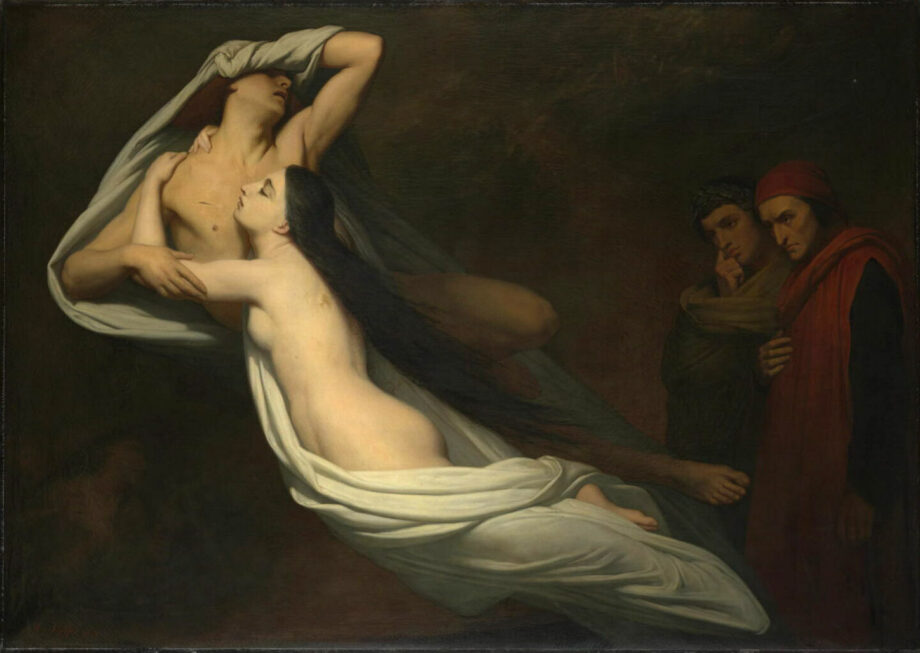
Category: Art of Italy

Dante’s Divine Comedy: The Epic Masterpiece Illustrated

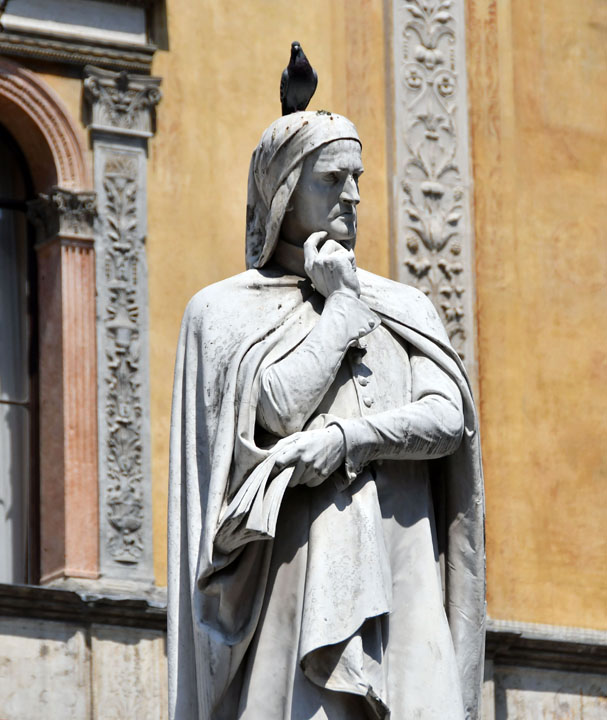
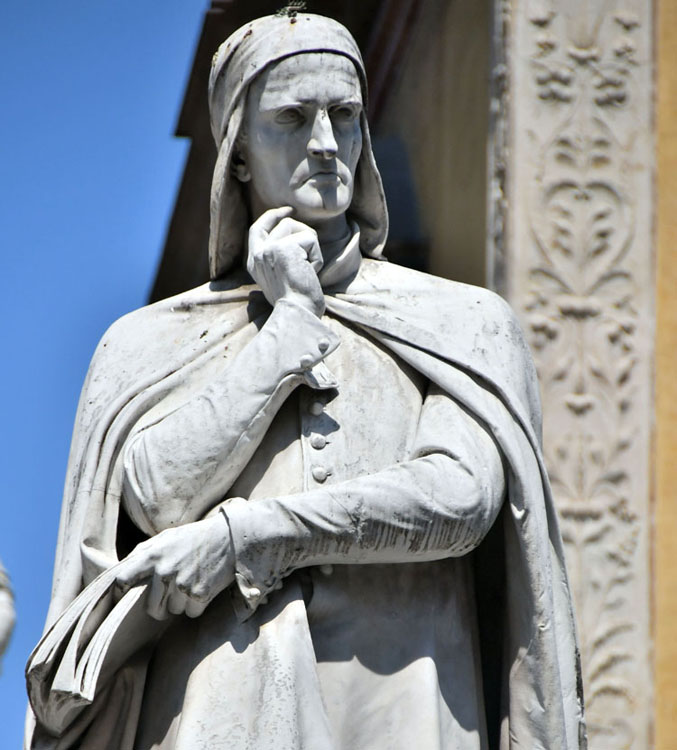
The statue of Dante in Verona, Italy

Written in the early 14th century (between1304-1316), Dante Alighieri’s Divine Comedy is a three-part epic poem that details a visionary journey of a man through the afterlife. It’s a masterpiece of Italian literature that describes the soul’s journey from the circles of Hell to the spheres of Heaven. As a living being Dante travels through the dark realms and encounters monsters, ghosts, and tortures of the dead for their sins. Unlike the dead men stuck in fixed state, Dante can still change his fate traveling across realms with Virgil, his guide. As he moves upwards toward God, Dante encounters Beatrice, angels, and people who died honorably. At the end of his journey, he meets God. These realms is an allegory of the Christian soul’s journey from sin to divine union.

The author made a conscious choice to write this poem in Italian language to make it accessible to common people, as the Latin was the language of the elite and the Church. By picking the language, Dante also makes a point about the soul’s salvation without the Institution.
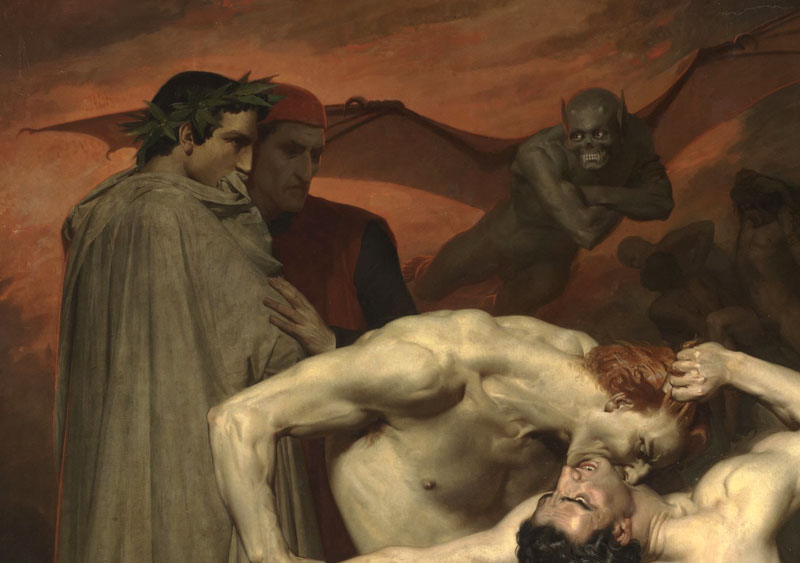
William-Adolphe Bouguereau, Dante and Virgil, oil painting, 1850. It depicts Dante and Virgil in the eighth circle of Hell, observing two damned souls in eternal combat, painting detail

About the poet: Visualizing Dante

Dante Alighieri was born in Florence around 1265 to a family of minor nobility (the Alighieri). The family claimed ancient Roman roots, descending from a branch of the Elisei family. His father, Alighiero II, and grandfather were involved in moneylending. Dante’s mother died when he was a young child. He had a brother (Francesco) and a sister (Tana/Gaetana) from his father’s second marriage. He was baptized in the Baptistery of San Giovanni in Florence, a place that held deep symbolic meaning for him as representative of his beloved city. Dante received early education in grammar, rhetoric, and Latin classics. He studied under the influential Guelph intellectual Brunetto Latini, who introduced him to French culture, philosophy, and civic humanism. This education, combined with the flourishing of vernacular poetry in Tuscany (including the Sicilian School and dolce stil nuovo), shaped his poetic voice. He distinguished himself with poems in praise of Beatrice (his idealized love), later collected and explained in La Vita Nuova.
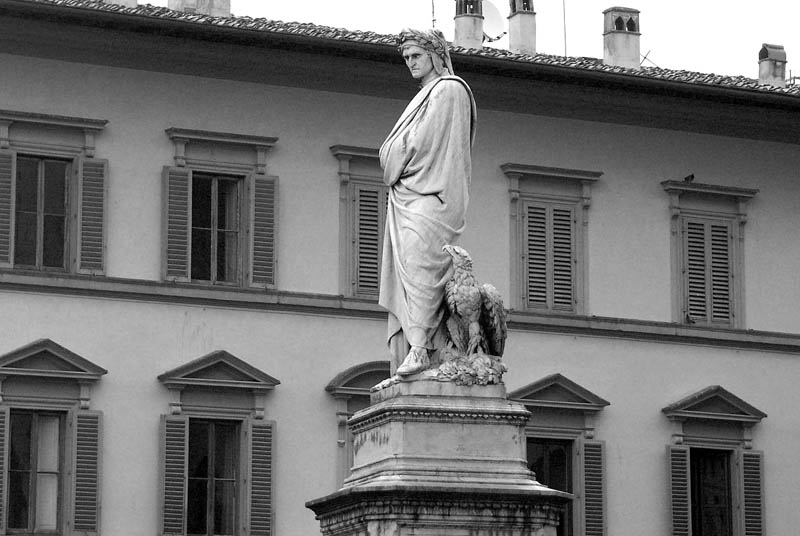
Dante’s statue in Florence, Italy

Dante actively participated in Florence’s turbulent politics during the Guelph-Ghibelline conflicts and the later split between White and Black Guelphs. He fought in the Battle of Campaldino (1289) against the Ghibellines of Arezzo. He enrolled in the Guild of Physicians and Apothecaries to qualify for office under the Ordinances of Justice. He served as a prior (one of the highest offices) in 1300 and acted as ambassador to San Gimignano.

As a White Guelph who opposed Pope Boniface VIII’s interference in Florentine affairs, Dante was sent on an embassy to Rome in late 1301. While he was away, Charles of Valois entered Florence, enabling the Black Guelphs to seize power. In 1302, Dante was accused of corruption, fined, and sentenced to exile. When he did not pay the fine, the sentence was escalated to death. He never returned to Florence.
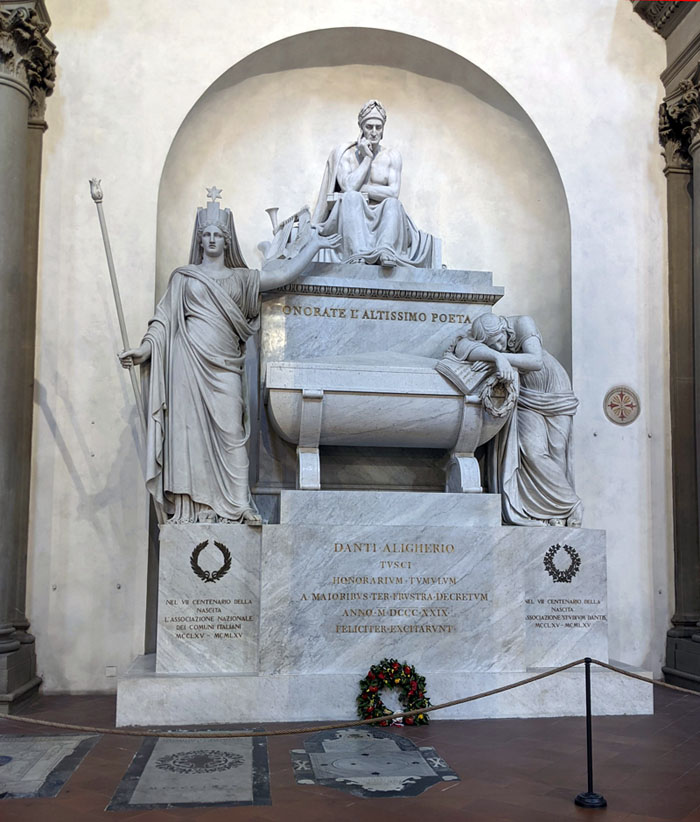
The Tomb of Dante in Florence although he was buried in Ravenna, Italy.

Life in Exile (1302–1321)

Dante initially joined other White Guelph exiles in attempts to regain power militarily, but after their defeat (e.g., at Lastra a Signa in 1304), he distanced himself (“formed a party of one”). He wandered through Italian cities, including: Bologna, Verona, Lucca, Casentino, Sarzana. He placed great hope in Emperor Henry VII’s descent into Italy (around 1310–1313) as a way to restore order and possibly return home, writing political letters and the treatise De Monarchia. After Henry’s death in 1313, those hopes ended. Later, he stayed with Cangrande della Scala in Verona and finally found a peaceful refuge in Ravenna under Guido Novello da Polenta. He completed The Divine Comedy there. Sent as an ambassador to Venice, he contracted malaria on the return journey. Dante died in Ravenna during the night of 13–14 September 1321, shortly after finishing Paradiso. He left behind his masterpiece, The Divine Comedy (which later generations called “Divine”), along with other major works in both vernacular and Latin. His exile profoundly shaped his writing, blending personal loss, political critique, moral vision, and spiritual hope.

Dante Alighieri: Biography Summary is based on the official Museo Casa di Dante page https://www.museocasadidante.it/en/dante-alighieri/biography )
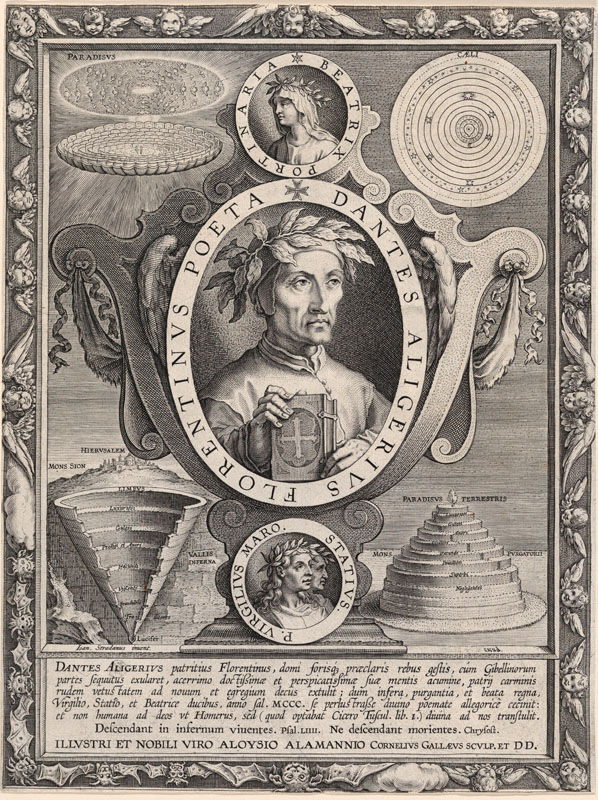
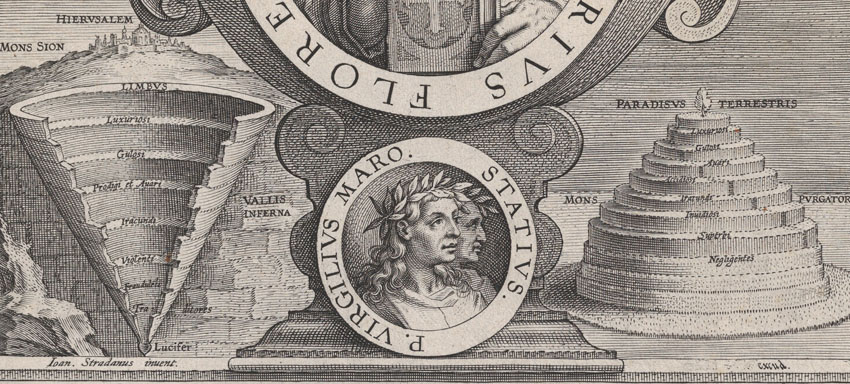
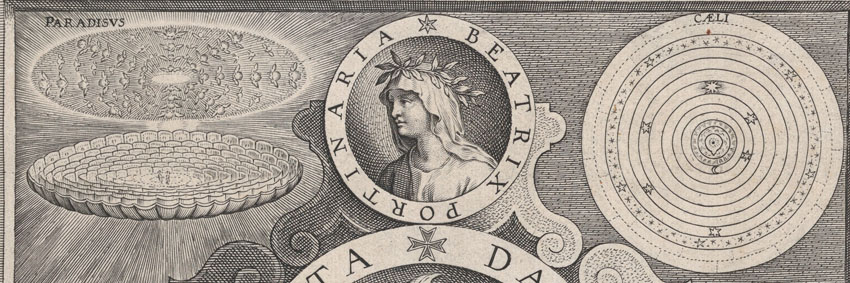
The Met: Portrait of Dante Alighieri, Artist: After Jan van der Straet, called Stradanus (Netherlandish, Bruges 1523–1605 Florence), Publisher: Philips Galle (Netherlandish, Haarlem 1537–1612 Antwerp)
Artist: Cornelis Galle I (Netherlandish, Antwerp 1576–1650 Antwerp), 1595, Engraving, size: 10 5/8 x 7 7/8 in. (27 x 20 cm).
Engraving celebrating Dante. The central roundel includes a large portrait of the poet. A smaller roundel above includes a portrait of Beatrice and a smaller roundel below represents a double portrait of Virgil and Statius. Portraits surrounded by four diagrams in each corner representing Paradise, the Heavens, Jerusalem with Limbo and Hell as well as the Terrestrial Paradise. The inscription at the base of the image boasts of Dante’s Florentine origins and his work and dedicates the image to Luigi Alamanni.

The Divine Comedy: Literary Symbolism

The poem is divided into three sections: Inferno, Purgatorio, and Paradiso. The narrator and protagonist, Dante, begins his journey lost in the dark woods of sin on Good Friday in 1300, possibly representing a mid-life spiritual crisis.

1. Dante Inferno (Hell)
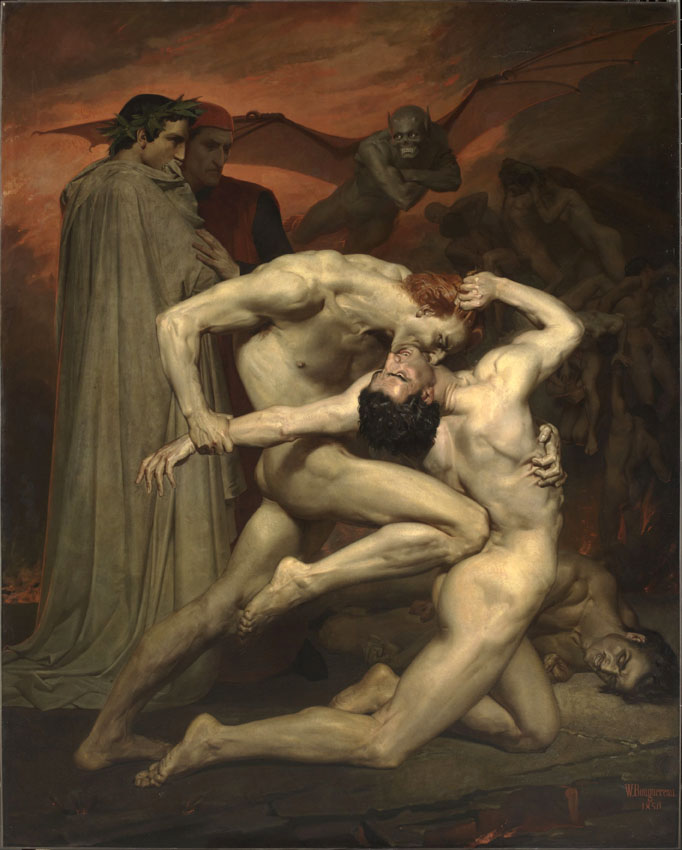
William-Adolphe Bouguereau, Dante and Virgil, oil painting, 1850. It depicts Dante and Virgil in the eighth circle of Hell, observing two damned souls in eternal combat.

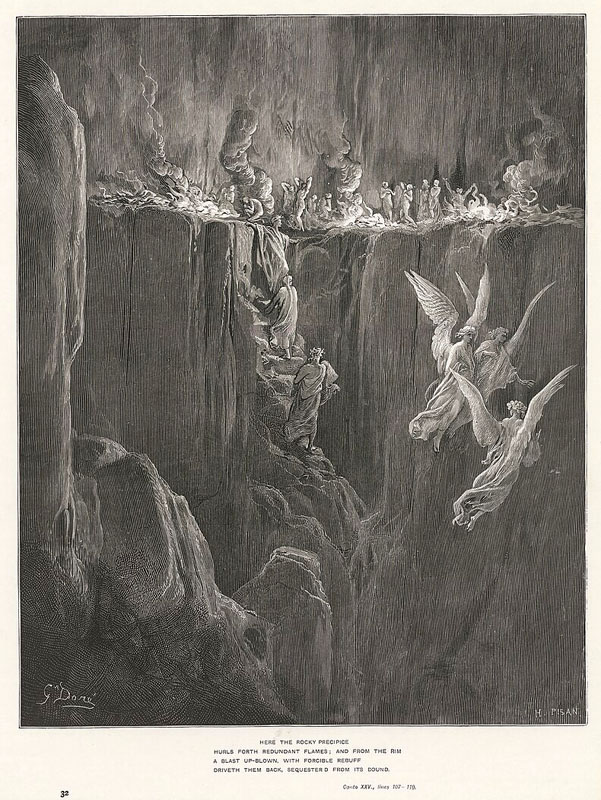
Guided by the Roman poet Virgil, Dante descends through nine concentric circles of suffering. Hell is a descending cone of increasing wickedness toward the center of the Earth. It is divided into 10 levels: the Ante-Inferno and nine circles of hell. After the first six circles, the seventh is divided into three sub-circles or rounds, the eighth into ten pits, and the ninth into four levels- Caina, Antenora, Ptolomea, and Judecca.
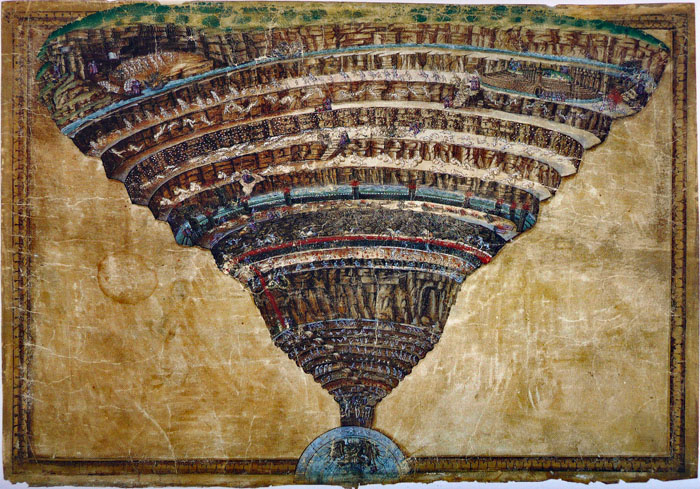
Sandro Botticelli, Inferno map

The structure of Hell is governed by the concept of contrapasso, a system where the punishment of a sinner reflects their sin during their life. Dante describes each circle’s environment with its monsters (the infernal hurricane, the eternal rain, Fortune and her wheel, Styx, the gates and city of Dis, etc.), why people get there, and how they get punished for their sins. Sins are categorized broadly as incontinence (lack of self-control), violence, and fraud/malice. The descent symbolizes moving farther from God.
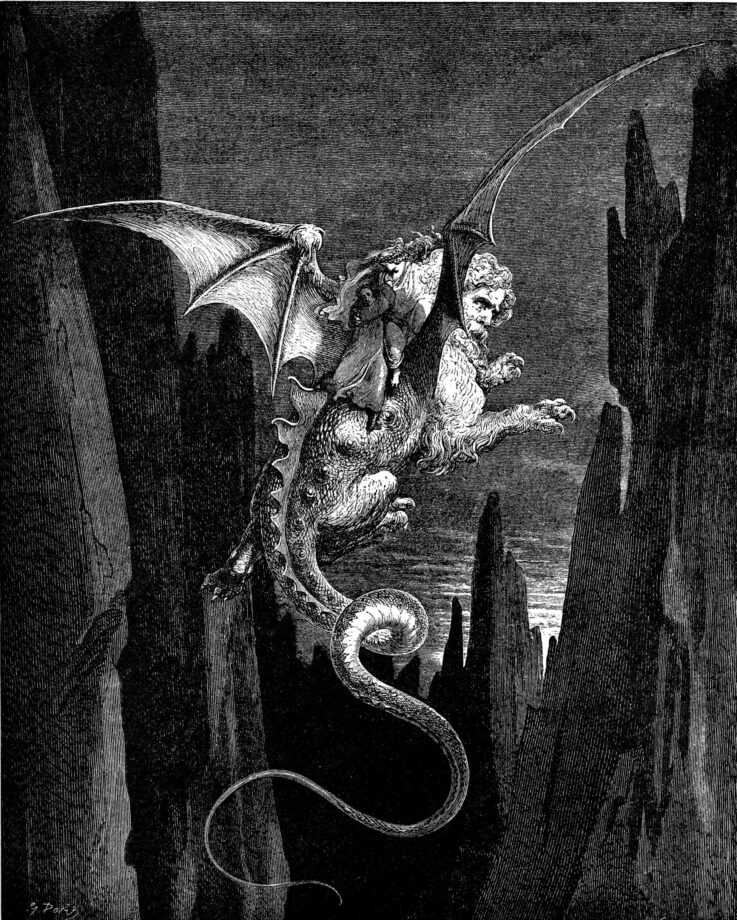
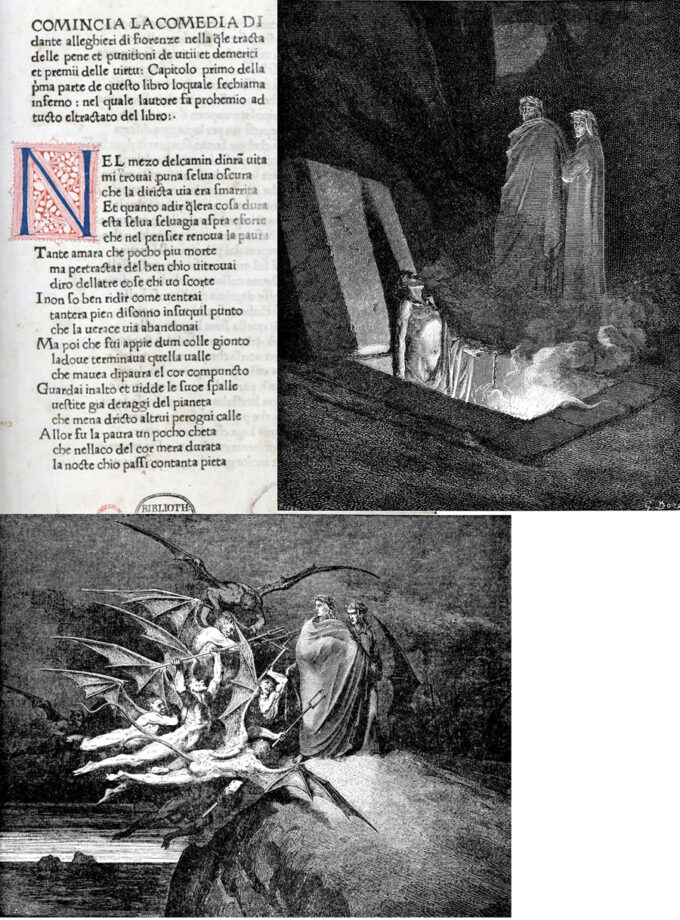
Dore, inferno into Abyss on Geryons Back
  • Upper Hell: Reserved for sins of incontinence (lust, gluttony, greed).
  • Lower Hell: Contains more “human” sins such as heresy, violence, treachery, and fraud.
  • The Bottom: In the frozen lake of Cocytus, Dante finds Satan—a three-faced monster—chewing on the world’s greatest traitors: Judas Iscariot, Brutus, and Cassius.
  • The First Circle⁠—Limbo, or the border land of the unbaptized⁠ people (who got there before the birth of Christ)
Hell Symbolism

  • Ante-Inferno (or Vestibule): The indifferent or neutral souls who took no sides in life (e.g., those who lived without praise or blame).
  • Symbolism: Cowardice and moral neutrality; they chase a banner while being stung by insects, representing their futile, restless existence.
  • Circle 1: Limbo — Virtuous pagans and unbaptized souls (e.g., Homer, Socrates, Aristotle).
  • Symbolism: Lack of Christian revelation or baptism; a place of natural reason and mild longing, without torment but without the beatific vision.
  • Circle 2: Lust — Carnal sinners (e.g., Cleopatra, Helen, Paris).
  • Symbolism: Uncontrolled passion; souls are tossed eternally by stormy winds, mirroring how lust swept them away in life.
  • Circle 3: Gluttony — Gluttons and those excessive in consumption.
  • Symbolism: Self-indulgence; souls lie in vile slush under freezing rain and are torn by Cerberus, reflecting their wallowing in earthly excesses.
  • Circle 4: Greed (Avarice/Prodigality) — Hoarders and wasters.
  • Symbolism: Misuse of material goods; souls push heavy weights against each other in endless conflict, showing the futility of greed.
  • Circle 5: Wrath (and Sullenness) — The wrathful and the sullen.
  • Symbolism: Uncontrolled anger or repressed resentment; wrathful fight in the muddy Styx, while the sullen gurgle beneath it.
  • Circle 6: Heresy — Heretics and those who deny the soul’s immortality.
  • Symbolism: Intellectual/spiritual falsehood; souls are trapped in burning tombs.
  • Circle 7: Violence (divided into three rings) — Against others (tyrants in boiling blood), against self (suicides as twisted trees), and against God/nature/art (blasphemers, sodomites, usurers in a desert of burning sand/flames).
  • Symbolism: Harm to neighbor, self, or divine order.
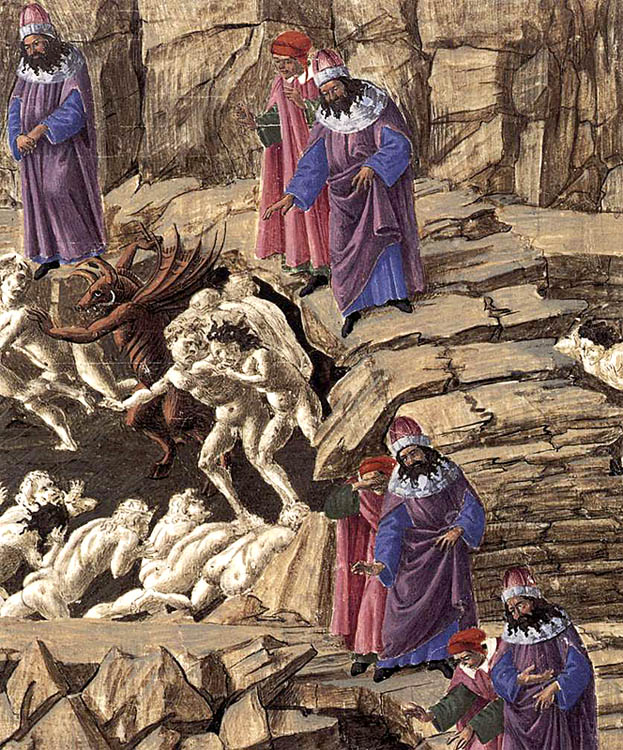
Detail from Sandro Botticelli’s illustrations for Inferno, Canto XVIII, 1480s, silverpoint on parchment, pen and ink
Canto XVII Geryon⁠—The violent against art⁠—Usurers⁠—Descent into the abyss of Malebolge.
“Behold the monster with the pointed tail,
Who cleaves the hills, and breaketh walls and weapons,
Behold him who infecteth all the world.”
Thus unto me my Guide began to say,
And beckoned him that he should come to shore,
Near to the confine of the trodden marble;
And that uncleanly image of deceit
Came up and thrust ashore its head and bust,
But on the border did not drag its tail.
The face was as the face of a just man,
Its semblance outwardly was so benign,
And of a serpent all the trunk beside.
Two paws it had, hairy unto the armpits;
The back, and breast, and both the sides it had
Depicted o’er with nooses and with shields.
With colors more, groundwork or broidery
Never in cloth did Tartars make nor Turks,
Nor were such tissues by Arachne laid.
As sometimes wherries lie upon the shore,
That part are in the water, part on land;"
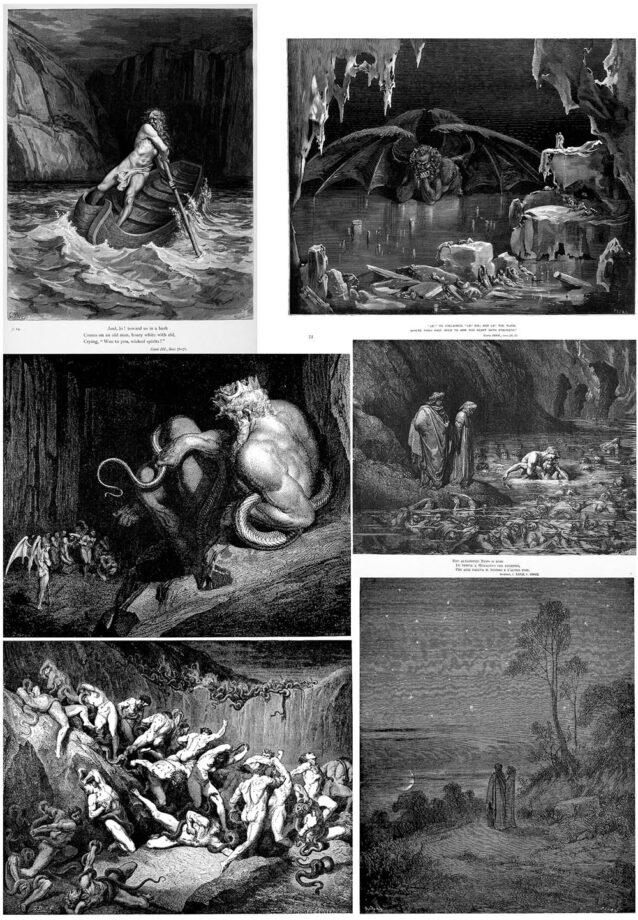
Gustave Doré, illustrations of Dante Alighieri’s Inferno
  • Circle 8: Fraud — 10 bolgias (ditches) for various frauds (e.g., panderers, flatterers, simoniacs, sorcerers, barrators, hypocrites, thieves, false counselors, schismatics, falsifiers).
  • Symbolism: Deception and betrayal of trust; complex, inventive punishments fitting each deceit.
  • Circle 9: Treachery (divided into 4 rounds: Caina, Antenora, Ptolomaea, Judecca) — Traitors to family, country, guests, and lords/benefactors.
  • Symbolism: Ultimate betrayal of trust and love; frozen in ice (Cocytus), with Satan at the center chewing the worst traitors – Judas, Brutus, and Cassius. Represents the coldest, most isolated sin.
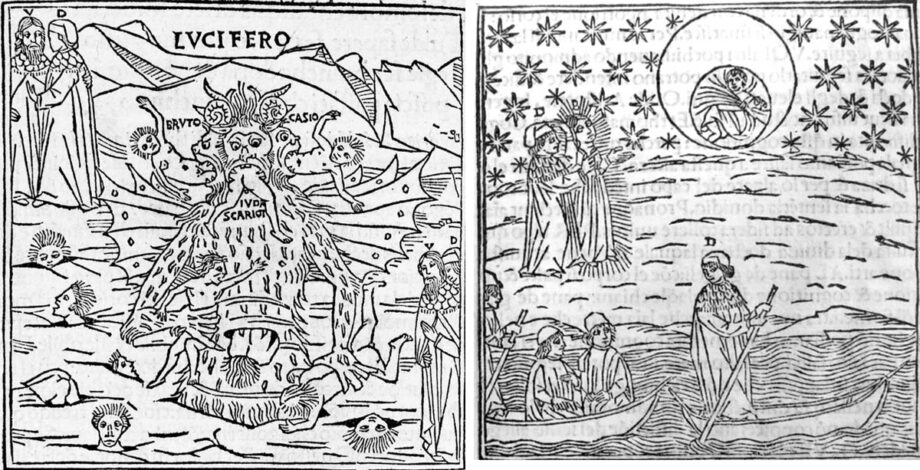
Woodcut in the first fully illustrated print edition, Inferno or Hell with Lucifer & Paradise with Dante & Beatrice by Pietro di Piasi, Venice, 1491
G. Dore, illustrations of Dante’s Inferno
"Underneath each came forth two mighty wings,
Such as befitting were so great a bird;
Sails of the sea I never saw so large.
No feathers had they, but as of a bat
Their fashion was; and he was waving them,
So that three winds proceeded forth therefrom.
Thereby Cocytus wholly was congealed.
With six eyes did he weep, and down three chins
Trickled the tear-drops and the bloody drivel.
At every mouth he with his teeth was crunching
A sinner, in the manner of a brake,
So that he three of them tormented thus.
To him in front the biting was as naught
Unto the clawing, for sometimes the spine
Utterly stripped of all the skin remained.
“That soul up there which has the greatest pain,”
The Master said, “is Judas Iscariot;
With head inside, he plies his legs without.
Of the two others, who head downward are,
The one who hangs from the black jowl is Brutus;
See how he writhes himself, and speaks no word.
And the other, who so stalwart seems, is Cassius.
But night is reascending, and ’tis time
That we depart, for we have seen the whole.”
As seemed him good, I clasped him round the neck,
And he the vantage seized of time and place,
And when the wings were opened wide apart,
He laid fast hold upon the shaggy sides;
From fell to fell descended downward then
Between the thick hair and the frozen crust.
When we were come to where the thigh revolves
Exactly on the thickness of the haunch,
The Guide, with labor and with hard-drawn breath,
Turned round his head where he had had his legs,
And grappled to the hair, as one who mounts,
So that to Hell I thought we were returning.
“Keep fast thy hold, for by such stairs as these,”
The Master said, panting as one fatigued,
“Must we perforce depart from so much evil.”
Then through the opening of a rock he issued,
And down upon the margin seated me;
Then tow’rds me he outstretched his wary step.
I lifted up mine eyes and thought to see
Lucifer in the same way I had left him;
And I beheld him upward hold his legs."
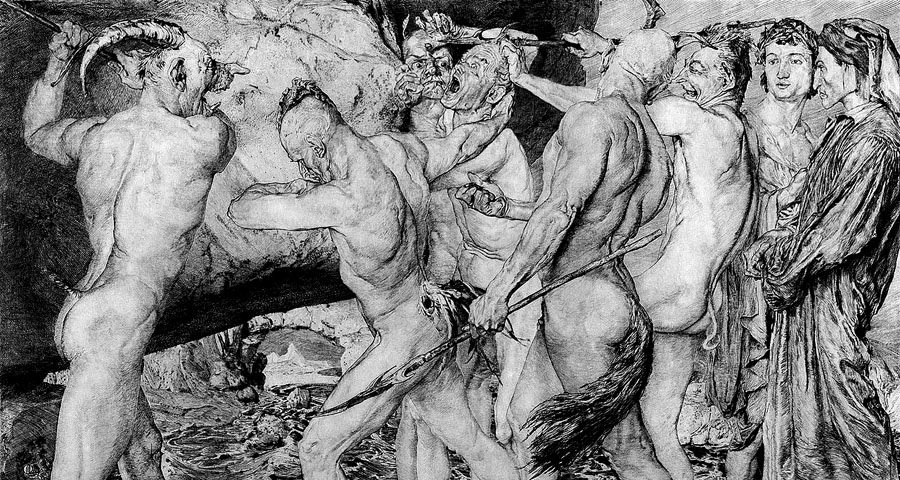
Otto Greiner, Dante and Virgil in Hell

2. Dante Purgatorio (Purgatory): Ante-Purgatory + 7 Terraces + Earthly Paradise
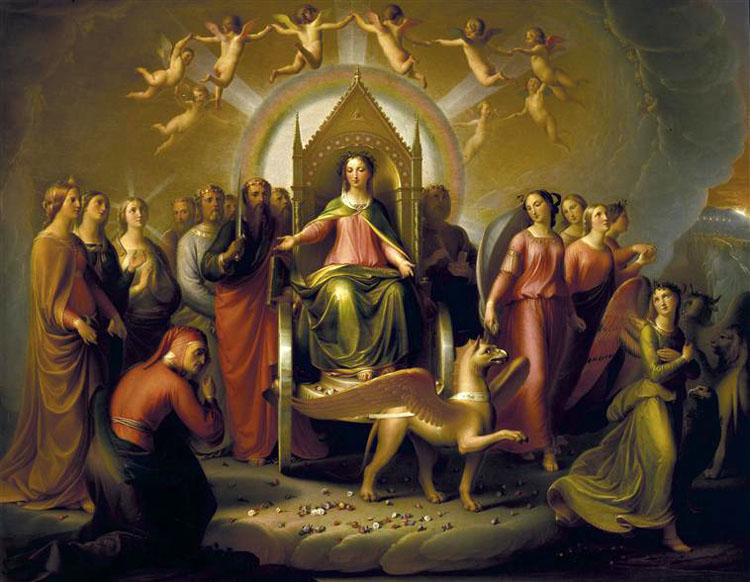
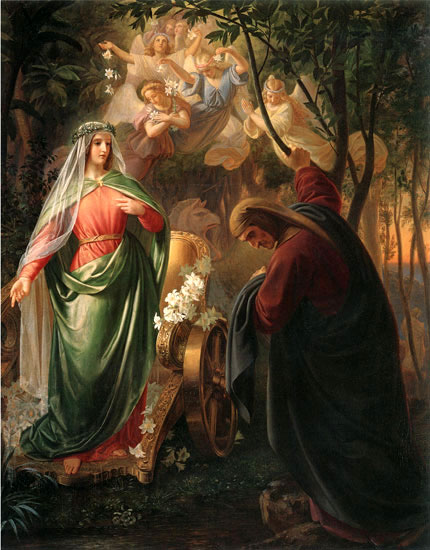
Andrea Pierini , Meeting of Dante and Beatrice in Purgatory, 1853

Dante and Virgil emerge on the shores of Mount Purgatory that they need to climb to reach Heaven. It is divided into three parts: Ante-Purgatory, Purgatory divided into second terraces, and the Earthly Paradise at the top of the mountain. Unlike the eternal punishments of Hell, Purgatory is a place of hope and purification for repentant souls. It’s an ascending mountain that symbolizes hope and moral growth. Here, they undergo penance for the seven deadly sins to cleanse themselves before ascending to Heaven’s realm. At the summit, Virgil—representing human reason—cannot go further and leaves Dante. However, Dante meets Beatrice, who represents divine revelation and guides him through spheres of Paradise.

https://www.ashmolean.org/collections-online#/item/ash-object-877057
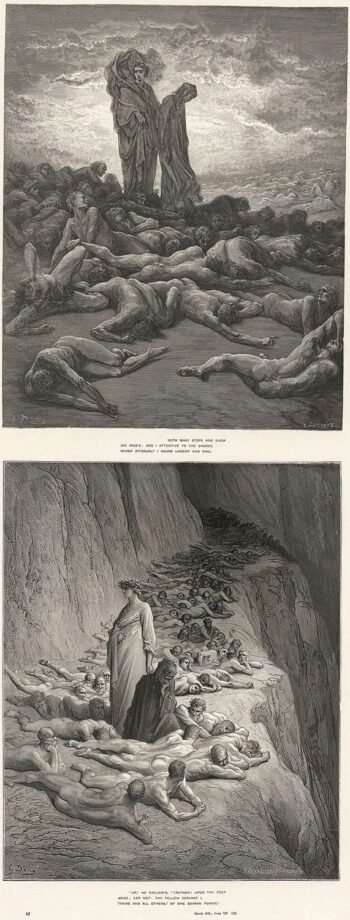
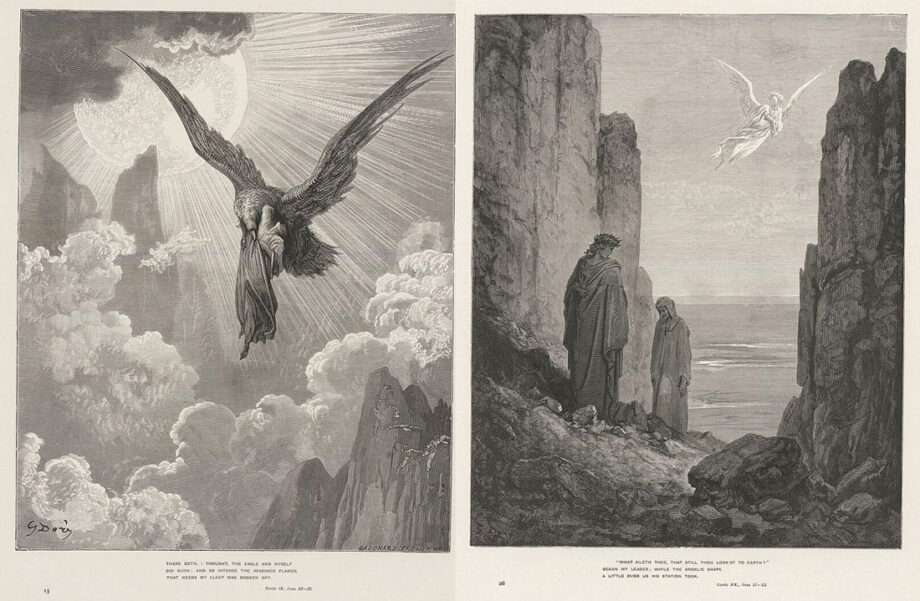
G. Dore, the divine comedy, The vision of Purgatory & Paradise

Purgatory Symbolism

G. Dore, the vision of Purgatory & Paradise, Dante Alighieri Vol1, 1900
  • Ante-Purgatory: Late-repentant souls, excommunicated, and those distracted by worldly cares (e.g., princes). Symbolism: Delayed repentance; souls wait and pray.
  • Terrace 1: Pride — Souls bent under heavy stones. Symbolism: Humbling of the arrogant; carved examples of humility (e.g., Mary) aid correction.
  • Terrace 2: Envy — Souls with sewn-shut eyes, weeping. Symbolism: Blinding oneself to others’ good; examples of generosity.
  • Terrace 3: Wrath — Souls in blinding smoke. Symbolism: Obscuring of reason by anger; examples of meekness.
  • Terrace 4: Sloth (Acedia) — Souls running zealously. Symbolism: Remedy for spiritual laziness; examples of diligence.
  • Terrace 5: Avarice (Greed) — Souls weeping face-down, bound. Symbolism: Attachment to earthly goods; examples of poverty and generosity.
  • Terrace 6: Gluttony — Souls emaciated, tormented by unreachable fruit and water. Symbolism: Temperance through hunger; examples of moderation.
  • Terrace 7: Lust — Souls in purifying flames. Symbolism: Burning away disordered love; examples of chastity.
  • Earthly Paradise (Garden of Eden): At the summit. Symbolism: Restored innocence and original state before the Fall; Dante undergoes final purification (Lethe and Eunoe rivers) and meets Beatrice. It bridges Purgatory and Heaven.
G. Dore, The vision of Purgatory & Paradise, Dante Alighieri

3. Dante Paradiso (Paradise)

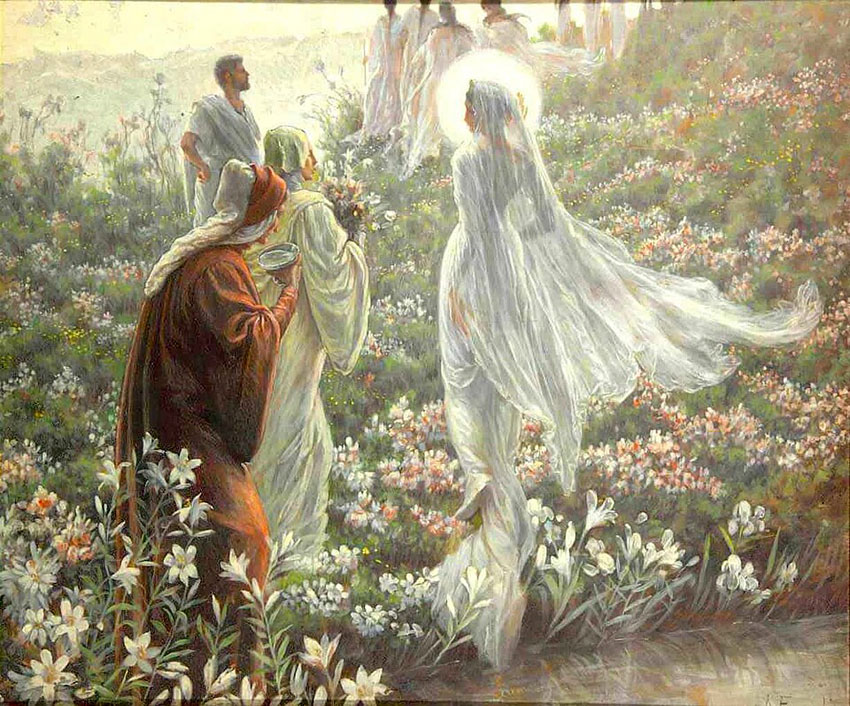
Ruggero Focardi, Dante & Beatrice in Paradise, painting

In the third part of the Divine Comedy, Paradiso, Dante travels through nine celestial spheres, which are based on the Ptolemaic (earth-centered) model of the universe, each associated with a different virtue and planetary body (like the Moon, Mars, Mercury). Heaven represents the soul’s ascent toward God through increasing light, love, and understanding. Souls appear in different spheres according to their capacity, but all enjoy the beauty of paradise.

The journey culminates in a tenth, non-physical realm, in the Empyrean, where Dante experiences a fleeting, transcendent vision of God as three blinding circles of light, signifying the Holy Trinity. Beatrice replaces Virgil in this realm. Beatrice appears before Dante and Virgil. Unlike the Inferno, where souls are trapped in specific circles due to their sins, the souls in Paradiso all reside in the presence of God but appear to Dante in different spheres to help him understand their varying degrees of bliss.
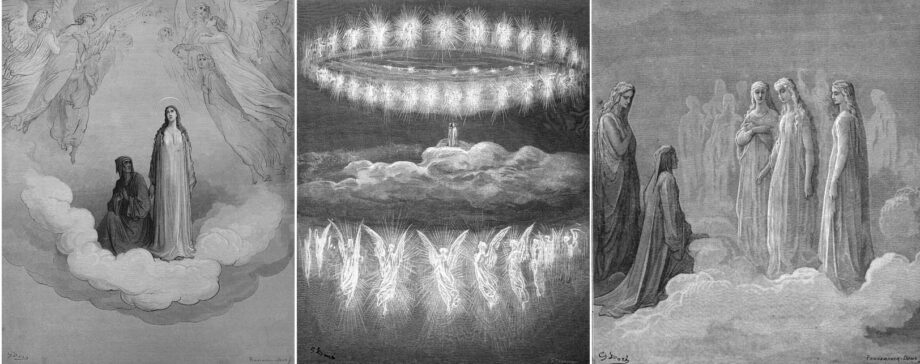
Dante’s Paradise by Gustave Dore

Heaven Symbolism:

  • Sphere 1: Moon — Inconstant souls (e.g., those who broke vows). Symbolism: Inconstancy and imperfection; Those who were virtuous but failed to keep their sacred vows (often due to outside pressure). The Moon’s changing phases and faint light represent their lack of steadfastness.
  • Sphere 2: Mercury — Ambitious souls who sought fame/honor. Symbolism: Active but somewhat self-interested virtue. Those who performed great and virtuous deeds primarily to gain earthly fame and honor. Mercury is small and often hidden by the sun’s rays, much like their personal glory is now absorbed into God’s.
  • Sphere 3: Venus — Loving souls (lovers, those with excessive but redeemed affection). Those whose virtue was fueled by love, though it was sometimes misdirected toward earthly passion before being purified. Symbolism: Human love as a reflection of divine love. Venus is the planet of love, now transformed into divine affection.
  • Sphere 4: Sun — Wise souls, philosophers, scholars, and theologians (e.g., Thomas Aquinas, king Solomon). Symbolism: Intellectual light and prudence/wisdom. The Sun represents the light of intellectual and spiritual wisdom.
  • Sphere 5: Mars — Warriors, crusaders, and martyrs who fought for faith. Symbolism: Fortitude and courage in defense of the good. The planet appears red, and the souls form a giant, glowing cross.
  • Sphere 6: Jupiter — Leaders who administered justice with wisdom (e.g., King David and Constantine). Souls of justice. Symbolism: Justice and righteous governance (eagle formation). The souls arrange themselves to form the shape of a giant eagle, the symbol of Roman imperial justice.
  • Sphere 7: Saturn — Contemplative souls and mystics. Monks and hermits who dedicated their lives to prayer and meditation (e.g., Saint Benedict). Symbolism: Temperance and divine contemplation. A golden ladder reaches upward, symbolizing the soul’s ascent through contemplation.
  • Sphere 8: Fixed Stars — The Triumphant Church. The Apostles and the Virgin Mary. Here, Dante is examined on the three theological virtues: Faith, Hope, and Love.. Symbolism: Theological virtues and the Church triumphant. A realm of pure light and celestial song representing the victory of Christ.
  • Sphere 9: Primum Mobile — This is the physical boundary of the universe. It moves all other spheres and is moved directly by God.. Symbolism: The swiftest sphere imparting movement to the cosmos; angelic hierarchies. Dante sees nine rings of fire whirling around a point of intense light, representing the nine hierarchies of angels.
  • Empyrean: The highest heaven, outside space and time; the abode of God or the “True Home” of God, the angels, and all the redeemed. Symbolism: Direct presence of God (the “love that moves the sun and other stars”); the rose of the blessed. Dante experiences the Beatific Vision here: The souls form a massive White Rose. The poem ends with Dante’s direct vision of the Holy Trinity as three distinct circles of light.
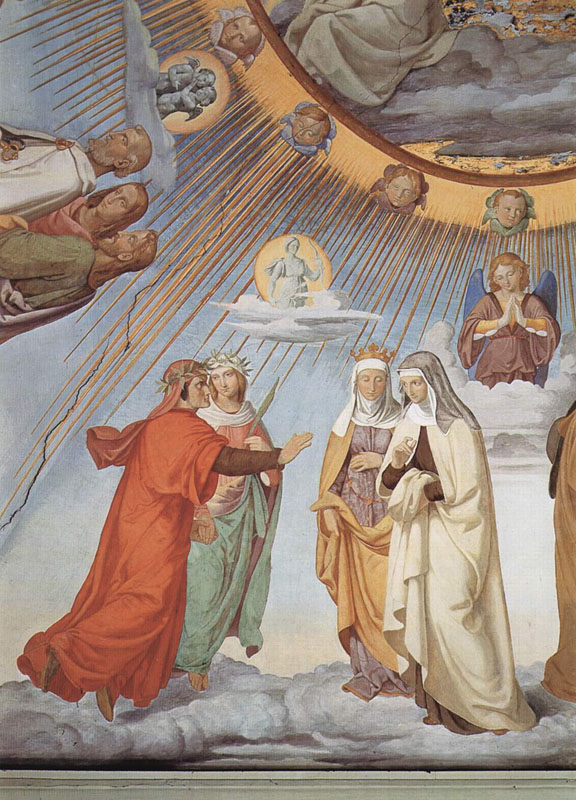
Philipp Veit, Paradiso, Canto III Dante and Beatrice speak to Piccarda and Constance of Sicily, fresco
"Within the deep and luminous subsistence
Of the High Light appeared to me three circles,
Of threefold color and of one dimension,
And by the second seemed the first reflected
As Iris is by Iris, and the third
Seemed fire that equally from both is breathed.
O how all speech is feeble and falls short
Of my conceit, and this to what I saw
Is such, ’tis not enough to call it little!
O Light Eterne, sole in thyself that dwellest,
Sole knowest thyself, and, known unto thyself
And knowing, lovest and smilest on thyself!
That circulation, which being thus conceived
Appeared in thee as a reflected light,
When somewhat contemplated by mine eyes,
Within itself, of its own very color
Seemed to me painted with our effigy,
Wherefore my sight was all absorbed therein.
As the geometrician, who endeavors
To square the circle, and discovers not,
By taking thought, the principle he wants,
Even such was I at that new apparition;
I wished to see how the image to the circle
Conformed itself, and how it there finds place;
But my own wings were not enough for this,
Had it not been that then my mind there smote
A flash of lightning, wherein came its wish.
Here vigor failed the lofty fantasy:
But now was turning my desire and will,
Even as a wheel that equally is moved,
The Love which moves the sun and the other stars."

Art Illustrating the Spheres of the Divine Comedy
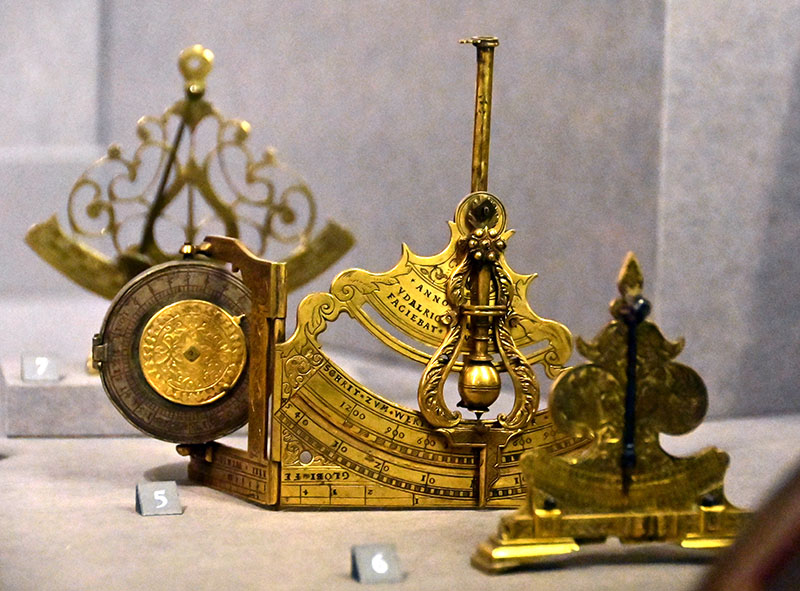
The structure of Dante’s Heaven is deeply tied to medieval astronomy and theology. The Museo Galileo (Florence): This museum holds astronomical instruments from Dante’s era, helping visitors visualize how the Ptolemaic spheres were understood as physical realities in the 1300s. https://www.museogalileo.it/en/galileo.html .

The British Library holds the Yates Thompson 36 manuscript, which contains 110 miniatures by Giovanni di Paolo (c. 1444). These are considered some of the finest depictions of the Paradiso ever created. https://searcharchives.bl.uk/catalog/040-002354967 https://www.facsimilefinder.com/facsimiles/divine-comedy-yates-thompson-manuscript-facsimile
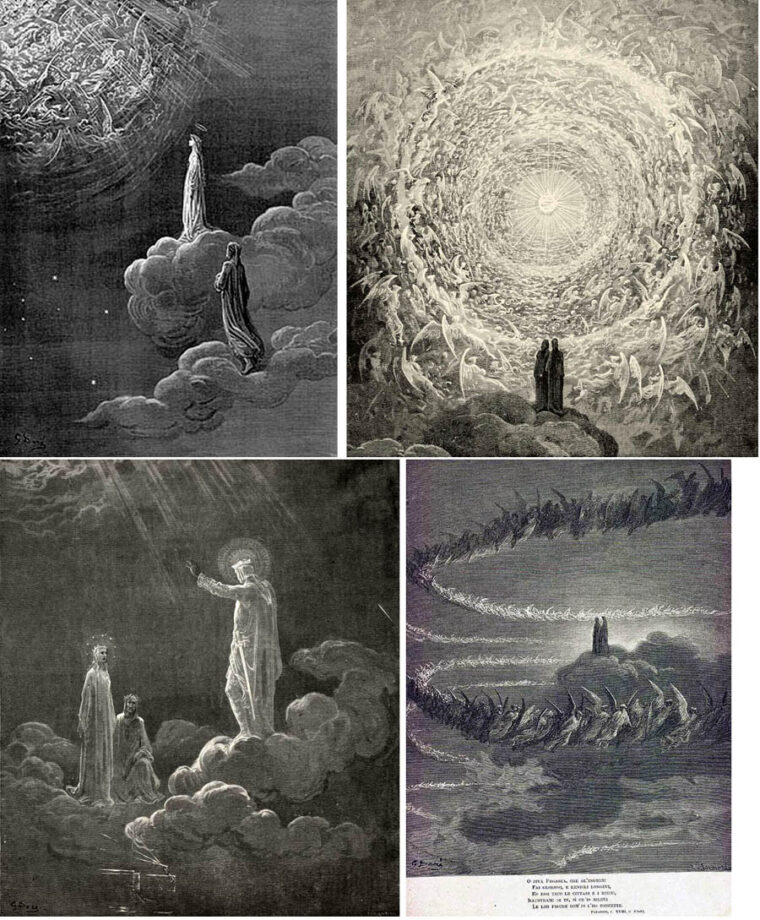
G. Dore-Dante, Mars, Paradise Canto31, the celestial rose Dante and Beatrice gaze upon the highest Heaven, The Empyrean

Gustave Doré, The Celestial Rose: A famous engraving showing the Empyrean as a vast, light-filled amphitheater of souls. https://commons.wikimedia.org/wiki/File:Paradiso_Canto_31.jpg and Sandro Botticelli, The Nine Skies of Paradise: Sketches that emphasize the circular, harmonious nature of Heaven compared to the jagged depths of his Inferno maps. https://en.wikipedia.org/wiki/Divine_Comedy_Illustrated_by_Botticelli

https://www.ashmolean.org/collections-online#/item/ash-object-877080
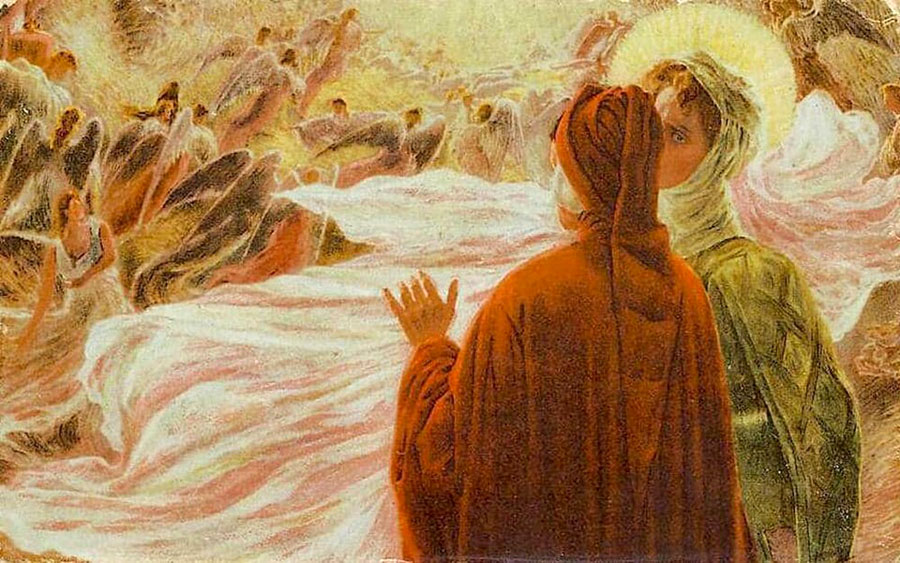
Ruggero Focardi, Dante and Beatrice, nel X Cielo
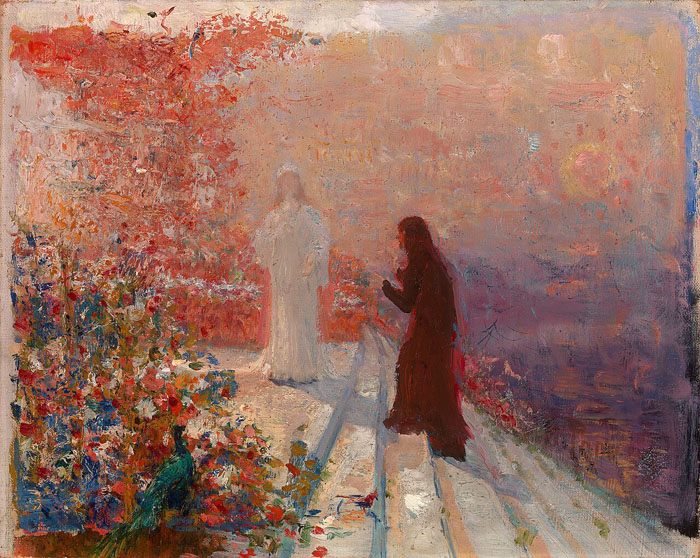
Ilya Repin, this is a color sketch/study titled, the Meeting of Dante and Beatrice

Visualizing the Divine Comedy in Art

The Divine Comedy has inspired centuries of visual art, with major collections held in institutions like the Vatican, the British Museum, and the Louvre.
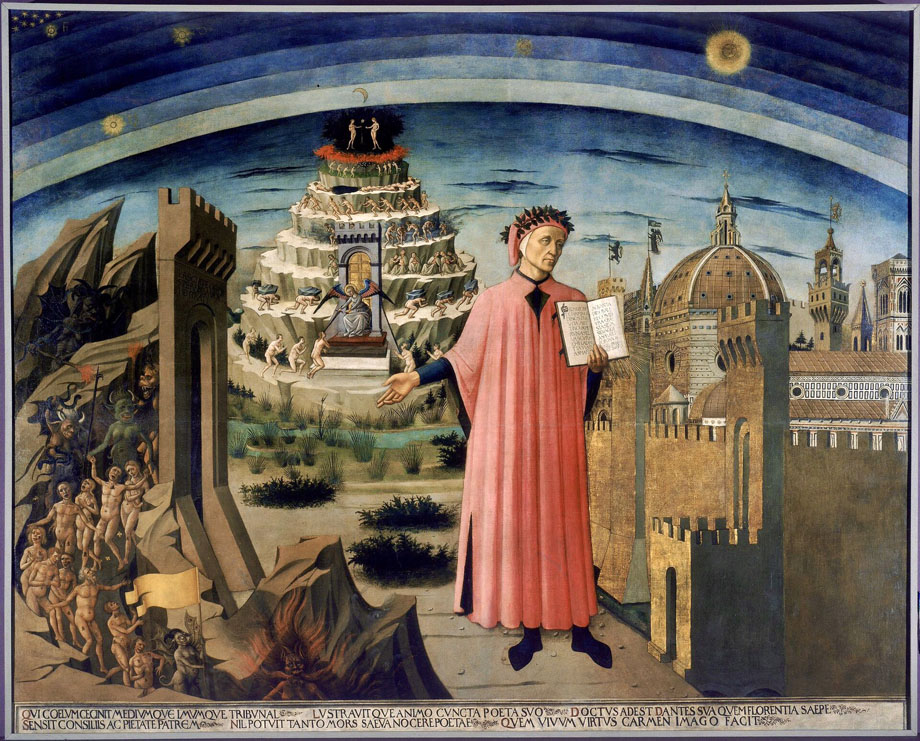
Dante and His Poem by Domenico di Michelino

Renaissance Era:

  • Sandro Botticelli (mid-1480s–mid-1490s): A series of full-page drawings (mostly silverpoint on parchment, a few colored) illustrating nearly every canto. Commissioned for a lavish manuscript by the Medici; considered masterpieces of Renaissance draftsmanship. Includes the famous Map of Hell (a detailed conical diagram of Inferno). Many are housed in the Kupferstichkabinett, Berlin, and the Vatican. https://en.wikipedia.org/wiki/Divine_Comedy_Illustrated_by_Botticelli
  • Domenico di Michelino (1465): La Divina Commedia di Dante — A large fresco in Florence Cathedral showing Dante standing outside the city with the three realms of the afterlife depicted around him (Hell, Purgatory mountain, and celestial spheres). https://duomo.firenze.it/en/discover/cathedral/9143/domenico-di-michelino-dante-firenze-e-la-divina-commedia
  • Luca Signorelli, The Damned Cast into Hell (1499–1504): Located in the Orvieto Cathedral, these frescoes were heavily influenced by Dante’s descriptions of physical suffering and the psychological weight of sin.
  • Giovanni di Paolo, Paradiso Illuminations (1440s): For a stark contrast to the darkness of the Inferno, these 15th-century manuscript illuminations (now held at the British Library) use ethereal blues and golds to depict Dante and Beatrice moving through the celestial spheres.
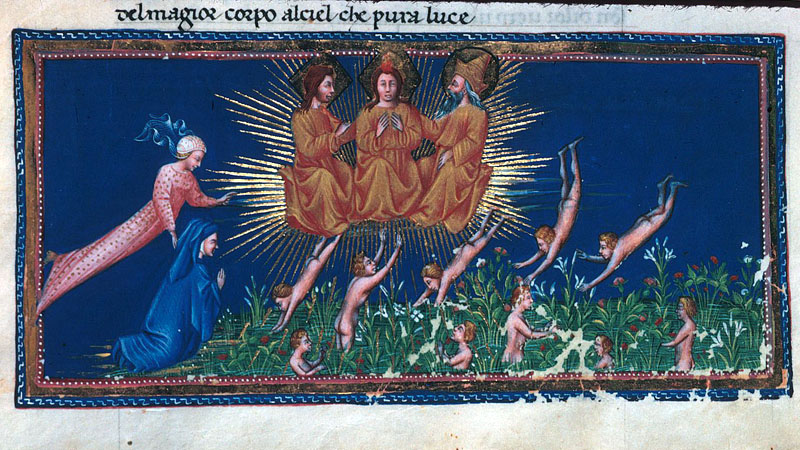
Dante & Beatrice kneeling before the Holy Trinity by Giovanni di Paolo, 1398-1482

18th–19th Century Romantics:

Dante and Beatrice, by Osterely
  • William Blake (1824–1827): 102 watercolor drawings and sketches (with 7 engravings completed). Blake created these in his final years, blending his mystical style with Dante’s visions. Notable examples include The Circle of the Lustful: Paolo and Francesca and scenes of thieves attacked by serpents. Housed in collections like the Tate and others.
  • Gustave Doré (1861–1868): over 100 dramatic, black-and-white engravings, the most extensive and widely reproduced series that are my favorite besides the painting by Bouguereau. Dore illustrated every canto with the dark, atmospheric Inferno plates (e.g., Satan in the ice of Cocytus, Paolo and Francesca in the storm), and lighter Purgatorio and Paradiso.
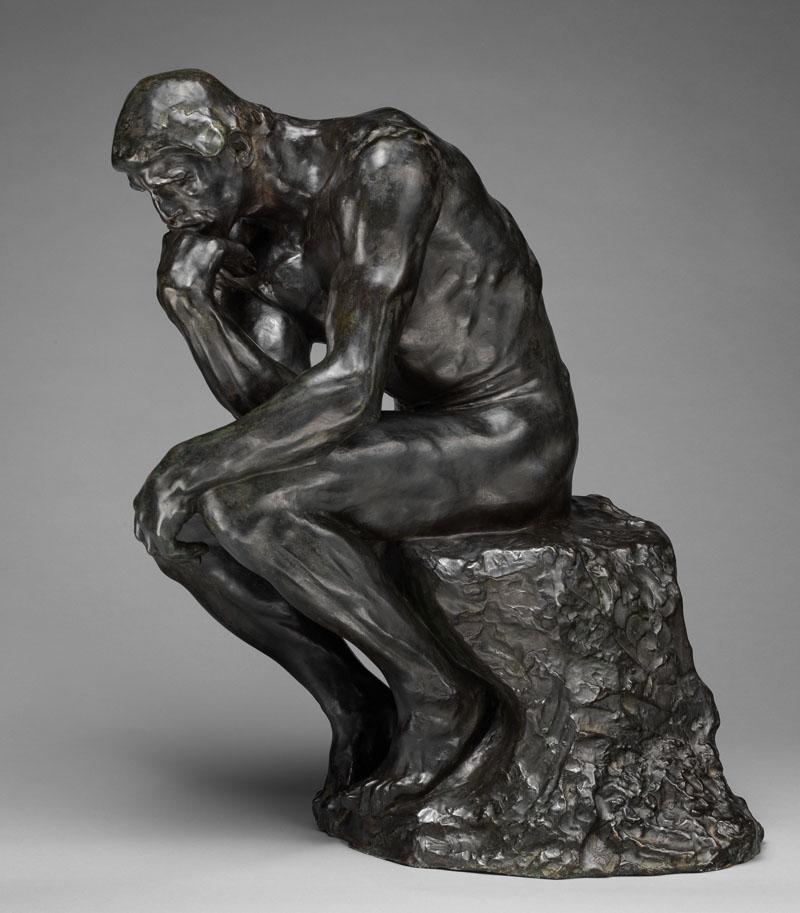
  • Auguste Rodin, The Gates of Hell. A massive bronze sculptural group (over 6 meters tall) featuring figures like The Thinker (Dante) and The Kiss. Housed at the Rodin Museum.
  • Eugène Delacroix, The Barque of Dante (1822): This painting, currently in the Louvre Museum, depicts Dante and Virgil crossing the river Styx while the damned souls cling to their boat. It is a landmark of the Romantic movement, emphasizing movement and raw emotion.
  • Ary Scheffer, Dante and Beatrice (1851): While many artists focused on the horrors of Hell, Scheffer’s work (found in the Museum of Fine Arts, Boston) captures the more spiritual and serene relationship between the poet and his muse in the higher realms.
  • Pre-Raphaelites: Dante Rossetti painted several images on the theme.
  • Raffaele Giannetti (1837–1915), First meeting of Dante and Beatrice, 1877 https://commons.wikimedia.org/wiki/File:Raffaele_Giannetti_-_First_meeting_of_Dante_and_Beatrice.jpg
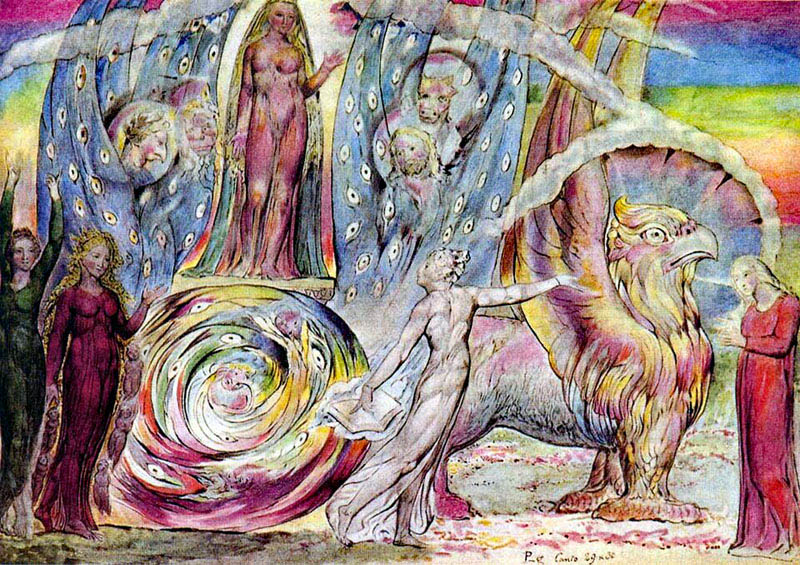
Beatrice Addressing Dante by William Blake
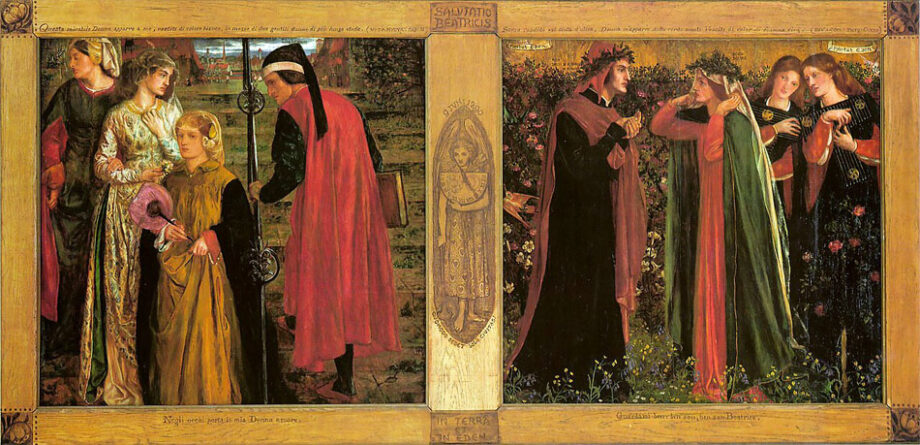
Dante Gabriel Rossetti, Salutation of Beatrice, painting
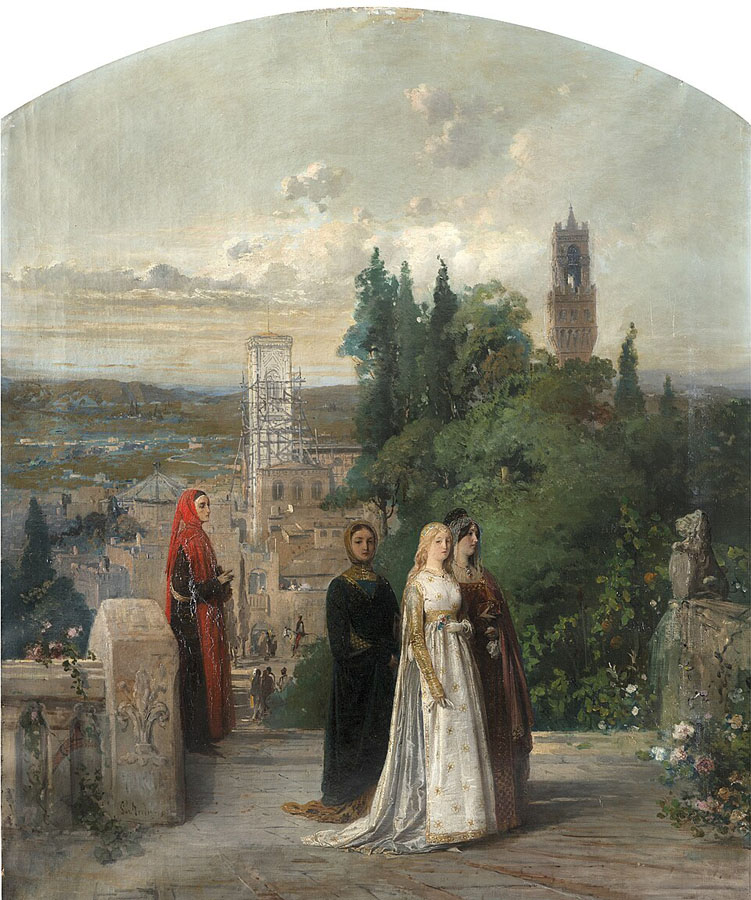
Raffaele Giannetti, Dante and Beatrice, oil painting, https://commons.wikimedia.org/wiki/File:Raffaele_Giannetti_-_Dante_e_Beatrice.jpg

More Art

  • John Flaxman (early 19th century): Neoclassical line drawings/engravings for a popular edition, influential for their simplicity and clarity. See every page here: https://archive.org/details/McGillLibrary-rbsc_la-divina-comedia_dante_folioPQ4329F551802-20446/page/18/mode/2up
  • Bartolomeo Pinelli (early 19th century): 145 prints offering a detailed, dramatic interpretation.
  • Stradanus (Jan van der Straet) (1587–1588): Sepia-toned prints of scenes from the poem.
  • William Dyce, Dante And Beatrice, oil painting
  • Eyre Crowe, The meeting of Dante and Beatrice (La Vita Nuova), oil painting
  • Ruggero Focardi, Dante e Beatrice nel Paradiso Terrestre, oil painting
  • Odilon Redon, Dante et Béatrice, watercolor, Uehara Museum of Art
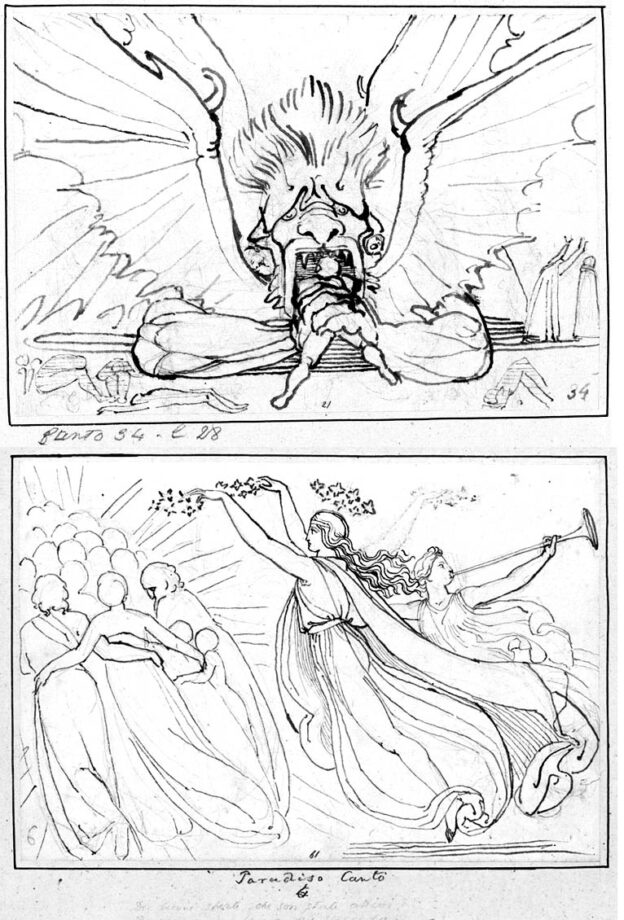
Sketches for Dante’s divine comedy by John Flaxman in NGA

20th Century:

  • Salvador Dalí (1951–1963): 100 watercolor illustrations (later turned into prints/wood engravings). A surrealist take commissioned to mark the 700th anniversary of Dante’s birth. Covers all three realms with Dalí’s dreamlike style.
  • Bellagio, Lake Como – statue of Dante and Beatrice

Many other artists have created individual paintings or smaller series.
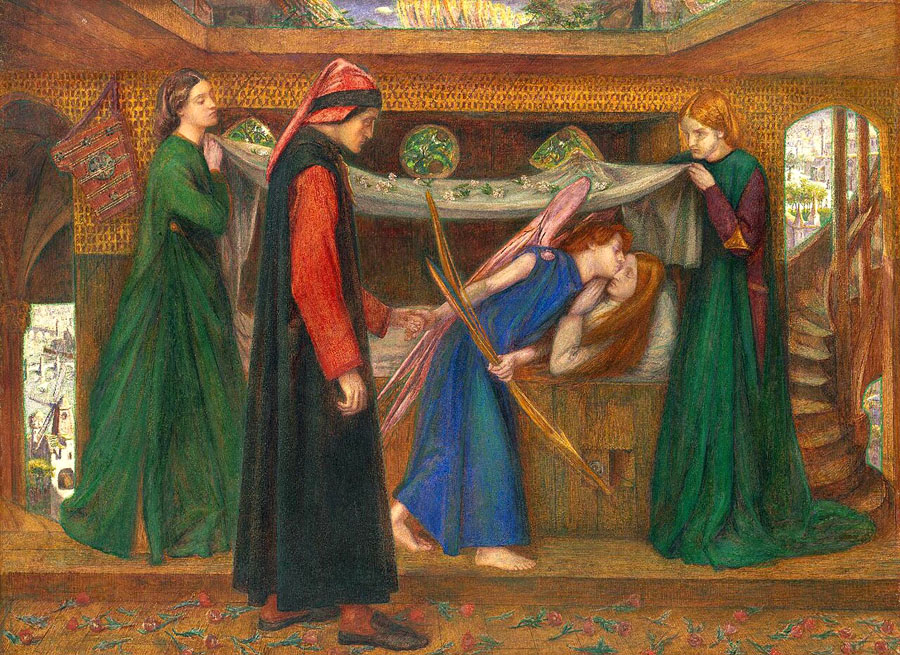
Dante Gabriel Rossetti, Dante’s Dream at the time of the death of Beatrice, 1856

Museums and Historical Collections:

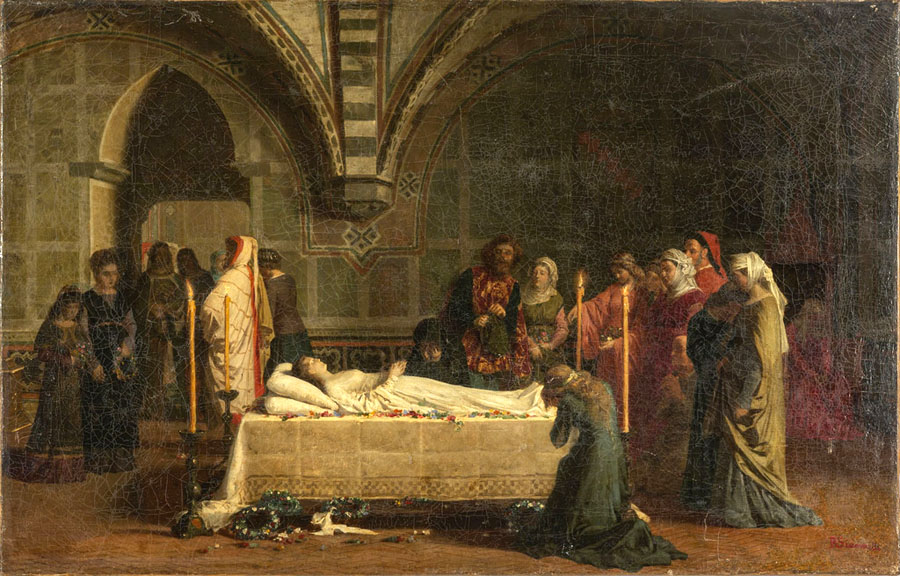
Gerolamo Induno, Beatrice, oil painting

If you want to see the “historic accounts” in person, these institutions hold the primary evidence:

  • The Dante House Museum (Museo Casa di Dante), Florence: Located in what is believed to be the district where he lived, this museum houses documents regarding his political life and the legal papers of his exile. https://www.museocasadidante.it/en/
  • The Laurentian Library, Florence: Contains some of the earliest and most beautiful manuscripts of the poem, showing how the “story” was physically distributed before the printing press.
  • The Classense Library, Ravenna: This city is where Dante finished the Paradiso and where he is buried. They hold significant historical records of his final years and his interactions with the local nobility that allowed him to finish his masterpiece.
  • Free ebook: https://standardebooks.org/ebooks/dante-alighieri/the-divine-comedy/henry-wadsworth-longfellow
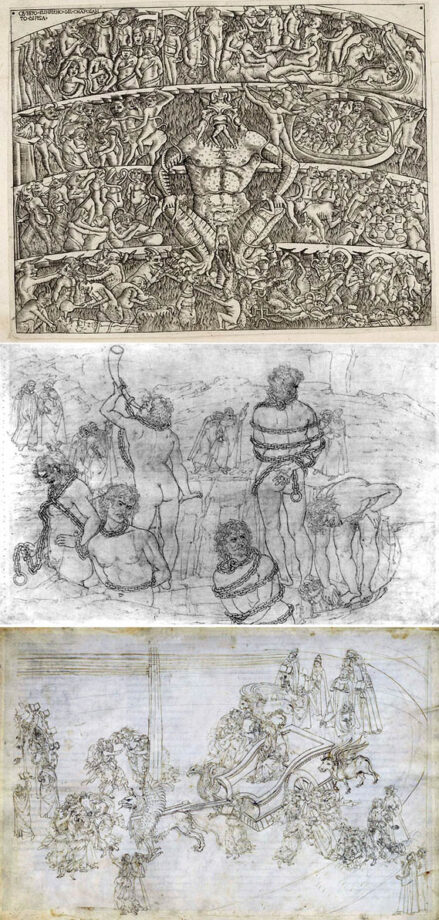
Dante’s Inferno and Purgatorio by Sandro Botticelli, 1481
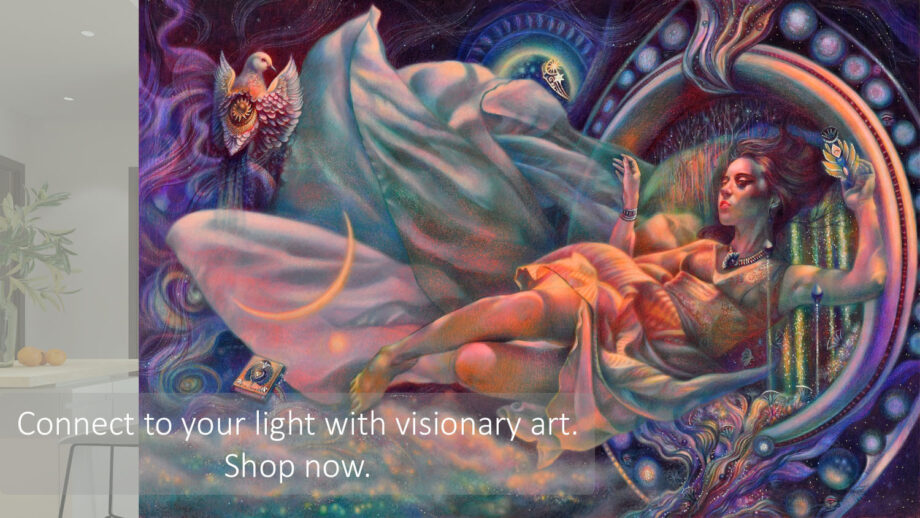
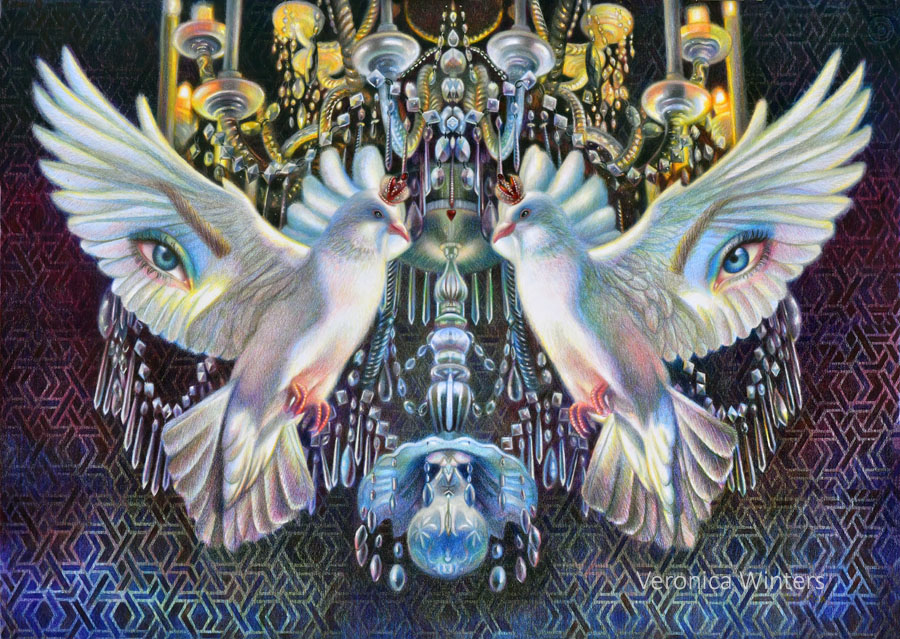
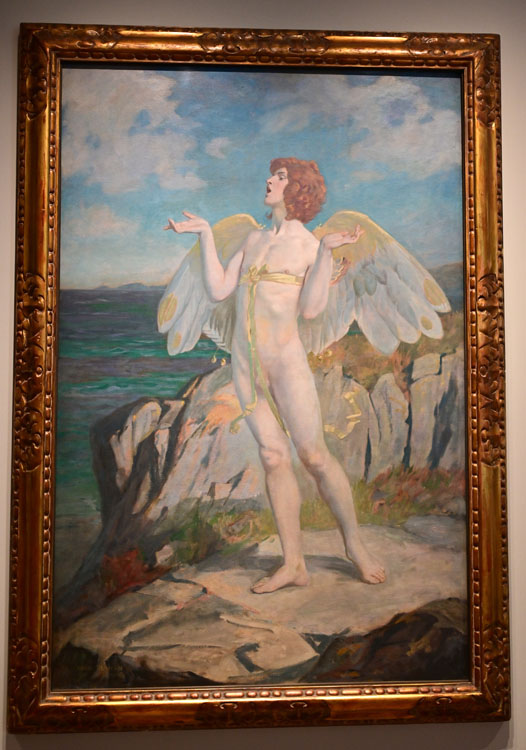
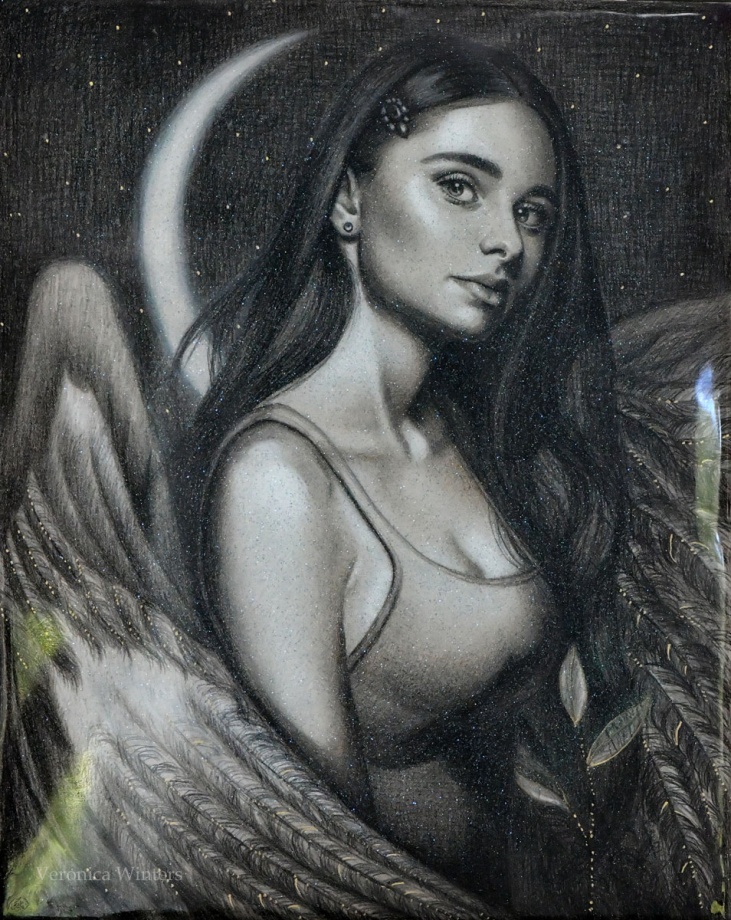
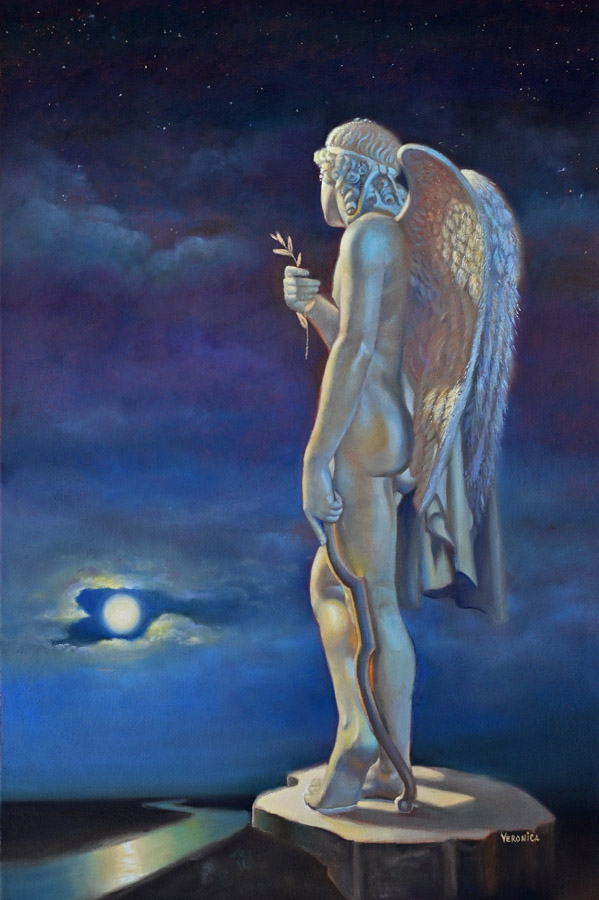
The Moon Realm:Cupid, 24x36in, oil on canvas, Veronica Winters https://veronicasart.com/product-category/veronica-winters-visionary-art-for-sale/

The Divine Comedy: Dante

Dante, statue in Verona, Italy

In the Divine Comedy, Dante is both the author and the protagonist. This dual identity creates a unique narrative where the character experiencing the journey is also the poet reflecting on it years later.
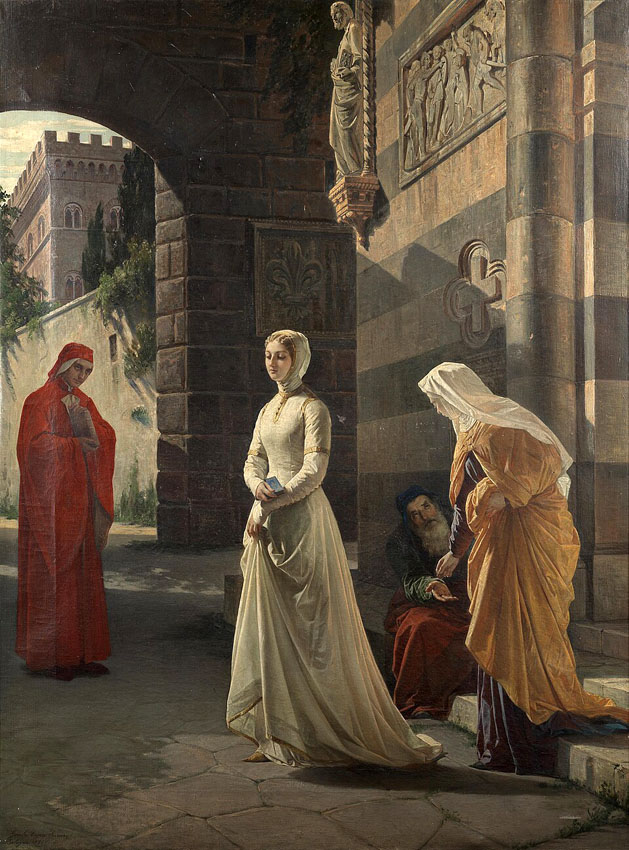
Giulio Cesare Ferrari, La Beatrice di Dante, oil painting

1. The Protagonist

At the start of the poem, Dante presents himself as a lost soul. He is not a hero of mythic proportions but an ordinary man who has gone astray. The poem begins in the middle of things. Dante doesn’t enter the afterlife through a traditional “gate of death.” Instead, he wakes up in a “Dark Wood”, having lost the “straight path” of righteousness.

  • The Mid-life Crisis: He begins the poem with the famous line, “Midway upon the journey of our life,” placing him at age 35 (based on the biblical lifespan of 70).
  • The Pilgrim: Throughout the journey, he is referred to as “The Pilgrim.” He reacts to the afterlife with very human emotions: he faints from pity in Hell, trembles in fear, and feels immense joy in Paradise.
  • The Learner: His character arc is one of spiritual education. At first, he is often too sympathetic toward sinners, and Virgil must scold him, teaching him that divine justice is perfect and that he must align his will with God’s.

How the Souls Know He is Alive

The fact that Dante is a living man in a realm of spirits creates several dramatic moments throughout the poem:

  • The Shadow: In Purgatorio, the souls are shocked because Dante casts a shadow. Since the spirits are made of “aerial bodies,” the sun passes right through them, but Dante’s physical body blocks the light.
  • The Weight: When Dante climbs into Charon’s boat to cross the river Acheron, or when he is carried by the giant Antaeus, the poem notes that the vessels or arms sink under his weight. The spirits, being weightless, don’t move things the way he does.
  • His Breath: Souls in the Inferno notice he is breathing, which is a sign of life that immediately draws their attention (and often their envy or anger).

2. The Political Exile

Dante wrote the poem while in actual, physical exile from his home city of Florence. This real-world trauma heavily colors his character in the poem.

  • The Prophecies: Since the poem is set in 1300 but written years later, the “character” Dante hears many “prophecies” from souls in the afterlife about his upcoming exile and the political corruption of Florence.
  • The Judgment: By placing real-life political enemies—including Popes and Florentine leaders—in Hell, the character of Dante acts as a moral judge, using the poem to find the justice he was denied in his own life.
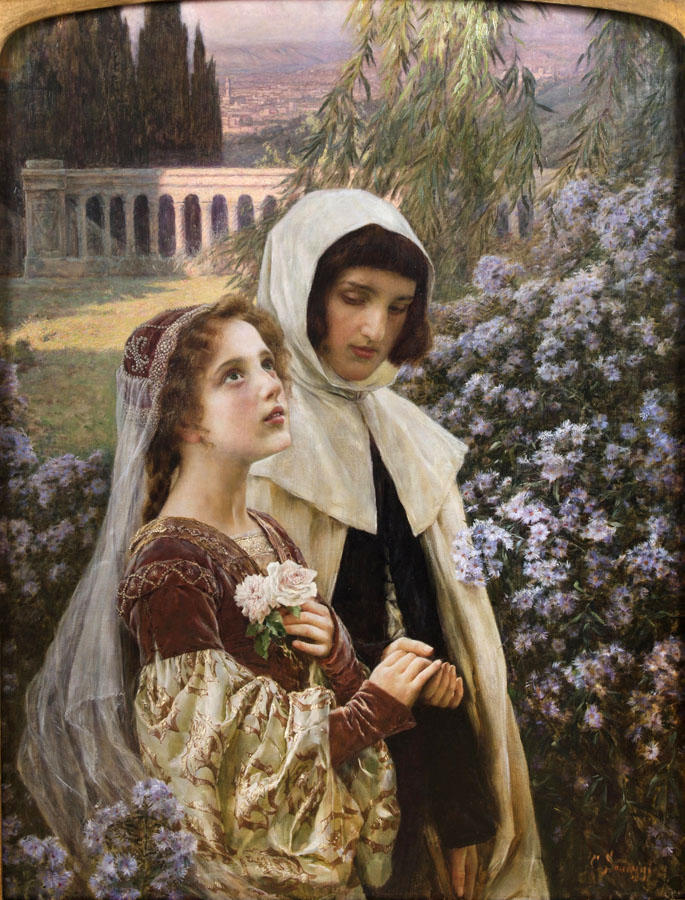
Cesare Saccaggi, Incipit Vita Nova Dante, painting, 1903

3. The Lover (The Connection to Beatrice)

Dante’s primary motivation for the journey is his love for Beatrice.

  • In the poem, Beatrice (a woman Dante loved in real life who died young) looks down from Heaven, sees Dante lost in the “dark wood” of sin, and sends Virgil to rescue him. As he tries to climb a sunlit mountain, he is blocked by three beasts (a leopard, a lion, and a she-wolf). From Heaven, Beatrice sees his distress and asks the Virgin Mary and Saint Lucia for help. They authorize Virgil to descend from Limbo to find Dante.
  • His identity is defined by this “Courtly Love” transformed into divine devotion; he endures the horrors of Hell specifically so he can eventually see her again in Paradise.
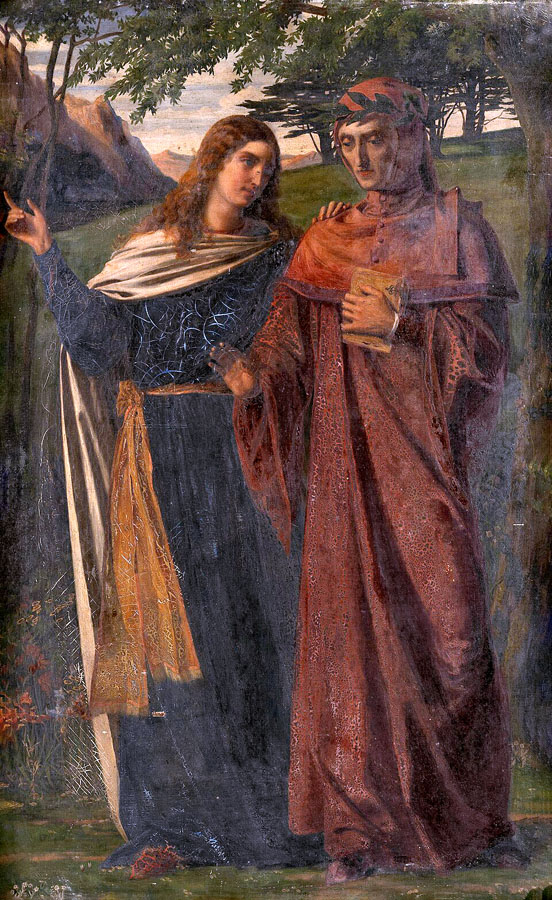
William Henry O’Connor, Dante & Beatrice in Heaven

Symbolic Meaning of “Dante”

Unlike the shades (ghosts) he meets, Dante has a physical body that casts a shadow and makes the ground move, symbolizing that he still has the “weight” of mortal life and the opportunity to change.

The Permission: Virgil explains to Dante—and later to the various demons and guardians of Hell—that Dante’s journey is willed by God. He is being granted a rare, “special grace” to see the afterlife while still in his mortal body so that he can return to Earth and warn others.

He represents the Human Soul. His journey from the depths of Hell to the heights of Heaven symbolizes the potential for any person to achieve salvation through self-reflection and grace.

As a poet, he is the “vessel” for the story. By the end of the poem, he is charged by the saints to return to Earth and write down everything he saw to help others.
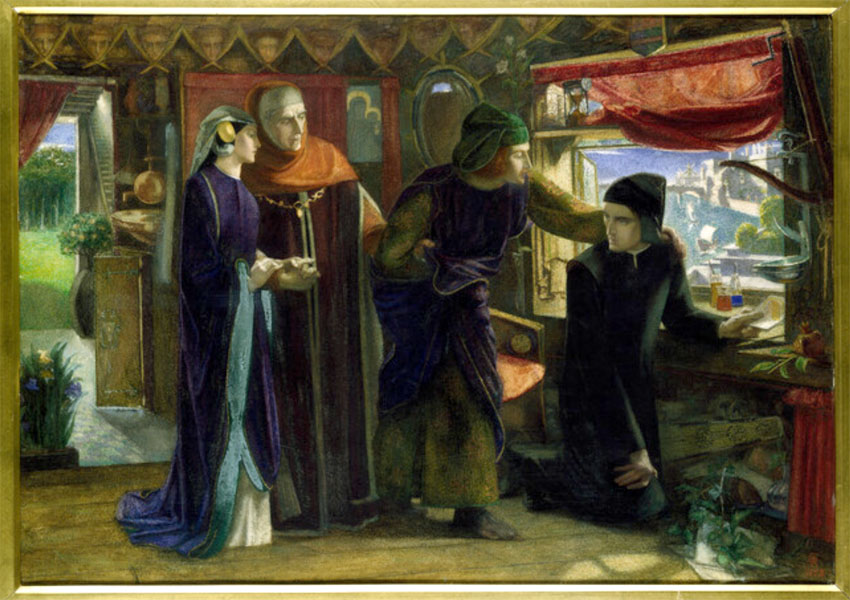
Dante Drawing an Angel or Dante drawing an Angel on the Anniversary of Beatrice’s Death, 1850s, Ashmolean Museum, University of Oxford.

How and why Dante came up with the story
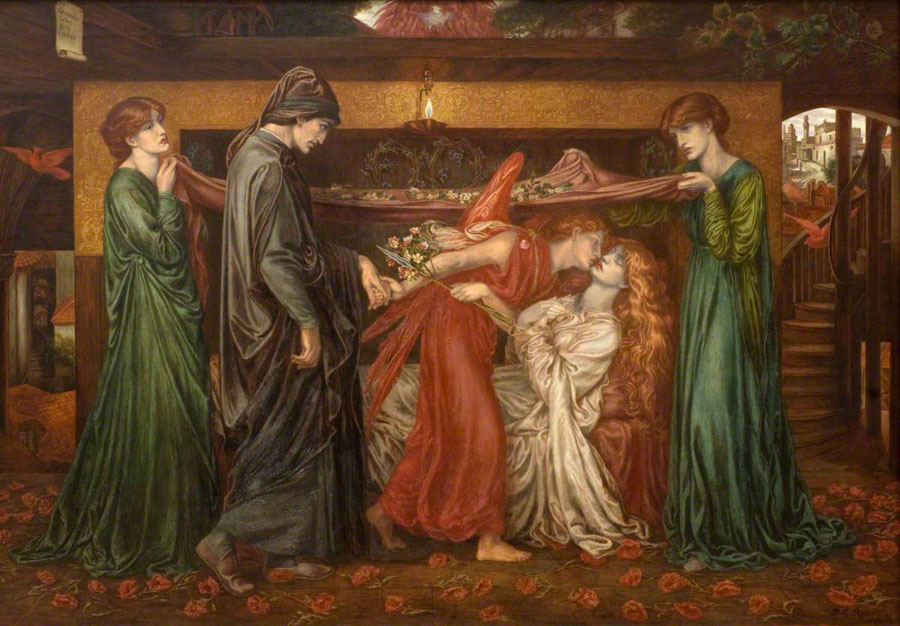
Rossetti, Dante Gabriel, Dante’s Dream on the Day of the Death of Beatrice; Dundee Art Galleries and Museums Collection (Dundee City Council); http://www.artuk.org/artworks/dantes-dream-on-the-day-of-the-death-of-beatrice-92864

Historians and literary scholars point to a perfect storm of personal tragedy, political bitterness, and medieval philosophy that forced the Divine Comedy into existence. The story was forged through several events including his exile in 1302, and the popularity of vision literature (heaven and hell).

The most direct historic “account” of why he wrote this story is his own political downfall. Dante was a high-ranking politician in Florence. When a rival faction (the Black Guelphs) took power, he was falsely accused of corruption, fined, and sentenced to be burned at the stake if he ever returned. He spent the rest of his life wandering from city to city. Scholars believe the Divine Comedy was his way of “reconstructing” the world he lost. By creating an afterlife where he was the judge, he could punish those who had betrayed him and find a higher sense of justice that the earthly courts had denied him.

There is a famous historical document called the “Letter to Cangrande della Scala” (Dante’s patron in Verona). In this letter, Dante explains his own intent: He states the poem is meant to “remove those living in this life from a state of misery, and to lead them to a state of happiness.” He confirms that the story should be read on four levels: literal, allegorical, moral, and anagogical (spiritual).
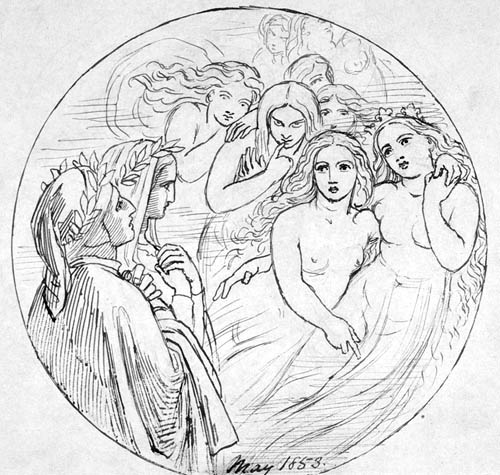
Joseph Noel Paton, sketch/study, Dante and Beatrice in the lunar sphere

Dante Depictions in Art

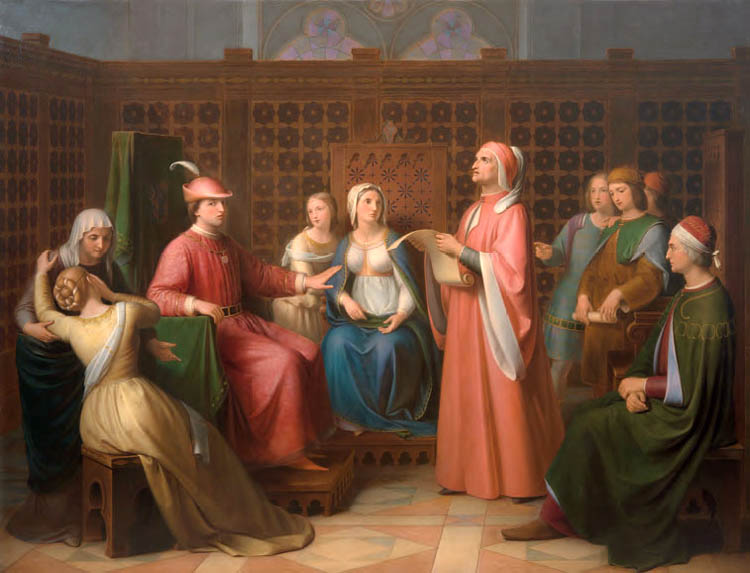
Dante reading the Divine Comedy at the court of Guido Novello, art by Andrea Pierini, 1850, Palazzo Pitti, Florence

Dante is almost always depicted in art wearing a red robe and a laurel wreath (the symbol of a master poet). In the Palazzo Vecchio in Florence, you can see the “Cenotaph of Dante.” While his physical remains are actually in Ravenna (due to his exile), Florence treats him as a perpetual “living” presence through their monuments.
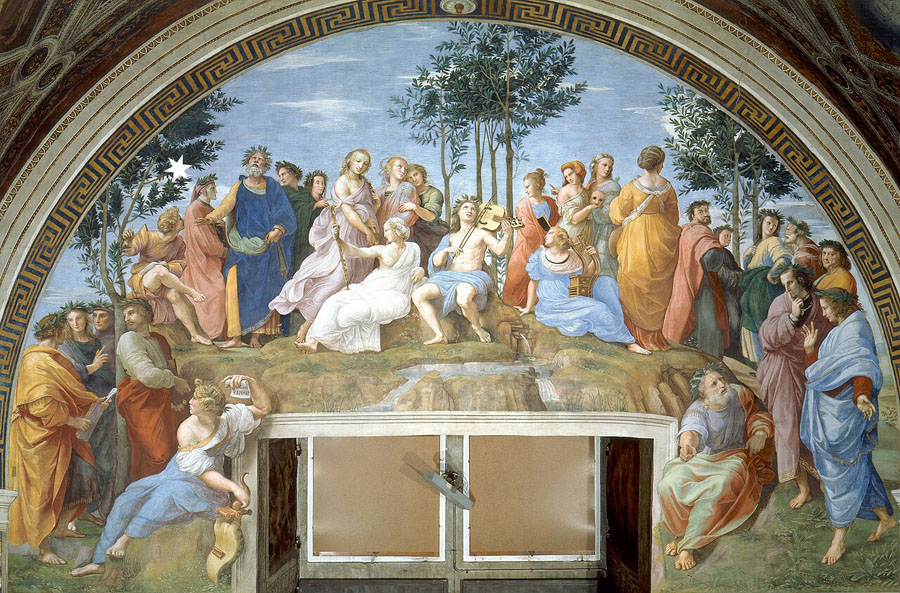
Raphael the Parnassus Vatican 1511, Dante’s depiction marked by a star
  • Raphael, The Parnassus (1511): Located in the Vatican Museums, this fresco shows Dante among the greatest poets of history.
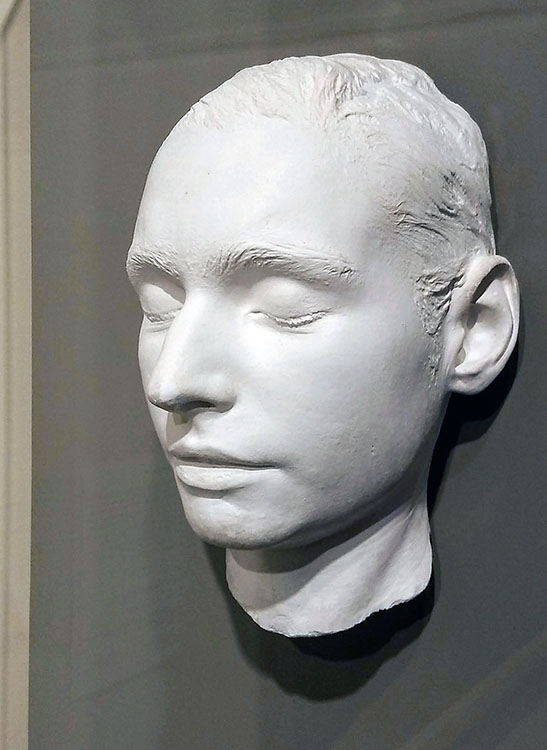
  • The “Dante Mask”: Several museums, including the Palazzo Vecchio in Florence, display what was long thought to be Dante’s death mask, though it is now considered a 15th-century commemorative sculpture. It captures the hooked nose and somber expression that have become his definitive look.
  • Dante Gabriel Rossetti, The First Anniversary of the Death of Beatrice: This painting illustrates the “historic” grief that eventually led to the Divine Comedy. View at the Ashmolean Museum.
  • Federico Zuccari, Dante in the Dark Wood: Part of a rare collection at the Uffizi Gallery, these drawings show the poet in his study, bridging the gap between his historical reality and his fictional journey.
  • William Blake, Dante Running from the Three Beasts: This watercolor captures the moment a living, terrified Dante realizes he is lost. View at the Tate Modern.
  • Gustave Doré, The Dark Wood: One of the most famous illustrations, showing a physical Dante looking small and vulnerable among giant, gnarled trees. https://rmc.library.cornell.edu/visionsofdante/art_dore.php
  • Filippino Lippi, Allegory: Various Renaissance depictions often show Dante holding a book, bridging the gap between the “Living Poet” and the “Divine Journey.”
  • Dante by Dali: https://rmc.library.cornell.edu/visionsofdante/art_dali.php
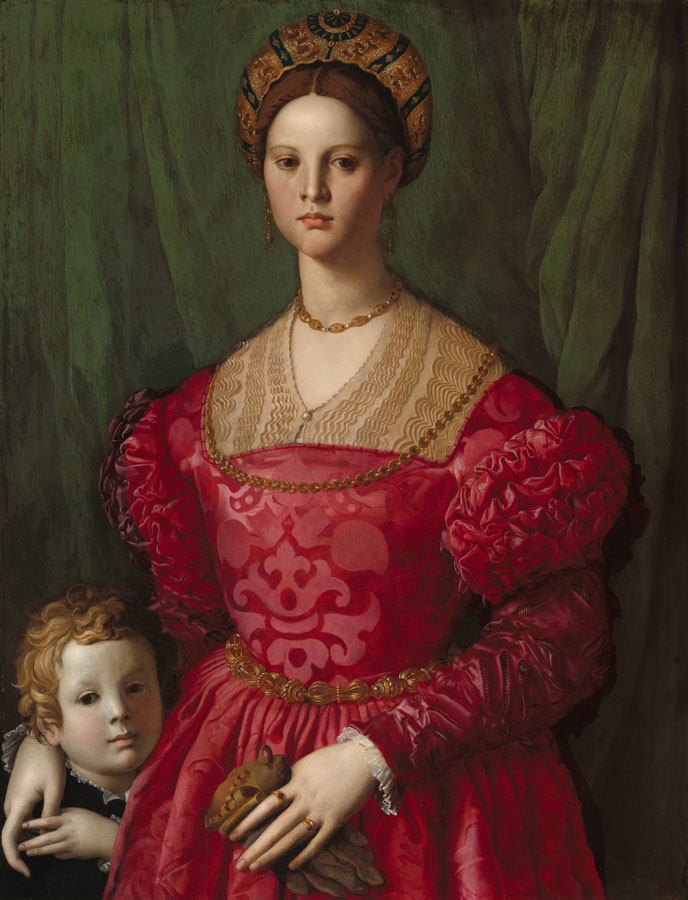
  • Dante gazes at Mount Purgatory in an allegorical portrait by Agnolo Bronzino, painted c. 1530, Gallery of Art, Washington DC
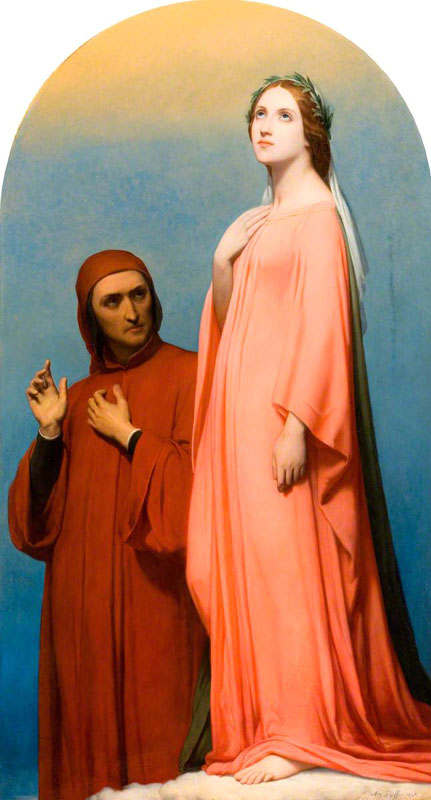
Scheffer, Ary, The Vision, Dante and Beatrice, Wolverhampton Arts and Heritage, http://www.artuk.org/artworks/the-vision-dante-and-beatrice-18955

The Divine Comedy: Virgil

Virgil (70–19 BCE) was a classical Roman poet, widely considered one of the greatest writers in Western history. While he is a central character in Dante’s Divine Comedy, he was a real historical figure who lived more than 1,300 years before Dante. Born Publius Vergilius Maro near Mantua, Italy, Virgil lived during a period of intense political upheaval as the Roman Republic transitioned into the Roman Empire.

His most famous work is an epic poem commissioned by the first Roman Emperor, Augustus. It tells the story of Aeneas, a Trojan hero who traveled to Italy and became the ancestor of the Romans. The poem was designed to provide Rome with a grand national origin story and to legitimize Augustus’s rule.

During the Middle Ages, Virgil was viewed with almost mystical reverence. Many Christians believed his Fourth Eclogue—which foretold the birth of a child who would bring a new Golden Age—was a pagan prophecy of the birth of Jesus Christ. This “Christianizing” of Virgil made him an acceptable and beloved figure for medieval writers like Dante.
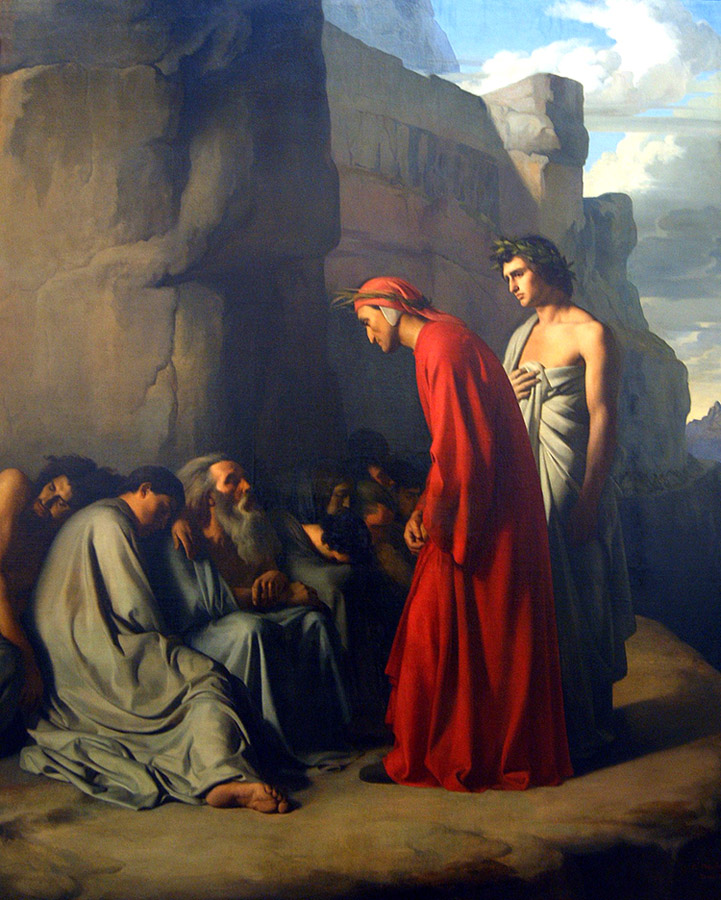
Hippolyte Flandrin, Dante accompanied by Virgil, consoles the souls of the envious

Virgil’s Role in the Divine Comedy

In the poem, Virgil serves as Dante’s guide through Inferno and Purgatorio and a protector. Dante’s choice to use him was purposeful and symbolic:

  • The Voice of Reason: Allegorically, Virgil represents human reason and classical wisdom. He can guide Dante through Hell and Purgatory because reason can recognize sin and the need for repentance.
  • The Mentor: Dante refers to him as “Master” and “Author,” crediting Virgil’s poetry as the primary influence on his own writing style.
  • The Limitation of Reason: Because Virgil was born before Christ and never knew “the true way,” he cannot enter Heaven. He represents the highest level of achievement possible for a human without divine grace (faith).
  • The Farewell: At the summit of Mount Purgatory, Virgil must disappear. He is replaced by Beatrice, who represents Divine Revelation/Theology, as reason alone is insufficient to comprehend the mysteries of Paradise.

To the real-life Dante, Virgil was the “Prince of Poets.” Dante’s primary historical goal was to prove that the Italian language of the common people could be just as noble as Latin. When Virgil eventually disappears at the end of Purgatorio, Dante weeps. It is one of the most heartbreaking moments in literature because it signifies the moment where “thinking” is no longer enough, and “feeling/believing” must take over. The “second meaning” (or allegorical layer) of Virgil is that he represents Human Reason. In the medieval worldview, God granted humans “Natural Reason” to understand the world, ethics, and justice even without the Bible.

  • Why Virgil guides through Hell: Reason is sufficient to understand that sin is destructive. You don’t need a miracle to see that greed or violence leads to misery; you only need a clear mind.
  • Why Virgil guides through Purgatory: Reason can help a person discipline themselves and build better habits (virtue).
  • The “Tragedy of Virgil”: The most profound second meaning is that Virgil represents the limitation of the human mind. He can lead Dante to the edge of Heaven, but he cannot enter. This symbolizes the belief that while science, philosophy, and logic are great, they cannot bridge the final gap to the “Divine”—that requires Faith (represented by Beatrice).

There is a fascinating historical “second meaning” to Virgil known as the Messianic Eclogue. In his real-life Fourth Eclogue, Virgil wrote about a “child” who would be born to bring peace to the world. Medieval Christians (including Dante) believed Virgil had accidentally prophesied the birth of Jesus. Because of this, Virgil’s role in the poem is that of a “Pagan Prophet”—a man who held the light up for others to see the way, even though he remained in the dark himself.
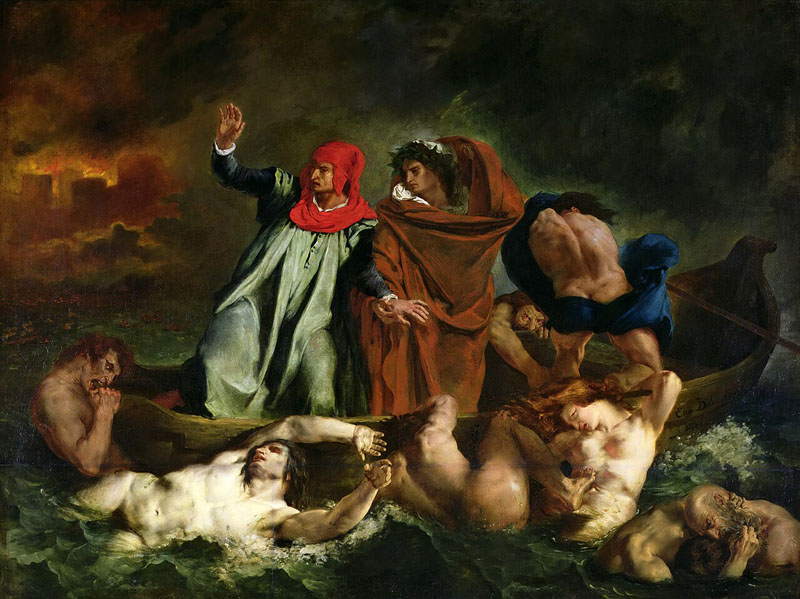
Eugène Delacroix, The Barque of Dante (1822): This painting, currently in the Louvre Museum, depicts Dante and Virgil crossing the river Styx while the damned souls cling to their boat. It is a landmark of the Romantic movement, emphasizing movement and raw emotion.

Virgil’s depictions in Art

  • https://www.ashmolean.org/collections-online#/search/simple-search/virgil/%257B%257D/4/16/_score/desc/catalogue
  • William Blake, Virgil Rescuing Dante from the Three Beasts in Tate Britain https://www.tate.org.uk/. Shows Reason (Virgil) physically pulling the Human Soul (Dante) away from the animal instincts of the “beasts.”
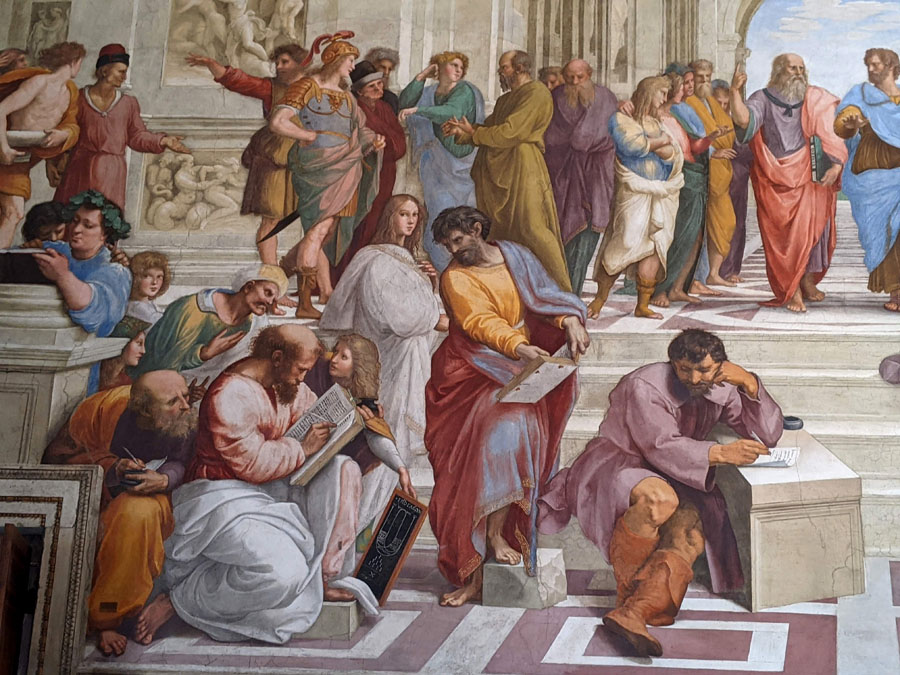
  • Raphael, The School of Athens in the Vatican Museums. the placement of classical figures near Dante in the Parnassus nearby emphasizes Virgil as the peak of human logic.
  • Gustave Doré, Virgil and Dante looking into the Geryon Abyss. Virgil is always shown standing taller and more composed, symbolizing the steady nature of Reason in the face of chaos.
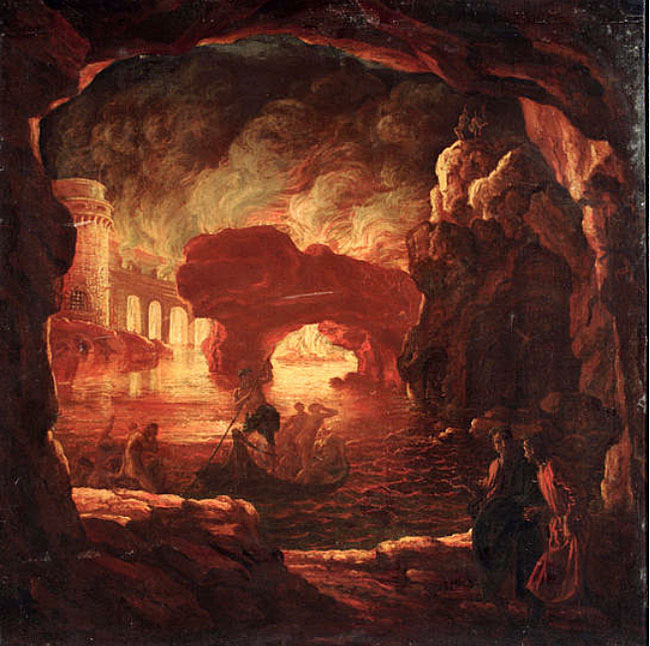
C. Onofri Livio Mehus, Dante and Virgil in Hell, oil painting

The Divine Comedy: Beatrice

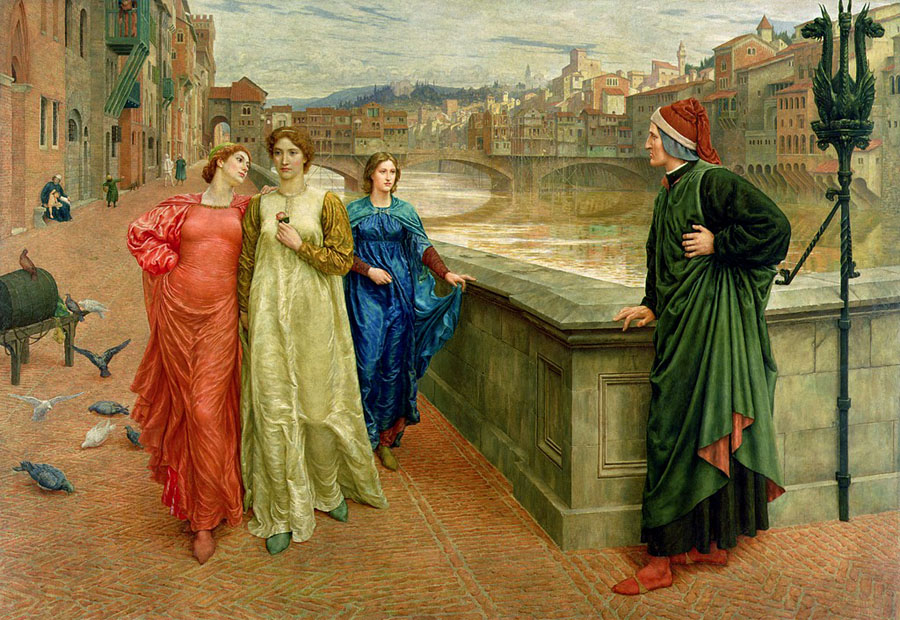
Henry Holiday, Dante meets Beatrice, oil painting

Long before he wrote the Comedy, Dante wrote La Vita Nuova (The New Life), a collection of poems about his unrequited love for Beatrice Portinari. When she died young (around 1290?), Dante was devastated. At the end of La Vita Nuova, he promised he would one day write of her “what hath never been written of any woman.” The Divine Comedy is the fulfillment of that promise. He “invented” the journey through Hell and Purgatory essentially as a massive narrative bridge to reach the Beatrice he had lost. So Beatrice represents everlasting Love as she is priestess of love and angel of salvation.

In Gustave Doré’s wood engravings for Purgatorio (Canto 30 and 31 located at Cornell University Library)
Beatrice chastises him for having loved others after her death. In Canto 31, she offers Dante forgiveness through a second baptism, plunging him in the waters of Lethe (λήθη = the river in Greek mythology whose name means “oblivion.”)
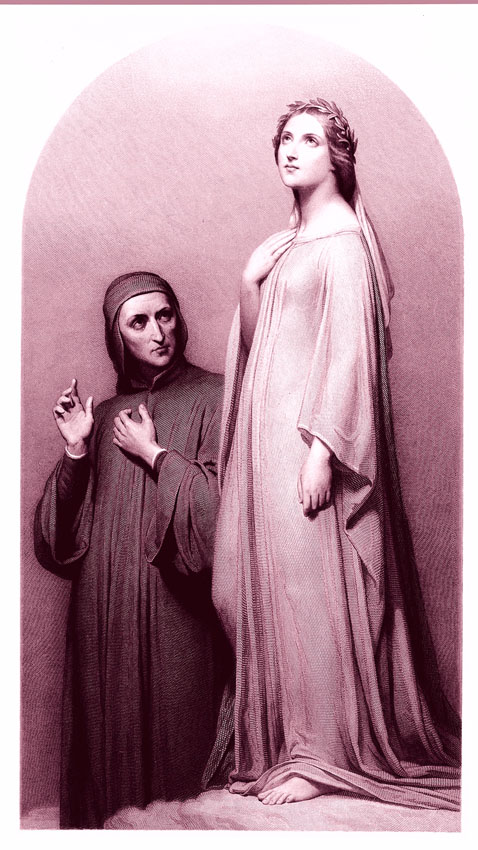
The Met: Dante and Beatrice, Artist: Narcisse Lecomte (French, 1794–1882), after Ary Scheffer (Dutch, Dordrecht 1795–1858 Argenteuil, 19th century, print size: 19 3/8 x 12 1/2 in. (49.2 x 31.8 cm)

Why the Divine Comedy is a masterpiece
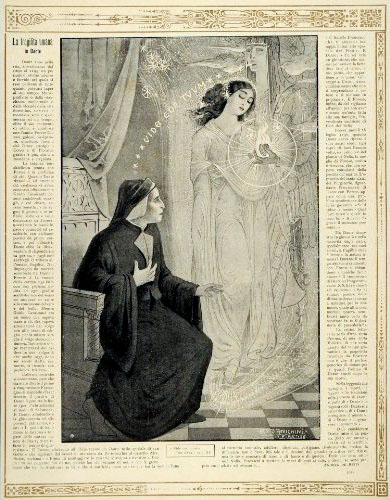
Ezio Anichini, Beatrice and Dante, (Vita Nuova)

Here is why I find the Divine Comedy a masterpiece. Dante’s writing is highly symbolic and visionary: the journey mirrors the soul’s moral and spiritual progress, with Virgil representing reason (limited to lower realms), Beatrice divine grace/theology, and numerical/symbolic structures (3 for Trinity, 7 for sins/virtues) tying into Christian theology and medieval cosmology.

The Divine comedy has profound meaning. We-humans have freewill to live and create life we want to inhabit. We are not machines or creatures with pre-determined fate. While it’s easy to engage in treachery and fraud, to steal or betray, it takes effort to imagine, build, nurture, and create life that expands our universe. Some people choose to end up in the circles of Hell, while others make a decision to aspire to a better life via love and devotion.

The Divine Comedy emphasizes the divine spark inside our souls. Dante walks in the heavenly realms with Beatrice, his love. The realms emphasize justice, freewill, love (perverted in Hell, purified in Purgatory, perfected in Heaven), and the ultimate goal of union with the divine. We save ourselves by love through giving, and that’s how we reach the heavens. Sometimes we get lost in problems and difficulties spiraling to the circles of hell inside us, but it’s Love that gives our life meaning and return to God.

https://veronicasart.com/product-category/visionary-art-painting/

Explanation by the Predictive History:

I find this poem difficult to comprehend due to ancient language in translation. I think Professor Jiang from “Predictive History” gives a personal explanation of this poem. You can watch one of his lectures here:

Art books from the artist:

https://amzn.to/4bbYT81
colored pencil manual veronica winters
https://amzn.to/3xoJjbi
thailand-book-cover-front
The Enigma of Thailand, 2013 https://amzn.to/4qOouLS
https://amzn.to/46mDs4z

What does purple cloth symbolize in art and church?

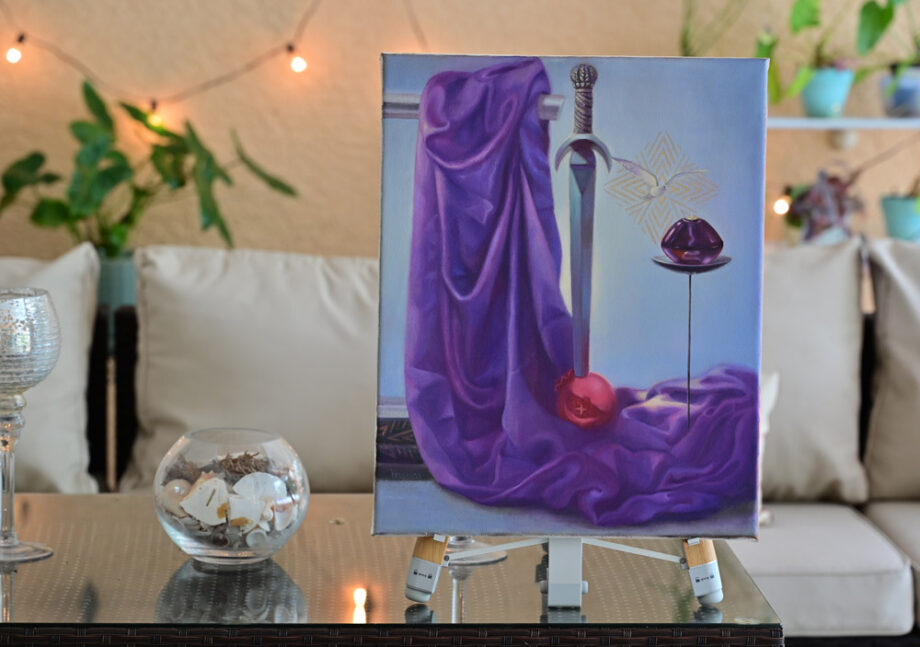
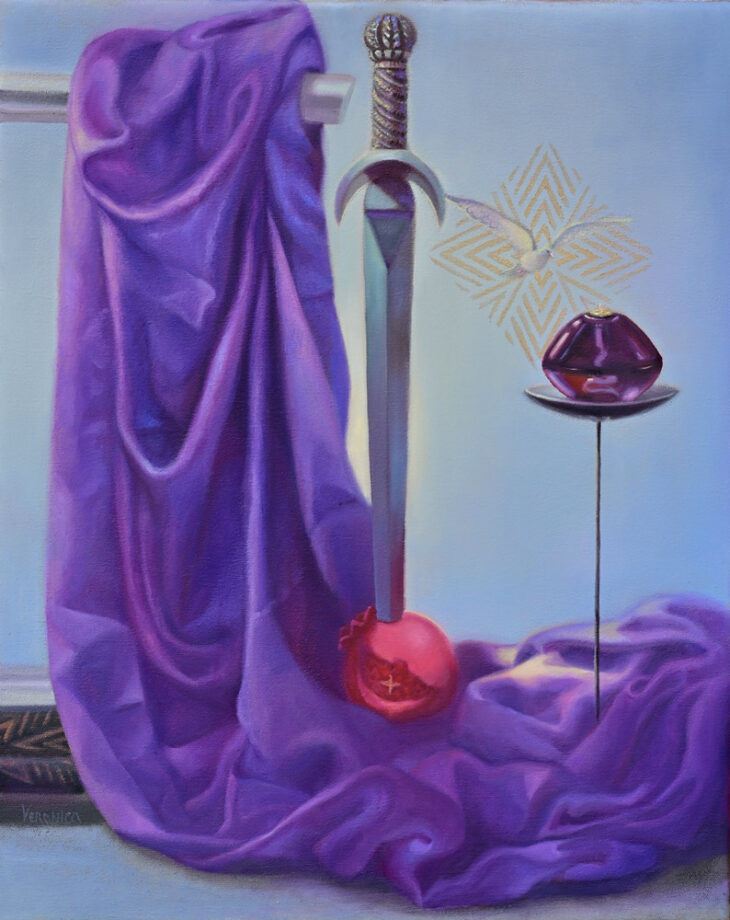
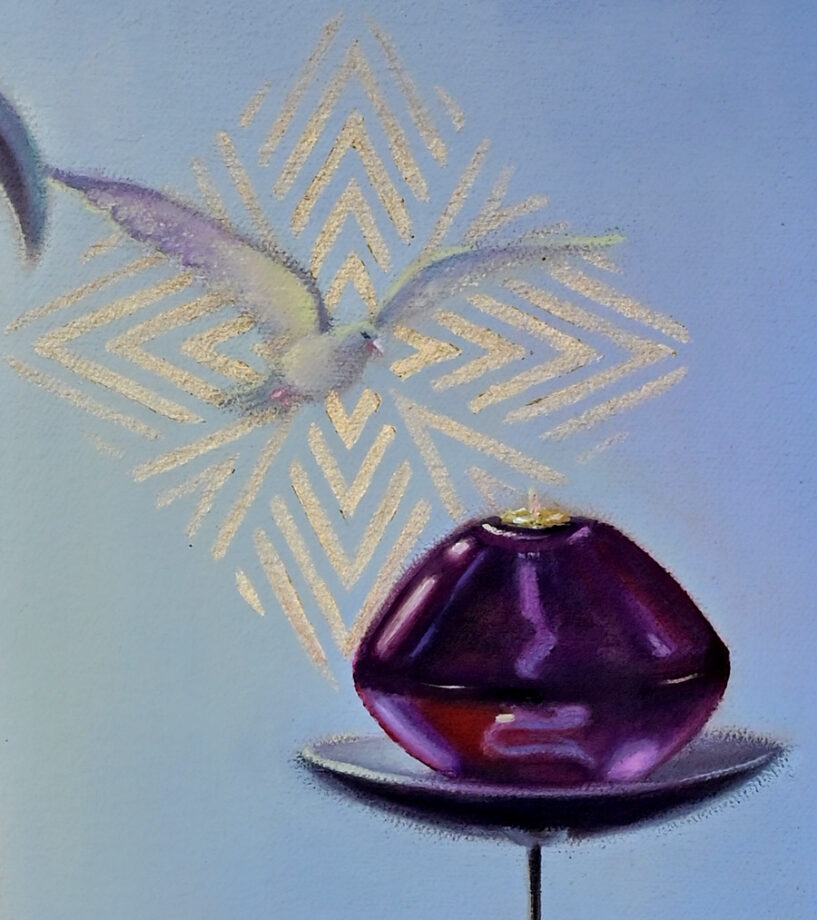
Veronica Winters, Promise (of resurrection), oil painting on canvas, 16x20in

As I traveled in Italy once again, I visited many churches in Bergamo, Venice, Milan, and so on. The figure of Christ was covered in a beautiful, sheer fabric of either purple or deep red hue. The colors varied a bit, but I found this rich purple color striking to paint. Violet is one of my favorite hues to paint in my art. While I’m not religious, I think this symbolic painting may bring hope to many people believing in Christ and his resurrection.

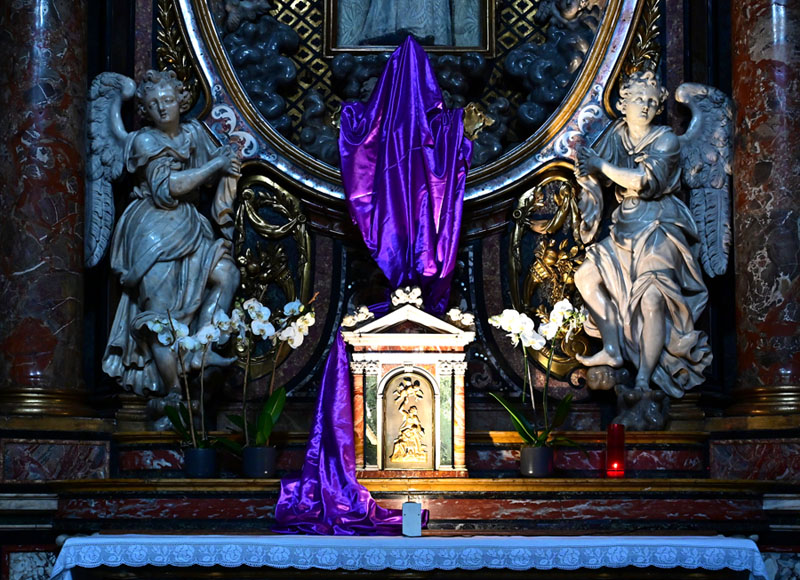
Symbolism of purple cloth in the Catholic Church: meaning of purple cloth over a crucifix during Lent

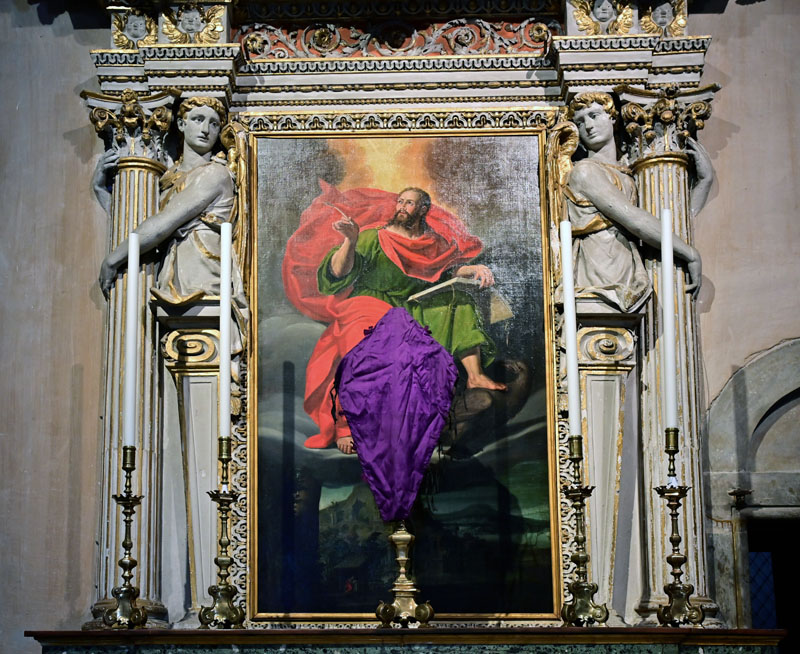
In the Catholic Church, the practice of covering crosses and statues with purple cloth is a tradition primarily associated with Passiontide, the final two weeks of Lent. Starting on the Saturday before the Fifth Sunday of Lent, you will often see crucifixes and other religious images veiled in violet or purple fabric.

1. Mourning and Penitence

Purple is the liturgical color for Lent, symbolizing penance, preparation, and sacrifice. By veiling the cross, the Church visually signals a period of deep mourning as the faithful approach the anniversary of Christ’s suffering and death.

History of purple veiling in the traditional Roman Rite

In the traditional Roman Rite, the practice of veiling crosses and statues is a solemn tradition that dates back to the early Middle Ages, specifically becoming a universal custom by the 17th century. It marks the beginning of Passiontide, the final two weeks of Lent, and serves as a powerful visual cue that the Church has entered its most somber period of the liturgical year.

2. A “Fast for the Eyes.”

Just as Catholics might fast from food or luxuries during Lent, the veiling of religious art and the crucifix itself is a “fast for the eyes.” By removing the visual representation of Christ and the saints, the Church creates a sense of spiritual hunger and heightened anticipation for the Resurrection at Easter.

The Origins

While the exact origins are debated, many historians link the practice to a medieval custom in Germany called the Hungertuch (hunger cloth) or Lenten veil. This massive cloth would completely hide the altar from the congregation’s view during Lent. Over time, this evolved into the custom of veiling individual images. The primary theological reason is to create a “fast for the eyes.” It forces the faithful to focus inward on the penitential nature of the season, stripping away visual comforts to emphasize the gravity of Christ’s impending Passion.

3. Focus on the Narrative: Symbolic Meaning of the Veil

The veiling helps the congregation focus on the words of the liturgy and the Gospel readings rather than the physical environment.

  • The Hidden Divinity: The veiling corresponds to the traditional Roman Rite, the Gospel of the Fifth Sunday of Lent (in the traditional calendar), which ends with the words: “Jesus hid himself and went out of the temple” (John 8:59). The purple cloth represents Christ hiding his glory as he enters into his suffering.
  • Mourning and Humility: The violet color itself signifies penance and mourning. By covering the saints, the Church reminds us that the “servant is not greater than the Master.” If Christ’s glory is veiled, the glory of his saints must also be obscured.
  • Anticipation: The removal of the veils at the Easter Vigil creates a dramatic visual “resurrection,” where the sudden reveal of the statues and the light of the church symbolize the triumph of life over death.

4. The Glory of the Reveal

The veils remain until the Easter Vigil (though the cross is specifically unveiled for veneration on Good Friday). On Good Friday, the cross is uncovered so the faithful can focus solely on the instrument of salvation. During Easter Virgil, the statues and other images are finally revealed, signaling the triumph of life over death and the joy of the Resurrection.

Veronica Winters, Promise (of resurrection), oil painting on canvas, 16x20in

Liturgical Rubrics

In the Usus Antiquior (the older form of the Roman Rite):

  • All crosses, statues, and pictures (except the Stations of the Cross) are covered before the Vespers of the Saturday preceding the Fifth Sunday of Lent.
  • The crucifix remains covered until the Solemn Unveiling during the Good Friday liturgy, where it is revealed in three stages as the priest chants, “Ecce Lignum Crucis” (Behold the wood of the Cross).
  • Other images remain veiled until the singing of the Gloria in Excelsis during the Easter Vigil.

If you see a mistake in this summary, write to nika@veronicasart.com

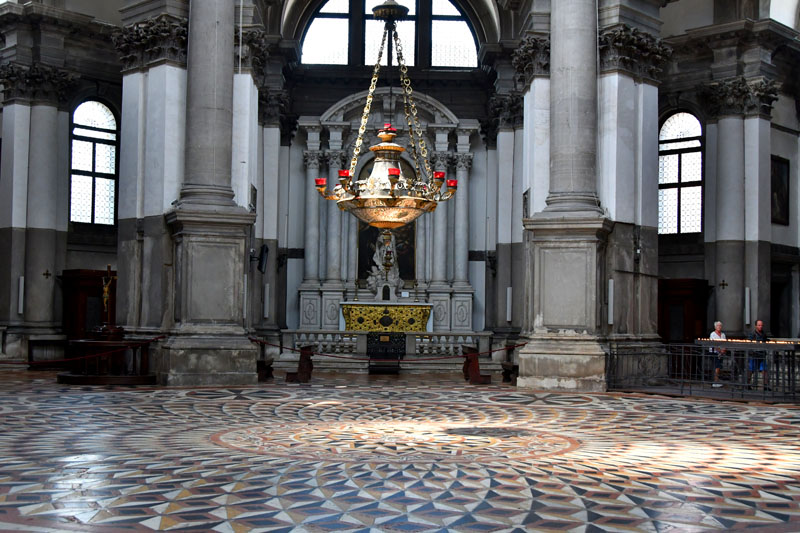
Basilica Santa Maria della Salute in Venice

History, Symbolism & Art with Purple Color In It 

Outside of Catholic liturgy, purple has been one of the most expensive and difficult colors to produce, which has determined its symbolism across time and cultures.

Royalty, Wealth, and Power

For centuries, purple was the color of the elite. This is largely due to Tyrian purple, a dye made from the secretions of sea snails. It took 10,000-12,000 murex snails to produce just one gram of dye, making it worth its weight in gold!

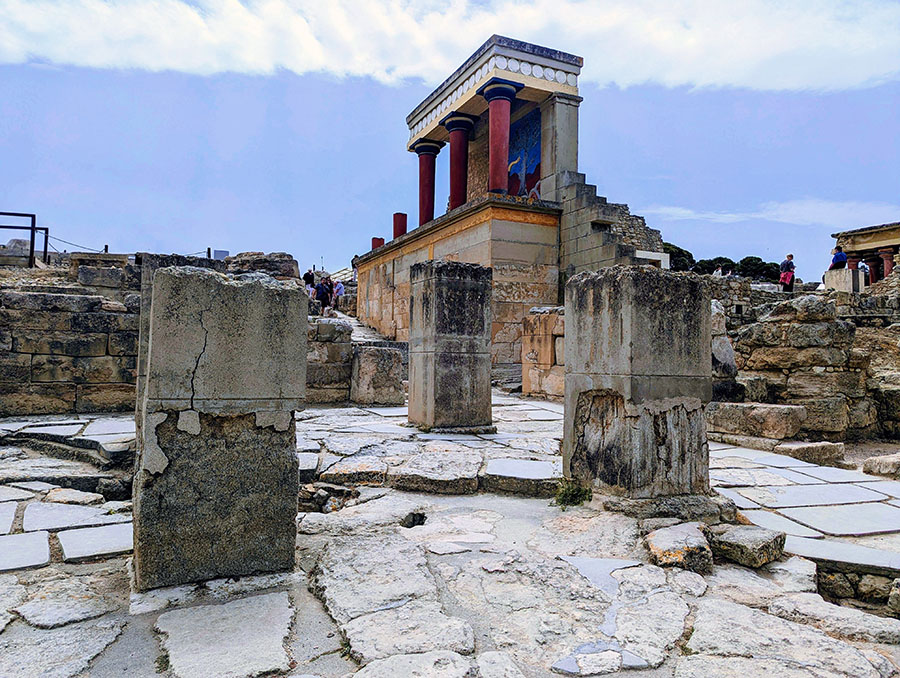
The Minoans of Crete were pioneers in the manufacture of Tyrian purple.

palace of Knossos
The Palace of Knossos, Greece.

The Minoans obtained the dye from murex sea snails, similar to the Phoenicians, who later became famous for it. Archaeological evidence suggests Minoan production dates back to the Middle Minoan period (2000-1600 BCE), predating the Phoenicians by centuries. Discoveries of large quantities of crushed murex shells at sites like Chryssi Island in eastern Crete point to dedicated dye production facilities. The Minoan purple dye likely possessed the same rich, deep color and remarkable lightfastness (resistance to fading) that made Tyrian purple so valuable. The extraction process was laborious, involving the collection and processing of vast numbers of sea snails. The resulting dye was incredibly expensive due to the difficulty of production. Minoan purple likely colored textiles and other luxury items, signifying wealth and status. It’s interesting to note that while the Phoenicians later became synonymous with this purple dye, the Minoans may have been the true innovators behind this remarkable ancient technology.

The color had an obnoxious smell even in the fabric itself, according to the ancient writer, Pliny. Tyrian purple was highly resistant to fading in textile production, but how it was manufactured is quite a mystery. Pliny wrote the most detailed recipe for its production in the 1st Century AD.

Why was purple the color of royalty in ancient Rome?

In Ancient Rome, Byzantium, and the Elizabethan era, “sumptuary laws” often forbade anyone but the highest-ranking officials or monarchs from wearing it.

The association between purple and Roman royalty was born from a combination of extreme scarcity, high cost, and strict legal control. As the color was derived from Tyrian purple, the material was literally worth its weight in gold.

In ancient Rome, this economic barrier was reinforced by “sumptuary laws,” which dictated who could wear the color based on social rank. While high-ranking senators were permitted to wear a purple stripe (clavus) on their tunics, the toga picta—a solid purple garment embroidered with gold—was eventually reserved exclusively for the Emperor. Julian Caesar met Cleopatra in her purple rooms. He loved the color, and soon only the emperor was allowed to wear a fully purple toga. This made the color a “visual shorthand” for absolute power.

Pavonazzo was a purplish color in ancient Rome. This word also reffered to a marble with red, violet, or purple veins found in ancient Roman buildings and thought to be Phrygian. Pagonazzo translates as purple from Italian.

Today, purple is still used by brands to evoke a sense of luxury, premium quality, or “high-end” status.

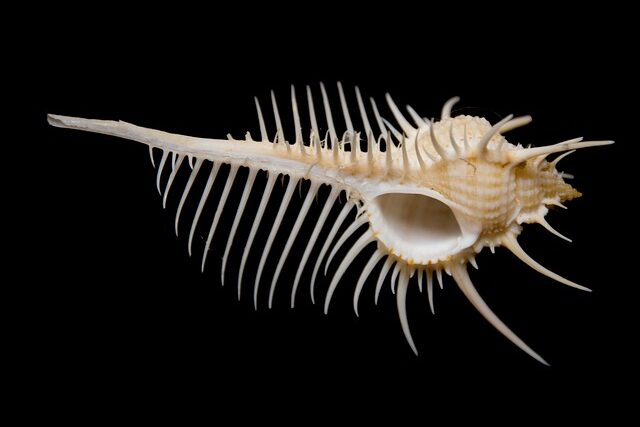
This is what the murex seashell looks like.
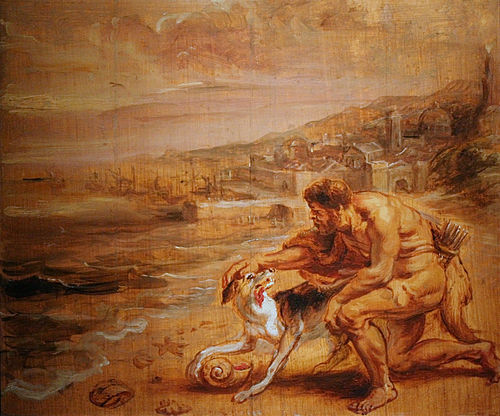
Hercules’s Dog Discovers Purple Dye, by Peter Paul Rubens. 28 × 34 cm; oil on panel. Musée Bonnat, Bayonne, France.

The Roman city, Tyre, was the birthplace of the seashells and purple dye. Here, the artist depicts this seashell differently from the murex shell, probably because Rubens didn’t really see the murex seashell. In this underpainting, the dog bit a sea snail, and the snail’s blood dyed the dog’s mouth Tyrian purple.

I recommend listening to this book on Spotify: Color: A Natural History of the Palette by Victoria Finlay to learn about the historic accounts of all main colors, including purple.

Because purple was so rare, using purple to represent wealth and power in portraiture was symbolic. One of the earliest examples of purple wear is Empress Theodora and Her Retinue (Basilica of San Vitale, Ravenna). In this 6th-century mosaic, Theodora is depicted wearing a deep, imperial purple chlamys (cloak). In Byzantium, purple was strictly regulated. By wearing this hue, Theodora showed her wealth and co-ruling status alongside Emperor Justinian.

Here is an example of an early Byzantine glass jar with an iridescent purple color on its surface.

Cleopatra’s Sails:

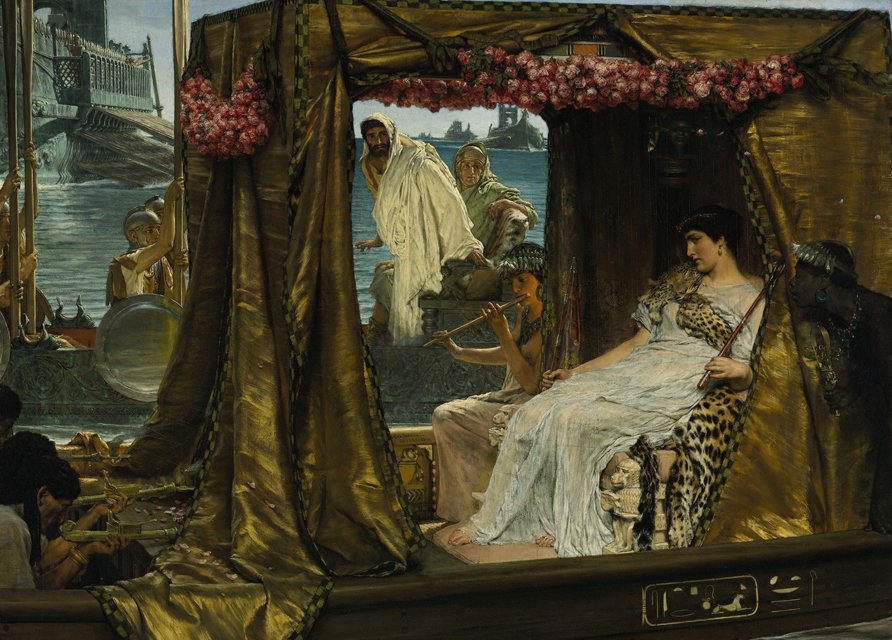
The story of Cleopatra’s purple sails is a famous historical account, primarily recorded by the ancient Greek historian Plutarch. I don’t know if he just told us stories or if it was really the case, but… In Plutarch’s Life of Antony (written in the 1st century AD), he wrote about the Meeting of Antony and Cleopatra at Tarsus in 41 BC, he describes her arrival on a magnificent barge:

“…she came sailing up the river Cydnus, in a barge with gilded stern and outspread sails of purple, while oars of silver beat time to the music of flutes…”

The Meeting of Antony and Cleopatra, Lawrence Alma-Tadema (1836–1912)

By dyeing her sails in Tyrian purple, Cleopatra was making a bold political statement. In Rome, this dye was regulated and extremely rare. So by unfurling it on her sails, she was announcing herself as a sovereign queen who bowed to no one. Plutarch also notes that the sails were so heavily perfumed that the scent reached the shore before the boat did, further overwhelming the senses of the Roman onlookers and Mark Antony himself. This description was so vivid that it inspired William Shakespeare for his play, Antony and Cleopatra. He famously wrote: “Purple the sails, and so perfumed that / The winds were lovesick with them.” The story also inspired the 19th-century realist artist Lawrence Alma-Tadema. You can read about the Ptolemies in this book.

Purple In Art

The use of purple in art is not as common as you may think. It took me a while to collect a few paintings with purple in them. Perhaps it’s due to fading, and violet or mauve looks more like grey or brown today. Purple in art before the 19th century was rare, but when a young chemist, William Henry Perkins, invented the synthetic dye by accident, everything changed.

A young chemist patented the dye and began textile production in London. Named after the inventor, as Perkin’s Purple, the deep mauve color enjoyed instant fame, making him wealthy and women fashionable. Even Queen Victoria wore a silk gown dyed with mauveine at the Royal Exhibition of 1862. You can see an example of the 1860s mauve dress here.

Purple in Art: Varied symbolism

Because the original Tyrian purple dye trade collapsed with the fall of Constantinople in 1453, Renaissance painters had to mix the color using blue and red pigments. Purple hue can vary, of course, from lilac to deep violet, to fuchsia, to purple-madder.

In Raphael’s The Dream of the Knight, 1504, Pleasure is wearing Tyrian purple (that looks blue to me) and Virtue is wearing a dark blue dress. The soldier is asleep with a vision of Virtue and her adversary Pleasure. Virtue promises Scipio honour, fame, and glory through victory in war. Pleasure promises an easy life. According to the museum’s description, Raphael interpreted the theme not as a moral dilemma but as a combination of all the virtues to which an ideal soldier should aspire.

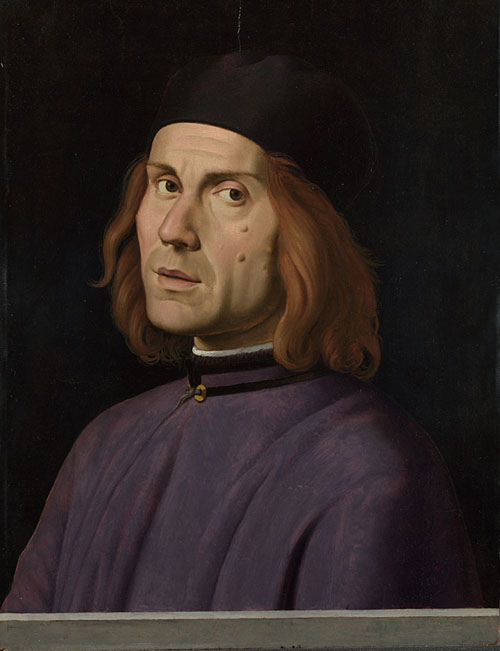
Lorenzo Costa, Portrait (supposed to be of Battista Fiera), 1490. National Gallery, London.

The man wears dull purple clothing that symbolizes justice.


Purple in Art: Fading

All colors fade with time, and mixed violet could also have faded in classical art. So when we look at purple in oil paintings, it may appear brownish, pinkish, greyish, or dull red instead. For example, Mantegna’s Triumph of Caesar might have had rich violet that looks pale today. Tyrian purple was highly resistant to fading in textile production, but I don’t know how it was made for painting.

Master of the Bruges, Passion scenes, Christ presented to the people, oil on wood, 1510. You can check out the National Gallery Podcast – Stories in Colour for more information about this and other paintings. In this artwork, Christ wears a toga that looks greyish-blue today, which could have been purple in the past. In Vouet’s painting, the color is pinkish-mauve. This means if you paint, use high-quality oil paints to make your paintings last! Otherwise, you’ll end up with Van Gogh’s flowers of green and brown in a few decades from now.

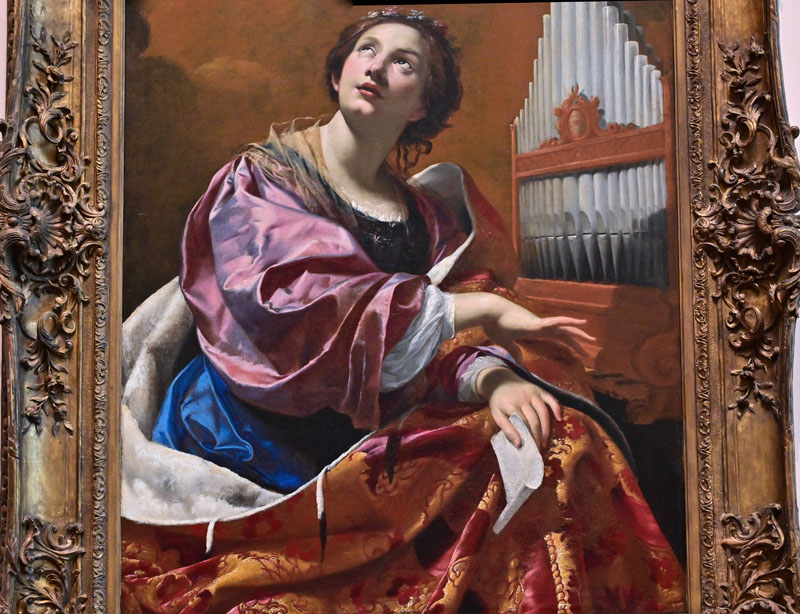
Simon Vouet, Paris, France, 1590-164, Saint Cecilia, 1626, oil on canvas, closeup, Austin, TX

Museum’s description: Cecilia, the patron saint of music and musicians, sits in a brocaded mantle. She gracefully turns to the two cherubs that appear to her at the upper-left corner of the scene. Golden light bathes the figure and the background, who lived in Rome. She took a vow of virginity and on her wedding night, converted her groom, Valerian, to Christianity; he, in turn, guided his brother Tiburtius to the Christian faith. Their beliefs were soon discovered by the authorities, and all three were ultimately martyred at the hands of Roman prefect Turcius Altmachius.
Cecilia has been represented with a musical instrument since the fourteenth century, although her connection to music is tenuous at best. According to The Golden Legend, the saint heard celestial music when she was praying to God to preserve her virginity, “T et my heart and my body be undefiled, O Lord and sang, “Let my heart and my body be undefiled, O Lord, that I may not be confounded. “Depictions of female saints were popular in Rome in the 1620s. It is possible that his wife, the painter Virginia da Vezzo, was the model for the figure of the saint. The two artists married in Rome in 1626, just before they left for France to serve King Louis XIII.

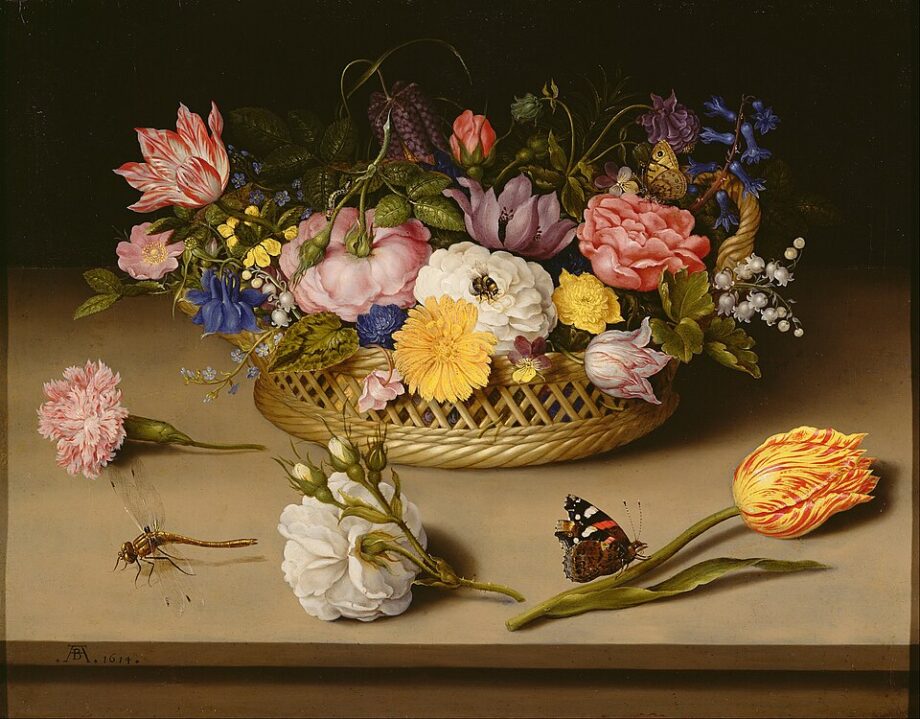
Ambrosius Bosschaert the Elder (1573 – 1621) was a Flemish-born Dutch still-life painter and art dealer who painted flowers of many seasons in a single still life. Some of his flowers have a purplish color. His three sons became famous artists as well!

There is more art with purple in it in the 19th-century paintings. Maybe, because it hasn’t faded yet, or because it was easy to manufacture. You’ll find several paintings with shades of purple in them below.

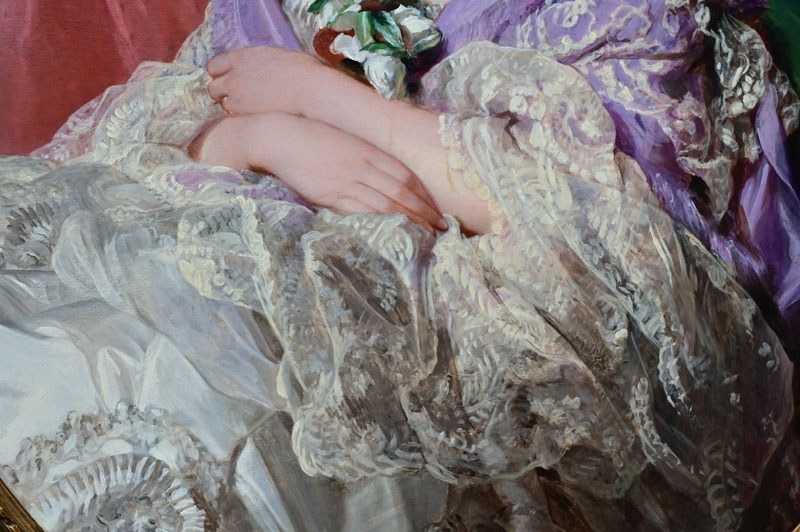
Franz Xaver Winterhalter, 1816-1871, Empress Eugénie, 1854, Oil on canvas, painting’s details

When Empress Eugenie ascended to the throne as the wife of Napoleon III, she was acknowledged as one of the most beautiful crowned heads of Europe, but she was not of royal blood. Since Napoleon III declared himself emperor, just as his famous uncle had done in 1804, he had difficulty in finding a spouse among European royalty. Eugenie, already 26 at the time of their marriage, was the daughter of a Spanish grandee and a commoner. She chose Franz Winterhalter, a wonderfully gifted German portraitist, as her court painter. Her patronage brought him commissions from virtually all the crowned heads of Europe

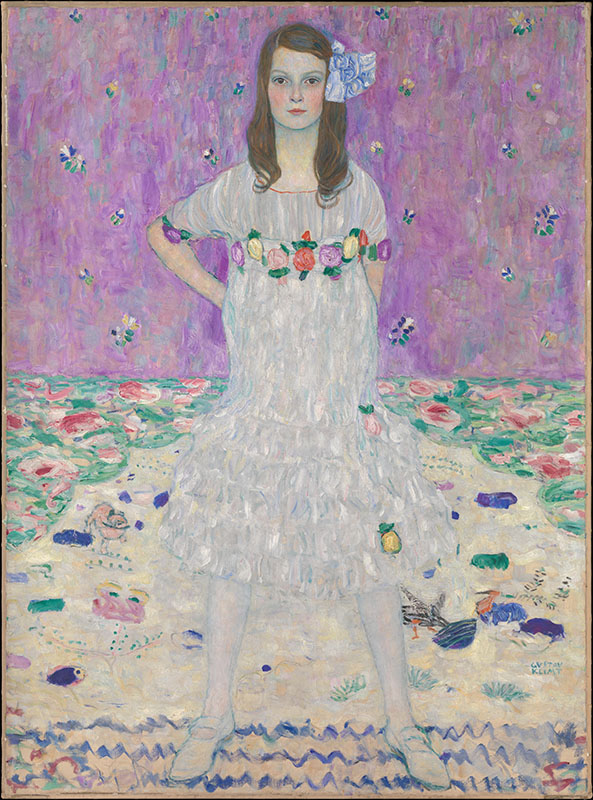
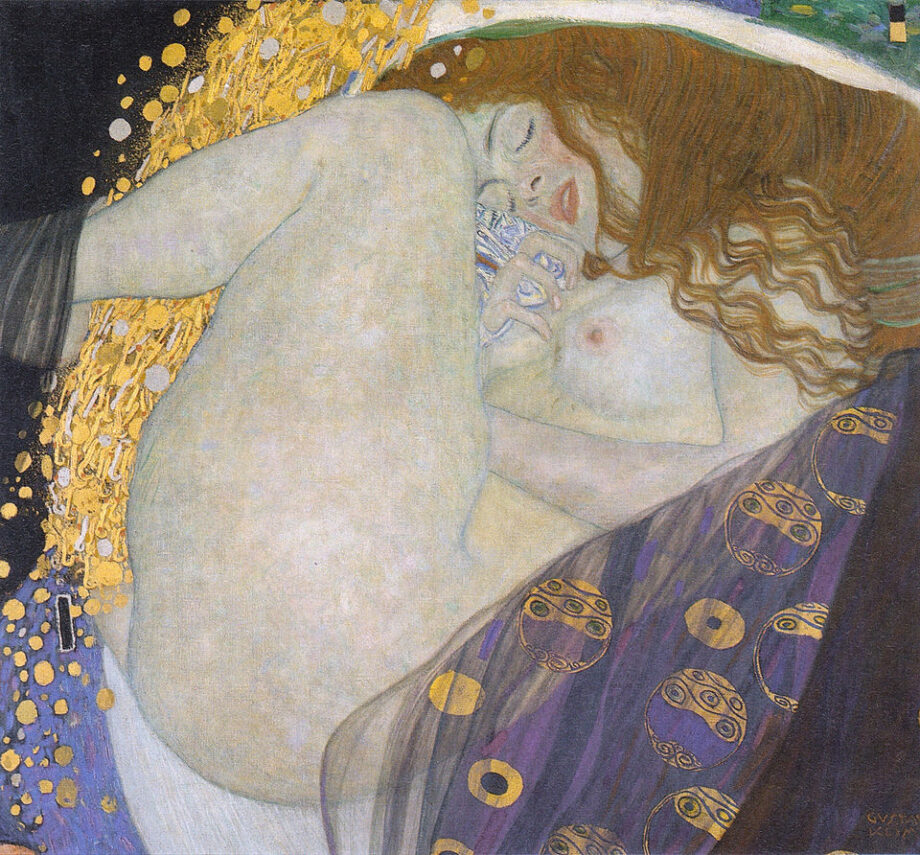
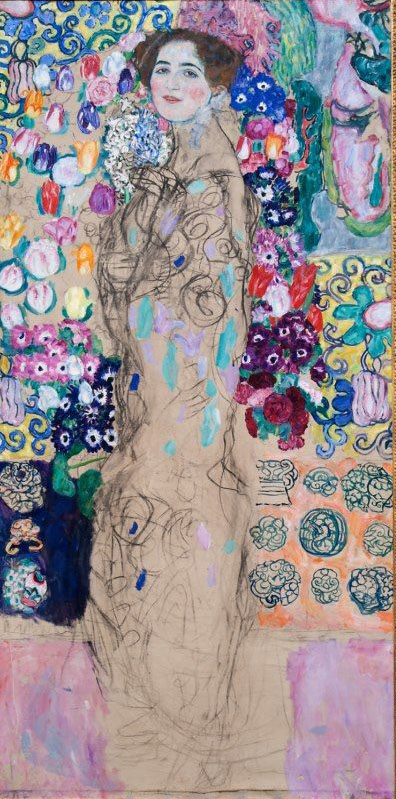
Gustav Klimt liked to use purple in his art. The examples include The Maiden, Danae, unfinished portrait of Ria Munk III, etc.

Mäda Primavesi (1903–2000) Gustav Klimt Austrian, 1912–13
Mäda Primavesi (1903–2000), Gustav Klimt, Austrian, 1912–13
http://www.metmuseum.org/art/collection/search/436819
Gustav Klimt, Danae, 1907-08
Gustav Klimt, Portrait of Ria Munk III (unfinished)
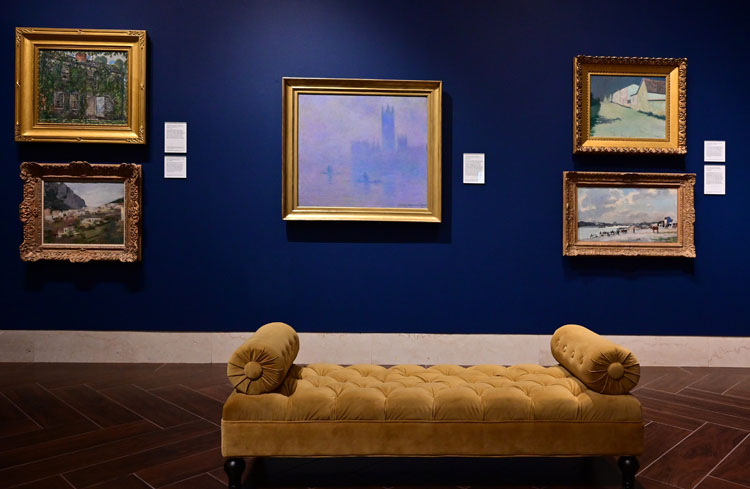
The Impressionists gallery with Monet painting in the center of the room, the art museum in St. Pete, FL

In his later Water Lilies series, Claude Monet heavily utilized violet shadows and purple reflections to capture the fleeting, almost spiritual quality of light and water, mirroring his understanding of the natural world.

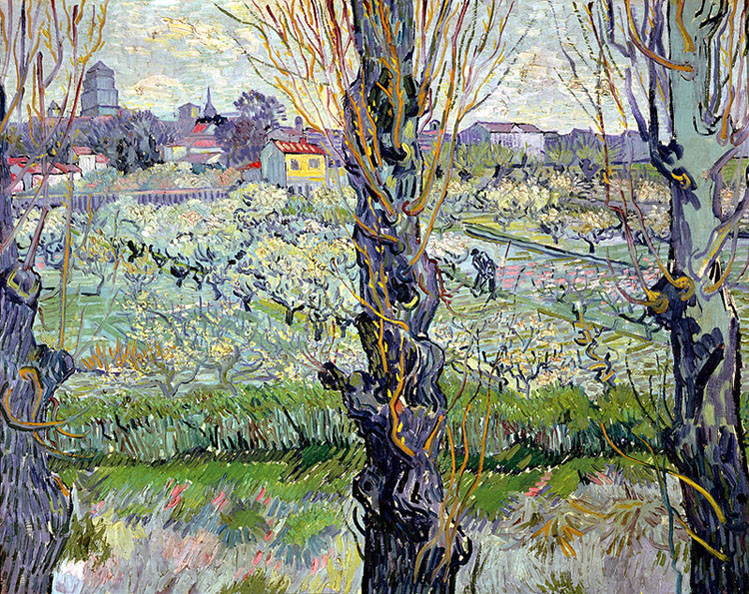
Van Gogh painted “View of Arles, Flowering Orchards” in 1889 using a beautiful color combination of purple and green.
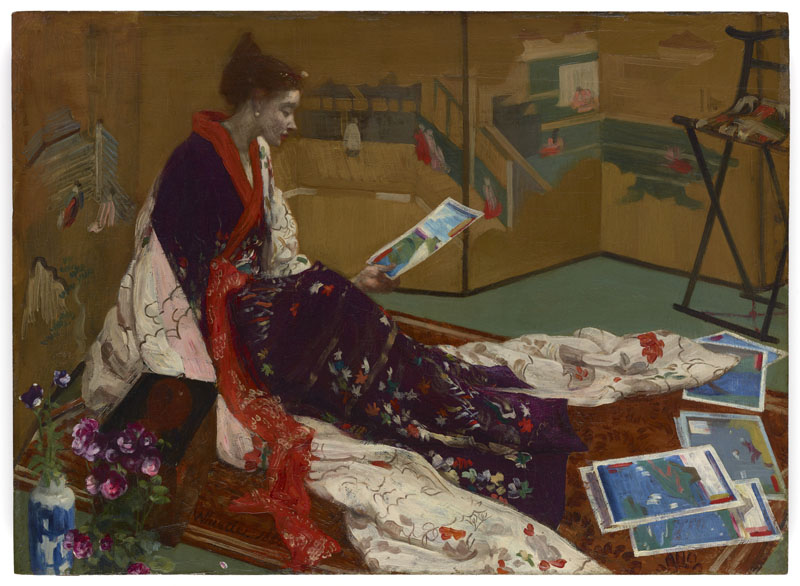
Whistler painted a woman in a Japanese kimono in 1864. The oil on wood art is titled Caprice in Purple and Gold“. In this painting, the kimono’s purple leans towards cool red, giving it a rich mauve hue.

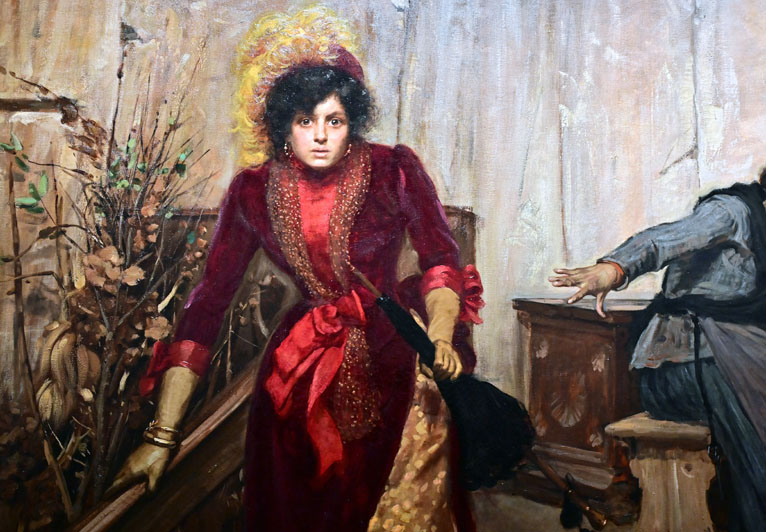
Ponziano Loverini, The Curse of the Mother, Accademia Carrara Museum in Bergamo, Italy.
This is a close-up of the painting showing a woman dressed in a purplish-crimson dress similar to the kimono above.

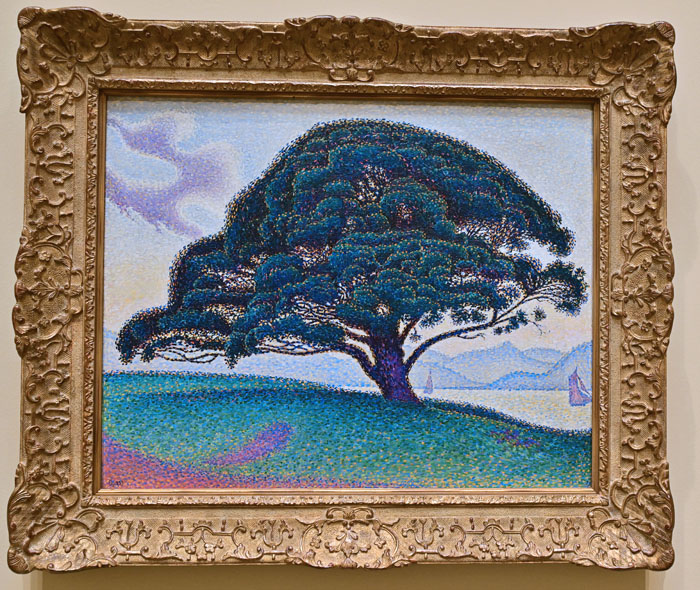
Paul Signac, French, 1863-1935, The Bonaventure Pine in Saint-Tropez, opus 239, 1893, oil on canvas, MFAH, Tx.
Paul Signac painted landscapes of the Mediterranean in the south of France. In this painting, Signac pays homage to the lyrical shape of a particular umbrella pine tree. He places regular, tiny dots of cool colors like purple and turquoise to paint the reflective surfaces of pine needles, grassy plane, and sea. Here, Signac’s pointillism outshines his other artworks in terms of contrast and color.

More art with purple in it:

  • Maximilien Luce, French, 1858-1941, Rue Ravignan-Night, 1893, Oil on canvas, MFAH
    This work is somewhat unusual for Neo-Impressionism in that it depicts a nightscape. Using a high concentration of small dots, Maximilien Luce transforms rue Ravignan, a typical street in the Montmartre area of Paris, into an eerie scene tinged with a melancholy atmosphere of emptiness and isolation. Luce exhibited this intense work at important avant-garde exhibitions in both Paris and Brussels.
  • Robert Lewis Reid (1862–1929), The Violet Kimono, 1910.
  • Pre-Raphaelite painters mixed blue and madder to get rich purples. There are many paintings, including Cloister Lilies, 1891, by Marie Spartali Stillman; Rossetti “The first anniversary of the death of Beatrice; Millais “The Blind Girl” and “Autumn Leaves; William Hunt “The Finding of the savior in the temple”; Author Hughes “April Love”, “The Brave Geraint”, “Home from the Sea” and “The Annunciation”; Burne-Jones “the Beguiling of Merlin”; John Shaw “The Blessed Damozel.”
  • William-Adolphe Bouguereau (French, 1825–1905), Dream of Spring (Rêve de printemps), 1901. This is a very beautiful painting. The image is copyrighted and can be seen on the museum’s site.
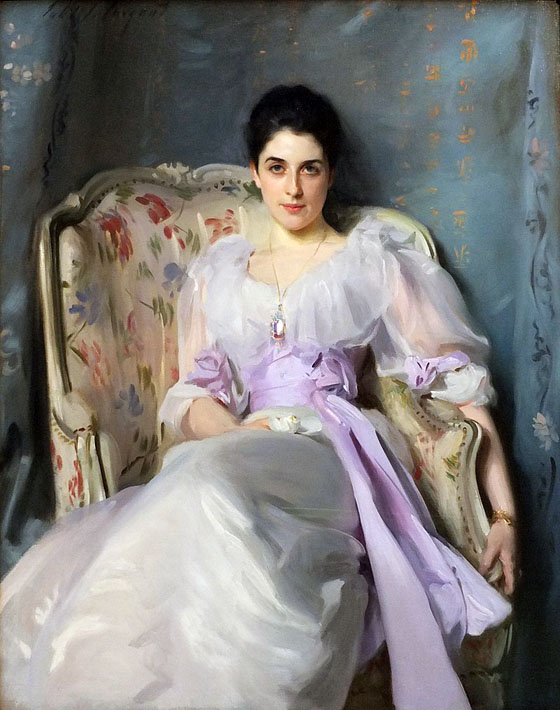
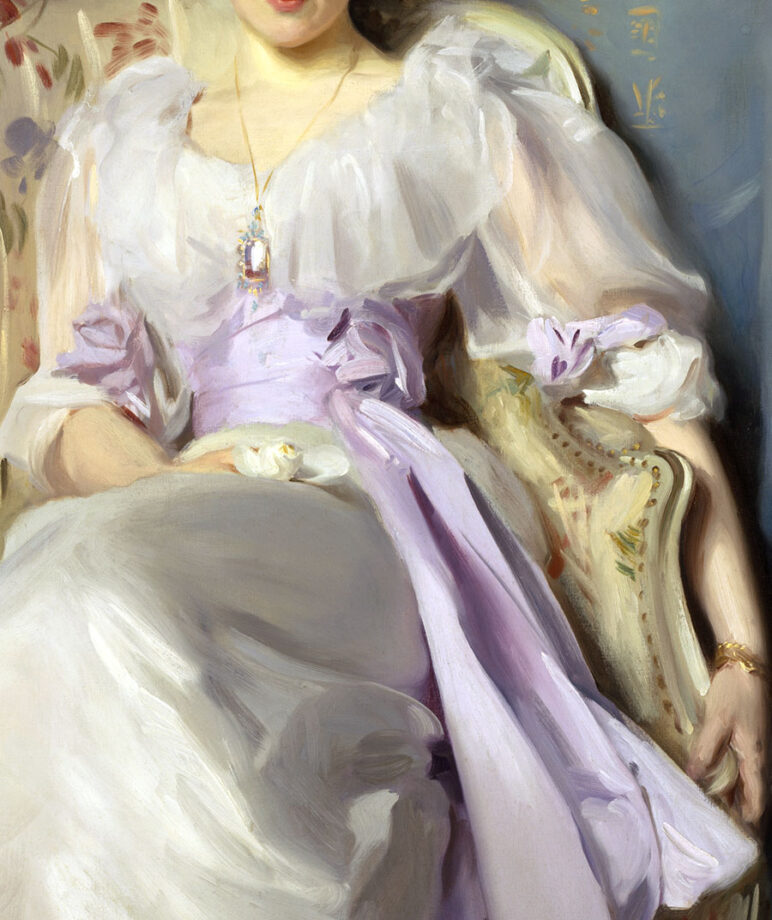
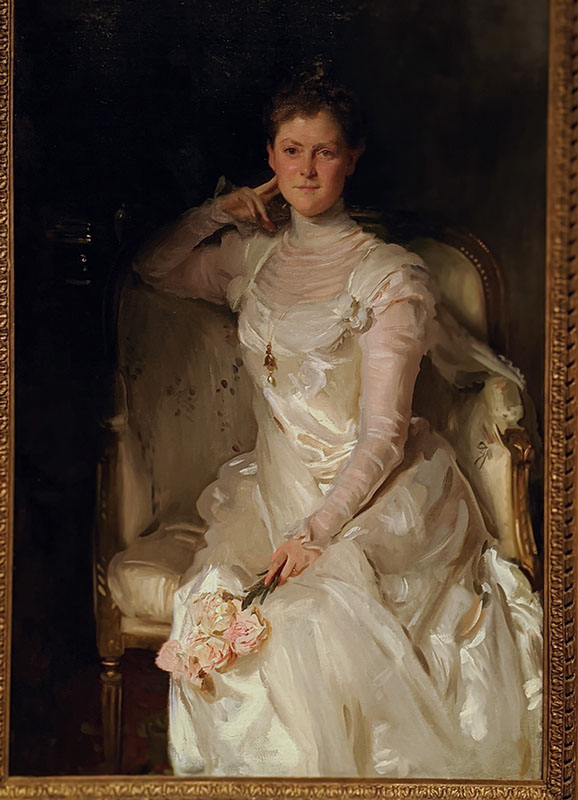
John Singer_Sargent_Lady_Agnew Scottish National Gallery
John Singer Sargent, Lady Agnew of Lochnaw, Gertrude Vernon, (1864-1932), Edinburgh.

Are you interested in learning color harmonies in your art? Take a class to create beautiful color schemes in your paintings!

2. Mystery, Magic, and Spirituality

Because purple is rarely found in large quantities in nature (unlike green or blue), it is often associated with the “unnatural” or the supernatural.

It is frequently linked to the Third Eye, intuition, and mindfulness as esoteric language.

Looking for the color of magic? In literature and film, purple is the go-to color for wizards, sorcery, and cosmic mysteries. It represents the veil between the known world and the unknown.

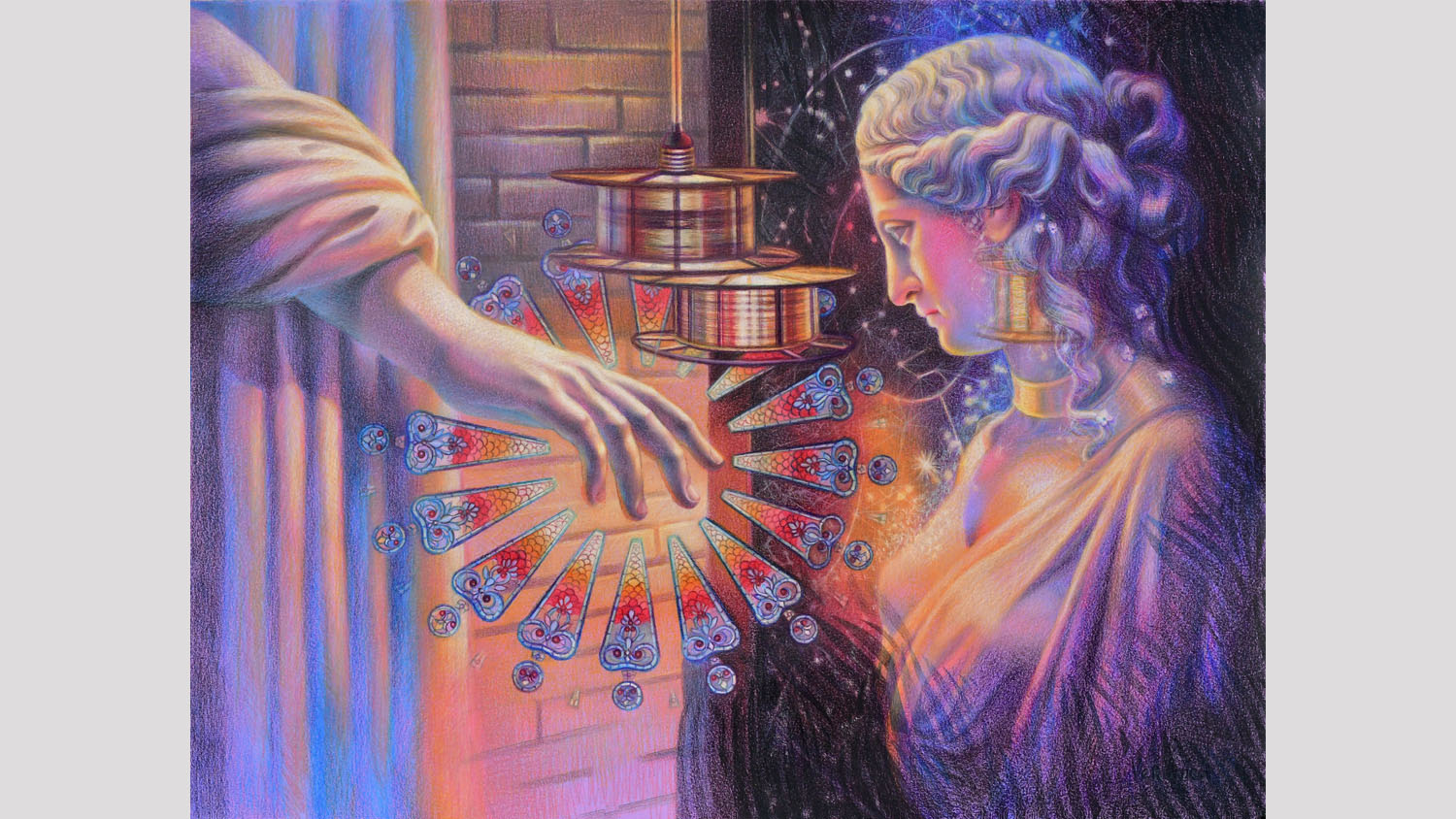
Celestial Room Drawing by Veronica Winters

Celestial Room, colored pencil drawing

$2,200.00

“Celestial Room”, 19×25 inches, colored pencil on paper. Price includes framing. Currently unframed. Feel the Creator. Welcome to the celestial room!


Purple color symbolism in mindfulness and intuition

Veronica Winters colored pencil art
Moonlight, 22x30in, colored pencil on art board, Veronica Winters

In art and spiritual practice, purple serves as a bridge between the physical and the metaphysical, often associated with the Third Eye chakra, intuition, and a deepened state of mindfulness. As a blend of the grounding stability of blue and the passionate energy of red, purple creates a psychological space for introspection and “inner sight.” In mindfulness, the color is used to represent the transition from conscious thought to a higher state of awareness, acting as a visual cue for clarity and spiritual wisdom.

odilon redon-orpheus-pastel on paper 22x27
Orpheus, c. 1903–10 by Odilon Redon, (French, 1840–1916)

A key figure in the Symbolist movement, Redon’s works, like The Cyclops or his late floral pastels, use luminous violets and purples to depict dreamscapes and the “invisible world” of the psyche.

the infinity of human soul-24x36-veronica winters-oil paintings for sale
The infinity of human soul, oil painting on canvas, 24×36, veronica winters

Want more visual inspiration?

This is a beautiful seashell with a beautiful pearlescent purple color. I saw it at the museum in Houston, TX

3. Wisdom and Maturity

As a blend of stable blue and high-energy red, purple is often seen as a color of balance. It is often associated with deep thought or dignity, and In the United States military, the “Purple Heart” medal is awarded to those wounded or killed in service. Here, the color represents a somber dignity, bravery, and the ultimate sacrifice.

flower of life drawing, veronica winters colored pencil
The Flower of Life, colored pencil drawing on paper, 18×25″ by Veronica Winters
Veronica Winters, Promise (of resurrection), oil painting on canvas, details, 16x20in

4. Creativity and Eccentricity

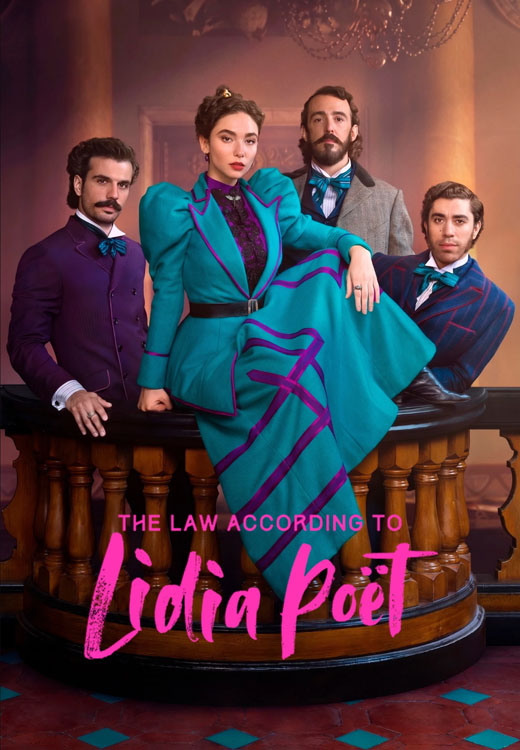
Here you can see a beautiful color combination of purple and turquoise in this fantastic series streaming on Netflix!

In the modern world, the color Purple is often the choice of the rebel artist. It is a bright color that suggests an artistic or unconventional personality. It was a favorite of the 1960s psychedelic movement culture (e.g., Jimi Hendrix’s “Purple Haze” or Prince’s “Purple Rain”) and has long been used to represent individuality and the avant-garde.

And here you have it! Lots of symbolism to decode in just one color.

Art books from the artist:
https://amzn.to/4bbYT81
colored pencil manual veronica winters
https://amzn.to/3xoJjbi
thailand-book-cover-front
The Enigma of Thailand, 2013 https://amzn.to/4qOouLS
https://amzn.to/46mDs4z

If you’d like to discover more, check out other articles below:

Lidia Poët: The True Story of Italy’s First Female Lawyer in Three Seasons on Netflix

The Law According to Lidia Poët” is on Netflix.

Review: The Law According to Lidia Poët


If you are looking for a riveting story and feist for the eyes on “Netflix”, The Law According to Lidia Poët is a must-watch series. This Italian period drama spans three seasons and tells the inspiring true story of Lidia Poët, the first modern female lawyer in Italy. Set in late 19th-century Turin, the show follows her struggle to practice law in a society that legally forbade women from entering the profession. Therefore, she had to work together with her brother, a practicing lawyer in Turin, to investigate cases and save victims from prison.

A Story of Ambition and Style


The series focuses on a young woman who refuses to accept societal norms of that period for an answer. While the show sometimes feels lighthearted or even naive, the lead character is a fantastic role model for women. She represents an inspirational figure with big goals—the kind of character many of us wished we had seen on TV when we were young.


One drawback for families is that the show includes some sex scenes. Although tastefully done, without these, it would be a perfect recommendation for teenage girls looking for career inspiration. However, the core message remains powerful: a woman’s fight to be treated as an equal to men in her chosen field.


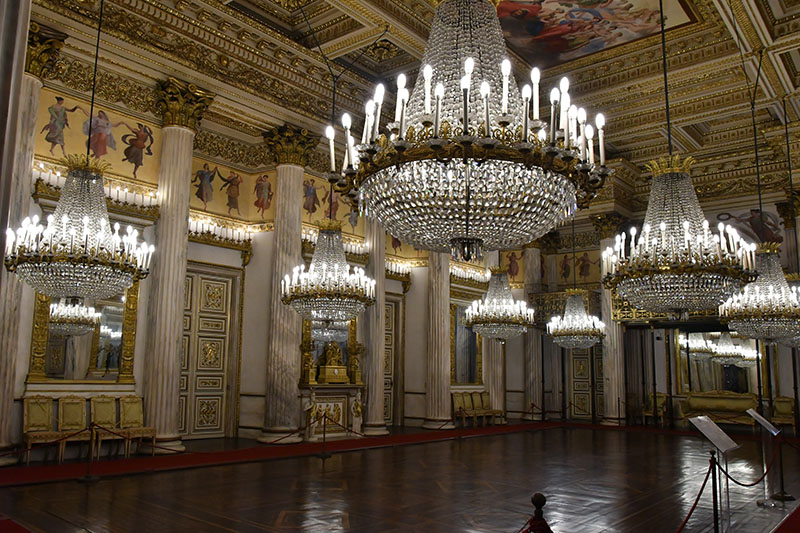
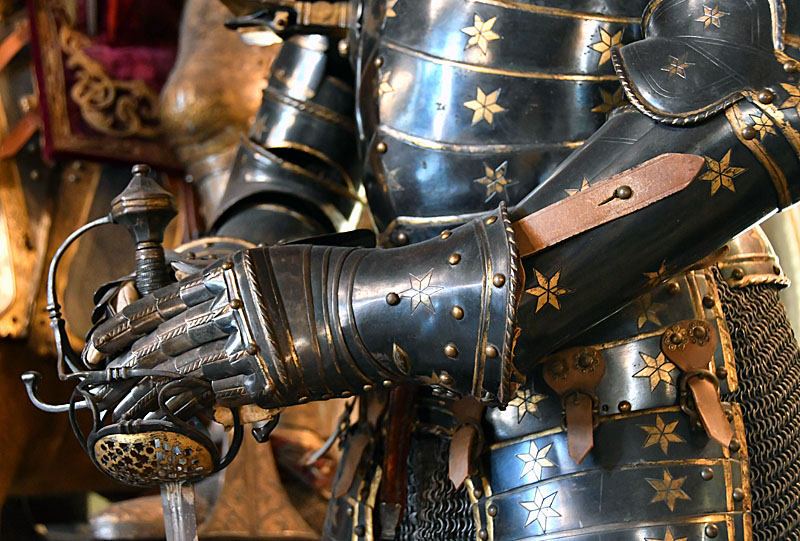
Palazzo Reale (The Royal Palace): The Royal Palace of Turin showcases the opulent lifestyle of the House of Savoy, complete with royal apartments and a world-class armory.

Why Netflix’s Lidia Poët is the Ultimate Period Drama for Fashion Lovers


Lidia Poet is a visual masterpiece! Beyond the story, the production value is incredible. The costume design is stunning enough to deserve an Oscar nomination. Every outfit is a work of art, making the show a literal “feast for the eyes.”

The cinematography is equally impressive. Each scene uses beautiful lighting, creative camera angles, and rich colors. It is easy to get “glued to the screen” because the visual world of 1880s Turin is so absorbing.

Italians are the masters of art, and The Law According to Lidia Poët didn’t disappoint me. According to Netflix, the production employed more than 600 cast and crew members, supported by an additional 2,700 extras and daily hires. They filmed the series across 110 locations—primarily in Turin and the Piedmont region. Artisans created 90 unbelievably beautiful costumes and 100 jewelry pieces! I was totally mesmerized by visual flair of costumes in the series.

The stunning costumes I enjoyed in The Law According to Lidia Poët were designed by Stefano Ciammitti.
Ciammitti is a talented Italian costume designer known for his meticulous attention to historical detail. For this series, his work was specifically praised for how it used fashion to tell a story of female empowerment. He balanced historical accuracy with a modern “editorial” look, using expensive fabrics and unusual patterns (like the “kimono” style robes Lidia wears at home) that have made the show a favorite for fashion bloggers. He was supported by Sara Barsotti, the costume supervisor, and a large team that sourced and created the elaborate 19th-century wardrobes. He often incorporated restrictive elements like stiff waistcoats and structured jackets to mirror the legal and social restrictions Lidia faced at that time. You may have noticed Lidia wearing “suit and tie” blouses, which was a deliberate choice by Ciammitti to show her emulating the professional attire of men to be taken seriously in court.

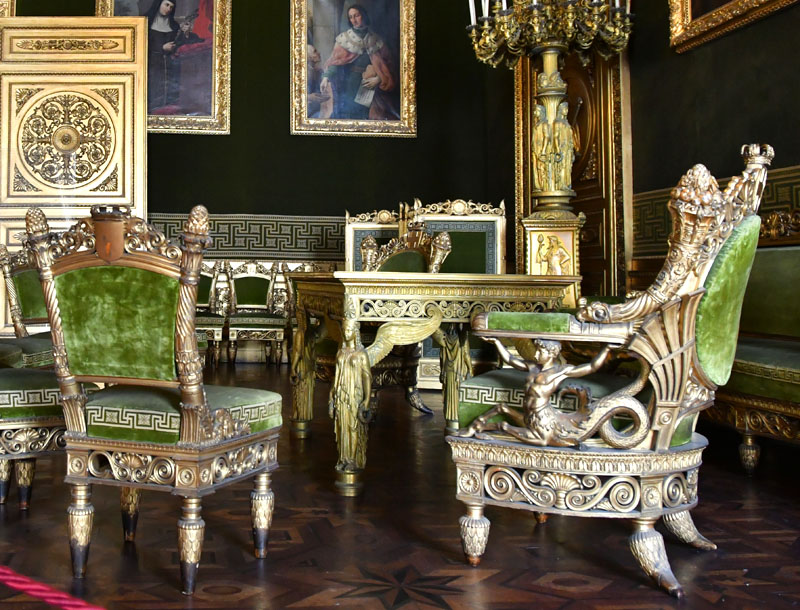
The Royal Palace of Turin, one of the rooms with green chairs

Most of the scenes were shot in Turin, including town’s prison Le Nuove and the Le Nuove Museum. For the third season, the crew moved to Rome. I love Italy for its landscape, art and people. I visited it numerous times, and I have been to Turin in the past. I hope you’ll feel inspired to travel there after watching this fascinating series.

Art in Turin, Italy

The Cast and Characters:


The actors bring this history to life with great skill and charm:
Matilda De Angelis (Lidia Poët): A talented and oh so beautiful Italian actress was born in Bologna. Before this series, she gained international fame starring alongside Nicole Kidman in the HBO hit The Undoing. Besides acting, Matilda is also a singer.
Eduardo Scarpetta (Jacopo Barberis): Also Italian, Scarpetta comes from a famous family of actors and playwrights in Naples. He is well-known for his role in the acclaimed series My Brilliant Friend.
Pier Luigi Pasino (Enrico Poët): Known for his work in Italian theater and television, he plays Lidia’s brother, providing a grounded contrast to her rebellious spirit.

While I wish there were more than three seasons, the existing episodes are perfect for relaxing and finding a bit of inspiration after a long day of work.

What to see in Turin inspired by the series:

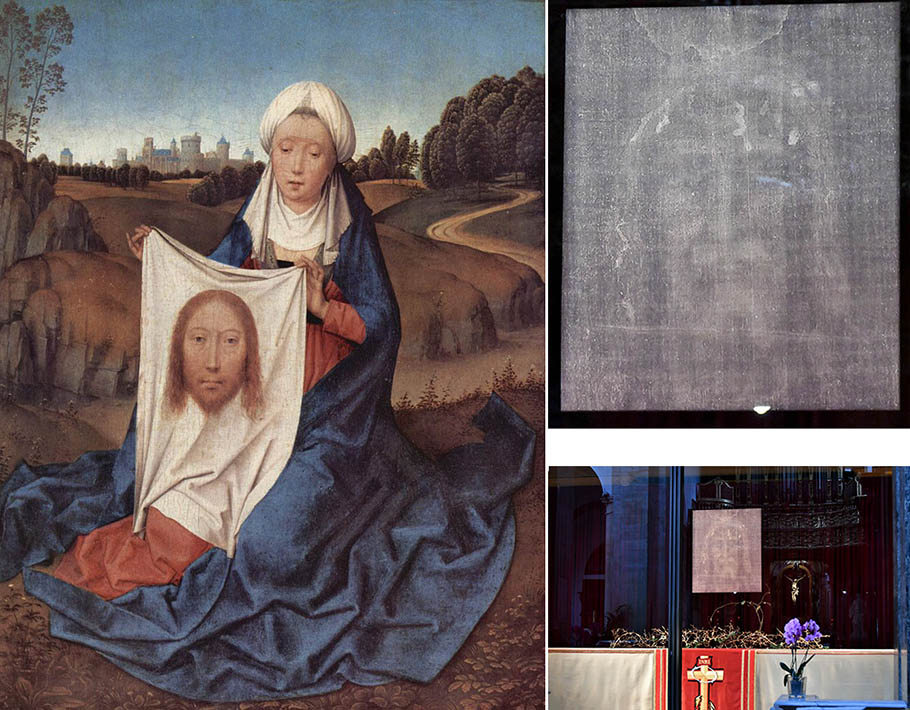
Hans_Memling veronica holding her veil, 1470 and christ in turin
Turin is a beautiful, artsy town in Italy that’s famous for its shroud of Turin. Hans Memling, Veronica holding her veil, 1470 and image of Christ on the shroud of Turin in the church

Turin is a city defined by royal Savoy history, grand baroque architecture, and a unique cinematic atmosphere. Whether you are interested in ancient artifacts or the elegant filming locations of period dramas like The Law According to Lidia Poët, here are the top places to visit.

Painting detail of angels, art in Turin, Italy

Mole Antonelliana is the undisputed symbol of the city. Originally designed as a synagogue, this 121-meter tall spire now houses the National Museum of Cinema and features a glass elevator with 360-degree views of the city and the Alps.

Palazzo Reale (The Royal Palace): The Royal Palace of Turin showcases the opulent lifestyle of the House of Savoy, complete with royal apartments and a world-class armory.

Egyptian Museum: The Museo Egizio is one of the most important museums in the world for Egyptian antiquities outside of Cairo, housing thousands of artifacts from statues to papyrus scrolls.

Palazzo Madama: Located in the heart of Piazza Castello, Palazzo Madama features a stunning baroque facade wrapped around a medieval castle, now serving as a museum of ancient art.

For those who enjoy the elegant 19th-century aesthetic seen in The Law According to Lidia Poët, a visit to Palazzo Carignano is essential; its unique red-brick facade served as the exterior for the courthouse in the series.

Parco del Valentino: Parco del Valentino is a peaceful riverside park home to the Castello del Valentino and the Borgo Medievale, a charming replica of a 15th-century village.

Basilica of Superga: Perched on a hill overlooking the city, the Basilica of Superga offers one of the best panoramic views of Turin and was also featured in the Netflix series.

Turin is famous for its historic cafes and chocolate. A visit is incomplete without trying the Bicerina local drink made of coffee, chocolate, and cream. Visit the legendary Caffé Al Bicerin, where this famous drink originated in 1763, located in the beautiful Piazza della Consolata.

Have fun traveling to Turin, guys!

Check out my art by tapping the images below. 🙂

Heaven’s Light, oil panting on panel, 24×36 in., interior view

Art books from the artist:
https://amzn.to/4bbYT81
colored pencil manual veronica winters
https://amzn.to/3xoJjbi
thailand-book-cover-front
The Enigma of Thailand, 2013 https://amzn.to/4qOouLS
https://amzn.to/46mDs4z


The Queen’s Hidden Palace: Isabella Stewart Gardner’s Boston Legacy of Art, Intrigue, and the Greatest Heist Ever

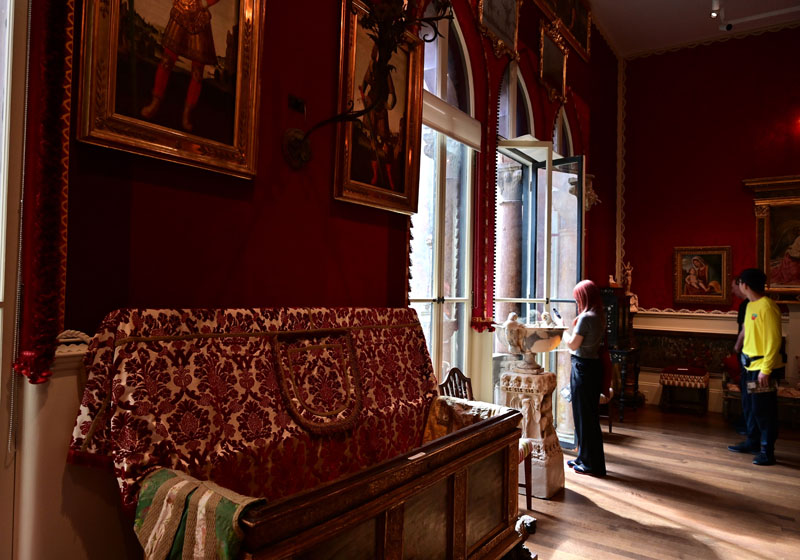
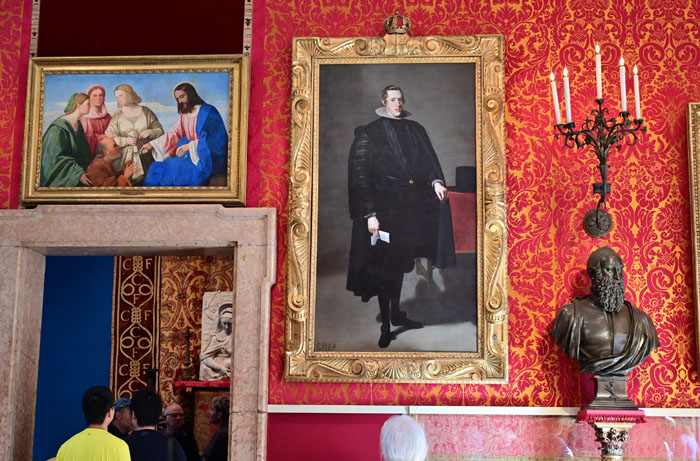
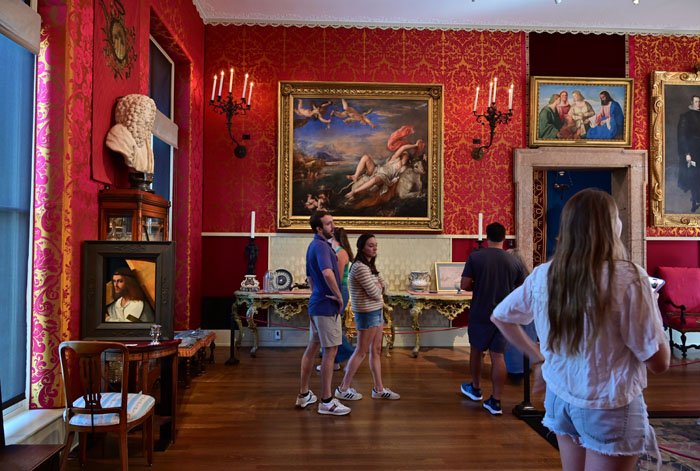
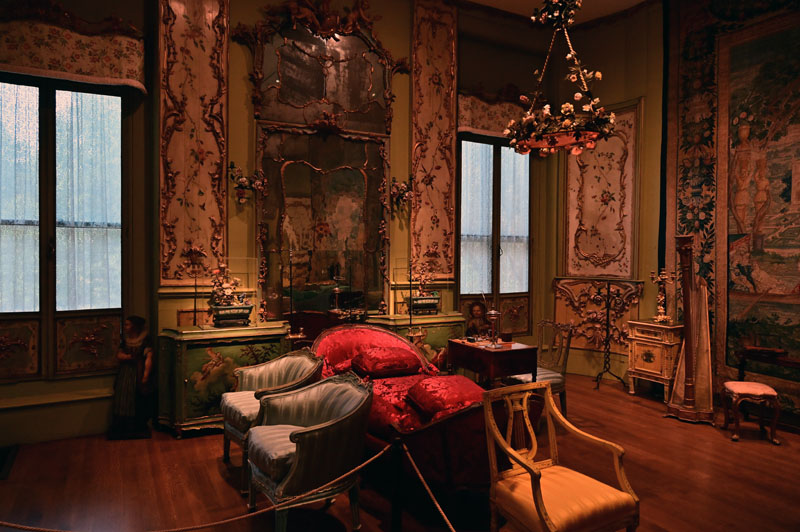
The Titian Room’s details

From Venice to Boston: The TRUE Story of America’s Craziest Art Collection & the Thieves Who Stole It


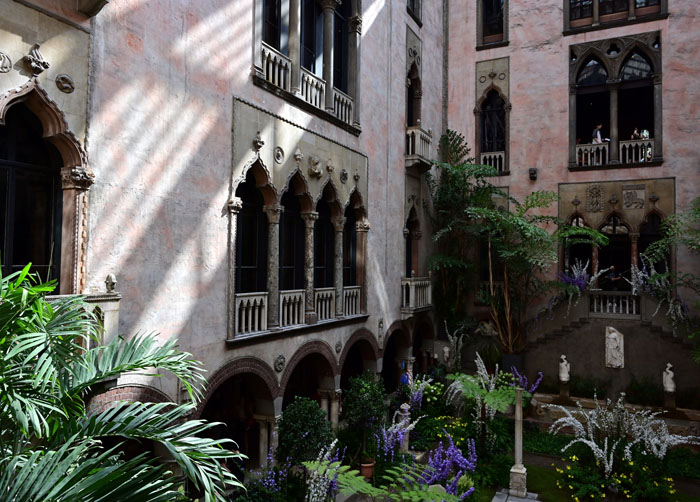
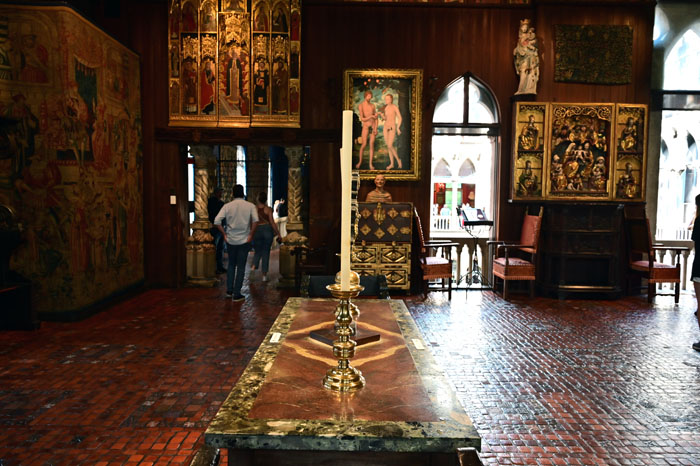
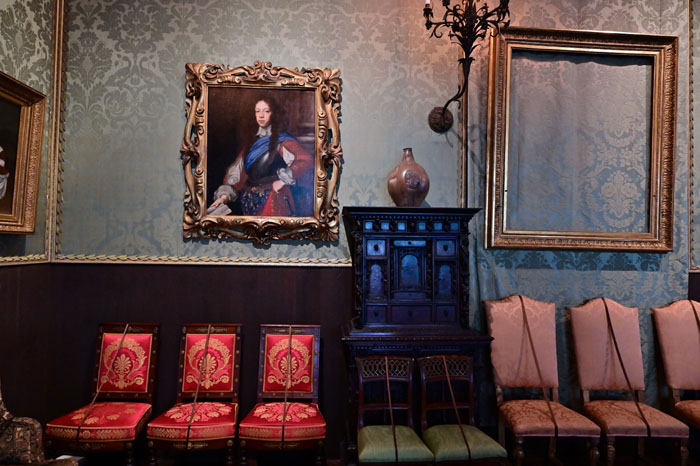
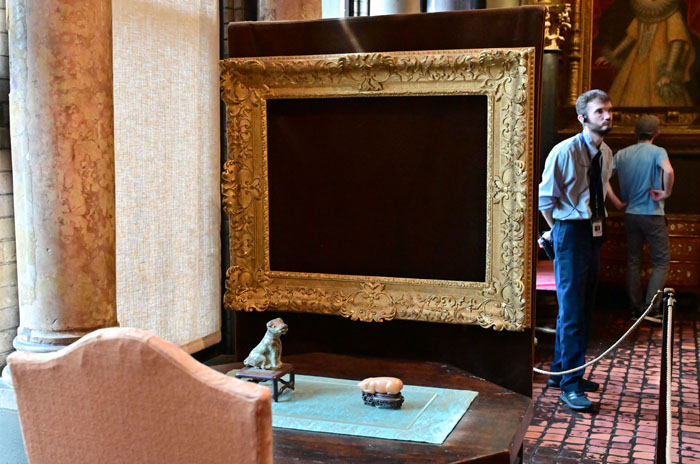
Imagine stepping into a stunning Venetian palace hidden in the heart of Boston—not a stuffy museum with white walls and random contemporary art, but a living, breathing dreamscape filled with Renaissance masterpieces, exotic sculptures, famous art, and the whispers of scandalous parties attended by the era’s greatest minds. This is the world of Isabella Stewart Gardner, the fiery socialite and adventurous spirit who turned her passion for beauty into one of America’s most audacious art collections. The house is her magical creation. But beneath the glamour lies a shadow: the largest art theft in history, a crime so brazen it left empty frames mocking visitors to this day. Welcome inside the powerful, enigmatic realm of Isabella Gardner—a tale of creative vision, tragedy, and treasures still missing.

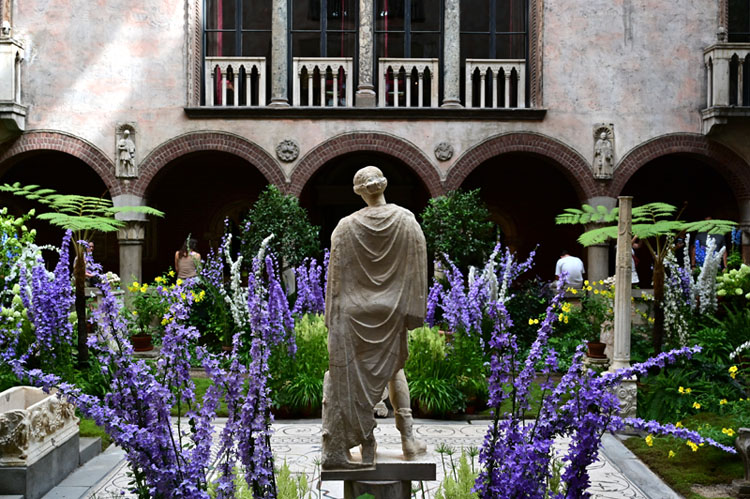
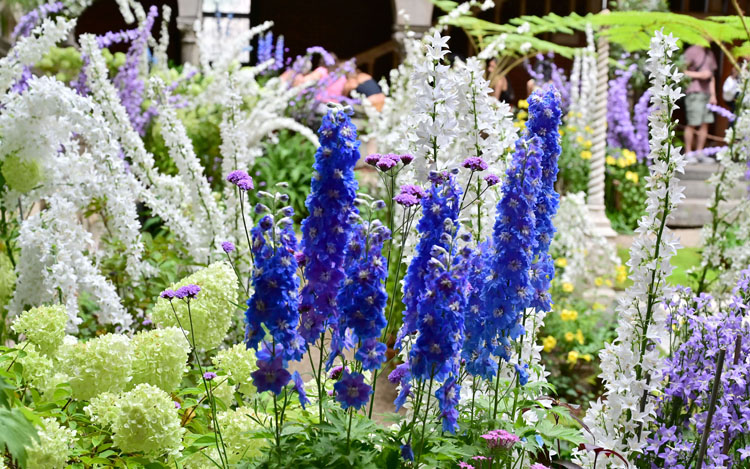
Dedicated to the enjoyment of the public from the very beginning, this palace was never Isabella’s house. Rather, it is a Venetian-style palace filled with art, history, and beauty that reflects her aesthetic and taste. The courtyard alone is a stunning floral masterpiece!

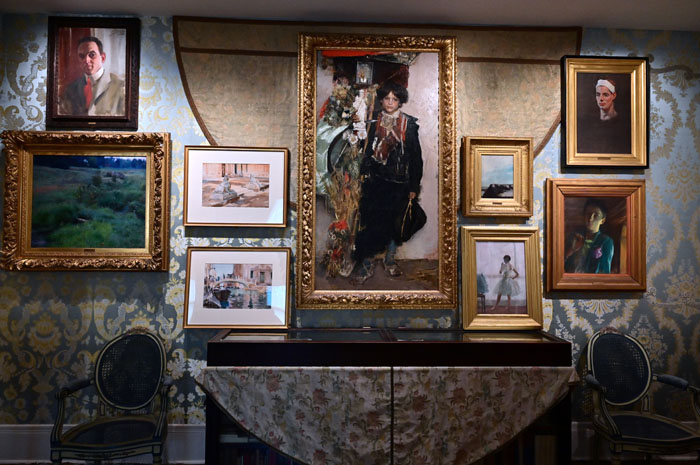
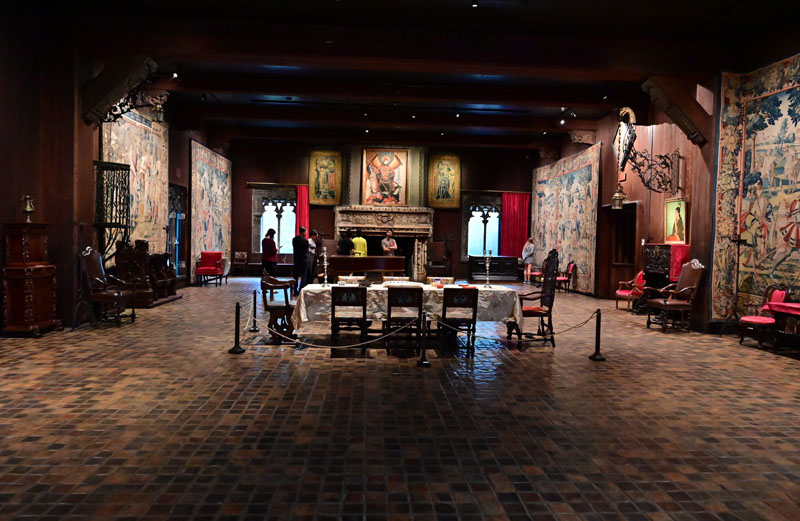
Gothic Room

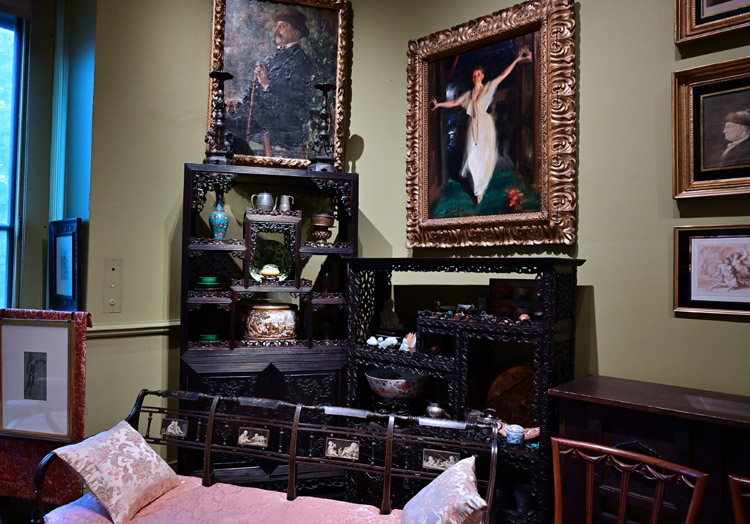
Isabella Stewart Gardner Museum History and Life: stunning art collection inside

Courtyard with Roman Sculptures and changing floral displays


Born in 1840 to a wealthy New York family of linen merchants, Isabella Stewart was no shrinking violet. Nicknamed “Belle,” she was sharp-witted, fiercely independent, and destined to shake up Boston’s buttoned-up elite. She grew up in Manhattan and lived in Paris and Italy in her teenage years, studying art, languages, religion, and music. At 20, she married John “Jack” Gardner, heir to a shipping fortune, in a union that blended New York flair with Boston restraint. They settled into a grand townhouse on Beacon Street, but joy turned to heartbreak when their only child, little Jackie, died at 18 months from pneumonia in 1867. Isabella had multiple miscarriages and a stillbirth. After such brutal beginnings, Isabella experienced severe depression. Devastated, the Gardners escaped into the world, embarking on grand tours of Europe (Scandinavia, Russia, Paris, etc) and the Middle East ( Northern India, Syria, and Egypt). Venice became their obsession—the city’s labyrinthine canals and opulent palazzos igniting Isabella’s passion for the arts.

“Venice is like eating an entire box of chocolate liqueurs at one go,” she once quipped.

These artful journeys of an entire decade were awakenings to her true passion. Art. Isabella devoured art history, studied Italian literature at Harvard—unheard of for a woman then—and began amassing rare books, her first foray into art collecting. In 1875, her husband’s brother died, and Jack and Isabella adopted three boys.

Where did Isabella’s wealth come from?

Isabella’s wealth came from her father, who imported textiles from Europe to the US at first, and then he made investments in railroads and mines, accumulating a fortune that he gave to his daughter at 51 after his passing. According to Diana Greenwald, Curator of the Collection at the Gardner, Isabella inherits the equivalent of about seventy-eight million dollars in today’s money. She and her husband, Jack, jointly decide that they are going to live off of Jack’s money, which also comes from family inheritance and investments. And they will spend her money on art.

Sargent’s scandalous painting of Isabella Stewart Gardner, inside the museum.

When you walk into the Gothic Room, you’ll see a vertical painting in the corner, depicting Isabella Stewart Gardner in a simple black dress set against red-orange Italian textile. Painted by a famous artist in her day, John Singer Sargent, the woman is 47 in this oil painting. Sargent was known for painting large portraits of high-society men and women in loose, fresh, and fluid brushstrokes. In this one, he designs the painting in circles: the halo above her head, the circle of pearls on her waistline, and a circle of her interlocking hands. She stands tall, facing us with confidence. It was a scandalous portrait among Bostonian high society at her time.

Isabella Gardner art collection & Bernard Berenson

The Raphael room with a Roman stone bowl


By the 1880s, Isabella’s tastes evolved from manuscripts to canvases. She met Bernard Berenson, the charismatic Harvard art connoisseur of Italian Renaissance art who became her lifelong advisor and confidant. Together, from the 1890s onward, they scoured Europe for gems, outbidding rivals in smoky auction houses. As she inherited almost 2 million from her father, Isabella began her art collecting journey of European fine art. Isabella’s eye was eclectic and bold: Italian Renaissance masterpieces like Titian’s The Rape of Europa, a stormy seascape by Rembrandt, and delicate Chinese bronzes from ancient dynasties, the Concert by Vermeer (bought at a Paris auction), and delicate Botticelli’s Madonna and Child. She snapped up Impressionist stunners—Manet’s cheeky Chez Tortoni—and even contemporary works by Matisse. No dusty timelines here; her collection spanned 3,000 years across five continents, blending European art with vibrant Persian textiles, silver, manuscripts, ceramics, and architectural pieces. By her death, it numbered over 2,500 objects, a fortune that would rival kings.

Art is in one of the rooms on the first floor

Isabella Stewart Gardner Art Collection Highlights (listed in the museum’s brochure):

“A young country is in need of the arts,” Isabella once said.

First Floor: When you walk into the Palace, you have to adjust your eyesight as it seems dark at first, especially in the first floor’ cloisters. Isabella not only designed the rooms and art displays, but also varied the lighting in each room of the house. It’s crowded on the first floor, and some rooms have a line with a 5-10 minute wait time to enter.

Zorn’s painting of Isabella
  • Courtyard: Incredibly beautiful courtyard features the Roman mosaic in its center, depicting Medusa. It also hosts all female Roman statues. A novel glass roof was Isabella’s design. As it doesn’t emit the UV light to protect the art, the flowers must change weekly, and the entire floral arrangements must change every 6 weeks, according to Christina Nielsen, Curator of the Collection. The Venetian-style windows are reminiscent of Venice if they were transported from Italy to the US.
  • Spanish Cloister: This is a very dark space that mimics the directional light in the painting El Jaleo by John S. Sargent.
  • Chinese Loggia: Chinese Votive Stele
  • Yellow Room: Henri Matisse, the Terrace St-Tropez & James Whistler, Harmony in Blue and Silver. Lady in Yellow by Thomas Wilmer Dewing
  • Blue Room: this room features Isabella’s personal friendships, including art, bookcases, and cases with objects and letters. Artists such as John S. Sargent, Madame Gautreau, drinking a toast; Anders Zorn, the Omnibus, Eduard Manet, Madame Auguste Manet; John Singer Sargent, A Tent in the Rockies, watercolor; Return from the Lido by Ralph Wormeley Curtis; Incensing the Veil, watercolor by John Singer Sargent;
  • Macknight Room: the only room in the Museum to be named after a contemporary artist, this space is dedicated to the watercolor art of Dodge Macknight. This room with small paintings served as an apartment for Isabella Stewart Gardner’s guests in the beginning. John S. Sargent, Mrs. Gardner in White; Diana, bronze sculpture by Paul Manship.
  • The Vatichino—the little Vatican is a narrow space located in the adjacent Macknight Room. According to the museum, it originally contained 1,850 objects, including art, pictures, books, Mexican portraits, and souvenirs like a Sudanese dagger purchased in Egypt. The room houses a small portrait of Gardner in fancy dress by Dennis Miller Bunker.
Isabella Stewart Gardner Museum: Tapestry room
Titian Room paintings

Second Floor: I think the 2nd and 3rd floor has the most beautiful rooms and art reminiscent of beautiful Venice. I felt like I was transported into the past of a prosperous Venetian city-state.

  • Early Italian Room: This room has the collection of Italian Gothic and Renaissance paintings by P. della Francesca, Hercules; Fra Angelico, the Dormition and Assumption of the Virgin, etc.
  • Raphael Room: One of the most beautiful rooms in the palace is dedicated to Raphael. Decorated in vivid, luxurious red, this opulent room displays paintings by the 15th and 16th-century Italian painters, ancient Roman wall paintings, sculptures, and vases. Two heavy velvet curtains flank the Venetian-style fireplace. Art includes the portrait of Tomasso Inglirami by Raphael; the Annunciation, 1487 by Piermatteo d’Amelia; The Story of Lucretia, 1500 by Sandro Botticelli; Saint George Slaying the Dragon, 1470 by Carlo Crivelli; Virgin and Child,1457 by Francesco Pesellino. The window light bathes an ancient Roman stone bowl with two animals, adding history and glamour to this room.
  • Short Gallery: the Short Gallery displays Isabella Stewart Gardner’s collection of prints and old master drawings, old books, textiles, and family portraits. You need to open the panels to see drawings by Michelangelo and Bronzino, Henri Matisse, etc as they’re sensitive to the light. You can see Isabella in white and pearls painted freely by Anders Zorn and titled “Isabella Stewart Gardner in Venice.”
  • Little Salon: Little Salon is done in the Rococo art style with wines and flowers, housing French paintings, Italian furnishings, and German sculpture. Huge, lavish tapestries decorate the wall space, along with the 1780 mirror, purchased from the Palazzo Morosini in Venice. At the top of the mirror is an oval shield with the arms of Doge Francesco Morosini (1619-1694). Delicate blue armchairs, covered in blue moiré satin striped fabric, are painted furniture that was purchased by Isabella Stewart Gardner in Venice in 1906. Here you’ll find an oil painting created by the court artist to King Louis XV- The Chariot of Venus, 1750 by François Boucher.
  • Tapestry Room: The Tapestry Room is one of the largest and darkest spaces in the palace that evokes a great medieval ballroom in a northern European castle. This room has beautiful art: Saint Engracia, 1474 by Bartolomé Bermejo, cases with Islamic manuscripts, Pedro Benabarre, St. Michael Archangel above the fireplace, etc. Ten large, rich Flemish tapestries decorate the walls, depicting stories of the ancient Persian king Cyrus the Great and Abraham.
  • Dutch Room: The Dutch room features light green Venetian-style fabric walls with art by Anthony van Dyck, Woman with a rose, Rembrandt, self-portrait, age 23; Peter Paul Rubens, Thomas Howard. Rembrandts were stolen from this room, and empty frames still hang on the walls. The Dutch Room is also large, and Gardner enjoyed entertaining guests in it. She hosted dinners there, including one for the Harvard football team following their victory over Yale in 1909, according to the museum’s description.
Saint Engracia painting in the Tapestry Room in the Gardner Museum

Stairway:

  • Giorgio Vasari – Musicians, about 1545, fresco
  • Even the staircases look enigmatic, filled with sculptures, fragments, and decorations. Isabella Stewart Gardner asked to paint the main stairwell from the Courtyard to the second and third floors in Bardini Blue, a shade of royal blue favored by the Florentine gallery owner Stefano Bardini. Here you’ll find the Portrait of a Lady in Black by Domenico Tintoretto.
Titian room with Rape of Europa painting inside the Isabella Stewart Gardner Museum

Third Floor:

  • Veronese Room: This reflects Isabella Stewart Gardner’s love for Venice, like some other rooms in the palace. The painting on the ceiling, the Coronation of Hebe, was attributed to Veronese, an Italian Renaissance master. Isabella collected an eclectic mixture of objects here, such as leather panels from Spain, Italy, and the Netherlands, gilded china saucers, cups, and a pitcher, and the Venetian chair-seat from a Gig. There are several small pastels by James McNeill Whistler as well.
  • Titian Room: The Titian Room is another opulent space in stunning red. Bathed in bright, afternoon light, this space is a spectacle of Baroque textiles and Rococo furniture, showcasing art by Titian, Rape of Europa; B.Cellini, Bindo A.; Velázquez, Philip IV of Spain, Landucci’s armchairs, Circle of Bellini, Christ carrying the cross.
  • Long Gallery and chapel: the Long Gallery is also a very interesting space in blue and gold because it accommodates an archive, a library, a gallery, and a chapel all at once. You’ll pass by a variety of ancient objects, sculptures, church furniture, modern letters, photographs, rare books, Renaissance paintings, and the 12 cases of historical manuscripts, personal correspondence, etc. Here you’ll find Botticelli, Virgin and Chil,d and the stained-glass window from Soissons Cathedral.
  • Spanish Chapel: Tomb Figure of a Knight, about 1498-1500, Salamanca, alabaster; The Self-Mortification of Saint Benedict, about 1496 by Albrecht Dürer, (Nuremberg, 1471 – 1528), white glass with silver stain, vitreous paint, and back-painting
  • Gothic Room: Simone Martini, Virgin and Child; Giotto, Christ Child in the temple; John S. Sargent, Isabella Stewart Gardner, Adam and Eve,16th century by Lucas Cranach the Elder. Dark and mysterious, this Gothic room was designed as a chapel with Gothic art, beautiful old books, chests, and a stained-glass window from a French Cathedral! In a wooden bookcase, you’ll find a collection of books by the medieval Italian writer, Dante.
Rembrandt’s self-portrait in the Dutch Room of the Palace

Venetian palazzo in Boston

Raphael’s room: the Roman stone bowl


During the couple’s visits to Venice, they stayed in the Palazzo Barbaro on the Grand Canal, which was an inspirational hub for her soul. Back home in Boston, Isabella didn’t want her treasures locked in a vault for herself only. In 1898, tragedy struck again—Jack died suddenly of a stroke at 65. Undeterred, the 58-year-old widow poured her grief into creation. She bought a swampy Fenway plot and envisioned Fenway Court: a 15th-century Venetian palazzo transplanted to Boston’s marshes. Construction began in 1899 under architect Willard T. Sears, blending Byzantine mosaics, Gothic loggias, and a soaring glass-roofed courtyard garden bursting with exotic blooms year-round—palm fronds swaying beside marble statues, a living heartbeat at the museum’s core. Completed in 1901, Isabella spent two years installing her collection exactly as she dreamed: no chronological order or labels, just poetic juxtapositions, no changes afterwards. A Raphael self-portrait gazes over 18th-century French furniture; Greek artifacts mingle with Japanese screens. She opened the doors to the public in 1903, but with a twist—this was her home on the 4th floor, too. Upstairs, her private apartment brimmed with lion-skin rugs and velvet drapes, the rest of the house was destined to become an art museum. She was 62 years old when Isabella opened it. When she died in 1924 (at 84), her will about the art museum came into effect.

Isabella Gardner famous parties

Little Salon


Fenway Court wasn’t a mere art gallery for private parties; it was Boston’s cultural supernova that she designed herself. Isabella, the “Queen of the Back Bay,” hosted legendary soirées: Bach concerts under the courtyard stars, literary salons where ideas crackled like fireworks. Her circle? A who ‘s-who of genius. John Singer Sargent, who immortalized her in a scandalous portrait, dined at her table. Henry James, the novelist, called her his “splendid and terrible Isabella,” penning tales inspired by her Venice haunts. Whistler sketched her; Anders Zorn painted her; even Asian scholar Okakura Kakuzō shaped her taste for Eastern art. She championed women like Julia Ward Howe and backed composers like Walter Damrosch. Eccentric to the core, Isabella once crashed a symphony in a Red Sox headband, scandalizing prudes. Her parties blurred the lines between high society and bohemia, making Fenway Court the epicenter of America’s Gilded Age arts scene.

I must mention the Gardner Museum courtyard garden, which is incredibly beautiful and draws you in with serene flowers and the exotic architectural vibe of the Venetian-style house. The Courtyard showcases Isabella Stewart Gardner’s exquisite taste as she arranged a beautiful display of objects from all over the world: Africa, Italy, Spain, Greece, etc . You can see all rooms here: https://www.gardnermuseum.org/experience/rooms

Isabella Stewart Gardner Museum Heist

The Dutch room: stolen art in the Gardner museum


Yet for all its splendor, Fenway Court harbors an unsolved Isabella Stewart Gardner museum heist story. On March 18, 1990, two thieves in Boston police uniforms duped night guards Rick Abath and Randy Herguard into buzzed entry. “We got a report of a disturbance,” they lied. What followed was cinema-villain audacity: 81 minutes of mayhem. They covered the security guards’ eyes and mouths with duct tape, handcuffed them to pipes, and put them in basement spaces, away from each other. The thieves also disabled security cameras and pillaged the Dutch Room.

Saws whirred as they slashed Rembrandt’s Christ in the Storm on the Sea of Galilee—his only seascape he ever painted—from its frame (Rembrandt’s face is one of the men painted in a seascape). They also took another large Rembrandt with a double portrait of a Dutch couple, ripping off the canvases from their frames with a sharp blade! The thieves also ripped off a painting they thought was the third Rembrandt but it was his student’s art ( Govert Flinck was one of numerous students). According to Anthony Amore, the thieves also planned on stealing Rembrandt’s self-portrait, painted at 23 years of age, as they took it down, turned it to lean against the chest, and then forgot to take this painting with them!

They pocketed Vermeer’s The Concert, one of just 36 artworks ever painted by the artist, worth $250 million alone, five Degas sketches ( three of them are images of jockeys and horses), a tiny, postage-stamp-sized Rembrandt etching, and an eagle finial from the Imperial Guard of Emperor Napoleon; the flag vanished too. Total haul: 13 pieces, half a billion dollars. They had stolen six pieces from the Dutch Room and six from the Short Gallery: the drawings and the eagle. That makes 12. There’s one more small painting by Manet they took from the Blue Room downstairs.

The thieves spray-painted a camera lens for good measure and fled into the dawn, leaving the guards bound till morning. The thieves spent an hour and 21 minutes inside the museum, more than any other thieves! To this day, those gaping frames hang exactly as the thieves left them—a defiant monument to loss. The FBI’s probe rages on, with a $10 million reward dangling like forbidden fruit. Was it mafia muscle? Art-world insiders? Theories swirl, but the masterpieces remain ghosts.

It looks like the thieves were ordered to steal Rembrandts as every other museum in Massachusetts with Rembrandt paintings had been robbed before the Gardner’s, according to the audio talk by Anthony Amore, the Museum’s Chief of Security, and Chief Investigator. Could one of the thieves be French, as other French artworks disappeared from the museum too?

The Dutch room: stolen art in the Gardner museum

The Isabella Stewart Gardner Museum stolen art: true crime art heist

On March 18, 1990, 13 artworks were stolen from the Isabella Stewart Gardner Museum in Boston, Massachusetts. The Gardner Museum theft remains unsolved, and as of October 2025, none of the items have been recovered. The total estimated value exceeds $500 million, with a $10 million reward offered for information leading to their return in good condition. Below is a complete list of the 13 artworks stolen from the Gardner Museum.

An empty frame showing the unsolved Gardner Museum theft.
Vermeer the concert heist: this is one of the stolen paintings from the art museum.
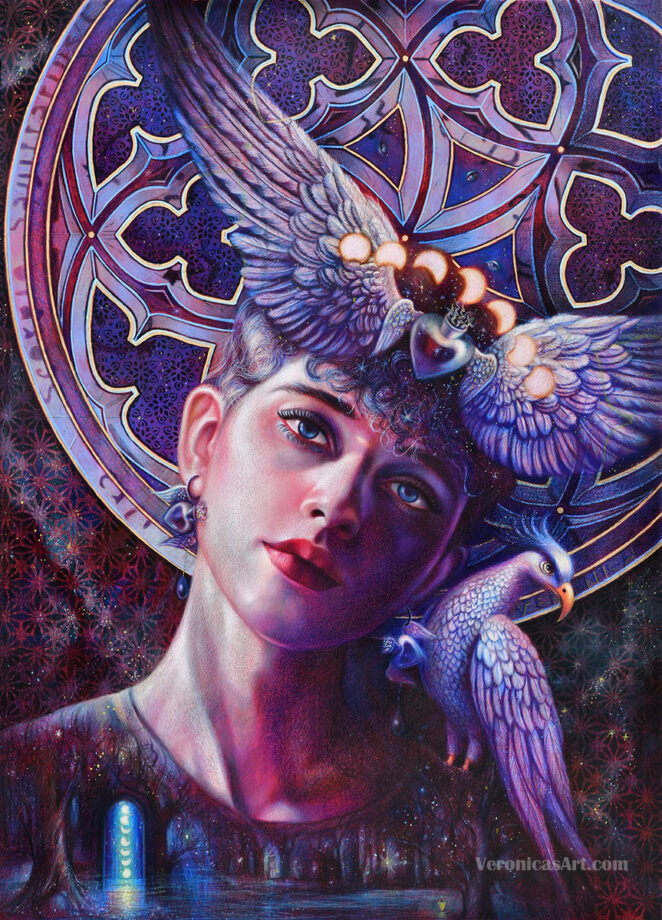
#ArtistTitleDateMediumEstimated Value
1Rembrandt van RijnThe Storm on the Sea of Galilee1633Oil on canvas$140 million
2Rembrandt van RijnA Lady and Gentleman in Blackc. 1633Oil on oak panelNot specified
3Johannes VermeerThe Concertc. 1664Oil on canvas$250 million
4Édouard ManetChez Tortoni1878Oil on canvasNot specified
5Govert FlinckLandscape with an Obeliskc. 1638Oil on canvasNot specified
6Edgar DegasProgram for an Artistic Soiréec. 1879Charcoal and chalk on paper< $100,000 (combined for Degas sketches)
7Edgar DegasLa Sortie du Conservatoire (study)c. 1879Pencil on paper< $100,000 (combined for Degas sketches)
8Edgar DegasThree Mounted Jockeysc. 1885Pencil on paper< $100,000 (combined for Degas sketches)
9Edgar DegasCount Lepic and His Daughtersc. 1882Pencil on paper< $100,000 (combined for Degas sketches)
10Edgar DegasLittle Dancer Aged Fourteen (study)c. 1880–85Pencil on paper< $100,000 (combined for Degas sketches)
11Rembrandt van RijnSelf-Portrait (etching)1631EtchingNot specified
12Unknown (ancient Chinese)Bronze gu (beaker/vessel)c. 1200–1100 BCBronzeSeveral thousand dollars
13Unknown (French Imperial)Eagle finial (Napoleonic standard top)1813–14Gilt bronzeNot specified ($100,000 reward for this item alone)
Rembrandt, Storm on the Sea of Galilee, is the only known seascape painted by the artist. Rembrandt was stolen from the Gardner Museum.
Rembrandt, Storm on the Sea of Galilee: this detail shows Rembrandt himself as one of the men

Isabella Stewart Gardner Legacy in Boston

Gardner Museum: one of the chapels with stained glass windows


Isabella died in 1924 at 84, her will a masterpiece of prescience: $1 million endowment, ironclad rule—no rearranging her galleries, ever.

“Surrounded by the treasures which I have gathered for the benefit of the public,” her inscription reads on a courtyard tombstone.

Fenway Court evolved into the Isabella Stewart Gardner Museum, a beacon drawing 1.5 million visitors yearly. Her legacy? Democratizing art—free admission in her day, eclectic displays that spark visual joy over monotonous lectures. She shattered glass ceilings for women patrons, mentored Berenson into legend, and infused Boston with Venice’s mysterious soul. Even the museum heist makes her art collection even more famous.

Today, as a new wing by Renzo Piano expands the space without touching her core, Isabella’s spirit endures—bold, unapologetic, eternally collecting hearts. In a world of algorithms and online auctions, Isabella reminds us: Art is experienced. What secrets might those empty frames still whisper? The queen’s palace awaits.

Tickets & audio guide:

Tickets: adult-$22 and free for children. The house is very crowded with visitors, and I suggest visiting it earlier in the morning. You can listen to the Isabella Stewart Gardner Museum history at https://www.gardnermuseum.org/audioguides . Address: 25 Evans Way, Boston, MA 02115

Celestial Room, spiritual art by Veronica Winters. Check out visionary art!

To continue Reading:

The most beautiful art in the Louvre from sculpture to painting to ancient cultures of Egypt, Assyria, and Greece

We spent two full days in the Louvre or about 15 hours, walking its lavish interior space filled with priceless art, jewelry, ancient sculpture, and furniture. The length of this famous art museum is remarkable. The Louvre covers about 60,600 square meters. Just imagine walking 652,000 square feet!
The Louvre’s art collection is even more impressive as this top art museum houses over 35,000 works of art, spanning from ancient Egypt to 19th-century art.
Yes, the Louvre is most famous for the Mona Lisa, Venus de Milo, Michelangelo’s Dying Slave, Canova’s sculptures, David’s paintings, and the Winged Victory of Samothrace. However, the palace displays so many other incredible pieces of art that I’d stay there for weeks to sketch and paint from this famous art if I could.

Video:

  • 00:00 Introduction to the Louvre Museum & its collection history
  • 05:50 The Napoleon III Apartments
  • 08:02 The Apollo gallery & French Crown Jewels
  • 11:31 Ancient Egypt art collection
  • 14:15 The Palace of Sargon, Babylon & the Assyrian art
  • 16:42 Ancient Greco-Roman Art Collection
  • 19:36 The Michelangelo Gallery & classical art
  • 21: 42 Famous Paintings of the Louvre
  • 26:54 Islamic art collection
  • 29:41 The Sennelier Art Supply Store
  • 30:33 Views of Paris

History of the Louvre as a Royal Palace:

Let’s look at the history of the Louvre Palace before it became a museum. Construction began on a fortified castle on the right bank of the Seine River in Paris in the 12th century. In the 16th Century, King Francis I (1515-1547) transformed the castle into a luxurious royal residence, inspired by Italian Renaissance architecture. The king hired Leonardo to be his court artist in the last decade of the artist’s life and commissioned the Mona Lisa, among other pieces. (The famous Italian artist da Vinci passed away in France, and that’s why the Mona Lisa is in the Louvre, not Italy). When Louis XIV moved the royal court to Versailles in the 17th century, he left the Louvre as a royal palace for occasional visits and storage of art collections.

During the French Revolution in 1793, the Louvre transformed into an art museum as it was declared a “museum of the people.” In the 19th Century, Napoleon Bonaparte expanded the Louvre’s collection through conquests and purchases, making it one of the world’s largest and most prestigious art museums. Emperor of France from 1800 to 1814, made significant expansions of the art collections. A century later, the Louvre underwent extensive renovations and expansions under Georges-Henri Rivière, director of the Louvre from 1887 to 1908. The construction of the famous glass pyramid by architect I.M. Pei happened in 1989. https://www.louvre.fr/en/explore/the-palace

Athena/Minerva, the Louvre. Photo: Veronica Winters

The Louvre consists of several architectural styles present in the museum:

The earliest parts of the Louvre were constructed in the Gothic style (12th-16th centuries) with pointed arches, ribbed vaults, and stained glass windows. The oldest section of the museum, known as the “Old Louvre,” exhibits Gothic architectural elements.

King Francis I’s reign marked a significant shift toward the Renaissance style, inspired by Italian architecture in the 16th-17th centuries. The Renaissance portion of the Louvre features symmetrical facades, columns, and ornamentation. (Example: The Cour Napoléon, a central courtyard, showcases Renaissance architecture.)
The 18th century saw a revival of classical architecture, characterized by symmetry, proportion, and the use of Greek and Roman motifs, which is called Neoclassical style. ( Example: The Denon Wing, one of the main wings of the museum, is a prominent example of neoclassical architecture).

Modern Architecture of the 20th century includes I.M. Pei’s Glass Pyramid. Designed by Chinese-American architect I.M. Pei, looks very different from the older sections of the museum.


Mansard Roofs: A French Architectural Innovation

The roofs of the Louvre are a combination of several architectural styles. In some of the older parts of the Louvre, you might find slate roofs, which were common in medieval and Renaissance architecture. These roofs often have a steep pitch and are covered in dark, natural slate tiles. The newer sections of the Louvre, especially those built in the neoclassical style, often feature mansard roofs. These French roofs have a double-sloped design, with a steeper lower slope and a flatter upper slope. Mansard roofs were popular in the 17th and 18th centuries and are known for their practicality, offering added height and visual interest to buildings.

Mansard roofs, named after the French architect François Mansart, originated in France during the 17th century. King Louis XIV was a patron of arts & architecture who must have favored and influenced the popularity of mansard roofs in France.
These roofs offer several advantages. The sloped upper part of the roof allows for additional usable space within the attic or dormer. The steeper lower slope helps to shed rainwater more efficiently, reducing the risk of leaks and water damage. Also, the Mansard roofs can provide additional structural support to a building, especially in areas with heavy snowfall or strong winds. The symmetrical, balanced, and unique visual design of mansard roofs offers a distinctive silhouette that Paris is known for.


It’s not the first time I visit the museum, but I’m thrilled to share incredible genius of artists who created these pieces. I found the Louvre’s best art, some of it overly famous and other is not. Let’s explore the museum’s art collection together.

The Napoleon III Apartments

Napoleon III Apartments: the Grand Salon, Room 544, Richelieu Wing, Left 1. Photo: Veronica Winters

These luxurious red rooms are the most astonishing ones in the whole palace! You can’t skip them even if you’re short on time. You’d be stunned by the richness of its decorations. In 1861, these rooms became the apartments of Napoleon III, Minister of State, in the Richelieu wing. These opulent rooms in red, gold, and art, with crystal chandeliers, were used for various receptions, balls, dinners, and meetings between 1852 and 1870. It’s one of the most opulent rooms I’ve seen in many European palaces. Made around 1860, the largest chandelier sparkles with 180 lights and measures 4.7 by 3.27 meters.

One of the rooms displays the portrait of Emperor Napoleon III (1808-1873). The salon-theatre displays the portrait of Empress Eugénie and could house up to 250 guests. There was a special musicians’ platform above the stage hidden at first sight. The rooms have novel-designed red chairs and three-seater armchairs that zigzag to seat several people at once to have conversations. The Ministry of Finance occupied the rooms until the day the Louvre became a museum in 1993.

The Napoleon III Apartments in the Louvre, Photo: Veronica Winters

French Crown Jewels collection in the Apollo gallery

Apollo gallery in louvre
The Galerie d’Apollon, Room 705, Denon Wing, Level 1, the Louvre, Photo: Veronica Winters

Being just 23 years of age, King Louis XIV aligned himself with the ancient Greek god Apollo to become the sun king in France. He hired the best artists of the day, including the architect Louis Le Vau and Charles Le Brun, the first artist to the king, to work on one of the most beautiful rooms in a palace after it burned in fire. These famous artists later worked on the Hall of Mirrors at the Château de Versailles, the preferred residence of the Sun King.

Apollo gallery paintings in the louvre

Le Brun created a whole journey of the God Apollo in a series of ceiling paintings. The sun god rides his chariot across the sky from dawn to dusk. Apollo’s journey is set with many images, symbols, and representations of time, zodiac, and calendar to show the rule over the Universe. In 1850, famous French artist Eugène Delacroix received a commission to decorate the ceiling’s centerpiece – a 12-metre wide painting. Delacroix depicted the most famous scene from the ancient Greek mythology, Apollo Slaying the Serpent Python, in a style of French Romanticism. At the same time, beautiful portrait tapestries of 28 monarchs and artists were added as wall decorations.

Hardstone vessels in Apollo gallery in the Louvre-blog
The royal collection of vessels in the Apollo gallery, the Louvre, Photo: Veronica Winters

Today, you can view the royal collection of 800 hardstone vessels and the French Crown Jewels in the Galerie d’Apollon. These unique, artful vessels are made of precious stones, like agate, amethyst, lapis lazuli, jade, and crystal. Louis XIV had great taste!

THE FRENCH CROWN JEWELS (1530-1789)

french crown louvre

On 15 June 1530, François I, king of France from 1515 to 1547, established the French Crown Jewels, selecting eight pieces of royal jewelry that were to remain the inalienable property of the monarchy. King Louis XIV (reigned 1643-1715) added more items to the collection during his reign. Under the subsequent sovereigns, for various occasions, the gemstones were used and remounted to create new items.

Today, you can admire natural beauty of precious stones and artistic achievement captured in a crown of Louis XV, a crown and diamond brooch of Empress Eugénie, Tiara of the Duchesse d’Angoulême, jewels of Queen Marie Amélie, necklace and earrings from the emerald parure of Empress Marie Louise, the Regent and pink diamonds, and many more fantastic pieces!

Badge of the Order of the Holy Spirit: 400 brilliant-cut diamonds and a ruby mounted on silver

The Order of the Holy Spirit, founded in 1578 by King Henri III, was a French order of chivalry. There are two hypotheses as to who received this badge from King Louis XV (reigned 1715-1774): his son-in-law, Philip, Infante of Spain and Duke of Parma, named Knight of the Order in 1736; or his grandson, Ferdinand, Infante of Spain and future Duke of Parma, named Knight of the Order in 1762. It was modelled on the badge from the white insignia of Louis XV, created by Pierre-André Jaqmin about 1750.

Eternal Egypt: Best Egyptian artifacts to see at the Louvre

Lionesses, Statues of the goddess Sekhmet (Le Temple) Room 324, Sully wing, Level 0, the Louvre

The Egyptian art collection at the Louvre primarily came about through three main avenues, Napoleon’s conquests, 19th century acquisitions, donations, and purchases.

Did you know that Jean-François Champollion was the French scholar who deciphered Egyptian hieroglyphs in 1822. He was just 32 years old. He founded the Egyptian museum in Turin, Italy and the Egyptian collection in the Louvre by convincing Charles X to purchase the Egyptian artifacts.


The role of Napoleon in shaping the Louvre’s art collection:

During his military campaigns in Egypt (1798-1801), Napoleon and his troops discovered and plundered numerous ancient Egyptian artefacts. These treasures were then brought back to France and eventually housed in the Louvre. The 19th century saw a surge of interest in Egyptology, leading to numerous archaeological expeditions and discoveries. Many of these artifacts were acquired by European museums, including the Louvre. Also, over the years, the Louvre has acquired Egyptian artefacts through donations from private collectors and purchases from antiquities dealers and art collectors. These additions have further enriched the museum’s Egyptian collection.


The Louvre today boasts one of the world’s most extensive and significant collections of Egyptian art of over 6,000 works spanning 5,000 years of Egyptian history, including iconic pieces such as the Sphinx of Tanis. Egyptian art collection is rich and occupies two floors of the palace. Let’s look at the best Egyptian artifacts at the Louvre.

To house the Egyptian collection, some rooms were redone into the Museum of King Charles X (Egyptian Antiquities, Room 637, Sully wing, Level 1).  The architects linked nine rooms together with high openings and stucco decorations. These are very beautiful rooms with painted ceiling decorations that were done by several famous French artists of the period, Antoine-Jean Gros, Horace Vernet, and Jean-Auguste-Dominique Ingres. Painted scenes depict ancient Egypt in Greco-Roman style. One of the paintings by Jean-Auguste-Dominique Ingres, The Apotheosis of Homer, was replaced with a copy, and the original hangs in room 702 (Salle Daru), Denon Wing, Left 1.

https://www.louvre.fr/en/explore/the-palace/a-royal-setting-for-egyptian-antiquities

Look at these beautiful, perfect cuts shaping the texture of the sphinx. I wonder what kind of tool they used to cut into the hard stone of granite so perfectly. It’s one of the Egyptian sphinxes exhibited at the Louvre.

Some of the most famous and best Egyptian artifacts to see at the Louvre include a Seated Scribe figure, jewelry, sarcophagi, tomb of Akhethotep, furniture, clothes, granite statues of kings and queens (Sesostris III, Ahmose Nefertari, Hatshepsut, Amenophis III, Nefertiti, Akhenaton and Ramesses II), standing statue of Horus, and numerous artifacts I list below.

Pectoral with the name of Ramesses II, Room 642, Sully wing, Level 1. 1279 / -1213 (Ramses II), cloisonné inlay, glass, electrum. It was found in a tomb of Ramses II.

Osorkon Triad in the Louvre
Osorkon Triad, 865 /830 (Osorkon II), sculpture, gold, lapis lazuli, inlay. Found in Karnak, this golden pendant is in the form of a statue depicting a family of 3 gods, Osiris (center), Isis, and Horus, who stand in a protective pose with raised arms. It was purchased by the museum from a collector in 1872. https://collections.louvre.fr/ark:/53355/cl010006343

Osiris, Isis and Horus represent a founding myth of Egyptian religion. Osiris was killed by his brother Seth but he was revived by his wife Isis who also birthed their son Horus, the falcon god. Horus symbolizes victory over evil and the enduring power of the pharaohs.

The cat goddess Bastet, 664 / -610 (Wahibrê Psamtik I), copper alloy, gold. Museum’s purchase in 1852 from a collector.

Musée du Louvre, Département des Antiquités égyptiennes, E 27112 – https://collections.louvre.fr/ark:/53355/cl010003776 | Bust of Akhenaten, stoneware, 1352 / 1335 (Amenhotep IV Akhenaten). Place of discovery: Temple of Amenhotep IV Akhenaten. Display: Sully, Room 638, The New Empire, in the time of Akhenaten and Nefertiti.
This is one of the most fascinating portrait sculptures of the Egyptian pharaohs I’ve seen. The face has an unusual, elongated shape with wide eyes, a long nose, and full lips. It’s not an idealized view of the Egyptian pharaoh but rather a portrait of a real person.

Statue of Horus in the Louvre
The Statue of Horus Posno, the falcon-headed Egyptian god, is standing with outstretched arms in a purification pose. The statue is made of copper alloy and attributed to the Third Intermediate Period (attributed according to style) (-1069 – -664). Display: Sully Wing, Room 643
Statue of Amun and Tutankhamun in louvre
Statue of Amun and Tutankhamun, 1330 /1321 (Tutankhamun), Place of origin: Temple of Amon-Re (?). Made of diorite, the seated statue holds a crown of Amun. Discovered at Karnak, the statue was sold and resold to the Louvre in 1920. https://collections.louvre.fr/ark:/53355/cl010009969

The ‘mastaba’ tomb of Akhethotep

“The mastaba of Akhethotep was purchased from the Egyptian government in 1903 and reconstructed in the Louvre. During the Old Kingdom (2700–2200 BC), members of the king’s circle were entitled to be buried in an elaborate mastaba – a massive structure built over a shaft leading down to an underground chamber, where the mummy of the deceased lay in a sarcophagus. The superstructure above the shaft contained a funerary chapel, where offerings were made to the deceased” -the Louvre

The Crypt of the Sphinx & Great Sphinx of Tanis

Room 338, Sully wing, Level -1

Great Sphinx of Tanis, 2620 / 1885, Height: 183 cm; Length: 480 cm; Width: 154 cm; probably IVth dynasty. Photo: Veronica Winters.
Made of pink granite, the statue was discovered in Tanis and purchased by the museum in 1826. For some reason, this statue receives a lot of attention from visitors, although there are some other similar, if not better, statues displayed in other parts of the Louvre that don’t get much attention at all.

Naos, once housing the statue of Osiris

Naos housing Osiris in Louvre
Naos, once housing the statue of Osiris in the Louvre, granite

The pharaoh Amasis (570-526 BC) had this pink granite naos bearing his name made for a temple in the Nile Delta dedicated to Osiris. A naos is a wooden or stone chapel, large or small, present in each temple and housing the cult statue of the god to whom the monument is dedicated. Every day, priests would open their doors, bringing offerings of purified food and drink to the god, who was dressed in special attire. Carved from a single block of granite, the naos bears depictions on its outer walls of the many deities constituting the personal guard of the god Osiris. Through augmented reality, the statue of the god Osiris regains its position in the temple sanctuary and receives offerings once again. By walking around the monument, you can explore the reliefs portraying the other gods. **From the museum’s description.

Crypt of Osiris: Room 323, Sully Wing, Left -1. Photo: Veronica Winters

Reign of Amasis (570-526 BC), 26th Dynasty

The Dendera Zodiac

Made of sandstone, it was created between 15 June-15 August 50 BC, and purchased in 1822. Place of discovery: Temple of Hathor.

Various astronomical phenomena are recorded here, on the ceiling of one of the rooftop chapels of the temple of the goddess Hathor in Dendera. Inside a circle showing the year divided into ten-day periods (decans), we can see the twelve constellations of the zodiac, the five planets known at the time, and two eclipses – one solar and one lunar.

Upon its discovery in 1798, archaeologists hoped to date the Egyptian civilization correctly, but it raised great concerns over the established biblical chronology. Jean-François Champollion (1790-1832) was off by a hundred years, proposing the 50 AD date to reassure the pope of the established date of the Flood. Today, the temple’s inscribed dedications suggest its establishment in 54 BC, under Cleopatra’s reign. Through augmented reality, you can explore the three-dimensional details of these decorations and travel through the different levels of this celestial vault.https://collections.louvre.fr/ark:/53355/cl010028871

The Palace of Sargon II: History of the Louvre’s collection of ancient Near Eastern art

This is one of the most fascinating galleries in the Louvre because it displays the 8th century BC excavations of the ancient city, decorations, and the palace of King Sargon II at Dur-Sharrukin, present-day Khorsabad (Room 229, Richelieu wing, Level 0).

These wall sculptures represent the Assyrian Empire of King Sargon II, who built a new capital at Khorsabad, the largest city in the ancient world, with a huge palace. Unfortunately, his city soon declined after his death on a battlefield in 705 BC. French archeologists rediscovered the place buried in sand in the 19th century and brought the artifacts into the Louvre. Paul Émile Botta, the French vice-consul in Mosul, excavated the site that began the Mesopotamian and Near Eastern archaeology. https://www.louvre.fr/en/explore/the-palace/the-palace-of-sargon-ii

Félix Thomas, The Pasha of Mosul visiting the excavations of Khorsabad
Félix Thomas, The Pasha of Mosul visiting the excavations of Khorsabad. The 19th century Painting shows the discovery of this ancient city. https://collections.louvre.fr/ark:/53355/cl010067586
Large carved in low-relief alabaster stone slabs, many of which stood in a courtyard of the palace, were painted in bright blue and red. They showed life in a court, hunting and even construction scenes. Decorations and palace of King Sargon II

Carved into the entrance walls of the palace for protection, the protective genii (called aladlammû or lamassu) watched over the city and its palace. These colossal winged bulls weigh 28 tons each. Carved from a single alabaster block, the mythical, protective creatures look like bulls with eagle wings and human heads. These are fascinating creatures that resemble the art style of ancient Egypt with strangely moving legs, faces in profile, and flattened wings. This protective creature smiles gently and wears a hat with 3 sets of horns representing the divine power of the Mesopotamian region.

Mesopotamian wall Gilgamesh overpowering a lion and Protective genii in the Louvre
Mesopotamian wall: Gilgamesh overpowering a lion (left) and the Protective lamassu (right)

In these galleries, you can view “Gilgamesh overpowering a lion”, the high-relief sculpture that lacks original color but keeps its rough beauty. (Room 229, Richelieu Wing, Level 0). We look straight at the mad face of Gilgamesh squashing a lion. It’s not a side view, which is an unusual depiction of the hero. 721 /705 (Neo-Assyrian: Sargon II). It’s interesting to see how different people were in that region of the world. The man wears a bushy beard and curly hair. His long robe covers a loincloth. He wears sandals, earrings, and even a couple of different bracelets that were probably signs of his high status. This dark-toned sculpture was probably colored in white and other hues. Unlike the most refined granite sculptures of ancient Egypt, this figure lacks perfect proportions of the body but keeps stylization in place.

Passing lion, glazed terracotta, neo-Babylonian period, reign of Nebuchadrezzar II (605 BC–562 BC), Babylon, Iraq. Displayed at the Louvre. Photo: Veronica Winters

Cuneiform Script:


Sumerians developed cuneiform, a system of writing using wedge-shaped marks impressed into clay tablets, around 3500 BCE. The Louvre’s Near Eastern Antiquities collection, housed in the Galerie d’Angoulême (Room 301, Richelieu wing, Level 0), features Sumerian artifacts including cuneiform tablets, statues, stelae, and other objects.

The Louvre houses a Sumerian document with microscopic cuneiform, containing more than 30 lines of text and six to seven times as many signs as an ordinary cuneiform tablet. The Louvre also has a fragment of the Lament for Sumer and Ur, a Mesopotamian city lament.

Highlights of the Greek and Roman antiquities at the Louvre

This Ancient Greco-Roman Art Collection spreads across many rooms and levels. Obviously, it’s impossible to list everything that’s in this spectacular ancient Greek and Roman art collection but here are a few of my favorites.

Artemis Dianna-Louvre -Veronica Winters Art blog
Artemis/ Dianna (and the Caryatids behind her) stands in a beautiful ballroom gallery in the Renaissance style inside the Louvre, the Salle des Cariatides, Room 348, Sully wing, level 0. The gallery also displays ancient Roman marble copies of Greek bronze originals. Artemis with a Doe is a marble sculpture from the 2nd century BC and was based on a bronze original made in about 330 BC. It is also known as the Diana of Versailles, as it used to adorn the Hall of Mirrors at the Château de Versailles.
Artemis, known as Diane de Gabies 
Artemis, known as Diane de Gabies, Parian marble, found in Italy, displayed in room 348, Sully wing, Level 0, the Louvre. Original Greek sculpture, 4th quarter 4th century BC. The model was long identified with Praxiteles’ Artemis Brauronia, mentioned by writer Pausanias. The sculpture belonged to Camille Borghese before it was purchased by the State in 1807. Photo: the Louvrehttps://collections.louvre.fr/ark:/53355/cl010278726

Apollo lizard slayer-Louvre-Veronica Winters Art blog
Apollo, the lizard slayer, the Louvre. Veronica Winters Art blog. Marble statue from the original by Praxiteles (400-325 bc). Achat, 1807, collection Borghèse. The god of the arts, shown as an adolescent, prepares to kill a lizard. The scene is a reference to the protective nature of the god or, in an indirect way, to his struggle against the serpent Python

The Louvre’s Greek art collection is a result of centuries of collecting, discoveries, and acquisitions. The first significant Greek artifacts were acquired by French collectors in the 16th century, primarily through diplomatic missions and personal travels. In the 17th Century, the Louvre began to acquire a small number of Greek antiquities, often as part of larger collections or gifts from wealthy individuals.

In the 18th Century, the Grand Tour, a cultural pilgrimage to Italy and Greece, became popular among European aristocrats. Many of these travellers returned with collections of Greek antiquities, which were often donated or sold to museums like the Louvre. Lord Elgin, a British ambassador to the Ottoman Empire, is perhaps the most famous collector of Greek antiquities from this period. His controversial removal of the Parthenon Marbles from Athens remains a subject of continuous debate. You can read about the Parthenon’s fate here.


The 19th century saw a surge in archaeological excavations in Greece, leading to the discovery of numerous ancient Greek sites. Many of the artifacts found during these expeditions were acquired by museums, including the Louvre. Heinrich Schliemann, a German archaeologist, is famous for his excavations at Troy and Mycenae, he also wanted to excavate Knossos. The Louvre continued to acquire Greek antiquities through donations and purchases from private collectors throughout the 20th century.
The Getty Museum in Los Angeles and the Metropolitan Museum of Art in New York City are among the other major museums with significant ancient Greek art collections.

The galleries dedicated to Classical and Hellenistic Greece are found in Room 344, Sully Wing, Left 0. They were transformed into a large space from the royal apartments to display ancient Greco-Roman sculptures in the Louvre.

The galleries have several different sculptures of Athena, the Greek goddess of war, victory, and power. Mattei Athena stands tall with both hands in a resting pose gesture, and Athena, known as ‘Pallas of Velletri’ has one hand raised up and another down. Athena without arms is probably an ancient marble copy of a colossal sculpture that was standing on the Acropolis Hill in Athens.

Athena Parthenos, the Louvre

Torso of the ‘Diadumenos’ type, Imperial Roman, marble, 100 / 150 (1st half of the 2nd century AD),  Room 344, Sully wing, Level 0https://collections.louvre.fr/ark:/53355/cl010250998

Statue of Eros stringing his bow in the Louvre, photo: V. Winters

The galleries with ancient Greek vases are located in a different place, the Galerie Campana. This is a long space of rooms with thousands of high-quality ancient Greek vases, cups, and other vessels. These galleries have several famous vases, like Hercules stealing the tripod from Apollo or Athena helping the hero win his battles, etc. The Marquis Giampietro Campana (1807–1880) was a super wealthy art collector who also led some archeological finds. After his arrest for financial fraud, his art collection was confiscated and sold off to czars and Emperors of Europe including Napoleon III. It’s a truly remarkable collection of ancient Greek pottery that can’t be missed! https://www.louvre.fr/en/explore/the-palace/the-marquis-greek-vases

Ancient Greek vase Athena & Herakles-Louvre-Veronica Winters Art Blog
Ancient Greek vase Athena & Herakles, the Louvre, Veronica Winters Art Blog

What shocked me about the Louvre’s Greek art collection is its high quality and vast size. I’ve been to Greece before, and the archaeological museums in Athens and the islands have little high-quality ancient Greek art left in situ. It was disappointing but clear that Greece “gave away” numerous art pieces to private and public art collections around the world. Besides the Greco-Roman sculpture hall, the Louvre displays numerous, high-quality, ancient Greek vases in several rooms of the palace, the Galerie Campana.

Model of the temple of Zeus in Olympia

Model of the Temple of Zeus in Olympia, 500-30 BC, by Michel Goudin with the help of Patrick Lizon, 1997, wood, 1/50 scale, 1997
Ancient Greek temple model showing construction inside. Model of the Temple of Zeus in Olympia, 500-30 BC, by Michel Goudin with the help of Patrick Lizon, 1997, wood, 1/50 scale, 1997, the Louvre

Built around 460 BC by the local architect Libon of Elis, the temple of Zeus in Olympia was the largest of its kind in the Peloponnese (27.68 m x 64.12 m). Surrounded by a colonnade, it was made of stuccoes and painted limestone, with its sculpted decoration made of marble. The pediments were dominated by the statues of Zeus on each facade, the patron god of the sanctuary. The east pediment depicted the preparations for the chariot race between the king of Pisa, Oinomaos, and the hero, Pelops. Pelops won, gaining dominion over the region. The west pediment depicted the victory of a mythical Greek tribe, the Lapiths over the Centaurs. It was an allegorical battle between civilization and the Barbary.
Inside the temple colonnade, above the entry porch (pronaos) to the east and the rear porch (opisthodomos) to the west, twelve metopes (rectangular elements with sculpture in high relief) of the Doric frieze featured the labors of Herakles, a hero considered one of the founders of the Olympic Games. The temple chamber (naos or cella) housed a colossal statue of Zeus in gold and ivory with a wooden core (about 460-450 BC). A masterpiece of the sculptor Phidias, the statue is considered one of the seven wonders of the ancient world.


The Greco-Roman art collection includes many sculptures of goddesses in the Louvre collection, including the Winged Victory, Venus de Milo, and Venus of Arles.

The Winged Victory of Samothrace

Who was the Goddess of Victory? In antiquity, the winged goddess Nike expressed the will of the gods. She announced, rewarded and glorified the victors. We often encounter the figure of Nike in sculpture, pottery, and goldsmithing. The Nikes found at the sanctuary of Delphi come from public buildings, where they were used as symbols of victory in literal or metaphorical battlefields.

The Winged Victory of Samothrace
The Winged Victory of Samothrace is located in the Daru staircase inside the Louvre. Photo: Veronica Winters Art Blog

The Winged Victory of Samothrace is one of the rare Greek statues whose exact original location is known as the Greek island of Samothrace. This beautiful sculpture was made as an offering to the gods for a sanctuary there. The Parian marble statue dates to 190 BC and was commissioned to celebrate the sailor’s victory. The winners, probably from the island of Rhodes, erected it in Samothrace to thank the Gods of the island. Located in the Aegean Sea, the broken into 110 pieces sculpture was discovered by Charles Champoiseau in 1863. The Winged Victory of Samothrace was placed in the Louvre 20 years after its discovery. The goddess of Victory’s wings were partially retrieved and restored with plaster. The pieces of the ship that form the base of this beautiful sculpture were found later on. Also, other excavations found one of her hands with missing fingers. https://www.louvre.fr/en/explore/the-palace/a-stairway-to-victory

The Venus de Milo

the Venus de Milo from the galleries dedicated to Classical and Hellenistic Greece -louvre-veronica winters art blog
The Venus de Milo from the galleries dedicated to Classical and Hellenistic Greece in the Louvre was made between 130 and 100 BCE, during the late Hellenistic period. Photo: Veronica Winters.

The Venus de Milo name comes from the Greek island of Melos, where she was found in 1820. The Marquis de Rivière, the French ambassador to Greece, bought the piece and presented the sculpture to King Louis XVIII. This is one of the best-preserved female nude sculptures existing today. The proportion, movement, and simplicity are divine. Venus was the only goddess depicted in the nude, and Greek sculptor, Alexandros of Antiocha, carved the woman in a beautiful, natural pose. https://www.louvre.fr/en/explore/the-palace/ideal-greek-beauty

Aphrodite as Venus of Arles in the Louvre-Veronica Winters Art blog
Aphrodite as Venus of Arles in the Louvre, Veronica Winters Art blog. Aphrodite, known as the ‘Venus of Arles’, Marble. This Venus was presented to King Louis XIV of France as a gift in 1683. François Girardon, the king’s sculptor, added the attributes of the goddess of love: a mirror and an apple, references to her victory in the Judgement of Paris. This work may be a copy of the Aphrodite of Thespiae (Boeotia, Greece), commissioned around 360 BC from the sculptor Praxiteles by the courtesan Phryne.

Aphrodite by Praxiteles Louvre
Aphrodite by Praxiteles, the Louvre. Female head of the ‘Aphrodite of Knidos’ type, known as the ‘Kaufmann Head’, Room 344, Sully wing, Level 0.


The Michelangelo Gallery inside the Louvre

Napoleon III ordered the redesign of this gallery during the Second Empire (1852–1870). The Michelangelo gallery houses the unfinished work by Michelangelo and Canova’s masterpieces, among other Italian sculptures from the 16th to the 19th century. Built between 1854 and 1857, the Michelangelo gallery led to the Salle des États (the rooms that served for the legislation of the country). This new gallery also became an open space for a prestigious annual art competition, the Salon, for sculpture.

michelangelo, the dying slave, louvre-veronica winters art blog
Michelangelo, the dying slave at the Louvre | Photo: Veronica Winters | This sculpture is part of a series of sculptures known as the “Prisoners” or “Slaves.” It dates between 1513 and 1530, during Michelangelo’s time working on the tomb of Pope Julius II in Rome. I love how the artist curved the body creating movement in the figure. It looks so beautiful even without the polished luster of finished marble.
Room 403, Denon wing, Level 0

Canova, Cupid and Psyche, marble sculpture, 1793, louvre-veronica winters art blog
Antonio Canova, Psyche Revived by Cupid’s Kiss, marble sculpture, 1793, Room 403, Denon wing, Level 0, the Louvre, photo: Veronica Winters art blog

Canova, Cupid and Psyche, marble sculpture, louvre-veronica winters art blog
Canova, Cupid and Psyche, marble sculpture, 19th century, Room 403, Denon wing, Level 0, the Louvre | Photo: Veronica Winters. I love Canova’s art although it’s a bit too sweet for my taste but the sculptor was an incredible talent who created such beautiful works of art.
Lorenzo Bartolini, Nymph with a Scorpion,1835 / 1845, Room 403 (Michelangelo Gallery), Denon wing, Level 0. Probably commissioned in marble from the plaster model created around 1835 and remaining in Bartolini’s studio. Acquired by Prince Charles de Beauvau for his Château d’Haroué around 1843.

Sleeping Hermaphrodite in Louvre
Sleeping Hermaphrodite, Room 348, Sully wing, Level 0, the Louvre. Hermaphroditos was the son of Aphrodite and Hermes, the messenger god. When he was a young man, the nymph Salmakis fell in love with him, but he rejected her advances; disappointed, she asked Zeus to join their bodies into one. This is an ancient Roman marble sculpture, unknown artist, c. 100-500 AD, first in the Borghese Collection

13 Famous Artists inside the Louvre

These are some of the most famous artists in the world, listed in no particular order. There are many more inspiring artists in the Louvre that I simply don’t have space to do so.

1. Leonardo da Vinci

Who painted the Mona Lisa and when, you may ask?

Leonardo da Vinci’s “Mona Lisa”, closeup. 30×20 in, oil on polar wood. This small portrait of a woman is the most famous painting in the world and is considered a masterpiece of early Renaissance art. Painted between 1503-1519, it depicts Lisa Gherardini, the wife of Florentine silk merchant Francesco del Giocondo. That’s the official story of the model. However, there are rumors that the woman is a younger Leonardo himself (the artist is believed to be gay), and other theories include him painting a mistress of the Medici rather than a merchant’s wife… No one knows this for sure. Leonardo created this and other rare paintings of his using the sfumato technique, which gives this soft and hazy appearance. Although the original colors of this painting were not brown but rather vivid and colorful. Here you can read about the painting in greater detail. You can also read about another, even more controversial painting of the artist here.

2. Eugene Delacroix

The Delacroix Palette is displayed in his museum in Paris. I don’t suggest visiting this museum if you’re short on time. The museum is a fair walk from the Louvre, and it has very little art. But if you go, stop by the art supply store, the Sennelier.
Liberty Leading the People by Delacroix
Liberty Leading the People. 1830. Oil on canvas, 260 x 325 cm.

Eugene Delacroix’s “Liberty Leading the People” – This painting depicts the allegorical figure of Liberty leading the people of France during the Revolution of 1830 and is considered a symbol of the fight for freedom and democracy.

3. Arcimboldo

Arcimboldo, 4 seasons at the Louvre
Arcimboldo, Four Seasons at the Louvre, Paris, France

https://collections.louvre.fr/en/ark:/53355/cl010065017 | Commissioned by Emperor Maximilian II (1527 -1576) for Elector Augustus of Saxony (1526-1586), the paintings show some symbolism representing the royal court. The crossed swords of Meissen and the coat of arms of Saxony appear on the winter coat, and the date of 1573 is inscribed on the shoulder of L’ Summer, signed by the artist. The Four Seasons have multiple layers of meaning. The obvious one is the change of seasons, but the four paintings may also suggest the four ages of man: childhood, adolescence, maturity, and old age, as well as everlasting peace and abundance of the Hapsburg’s empire. You can read about this artist here.

4. Jean-Auguste-Dominique Ingres

Jean-Auguste-Dominique, the Valpinçon Bather, 1808
Jean-Auguste-Dominique, the Valpinçon Bather, 1808, the Louvre. Room 940 Sully Wing, Level 2. https://collections.louvre.fr/ark:/53355/cl010066528 . This is one of my favorite paintings because it has a perfect balance between a sensual figure and beautiful folds of fabric.

ingres odalisque
http://www.metmuseum.org/art/collection/search/436708. Ingres, An odalisque, called The Great Odalisque, 1814. The grey version is an underpainting/study of the finished painting displayed at the Louvre. It’s also reduced in size and much simplified. The 19th-century artists were fascinated with the Orient and painted their ideas with the props from the orient world. Here, Ingres shows his concept of ideal beauty captured in this woman, an imagined concubine in a Middle Eastern harem.
Ingres, Jean-Auguste-Dominique, France, Musée du Louvre, Département des Peintures, RF 1158 – https://collections.louvre.fr/ark:/53355/cl010065566 | This photo shows the closeup of a beautiful contrast between the fabric and face.
Ingres in the Louvre
Ingres, Jean-Auguste-DominiqueFrance, Musée du Louvre, https://collections.louvre.fr/ark:/53355/cl010059986
Ingres painted several versions of the Oedipus and Sphinx in the neoclassical style. The Walters art museum, the National Gallery in London and the Louvre have these paintings. Oedipus explains the riddle of the Sphinx, 1808, oil on canvas, Height: 1.89 m x Width: 1.44 m. On view at Denon, Room 702 – Daru Room, the Louvre.

5. David

David was the leading artist of the neoclassical art style being admirer of Michelangelo and Caravaggio. David is famous for his large-scale historical painting. His paintings ,like The Oath of the Horatii and The Intervention of the Sabine Women are on display in the Louvre, Room 702 (Salle Daru), Denon wing, Level 1.

Jacques-Louis_David death of marat
Jacques-Louis David, Death of Marat or Marat assassinated, 1800, oil on canvas. Height: 1.625 m; Height with accessory: 1.9 m; Width: 1.3 m. Room 702, Denon Wing, Level 1, The Louvre. Replica of the painting donated by David to the Convention on 14 November 1793 (displayed in the Royal Museum of Fine Arts, Brussels). Bequest of Baron Jeanin, descendant of the artist, 1945.

David painted his assassinated friend and French revolutionary leader, Jean-Paul Marat. David was the leading French Neoclassical painter and supporter of the French Revolution. Being a member of the revolutionary Committee of General Security, he voted for the death of French king Louis XVI. Marat had a skin condition, the pain of which was elevated by taking a long bath. He was assassinated by Charlotte Corday in it on 13 July 1793. He painted Marat in a pose resembling the Pieta.

Jacques-Louis David’s “The Coronation of Napoleon”1805-1807. This incredibly large painting depicts Napoleon Bonaparte and his wife Josephine being crowned emperor and empress of France in Notre-Dame Cathedral in 1804. This gigantic painting (20ft x 32ft) has remarkable detail that you must see up close. It’s an incredible fit of artistic genius to design such a balanced composition in a gigantic oil painting, which measures 6.21 meters tall and 9.79 meters wide, making it one of the largest paintings in the Louvre Museum in Paris.
Jacques-Louis_David_madame recamier
Jacques-Louis David, Portrait of Madame Récamier, 1800, is one of my favorite neoclassical paintings by the master. It’s a commissioned portrait of the Parisian socialite Juliette Récamier shown reclining on a classical, Pompeian-style recliner. Because the painting is unfinished, it shows brushwork and simplified color choices that are great for a study if you’re a realist artist.

6. Georges de La Tour

The Card Sharp with the Ace of Diamonds is an oil-on-canvas painting 1636–1638 by the French artist Georges de La Tour-veronica winters.
Georges de La Tour, The Card Sharp with the Ace of Diamonds, oil painting, 1636–1638, photo: Veronica Winters. This French artist became famous for his art style depicting figures in a strong, directional candle light. Many ‘candlelight’ painters imitated his style.
Georges de La Tour, The Card Sharp with the Ace of Diamonds, oil painting 1636–1638, closeup, the Louvre | Photo: Veronica Winters

7. Caravaggio

The Fortune Teller – Caravaggio 1595

Death of a virgin – Caravaggio 1606

Portrait of Alof de Wignacourt and his Page

8. Johannes Vermeer

Johannes Vermeer, The Astronomer, 1668. This small but exquisite painting depicts a scholar examining the stars and is considered one of Vermeer’s masterpieces. I love the quietness and natural light in his paintings, as well as the suggested detail and mysterious nature of the figures.

9. Théodore Géricault

Théodore Géricault, “The Raft of the Medusa”. It was a revolutionary painting because it depicted a controversial subject of the day. This monumental painting depicts the aftermath of the shipwreck of the French frigate Medusa in 1816 and is considered a masterpiece of the Romanticism movement that created much controversy during the painting’s reveal. The artist depicted figures with stunning realism and movement characteristic of the Romanticism style.

10. Anne-Louis Girodet de Roucy-Trioson

The funeral of Atala,1808,Girodet_de_Roussy-Trioson
Anne-Louis Girodet de Roucy-Trioson, The Entombment of Atala, oil on canvas,207 cm × 267 cm (81 in × 105 in), 1808, Room 702 (Salle Daru), Denon wing, Level 1. A student of David, Girodet painted a picture of love. Being Christina, Atala chose death by poison to end her struggle between her faith and love for an Indian boy. It was a very influential painting among French artists for decades to come. It was painted in neoclassical style with some romantic notes that led to the development of the Romanticism style in 19th century France.

11. Elisabeth-Louise Vigée Le Brun

Elisabeth-Louise Vigée Le Brun, La Paix ramenant l’Abondance

12. Titian

Titian, The woman in the mirror, oil painting, 1525 / 1550

13. Paul Delaroche

Delaroche, Paul, The Young Martyr, oil on canvas, 1854 / 1855, 67.3×58.3 inches. Although the subject is one of sadness, I love how the artist painted the light on her face and the water. These subtle grey-green colors of water are so beautiful that I can’t stop looking at this painting!
Ary Scheffer, The Shades of Francesca da Rimini and Paolo Malatesta Appear to Dante and Virgil

 Room 700 (Salle Mollien), Denon wing, Level 1
Scheffer, AryFrance, Musée du Louvre, Département des Peintures, RF 1217 – https://collections.louvre.fr/ark:/53355/cl010065982 Ary Scheffer, The Shades of Francesca da Rimini and Paolo Malatesta Appear to Dante and Virgil, Room 700 (Salle Mollien), Denon wing, Level 1. Repetition of the painting exhibited at the Salon of 1835 (booklet no. 1943, currently London, Wallace Collection, P. 316); remained in the artist’s family; bequeathed to the Louvre Museum by Madame Cornélia Marjolin Scheffer (1830-1899), the artist’s daughter, in 1900.
I absolutely love this painting for its emotion and artistic use of diagonals and contrast to create movement in this oil painting.


The Islamic Art Collection

What kind of Islamic art is in the Louvre Museum?

The Islamic art collection has amazing artifacts displayed in spacious, dark galleries below the ground floor in Cour Visconti. Some of the pieces display remarkable artistic skills. The collection spans from the rise of Islam in the 7th century to the late 19th century. Geographically, the collection comes from four regions: Spain, India, North Africa, and Egypt. Room 185, Denon Wing, Left -1

There are several Islamic zodiac/astral/celestial tools displayed throughout the museum, but i don’t remember what room they belonged to.

Planispheric Astrolabe in the Louvre
Planisphere Astrolabe in the Louvre, made around 1800 in Morocco.

The inscriptions are engraved in a Maghrebi Kufic script, suggesting Morocco as its place of origin. The names of the stars on the “spider” (a cut-out copper plate rotating inside the case), except one, are in cursive style. Only twenty of the twenty-five star indexes bear names. It looks like the “spider” remained unfinished and was partially completed later. Inside the case (or mother), under the “spider”, is a metal disc engraved on both sides (or “tympanum”) to indicate the latitudes, which could be turned over as needed, depending on where the astrolabe was used (on one side, Meknes; on the other, Fez). The astrolabe also contains five other tympanums. The back of the astrolabe has the Julian zodiacal calendar (O° Aries = March 7), a chart of unequal hours, and a square of shadows. https://collections.louvre.fr/ark:/53355/cl010115734
Islamic arts in the Louvre
Iznik pottery, walls of Islamic decorations. Room 186, Denon wing, Level -2

I hope you enjoyed traveling across centuries of beautiful art with me. You can watch my video about the Louvre to see even more beautiful art, the interiors of the palace, the streets of Paris, and the beauty of France! Let me know what your favorite art is in the comments section of the video.

Shop unique visionary art, art instruction books, prints, and art gifts https://veronicasart.com/

Further reading:

How to paint realistic details by studying famous art & artists through art history

When I travel and visit art museums, I study the art. I often take pictures of close-ups and details in the oil paintings to see how famous artists conveyed realism through texture and detail in their masterpieces. Some top art museums have digital art collections available to view and even download online these days, but many don’t.

I find it enjoyable to take pictures of jewelry, fabric, bows, gowns, metal, gold, silver and other details I see in art. I learned a lot by studying such detailed paintings and if you’re interested in the realist oil painting techniques, I suggest making painted copies of your favorite paintings. I hope this blog post can inspire you to do just that. Enjoy!

All photos are taken by me- Veronica Winters unless noted otherwise. Also, many famous paintings are in the public domain and can be downloaded for free from art museums websites like the Met, the National Gallery of Art, etc.

Agnolo Bronzino-Eleonora of Toledo with Her Son Giovanni-painting details-blog
Agnolo Bronzino, Eleonora of Toledo with Her Son Giovanni, painting details of pearls and fabric. | photo: V. Winters. From 1539 to 1572, Bronzino served as the court painter to Cosimo I, Duke of Florence. The Florentine artist, Bronzino, painted in the Mannerist art style – emotionless figures and hyperrealist painting details of jewelry and fabric gowns.
Bronzino
Titian, a close-up of hands, fur, and jewelry rings | photo: V. Winters
Holbein-the ambassadors closeup
Holbein, The ambassadors, a closeup of fur. National Art Gallery in London. Notice how soft the fur looks in comparison to the carefully painted golden details in fabric.

A close-up of a painting showing white lace, Metz, France. Photo: Veronica Winters
Art closeup at the CA’ d’Oro palace in Venice, Italy
Sargent, Mrs. Joshua Montgomery Sears, a close-up of a white gown, Houston Art Museum

lady reading letters of Heloise and Abelard-1780-A. dAgesci
Auguste Bernard d’Agesci, A lady reading letters of Heloise and Abelard, 1780, oil painting, Art Institute of Chicago

Titian, Portrait of a Lady, a golden earring and pearl detail, the Pitti Palace, Italy

Some ribbon and fabric details at the Smithsonian National Art Gallery
Turin, Italy. Here, the meticulously created details of fabric are layered over the initial painting of a fancy yellow jacket.
oil painting closeup-the Soumaya Art museum, Mexico city, Mexico
oil painting closeup, the Soumaya Art museum, Mexico city, Mexico | I love the variety of textures created in this fabric.

veronica winters painting

white fabric detail-Smithsonian
White fabric detail at the Smithsonian National Art Gallery. | Notice how abstract the details look, painted over the base color. Stroke direction and curvature are essential to describe forms, shapes, and textures.

how to paint realistic details-white fabric and gold details- the Smithsonian
White fabric and gold details, the Smithsonian. | Notice how gold reads as gold because of a few light highlights added to the general shape of these golden accents. How to mix gold color: You should use browns with a touch of either red or yellow (depending on the reflected light) to mix gold color. It’s not about mixing lots of yellow into the oil paint, rather, it’s using ochre and brown oil paint like raw sienna, burnt sienna, raw umber, and burnt umber to create the shape first and then adding some strategic highlights over it where the light hits it the most.
Élisabeth-Louise Vigée Le Brun, The Marquise de Pezay, and the Marquise de Rougé with Her Sons Alexis and Adrien 1787. Image downloaded from the Smithsonian website. | This is a beautiful close-up of the female face that shows how to paint hair, face, and fabric. The hair is always soft in classical art painting. The fabric has soft edges but definite highlights. The earring has the most defined edge. French female painter, Vigée Le Brun, was a self-taught artist who was quickly noticed by her future husband, famous art dealer Jean Baptiste Pierre Le Brun. The artist enjoyed both the opulent lifestyle and career in Paris and way beyond France, painting the wealthy and royals in Austria, Russia, Italy, Germany, England, etc. She is known for her official portrait of Marie-Antoinette. Her high-paying clientele loved her art style – creative poses based on classical ideals, realism, and color choices.

Élisabeth-Louise Vigée Le Brun
The Marquise de Pezay, and the Marquise de Rougé with Her Sons Alexis and Adrien
1787
Élisabeth-Louise Vigée Le Brun, The Marquise de Pezay, and the Marquise de Rougé with Her Sons Alexis and Adrien 1787. Image downloaded from the Smithsonian website. | Although I find Le Brun’s art less intriguing in terms of subject and meaning, I think her ability to paint realistic gowns and details is supreme. Notice how she catches the light on fabric in broad strokes of golden pink. We can feel the shimmer of fabric looking at this intense turquoise-blue and a lush golden sash.
details of hands and animal-the Smithsonian
Details of hands and animals, the Smithsonian.
de heem details-the Smithsonian
de Heem, still life painting detail, The Smithsonian, National Gallery of Art | The seventeenth-century painter, de Heem, is one of my favorite Dutch still life painters who captured the life of the wealthy in lux objects and food items. I learned a lot about classical realist painting by studying Dutch art, mainly composition, color choice,s and objects’ texture. His deliberate compositions feature a careful balance of all objects and textures. Usually, a piece of fabric leads the eye to the focal point. The background has subtle colors that support high-contrast still life.
de Heem, oil painting details of glass, fabric, and silver. The Smithsonian.
Dutch painting of donuts and sweets at the Smithsonian.
Dutch painting of sweets at the Smithsonian.
ringling art museum_Munari_still life with plates
Munari, still life with plates, closeup, the Ringling Museum of Art.
Lavinia Fontana, jewelry painting detail, The Smithsonian
Lavinia Fontana, Portrait of Costanza Alidosi, close-up of jewelry- c. 1595, oil on canvas, National Museum of Women in the Arts, Washington. | A famous female artist of her time, Fontana lived in Bologna, Italy, in the late 1500s. It was highly unusual to have a name and a career as a female artist in Europe before the late 19th century. It was also a strange choice to depict the mythological nudes at that time. Like other female artists of the past, she was trained by her father, Prospero Fontana, in the late mannerist style. When she married, her husband became her manager; Apparently, Lavinia made a lot of money painting portraits of noblewomen and religious subjects for churches because she had a big family of 11 children whom she supported!
Golden jewelry and fabric details at the Smithsonian
Lace and jacket fabric details at the Smithsonian.
Rembrandt, Lucretia, 1664, dress details. The National Gallery of Art (Smithsonian) has 737 works of art by Rembrandt! Notice how abstract the strokes are, describing the texture and light of the fabric. These are thick strokes with deliberate rotation and movement of the brush.
Rembrandt, Lucretia, 1664, dress and jewelry details. Notice how the artist uses grays to juxtapose colors. Thick, painterly strokes shape and sculpt the subject.

This article is getting updated with new art ideas. So come back soon by subscribing to my awesome VIP list!

What is the color white in life & art history?

Canova-Napoleons sister-closeup of feet-Borghese gallery -blog

What is the color white? Is it the titanium white in oil painting? Or is it the color of your skin, feather, cream, silk, snow, kitty, pearls, chess, lace, car, flowers, crystals, swans, wall paint, clouds and the moon? Or is it the white of a happy smile, hope, or the light of your soul? Is it the blinding sunlight, the whiteness of an angel’s wings or purity and innocence of a child?
It seems that white represents no color. Yet, it means so much to us. The bride’s wedding gown. The white glow of the sublime. The ethereal beauty of a white Greco-Roman marble sculpture. White light. White face. White lilies. White room. White staircase. White dove. White snow. It’s either a clean start or cold emptiness. We see unity in the symbolism of white across many cultures but not all. White can mean either a wedding or a funeral.

Turin

Video on YouTube: https://youtu.be/mMMiPF6OpQY

Technically, white isn’t a specific “color” like red or blue. When all the wavelengths of visible light are present and reflected by an object, we perceive it as white. In simpler terms, white is “all colors of the rainbow combined.”

Ai-generated female face in neutral white hue.

What is the color white technically?

The color spectrum & white

Rainbow. What is the color white? | photo: Veronica Winters
color spectrum
Color spectrum | Images https://www.freepik.com/ and https://pixabay.com/


All the colors we see exist on the visible light spectrum, a range of wavelengths our eyes can perceive. Each color corresponds to a specific wavelength of light. White is an achromatic color, which means it lacks a “hue.” White light is “all colors combined.” We perceive black when an object absorbs all wavelengths of light instead of reflecting them. An opposite to white, black is the absence of reflected light.

What is the color white? | photo: Veronica Winters

What is the color white in oil & acrylic painting?

Closeup of a white gown and metal from the Accolade, Edmund Blair Leighton (1852–1922), oil on canvas, 1901, height: 182.3 cm (71.7 in); width: 108 cm (42.5 in), private collection

While prehistoric art got created with a white chalk made of the mineral calcite, white oil paint has a different composition and history. In oil painting, the ideal opaque white is neither warm nor cool. For generations artists painted with lead white until the 19th century when everything changed. Companies began to mass-produce art supplies including watercolor and oil paint. No more hand-grinding of pigments!

White comes from substances like titanium dioxide, lead carbonate, calcite or zinc oxide. Zinc white has zinc pigments. Flake white is a softer, warmer white that used to have lead in it. Flake white is found in early Chinese painting. Kremnitz white, Venetian white, French white, and Dutch white were also based on lead carbonate and lead hydroxide. Flemish white is based on lead sulfate. Cool color, the Titanium white is the strongest and most opaque white used by most contemporary artists today. A vast majority of the manufactured white pigments don’t have toxic lead in them. However, such paint is a lot more brittle and susceptible to the environmental changes, especially if it’s mixed with the safflower oil and not the linseed oil.

Symphony in White, No. 2: The Little White Girl 1864, James Abbott McNeill Whistler, 1834-1903, oil on canvas, Bequeathed by Arthur Studd 1919, © Photo: Tate http://www.tate.org.uk/art/work/N03418 CC-BY-NC-ND 3.0 (Unported).
In this painting the artist painted his mistress wearing an airy white dress – Jo Hiffernan with whom he lived for a decade. “The Little White Girl” is one of three Whistler paintings known as “Symphonies in White.” Out of three paintings, I think this one is the most successful because the woman looks real and the white gown is also beautifully painted.
Joyce H. Townsend, Senior Conservation Scientist, Tate, London, and honorary professor in the School of Culture and Creative Arts, University of Glasgow wrote about her experience of seeing the shades of white when old, lemon-yellow varnish got removed in 2021. This varnish removal revealed a range of beautiful, soft whites Whistler painted in the dress that included crimson red lake, red ochre, yellow ochre, blue ultramarine, and bone black, painted over a thinner layer of dark gray, according to the conservation scientist. As you can see, this range of whites got painted to capture the surrounding colors of the model cast from the pink flowers, blue vase and fireplace.
Detail of “The Little White Girl” showing how Whistler painted Hiffernan’s skin over the dress’s white fabric. © Tate, London | image taken from https://www.nga.gov/blog/how-whistler-painted-white-in-full-color.html
James McNeill Whistler -symphony in white, no1 the_white girl-Smithsonian-blog what is color white
James McNeill Whistler, Symphony in white, no.1, 1861-1863, 1872, the White Girl at the Smithsonian. 213 x 107.9 cm (83 7/8 x 42 1/2 in.), oil on canvas.
All three paintings were influenced by the Japanese art as the country opened itself in the 19th century. Just like the Impressionists, Whistler took the unusual elements of the Japanese woodblock printing to stylize his art. Artists borrowed cropping, the point of view, flatness of space and emphasis on patterns of color.
James McNeill Whistler -symphony in white, no1 the_white girl-Smithsonian-closeup-blog what is color white
James McNeill Whistler, Symphony in white, no.1, 1861-1863, 1872, the White Girl at the Smithsonian. 213 x 107.9 cm (83 7/8 x 42 1/2 in.), oil on canvas.

A modern invention, acrylic white is a chemical-based paint that’s made of pigment suspended in an acrylic polymer emulsion. It’s also made of plasticizers, silicone oils, defoamers, stabilizers, or metal soaps. Unlike oils, it’s water-based and dries super quickly. Used in house painting, acrylic paint dries to be water-resistant. Some artists love painting with acrylics while others don’t. Unique properties of each paint fit different creative personalities.

statue torso of river-the palatine museum-rome-blog
“Torso of river” statue fragment at the Palatine museum in Rome | Photo: Veronica Winters
Canova-Napoleons sister-closeup of feet-Borghese gallery -blog
Canova, Napoleon’s sister, closeup of fabric in marble, Borghese gallery, Rome, Italy

What are the shades of white?

Duomo di Bergamo cathedral rose window wall
Duomo di Bergamo cathedral rose window wall. Near Milan, Italy. | look at all these shades of white! I absolutely love the use of color marble here. Also there are several different patterns and textures that describe the ornamentation of this cathedral. Beautiful!

While most people don’t think of white having shades, artists and creatives perceive a wide range of subtle variations of white while creating their art. Normally, we don’t see the difference between the shades of white unless we choose a wall paint in a hardware store or look at the neatly stacked rows of clothes in a shop.

Shades of white seen in the Alhambra Palace in Granada, Spain

White should be neutral, but it’s often either warm or cool. Warm whites have a hint of yellow to create a sense of warmth and coziness. Ivory, eggshell, cream, antique white, vanilla, and beige are the shades of warm white.

Bernini, Apollo and Daphne-details 1625
Bernini, Apollo and Daphne, closeup of fabric and hand, 1625, Rome, Italy. This white marble has a warm tone because of warm light.
The dodge’s palace in Venice, Italy. Here the white marble has a warm cast on the left side and a bluish color on the right.
Neutral color of the white snow in Russia.

Cool whites have a bluish-grey undertone giving a sense of timeless airy feel. Alabaster, pearl, white smoke and snow come to mind describing cool whites. But not all snow scenes are created equal. Some snow scenes have warm, yellowish color and bluish shadows seen under the sun.

Shades of white could also lean towards a specific color like pink, peach or green. Seashell white is a soft, pinkish-white reminiscent of the delicate hues of seashells.

The crystal white tiara could literally be any color of the light projected onto it. Here it ranges from a purplish white to warm white.

One of my favorite artists is John Singer Sargent. I love his use of bold brushstrokes, color and richness of paint he achieved in his large-scale canvases.

John Singer_Sargent_Lady_Agnew Scottish National Gallery
John Singer Sargent, Lady Agnew of Lochnaw (1864-1932), 1892, 127.00 x 101.00 cm, oil on canvas, National Galleries of Scotland.https://www.nationalgalleries.org/art-and-artists/5396/0?overlay=download
I’ve seen this painting hanging at the entrance to the art museum in Edinburgh, Scotland. The artist painted ultra wealthy individuals and often participated in the arrangement and choice of gowns on his models. According to the museum’s notes, living a lavish lifestyle, Gertrude had to sell several paintings including this one to the National Gallery of Scotland in 1925!

Regardless, I love how fluid and beautiful the white fabric is here. Look at all these shades of white!
John Singer Sargent, Lady Agnew of Lochnaw (1864-1932), a closeup of the painting revealing beautiful shades of white shifting from warm to neutral to cool white.
Sir Frederic Leighton, Portrait of a Roman Lady (La Nanna), Oil on canvas
Dimensions: 31 1/2 x 20 1/2 inches (80 x 52.1 cm), 1859, Philadelphia Museum of Art
While her face appears artificial lacking life and character I love how the artist painted all these different white garments! They range from neutral white in her robe to a warm white of silk cover to a pinkish white skirt. Also, a single string of white pearls matches the warmth of the silk. The background has some white elements that are greyed down and subdued to bring the figure forward.

Sir Frederic Leighton, Portrait of a Roman Lady (La Nanna), Oil on canvas Dimensions: 31 1/2 x 20 1/2 inches (80 x 52.1 cm), 1859, Philadelphia Museum of Art

The Symbolism of White across Art History

Paul Delaroche-the execution closeup of hands
Paul Delaroche, The execution of Lady Jane Grey, 1833, National Gallery, London, a closeup of hands and white gown. Photo: Veronica Winters | Here the white fabric is warm while the “grey” shadows are neutral and warm somewhat as well.
Canova, Napoleon's sister, closeup of fabric in marble, Borghese gallery, Rome, Italy
Antonio Canova, Napoleon’s sister, Venus Victrix, 1805-08, closeup of fabric in marble, Borghese gallery, Rome, Italy | The light is warm hitting the marble casting bluish-grey shadows.

The symbolism of the color white is quite astonishing if we think about it. There are universal associations with this color as well as the nuanced meanings of white depending on culture or context. One color. Two opposite associations.

Positive associations with the color white

In Christianity, white represents purity, innocence, and divinity.

Think of the white angels, white robes of monks and heavenly figures, a white dove or the white lilies of the Virgin Mary.

paintings of angels
The Ghent Altarpiece. Adoration of the Mystic Lamb: The Archangel Gabriel, 1432. Here, Gabriel brings the white lilies to Mary in the annunciation. These flowers mean purity and virginity. The archangel wears a white robe with beautiful pearls decorating the fabric.
Dressed in a beautiful white gown, the heavenly figure of Mary soars on a white cloud. This is one of the most beautiful religious sculptures I’ve seen in the European churches.
angel painting thyer
Abbott Handerson Thayer, Angel, 1887, oil on canvas, Smithsonian American Art
caravaggio angel violin
Michelangelo Caravaggio, a closeup of a painting “Rest on the Flight into Egypt”, 1597. We see an angel playing music wrapped in swirling white fabric.

While the white clothing is ceremonial of passing into another world or Heaven, the ethereal glow of white light represents heaven and the divine, spiritual purity, enlightenment and truth.

Scottish national gallery
John Duncan, 1866-1945, Scottish, St.Bride, 1913 detail | Scottish National Gallery | White clothing is ceremonial of passing into another world or Heaven. It’s the color of the ascension into the Heavens.
This is the official emblem of the pope with a dove or the Holy Spirit depicted in the center of it. I think I saw it in the Vatican, Italy. I love how Italian artists used colored marbles and stone to decorate the churches, placing the material on the floor and walls.
A closeup of the Pope’s emblem showing the Holy Spirit

White dove or the Holy Spirit is a symbol of peace, forgiveness, hope, and love. In art, it forms the Trinity and flies in rays of sunlight with an olive branch in its beak.

Mexico City, Mexico
Portrait of Pope, Leo X and his cousins, cardinals Giulio de’ Medici & Luigi de’ Rossi. Closeup detail of the white garment of the pope. Raphael, c. 1518-1520, oil on wood, 154 cm × 119 cm (61 in × 47 in), Uffizi, Florence.

White can symbolize hope, innocence, and royalty in ceremonies.

A white wedding gown means innocence and pure perfection especially of a young bride. White is the color of light and white pearls communicate similar symbolism.

Vladimir Makovsky, to the marriage (farewell), 1894; Russian Federation, oil on canvas, Samara Regional Museum of Fine Arts, Samara, Russia, Dimensions: 115 x 99 cm. | Here, although the bride wears a white gown and is about to get married, she is devastated by the normally joyful event. The artist commented on the common practice of parents giving their daughter to marry at a young age to fix the family’s financial situation.
Fedotov, Matchmaking of a major, 1848 | This famous Russian painting carries similar symbolism where a young bride doesn’t want to marry an old man for money.

James McNeill Whistler (1834–1903), Symphony in Flesh Colour and Pink: Portrait of Mrs Frances Leyland, Image source: Frick Collection, NY., Henry Clay Frick Bequest, 1916.1.133

Accolade, Edmund Blair Leighton (1852–1922), oil on canvas, 1901, height: 182.3 cm (71.7 in); width: 108 cm (42.5 in), private collection
Closeup of a white gown and jewelry pieces from the Accolade, Edmund Blair Leighton (1852–1922), oil on canvas, 1901, height: 182.3 cm (71.7 in); width: 108 cm (42.5 in), private collection | White is the color of light, divinity, nobility and purity of the heart. White pearls also symbolize purity, wisdom, and sincerity. And let’s just say that these beautiful pearls make a great visual statement in paintings like this one!

White can represent royalty.

Jean-Auguste-Dominique Ingres, Napoleon on his Imperial Throne, 259 cm × 162 cm (102 in × 64 in), oil on canvas, 1806, Musée de l’Armée, Paris. | You’d be surprised, but this artwork wasn’t popular at the Paris Salon when he exhibited this monumental painting. It received vitriolic criticism mainly because Napoleon looked too artificial and Gothic. However, if you know other paintings by Ingres, this is the most elaborate one! Just like another French artist – Poussin, Ingres often received poor reception for his art at the Salon. Moreover, in the middle of his career he got so fed up with the criticism and poor receptions of his work that he began to exhibit his art in his studio and private apartments. A student of famous neoclassical painter David, Ingres took a different road in his vision of art than the contemporaries and critics didn’t get.
In this painting you can certainly admire a perfect balance of color, lines, objects, textures, and symbols captured in one painting. The artist’s composition is a reversed triangle. Both composition and realistic textures are reminiscent of Jan van Eyck’s painting.

French artist, Ingres puts a lot of symbolism into this painting depicting Napoleon as a ruler blessed by God. Napoleon looks like a religious icon. The artist bestows a Roman-like golden laurel crown onto his head and paints a circular-shaped throne behind him to suggest the divine power of the ruler. White ermine fur encircles Napoleon’s neck – the symbol of royalty. The emblem of bees seen throughout the Vatican can be noticed on this lush, red cloak. The golden bees represent immortality and resurrection, while the Eagle represents military might. You can read about the life and work of the artist in a concise book titled “Ingres” by Karin H. Grimme.

The sword represents the military power of French kings.
The painting detail shows Charlemagne’s golden scepter – the symbol of the executive power.

Jean-Auguste-Dominique Ingres, Napoleon on his Imperial Throne, 1806, detail of the hand of justice
Jean-Auguste-Dominique Ingres, Napoleon on his Imperial Throne, 1806, detail of the Hand of Justice ( in white).
Anthony van Dyck Henrietta Maria of France. meaning of white in art
Anthony van Dyck, Henrietta Maria of France.
Marie-Antoinette, oil on canvas, 92.7 × 73.1 cm (36 1/2 × 28 3/4 in.), after 1783, unknown artist, at the Smithsonian National Gallery
Jacques-Louis_David_madame recamier
Jacques-Louis David, madame Recamier, 1800, the Louvre
Sargent, Mrs. Joshua Montgomery Sears, a closeup of white gown at The museum of fine arts, Houston, 1899, Canvas or panel: 58 1/8 × 38 1/8 in. 
Sargent, Mrs. Joshua Montgomery Sears, The museum of fine arts, Houston, 1899, Canvas or panel: 58 1/8 × 38 1/8 in. 
John White Alexander -American -repose-1895
John White Alexander, Repose, oil painting, 1895, American, the Met, New York | Similar to Sargent and Chase, Alexander loved to capture wealthy women in gowns at rest. This beautiful white dress stretches from left to right forming a diagonal, which is one of the ways to create a dynamic composition.


White is Heaven.

The Cathedral of Salerno inside
The Cathedral of Salerno inside. Italy.
The Cathedral of Salerno inside, Italy. The Cathedral of Salerno was built between 1080 and 1085 on the ruins of a Roman temple.

Ivan the Great Bell Tower at the Kremlin, image by Veronica Winters. | We can enjoy seeing the white stone cathedrals bathing in the warm sunlight. The Kremlin was built between the 14th and 17th centuries. The first white-stone walls and towers were built in 1367-68. The existing walls and towers were built by Italian masters from 1485 to 1495.

Wat Rong Khun - the White Temple
Wat Rong Khun – the White Temple in Thailand. Photos c Veronica Winters | This looks like heaven on earth. Famous contemporary Thai artist, Ajarn Chalermchai wanted to build a temple that’s different from other wats. Normally, Thai temples are golden and the artist wanted to emphasize the Buddha’s purity who achieved Nirvana. Ajarn considered gold having a negative connotation about human behavior like lust. He put myriads of small mirrors into the white sculptures that beautifully reflect the light of the temple. These mirrors are the symbol of Buddha’s wisdom that shines throughout the universe according to the artist. He amassed a team of artists to build this beautiful site that represents heaven on earth. Wat Rong Khun is expanding as new elements are added to the wat. The admission is free for people to enjoy the garden feeling peace and joy. Isn’t it wonderful?

The Alhambra was built between 1238 and 1358, mainly during the reigns of Ibn al-Aḥmar and his successors. Located in Granada, Spain, the Alhambra is one of the world’s finest examples of Islamic architecture that served as inspiration for many artists including Escher. This elaborate geometric design shows heavenly colors of white and blue. Image by Veronica Winters

White in mythology:

White crane, a closeup of a Japanese temple decoration. Photo: V.Winters | In Japanese culture, the white crane, or tsuru, is a national treasure and symbol of good fortune, longevity, and peace. It is also associated with loyalty, wisdom, fidelity, and beauty. The crane is depicted in art, literature, and mythology, and is said to live for 1,000 years. It is also associated with the Shinto god of happiness, and it is said that the god will come to a person who folds 1,000 cranes. Recently, the crane has become a symbol of peace, hope, and healing.
cranes fabric-Japan
Look at these beautiful patterns of gold, blue and white! We can see the white dragon in the center of the decoration. Two white cranes create symmetry in this elaborate decoration seen in Japan.

In Japanese culture, dragons are guardians of the Buddhist temples and their meaning varies depending on their color. The white dragon, or Hakuryuu, is a water god that controls rainfall and water. White dragons are also associated with great wealth and blessings in marriage.

The white dragon decoration, Japan.

White as a force in duality of nature:

Yin and Yang is a core concept in the Chinese philosophy that describes two opposing yet interconnected and complementary forces that are believed to underlie all of reality. They represent intertwined aspects of a whole in a dynamic balance within the universe. Famous symbol of yin and yang is the taijitu, a circle divided into two halves, each containing a swirl of the opposite color. The swirl within each half represents the seed of the other force, signifying their interdependence. In art, it often means balance, where white can’t exist without black, just like the sun doesn’t exist without the moon.

Among Neolithic jades of ancient China are bracelets (huan), penannular rings (chüeh), half-rings (huang), a flat disc with a hole in the centre (pi) and a ring or short tube squared on the outside (tsung). In later historic times these shapes acquired a ritual or ceremonial function, the pi and tsung, for example, symbolizing respectively heaven and earth.

(From the book: the arts of China, 3d edition, Michael Sullivan)

White often represents all the light in the world, opposing the black of the darkness.

Vasnezov Sirin and Alkonost. The song of happiness and sadness
Viktor Vasnezov, Sirin and Alkonost. The song of happiness and sadness, 1896, The Tretyakov Gallery, Moscow

In this oil painting, “Sirin and Alkonost,” also referred to as “The Birds of Joy and Sorrow,” depicts two beautiful, half-bird, half-woman creatures from Slavic mythology. Sirin, on the right, is typically associated with joy and enchantment, while Alkonost, on the left, brings sorrow and mourning. Their contrasting melodies intertwine, creating a complex and evocative harmony that reflects the duality of human experience. The painting itself is a masterpiece of the Russian Romanticism expressed in symbolism that invites contemplation of life’s emotional range.

A close up of hands and lace in oil painting, Metz, France. Photo: Veronica Winters
Holbein-the ambassadors closeup
Holbein, The Ambassadors, an oil painting’s closeup of fur. London

The calming power of white:

The calming effect of white is obvious in snowy landscapes, white clouds or cashmere sweater that bring us feelings of peace. Tranquil nature relaxes our mind. Soft, white fabric evokes serenity. And white swans and snowflakes seem magical floating in water.

Snowy Gorge-
Utagawa Hiroshige -Japanese-
Edo period 1615–1868-Met
Snowy Gorge, Utagawa Hiroshige, Japanese, Edo period (1615–1868), the Met

White can carry a special meaning in objects we often see. For instance, symbolic of new life, a white egg represents birth. Moreover, we can read the Chinese ancient legend about the origins of the world.

“Once upon a time, the universe was an enormous egg. One day the egg split open; its upper half became the sky, its lower half the earth, and from it emerged P’an Ku, primordial man. Every day he grew ten feet taller, the sky ten feet higher, the earth ten feet thicker. After eighteen thousand years P’an Ku died. His head split and became the sun and moon, while his blood filled the rivers and seas. His hair became the forests and meadows, his perspiration the rain, his breath the wind, his voice the thunder-and his fleas – our ancestors.” This legend expresses a Chinese philosophy, that man is not the culminating achievement of the creation, but a relatively insignificant part in the scheme of things; an afterthought. By comparison with the beauty and splendor of the world itself, the mountains and valleys, the clouds and water- falls, the trees and flowers, which are the visible manifestations of the workings of the Tao, he counts for very little.

(From the book: the arts of China, 3d edition, Michael Sullivan)
http://www.metmuseum.org/art/collection/search/68969 Rank Badge with Leopard, Wave and Sun Motifs
Period: Qing dynasty (1644–1911), late 18th century, China, silk, metallic thread, 10 3/4 x 11 1/4 in. (27.31 x 28.57 cm), Textiles-Embroidered, Credit Line: Bequest of William Christian Paul, 1929

Caspar_David_Friedrich_-the polar sea
Caspar David Friedrich, the polar sea or the sea of ice,1823–1824, oil on canvas, 96.7 cm × 126.9 cm (38 in × 49.9 in). This is one of my favorite Romanticism artists who painted the power of Nature to show its spiritual dominance over men.

White hue can also be a symbol of cleanliness. Healthcare facilities have white rooms, corridors, and doctors’ coats.

Contemporary architecture loves the color white. Both interior and exterior spaces have white paint and decorum seen across Florida’s new construction to amplify the light in the region.

White can also represent neutrality or fairness, negotiation or surrender – the white flag of surrender.

John Trumbull, The Surrender of Lord Cornwallis at Yorktown, oil on canvas, 1826,21 × 30 5/8 × 3/4 in. image from the Yale University Art Gallery. It can also be seen in a 12′ x 18′ size at the US Capitol Rotunda. This painting illustrates the surrender of the British army at Yorktown, Virginia, in 1781, which ended the last major campaign of the Revolutionary War. https://www.aoc.gov/explore-capitol-campus/buildings-grounds/capitol-building/rotunda
Jacques-Louis_David death of marat
Jacques-Louis David, the death of Marat, 1793–1793, in the collection of the Royal Museums of Fine Arts of Belgium.
This neoclassical painting has a very careful, classical design both in color and lines. Marat was a revolutionary in France and a friend of the artist. David was also a radical thinker and revolutionary who was once an official court painter to Napoleon but ended up in prosecution and escape from France to Belgium closer to the end of his life.
Marat’s skin condition made him take long baths to soothe the pain where he got assassinated. This painting represents the ideals of neoclassical art and politics- simplicity, heroism, idealization, classicism, neutrality and stoicism. Color white helps communicate these virtues.

In modern art, white can symbolize a fresh start, an open canvas, or a space for interpretation. White is neutral, blank canvas. Artists like Robert Rauschenberg and Agnes Martin explored this potential in their monochromatic white paintings. Rauschenberg first painted his white canvases in 1951 in six variations, one to seven panels. Martin spent her 40-year career exploring the perception of stillness.

Georgia O’Keeffe (1887–1986), the white skull, Chicago Art Institute. O’Keeffe often painted the bleached white bones and skulls of the animals in New Mexico. She associated the skulls with strength of an American spirit.

White means innocence.

William Sergeant Kendall, art interlude, 1907, oil on canvas, American Art Museum at the Smithsonian
William Sergeant Kendall, art interlude, 1907, oil on canvas, American Art Museum at the Smithsonian Institution, Washington D.C.

Rembrandt van Rijn, Lucretia, oil on canvas,(47 1/4 x 39 3/4 in.), 1664, closeup of fabric and pearls. National Gallery of Art, the Smithsonian, Washington, DC. Rembrandt depicts the suicide of Lucretia happening in Rome in the 6th century BC. She signifies virtue, loyalty and honor wearing white and pearls. You can read the full story here: https://www.nga.gov/collection/art-object-page.83.html
Psyche Abandoned by Pietro Tenerani, Pitti palace, Rome, Italy. Image by Veronica Winters

Paul Delaroche-the execution of lady jane grey-national gallery London
Paul Delaroche, the execution of Lady Jane Grey, National Gallery London. The only person dressed in white – Jane Grey symbolizes innocence.
Paul Delaroche, the execution of Lady Jane Grey, National Gallery London, Photo by Veronica Winters
Sir Joshua Reynolds The Ladies Waldegrave 1780_detail_scottish national gallery
Sir Joshua Reynolds The Ladies Waldegrave 1780, closeup, Scottish National Gallery. The dresses in Joshua Reynolds’ “The Ladies Waldegrave” are a striking feature of the painting. All three sisters are clad in garments of a singular color: white. The material is most likely muslin, a popular choice for fashionable gowns in the late 18th century. White evokes purity, innocence, and a sense of classical elegance and timeless quality Reynolds appreciated in ancient art.
Canova, Cupid and Psyche, marble sculpture, 1793, louvre-veronica winters art blog
Canova, Cupid and Psyche, marble sculpture, 1793, Louvre. Photo: Veronica Winters

The Dance Class-Degas-met
Edgar Degas, The Dance Class, oil painting, 1874, the Met, NY | Degas created a series of paintings devoted to the theme of dance. He captured white ballerinas in rehearsals sketching in pastels and painting in oil.
Gerome, Pygmalion and Galatea
Gerome, Pygmalion and Galatea,1890, oil on canvas, 35 x 27 in. (88.9 x 68.6 cm), the Met. “Between 1890 and 1892, Gérôme made both painted and sculpted variations on the theme of Pygmalion and Galatea, the tale recounted in Ovid’s Metamorphoses. All depict the moment when the sculpture of Galatea was brought to life by the goddess Venus, in fulfillment of Pygmalion’s wish for a wife as beautiful as the sculpture he created. This is one of three known versions in oil that are closely related to a polychrome marble sculpture, also fashioned by Gérôme (Hearst Castle, San Simeon, Calif.). In each of the paintings, the sculpture appears at a different angle, as though it were being viewed in the round.” The Met
Francesco Hayez Suzanna at her Bath
Francesco Hayez Suzanna at her Bath, National Art Gallery of Scotland. A classical painting in many ways, the white fabric forms a circle around the nude communicating innocence of youth.

White as the representation of timelessness & memory

The marble sculpture at the CA’ d’ ORO Palace in Venice, Italy.
Michelangelo’s tomb, detail, Italy
I love how lifelike this sculpture looks. It shows a pope blessing the crowd and wearing his crown. The light hit it so beautifully. It’s in St. Peter’s Basilica in Vatican City, Rome, Italy.

Negative white

Depending on our view of the world, specific events or cultural differences we can see the color white as cold, empty and artificially sterile. This kind of emotionless, stark white can trigger feelings of isolation, and emptiness. Moreover, white can be associated with mourning and death in some countries.

White ghosts scare us, representing the supernatural and death.

William Blake, The Ghost of Samuel Appearing to Saul, c. 1800, pen &ink, watercolor, National Gallery of Art, the Smithsonian, Washington DC

White can also represent death. White shroud symbolizes death, mourning, and loss.

Vernet, Horace. angel of death, 1789-1863_hermitage
Vernet, Horace. Angel of death, 1789-1863, the Hermitage

Hieronymus Bosch, Death and the Miser, c. 1485/1490, oil on panel (other panels lost), 93 × 31 cm (36 5/8 × 12 3/16 in.), National Gallery of Art, Washington DC
Hieronymus Bosch Death and the Miser, c. 1485/1490, oil on panel (other panels lost), 93 × 31 cm (36 5/8 × 12 3/16 in.), National Gallery of Art, Washington DC.
“In this panel Bosch shows us the last moments in the life of a miser, just before his eternal fate is decided. A little monster peeping out from under the bed–curtains tempts the miser with a bag of gold, while an angel kneeling at the right encourages him to acknowledge the crucifix in the window. Death, holding an arrow, enters at the left.
Oppositions of good and evil occur throughout the painting. A lantern containing the fire of Hell, carried by the demon atop the bed canopy, balances the cross which emits a single ray of divine light. The figure in the middle ground, perhaps representing the miser earlier in his life, is shown as hypocritical; with one hand he puts coins into the strongbox where they are collected by a rat–faced demon, and with the other he fingers a rosary, attempting to serve God and Mammon at the same time. A demon emerging from underneath the chest holds up a paper sealed with red wax — perhaps a letter of indulgence or a document that refers to the miser’s mercenary activities.
This type of deathbed scene derives from an early printed book, the Ars Moriendi or “Art of Dying,” which enjoyed great popularity in the second half of the fifteenth century. The panel may have been the left wing of an altarpiece; the other panels — now missing — would have clarified the meaning of some aspects of the scene, such as the discarded and broken armor and weapons in the foreground.” Taken from the gallery’s page https://www.nga.gov/collection/art-object-page.41645.html

Empty white rooms can feel lonely and even scary.

Blindfolded figures often represent ignorance, inability to see, and vulnerability, but the blindfolded Lady Justice has a different meaning. The blindfold represents that justice is unbiased and should not be influenced by a person’s appearance or other factors.

Justice, from the Cardinal Virtues, Nicolaes de Bruyn Netherlandish, Publisher Frederick de Wit Dutch
1648–56, the Met, New York. http://www.metmuseum.org/art/collection/search/423841

Whitewashing is a term denoting the covering up of unpleasant truth, describing censorship.

art museum, Metz, France

As you can see the color white carries several meanings and rich symbolism in art history and our life. What do you think of white?

PS If you see a mistake in this article, please know it’s not intentional. Reach out with the suggested correction to nika@veronicasart.com

The Color White in Contemporary Art

Ann-Marie Kornachuk, oil painting, copyright of the artist
G Mortenson, Homework, copyright of the artist
lorenzo quinn hands sculpture in Venice
Lorenzo Quinn, Hands, sculpture, Venice. Photo by Veronica Winters, 2017
Lorenzo Quinn hands sculpture in venice italy
Lorenzo Quinn, Hands, sculpture, Venice, Italy. Photo by Veronica Winters, 2017

the infinity of human soul-24x36-veronica winters-oil paintings for sale

Jorge Jiménez Deredia, capullo, marble sculpture-contessa gallery-art wynwood 2023
filippo tincolini-spacesman seat-marble, art contexxt miami
Filippo Tincolini, Spacesman seat, Marble, exhibited in Miami Art Context 2023
Michael Buthe-white painting-tate modern-london-1969
Michael Buthe, white painting at Tate Modern, 1969, London. I snapped a picture of this painting in 2019. A carefully constructed composition with white stretcher bars, Buthe blurs the line between the canvas and its support, emphasizing the artwork’s physical construction.
Freedom-psychedelic art-Veronica Winters artist
Freedom, 22x30inches, colored pencil drawing by Veronica Winters

SHOP

The 15 best art museums in the world you must visit

The best art museums in the world for art lovers offer a unique experience to learn about art history and humanity as we can study art masterpieces in the context of socio-economic and political changes rather than from a technical point of view. Top art museums for art lovers offer visitors a chance to appreciate the beauty, cultural significance, creativity, and history of different people from across the world regardless of current views on culture appropriation or colonialism issues. While we can argue which must-see museums are the best ones because art is always subjective, I list the 15 best art museums in the world based on the art collection variety, size, and overall museum experience. Every art collector and art enthusiast is going to be inspired by these top art museums in Europe and the US.

#1 The Vatican Museums, Vatican City, Italy

The Vatican Museums house an extraordinary art collection of the most famous ancient Greco-Roman art, Egyptian art, Italian Renaissance art, and Baroque art. The Vatican City has a maze of rooms, hallways, museums, chapels, pavilions, and apartments, including the Ethnological Museum and the Pio Clementino Museum as well as beautiful gardens and St. Peter’s Basilica. The Vatican Library houses an incredible collection of books, manuscripts, and other documents. Plan to spend a day on the grounds of the Vatican City. You must see:

The Sistine Chapel Ceiling by Michelangelo: This masterpiece is one of the most famous artworks in the world, depicting scenes from the book of Genesis. The ceiling, completed in the early 16th century, is renowned for its monumental beauty and complexity of figures placed in space. Figures twist, turn and stare, carrying Michelangelo’s sculptural quality in painted form. No photography or talking is allowed in the chapel.

The School of Athens by Raphael: This fresco is one of the most famous paintings of High Renaissance art significant as a reflection of Renaissance humanism, depicting a group of ancient Greek philosophers and thinkers. Located in the Vatican Palace, The Raphael Rooms are a series of 4 rooms that include The Transfiguration mural. Just like Leonardo and Michelangelo, Raphael showed thorough planning designing the figures in space with correct perspective and balanced composition.

Raphael fresco closeup-veronica winters art blog
Raphael, the School of Athens’ fresco closeup. Photo by Veronica Winters, 2021 | These pictures get distorted because of the camera’s angle and lens. In this part of the mural you can see the Michelangelo figure (right).
One of Raphael’s frescoes in the Vatican rooms. Photo by Veronica Winters, 2021

The Laocoön Group: Found in 1506, a Hellenistic sculpture from ancient Greece dating from around 40-30 B.C., depicts a priest of Apollo in the city of Troy, Laocoön, and his sons being strangled by sea serpents.

Laocoön and his sons in Vatican courtyard-veronica winters art blog
Laocoön and his sons in Vatican courtyard, Photo by Veronica Winters, 2008 | According to the museum’s notes “Laocoön warned the Trojans against taking in the wooden horse left by the Greeks outside the city gates. Athena and Poseidon, who favored the Greeks, sent two great sea serpents to kill them. From the Roman point of view, the death of these innocents was crucial to the decision of Aeneas, who heeded Laocoön’s warning, to flee Troy, and this led to the eventual founding of Rome.” Pope Julius II (1503-1513) bought the marble sculpture to display it in the Cortile delle Statue. I don’t know if the information is still correct but I remember from my art history class that Michelangelo ran to see the newly found sculpture to figure out if it was made from a single marble block (and it wasn’t).
  • The Apollo Belvedere: This ancient Roman sculpture depicts the god Apollo, and is considered one of the greatest works of antiquity because it captures the perfection or the highest ideal of art in the human figure. ‘Belvedere’ roughly translates as a ‘beautiful view’ in Italian. A youthful, nude man has just released an arrow from his bow allowing viewers to admire his lifelike beauty made of marble. According to the museum, the sculpture has been dated to the 2nd century A.D. and is considered to be a copy of an original bronze statue of 330-320 B.C.
  • The Gallery of Maps – a long corridor lined with colorful maps of Italy, commissioned by Pope Gregory XIII in the late 16th century. But to be honest, any hallway or corridor in the Vatican is an amazing work of art that beats the gallery of maps.
the vatican soldier-costume design by Raphael-Veronica Winters art blog
The Vatican’s soldier dressed in a form originally designed by Raphael. Photo by Veronica Winters, 2021

The Belvedere Torso is the marble torso with the identity of the figure being open to interpretation for centuries! It’s a beautiful fragment of a Hellenistic statue from ancient Greece. This fragmented statue was found in Rome at the end of the 15th century. “Current hypothesis identifies the male marble sculpture as the Greek hero Ajax, contemplating his suicide. According to the museum’s notes, Ajax becomes enraged when Achilles’ armor is awarded to Odysseus and not him during the Trojan Wars and so he kills himself. “The head was leaning sadly towards the right hand which was gripping the sword with which the hero would take his own life. The sculpture dates from the 1st century B.C. and is signed by the Athenian sculptor Apollonios, an artist of the neo-Attic school, who was most probably inspired by a bronze from the first half of the 2nd century B.C.”

The Pietà and St. Peter’s Basilica

pieta closeup-Michelangelo-Veronica Winters Art Blog
The Pietà, a closeup of the marble sculpture by Michelangelo, 1499. Photo by Veronica Winters, 2021

Located in the St. Peter’s Basilica in Vatican City, the Pietà is an emotional sculpture by the Italian Renaissance artist Michelangelo. It depicts the Virgin Mary holding the dead body of Jesus after his crucifixion. The Renaissance sculpture is one of the most famous artworks in the world. The Pietà was commissioned by Cardinal Jean de Bilhères, who was a French ambassador in Rome. Michelangelo was just 23 years old when he carved the ethereal statue from pure white, Carrara marble in 1499. It is the only piece of sculpture that Michelangelo ever signed.

The Pietà is a powerful and moving work of art. The Virgin Mary is shown grieving the death of her son holding him on her knees, but she is also shown with a sense of peace, hope, and faith. Michelangelo was a religious man and he created an emotional depiction of the Christian faith. From the technical point, Mary appears to be disproportionally tall in comparison to the body of Christ but who cares when this beautiful sculpture speaks volumes of human emotion.

St. Peter’s Basilica is an architectural marvel on its own right that can’t be missed! It was designed and constructed by several famous architects and artists including Bramante, Michelangelo, Bernini and Maderno. The Baroque art, sculptures, tabernacle and dome inside the basilica impress with their overflowing rich decorum, monumentality, life-like appearance and scale. And while it’s not a museum in a traditional sense, it is one of the top must-see attractions for art lovers in the world.

#2 The Hermitage Museum, Saint Petersburg, Russia

the Hermitage with carriage- winter palace-veronica winters art blog
The Hermitage with a Carriage, Photo by Veronica Winters, 1997

The Hermitage Museum is one of the largest, top art museums for art lovers in the world, housing over 3 million works of art and artifacts in a Winter Palace where Catherine the Great ruled Russia for 34 years, from 1762 to 1796. Catherine came to power after overthrowing her weak-minded husband, Peter III. The Empress was a highly intelligent woman, shrewd politician, and powerful ruler who oversaw a period of great change and expansion for Russia. She promoted education and the arts, and she expanded the Russian Empire into new territories.

Located in the beautiful northern capital of Russia -Saint Petersburg, one of the best art museums in Europe was founded in 1764 when Empress Catherine the Great acquired 225 paintings by Western artists. She displayed her art collection in the private apartments of the palace first, which she called the Hermitage, which means “my solitude” in French. (Russian nobility spoke French until the revolution in 1917). As an avid art collector, Catherine the Great kept expanding her art collection which included antiques, sculpture, porcelain, furniture, giant semi-precious stone vases, jewelry, and paintings. So she expanded the building for it as well which was called the Great Hermitage and then the New Hermitage Palace after that. Consisting of 6 connected buildings, the “Hermitage complex” is also called the Winter Palace (one of the buildings) because the Empress spent most of her time in it. Her Summer Palace is located in Tsarskoye Selo. Catherine the Great loved to entertain Russian and European royalty with balls, theatre, and masquerades at the palace. The Winter Palace also held grand receptions and ceremonies for state and government officials. The Hermitage buildings served as a home and workplace for nearly a thousand people, including the Imperial family.

Main rooms in the Hermitage:

The Pavilion Hall

pavilion room-hermitage-veronica winters art blog
The Pavilion room in the Hermitage, photo: Veronica Winters

The pavilion hall is the most stunning room in the Small Hermitage, designed in the mid-19th century in white and gold hues with oriental and classical decorum by Russian architect Andrei Stakenschneider. It’s so ethereally beautiful it reminds me of a magical, white wedding cake. Big, crystal chandeliers are reminiscent of the Versailles grandeur. In that room, you can find a big, mechanical clock with a peacock and moving figures, presented to Catherine by her lover Potemkin.

the pavillion room in hermitage-veronica winters art blog
The Pavilion Room in hermitage, veronica winters art blog

St. George’s or the Great Throne Hall. Designed in neoclassical style in white and gold, the hall features the royal throne for the reception.

The Armorial Hall. Used for special events, this great hall was created for celebrations. The Alexander Hall is named after Alexander I. In the Concert Hall you’ll find a silver shrine of Alexander Nevsky, the patron saint of St. Petersburg, entirely made of silver.

This short video gives a great overview of the Hermitage showing main rooms in the palace as well as major art collection.

The Malachite room at the Hermitage

Created in 1838, the Malachite room is one of the most valuable drawing rooms in the palace because of its precious stone columns, tables, vases, and fireplace decorum. Malachite is a dark green, semi-precious stone coming from the mountain region of Russia – Ural. The room also features golden doors, dark red curtains, gilded element,s and incredibly rich, ornate ceilings and wooden floors.

The Diamond Storeroom

The treasury is located away from the excursion routes around the museum, and not everyone knows about it. The secret room displays the jewels of the Romanov dynasty and St. Petersburg collectors, as well as diplomatic gifts, church utensils dating back to the Byzantine era, as well as masterpieces by Faberge, Pozier and other court jewelers. It requires a separate ticket that’s sold in addition to the general admission ticket to the Hermitage.

Art Collection at the Hermitage

If you look at every displayed art object and painting in the palace, it will take you about 8 years to go through everything. At least that’s what they say! In all seriousness, this top art museum is so massive, you can easily spend two days in it. Featuring an extensive collection of European art, the most popular art museum in Russia includes works from the old masters and other famous artists such as Rembrandt, Leonardo da Vinci, Rubens, Van Dyck, Hals, and Vincent van Gogh. The art museum’s collection includes works of art from ancient Egypt, Greece, and Rome; paintings from the Renaissance, Baroque, and Rococo periods; and sculptures, tapestries, and other decorative arts from around the world. The Hermitage also has a large collection of Russian art, including paintings by Ilya Repin, Vasily Kandinsky, and Kazimir Malevich. You must reserve the entire day to walk through the best art museum in the world!!!

The Soviets sold over 250 works to the West in early 1930s and so Russian people said goodbye to Jan van Eyck, Titian, Rembrandt, Rubens, Raphael, and many more famous artists! One of super wealthy art collectors was Andrew Mellon who purchased the art and ended up donating his art collection to the government. So these famous paintings are now displayed at the National Gallery of Art in Washington, D.C.

Leonardo_da_Vinci_Benois_Madonna
Leonardo daVinci, Benois Madonna, 1478

Today you can view the following works in the Hermitage’s art collection:

  • The Kolyvan vase is a giant stone vase made of jasper by Avraam Melnikov, in 1843. It weighs almost 19 tons with 8.55 ft in height.
  • Leonardo da Vinci’s “Benois Madonna” got its name from a family who owned this painting before it entered the Hermitage’s art collection. it is considered one of the most important works in the museum’s collection.
  • A copy of an ancient Roman mosaic floor is located in the Pavilion Hall. The artist is unknown.
  • Canova’s “Cupid and Psyche” marble sculpture, 1808, and “Three Graces”, 1816 are so beautiful, they can make you cry. The Hermitage has a collection of 9 sculptures by Canova from the Yusupov collection. Canova’s Psyche Revived by Cupid’s Kiss, exists in two iterations only. In the Hermitage one, the artist draped the legs of Psyche completely unlike in the second one housed in the Louvre. Yusupov’s sculpture was damaged during the fire in his residence and it was transported and restored in the Hermitage later on.
  • Tenerani, “Psyche in a Faint”, a marble statue of the 19th century
  • Bartolini, “Nymph with a scorpion,” marble statue of the 19th century commissioned by tsar Nicolas I. Bartolini was one of David’s students and a friend of Ingres, he created utterly beautiful, neoclassical sculptures that were often copied.
  • James Cox, The Peacock clock,1770s is displayed in the Pavilion Hall.
  • Giorgione, Judith.
  • Diego Velazquez’s “Lancheon”, 1617.
  • Rembrandt’s “The Return of the Prodigal Son”, 1665 – This monumental painting is considered one of the greatest works of art ever created and is a masterpiece of Dutch Baroque painting because it shows the triumph of love and forgiveness over bitterness and loss. There is also Rembrandt’s “Flora”, 1634 that he painted after marrying his wife.
  • Michelangelo’s “Crouching Boy” – This sculpture is one of only a few surviving works by Michelangelo that are not in Italy, and it is considered a rare example of his early, unfinished work.
  • Raphael’s “Conestabile Madonna” – This painting is considered one of the most beautiful and important works in the Hermitage’s collection of Italian Renaissance art.

#3 The Louvre, Paris, France

The Louvre Art Museum is located in Paris, France. The Louvre is the most famous and visited art museum in the world. It houses an extensive collection of Western art from the Middle Ages to the 19th century, including Rembrandt, Michelangelo, and Leonardo da Vinci’s iconic masterpiece behind glass, the Mona Lisa.

The Card Sharp with the Ace of Diamonds, closeup detail, oil painting 1636–1638 by the French artist Georges de La Tour, the Louvre | Veronica Winters

The Louvre, the best art museum in Europe, is home to numerous masterpieces including:

  • Grande Odalisque”, also known as ”Une Odalisque or La Grande Odalisque”, completed in 1814, is a Jean Auguste Dominique Ingres oil painting depicting an odalisque or concubine. It is currently housed in the Louvre, Paris.
  • “The pastoral concert” by Titian, 1509
  • The Virgin, Saint Anne, and the Child Playing with a Lamb, da Vinci, 1503-19
  • Saint John the Baptist, da Vinci 

Canova, Cupid and Psyche, marble sculpture, 1793, louvre-veronica winters art blog
Canova, Psyche Revived by Cupid’s Kiss, marble sculpture, 1793, the Louvre | Photo: Veronica Winters | Cupid and Psyche exists in two variants made by Canova. In the Hermitage one, the artist draped the legs of Psyche completely unlike in the second one housed in the Louvre. I absolutely love the movement of arms and the diagonals of legs and bodies in these perfectly made, marble figures.
michelangelo, the dying slave, louvre-veronica winters art blog
Michelangelo, the dying slave at the Louvre | Photo: Veronica Winters | This sculpture is part of a series of sculptures known as the “Prisoners” or “Slaves.” It dates between 1513 and 1530, during Michelangelo’s time working on the tomb of Pope Julius II in Rome. I love how the artist curved the body creating movement in the figure. It looks so beautiful even without the polished luster of finished marbles.
Canova, Cupid and Psyche, marble sculpture, louvre-veronica winters art blog
Canova, Cupid and Psyche, marble sculpture, 19th century, Louvre | Photo: Veronica Winters. I love Canova’s art although it borders sweetness. An incredible talent and perseverance he possessed to create such beautiful works of art.
the Venus de Milo from the galleries dedicated to Classical and Hellenistic Greece -louvre-veronica winters art blog
The Venus de Milo from the galleries dedicated to Classical and Hellenistic Greece in the Louvre, made between 130 and 100 BCE, during the late Hellenistic period. Photo: Veronica winters. This is one of the best Greco-Roman sculptures existing today. The proportion, movement, and simplicity are divine.
  • Leonardo da Vinci’s “Mona Lisa” – This small portrait of a woman is the most famous painting in the world and is considered a masterpiece of early Renaissance art.
  • “The Winged Victory of Samothrace” – This ancient Greek sculpture depicts the goddess Nike (Victory) standing on the prow of a ship and is considered one of the greatest masterpieces of Hellenistic art. I love this sculpture’s force and movement that communicates confidence and vigor.
  • Eugene Delacroix’s “Liberty Leading the People” – This painting depicts the allegorical figure of Liberty leading the people of France during the Revolution of 1830 and is considered a symbol of the fight for freedom and democracy.
Jacques-Louis David’s “The Coronation of Napoleon”1805-1807. This incredibly large painting depicts Napoleon Bonaparte and his wife Josephine being crowned emperor and empress of France in Notre Dame Cathedral in 1804. This gigantic painting (20ft x 32ft) has remarkable detail that you must see up close. It’s an incredible fit of the artistic genius to design such a balanced composition in a gigantic oil painting, which measures 6.21 meters tall and 9.79 meters wide, making it one of the largest paintings in the Louvre Museum in Paris.
Johannes Vermeer’s “The Astronomer” 1668 This small but exquisite painting depicts a scholar examining the stars and is considered one of Vermeer’s masterpieces. I love the quietness and natural light in his paintings, as well as the suggested detail and mysterious nature of the figures.
  • Théodore Géricault’s “The Raft of the Medusa” – This monumental painting depicts the aftermath of the shipwreck of the French frigate Medusa in 1816 and is considered a masterpiece of Romanticism that created much controversy during the painting’s reveal.
  • Elisabeth-Louise Vigée Le Brun, La Paix ramenant l’Abondance
  • The Woman in the Mirror, oil painting, 1525 / 1550 by Titian
  • Egyptian colossal statue of Sphinx de Tanis
  • Jacques-Louis David, Portrait of Madame Récamier, 1800 is one of my favorite neoclassical paintings by the master. It’s a commissioned portrait of the Parisian socialite Juliette Récamier shown reclining on a classical, Pompeian-style recliner. Because the painting is unfinished, it shows brushwork and simplified color choices that are great for a study if you’re a realist artist.
The Card Sharp with the Ace of Diamonds is an oil-on-canvas painting 1636–1638 by the French artist Georges de La Tour-veronica winters.
The Card Sharp with the Ace of Diamonds, oil painting, 42x57in, 1636–1638 by the French artist Georges de La Tour, the Louvre | Veronica winters. The second version of this painting is located in the Kimbell Art Museum, TX

Aphrodite as Venus of Arles in the Louvre-Veronica Winters Art blog
Aphrodite as Venus of Arles in the Louvre, Veronica Winters Art blog. Aphrodite, known as the ‘Venus of Arles’. Made of marble. This Venus was presented to King Louis XIV of France as a gift in 1683. François Girardon, the king’s sculptor, added the goddess of love’s attributes: a mirror and an apple, references to her victory in the Judgement of Paris. This work may be a copy of the Aphrodite commissioned around 360 BC from the Greek sculptor Praxiteles by the courtesan Phryne.

#4 The National Gallery of Art, Washington D.C, USA

elizabeth le brun-madame daguesseau de fresnes-closeup detail-1789-veronica winters art blog
Élisabeth-Louise Vigée Le Brun, Madame d’Aguesseau de Fresnes, 1789, closeup detail, oil painting on wood, 42x32in, 1789 | Photo: veronica winters | A court painter to Marie Antoinette since 1779, rare female artist fled France during the revolution. In her portraits she didn’t reveal the turmoil painting classical ideals mixed with the Orient costumes popular in art during those times.

The National Gallery of Art – Washington D.C, USA is one of the best art museums in the United States and the world located in the National Mall among other Smithsonian museums and institutions. Free to visit, it offers an extensive art collection with incredible paintings, sculptures and objects. Build in 1937, The National Gallery of Art is a must-visit art museum for art lovers in the United States, featuring a vast collection of European and American art, including works by Vermeer, Monet, David, Manet, Bosch, Whistler, Sargent, Fragonard, and Van Gogh. Some famous artists include:

  • Titian, Doge Andrea Gritti, c. 1546/1550, oil on canvas
  • Rembrandt van Rijn, Lucretia, 1664, oil on canvas
  • Hiram Powers (sculptor), The Greek Slave, model 1841-1843, carved 1846, marble
  • Titian, Woman Holding an Apple, c. 1550, oil on canvas
  • Georges de La Tour, The Repentant Magdalen, 1635/1640, oil painting
  • Leonardo da Vinci, Ginevra de’ Benci, 1474/1478
  • Jean Siméon Chardin, The House of Cards, 1737, oil painting
  • William Michael Harnett, The Old Violin, 1886, oil painting
  • John Singer Sargent, Nonchaloir (Repose), 1911, oil painting
  • Sir Anthony van Dyck, Marchesa Elena Grimaldi Cattaneo, 1623
  • Raphael, The Alba Madonna, 1510, tondo painting
  • Joseph Mallord William Turner, Keelmen Heaving in Coals by Moonlight, 1835
  • Hieronymus Bosch, Death and the Miser, 1485/1490, Painting
  • Titian, Venus with a Mirror, 1555, oil painting
  • Auguste Rodin, The Thinker (Le Penseur) model 1880, cast 1901, sculpture
  • Edgar Degas, Little Dancer Aged Fourteen, 1878-1881, sculpture
  • Gian Lorenzo Bernini, Monsignor Francesco Barberini, 1623, sculpture
  • Jacques-Louis David, The Emperor Napoleon in His Study at the Tuileries
    1812
Caspar David Friedrich, Northern Landscape, spring, 1825. I love how this German artist depicted nature – powerful and somber. His mastery of subtle color shifts can be admired in the museum. The pictures just don’t do it justice.
a young woman and her little boy-bronzino-1540-national gallery of art-washington dc
A young woman and her little boy by Florentine artist Agnolo Bronzino, 1540, the National Gallery of art, Washington DC. | Bronzino was the principal portraitist in the court of Cosimo I de Medici, Duke of Florence in the mid-sixteenth century. A master of rich textures and detail, this artist is so intriguing to me because all his paintings show painted figures of royalty with very restrained emotion. The x-ray study of this painting revealed significant changes made to it where the boy and gloves were added later on, while her gown got enlarged and embellished.
Titian, Woman Holding an Apple, closeup of hands, 1550 oil on canvas
jewels closeup of Lavinia Fontana’s painting at the National Gallery in Washington DC
Lavinia Fontana, Portrait of Costanza Alidosi, closeup of jewelry,1595, oil on canvas, National Museum of Women in the Arts, Washington |  Fontana was one of few successful Italian Renaissance and baroque women artists who made it in the history of art.
Giuseppe Arcimboldo, Four Seasons in One Head, 1590, the National Gallery in Washington DC. This is one of the most fascinating artists of the late Renaissance who was a court painter in Vienna and Prague. He painted the heads combining plants, animals, and other objects that were optical illusions.

“The flowers and fruit (apples, plums, grapes, and cherries) in the Four Seasons compare with the same or similar nature motifs in Arcimboldo’s other works. In particular, the gnarled and rather menacing tree trunk and branches find exact parallels in the versions of Winter in the Louvre and in the Kunsthistorisches Museum, Vienna. The Four Seasons has the additional interest of the more engaging three-quarter view, unlike the strict profile Arcimboldo adopted for the Seasons and the Elements. The Four Seasons stands out in other respects as well. In contrast to the whimsical character of much of Arcimboldo’s work, the mood is darker and more somber. The Four Seasons is also the most closely related of all Arcimboldo’s composite heads to the physiognomic studies of Leonardo da Vinci, Arcimboldo’s predecessor in Milan. Painted around 1590, after Arcimboldo had returned to his native city, the Four Seasons is one of his last works. If not a self-portrait of the artist in the “winter” of his life, the painting is a summa of his career.” from: https://www.nga.gov/collection/art-object-page.142008.html

The Annunciation, closeup, Van Eyck, 1436. I think this is one of the paintings that was sold to Mellon from the Hermitage collection. This is a closeup of a larger painting to show the incredible mastery of the Flemish artist. Van Eyck was one of the first artists to master the technique of oil painting. Glazing was one of the oil painting techniques he used to describe the light passing through objects. You can explore the symbolism of this painting here: https://www.nga.gov/collection/highlights/van-eyck-the-annunciation.html

As you can see the National Gallery of Art in Washington DC is one of the best art museums in the United States to visit for art lovers.

#5 The Metropolitan Museum of Art, New York, USA

The Met is the largest art museum in the United States with one of the most comprehensive art collections in the world. It contains more than 2 million works of art, including ancient artifacts, European paintings, glassware and tableware, furniture, and some contemporary art. I love how well-lit and structured the art displays are at this top art museum.

ingres-Princesse-de-Broglie-1853-closeup-the-met-best-art-museums
Ingres, Princesse de Broglie, 1853, detail closeup of jewelry and fabric at the Met

The art collections at the Met are divided into the following groups: African Art, American Art, Ancient American Art, Ancient Near Eastern Art, Arms and Armor, Asian Art, The Costume Institute, Drawings and Prints, Egyptian Art, European Paintings, European Sculpture and decorative Arts, Greek and Roman Art, Islamic Art, The Robert Lehman Collection, The Libraries, Medieval Art and The Cloisters, Modern and Contemporary Art, Musical Instruments, Oceanic Art, Photography.

Still Life with Oysters a Silver Tazza and Glassware by Heda-closeup-the Met-best art museums
Still Life with Oysters a Silver Tazza and Glassware by W. Heda, oil on wood, 1635, closeup of the painting displayed at the Met. I absolutely love Golden Age Dutch painters for their use of contrast, detail and composition. Heda was one of the best still life painters in the seventeenth century.

Art Collection Highlights

There are several Post-Impressionism paintings on view created by Vincent van Gogh. Irises, Self-portrait with a straw hat, sunflowers, roses, and some more!

vincent-van-gogh-shoes-18x21-1888-the-met-best-art-museums
http://www.metmuseum.org/art/collection/search/436533 | Vincent van Gogh, shoes, 18×21 in, 1888 at the MET
  • Emanuel Leutze’s “Washington Crossing the Delaware” 12′ 5″ x 21′ 3″, 1851- This large-scale painting depicts George Washington leading his troops across the Delaware River during the Revolutionary War and is considered a symbol of American patriotism.
  • Ancient Egyptian Temple of Dendur – This ancient temple was built over 2,000 years ago and was gifted to the United States by the Egyptian government in 1965. Roman Period, completed by 10 B.C.
  • There are several, exquisite paintings by Jan Vermeer.
Marble Statue Group of the Three Graces-the met-best art museums
Marble Statue Group of the Three Graces, marble sculpture at the MET | Roman copy of a Greek work of the 2nd century B.C. These dancing girls represent The Three Graces: Aglaia (Beauty), Euphrosyne (Mirth), and Thalia (Abundance).

There are several portraits displayed at the Met painted by Spanish artist Diego Velazquez.

Diego-Velazquez-Maria-Teresa-infanta-of-spain-1651-the-Met-best-art-museums
http://www.metmuseum.org/art/collection/search/437870 | Diego Velazquez, María Teresa (1638–1683), Infanta of Spain, 13 1/2 x 15 3/4 in, oil on canvas, 1651, at the Met. The daughter of King Philip IV of Spain, María Teresa became the heir to the throne in 1646. In 1660 the infanta married Louis XIV, her first cousin, becoming queen of France. This portrait of a royal girl attracted my attention because of its unusual headpiece. She probably wore a wig with these beautiful ribbons that remind me of the lemon slices. I love how the artist painted the sparkle so freely.
Still Life with Oysters a Silver Tazza and Glassware by Heda-the Met-best art museums
Still Life with Oysters, a Silver Tazza, and Glassware, Willem Claesz Heda, Dutch, 1635 | I’ve seen several very similar still life paintings in Europe painted by Heda using the same wineglass, cut lemon and a silver goblet as his props. So don’t be confused!
man-in-a-turban-Rembrandt-the-met
“Man in a Turban,” Rembrandt van Rijn, Dutch, 1632. I love this painting for dramatic light and heavy brushwork that defines textures so well. He always illuminated the faces in his art leaving the rest of the composition in a shadow. Rembrandt collected a lot of props for his art, so when he got broke he had to auction off most of his collection. Orientalism was a popular theme in art due to the trade between the republics.
"Man in a Turban," Rembrandt (Rembrandt van Rijn) Dutch, 1632
“Man in a Turban,” closeup of a painting showing incredible textures and details, Rembrandt van Rijn, Dutch, 1632
rodin the thinker-the met-best art museums
Auguste Rodin, bronze sculpture, “The Thinker” is one of the best-known works by the artist. Thinker was made to sit over the doorway of the Gates of Hell, contemplating the fate of the damned. The sculpture got popular among the art patrons and the artist produced several castings of this pose.
rodin-st-john-the-baptist-the-met-best-art-museums
Auguste Rodin, St. John the Baptist at the Met. I remember seeing the same cast at the Princeton Art Museum in California. I thought the facial expression was very life-like seeing it in person that gets lost in photography.

ingres-Princesse-de-Broglie-1853-the-met-best-art-museums
Joséphine-Éléonore-Marie-Pauline de Galard de Brassac de Béarn (1825–1860), Princesse de Broglie
Jean Auguste Dominique Ingres,
French, 1851–53. The Virgin Adoring the Host, Jean Auguste Dominique Ingres French, 1852. The museum also has many preparatory drawings produced by the artist.

ingres-Princesse-de-Broglie-1853-closeup-of-face-and-jewelry-the-met-best-art-museums
Amazing details of the realistic earring and soft skin. Ingres, Princesse de Broglie,1853, closeup, The MET.
Oedipus and the Sphinx, g. moreau 1864-the met-best art museums
Oedipus and the Sphinx, Gustave Moreau, French, 1864, at the MET. Moreau exhibited his painting at the Paris Salon of 1864. He found inspiration in painting mythological scenes and stories from the Bible using his wild imagination that inspired other artists like Odilon Redon and Oscar Wilde.
 Gustave Moreau French, 1864
Oedipus and the Sphinx, Gustave Moreau French, 1864, closeup detail. “The Greek prince Oedipus confronts the malevolent Sphinx, who torments travelers with a riddle: What creature walks on four legs in the morning, two legs at noon, and three legs in the evening? Remains of victims who answered incorrectly litter the foreground. The solution is the human, who crawls as a baby, strides upright in maturity, and uses a cane in old age.” -taken from the description at the Met.

#6 The Prado Museum, Madrid, Spain

The Prado Museum is Spain’s national art museum that houses the incredible art collection of over 35,000 artworks including collections of European art from the 12th to the 19th century. It includes works from famous artists such as Francisco Goya, Diego Velázquez, and El Greco. I greatly enjoyed visiting one of the top art museums in the world to see some amazing Spanish artists who painted large-scale art that’s off the art books for some reason. Here is an example of one unbelievably talented Spanish artist- Jose Moreno Carbonero (Malaga, 1860 – Madrid, 1942).

El príncipe don Carlos de Viana-Jose M Carbonero-Prado
El príncipe don Carlos de Viana, oil on canvas, 1881, Height : 311.5 cm ; Width : 243cm, Jose Moreno Carbonero at Prado art museum. You can read the details about the subject for this painting here https://www.museodelprado.es/coleccion/obra-de-arte/el-principe-don-carlos-de-viana/0803bb04-cec0-4544-9890-94c329fef4af the artist painted it at the age of 21! The painting shows the prince who had to live the life of an outcast until his death at 40 years of age. Despised by his father for the succession to the Crown, the prince lived a life of seclusion and constant intrigue. I love how the artist painted his emotional state visually referencing a sad dog, old books, dust, and clutter. The prince looks disappointed and resigned. Technically, this oil painting is incredible being painted in lush, broad strokes looking so real.

The second painting created by Carbonero is even more striking. I wish you could see the sheer scale and all the details in the painting!

Conversión del duque de Gandía-Jose Moreno Carbonero-Prado-best art museums
Conversión del duque de Gandía, Jose Moreno Carbonero,oil on canvas, 315 x 500 cm at Prado. |
Conversión del duque de Gandía-Jose Moreno Carbonero-detail-prado
Conversión del duque de Gandía, Jose Moreno Carbonero, painting closeup at Prado, Madrid.
Las meninas-closeup-prado-the best art museums
Las Meninas, oil on canvas, 320.5 x 281.5 cm by Diego Velazquez, closeup: This 17th-century painting is perhaps the most famous artwork in the Prado. It depicts a group of people, including the Spanish royal family, in a large room, with Velazquez himself appearing behind the infanta.
the best art museums
The Garden of Earthly Delights by Hieronymus Bosch, 1490 – 1500. Oil on oak wood panel.
Closeup | The Garden of Earthly Delights by Hieronymus Bosch: This triptych painting is one of Bosch’s most famous works, depicting scenes of paradise, earthly pleasure, and damnation. It’s speculated that Bosch (1450 –1516) died of cholera.
  • The Third of May 1808, 1814 by Francisco de Goya: This painting depicts the execution of Spanish citizens by French troops during the Peninsular War. It is considered one of the most important works of Spanish Romanticism.
  • The Descent from the Cross, created c. 1435 by Rogier van der Weyden: This Flemish masterpiece depicts the moment when Jesus’s body is taken down from the cross after his crucifixion using unusual composition in which the Mary’s figure mimics the Christ’s.
  • “The Triumph of Death” 1562 by Pieter Bruegel the Elder: This haunting painting depicts a landscape filled with death and destruction, with skeletons and corpses littering the scene. It is a powerful commentary on the transience of human life.

#7 The Art Institute of Chicago

Chicago downtown

The Art Institute of Chicago is one of the best art museums in the world for art lovers. This top art museum in the United States has an extensive collection of over 300,000 works of art, spanning over 5,000 years of human creativity, including works by renowned artists such as Monet, Picasso, Dali, O’Keeffe, Magritte, and many more. The art museum’s collection includes a wide range of artistic styles and mediums, from classical antiquities to contemporary art installations. The Art Institute of Chicago is also known for its exceptional architecture, with its iconic lion statues guarding the entrance and its notable Modern Wing designed by Renzo Piano. In addition to its permanent collection, the top art museum hosts a variety of temporary exhibitions throughout the year, making it a dynamic destination for art lovers. artic.edu

  • American Gothic by Grant Wood: This iconic painting is a quintessential representation of American folk art. It depicts a stern-looking farmer and his daughter standing in front of their farmhouse.
  • Nighthawks,1942 by Edward Hopper, American, 1882–1967: This painting is one of the most recognizable works of American art of the 20th century. It depicts a late-night diner scene, with a group of customers sitting at the counter.
  • Virgin and Child with an Angel, 1485 by Sandro Botticelli, Italian, 1445-1510: is a beautiful gentle painting of the mother and son. While it’s not the best painting by the artist, it offers a good representation of the early Italian Renaissance art.
  • A Sunday Afternoon on the Island of La Grande Jatte by Georges Seurat: This pointillist masterpiece is known for its intricate technique of using tiny dots of paint to create an image. It depicts a scene of people relaxing on a grassy bank by the river.
  • The Bedroom, 1889 by Vincent van Gogh, Dutch, 1853-1890: This iconic painting depicts the interior of Van Gogh’s bedroom in Arles, France. It is known for its vibrant colors and bold brushstrokes. The gallery also displays one of his self-portraits, from 1887.
  • Water Lilies,1906 by Claude Monet: This series of paintings depicts the tranquil water lily pond in Monet’s garden at Giverny. The paintings are known for their luminous colors and impressionistic style.
  • The Child’s bath, 1893 by Mary Cassatt is one of the famous paintings by the female artist who liked to depict women and children at daily activities.
  • At the Moulin Rouge, 1892-95 by Henri de Toulouse-Lautrec. The artist spent a lot of time drawing singers and other characters at the Moulin Rouge. This painting features unusually colored singer May Milton sticking out from the right edge of the painting, which gives the sense of immediacy to the scene. Her face was cut off from the painting at some point but then reinstated.
  • Doge Andrea Gritti, 1530/1540 by Workshop of Titian, Italian, 1477-1576
  • John Singer Sargent, Life study of an Egyptian girl, oil on canvas, 1891 – it’s a beautiful painting of a young nude girl fixing her hair in a complicated pose. Created in classical style, this artwork has little visible brushstroke. This painting is a full-length figure study painted in Cairo.
  • Magritte, time transfixed, 1938. This is one of the most famous surrealist paintings by Magritte who combined and juxtaposed unrelated objects together playing with scale.
  • Abbott A. Thayer, Winged Figure, oil on canvas, 1889. This is an allegorical painting of a female figure with wings that looks very contemporary due to its freedom of brushstrokes yet it’s rooted in classical painting.
  • Rembrandt, a young woman at an opened half-door, oil on canvas, 1645
best art museums-the art institute of Chicago
Tintoretto- Tarquin and Lucretia-art institute of chicago
Tintoretto, Tarquin and Lucretia, 1580, oil on canvas, Italian, 1518-1594, The Art Institute of Chicago | The rape of Lucretia by Tarquin, son of the king of Rome, incited the people to overthrow the monarchy and establish a republic around 510 BCE. Lucretia committed suicide after the rape not to dishonor her family. Tintoretto depicted violence with distortions of the anatomy and perspective, placing figures at a diagonal and letting colorful fabric and pillows fly to create movement. The pearl necklace breaks off her neck, dropping down to the floor next to a dagger.
Eustache Le Sueur- Meekness, bst art museums
Eustache Le Sueur, Meekness, Oil on panel, 39 7/8 × 26 3/8 in., 1650, French, 1616-1655 | French artist painted 8 Beatitudes, the ideal qualities Jesus identified in his Sermon on the Mount in the Bible. Guillaume Birssonnet commissioned the pieces for his chapel in Paris home. Only the Annunciation altarpiece and two of the Beatitudes survive to the present day.
Manfredi- Cupid Chastised-art institute of chicago
Bartolomeo Manfredi, Italian, 1582-1622, Cupid Chastised, oil on canvas, 1613, The Art Institute of Chicago | Manfredi launched his artistic career by making copies of the famous Caravaggio. So he assimilated many elements from Caravaggio’s art style, such as visual balance, light and shadow drama, and the use of common people in mythological scenes. Manfredi painted this beautiful piece after now lost Caravaggio. In this artwork, the god of war, Mars punishes Cupid for his involvement in the embarrassing love affair between Mars and Venus (the boy’s mother). This visual story may also comment on the conflict between love and war. I’m amazed by the breadth and delicacy of Cupid’s skin tone. Also, the rotation of figures and the movement of bright fabric creates a beautiful, dynamic composition.
The Banquet, 1958, René Magritte, oil painting, Belgian, 1898–1967. This is one of 4 oil paintings existing with this title. There are also 5 versions in gouache. Magritte loved to superimpose objects placing them in non-existing relationships. He played with the visible and the invisible motifs to create this painting.
Toby Edward Rosenthal- Elaine-the art institute of chicago
Toby Edward Rosenthal, Elaine, 1874, 38 9/16 × 62 1/2 in., American, 1848–1917 | The Art Institute of Chicago | Toby Edward Rosenthal found inspiration for this composition in Idylls of the King, a 19th-century version of the Arthurian legends written by Alfred, Lord Tennyson. In the poem, Elaine dies of a broken heart after being spurned by Sir Lancelot; Rosenthal’s painting depicts Elaine’s postmortem voyage from Astolat to Camelot: “In her right hand the lily, in her left / The letter—all her bright hair streaming down.” Rosenthal’s artistic choices reflect the influence of the Pre-Raphaelites, a group of English artists who favored highly naturalistic details, richly colored surfaces, and subjects drawn from medieval literary sources. After it was purchased by an American patron, Rosenthal’s work sparked Elaine’s hysteria: clubs were formed in her honor, dirges and waltzes were composed, and copies of Idylls of the King sold out in bookstores. Source: museum’s plague
Pieter Claesz - Still Life-1625-the art institute of chicago
Pieter Claesz, Still Life,18 7/8 × 30 1/4 in, oil on panel, 1625, Dutch, 1596/97–1660 | The art Institute of Chicago | Another famous Dutch still life artist who painted realistic and detailed images of food, glass and tableware.

Pieter Claesz, Still Life, 1625, closeup

Learn about famous ancient Greek sculptors and more! https://veronicasart.com/untold-story-of-famous-ancient-greek-sculptors-an-artist-perspective-on-realist-techniques-in-search-of-the-divine/

#8 The National Gallery – London, UK

The National Gallery is one of the best art museums in Europe for art lovers to see. Located in Trafalgar Square, London, and it boasts one of the most extensive collections of Western European paintings in the world. It includes works from famous artists such as Leonardo da Vinci, Van Gogh, Bellini, Ingres, Rubens, Holbein, and Rembrandt.

Hans Holbein the Younger-the ambassadors-national gallery in London
Hans Holbein the Younger, The Ambassadors, oil on oak, 207x20cm, 1533 at The National Gallery in London. | The man on the left -Jean de Dinteville was a French ambassador to the court of Henry VIII in 1533. If you zoom in on the golden dagger, you’ll see the number suggesting that he was 29 years old. The second man is George de Selver, Bishop of Lavaur who is 25 years old. The book under his arm reveals his age. The painting was commissioned by de Dinteville for his home in Champagne. This painting is highly symbolic because every element has a special meaning in it. The broken string of the lute may represent the political and religious discord. There is an array of beautifully painted objects behind the men that seem to suggest their interest in the sciences of measuring time and space.

This is one of the most fascinating paintings displayed at the art gallery not only because of all the intricate, realistically painted details but also because of this bazaar skull-the symbol of mortality- that looks extremely elongated when you face the painting. When you move to the right of the painting, the same skull looks almost right. It seems that the artist used a special instrument to create such distortion similar to the one you see in the painting below.
In the second painting below the distortion is incredible but when you look through the monocle-like instrument it looks just right. Holbein painted the royalty of the Tudor court for the most part but I think this painting represents the height of his mastery. The artist is most known for his portrayal of Henry VIII who stands in an overly confident pose looking directly at the viewer. The original was lost during fire but we know about it thanks to multiple copies made from that painting. Holbein died of the plague around 45 years of age!

Highlights from the art collection

  • Rembrandt, Self Portrait at the Age of 34 plus 25 more artworks by the artist!
  • Hans Holbein the Younger, the Ambassadors,
  • Jean-Auguste-Dominique Ingres, Madame Moitessier
  • Giovanni Bellini, Doge Leonardo Loredan
  • Jan van Eyck, The Arnolfini Portrait
  • Joseph Mallord William Turner, The Fighting Temeraire
  • John Constable, The Hay Wain
  • Michelangelo Merisi da Caravaggio, The Supper at Emmaus
  • Diego Velázquez, The Toilet of Venus (‘The Rokeby Venus’)
  • Leonardo da Vinci, The Virgin of the Rocks
  • Paul Delaroche, The Execution of Lady Jane Grey
  • Giovanni Battista Moroni, Portrait of a Lady (‘La Dama in Rosso’). There are several portraits displayed in the art collection. All of them are remarkable.
Paul Delaroche-the execution of lady jane grey-national gallery London
Paul Delaroche, 1797 – 1856, The Execution of Lady Jane Grey, oil on canvas, 246 × 297 cm, 1833 at the National Gallery London
Paul Delaroche, 1797 – 1856, The Execution of Lady Jane Grey, oil on canvas, 246 × 297 cm, 1833, closeup details of painted jewelry, fabric, and hands. Lady Jane Grey reigned for 9 days as Queen of England in 1553. The 17-year-old Lady Jane was deposed by the faction supporting King Edward VI’s half-sister and heir, Mary Tudor. Tried for treason, she was beheaded at Tower Hill in 1554. Delaroche shows the moment right before the execution with two ladies-in-waiting unable to watch the horror scene. This painting feels very real with high-contrast lighting and life-size figures. It’s also unbelievably well painted where you can spend hours examining all the details in Delaroche’s art.
Moroni-the Tailor-national gallery London
Giovanni Battista Moroni, (1520/4 – 1579), The Tailor, 1565-70, oil on canvas, 99.5 × 77 cm | Walking through the gallery, this oil painting stopped me in my tracks because the tailor’s face looked so real and thoughtful, which was probably the effect of painting this person from life. Painting from life always looks more real and natural even if there are no details or the anatomy isn’t quite correct. I love how the artist shows this person caught up in a simple task. His outfit and a sword belt suggest his high status in a guild.
Giovanni Battista Moroni, (1520/4 – 1579), The Tailor, closeup, 1565-70, oil on canvas, 99.5 × 77 cm
Giovanni Battista Moroni, (1520/4 – 1579), The Portrait of a Lady, closeup, 1556, oil on canvas. In the gallery, you can find another painting by Moroni – The Lady in red, which is also very beautiful and skillful depicting the jewelry and fabric of the sitter.


I wanted to include this picture to show you how small most of the Vermeers are. Yet, all of them have amazing detail, composition, and light.
Diego Velázquez, The Toilet of Venus-The Rokeby Venus- national gallery London
Diego Velázquez, The Toilet of Venus, The Rokeby Venus, National Gallery London | The Rokeby Venus, also known as “The Toilet of Venus,” is a painting by the Spanish artist Diego Velázquez. It was acquired by the National Gallery in London in 1906 and has been a part of the gallery’s collection ever since.
However, in 1914, the painting was attacked by a suffragette named Mary Richardson, who slashed the canvas seven times with a meat cleaver. She was protesting the arrest of fellow suffragette Emmeline Pankhurst and chose the painting because she believed it represented the objectification of women.
Fortunately, the damage was not severe, and the painting was restored by the gallery’s chief restorer, Helmut Ruhemann. Today, the cuts are still visible, but they have been carefully repaired, and the painting remains on display at the National Gallery.
The Rokeby Venus was painted by Diego Velázquez between 1647 and 1651. Velázquez was the court painter to King Philip IV of Spain, and the painting is believed to have been commissioned by the king’s minister, Gaspar de Guzmán, Count-Duke of Olivares. The painting depicts the Roman goddess Venus, who is shown reclining on a bed, looking into a mirror held up by Cupid, while her attendants help her with her toilette. It is considered one of Velázquez’s greatest masterpieces and one of the most famous depictions of the female nude in Western art.
Rembrandt, Self-portrait at the age of 34, closeup, The National Gallery, London
Jan van Eyck, portrait of a man, 1433
Leonardo da Vinci, The Virgin of the Rocks-national gallery London
Leonardo da Vinci, The Virgin of the Rocks, painted between 1495 and 1508, National Gallery London | This is the second version of the painting. The first version is in the Louvre. It’s always fun to see famous paintings in situ because the scale and presentation of art vary so much, affecting our perception of paintings. A lot of Italian Renaissance paintings have custom-built frames of incredibly high quality and elaborate detail since most of them decorated the churches.
Ingres, Madame Moitessier-closeup of jewelry and hand-national gallery London
Ingres, Madame Moitessier, closeup of jewelry and hand, National Gallery, London

Francesco Hayez Suzanna at her Bath
Francesco Hayez (1791 – 1881) Suzanna at her Bath, closeup. I think it’s a beautifully painted nude with subtle shifts in skin tone we all can study. Just like in the Valpinçon Bather,1808 painted by the French Neoclassical artist Jean-Auguste-Dominique Ingres, we can observe a beautiful play between smooth, white skin and the gentle folds of the fabric.

#9 The Rijksmuseum, Amsterdam, Netherlands

The Rijksmuseum is the most extensive art museum in the Netherlands, housing over 1 million works of art from the country’s cultural heritage, ranging from paintings and sculptures to decorative arts, prints, and photographs. One of the best art museums in Europe, it includes art from famous Dutch painters such as Rembrandt, Vermeer, and Frans Hals. Located in Amsterdam, it’s famous for its collection of Dutch art and history. Some of the most famous works in the collection include:

“The Milkmaid” by Johannes Vermeer: This painting, completed in 1658, depicts a young female servant pouring milk. There are a few more paintings by the artist – “Woman reading a letter” 1663, “View of the Houses in Delft” 1658 and the “”Love letter” 1670.

Woman Reading a Letter, Johannes Vermeer, c. 1663 oil on canvas, h 46.5cm × w 39cm × d 6.5cm, The Rijksmuseum
  • “The Night Watch” by Rembrandt: This large-scale painting, completed in 1642, depicts a group of Dutch militiamen and is considered one of the greatest masterpieces of the Dutch Golden Age.
  • “The Jewish Bride” by Rembrandt: This intimate portrait, completed in 1667, depicts a young Jewish couple in a tender embrace and is considered one of Rembrandt’s most romantic works. Actually, there are many artworks displayed in the museum including etchings and lesser known paintings next to the famous paintings, such as Self-portrait as the Apostle Paul, Rembrandt van Rijn, 1661; Portrait of a Woman, Possibly Maria Trip, Rembrandt van Rijn, 1639 and so on.
Portrait of a Woman, Possibly Maria Trip, Rembrandt van Rijn, 1639, The Rijksmuseum, Amsterdam

  • “The Battle of Waterloo” by Jan Willem Pieneman: This large-scale painting, completed in 1824, depicts the final battle of the Napoleonic Wars and is considered one of the most significant historical paintings in Dutch art.
  • “The Doll’s House” by Petronella Oortman: This miniature dollhouse, completed in the late 17th century, is one of the most elaborate and well-preserved examples of a Dutch dollhouse and provides a fascinating glimpse into the daily life of a wealthy Dutch family. There is an array of the dollhouses at the museum.
  • “Still life with gilded beer jug,” by Willem Claesz. Heda, 1634 – a very similar still life painting I mentioned earlier. Heda created dramatic, hyperrealist paintings with the items of luxurious living at that time.
  • “Rest on the Flight into Egypt,” by Jan Brueghel (I) (manner of), 1600 – 1699, oil on copper.

#10 The Pitti Palace, Florence, Italy

The Pitti Palace, located in Florence, Italy, has a remarkable art collection that often gets overlooked by tourist guides. And while everyone visits the Uffizi Gallery, the palace offers an equally beautiful experience and inspiration. This is one of the best art museums in Europe. The palace was designed in the 15th century by Filippo Brunelleschi, the architect of the famous dome of the Florence Cathedral. The building features a grand façade and spacious interior courtyards. The Pitti Palace has been home to several prominent Italian families, including the powerful Medici family, who lived in the palace during the Renaissance. The palace was also used as a residence by the King of Italy after the unification of Italy in the 19th century. The palace is surrounded by expansive gardens that are not well-maintained and were a disappointment for me on my visit back in 2021. The Boboli Gardens, located behind the palace seem to be overrated and in desperate need of funding to bring them back to their former glory.

Raphael-woman with a veil-Pitti Palace-Florence
Raphael, woman with a veil, 1515, the Pitti Palace in Florence | The Pitti Palace holds a number of beautiful Raffaels!

With a collection of over 200,000 works of art, The Pitti Palace is so incredibly rich in art, it’s a must-see art museum for art lovers! It houses a vast collection of Renaissance and Baroque paintings, as well as works by Italian artists from the 18th to the 20th centuries. The palace also contains the Royal Apartments, which are decorated with ornate furnishings and artworks. Some rooms have so many famous artists on their walls including Raphael, Botticelli, Perugino, Van Dyck, and Rembrandt it’s truly stunning! Famous paintings occupy every inch of the wall space.

Portrait of a Lady -La Bella-titian-1536-la-bella-totale-Pitti palace
Portrait of a Lady, La Bella, Titian, 1536, Pitti palace

Some of the most famous paintings in the Pitti Palace include:

  1. Madonna of the Chair by Raphael: Madonna della Seggiola, completed in the early 16th century, is one of Raphael’s most famous depictions of the Madonna and Child. The circular painting is noted for its tender depiction of the mother and child. Uniquely presented in space, famous art has beautiful color harmony and a graceful flow of lines. There are many paintings by Raffael in the Pitti palace. I think their presentation is also very interesting with unique, elaborate golden frames, some of them suspended on the wall like the opened shutters.
  2. Raphael (Urbino 1483 – Rome 1520), Woman with a Veil, 82 x 60.5 cm, 1515
  3. Bust of Antoninus Pius, Roman Art, Mid 2nd century A.D., Greek Marble, 67.5 cm
  4. Bust with the Head of Aristotle, Roman Art, reek marble and onyx, 2nd century AD
  5. Titian (Pieve di Cadore 1488/90 – Venice 1576), Portrait of a Lady (“La Bella”), oil on canvas, 1536-1538, 89 x 75.5 cm
  6. Canova, Venus, marble sculpture, Height 171.5 cm, 1812. There are some really beautiful neoclassical sculptures including Venus and the bust of Napoleon besides painting at the palace.
  7. Judith with the Head of Holofernes, Cristofano Allori (Firenze 1577-1621)
  8. Martyrdom of St. Cecilia, Orazio Riminaldi (Pisa 1593- 1630), oil on canvas, 334 x 216.6 cm, 1625
  9. Bust of Cosimo I de’ Medici, Baccio Bandinelli (Florence 1493 – Florence 1560)
  10. Charity, Lorenzo Bartolini (Savignano, Prato 1777 – Firenze 1850)
  11. The Seven Wonders of the World, Bernard Rantwyck (Flanders, active c. 1573 – 1596),
    36×47 cm,1611
  12. Monumental vase, Sèvres Factory, 1784, 200 cm, Porcelain painted in “blue Nouveau” and gilded; gilded bronze
  13. Still life with fruit and a crystal vase, Willem van Aelst (Delft 1626-27 – Amsterdam post 1683)
  14. St. Francis of Assisi, Jusepe de Ribera (1591-1652)
Psyche Abandoned by Pietro Tenerani, 1819, gallery of modern art at the Pitti palace

Canova, Venus, marble sculpture, Height 171.5 cm, 1812

Statue in Amour, Roman art, Carrara marble, mid 2nd century A.D.

Andrea del Sarto, St. John the Baptist, c. 1523

Raphael

Self-portrait, Raphael, oil on panel, 1506

Have I convinced you to visit the Pitti palace in Florence???

#11 The Palace of Versailles

Located just outside Paris, the Palace of Versailles is a stunning French royal palace located in the town of Versailles built in the early 17th century as a hunting lodge for King Louis XIII, but it was greatly expanded and renovated by his son, King Louis XIV, who transformed it into one of the most opulent and extravagant palaces in the world. During the reign of Louis XIV, the Palace of Versailles became the center of political power in France. Consider spending most of the day in this must-see art museum walking through its opulent rooms, gardens, and furnishings containing over 60,000 works.

The art collection at Versailles includes decorative objects, tapestries, furniture from the 17th-18th centuries, and art by famous artists of the period, such as Jacques-Louis David, Jean-Marc Nattier, François Boucher, Elisabeth Vigée Le Brun, Ingres, Adélaïde Labille-Guiard, Jean-Marc Nattier, and Hyacinthe Rigaud. These works are primarily portraits of the royal family, as well as mythological scenes and landscapes. The palace is famous for its stunning architecture and lavish interior design, including the Hall of Mirrors, the Royal Chapel, and the Grand Apartments. It also features extensive gardens and fountains, which were designed by the famous landscape architect André Le Nôtre. The Hall of Mirrors and the garden designs were copied by other European royalty to match the grandeur of their courts. Several famous paintings of Napoleon Bonaparte can be found in the Palace of Versailles that document the life and legacy of Napoleon Bonaparte, who was one of the most significant figures in French history.

Marie-Antoinette-with-a-rose_1783 by le Brun
Marie Antoinette with a rose, 1783, Elizabeth le Brun. The artist showed the queen in a classic, blue-gray silk gown. There were several copies of this painting made, including the one kept at the Palace of Versailles. It was rare to be a woman artist in the 18th century as only artist-fathers could train their daughters to become artists. Elisabeth Vigée Le Brun was so talented she became a court painter to Marie-Antoinette, Queen of France (1755-1793) whom she painted many times. Marie-Antoinette spent nineteen years at Versailles living a very lavish lifestyle for which she lost her head during the revolution.

Versailles gate of Louis XIV the sun king-veronica winters art blog
Versailles gate with the emblem of Louis XIV the Sun King, Photo by Veronica Winters, 2014. Louis XIV was the French king who was known as the “Sun King” (1638-1715). He ruled France for 72 years, making him the longest-reigning monarch in French history. Louis XIV was known for his extravagant lifestyle and his lavish court at Versailles. He was also a powerful and successful military leader. He led France to victory in several wars, including the Franco-Dutch War and the War of the Spanish Succession. Louis XIV was a controversial figure. Some historians see him as a brilliant leader who brought France to the height of its power. Others see him as a tyrannical ruler who squandered France’s resources and led to the French Revolution. But isn’t the controversy necessary for any great leader to be one?

the hall of mirrors chandelier-veronica winters art blog
  1. The Hall of Mirrors – This is perhaps the most famous feature of the Palace of Versailles, with its 17 mirrored arches that reflect the sunlight streaming in through the windows. The hall is also adorned with beautiful ceiling paintings by Charles Le Brun.
  2. The Royal Chapel – This stunning chapel features marble floors and walls, a vaulted ceiling, and elaborate stained glass windows. It is also home to a famous sculpture of the Assumption of the Virgin Mary by Antoine Coysevox.
  3. The Grand Apartments – These apartments were once used by the king and queen and are adorned with beautiful frescoes and gilded furnishings. One of the most famous rooms is the Queen’s Bedchamber, which features a magnificent bed decorated with carvings, gold leaf, and richly colored textiles.
  4. The Gallery of Battles – This gallery features paintings depicting the most significant battles in French history, from the Battle of Tolbiac in 496 to the Battle of Wagram in 1809.
  5. The Gardens – The gardens of Versailles are a work of art in themselves, with fountains, sculptures, and geometrically designed paths. They are also home to many statues and other works of art, including the famous sculpture of Apollo by Jean-Baptiste Tuby.
Versailles-the hall of mirrors-veronica winters art blog
Versailles, the Hall of Mirrors, Veronica Winters, 2014 | The Hall of Mirrors is a grand Baroque style gallery was intended to illustrate the power of the absolutist monarch Louis XIV that was originally designed by the architect Jules Hardouin-Mansart in the late 17th century. The Hall of Mirrors is a long, rectangular that runs the length of the palace’s central building, with 17 large arched windows on one side and 17 mirrored arches on the other side, facing the gardens. The windows are framed by gilded mirrors, which reflect the light from the gardens outside. The walls are decorated with marble and gold leaf, and the ceiling is painted with a fresco depicting the history of France by Charles Le Brun. The paintings depict important events from the reign of Louis XIV, such as his military victories and the founding of the French Academy of Sciences. It is 73 m (240 ft) long and 10.50 m (34.4 ft) deep. With its height of 12.30 m (40.4 ft). The mirrors in the Hall of Mirrors are an important feature of its design, as they reflect the light from the windows and crystal chandeliers to create a dazzling effect. The mirrors were made using a complex process that involved coating glass with a mixture of tin and mercury to create a reflective surface. This was a highly skilled and expensive process at the time, and it is estimated that over 350 mirrors were used in the construction of the gallery.

The Catherine Palace has a ‘copy” of the Versailles Hall of Mirrors in St. Petersburg, Russia. The Hall of Mirrors in the Catherine Palace was designed in the late 18th century by the architect Francesco Bartolomeo Rastrelli, who also designed many other rooms in the palace. The Hall of Mirrors in the Summer Palace is a large ballroom with a series of large mirrors along one wall, similar to the Hall of Mirrors in Versailles. However, unlike the French version, the mirrors in the Summer’s Hall of Mirrors are not arched, but rectangular in shape. The mirrors are surrounded by gilded woodwork and decorative paintings on the ceiling and walls. The Hall of Mirrors in St. Petersburg was used for grand receptions, balls and treaty signings during the reign of the Russian tsars.

#12 The National Museum of China, Beijing

While I’ve never been to China, I’d like to list the National Museum of China because it’s also one of the largest art museums in the world, showcasing the country’s rich history and culture through art, artifacts, and exhibitions. It includes works from ancient Chinese dynasties, modern art, and calligraphy. National Museum of China, Beijing: The National Museum of China is the largest in the country, featuring an extensive collection of Chinese art and artifacts dating back over 5,000 years. It is located in Beijing, on the eastern side of Tiananmen Square. The NMC has a permanent collection of over 1.4 million objects, covering various aspects of Chinese history and culture.

#13 National Museum of Anthropology, Mexico City

Museo Nacional de Antropología is located in Mexico City. While it’s not an art museum per se, you can’t skip it if you’re in town! I spent almost all day there walking from one gallery to the next. This is one of the best art museums for archeology lovers that consists of 23 permanent archeology exhibit halls with each culture presented in a separate gallery organized in chronological order. The further you go, the more interesting it gets. After visiting this archeological museum I got a much better overview of the tribes, gods, ancient culture, and art of the Mexico region. The Oaxaca, Maya, and Aztec rooms impress with rich archeological collections, including the pyramid’s design and decorum, and the most famous Aztec Calendar, commonly known as the “Sun Stone,” which turns out to be the sacrifice stone to rip the hearts out from people’s chests!!

snakes -feathered serpent at National Museum of Anthropology in mexico-veronica winters art blog
Ancient statues of snakes (the feathered serpent god) at the National Museum of Anthropology in Mexico city. Photos by Veronica Winters, 2023

In recent excavations, archeologists have found mass-burials of sacrificed people dressed as warriors buried inside the pyramid in the Teotihuacan -the most important political and religious center erected in 150-200 AD (now about 30 km away from Mexico City). The number of victims and the symmetrical arrangement of sacrificed bodies indicate that the building and the rituals were in direct relationship to the culture’s astronomy, agriculture, and calendar.

Mayan calendar-sacrificial stone-knives-veronica winters art blog
“Mayan calendar” was named as such when it was first discovered, however the true meaning of this stone is different. It was the place for human sacrifice, which the indigenous people loved to do to appease the god of rain. The stone knives were made to cut people’s chests and take their hearts out!! In the museum in Mexico City you can find other “tools” that Mayans made to make people bleed in other parts of their bodies. | Images: Veronica Winters, 2023

#14 Moscow Kremlin Museums, Moscow, Russia

I was torn on this one. Although the Uffizi Gallery in Florence does have a great collection of Italian art so does the State Russian Museum in St. Petersburg, which has a wonderful collection of Russian art. Also, the Great Peterhof Palace with its golden fountains is a must-see art museum. And the Catherine’s Summer Palace in St. Petersburg is another art marvel. So I decided to list a historic site here that’s not an art gallery per se. However, it offers a unique cultural experience that’s very different from the rest of Western Europe.

Every nation has its historic center. The Kremlin is a historic fortress located in the heart of Moscow and is a UNESCO World Heritage site and a symbol of Russian statehood. It is a complex of buildings that includes the Armoury Chamber and the architectural ensemble of the Cathedral Square, consisting of the Assumption, Archangel, and Annunciation cathedrals, the Church of Laying Our Lady’s Holy Robe, the Patriarch’s Palace with the Twelve Apostles Church and the ‘Ivan the Great’ Bell Tower complex, as well as the exhibition halls in the Assumption Belfry and in the One-Pillar Chamber of the Patriarch’s Palace. Reserve several hours to visit everything and be aware that the must-see diamond fund may have a separate entry ticket. Some of the top attractions to see within the Kremlin complex are:

st basil cathedral-christmas lights-veronica winters art blog
St.Basil Cathedral during the Christmas season

The Armoury Chamber: This museum houses an impressive collection of royal treasures, including Fabergé eggs, carriages, and ceremonial weapons.

The State Kremlin Palace: This grand concert hall is one of the largest in Russia and is used for major events and performances.

The Ivan the Great Bell Tower (left): This iconic tower is one of the tallest structures in Moscow and offers stunning views of the city. The Archangel Cathedral (right), constructed in 1505-1508 by the Italian architect Aloisio Novyi, is the most unique monument in the whole ensemble of the Cathedral Squire of the Moscow Kremlin. It was the residence of grand princes, which was planned and realized by Ivan III – the Grand Prince and the sovereign of All Russia (1462-1505). During his reign Russia became free from the Mongol-Tatar Yoke in 1480). It was also the burial place of grand princes of Moscow. The cathedral is dedicated to the Archangel Michael, the patron saint of princes.

The Cathedral of the Assumption: This cathedral was the main church of the Russian Orthodox Church and was used for the coronation of Russian tsars.

Annunciation Cathedral in Kremlin. The current appearance of the church with enclosed galleries and 9 golden domes was formed in 1560s. Having a square footprint under the central part of the building, the Cathedral lost its symmetrical silhouette and balanced interior of a small Moscow church of the 15th century. The design is close to the times of Ivan the Terrible.

The Grand Kremlin Palace: This palace was built in the 19th century and was used as the residence of Russian tsars and later Soviet leaders.

The Tsar Bell also known as the Tsarsky Kolokol, Tsar Kolokol III, or Royal Bell, is a 6.14-metre-tall (20.1 ft), 6.6-metre-diameter (22 ft) bell.

The State Historical Museum: This museum contains a vast collection of artifacts and exhibits that tell the story of Russia’s rich history.

kremlin at night and st basil cathedral-veronica winters art blog

The Diamond Fund:

Cap of Kazan. 1553-1558; frame of the top – 17th century. Photo of the museum. Gold, yellow sapphire, rubies, tourmalines, turquoise, pearls, fur, Embossing, casting, engraving, niello, filigree, enamel, Height: 24,8 cm; circumference: 65,0 cm

The Diamond Fund: is a museum located within the Kremlin complex in Moscow, Russia. It contains an impressive collection of jewels, precious stones, and artifacts related to the Russian royal family and nobility in Russian history. Some of the items on display at the Diamond Fund include:

Throne of Tsar Mikhail Fyodorovich, The Orient; Russia, The Moscow Kremlin Workshops, before 1642.
Gold, precious stones, pearls, wood, velvet, brocade; embossing, flat chasing
  • The Imperial Crown of Russia: This crown was made in 1762 for the coronation of Catherine the Great and contains more than 4,000 diamonds, including the famous Orlov diamond.
  • The Orlov Diamond: This diamond is one of the largest and most famous in the world, weighing 189.62 carats. It is said to have belonged to the Mughal Emperor Shah Jahan before being acquired by Catherine the Great.
  • The Shah Diamond: This diamond weighs 88.7 carats and is said to have been owned by the Persian ruler Nadir Shah.
  • The Imperial Sceptre: This scepter was made in 1741 for the coronation of Empress Elizabeth and is adorned with a large diamond known as the Great Imperial Crown Diamond.
  • The Imperial Sword: This sword was made in 1801 for the coronation of Tsar Alexander I and is adorned with more than 1,000 diamonds.
Russian Cap of Monomach
Russian Cap of Monomach, Russian State Regalia, photo of the museum. The Monomakh’s Cap: This crown was made in the first half of the 14th century and is the oldest surviving Russian crown. It is made of gold, silver, and is adorned with pearls and precious stones, pearls, velvet, satin, fur; casting, forging, embossing, engraving, granulation, carving, filigree, enamel.

Barmy (regalia collar) of Tsar Alexey Mikhailovich, Istanbul, 1660-1662, gold, diamonds, rubies, emeralds, sapphires, fabric; chasing, enamel, carving

Sceptre and orb of the grand attire
Crown, scepter and orb of the grand attire, photo of the museum. Cap of Tsar Mikhail Fyodorovich – Moscow Kremlin Workshops, 1627. Gold, silver, precious stones, pearls, fur; casting, embossing, engraving, enamel. Scepter and orb – Western Europe, late 16th century. Gold, precious stones, pearls; casting, chasing, engraving, enamel, flat chasing.

Gold Chain of Tsar Mikhail Fyodorovich, The Moscow Kremlin Workshops, 1613-1626, gold, chasing, carving, flat chasing, riveting.

The Crown of the Tsarina Alexandra: This crown was made in 1900 for the coronation of Tsar Nicholas II and is adorned with diamonds, sapphires, and other precious stones.

Cap of Tsar Mikhail Fyodorovich
Cap of Tsar Mikhail Fyodorovich, photo of the museum, The Moscow Kremlin Workshops, 1627.
Gold, silver, precious stones, pearls, fur; casting, embossing, engraving, enamel.
Crown of Empress Anna Ioannovna, kremlin
Crown of Empress Anna Ioannovna, 1730. Silver, diamonds, rubies, tourmalines
Casting, chasing, engraving, gilding, Height: 31,3 cm; circumference: 68,0 cm. Photo of the museum.

#15 The British Museum in London, UK

The British Museum is one of the best art museums in the world that has over 8 million works in its collection, covering the history of human civilization from the beginning of time. It is also home to some of the most impressive pieces of art from ancient Egypt and Greece, including the Rosetta Stone, the Parthenon sculptures, and the Elgin Marbles. I think your desire to visit this museum will depend on your interests because if you don’t care about history and archeology, this museum might not be great for you. Some of the most popular and significant areas of the museum’s collection include:

Greek and Roman antiquities: The must-see art museum has an extensive collection of ancient Greek and Roman artifacts, including the Parthenon sculptures (also known as the Elgin Marbles) and the Rosetta Stone.

Discobolus

I must say that if you go to the British museum for ancient Egyptian art, travel to Florence and visit their archeological museum that has an amazing art collection of well-preserved Egyptian art and artifacts.

Ancient Egypt: The British Museum’s collection of ancient Egyptian artifacts is one of the largest in the world, with over 100,000 objects ranging from mummies and sarcophagi to sculptures and hieroglyphic inscriptions. You’ll see coffins from 240 BC, the wall paintings from Nebamun’s tomb chapel from 1350BC, Book of the Dead of Hunefer papyrus from 1450BC and many more other exciting artifacts that are fun for the kids to learn about.

Ancient Egyptians mummified not only people but also animals, birds, and even crocodiles because animals were sacred to the gods in Egypt. The afterlife was incredibly important to the Egyptians. They consulted the Book of the Dead for proper spells to go through challenges on the way to ‘heaven’ or immortality. Ancient Egyptians mummified the dead by removing most internal organs and placing them in designated jars. The brain wasn’t preserved and the body was wrapped up in bandages after treatments with salt and oils.
You can see the Gayer-Anderson cat in the Egyptian sculpture gallery in Room 4. The Gayer-Anderson cat is a small bronze statue of a seated cat that is currently housed in the British Museum’s Department of Ancient Egypt and Sudan. The statue is named after Major Robert Grenville Gayer-Anderson, a British army officer and collector who donated it to the museum in 1939. The statue is believed to date back to the Late Period of ancient Egypt, which lasted from around 664-332 BCE. It is thought to have been made as a votive offering to the goddess Bastet, who was the protector of the home and the goddess of cats.

The Gayer-Anderson cat is a beautifully crafted piece, with intricate detailing on the fur and a regal expression on its face. It is also notable for its inscriptions, which include the name of a high-ranking priest named Udjahorresnet, who served during the reign of the pharaoh Psamtik I. The statue has become famous for its association with Gayer-Anderson, who was an eccentric collector and scholar of Middle Eastern art and architecture. He acquired the statue during his time in Egypt in the 1920s and 1930s, and it became one of his most prized possessions. You can find it here: https://www.britishmuseum.org/collection/animals/gayer-anderson-cat

The Rosetta Stone is a large slab of black basalt inscribed with a decree issued at Memphis, Egypt in 196 BC. The decree is written in three scripts: ancient Greek, demotic (a form of Egyptian script used by ordinary people), and hieroglyphics (a script used by priests and nobles). The stone was discovered by a French soldier during Napoleon’s campaign in Egypt in 1799 and eventually ended up in the possession of the British after the defeat of Napoleon’s forces. The Rosetta Stone was a breakthrough in the decipherment of Egyptian hieroglyphs. The Greek text was relatively easy to translate, and by comparing it to Egyptian texts, scholars were able to begin to understand the meaning of the hieroglyphs. The decipherment of the hieroglyphics on the Rosetta Stone was a breakthrough in the understanding of ancient Egyptian culture and language. It allowed scholars to translate many other Egyptian texts and provided important insights into the culture, religion, and history of ancient Egypt. It’s on permanent display in the Egyptian Sculpture Gallery. Despite its historical significance, the stone looks quite boring in comparison to other Egyptian statues. It’s 1 meter in length and 70 centimeters in height and weights around 760 kg. However, its role in unlocking the secrets of ancient Egypt has made it one of the most important artifacts in the world.

andesite porphyry stone jar (dark), breccia (red, left)

Middle Eastern civilizations:

The museum has an impressive collection of artifacts from the Middle East, including the Cyrus Cylinder, which is considered the world’s first declaration of human rights.

Gold griffin-headed armlet, from the Oxus treasure, Achaemenid Persian, found in Takht-i Kuwad, modern Tajikistan and dated 5th – 4th century BC. Ancient Iran room 52

The Standard of Ur: This is a Sumerian artifact from ancient Mesopotamia, dating back to around 2500 BCE. It is a wooden box that is decorated with inlaid panels of shell, lapis lazuli, and red limestone and is thought to have been used as a military standard.

Asia: The museum’s collection of Asian art and artifacts is also significant, with highlights including the Admonitions Scroll, a Chinese painting from the 6th century, and the Amaravati sculptures, which date back to the 2nd century BC.

Contemporary art: In addition to its historical collections, the British Museum also has a collection of contemporary art, including works by famous artists such as Damien Hirst and Ai Weiwei.

The Middle East

While Thailand has unbelievably rich and beautiful palaces and Japan offers peaceful temples, big art museums are not there. I’ve never been to India, the Middle East, or China, so it’s difficult for me to make a comparison although I wish to see the Indian temples in situ one day. Several excellent art museums in the Middle East showcase the region’s rich artistic and cultural heritage.

  1. The Museum of Islamic Art, Doha, Qatar: This museum, located in the heart of Doha, is dedicated to Islamic art and culture from across the Islamic world, including North Africa, the Middle East, and Central Asia. The museum’s collection includes ceramics, textiles, jewelry, calligraphy, and other works of art, dating from the 7th to the 19th centuries.
  2. Louvre Abu Dhabi, United Arab Emirates: Opened in 2017, the Louvre Abu Dhabi is the first outpost of the famous Parisian museum outside of France. The museum features a collection of art and artifacts from around the world, with a particular focus on bridging the gap between Eastern and Western art. The collection includes ancient artifacts, contemporary art, and everything in between.
  3. The Sharjah Art Museum, Sharjah, UAE: This museum, located in the emirate of Sharjah, is one of the largest art museums in the Middle East, featuring a collection of contemporary art from across the region and beyond. The museum regularly hosts exhibitions and events that showcase the work of emerging and established artists.

Extra awesome art & history museums in Rome:

I also want to make a special note about Rome because it’s the center of so much ancient Greco-Roman art! More ancient architecture is being discovered underground or meshed between the modern apartments in central Rome even today. Here are some of the top art museums in Rome (in addition to the Vatican museums):

Galleria Borghese

Borghese gallery, Damien Hirst, the Minotaur sculpture, Archaeology Now
Borghese Gallery, Damien Hirst, the Minotaur sculpture, Archaeology Now, exhibition, 2021
Apollo and Daphne, Bernini 1625-veronica winters art blog
Apollo and Daphne, Bernini, 1625, Borghese gallery. Photo by Veronica Winters, 2021

The Galleria Borghese is a stunning 17th-century palace-turned-museum that houses a collection of masterpieces by renowned Italian artists commissioned by Cardinal Borghese. Its collection includes sculptures, paintings, and decorative arts, all displayed in opulent rooms that evoke the grandeur of Baroque Rome. While some rooms are going overboard decorated with art, they house very famous Baroque sculptures by Bernini like Apollo and Daphne, David, and the rape of Proserpina. There’s an entire wall dedicated to the Caravaggio’s art. And you can find Raphael and Titian there too. You can see pictures here: https://veronicasart.com/damien-hirst-genius-or-imposter-solo-show-at-villa-borghese-in-rome/

caravaggio wall in borghese gallery-veronica winters art blog
You can see the entire wall filled with Caravaggio’s paintings at the Borghese Gallery in Rome. Photo by Veronica Winters, 2021

Capitoline Museums

Capitoline Museums are a group of art and archaeological museums located on Capitoline Hill in Rome. They feature an impressive collection of ancient Roman sculptures, as well as Renaissance and Baroque paintings, including works by Caravaggio and Titian. And National Roman Museum is a network of four museums in Rome that focus on the ancient Roman world. Its collections include ancient Roman sculptures, mosaics, and frescoes, as well as other artifacts from ancient Greece and the Near East.

Galleria Nazionale d’Arte Antica at Palazzo Barberini, Rome is a fairly modest gallery that displays some of the most famous paintings like Caravaggio’s Judith Beheading Holofernes, 1602. 

Caravaggio, Judith Beheading Holofernes, 1602, Barberini palace, Rome-veronica winters art blog
Caravaggio, Judith Beheading Holofernes, 1602, The Barberini Palace, Rome. Photo by Veronica Winters, 2021

MFA Boston

wall art arrangement at MFA Boston museum
There is a very good presentation of the Naqada period at MFA Boston. This display shows various pottery, flint knife, stone vessel,etc
https://veronicasart.com/time-traveling-through-history-by-exploring-art-artifacts-at-the-museum-of-fine-arts-boston/

I hope you enjoyed traveling across the world and visiting the best art museums in the world virtually. If you have a chance, visit each one in the near future. Subscribe to my monthly VIP email list. 🙂 And share this article with your friends!!!

What are your favorite? Let me know! Connect with me here:

Start Shopping!

Check out other art museums and residencies:

https://veronicasart.com/vizcaya-museum-and-gardens-floridas-best-mansion-to-see/

salvator mundi by leonardo da vinci_veronica winters blog, fake orb

The Salvator Mundi painting of Leonardo da Vinci: is it real or fake?

The authenticity of Salvator Mundi is a matter of ongoing debate among art historians. Some experts believe that it is a genuine work by Leonardo da Vinci, while others believe that it is a copy or a workshop painting. There is evidence to support both sides of the argument. The painting’s style is consistent with Leonardo’s other works, and it has been authenticated by some of the world’s leading experts on da Vinci. However, there are also some inconsistencies in the painting’s execution, composition and some experts believe that it may have been significantly altered over time.

In 2017, Salvator Mundi was sold for a record-breaking $450 million at Christie’s auction house. The buyer was a Saudi Arabian prince, who later donated the painting to the Louvre Abu Dhabi. However, in 2019, the Louvre Abu Dhabi announced that it would not be displaying the painting, citing “technical and logistical challenges.”

After reviewing the available information online, images and other literature I’ve found about this painting, I believe that the Salvator Mundi is not painted by Leonardo da Vinci. If not a skillful forgery, this painting may have the underpainting done by Leonardo with the rest got filled in by one of his students at best. The more I study this painting, the more inconsistencies I see in the Salvator Mundi.

In the following article you’ll find why the authentication process of da Vinci’s work is so speculative.

The Salvator Mundi oil painting by Leonardo da Vinci (Italian, 1452-1519): is it real or fake?

da vinci salvator mundi after restoration
“Salvator Mundi” Oil on walnut panel, 25 13/16 x 17 7/8 inches (65.6 x 45.4 cm), Private Collection

The last artwork authenticated as Leonardo’s is the Benois Madonna located at the Hermitage, St. Petersburg. It was over 100 years ago. With just about 15 paintings attributed to the artist, finding a new da Vinci is extremely rare. This is the most expensive work of art ever sold at auction. Salvator Mundi  or Savior of the World sold for the astronomical $450,312,500 (that includes buyer’s premium) at Christie’s New York. While you can find plenty of information online about the artwork’s ownership and how the Salvator Mundi arrived at Christie’s, I’d like to talk about this painting from the artistic point of view and what inconsistencies I see in it as an artist. While I’m not an expert on Leonardo’s art, I’m a realist painter who designs and paints classically-inspired art.

When art sells for millions we need to question its origin. When I listened to the interview with an art dealer Robert Simon I felt for the painting and believed it was real. Simon outlined a very slow process of discoveries made about the painting. After listening to the podcast, I got interested in researching the available documentation and imagery. The more I looked, the more doubtful I became of its original creation. Here is why.

Suggested Donation podcast: http://www.suggesteddonationpodcast.com/blog/2015/9/15/episode-21-robert-simon).
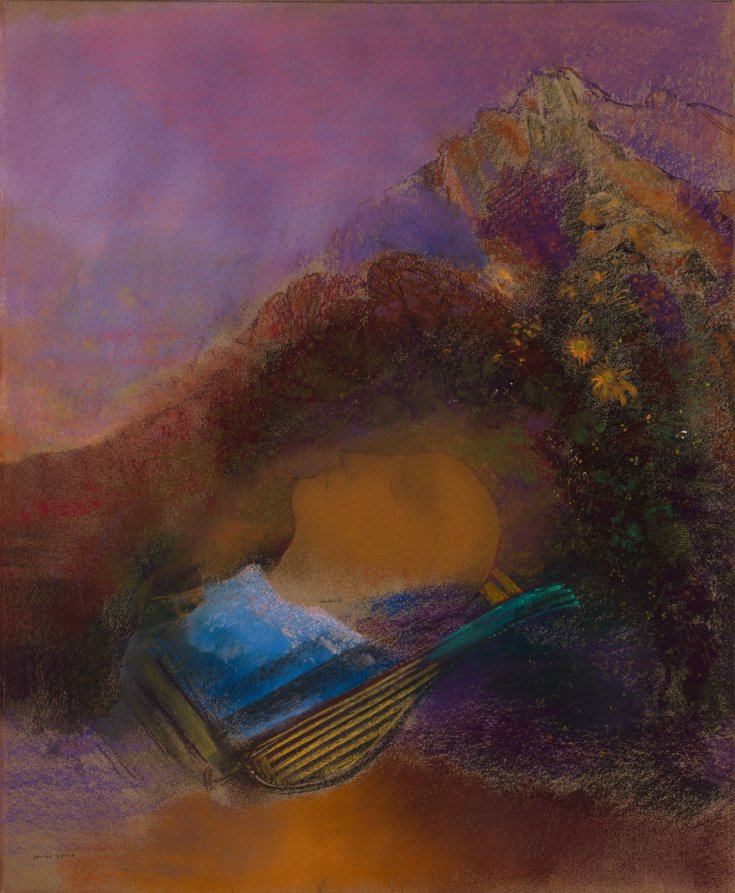
The over painted version of Salvator Mundi is on the left, while the restored version is on the right.

In his story Robert Simon describes the terrible condition he found the artwork in. Although he saw the beautiful hand that didn’t correspond to a harshly overpainted face stylistically, Mr. Simon had no idea it would be da Vinci at first sight. In the interview you’ll learn how slow the process of discovery was, working closely with the restorer Dianne Dwyer Modestini, Senior Research Fellow and Conservator of the Kress Program in Paintings Conservation at the Conservation Center of the Institute of Fine Arts, New York University. Both of them found clues that this painting could be by Leonardo. Eventually Robert Simon introduced this painting to the Leonardo’s experts in London to confirm the authenticity of the art.

References that suggested the existence of da Vinci’s the Salvator Mundi

In the scholarly article written by Joanne Snow-Smith she traces the whereabouts of the artist. Looking at the trail of paperwork registered in royal courts, she concludes that Louis XII, the king of France, ordered a direct commission to Leonardo da Vinci in 1507, made payments for it between 1507-11, and demanded its completion and turn over in 1513. So the original artwork was painted between 1507-1513. (Painting it on and off for many years is consistent with the artist’ habits). In 1513 da Vinci turned it in to the king’s intermediaries. Next year the king’s wife died and he donated the artwork to a convent in 1514 where it remained for over a century until it got to the Charles I royal collection.

Below you’ll find images with dates that don’t quite correspond to this timeline. For instance, Leonardo’s studies of clothed arms and chest were done between 1504-8 and many paintings with similar composition are dated before 1507. Joanne Snow-Smith proposes that Leonardo painted two copies of the Salvator Mundi based on similarities and differences in the etching, copy paintings and the Windsor castle drawings. ( Source: “The Salvator Mundi of Leonardo da Vinci” by Joanne Snow-Smith, Arte Lombarda Nuova Serie, No. 50 (1978), pp. 69-81).

So the Leonardo’s Salvator Mundi painting existed for sure,  maybe even in two versions, which is also possible because the artist painted two versions of the Virgin of the Rocks. What raises questions if the etching was done from the original da Vinci’ painting hidden in the convent for a century. The etching by Hollar becomes important because it’s one of the strongest visual references to the proposed original, or perhaps, it served as a prototype for a beautiful forgery. Let me explain.

#1 reference: etching

Wenceslaus Hollar’s etching, 1650 | Before the modern printing process ever came to existence, it was common practice to produce etchings of masterworks for wider distribution among the royalty, wealthy and public. It’s clear that Leonardo worked on the concept of this painting because he gave it to Louis XII in 1513, and one etching (3 versions of the etching) completed by Wenceslaus Hollar after the original were registered in the royal collection of Charles I of England. Hollar signs and dates his etching, with Latin inscription that ‘Leonardo da Vinci painted it.’ This etching was done from Hollar’s previous drawing that he could have sketched while on a visit to the convent.  According to Robert Simon the etching has a large jewel in the clothing that was painted over and then re-discovered in the original painting during the restoration. Yet, there is no clear evidence that the Leonardo’s painting was indeed the prototype for this etching.
What is etching? Intaglio or etching is one of the oldest forms of printmaking where an artist would draw an image with a needle on a metal plate, engrave it with an acid, then charge it with ink to impress the picture on paper with the press.  A single image could have many stages or states in its development when the artist increases contrast by building up strokes in the shadows. Every new state goes through the same process of acid corrosion, inking and printing.  Because the artist hand-inks the plate and decides how much ink to remove from it, the final image may appear much lighter or darker. Not a single stroke can be removed, so artists exercised great control over the quality and quantity of their strokes. Master etchers among the old masters are Rembrandt and Durer. This printmaking process is taught in art colleges and I made a number of prints using this technique.

If we begin to compare this etching to the discovered Salvator Mundi we can observe three things. The eyes look in different direction. Christ has a definite beard in the Hollar’s etching unlike in the presented painting. The orb’s reflection is not what the scientist artist (da Vinci) would actually see but it’s similar in the etching, the da Vinci’s painting, and some copy paintings. If the etching was done from the original da Vinci, it raises questions how the artist could have ignored the effects of optics he studied so carefully. (Below you’ll find my photos of the orb and how it appears placed in a hand).

#2 reference: da Vinci’s sketches

The second strongest visual reference to the existence of the Salvator Mundi are the da Vinci’s studies located in the Windsor castle collection.

two drapery studies for salvator Mundi by da Vanci
Two drapery studies – preparatory drawings for the Salvator Mundi by da Vanci – are  in the royal collections at Windsor Castle, England, 1504-1508. These two drawings is a clear evidence that Leonardo studied the folds and disposition of Christ’s tunic and its sleeves. The drawings are modeled in two colors in chalk characteristic for the classical method of drawing in that period.  These studies of drapery show that Leonardo was influenced by the Greco-Roman art and must have studied classical sculpture during his travels in Rome and wanted the clothing look natural and graceful. It also proves that he worked on the concept of his future painting.

We can see that the drawings show two different positions of the arms with folds falling somewhat differently. One of the hand positions is captured fairly closely to the original drawing in the etching and painting. These preparatory drawings become the strongest references to the Salvator Mundi painting. The hand is so beautifully painted, it does look like Leonardo!
(Images: https://www.royalcollection.org.uk/collection/912525/studies-of-drapery-for-a-salvator-mundi | https://www.royalcollection.org.uk/collection/912524/a-study-of-drapery-for-a-salvator-mundi).

#3 reference: artist copies

Albrecht_Dürer and school of da vinci_mundi
1. Albrecht Dürer, c.1505, (unfinished), The Met        2.   School of Leonardo da Vinci, c.1503           3.  Cesare da Sesto, 1516, Wilanow Palace, Poland (Images source: https://en.wikipedia.org/wiki/Salvator_Mundi_(Leonardo) )

There are many copy paintings made from either the original or the etching, letting us believe that the artists were familiar with the original composition of the Salvator Mundi and painted either copies or their interpretations on the theme. By looking at these painted copies we can see striking similarities to the etching and the da Vinci’s Salvator Mundi in the depiction of both hands, the orb, and the figure positioning painted by various artists.

However, based on the existing documents and style, the da Vinci painting was painted between 1507 and 1513, while he was in the service of king Louis XII, which places some of the copies before  da Vinci finished working on his painting. Unless da Vinci had conceived and began working on this composition before 1503 (Mona Lisa was begun between 1503-6), and other artists had already seen it, it’s difficult to believe that this composition is original Leonardo.  Leonardo’s drawings of clothed arms are dated 1504-8. Therefore it’s either the fact that these paintings were done after a different painting (and not from the da Vinci’s), or Leonardo borrowed the composition and its elements for his work from the Flemish painters and the Vera Icon (Head of Christ) by van Eyck (now lost and existing in contemporary copies of his workshop). Or Leonardo made the first version of his painting before working on the Louis XII commission, which is less likely.

Salvator Mundi, Workshop of Hans Memling, Flemish, 1475-99, the Met. “Christ is shown here as the Savior of the World, holding in his left hand a cross-topped globe representing the earth, while his right hand is raised in blessing. This was a popular image type in the fifteenth-century Flemish painting that merged the themes of the Holy Face (Christ’s features miraculously imprinted on a cloth) and Christ in Majesty.” (Source: https://www.metmuseum.org/art/collection/search/437061)

Vera Icon (Head of Christ), Jan van Eyck workshop

Hans_Memling veronica holding her veil, 1470 and christ in turin
Hans Memling, Veronica holding her veil,” 1470, early Flemish painting (left) | Veronica’s Veil with the image of Christ on display in, Turin, Italy

What looks like Leonardo…

In classical art, the artist sketches the subject, transfers the lines and paints them in warm, brown paint on panel or canvas. He then layers color in subsequent layers. In the old masters technique, multiple layers were very thin to achieve the desired atmospheric effect. The da Vinci's sfumato technique involves multiple glazing of thin paint, so thin that some areas don't even show up in the X-ray examinations. In his podcast interview Robert Simon describes how they took a probe on the face of the Salvator Mundi to reveal 17 layers of paint!

His Face

By looking at some copy paintings above it’s easy to see that these artists were able to copy the beautiful hand, orb and delicate pattern of the clothing. However, none of them could copy the same glowing face of the da Vinci painting. The ambiguous face in the Salvator Mundi is so much like Leonardo. Illusive. Ethereal. Glowing. The artist achieved such appearance in his art by glazing very thin layers of oil paint. By mixing the paint with a lot of medium (linseed oil or other oil) the artist created the sfumato technique, the very style we see in the Mona Lisa, the Saint John the Baptist, and in the Virgin and Child with St. Anne. And by looking at the painting for the first time without studying it carefully, it’s easy to conclude that it’s by Leonardo because the painting art style is so similar to other works created by the artist.

If you look at the restored portrait closely, you’ll notice the discrepancies that Leonardo couldn’t have done himself. While the painting style is so Leonardonesque, the crooked tip of the nose and the cross-eyed appearance of Christ raise questions for me as an artist. Being a scientist, Leonardo’s anatomy drawings show exquisite understanding and perfection of human form of that period, so these anatomical discrepancies look like obvious flaws. Why would the artist paint the body of Christ with such symmetry and ignore the symmetry of the eyes and nose? One explanation is that the panel has cracked and warped so much in five centuries that it changed the appearance of the drawing in the nose and chipped off some paint in the eyes (which is hard to believe because the pupils look so uneven, and the shape of the eyes is different).   I would like to hear the restorer’s explanation to understand this. If you look at this picture where I overlay straight lines over his face, you can see how crooked the nose is, which lines up with the mouth but not with the top part of the face. The eyes don’t line up either, each having a different shape. In other Leonardo’s drawings and paintings you can see a more complicated rotations of the head that demand a perfect line up of facial features.

Moreover, In the Hollar’s etching we can see that the Christ’s eyes look in a different direction compared to the painting’s straight gaze. The man also wears a definite beard in the etching unlike in the da Vinci’s painting that looks soft and illusive.

The face has a beard. The eyes look in a different direction than the found da Vinci.
da Vinci faces from his paintings from left to right: 1. Angel from the Madonna of the Rocks 2. Salvator Mundi 3. The St. John the Baptist 4. Virgin of the Rocks 5. The Virgin and Child with St. Anne (bottom) 6. Mona Lisa 7. La Belle Ferronniere 8. drawing for The Virgin and Child with St. Anne .
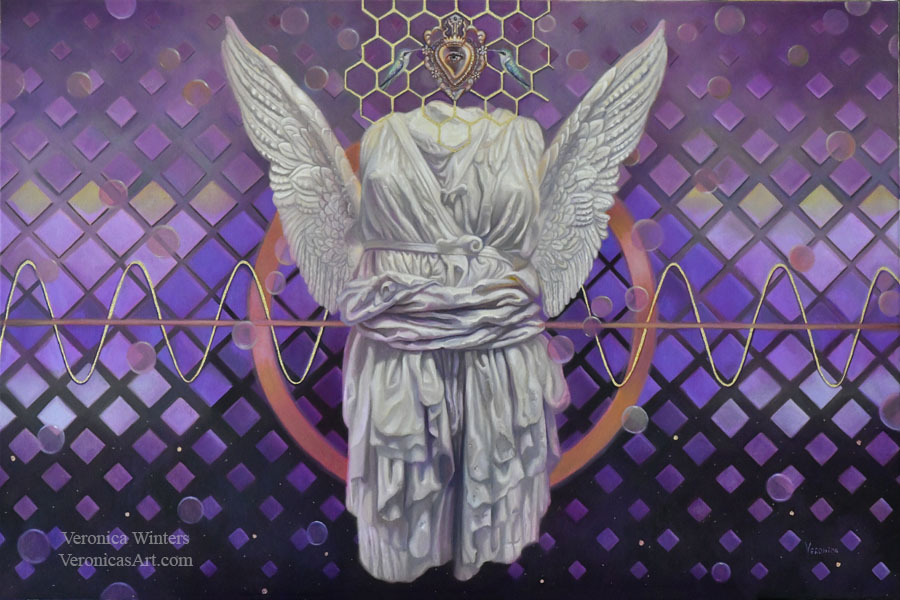
Moreover, the presented Salvator Mundi has a non-existent neck. When you look at the line up of faces from da Vinci paintings above, you see a different style of painting the neck. All of them are cylinder-like with considerable definition and naturalistic detail. In the Salvator Mundi painting the neck is obscure and ill-defined unlike in other da Vinci paintings. Also, all known paintings by da Vinci have the models rotating in space a lot. The Salvator Mundi portrait is so frontal it’s inconsistent with the artist’s work.

His Hand

The Salvator Mundi blessing hand is the most realistic, da Vinci-like element in the entire painting. Its elegant design and unbelievably well-painted anatomy make it the best hand by Leonardo I’ve seen in comparison to his other paintings. It’s the most believable element in the painting that looks like Leonardo painted it.

The Salvator Mundi’s hand is the most beautiful element in the entire painting.
Details of hands from other artworks painted by da Vinci.


His Hair

Details of the curly hair painted by da Vinci.

While we can see the Leonardonesque hair in this portrait where every strand is observed, this visual element is actually prone to copying by other artists (see the image above of Salvator Mundi, School of Leonardo da Vinci, c.1503 ). The Leonardonesque hair type was a very popular element in the Italian Renaissance painting. Therefore, its hard to say that Leonardo was the only artist painting these beautiful curls in this manner. Leonardo got his initial training in the Andrea del Verrocchio’s workshop in Florence where he assisted the master artist in completion of art, working among many other students. Here we can see this manner of painting the curls.

Verrocchio,_Leonardo_da_Vinci_-_Battesimo_di_Cristo sm
Verrocchio, the Baptism of Christ. This is the first known work where da Vinci painted the angel to the left being a student in the Verrocchio’s workshop.

Verrocchio, Tobias and the Angel | This painting shows how Verrocchio himself painted the curly hair.

These are examples of other artists painting the curly hair before and after da Vinci. They have similar style that makes it fairly easy to copy the da Vinci’s hair. | From left to right: Italian painting details, Turin and Durer’s self-portraits.
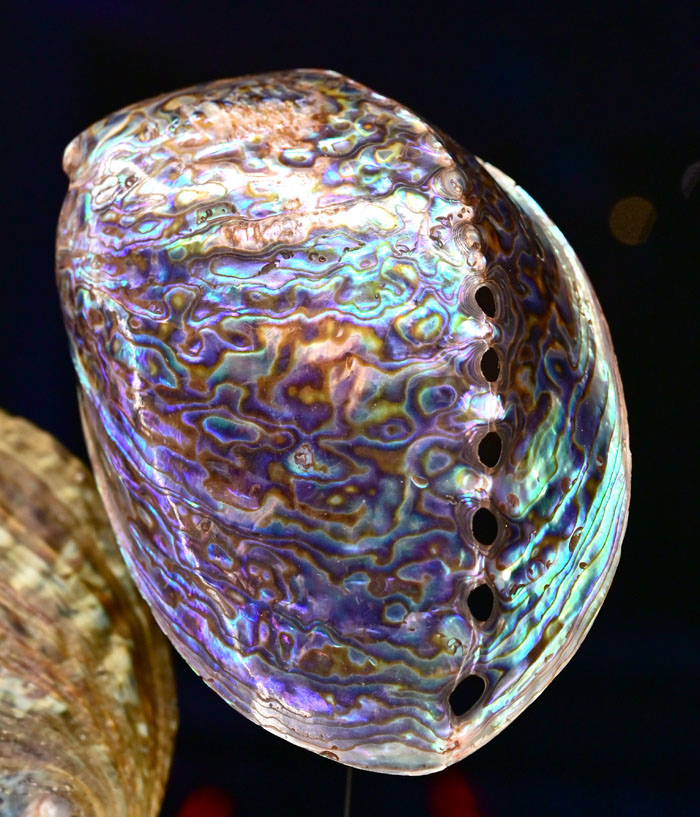
The painting’s restoration process

1. The removed overpainting reveals the image beneath it. | 2. Overpainted version | 3. The restored painting

In general, paintings get cleaned by removing the varnish, which is a protective coating that traps the dirt and UV light, and protects the oil paint from damage. Usually the removal of old varnish, reveals a much lighter and brighter painting with the original, beautiful colors painted by the artist. High-quality paints wouldn’t fade as much, rather would become more transparent with age. What we see in the first image is the removal of the overpainted image that reveals the original painting underneath it. White lines look like gesso marks crudely painted over the cracks of the original painting trying to fill them in. Oil paint is applied over the gesso to create a painting. By comparing the first and the last image we can see how much restoration was done.

In the interview Mr. Simon says that the Salvator Mundi came to him in terrible condition: the walnut panel had a big vertical crack that was poorly repaired and repainted multiple times over. Smaller cracks and hastily repairs damaged the surface to a great degree.

Dianne Modestini made an incredible job cleaning and restoring the artwork. She didn’t just create a new version of Christ like we see in the overpainted image in the center. Rather, she stripped the painting down to its original state, fixing the “scratches.” The Da Vinci’s signature style – sfumato and the ethereal appearance of the face, are present after 500 years from its creation. The original color of clothing may have been different, however, probably having brighter blues in the beginning. Here is what the restorer says about the painting on Christie’s website.

Dianne Modestini explains that the original walnut panel on which Leonardo, who was known for his use of experimental material, executed Salvator Mundi contained a knot which had split early in its history. However, she concludes that important parts of the painting are remarkably well-preserved, and close to their original state. These include both of Christ’s hands, the exquisitely rendered curls of his hair, the orb, and much of his drapery. The magnificently executed blessing hand, Modestini notes, is intact. With regards to the face, Modestini comments, ‘Fortunately, apart from the discrete losses, the flesh tones of the face retain their entire layer structure, including the final scumbles and glazes. These passages have not suffered from abrasion; if they had I wouldn’t have been able to reconstruct the losses.

During the conservation process, pentimenti — preliminary compositional ideas, subsequently changed by the artist in the finished painting, but not reflected in the etching or painted copies — are observed through infrared imaging, and duly photographed. The most prominent is a first position for the thumb in the blessing hand, more upright than in the finished picture. IRR imagery also reveals distinct handprints, especially evident on the proper left side of Christ’s forehead, where the artist smoothed and blotted the paint with his palm. This kneading of the paint in order to create soft and amorphous effects of shadow and light is typical of the artist’s technique in the latter part of Leonardo’s career. reference: http://www.christies.com/features/Salvator-Mundi-timeline-8644-3.aspx )

da Vinci’s materials and the preparatory ground

Because the artwork’s creation is placed close to the Mona Lisa painting in its style and dates, one of the clues to the authentication of the Salvator Mundi  would be the examination and analysis under a microscope of preparatory ground (gesso) underneath the oil paint. It’s known that Leonardo tinted the ground in two colors: blue under the top/ landscape area; red under the bottom area in Mona Lisa, La Belle Ferronniere, The Musician, and St. Anne. ( Pietro C. Marani, Leonardo da Vinci, the complete paintings, Harry N. Abrams, inc. publishers, p. 198). Such examination would also reveal marks of an underlying drawing traced in the ground. Christie’s website mentions spolveri — pouncing — can be seen running along the line of the upper lip. “The rest of the body has a much looser, brushy underdrawing, with further small changes of mind. This combination of careful preparation for the head and much greater improvisation for the body is characteristic of Leonardo.” The X-rays would show different positions or variations of features from the finished painting. Because da Vinci painted in very thin glazes, some elements like an illusive smile or hair may not show up in the X-rayed images.

On the Christie’s website you’ll find this statement. “Powerfully convincing evidence of Leonardo’s authorship was provided by the discovery of numerous pentimenti — preliminary composition ideas, subsequently changed by the artist in the finished painting, but not reflected in the etching or painted copies. The most prominent of these — a first position for the thumb in the blessing hand, more upright than in the finished picture — was uncovered and photographed during the conservation process.” Further examination with infrared imaging would show additional pentimenti- changes in the drawing, which are recorded on the Christie’s website as subtle changes found in the contour of the hand holding the orb.

While these discoveries of pentimenti and spolveri are good indications of the old master work, they are not exclusive to Leonardo’s method of work. And if we think of a careful forgery, this method of working on a painting could have been forged after reading a comprehensive book on Leonardo.

Da Vinci was famous for his experimentation with materials and techniques (Look at the terrible condition of the Last Supper mural). While most artists of his time painted on poplar panels, he chose the walnut one. (Half of his paintings are on poplar wood). He also was one of the first painters to use the walnut oil, which slows down the drying time of oil paint and thus allows for a prolonged painting period. While the walnut oil doesn’t yellow unlike the linseed oil, it’s less stable and may contribute to a weaker bond between many layers of paint and thus makes the painting more susceptible to damage in the long run.

Technical examinations and analyses have demonstrated the consistency of the pigments, media, and technique discovered in Salvator Mundi  with those known to have been used by Leonardo. Syson notes particularly the use of precious lapis lazuli in the Christ’s celestial blue clothes, a practice that was unusual at this date, suggestive of the opulence of the commission.

Da Vinci was not the only artist to use precious pigments in his art.  Florentine artist Giotto (c. 1266-1337) comes to mind. Therefore it can’t be a strong argument to authenticate the painting based on the precious pigments used, in my opinion.

What’s fake? (or added after Leonardo)

The da Vinci’s orb may not be by da Vinci

The orb’s reflection makes this painting the hardest thing to believe that it’s by da Vinci. It’s painted with transparency of glass that’s impossible to achieve, considering the shape and properties of the orb, regardless its material. da Vinci was a scientist who studied the effects of optics and light extensively. His knowledge of optics is shown in his atmospheric quality of layering paint on figures and landscape backgrounds. There are many scientific drawings made by Leonardo that show his curiosity and understanding of nature. As an artist he was exceptional at perfecting every aspect of painting: composition, atmosphere, color, anatomy, etc. In the following pictures you can see how the orb’s reflection looks like. I’m tempted to speculate that the Da Vinci’s original was unfinished at the time he needed to give it to the king Louis XII, and it was hastily completed by one of his students. Leonardo was notorious for not finishing his projects (and not just paintings), and like in the Mona Lisa case, it’s presumed the painting traveled with the artist, and he worked on it on and off for about 5 years. Or perhaps, the referenced orb was made of a different material rather than the one shown below.

da vinci orb a fake?
I took these pictures of the orb under different lighting conditions and points of view to illustrate the essence of a problem we see in the painting. The orb’s real reflection is very different from the painting’s. The orb can reflect in three ways. 1. The image of the surroundings turns upside down in the orb when you partially hold it or place it on a stand. 2. The orb reflects the surroundings without turning them upside down. In the second row you see my studio and me reflected in the orb. 3. The orb magnifies the palm of the hand big time (the last row). Depending on the viewer’s point of view, you may also see a weak reflection of the surroundings besides the reflected hand. But in no circumstances the orb can be as transparent as you see in the Salvator Mundi painting. So if it were painted by da Vinci, the orb could have been made of other material to have the reflections shown in the painting.

Isaacson believes that this was “a conscious decision on Leonardo’s part”,[33] and speculates that either Leonardo felt a more accurate portrayal would be distracting, or “he was subtly trying to impart a miraculous quality to Christ and his orb”.[32] Kemp, on the other hand, says the doubled outline of the heel of the hand holding the sphere—which the restorer described as a pentimento—is an accurate rendering of the refraction produced by a calcite sphere.[27] 

Both of these statements are questionable. At the same time, it seems close to impossible that Leonardo would override his scientific side in favor of a creative interpretation. ( da Vinci considered himself a scientist, not a painter by writing a letter to L. Sforza of Milan offering his services to the court as a military engineer, not an artist.)

Composition and background

Many are concerned with the provenance of the da Vinci painting due to its tight, unlike-da-Vinci composition and a dark, empty background. While the background itself is of a lesser concern here because da Vinci painted several artworks with similar, dark background, what’s unclear why the figure is so frontal and sits so close to the edge.

The_Lady_with_an_Ermine and st john the baptist by da vinci
The Lady with an Ermine, 1489 and St. John the Baptist by da Vinci | These two works are attributed to da Vinci. They both have a single figure placed in a very dark background, which is similar to the Salvator Mundi. However, the rotation of the figures is different. Leonardo loved to rotate the figures showing them at 3/4 view as well.

No realist artist would allow himself to place a figure so tight to the edge of the frame like we see in the Salvator Mundi. While this is a common mistake for a beginner artist, artists like da Vinci just couldn’t afford sacrificing composition to this degree. When the form is so close to the edge, it creates tension, which every good artist tries to avoid making. If the sleeve or hand gets cropped, it should look intentional and more definite (like we see in the Impressionists). In this painting we observe Christ’s hands and arms sitting so unbelievably close to the edge of the painting, the figure barely fits in the frame. The only explanation of such positioning is cropping of a wood panel at a later stage in history of this painting. Note that we can see the same tight cropping of the figure in the Hollar’s etching and other copy paintings! How would this be possible? Was the original painting cropped within the first 100 years of storage in a convent? What would be the reason for doing so? No adequate frame was found around to fit it in? Was the etching done not from the original da Vinci, which makes this painting forged from the etching itself?

In his art Leonardo rotated the figures to get a more dynamic and dramatic position of a model. He either twisted the figures or used three-quarters view in portraiture art.  Was it his intention to reverse to the iconic imagery of the Medieval art to create a more universal image of Christ? There is a long history of iconography with frontal depiction of Christ that makes me think if Leonardo could make himself skip on his innovations in composition, reverting to this Medieval, symmetrical, iconic image of Christ.

Some argue that it’s work by Leonardo because of the triangular composition (hands and head form a triangle). However, triangles were widely used by many artists as a design element in painting. We can also argue that the Salvator Mundi is either a forgery or an inspiration for other artists by comparing its composition to the Durer’s self-portrait at 28. What’s interesting here is that although Durer was German, he traveled to Italy around that time and may have seen the da Vinci’s work-in-progress in person, because this self-portrait is drastically different from his previous two. Or we can argue that the forger tried to create this universal, frontal image of Christ basing it off of the etching and Durer’s portrait.

Dürer_self_portrait_28
Durer, self-portrait at 28, 1500, oil on wood

Conclusion

The controversy surrounding Salvator Mundi is likely to continue for many years to come. Until the painting is publicly exhibited and subjected to further scientific analysis, it is impossible to say definitively whether it is a genuine work by Leonardo da Vinci. The lack of public exhibition has only fueled the debate over the painting’s authenticity. Some experts believe that the Louvre Abu Dhabi is hesitant to display the painting because they are unsure of its authenticity. Others believe that the museum is simply trying to protect the painting from damage.

The more I study the Salvator Mundi, the more questions it raises. And the deeper I go, the more puzzling the inconsistencies in its origin become. Despite my first impression that the portrait has the da Vinci’s signature appearance with every detail and magical golden glow, all the problems I’ve listed above make me think that it’s either Leonardo’s underpainting finished by his student (considered the Old Master’s work), or it’s a complete forgery.  What’s clear is that it’s not enough to compare the da Vinci’s paintings visually. Only a thorough examination of all written documents as well as modern chemical analysis of the painting (and the etching) could authenticate the present Salvator Mundi by giving us the original dates. No matter how much time the experts would spend comparing this work to others done by da Vinci, there is still a lot of doubt in place if it’s his. And if it’s not a skillful forgery, Leonardo’s style is most definite in the face and the blessing hand, not in the orb, hair or fabric, which are fairly easy to forge by a contemporary realist artist or a restorer.

Of course, this painting and its origin may deserve the criticism it receives from people working in the field that includes many experts on da Vinci’s art. Perhaps it may receive some criticism from art critics like we see here by Jerry Saltz. However, if someone is not an artist, hasn’t held a brush long enough to understand how hard realist painting is, or has meager knowledge of art history should refrain from posting negative comments about the restorer on social media, which I’ve seen a lot. We can still enjoy the art and discover new secrets about Leonardo and his circle.

In 2021, a new documentary called “The Lost Leonardo” was released. The film explores the mystery surrounding Salvator Mundi and raises new questions about its authenticity. The film claims that the Louvre actually believes that the painting is a genuine da Vinci, but that they are refusing to display it because they do not want to anger the Saudi government.

If you like reading my articles, please consider supporting my projects by shopping at the gift store.

Check out visionary art for sale

Learn about famous ancient Greek sculptors and more! https://veronicasart.com/untold-story-of-famous-ancient-greek-sculptors-an-artist-perspective-on-realist-techniques-in-search-of-the-divine/

Resources:

Scholarly papers database http://www.jstor.org | Snow-Smith, J. (1978). The Salvator Mundi of Leonardo da Vinci. Arte Lombarda, (50), nuova serie, 69-81. Retrieved from http://www.jstor.org/stable/43105161

Pietro C. Marani, Leonardo da Vinci, the complete paintings, Harry N. Abrams, inc. publishers

Windsor Castle royal collection: https://www.royalcollection.org.uk/collection/search#/page/1

Christie’s timeline: http://www.christies.com/features/Salvator-Mundi-timeline-8644-3.aspx

Christie’s http://www.christies.com/features/The-last-da-Vinci-Salvator-Mundi-8598-3.aspx

Suggested Donation: http://www.suggesteddonationpodcast.com/blog/2015/9/15/episode-21-robert-simon

Old Master Dealer Robert Simon https://www.robertsimon.com/leonardos-salvator-mundi/

*I wrote this article on Nov.24, 2017 and updated it slightly in 2023 to include the most recent information on it.

Damien Hirst: genius or imposter? Solo show at villa Borghese in Rome
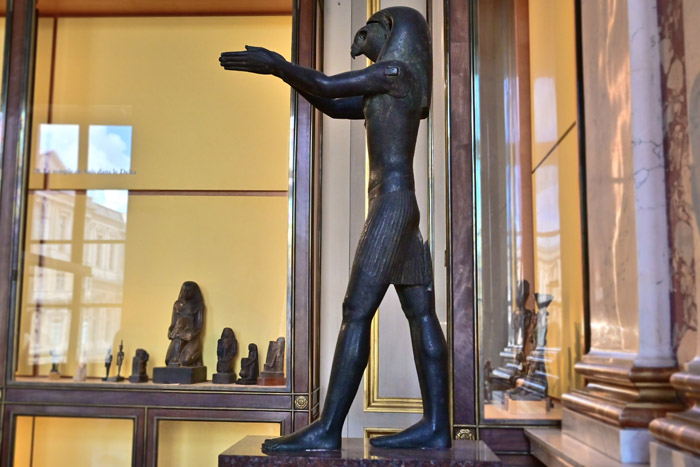
Damien Hirst’s show at Villa Borghese in Rome

I revisited the Borghese gallery in Rome in September 2021 and saw Damien’s solo exhibition titled “Treasures from the Wreck of the Unbelievable.” It’s a collection of sculptural works from a fictional shipwreck off the coast of East Africa. Walking around the gallery, I couldn’t help but notice a thoughtful placement of the artist’s pieces in the rooms. Most fit organically into the gallery space that goes overboard with art by design. The powerful Borghese family members were avid art collectors and patrons of the arts. That’s why their exuberant art collection boasts so many masterpieces by the 16th and 17th-century artists like Caravaggio, Bernini, and Canova.

Borghese gallery, Damien Hirst, the Minotaur sculpture, Archaeology Now
Borghese Gallery 2021, Damien Hirst: The Grecian Nude (left) and The Minotaur (right), black granite, sculpture.
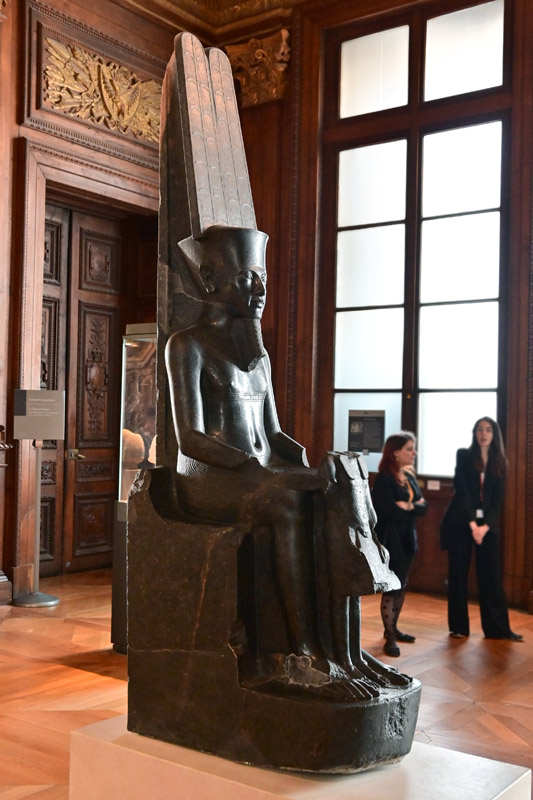
Born in 1965, Damien Hirst is a British contemporary artist who explores the theme of life and death. Because he sees no separation between life and art, this theme becomes his art, which is an amalgam of painting, sculpture, and installation. The theme of death is one of the central themes in the Western art world, but every artist can take it into a different direction…

Damien Hirst Lion Women of Asit Mayor- bronze-2012-borghese gallery-winters blog
Damien Hirst Lion, Women of Asit Mayor, bronze, 2012, at Villa Borghese, 2021, pictures taken by Veronica Winters

First shown in Venice in 2017, “Treasures from the Wreck of the Unbelievable” is a show with some merit. Sculptural works utilize traditional and precious materials, such as marble, alabaster, lapis lazuli, coral, crystals, malachite, and bronze. Some sculptures breathed with beauty and classicism, long forgotten by contemporary art galleries. It was fun to spot contemporary art by Hirst standing right next to the antiques of the Borghese gallery’s permanent collection. Some sculptures evoked a sense of rescued objects from the ocean floor, as colorful barnacles and sea creatures adorned the surfaces of many sculptures. Somebody’s limbs were missing or obscured by the sea overgrowth.

damien hirst_unknown pharaoh-borghese g-veronica winters blog
Damien Hirst, Unknown Pharaoh at Villa Borghese. This is one of my favorite pieces seen at the gallery. There is a beautiful balance between materials, color, and form. This sculpture gives a feeling of a real piece saved from a shipwreck.

While most of it fit well within the space, the sculptures were strikingly different in the level of execution. It prompted a question of who really made these artworks and how much of it was Hirst’s skill and vision. Some were very classical in nature, while others looked like the leftovers from modernism. Some sculptures were beautiful and engaging, while others looked strange and too primitive to be called ‘art’ especially in comparison to the art collection of the Borghese family.

borghese gallery-sculpture of hirst
Bronze sculpture of Hirst at the Villa Borghese in 2021. This sculpture looks grotesque, lacking the ethereal beauty of classical art.

How original is Damien Hirst?

Hirst is the all-over-the-place artist, in my opinion. He produced a variety of art that would be frowned upon in any graduate school where consistency of theme, size, and approach is encouraged and basically required to graduate. And this is where the rules get broken… The artist rose to fame with several controversial art pieces. The notorious diamond skull, beautiful entomology paintings, sharks in formaldehyde, pill cabinets, dot paintings, neoclassical sculptures, installations, and so much more – everything made by Hirst or it may be not.

I think it’s ok to evolve and transition into new art forms or bodies of work over the years as we artists experience change, and so art changes with us. However, Hirst seems to drift from one idea to the next that doesn’t have a clear connection to his previous work in either technique or vision. Usually, we can see one work by the artist and recognize the “style” in subsequent work,s even if it’s quite different. Hirst puzzled me in this regard because his series of paintings or sculptures had no connection to each other.

Art by Damien Hirst

Art Workshop

The exhibit made me think of a Renaissance workshop. Workshops used to be the only way of learning and training young artists in Renaissance Italy. That’s how da Vinci painted his first angel in Verrocchio’s painting (The Baptism of Christ, 1475, Uffizi gallery, Florence). Vision and ideas were of the master artists who painted major figures and finished paintings. Master artists worked on image designs, composition, color, and so on, while art students mixed paints, helped with image transfer and did some underpainting. Based on the presented sculptures I saw at the Villa Borghese, the Damien Hirst workshop functions quite differently. The apprentices seem to be the creators.

damien hirst_Pair of Slaves Bound for Execution-painted bronze sculpture-borghese g
Damien Hirst, Pair of Slaves Bound for Execution, painted bronze sculpture at the Villa Borghese

His workshop may produce all the art with some apprentices (artists) being very skillful at their task. That explains the great inconsistency and variety of the produced art by Damien Hirst. Painted bronze sculpture “Pair of Slaves Bound for Execution” was the most exceptional, contemporary art piece I’ve seen in a long time, showing balance, grace, and the perfection of anatomy, central to classical art. “Unknown Pharaoh” is one of my favorite pieces. There is a beautiful balance between materials, color, and form. This sculpture gives a feeling of a real piece saved from a shipwreck. While another sculpture with a giant foot, squirrel, and ear looks immature. The standing bronze figure of Hirst appears grotesque to me as well.

Damien Hirst-Archaeology Now at the Galleria Borghese-installation view
Damien Hirst, Archaeology Now at the Galleria Borghese-installation view (giant foot with a squirrel)


Are workshop artists mere laborers or the creators on their own right? Based on the produced and shown art at the Villa Borghese, Hirst created a factory of talented artists who do all the work but marketing. And in this case, it looks like marketing is everything, really. Remove the name from any of these works, and they won’t be fetching top dollar for art.

Now, many famous contemporary artists keep workshops. We can explore the workshops of contemporary realist artist Kehinde Wiley or the glass blower Chihuly. You can find their art pieces in many permanent museum art collections, private art collections, hotel lobbies, and so on. The key difference is that these artists are true to their unique vision, and every piece feels like a continuation of the artist’s previous work. Apprentices in their workshops are the helpers, not the sole creators of art. That’s my opinion, of course, you may not agree with.

Damien Hirst, sculpture of a shell displayed at the villa Borghese in 2021

There is no doubt that Damien Hirst is a very smart artist. He is also a great publicity guru. He created and marketed himself as a top luxury brand for the wealthy to invest in. There is a lot to either admire or learn from this living artist. What do you think of his art? Share.

Damien Hirst, Hydra and Kali, outdoor sculpture, Borghese gallery-veronica winters blog
Damien Hirst, Hydra and Kali, sculpture displayed outdoors at the Borghese gallery
damien hirst_neptune-borghese g-veronica winters blog
Damien Hirst, Neptune, 2011, at Villa Borghese

Learn more: https://damienhirst.com/
This blog is created for educational purposes with the art credited to the cited artists. All pictures are taken by Veronica Winters. The article expresses personal opinion only.

Damien Hirst sculptures at villa Borghese
Damien Hirst sculptures at the Villa Borghese in Rome in 2021

Check out visionary art for sale

20 paintings of angels & more veronica winters

Traveling through art history: 20 brilliant paintings of angels & more

20 Famous Paintings of Angels & more

William-Adolphe Bouguereau, The Queen of the angels or The Virgin with angels, closeup, 285 cm (112.2 in)x 185 cm (72.8 in), 1900, Paris

In this article I’d like to share some of the most beautiful paintings of angels created throughout art history and why I love every one of them! But first, let’s talk about the hierarchy of angels.

paintings of angels

Hierarchy of Angels

Believe-it-or-not, angels also have their hierarchy! At least that’s how the Church saw them painted throughout art history. In large-scale paintings, many angels were often painted in tiers, while there is only one archangel Gabriel who appears to the virgin Mary in the “Annunciation” paintings. There are a lot of Annunciation paintings! The angel comes down to announce that Mary is going to be pregnant with Christ. He carries the white lily that symbolizes Mary’s purity.

There are 9 rows /orders of angels painted in tiers. According to Joost Joustra, who decodes paintings of angels in a video at the National Gallery of Art in London ( https://www.nationalgallery.org.uk/stories/a-curated-look-angels?utm_source=wordfly&utm_medium=email&utm_campaign=NG_2020June_Newsletter_NM&utm_content=version_A ), the very bottom tier consists of angels, then archangels, and principalities. They have human form and become the messengers to humans. The second tier consists of powers, virtues, and the dominions. The third, top tier consists of baby-like angels – thrones, cherubims, and seraphims that often surround Mary and Christ in Heaven. (Source: National Gallery, London)


Bermejo (1440-1498), Spanish (Jewish)

 Bartolomé Bermejo, 'Saint Michael Triumphs over the Devil', 1468
Bartolomé Bermejo, ‘Saint Michael Triumphs over the Devil’,
1468, the National Gallery, London

Bermejo was one of the most influential painters in 15th century Spain and very few works are known to exist to this day. Recently restored, this beautiful painting is on view at the National Gallery of Art in London.

Archangel Michael wears golden suit of shiny tournament armor decorated with beautiful jewels. Realistically painted precious stones, fabric textures, incredible details, angel’s scale and colorful wings clearly show the influence of the Netherlandish artist Jan van Eyck (one of the artists shown below).

Bermejo conveys slender St. Michael jumping into action to defeat the Devil. Realistically painted, bright, floating fabric crosses the picture at a diagonal to create movement. Calm, stylized face has the female features – full, red lips, soft jawline and thin, round eyebrows.

 Bartolomé Bermejo, 'Saint Michael Triumphs over the Devil', 1468
Bartolomé Bermejo, ‘Saint Michael Triumphs over the Devil’, 1468, close up of the monster

When we stop staring at the incredible armor boots decorated with pearls and precious stones, we turn our gaze to the red-eyed monster that consists of different animal parts – a second face body, snakes, reptilian heads and tail, butterfly wings and bird-like back legs. These wings suggest that the monster is a fallen angel.

Fra Filippo Lippi (1406-1469), Italian

Fra Filippo Lippi painting of angel
Fra Filippo Lippi, Annunciation, close up of angel, 1449-1459, tempera on wood, National Gallery, London| By Filippo Lippi – This file was derived from:  Fra Filippo Lippi.jpg: Author of derivative work: Fulvio314, Public Domain, https://commons.wikimedia.org/w/index.php?curid=27581843

The friar lived in a monastery all his life and painted Christian imagery for the churches and prominent families in Italy. This painting was commissioned by the Medici family to hang in their palazzo in Florence. What I love about this painting is the angel’s peacock feather wings. Beautiful black-gold feathers appear on the angel’s shoulders as well. Gabriel is a boy in this painting.

We often see the white lily in the Christian art paintings as these flowers represent the Virgin Mary’s purity who ascended into the Heaven.

Fra filippo lippi the_annunciation_ 1435 tempera on panel 39 by 63in_closeup of angel
Fra Filippo Lippi, the annunciation, 1435 tempera on panel 39 by 63in, closeup of angel, the National Gallery of Art, Washington D.C.

Here is another painting’s close up of the angel painted by Lippi. The face looks less naturalistic but the peacock feather wings are super detailed.

barberini palace art FILIPPO LIPPI annunciation 1435 oil on wood-blog
Filippo Lippi, Annunciation, closeup of a painting in the Barberini palace, Rome, 1435, oil on wood

Fra Angelico (1395 –1455), Italian

fra angelico_angel closeup_annunciation_paintings of angels
Fra Angelico, Annunciation of Cortona, tempera on panel, closeup of angel

Fra Angelico was a Dominican friar who created altarpieces in Cortona, Florence, and other towns in Italy. “Angelic” was his nickname for high moral virtues he exhibited in his daily life. Influenced by the classical school of altar painting, his iconic-like figures are wrapped up in beautiful fabrics with golden accents. This angel is frozen in action, thrusting forward to deliver the message. Colorful wings, golden words and the halo celebrate the divine nature of the figure.

Michelangelo Caravaggio (1571–1610), Italian

caravaggio angel violin
Michelangelo Caravaggio, Rest on the Flight into Egypt 1597, close up of angel

The Italian Baroque artist was a highly influential painter who left incredible artistic legacy. Caravaggio is responsible for the creation of an entirely new movement after his death – the ‘candle light painters.’ Caravaggio began his career as a very poor young man but he quickly rose to prominence painting for the royalty and the wealthy in Rome and beyond.

The_Inspiration_of_Saint_Matthew_by_Caravaggio
The Inspiration of Saint Matthew by Michelangelo Merisi da Caravaggio (1571-1610), the Contarelli chapel in Rome

The artist was the innovator on so many levels, using regular, often poor people as his models to depict stories from the Bible. His beautiful paintings have unusual compositions, high contrast, and naturalism. Caravaggio painted realistically, showing strong drawing skills. Look at the perfect contour lines of the legs and arms! The artist mastered human facial expressions as well as the light in perfectly-painted skin tones. And the angels’ wings look as real as the ones of a bird. In his paintings, fluid fabric creates movement, visual interest, and balance.

Jan van Eyck (1390-1441), Belgium

Jan_van_Eyck-The_Annunciation_paintings of angels
Jan van Eyck, The Annunciation, 1434, the National Gallery of Art, Washington D.C.

The Netherlandish artist (currently Belgium) Jan van Eyck is one of my favorite painters. This painting was part of a triptych and carries a lot of symbolism recorded in the interior space of the church. (Read about this painting here: https://www.nga.gov/collection/art-object-page.46.html )

While the artist’s figures are often out of scale in comparison to the architecture, and his use of linear perspective is intuitive, van Eyck’s incredible realism of painted textures and faces is fantastic! I learned a lot from his work studying painted jewelry, fabric, and other details. He is the greatest artist of late Gothic Northern Europe.

paintings of angels van Eyck
Jan van Eyck, The Annunciation, close up, 1434

The archangel wears an elaborate crown and bright red attire matching the ornate quality of colorful wings. Notice that Gabriel smiles delivering his message to Mary, which is quite unusual.


Not only can you appreciate these paintings, but you can also use elements from the paintings to make customized Metal Pins for commemoration or collection.

Leonardo da Vinci (1452-1519), Italian

Leonardo da Vinci_virgin of the rocks Louvre & London
Leonardo da Vinci, “the virgin of the rocks” in the Louvre & London

The Virgin of the Rocks (1483–1486 & before 1508) are two variants of similar paintings displayed in London and Paris. They do differ in many ways including how they were painted. Also in the Louvre painting the angel’s hand points at St. John the Baptist.

In the London version (right) the top color layers of paint wore of of their faces revealing a lot of black-and-white painting (underpainting). That’s why the angel in particular lacks the vibrancy of colors painted in greys and browns. Only his cloak reveals some blue-yellow hues. Yet the angel looks absolutely stunning and ethereal. This is fascinating because you can reverse-engineer the da Vinci’s oil painting technique.

da vinci_virgin of the rocks_angel detail, paintings of angels
da Vinci, the Virgin of the rocks, angel (painting close up), oil on panel, National Gallery, London

I love the rotation of this angel’s head and the delicate curls in his hair. Young face appears androgynous with large, serene eyes, full lips and a narrow chin. The clothing is also more elaborate than in the Louvre version with intricate pattern running across the shoulder and body. Fused with the body, grey-brown wings have no color layers left but feel very real nonetheless.

A close-up of a painting showing the first artwork by da Vinci – the angel Gabriel, Florence

Botticelli (1445-1510), Italian

Madonna of the Pomegranate (1487), tempera on panel, Sandro Botticelli

Italian artist, Sandro Botticelli was born in Florence. He trained in the workshops of Filippo Lippi and Verrocchio – two prominent Italian artists. Botticelli met young Leonardo da Vinci in the Verrocchio’s workshop and while their art styles are different, all these artists (Botticelli, Lippi, da Vinci, Verrocchio) have a few things in common, such as thoughtful compositions, great anatomy skills, graceful position of figures, painting of wavy hair and realistically painted fabric. Like most artists, Botticelli produced religious art for churches and prominent families. The frame for this painting consists of blue-gold lilies – the symbol of Florence, where he worked most of his life.

Madonna of the Pomegranate (1487), tempera on panel, Sandro Botticelli closeup

When we look at the artist’s body of work, we see no real difference in painted faces. Madonnas and Venus look about the same and even male faces appear very similar to the female ones. The skin tones also have a very limited color palette and hardly have any color temperature shifts from warm to cool that artists often use to paint the skin realistically. He relies on graceful lines to describe the figures. This stylized, icon-like approach to painting portraits becomes his signature art style.

If Madonna gets up, her body is very tall in comparison to the surrounding angels. The baby’s body is also unnaturally large. It happened because some artists used the convex and concave mirrors in Flemish art, during the Renaissance and beyond (think 16th-century Mannerism). Artists used mirrors to see how to “compress” a large number of figures into a small, often round panel. This distortion magnifies the importance of Mary and child and also brings angels in a tight semi-circle around the main figures. The roses also have this unusual compression. Botticelli paints the angels with beautiful rotations of heads looking in different directions, as they’re speaking to each other, which makes this painting dynamic and naturalistic. Angels hold white lilies and roses – the symbols of Mary’s purity. The Pomegranate is a symbol of Resurrection (Source: The Great Masters of European Art, Franci, p.109).

Vernet (1789-1863), French

Vernet, Horace. angel of death, 1789-1863_hermitage
Vernet, Horace, Angel of death, 1851, oil on canvas, 57×44″, the Hermitage (image copyright the Hermitage)

French artist Vernet doesn’t belong to the league of top artists. He mostly painted battle scenes disliking Academic painting. This oil painting is very different from his other works. I love the glow emanating from the female figure taken away by the dark angel behind her. Young woman almost slides into the angel’s hands. She is painted at a diagonal to create dynamic composition fitting the praying man by her death bed.

Thayer (1849-1921), American

angel painting thyer
Abbott Handerson Thayer, Angel, 1887, oil on canvas, 36×28″, Smithsonian American Art Museum, Washington D.C.

You can find Abbott Handerson Thayer’s art at the Smithsonian museum in Washington, D.C. He painted a lot of angels using family as his inspiring models. This is a portrait of his daughter Mary. I like how free his painting feels. Painterly and unfinished on the edges, the figure uncrosses her arms creating a triangle – a widely used composition in Renaissance art. Covered ina white robe, this beautiful angel has an ethereal facial expression that’s neither dramatic nor too sweet. White wings are so soft, I want to reach out to touch them. This painting looks very contemporary rooted in traditions of classical painting.

Abbott Handerson Thayer, Stevenson Memorial, 1903, oil on canvas, Smithsonian
Abbott Handerson Thayer, Stevenson Memorial, 1903, oil on canvas, Smithsonian American Art Museum

“Apart from the title, our only clue to the subject of this work is the inscription ​“VAEA,” the name of the mountain in Samoa where Robert Louis Stevenson is buried. Stevenson’s poetic tales of men at war with themselves had dazzled Abbott Handerson Thayer, whose own life was marked by exaltation and despair. And, like the Scotsman’s most memorable characters, the Stevenson Memorial carries a hidden story. Underneath this image is an earlier composition, a portrait of Thayer’s three children that he had painted as a tribute to Stevenson’s A Child’s Garden of Verses. But Thayer painted over this with the figure of an angel to convey a more encompassing, personal grief. The artist’s wife had died in 1891, and his many paintings of angels created thereafter suggest the mysteries of life, death, and the fate of the spirit.

The luminous angel shown here, seated at Stevenson’s tomb, is an emblem of memory, a light against oblivion. Just as Thayer’s love for his wife survived in the image of their children, Stevenson’s fame would live on in his works.”

Exhibition Label, Smithsonian American Art Museum, 2006

Winged Figure,1889, Abbott Handerson Thayer, American, 1849–1921.
“I have put on wings probably more to symbolize an exalted atmosphere … where one need not explain the action of his figures.”

Canova ( 1757-1822), Italian

Antonio Canova, Psyche Revived by Cupid’s Kiss, 1794-1799, Louvre version

Incredibly talented Italian neoclassical sculptor, Antonio Canova created two versions of this sculpture. “Psyche revived by Cupid’s kiss” are located in the Louvre and the Hermitage. (One of the copies is at the Met.) The artist captures Cupid, god of Love, in the moment of kissing lifeless Psyche, waking her up.

According to the Roman writer Apuleius, Cupid’s mother, the goddess Venus, envious of Psyche’s beauty, sent her into the Underworld to get a vessel with Proserpina’s beauty ointment. Although Venus told Psyche not to open the bottle, Psyche did and fell asleep. Only the kiss of Cupid revived his lover.

Since ancient times Psyche has been depicted with butterfly wings. This is a reference to the dual meaning of her name, Psukhē, in Greek: soul and butterfly. Thus did the butterfly become the symbol of the immortality of the soul. The story of Psyche symbolizes the ordeals the soul must undergo to achieve happiness and immortality (Source: the Louvre | https://collections.louvre.fr/ark:/53355/cl010091976).

Antonio Canova, Psyche Revived by Cupid's Kiss, 1794-1799
Antonio Canova, Psyche Revived by Cupid’s Kiss, 1794-1799, marble, closeup, the Hermitage version (height: 148 cm; length: 172 cm, Acquisition date: Entered the Hermitage in 1926 | the Hermitage version was originally commissioned by Prince Yusupov. The sculpture decorated one of his rooms in the Arkhangelskoye country home (outside Moscow).

I love this sensual sculpture for highly artistic presentation on the theme of love. Two life-like figures interlock their arms, creating a circular movement, asking the viewer to gaze at their perfectly carved, graceful figures. Inspired by classical antiquity, Canova emphasizes line quality, balance and circular movement in his unique design. He creates a brilliant composition where two marble figures interlock and rotate, creating an ascending triangle. This dynamic movement is characteristic of romanticism. (Images are taken from Wikipedia & the Louvre museum websites.)

Canova, Cupid and Psyche, marble sculpture, 1793, louvre-veronica winters art blog
Canova, Cupid and Psyche, marble sculpture, 1793, Louvre, photo: Veronica Winters

William-Adolphe Bouguereau (1825-1905), French

Bouguereau is one of my favorite painters for his unbelievable knowledge of anatomy in oil painting. Most contemporary realist artists study Bouguereau’s paintings, especially how he handled the depiction of skin tones. He captures figures with perfection and grace, reveling in the enormous undertaking of preparatory work. His compositions show thorough knowledge of classical art and revolve around diagonals, triangles, and curving lines that let us enter and travel around the painting. There is perfection and balance between shapes, curves, and diagonals in every oil painting. The artist was prolific and hardworking, spending most of his time locked in the studio painting. He is often criticized for his lighthearted subject matter painting “boring” classical nudes and stories from Greco-Roman mythology. However, such critics don’t understand the artist’s unique talents in handling color, composition and human anatomy.

Psyche abduct_By William-Adolphe Bouguereau
Psyche abduction, By William-Adolphe Bouguereau
Bouguereau_first_kiss
Bouguereau, First Kiss, oil on canvas, 1890, private collection. By William-Adolphe Bouguereau (Unknown source, Probably Art Renewal Center, Public Domain, https://commons.wikimedia.org/w/index.php?curid=515543)

In the previous painting we see winged lovers flying across the sky. It’s not the only painting he created on the theme. For instance, in this painting William Bouguereau portrays Cupid and Psyche as very young children to highlight their innocence. In both paintings, the butterfly wings adorn Psyche while Cupid has white, bird-like wings. In these paintings, the artist creates dynamic compositions with movement and balance of every body part. This sensibility to beauty is rare to see in contemporary art.

William-Adolphe_Bouguereau_The_Virgin_With_Angels
William-Adolphe Bouguereau, The Virgin With Angels, oil on canvas, 1900

François GÉRARD (1770-187), French

gerard psyche and cupid kiss
François GÉRARD, Psyche and Cupid (1798), Oil on canvas, H. 1.86 m; L. 1.32 m, Paris, Musée du Louvre | (image:wikimedia commons)

This neoclassical painting was completed by one of David’s students – Gerard. Neoclassical art is characterized by smooth, unseen brushwork, the perfection of human form and classical compositions. David was a father figure in the revival of classical painting that became the 19th century neoclassicism art movement.

gerard cupid and psyche kiss
François GÉRARD, Psyche and Cupid (1798), Oil on canvas, Paris, Musée du Louvre, close up (image:wikimedia commons)

François Gerard gives his interpretation of the myth when yet unseen Cupid kisses Psyche surprising her. Both the butterfly (hence the butterfly wings in Bouguereau’s paintings) and the name Psyche means “soul”. So the artist depicts unity of the divine love and human soul (Source: De Vergnette François, Louvre).

I love the artist’s keen sensibility to depict a sensual touch. Cupid’s hand gracefully wraps around Psyche as he barely touches her. The perfection is in every part of this artwork – soft skin tones, balanced composition, perfect anatomy, realistic fabric, curly hair and beautiful wings, of course! This idealization of forms was criticized by the contemporaries, but I think it was the very aim of the artist in his portrayal of pure love.

Raphael (1483-1520), Italian

Italian artist & architect, Raphael is the third artist of the High Renaissance in Italy (Together with Michelangelo and da Vinci they formed the epitome of artistic excellence in the early 16th-century Italy). Raphael was a dashing young man who also had an easy going personality. Coupled with his talent, his persona helped him receive a constant stream of commissions from royalty including the two Popes. Raphael organized a large-scale workshop with numerous students and craftsmen fulfilling commissioned art. Although he died at the 37 years age of, he left an impressive artistic legacy, producing a large body of work with most of it located in the Vatican. Raphael incorporated the influences of his peers – da Vinci and Michelangelo to produce religious art and portraiture.

RAFAEL the sistine madonna angels
Raphael, Two Cherubs (detail of the Sistine Madonna), (c.1512 -1514), Oil on panel. 265 x 196 cm. Gemäldegalerie, Germany

This is a closeup of the altarpiece commissioned by Pope Julius in 1512 that features classical, triangular composition with the Sistine Madonna and Child floating on the clouds and two kneeling saints below them. These two cherubs were painted at the very bottom of the painting and look very different from the rest. They’re bored and curious, and remind us of little kids rather than idealized, divine creatures.

Ca’ d’ Oro palace

cadoro painting of angel
Ca’ d’ Oro palace, Venice, painting of angel, close up

What I love about this painting that I photographed at the Ca’ d’Oro palace in Venice is the angel’s frontal position. The angel faces us and it almost feels like he is going to speak to the viewer.

Florence
colored pencil manual veronica winters
The Colored Pencil Manual
How to Color Like an Artist
These art instruction books are on sale on Amazon!
how to color like an artist_coloring book_veronica winters

John Duncan 1866-1945, Scottish

John Duncan 1866-1945 scottish_st.bride 1913 paintings of angels
John Duncan 1866-1945 | Scottish national gallery, St.Bride, 1913
Scottish national gallery
John Duncan 1866-1945 (Scottish), St.bride 1913 detail | Scottish National Gallery
John Duncan (1866-1945), Scottish, St. Bride, 1913

Duncan studied art in Scotland, England and Belgium to settle in Edinburgh in 1892. The artist represents the Celtic Revival movement in Scottish art and his illustrative style looks innovative even today. This colorful painting looks like it’s made of collaged pieces as religious symbols, and even the ornate frame mimics the artist’s unique style.

“According to the legend of the Irish Saint Bride she was transported miraculously to Bethlehem to attend the nativity of Christ. Here, two angels carry the white robed saint across the sea. The seascape reflects Duncan’s fascination with the Outer Hebrides and the Isle of Iona. The birds and seal provide an effective naturalistic foil for the supernatural angels overlapping the patterned border. Scenes from the life of Christ decorate the angel’s robes, and may include the artist’s self-portrait as the tiny clown (a holy fool) accompanying the procession of the magi on the leading angel’s gown. ” (Source: Scottish National Gallery)

Angel, Salamanca, Spain
Virgin and Child with Four Angels by Gerard David, Netherlandish, ca. 1510–15, On view at The Met Fifth Avenue in Gallery 636, http://www.metmuseum.org/art/collection/search/436102

“Gerard David, the leading painter in Bruges in the late fifteenth century, followed the legacy of Jan van Eyck. In this painting, he has taken the Virgin and Child from his predecessor’s well-known Virgin and Child at the Fountain, but modernized the composition by placing the figures in a grand arched porch flanked by columns with Italianate capitals, against the skyline of contemporary Bruges. A Carthusian monk is seen strolling and reading in the enclosed garden, suggesting that the painting was linked to the former monastery at Genadedael, just outside the city walls of Bruges.”-description taken from the Met

Virgin and Child with Four Angels by Gerard David, closeup, ca. 1510–15, On view at The Met Fifth Avenue in Gallery 636
paintings of angels
Hans Memling, the Annunciation, 1465, closeup of the angel, on view at the Met http://www.metmuseum.org/art/collection/search/437490

Hans Memling painted realistic textures and details in a similar style of van Eyck. The composition is based on a design by Rogier van der Weyden where he probably was an apprentice before establishing himself in Bruges in 1465.

Coderch and Malavia-ALIS VOLAT PROPRIIS-sculpture-art fair miami 2023
Art Fair Miami 2023 | Coderch and Malavia, ALIS VOLAT PROPRIIS, sculpture, photo: V Winters
Raffael Sanzio, Saint Michael Vanquishing Satan, oil painting
Claudio Coello, Spanish, 1642-1693, Saint Michael the Archangel, 166os, oil on canvas.
The Museum of Fine Arts in Houston.
“There was war in heaven.” The biblical Book of Revelation tells how Michael and his angels
cast the Devil out of heaven. The Devil is described as a dragon but is usually depicted in a dark, angelic form. Saint Michael the Archangel was frequently portrayed in Spanish painting of the 17th century. He represented the Church’s victory over heresy and the righteous role of Spanish Catholicism in its confrontation with the Protestant Reformation.
painting of angel
Phoebe Anna Traquair Progress of a Soul: Victory. The National Gallery of Scotland. You can see more art from the gallery here.
Painting of a singling angel in the Scottish National Gallery

Carlo Crivelli, The Annunciation, with Saint Emidius,1486, Egg tempera with some oil on canvas, dimensions 207 × 146.7 cm. Painting detail of an angel from the painting. The National Gallery London.

Saint Emidius is the patron saint of the town of Ascoli Piceno in Italy. The Archangel Gabriel descends from God to tell the Virgin about her future child ( the Annunciation). Gabriel is stopped by a bishop saint in town. This altarpiece was commissioned to celebrate Acoli’s independence. The coats of arms along the base represents the power of the pope, the town and its bishop. ‘LIBERTAS ECCLESIASTICA’ is the inscription that was the title of the papal bull granting Ascoli its rights (according to museum’s description).

My art inspired by the paintings of angels

veronica winters colored pencil drawing
Create, a colored pencil drawing, 19×25 inches
Divine Spirit, 24×36″ oil on canvas panel
messenger angel
Messenger, colored pencil drawing with glitter and resin, 16×20 inches, unframed

Check out all visionary art for sale

Did you like these paintings of angels? What is your favorite? Do you have other paintings of angels that you love? If you love this article, share it on social media. So more people see beautiful art.

All art is copyrighted by respective artists and museums. All art is used for educational purposes only.

Venice biennial 2017:  a crappy show with rave reviews

If you regret that you haven’t seen the show yet, don’t. Venice Biennale 2017 is monumental in concept and degraded on visuals, heavy on installations, and weak on any form of beautiful painting, huge on scale and tiny on emotion. Chief curator of the Pompidou center in Paris, Christine Macel  arranged the exhibition in several pavilions -realms which flow together with concept art titled “Viva arte Viva!”

While paid entrance to the biennale invites you to visit vast spaces of the Arsenale and the Giardini, several other pavilions are scattered throughout Venice in medieval palazzos and gardens. Art in those palaces looked better than the one in the official biennale. Each pavilion usually represents a single country with its native artists exhibiting their talent to the multilingual public.

Karla Black’s abstract sculptures
Venice biennial 2017: the Arsenale. 9 chapters or realms, 86 countries, 120 artists – one feeling of confusion. The show opens up with large-scale installations situated between a long stretch of bare, tall brick halls of the Arsenale. Arsenale is the medieval Venetian warehouse for arms and boats.

This is one of the top international art shows that obliterates visual beauty in favor of concept. Boring to the eyes and craftsy at best, the viewer has to read lengthy statements in provided brochures to “get” the idea behind the pieces. I love Venice for its beautiful architecture, history, and art, yet the biennial rejects even the slightest idea of having representational art on its grounds. The exception is the Venetian pavilion itself that defies the curator’s voice with sparkling jewelry, chandeliers, gowns, and sophisticated glass that highlights traditional artist labor and skill.

A woman’s head is picking out from a hole in the floor with piles of clothes arranged in a circle.
The Romanian Pavilion

Like in the naked king fairy tale, the fooling of people takes place in the exhibition, stating that what they see is ART.  Rooms after rooms, visitors encounter piles of materials, fabric, metals, or abstract sculptures that often have profound meaning expressed through riveting writing. However, these endless primitive installations and videos leave the spectators confused about what ART means.

Art exists to call our attention to something, to make a statement, or to leave a record of times lived. Curated as apolitical and without a clear message, the biennial misses to deliver on any of these points.

The German Pavilion

More rooms

Visual arts are called visual for a reason. Because the artist’s call to attention and its impact is visual, conceptual art rarely leaves a considerable emotional impact. Even when the concept is strong, it’s weakened by the absence of the visual perception we all share. Therefore, such installations should get a specific classification so as not to be promoted as art. Today’s notion abolishes any standard for an artist to aspire to, and for people to understand or appreciate. Why did we keep high standards in music or dance and completely abolish them in art? It’s not the absence of artists willing to travel years in education to achieve something worthwhile that people’s attention, it’s about a few art critics and curators, influential art shakers who pick and choose, add and subtract, curate according to their tastes, business practice, and economic whims.

The pavilion of Shamans

Art installations that catch attention

On the upside, the exhibition is gender-equal, nationality-diverse, with the majority of the unknown artists representing both influential and obscure countries. There are a few art installations at the main complex of the biennale that caught my eye.

The Zimbabwe Pavilion

Zimbabwe pavilion

The Russian pavilion

Russian Pavilion: Change of Decorum. Growing aggression, terror, irrational life of people, control and manipulation of masses are the themes of the art installation with drones, people, soldiers and androids living in the “transparent world.”

The Chile Pavilion

Artist Bernardo Oyarzun explores the theme of the current representation of the Mapuche community, a group of indigenous inhabitants of southcentral Chile and southwestern Argentina. Dark room features an installation of over 1,000 Mapuche kollong masks, traditionally used in ceremonies. Note that 40 Mapuche artisans produced these handmade masks, commissioned by the artist who installed them in the pavilion.

The Argentine Pavilion

Claudia Fontes, The Horse Problem
“Making art is not a luxury. It’s a way of surviving that humans as a species have developed: we are, so far as we know, the only group of living beings capable of calling the attention of others to the meaning of life. That’s something to celebrate.” – Claudia Fontes

Other rooms

The Mongolian Pavilion
The Venetian Pavilion
This is a visual Venice guide about the city and its history. To shop on Amazon: https://amzn.to/3QSvpFr

Art seen next to the biennial in Venice in 2017

A nice surprise is a solo show by Carole A. Feuerman situated in a peaceful corner of a green garden at the Giardino Della Marinaressa, by the Venice Biennale (open and free to the public). The artist creates hyper-realistic, life-size sculptures of women in painted bronze and steel, resin, and oil that are so lifelike, you want to reach out and touch them.

Kendall Island, lacquer on bronze, life-size sculpture

Project by Lorenzo Quinn on the Grand Canal in Venice. His monumental sculpture of white hands raises awareness about climate change and the rising sea levels.

Street art in Italy

I must mention the performance that I saw on the streets of Turin. A young man pounded the keys of an old typewriter with rare obsession. Here is one of his finished pieces.

The artwork was made using an old typewriter.

Check out visionary art for sale