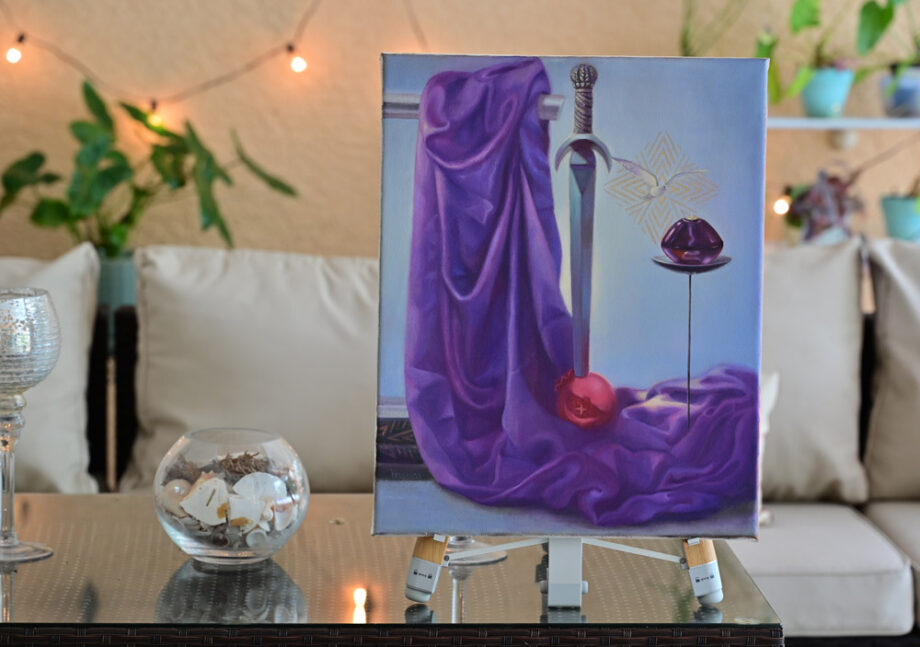
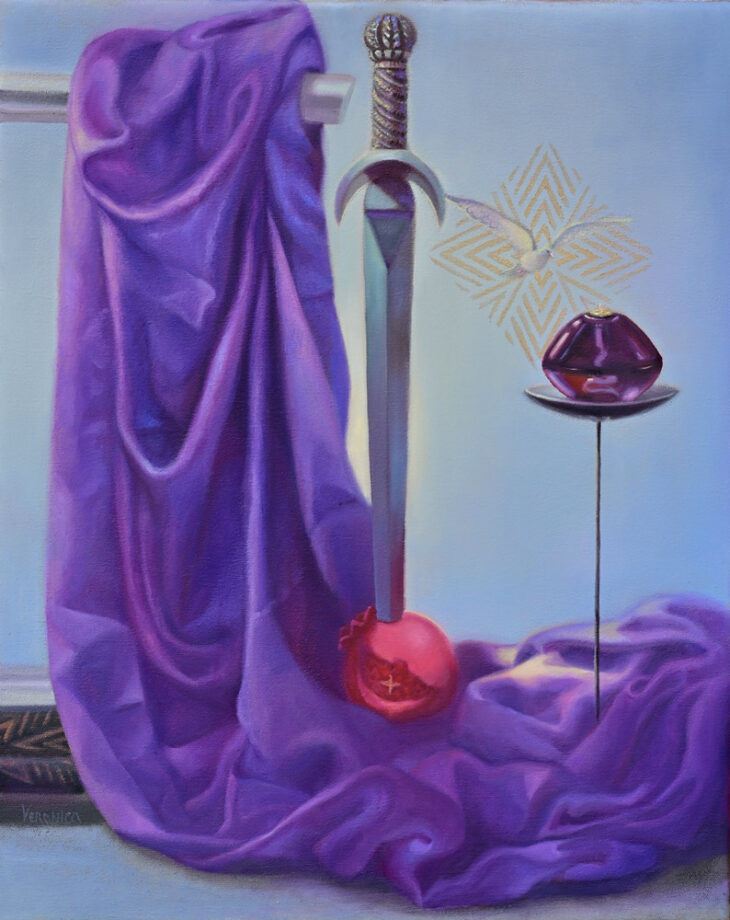
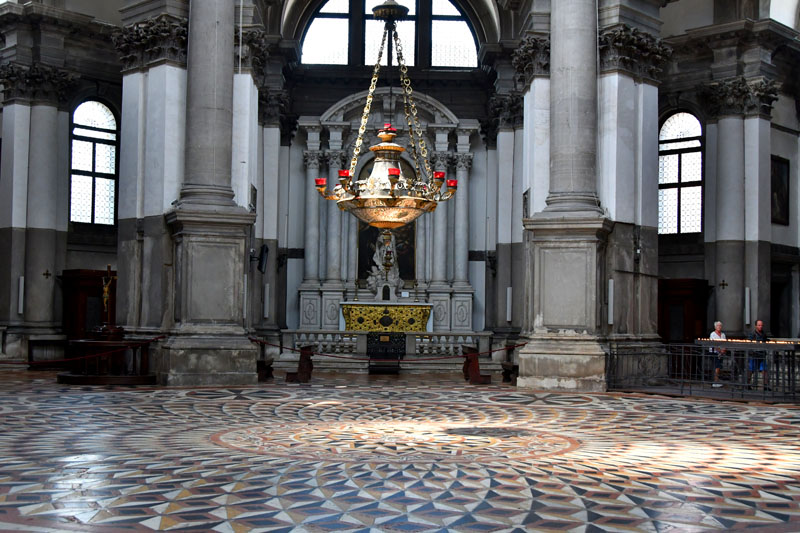
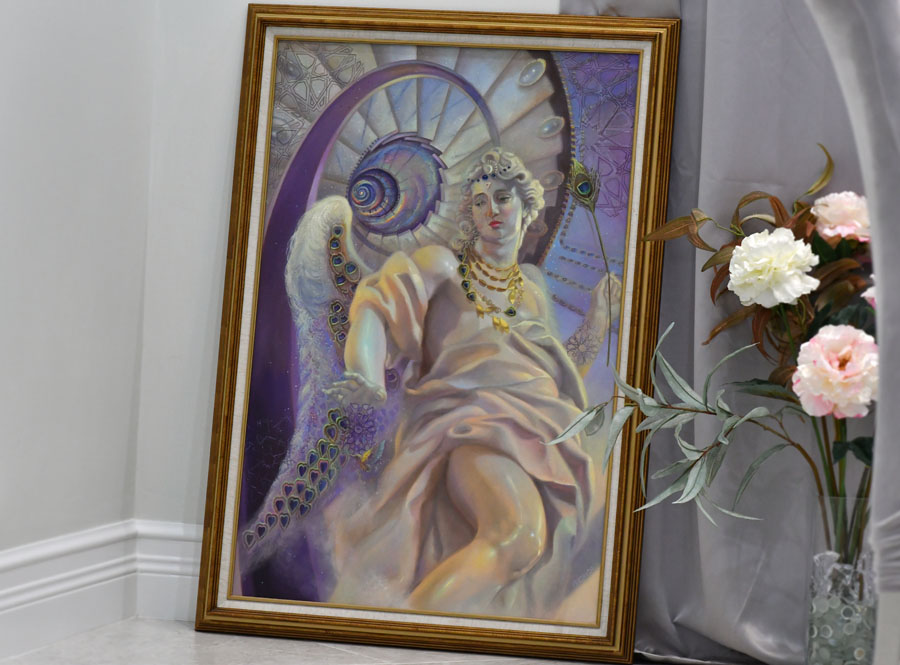
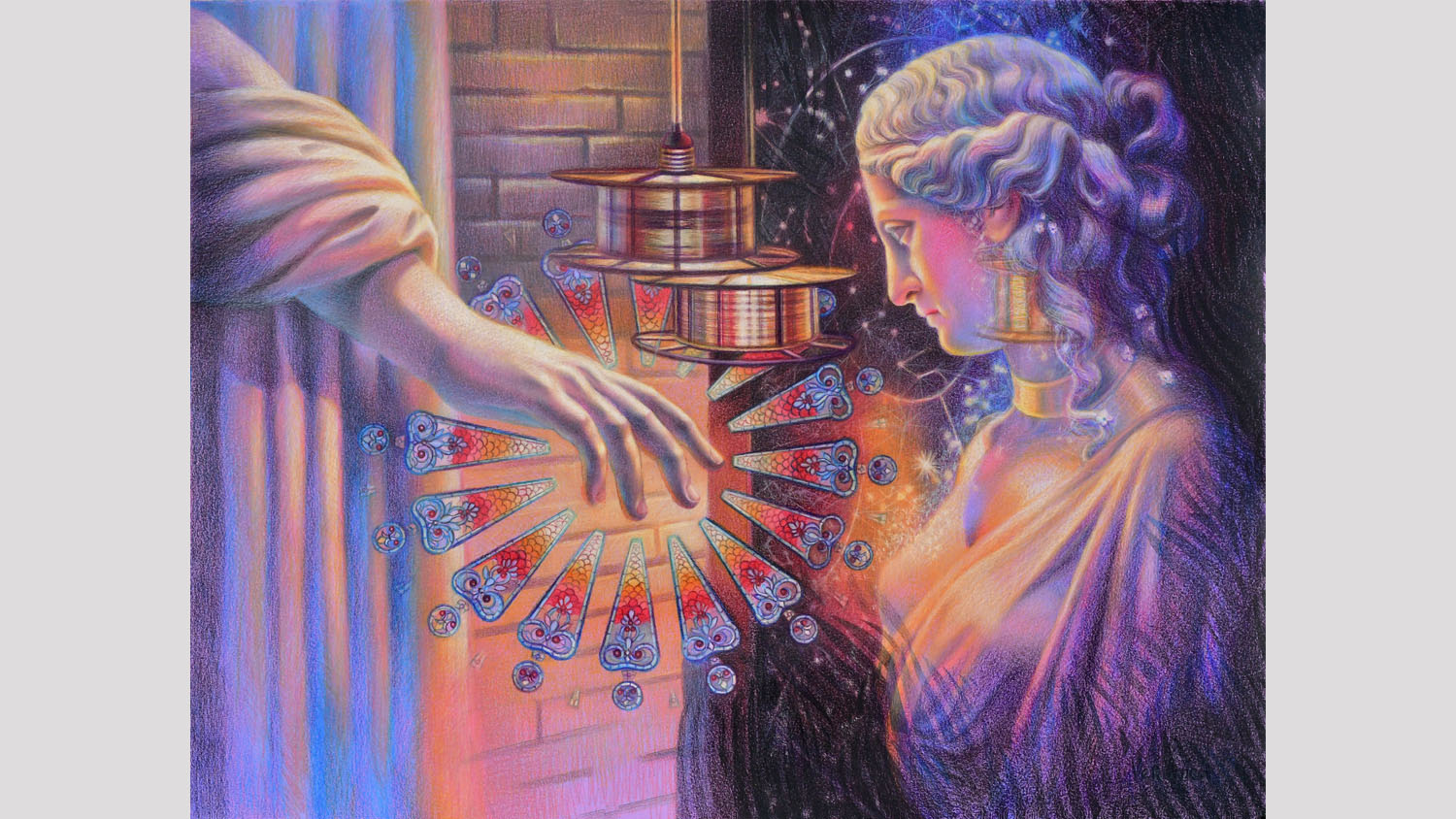
As I traveled in Italy once again, I visited many churches in Bergamo, Venice, Milan, and so on. The figure of Christ was covered in a beautiful, sheer fabric of either purple or deep red hue. The colors varied a bit, but I found this rich purple color striking to paint. Violet is one of my favorite hues to paint in my art. While I’m not religious, I think this symbolic painting may bring hope to many people believing in Christ and his resurrection.
Symbolism of purple cloth in the Catholic Church: meaning of purple cloth over a crucifix during Lent
In the Catholic Church, the practice of covering crosses and statues with purple cloth is a tradition primarily associated with Passiontide, the final two weeks of Lent. Starting on the Saturday before the Fifth Sunday of Lent, you will often see crucifixes and other religious images veiled in violet or purple fabric.
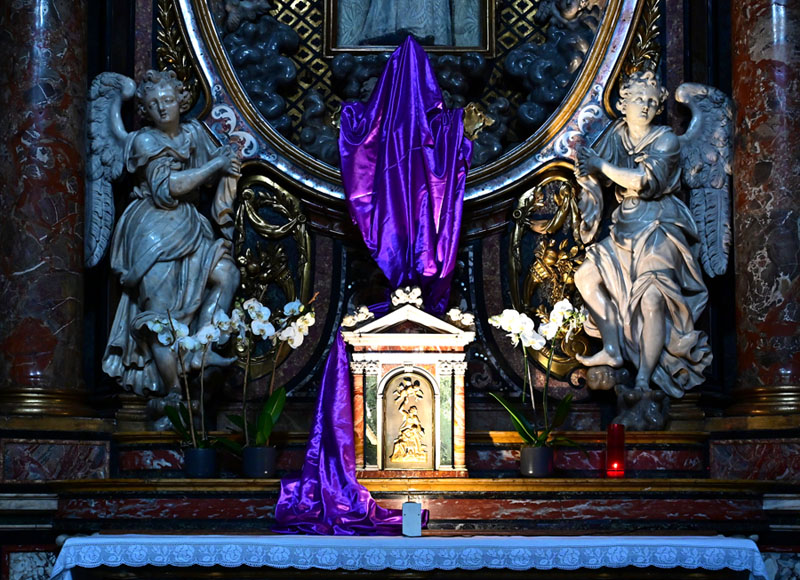
1. Mourning and Penitence
Purple is the liturgical color for Lent, symbolizing penance, preparation, and sacrifice. By veiling the cross, the Church visually signals a period of deep mourning as the faithful approach the anniversary of Christ’s suffering and death.
History of purple veiling in the traditional Roman Rite
In the traditional Roman Rite, the practice of veiling crosses and statues is a solemn tradition that dates back to the early Middle Ages, specifically becoming a universal custom by the 17th century. It marks the beginning of Passiontide, the final two weeks of Lent, and serves as a powerful visual cue that the Church has entered its most somber period of the liturgical year.
2. A “Fast for the Eyes.”
Just as Catholics might fast from food or luxuries during Lent, the veiling of religious art and the crucifix itself is a “fast for the eyes.” By removing the visual representation of Christ and the saints, the Church creates a sense of spiritual hunger and heightened anticipation for the Resurrection at Easter.
The Origins
While the exact origins are debated, many historians link the practice to a medieval custom in Germany called the Hungertuch (hunger cloth) or Lenten veil. This massive cloth would completely hide the altar from the congregation’s view during Lent. Over time, this evolved into the custom of veiling individual images. The primary theological reason is to create a “fast for the eyes.” It forces the faithful to focus inward on the penitential nature of the season, stripping away visual comforts to emphasize the gravity of Christ’s impending Passion.
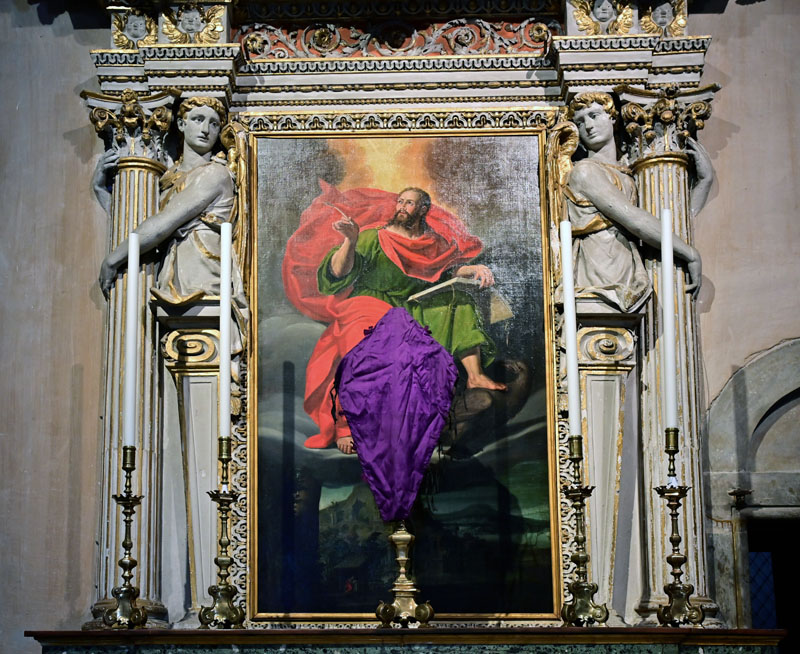
3. Focus on the Narrative: Symbolic Meaning of the Veil
The veiling helps the congregation focus on the words of the liturgy and the Gospel readings rather than the physical environment.
- The Hidden Divinity: The veiling corresponds to the traditional Roman Rite, the Gospel of the Fifth Sunday of Lent (in the traditional calendar), which ends with the words: “Jesus hid himself and went out of the temple” (John 8:59). The purple cloth represents Christ hiding his glory as he enters into his suffering.
- Mourning and Humility: The violet color itself signifies penance and mourning. By covering the saints, the Church reminds us that the “servant is not greater than the Master.” If Christ’s glory is veiled, the glory of his saints must also be obscured.
- Anticipation: The removal of the veils at the Easter Vigil creates a dramatic visual “resurrection,” where the sudden reveal of the statues and the light of the church symbolize the triumph of life over death.
4. The Glory of the Reveal
The veils remain until the Easter Vigil (though the cross is specifically unveiled for veneration on Good Friday). On Good Friday, the cross is uncovered so the faithful can focus solely on the instrument of salvation. During Easter Virgil, the statues and other images are finally revealed, signaling the triumph of life over death and the joy of the Resurrection.
Liturgical Rubrics
In the Usus Antiquior (the older form of the Roman Rite):
- All crosses, statues, and pictures (except the Stations of the Cross) are covered before the Vespers of the Saturday preceding the Fifth Sunday of Lent.
- The crucifix remains covered until the Solemn Unveiling during the Good Friday liturgy, where it is revealed in three stages as the priest chants, “Ecce Lignum Crucis” (Behold the wood of the Cross).
- Other images remain veiled until the singing of the Gloria in Excelsis during the Easter Vigil.
If you see a mistake in this summary, write to nika@veronicasart.com
History, Symbolism & Art with Purple Color In It
Outside of Catholic liturgy, purple has been one of the most expensive and difficult colors to produce, which has determined its symbolism across time and cultures.
Royalty, Wealth, and Power
For centuries, purple was the color of the elite. This is largely due to Tyrian purple, a dye made from the secretions of sea snails. It took 10,000-12,000 murex snails to produce just one gram of dye, making it worth its weight in gold!
The Minoans of Crete were pioneers in the manufacture of Tyrian purple.
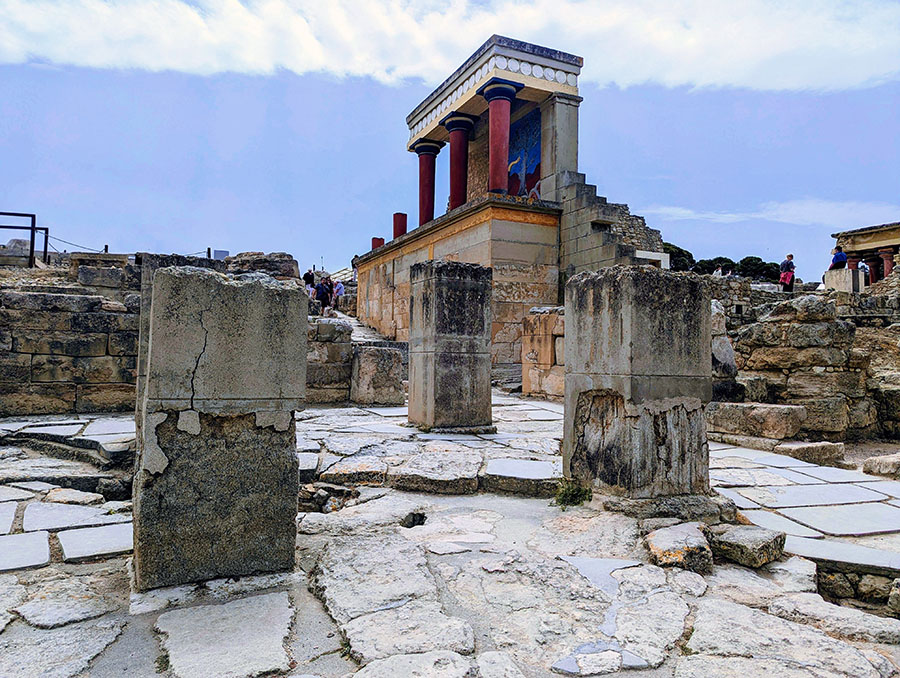
The Minoans obtained the dye from murex sea snails, similar to the Phoenicians, who later became famous for it. Archaeological evidence suggests Minoan production dates back to the Middle Minoan period (2000-1600 BCE), predating the Phoenicians by centuries. Discoveries of large quantities of crushed murex shells at sites like Chryssi Island in eastern Crete point to dedicated dye production facilities. The Minoan purple dye likely possessed the same rich, deep color and remarkable lightfastness (resistance to fading) that made Tyrian purple so valuable. The extraction process was laborious, involving the collection and processing of vast numbers of sea snails. The resulting dye was incredibly expensive due to the difficulty of production. Minoan purple likely colored textiles and other luxury items, signifying wealth and status. It’s interesting to note that while the Phoenicians later became synonymous with this purple dye, the Minoans may have been the true innovators behind this remarkable ancient technology.
The color had an obnoxious smell even in the fabric itself, according to the ancient writer, Pliny. Tyrian purple was highly resistant to fading in textile production, but how it was manufactured is quite a mystery. Pliny wrote the most detailed recipe for its production in the 1st Century AD.
Why was purple the color of royalty in ancient Rome?
In Ancient Rome, Byzantium, and the Elizabethan era, “sumptuary laws” often forbade anyone but the highest-ranking officials or monarchs from wearing it.
The association between purple and Roman royalty was born from a combination of extreme scarcity, high cost, and strict legal control. As the color was derived from Tyrian purple, the material was literally worth its weight in gold.
In ancient Rome, this economic barrier was reinforced by “sumptuary laws,” which dictated who could wear the color based on social rank. While high-ranking senators were permitted to wear a purple stripe (clavus) on their tunics, the toga picta—a solid purple garment embroidered with gold—was eventually reserved exclusively for the Emperor. Julian Caesar met Cleopatra in her purple rooms. He loved the color, and soon only the emperor was allowed to wear a fully purple toga. This made the color a “visual shorthand” for absolute power.
Pavonazzo was a purplish color in ancient Rome. This word also reffered to a marble with red, violet, or purple veins found in ancient Roman buildings and thought to be Phrygian. Pagonazzo translates as purple from Italian.
Today, purple is still used by brands to evoke a sense of luxury, premium quality, or “high-end” status.

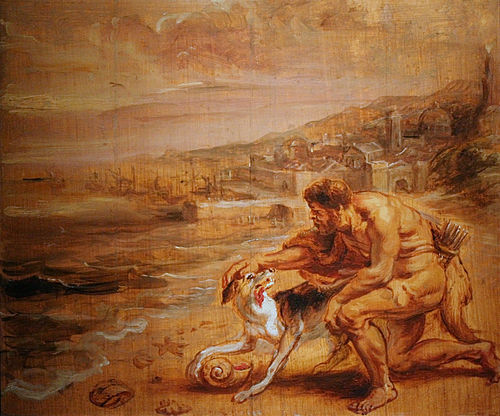
The Roman city, Tyre, was the birthplace of the seashells and purple dye. Here, the artist depicts this seashell differently from the murex shell, probably because Rubens didn’t really see the murex seashell. In this underpainting, the dog bit a sea snail, and the snail’s blood dyed the dog’s mouth Tyrian purple.
I recommend listening to this book on Spotify: Color: A Natural History of the Palette by Victoria Finlay to learn about the historic accounts of all main colors, including purple.
Because purple was so rare, using purple to represent wealth and power in portraiture was symbolic. One of the earliest examples of purple wear is Empress Theodora and Her Retinue (Basilica of San Vitale, Ravenna). In this 6th-century mosaic, Theodora is depicted wearing a deep, imperial purple chlamys (cloak). In Byzantium, purple was strictly regulated. By wearing this hue, Theodora showed her wealth and co-ruling status alongside Emperor Justinian.
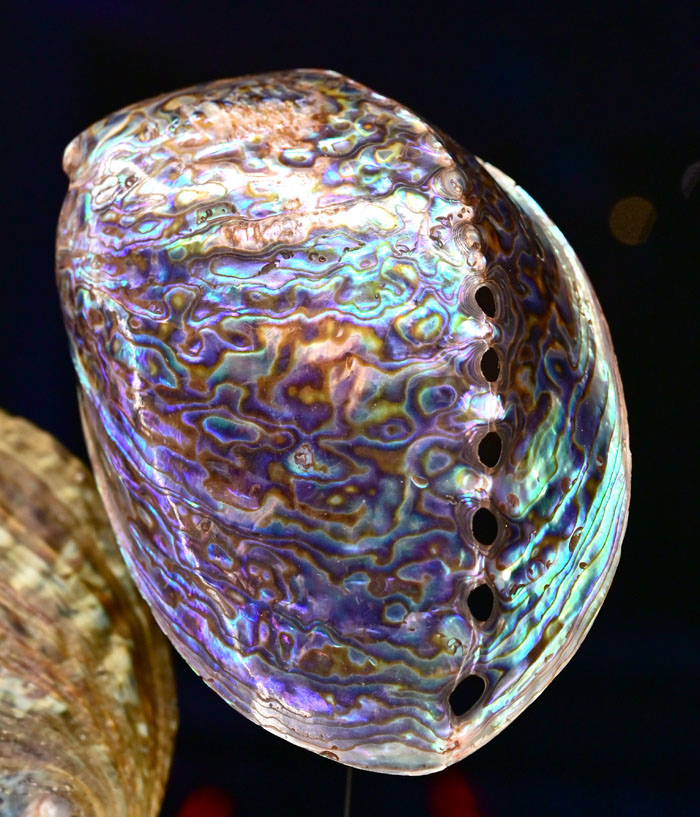
Here is an example of an early Byzantine glass jar with an iridescent purple color on its surface.
Cleopatra’s Sails:
The story of Cleopatra’s purple sails is a famous historical account, primarily recorded by the ancient Greek historian Plutarch. I don’t know if he just told us stories or if it was really the case, but… In Plutarch’s Life of Antony (written in the 1st century AD), he wrote about the Meeting of Antony and Cleopatra at Tarsus in 41 BC, he describes her arrival on a magnificent barge:
“…she came sailing up the river Cydnus, in a barge with gilded stern and outspread sails of purple, while oars of silver beat time to the music of flutes…”
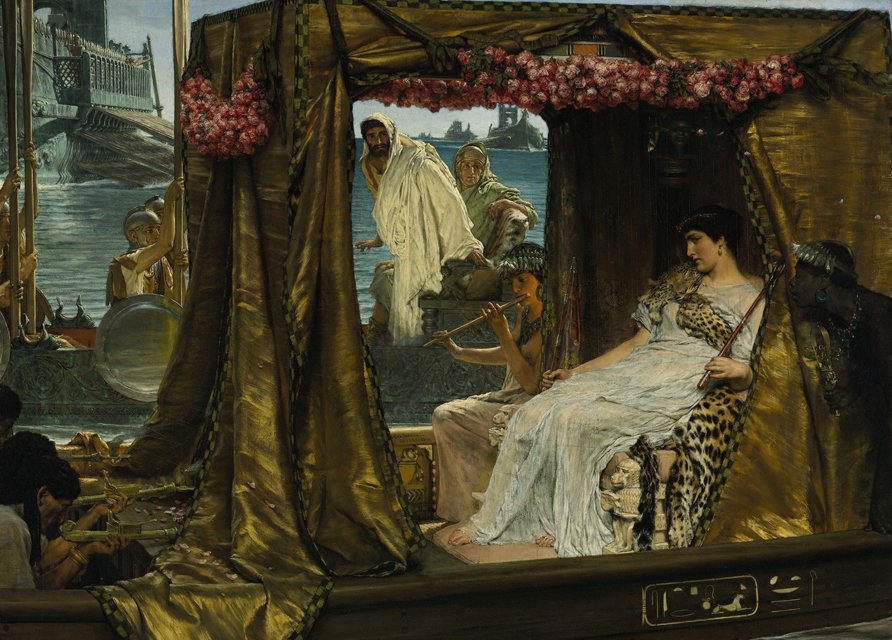
By dyeing her sails in Tyrian purple, Cleopatra was making a bold political statement. In Rome, this dye was regulated and extremely rare. So by unfurling it on her sails, she was announcing herself as a sovereign queen who bowed to no one. Plutarch also notes that the sails were so heavily perfumed that the scent reached the shore before the boat did, further overwhelming the senses of the Roman onlookers and Mark Antony himself. This description was so vivid that it inspired William Shakespeare for his play, Antony and Cleopatra. He famously wrote: “Purple the sails, and so perfumed that / The winds were lovesick with them.” The story also inspired the 19th-century realist artist Lawrence Alma-Tadema. You can read about the Ptolemies in this book.
Purple In Art
The use of purple in art is not as common as you may think. It took me a while to collect a few paintings with purple in them. Perhaps it’s due to fading, and violet or mauve looks more like grey or brown today. Purple in art before the 19th century was rare, but when a young chemist, William Henry Perkins, invented the synthetic dye by accident, everything changed.
A young chemist patented the dye and began textile production in London. Named after the inventor, as Perkin’s Purple, the deep mauve color enjoyed instant fame, making him wealthy and women fashionable. Even Queen Victoria wore a silk gown dyed with mauveine at the Royal Exhibition of 1862. You can see an example of the 1860s mauve dress here.
Purple in Art: Varied symbolism
Because the original Tyrian purple dye trade collapsed with the fall of Constantinople in 1453, Renaissance painters had to mix the color using blue and red pigments. Purple hue can vary, of course, from lilac to deep violet, to fuchsia, to purple-madder.
In Raphael’s The Dream of the Knight, 1504, Pleasure is wearing Tyrian purple (that looks blue to me) and Virtue is wearing a dark blue dress. The soldier is asleep with a vision of Virtue and her adversary Pleasure. Virtue promises Scipio honour, fame, and glory through victory in war. Pleasure promises an easy life. According to the museum’s description, Raphael interpreted the theme not as a moral dilemma but as a combination of all the virtues to which an ideal soldier should aspire.
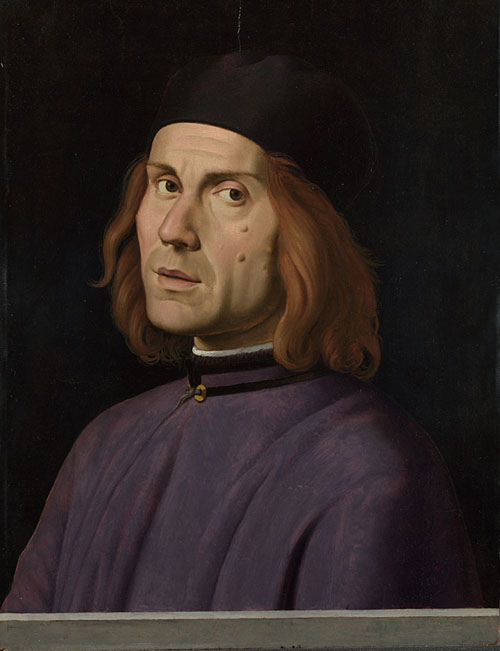
The man wears dull purple clothing that symbolizes justice.
Purple in Art: Fading
All colors fade with time, and mixed violet could also have faded in classical art. So when we look at purple in oil paintings, it may appear brownish, pinkish, greyish, or dull red instead. For example, Mantegna’s Triumph of Caesar might have had rich violet that looks pale today. Tyrian purple was highly resistant to fading in textile production, but I don’t know how it was made for painting.
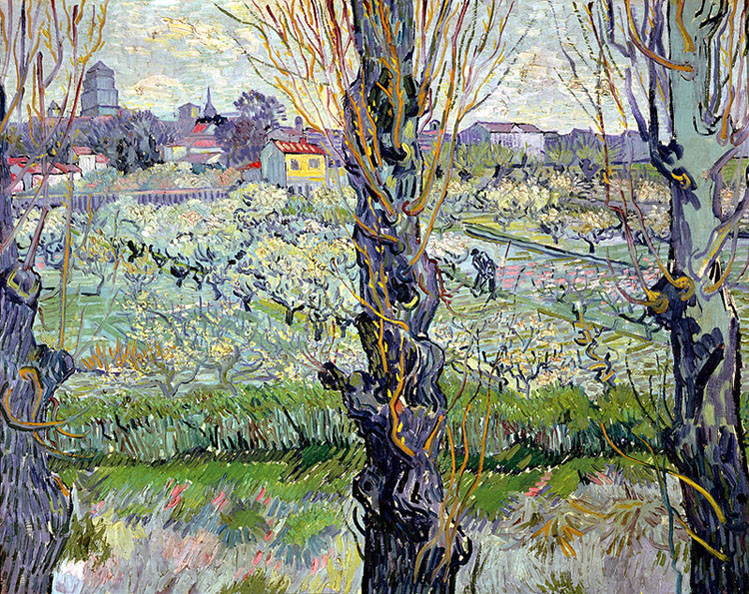
Master of the Bruges, Passion scenes, Christ presented to the people, oil on wood, 1510. You can check out the National Gallery Podcast – Stories in Colour for more information about this and other paintings. In this artwork, Christ wears a toga that looks greyish-blue today, which could have been purple in the past. In Vouet’s painting, the color is pinkish-mauve. This means if you paint, use high-quality oil paints to make your paintings last! Otherwise, you’ll end up with Van Gogh’s flowers of green and brown in a few decades from now.
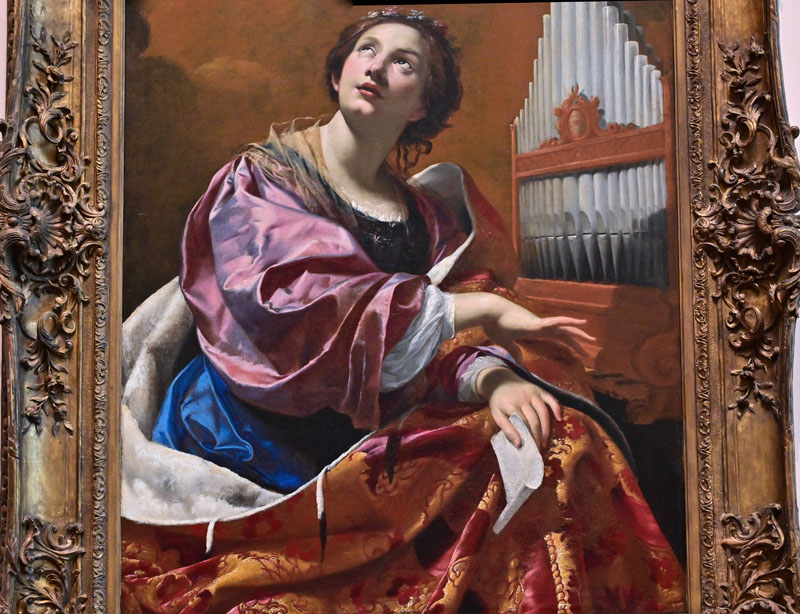
Museum’s description: Cecilia, the patron saint of music and musicians, sits in a brocaded mantle. She gracefully turns to the two cherubs that appear to her at the upper-left corner of the scene. Golden light bathes the figure and the background, who lived in Rome. She took a vow of virginity and on her wedding night, converted her groom, Valerian, to Christianity; he, in turn, guided his brother Tiburtius to the Christian faith. Their beliefs were soon discovered by the authorities, and all three were ultimately martyred at the hands of Roman prefect Turcius Altmachius.
Cecilia has been represented with a musical instrument since the fourteenth century, although her connection to music is tenuous at best. According to The Golden Legend, the saint heard celestial music when she was praying to God to preserve her virginity, “T et my heart and my body be undefiled, O Lord and sang, “Let my heart and my body be undefiled, O Lord, that I may not be confounded. “Depictions of female saints were popular in Rome in the 1620s. It is possible that his wife, the painter Virginia da Vezzo, was the model for the figure of the saint. The two artists married in Rome in 1626, just before they left for France to serve King Louis XIII.
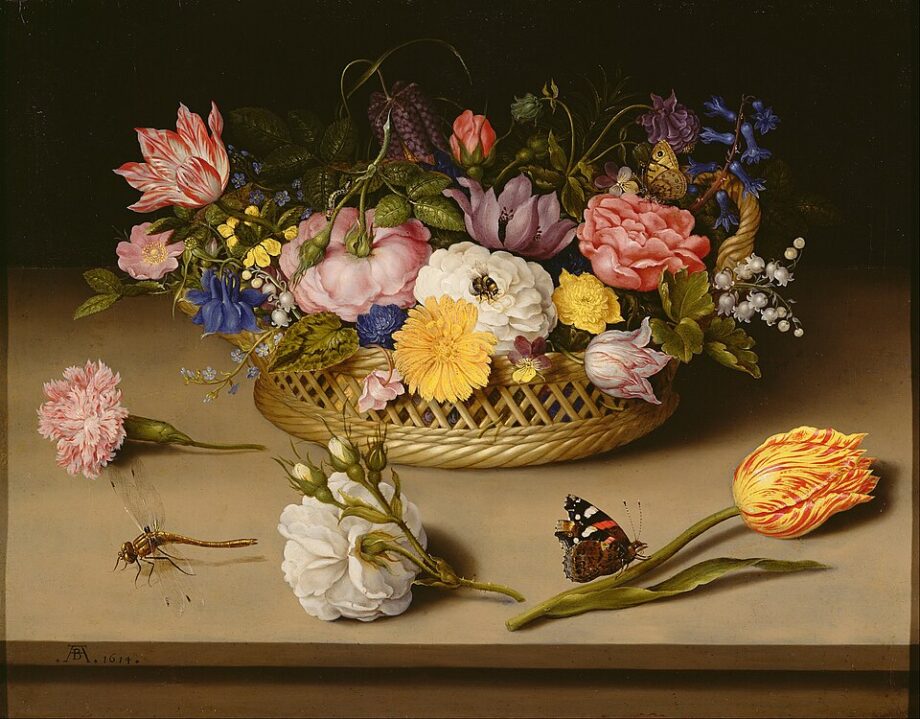
There is more art with purple in it in the 19th-century paintings. Maybe, because it hasn’t faded yet, or because it was easy to manufacture. You’ll find several paintings with shades of purple in them below.
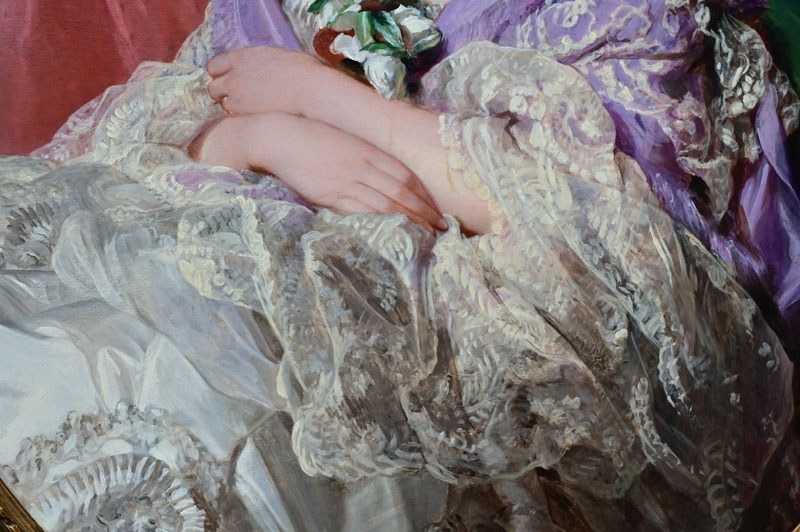
When Empress Eugenie ascended to the throne as the wife of Napoleon III, she was acknowledged as one of the most beautiful crowned heads of Europe, but she was not of royal blood. Since Napoleon III declared himself emperor, just as his famous uncle had done in 1804, he had difficulty in finding a spouse among European royalty. Eugenie, already 26 at the time of their marriage, was the daughter of a Spanish grandee and a commoner. She chose Franz Winterhalter, a wonderfully gifted German portraitist, as her court painter. Her patronage brought him commissions from virtually all the crowned heads of Europe
Gustav Klimt liked to use purple in his art. The examples include The Maiden, Danae, unfinished portrait of Ria Munk III, etc.
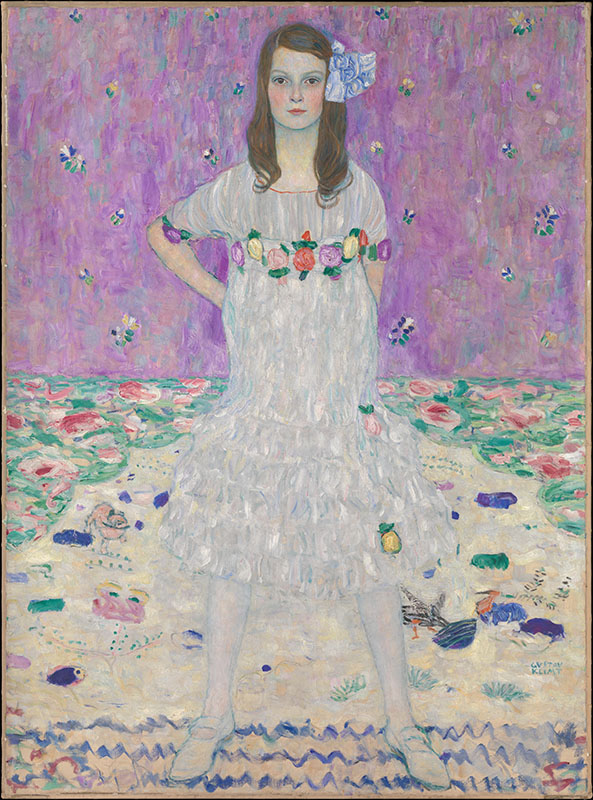
http://www.metmuseum.org/art/collection/search/436819
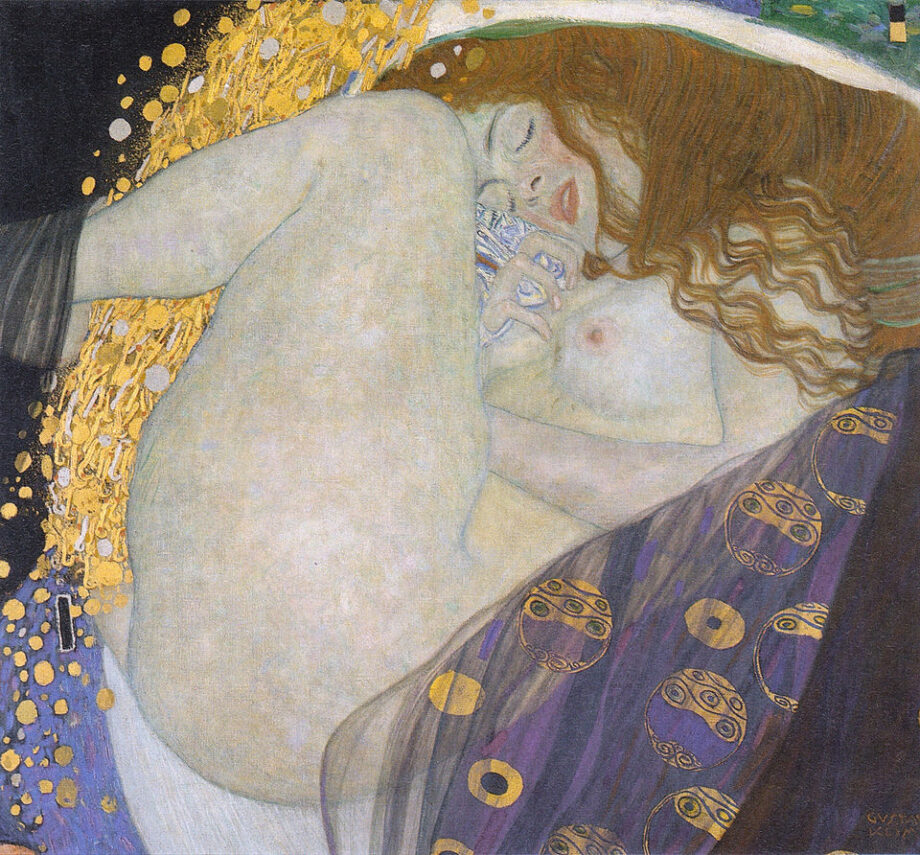
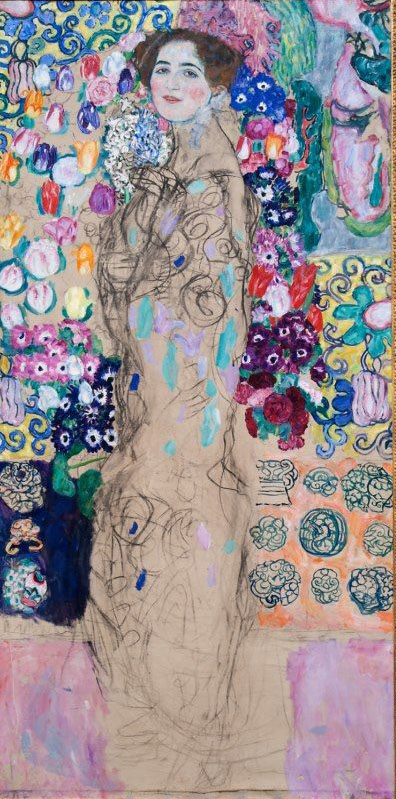
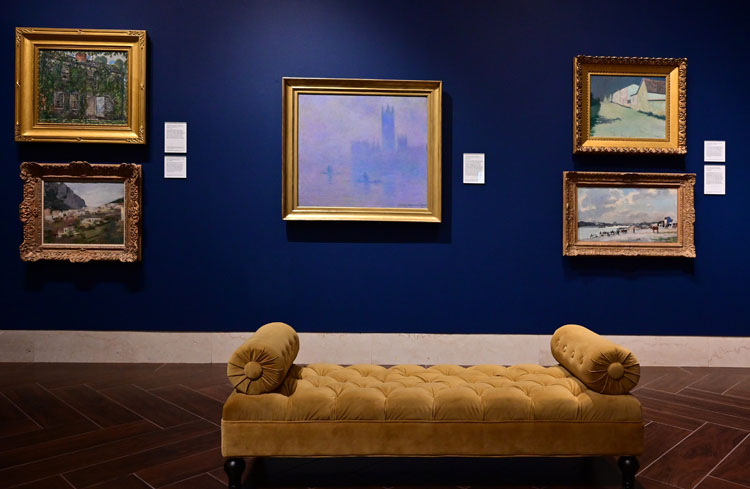
In his later Water Lilies series, Claude Monet heavily utilized violet shadows and purple reflections to capture the fleeting, almost spiritual quality of light and water, mirroring his understanding of the natural world.
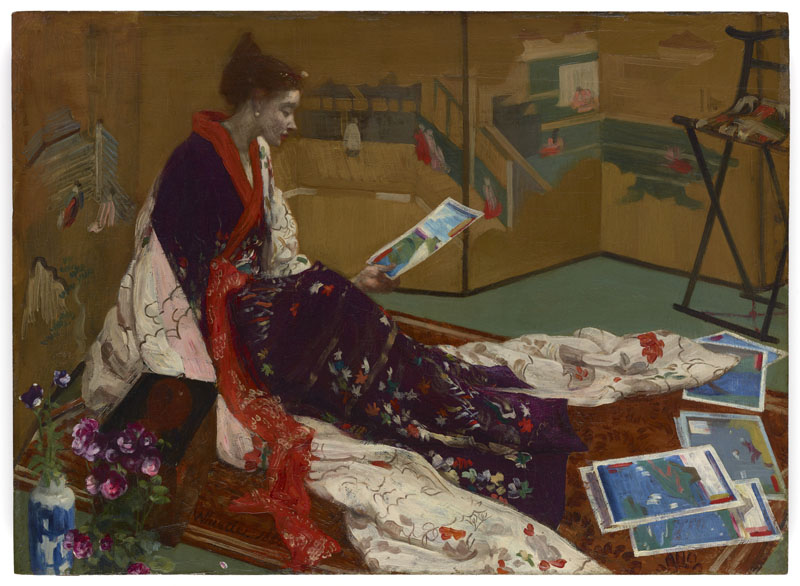
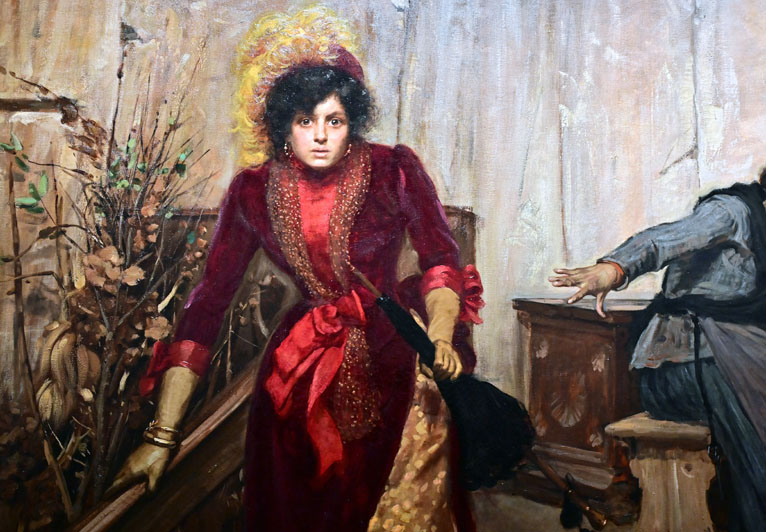
This is a close-up of the painting showing a woman dressed in a purplish-crimson dress similar to the kimono above.
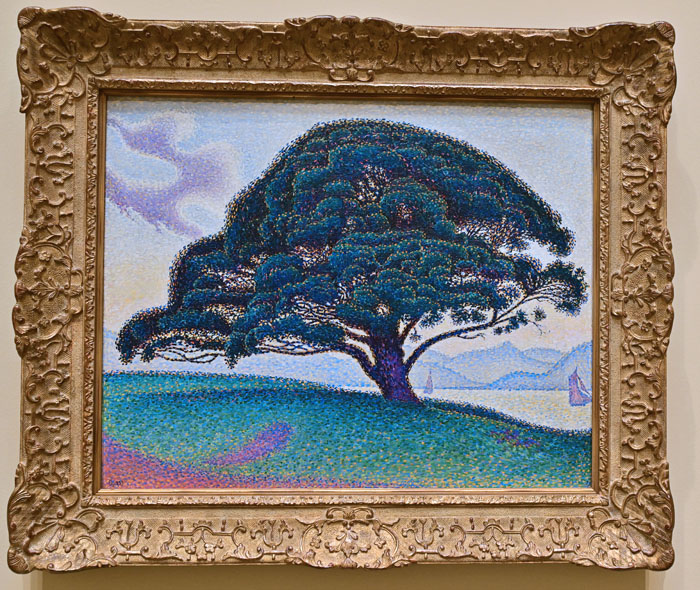
Paul Signac painted landscapes of the Mediterranean in the south of France. In this painting, Signac pays homage to the lyrical shape of a particular umbrella pine tree. He places regular, tiny dots of cool colors like purple and turquoise to paint the reflective surfaces of pine needles, grassy plane, and sea. Here, Signac’s pointillism outshines his other artworks in terms of contrast and color.
More art with purple in it:
- Maximilien Luce, French, 1858-1941, Rue Ravignan-Night, 1893, Oil on canvas, MFAH
This work is somewhat unusual for Neo-Impressionism in that it depicts a nightscape. Using a high concentration of small dots, Maximilien Luce transforms rue Ravignan, a typical street in the Montmartre area of Paris, into an eerie scene tinged with a melancholy atmosphere of emptiness and isolation. Luce exhibited this intense work at important avant-garde exhibitions in both Paris and Brussels. - Robert Lewis Reid (1862–1929), The Violet Kimono, 1910.
- Pre-Raphaelite painters mixed blue and madder to get rich purples. There are many paintings, including Cloister Lilies, 1891, by Marie Spartali Stillman; Rossetti “The first anniversary of the death of Beatrice; Millais “The Blind Girl” and “Autumn Leaves; William Hunt “The Finding of the savior in the temple”; Author Hughes “April Love”, “The Brave Geraint”, “Home from the Sea” and “The Annunciation”; Burne-Jones “the Beguiling of Merlin”; John Shaw “The Blessed Damozel.”
- William-Adolphe Bouguereau (French, 1825–1905), Dream of Spring (Rêve de printemps), 1901. This is a very beautiful painting. The image is copyrighted and can be seen on the museum’s site.
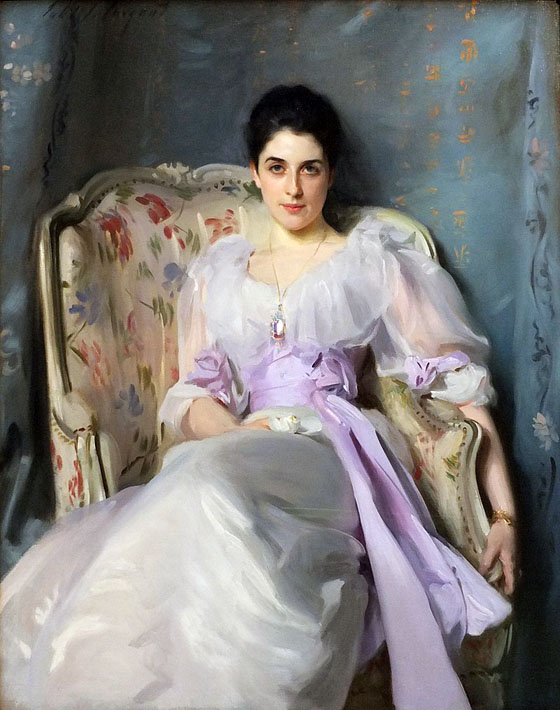
Are you interested in learning color harmonies in your art? Take a class to create beautiful color schemes in your paintings!
2. Mystery, Magic, and Spirituality
Because purple is rarely found in large quantities in nature (unlike green or blue), it is often associated with the “unnatural” or the supernatural.
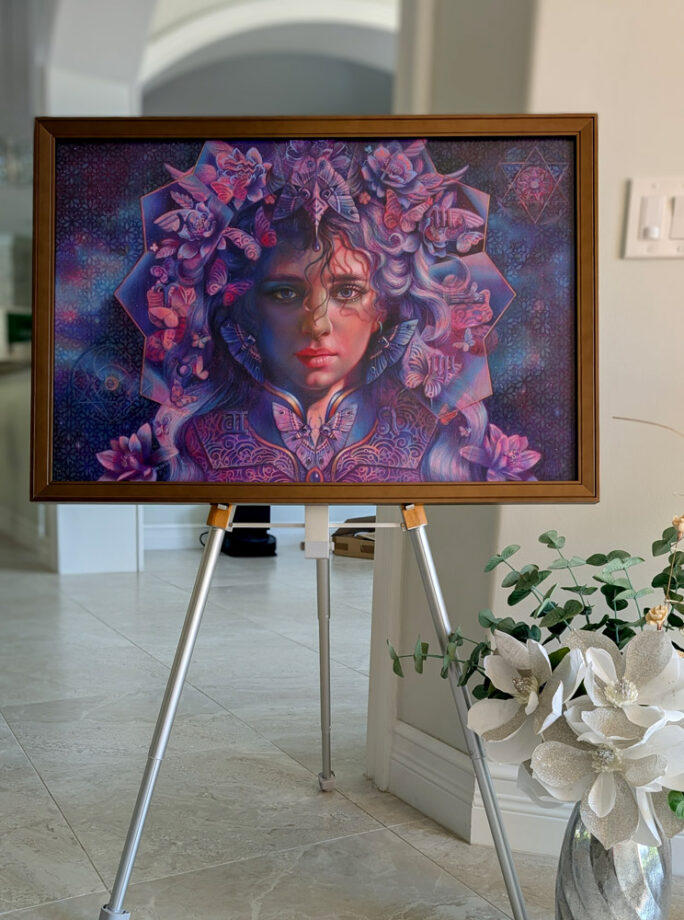
It is frequently linked to the Third Eye, intuition, and mindfulness as esoteric language.
Looking for the color of magic? In literature and film, purple is the go-to color for wizards, sorcery, and cosmic mysteries. It represents the veil between the known world and the unknown.

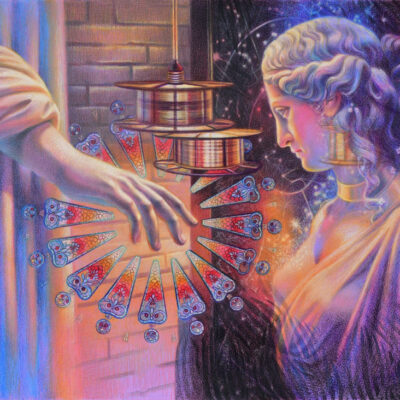

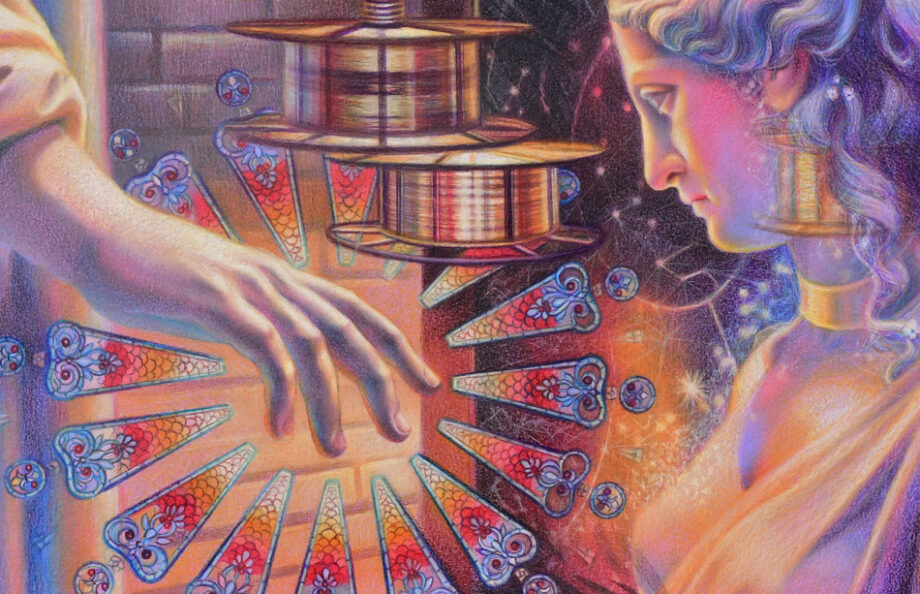
Celestial Room, colored pencil drawing
“Celestial Room”, 19×25 inches, colored pencil on paper. Price includes framing. Currently unframed. Feel the Creator. Welcome to the celestial room!
Purple color symbolism in mindfulness and intuition
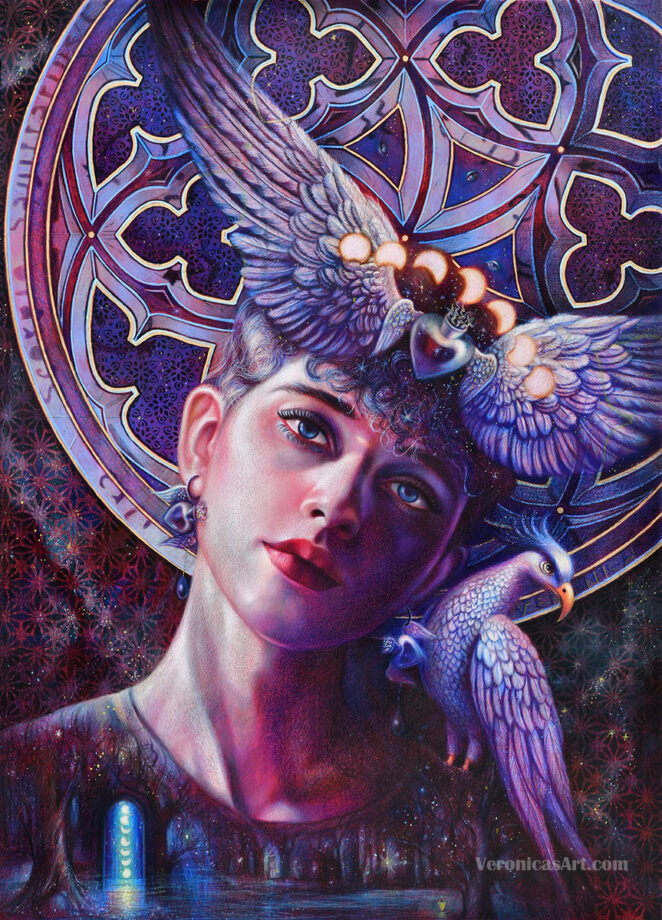
In art and spiritual practice, purple serves as a bridge between the physical and the metaphysical, often associated with the Third Eye chakra, intuition, and a deepened state of mindfulness. As a blend of the grounding stability of blue and the passionate energy of red, purple creates a psychological space for introspection and “inner sight.” In mindfulness, the color is used to represent the transition from conscious thought to a higher state of awareness, acting as a visual cue for clarity and spiritual wisdom.
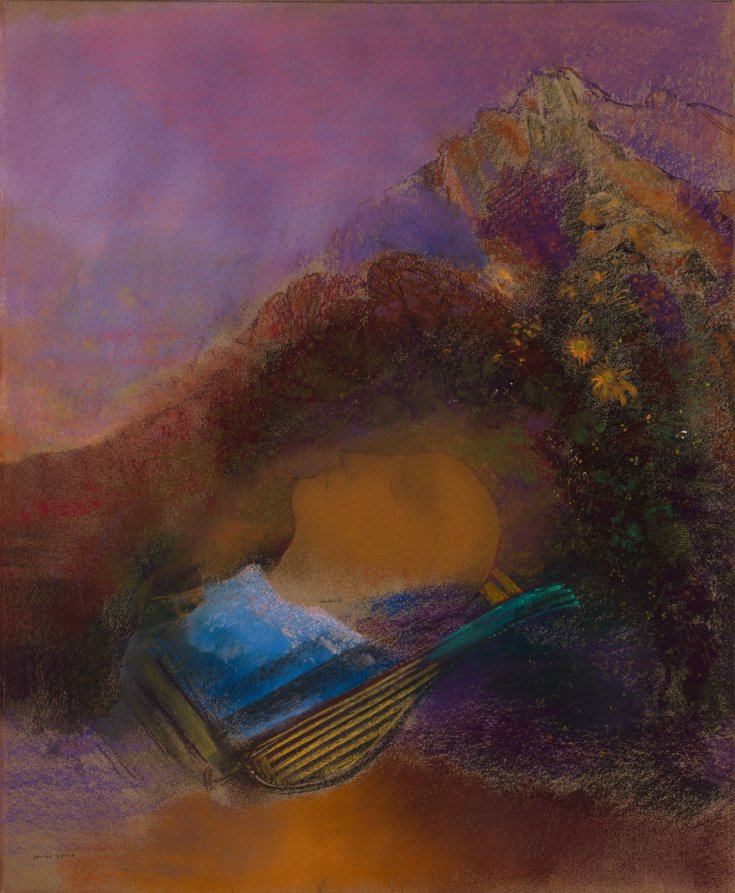
A key figure in the Symbolist movement, Redon’s works, like The Cyclops or his late floral pastels, use luminous violets and purples to depict dreamscapes and the “invisible world” of the psyche.
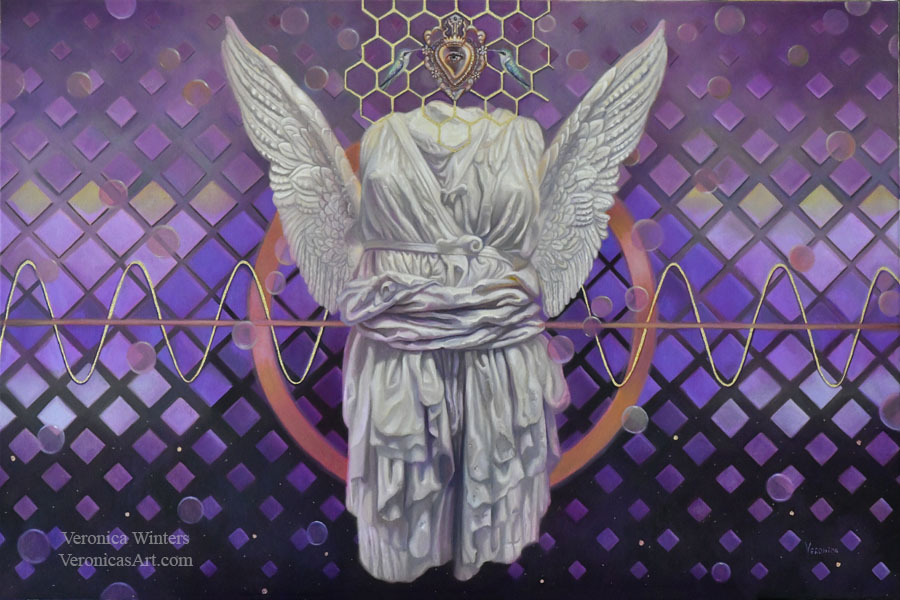
Want more visual inspiration?
3. Wisdom and Maturity
As a blend of stable blue and high-energy red, purple is often seen as a color of balance. It is often associated with deep thought or dignity, and In the United States military, the “Purple Heart” medal is awarded to those wounded or killed in service. Here, the color represents a somber dignity, bravery, and the ultimate sacrifice.
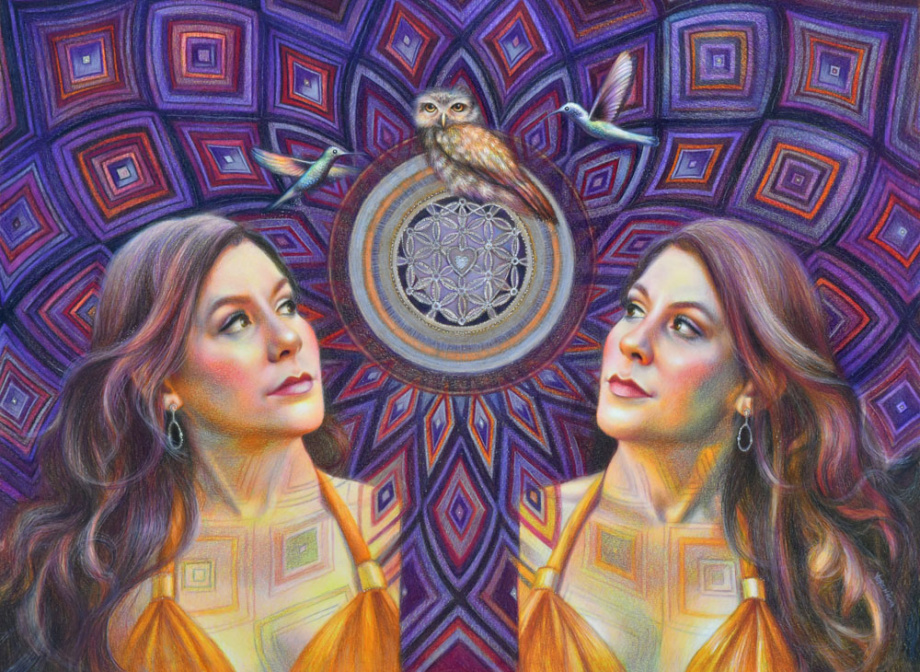
4. Creativity and Eccentricity
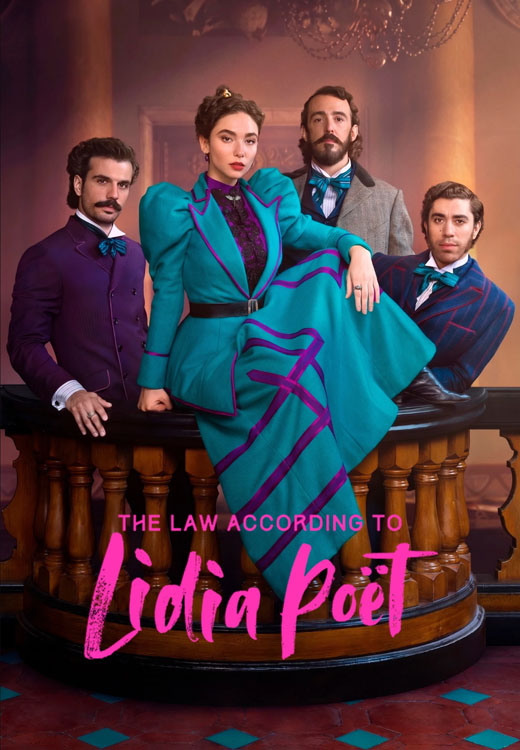
In the modern world, the color Purple is often the choice of the rebel artist. It is a bright color that suggests an artistic or unconventional personality. It was a favorite of the 1960s psychedelic movement culture (e.g., Jimi Hendrix’s “Purple Haze” or Prince’s “Purple Rain”) and has long been used to represent individuality and the avant-garde.
And here you have it! Lots of symbolism to decode in just one color.
Art books from the artist:



If you’d like to discover more, check out other articles below: