Discover how major 2026 auction house premium increases impact famous art collections, raising overall purchase costs for high-profile blue-chip buyers.
Tag: art collecting
High-Precision Vases Under Djoser’s Step Pyramid? Fact vs. Fiction
Were ultra-thin, high-precision stone vases really found under Djoser’s Step Pyramid? We dive into actual archaeological data to separate fact from myth.
How Fake Artifacts Could Be Used To Shield The Wealthy Via Non-Profits
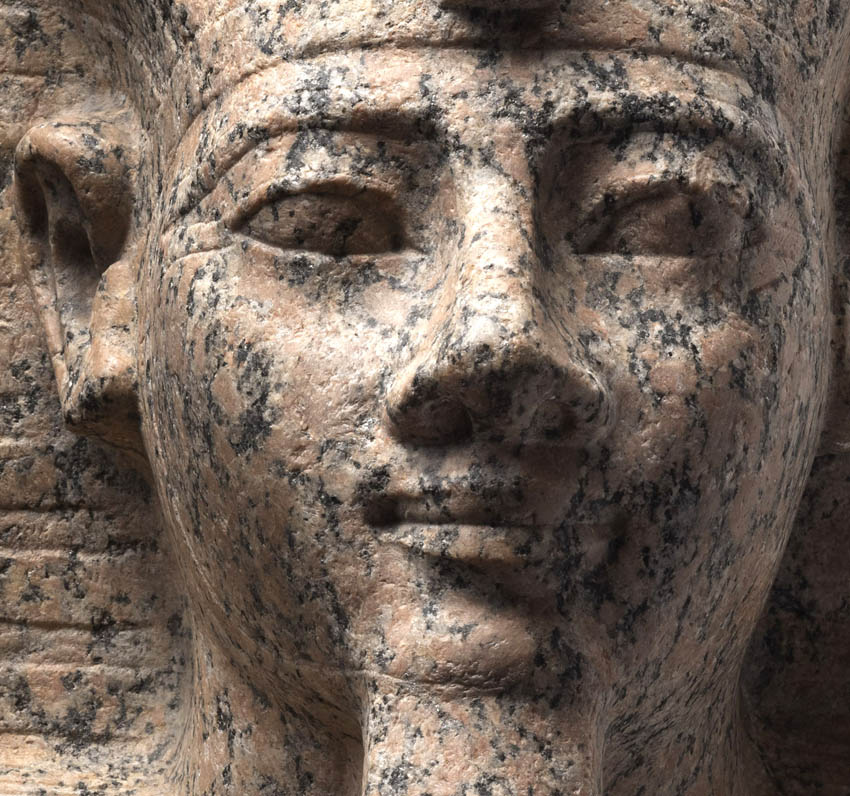
This article describes hypothetical fraud risks in the nonprofit, art, and antiquities sectors. It does not accuse any specific organization or individual of committing fraud. Any real-world concerns should be evaluated through public records, provenance documents, appraisals, IRS filings, and regulator review.
Art, Non-Profits, & Tax Fraud
When a 501(c)(3) non-profit research organization is established, it unlocks standard tax-exempt benefits. While many non-profits operate strictly within legal bounds, the specific structure of an independent research foundation dealing with historical artifacts, private collections, and media production can theoretically be vulnerable to tax abuse if individuals choose to manipulate the system.
Historically, there are several common ways bad actors abuse 501(c)(3) research foundations for tax avoidance or evasion:
1. The Antiquities Appraisal Scam (Overvaluation)
This is one of the most prevalent forms of tax fraud involving physical artifacts and private collections.
- How it works: A wealthy collector buys a physical item (like an unprovenanced artifact, art, jewelry, or ancient tool) on the private market for a relatively low price. They then have a friendly or corrupt “expert” write an appraisal assigning the object an artificially inflated, exorbitant value (e.g., buying it for $5,000 but appraising it at $500,000).
- The Tax Write-Off: The collector “donates” the artifact to the tax-exempt foundation. They then claim a massive charitable deduction on their personal income taxes based on the fake, inflated appraisal value, effectively wiping out what they owe to the IRS.
2. Private Inurement and Benefit
By law, a 501(c)(3) cannot exist to financially benefit its founders or specific private individuals; it must serve a public good. Tax cheating occurs when the lines between personal finance and the foundation become blurred.
- Funneling Personal Expenses: Founders might use the foundation’s tax-exempt funds to pay for luxury global travel, expensive camera equipment, vehicles, or high-end tech, jewelry, scanners, analytical equipment, under the guise of “field research” or “media production,” when the items are actually being used for personal enjoyment or private business.
- Overpaying Insiders: The foundation might pay inflated “consulting fees,” salary, or honorariums to the founders or their immediate family members, looping untaxed donation money back into their own pockets.
3. Masking For-Profit Ventures as “Non-Profit”
Many independent research entities operate alongside for-profit media channels, podcasts, merchandise stores, or paid travel tour companies.
- The Scam: If a group organizes highly lucrative international travel tours or sells expensive media access, they are supposed to pay standard corporate taxes on that revenue.
- The Abuse: If they funnel those profitable business revenues directly into the 501(c)(3) foundation and characterize them as tax-exempt “charitable donations” or “educational program fees,” they are actively dodging the taxes an ordinary tourism or media company would legally have to pay.
4. Directing Donations for Personal Gain
A legitimate charity cannot accept donations that are explicitly earmarked to benefit a specific person. If a donor gives money to a foundation with a backroom agreement that the foundation will use that money to fund a specific founder’s private project, buy their personal art, artifacts, or pay for their family member’s vacation, it violates IRS laws.
Note: Just because an organization is a 501(c)(3) that handles private artifacts, artworks, or digital media doesn’t mean they are engaging in these practices. However, because independent foundations don’t face the same strict, institutional oversight as major universities or state museums, the IRS monitors them closely to ensure physical assets, travel expenses, and media revenues aren’t being used as a front for tax evasion.
Fraud Schemes that could happen:
If a non-profit organization were to actively exploit ancient artifacts or art for financial gain or tax avoidance, the scheme would likely leverage specific vulnerabilities in the antiquities market, appraisal system, and tax-exempt law.
To bypass the IRS:
1. The High-Precision Artifact Appreciating Scheme
Because many looted artifacts and some art lacks archaeological context or ownership, and are sourced from private collections or art and antiquities dealers rather than official digs, their true “market value” is completely subjective.
- The Setup: A private individual or a founder purchases an unprovenanced, visually flawless artifact/object/artwork for a relatively low sum (e.g., $5,000) because it lacks historical pedigree and mainstream verification.
- The Fabricated Appraisals: Armed with this “scientific proof” that the object possesses “impossible ancient beauty, precision, uniqueness” a friendly or internal appraiser assigns the artifact an artificially inflated astronomical valuation (e.g., $500,000), claiming it is a priceless relic of a famous artist or lost civilization.
- The Tax Shield: The private collector formally “donates” the artifact or artwork to the 501(c)(3) foundation. Using IRS Form 8283, they claim a massive charitable deduction based on that inflated $500,000 valuation, wiping out their personal tax liabilities for the year while the art or artifact never leaves their immediate network.
2. Offsetting Production Costs for For-Profit Media
If creators run commercial media platforms (like paid YouTube channels, podcasts, travel agencies, research organizations, or premium video streaming services) alongside a non-profit foundation, the physical artifacts can serve as a conduit to hide taxable commercial revenue.
- Flipping Commercial Expenses: Buying equipment, paying for international travel to Mexico, Italy, or Peru, and purchasing art, artifacts or other antique objects are heavy expenses. If a for-profit media company pays for them, those costs aren’t fully tax-deductible against normal income.
- The Loophole: Instead, the creators can use tax-deductible public donations given to the foundation to fund the international travel, purchase the artifacts, and buy the gear under the guise of “scientific research.” They then use those exact same foundation-funded artifacts and equipment to generate high-traffic, revenue-producing content for their private YouTube channels or podcasts—essentially letting public donations pick up the tab for their commercial production costs.
3. Masking Commercial Tourism as Educational Travel
Many alternative history circles generate massive capital by hosting physical international expeditions to see these precision artifacts or art firsthand.
- If a standard travel agency or tourism business sets up a luxury tour to a foreign country charging individuals exuberant fees, that revenue is fully taxable.
- To cheat the system, an organization can structure these trips entirely through the non-profit foundation, labeling the ticket prices as “tax-deductible educational donations” or “field research fees.” This allows them to run a highly lucrative, commercial international travel business while paying zero corporate taxes on the incoming cash flow.
Why This Specific Scheme Fails Under Close Audit
While this looks clean on paper, the IRS maintains a specific Art Advisory Panel comprised of independent museum curators, geologists, and antiquities dealers specifically tasked with catching this exact type of fraud.
If an organization claims a massive tax benefit based on an unprovenanced art or artifact, forensic auditors will demand an ironclad chain of custody and an independent material analysis. The moment geologists point out that the stone composition looks modern or that the tool markings match modern paints or equipment rather than historical tools, the appraisal is rejected as a sham, the tax write-offs are invalidated, and the participants face heavy civil and criminal tax fraud penalties.
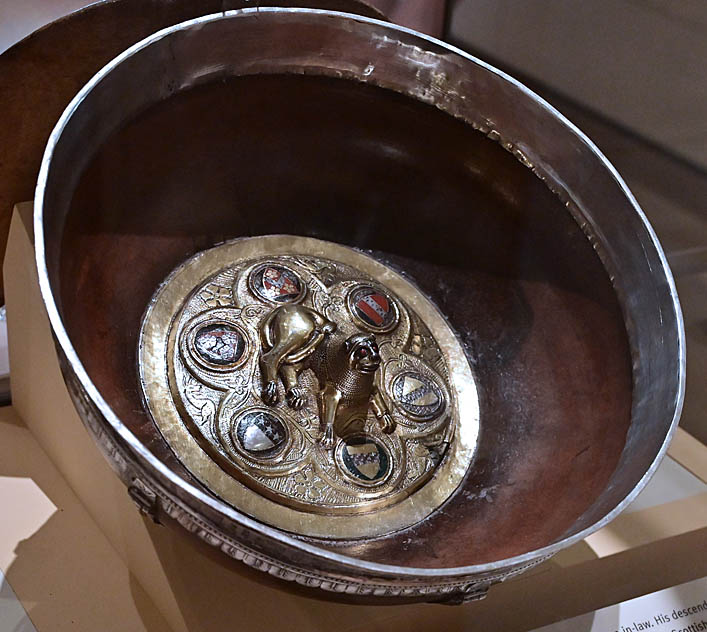
Possible selling of fake artifacts or art?
An organization operating under the banner of an independent research foundation could theoretically be used to market or sell modern reproductions as authentic ancient artifacts and art. Because entities in the alternative history space operate outside the strict oversight of traditional academic institutions and state-run antiquities ministries, the barrier to introducing unprovenanced or questionable items into the market is much lower.
If an independent foundation or its associated creators were to engage in selling or profiting from questionable artifacts, the operation would likely take one of several forms:
1. Private Antiquities Brokering
Because foundations studying these artifacts, art, objects build deep networks with private collectors, dealers and gallerists who buy and sell unprovenanced items on the open market, they can act as a bridge for private sales.
- The Appraisal Boost: A foundation can use its media platform to highlight a specific item from a private collection, publishing reports that claim it displays fantastic qualities.
- The Sale: By using their platform to publicly validate the object’s “anomalous nature,” they drastically increase its perceived value to wealthy collectors and enthusiasts. The object can then be sold privately or via high-end estate auctions for a massive premium, with the foundation taking a finder’s fee or a direct cut of the transaction.
2. Crowdfunded “Acquisitions”
Instead of a direct retail sale, an organization can use the physical artifact as a tool to raise capital via public donations.
- The Strategy: The foundation claims it has located a “priceless, unrecognized ancient artifact” or ‘lost artwork’ in danger of being lost to a private collection or destroyed.
- The Abuse: They launch a massive crowdfunding campaign to “rescue” the object for scientific study. Once the public funds the purchase, the object sits in the foundation’s private custody—often inside a founder’s home or private studio—serving as premium content for their paid channels while financed entirely by untaxed public charity.
The Legal Consequences
Selling a modern forgery as an authentic antiquity crosses the line from a historical debate into criminal wire fraud and grand larceny.
If an organization sells an item across state lines or internationally claiming it is a 6,000-year-old artifact when it was actually turned on a modern lathe, they face severe legal exposure. In the United States, both the FBI’s Art Crime Team and the IRS actively investigate organizations that use falsified historical claims to generate commercial revenue or secure fraudulent tax write-offs.
How to check the non-profit organization:
In general, if you donate money to your favorite non-profit organization, you do it to help their cause. It’s admirable and worth doing.
Because non-profits are legally required to be transparent, checking them for financial misconduct involves examining public records, applying IRS regulations, and reviewing asset provenance.
1. Auditing the Public IRS Form 990
Many tax-exempt nonprofits file Form 990 or 990-EZ, while very small organizations may file Form 990-N, which provides far less financial detail.
This document is entirely public and can be accessed by anyone via databases like ProPublica NonProfit Explorer or GuideStar. To spot potential tax evasion, auditors look for specific red flags on this form:
- Schedule L (Transactions with Interested Persons): This section explicitly tracks whether the foundation is paying its founders, board members, or their family members. If a founder is receiving a massive “consulting fee,” or if the non-profit is renting property from a board member at inflated rates, it flags illegal private inurement (funneling charity money to private individuals).
- Functional Expenses Breakdown: The Form 990 forces the organization to categorize its spending into Program, Management, and Fundraising. If “Program Expenses” consist almost entirely of international luxury travel or similar big expenses, while actual public educational output is minimal, the IRS treats it as a personal hobby masquerading as a charity.
- Independent Contractors: The form lists the top five highest-paid independent contractors. If tax-exempt foundation funds are being paid directly to a founder’s private, for-profit business (like a video production company or a private contracting venture), it signals a conflict of interest meant to bypass corporate taxes.
2. Cross-Referencing Commercial and Charity Operations
When public figures operate a non-profit alongside highly profitable private entities (such as YouTube channels, podcasts, or paid global tour companies), the IRS analyzes how money moves between them:
- Unrelated Business Income Tax (UBIT): If the foundation is used to run international travel tours that generate hundreds of thousands of dollars, that money might not be tax-exempt. The IRS checks if the tour revenue is being properly declared as commercial income or if it is being hidden as “charitable donations.”
- Co-Mingling Assets: Investigators look at who actually owns the equipment. If high-end equipment is purchased using tax-deductible donations made to the foundation, but is actively used to generate profit for a private business or YouTube channel, it constitutes an illegal transfer of non-profit assets for private gain.
3. Investigating “Overvaluation” and Provenance Fraud
For organizations dealing with historical artifacts or private collections, checking for tax fraud requires looking at the physical objects themselves:
- Submitting IRS Form 8283: When a private collector donates an artifact to a foundation for a tax write-off, they must file this form if the item is worth more than $5,000. It requires a certified appraisal.
- Forensic Appraisals: To catch a fraud, the IRS can assign independent, institutional appraisers to audit the object or art. If an unprovenanced, potentially modern artifact was purchased for a few thousand dollars but appraised at hundreds of thousands to give a donor a massive tax shield, the appraisal is rejected, and both the donor and the appraiser face severe penalties.
4. Triggering a Formal IRS Investigation
If a citizen or an insider suspects an organization is actively cheating on its taxes, there are formal channels to initiate a regulatory check:
- IRS Form 13909 (Tax-Exempt Organization Complaint): This is the official whistleblower document submitted to the IRS Dallas office (which handles exempt organizations). Anyone can file this with supporting evidence (such as public videos showing personal use of foundation assets, discrepancies in tour bookings, or questionable artifact transactions).
- The IRS Whistleblower Office: If an insider provides concrete, non-public financial documents that lead to the recovery of stolen tax revenue, the IRS legally rewards the whistleblower with 15% to 30% of the collected taxes and penalties.
Ultimately, because these foundations rely entirely on maintaining a flawless legal status to keep their tax-exempt perks, even a preliminary IRS audit forces them to open up their bank routing records, travel receipts, and asset logs to prove where every dollar originated.
As you can see our world is a mess and honesty is not a virtue, and some non-profits can be shams while others do help the communities. We can only lead by example, and try to do our best in accordance with our personal values, aesthetic, and goals. This article explains a hypothetical risk structure. I am not alleging that any specific foundation has committed fraud. The proper questions are whether artifact donations, appraisals, Form 8283 acknowledgments, related-party benefits, or private-collection valuation loops exist.
Check out other articles below.
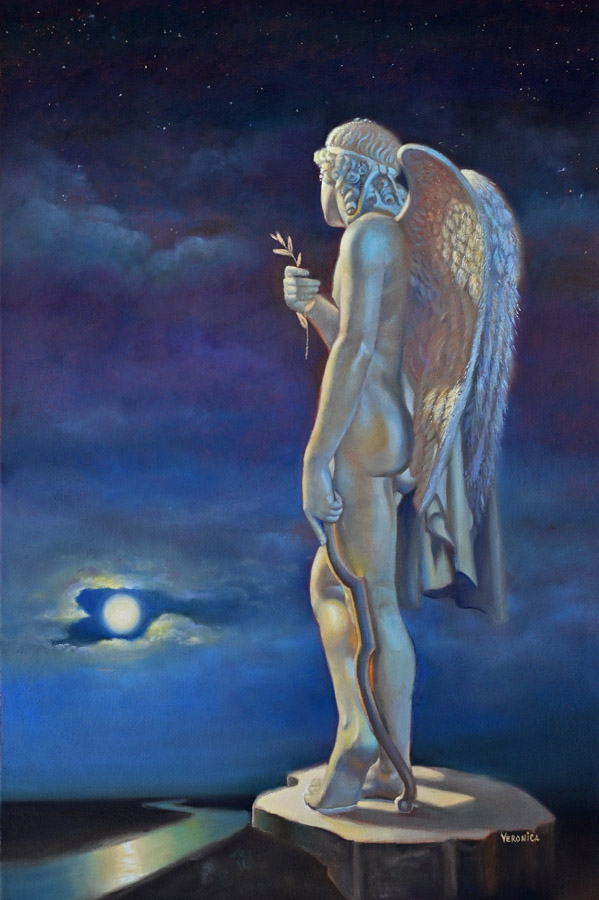
Why People Hate Contemporary Art: This One Makes Me Sick

Why contemporary art sucks
Have you visited a contemporary art museum lately? Over the summer and early fall of 2025, I toured at least eight such museums and galleries across Florida, Massachusetts, and Texas. For years, I’ve harbored a quiet skepticism toward certain trends in contemporary art, but these recent visits finally broke the camel’s back. I can no longer stand by and watch this fakery unfold. Complaining about budget cuts, directors and curators continue to flood vast, often exorbitantly expensive contemporary art museum spaces with mediocre pieces masquerading as “abstract” art in joined art museum corruption schemes. Visitors murmur that they “don’t understand it,” but lacking a better label for this nonsense, they settle for uneasy silence while staring at what feels like horrible art. No one wants to be offensive or uninformed by voicing their judgment, but if we all stay quiet, who will call out this travesty? The first step toward any kind of change is refusing to pretend this is normal and participating in contemporary art debate.

Here is why people hate contemporary art. I can give you one particularly striking moment at the contemporary art gallery in Harvard’s museum. Frustrated by the parade of ugly pieces in empty rooms, I started snapping photos—not out of admiration, but as evidence of the art world’s fakery. A woman nearby approached me with irritation. “What could be so interesting about this abstract stuff?” she asked. “It doesn’t speak to me at all!” When I explained that I was documenting the mediocrity rather than celebrating it, her expression shifted from annoyance to visible relief. It’s a common plight: the fear of appearing culturally illiterate keeps us all compliant. Yet, by normalizing this soulless art, we’re eroding our inner life, perception, and reality. We owe it to ourselves—to speak up.
At its core, beauty is a harmonious blend of shape, line, color, and form that delights the aesthetic senses, particularly the eye. As Professor Paul Monson puts it in one of his videos on YouTube, “The purpose of beauty isn’t subjective. Its purpose is to bring us back into unity with the divine.” If we accept this flood of so-called art without question, we’re forced to reevaluate our very notions of beauty, emotion, and aesthetics. What happens when the divine feels more like a demolition site?
True Art is the expression of human highly creative skill, imagination, and vision in a visual form such as painting, drawing, sculpture, or multi-media installation producing works to be appreciated primarily for their emotional beauty and power. These works gain prominence and value not just for their technical skills but for feelings and raw power they evoke. Art is a test of empathy. It invites us to peer into the artist’s inner world, experiencing emotions and perspectives we might otherwise never encounter or express. Powerful art is a reflection of our inner life, soul, and aspirations. Through this beautiful visual story, we connect to the Divine without words.
Scroll through Instagram, and you’ll find an abundance of genuine creativity that captures the human spirit in ways that feel pure, emotional, and authentic. Why, then, do our contemporary art museums prioritize this horror-show alternative? People deserve better; they deserve art that uplifts rather than repels.
Let’s not ignore the issue of corruption propping this up. Galleries and museums operate like gated enclaves, where insiders peddle subpar work under the guise of innovation, while outsiders remain too intimidated to protest. I’m exhausted by it all—this soulless occupation of sacred spaces. Why shell out $22 for a ticket to endure it? And taking the family? Dropping $60–$80 for an afternoon of bewilderment? Most wouldn’t do it, and who can blame them?
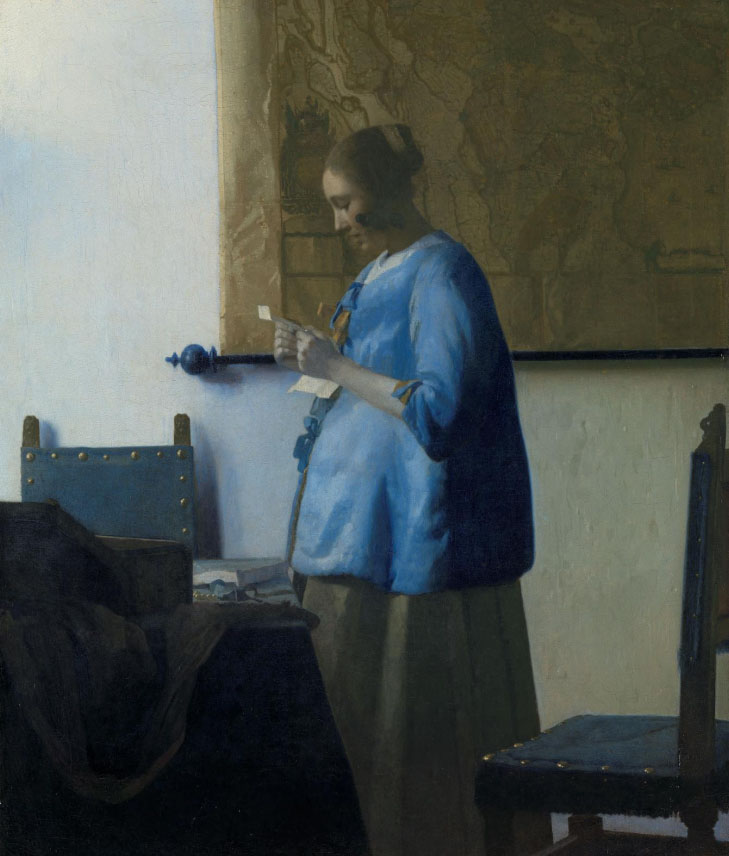
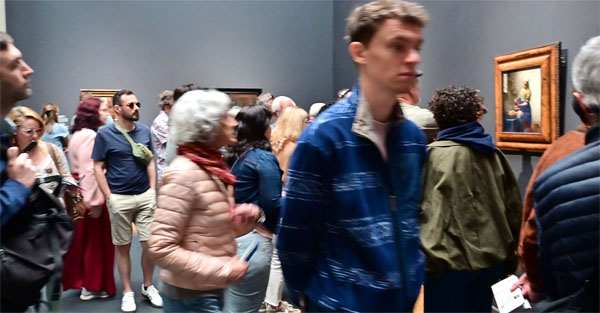
Consider the Rijksmuseum in Amsterdam, where galleries brim with admirers lost in the soft glow of Vermeer’s masterpieces—crowds drawn to the emotional depth and technical brilliance of the artist. Now picture the echoing voids of empty contemporary galleries: sterile expanses begging for occupancy but repelling it. This isn’t a coincidence; it feels deliberate, a subtle ploy to divert us from “real” art toward hollow expressions that starve the soul. When we’re robbed of inspiration, beauty, and emotion, we grow numb. Empathy withers, thoughtfulness fades, and sincerity erodes. In a desensitized world, we interact with others not as fellow neighbors, but as distant shadows—less connected, less alive, and less human.
Of course, some might dismiss me as overly critical or simply “not getting it.” Contemporary art criticism isn’t as common as we may think. But here’s the truth: we all grasp art’s essence on an intuitive level. No amount of intellectual posturing or institutional gatekeeping can brainwash us out of that primal knowing. Beauty moves us because it’s universal; ugliness repels for the same reason. Dismissing honest critique as ignorance only heightens the problem.
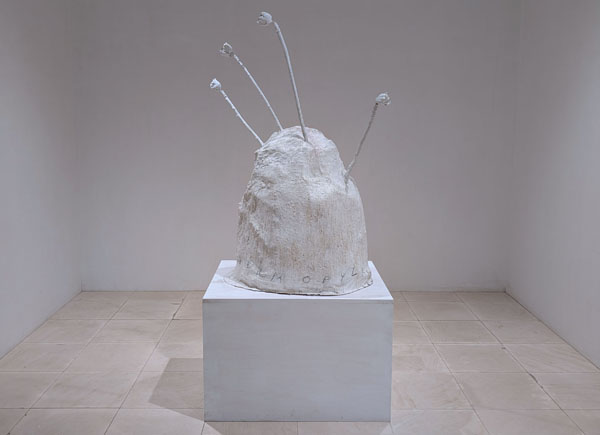
We crave positive change in our lives, yet we often defer it to others, shying away from possible problems and outcomes. Perhaps it’s time to apply that energy here. I think director-curator’ selections must be questioned when they present this ‘abstract art’ to us in art museums. The installed shows must be rated. Organizers can be fired on occasion. Audiences have already voted with their feet, boycotting these venues as a drain on their resources. The result? Perpetually empty contemporary art spaces existing for themselves. Art museums, ever pragmatic, often sustain themselves through lavish donations or endowments, so low foot traffic barely registers. But if not for visitors, then for whom is this spectacle staged? A self-congratulatory echo chamber for the elite pampering prices for famous contemporary art they already own to resell in the future?
The numbers don't lie: While the global art market hit $68 billion in 2025—fueled by emerging digital trends and younger collectors—contemporary segments saw a 15% dip in foot traffic at major museums, with "woke fatigue" cited as a factor in post-exhibit surveys.
The Fraud of Modern Art: Why People Hate Contemporary Art
With my frustration of wandering through vast modern and contemporary art galleries, staring at soulless contemporary art, let’s dig deeper into this modern art controversy—the outright fraud. Here is why contemporary art sucks for so many. It’s not just about bad taste; it’s a systemic betrayal of what art should be. I’d like to look at the key characteristics of true art, expose the cultural extinction it’s causing, and demand better work from contemporary art museums that flood us with abstract art horror and soulless art installations.
Timeless Principles of Real Art
In essence, art is a deliberate act judged by timeless principles:
- Does it evoke any kind of emotion that pulls you into the artist’s raw inner world?
- Is it inspiring? Great pieces don’t just hang on walls; they bring so much inspiration, you want to create something new in your life. You feel alive.
- How difficult is it for the artist to create and recreate? True mastery demands sweat—years of honing vision, style, subject, color, point of view, composition, and material into something irreplaceable.
- Is it thoughtful?
- What’s so innovative about the piece? Innovation isn’t chaos; it’s a fresh take on beauty in art that honors aesthetics in traditional art without descending into gimmicks.
- Quality? Uncompromising craftsmanship that withstands scrutiny.
- And finally, is it something to be admired?
Contrast this with the best vs. worst contemporary art flooding our feeds and museums. The worst? Talentless voids peddled as “edgy.” The best? Evocative art that blends traditional vs. contemporary art seamlessly, proving innovation can coexist with soul. A good example of innovative, contemporary art is Studio Drift.
Studio Drift: Pioneers of Kinetic Nature-Tech Art
Studio Drift (often stylized as DRIFT) is an Amsterdam-based multidisciplinary art and design collective founded in 2007 by Dutch artists Lonneke Gordijn (1980) and Ralph Nauta (1978) . With a multidisciplinary team of 45 collaborators, they specialize in experiential sculptures, kinetic installations, and performances that fuse technology with natural phenomena, aiming to reveal hidden properties of the Earth, connecting us to nature and each other.
Their work often employs biomimicry—mimicking biological processes like flocking birds or flowing water—through mechanics, light, and sound, creating immersive, poetic experiences that evoke wonder, transience, and emotional resonance on a grand scale. Signature projects include The Shylight, and large-scale public works like drone swarms simulating starling flight, blending sculpture with digital motion for meditative, audience-engaging art.
Shylight: Their Iconic Installation at the Rijksmuseum
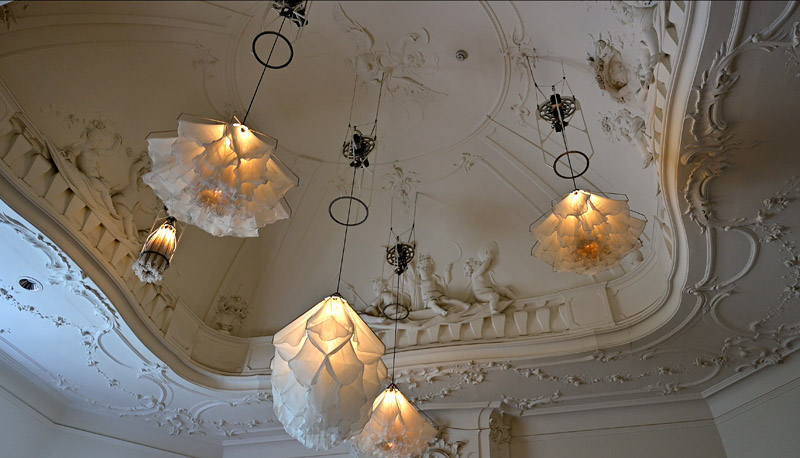
One of Studio Drift’s most celebrated works, Shylight (2014), is a permanent kinetic lighting installation acquired by the Rijksmuseum in Amsterdam in 2014 and installed in the museum’s ornate 18th-century room. Comprising five large, suspended silk-covered mechanical sculptures resembling oversized flowers or chrysalises, the piece dramatically unfolds and retracts in a choreographed cycle: petals bloom open to reveal glowing, illuminated cores, then gracefully close, mimicking the natural lifecycle of growth, fragility, and renewal. Powered by hidden mechanics and soft LED lighting, it creates a mesmerizing interplay of light and shadow against the room’s historical grandeur, symbolizing the harmony between organic beauty and technological precision. Visitors often describe it as a “performative light ballet,” evoking quiet awe and serving as a modern counterpoint to the museum’s classical masterpieces— a testament to Drift’s idea of re-enchanting everyday spaces with nature’s fragile beauty and elegance.
Cultural Extinction: How Modernity Killed Skillful Art
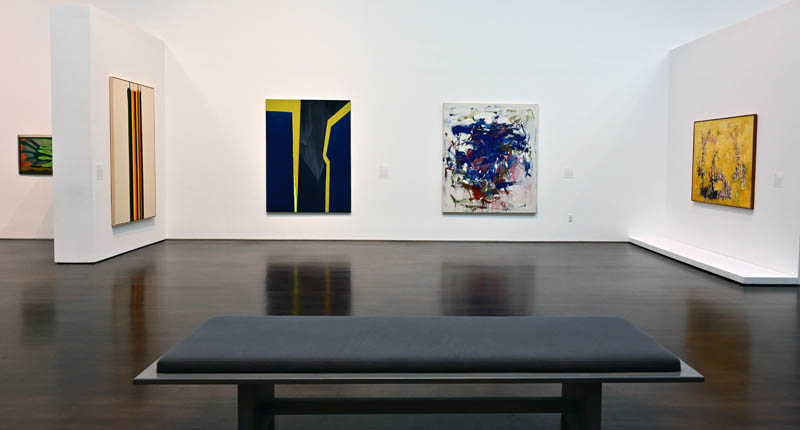
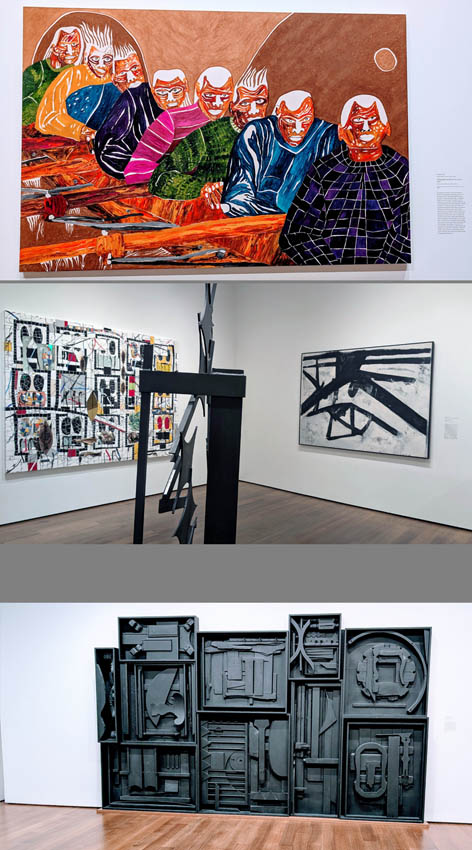
Modernity didn’t just evolve art—it purposefully murdered emotional and skillful art, replacing it with fake admiration and art museum corruption. Often inspired by Duchamp’s presentation of an everyday, mass-produced objects named a “readymade,” became an icon and a call to aspire to in art selections. Consider a museum purchase of Patrick Martinez, Jaguar Guardian, 2024 as an example of this notion.
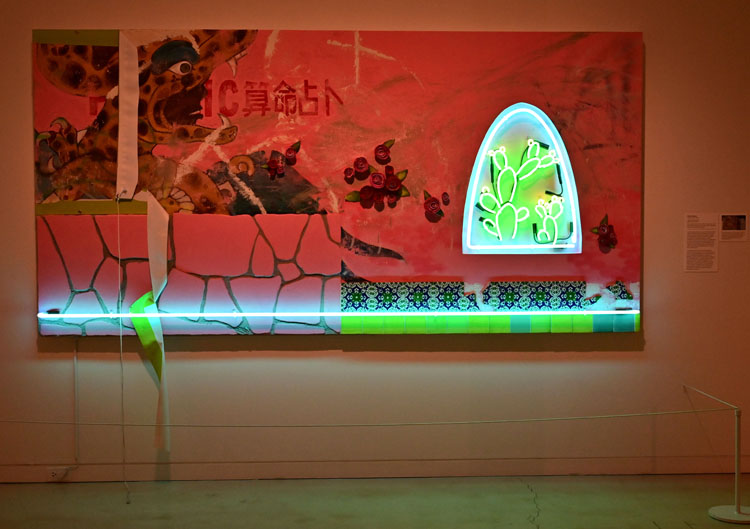
So many talented contemporary artists are left to perish in obscurity, while corruption in modern art museums elevates the mediocre. Contemporary art criticism often tiptoes around this, but let’s say it: our society needs to wake up and demand good art from museum curators, critics, art influencers, directors, and gallery owners. Why people hate contemporary art boils down to this betrayal—talentless works promoted as great, while genuine creators sink into poverty, desperately honing their craft just to scrape by.
Who are these fake artists? They’re money-making machines, thriving on social savvy, connections, and business acumen, not raw talent. Real artists see and feel profoundly, translating the ineffable into highly-skilled Art in ways no one else can. We wouldn’t tolerate fake musicians butchering melodies or fake ballerinas stumbling through routines—yet we pretend to admire horrible art in contemporary art institutions. Where did aesthetics, art history, and taste go? Vanished in the haze of Duchamp’s urinal, that 1917 stunt declaring anything “art.” Perhaps when we weave these parameters into daily conversations—debating the emotional power of art over some soulless contemporary art—we’ll see fewer ugly sculptures and paintings hyped as masterpieces. How many more fools will fall for the taped banana? It’s entertainment for the rich, an assault on real artists and adults alike.

Fast-forward to 2025, and the modern art controversy rages on with boundary-pushing stunts that feel less like innovation and more like desperate bids for relevance. For large-scale LEDs critiquing consumerism—check out Barbara Kruger’s immersive exhibition at the Guggenheim Museum Bilbao (June 24–November 9, 2025): https://www.guggenheim-bilbao.eus/en/exhibitions/barbara-kruger. It features text-overlay LEDs on everyday scenes, skewering power, identity, and consumer culture in giant, room-filling displays with text, letters, and messages. It’s neither terrible nor awe-inspiring…This type of art doesn’t feel like progress; it’s a pivot where “transformative dialogue” masks the loss of aesthetics, beauty, creativity, and the original purpose of art.
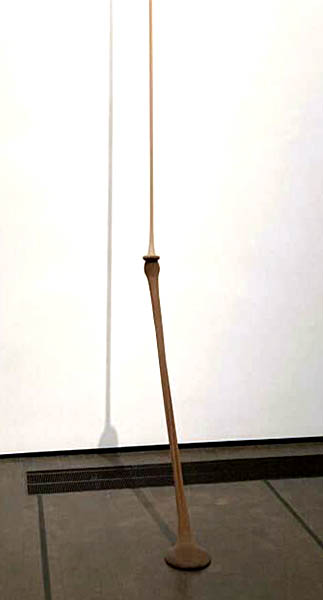
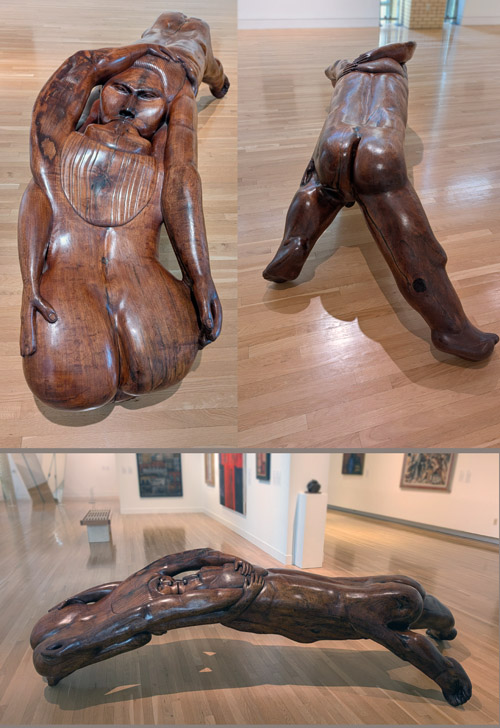
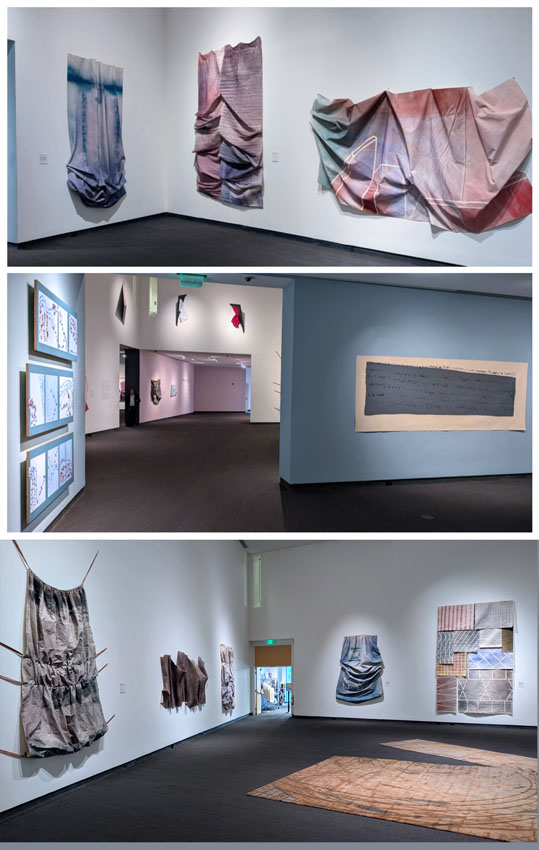
In the Museum of Fine Arts Houston (MFAH), you’ll find visually empty contemporary art, some of which is in the Fiber Arts exhibits. For instance, Ernesto Neto’s “Cópula” is a Nylon stocking stretched, filled with lead beads, and hung by a rope against a white wall. How come stockings are art? Yet, it deserves space in this art museum (gallery 312), gifted by Martin and Rebecca Eisenberg. Another nylon marvel made by Senga Nengudi is a museum purchase! Titled “R.S.V.P. Reverie ‘Bow Leg”, this ‘sculpture’ is a torn and stretched stocking…Contemporary art sculptures like the Melanesian Venus by John Duff make me wonder why such excellent art museums waste resources on such ‘art’ that include storage space as well. A shocking amount of “artistry, vision, and creativity” on display inside the MFAH contemporary art galleries, although the museum has rich and diverse art collections overall, and definitely deserves your time and money!
Titled Satellite, a large outdoor sculpture by famous contemporary artist Simone Leigh, is also a museum purchase. This bronze is reminiscent of the African female body, featuring sagging breasts, thin legs, and a large, plate-shaped head without eyes and mouth. Although its purpose may be the nurturing of women, it doesn’t appear to be a highly inspirational and creative masterpiece. At least, not in my view. Perhaps, if we ask black women about this sculpture reminiscent of African masks, they’ll give you a different opinion.
Big Art Museums Face Big Spending Cuts due to political and ideological changes:
Contemporary art museums across Europe and the United States are wailing under the weight of impending government funding cuts in 2025 and beyond, a gut-punch to the arts sector that’s now amplified by a volatile political landscape. As detailed in a recent Artnet News report, institutions face a “seismic shift” in support: in the U.S., the Trump administration’s slashes to the National Endowment for the Arts and related bodies have already cost millions, with examples like the Japanese American National Museum losing $659,000 for resisting DEI content removals and the Smithsonian under scrutiny for “woke” exhibits. In Europe, Berlin’s cultural budget cratered by €130 million last year, while UK museums endure 14 years of austerity, prompting fears of reduced budgets at places like the Royal Academy, the National Gallery, and Tate. Experts warn of eroded autonomy—curators muzzled on politics, from Gaza stances to anti-DEI mandates—and urge pivots to private donors, admission fees, and relevance-building, though generational philanthropy gaps loom large. Shocking? Sure, but predictable—the arts are always the first to be cut. These public organizations, ostensibly for the people, must now confront their paper-thin mandate: while I oppose cutting jobs for dedicated researchers and staffers, this crisis screams for a reckoning. It’s time to ditch the special exhibitions’ fakery, peddling soulless conceptual dreck, and reclaim spaces that truly inspire the public. While art is essential to our mental health and deserves financial support, all these millions spent on grants, funds, and donations for art museums must be questioned to shake out the corruption, management, and ideology besieging contemporary art museums.
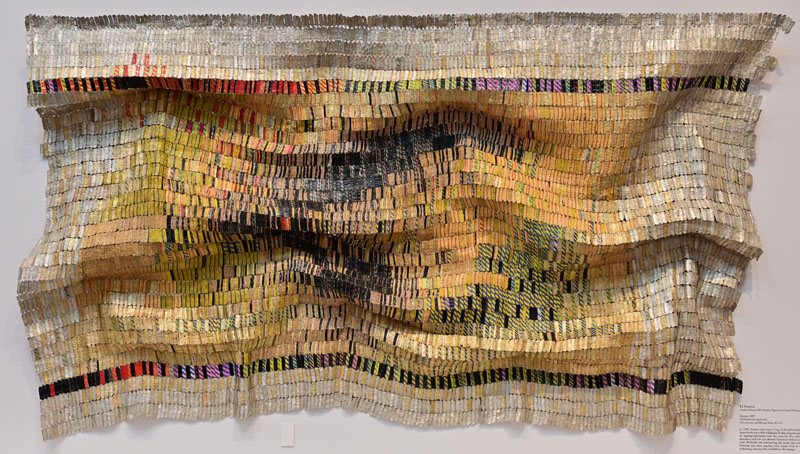
Museum’s description:
“Seepage” is composed of thousands of flattened aluminum wrappers from Nigerian liquor bottle caps that the artist El Anatsui and his team of assistants tied together with twisted strands of copper wire. Its shimmering metal surface resembles a mosaic while its undulating form suggests a regal tapestry. The bold coloration and pattern also suggests traditional Kente textiles that are made by male weavers and traditionally used for religious and ceremonial occasions in Ghana, where Anatsui is from. Since 2002, Anatsui has been making these bottle-cap reliefs as a way of addressing the legacy of colonialism in Africa and the historic triangle trade, in which European countries imported alcohol into Africa in exchange for slaves, ivory, and gold. “Seepage” reminds us of the way that African people were treated as commodities or currency. This is one of very few double-sided bottle-cap works that Anatsui has ever made and the only one in a museum collection. This is the first time the Blanton Museum of Art, Austin has exhibited the red side of the relief.
One glaring flaw in these financial and staffing cuts is their indiscriminate, across-the-board approach: they disproportionately axe entry- and mid-level roles held by everyday workers, while sparing the lofty salaries of top directors and curators. Sure, some pruning feels essential—like a natural wildfire or flood that scorches the underbrush to pave the way for renewal—but others inflict lasting harm, gutting vital research, overburdening dedicated museum staff, and sidelining exhibitions that actually deserve the spotlight. Compounding the chaos, we Americans (and increasingly the world) frame every crisis in stark black-and-white binaries, laced with partisan politics, religious fervor, and cultural crusades. This polarization doesn’t just stall progress; it paralyzes art institutions, starves artists of support, burdens directors with impossible choices, and alienates the very public these spaces are meant to serve.
As famous photographer Sally Mann warned in her latest memoir, we’re entering a “new era of culture wars,” where police raids on “offensive” exhibits, like her own boundary-testing nudes pulled from a gallery in September. The Danbury Institute, a conservative Christian advocacy group, accused the museum of displaying “child pornography” in a December 2024 open letter. Backed by some local elected officials, they demanded the photographs be removed, according to the article on NPR. Some of her old pictures depicted her beautiful children half-nude. As a result, Sally Mann’s work has become sandwiched between current politics, trends, and ideology.
Mann’s work isn’t an isolated example. I think other famous artists are a lot more shocking. Chris Burden, Chris Ofili, Damien Hirst, Maurizio Cattelan, Robert Mapplethorpe, Tracey Emin, and Marina Abramović, of course. Famous controversial artists are symptoms of a system where politics, ugliness, and corruption warp the art market. How many more shocking art installations or performances must we endure before we demand pieces that evoke beautiful emotion, not shock value?
While art reflects culture and drives social change, installed ideology on art of any party isn’t fruitful in the long run. However, politics has always played a role in the arts. For example, Roman art modernized classical Greek art by adding real faces of contemporary politicians and the wealthy to classical ideals. The Italian Renaissance saw a rise of humanism expressed in realistic portraiture and sculpture, supported by the Medici’s, the Pope, and alike. This 19th century Russian art movement responded to social inequality that wasn’t supported by the government directly. While the Soviet Art was a pure creation of the government’s ideology: the Soviets supported artists and art organizations heavily to create mass propaganda across a vast country landscape, which is quite similar to what we see today in the US.
A lot of contemporary art has lost its most sacred principle: the sense of beauty. There’s so much ugly, empty, talentless “art” that no one should endure—yet it’s curated into numerous museums of contemporary art, sold at exorbitant fairs, and defended in endless contemporary art debates.
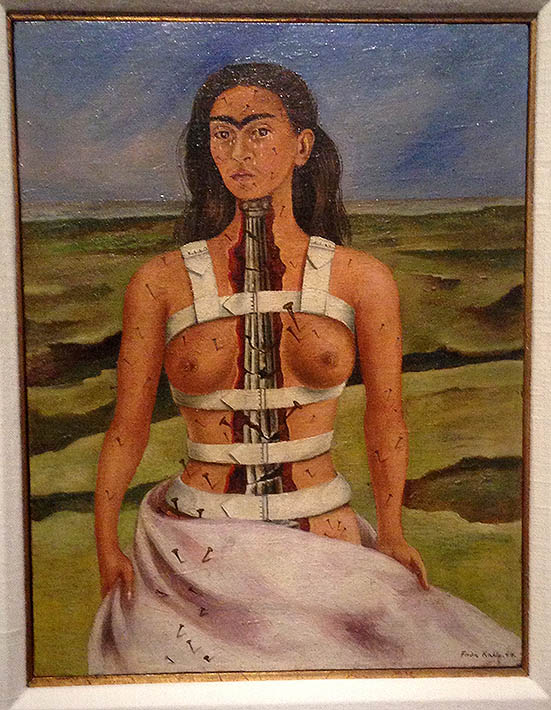
I think public art museums should stop catering to weird trends and notions. Rather focus on contemporary art programming, incorporating people’s participation, surveys, and responses to past exhibitions as one of the options. Another option would be social media voting for possible future exhibits and artists. Personally, I’m tired of seeing endless Frida Kahlo exhibitions in art museums across the US (Visit Frida’s museum in Mexico). It seems the art museum management knows that people know one name, and they drag this brand name across the US to either make money or beat a dead cow. Instead, let’s enjoy art of so many underrated female artists who deserve to have a retrospective show, for instance Remedious Varo or Cecilia Beaux.
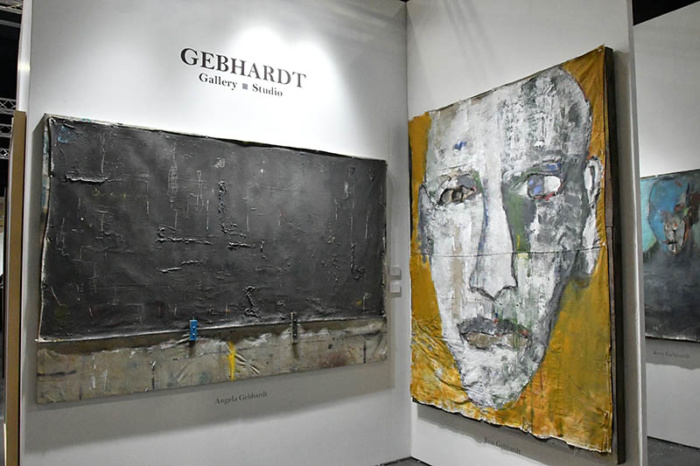
The solution for today’s art institutions’ crisis might be a different focus. Stop following the ideological trends to brainwash the public, and start aiming at timeless principles in art. This doesn’t mean showing ‘boring classics’. There are plenty of contemporary artists who push the boundaries, combine different art materials, and create mind-blowing art. Here are some examples from Context Art Miami 2023.
It’s an amazing trend to watch: artists once apprenticed for many years, training to capture beauty in every line, curve, and body, face indifference at best. Color, composition, originality, and anatomical knowledge weren’t optional for centuries of fine art. These principles crumbled under modernism, much like realism was crushed in the Middle Ages, only to come back in the Renaissance. America got taken over by the Abstract Expressionism for decades to drown in all forms of shocking performance, ugly installation, and soulless abstract ‘art.’ However, slowly but surely today we begin to witness a revival of realism—a quiet rebellion against traditional art beauty vs. modern emptiness. It’s just a start.
How to spot art market fraud in the contemporary art world


Summary of Salaries in Art Museums and Institutions (2024-2025)
Salaries in the art museum sector vary widely by institution size, location, and role, with top-tier (large national museums like MoMA or the Met, budgets >$50M), mid-tier (medium-sized urban or state institutions, budgets $10-50M), and regional/small (local or rural museums, budgets <$10M) showing clear disparities. Data is drawn from 2024 BLS medians, Glassdoor/Zippia averages, AAMD surveys (2022 baseline, as 2025 full details are paywalled), and anecdotal Reddit transparency threads (2024).
Overall trends: Modest 3-5% increases from 2023; inflation outpaces raises in smaller institutions. Note: Figures are annual USD medians/averages; benefits add 20-30%. *The following data is compiled by Grok and I don’t know how accurate the numbers are…
| Role | Top-Tier (e.g., NYC/SF) | Mid-Tier (e.g., Midwest/South cities) | Regional/Small (e.g., Rural/Southwest) |
|---|---|---|---|
| Director | $300,000–$500,000+ (avg. $344k) | $120,000–$200,000 (avg. $150k) | $70,000–$120,000 (avg. $85k) |
| Curator | $90,000–$150,000 (avg. $100k) | $60,000–$90,000 (median $62k) | $45,000–$70,000 (avg. $55k) |
| Staff (e.g., Registrar/Assistant) | $60,000–$90,000 (avg. $75k) | $45,000–$65,000 (avg. $55k) | $35,000–$50,000 (avg. $42k) |
Therefore, top-tier pay reflects high-stakes fundraising; regional roles often lack benefits. BLS notes 4% job growth to 2034, but turnover is high due to low pay in smaller venues. For 2025, expect 2-4% bumps amid budget pressures.
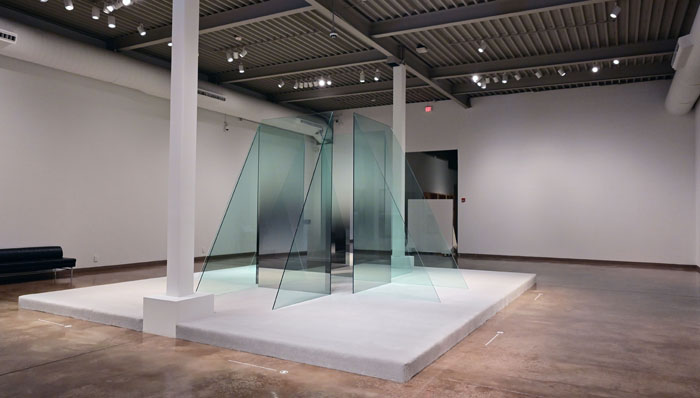
Comparison of Top Museum Directors’ Salaries: US vs. Europe (2024-2025)
To compare, I’ve selected comparable top-tier institutions in major cities, using total compensation where available (base + bonuses/perks). US figures are from IRS filings and surveys; European data is sparser due to privacy laws but drawn from public reports, job listings, and salary surveys. All converted to USD (approx. rates: £1=$1.30, €1=$1.09 as of Oct 2025). European salaries are generally lower (often 20-70% less for equivalents), reflecting public funding models, cost-of-living differences, and less emphasis on private-sector perks. Averages: US top ~$1.5M; Europe top ~$200k. *Compiled by Grok, so beware that the numbers might be off.
| Region/City | Museum | Director | Total Compensation (USD) | Year/Source Notes |
|---|---|---|---|---|
| US – New York | Metropolitan Museum of Art | Max Hollein | $1,602,410 | 2024; base ~$1.33M + perks. |
| US – New York | Museum of Modern Art (MoMA) | Glenn D. Lowry | ~$2,260,000 | Pre-2025; base $1.55M + $706k other. |
| US – Los Angeles | LACMA | Michael Govan | $2,496,238 | FY2024; includes bonuses/housing. |
| US – Los Angeles | J. Paul Getty Museum | Timothy Potts | ~$1,100,000 | 2023 baseline; stable trend. |
| US – Denver | Denver Art Museum | Christoph Heinrich | $409,322 | 2024; base $340k + other. |
| US – Phoenix (AZ) | Phoenix Art Museum | Jeremy Mikolajczak | $229,881 | 2024; base pay. |
| Europe – London | British Museum | (Vacant/Interim) | ~$280,000 (£215,841) | 2024 job listing; paltry vs. US peers. |
| Europe – London | National Gallery | Gabriele Finaldi | ~$221,000 (£170,598) | FY2024; basic salary, public sector. |
| Europe – London | Tate (Modern/Galleries) | Nicholas Serota (or successor) | ~$140,000 (£108,046) | 2024 estimate; 29% above UK avg. |
| Europe – Paris | Louvre | Laurence des Cars | ~$103,000 (€94,369 avg. Paris) | 2025 avg. for Paris directors; specific not public, est. higher (~$150k-200k cap). |
| Europe – Amsterdam | Rijksmuseum | Taco Dibbits | ~$100,000 (€91,509 avg.) | 2025 Netherlands avg.; bonus ~$12k. |
| Europe – Berlin US – Chicago US – Boston | Staatliche Museen zu Berlin Art Institute of Chicago Museum of Fine Arts, Boston | Hermann Parzinger (general dir.) James Rondeau Matthew Teitelbaum | ~$110,000 (€101,059 avg.) $1,009,815FY2023 $1,055,830 | 2025 Germany avg.; bonus ~$13k. |
High-end US peers are far exceeding European equivalents due to private funding reliance. Gaps widen for mid-tier roles. Data limitations persist for Europe.
Conclusion: US directors at elite institutions command 5-10x higher pay, driven by private donations and market competition, while European roles (often civil service) emphasize stability over extravagance. Smaller/mid-tier gaps narrow (e.g., Denver vs. Rijksmuseum: $409k vs. $100k). Data limitations: Europe relies on averages due to less transparency. * These numbers are summarized by Grok.

Innovation in a Crowded Art Museum Space: The High Bar for Today’s Artists
Mastering classical principles of beauty isn’t enough in the contemporary art world. There must be innovation or originality in the artist’s voice—a personal seal that sets it apart in this century. Inspired by giants like Michelangelo, Caravaggio, or Van Dyck, the great contemporary artist innovates beyond expectation, infusing personal sensitivity, aesthetic depth, and an innate sense of design steeped in art history. It’s a sky-high bar: influenced by the past, yet utterly different from everything done before him.

Take Kehinde Wiley or Chuck Close as prime examples of famous contemporary artists. Wiley reimagines historical portraits with modern people of color, blending Renaissance grandeur with street-level grit—innovation that honors empathy in art without sacrificing beauty. It’s often cliche and almost grotesque, but vastly different from hyped modern art. Close‘s hyper-detailed portraits, built from fragmented grids, turn the mundane face into a monumental puzzle, demanding we confront identity up close. These aren’t abstract art horrors; they’re thoughtful modern paintings that provoke and uplift, proving the best vs. worst contemporary art divide is wider than ever.
What can I say about the state of contemporary art? To be honest, a lot of it sucks, and many of us are just afraid to say it aloud. Why? Fear of looking stupid or uncultured, especially when sparring with famous art critics, directors, or curators. But there’s no standard left—post-Duchamp, anything qualifies as art. I wonder when real change will hit: when the public stops tolerating enormous, empty contemporary galleries stuffed with crappy installations, or when major art fairs quit peddling such “art” as famous, approved, or important. When will we end this pretense and encourage real talent in major venues? Only time will tell…
Auction Sales Comparison for Hot Contemporary Artists: 2020 vs. 2025
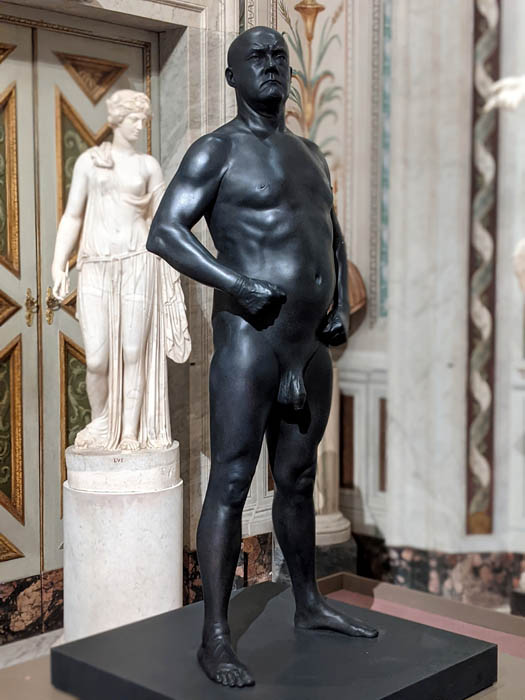
Based on available data from auction reports (primarily post-2000 works, as this segment defines “contemporary” in key analyses like Hiscox), here’s a comparison of total auction sales for select hot contemporary artists in 2020 and 2024 (the latest full-year data for the 2025 reporting period). Note that 2025 data is partial (through H1), so 2024 figures are used as the proxy for recent performance. Numbers are in USD millions and focus on major houses (Christie’s, Sotheby’s, Phillips). (*Data compiled by Grok).
| Artist | 2020 Total Sales | 2025 (2024) Total Sales | Change (%) | Notes |
|---|---|---|---|---|
| Yayoi Kusama | 18 | 58.8 | +226% | Top seller in both years; post-2000 works drove resurgence. |
| Banksy | 31.9 | 20 | -37% | Originals and prints; H1 2024 alone ~$10M, full year est. $20M. |
| Damien Hirst | N/A (est. ~10) | 9.5 | -5% (est.) | Ranked #12 in Hiscox 2025; spotty 2020 data, but decline in recent years. |
| Jeff Koons | N/A (est. ~50) | 27.8 | -44% (est.) | Post-2019 peak; 2023 figure used as proxy for 2024 trend. |
| Gerhard Richter | N/A (est. ~100) | N/A (est. ~150) | +50% (est.) | High-volume abstract sales; 2021 peak $247M, stable high end. |
Overall contemporary market: $1.1B in 2020 vs. $698M in 2024 (down 37%). Data gaps exist for exact 2020 totals (pandemic impacted reporting), but trends show a post-2021 correction with resilient blue-chips like Kusama.
The Floating World in Houston, TX: A.A. Murakami
A surprisingly meaningful, dream-like art installation, titled the "Floating World: A.A. Murakami", made me think that not everything is lost in the contemporary art world of soulless installations. The meditative floating world was a genuine sensory immersion into a surreal space of thoughts, beauty, calmness, peace, and simplicity.
The “Floating World: A.A. Murakami” exhibition, which wrapped up on September 21, 2025, at the Museum of Fine Arts, Houston (MFAH), was the U.S. debut of this ambitious immersive project by the Tokyo- and London-based artist duo A.A. Murakami, established in 2020 by artists Alexander Groves (born 1983) and Azusa Murakami (born 1984). Spanning 25,000 square feet across the Beck Building’s galleries, it transformed the space into four interconnected sensory landscapes that fused cutting-edge technology with natural phenomena, evoking the transient beauty of Japan’s Edo-era ukiyo-e (floating world) tradition and auspicious cloud motifs from Asian art. Thematically, it explored life’s ephemerality—bridging earthly chaos and heavenly serenity through “Ephemeral Tech,” where mechanical wizardry mimicked fleeting natural forces like fog, plasma, and light. Curated by Bradley Bailey, the Chao curator of Asian art at MFAH, this was the duo’s largest show to date and their first solo U.S. museum presentation.
The Four Immersive Installations
Each room built a progression of wonder, prioritizing physical, analogue experiences over screens or apps—inviting visitors to feel the art through sight, sound, and even touch.
According to the MFAH description, Floating World comprises five intertwined works that feed seamlessly into each other: Cell, a garden of aluminum forms akin to the volcanic rocks at the bottom of the sea; Neon Sun, which mimics the Northern Lights through an incredible array of plasma tubes; Beyond the Horizon, an ethereal experience that challenges perceptions of reality and technology; Passage, a new installation created specifically for the MFAH; and the hypnotic lightning patterns of Under a Flowing Field.
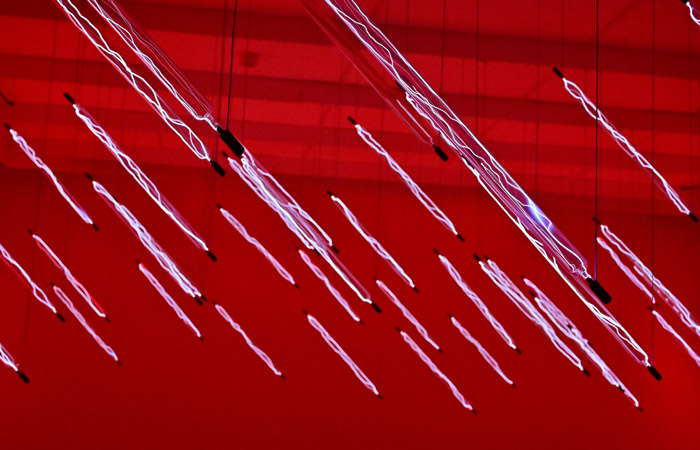
everywhere except our planet. Typically unseen, it can be rendered visible through carefully calibrated electric currents, causing arcs of plasma to flicker in and out of visible existence, generating literal “lightning in a bottle,” their naturally pulsing patterns creating a fluid, living effect. Unlike the sterile silence of LEDs, the tiny lightning strikes produce sound, resonating against the glass of the tubes. This sound and the title reference the suzumushi or Japanese bell cricket (Meloimorpha japonica), whose distinctive chirps mark the arrival of the fall; suzumushi is a kigo, or seasonal word, and appears frequently in haiku to designate the passage of time. With this piece, A.A. Murakami invites the viewer to return back to a natural measurement of time: the changing of the seasons.
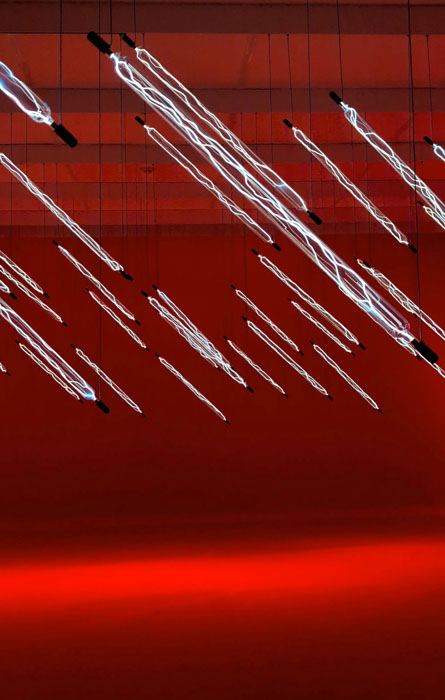
- Under a Flowing Field (2023): A ceiling-suspended network of glass tubes filled with krypton gas pulses with lightning-like white lines. Set against a stark red monochrome backdrop, it hummed with strange energetic sound, creating an unsettling yet beautiful feeling.
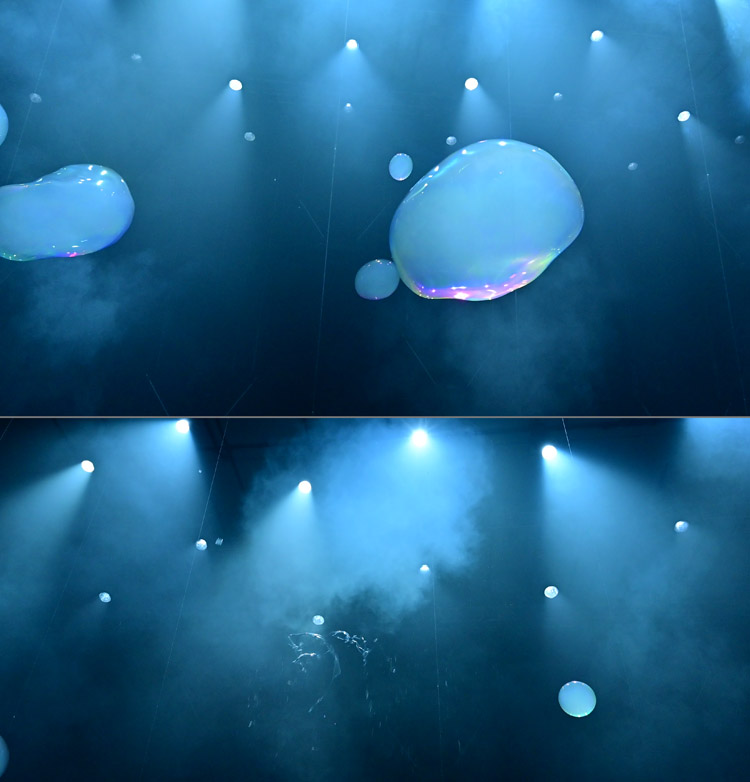
- Beyond the Horizon (2024): In a vast, dimly lit chamber, mechanical “arms” inflate and release massive, amorphous soap bubbles laced with fog inside. These orbs drift unpredictably, catching synchronized LED lights that shift from glow to dim, bursting into misty clouds. This constant release and collapse of giant, milky bubbles created meditative sensory experience for me.
- Passage (2023): The standout for many, this featured 18 fog cannons on a towering scaffold launching hypnotic smoke rings into a blue-lit void. The rings expanded, intersected, and dissolved in slow motion, creating a mesmerizing portal-like. Ethereal, soft rings created a dark blue dreamscape.
- Cell (2020) and Neon Sun (2020): Earlier works anchored the show—Cell with futuristic steel-and-aluminum sculptures nodding to Zen rock gardens and oceanic origins, while Neon Sun uses noble-gas-filled tubes to simulate the Aurora Borealis, flickering between serene greens and fiery oranges via electromagnetic fields.
The Palette of Possibility: Color as a Window to the Soul
In painting, color mixing reveals an artist’s soul. The Impressionists ditched black, teaching us to spy hues in shadows. Old Masters like Velázquez, Rembrandt, and Caravaggio wielded black masterfully. Vermeer and Ingres? Subtle, controlled palettes unveil beauty through carefully created unity.
A lot of contemporary painting is about nothing: no color, no ideas, no light, and as a result, no beauty. It’s up to the artist—what do you want to paint or see? In this critique of abstract art, I choose works that breathe, that challenge us to rediscover aesthetics in traditional art amid the modern art controversy.
Defenders cry, “Art must evolve—2025’s trends demand bold experimentation on social issues and tech!” Fair, but when “evolution” means more abstract art voids over Caspar David Friedrich-inspired innovation, it’s regression. Even Hyperallergic’s “Dos and Don’ts for 2025” urges ditching performative wokeness for genuine joy—aligning with my call to revive emotional power. Gatekeeping? Sure, but not when it protects fraud from scrutiny.
Art is subjective, sure—but that doesn’t excuse the mess. People don’t want to feel stupid dissecting a piece or dropping cash on it, so they treat it like an investment: chasing famous contemporary artists for resale hype, driving crazy pricing. That’s why conceptual painting thrives—forcing ideas on viewers that you can’t grasp just by looking. You need the wall of text, assuming it’s provided next to the painting in that sterile contemporary art museum.
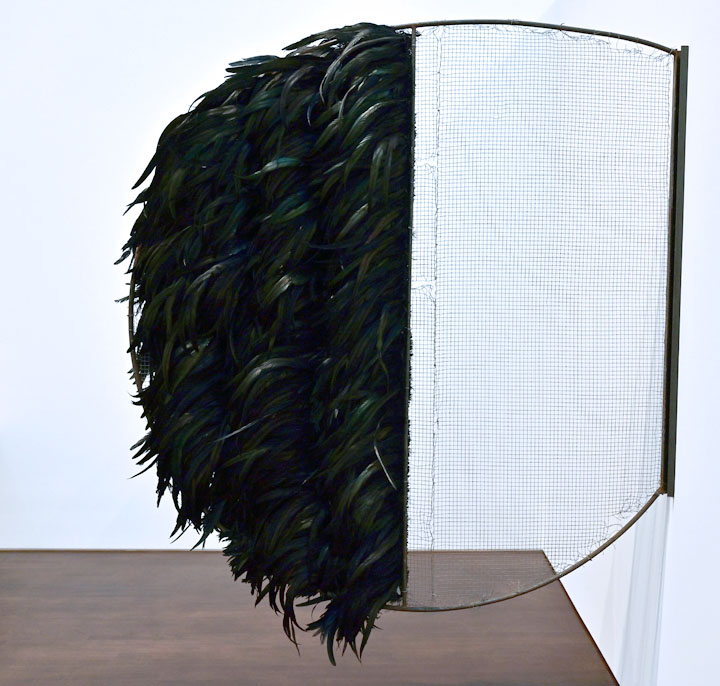
Purchase through the Archer M. Huntington Museum Fund and with support from the Blanton Contemporary Circle.
Museum’s description:
Terry Adkins’s work bridges past and present, striving to revive the lives and impacts of forgotten or underrepresented cultural figures. To commemorate particular people and places, he often created elegant, eloquent sculptures and installations using salvaged materials that hold specific meaning. Made when Adkins was invited to create a series of works in the remains of the Finesilver Uniform Factory in
San Antonio, Single Bound is a meditation on the unnamed factory workers and early Texas blues musicians who made pivotal recordings in that city in the 1920s. Consisting of a metal D-shaped hoop interlaced with lustrous black rooster feathers, the sculpture projects outward, hanging perpendicular to the wall. The rooster feathers are a tribute to blues troubadours, referencing everything from Rooster
Blues, the label dedicated to blues music of the Mississippi Delta, to the ways feathers symbolize sexual boasting and masculinity in both lyrics and in performances. The exposed metal mesh and D-ring shape reference the history of industrial manufacturing and its often-anonymous workforce. Collectively, the materials assert the heroism of those who never truly have gotten their due. In 2003, Single Bound was included as part of one of Adkins’s major recitals: Towering Steep. Recitals, often featuring his
sculptures, were a major element of Adkins’s work. Towering Steep was composed almost entirely of works produced at Finesilver. It continues to commemorate anonymous factory workers, blues music, and the connected legacy of the more than six million African Americans who moved from the South to cities and towns in the Northeast, Midwest, and the West between 1916 and 1970 during the Great Migration.
Daring to Dream as a Contemporary Artist
Artists crave freedom to paint the truth, unswayed by fashion, opinions, trends, or markets. We get one endless question: “How long did it take to paint?” But flip it—imagine you spending that time on it. Would you match the result? Chances are, no. Artists have vision; no one’s handing it over. No one cares enough to prop you up forever. Only you stay tenacious, believing in yourself to make dreams a reality. Reject current trends to pursue your vision. Don’t sideline yourself with bad advice. Seek those who can share your values as well as challenge your views and possibilities. Listen to your heart, craft a strategy, embrace constant change, and focus relentlessly on your craft.
Being an underdog artist in the contemporary art world? It’s a grind. Over the years, I’ve chatted with folks who adore the arts—some snag a print or original for $50. They beam, assuming their home-dotted with prints, means they’re fueling artist’s journey. Sure, there’s truth there that deserves some admiration, but at those prices, artists rarely break even amid sky-high studio costs: jury fees, festival booths, shipping, supplies. Buying prints beats nothing—it’s a win for exposure and your walls—but claiming deep involvement in an artist’s career? That’s a bit of a stretch.
Worse: most “likers” on social media never become meaningful supporters. Likes don’t cash checks. For artists, social media’s a tease; for fans, it’s a self-entertaining “contribution” without the commitment of an art book, original painting, or theater ticket. Collecting? It’s brand-chasing, not passion. Confronting the values and aesthetics is necessary. With goods so cheap, art feels like a luxury waste to the middle class, stretched by so many bills, costs, and inflation.
As a highly-developed society, we must revive art programs with professional artists visiting high schools for emotional stability and cultivation of aesthetics in children. Let public art unite communities with good art, artists, and vibes. Demand better—because in the end, real art isn’t fraud; it’s the passion we all crave.

In the midst of this contemporary art critique, it’s worth remembering that not all contemporary art is lost—and that true artists, even today, can cut through the noise. Every person is born with innate talents, but brilliance emerges not from raw gift alone, but from relentless effort. We glimpse the polished results in a Sargent or a modern innovator, yet rarely consider the grueling path: the late nights, the self-doubt, the cascade of debilitating failures that make us stronger in mastery. Growth demands struggle; it’s in wrestling with our flaws and fears that we evolve and succeed. To create anything worthwhile, we must own our journeys—taking full responsibility for our craft and career.
So, to the aspiring artist reading this: the next time fear overwhelms you, push back. Declare it: “I’m going to do this anyway!” After all, fortune favors the ambitious. Channel your passion into your art that creates genuine emotion and beauty. The museums may be adrift, but art’s true power lies in those who dare to reclaim it—for themselves, and for all of us. In my belief, Art is a search for the truth that’s filled with light.
Are you interested in learning what makes contemporary art great? and Why artists create ?
Join the chorus on your favorite social media platform—tag #StopArtFraud and share your museum horror stories. Real change starts when we stop pretending.
You can find my visionary art | Instagram | YouTube
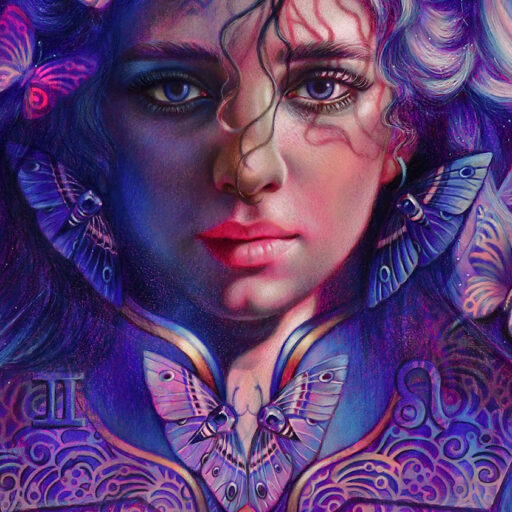
Is Bad Art Ruining Naples? Let’s Demand Inspiration, Not Eyesores!
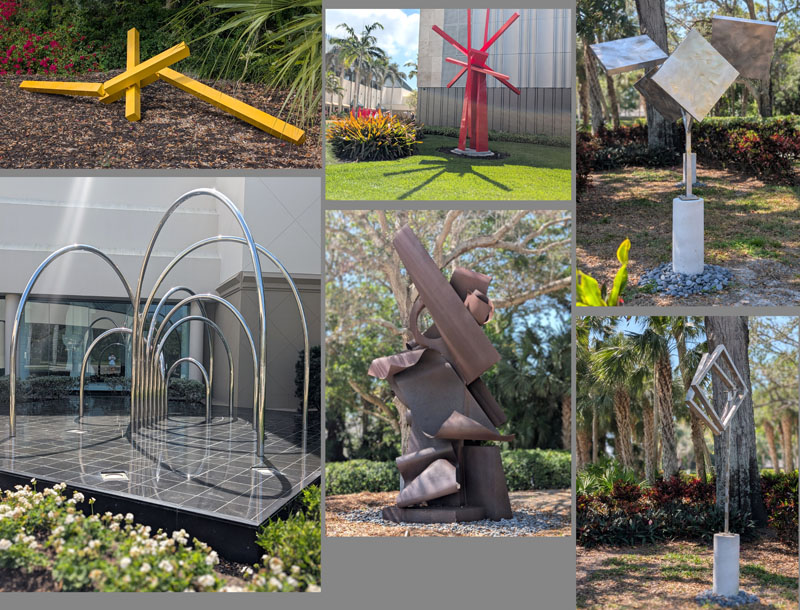
Exposing the Ugly Truth About Naples’ Art – You Won’t Believe This!
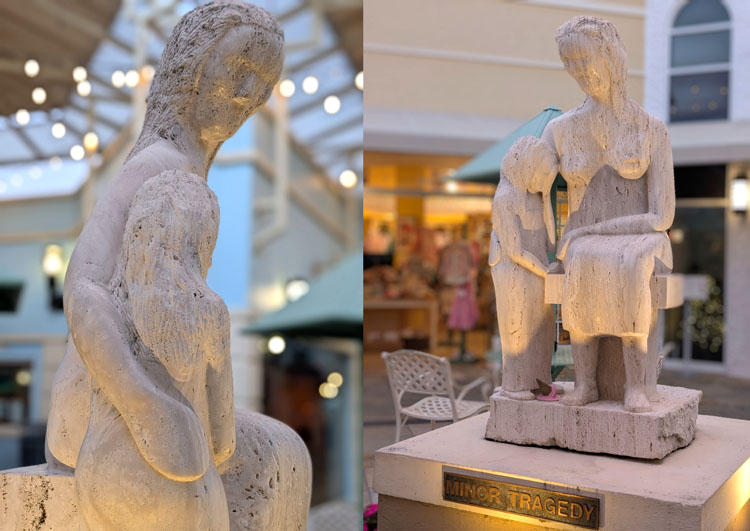
I’ve lived in Naples for over 15 years, and I’m frustrated by the dreadful public art cluttering this beautiful city. Naples is a tourist haven, with stunning beaches, endless sunshine, and affluent retirees. Yet, the growing presence of subpar art is a real letdown. In this video, I’ll walk you through some of the worst offenders I encounter daily—trust me, there are plenty. Stick around until the end for the absolute low point: a true tragedy.
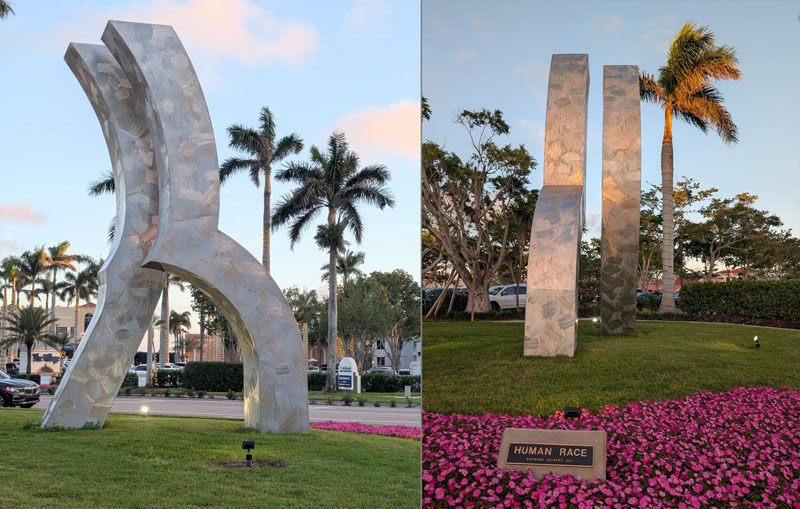
Let’s evaluate these pieces through the lens of what art should be:
- Art evokes feeling. What emotions do these pieces stir in you?
- Art seeks balance. Do you see harmony or chaos here?
- Art embodies beauty. Is there anything beautiful in these works?
- Art speaks to eternity. Do these feel timeless or forgettable?
- Art radiates passion. Can you sense any fire in these creations?
- Art fosters unity. Do these pieces bring people together?
- Art drives innovation. Is there anything groundbreaking here?
- Art inspires. Are you feeling moved or motivated?
- Art reflects love. Is there any warmth or heart in these?
- Art showcases exceptional skill. Do these demonstrate mastery?
- Art conveys maturity. Is there depth or sophistication here?
- Art expresses compassion. Can you feel empathy in these works?
- Art demands talent and vision. Is there any trace of brilliance?
- Art points to the future. Do these pieces inspire hope or progress?
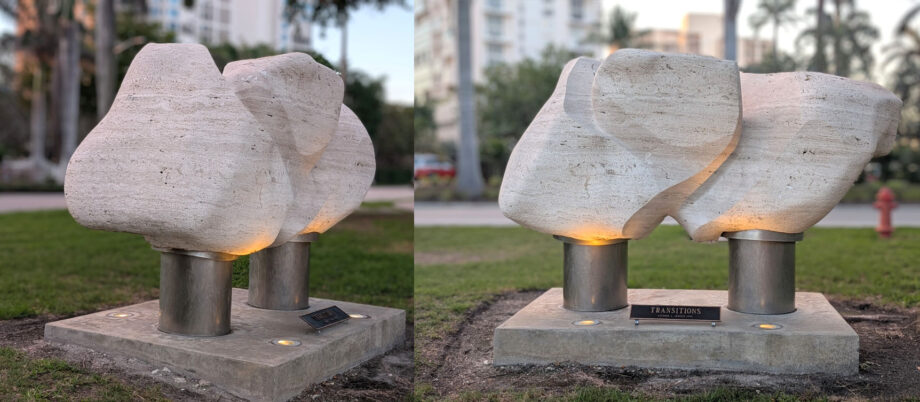
Naples’ Public Art Disaster: Why We Deserve Better Beauty in Our City!
My goal isn’t just to criticize. I’m calling for a wake-up call: we must stop tolerating mediocre public art. We deserve art that’s beautiful, inspiring, and powerful—art that draws people together and uplifts us. After all, we’re paying for it. Public art should not only be a backdrop for tourist selfies, but also should evoke healing, joy, and connection when we need it most.
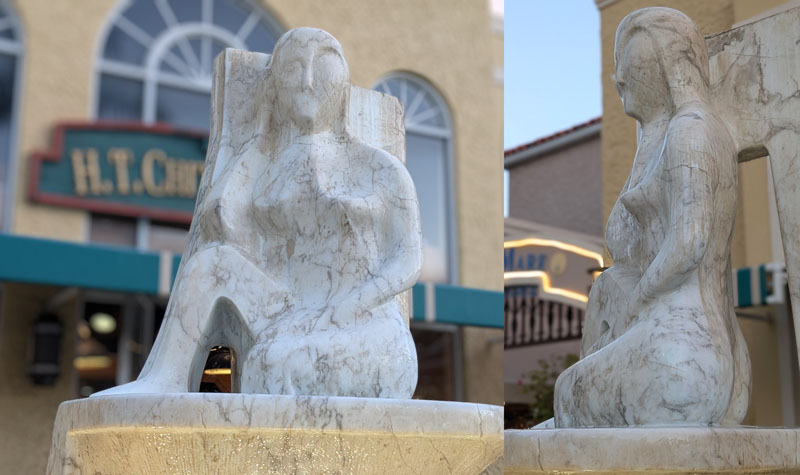
The problem isn’t just poor taste or mismanagement—though those play a role. The real issue is the growing corruption in the art world, which prioritizes profit over purpose. Want to dig deeper? Check out my video on corruption schemes in contemporary art to understand why these works end up in our museums and public spaces (see below).
Let’s demand better. Let’s unite for art that inspires, creates, and elevates humanity. Together, we can reject terrible “art” and champion a future filled with beauty and meaning.
Art Instruction books on Amazon:
Continue reading:
The Power of Art in Driving Social Change
During times of social and economic upheaval, diverse groups advocate for change in unique ways. Students may protest in the streets, scholars critique systemic flaws through research, and others express their dissent in personal, creative forms. Artists advocating social justice play a vital role in social and political movements. Their painting, murals, music, poems, posters can challenge authority and inspire change, striking fear into the hearts of those in power. Through their unusual creations, several artists have gained global recognition for their art. Let’s explore some social and political activism through art in greater detail.
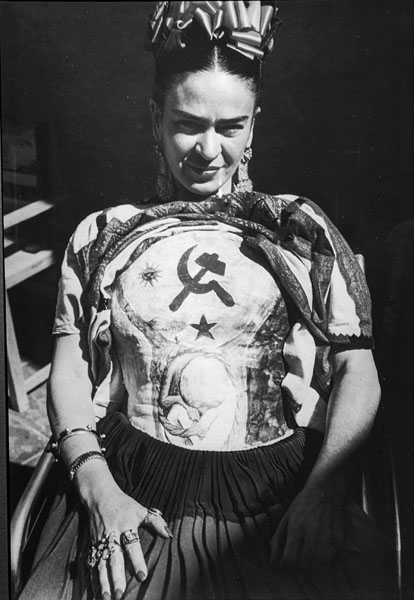
How Art Catalyzes Social Change
Art may not immediately come to mind when considering social activism, but it serves as a powerful force for transformation. By revealing the underlying causes of societal issues and bringing them into the public’s awareness, art often drives meaningful change, and political activism through art takes central stage during election season.
You can even think about this on a personal level. If you want to discover more about yourself and where you came from, you can take a DNA test or look further into your genealogy. If you have a dog whose behavior you want to understand further, you can do a dog genetic testing to determine its breed composition. Basically whatever you want to find out about the world, you can do through careful research and through the right channels.
Cesar Chavez: Art and Advocacy
Cesar Chavez, a 20th-century Mexican-American artist and activist, was a pivotal figure in the labor movement. His painting symbolized the struggles of the working class, particularly farmworkers.
Chavez’s art, characterized by vibrant murals, depicted the hardships faced by farmers in their daily labor. These large-scale murals promoting social equality, often displayed in public spaces, were accessible widely to raise awareness among common people. Despite his amateur art style, his painting inspired a broader social movement, contributing to the passage of fairer laws for agricultural workers.
Pablo Picasso: Art as a Catalyst for Social Awareness
Pablo Picasso, the renowned Spanish artist, is celebrated for his unusual insights into the human condition. Living through the early 20th century, a period marked by significant social and political turmoil in Spain and beyond, Picasso used his art to highlight pressing societal issues.
His iconic painting Guernica (1937) captured the atrocities of the Spanish Civil War in black and white colors, exposing the devastation caused by fascism. This monumental work, with its chaotic imagery of suffering and destruction, brought global attention to the conflict’s horrors.
Moreover, Picasso’s recurring use of the dove as a symbol of peace, like Dove of Peace (1949), became a universal emblem of hope and reconciliation, resonating worldwide. Through some of his art he made statements, attracted attention, and left a lasting legacy.

Picasso’s “Dove of Peace” is a series of images, most famously a simple, graphic line drawing of a white dove, that became a global symbol of peace after its creation in 1949. Inspired by a real pigeon gifted to him by Henri Matisse, Picasso created the image for the 1949 International Peace Conference in Paris. The image’s impact grew, appearing on posters, prints, and other media for peace movements worldwide and representing hope, purity, and the collective effort needed for peace.
Banksy: Street Art for Social Change
Banksy, the enigmatic British street artist whose identity remains a mystery, is globally celebrated for his provocative and instantly recognizable work. His stenciled murals, often rendered in flat colors of black and red, decorate buildings across the UK and beyond, addressing pressing social issues with street style imagery.
Anti-War Advocacy: Banksy’s art frequently conveys powerful anti-war messages. Murals like Balloon Girl (2002), depicting a girl releasing a heart-shaped balloon, and Rage, the Flower Thrower (2003), showing a rioter throwing a bouquet, symbolize peace and resistance against violence.
Anti-Capitalism Critique: Banksy critiques consumerism and capitalism through striking symbols. In Shop Until You Drop (2011), he portrays a woman falling amidst shopping bags, highlighting the excesses of consumer culture. Similarly, Barcode Shark (2008) uses a barcode to represent the commodification of nature.
Anti-Establishment Sentiment: His work often mocks political authority, as seen in Sweeping It Under the Carpet (2006), where a maid sweeps dirt under a wall, critiquing institutional cover-ups. This rebellious streak may contribute to his choice to remain anonymous.
Banksy’s art has transcended street corners, inspiring global social movements and even influencing merchandise, from prints to clothing. His famous art goes beyond street painting and can be seen on Art Basel in Miami almost every year. This famous artist continues to resonate, sparking dialogue and driving change worldwide.
Ai Weiwei: Contemporary Art as Defiance
Ai Weiwei, a globally celebrated Chinese artist, is renowned for his provocative contemporary art and social issues that challenge authority, often clashing with Chinese officials due to his political messages. His anti-establishment art has led to his exile from China, a consequence of his unyielding critique of governmental oppression.
Born to a dissident poet, Ai Weiwei’s life has been marked by displacement, from his early years in China to his later residences in the United States, Germany, and Portugal. This international journey has amplified his influence, allowing him to inspire audiences worldwide. His art, like Sunflower Seeds (2010), a sprawling installation of millions of handcrafted porcelain seeds symbolizing individuality and mass production, and Dropping a Han Dynasty Urn (1995), a performative act questioning cultural value and authority, have moved people and challenged conversations about freedom and human rights. Today, artist Ai Weiwei speaks about the global refugee crisis in his book titled, Humanity.
Diego Rivera: Art for Social Revolution
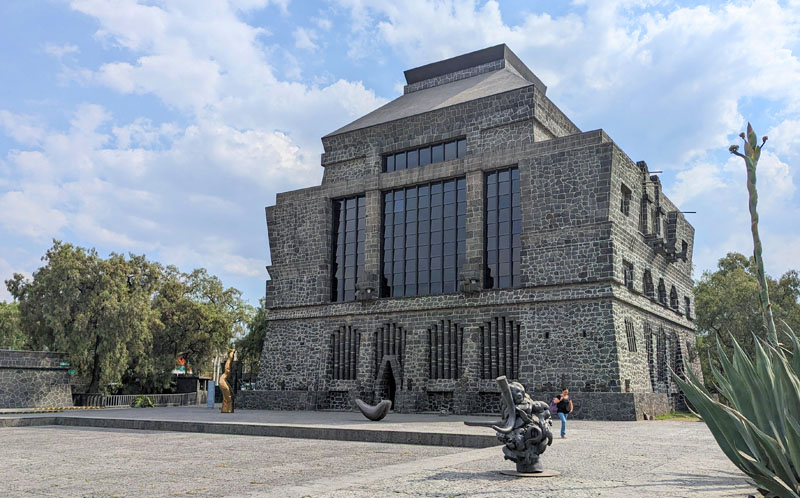
Diego Rivera (1886–1957), a famous Mexican artist and a husband of Frida Kahlo, is celebrated for his monumental murals that championed social justice and celebrated Mexican culture. As a leading figure in the Mexican Muralism movement, Rivera used his art to address issues of class struggle, indigenous identity, and political revolution, leaving a lasting impact on Mexico and the global art world.
Born in Guanajuato, Mexico, Rivera studied art in Europe, where he was influenced by Cubism and Renaissance frescoes. Returning to Mexico in the 1920s, he embraced muralism as a public medium to educate and inspire the masses. His works often decorated government buildings, schools, and public spaces, making his messages accessible to common people.
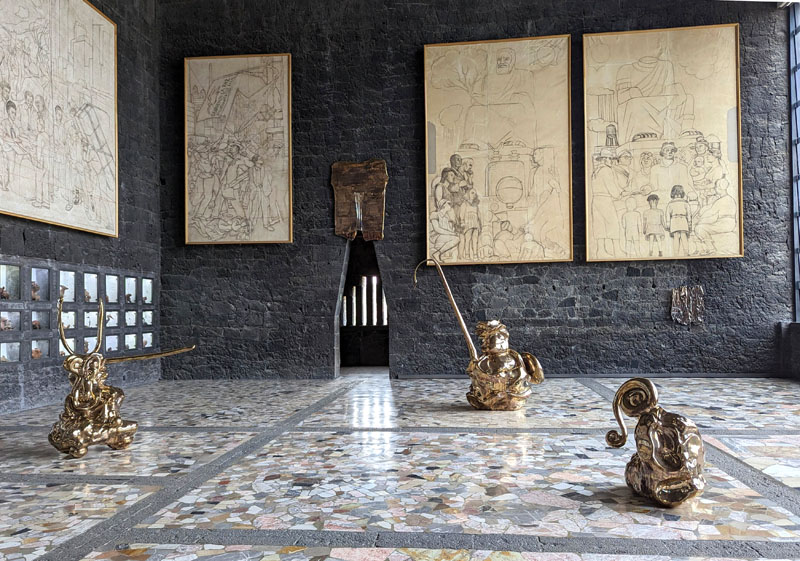
Key Art:
Man at the Crossroads (1933–1934): Originally commissioned for Rockefeller Center in New York, this mural depicted workers, technology, and social progress but included a portrait of Lenin, sparking controversy and leading to its destruction. A recreated version, Man, Controller of the Universe (1934), in Mexico City’s Palacio de Bellas Artes, critiques capitalism and celebrates collective labor. You can see it today by visiting the center in the heart of Mexico City.
The History of Mexico (1929–1935): Located in the National Palace in Mexico City, this sprawling mural series portrays Mexico’s indigenous heritage, colonial oppression, and revolutionary struggles. It highlights the exploitation of workers and peasants, advocating for social equality and national pride.
Detroit Industry Murals (1932–1933): Created for the Detroit Institute of Arts, these murals glorify industrial workers and critique the dehumanizing effects of industrialization. Rivera’s vivid imagery blends technology with human labor, emphasizing the dignity of the working class.
Rivera’s art was deeply political, often aligning with Marxist ideals and advocating for the rights of workers and indigenous peoples. His bold depictions of social inequality and historical narratives challenged the status quo, earning both admiration and criticism. Despite controversies, including his conflicts with patrons like the Rockefellers, Rivera’s murals inspired social movements and solidified his legacy as a voice for the marginalized. Rivera’s murals still attract lots of attention from tourists visiting the museums in Mexico.
The Transformative Power of Art

The impact of artists on social change can be profound, with countless creators using their talents to influence societies and the world at large. While artists like Banksy, Ai Weiwei, and Pablo Picasso are widely celebrated for their statements, many others have also driven change through their work. Visionaries like Frida Kahlo, with her introspective paintings such as The Two Fridas (1939), explored identity and cultural struggles, while Shepard Fairey’s Hope (2008) poster became a global symbol of political optimism. Beyond visual art, musicians like Bob Dylan, filmmakers like Ava DuVernay, and even dancers like Alvin Ailey have woven powerful social messages into their craft. When visiting an art gallery or engaging with any creative medium, look beyond the surface—each piece may carry a deeper call for change.
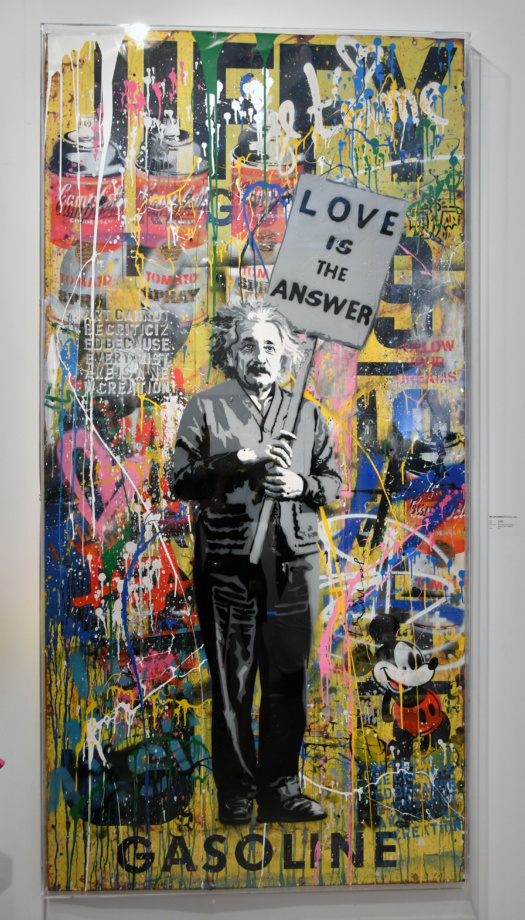
Artists to Explore Further:

- Frida Kahlo: Known for her raw, personal depictions of gender, identity, and Mexican heritage.
- Shepard Fairey: Creator of iconic street art with political resonance, including the Obey series.
- Kara Walker: Uses silhouettes to confront race, history, and power dynamics in works. An American artist renowned for her provocative silhouettes and installations. Her work A Subtlety (2014), a massive sugar-coated sculpture, critiqued the legacy of slavery and exploitation in the sugar trade, talking about racial injustice.
- Yayoi Kusama: Her immersive installations, such as Infinity Mirrored Room (1965–present), challenge perceptions and advocate for mental health awareness.
- Judy Chicago: This American artist created feminist art for social change. She used her installations to challenge gender inequality and advocate for social change. Active since the 1960s, Chicago’s art confronts patriarchal structures and celebrates women’s contributions. Her most famous work, The Dinner Party (1974–1979), a massive triangular table with 39 place settings honoring historical women, redefined art’s role talking about feminism. By addressing issues like gender oppression and women’s erasure from history, Chicago’s multimedia art installations continue to inspire activism and empower movements for equality.
Written by Alice Yang & Veronica Winters

Inside the Art Institute of Chicago: A Complete Guide for First-Time Visitors
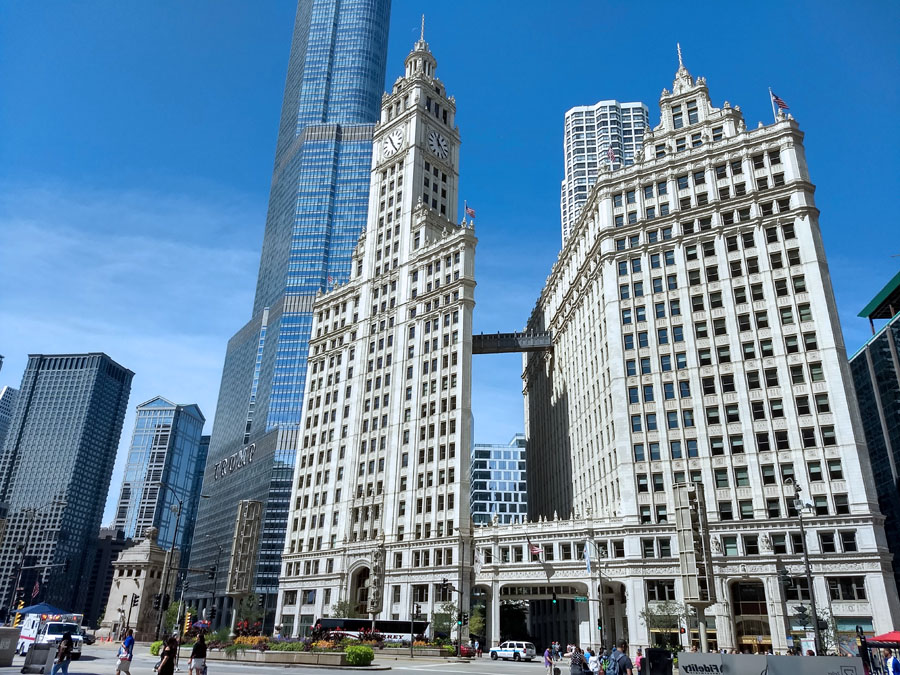
For travelers drawn to art, few museums carry the quiet gravity of the Art Institute of Chicago. Inside its
stately Beaux-Arts facade, the museum holds one of the most remarkable and diverse collections
anywhere in the world. But with its numerous galleries, global holdings, and central location in downtown Chicago, first-time visitors often wonder how to make the most of their day. This guide offers a thoughtful approach to experiencing the museum’s many treasures—balancing highlights, pauses, and the natural rhythm of discovery. Whether you’re a devoted art historian or simply curious to stand before a few world masterpieces, the Art Institute invites you into a world where time slows and creativity expands.
Begin at the Modern Wing: Light, Space, and New Perspectives
If you are into modern art, then the best place to begin your visit is the museum’s Modern Wing, where Renzo Piano’s design allows sunlight to filter across white walls and polished stone floors. Entering here sets the tone: open, bright, and quietly dramatic. With its sleek lines and airy galleries, the space itself feels like a work of art.
The Modern Wing houses a formidable collection of 20th and 21st-century works. Start with the
European modernists: Picasso’s fragmented forms, Matisse’s bold colors, and Brâncuși’s smooth,
sculptural lines. Then move into the American section, where Warhol’s portraits and Lichtenstein’s
punchy comic panels capture both wit and cultural commentary. You can view many pictures from this art museum here.
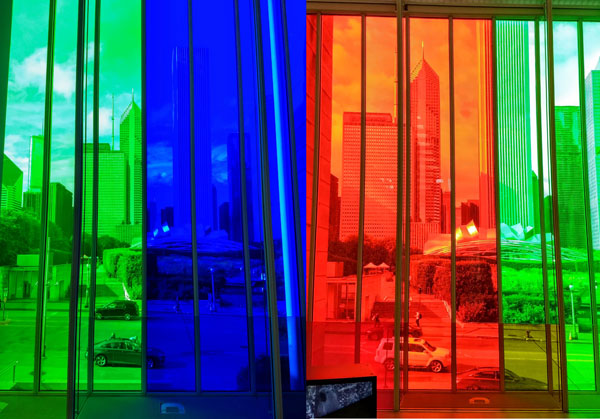
One floor below, contemporary photography, design objects, and media installations push the boundaries of what defines art. The wing’s terrace offers views over Millennium Park and downtown Chicago. On clear days, this becomes a natural pause before stepping into the museum’s historical collections.
Personally, I’m not fond of modernism and thus go straight to classics!
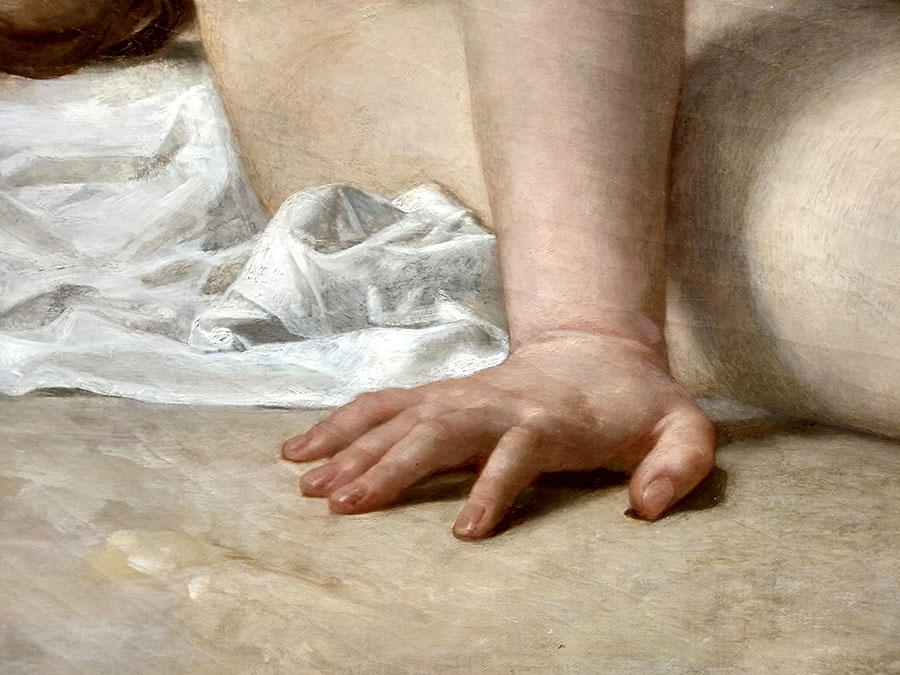
Cross into the Main Building: The Classics Await
From the Modern Wing, a glass bridge carries visitors into the original 1893 structure. Here, the weight
of art history presses gently. Begin with the museum’s celebrated Impressionist and Post-Impressionist galleries. Monet’s Water Lilies, Renoir’s soft portraits, and Seurat’s A Sunday on La Grande Jatte pull visitors into familiar yet endlessly rewarding works. Van Gogh’s The Bedroom glows with intimate warmth, while Cézanne’s precise still lifes showcase masterful balance.
Move further to encounter the American galleries, where Hopper’s Nighthawks offers one of the
museum’s most recognized images—a quiet, timeless scene of late-night urban solitude. Nearby, Grant
Wood’s American Gothic holds its iconic, ambiguous stare.
Elsewhere, the Thorne Miniature Rooms surprise many first-time guests. These elaborate models of historical interiors provide a captivating shift in scale and storytelling.
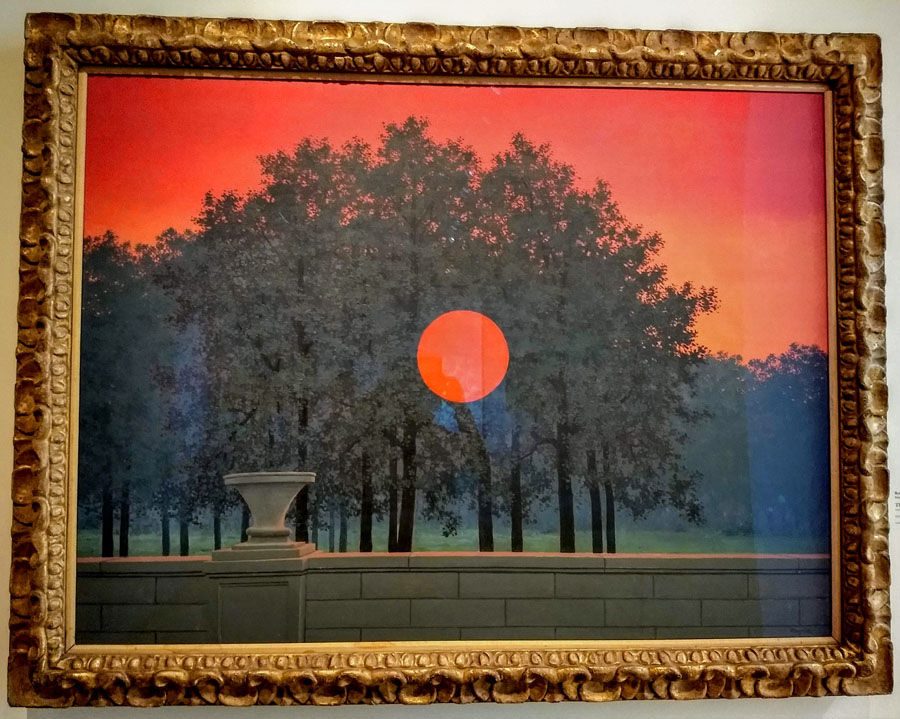
The Art Institute also houses extensive holdings from Africa, Asia, and the ancient Mediterranean. Rich
textiles, intricate masks, and centuries-old Buddhist sculptures present entire worlds in single galleries.
Many visitors find themselves unexpectedly drawn into these quieter spaces, lingering longer than
planned.
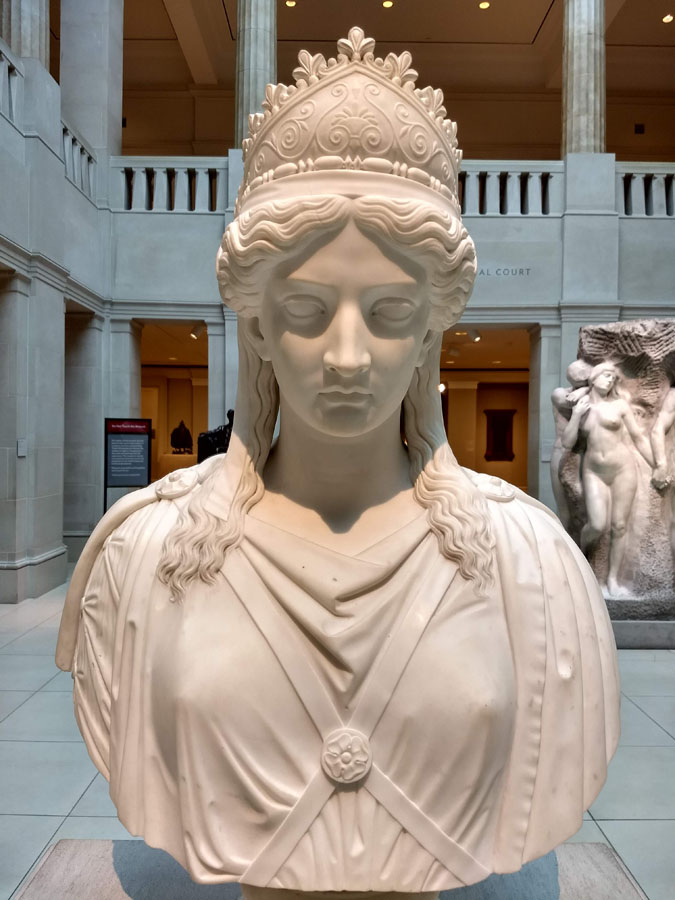
Here are a few famous artists and artworks that stood out on my visit to this art museum:
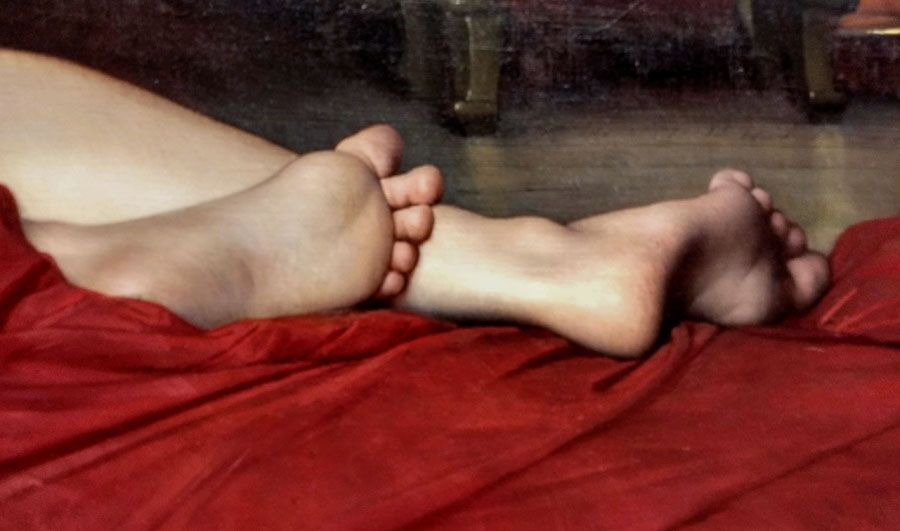
- Sargent, Study of an Egyptian Girl
- Rosetti, Beatrix
- Tintoretto, Tarquin and Lucretia
- Lefebvre, Odalisque (One of David’s students)
- Manfredi, Cupid Chastised
- Cassatt, After the Bullfight
- Simpson, the Captive Slave
- Canova, Head of Medusa
- Zurbaran, the Crucifixion
- Titian
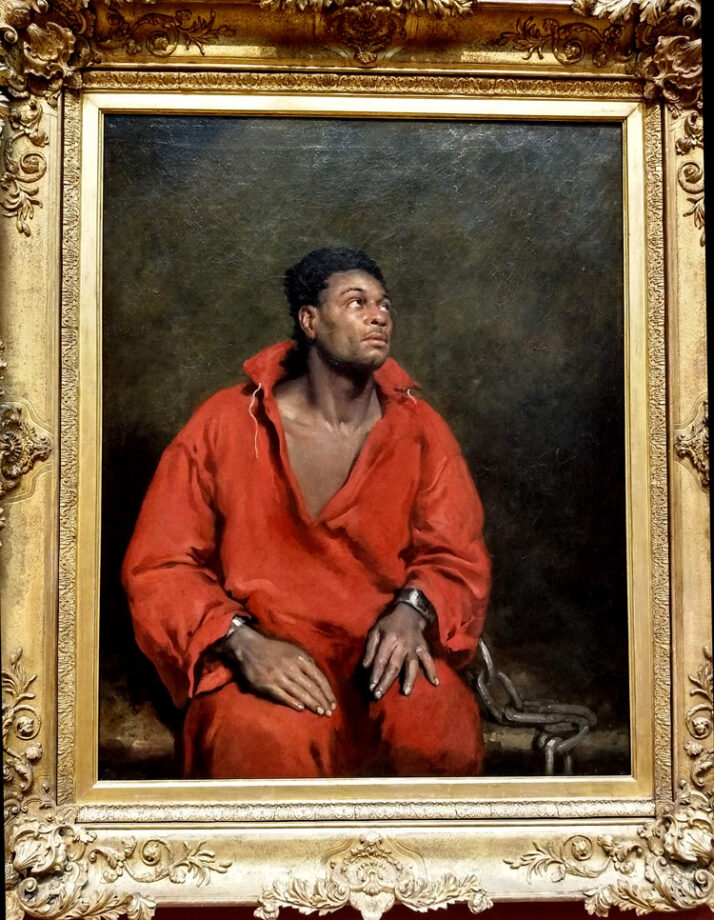
In 1827, when the English portrait painter John Simpson exhibited this heroic image of a manacled man, he was making a bold statement. The slave trade was still a controversial moral and political issue, and it would not be fully resolved in England until six years later, when Parliament passed the Slavery Abolition Act. As his model, the artist posed Ira Aldridge, the freeborn son of a lay preacher in New York who would go on to have an important career on the London stage. Here Aldridge’s expressive upward gaze conveys a yearning for freedom in an image that both speaks to and transcends its historical moment. +the museum’s description
Plan with Purpose: Tips to Shape Your Visit
Even the most art-loving traveler benefits from thoughtful pacing. With over a million square feet of
gallery space, the Art Institute rewards focus over speed.
Buy tickets in advance. Online reservations help avoid long entry lines, especially during peak
hours.
Start early. Arriving close to opening allows you to enjoy galleries before midday crowds grow.
Dress for distance. The marble floors and expansive halls mean plenty of walking; comfortable
shoes matter.
Use the app. The museum’s free mobile guide offers helpful maps, suggested routes, and in-
depth information.
Keep bags small. Security screenings are smoothest when you travel light.
Pause often. The on-site cafés provide comfortable places to rest while looking out at
Millennium Park.
Families visiting with children should stop by the Ryan Learning Center, where interactive displays and
creative workshops engage younger visitors at their own pace.

Since the museum sits in Chicago’s busy downtown core, visitors often arrange a Chicago limo service to
simplify the day. Avoiding traffic, parking garages, and navigation allows you to begin and end your
museum visit in a calm, unhurried way.
Beyond the Galleries: The City Completes the Experience
Part of what makes the Art Institute experience so rich is its place within Chicago itself. Just beyond the
museum’s doors, Millennium Park offers an open-air extension to your art day. Cloud Gate,
affectionately known as “The Bean,” reflects city and sky in endlessly photogenic curves.
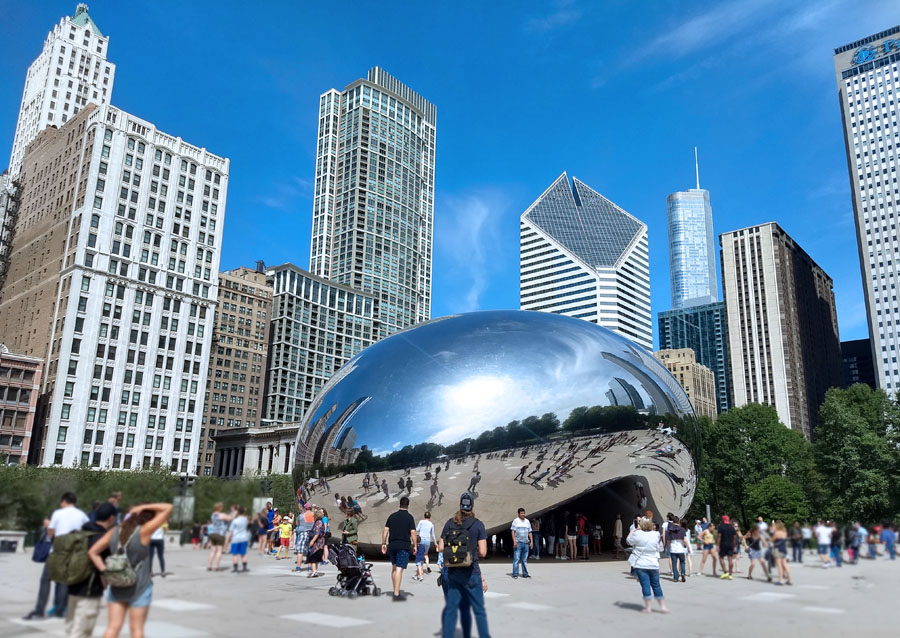
A short stroll leads to the Chicago Cultural Center, where free exhibitions and the world’s largest Tiffany
stained-glass dome offer an architectural treat. The nearby Riverwalk and Magnificent Mile extend the
day into riverside paths, boutique shops, and skyline views.

Depending on the season, visitors may choose to pair the Art Institute with outdoor festivals, lakefront
walks, or simply quiet time at one of the city’s rooftop cafés. In Chicago, the rhythm between seeing art
and simply being present often becomes its own reward.
One Museum, Many Moments
The Art Institute of Chicago doesn’t ask you to see everything in one visit. Instead, it invites you to find
your own pace, to pause before what draws you, and to let each work speak in its own time.
For many, the memory that stays isn’t tied to a single painting or sculpture. It’s the experience of
moving through spaces filled with history, beauty, and meaning—and the quiet moments between,
when art lingers just a little longer than expected.
To continue exploring:
The best art in the Louvre art museum
What’s inside the Louvre? I take you on a virtual tour of the best art museum in the world.
To read the article and see art: https://veronicasart.com/the-most-beautiful-art-in-the-louvre-from-sculpture-to-painting-to-ancient-cultures-of-egypt-assyria-and-greece/
Video: https://youtu.be/5EkpVRnBkqg
Subscribe & rate this podcast on Spotify and Apple | Show your support for the podcast: here | Host: Veronica Winters, MFA | veronicasart.com
Podcast: Play in new window | Download
The most beautiful art in the Louvre from sculpture to painting to ancient cultures of Egypt, Assyria, and Greece
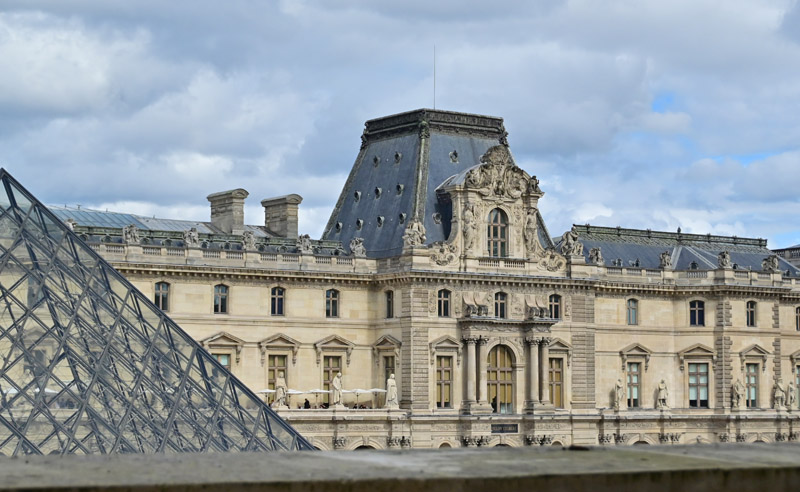
We spent two full days in the Louvre or about 15 hours, walking its lavish interior space filled with priceless art, jewelry, ancient sculpture, and furniture. The length of this famous art museum is remarkable. The Louvre covers about 60,600 square meters. Just imagine walking 652,000 square feet!
The Louvre’s art collection is even more impressive as this top art museum houses over 35,000 works of art, spanning from ancient Egypt to 19th-century art.
Yes, the Louvre is most famous for the Mona Lisa, Venus de Milo, Michelangelo’s Dying Slave, Canova’s sculptures, David’s paintings, and the Winged Victory of Samothrace. However, the palace displays so many other incredible pieces of art that I’d stay there for weeks to sketch and paint from this famous art if I could.
Video:
- 00:00 Introduction to the Louvre Museum & its collection history
- 05:50 The Napoleon III Apartments
- 08:02 The Apollo gallery & French Crown Jewels
- 11:31 Ancient Egypt art collection
- 14:15 The Palace of Sargon, Babylon & the Assyrian art
- 16:42 Ancient Greco-Roman Art Collection
- 19:36 The Michelangelo Gallery & classical art
- 21: 42 Famous Paintings of the Louvre
- 26:54 Islamic art collection
- 29:41 The Sennelier Art Supply Store
- 30:33 Views of Paris
History of the Louvre as a Royal Palace:
Let’s look at the history of the Louvre Palace before it became a museum. Construction began on a fortified castle on the right bank of the Seine River in Paris in the 12th century. In the 16th Century, King Francis I (1515-1547) transformed the castle into a luxurious royal residence, inspired by Italian Renaissance architecture. The king hired Leonardo to be his court artist in the last decade of the artist’s life and commissioned the Mona Lisa, among other pieces. (The famous Italian artist da Vinci passed away in France, and that’s why the Mona Lisa is in the Louvre, not Italy). When Louis XIV moved the royal court to Versailles in the 17th century, he left the Louvre as a royal palace for occasional visits and storage of art collections.
During the French Revolution in 1793, the Louvre transformed into an art museum as it was declared a “museum of the people.” In the 19th Century, Napoleon Bonaparte expanded the Louvre’s collection through conquests and purchases, making it one of the world’s largest and most prestigious art museums. Emperor of France from 1800 to 1814, made significant expansions of the art collections. A century later, the Louvre underwent extensive renovations and expansions under Georges-Henri Rivière, director of the Louvre from 1887 to 1908. The construction of the famous glass pyramid by architect I.M. Pei happened in 1989. https://www.louvre.fr/en/explore/the-palace
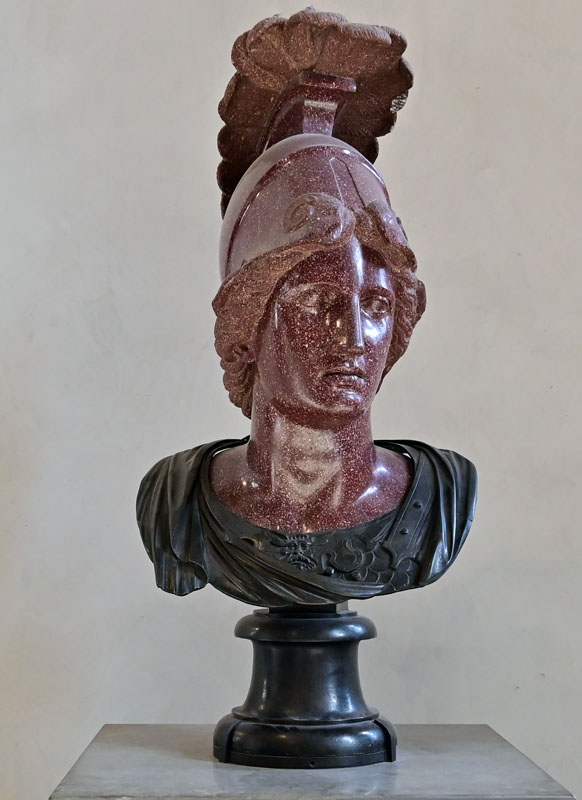
The Louvre consists of several architectural styles present in the museum:
The earliest parts of the Louvre were constructed in the Gothic style (12th-16th centuries) with pointed arches, ribbed vaults, and stained glass windows. The oldest section of the museum, known as the “Old Louvre,” exhibits Gothic architectural elements.
King Francis I’s reign marked a significant shift toward the Renaissance style, inspired by Italian architecture in the 16th-17th centuries. The Renaissance portion of the Louvre features symmetrical facades, columns, and ornamentation. (Example: The Cour Napoléon, a central courtyard, showcases Renaissance architecture.)
The 18th century saw a revival of classical architecture, characterized by symmetry, proportion, and the use of Greek and Roman motifs, which is called Neoclassical style. ( Example: The Denon Wing, one of the main wings of the museum, is a prominent example of neoclassical architecture).
Modern Architecture of the 20th century includes I.M. Pei’s Glass Pyramid. Designed by Chinese-American architect I.M. Pei, looks very different from the older sections of the museum.
Mansard Roofs: A French Architectural Innovation
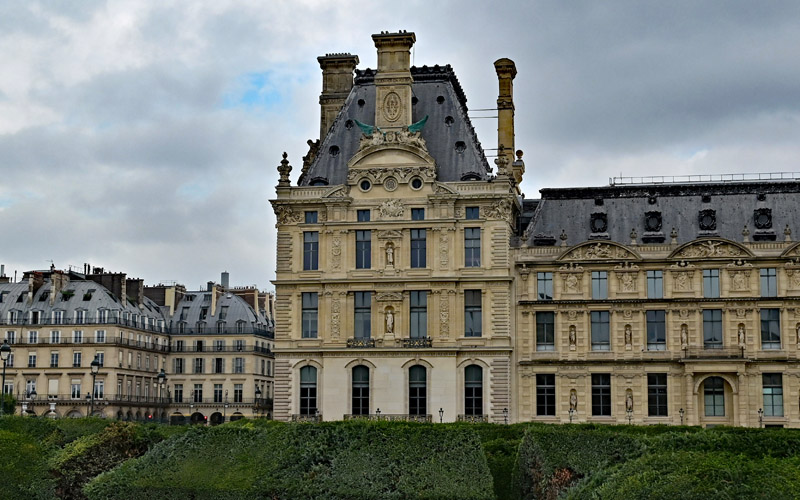
The roofs of the Louvre are a combination of several architectural styles. In some of the older parts of the Louvre, you might find slate roofs, which were common in medieval and Renaissance architecture. These roofs often have a steep pitch and are covered in dark, natural slate tiles. The newer sections of the Louvre, especially those built in the neoclassical style, often feature mansard roofs. These French roofs have a double-sloped design, with a steeper lower slope and a flatter upper slope. Mansard roofs were popular in the 17th and 18th centuries and are known for their practicality, offering added height and visual interest to buildings.
Mansard roofs, named after the French architect François Mansart, originated in France during the 17th century. King Louis XIV was a patron of arts & architecture who must have favored and influenced the popularity of mansard roofs in France.
These roofs offer several advantages. The sloped upper part of the roof allows for additional usable space within the attic or dormer. The steeper lower slope helps to shed rainwater more efficiently, reducing the risk of leaks and water damage. Also, the Mansard roofs can provide additional structural support to a building, especially in areas with heavy snowfall or strong winds. The symmetrical, balanced, and unique visual design of mansard roofs offers a distinctive silhouette that Paris is known for.
It’s not the first time I visit the museum, but I’m thrilled to share incredible genius of artists who created these pieces. I found the Louvre’s best art, some of it overly famous and other is not. Let’s explore the museum’s art collection together.
The Napoleon III Apartments

These luxurious red rooms are the most astonishing ones in the whole palace! You can’t skip them even if you’re short on time. You’d be stunned by the richness of its decorations. In 1861, these rooms became the apartments of Napoleon III, Minister of State, in the Richelieu wing. These opulent rooms in red, gold, and art, with crystal chandeliers, were used for various receptions, balls, dinners, and meetings between 1852 and 1870. It’s one of the most opulent rooms I’ve seen in many European palaces. Made around 1860, the largest chandelier sparkles with 180 lights and measures 4.7 by 3.27 meters.
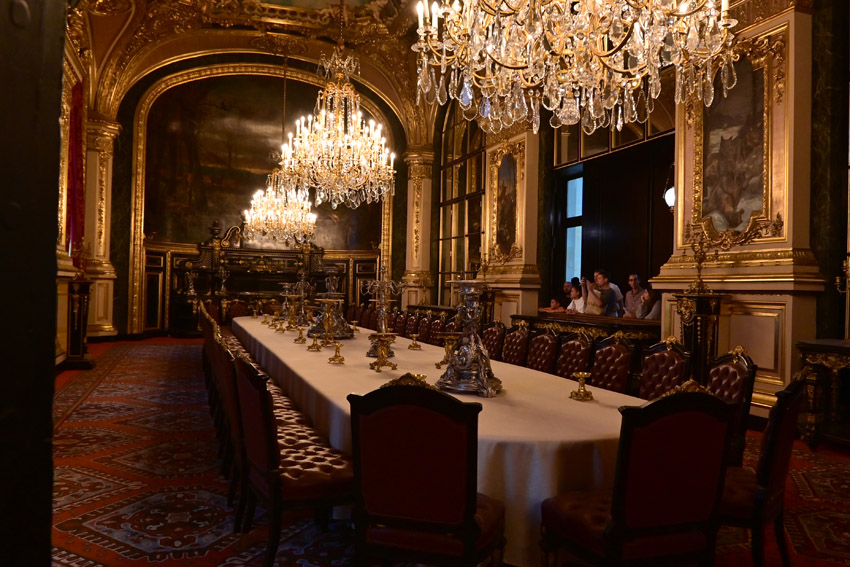
One of the rooms displays the portrait of Emperor Napoleon III (1808-1873). The salon-theatre displays the portrait of Empress Eugénie and could house up to 250 guests. There was a special musicians’ platform above the stage hidden at first sight. The rooms have novel-designed red chairs and three-seater armchairs that zigzag to seat several people at once to have conversations. The Ministry of Finance occupied the rooms until the day the Louvre became a museum in 1993.
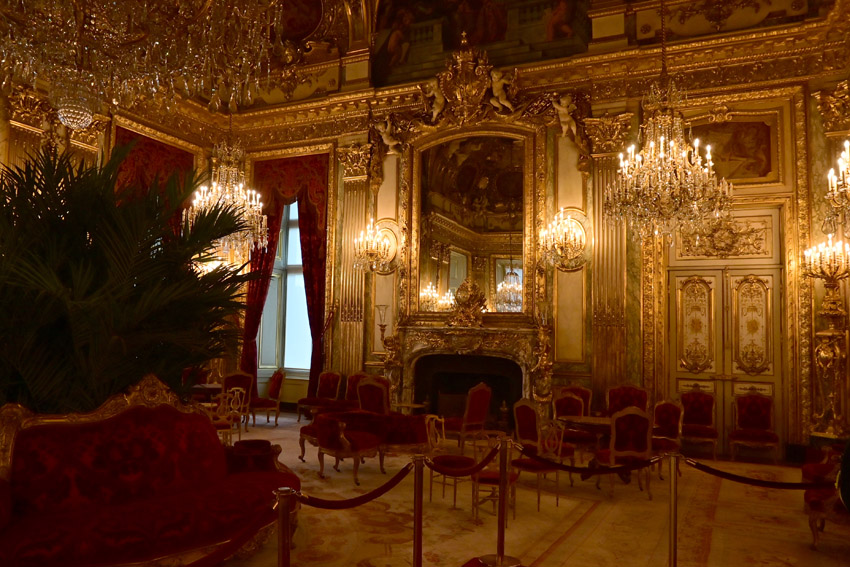
French Crown Jewels collection in the Apollo gallery
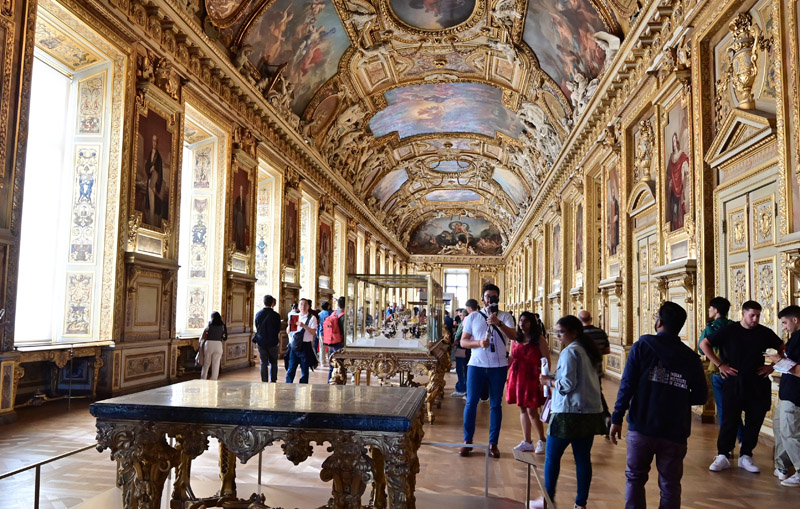
Being just 23 years of age, King Louis XIV aligned himself with the ancient Greek god Apollo to become the sun king in France. He hired the best artists of the day, including the architect Louis Le Vau and Charles Le Brun, the first artist to the king, to work on one of the most beautiful rooms in a palace after it burned in fire. These famous artists later worked on the Hall of Mirrors at the Château de Versailles, the preferred residence of the Sun King.
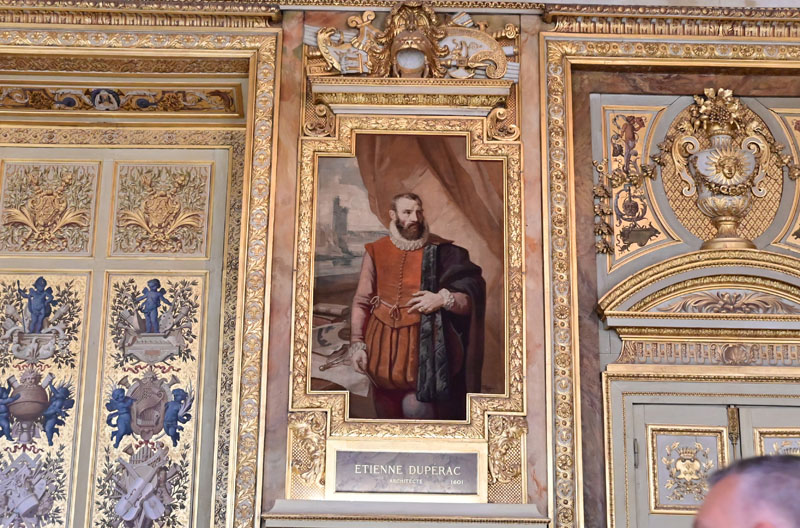
Le Brun created a whole journey of the God Apollo in a series of ceiling paintings. The sun god rides his chariot across the sky from dawn to dusk. Apollo’s journey is set with many images, symbols, and representations of time, zodiac, and calendar to show the rule over the Universe. In 1850, famous French artist Eugène Delacroix received a commission to decorate the ceiling’s centerpiece – a 12-metre wide painting. Delacroix depicted the most famous scene from the ancient Greek mythology, Apollo Slaying the Serpent Python, in a style of French Romanticism. At the same time, beautiful portrait tapestries of 28 monarchs and artists were added as wall decorations.
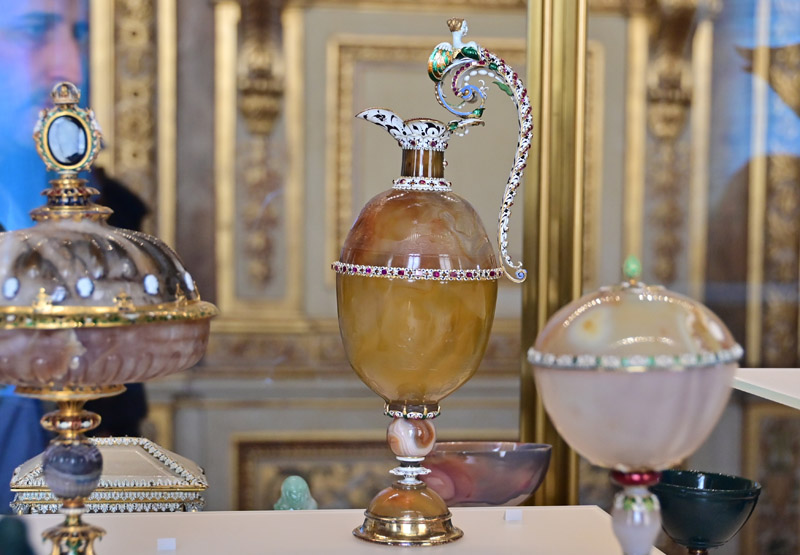
Today, you can view the royal collection of 800 hardstone vessels and the French Crown Jewels in the Galerie d’Apollon. These unique, artful vessels are made of precious stones, like agate, amethyst, lapis lazuli, jade, and crystal. Louis XIV had great taste!
THE FRENCH CROWN JEWELS (1530-1789)

On 15 June 1530, François I, king of France from 1515 to 1547, established the French Crown Jewels, selecting eight pieces of royal jewelry that were to remain the inalienable property of the monarchy. King Louis XIV (reigned 1643-1715) added more items to the collection during his reign. Under the subsequent sovereigns, for various occasions, the gemstones were used and remounted to create new items.

Today, you can admire natural beauty of precious stones and artistic achievement captured in a crown of Louis XV, a crown and diamond brooch of Empress Eugénie, Tiara of the Duchesse d’Angoulême, jewels of Queen Marie Amélie, necklace and earrings from the emerald parure of Empress Marie Louise, the Regent and pink diamonds, and many more fantastic pieces!

Badge of the Order of the Holy Spirit: 400 brilliant-cut diamonds and a ruby mounted on silver
The Order of the Holy Spirit, founded in 1578 by King Henri III, was a French order of chivalry. There are two hypotheses as to who received this badge from King Louis XV (reigned 1715-1774): his son-in-law, Philip, Infante of Spain and Duke of Parma, named Knight of the Order in 1736; or his grandson, Ferdinand, Infante of Spain and future Duke of Parma, named Knight of the Order in 1762. It was modelled on the badge from the white insignia of Louis XV, created by Pierre-André Jaqmin about 1750.
Eternal Egypt: Best Egyptian artifacts to see at the Louvre
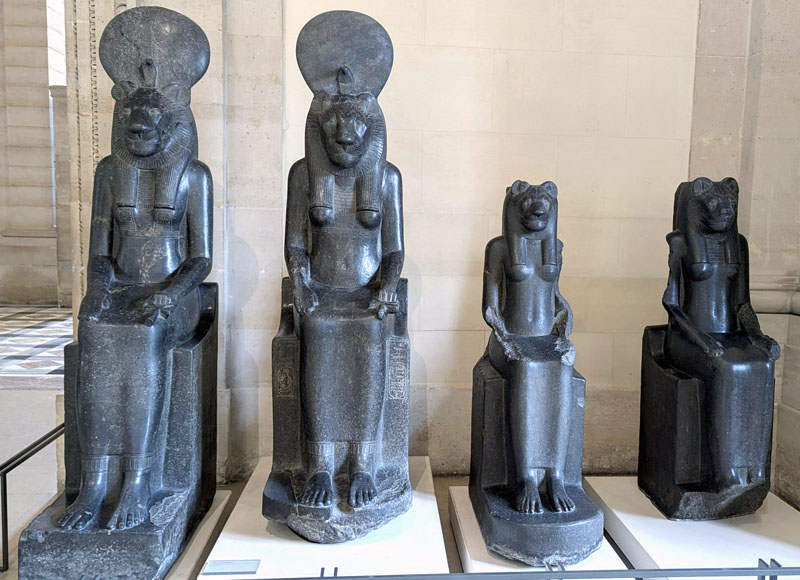
The Egyptian art collection at the Louvre primarily came about through three main avenues, Napoleon’s conquests, 19th century acquisitions, donations, and purchases.
Did you know that Jean-François Champollion was the French scholar who deciphered Egyptian hieroglyphs in 1822. He was just 32 years old. He founded the Egyptian museum in Turin, Italy and the Egyptian collection in the Louvre by convincing Charles X to purchase the Egyptian artifacts.
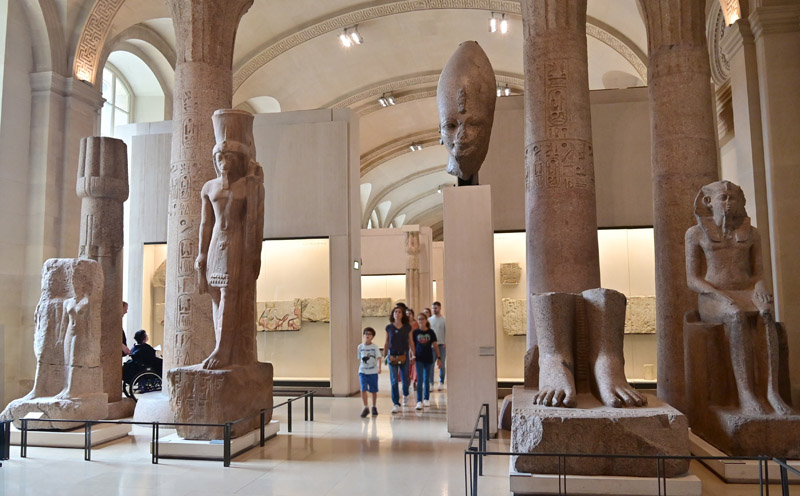
The role of Napoleon in shaping the Louvre’s art collection:
During his military campaigns in Egypt (1798-1801), Napoleon and his troops discovered and plundered numerous ancient Egyptian artefacts. These treasures were then brought back to France and eventually housed in the Louvre. The 19th century saw a surge of interest in Egyptology, leading to numerous archaeological expeditions and discoveries. Many of these artifacts were acquired by European museums, including the Louvre. Also, over the years, the Louvre has acquired Egyptian artefacts through donations from private collectors and purchases from antiquities dealers and art collectors. These additions have further enriched the museum’s Egyptian collection.
The Louvre today boasts one of the world’s most extensive and significant collections of Egyptian art of over 6,000 works spanning 5,000 years of Egyptian history, including iconic pieces such as the Sphinx of Tanis. Egyptian art collection is rich and occupies two floors of the palace. Let’s look at the best Egyptian artifacts at the Louvre.
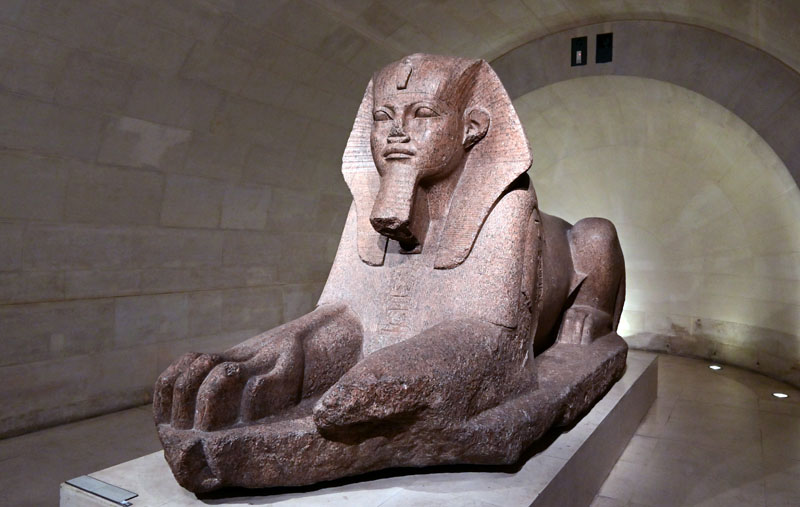
To house the Egyptian collection, some rooms were redone into the Museum of King Charles X (Egyptian Antiquities, Room 637, Sully wing, Level 1). The architects linked nine rooms together with high openings and stucco decorations. These are very beautiful rooms with painted ceiling decorations that were done by several famous French artists of the period, Antoine-Jean Gros, Horace Vernet, and Jean-Auguste-Dominique Ingres. Painted scenes depict ancient Egypt in Greco-Roman style. One of the paintings by Jean-Auguste-Dominique Ingres, The Apotheosis of Homer, was replaced with a copy, and the original hangs in room 702 (Salle Daru), Denon Wing, Left 1.
https://www.louvre.fr/en/explore/the-palace/a-royal-setting-for-egyptian-antiquities
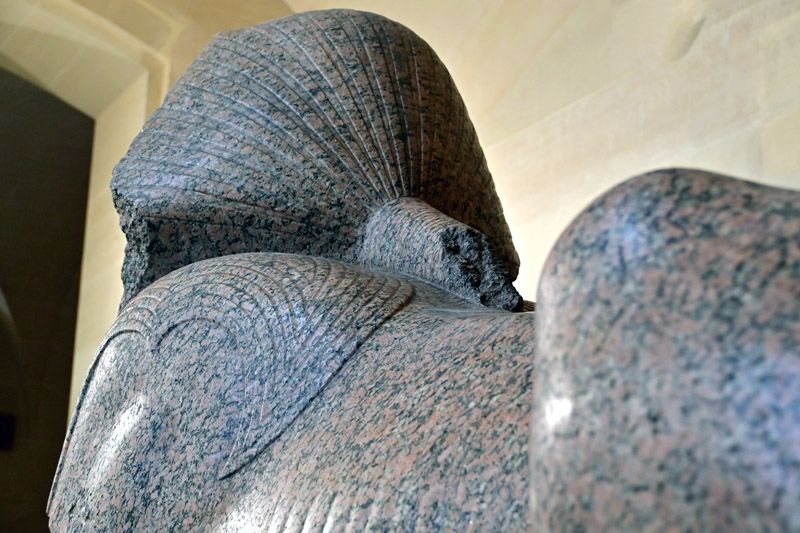
Some of the most famous and best Egyptian artifacts to see at the Louvre include a Seated Scribe figure, jewelry, sarcophagi, tomb of Akhethotep, furniture, clothes, granite statues of kings and queens (Sesostris III, Ahmose Nefertari, Hatshepsut, Amenophis III, Nefertiti, Akhenaton and Ramesses II), standing statue of Horus, and numerous artifacts I list below.
Pectoral with the name of Ramesses II, Room 642, Sully wing, Level 1. 1279 / -1213 (Ramses II), cloisonné inlay, glass, electrum. It was found in a tomb of Ramses II.
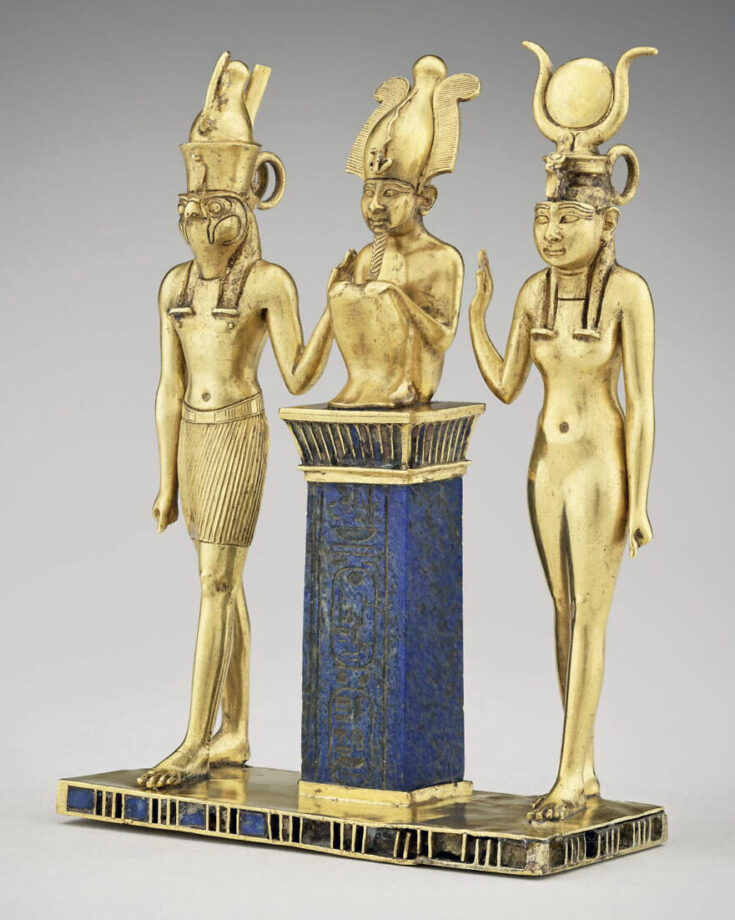
Osiris, Isis and Horus represent a founding myth of Egyptian religion. Osiris was killed by his brother Seth but he was revived by his wife Isis who also birthed their son Horus, the falcon god. Horus symbolizes victory over evil and the enduring power of the pharaohs.
The cat goddess Bastet, 664 / -610 (Wahibrê Psamtik I), copper alloy, gold. Museum’s purchase in 1852 from a collector.
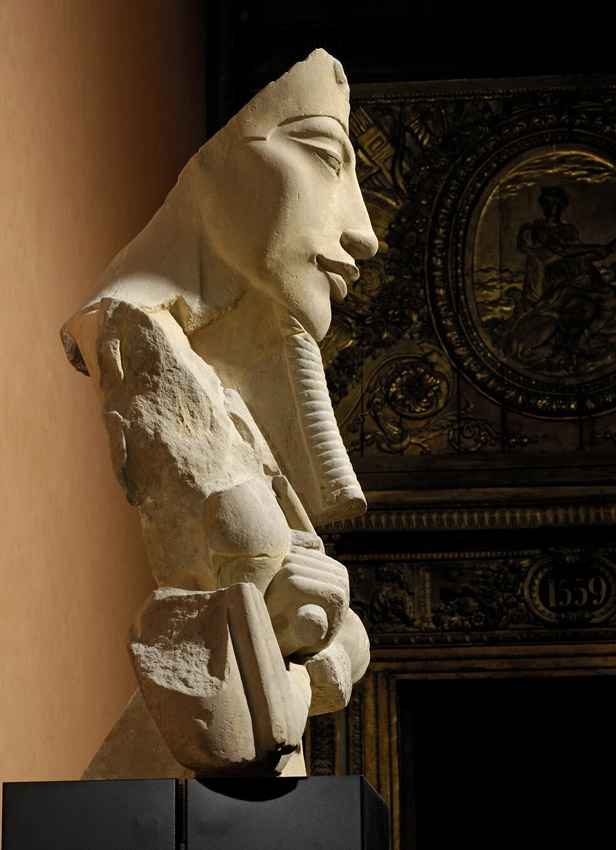
This is one of the most fascinating portrait sculptures of the Egyptian pharaohs I’ve seen. The face has an unusual, elongated shape with wide eyes, a long nose, and full lips. It’s not an idealized view of the Egyptian pharaoh but rather a portrait of a real person.
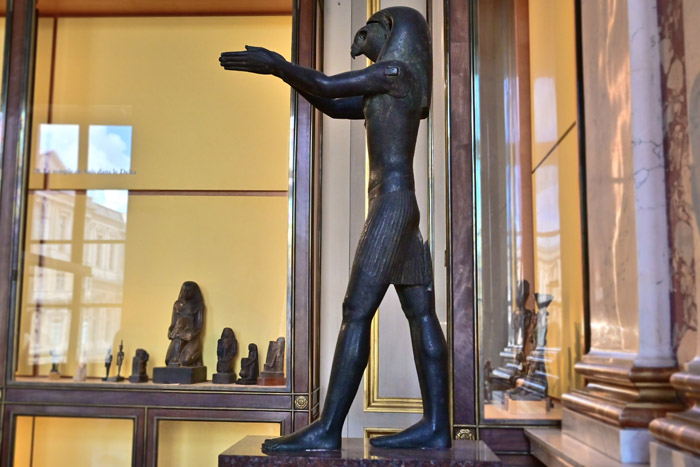
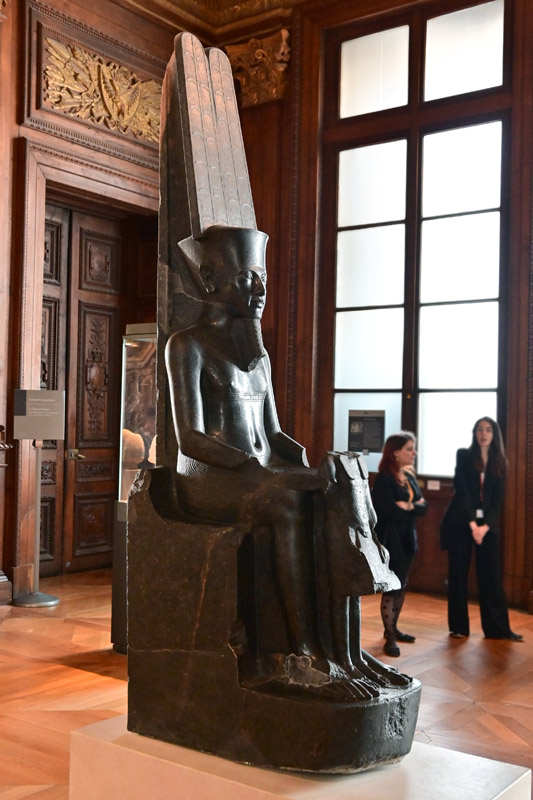
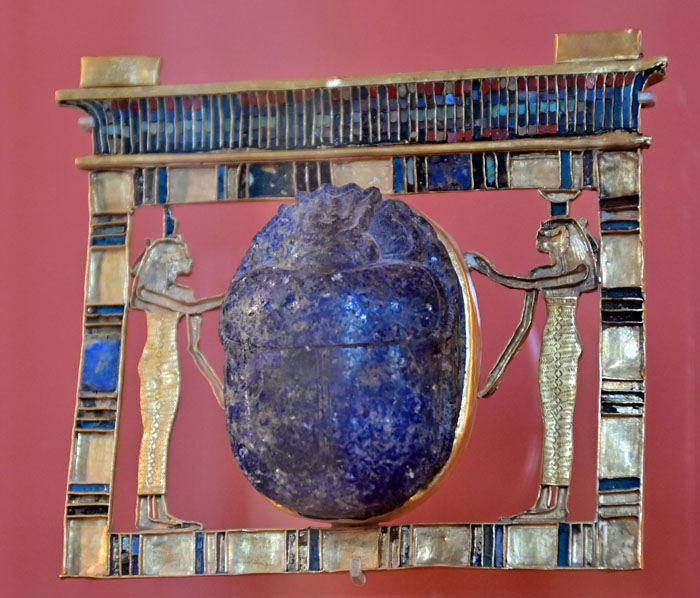
The ‘mastaba’ tomb of Akhethotep
“The mastaba of Akhethotep was purchased from the Egyptian government in 1903 and reconstructed in the Louvre. During the Old Kingdom (2700–2200 BC), members of the king’s circle were entitled to be buried in an elaborate mastaba – a massive structure built over a shaft leading down to an underground chamber, where the mummy of the deceased lay in a sarcophagus. The superstructure above the shaft contained a funerary chapel, where offerings were made to the deceased” -the Louvre
The Crypt of the Sphinx & Great Sphinx of Tanis
Room 338, Sully wing, Level -1
Made of pink granite, the statue was discovered in Tanis and purchased by the museum in 1826. For some reason, this statue receives a lot of attention from visitors, although there are some other similar, if not better, statues displayed in other parts of the Louvre that don’t get much attention at all.
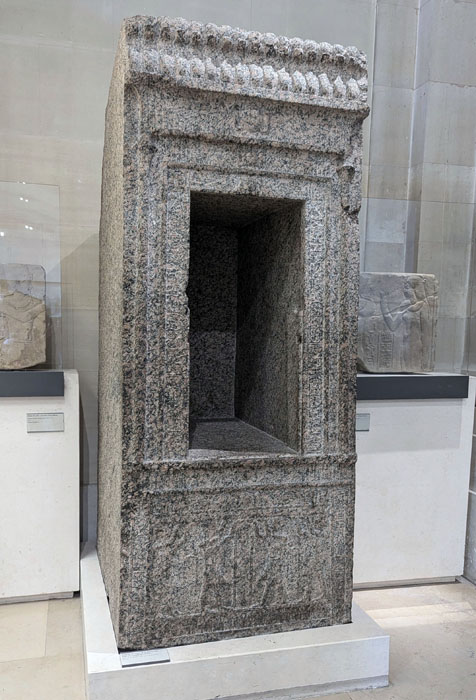
Naos, once housing the statue of Osiris
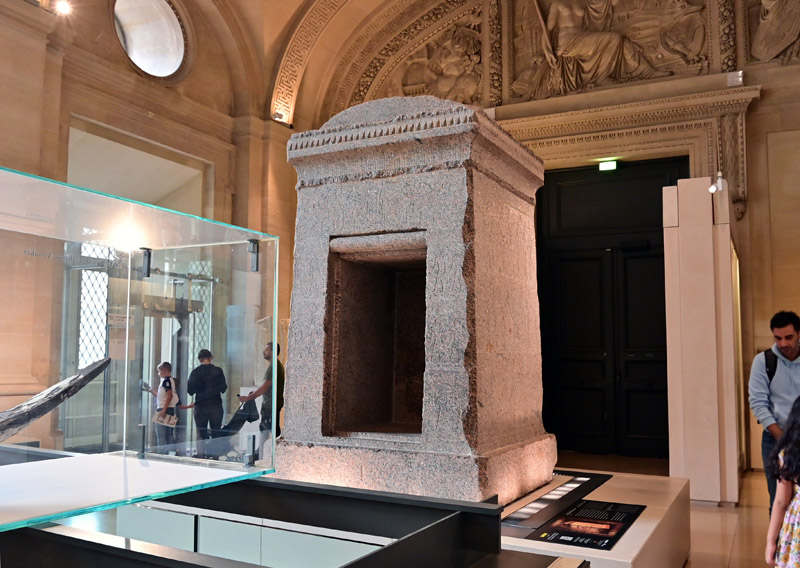
The pharaoh Amasis (570-526 BC) had this pink granite naos bearing his name made for a temple in the Nile Delta dedicated to Osiris. A naos is a wooden or stone chapel, large or small, present in each temple and housing the cult statue of the god to whom the monument is dedicated. Every day, priests would open their doors, bringing offerings of purified food and drink to the god, who was dressed in special attire. Carved from a single block of granite, the naos bears depictions on its outer walls of the many deities constituting the personal guard of the god Osiris. Through augmented reality, the statue of the god Osiris regains its position in the temple sanctuary and receives offerings once again. By walking around the monument, you can explore the reliefs portraying the other gods. **From the museum’s description.
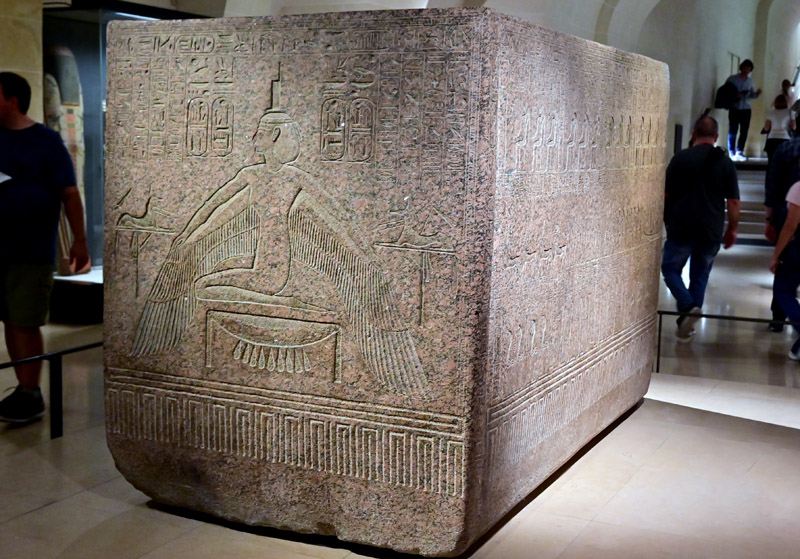
Reign of Amasis (570-526 BC), 26th Dynasty
The Dendera Zodiac
Made of sandstone, it was created between 15 June-15 August 50 BC, and purchased in 1822. Place of discovery: Temple of Hathor.
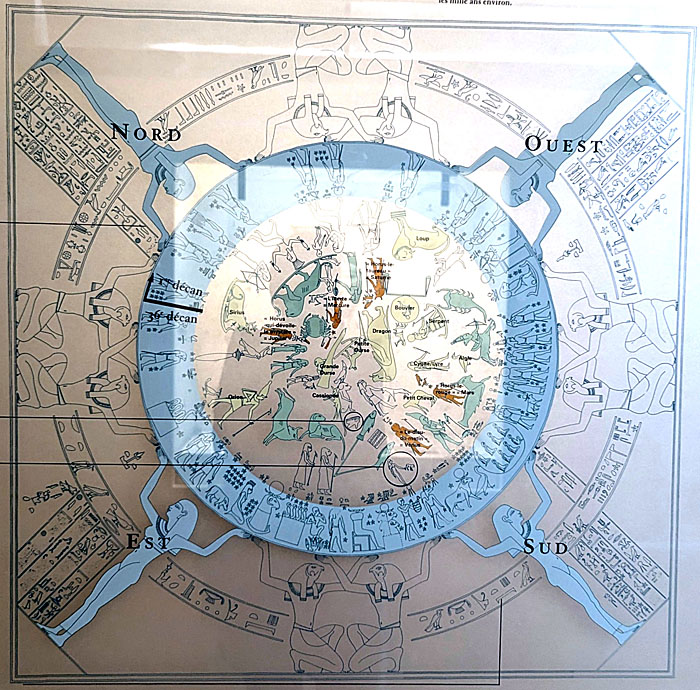
Various astronomical phenomena are recorded here, on the ceiling of one of the rooftop chapels of the temple of the goddess Hathor in Dendera. Inside a circle showing the year divided into ten-day periods (decans), we can see the twelve constellations of the zodiac, the five planets known at the time, and two eclipses – one solar and one lunar.
Upon its discovery in 1798, archaeologists hoped to date the Egyptian civilization correctly, but it raised great concerns over the established biblical chronology. Jean-François Champollion (1790-1832) was off by a hundred years, proposing the 50 AD date to reassure the pope of the established date of the Flood. Today, the temple’s inscribed dedications suggest its establishment in 54 BC, under Cleopatra’s reign. Through augmented reality, you can explore the three-dimensional details of these decorations and travel through the different levels of this celestial vault.https://collections.louvre.fr/ark:/53355/cl010028871
The Palace of Sargon II: History of the Louvre’s collection of ancient Near Eastern art
This is one of the most fascinating galleries in the Louvre because it displays the 8th century BC excavations of the ancient city, decorations, and the palace of King Sargon II at Dur-Sharrukin, present-day Khorsabad (Room 229, Richelieu wing, Level 0).
These wall sculptures represent the Assyrian Empire of King Sargon II, who built a new capital at Khorsabad, the largest city in the ancient world, with a huge palace. Unfortunately, his city soon declined after his death on a battlefield in 705 BC. French archeologists rediscovered the place buried in sand in the 19th century and brought the artifacts into the Louvre. Paul Émile Botta, the French vice-consul in Mosul, excavated the site that began the Mesopotamian and Near Eastern archaeology. https://www.louvre.fr/en/explore/the-palace/the-palace-of-sargon-ii
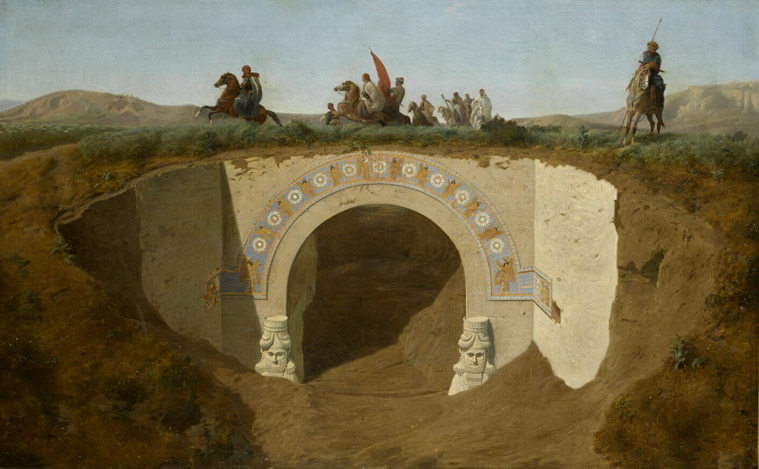
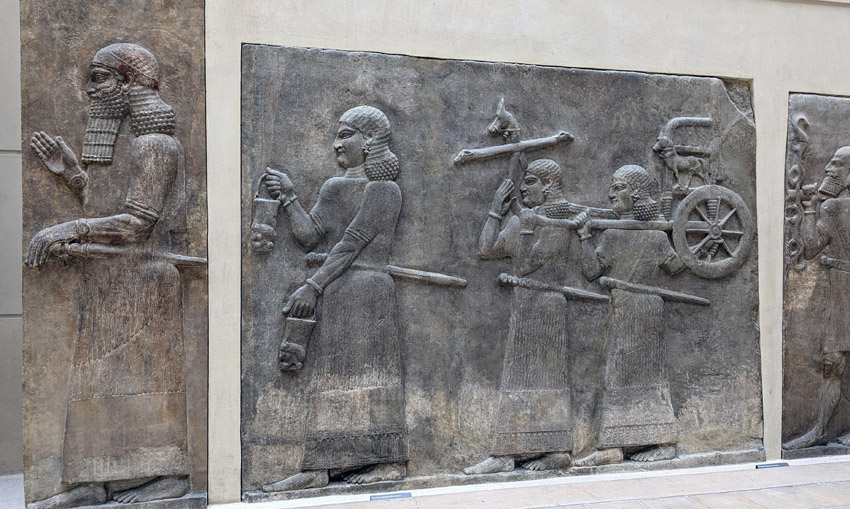
Carved into the entrance walls of the palace for protection, the protective genii (called aladlammû or lamassu) watched over the city and its palace. These colossal winged bulls weigh 28 tons each. Carved from a single alabaster block, the mythical, protective creatures look like bulls with eagle wings and human heads. These are fascinating creatures that resemble the art style of ancient Egypt with strangely moving legs, faces in profile, and flattened wings. This protective creature smiles gently and wears a hat with 3 sets of horns representing the divine power of the Mesopotamian region.
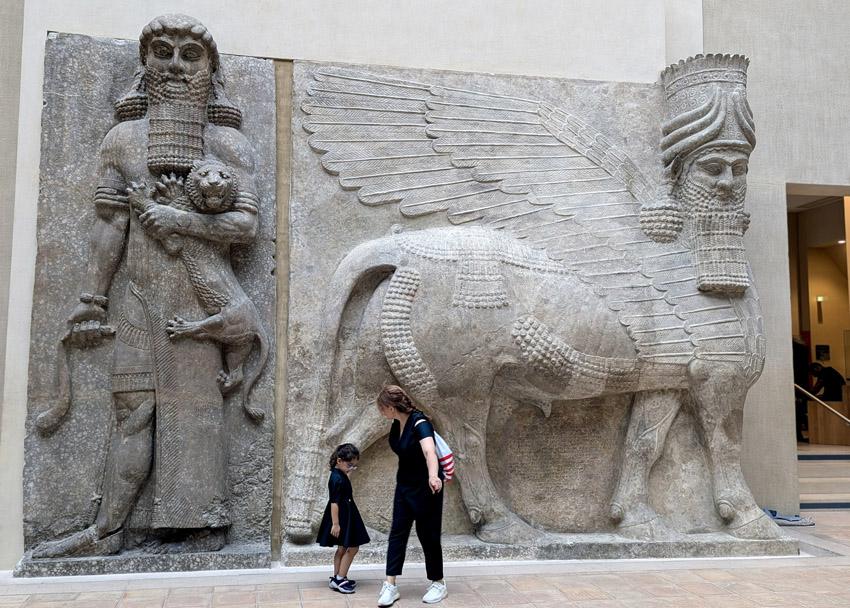
In these galleries, you can view “Gilgamesh overpowering a lion”, the high-relief sculpture that lacks original color but keeps its rough beauty. (Room 229, Richelieu Wing, Level 0). We look straight at the mad face of Gilgamesh squashing a lion. It’s not a side view, which is an unusual depiction of the hero. 721 /705 (Neo-Assyrian: Sargon II). It’s interesting to see how different people were in that region of the world. The man wears a bushy beard and curly hair. His long robe covers a loincloth. He wears sandals, earrings, and even a couple of different bracelets that were probably signs of his high status. This dark-toned sculpture was probably colored in white and other hues. Unlike the most refined granite sculptures of ancient Egypt, this figure lacks perfect proportions of the body but keeps stylization in place.
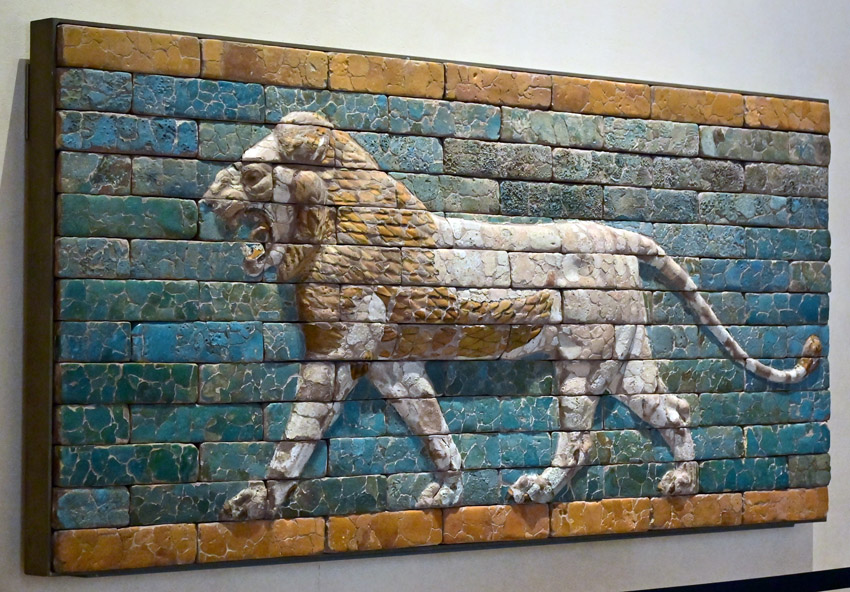
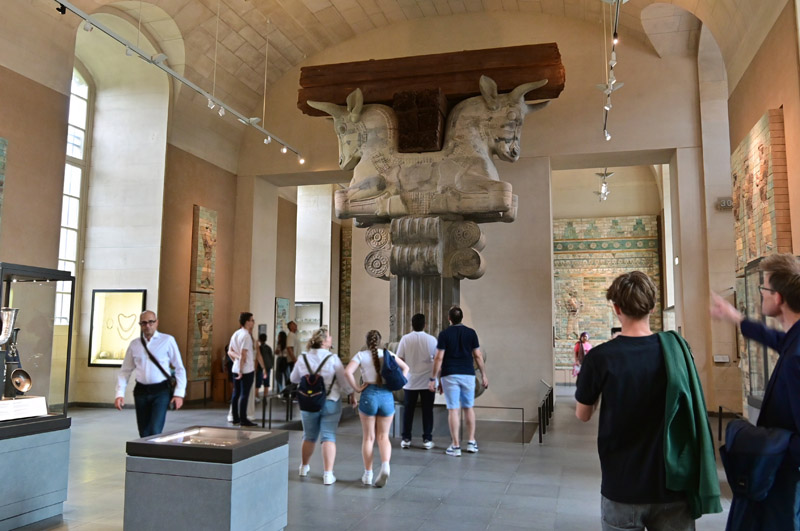
Cuneiform Script:
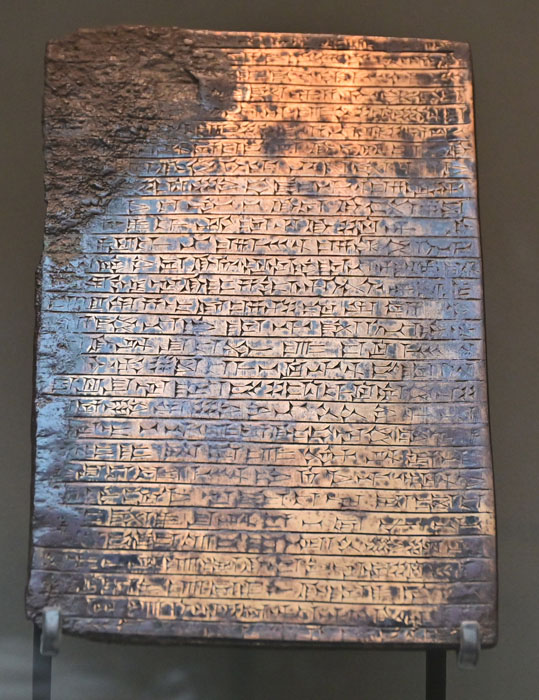
Sumerians developed cuneiform, a system of writing using wedge-shaped marks impressed into clay tablets, around 3500 BCE. The Louvre’s Near Eastern Antiquities collection, housed in the Galerie d’Angoulême (Room 301, Richelieu wing, Level 0), features Sumerian artifacts including cuneiform tablets, statues, stelae, and other objects.
The Louvre houses a Sumerian document with microscopic cuneiform, containing more than 30 lines of text and six to seven times as many signs as an ordinary cuneiform tablet. The Louvre also has a fragment of the Lament for Sumer and Ur, a Mesopotamian city lament.
Highlights of the Greek and Roman antiquities at the Louvre
This Ancient Greco-Roman Art Collection spreads across many rooms and levels. Obviously, it’s impossible to list everything that’s in this spectacular ancient Greek and Roman art collection but here are a few of my favorites.
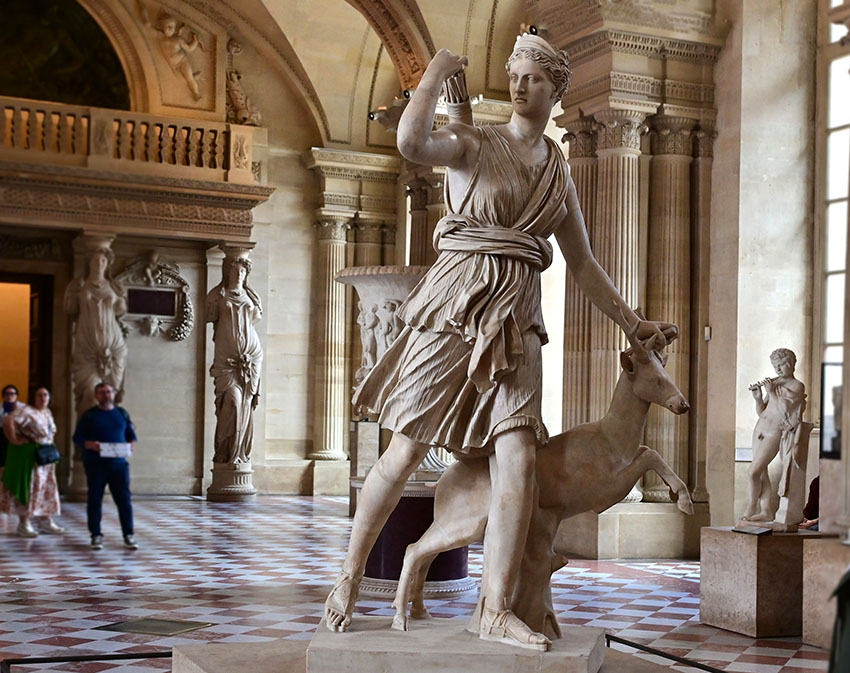
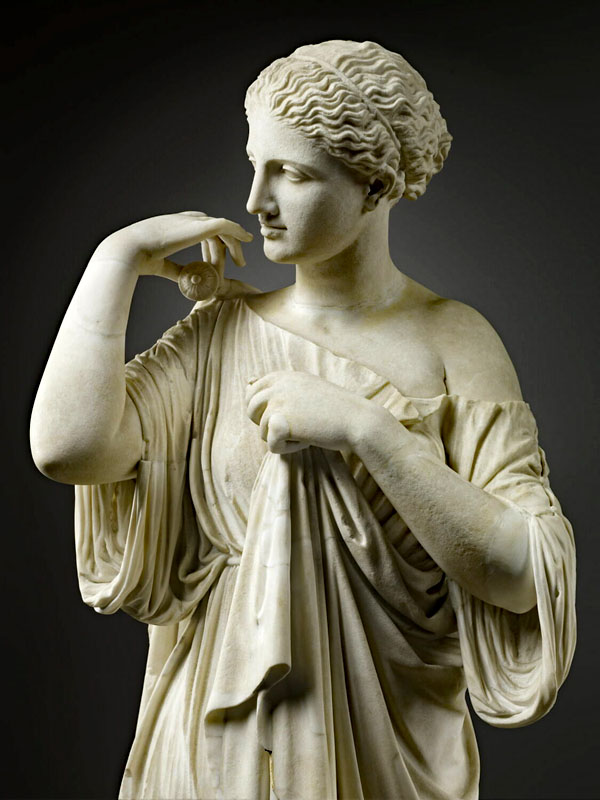
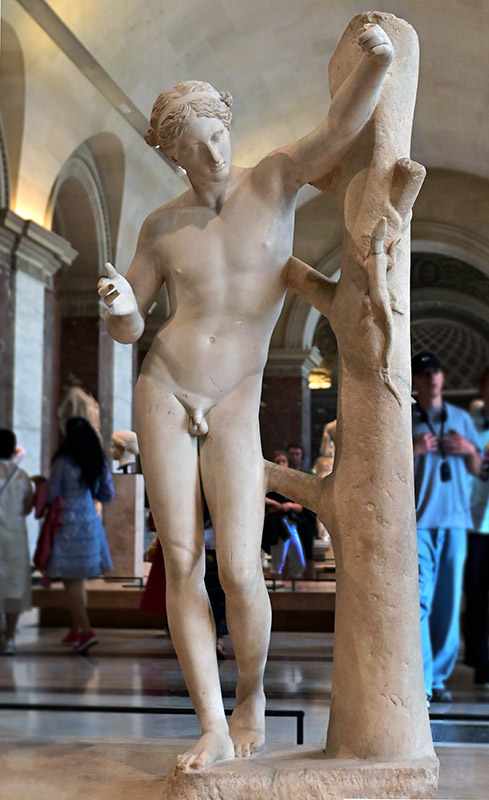
The Louvre’s Greek art collection is a result of centuries of collecting, discoveries, and acquisitions. The first significant Greek artifacts were acquired by French collectors in the 16th century, primarily through diplomatic missions and personal travels. In the 17th Century, the Louvre began to acquire a small number of Greek antiquities, often as part of larger collections or gifts from wealthy individuals.
In the 18th Century, the Grand Tour, a cultural pilgrimage to Italy and Greece, became popular among European aristocrats. Many of these travellers returned with collections of Greek antiquities, which were often donated or sold to museums like the Louvre. Lord Elgin, a British ambassador to the Ottoman Empire, is perhaps the most famous collector of Greek antiquities from this period. His controversial removal of the Parthenon Marbles from Athens remains a subject of continuous debate. You can read about the Parthenon’s fate here.
The 19th century saw a surge in archaeological excavations in Greece, leading to the discovery of numerous ancient Greek sites. Many of the artifacts found during these expeditions were acquired by museums, including the Louvre. Heinrich Schliemann, a German archaeologist, is famous for his excavations at Troy and Mycenae, he also wanted to excavate Knossos. The Louvre continued to acquire Greek antiquities through donations and purchases from private collectors throughout the 20th century.
The Getty Museum in Los Angeles and the Metropolitan Museum of Art in New York City are among the other major museums with significant ancient Greek art collections.
The galleries dedicated to Classical and Hellenistic Greece are found in Room 344, Sully Wing, Left 0. They were transformed into a large space from the royal apartments to display ancient Greco-Roman sculptures in the Louvre.
The galleries have several different sculptures of Athena, the Greek goddess of war, victory, and power. Mattei Athena stands tall with both hands in a resting pose gesture, and Athena, known as ‘Pallas of Velletri’ has one hand raised up and another down. Athena without arms is probably an ancient marble copy of a colossal sculpture that was standing on the Acropolis Hill in Athens.
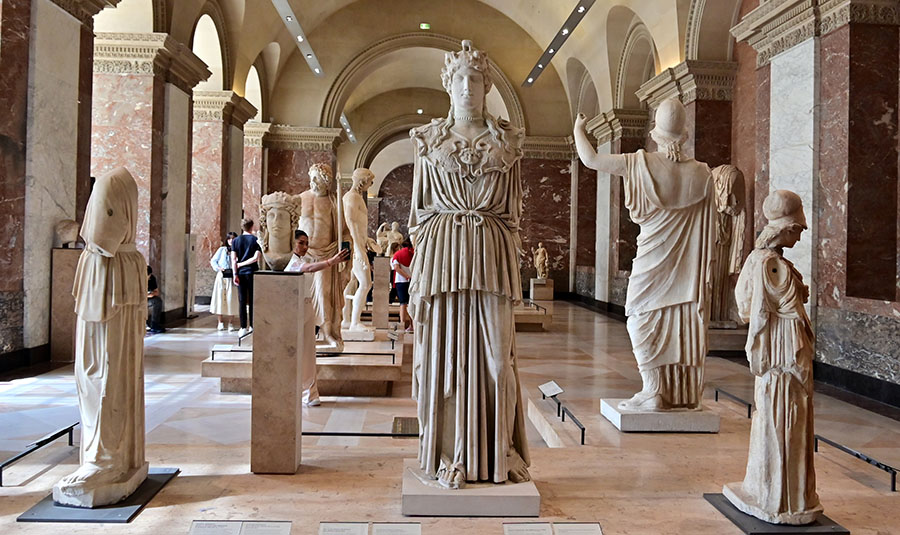
Torso of the ‘Diadumenos’ type, Imperial Roman, marble, 100 / 150 (1st half of the 2nd century AD), Room 344, Sully wing, Level 0https://collections.louvre.fr/ark:/53355/cl010250998
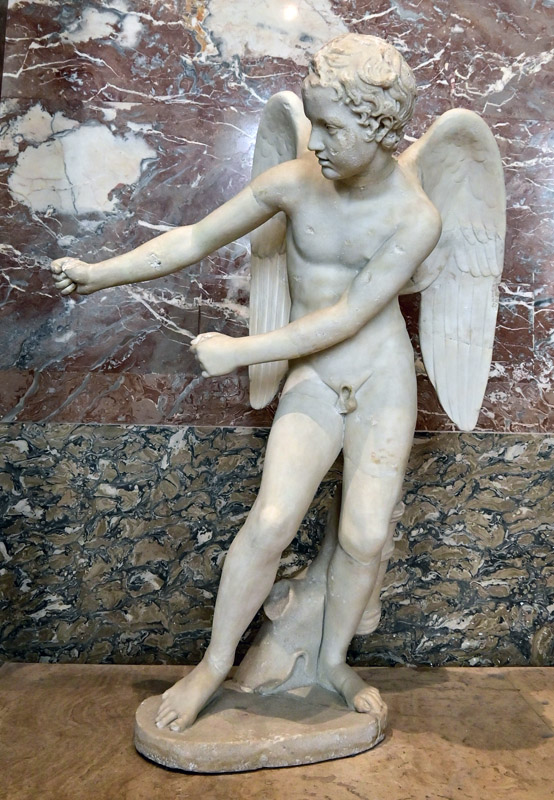
The galleries with ancient Greek vases are located in a different place, the Galerie Campana. This is a long space of rooms with thousands of high-quality ancient Greek vases, cups, and other vessels. These galleries have several famous vases, like Hercules stealing the tripod from Apollo or Athena helping the hero win his battles, etc. The Marquis Giampietro Campana (1807–1880) was a super wealthy art collector who also led some archeological finds. After his arrest for financial fraud, his art collection was confiscated and sold off to czars and Emperors of Europe including Napoleon III. It’s a truly remarkable collection of ancient Greek pottery that can’t be missed! https://www.louvre.fr/en/explore/the-palace/the-marquis-greek-vases
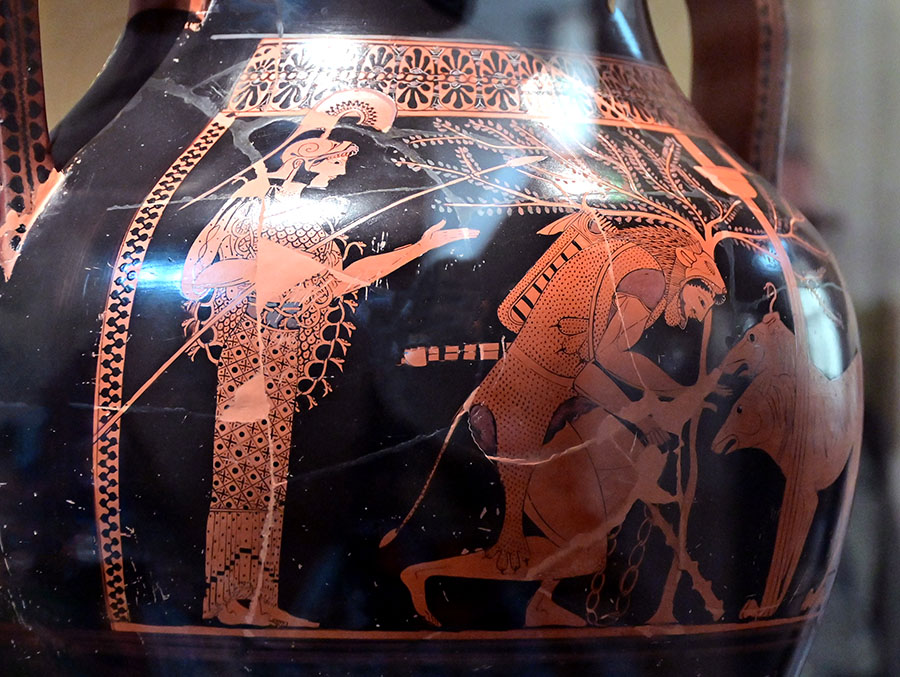
What shocked me about the Louvre’s Greek art collection is its high quality and vast size. I’ve been to Greece before, and the archaeological museums in Athens and the islands have little high-quality ancient Greek art left in situ. It was disappointing but clear that Greece “gave away” numerous art pieces to private and public art collections around the world. Besides the Greco-Roman sculpture hall, the Louvre displays numerous, high-quality, ancient Greek vases in several rooms of the palace, the Galerie Campana.
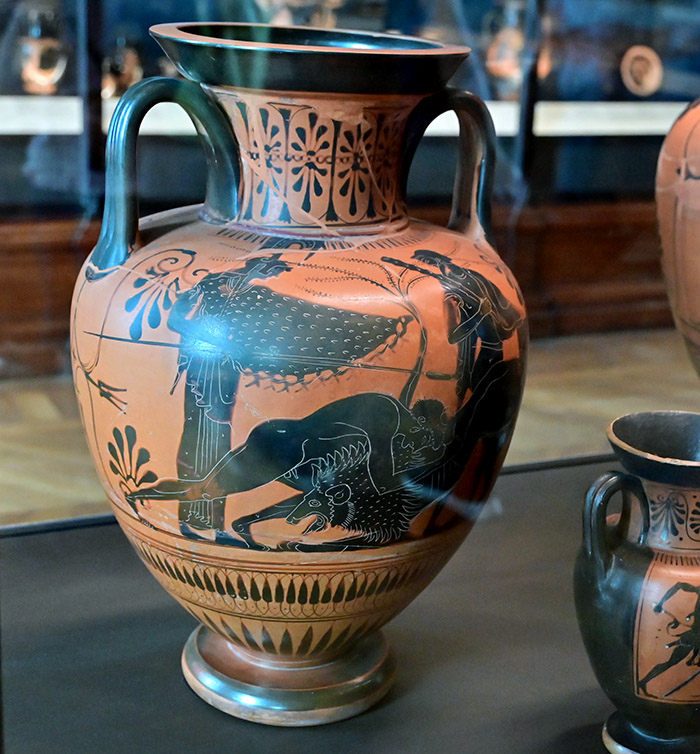
Model of the temple of Zeus in Olympia
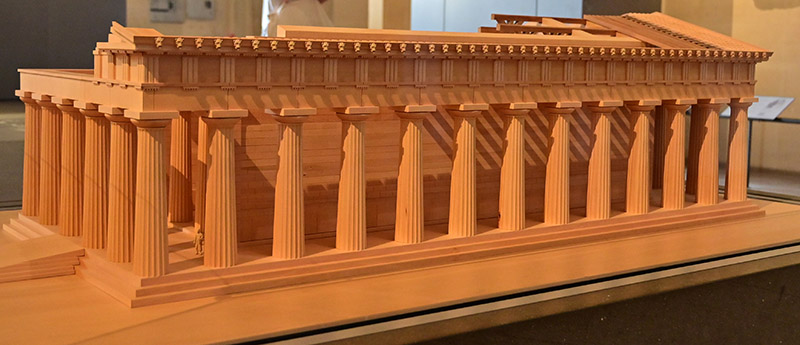
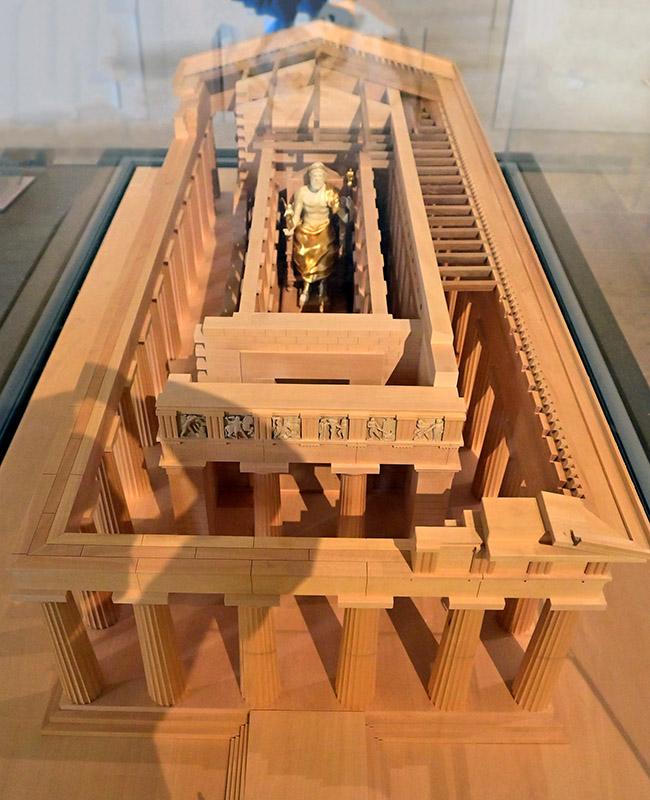
Built around 460 BC by the local architect Libon of Elis, the temple of Zeus in Olympia was the largest of its kind in the Peloponnese (27.68 m x 64.12 m). Surrounded by a colonnade, it was made of stuccoes and painted limestone, with its sculpted decoration made of marble. The pediments were dominated by the statues of Zeus on each facade, the patron god of the sanctuary. The east pediment depicted the preparations for the chariot race between the king of Pisa, Oinomaos, and the hero, Pelops. Pelops won, gaining dominion over the region. The west pediment depicted the victory of a mythical Greek tribe, the Lapiths over the Centaurs. It was an allegorical battle between civilization and the Barbary.
Inside the temple colonnade, above the entry porch (pronaos) to the east and the rear porch (opisthodomos) to the west, twelve metopes (rectangular elements with sculpture in high relief) of the Doric frieze featured the labors of Herakles, a hero considered one of the founders of the Olympic Games. The temple chamber (naos or cella) housed a colossal statue of Zeus in gold and ivory with a wooden core (about 460-450 BC). A masterpiece of the sculptor Phidias, the statue is considered one of the seven wonders of the ancient world.
The Greco-Roman art collection includes many sculptures of goddesses in the Louvre collection, including the Winged Victory, Venus de Milo, and Venus of Arles.
The Winged Victory of Samothrace
Who was the Goddess of Victory? In antiquity, the winged goddess Nike expressed the will of the gods. She announced, rewarded and glorified the victors. We often encounter the figure of Nike in sculpture, pottery, and goldsmithing. The Nikes found at the sanctuary of Delphi come from public buildings, where they were used as symbols of victory in literal or metaphorical battlefields.
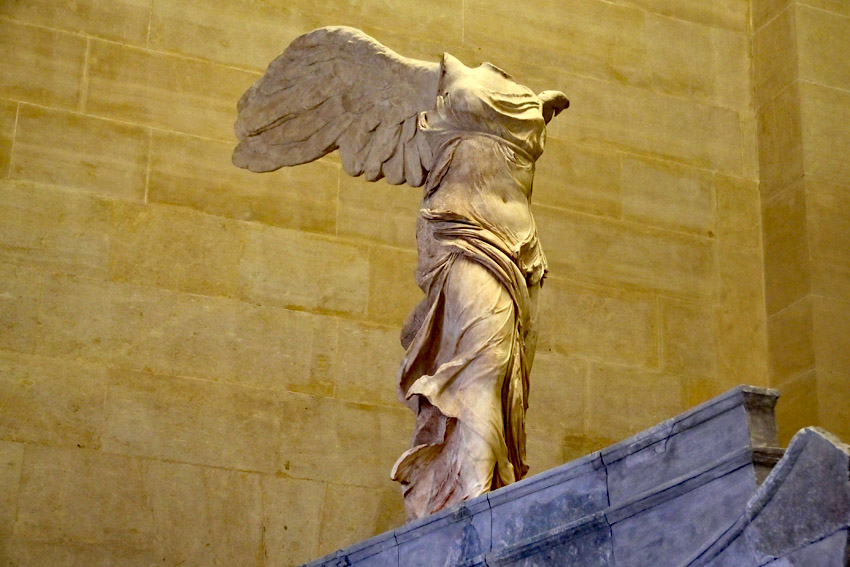
The Winged Victory of Samothrace is one of the rare Greek statues whose exact original location is known as the Greek island of Samothrace. This beautiful sculpture was made as an offering to the gods for a sanctuary there. The Parian marble statue dates to 190 BC and was commissioned to celebrate the sailor’s victory. The winners, probably from the island of Rhodes, erected it in Samothrace to thank the Gods of the island. Located in the Aegean Sea, the broken into 110 pieces sculpture was discovered by Charles Champoiseau in 1863. The Winged Victory of Samothrace was placed in the Louvre 20 years after its discovery. The goddess of Victory’s wings were partially retrieved and restored with plaster. The pieces of the ship that form the base of this beautiful sculpture were found later on. Also, other excavations found one of her hands with missing fingers. https://www.louvre.fr/en/explore/the-palace/a-stairway-to-victory
The Venus de Milo
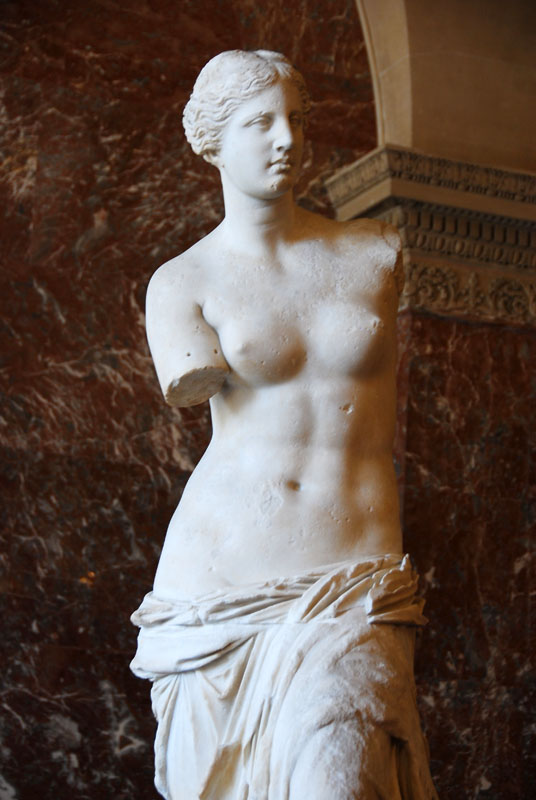
The Venus de Milo name comes from the Greek island of Melos, where she was found in 1820. The Marquis de Rivière, the French ambassador to Greece, bought the piece and presented the sculpture to King Louis XVIII. This is one of the best-preserved female nude sculptures existing today. The proportion, movement, and simplicity are divine. Venus was the only goddess depicted in the nude, and Greek sculptor, Alexandros of Antiocha, carved the woman in a beautiful, natural pose. https://www.louvre.fr/en/explore/the-palace/ideal-greek-beauty
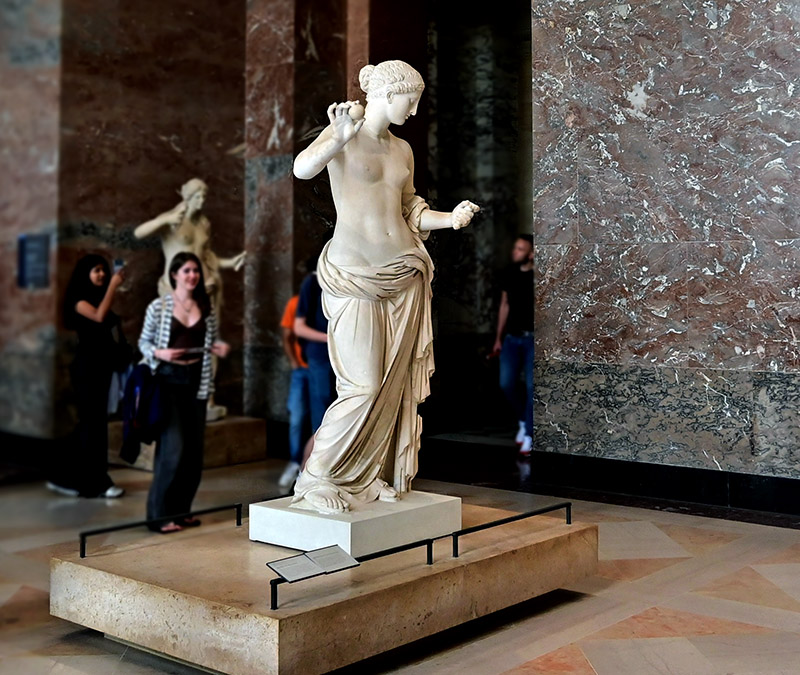
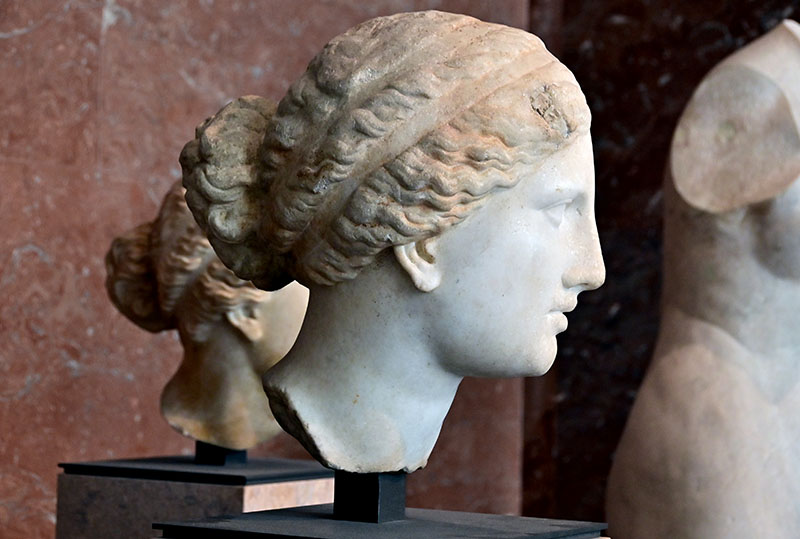
The Michelangelo Gallery inside the Louvre
Napoleon III ordered the redesign of this gallery during the Second Empire (1852–1870). The Michelangelo gallery houses the unfinished work by Michelangelo and Canova’s masterpieces, among other Italian sculptures from the 16th to the 19th century. Built between 1854 and 1857, the Michelangelo gallery led to the Salle des États (the rooms that served for the legislation of the country). This new gallery also became an open space for a prestigious annual art competition, the Salon, for sculpture.
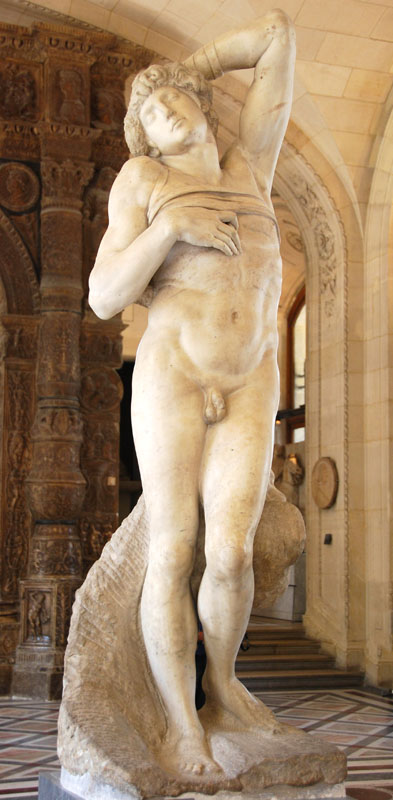
Room 403, Denon wing, Level 0
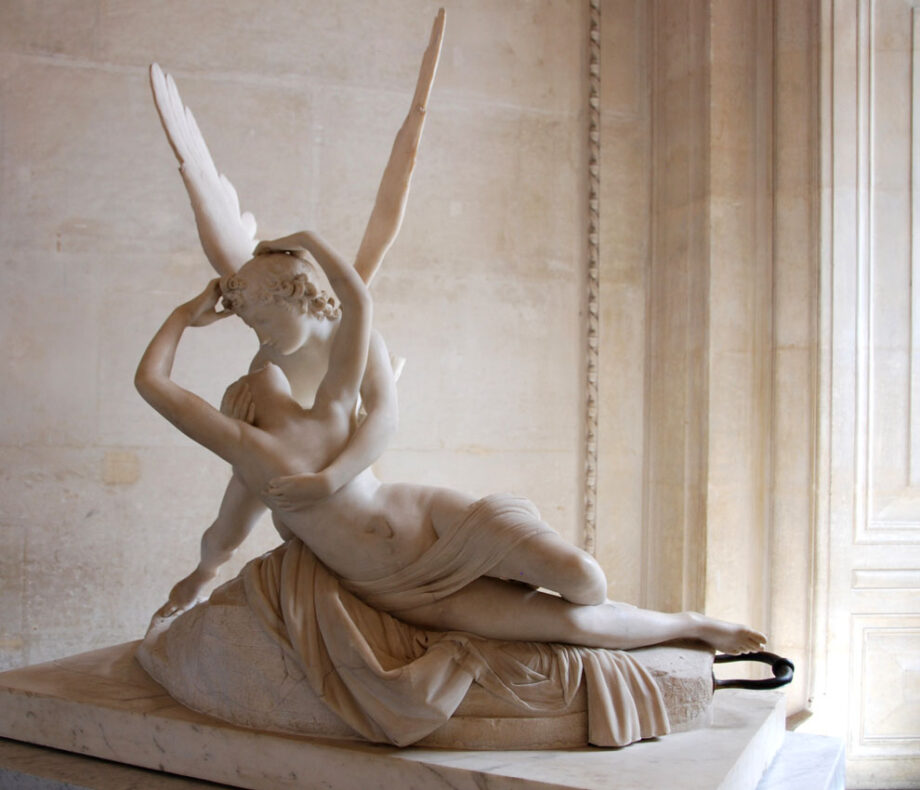
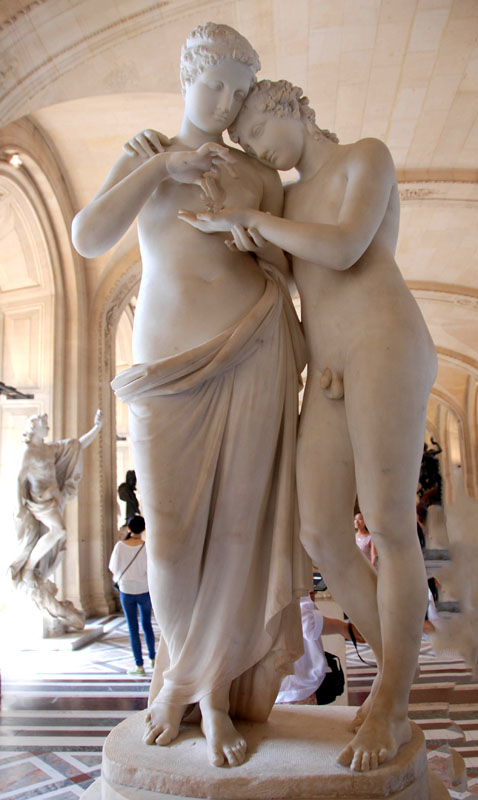
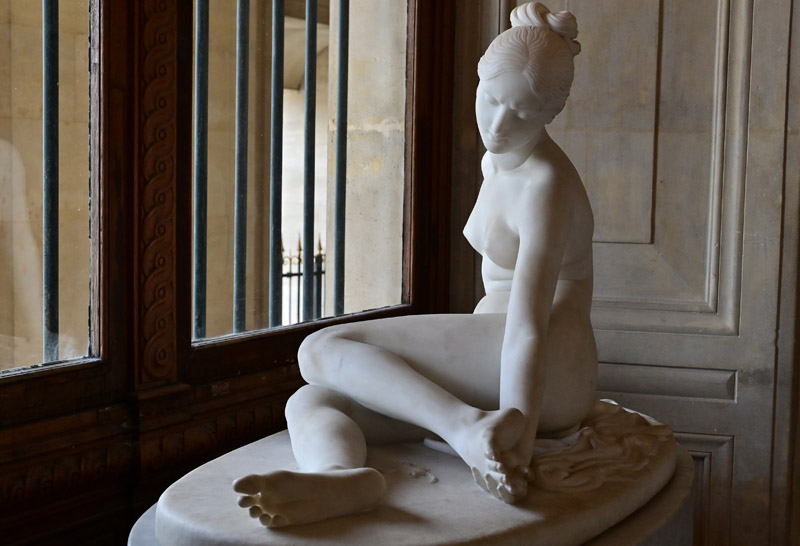
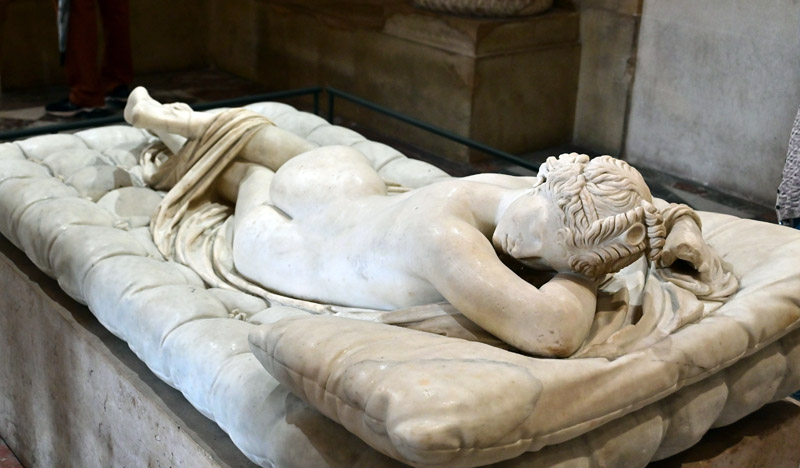
13 Famous Artists inside the Louvre
These are some of the most famous artists in the world, listed in no particular order. There are many more inspiring artists in the Louvre that I simply don’t have space to do so.
1. Leonardo da Vinci
Who painted the Mona Lisa and when, you may ask?
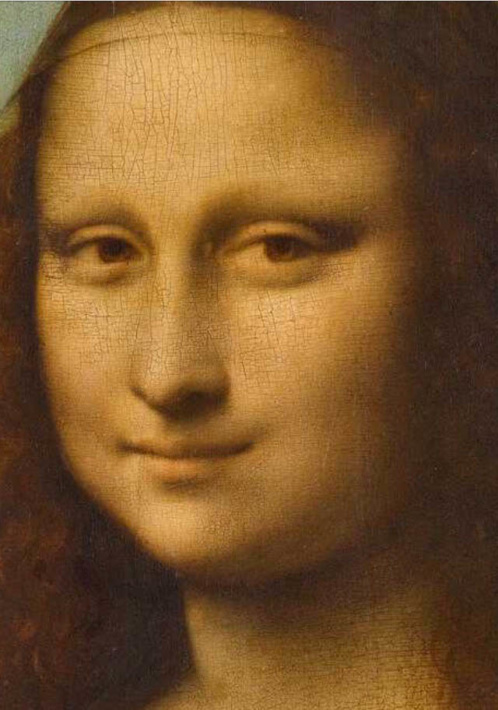
2. Eugene Delacroix
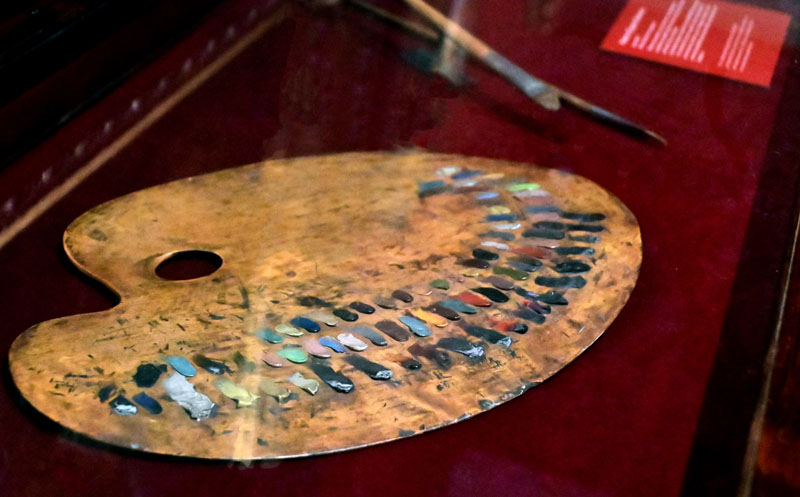
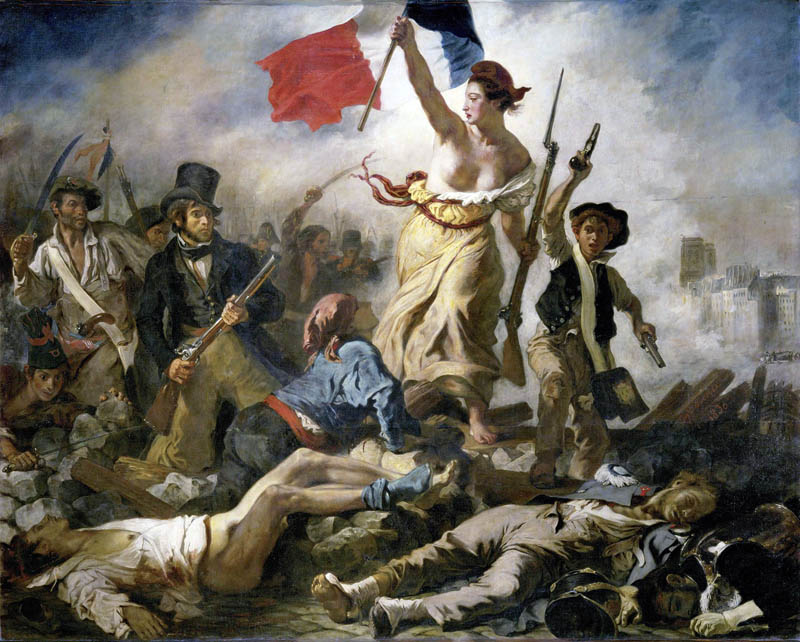
Eugene Delacroix’s “Liberty Leading the People” – This painting depicts the allegorical figure of Liberty leading the people of France during the Revolution of 1830 and is considered a symbol of the fight for freedom and democracy.
3. Arcimboldo
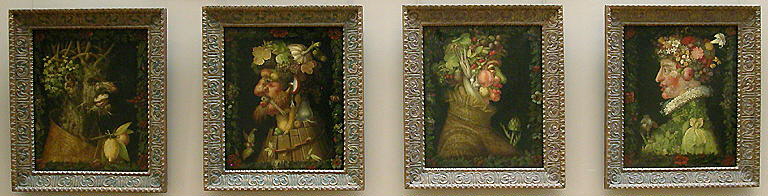
https://collections.louvre.fr/en/ark:/53355/cl010065017 | Commissioned by Emperor Maximilian II (1527 -1576) for Elector Augustus of Saxony (1526-1586), the paintings show some symbolism representing the royal court. The crossed swords of Meissen and the coat of arms of Saxony appear on the winter coat, and the date of 1573 is inscribed on the shoulder of L’ Summer, signed by the artist. The Four Seasons have multiple layers of meaning. The obvious one is the change of seasons, but the four paintings may also suggest the four ages of man: childhood, adolescence, maturity, and old age, as well as everlasting peace and abundance of the Hapsburg’s empire. You can read about this artist here.
4. Jean-Auguste-Dominique Ingres
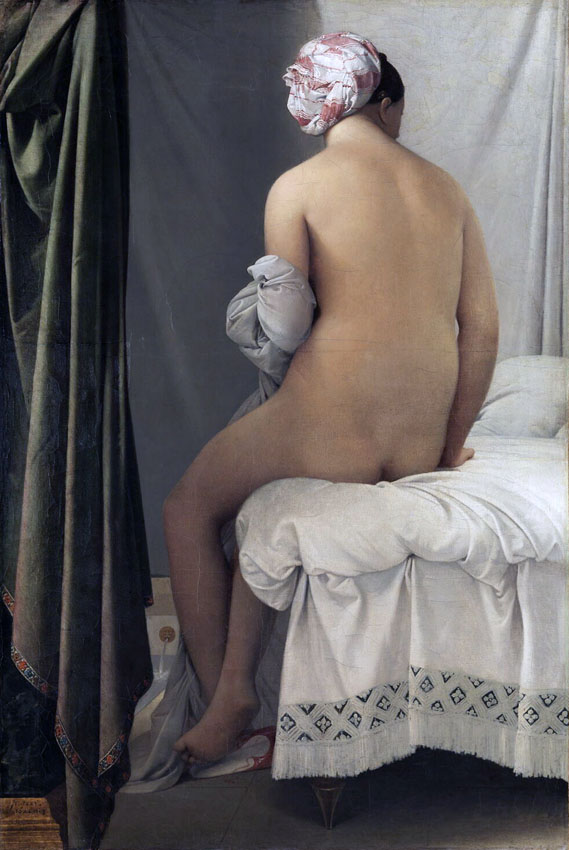
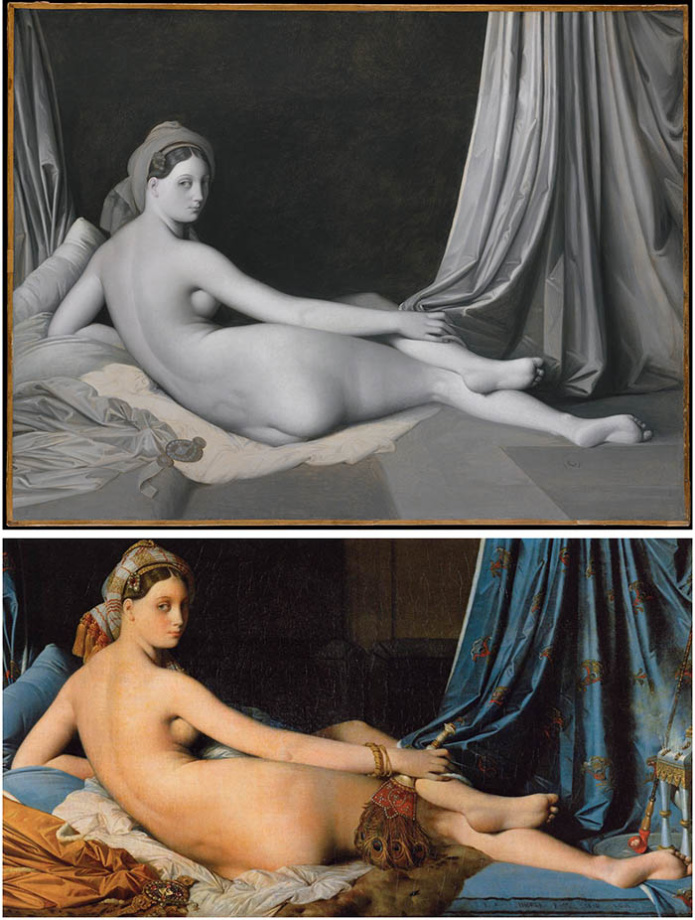
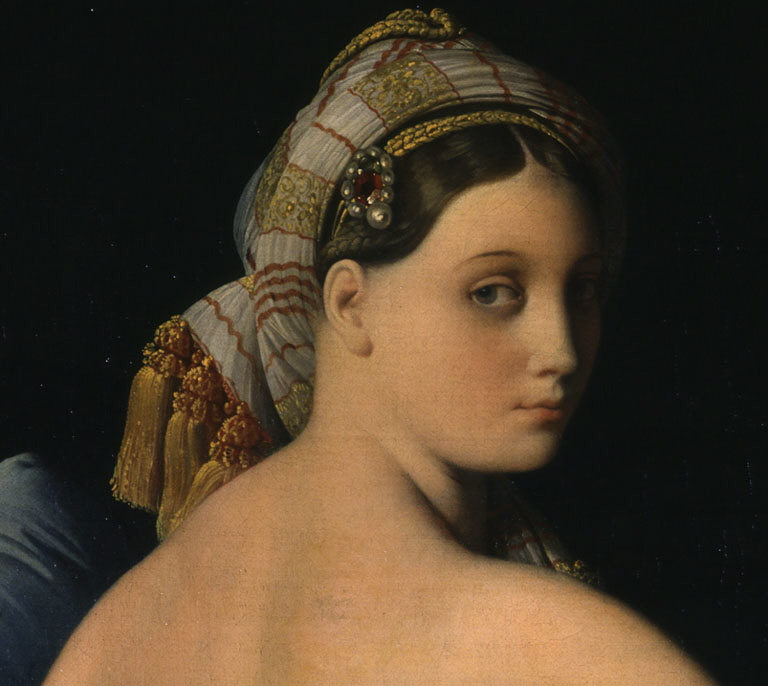
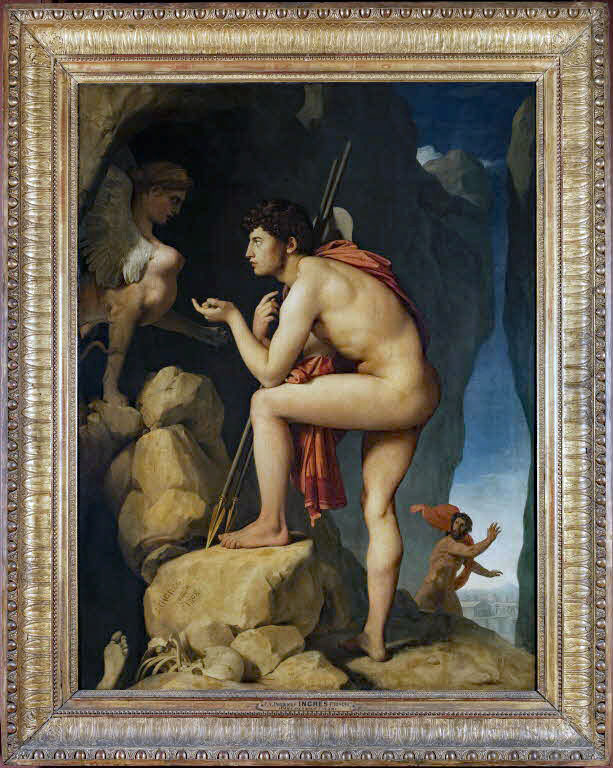
Ingres painted several versions of the Oedipus and Sphinx in the neoclassical style. The Walters art museum, the National Gallery in London and the Louvre have these paintings. Oedipus explains the riddle of the Sphinx, 1808, oil on canvas, Height: 1.89 m x Width: 1.44 m. On view at Denon, Room 702 – Daru Room, the Louvre.
5. David
David was the leading artist of the neoclassical art style being admirer of Michelangelo and Caravaggio. David is famous for his large-scale historical painting. His paintings ,like The Oath of the Horatii and The Intervention of the Sabine Women are on display in the Louvre, Room 702 (Salle Daru), Denon wing, Level 1.
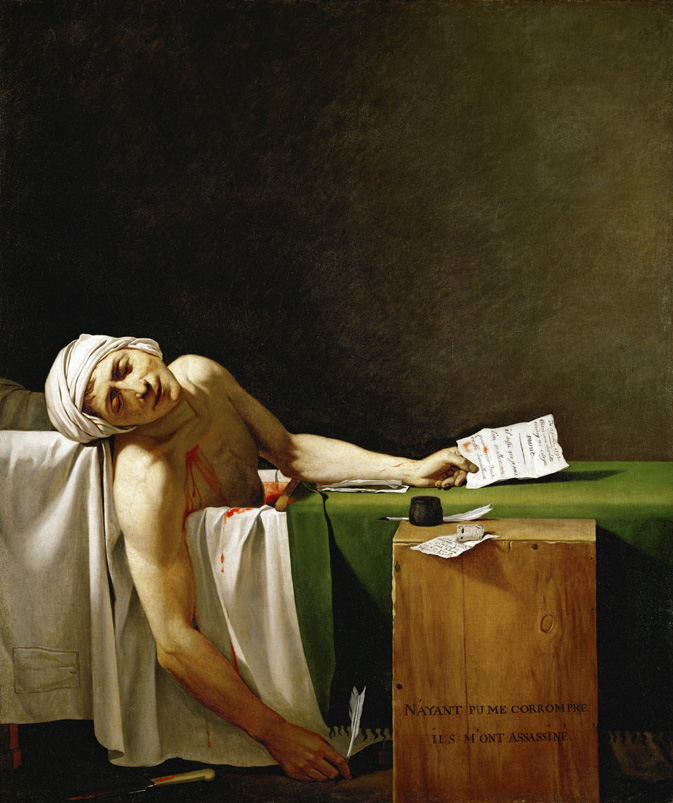
David painted his assassinated friend and French revolutionary leader, Jean-Paul Marat. David was the leading French Neoclassical painter and supporter of the French Revolution. Being a member of the revolutionary Committee of General Security, he voted for the death of French king Louis XVI. Marat had a skin condition, the pain of which was elevated by taking a long bath. He was assassinated by Charlotte Corday in it on 13 July 1793. He painted Marat in a pose resembling the Pieta.
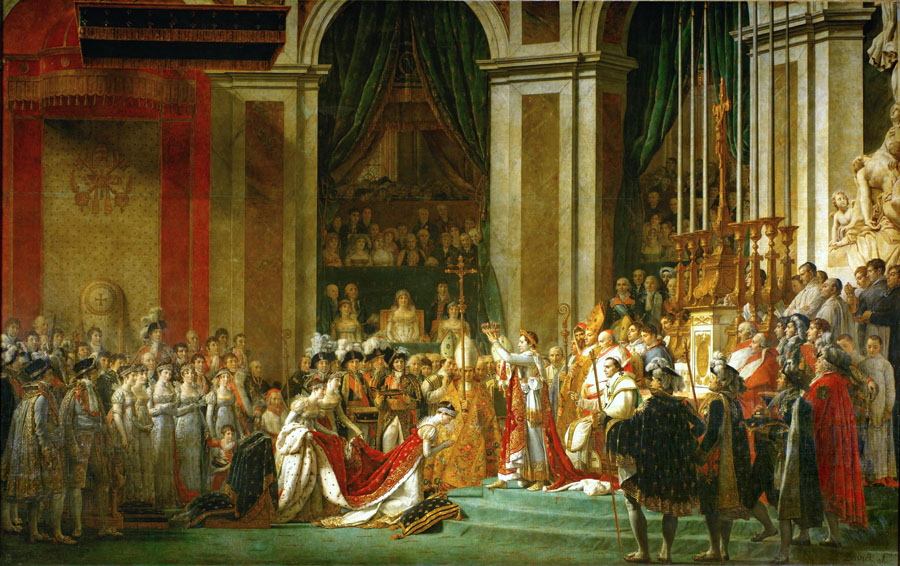
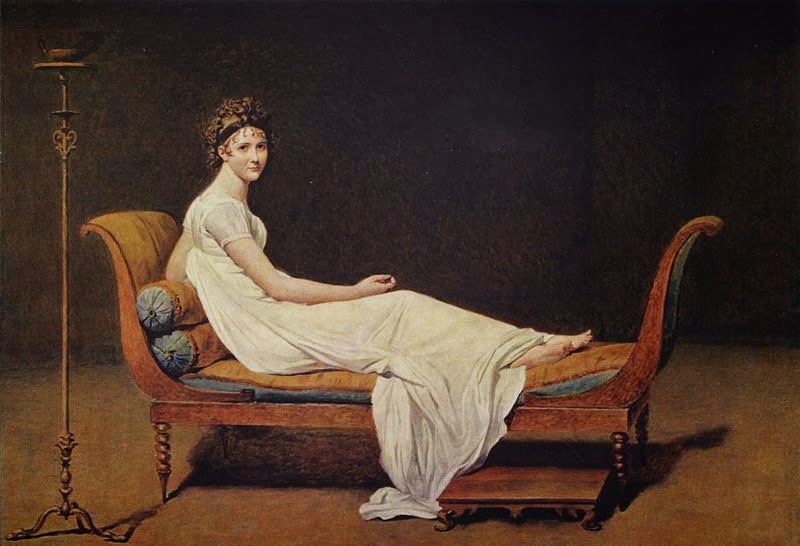
6. Georges de La Tour
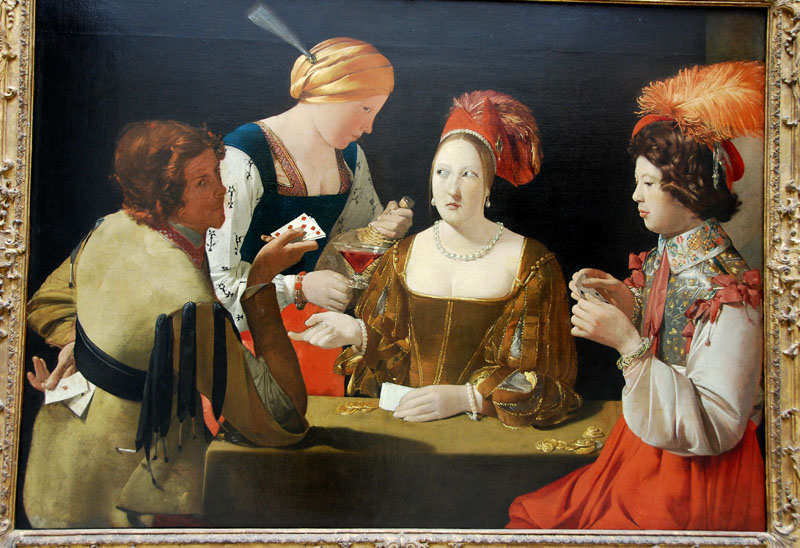
7. Caravaggio
The Fortune Teller – Caravaggio 1595
Death of a virgin – Caravaggio 1606
Portrait of Alof de Wignacourt and his Page
8. Johannes Vermeer
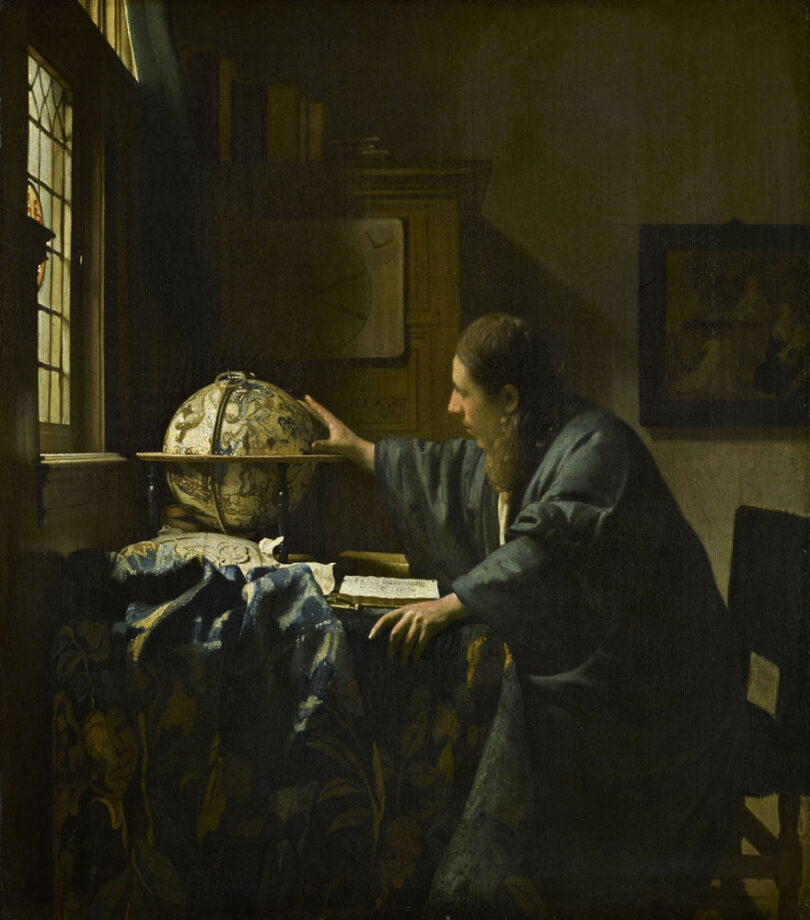
9. Théodore Géricault
Théodore Géricault, “The Raft of the Medusa”. It was a revolutionary painting because it depicted a controversial subject of the day. This monumental painting depicts the aftermath of the shipwreck of the French frigate Medusa in 1816 and is considered a masterpiece of the Romanticism movement that created much controversy during the painting’s reveal. The artist depicted figures with stunning realism and movement characteristic of the Romanticism style.
10. Anne-Louis Girodet de Roucy-Trioson
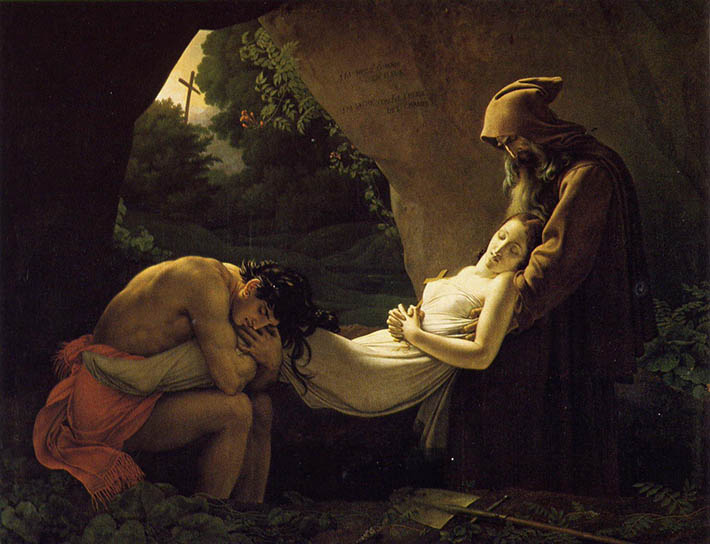
11. Elisabeth-Louise Vigée Le Brun
Elisabeth-Louise Vigée Le Brun, La Paix ramenant l’Abondance
12. Titian
Titian, The woman in the mirror, oil painting, 1525 / 1550
13. Paul Delaroche
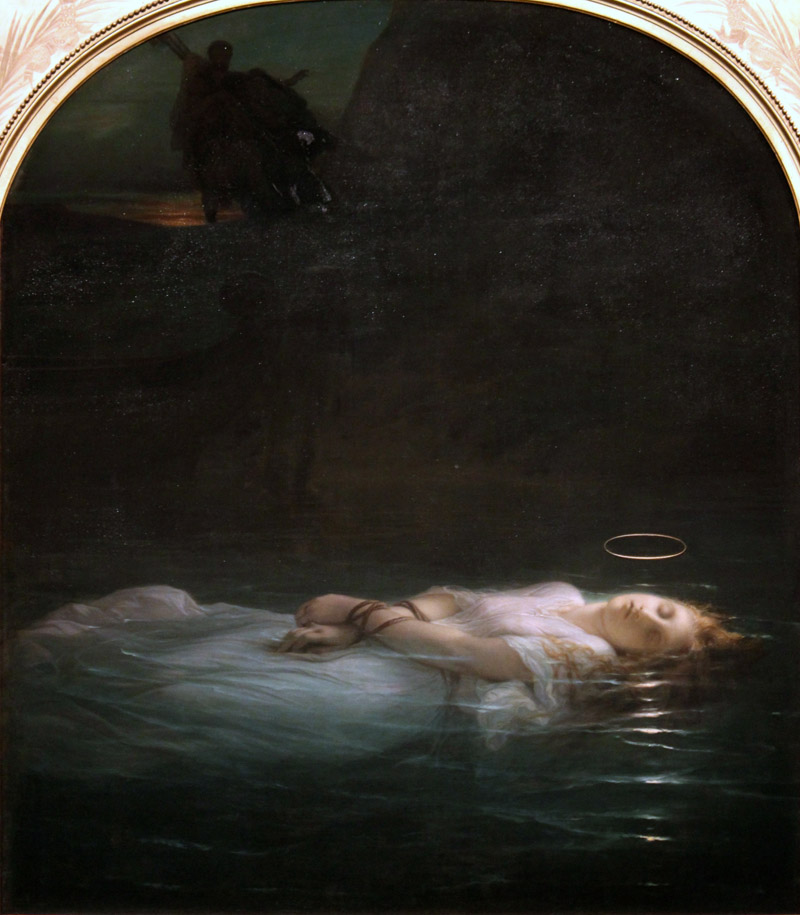
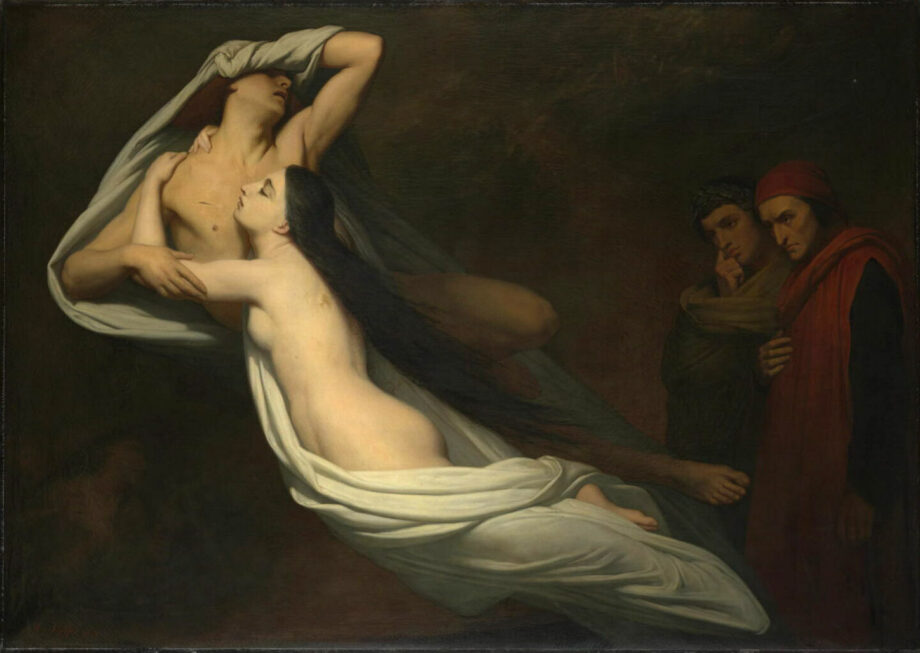
I absolutely love this painting for its emotion and artistic use of diagonals and contrast to create movement in this oil painting.
The Islamic Art Collection
What kind of Islamic art is in the Louvre Museum?
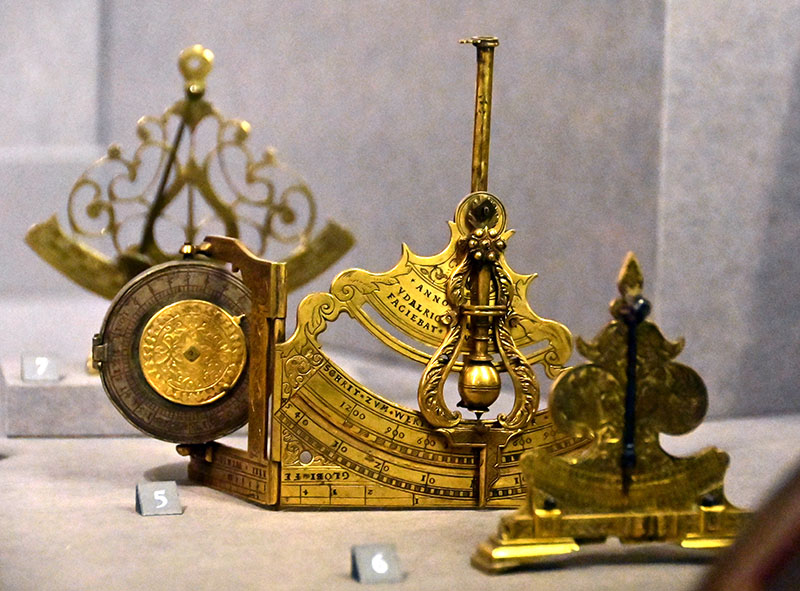
The Islamic art collection has amazing artifacts displayed in spacious, dark galleries below the ground floor in Cour Visconti. Some of the pieces display remarkable artistic skills. The collection spans from the rise of Islam in the 7th century to the late 19th century. Geographically, the collection comes from four regions: Spain, India, North Africa, and Egypt. Room 185, Denon Wing, Left -1
There are several Islamic zodiac/astral/celestial tools displayed throughout the museum, but i don’t remember what room they belonged to.

The inscriptions are engraved in a Maghrebi Kufic script, suggesting Morocco as its place of origin. The names of the stars on the “spider” (a cut-out copper plate rotating inside the case), except one, are in cursive style. Only twenty of the twenty-five star indexes bear names. It looks like the “spider” remained unfinished and was partially completed later. Inside the case (or mother), under the “spider”, is a metal disc engraved on both sides (or “tympanum”) to indicate the latitudes, which could be turned over as needed, depending on where the astrolabe was used (on one side, Meknes; on the other, Fez). The astrolabe also contains five other tympanums. The back of the astrolabe has the Julian zodiacal calendar (O° Aries = March 7), a chart of unequal hours, and a square of shadows. https://collections.louvre.fr/ark:/53355/cl010115734
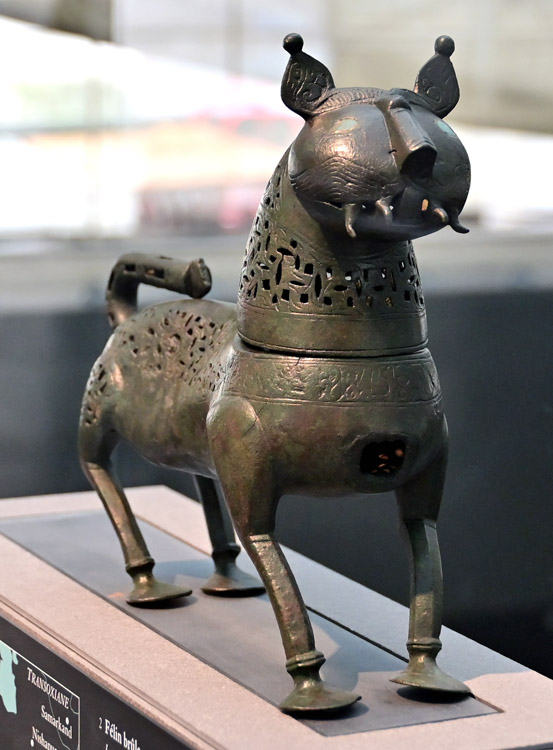
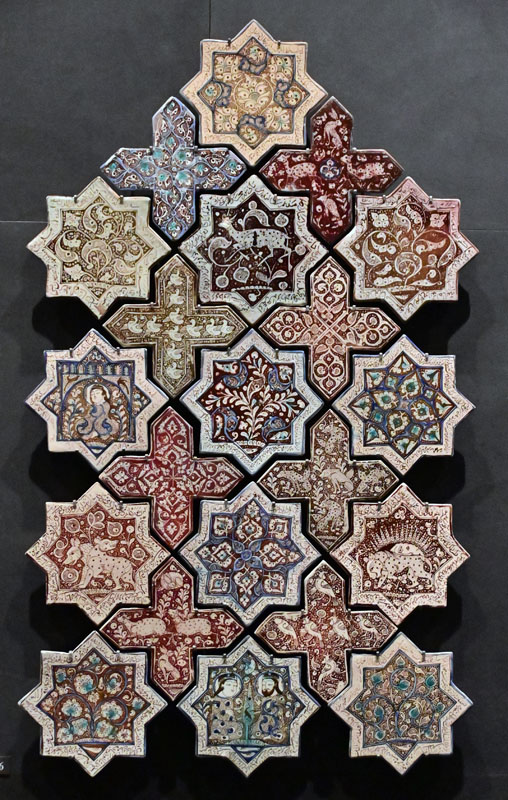
I hope you enjoyed traveling across centuries of beautiful art with me. You can watch my video about the Louvre to see even more beautiful art, the interiors of the palace, the streets of Paris, and the beauty of France! Let me know what your favorite art is in the comments section of the video.
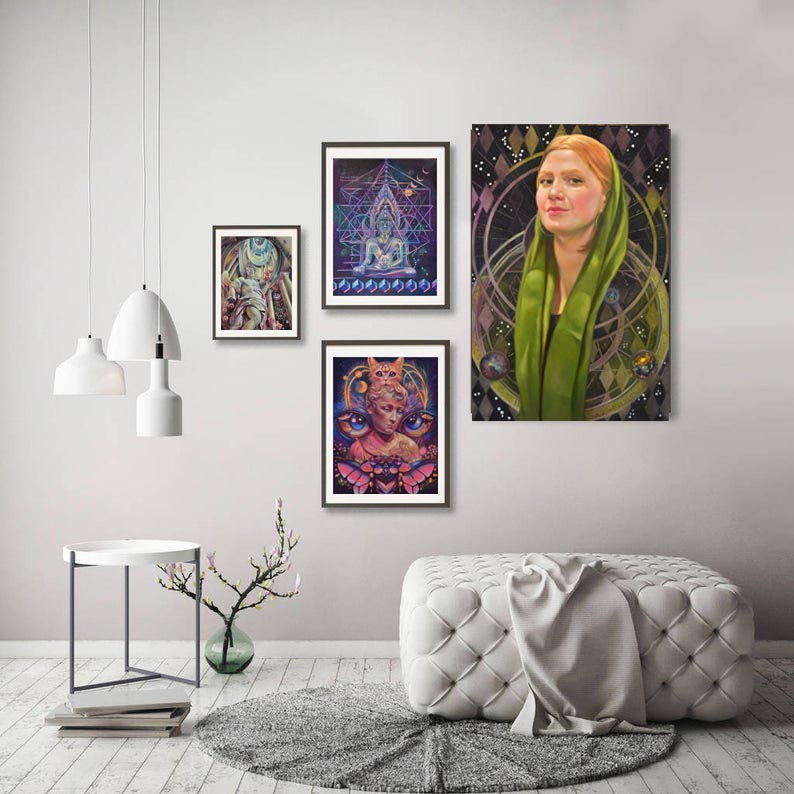
Further reading:
Creating a Stunning Home & Office Gallery: A Practical Guide to Displaying Your Art Collection
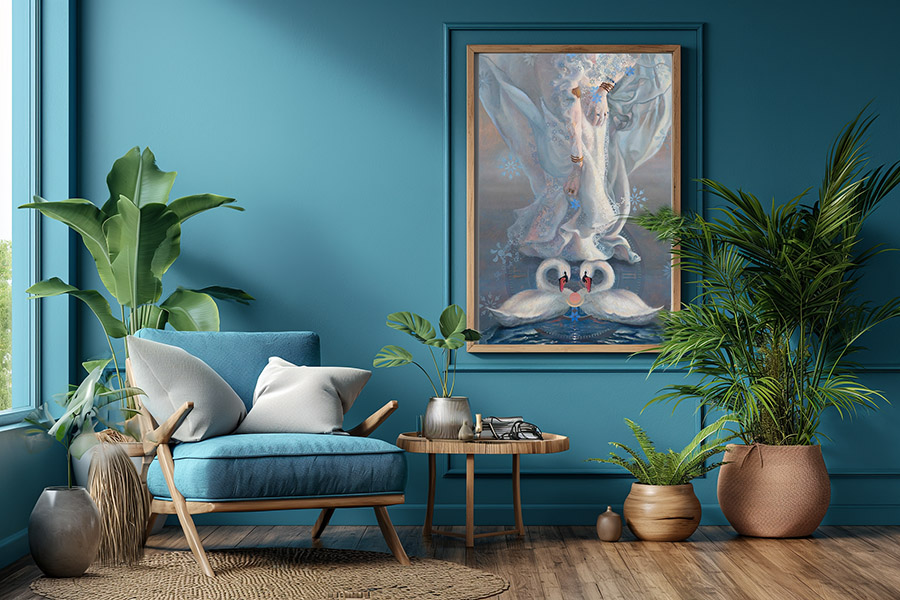
The right art display can transform an ordinary room into a personal museum. Whether you’re showcasing family photos, collected paintings, or your creative works, a well-planned home gallery adds character, style, and mood to your living space. But how exactly do you create the right space for a gallery? Do you need a room with many windows, or is artificial light better? What should the layout of the room look like? Let’s break down the essential steps to create an impressive art display that fits your home, lifestyle, and budget.

Pick the Perfect Space
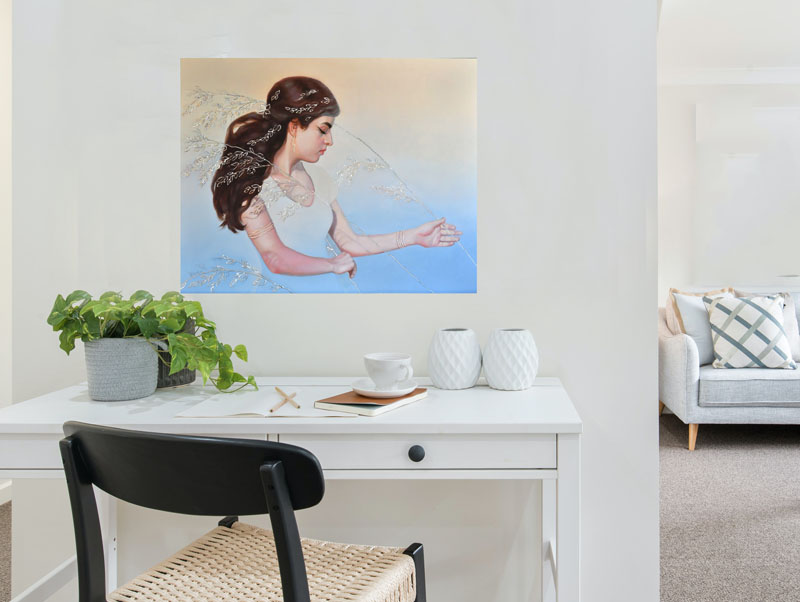
The first step is choosing the right location for your gallery. While many homeowners automatically think of the living room, consider other spaces that could work better. A wide hallway, home office, or even a dedicated spare room can serve as an excellent gallery space. Your bedroom could have a large, empty wall. The office space might have a long, narrow wall that’s grey and boring unless you put art into it. The key is finding an area with enough wall space and natural traffic flow.
Look for rooms with minimal furniture and clean sight lines. To display art beautifully at home, you need to make it possible for viewers to focus on the art without visual distractions. Also, consider how people move through the space — a gallery shouldn’t block normal traffic patterns or create awkward bottlenecks where you bump into the art with your shoulders.
Before you start hanging artwork, assess the walls. Older homes often need wall repairs or fresh paint. Fix any cracks, holes, or uneven surfaces. Color your walls in a light, neutral hue like light grey or beige. A smooth, clean wall surface makes your art look more professional and protects your pieces from damage.
Light It Right
Proper lighting can make or break a home gallery. Natural light is beautiful but can damage artwork over time. UV rays fade colors and can crack canvas art. If your chosen space has large windows, consider installing UV-protective window film or light-filtering shades. In general, it’s best to display the art under diffused light that has minimal UV impact. I’m not a big fan of direct, artificial light that leads to uneven fading of any art.
For artificial lighting, you have several options:
- Track lighting offers the flexibility to adjust individual lights as you change your display.
- Picture lights mounted directly above artwork provide focused illumination.
- Recessed ceiling lights create overall ambient lighting. This might be the best option to display art without creating damage to it.
- Wall-mounted sconces add both function and style.
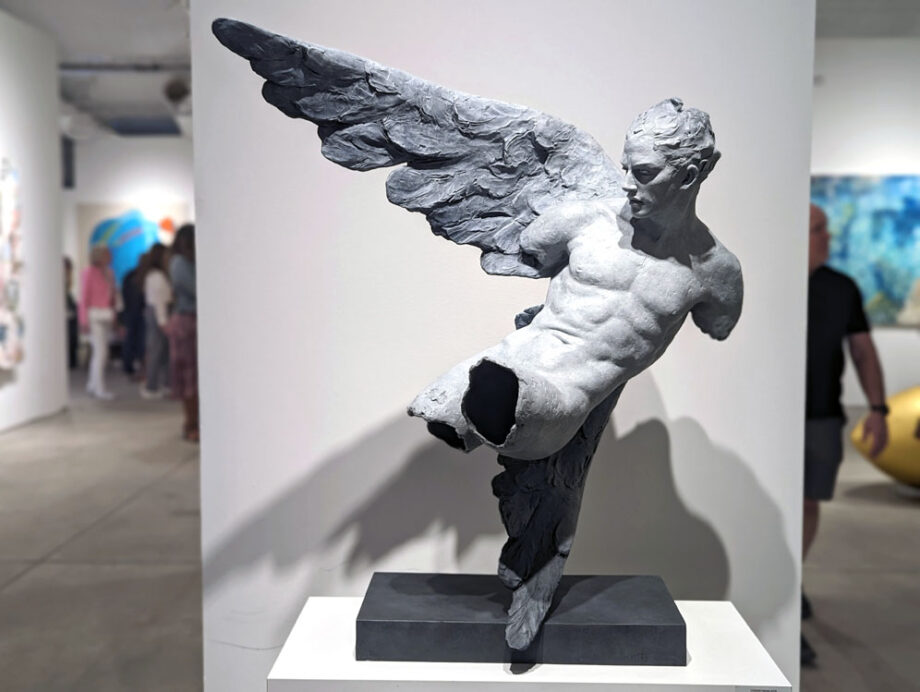
The color temperature of your lights matters too. Aim for bulbs rated between 2700K and 3000K for warm, natural-looking light that shows true colors. LED options now offer excellent color rendering while staying cool and energy-efficient.
If you display drawings (art on paper including watercolor), I strongly recommend the UV-protective, non-reflective plexiglass to protect art from damage. The thicker the plexiglass, the more exponential the protection is for art.
Installation and Layout
Before making any holes in your walls, plan your layout. Many professional installers use the paper template method: cut paper sheets to match your artwork sizes and tape them to the walls. This lets you experiment with different arrangements without damaging walls or artwork.
Consider these layout principles:
- Keep larger pieces at eye level, roughly 57–60 inches from the floor to the center of the piece.
- Allow enough space between works so each piece can “breathe.”
- Group similar pieces together: by theme, color, or frame style.
- Mix up sizes and orientations to create visual interest.
- Leave room for your collection to grow.
- Keep space small between art and sofa. Most people hang art too high above the sofa’s line.
Structural Considerations
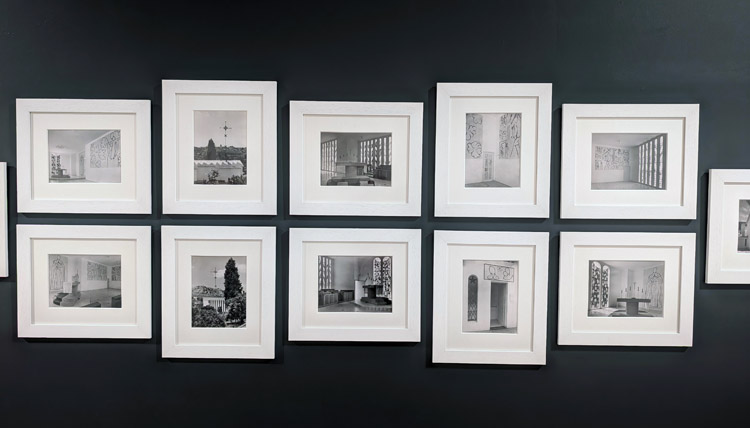
Most home walls can support small framed art (under 16 inches long and light frame), but heavy pieces need special attention. Locate wall studs with a stud finder and use appropriate anchors for your wall type. In older homes, plaster walls may need different hardware than modern drywall. If you don’t do this, your heavy art may fall off of the wall, break the frame, and damage both its surface and the floor or furniture below it.
If you’re planning an extensive gallery, consider these structural updates:
- Adding wall studs for heavy piece support
- Purchasing heavy-duty hooks for big art display
- Installing dedicated electrical circuits for gallery lighting
- Building shallow display niches for three-dimensional art
- Adding crown molding with integrated picture rail systems. This is an advanced method and a vast majority of homes don’t really need this for picture display.

Protection and Preservation
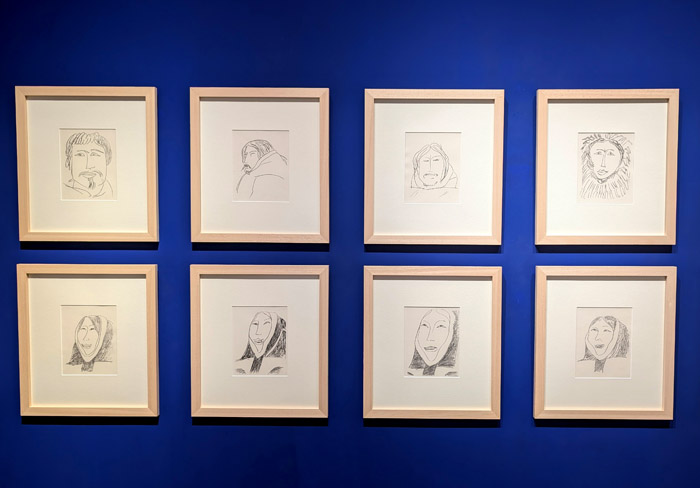
+ Don't hang big art where is not enough space between art and the viewer to see it properly.
+ Don't hang art too close to the kitchen's oven or cooking stove as hot vapors may damage the art in the long run.
+ Don't hang originals in bathrooms as excessive moisture and heat will damage the art.
Your home environment affects artwork differently than a museum setting. Consider these factors:
- Temperature fluctuations can damage certain materials, especially canvas.
- High-humidity areas like bathrooms are ok for art made of metal but please don’t hang valuable paintings in your bathroom space no matter how big it is! Humidity and strong light deteriorate any art quickly.
- Air vents can blow dust onto pieces.
- Direct sunlight causes serious fading and deterioration. Don’t put too much light onto your wall art. Pick a wall that has enough natural light on it but no direct sunlight or electrical light!
You might need to upgrade your home’s climate control system or add a dehumidifier to protect valuable pieces. Installing quality air filters helps reduce dust and other airborne particles that can damage artwork over time.
How to boost your brand with office wall art displays
Besides creating a wonderful art collection at home, you can also become a trendsetter by displaying art in your office. If you’d like to create a unique environment in your business space, consider the following details.
1. Brand positioning
Your art collection can make your brand and space different from millions of boring office spaces. You can attract new clients by showcasing your unique, luxury space that sparks conversations and makes you and your business memorable! Many offices looks the same having no clear direction or authenticity. Contemporary art can help you stand out from a crowd.
Describe your company using visual language so we can understand it without words. Bring art that relates to your business and matches in color. If you sell flowers, have floral art on the walls. If you’re in the real estate business, art with local scenery well. If you sell cars, have excellent, high-quality art or photos of rare cars on your walls. If you’re a law firm, you have many options keeping it either conservative or contemporary.
2. Visual comfort
You can create a soothing productive environment with light and art pieces that distress workers. Office employees can improve focus by resting their eyes on art. It creates a positive energy flow. Art can make offices a safe and comforting space you want to come back to. Pay attention to how psychologists decorate their offices because their art often creates inner comfort and warmth. Art with green plants can match your interior or canvases with blue landscapes may be a perfect fit for your space. Think of a feeling you want to elicit, colors help you communicate that feeling.

3. Inspiring space
Your art wall displays can become an inspiring space your clients will want to come back to. Art encourages positive emotions, creative thinking, and a light or fun atmosphere in an otherwise boring workspace.
4. Cultivate culture & become a trendsetter
Give people more chances to talk about your business for free! Without buying expensive ads, a great art collection speaks for itself. Be the leader in your business by displaying memorable, high-quality art that gives people more chances to talk about your business! Invest in art that inspires us and holds value long-term.
How to find & fit original art in your office space
Finally, let’s talk about the most important and practical aspect of your art collection for office space. Before rushing to your local art fair to buy paintings, think of all 5 points I mentioned earlier: brand positioning, color, visual comfort, feelings you want to create, and trendsetting. Here are a few more things to consider.
- The easiest thing to do is to create wall art displays designed around 1-2 colors (white-blue, green-yellow, or pastel colors of soft blue-lilac-pink, for example). Think of a specific color scheme to represent your brand in chosen artworks. Warm or cool? Light or dark? Red-white or gray-aqua? Vibrant or subdued?
- Another simple idea is to hang landscapes/local natural scenery art or photographs. Many medical offices do just that. Hang big art at eye level to have a visual impact.
- Think of the medium. Large-scale photography or canvas art?
- Consider the wall size to choose the right art for your space. Most of the time people make the mistake of hanging art that looks too small on a huge wall. The result is that art gets ‘lost’ on the wall.
- Have consistency in your art collection display. It needs to tie in together in color, type, theme. Abstract or representational? Bright or soothing? Figurative or floral? Framing should be consistent in style too!
- If you feel intimidated by this work and need help organizing office space, check out local services that include interior designers, local artists, and art consultants. If you know a local artist you like, invite him or her to see the space to commission art for your space.
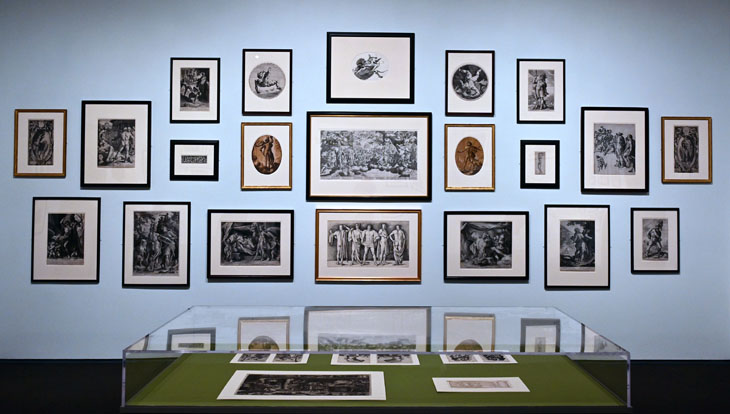
Making It Work Long-Term
A home gallery will grow with you. Leave space to add new pieces, and don’t feel locked into your initial arrangement. Professional galleries regularly rotate their collections — you can do the same at home. This keeps the space fresh and lets you highlight different pieces throughout the year.
Consider practical matters like cleaning and maintenance. Leave enough space between pieces to dust effectively. Think about how you’ll reach higher artwork for cleaning or rearranging. If you’re installing track lighting, make sure you can access it for bulb changes.
If you hang art in office space, strongly consider foot traffic around your art. Some artsy hotels display original art in glass cases, large wall spaces can have canvas art displays in groups that have no direct reach to it. In other words, your customers shouldn’t bump into wall art displays constantly.
To sum up, creating a home gallery or a business space decoration takes planning and often some home modifications, but the result is worth the effort. A well-designed gallery space showcases your collection, adds personal character to your home, and lets you feel joy. Take time to consider all aspects — from wall preparation to lighting to preservation — and you will create a display space that works beautifully for years to come.
6 Reasons to use high-quality art printing services for your art collection
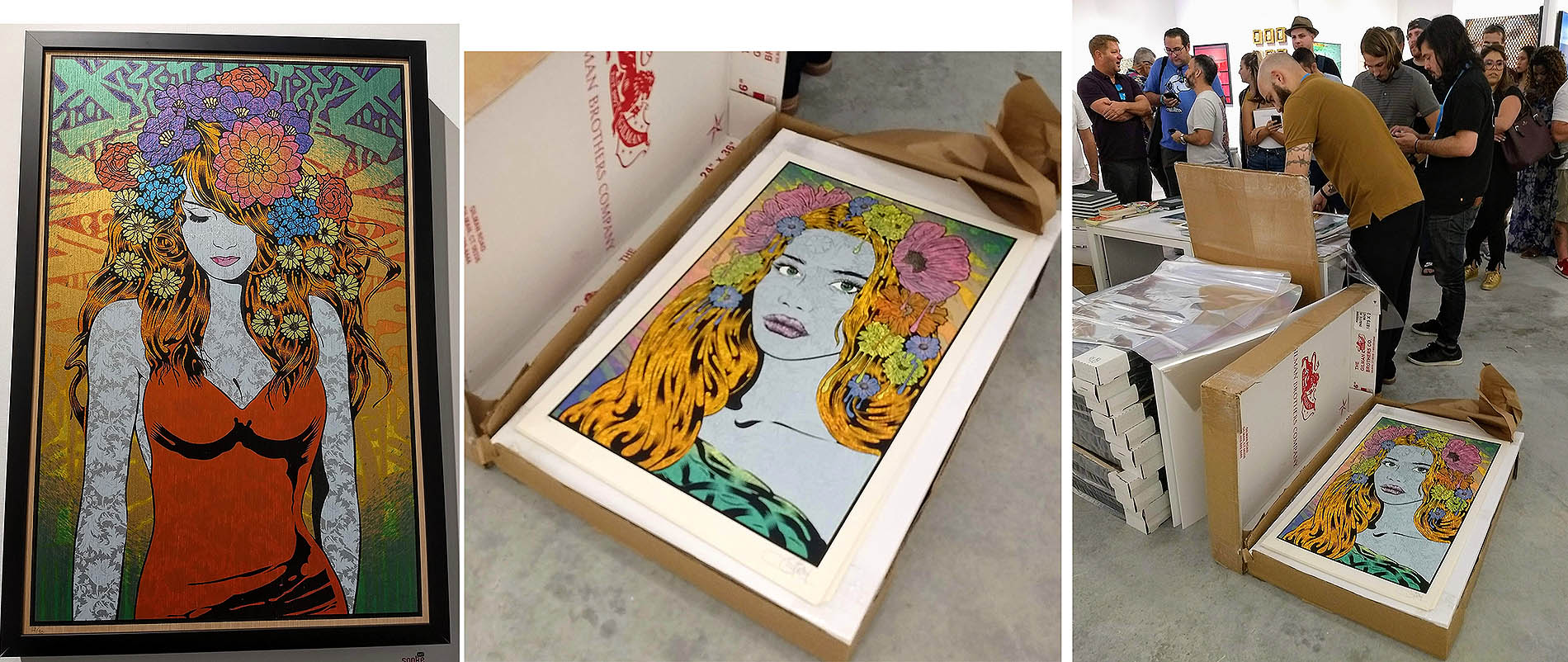
Sometimes it’s unclear what the difference is between art print companies, especially if you compare them online. However, all of us can agree that high-quality printing can make or break the display of a piece. High-resolution, well-crafted prints bring art to life, capturing the vibrancy, details, and textures that a lower-quality print might miss. With advancements in printing technology, fine art printing has evolved into a specialized service. In this guide, we’ll explore the benefits of using high-quality art printing services and why it’s worth the investment for collectors and creators.
#1 Maintaining Originality and Detail
A major benefit of high-quality art printing services is the ability to reproduce broad and accurate color spectrum, contrast and details of the original, fine art. Standard printing processes may fail to capture super fine brushstrokes, texture, and shifts in tone that create a special feeling when we look at art. So art printing companies that use high-resolution giclée or specialized pigment-based inks can offer reasonable fidelity.
If you plan on using the art printing service yourself, you must have a high-resolution, digital file to print from that’s at least 300 dpi and saved as a png or raw file. jpegs are compressed images and the file compression may show up printing large posters.
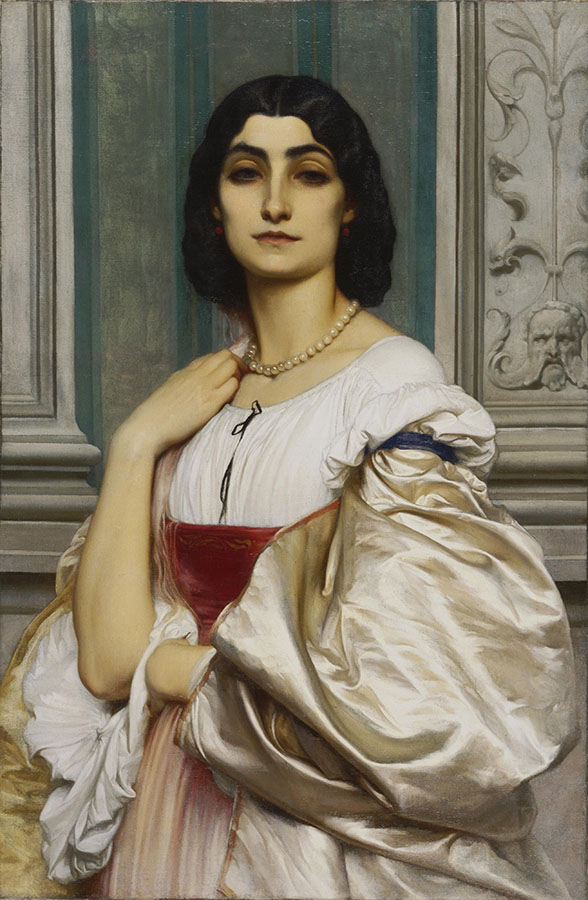
#2 Using Archival-Grade Materials
Archival-grade materials are designed to last decades without fading, yellowing, or warping. This level of durability is essential for anyone looking to keep their art prints in pristine condition over the long term, especially when they are limited-edition or rare art prints. Companies like the Stackhouse printing use the highest-quality materials for colorful art reproductions that can last over 100 years without fading under museum conditions.
Always keep your art and prints away from a direct sunlight, artificial light, high humidity and changing room temperature conditions. Art and prints fade, crack and warp if they're not custom-framed with archival, non-glare plexiglass and backing.
Archival materials used for printing add an extra layer of protection, helping fine prints resist the effects of light and moisture, thereby preserving their beauty and market value. When you shop for a printer, ask what supplies they use because paper must be pH-neutral not to yellow over time.
#3 Using Advanced Printing Techniques
Companies that create high-quality art prints use advanced printing techniques. Some of these methods include:
● Giclée Printing: A technique known for its exceptional quality, giclée printing uses pigment-based inks and high-resolution printers. This method is popular among artists and art collectors due to its ability to render incredibly detailed reproductions that mimic the look and feel of the original piece.
● UV-Protective Coatings: UV coatings shield prints from sunlight, which can fade colors over time. This added layer of protection is necessary for prints displayed in well-lit spaces or under direct lighting. Printing companies like the Stackhouse use these advanced methods for high-end art reproductions.
#4 Having Customization
Customization is a big advantage of working with a high-quality art printing service. Standard printing services often have limited choices in sizes, framing, and finish. A specialized art print shop can print pictures in a requested size. It’s invaluable for art collectors aiming to match a print to their collection’s theme or display needs, as well as for artists wanting to maintain complete control over the presentation of their work for a show.
If you plan to make a large order, ask for a test run of your pictures. I'm sure the shop could print a sample for you to appreciate their quality.
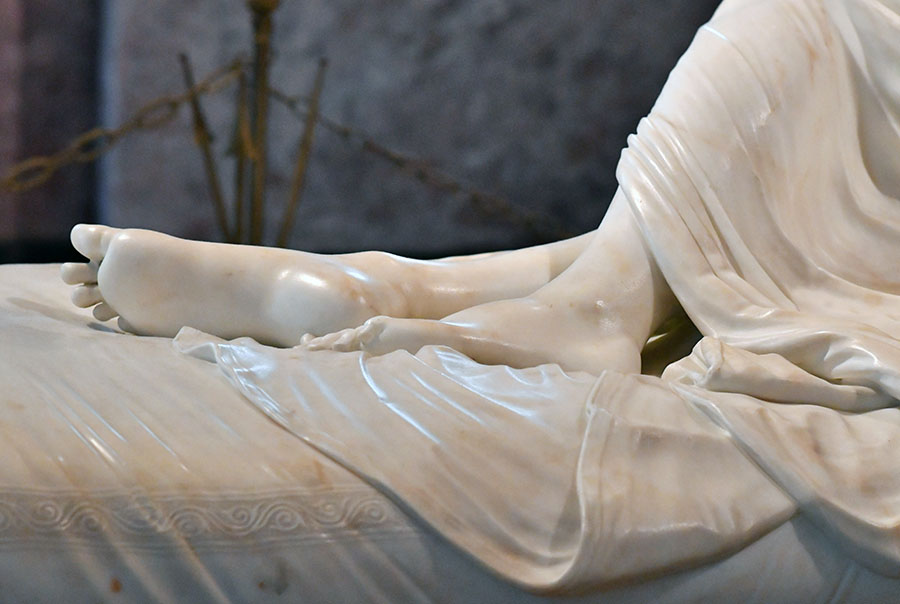
#5 Enhancing the Viewer’s Experience
Usually, we can distinguish between the art print and the original when we look at art in person. The emotional impact is lost in art reproductions. However, today advanced printing techniques are so good that high-quality prints can evoke similar emotions as the original piece. If you go to the Miami Art Context you can look at gigantic photographs that have beautiful detail, color, contrast, and sharpness. Sometimes art galleries display printed digital art that looks impressive because of high-definition in prints. The quality is so perfect that it looks like art, not a print.
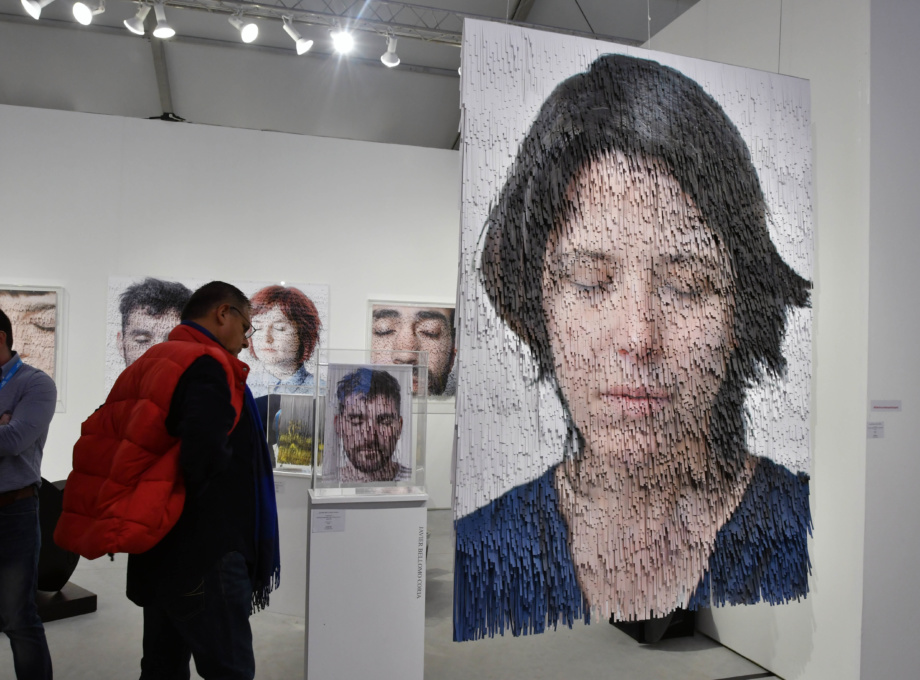
#6 Offering Long-Term Value and Investment Protection
Both limited-edition prints and rare art prints could become a valuable investment when these art prints are signed by a famous artist. Such prints may appreciate in value over time because the artist gains recognition. Therefore, it’s important to know if they were printed with high-quality inks, paper, and UV coating to ensure longevity and peace of mind, knowing that art prints will continue to hold their value and appeal.
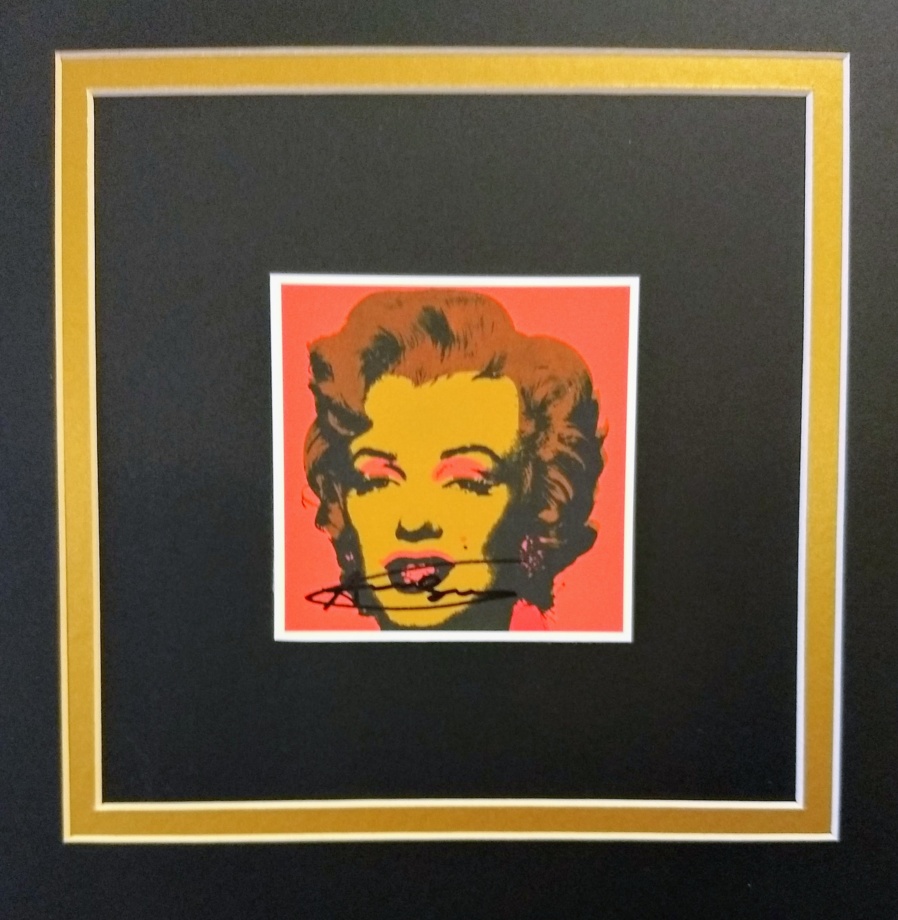
You must understand the difference between a giclee print and a hand-pulled lithograph or silkscreen. Both types of prints can be signed by a famous artist, but the first one is a computer-generated print, while lithographs, silkscreens and intaglios are hand-made prints pulled through the press. Done in multiples, these prints should have a much higher price point as opposed to a giclee print.
Next time you see a beautiful art print, ask its owner where it got printed. I keep a short list of businesses that offer different art services. For anyone serious about their collection or artistic portfolio, investing in a professional art printing service is a decision that pays off in the quality and satisfaction of each piece produced.
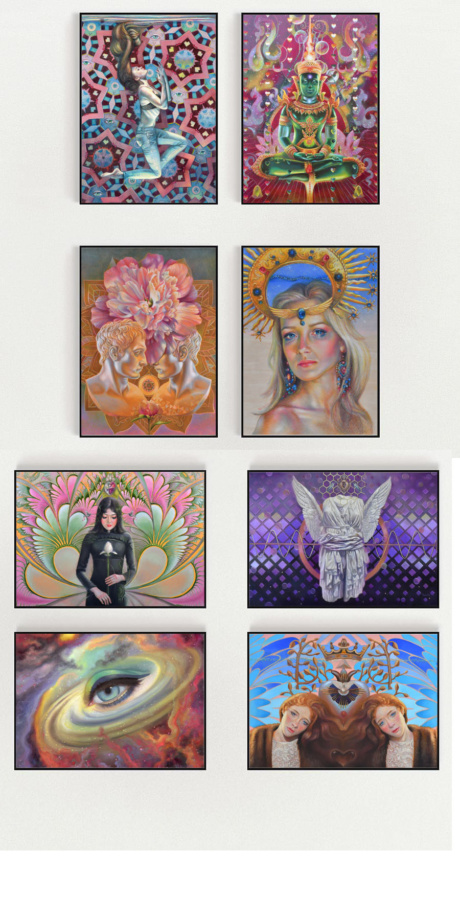
Check out open-edition prints in my shop.
To read more:
How to spot art market fraud in contemporary art world
The uncomfortable truth about the art market corruption
Is this painting great? No. Discover why we face the fraud of contemporary art every day.
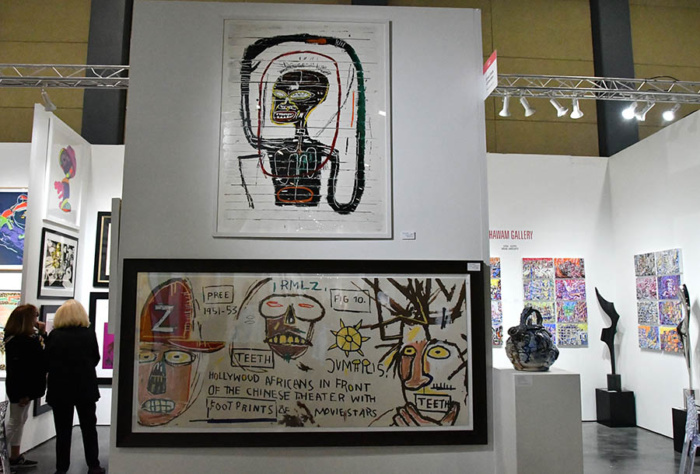
This is an opinion piece that you may not agree with. I’m going to explain some art market money laundering and Ponzi schemes prevalent at the top art market today. I’m a realist artist myself, and I see how the majority of talented artists can barely make a living, while others are killing it in the contemporary art market. The obvious question is why some artists are incredibly successful while the majority struggle. This question is not about feeling jealous or insecure; rather, it’s about observing and understanding the driving force behind successful artists so you can make informed decisions whether you’re an artist or an art collector.
The first answer to this question is relationships. Artists who grow their network and connect to the most influential art dealers, gallerists, and curators in New York, LA, London, and other top art destinations can become famous early in their career. Artists who get exhibited in art museums in New York stand a much better chance of growing their artistic career exponentially, according to Magnus Resch, the author of “How to become a successful artist” book.
The second answer to this question- why some strange artists become famous- is art market collusion. In essence, art investors pose as art collectors. This category of art collectors wants to make money by buying modern and contemporary art at the art fairs and top art galleries, hoping to flip the art in a few years, making a considerable profit. This leads to some remarkable art market corruption schemes at the very top tier of the art market you can learn about in podcasts, art law books, and some YouTube videos. (I’m going to mention some of them below.)
There is no art market regulation. Therefore, it attracts many speculators to it. In this post, I’m going to discuss several most commonly used art market corruption schemes; however, there are many more, I’m sure.
First, let’s look at the numbers because art seems to be a profitable business overall.
How big is the art market?
Despite billions made in revenue, the art market is relatively small if you look at the numbers in comparison to the revenues of some blue-chip companies. For instance, FedEx’s annual revenue for 2022 was $93.512B. Walmart generated over $572 billion in revenue in 2022. In its 2022 financial year, Apple reported 394.33 billion U.S. dollars in revenues. The global art market for 2022 was $67.8B.
- The global art market: the art market worldwide totaled $67.8 billion in 2022, growing by 3% year-over-year and reaching its second-highest level to date, according to The Art Market 2023, authored by Dr. Clare McAndrew, Founder of Arts Economics and published by Art Basel in partnership with UBS. The US was the top market, commanding 45% of global sales by value in 2022 and growing by 8% year-on-year to reach $30.2 billion! Significant growth at the high-end of the auction market, along with some growth in dealer sales, propelled the increase.
- Other art markets: The UK and China ranked second and third among global markets respectively.
- Dealer sales: art dealer sales went up 7%, reaching the pre-pandemic level of $37.2 billion. Nearly two-thirds (61%) reported an increase in sales year-on-year, and a majority (58%) even saw an improvement in values over 2019. About a quarter (24%) reported a year-on-year decline in values. The return of art fairs resulted in dealers making a growing percentage of their sales at in-person events in 2022.
- Online-only sales: Online fell to $11 billion, dropping 17% from their 2021 peak of $13.3 billion, though still 85% higher than in 2019. Online sales represented 16% of the art market’s 2022 sales volume overall.
- Auction Houses: The strength at the top end of the art market – Christie’s, Sotheby’s, and Phillips each achieved a record high in 2022, with combined annual revenues of $17.7 billion.
- Source: https://www.artbasel.com/stories/key-findings-art-market-report-2023
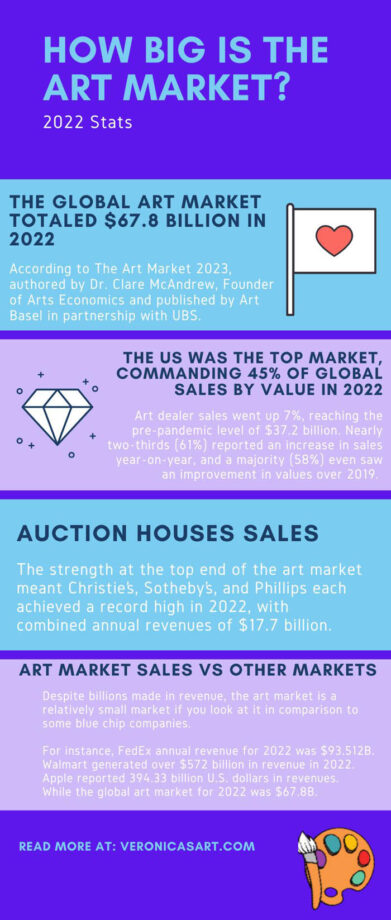
Top 5 art galleries in the world:
- Larry Gagosian of Gagosian Gallery, 17 galleries worldwide! $1B in revenue
- David Zwirner of David Zwirner Gallery, 6 locations, $1B in revenue
- Manuela Hauser and Iwan Wirth of Hauser & Wirth, 10 galleries, slightly under $1B in revenue
- Marc Glimcher of Pace Gallery, 6 locations, $1B in revenue
- Jeffrey Deitch of Deitch Project, 2 locations, considerably under $1B in revenue
Data Source: Magnus Resch
Art market fraud at the top tier of the art world
Money corrupts people. That’s human nature. The top tier of the art market is all about making money, not selling or purchasing beautiful art. Because of deregulation and tax laws in the US, art has become a place to write off taxes or to store millions in overpriced works. Art dealers, curators, advisors, and top mysterious clients all participate in these art flipping or art market tax evasion schemes to make money and to avoid paying taxes. Let me explain.
Ponzi scheme is a form of fraud in which belief in the success of a nonexistent enterprise is fostered by by the payment of quick returns to the first investors from money invested by later investors.
Art market fraud refers to deceptive and dishonest practices within the art industry that are intended to deceive, manipulate, or mislead buyers, sellers, collectors, investors, and other participants for financial gain. This type of fraud can encompass a wide range of illicit activities aimed at misrepresenting the authenticity, provenance, value, condition, or ownership of artworks.
#1 Charitable donations to art museums
Let’s examine the charitable donations to art museums. These philanthropic contributions have several angles. In the first instance, while the artist gets zero in return from donating his art to a charity (only the cost of art supplies can be written off as a business expense by the artist), the art collector can write off the entire price tag spent on art by donating it to an art museum or other non-profit organization. Yep, the artist gets nothing, but the art collector is getting paid via a legit art donation.
In the second instance, charitable art donations can be good for an artist’s brand name recognition. To advance their artistic career, artists must receive validation by exhibiting their art at the top art museums in New York City. What does it mean exactly? Art must be chosen for shows by leading art curators working in New York. According to Magnus Resch, New York is the center of the art world and the “Holy Land” of art institutions and galleries. The Holy Land consists of Gagosian, Guggenheim Museum, MoMA, the Whitney Museum, Pace gallery, and Houser & Wirth. A commercial gallery’s director representing the work of such artists would say that it’s a stamp of approval from professionals who choose the artist by merit. The more art museums the artist concurs, the more validation he receives, and the much higher price of art follows. As a result, galleries sell very expensive art because of formal validation, not the aesthetic principles of art or the artistic genius. Art market ethics are questionable here.
This leads to art museum purchases or donations that raise the value of art. Nothing wrong with that, only many mega-wealthy individuals sit on museums’ boards and pump the artist’s price up by giving the artist a show and then donating the art from their personal art collection to that museum at a much higher price. Donation is a tax write-off. Nothing more and nothing less. Big money donations to the art museums are simple tax write-offs. Plus, you get your name written on a bench or a plaque. How exciting!
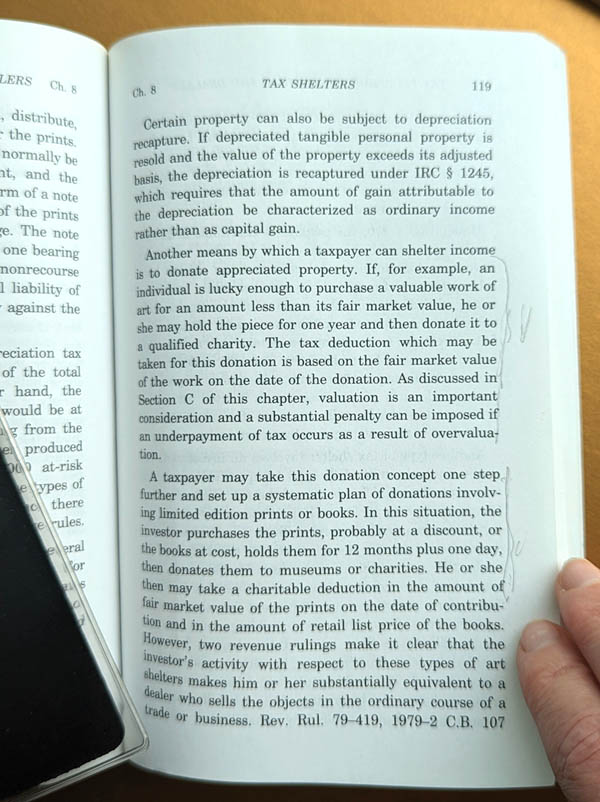
A taxpayer may take this donation concept one step further and set up a systematic plan of donations involving limited edition prints or books. In this situation, the investor purchases the prints, probably at a discount, or the books at cost, holds them for 12 months plus one day, then donates them to museums or charities. He or she then may take a charitable deduction in the amount of the fair market value of the prints on the date of contribution and in the amount of the retail list price of the books. However, two revenue rulings make it clear that the investor’s activity with respect to these types of art shelters makes him or her substantially equivalent to a dealer who sells the objects in the ordinary course of a trade or business. Rev. Rul. 79-419, 1979-2 C.B, 107. Source: Art Law in a nutshell by L. DuBoff, 4th edition.
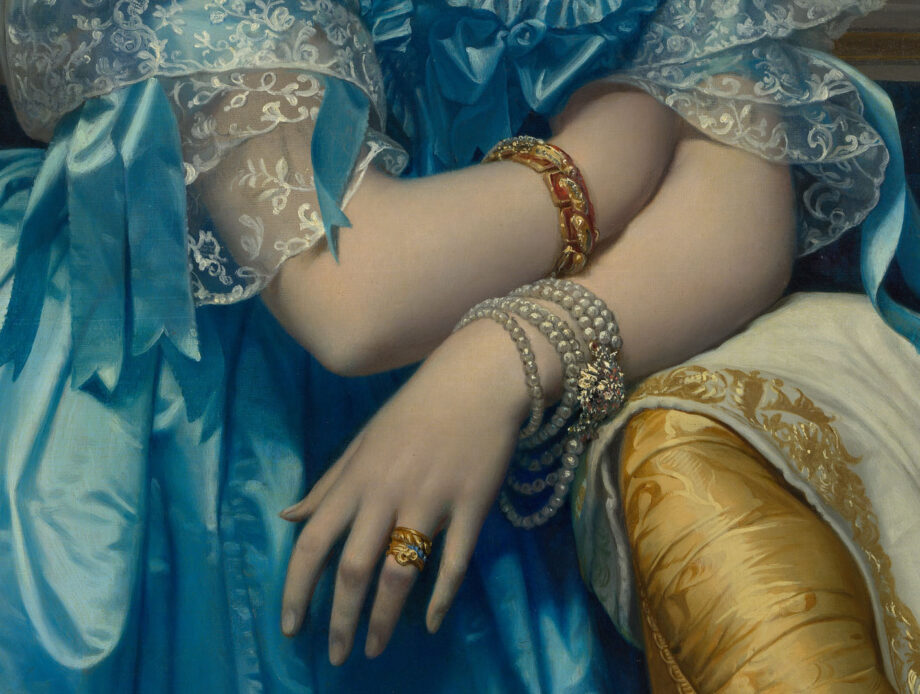
#2 How some obscure artists become famous.
Do you ever wonder how some strange art gets popular among the elite and good art remains in the shadows? Here is how you can become a famous artist participating in art market money laundering. Say, a wealthy person X must write off millions to avoid paying a big tax. So he must own an expensive painting, say a $15 million one, without spending that much money on it. That wealthy person finds an underrepresented artist and buys some of his art for a few thousand dollars. But how do you make a $1k painting worth $10 million? Here is how. Such people are usually well-connected and either already have or will find the necessary people in the art world to realize their scheme. It means finding high-end curators, appraisers, and gallery owners who can decide on the pricing of art. If the artist is underrepresented, they can’t justify a price increase without a reason. Therefore, they do something like this.
The unknown artist gets a massive marketing boost by hiring a PR firm to promote the artist’s work. These PR agencies place the artist in top publications, magazines, and art influencer accounts using their connections. After a while, the artist gets a show at a high-end gallery where the right people shop for art at high prices. This process gives lots of credibility and social proof to the artist. As a result, the unknown artist becomes “hot” as his artwork gets continuously promoted. The appraisers can put a high price on art from now on. At about that moment, the wealthy person X would cash in on his original investment because the art was purchased for pennies and sold for thousands. The investment is worth a million or two and can be donated to a set-up charity. By spending some money on art and promotion, the artificially raised price becomes income after donation, giving the investor profit not to spend on taxes.
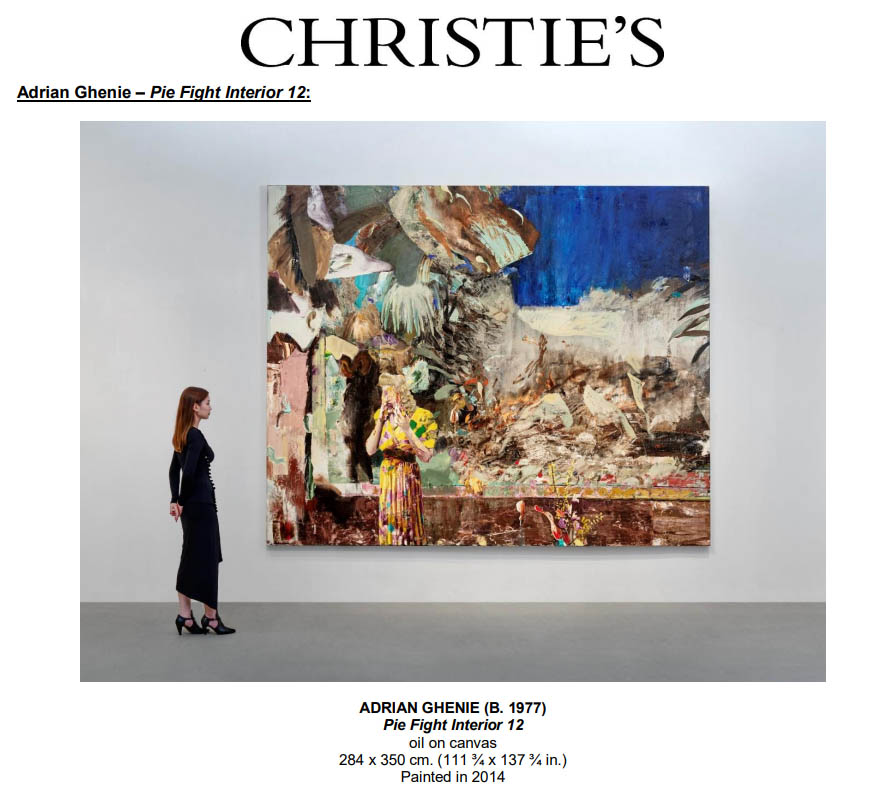
A variation of this business practice is when a ‘hot’ artist gets flipped a lot for higher prices in a pyramid-like scheme.
The most recent example of this Ponzi scheme is New York art advisor Lisa Schiff. She has a lawsuit where two plaintiffs allege that she owes them $1.8 million related to the sale of a painting by the famous Romanian artist Adrian Ghenie (b.1977). Ghenie is a hot artist represented by one of the four top galleries-Pace. According to Artnet News, the record for a Ghenie work sold at auction is $10.3 million for Pie Fight Interior 12 (2014), sold at Christie’s Hong Kong in May 2022. This lawsuit opened a can of worms, exposing Schiff’s business model of flipping art for profit for many years! In this particular case,
In 2021, Schiff told Barasch and Grossman that a Ghenie painting, Uncle 3 (2019), was available for purchase. After discussions, they agreed to buy the painting. Barasch took a 50 percent share, and Grossman and his spouse each acquired a 25 percent interest. No one got the art as it was shipped to a storage unit in Delaware. Source: https://news.artnet.com/art-world/art-advisor-lisa-schiff-hit-with-lawsuit-art-flipping-deal-2300709
Next year, the plaintiffs agreed to resell the art with the help of Lisa Schiff. They agreed on the price of art – $2.5 million and to split the proceeds, after a commission to Schiff of $250,000. The art was sold at Sotheby’s Hong Kong, and the sellers received $450,000. Schiff got the commission. The rest of the money, which was $1.8 million, was never wired to the sellers by Schiff, hence the lawsuit.
What’s common among such schemers as Bernie Madoff* or Sam Bankman-Fried, founder of the collapsed cryptocurrency exchange FTX, is their low sense of consciousness and unbelievably lavish lifestyle. Schiff maintained her business model and lavish lifestyle for many years at the expense of those art collectors/investors who chased hot contemporary artists to get a lucrative return on their investment within a few years.
*Bernie Madoff, a prominent New York financier, pleaded guilty in 2009 to running a Ponzi scheme that resulted in as much as $20 billion in cash losses and $65 billion in paper losses. He was sentenced to 150 years in prison and died in April 2021 at age 82. Sam Bankman-Fried’s case is ongoing in 2023.
#3 Art purchase as a bribe and exchange for a valuable position
In this art market money laundering scheme, you usually see inflated art prices on art being sold at a high-end art gallery, where an “art collector” comes in and purchases art in exchange for a big favor or a valuable position within the government or other entity. The Hunter Biden case illustrates this concept perfectly. I’m not going to discuss the political views and implications here; rather, I’d like to focus on the art corruption scheme itself.
In this particular case, the art gallery sold Hunter Biden’s art to some art collectors for 1.3 million. According to the Insider, one art collector bought 11 artworks for $875,000 according to the Insider. Upon close investigation, the names of at least two people who were art collectors became known- Elizabeth Hirsh Naftali & Kevin Morris. Eight months later, after Hunter Biden’s solo show opening, Joe Biden-the president, appointed Naftali to the Commission for the Preservation of America’s Heritage Abroad.
This case illustrates how valuable positions can be sold when you can’t do a simple money transfer in exchange for them.
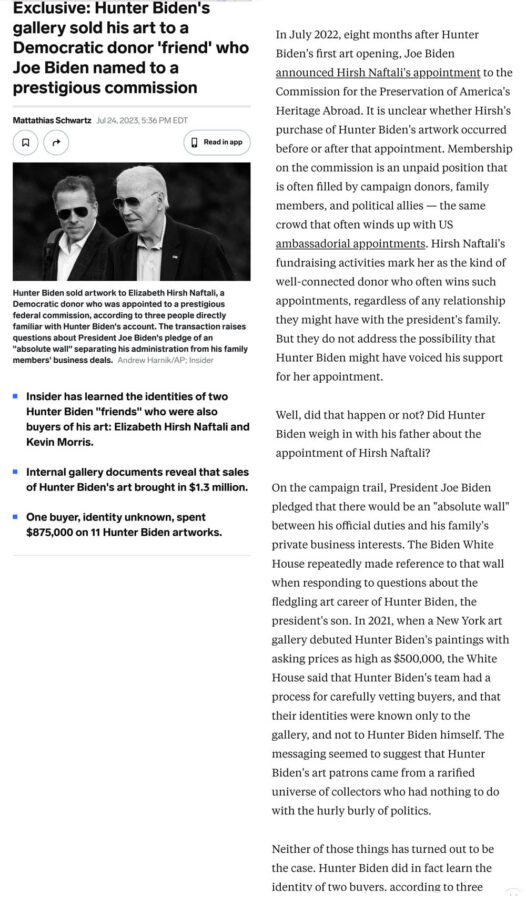
#4 Murky Pricing at high-end galleries
Pricing is murky. When you enter a top art gallery, you won’t see prices for art sold at the gallery. When you go to Miami Art Basel, you see very few art galleries displaying prices on walls next to paintings. There is no art market transparency. Shrouded in mystery, prices are not publicized by dealers for a reason. Price varies depending on your looks and status.
Hot artists are not sold to first-come, rich art collectors. If you just walk in wishing to buy a particular hot artist, you’d be placed on a wait list with a promise that you need to buy a “less hot” artist first. Hot artists are sold to the most well-known art collectors first to bump up the price further.
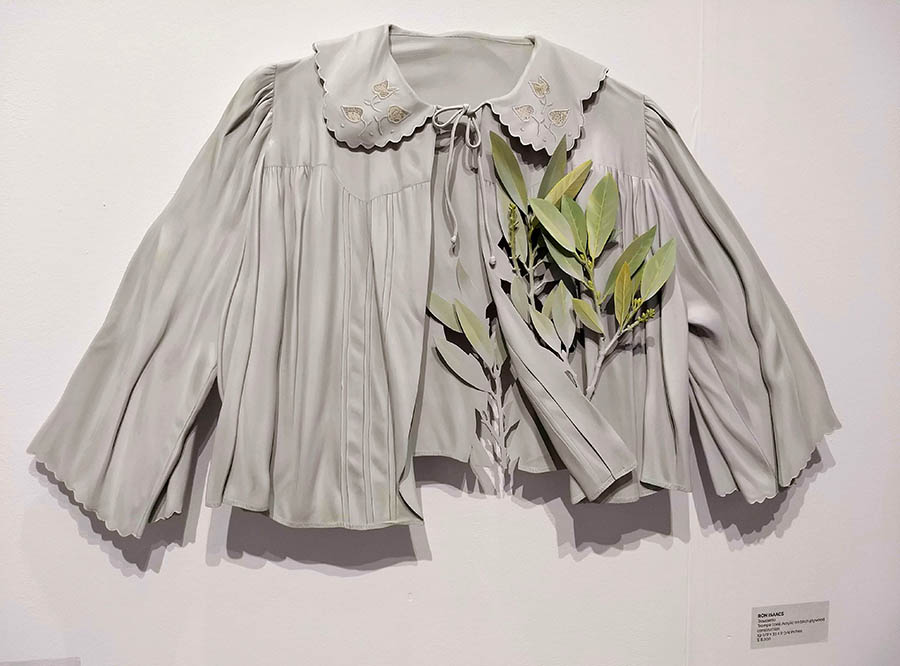
#5 Freeports
Freeports, also known as Free Trade Zones or Free Economic Zones, are specialized facilities that provide secure and tax-advantaged environments for the storage, trade, and exhibition of valuable assets, including art, collectibles, and luxury goods. These areas are typically located within a country’s borders but are considered to be outside its customs territory. Freeports offer various benefits, such as exemption from customs duties, taxes, and stringent regulations that would normally apply to imports and exports. In other words, the simplest way to use freeports is not to pay a sales tax on sold art by storing it in freeports, which speaks volumes about art market tax evasion.
Freeports have gained prominence as a solution for wealthy individuals, collectors, galleries, and art institutions seeking a secure and flexible space to store and manage their valuable artworks. They offer a range of services beyond simple storage, such as conservation, restoration, cataloging, and even private viewing rooms for potential buyers or patrons. These facilities are equipped with state-of-the-art security systems, climate control, and specialized expertise to ensure the preservation of delicate and valuable art pieces. An example of such fa acility is shown in the Tenet movie.
The primary advantage of using freeports for art storage is the ability to defer tax payments and customs duties until the items are brought back into the domestic market or are sold. This art market tax evasion feature can be particularly beneficial for collectors who acquire artworks from various parts of the world and wish to avoid immediate taxation or customs complications. It also allows for more fluid movement of art across international borders for exhibitions, auctions, and art fairs. Examples are:
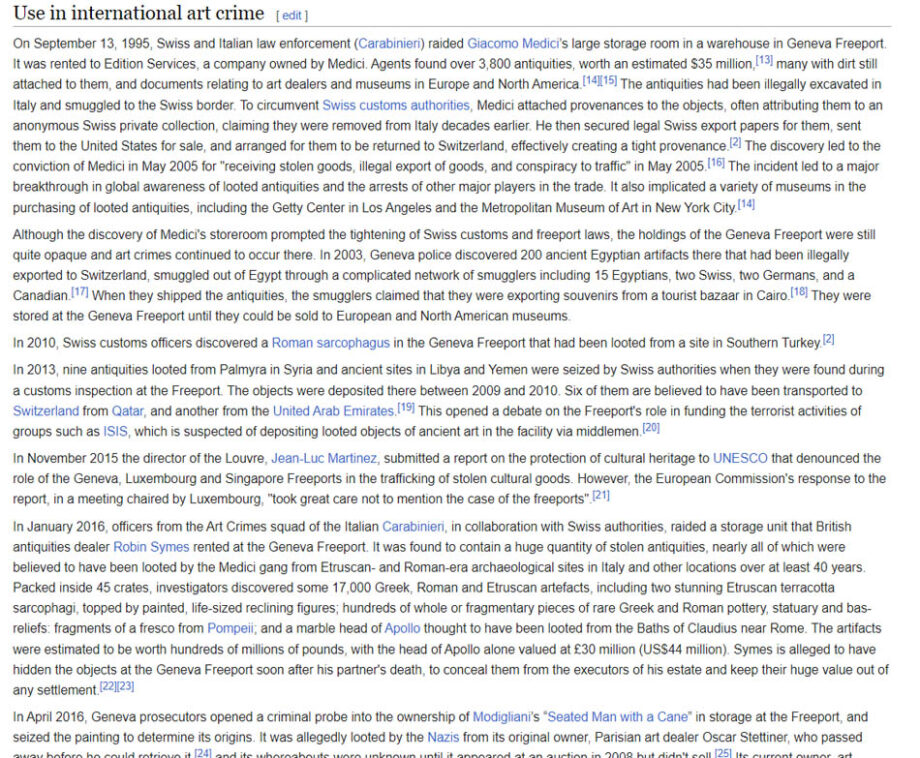
- Geneva Freeport (Switzerland): One of the most famous freeports for art storage is the Geneva Freeport. Located in Switzerland, it offers secure and climate-controlled spaces for storing high-value assets, including artworks, fine wines, and precious metals. The Geneva Freeport gained notoriety for its confidentiality and lack of transparency regarding the ownership of stored items, making it a popular choice for individuals and institutions looking to keep their collections discreet.
- Singapore Freeport (Singapore): The Singapore Freeport is strategically positioned in Asia and serves as a hub for art storage and trading in the region. It provides specialized facilities for storing art, precious metals, and other valuable assets. The Singapore Freeport is known for its stringent security measures, advanced technology, and favorable tax policies.
- Luxembourg Freeport (Luxembourg): The Luxembourg Freeport is another significant player in the world of art storage. It offers a range of services beyond storage, including customs clearance, art logistics, and private viewing rooms. The facility’s location within Europe makes it an attractive option for art dealers and collectors seeking a central point for their art transactions. The LUXEMBOURG HIGH SECURITY HUB is a 22,000 m2, 4-story building with beautiful architecture. The facility has 24-hour security and offers storage rooms, vaults, and safes of custom sizes. https://lux-hsh.com/luxembourg/
In recent years, freeports have faced criticism and increased scrutiny due to concerns about money laundering, tax evasion, and a lack of transparency regarding the ownership of stored assets. Some countries have taken steps to address these issues by implementing stricter regulations and transparency measures within their freeport systems.
Sometimes you can see the depiction of freeports in movies. They show such facilities where valuable items, like art, can be stored, traded, or showcased. Some movies include:
- “No Time to Die” (2021): In the James Bond film “No Time to Die,” there is a scene set in a fictional Cuban Freeport where a valuable art collection is stored. This location plays a significant role in the plot of the movie.
- “The Thomas Crown Affair” (1999): This remake of the 1968 film features a scene set in a freeport where the wealthy protagonist stores his art collection, including stolen pieces. The freeport becomes a focal point in the investigation of a major art heist.
- “Rush Hour 3” (2007): In this action-comedy film, there is a sequence set in a French customs warehouse that operates as a kind of freeport. The film’s protagonists discover valuable artworks stored there as part of the plot.
- “The Good Liar” (2019): While the film primarily revolves around a con artist and his schemes, there is a scene involving a high-security storage facility in London that serves as a freeport for valuable items.
- “Duplicity” (2009): This movie involves corporate espionage and features a subplot that revolves around a secure storage facility where high-value products are kept. While not a traditional freeport, the concept is similar.
- “Danny Collins” (2015): While not the main focus of the film, there is a scene set in a storage facility where valuable items, including artworks, are stored. This scene contributes to character development and plot progression.

While freeports don’t play a central role in the movies, they serve as intriguing settings for some movie scenes or plot developments. Keep in mind that movies often take creative liberties, so the portrayal of freeports in these films may not fully represent the real-world complexities and operations of such facilities but somehow illustrate the nature of art market tax evasion.
#6 Art market forgery
There are numerous art market forgery schemes. While they’re somewhat different in motivation from all the previous art market collusion schemes listed, they do exist as forged art gets produced and sold to art collectors, art museums, and private companies.
Art market forgery means creating or selling artworks that are falsely attributed to a well-known artist or created to imitate a particular artistic style in order to pass them off as genuine.
Misrepresentation of Provenance means providing false or fabricated ownership histories and records of an artwork’s past ownership to inflate its value or authenticity.
#7 Art Philanthropy
What is philanthropy? The original meaning of this word gets corrupted by human nature. Philanthropy raises the person’s profile. It also looks great on paper when the philanthropist is giving money to the foundations. The only problem is that the philanthropist controls the foundation behind the scenes. If it’s an LLC, these companies make and spend money as they want. During the money transfer to the foundation, they get a tax break for a charitable contribution. In reality, the same old tax evasion. If registered as a charity, philanthropists donate to both nonprofit and for-profit companies with a direct interest in those companies that make them money. It’s a business, not philanthropy.
#8 Price gauging at art auction houses

Price gouging at art auction houses refers to the practice of artificially inflating the prices of artworks beyond their fair market value through various means, ultimately leading to higher auction results. This can occur due to a combination of factors, including manipulation, collusion, hype generation, and unethical practices by auction houses, bidders, or intermediaries involved in the art market. While not all art auction houses engage in price gouging, instances of such behavior can undermine the transparency and integrity of the art market.
Methods of Price Gouging:
- Shill Bidding: Auction houses might use “shills,” which are individuals posing as legitimate bidders, to drive up the bidding and create an illusion of high demand. Shill bidders artificially increase the price of an artwork, encouraging genuine bidders to offer higher bids.
- Pre-Arranged Sales: Some artworks might be sold privately before an auction but are then presented as fresh-to-market items. This tactic can create the perception of high demand and value, leading to increased bidding during the auction.
- Chandelier Bidding: Auctioneers might falsely claim to have received bids from the audience, inflating the price of an artwork even if no actual bids were placed. This technique encourages real bidders to compete at higher price points.
- Limited Information: Auction houses might withhold relevant information about the artwork’s condition, provenance, or authenticity, leading to higher prices based on incomplete or misleading information.
- Hype Generation and Marketing: Auction houses often use elaborate marketing campaigns, glossy catalog descriptions, and celebrity endorsements to generate hype around certain artworks or artists. This can create an atmosphere of excitement and exclusivity, driving up demand and subsequently inflating prices.
Price gouging can have many negative consequences for the art market that include loss of trust of collectors and investors, loss of value of art, and damaged reputation of houses, dealers, etc.
Other art market scams:
In addition to price gauging, you must be aware of Online Auction Scams. These scams involve posting fake listings on online auction platforms, often using stolen images, to deceive potential buyers into making payments for nonexistent artworks. There are also scams involving undisclosed restoration or damage. The scammers conceal the fact that an artwork has undergone restoration or repair, or downplay the extent of damage, to sell it at a higher price. Some art market participants also give false appraisals. By providing inaccurate or inflated appraisals of an artwork’s value to deceive buyers or lenders for financial gain. Finally, some can forge the Certificates of Authenticity by creating counterfeit certificates of authenticity or manipulating genuine certificates to falsely authenticate an artwork. Obviously, it leads to financial losses and legal battles for the art collectors.
In conclusion
You can call me cynical or ironic in describing the art world. After all, it’s a web of connected art dealers, auctioneers, appraisers, art critics, influencers, and gallerists – all participating in the art market collusion. My point is that art has nothing to do with art. All of these art market money laundering schemes are real, and some thrive because of the legit tax code in the US. Art as an investment is for people to do just that. To put money to work. Yes, they all say that they love and enjoy looking at art. Perhaps. And so many really talented artists live and work on the sidelines of these marketing machines and have no way of receiving a” stamp of approval” to either confirm or raise the value of their art.
Until the day we have a new voting system in place where people vote after seeing new shows or recent acquisitions at the art museums, nothing would change. We will continue to be mesmerized by exuberant pricing and ugly “art” hung in institutions, telling us what’s great and what’s not. They will make you believe something that’s not true. You will continue being confused about what you’re seeing, saying to yourself that you don’t understand art.
The sad part is that the average Joe and Jane pay their taxes to support the government spending, while wealthy people who can really contribute to the well-being of our society avoid doing just that.
If you’re an artist and want to take part in this marketing machine, now you know what to do. You can try getting into the shows at the art museums in New York or connect to a powerful player in the art world who would promote your art.
As a side note, you can read about various cases and corruption schemes in this book. It’s a great read to understand other art-related issues as well. Art Law in a Nutshell, 6th Edition https://amzn.to/3Ds3SmJ Art Law in a Nutshell presents an overview of the legal issues concerning art. It covers the definition of art, and the theft and movement of art in wartime and peacetime. It examines the business of art for artists, dealers, museums, and collectors, including art as an investment, auctions, authentication, insurance, tax issues for artists and collectors, working artist issues, and aid to the arts. It also explains the intellectual property issues of copyright, trademark, moral rights and economic rights, right of publicity, and First Amendment freedom of expression rights. The latest introduction was written by a Ninth Circuit Court of Appeals judge who actually wrote at least one of the opinions discussed in the book.
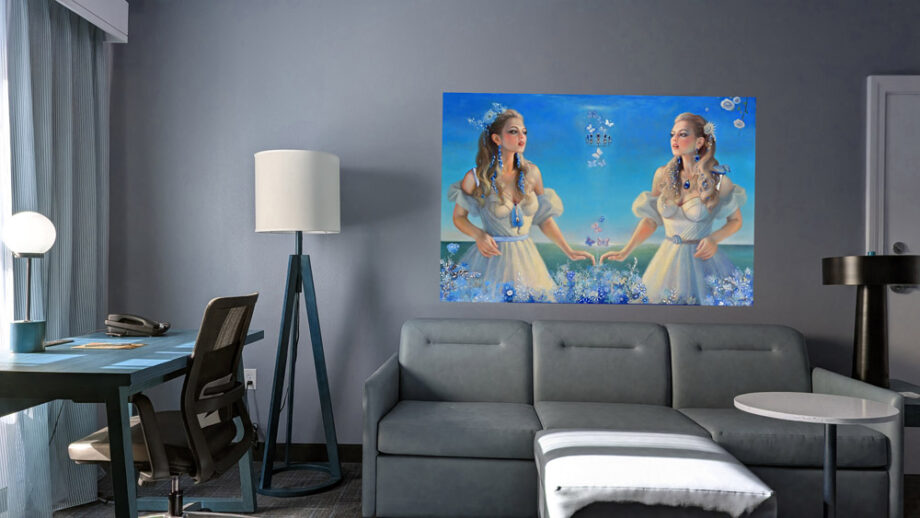
Nicole Finger: Unlocking the Secrets of Stunning Realism Art
Subscribe & rate this podcast on Spotify and Apple | Show your support for the podcast: here | Host: Veronica Winters, MFA | veronicasart.com

Colorado-based realist artist, Nicole Finger is a super-talented, highly-realistic oil painter who creates figurative realism art inspired by her family and surroundings. Immersed in beauty of the San Juan Mountains in Telluride, the artist enjoys juxtaposing stunning snow peaks with gentle tulips and peonies. She creates luscious textures painting almost any surface she chooses- donuts, tacos, jackets, lace and portraits. Painting large, realist artist captures your attention with fresh color palette and an unusual placement of common subjects on canvas. Finger loves the precision in oil painting and depicts the sunlit portraits of her children so realistically you want to marvel every detail in her art.
Finger holds a BFA degree from the University of Colorado, Boulder and is represented by several art galleries including Victory Contemporary in Santa Fe and Skidmore Contemporary Art in Santa Monica. The artist received top awards for her realist painting in 2022 including IGOR, Best Portrait Award 6th Annual National Juried Exhibition, (ANJE) , Honorable Mention, John Dalton Art Prize, Finalist, International FiKVA Award Finalist, 16th International ARC Salon semi finalist, American Women Artists (AWA) Juried Spring Online Show- Presidents Award and many more!
Her art is in many corporate collections including San Francisco Delta Sky Club Collection, San Francisco International Airport, Copper Mountain Hotel, St. Joseph’s Hospital, Denver, Children’s Hospital, Denver, Rocky Mountain Hospital for Children, Children’s Hospital, Parker, St. Mary’s Hospital, Grand Junction, Greeley Hotel, Greeley, First Warning Music, New York, NY and many more.

Contact Nicole: Website: fingerpaintingart.com | current project & charity info: https://www.instagram.com/postcodeukraine/ https://contribute.to/postcodeukraine
“The strength of the mountains and the fragility of the flowers and how that is a metaphor for life. It’s timeless and fleeting to be appreciative and grateful. It’s here. It’s beautiful and then it’s gone.”
Nicole Finger
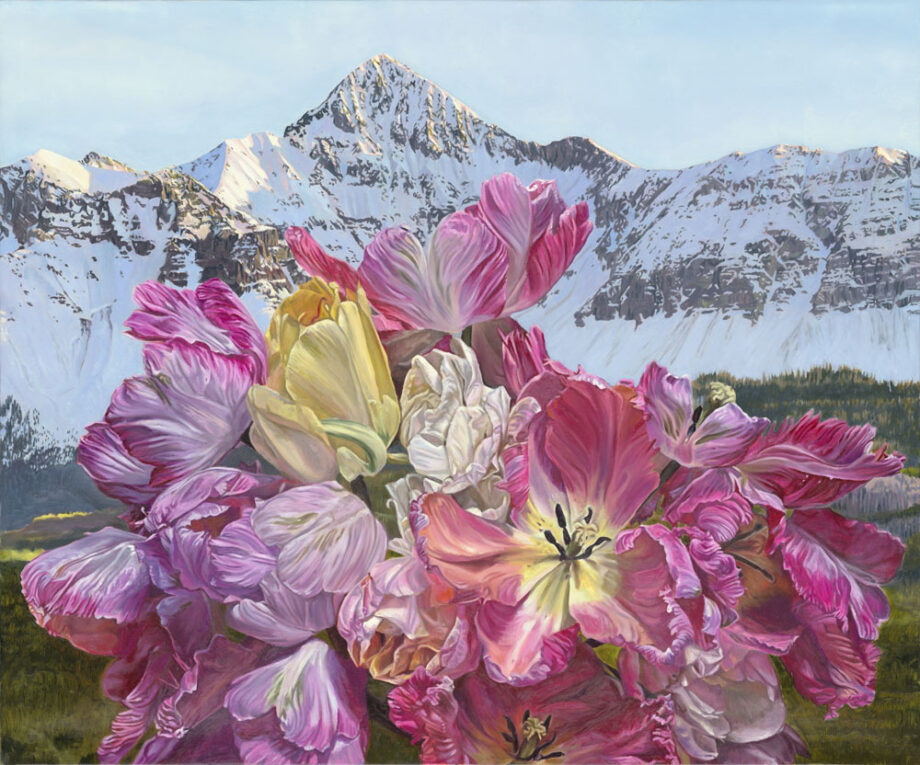
Interview:
1-10 min art overview
13:23 image transfer process
15:45-17:20 underpainting technique
17:40 What’s so exciting about the process of realism oil painting?
19:50 Photography process
21:30 Ideas and technique of oil painting “Freedom”
24:00 About artists on the Moon Project
27:20 “Floralscapes” series inspiration & meaning
31:40 Painting of Svetlana and Postcode Ukraine project
35:20 Going out to art galleries
36:00 What inspires the artist to create art
37:20-39:40 How the artist markets her realism paintings (art marketing tips)
41:48 Wearable art painting (paintings on dresses)
46:50 Greatest success
47:50 & 51:00-59:00 Getting into museum art shows and galleries, tips for young artists
49:50 What the artist wants to say with her hyperrealism art
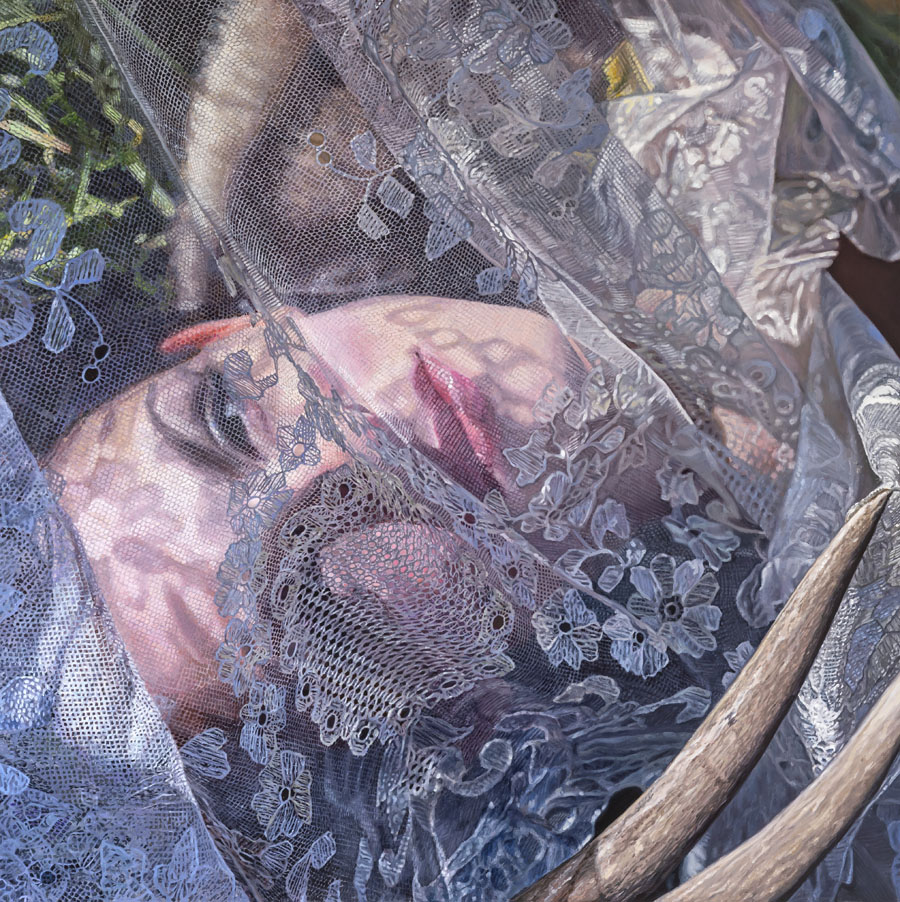
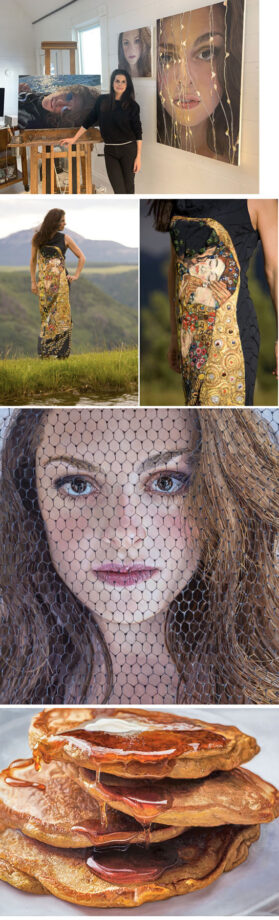
To watch on YouTube: https://youtu.be/rZ-5HYMysEc
Podcast: Play in new window | Download
ART WYNWOOD 2023: the sudden rise of commercial, mind-blowing art that changes the game in art collecting
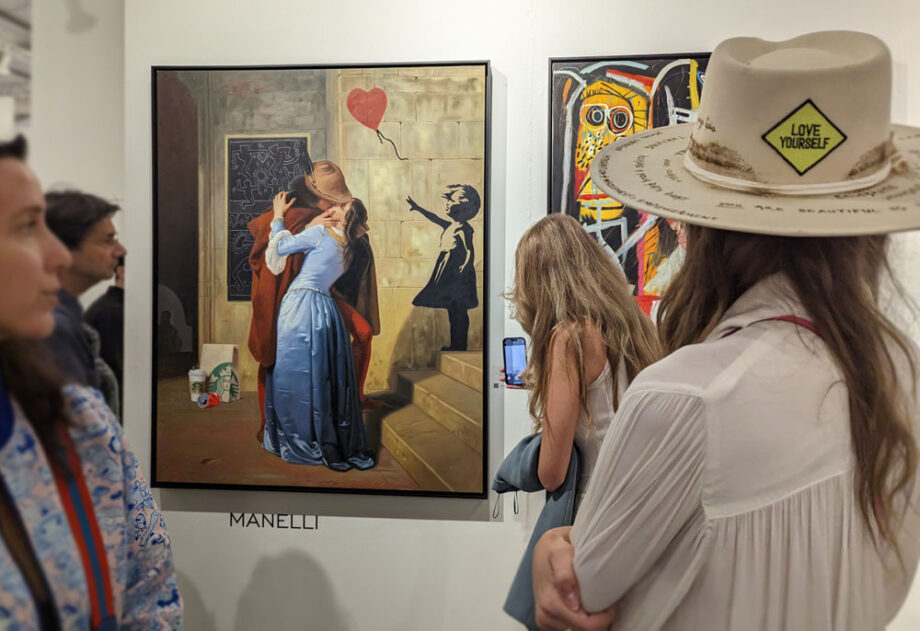
On February 16, 2023, ART WYNWOOD kicked off its 10th edition with exuberant crowds, diverse art and energetic vibe. Held during the presidents day weekend, the art fair welcomed art collectors big and small to enjoy art, cocktails and trendy hangout. Smaller than the CONTEXT Art Miami, this winter art fair was held in the same spot – One Herald Plaza @ NE 14th Street, on Biscayne Bay, Downtown Miami. Thursday’s VIP Preview benefited The Bass – Miami Beach’s contemporary art museum.
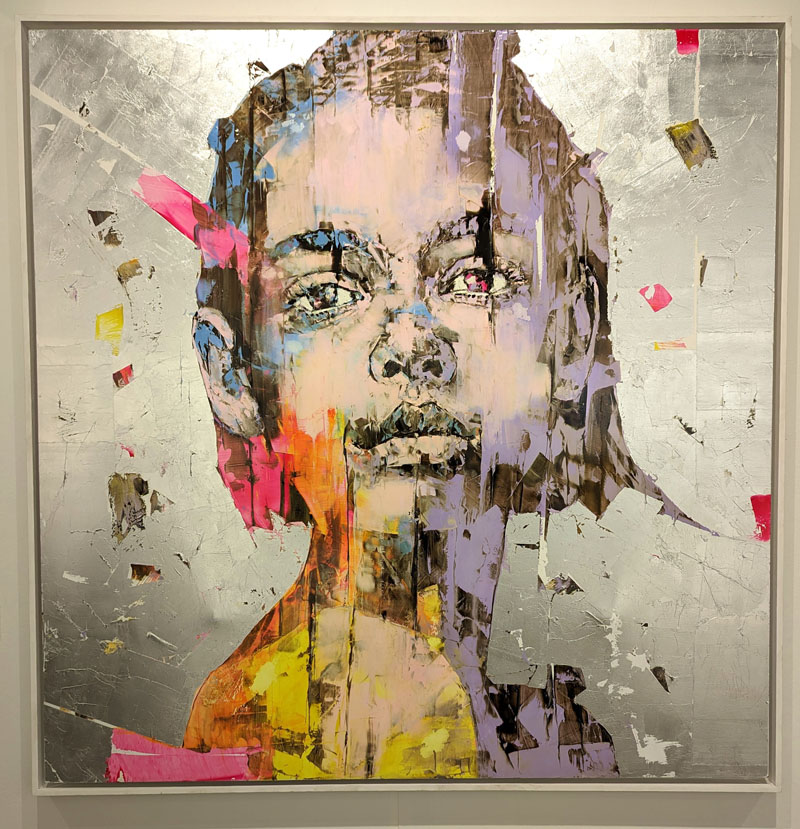
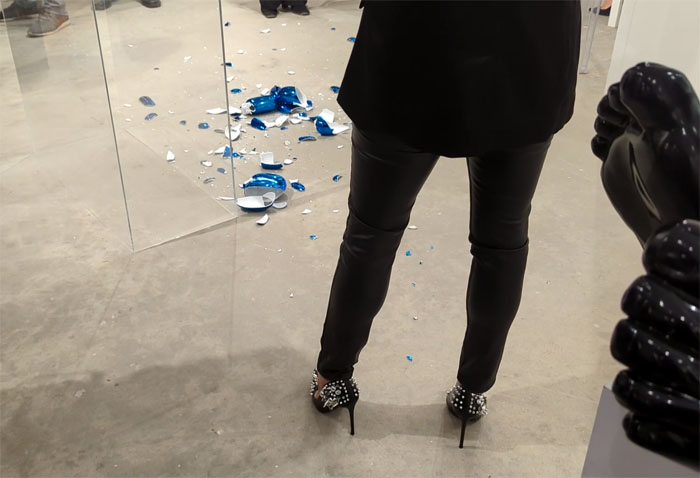
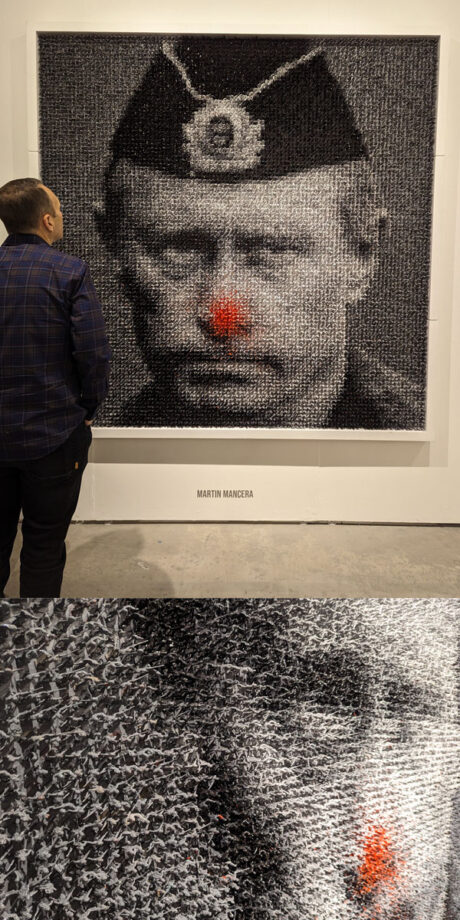
ART WYNWOOD attracted international crowd of the rich during the opening night in downtown Miami. Some walked off their yachts to see the show, others stepped out of their winter houses to enjoy the artsy night. People with dogs, women in hats, men in colorful shirts. Hispanic. White. Black.
The most fascinating part about such art fairs is the variety of presented art. Painting, drawing, sculpture, mixed media art, light-based art, textile art, photography – these general categories take on a new life here. Walking into the art fair in Miami can be both exciting and draining seeing so much art at once. Cutting-edge, contemporary art often tests the limits of what’s possible, appropriate or imaginable. Attracting wealthy viewers from afar, most paintings are very large to occupy the white walls at the fair. In fact, some art won’t fit your regular living room wall. They range from 50 to 80 inches in length. That’s how big those artworks are. Sculpture is often a hard-sell in a commercial gallery but it doesn’t seem to be the case here. It’s quite impressive to observe an array of subjects, materials and sizes presented at the Art Wynwood.
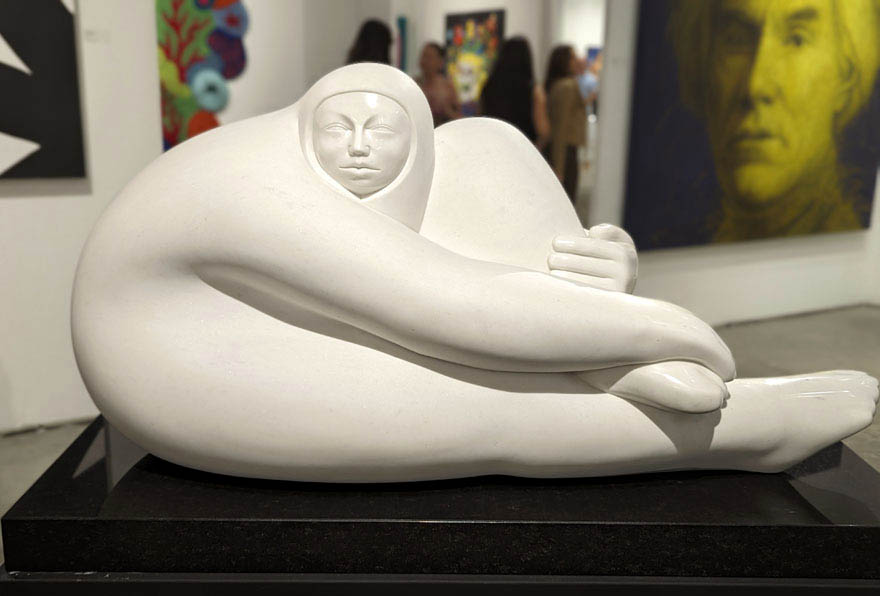
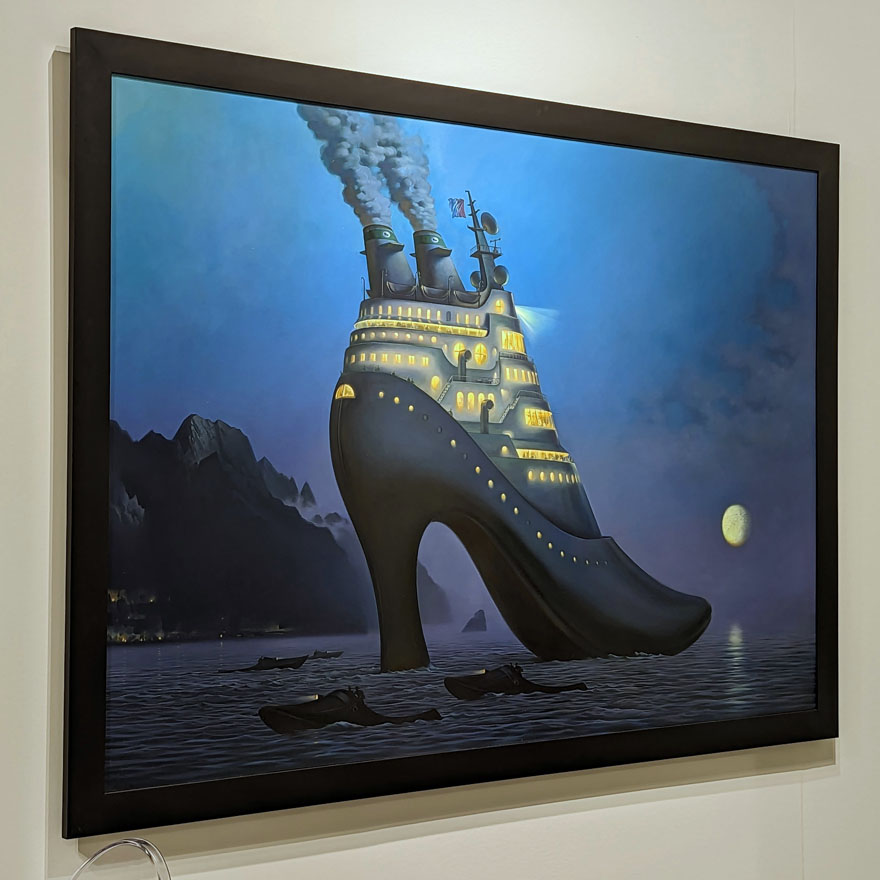
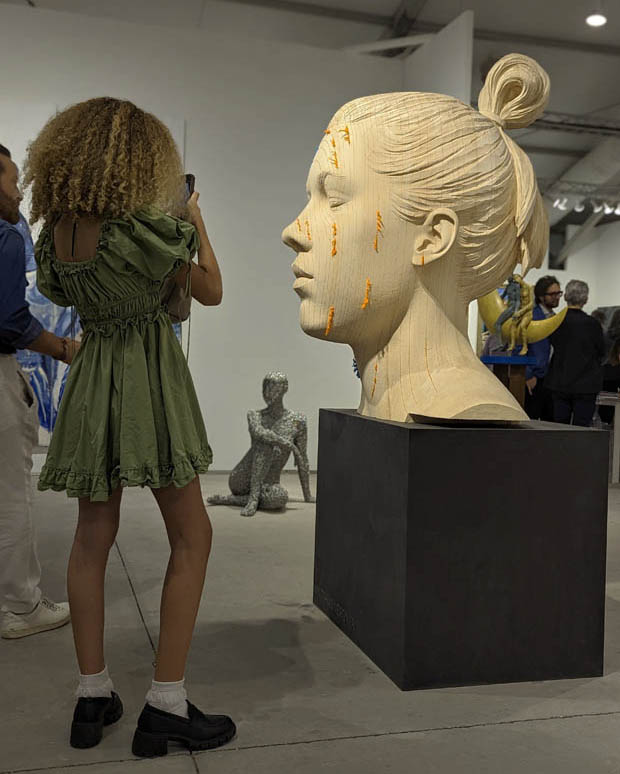
Art Galleries
Art Wynwood showcased contemporary art from more than 50 established and emerging international galleries. The galleries included the following:
- Aldo Castillo gallery: Aldo presented Daniele Fortuna who uses a variety of materials to create the the sculptures so they can be touched.
- Blink Group Fine Art presented Hebru Brantley’s fiberglass and acrylic sculpture that borders childhood memories, pop-up culture, shiny colors and Hero narratives.
- Bel-Air Fine Art showed Leo Manelli’s acrylic paintings that combine classical art with contemporary pop culture.
- Chase Contemporary: RISK debuted four new Virtual Reality graffiti prints, which come to life through the screen when activated via a phone camera.
- Heitsch Gallery showed Eike König, whose sarcastic social commentary is internationally recognized.
- Liquid Art System presented hyperrealist art by Attilio Cianni and sculptures by Peter Demetz.
- Cernuda Arte presented works from 20th century modern artists Wifredo Lam and Carlos Alfonzo.
- Contessa gallery showed Jorge Jiménez Deredia‘s sculpture.
- HOFA gallery presented popular Italian artist Marco Grassi who creates big figurative abstractions in gold and silver leaf, paint and resin.
- Quidley & Company showcased a variety of wall art.
- Goldman Global Arts Gallery presented a collection of 15 artworks by artists, including Leon Keer, Hebru Brantley, Dan Kitchener, Kai, and Okuda.
- Kush Fine Art Gallery presented paintings and sculptures of Russian-American artist Vladimir Kush who works in metaphorical realism combining surrealism and natural elements.
- Laurent Marthaler showcased new works from Swiss artists Crystel Ceresa and Daniel Cherbuin.
- Avant Gallery presented Tim Tadder’s works created with Artificial Intelligence.
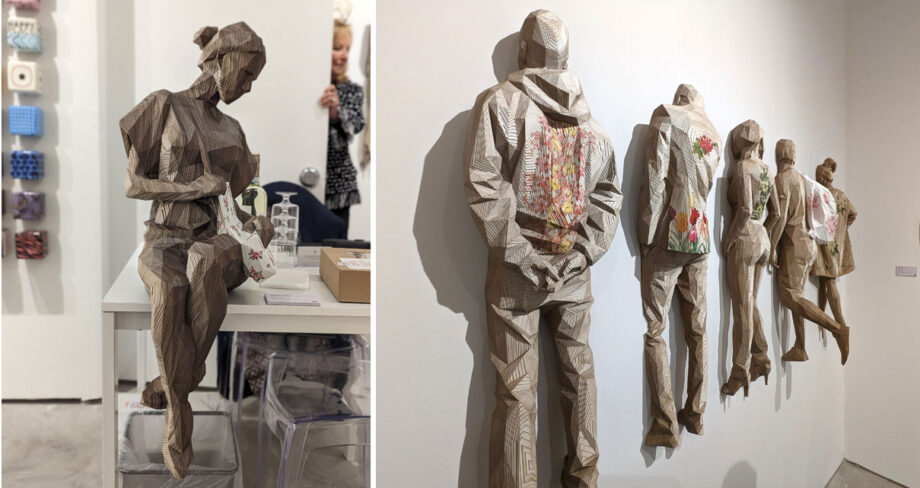
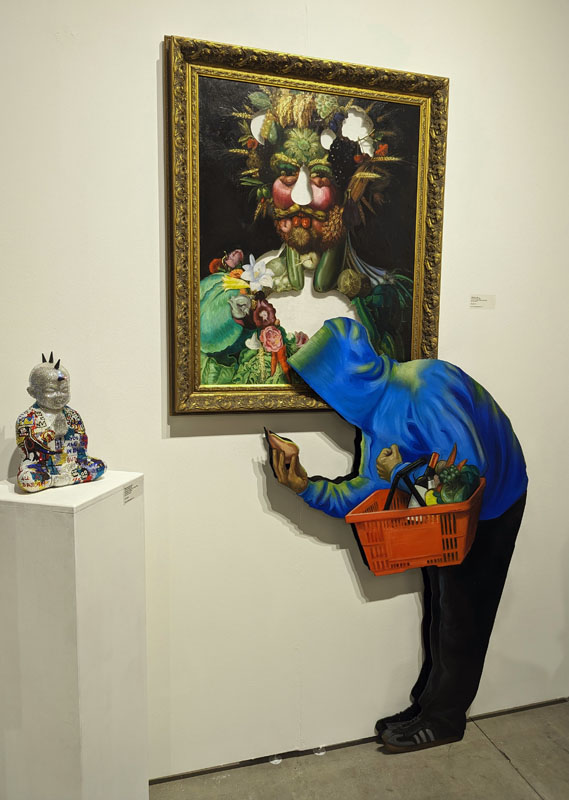
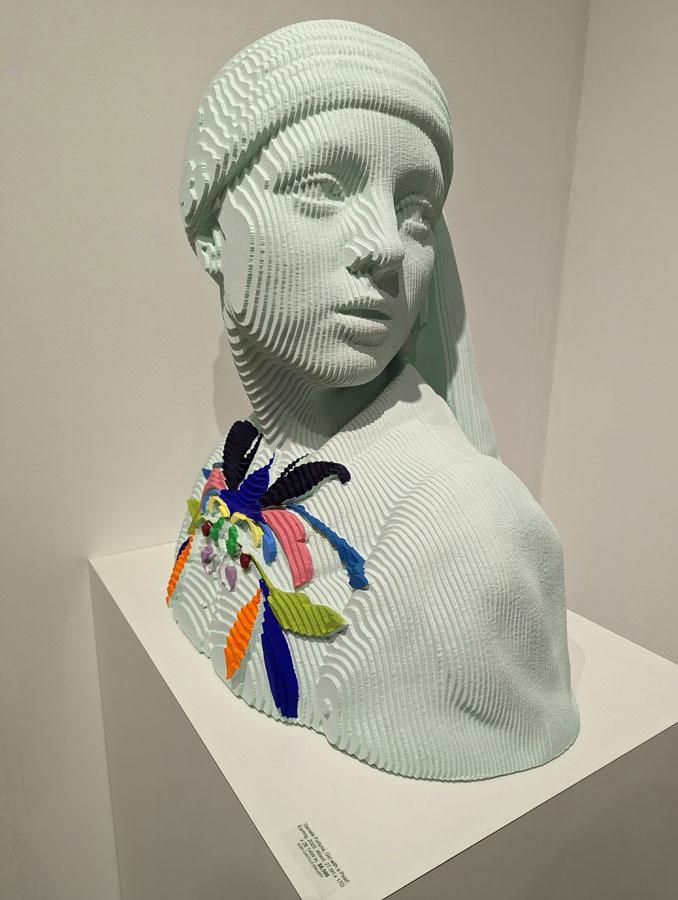
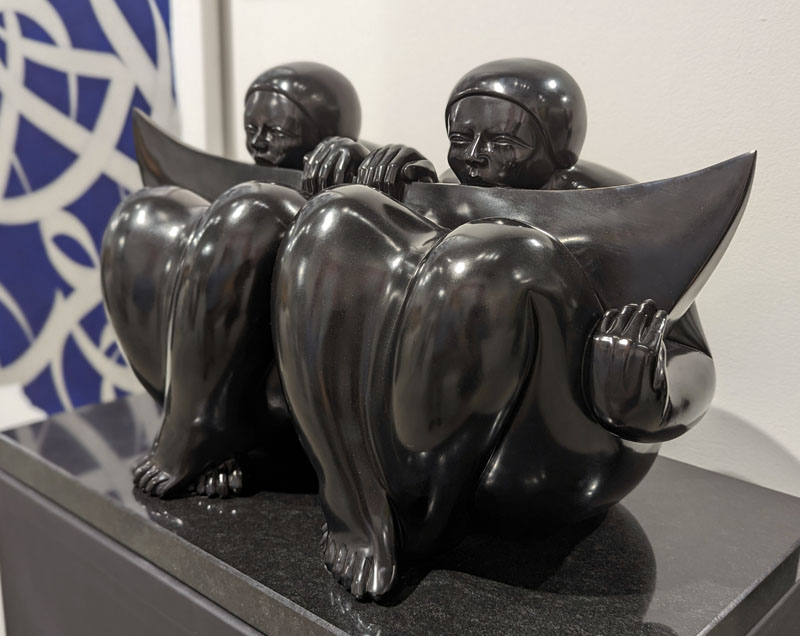
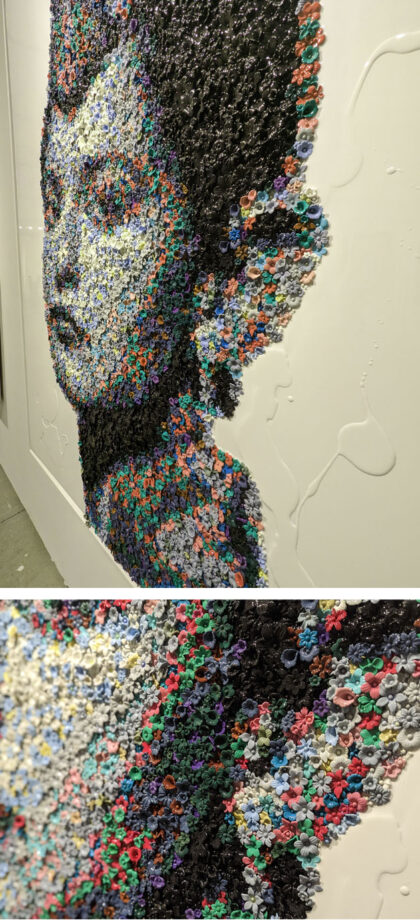
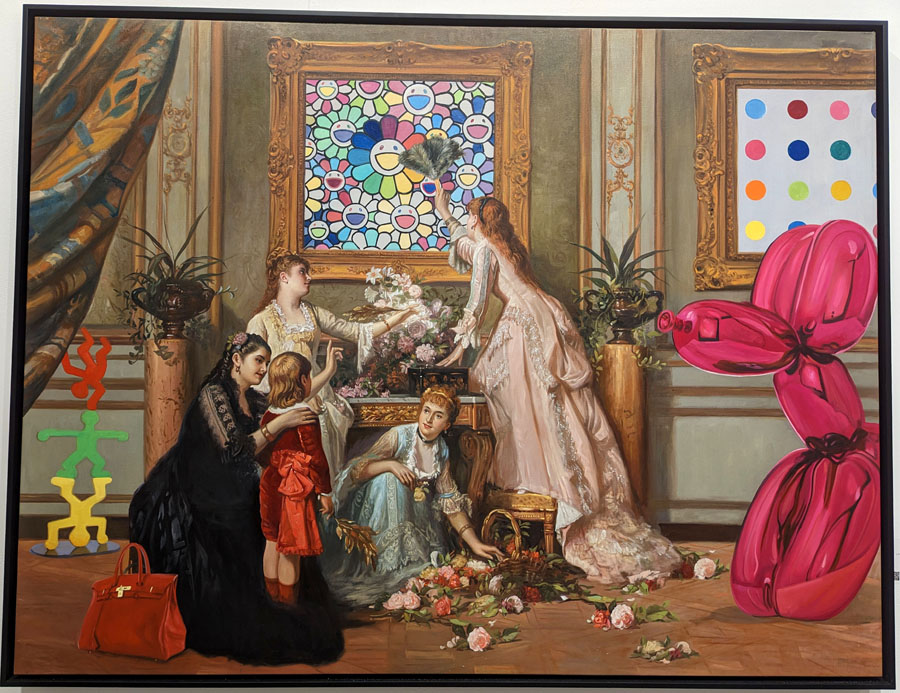
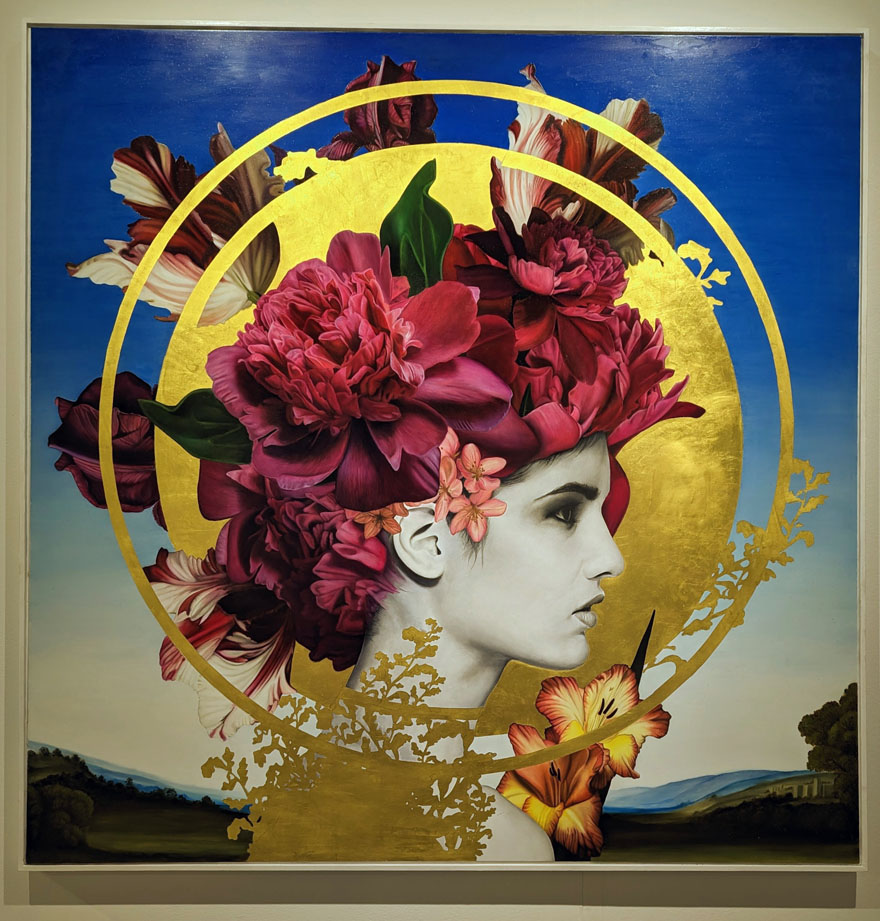
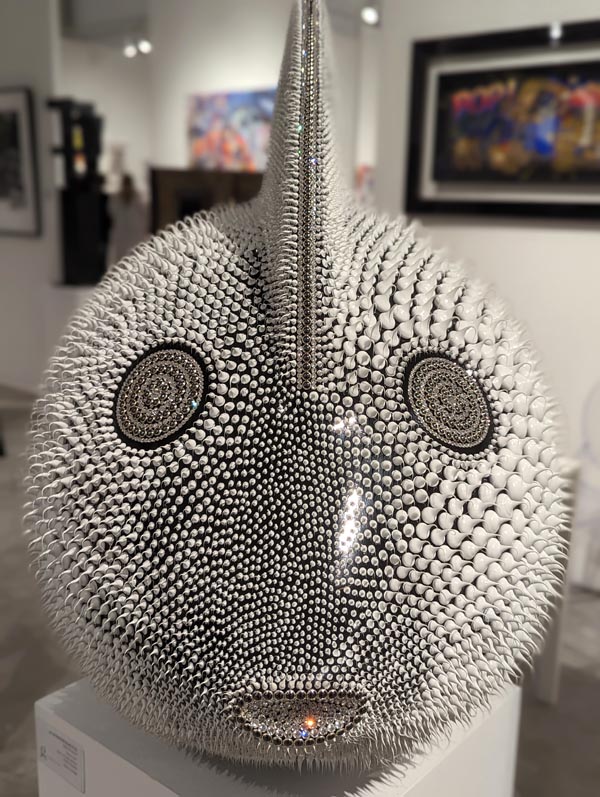
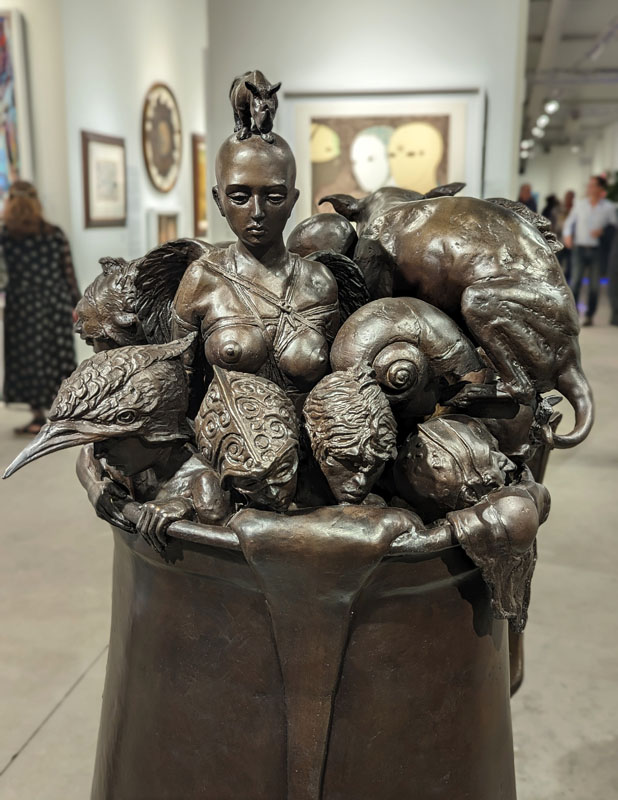
Location:
Tickets are: VIP-$225, General admission – $36.50, Senior/Student-$25. Garage parking is $30
http://www.artwynwood.com | February16-19, 2023 | Location: The Art Wynwood Pavilion, One Herald Plaza @ NE 14th Street, on Biscayne Bay between the Venetian Causeway & MacArthur Causeway, Downtown Miami
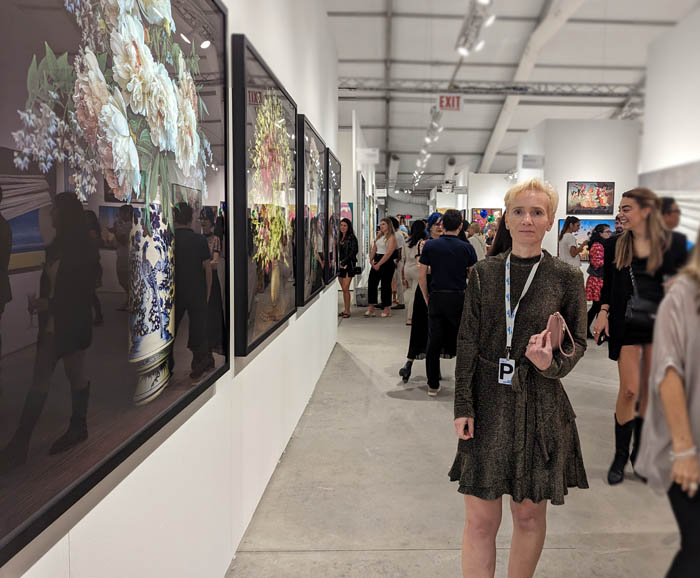
Check out visionary art for sale
Why Artists Create
Why Do Artists Create Art? Online Group Exhibition
I’d like to thank all the artists who entered this competition and all the sponsors who support the artists. Please visit the sponsors via the links shown below.
Written by Veronica Winters, MFA | Edited by Vladislav Fomitchev
You might think that artists create art for a variety of reasons. We find an outlet to communicate our ideas, to express our emotions, to capture a moment in time, to tell a story, or to bring inspiration and joy into people’s lives. Some artists create art to make money, while most artists produce art to express their soul and talent because they feel a pure need to create.
Learning to express ourselves visually is a need. Without having this deep drive to create the artist may remain just a skilled illustrator or a good craftsman. Many artists experience the urgency to paint especially when they’re deprived of it for quite some time.
Most artists feel the need to paint because doing art is freeing. It fixes our inner yearning and heals our pain. Artists often paint to fill a void inside them because creatives process emotions visually. To develop a unique visual language, every artist must do a deep dive inside his soul to understand his Why. Why do you create what you create? What does it accomplish? What do you want others to see in your artwork? These are the questions that are always there for the creatives to think about. After all, that’s how the artist discovers his purpose and meaning as well as the meaning behind his own creations.
Artists enjoy the process of creation so much that they commit to spending years learning the craft. It’s often not enough to have a 4-year college degree to master the skill and develop a unique vision. But because artists can’t live without art just like you can’t live without your heart, they are driven to produce art.
Many artists create art in progression of skill and personal growth. Artists keep painting, sculpting, and writing to make this world less dark and more beautiful. As art brings beauty home, artists paint emotions, not subjects or objects. And that’s the reason why you can really fall in love with a piece. You connect to it emotionally.
Since the 19th century, artists have gained freedom to create personal art that was very different from expected religious scenes, formal portraiture, and mythological illustrations. Stepping away from widely accepted academic painting, many new art styles have emerged since. Art Nouveau, Impressionism, Cubism, abstraction, surrealism, art installation, photography, new media and so many more!
The freedom of artistic voice is almost always affected by external culture. Why do we look at human history through ancient objects, architecture and painting? Early excavations, Renaissance masters, modern art… Art is never created in a void. Yes, it expresses emotion but it also comments on fashion, culture, events or political divisions in society. Sometimes it becomes a propaganda tool to express the political and economic glory of a nation.
Art is a visual language that’s often taken for granted because it’s all around us. However, if you remove every picture, poster, cover, book, sculpture, movie, cartoon, song just for one day you’ll experience a profound lack of beauty, thought, and inspiration. Art is a mirror for your soul. It’s a place to see your true self. It’s a depiction of feelings we often hide, suppress, or don’t even think about.
How long did it take you to paint this?
All artists get one question they may or may not find exciting. Viewers often try to start a conversation with this question. Artists either try to calculate the hours spent painting the art or get upset by the very nature of this question because the number of hours may not reflect all the unseen work, and sweat spent in the trenches learning the craft.
Don’t ask the artist how long he painted the art, ask him why he painted it. A lot of creatives need to process this question in their mind and heart themselves! This is the most fascinating part about creation. Artists produce something beautiful out of “nothing.” Understanding that space is peeking into the artist’s heart and mind. When I look at someone’s art, I also see how deep the artist travels inside himself. If there is exploration of feelings, social themes or intelligence. Painting is simply a journey into the artist’s soul. It’s an invitation to look into yourself without saying a word and to make personal discoveries. This in turn enriches our soul giving more meaning to what we do in our work.
When you see great art in a museum, you want to come back to it to experience it again, to find something exciting in it. The same painting can give you a different meaning, feeling, or story. It can make you look at life a bit differently. It can make you laugh or cry but it can’t leave you indifferent. While the curation of our taste in art comes from our knowledge and understanding of art history, art collecting should be about emotion, aesthetics, and the joy of appreciating beautiful work. By bringing art home you fill the need for beauty and emotion but you also make a difference in an artist’s life. You give the artists more reasons to create art and develop their vision and skill.
While there’s a lot of speculation at the top tier of the art market, most artists produce art to say something personal as opposed to making a quick buck. While top art collectors purchase art as an investment, most artists feel their art is getting devalued by daily offers of free work for ’’exposure’’ or with why-is-it-so-expensive questions. Even though they need it to continue painting, artists often search for meaning and beauty, not money. The dream of every artist is to keep creating and get paid for all their unseen work that can’t be measured in standard terms… To make a living, yes, but an artist’s real dream is to create art that touches your soul or makes a positive change in your life.
Nicole Finger
Award: Gift Certificate from Jerry’s Artarama
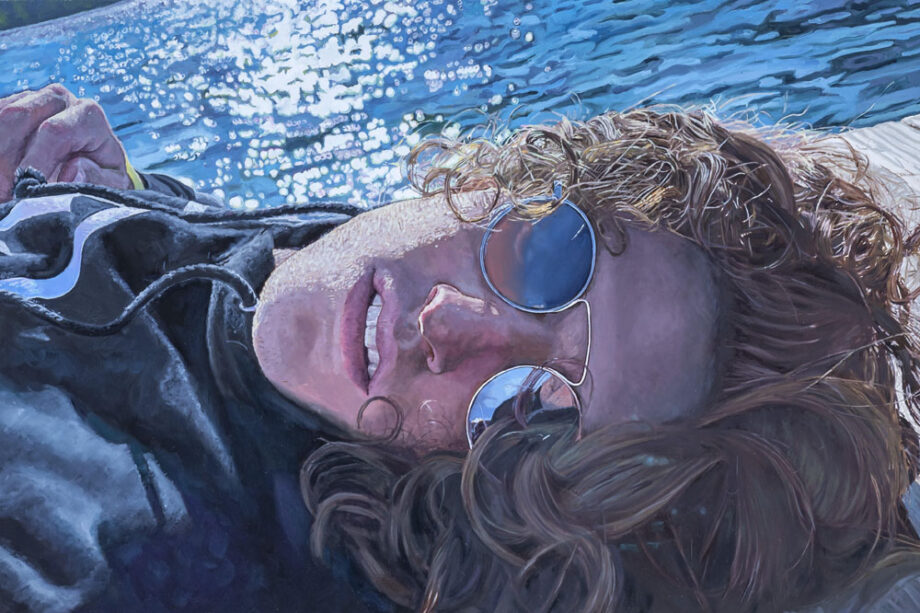
Making art has always been my most natural mode of expression. Creating something with my hands, eyes and mind always could be more highly curated than letting thoughts spill out of my mouth! I create because it has become habitual, meditative and satisfying. Harnessing creativity in both the process and end product is purely selfish; it fulfills a sense of productivity and feels like a daily hit of serotonin!
Barb Sotiropoulos
Award: digital subscription to the Colored Pencil Magazine
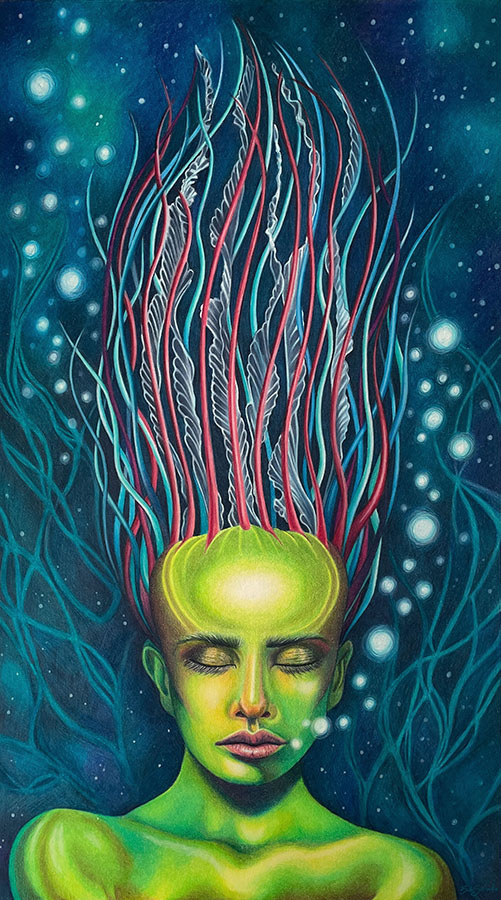
I have never known a time in my life when I wasn’t creating art in some way. There were seasons when I was able to create more abundantly than others, but I have always been driven to do something creative. In the times that I wasn’t creating as much art something always felt off or unnatural. I believe that artists are creative to their core and that when we aren’t making art our spirits often feel out of alignment. I endeavor to explore the themes and stories that I see in my head through my artwork. Often when these stories and themes find me they will haunt me until I create them. It’s almost as if they need to be born into the world somehow. As artists, I believe we are the conduits to make that happen. I create for myself, my spirit and to hopefully connect with others by experiencing the work I create.
Ali Rouse
Award: Gift Certificate from Jerry’s Artarama
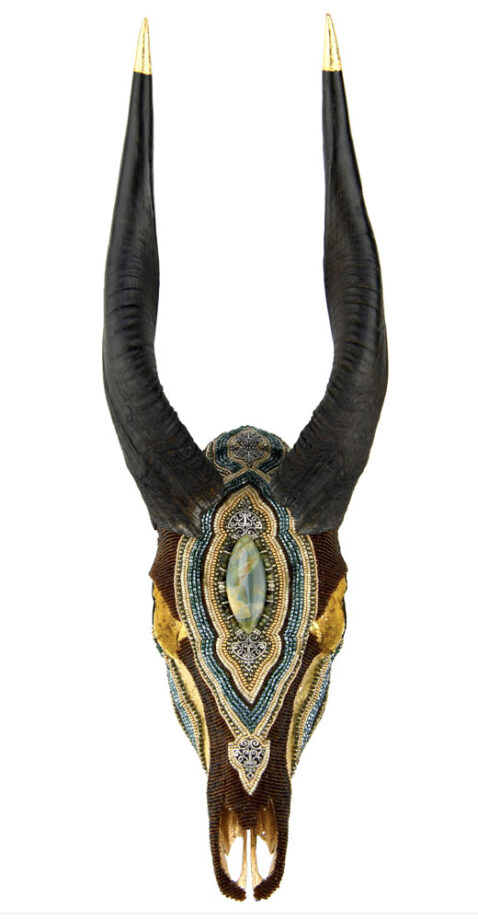
I create as I don’t know how to exist without creating. It is as breathing. Beauty is creation and creations surrounds us everywhere.
Nancy Jacey
Award: Gift Certificate from Jerry’s Artarama
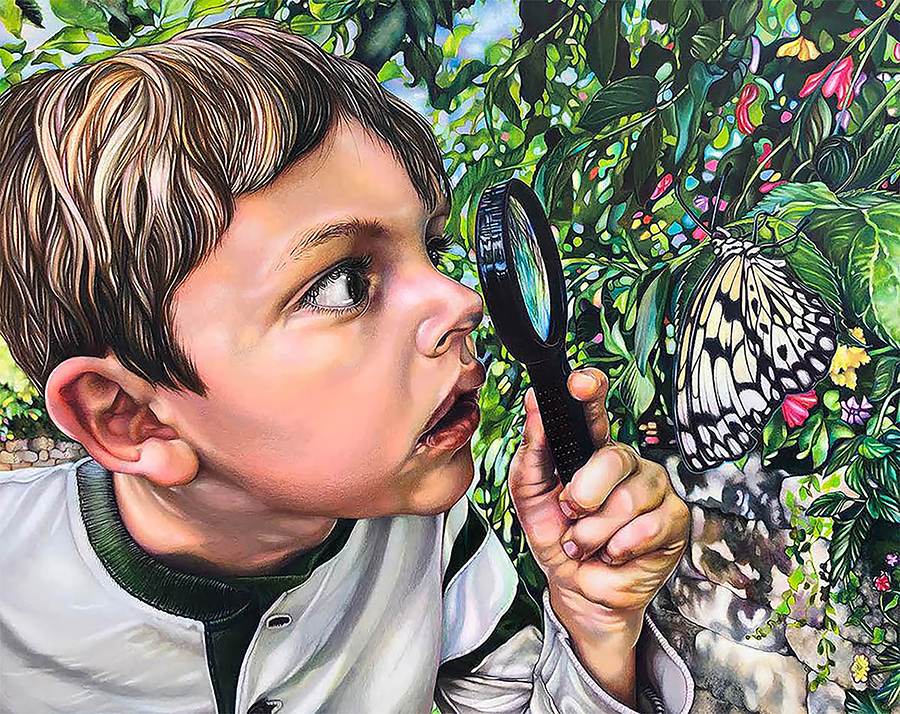
Every day I wake up inspired by the world around us: the colors, details and elements that make up our surroundings. I am fascinated by life’s details, and I like to reflect this in my everyday life and in my career as an artist. I constantly study and photograph the world around us and use these references and experiences in my artwork and in my teaching.
I like to vividly capture these personal interactions and bring them to life for my audience in large-scale oil, acrylic and colored pencil paintings. I work as a full-time artist, mother, small business owner and private art instructor.
Kimberly Raboin
Award: digital subscription to the Colored Pencil Magazine
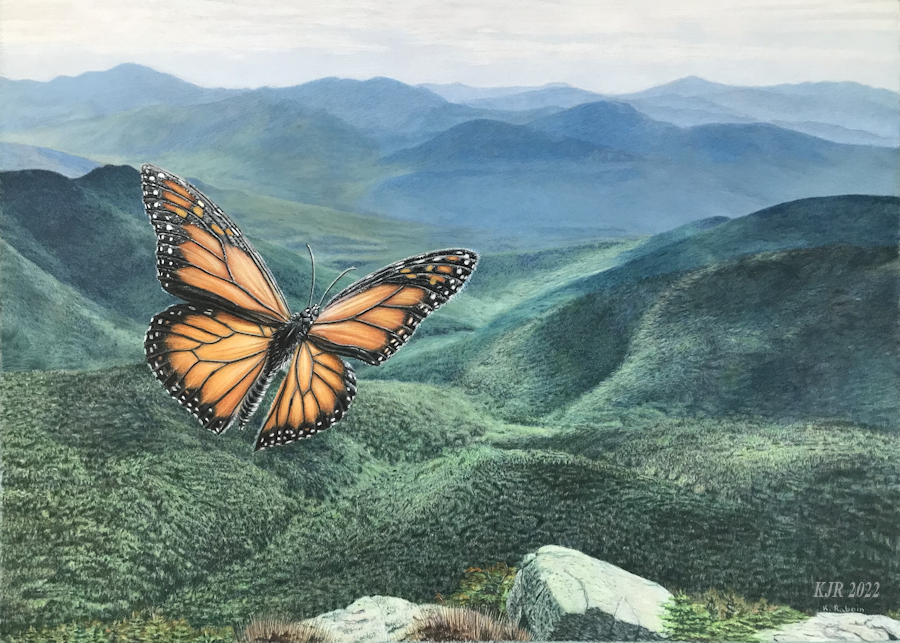
I create art because I want to capture the beauty of the natural world and also communicate inner experiences and emotions. Recently I’ve been practicing realism with colored pencil and my subject matter has been landscapes. In my landscape work I’ve tried to capture the beauty of places I’ve visited, and also the feelings I experienced while there. My hope is that my recent landscapes convey a sense of vastness and serenity.
My most recent colored pencil drawing ‘Wings of Renewal’ combines my love of landscapes with symbolism. The butterfly in this piece is a symbol of transformation and change. I hope to create more work that combines realism and symbolism.
Dean Rogers
Award: digital subscription to Create! Magazine
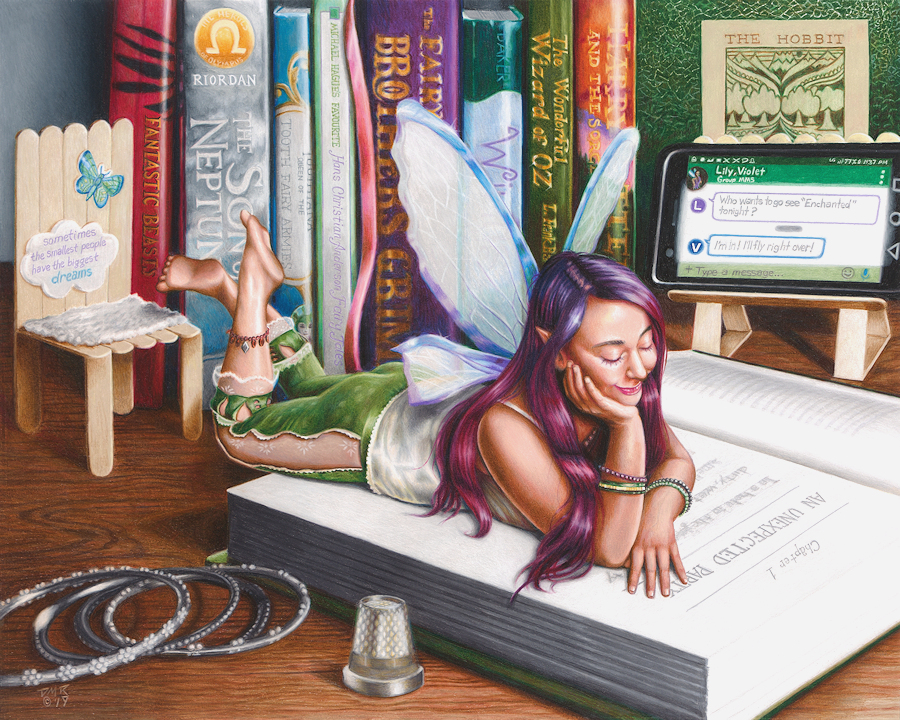
This piece represents the culmination of a lifetime of work. The books in the background are the inspiration for an incredible amount of artwork, as well as the series I’ve been creating for the last 5 years.
This series, “Fantasy Meets Reality” is about fantasy creatures who have crossed over into our world. I wanted to create a scene involving a fairy, and I couldn’t think of a better modern fairy pastime than reading relatively recent fantasy novels.
She is using a cell phone like a computer, and she is asking her friends if they would like to go see the movie “Enchanted” which directly inspired me to create this series.
Denise Howard
Gift Certificate from Jerry’s Artarama
I create for many reasons, but perhaps the most important one, and the one behind “Faith’s End,” is that I want people to stop and think, and come away with more than “that’s a pretty picture”.
Visual art has a power where words sometimes fail. Rather than hit the viewer over the head with an obvious message, which they might reject outright, I want them to use their imagination a bit to figure out what’s going on in the picture, what it means to them, and how it makes them feel. If it resonates with them, so much the better. I’ve spent a lot of years developing my skills, so I’d be lazy if I only used them for easily forgotten “pretty pictures”.
Kerry Simmons
Award: $100 Gift Certificate from Ampersand
I find joy and satisfaction in the act of creating. I see every new sheet of paper, or canvas as an opportunity to create something new, bring something into existence that is both my point of view and inspired by the work of other artists and the world around me. When I am painting or drawing I am able to let go of my worries and fears and just be in the moment. I’ve noticed time even operates at a different pace. If I’m thoroughly engrossed in what I am creating, time just whips by. I think for me, being able to create art has been an enormous gift, joy and comfort. One could also say it’s simply a compulsion as I can’t imagine life without it!
Dorian Vallejo
Award: digital subscription to Create! Magazine
This drawing is from a small sketchbook which I used to work from life in the warmer months. Working this way puts me in direct contact with a poetry of life that informs all the work I do. This practice sensitizes me to the beauty nature offers us on a regular basis. Most importantly, it also informs me of how that beauty can be used as a metaphor for the Good.
Ranjini Venkatachari
Award: digital subscription to Create! Magazine
When I discovered the art of Origami and how I can incorporate it in my Trompe-l’oeil still life, my work took a different trajectory. My usual collectors stopped buying my art because I didn’t make pretty still life’s using flowers or fruits anymore. I was discouraged, disappointed, I stopped drawing for a while too. But then I realized I stopped living as well. I was procrastinating, didn’t want to move out of my comfort zone I realized I stopped growing, that’s when I came across the concept of Dharma & Ikigai.
Dharma, is an ancient Sanskrit word that roughly translates to a soul’s purpose in life-the big reason why we are here, and it’s not just what we do, but how we do it, and why we do it. Ikigai is a similar Japanese concept on giving a person purpose life and living. I decided to draw for myself and that completely changed the way I looked at my own work. For me, art is the only reason to get out of my bed each morning and look forward to the rest of my life. I guess that’s how it is for the most of us artists, it’s our primal instinct without which we cannot survive. So I create in order to live my life to the fullest with a purpose.
Traci Wright Martin
Award: digital subscription to the Colored Pencil Magazine
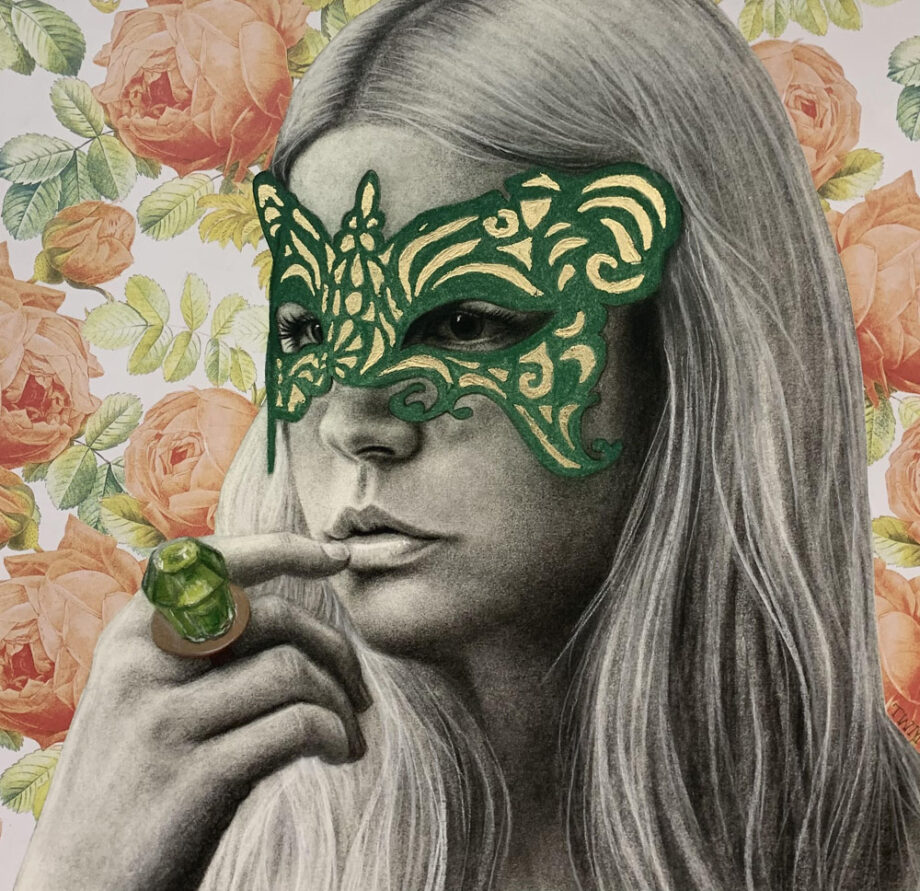
In all my years as an artist, I have spent the most time in an evolving exploration of the portrait. I am fascinated by people and their complex individuality. I marvel at the ability to build strong community by way of the smallest thread of commonality. It is my hope that each and every viewer finds a little point of connection or sees themselves somewhere in my work.
With these ideas in mind, the overall narrative in each series I create weaves in and out of a conversation on perspective and representation. Combined with charcoal drawing as the anchor, I carefully select colorful pastels, patterned papers, and paint techniques to further the themes and create a recognizable, unique identity for my body of work.
Dr. Carla René
Award: digital subscription to Color Crush Course
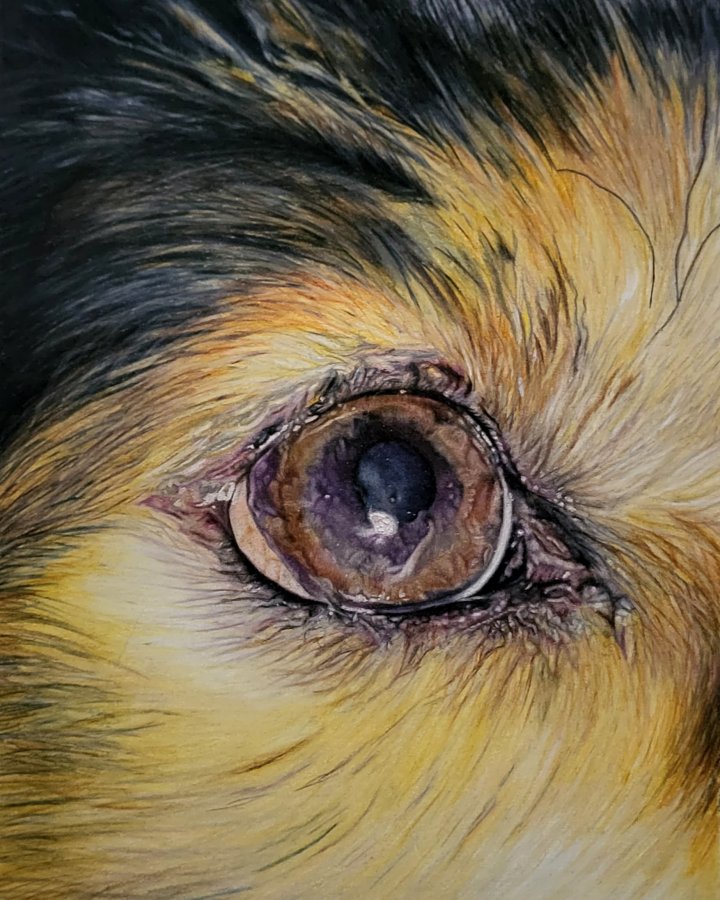
Long before “realism” was a genre in art, I described my artist self as “an arm with a camera on the end of it”. As a child, I was fascinated that the artist could possess the skill that would mimic the accuracy of a photograph so no one could tell the difference.
Now as an adult, an astrophysicist, and mathematician, the laws of physics show this mysterious symbiotic relationship is possible, so I strive to prove this on a personal level through every piece I produce. I have also developed an original technique using only standard CPs that emulates watercolors, since my attempt to learn them was disastrous. As my confidence grows, I’m able to explore my love of physics by experimenting with chemically-diverse tools. I AM a woman in STEM, and proud. I want to encourage others to find the joy of science, tech, engineering & math as I did.
I’d like to thank all the sponsors of this art competition. Please follow the links to discover awesome products they offer for artists to be creative!
Sponsored by:



ART SHOP
One reason for art collecting nobody is talking about
Nobody is talking about the fact that most people don’t buy contemporary art. There are too few art collectors and plenty of artists around. Art fairs are very popular but less than 1% of all visitors buys art. Mid. range and small galleries barely break-even selling art for a 50% markup. It angers some artists because half the price goes to the gallery while the artist pays for supplies, frames, studio costs, contest fees, lofty membership dues, ads, shipping costs, education, college loans and so on. But the galleries are also stuck with big overhead costs and promotion expenses. So it’s very clear that only top galleries like the Gagosian & Pace make lots of money selling art, and very few artists are really successful.
Of course it depends how you define success but by going to major art fairs, reading books and visiting art galleries I see what I see. Nobody is talking about the fact that artists’ careers are catapulted through top curators, gallerists and shows in MOMA. Everyone else is out of the circle and must be very creative to find his/her niche. While it’s totally possible to find the niche and be successful in this space, the winner still takes it all. You can find “9 key insights on the auction market in 2021” to prove my point: https://www.artsy.net/article/artsy-editorial-9-key-insights-auction-market-2021/?utm_medium=email&utm_source=gallery-nurture&utm_campaign=b2b-2022-a4g&utm_sfc=7013b000001RN3VAAW&mkt_tok=NjA5LUZEWS0yMDcAAAGB8iubjIOlRABgCTQrtp2eNagCU-f2yrrUchtIECccP3JLjS3rFkLxV9uNj_VHYy2f_rgpg5z0r186WdxUrf7yjjS_Fp3e_32hoNKIQ3Sf_6mqVLg
I think it’s time to stop scrolling Instagram and start collecting art or perhaps scroll it to collect art. 🙂 Even if it’s a very small painting, you make a difference in artist’s life and give a reason for him/her to continue living on a path few people choose to take. Artists need to make money to make more art.
Artists create because it’s a big part of them. There is no life without art for a creative person. Artists can’t wait for a retirement to be artists! It’s like living without a heart. Can you live without your heart? ?Art collecting should be about emotion, aesthetics and enjoyment looking at art, and not about speculation or investment. CURATE YOUR TASTE to feel inspired!
Start shopping
Highlights from CONTEXT ART MIAMI 2021
Miami swells with art and artsy crowds during the first week of December every year ( with no fairs in 2020). There are several top art fairs happening in the city that bring the art lovers and professionals from all over the world. Art Fairs include the Art Basel, Scope, Miami red dot/ Spectrum, Context art Miami and some more! In addition, some hotels organize art events during this time too to draw people in. The fairs are spread out in the Miami Beach but the locations stay the same year after year.
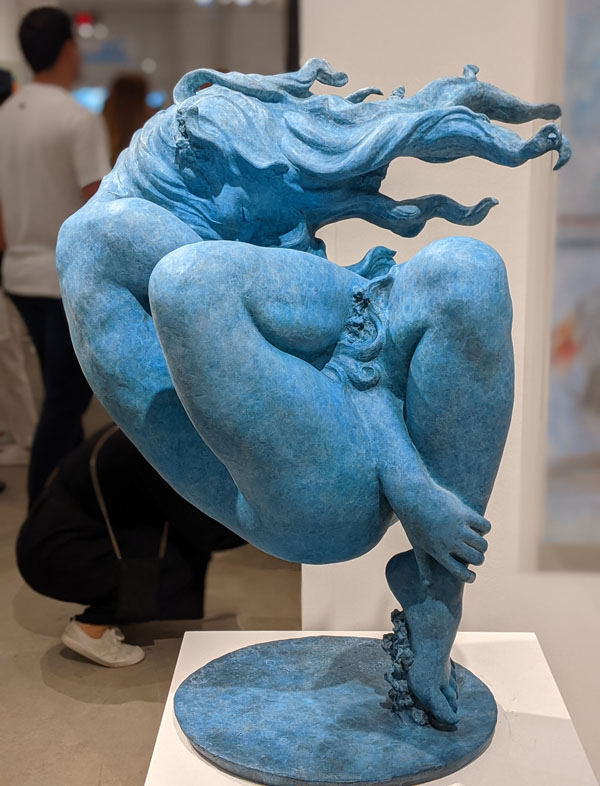
Miami Art Context 2021
I visited Context Art Miami during the opening hours in early December thanks to my friend Florencia. It felt like a big celebration of the arts. There were so many visitors, artists, gallerists, curators, art collectors, museum professionals and yes, celebrities visiting the fair, it almost felt crazy to experience so much energy in one place. While not every art piece was great, I loved to look at variety of contemporary art, pushing the boundaries of what art could be. I enjoyed seeing boldness and innovation, creativity, the use of textures and materials, and 3D-art.
? As long as artists create on this planet, we won’t be consumed by the existing darkness on Earth.?
This is a short video shot with my phone where I tried to capture realist art as well as some innovative pieces. Some of the artists shown are: Carole Feuerman (hyperrealist sculptures), Anthony James (light sculptures), Coderch & Malavia sculptures, David Uessem, Damien Hirst, Marco Grassi and so on.
As far as I know the rules of participation for the galleries have been relaxed somewhat, which used to include the following: The gallery must have a physical location. It must be in business for over 3 years. And it must pay a hefty fee. Depending on the size of the booth, the cost of gallery participation amounts to $20,000-50,000 (Context Miami. I’m pretty sure that Art Basel is even more expensive to participate in). This doesn’t include, airfare, hotel, meals and staff salary. So you can imagine that the art shown at Art Basel reflects this pricing and not every gallery sells out… Galleries are on the hunt for top collectors, institutions and celebrities buying art from them. While there were fewer visitors than in the previous year, sales were robust according to Artsy.
Spectrum Miami review
Finally I want to mention another popular art fair- SPECTRUM Miami located in Wynwood. I mainly want to record my opinion here, so if you plan to exhibit at this fair, it might not be what you think it is, or perhaps it’s a lot more than you thought of it in the first place. I’m going to compare it to Context Miami fair. So Spectrum is all about emerging artists taking charge of their careers and exhibiting there, not the galleries working on their behalf. The space and lighting isn’t top notch. The crowd coming to the show is very different. Young, excited to go out and celebrate. My question was if there were any art collectors there at all. My guess, there were few. Of course, the cost of renting a booth is much cheaper just as the price of an entry ticket in comparison to the Context. Finally the quality of art is very different from the Context, showing young artists with most being Florida-based…Perhaps there is a lot more to the Spectrum but these are valid points to consider either visiting or exhibiting in this art fair.
Check out visionary art for sale
Jesse Lane, realist colored pencil artist
My guest is super talented, realist colored pencil artist Jesse Lane. His large, realist colored pencil drawings demonstrate thorough understanding of colored pencil techniques, creativity and vision. He is the recipient of many prestigious awards including The Best of Show in 2020 by the Colored Pencil Society in America.
Jesse shares his thoughts on motivation, artistic challenges, emotions, creativity and much more! Personally, Jesse strikes me as a genuine human with positive, outgoing personality that helps him fulfill his destiny and share his art with the world.
Recorded in a video format first: https://youtu.be/1i0nFiS59bQ
Website: https://www.jesselaneart.com/
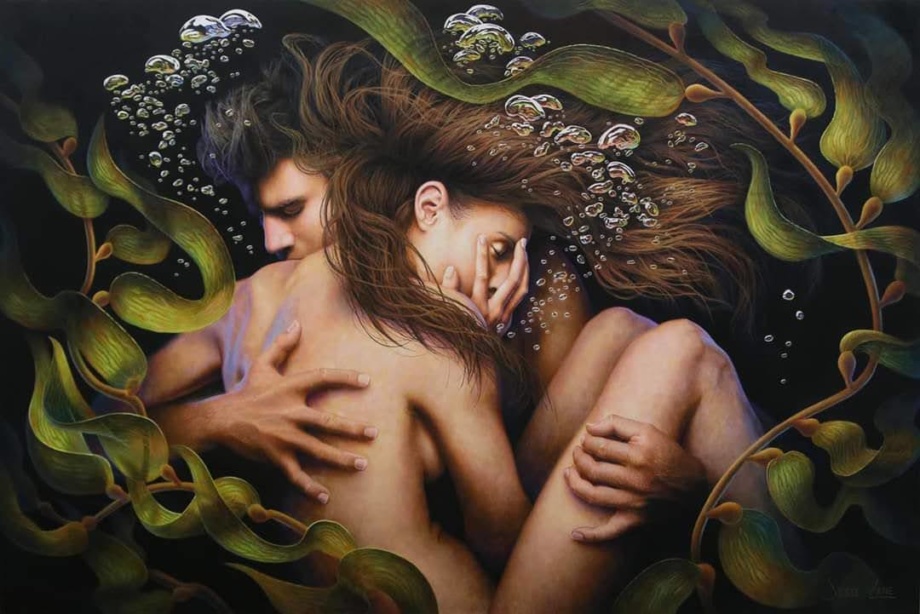
Veronica can be found at veronicasart.com
Podcast: Play in new window | Download
How to commission art as thoughtful art collector
If you have a specific idea or want to commission a portrait painting you need to learn how to approach the artist you like. So how do you approach the artist to create a beautiful artwork for you? In this episode I’d like to discuss what the artist needs from you in order to fulfill your commission. It’s a wonderful experience to own original art at home or office. Art collecting is a great way to show who you are, create unique space and support contemporary artists!
Reach out with questions or topic ideas at Veronicasart.com . Follow on Instagram @veronicawintersart
Hooked on Art podcast is one of the Top 10 Art Collecting Podcasts on the web rated by Feedspot: https://blog.feedspot.com/art_collecting_podcasts/
Podcast: Play in new window | Download
How to commission art as art collector: 8 things to know what artist needs to make a great, commissioned painting
If you’ve decided on a specific idea or want to commission a portrait painting you need to learn how to approach the artist you like. So what’s the right way of communicating your idea and understanding what the artist needs to produce a custom art piece? In this article I’d like to discuss what the artist needs from you in order to fulfill your commission.
Damien Hirst: genius or imposter? Solo show at villa Borghese in Rome
Damien Hirst’s show at Villa Borghese in Rome
I revisited the Borghese gallery in Rome in September 2021 and saw Damien’s solo exhibition titled “Treasures from the Wreck of the Unbelievable.” It’s a collection of sculptural works from a fictional shipwreck off the coast of East Africa. Walking around the gallery, I couldn’t help but notice a thoughtful placement of the artist’s pieces in the rooms. Most fit organically into the gallery space that goes overboard with art by design. The powerful Borghese family members were avid art collectors and patrons of the arts. That’s why their exuberant art collection boasts so many masterpieces by the 16th and 17th-century artists like Caravaggio, Bernini, and Canova.
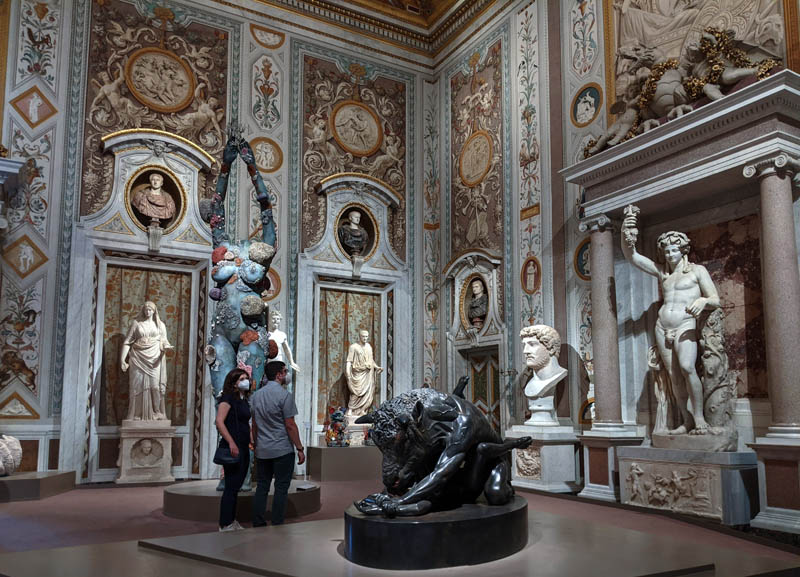
Born in 1965, Damien Hirst is a British contemporary artist who explores the theme of life and death. Because he sees no separation between life and art, this theme becomes his art, which is an amalgam of painting, sculpture, and installation. The theme of death is one of the central themes in the Western art world, but every artist can take it into a different direction…
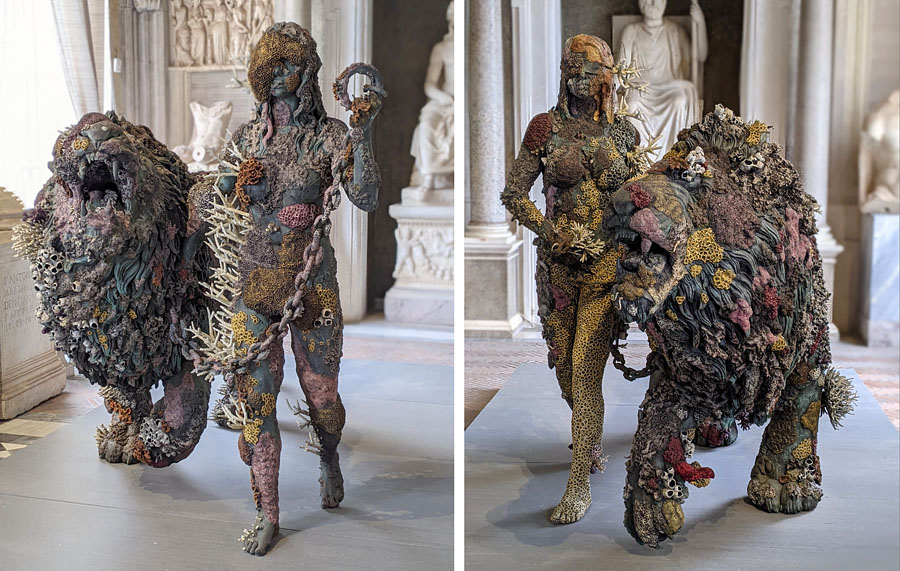
First shown in Venice in 2017, “Treasures from the Wreck of the Unbelievable” is a show with some merit. Sculptural works utilize traditional and precious materials, such as marble, alabaster, lapis lazuli, coral, crystals, malachite, and bronze. Some sculptures breathed with beauty and classicism, long forgotten by contemporary art galleries. It was fun to spot contemporary art by Hirst standing right next to the antiques of the Borghese gallery’s permanent collection. Some sculptures evoked a sense of rescued objects from the ocean floor, as colorful barnacles and sea creatures adorned the surfaces of many sculptures. Somebody’s limbs were missing or obscured by the sea overgrowth.
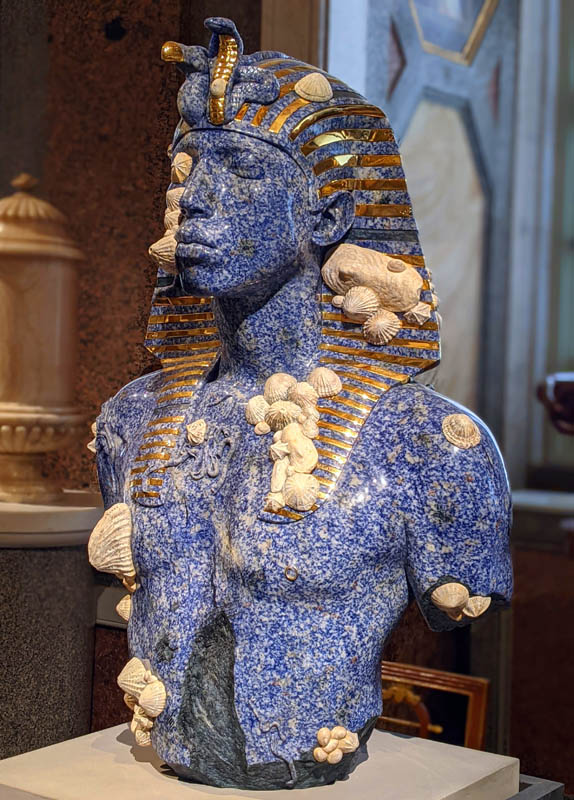
While most of it fit well within the space, the sculptures were strikingly different in the level of execution. It prompted a question of who really made these artworks and how much of it was Hirst’s skill and vision. Some were very classical in nature, while others looked like the leftovers from modernism. Some sculptures were beautiful and engaging, while others looked strange and too primitive to be called ‘art’ especially in comparison to the art collection of the Borghese family.
How original is Damien Hirst?
Hirst is the all-over-the-place artist, in my opinion. He produced a variety of art that would be frowned upon in any graduate school where consistency of theme, size, and approach is encouraged and basically required to graduate. And this is where the rules get broken… The artist rose to fame with several controversial art pieces. The notorious diamond skull, beautiful entomology paintings, sharks in formaldehyde, pill cabinets, dot paintings, neoclassical sculptures, installations, and so much more – everything made by Hirst or it may be not.
I think it’s ok to evolve and transition into new art forms or bodies of work over the years as we artists experience change, and so art changes with us. However, Hirst seems to drift from one idea to the next that doesn’t have a clear connection to his previous work in either technique or vision. Usually, we can see one work by the artist and recognize the “style” in subsequent work,s even if it’s quite different. Hirst puzzled me in this regard because his series of paintings or sculptures had no connection to each other.
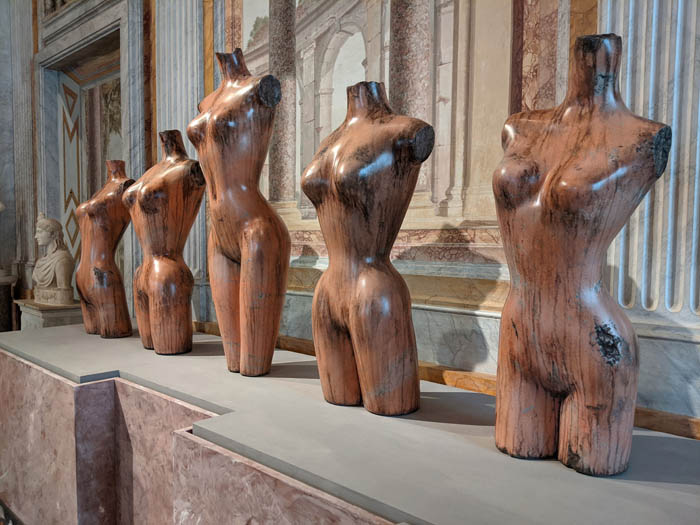
Art Workshop
The exhibit made me think of a Renaissance workshop. Workshops used to be the only way of learning and training young artists in Renaissance Italy. That’s how da Vinci painted his first angel in Verrocchio’s painting (The Baptism of Christ, 1475, Uffizi gallery, Florence). Vision and ideas were of the master artists who painted major figures and finished paintings. Master artists worked on image designs, composition, color, and so on, while art students mixed paints, helped with image transfer and did some underpainting. Based on the presented sculptures I saw at the Villa Borghese, the Damien Hirst workshop functions quite differently. The apprentices seem to be the creators.
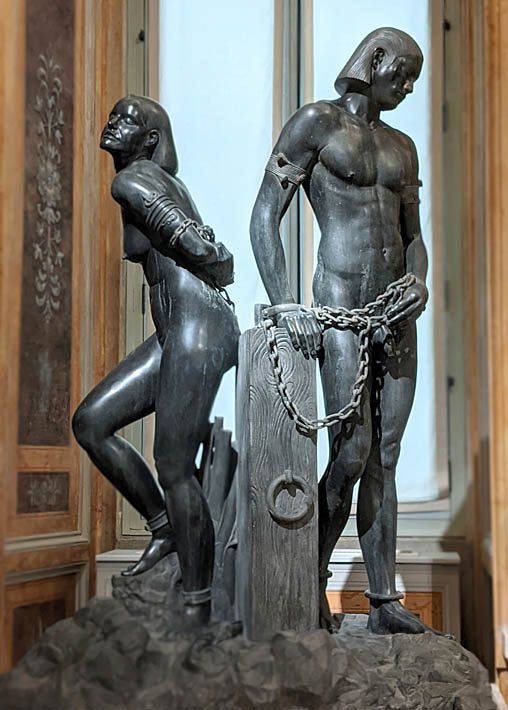
His workshop may produce all the art with some apprentices (artists) being very skillful at their task. That explains the great inconsistency and variety of the produced art by Damien Hirst. Painted bronze sculpture “Pair of Slaves Bound for Execution” was the most exceptional, contemporary art piece I’ve seen in a long time, showing balance, grace, and the perfection of anatomy, central to classical art. “Unknown Pharaoh” is one of my favorite pieces. There is a beautiful balance between materials, color, and form. This sculpture gives a feeling of a real piece saved from a shipwreck. While another sculpture with a giant foot, squirrel, and ear looks immature. The standing bronze figure of Hirst appears grotesque to me as well.
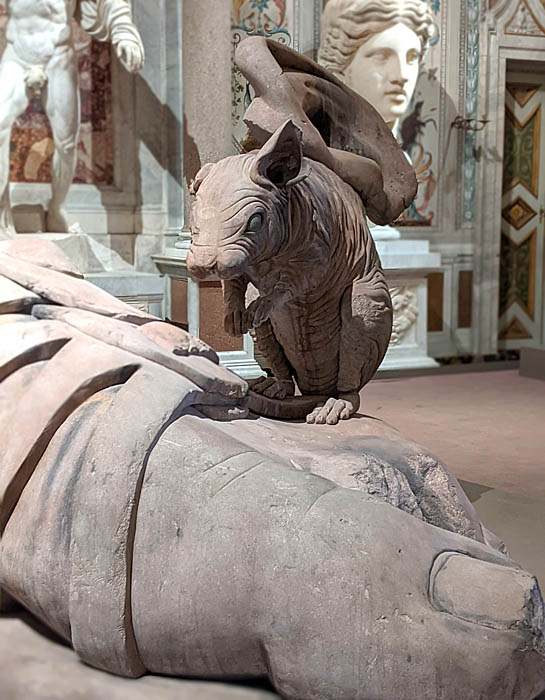
Are workshop artists mere laborers or the creators on their own right? Based on the produced and shown art at the Villa Borghese, Hirst created a factory of talented artists who do all the work but marketing. And in this case, it looks like marketing is everything, really. Remove the name from any of these works, and they won’t be fetching top dollar for art.
Now, many famous contemporary artists keep workshops. We can explore the workshops of contemporary realist artist Kehinde Wiley or the glass blower Chihuly. You can find their art pieces in many permanent museum art collections, private art collections, hotel lobbies, and so on. The key difference is that these artists are true to their unique vision, and every piece feels like a continuation of the artist’s previous work. Apprentices in their workshops are the helpers, not the sole creators of art. That’s my opinion, of course, you may not agree with.
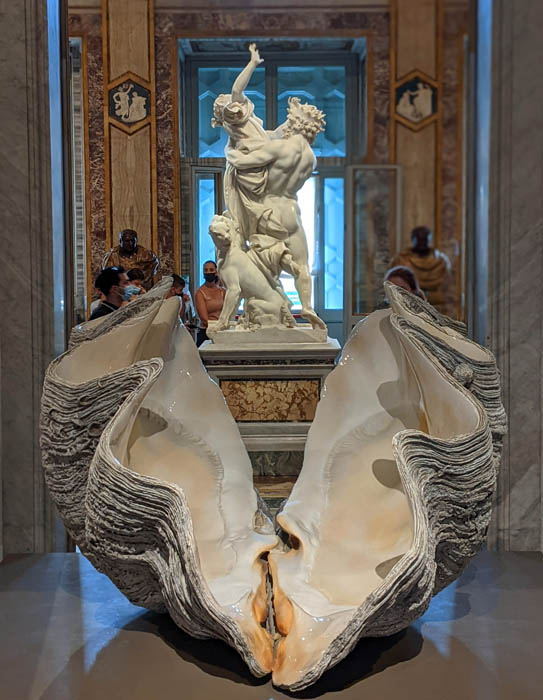
There is no doubt that Damien Hirst is a very smart artist. He is also a great publicity guru. He created and marketed himself as a top luxury brand for the wealthy to invest in. There is a lot to either admire or learn from this living artist. What do you think of his art? Share.
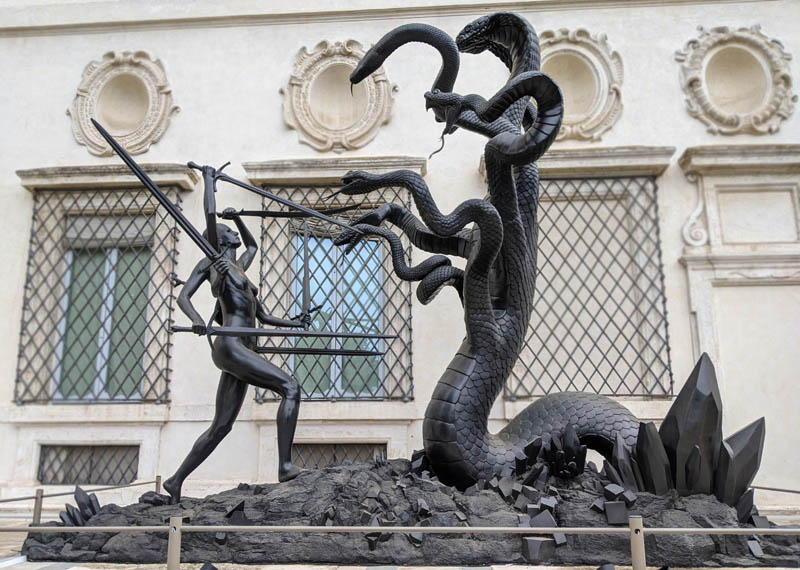
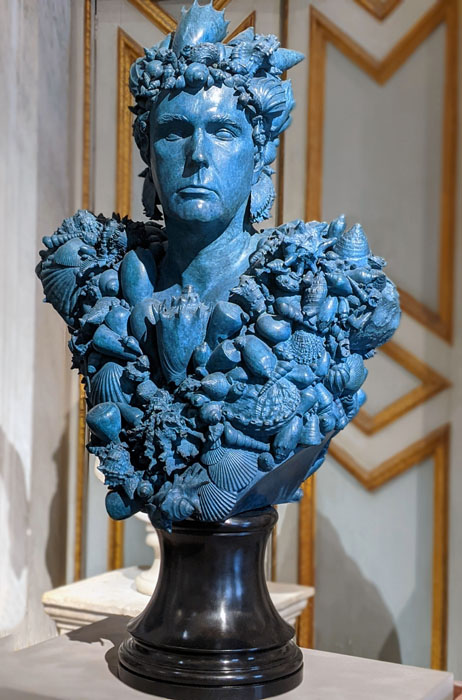
Learn more: https://damienhirst.com/
This blog is created for educational purposes with the art credited to the cited artists. All pictures are taken by Veronica Winters. The article expresses personal opinion only.
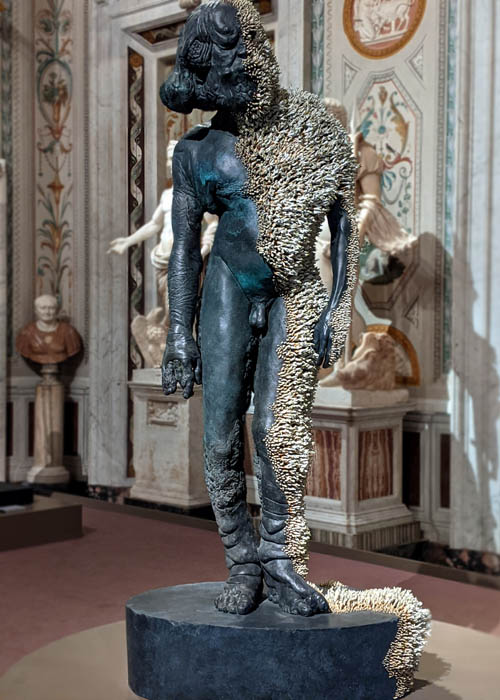
Check out visionary art for sale
Amanda Greive: oil painter who speaks of equal rights
Amanda Greive is a figurative realist artist who paints women to bring attention to challenges many women face, splitting life between family and work. By looking at Amanda’s beautiful, realist oil paintings we can get a much deeper understanding of her subjects and motivation behind painting.
First appeared as a video podcast on YouTube in March 2021: https://youtu.be/x68uKGQn8Ns
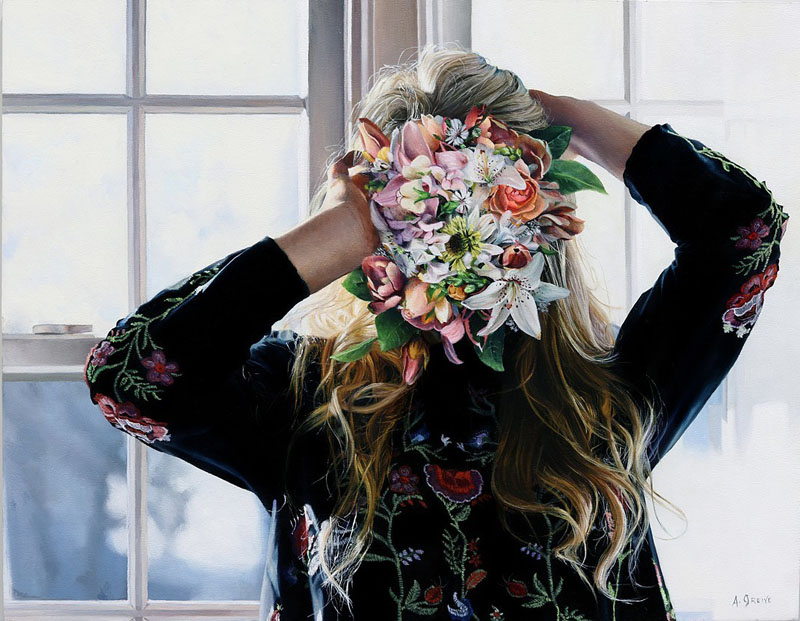
Contact the artist:
Web: https://amandagreive.com/
Contact the host:
Support the channel/donate: https://www.paypal.com/biz/fund?id=XEALQ6AHQ22EN
Veronica Winters, M.F.A. | https://VeronicasArt.com | https://www.instagram.com/veronicawintersart/
Podcast: Play in new window | Download
6 Tips for Arranging Wall Art in Your Home
Whether it’s your own work, a cherished gift, or an important purchase, a piece of art is one of the best ways to personalize your space. However, deciding where to place art and the best way to hang up a painting can be challenging. Thankfully, there are several rules of thumb to guide you. The following tips, along with 1stDibs’ illustrated advice on how to arrange wall art, will help you decide the perfect ways to exhibit art in your home.
1. Where to Hang Art
Small pieces look lost and awkward when placed alone on expansive walls. If you have a large wall to fill, consider finding larger works that make a statement. Alternatively, you can pair multiple small pieces together in a grid setup or gallery wall to help fill the space.
Other ways to display art include propping them up on a mantelpiece or floating shelf. This approach allows you to easily move pieces around without damaging the wall.
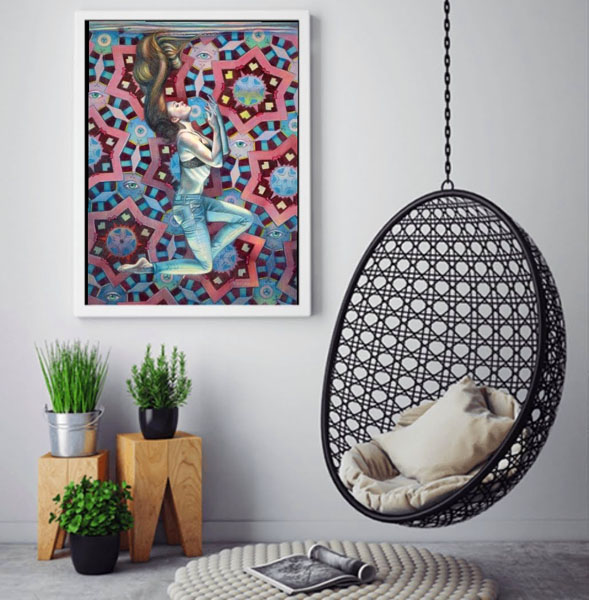
2. Plan your art wall display
One of the best things you can do before hanging wall art is to make a solid plan. There are several great methods of envisioning pieces on a wall before hanging them up.
First, you can try out art visualizer tools and interior decorating apps on your phone that use augmented reality to show you how a painting will look on your wall. This will not only help determine the best placement for an art piece, but will also show you how the colors will either complement or clash with your existing decor. There are lots of these digital tools out there, so you can search through the app store to find the best one for your needs.
Second, you can try using kraft paper to plan an arrangement. To do this, cut out kraft paper pieces that are the same sizes as all your art pieces. Adhere the pieces of paper to the wall with painter’s tape to find an arrangement that you like. This is also a great way to experiment with spacing between pieces before you hang them up.
3. Measure your wall space, furniture & art
Spacing out art and deciding on the best height to hang pieces is sometimes a matter of intuition. However, if you’re unsure where to start, here are some suggestions.
Hang art so that the middle of the piece sits at eye level, around 57 to 60 inches above the floor. This way, people walking by will get the best possible viewing experience and won’t have to strain to see the work.
When hanging art right above a piece of furniture, such as a sofa or console table, it’s aesthetically pleasing to keep the width of the furniture wider than the art above it. A general rule is to keep art above a sofa ⅔ the width of the sofa.
What about spacing in between multiple art pieces on a wall? In general, it’s a good idea to leave anywhere from 3 to 6 inches in between the pieces.
4. Decide on either Symmetrical or Asymmetrical wall art display
When planning an art display with multiple pieces, it’s important to ask yourself if the room would be better suited to an asymmetrical or symmetrical arrangement.
For a tidy, traditional-looking display, choose a symmetrical layout such as a grid, diptych, or triptych of identically-sized pieces.
For a more diverse feel, put together an asymmetrical, salon-style gallery wall. In a gallery wall, you can pair different sizes and styles, but it’s best to maintain cohesion by keeping a running theme or repeating color palette.
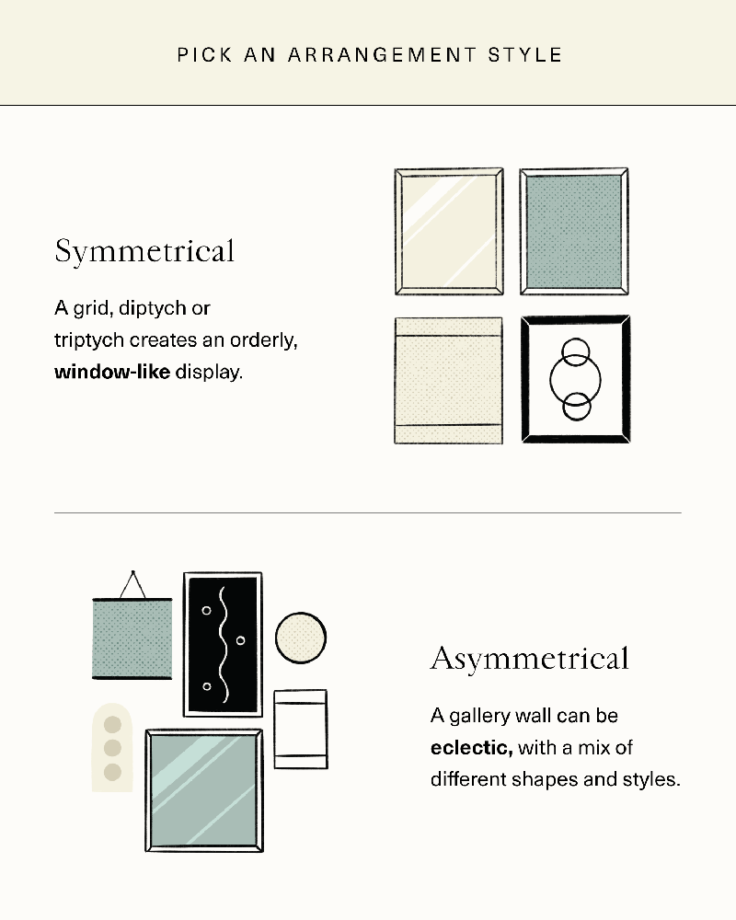
5. Create visual balance
In the aforementioned gallery wall setup, how do you keep everything visually balanced?
A great way to start is to hang up the largest pieces first. Put up a large art piece near the center of the wall to draw the eye to a focal point. Then, hang the smaller pieces around it to create visual interest.
Another approach is to imagine an invisible line down the center of the wall. When you hang up your art, keep the same visual weight of pieces, large and small, on both sides of the line. This way, you’ll ensure the wall stays balanced and unified.
Finally, if you’re lining up different-sized works horizontally, align the centers, not the tops or bottoms of the pieces.
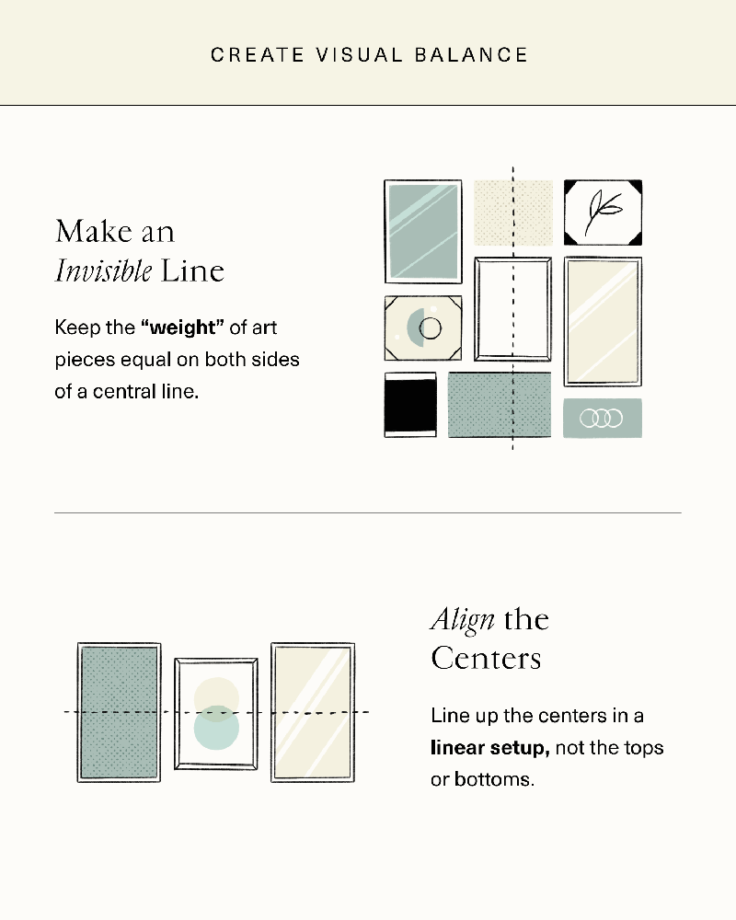
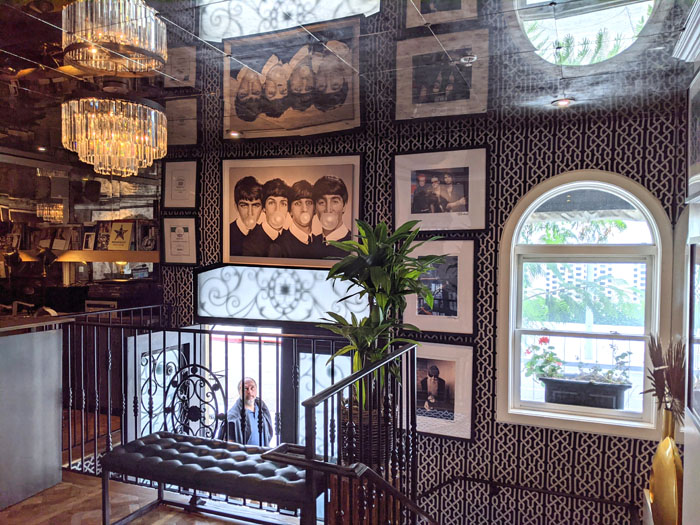
6. Experiment with the layout on the floor
If you have no visualization apps, place your arrangement on the floor first to see how art pieces harmonize together in size, theme and color. I often collect pictures of my favorite wall art displays in a digital folder. Some art arrangements include more than art, such as decorative mirrors and metal sculptures. Experiment!
These tips will help you get started creating a beautiful art arrangement that will enhance your home and make for a visually pleasing display. That said, showcasing art is all about creativity, so feel free to break the rules and follow your instinct whenever it feels right.
You can also see other wall art designs and ideas here: https://porch.com/advice/design-best-gallery-home
Check out visionary art for sale
Further reading: https://veronicasart.com/art-collecting-101-6-ways-to-display-art-beautifully-at-home-office/
Art Collecting 101: 7 ways to display art beautifully at home & office
How do you display art? While being an art collector may sound too serious, many of us have paintings at home. They may be small or by the unknown artists, gifts or simple prints that decorate our spaces. So we want to hang them prominently to add beauty and peace to our homes. There are several effective ways to display your art collection at home and office.
What’s to consider in wall art display
When you want to hang your painting, consider the following parameters:
#1 Consider the wall space size to make a statement with large art.
Large painting should take the majority of wall space in a room’s center. The art should have some of the colors seen in the room. Give one prominent art piece all the space it needs. Arrange other paintings around it.
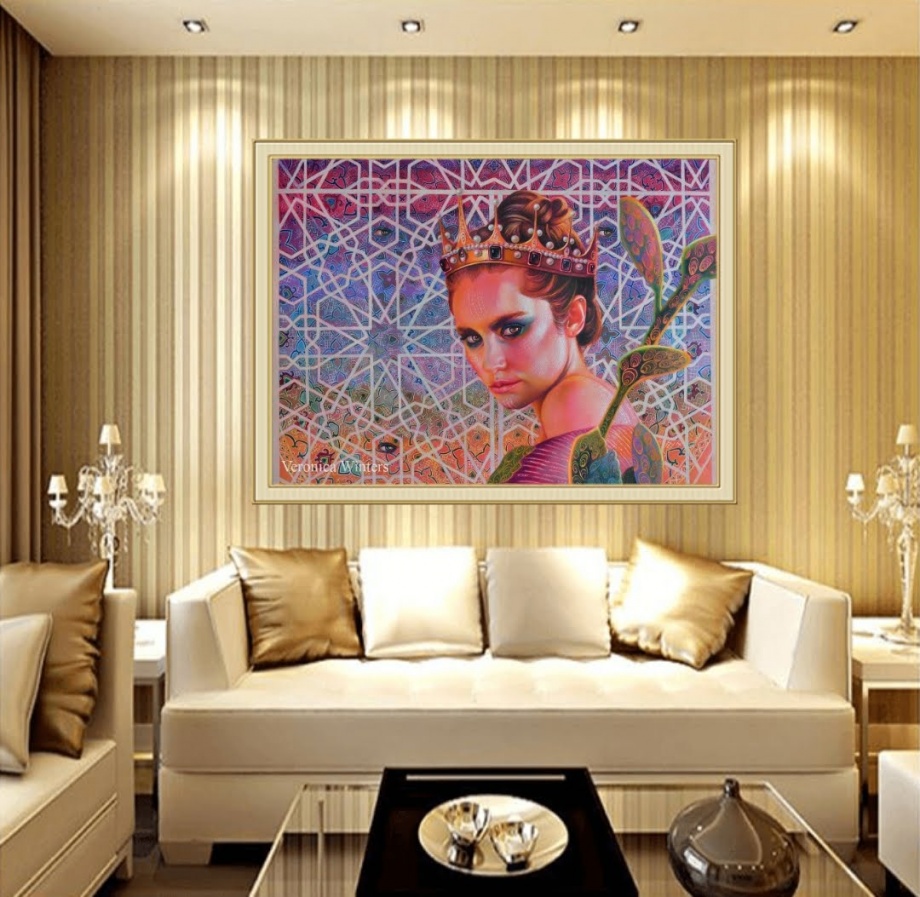
Don’t place small artwork too high on a large wall
One big mistake people make is placing small artwork too high on a large wall, so it gets lost in the space. Consider hanging one large painting instead. It should take up most of your wall space. It’s easy to determine the length of the painting by measuring the length of your sofa. Art should take 3/4 of its length.
#2 Painting’s size. Display art in multiples or in tight arrangements.
You’re not doomed, if you have small paintings. Small art works great in intimate spaces with small walls in a corridor or kitchen, or in a cozy guest room. Small art can also be a part of multiples arrangement.
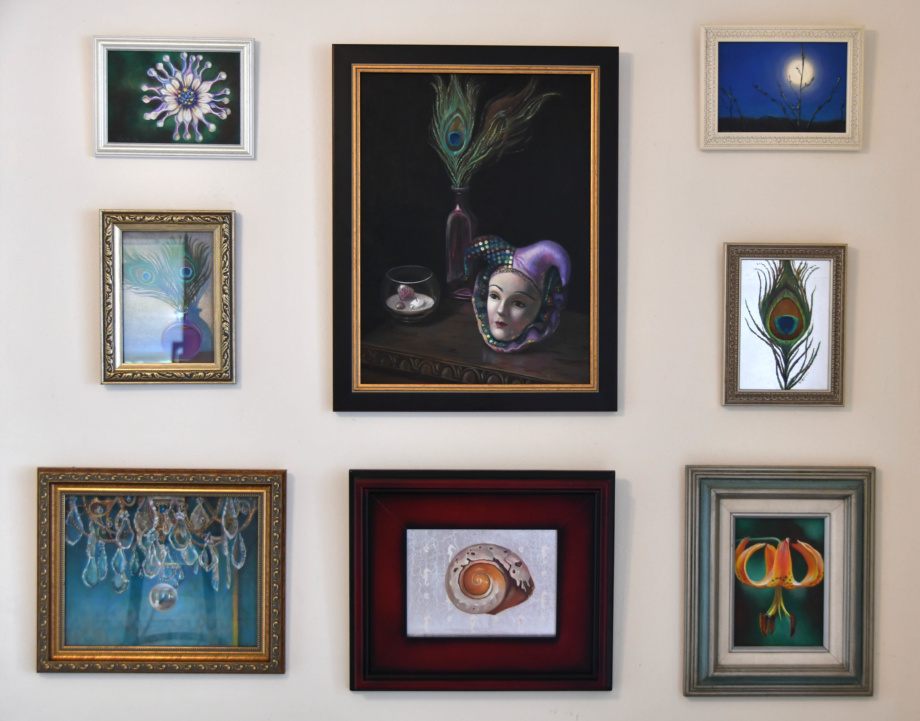
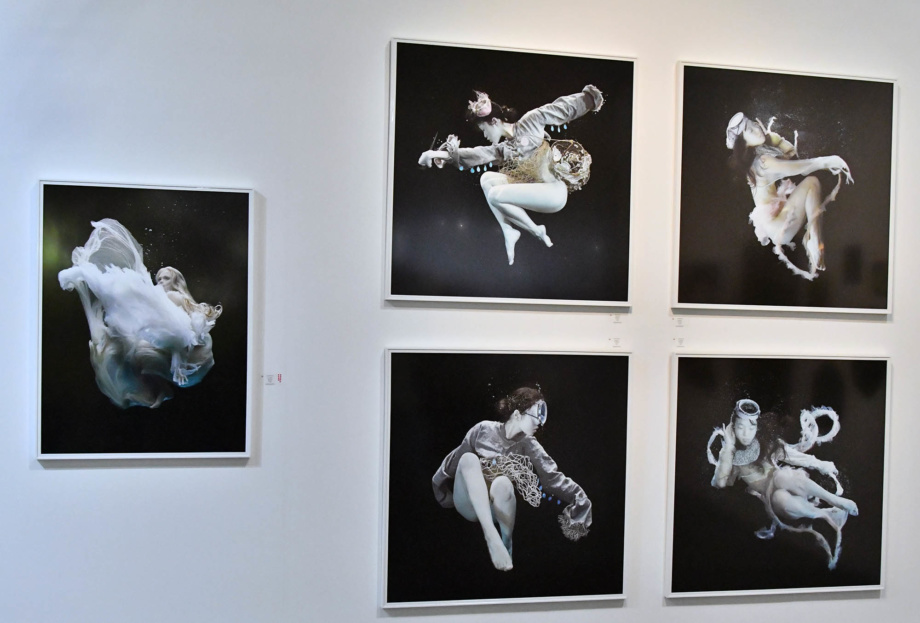
#3 Other wall art display ideas
Consider other displays shown below.
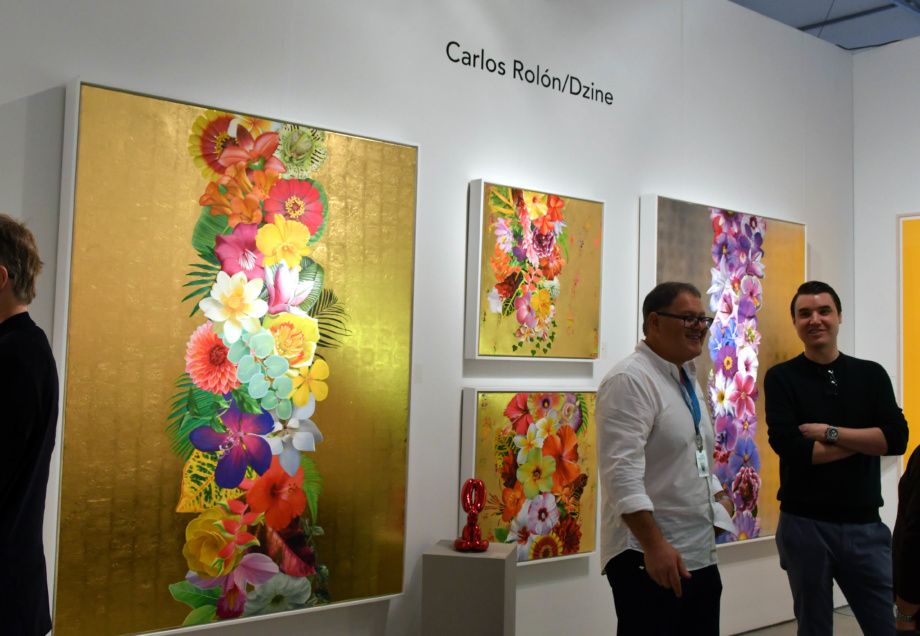
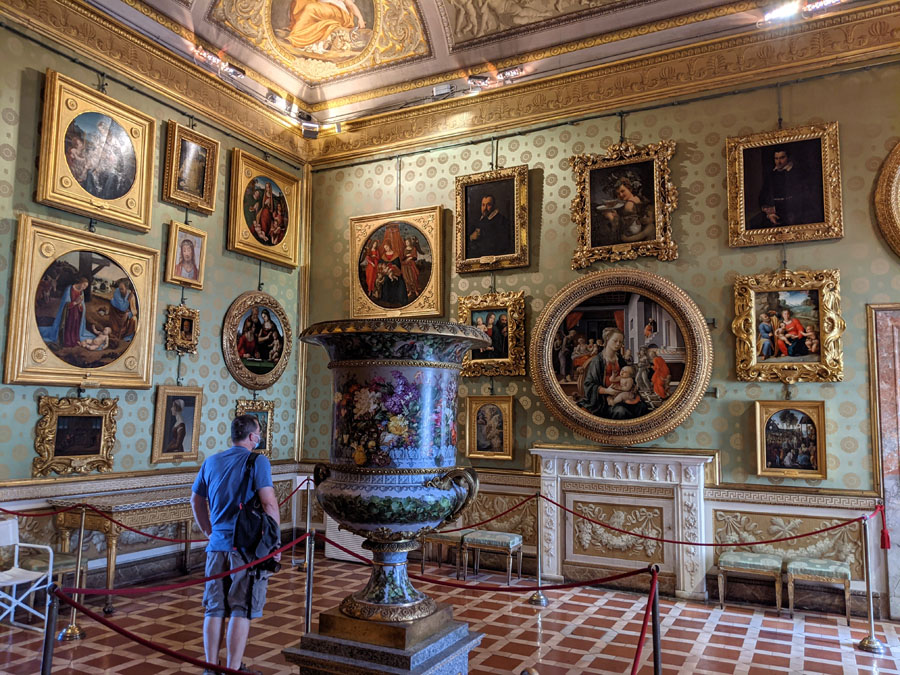
#4 Let main colors of the painting “connect” with the hues of your home accents
Color harmony. Color harmony is important in every space. Usually, if you have light and neutral walls, almost any artwork would fit into the room beautifully. Sometimes walls might have strong colors, and it’s tricky to find the right painting for it. Your chosen painting should echo some of the hues you already have in the space. Yet, sometimes it works great when strong colors of the wall complement the main color in the painting.
#5 Don’t mix gold and silver accents in one room
Try not to mix gold and silver (frames, chandeliers, furniture and accents) in one room. It’s overwhelming visually.
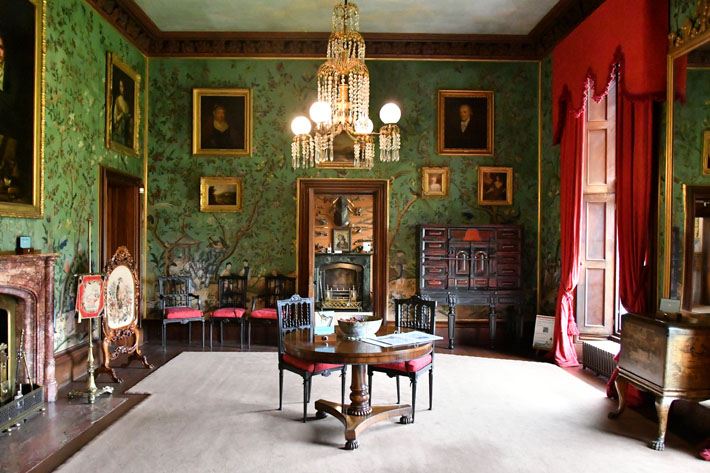
#6 If you have an art show…
If you have an art show, hang you wall art at the 57-inch level.
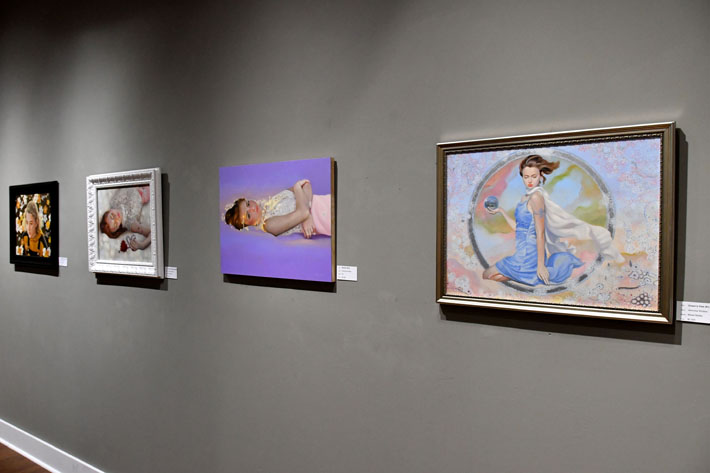
#7 Frame art well
Think how the frame style complements both your art and interior space. Do you have contemporary, white space with clean lines and minimalist appearance or do you like baroque-inspired rooms? Framing should reflect your aesthetic to have coherent look.
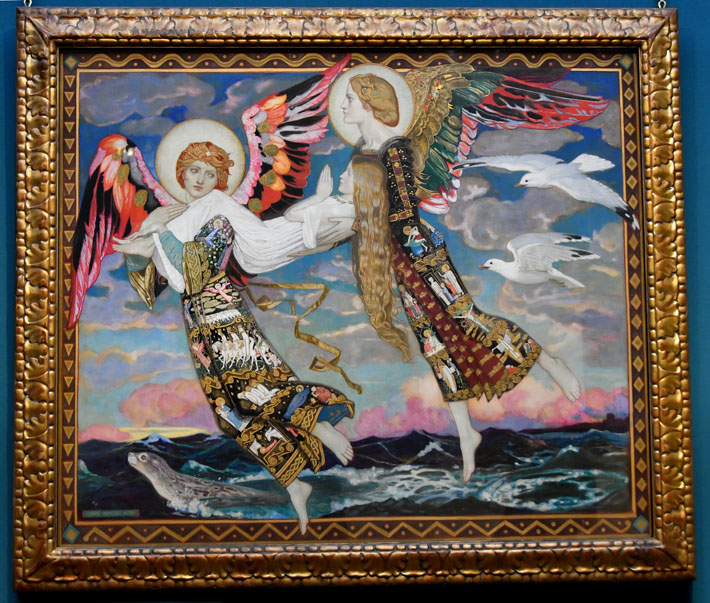
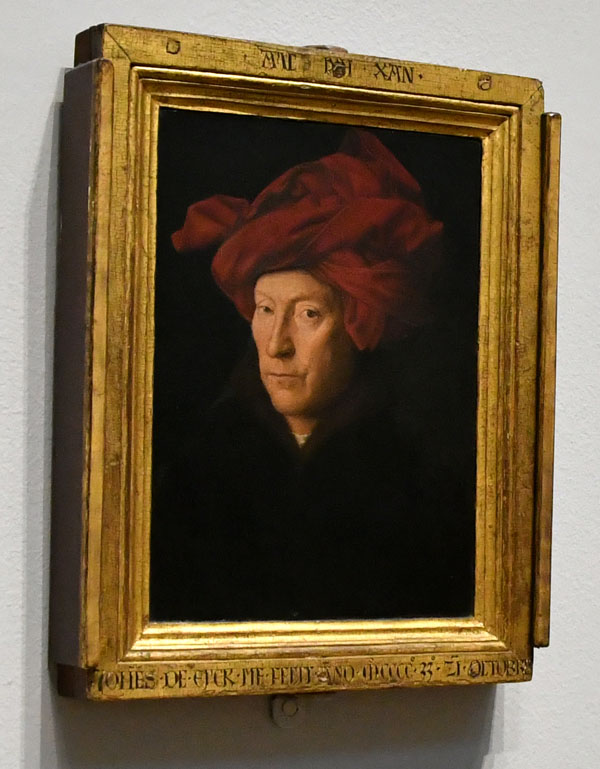
Check out this extensive blog post about framing here: https://veronicasart.com/how-to-frame-art-on-paper-and-on-canvas/
Check out visionary art for sale
Art Collecting for beginners: how to collect art like a pro
Contemporary art is a Wild West. Because there is no clear standard or assessment of creative genius available today, it’s often puzzling and frustrating to see how some childish art may be valued for a lot more than a beautiful painting. Contemporary art collecting is a multi billion economy where some artists make it big and others struggle for good. If you’re new to the art collecting world and want to get some insight, let’s have a discussion here! As an artist, art collector, and educator, I’m going to outline several characteristics that affect artist’s popularity, pricing and more. I’ll discuss the value of collecting art prints and what to look for in art pieces. I’m not an art dealer or museum curator, therefore views are strictly my own that reflect my understanding of contemporary art.
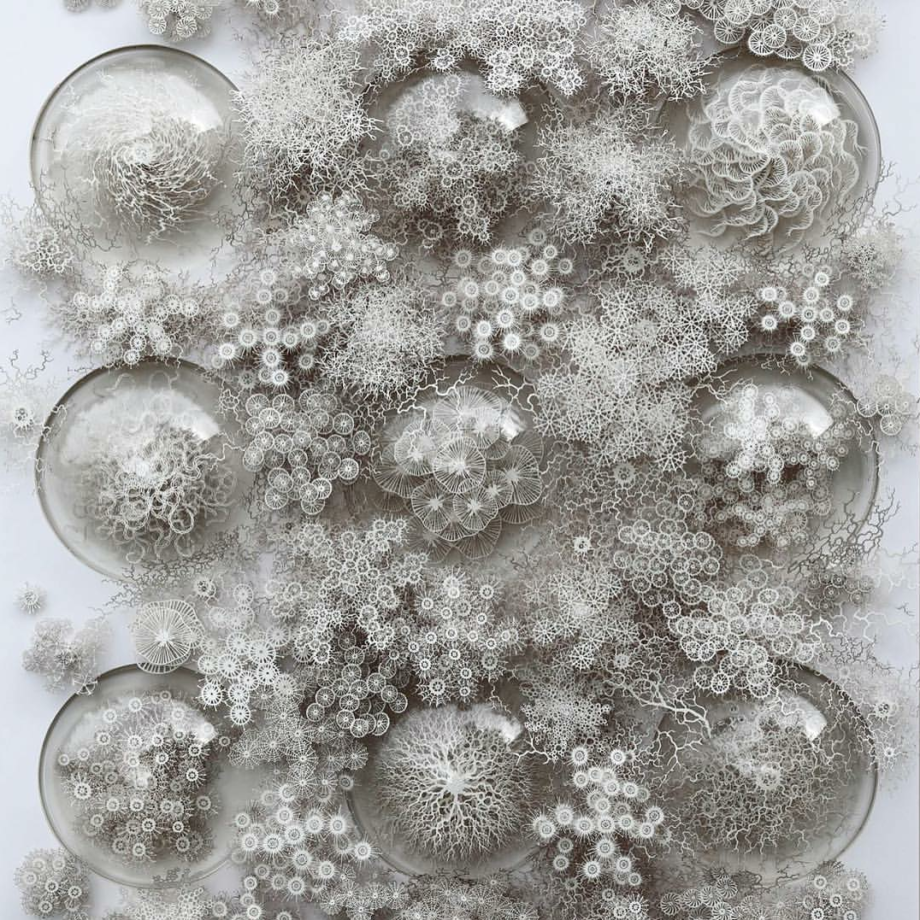
Why buy original art
There are many reasons why people collect art. It can be status, speculation, and love of art! I find that people collect American fine art simply because it’s their passion. They really love discovering new artists and following their careers. Art is an investment for many art collectors, especially the male ones. Primary goal is to invest in popular art that appreciates in value over time even more. Contemporary American art displayed at home shows taste and highlights luxury lifestyle. Another reason for art collecting may be to support the livelihood of contemporary artists. By doing so, you give them the opportunity to paint daily.
Be clear on your goal. Do you want to collect art for pure joy, investment or patronage of the artist? It could be all of the reasons mentioned above or just one.
Know what you like & what you want to invest in
I think it’s super important to educate yourself in art history and contemporary art to make good art purchases. Relying on art advisers, art brokers or gallery directors alone is a mistake because you end up relying on someone else’s taste, while you’re the only person who would live with the art piece at home. It’s good to hear their opinion and reasons for or against the painting, but the the final purchase decision should be yours.
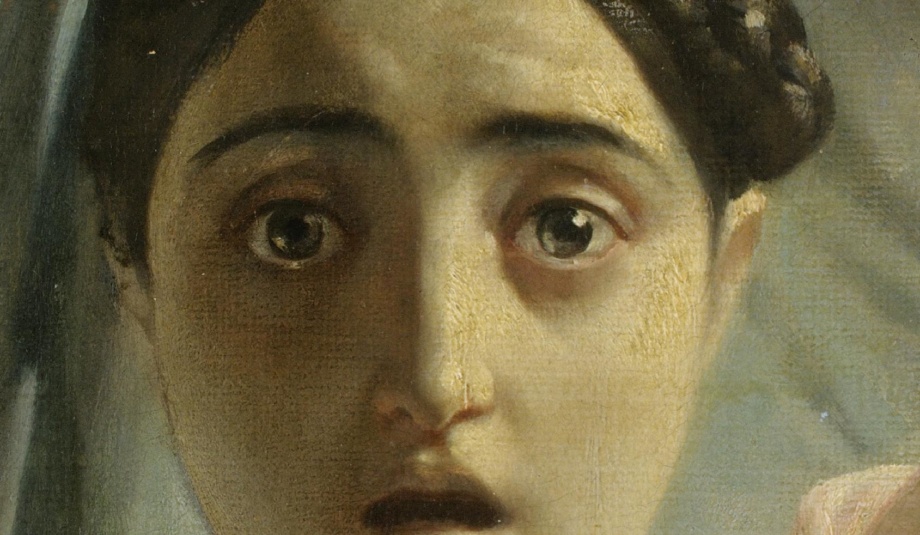
Study art history to figure out what you’re passionate about the most. Educate yourself in major art movements and artists of each time period. Understand the reasons why those artists got their fame. Figure out what time period interests you the most. Next, ask yourself if you favor old historic paintings or contemporary art. Do you like American fine artists or the Italian ones? Answers to these questions come with experience going to art exhibitions, museums, interaction with galleries and reading. It does take time and effort to develop taste and to distinguish between good and bad art.
“Any dealer who says, ‘you have to buy it now or it’s going to be gone,’ I generally won’t do business with,” art collector & ambassador Sondland said in the 2016 interview. “I try to go back and visit it again because, in different moods, art interacts with you differently. And I might be in a manic mood, I might be in a great mood, I might walk in and look at the painting and say, ‘I want to buy that.’ But then the next day, I’ll go and look at the same painting and say, ‘what was I thinking? It doesn’t inspire me.’” You can read the article here: https://news.artnet.com/art-world/gordon-sondland-art-collection-1710738
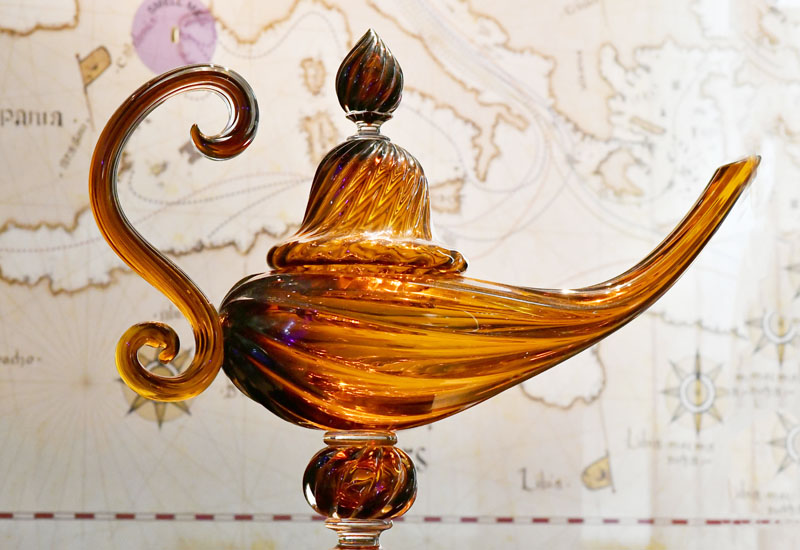
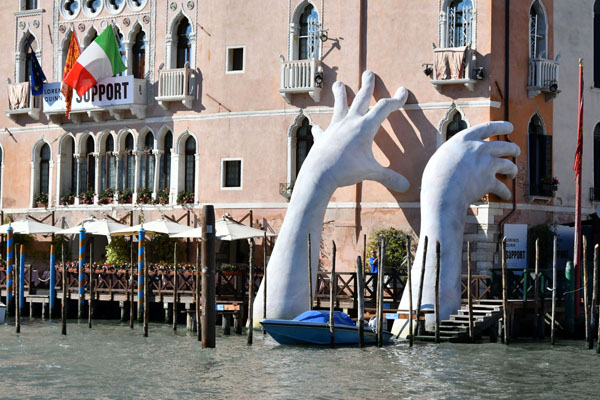
Learn what makes a painting great:
Great art has a message expressed beautifully. When it’s not heavy on concept or idea, paintings and sculptures can still be strong pieces visually. This is where you need to recognize Quality in art. By Quality I mean creativity/voice+artistic skill+technical skill+high-quality art supplies & presentation. Most importantly, good art generates emotional response that continues to grow on you every day. It could be a memory of a place or event, a combination of lines and color or something else. Emotional interaction with the piece is very personal.
Below you’ll find several extensive articles about art history, movements and more:
- Art movements, education, patrons and more: https://veronicasart.com/learn-what-makes-a-painting-great-video-1-part-1/
- Composition, color, lines & emotion: https://veronicasart.com/learn-what-makes-a-painting-great-video-1-part-2-composition-color-lines-and-emotion/
- Contemporary art: https://veronicasart.com/contemporary-art-learn-what-makes-it-great-today/
If you like American art and would like to collect fine artists of America, you can read the following articles here:
- If you like Hyperrealism: https://veronicasart.com/contemporary-art-hyperrealism-10-amazing-artists-who-crush-it/
- Contemporary women artists: https://veronicasart.com/17-contemporary-women-artists-the-best-of-real-and-surreal-in-painting/
- Art Context Miami 2018 includes both American art and International artists: https://veronicasart.com/art-miami-context-art-miami-2018-contemporary-realism-painting-and-more/
- Art in Palm Beach 2018: https://veronicasart.com/art-palm-beach-international-2018-highlights/
How to start art collecting
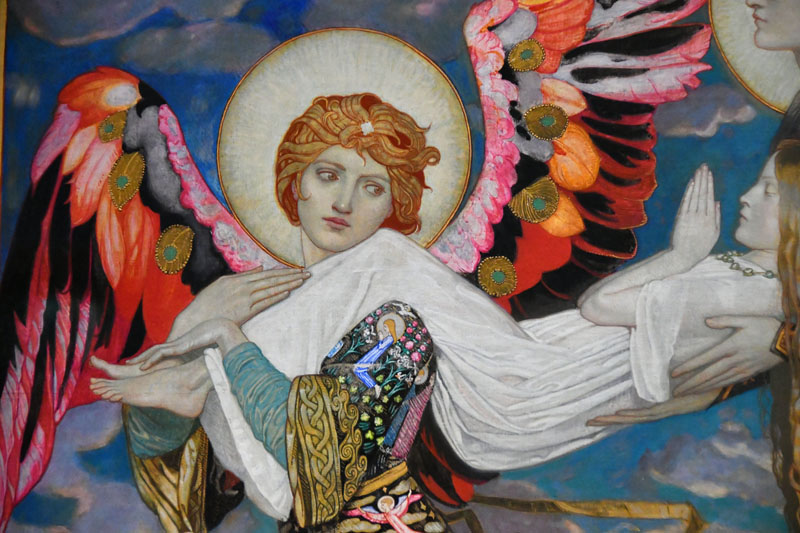
- Collect what touches your soul. I often visit commercial galleries and notice that not every painting creates emotional response in me. Sometimes I see dead paintings. Other times I can admire the technique and I rarely see the piece that moves me in a profound way.
- Constantly educate yourself in the arts cultivating taste and aesthetics.
- Be on mail lists of your favorite art galleries, museums and artists.
- Attend receptions at galleries and auction houses. Make connections with professionals. Schedule studio visits with artists!
- Know the artist you’re purchasing from. I think when the connection is personal, art grows on you even more.
- If art collecting is a clear investment for you, research the artist on Sotheby’s or other art auction house to see a range of paintings available and at what price they sell. Price may vary considerably over time and in different gallery. It also may go up or down in value. Buy famous art from reputable sources like Christie’s or established blue chip art gallery to minimize cheating. If you like contemporary art, go to Artsy or Artnet to see the price range of your favorite living artist. A lot of established galleries don’t display pricing, intimidating possible collectors.
- You can negotiate pricing above $10,000.
- Art must be unique and have a signature of the artist along with the certificate of authenticity.
- If artists don’t have gallery representation, contact the artist directly. If the artist sells through the gallery, you should contact the manager/director/owner of the gallery asking to view and purchase the art. Artists abide by the rules and have a relationship with the gallery, not selling their paintings directly but bringing the clientele to the gallery.
check out visionary art for sale
What established artists have:
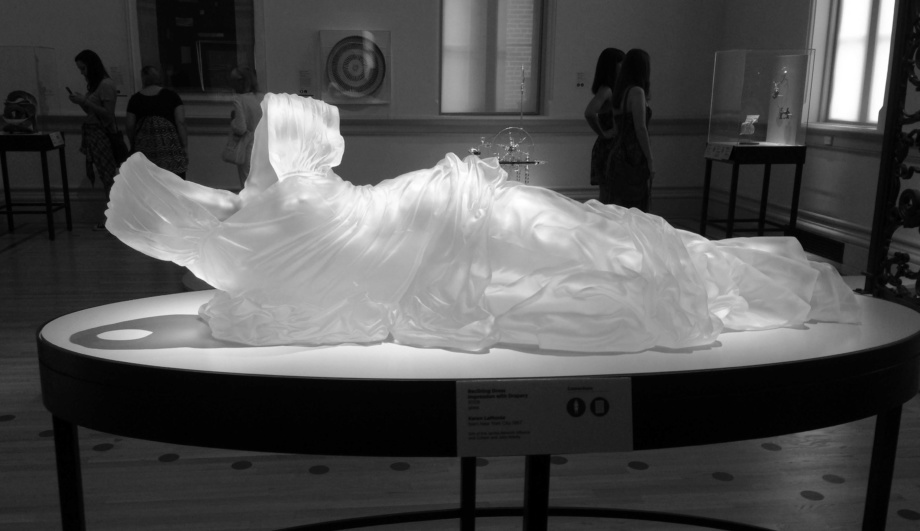
- Unique style, meaning that you can instantly recognize the artist’s work among the rest.
- Education level. It’s not a requirement but it often plays into the level of artist’s work.
- Sales record/collections list. If artists have notable placement in art museums or prominent corporate collections, it raises the artist’s status.
- Artists work on their careers diligently. It’s not a hobby. Artists are often experts in their fields of study.
- Consistent pricing.
- Other achievements ( grant recipients, etc)
Art posters: to buy or not to buy
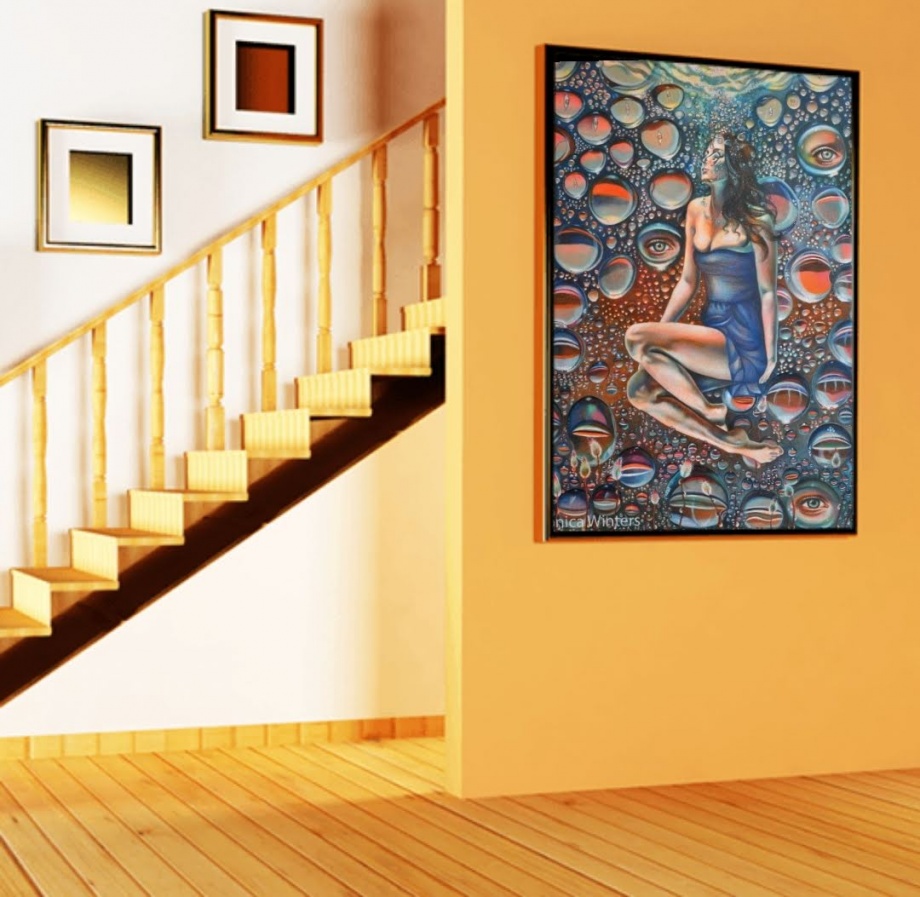
Art posters, open edition prints limited edition prints:
Art posters (prints of original paintings, drawings, etc) give people a chance to decorate their homes on a budget. Art posters also give artists a chance to raise some cash when selling originals may be difficult.
There are two types of art prints: limited edition and open edition. Open edition prints have no signature and are not numbered. So you have no way of knowing how many prints get printed. It could be just a few or 10k. It’s often doesn’t matter because it’s a nice way to bring art home and not to worry about the cost of owning the print. Open edition prints are affordable and make great art gifts.
Limited edition prints are limited in number. Different sizes may have their own limited editions. (Say, a 5×10″ print could be an edition of 20, while an 18×24″ could be an edition of just 10 prints).
A limited edition print must have artist’s signature and two numbers, like 1/500 (fist print in edition of 500). The smaller the number of prints, the more valuable the limited edition could be. Artist’s signature gives the series authentication. However, limited edition giclee prints are just computer reproductions. They don’t have much value unless it’s issued by a famous artist.
Limited-edition, signed giclee prints may accrue value if they’re issued by a famous artist but in no way it would equal to the value of original art (purchase price + appreciation over time). As a rule, giclee prints don’t have that much value, original art is valuable, assuming it’s a good one.
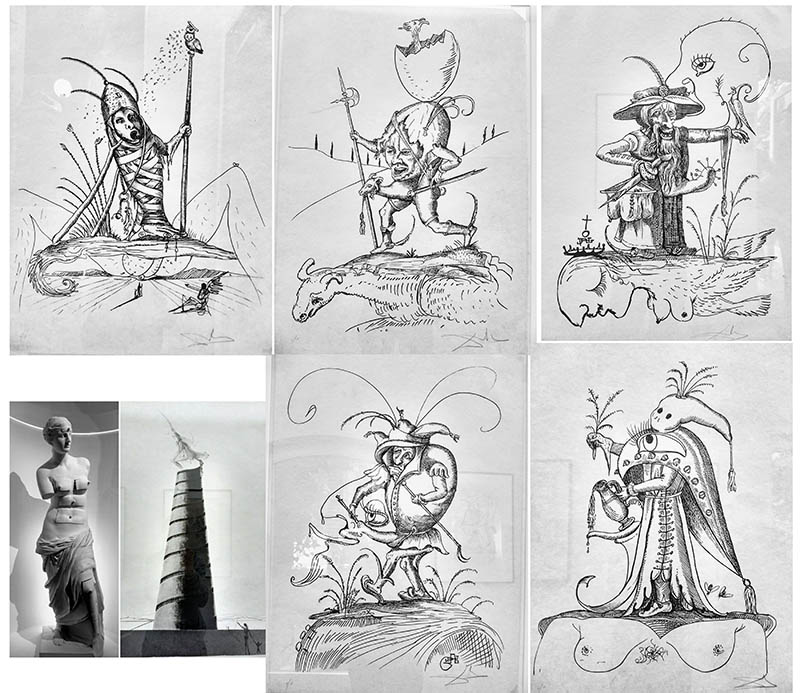
Printmaking & lithography:
Hand-pulled art prints have a lot more value. These are signed and numbered lithographs, intaglios, screen prints and other forms of printmaking when every print (in the limited edition) is hand-pulled by the artist. This is a very labor-intensive process that requires knowledge and skill to do it well technically assuming the artistry of the image itself is good.
Lithographs get printed off of the stones. Silkscreens get printed off the silk screen. Intaglios are printed off of the metal plate. Andy Warhol made limited edition silkscreens. Rembrandt was a master printer, producing not only oil paintings but also intaglio prints. Lithographs are also inherently limited in number. They can be either black-and-white or in color. The process of hand-printing in color pulling the print through the press requires a considerable skill that’s often taught in art colleges. All hand-pulled prints must line up colors perfectly. They also must have even printing of colors, clean white borders and backing. All prints are numbered and signed by the artist.
Factors that go into predicting whether an artist’s work will increase in value over time
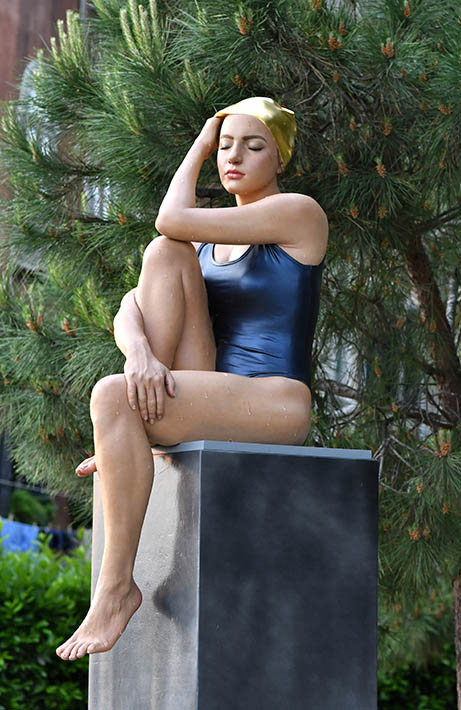
This is a grey area. Sometimes great artists perish and get rediscovered years or centuries later (Vermeer, Gaugin, van Gogh, etc). Other times the artist could be hot but it doesn’t mean he’ll go down in history passing his prime.
There are a few points for you to consider trying to figure out if you make a good investment in art.
- Art is truly unique. The artist’s voice is so one-of-a-kind it stands out.
- Art is in important collections in art museums, corporate or private collections of famous people or elite.
- Artist has been serious working on his/her career for years and often exhibits nationally and even internationally. There is a considerable body of work shown across art museums and galleries.
- Artist may have permanent public art installations.
- Check out the following artists that conform to all the points above: Carole Feuerman, Karen LaMonte, Kehinde Wiley, Arantzazu Martinez, Philipp Weber, Kaws, Koons, Hirst.
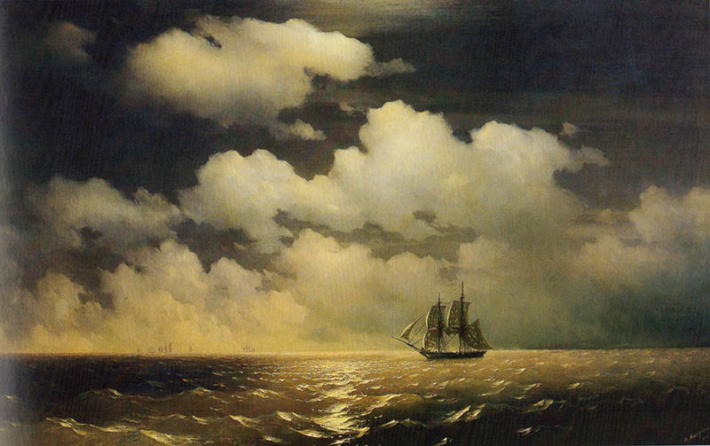
Art websites to check out:
- Sotheby’s
- Christie’s
- Artnet – contemporary art & auction research tool
- 1stdibs – contemporary art, fashion, furniture, jewelry and more
- SaatchiArt – contemporary art, abstract to realism
- MutualArt – auction price database search via premium membership
- MyModernMet – well curated contemporary art, inspiration
- The Colossal – curated contemporary art
- State Hermitage Museum, St. Petersburg, Russia
If you find this post useful, share it on social media.
de la Cruz Art Collection in Miami: Force and Form 2018 show
Located in the Miami Design District, de la Cruz Collection is a private, 30,000 square foot art museum displaying the contemporary art collection of Rosa and Carlos de la Cruz. Occupying a modern, 3-story white building, the art museum opened in 2009 to display the collection and to conduct lectures and workshops. Rosa and Carlos de la Cruz are the top 200 art collectors in the U.S., and it is amazing to see how much time, effort and finances this couple spared to build and maintain this art museum.
Force and Form
Force and Form brings together pivotal works from the collection to create a dialogue addressing a shift in artistic, as well as cultural, practice and form. The works respond to current issues of identity, gender, class, power, and the values that define our social fabric. The use of everyday materials and recycled imagery challenge traditional practices of sculpture, installation, and painting, while addressing the interaction between the human and mechanical gesture.
If you happen to see the galleries, the staff is incredibly friendly and accommodating to every person ringing the door bell. They are also eager to walk you through the installations. The downside is that the art show is hardly visual arts. Despite its monumental display and the scope of this art exhibition, most artwork is so conceptual, it leaves nothing for the eye to get excited about. And while the staff may explain the artwork to engage you some, this engagement would be limited to your perception and art appreciation in general. When I see such shows one of the questions that runs in my mind is how irrelevant the skill, talent, and knowledge have become in art production and sales. Almost anything can be named ART, while very few artworks deserve this definition. This is one of the reasons visitors feel confused looking at ART that makes no sense whatsoever and therefore doesn’t connect with the viewer on a visceral way. This purposeful deskilling of ART leads to and fosters public’s indifference to contemporary art in general, in my opinion.
Obviously, any private art collection is a matter of taste of the collectors, and should be viewed as such. It is nice of the couple to support the artists making purchases of their art. If you plan on buying art for your private art collection, I encourage you to rely on your aesthetics and support talented contemporary artists as well.
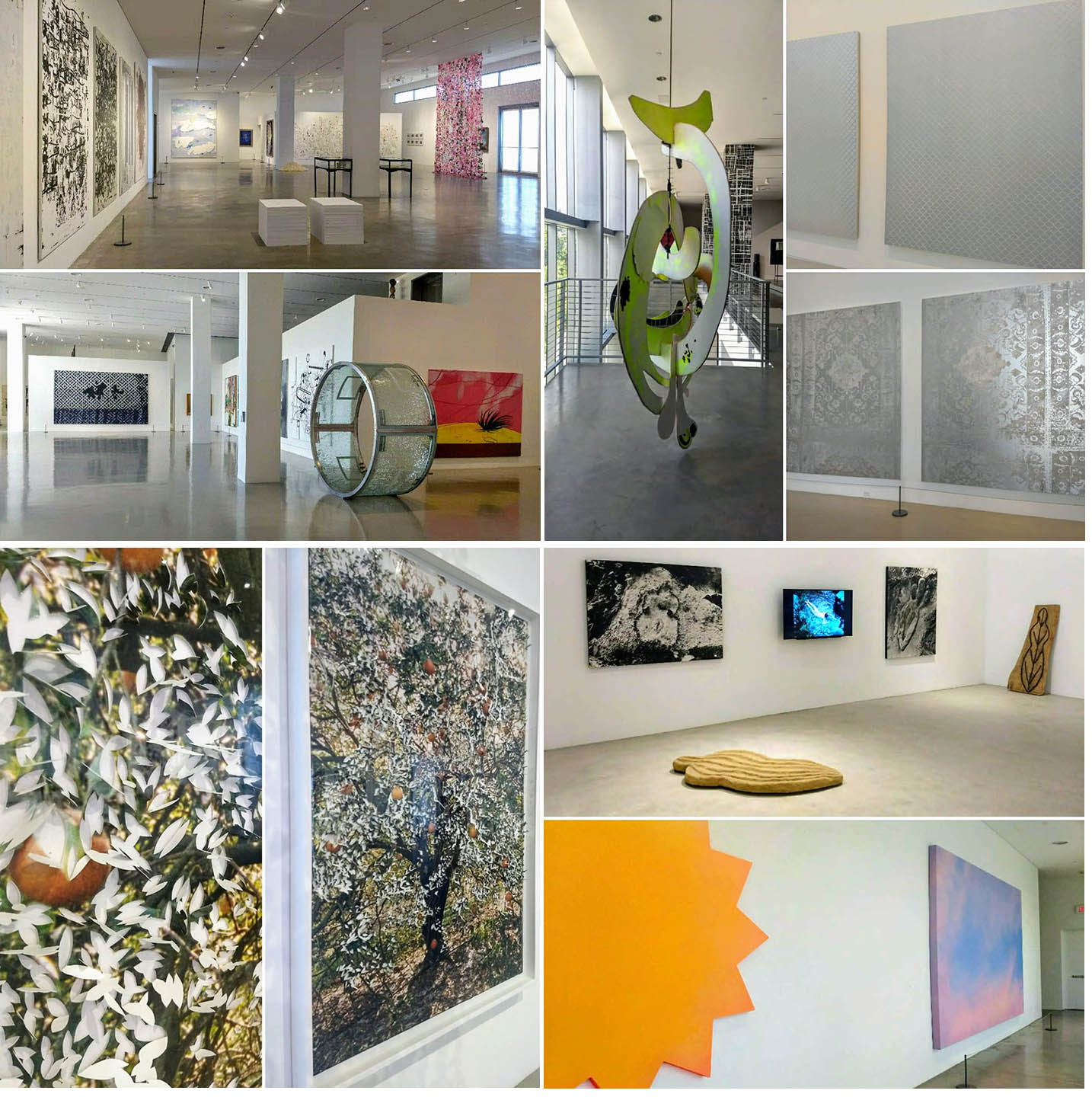
Artists in the Exhibition
Kathryn Andrews, Tauba Auerbach, Walead Beshty, Mark Bradford, Joe Bradley, Dan Colen, Martin Creed, Aaron Curry, Salvador Dalí, Peter Doig, Isa Genzken, Félix González-Torres, Mark Grotjahn, Wade Guyton, Guyton/Walker, Rachel Harrison, Arturo Herrera, Jim Hodges, Evan Holloway, Thomas Houseago, Alex Israel, Rashid Johnson, Alex Katz, Martin Kippenberger, Michael Krebber, Wifredo Lam, Glenn Ligon, Michael Linares, Nate Lowman, Adam McEwen, Ana Mendieta, Albert Oehlen, Laura Owens, Jorge Pardo, Manfred Pernice, Sigmar Polke, Seth Price, Sterling Ruby, Analia Saban, Josh Smith, Reena Spaulings, Rudolf Stingel, Rufino Tamayo, Kelley Walker, and Christopher Wool.
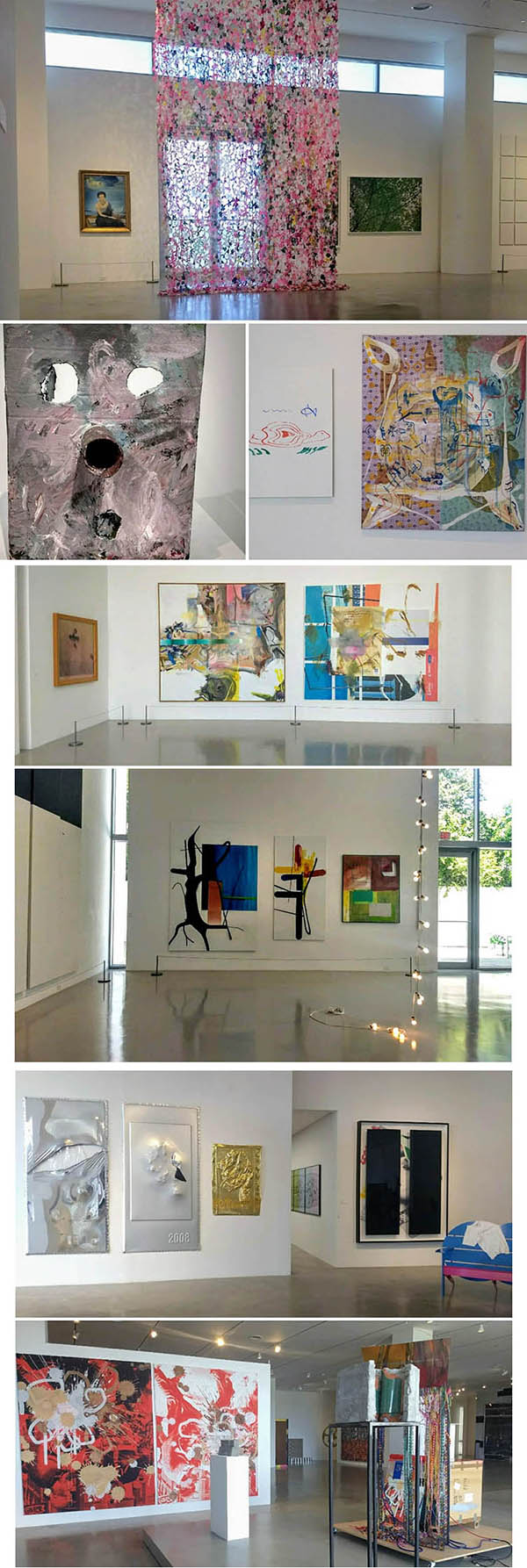
Contact:
Open Tuesday through Saturday from 10:00AM to 4:00PM. Admission free. Must call the doorbell to enter the museum (doors are locked even during the open hours).
23 NE 41 Street. Miami, FL 33137 | (305) 576-6112 | https://www.delacruzcollection.org/
Check out visionary art for sale
Venice biennial 2017: a crappy show with rave reviews
If you regret that you haven’t seen the show yet, don’t. Venice Biennale 2017 is monumental in concept and degraded on visuals, heavy on installations, and weak on any form of beautiful painting, huge on scale and tiny on emotion. Chief curator of the Pompidou center in Paris, Christine Macel arranged the exhibition in several pavilions -realms which flow together with concept art titled “Viva arte Viva!”
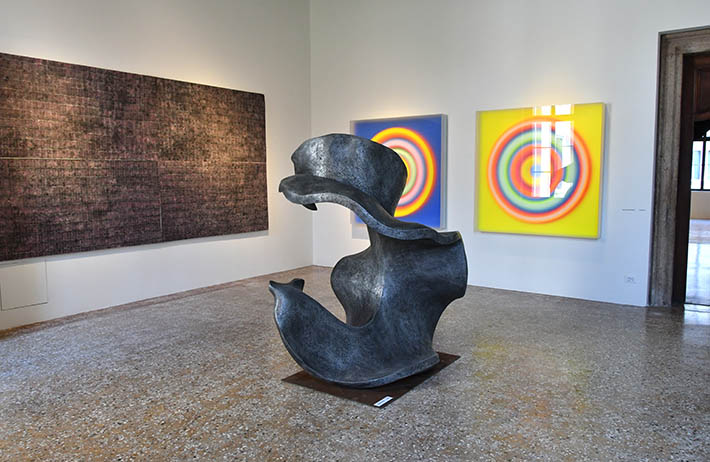
While paid entrance to the biennale invites you to visit vast spaces of the Arsenale and the Giardini, several other pavilions are scattered throughout Venice in medieval palazzos and gardens. Art in those palaces looked better than the one in the official biennale. Each pavilion usually represents a single country with its native artists exhibiting their talent to the multilingual public.
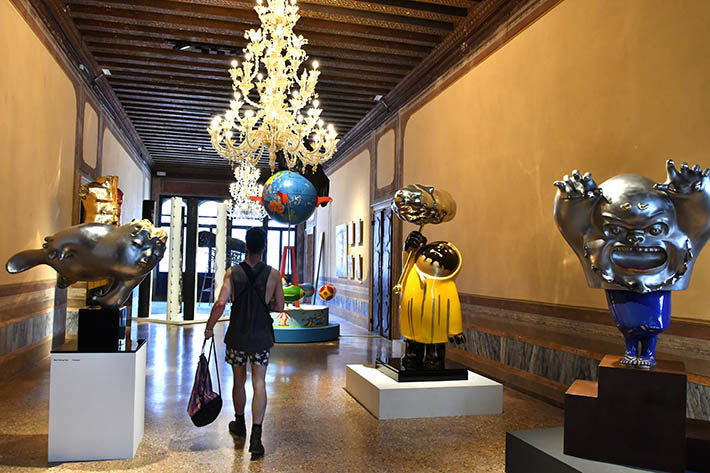
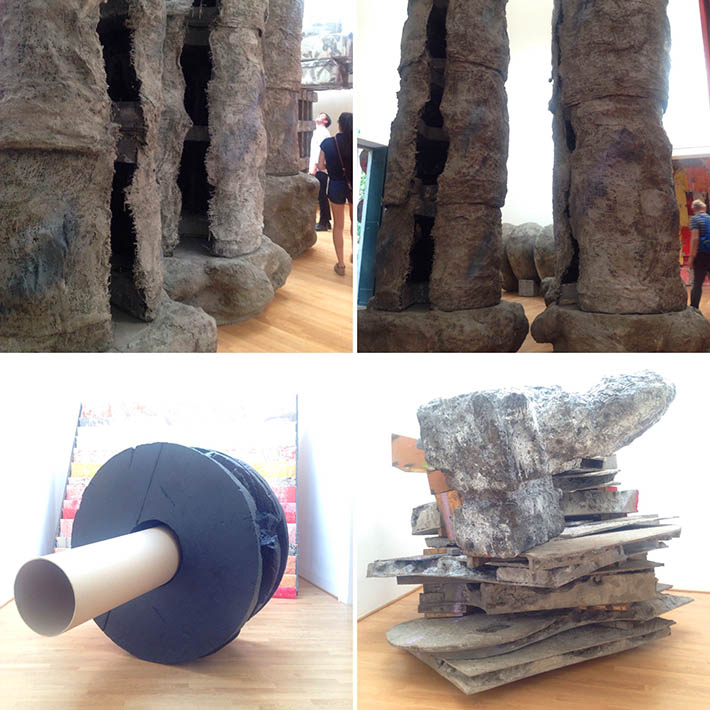
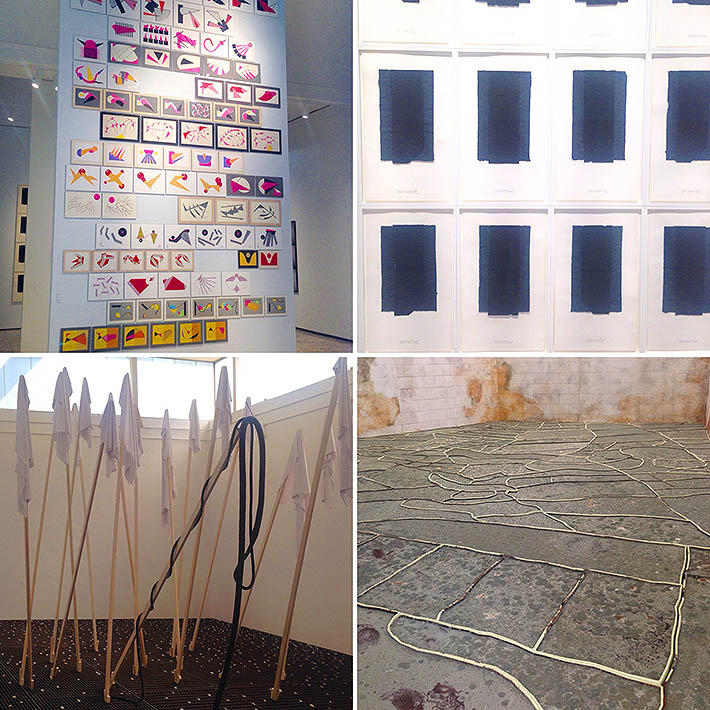
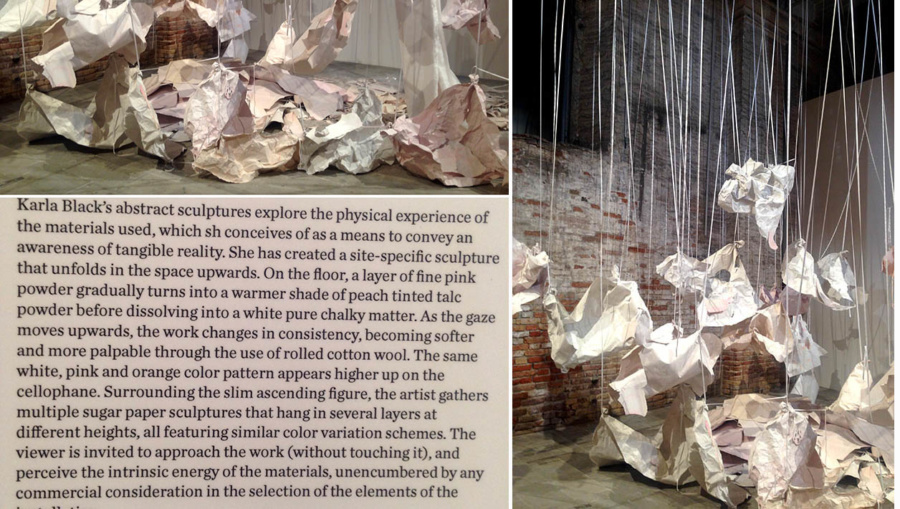
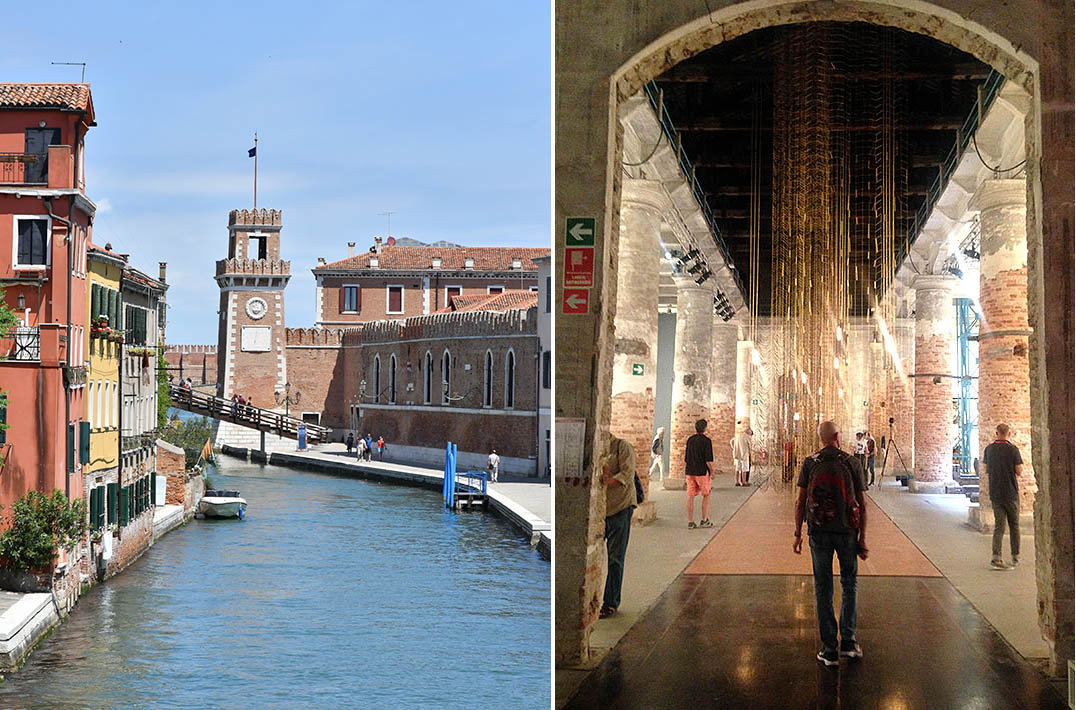
This is one of the top international art shows that obliterates visual beauty in favor of concept. Boring to the eyes and craftsy at best, the viewer has to read lengthy statements in provided brochures to “get” the idea behind the pieces. I love Venice for its beautiful architecture, history, and art, yet the biennial rejects even the slightest idea of having representational art on its grounds. The exception is the Venetian pavilion itself that defies the curator’s voice with sparkling jewelry, chandeliers, gowns, and sophisticated glass that highlights traditional artist labor and skill.
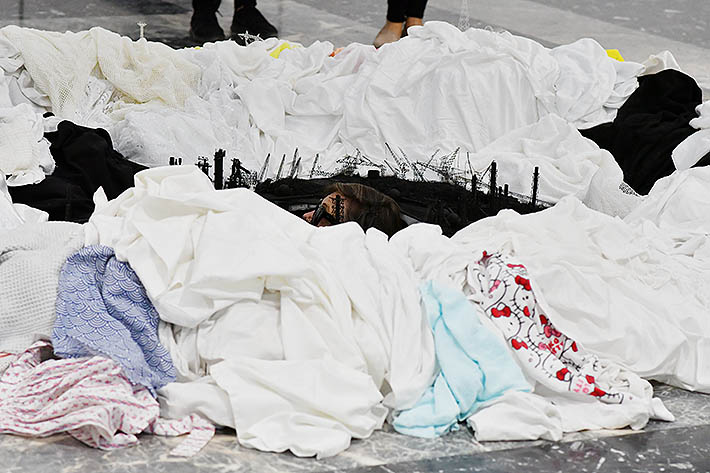
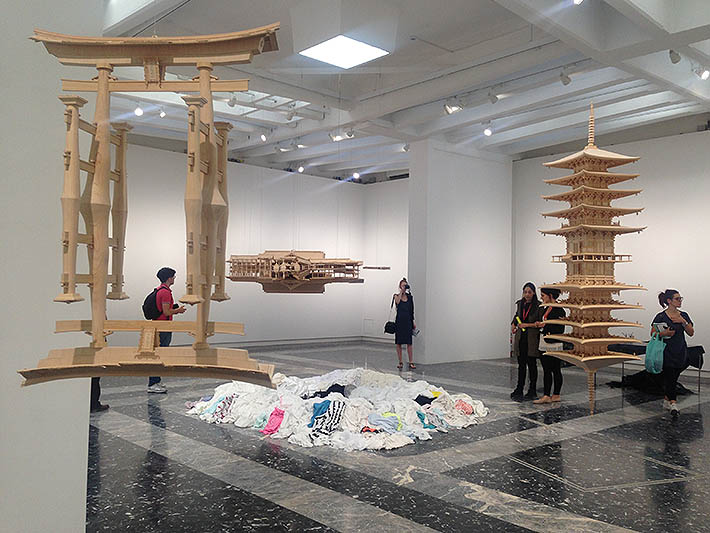
The Romanian Pavilion
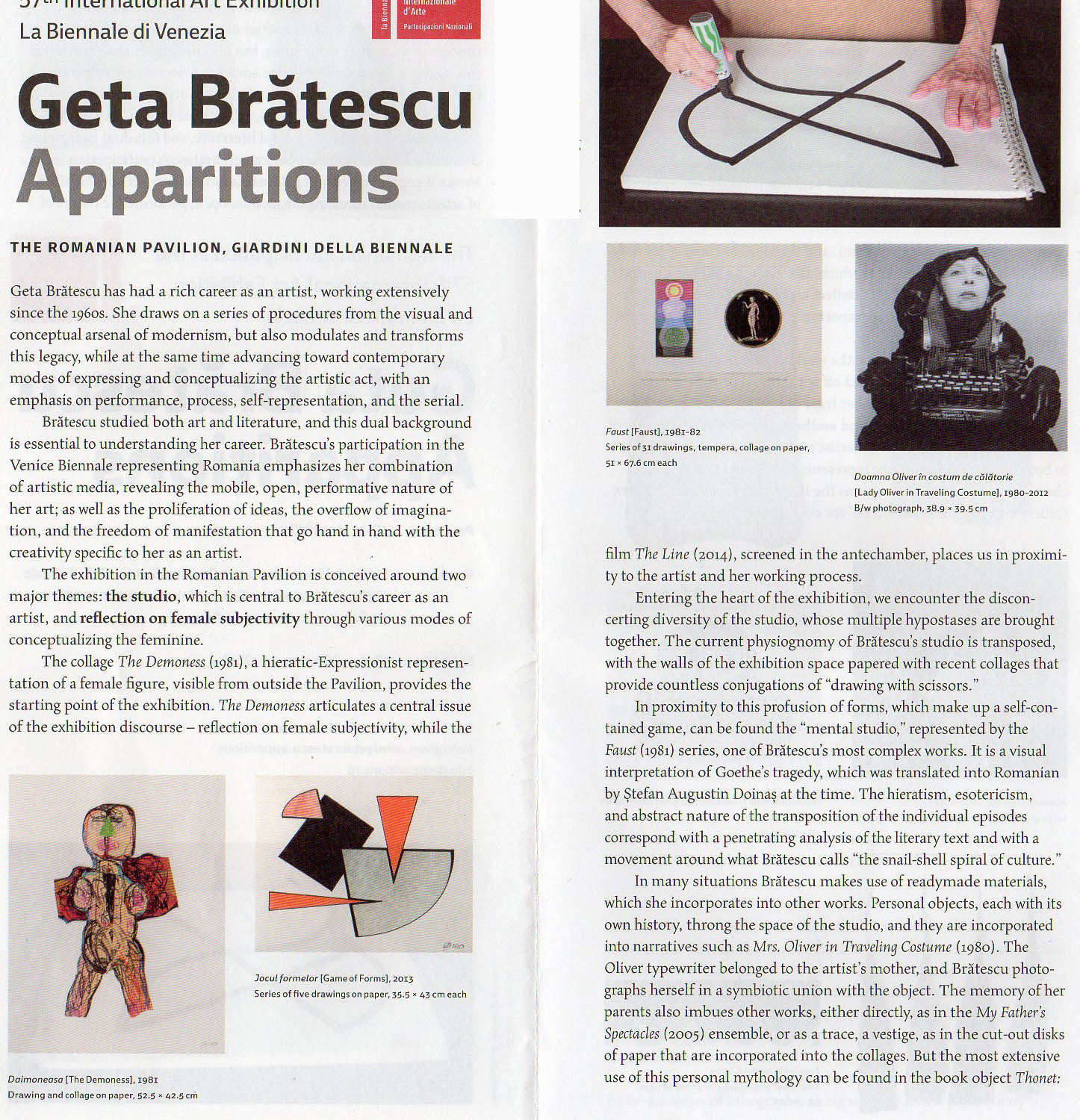
Like in the naked king fairy tale, the fooling of people takes place in the exhibition, stating that what they see is ART. Rooms after rooms, visitors encounter piles of materials, fabric, metals, or abstract sculptures that often have profound meaning expressed through riveting writing. However, these endless primitive installations and videos leave the spectators confused about what ART means.
Art exists to call our attention to something, to make a statement, or to leave a record of times lived. Curated as apolitical and without a clear message, the biennial misses to deliver on any of these points.
The German Pavilion
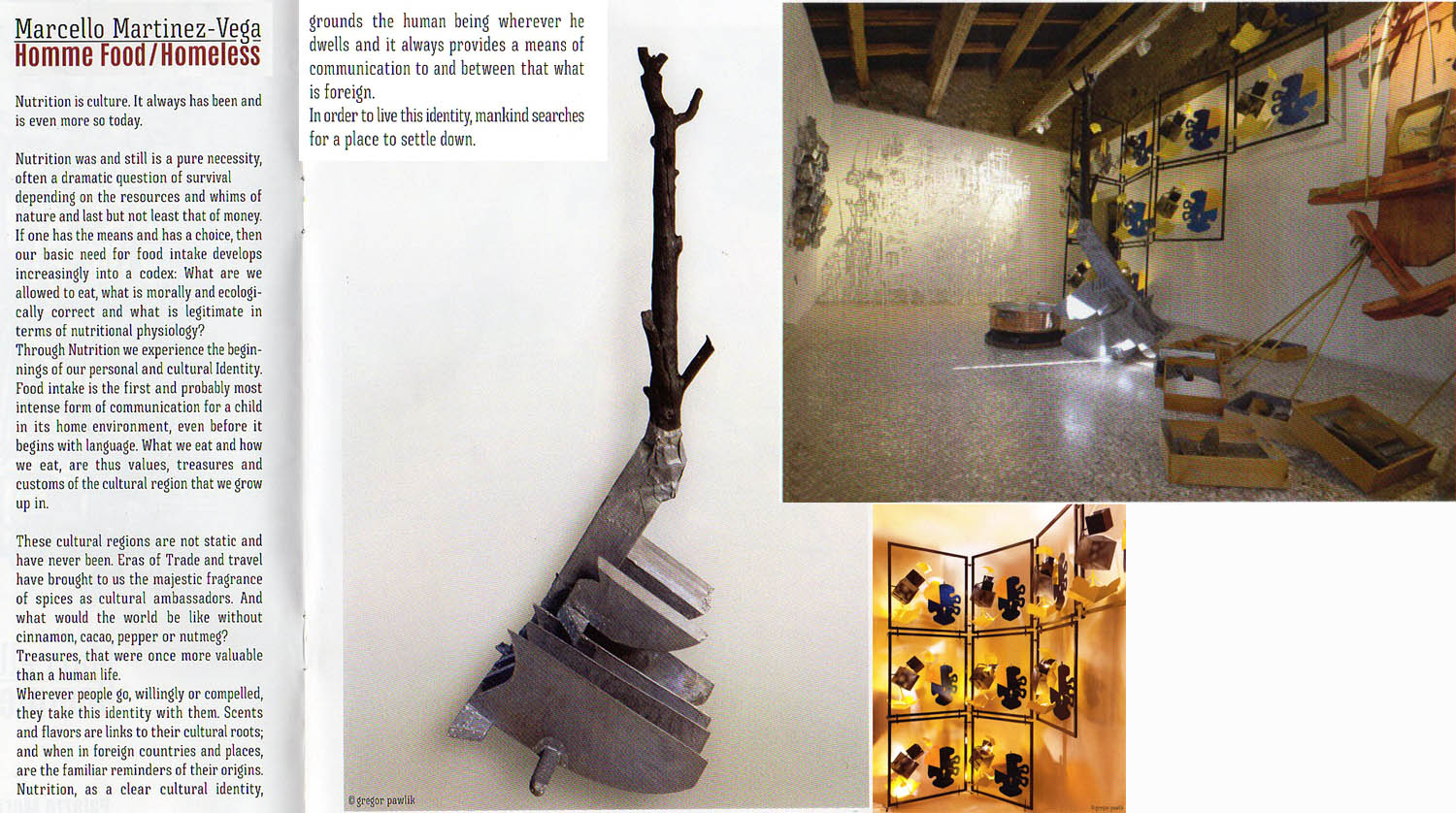
More rooms
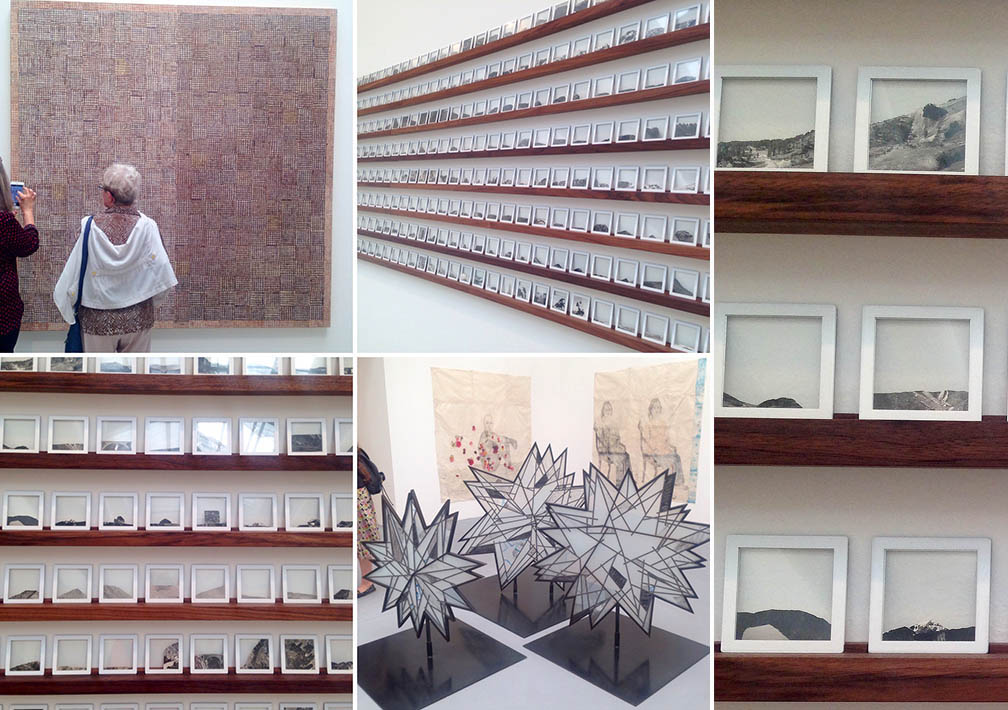
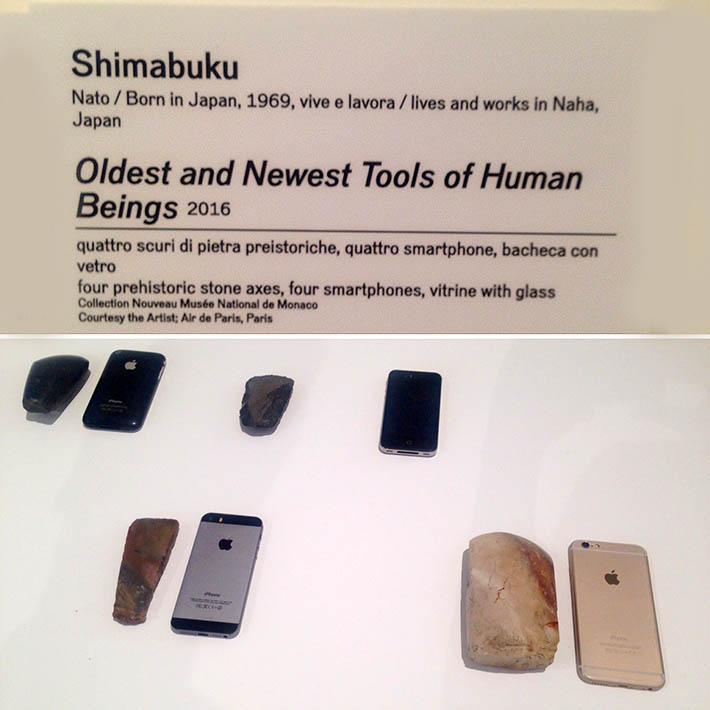
Visual arts are called visual for a reason. Because the artist’s call to attention and its impact is visual, conceptual art rarely leaves a considerable emotional impact. Even when the concept is strong, it’s weakened by the absence of the visual perception we all share. Therefore, such installations should get a specific classification so as not to be promoted as art. Today’s notion abolishes any standard for an artist to aspire to, and for people to understand or appreciate. Why did we keep high standards in music or dance and completely abolish them in art? It’s not the absence of artists willing to travel years in education to achieve something worthwhile that people’s attention, it’s about a few art critics and curators, influential art shakers who pick and choose, add and subtract, curate according to their tastes, business practice, and economic whims.
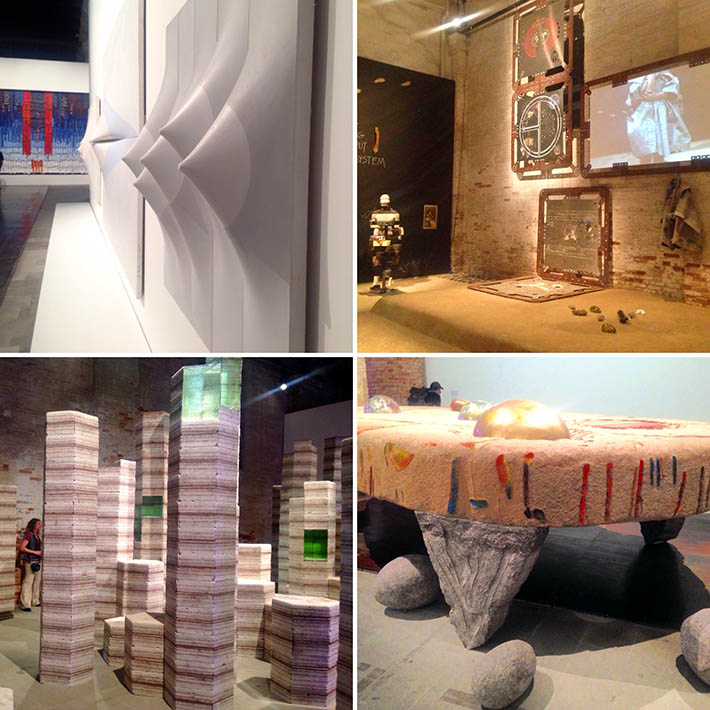
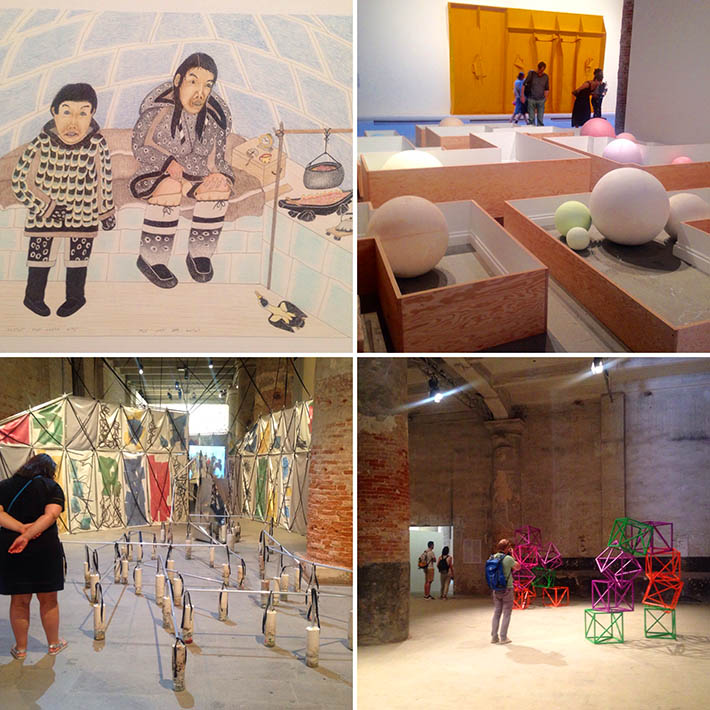
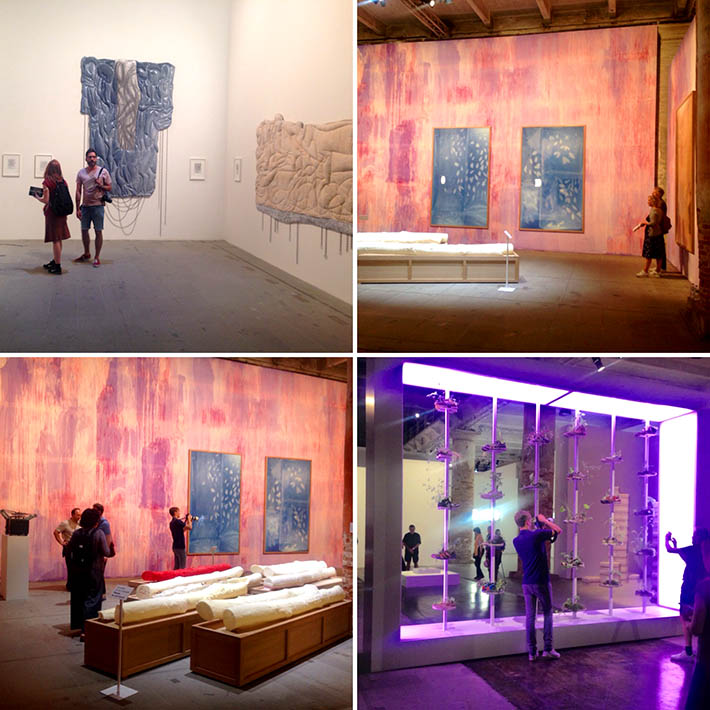
The pavilion of Shamans
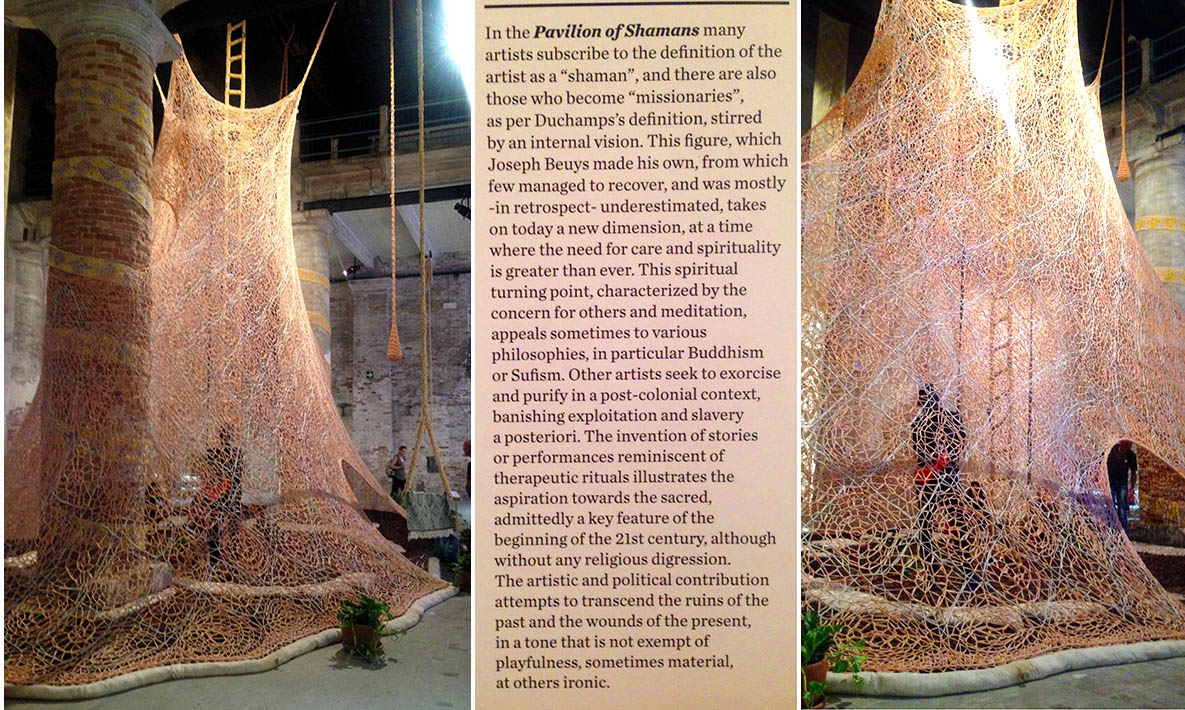
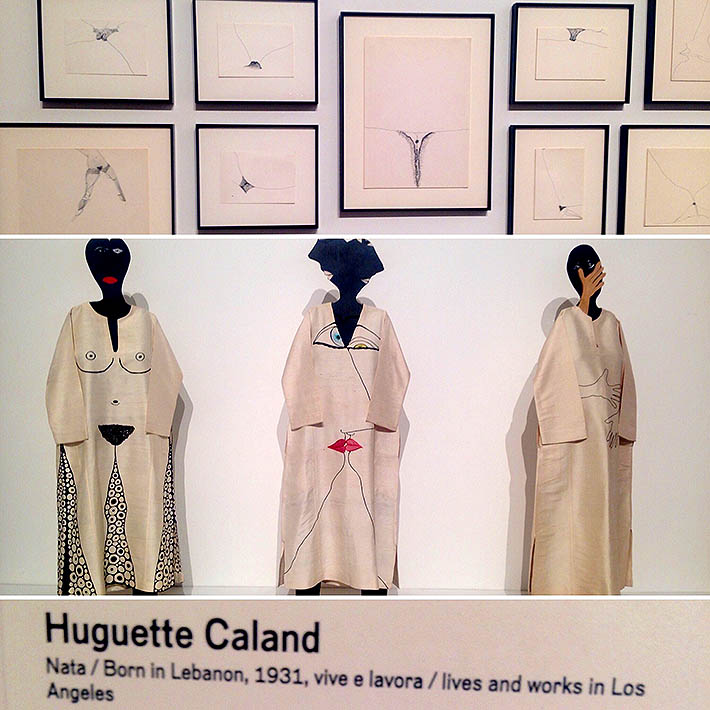
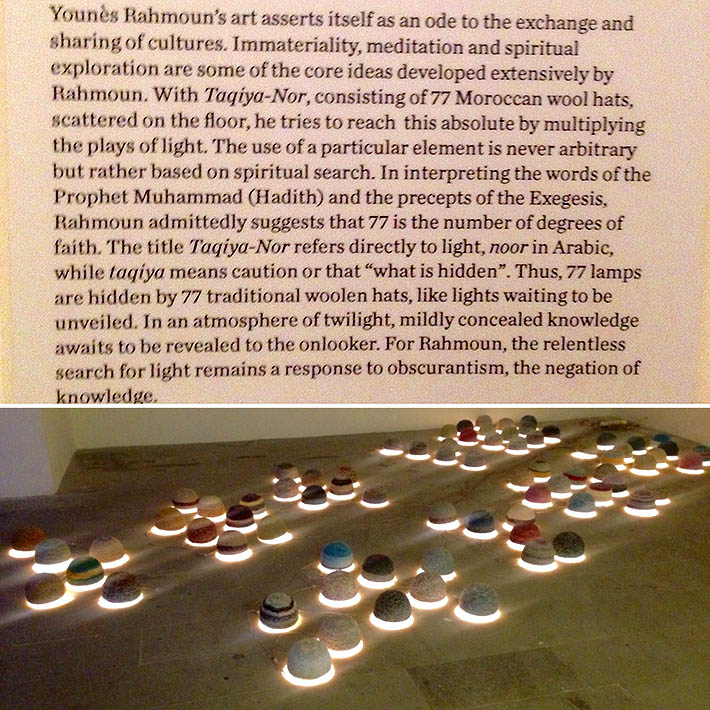
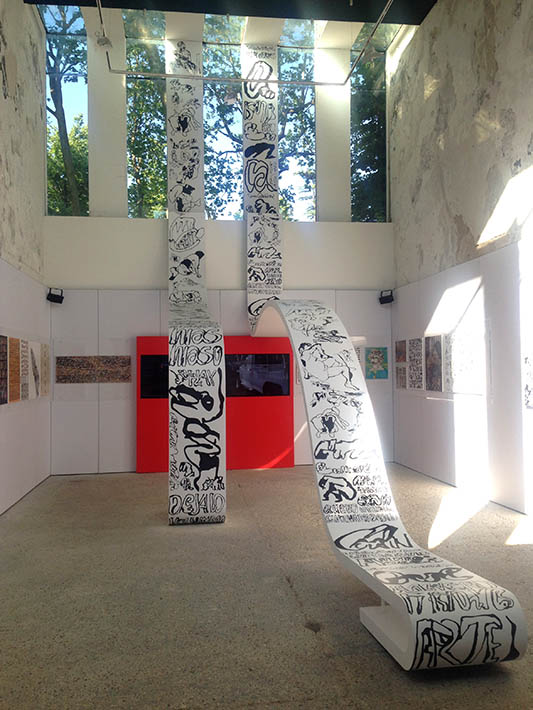
Art installations that catch attention
On the upside, the exhibition is gender-equal, nationality-diverse, with the majority of the unknown artists representing both influential and obscure countries. There are a few art installations at the main complex of the biennale that caught my eye.
The Zimbabwe Pavilion
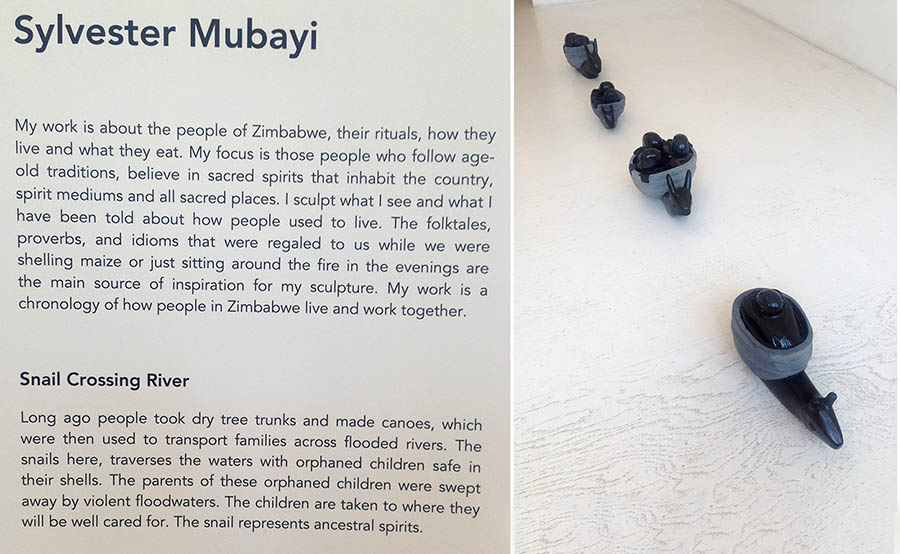
The Russian pavilion
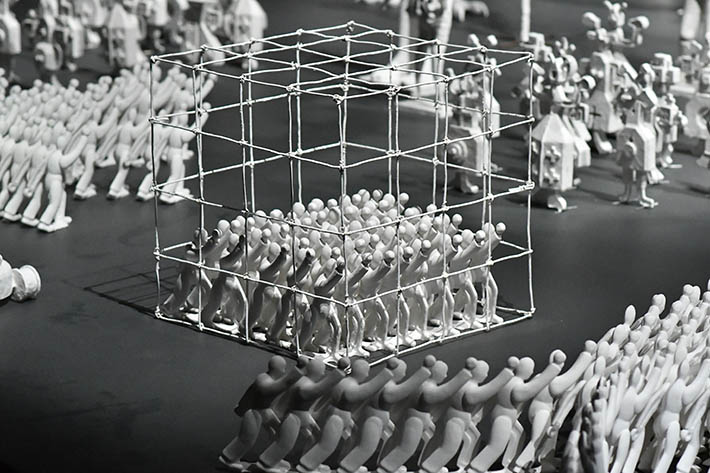
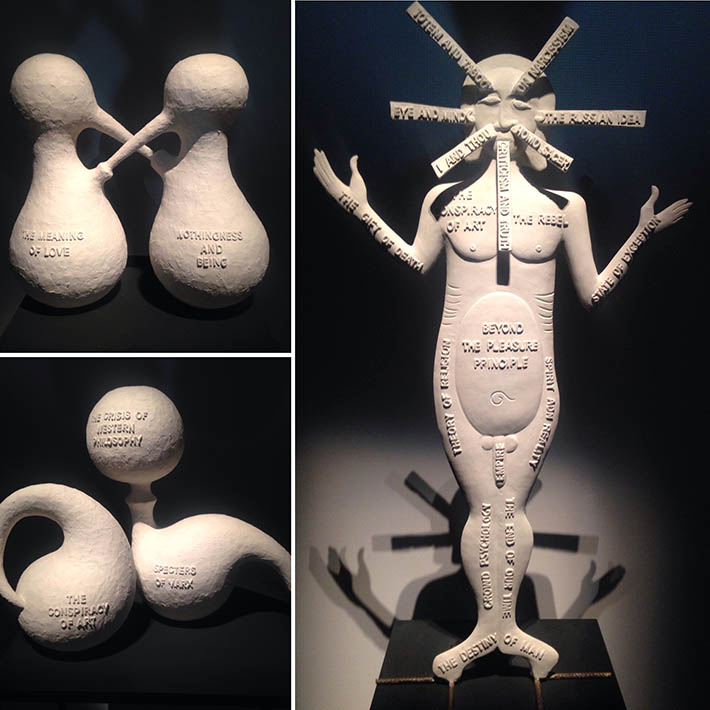
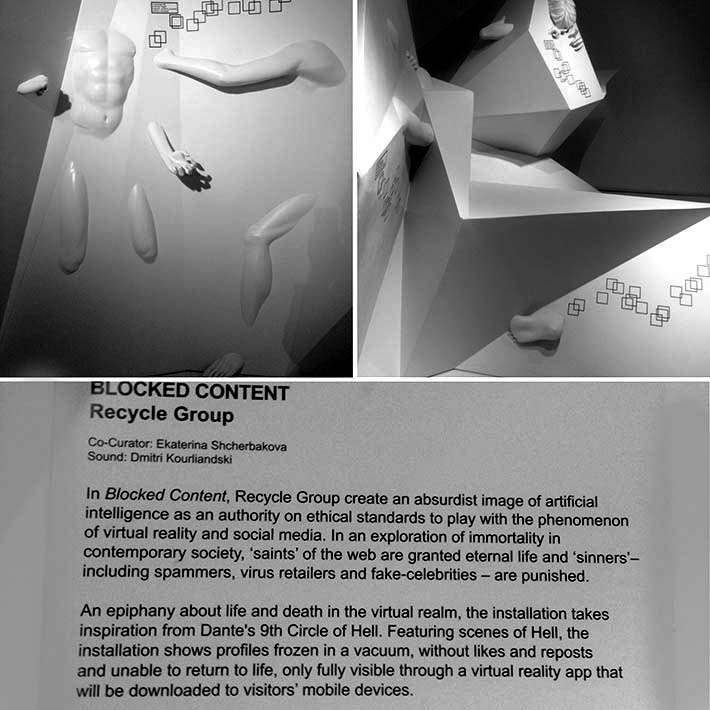
The Chile Pavilion
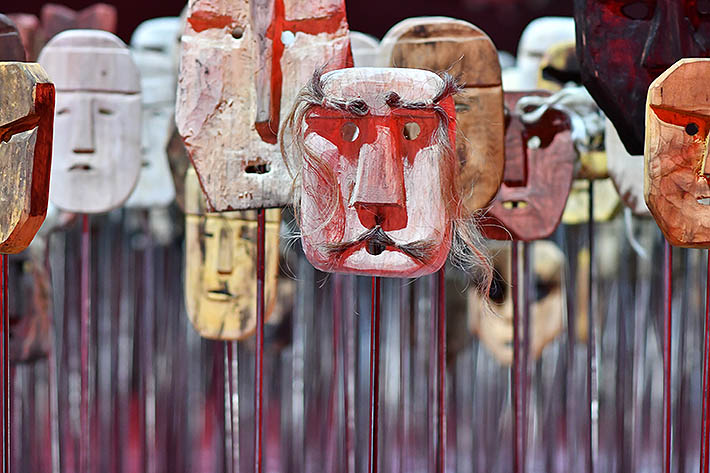
The Argentine Pavilion
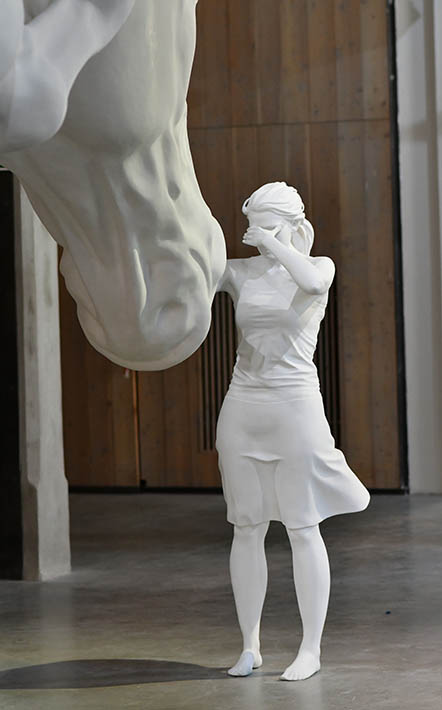
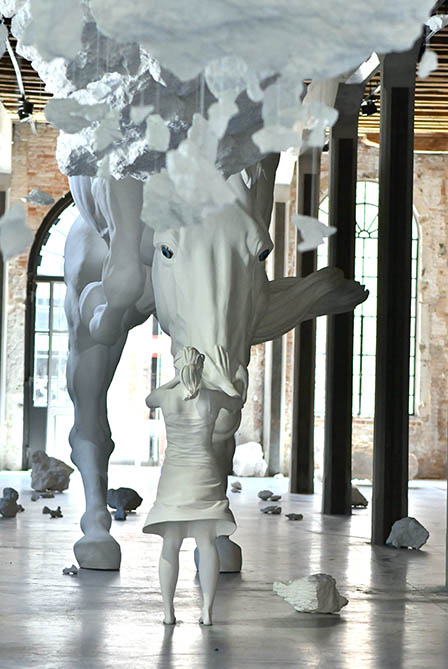
Other rooms
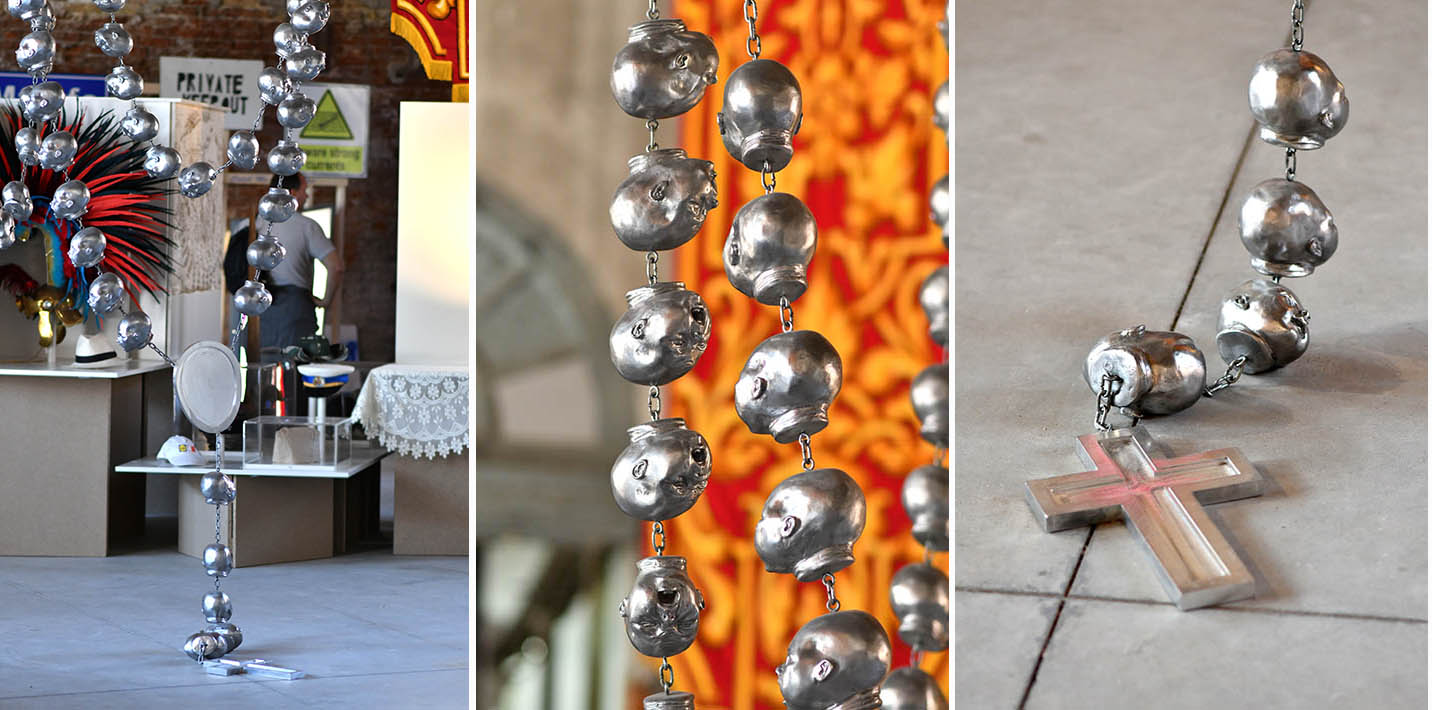
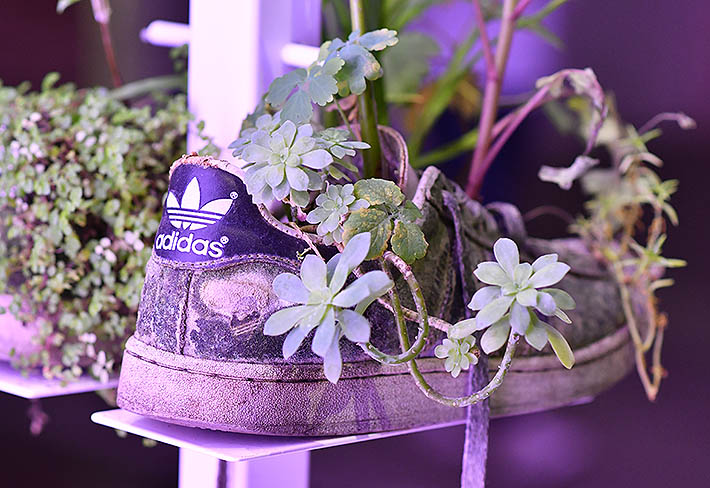
The Mongolian Pavilion
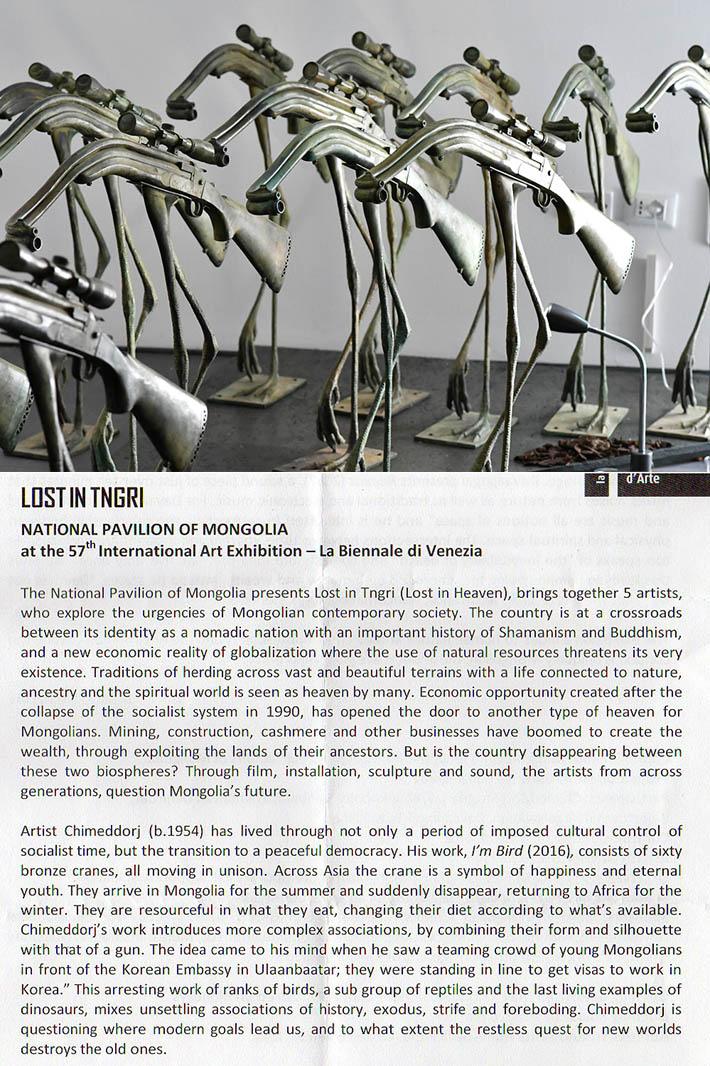
The Venetian Pavilion
Art seen next to the biennial in Venice in 2017
A nice surprise is a solo show by Carole A. Feuerman situated in a peaceful corner of a green garden at the Giardino Della Marinaressa, by the Venice Biennale (open and free to the public). The artist creates hyper-realistic, life-size sculptures of women in painted bronze and steel, resin, and oil that are so lifelike, you want to reach out and touch them.
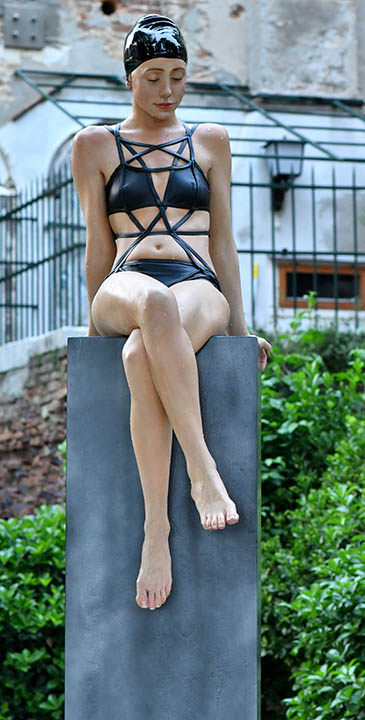
Project by Lorenzo Quinn on the Grand Canal in Venice. His monumental sculpture of white hands raises awareness about climate change and the rising sea levels.
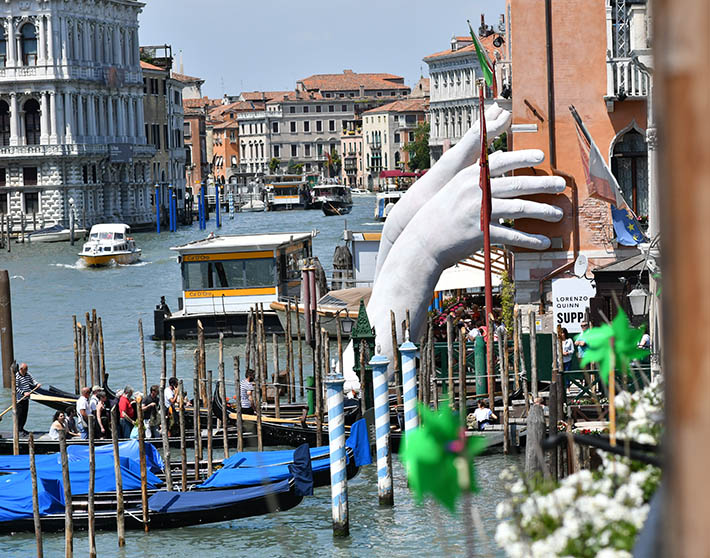
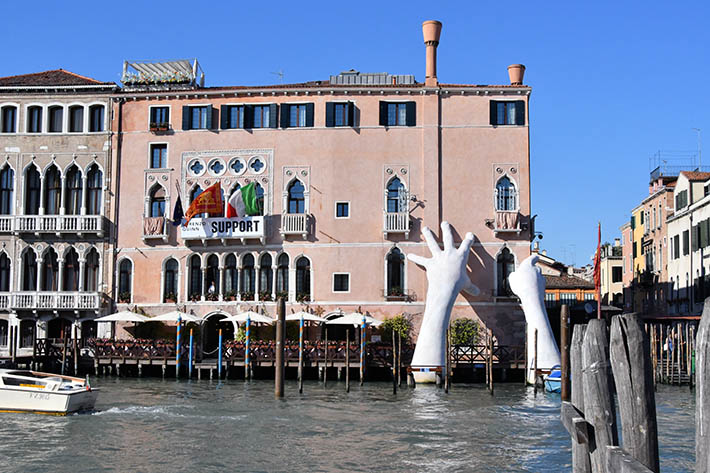
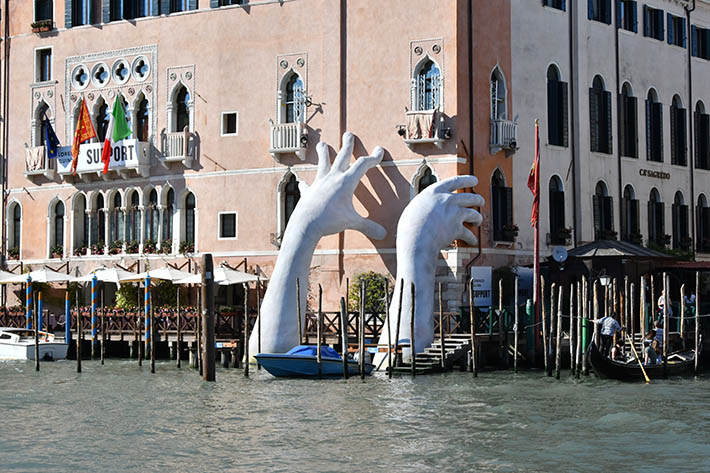
Street art in Italy
I must mention the performance that I saw on the streets of Turin. A young man pounded the keys of an old typewriter with rare obsession. Here is one of his finished pieces.
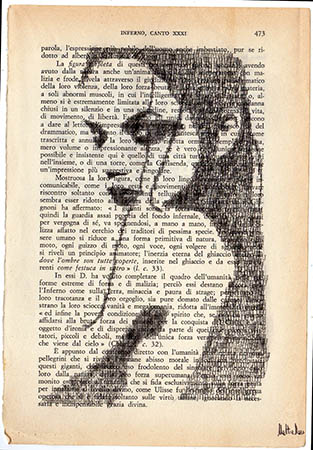
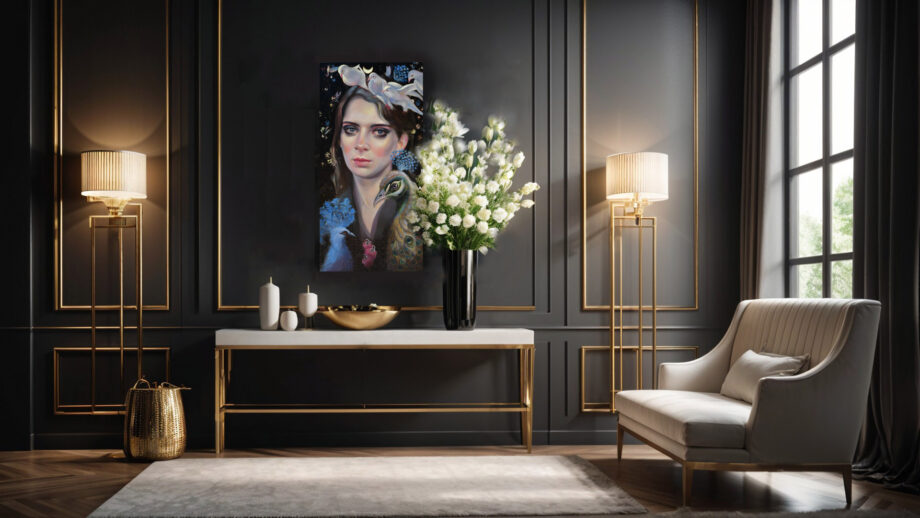
Check out visionary art for sale