The famous “Helicopter Hieroglyphs” in the Temple of Seti I at Abydos have captured my attention big time. The first time I saw those I thought it was one of the strongest evidence of alien tech existing on our planet. 🙂
At first glance, the relief appears to depict a futuristic fleet—a modern chopper, a submarine, and an aircraft. However, Egyptological research reveals that these shapes are not ancient foresight, but rather the result of stone recycling, re-carving, and physical erosion!
The Real Story Behind Egypt’s “Helicopter” Hieroglyphs
In ancient Egyptian temple architecture, re-carving a predecessor’s monuments was a common practice. When Ramesses II succeeded his father, Seti I, he updated the temple’s inscriptions to reflect his own royal titulary. Craftsmen filled Seti I’s original relief with plaster and carved Ramesses II’s titles directly over it.
Over the millennia, the plaster filler deteriorated and flaked away, leaving both the original and superimposed carvings visible at the same time.
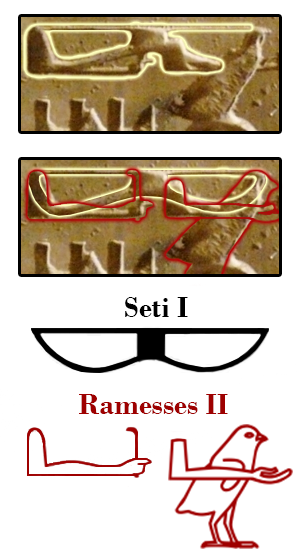
This layered carving technique creates a phenomenon known as a palimpsest. The visual overlap of Seti I’s bow sign with Ramesses II’s arm glyphs produces the distinctive outline of a rotorcraft. Coupled with pareidolia—the human psychological tendency to recognize familiar shapes in random patterns—a routine royal usurpation became one of history’s most famous pseudo-archaeological myths. Amazing, isn’t?
Here you can watch an excellent Russian video (use audio dubbing option) explaining the helicopter hieroglyphs :
So, Ramesses II’s craftsmen plastered over Seti I’s title and carved the nebti name of the new king over it. Over the centuries, the plaster crumbled, and this is what emerged:
The helicopter is a bow, superimposed with the determinative “hand with a stick,” as well as the hand, representing the sound “a.”
Superimposing the symbol for the “m” sound in “mek” on a hand—the symbol for the “d” sound in “der”—created a tank.
Superimposing a hand and a basket (the “k” sound) on the mouth—the symbol for the “r” sound. The result was either an airplane or a submarine.
Scholarly Sources & References
- Brand, P. J. (2023). Ramesses II, Egypt’s Ultimate Pharaoh. Lockwood Press. (Pages 82–85, 108 detail the royal re-carving under Ramesses II at Abydos and the resulting pareidolia).
- Roberson, J. A. (2016). “Anatomy of a Palimpsest: The Not-so-Strange Case of the ‘Abydos Helicopter’.” Kmt: A Modern Journal of Ancient Egypt, 27(1), 61–66.