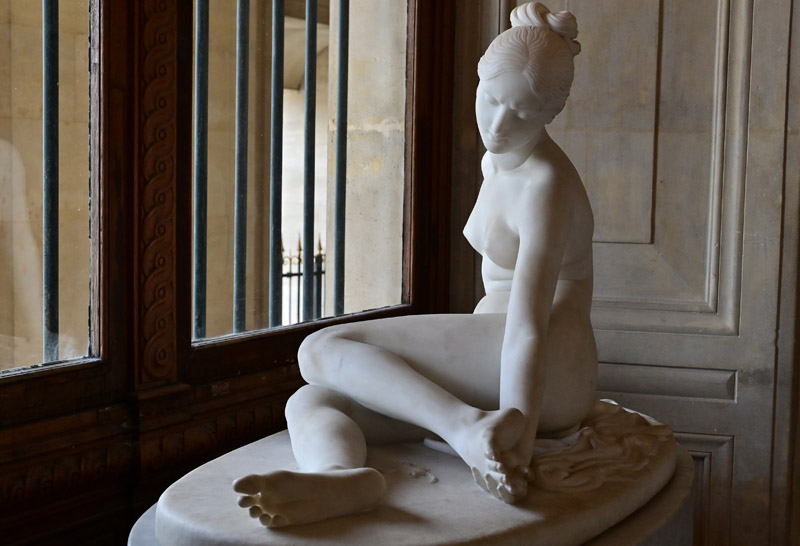
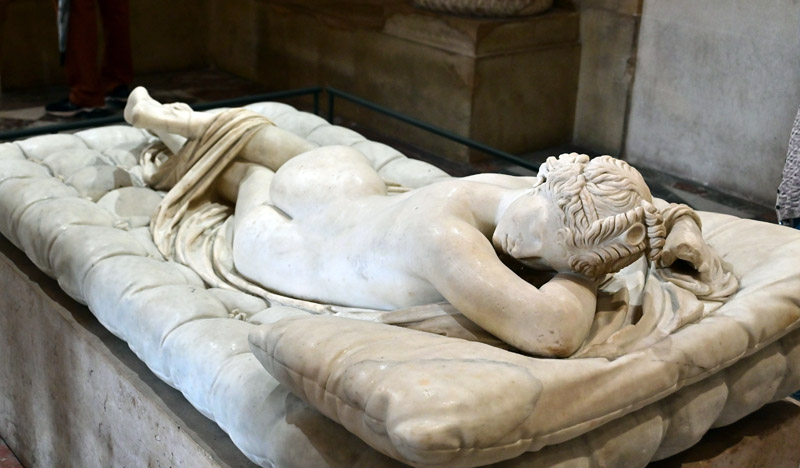
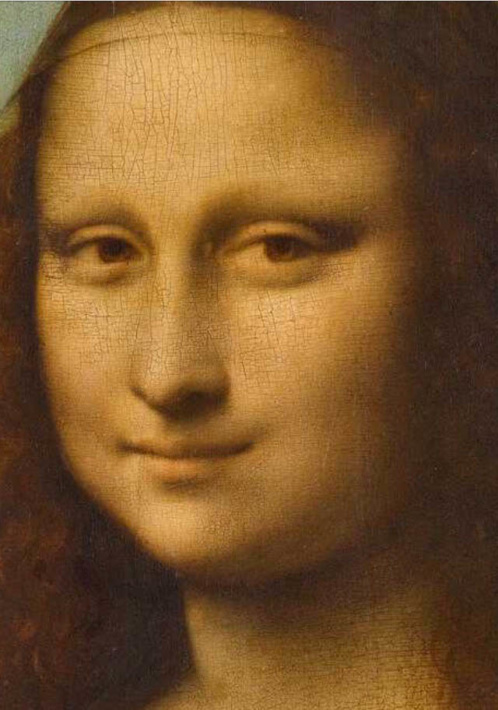
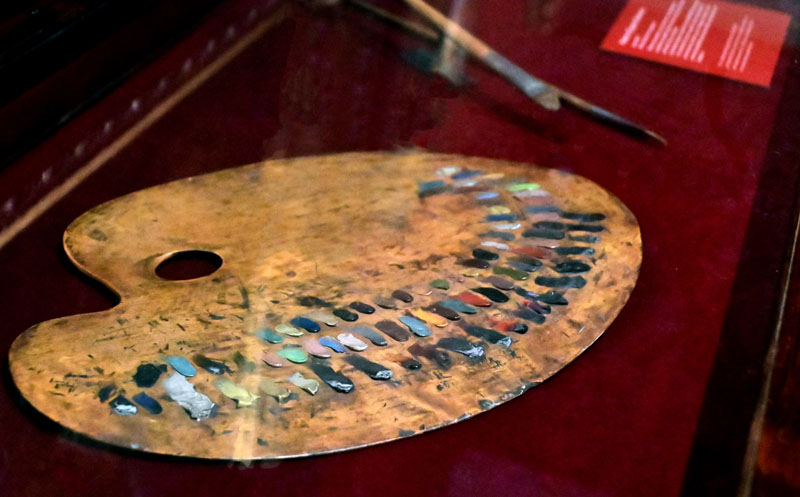
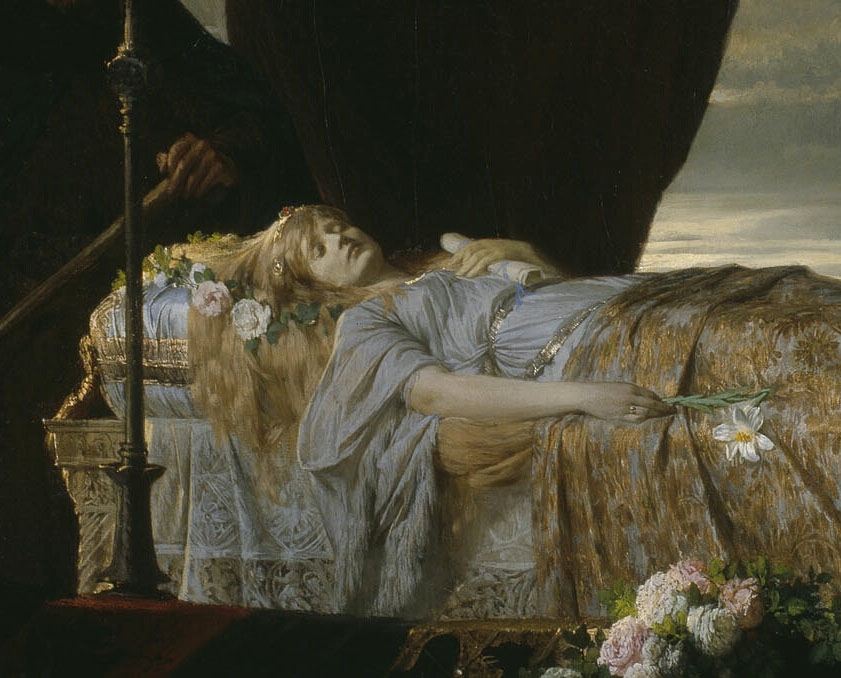
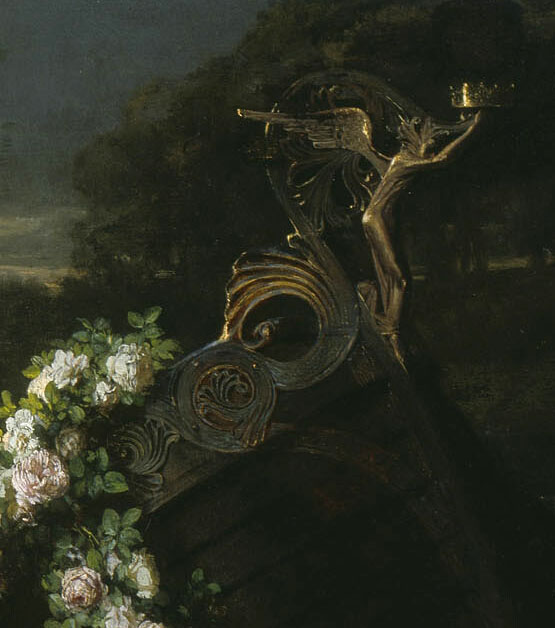
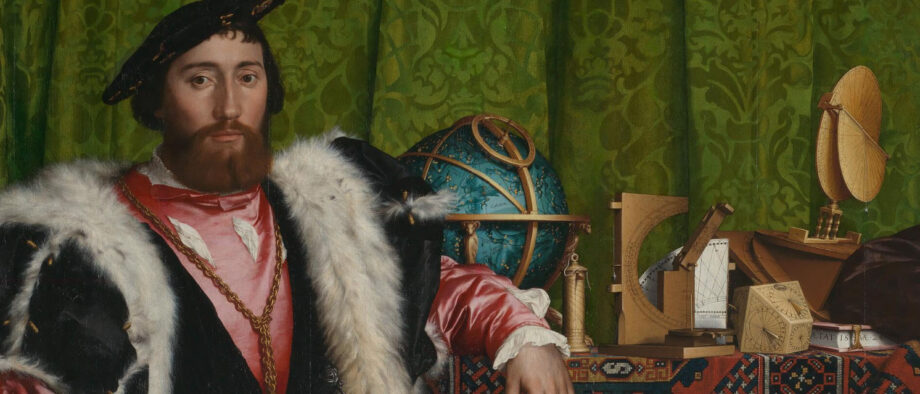
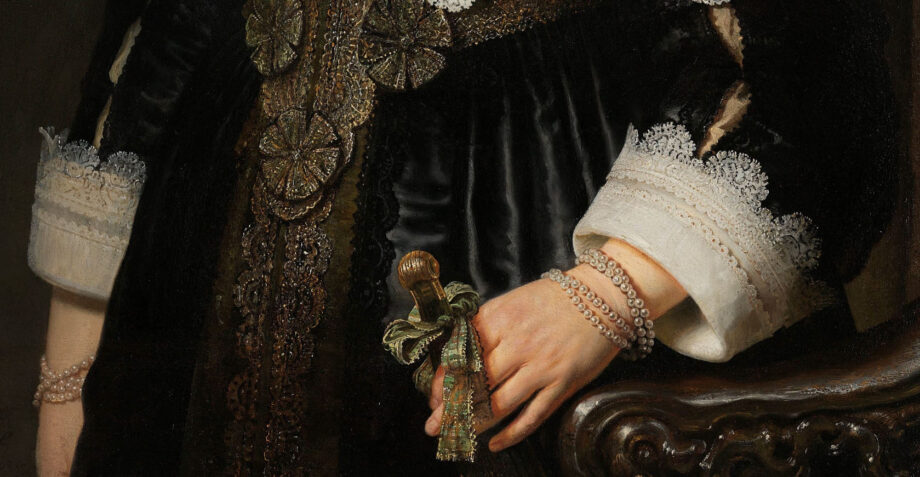
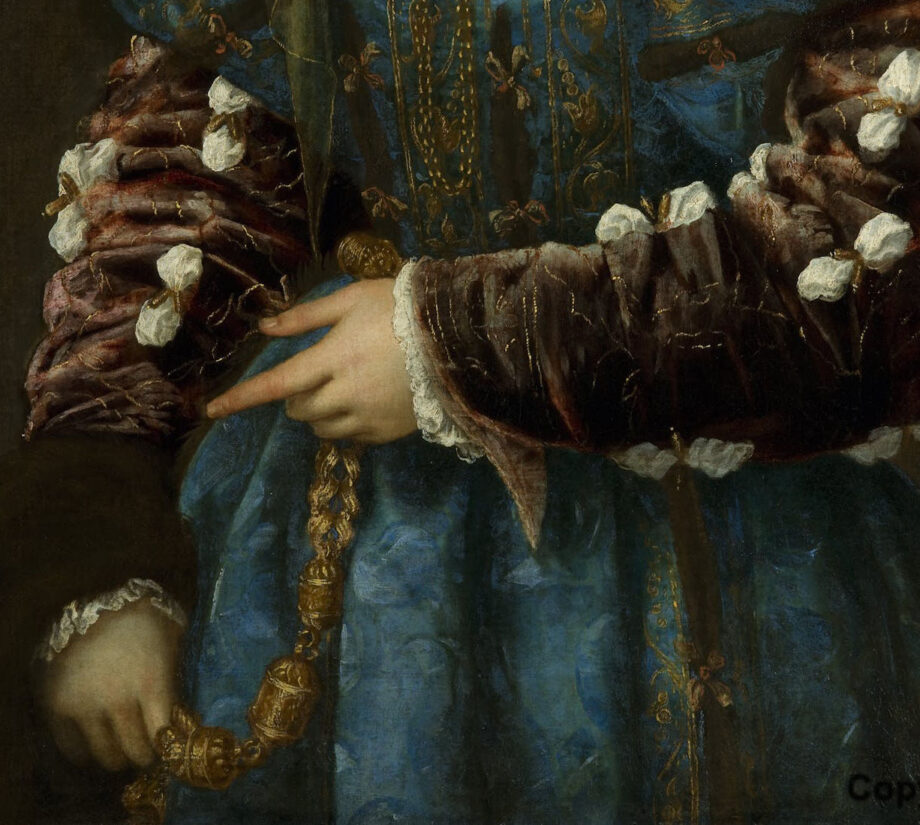
Tag: best art museums

Why Edinburgh Feels Like a Fantasy Novel 

Tap to watch a comprehensive, cinematic travel guide of Edinburgh

Why Edinburgh Feels Like a Fantasy Novel

I didn’t come to Edinburgh to make a travel video… I came because this city feels like someone painted my dreams and forgot to wake me up. I spent 3 days in Edinburgh, and it felt like stepping into a painting. Hi, I’m Veronica Winters, an artist who chases light in visionary art.
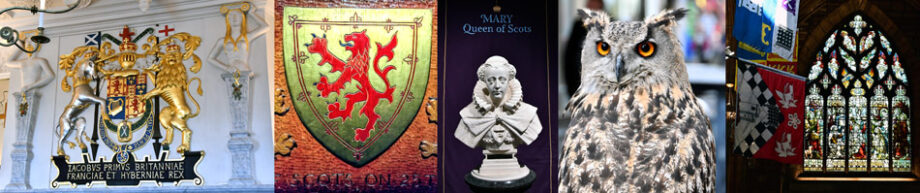
And Edinburgh? It’s a pure fantasy novel for painters. Every corner begs to be sketched. Cobbled streets are older than some countries. Giant stone buildings rising to the sky like they’re telling history about the 16th century. I thought I saw beauty… until Edinburgh burst me open.

Edinburgh’s history unfolds like a painting in layers of volcanic rock, smoke, and northern light. The city began on an extinct volcano that became Castle Rock around 8500BC. By the 7th century, a hillfort- Din Eidyn crowned it. That dramatic silhouette—steep, dark, monumental, unyielding—has obsessed artists ever since.

Pro tip from a creative visitor: Bring a tiny watercolor kit to sketch the colossal castle-like city, palace, and parks in May or June, the best time of the year. Visit the Scottish National Galleries for more inspiration. They are free. The 19th and 20th centuries brought the Scottish Colourists together to paint the northern beauty. (I have a separate video about the best art inside the Scottish National Gallery. Watch it next!)

In the Middle Ages, the immortal town clung to the ridge between castle and Holyrood like a dark brushstroke. Houses rose to 6 storeys in vertical stacking, leaning over narrow closes so tightly that daylight barely reached the cobblestones. Craftsmen and tradesmen alike lived in limited spaces of vertical chaos, monumental houses built upward to accommodate the growing city. By the 1500s, Edinburgh was Scotland’s capital, a crowded, stinking, brilliant place.
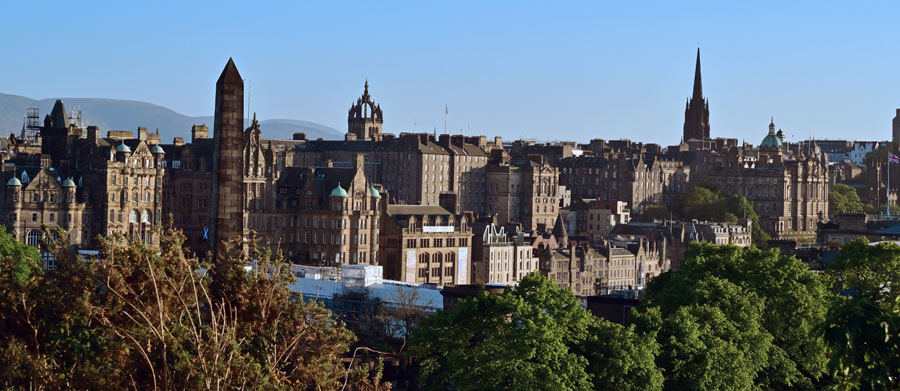
Edinburgh is even more beautiful than in the movies. Forget the guidebook highlights for a second. Walk down the Royal Mile– enormous stone houses, lovely people, pure magic. This place feels like The Lord of the Rings, but five minutes from Starbucks.

Mary King’s Close or The Vaults tour doesn’t allow photography or video inside, but offers a glimpse into hardship, sickness, work, and hope of Scottish people centuries ago.

Visit one of the most beautiful, medieval churches in Europe -St Giles on the High Street, unique stained glass windows and Scottish spirit. Founded in 1124 by King David I, the rising church over the Royal Mile has been open for over 900 years.

St Giles’ Cathedral History
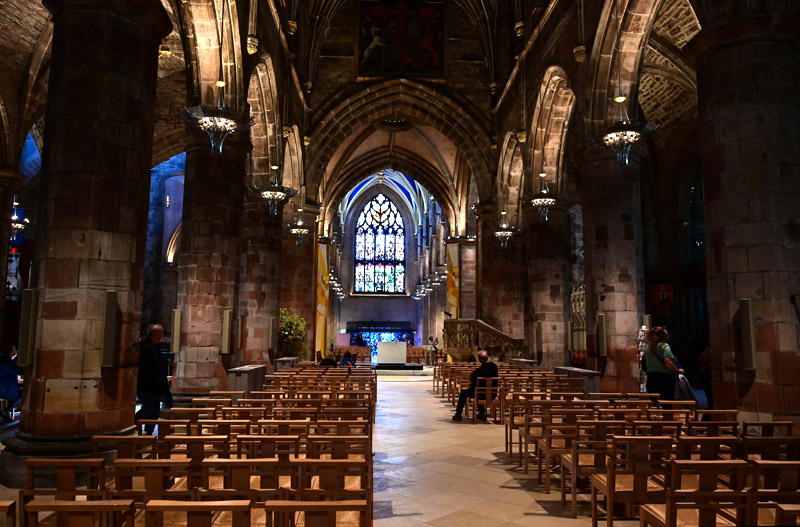
  • Early Origins: Began as a small Romanesque church, possibly founded around 1124, with its site used for worship for centuries before the current structure.
  • Fire & Rebuilding: Severely damaged by fire in 1385, most of the building was rebuilt in the 14th/15th centuries, featuring its iconic crown-shaped tower added in the 1490s.
  • Scottish Reformation: Became the center of Scottish Protestantism, with John Knox preaching there after 1559; it was subdivided into multiple churches under one roof.
  • Covenanters & Royal History: Site of significant Covenanter events, it hosted state funerals, including that of the Marquis of Montrose, and witnessed royal drama, including riots over a new prayer book.
  • Current Status: Now known as the High Kirk, it’s a working church of the Church of Scotland, not technically a cathedral as it lacks a bishop, but remains central to Scottish life. 

The Thistle Chapel (Added 1909-1911) 

  • Purpose: Scotland’s only private chapel for the Order of the Thistle, the nation’s highest chivalric order, founded by James III.
  • Design: Created by architect Robert Lorimer, it’s a masterpiece of Scottish Gothic, filled with heraldry, stalls for knights, and unique features like angels playing bagpipes. 

Walk through Greyfriars Kirkyard at twilight. Visit a Harry Potter store and cafe to experience magic.

Hike Arthur’s Seat in Holyrood Park. This ancient extinct volcano offers breathtaking views of the palace and busy Scottish city life. See changing exhibitions from the Royal Collection in the Palace of Holyroodhouse, featuring old master paintings, rare furniture, decorative arts and images from the vast photograph collection.

Another high point of the city is Calton Hill, the headquarters of the Scottish Government. Quiet moments on Calton Hill can’t be skipped. An entire fortress city spreads below in the picture-perfect, warm, welcoming sunset.

Visit the castle standing on Castle Rock since the Iron Age. The immortal castle shares historical conflicts, wars, and the Crown Jewels of Scottish monarchs with numerous visitors today. At the top, the city spreads beneath you like someone spilled diamonds across black velvet. Powerful. Emotional. Real. Depending on the hour, you can enjoy a colorful play of brown-stone streets, green trees, and deep blue sea and sky. I came up here to make a discovery and snap pictures for my future art, but realized the city had already been painting me.
History of the Scottish crown’s shape

Edinburgh faced political decline after 1603 when the court moved to London. And in 1767, a young architect, James Craig, won a competition to build a New Town across the valley. Broad streets, elegant squares, pale sandstone terraces—Edinburgh suddenly had perfect neoclassical bones beneath its Gothic skin. It became the center of culture and finance.

If you have three hours, visit the National Museum of Scotland, a fascinating blend of Scottish medieval history, culture, archeology, geology, science, technology, art, and curiosity.

Long Nights that made me smile. Eat: Cullen skink (Cullen skink is a thick, creamy traditional Scottish soup made primarily of smoked haddock, potatoes, and onions), haggis (made with sheep’s heart, liver, and lungs), Scotch pies, millionaire shortbread, anything with whisky in it. Drink: Hot chocolate with Baileys when you feel cold. Listen: There’s live traditional music every single night. Let it mesmerize you.

In the late eighteenth century, Scotland experienced cultural revival. Scientists like the chemist Joseph Black and engineers like James Watt became leaders in science and industrialization. Scientific and industrial changes somewhat eroded the religious beliefs that had previously guided society for centuries.
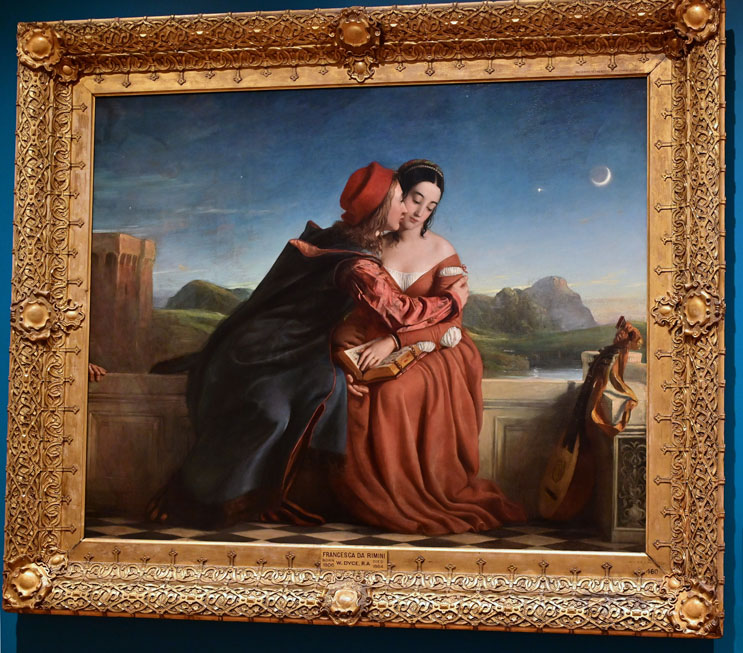
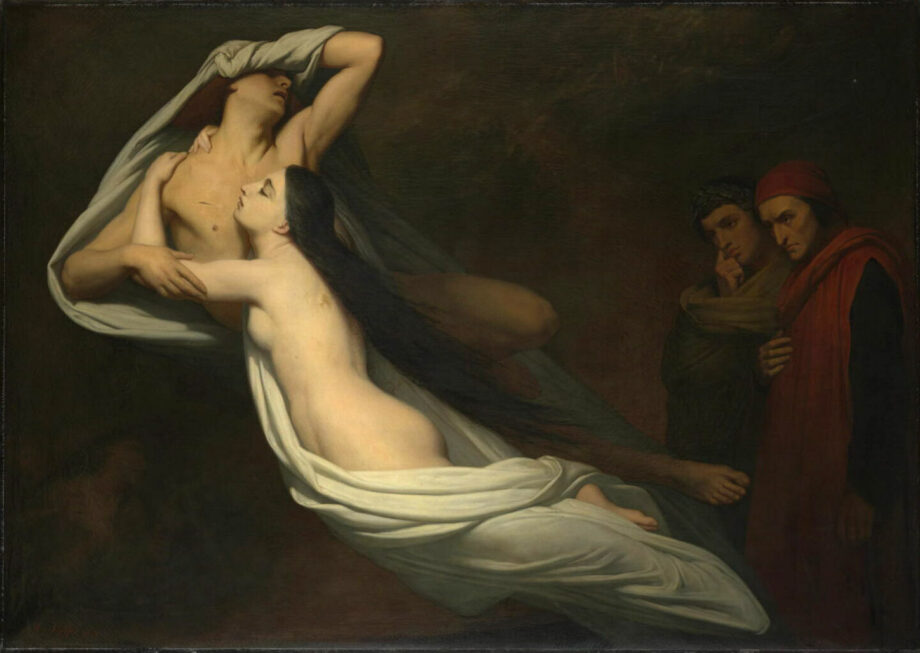
francesca da rimini

Intoxicating Romanticism arrived with Sir Walter Scott and Robert Burns in literature. He mythologized Scotland’s past and turned Edinburgh into a stage set of tartan and legend. The Scott Monument (1844), a soaring Gothic spire on Princes Street, still looks like something drawn in pen and ink by a fevered Victorian hand. The ancient city rises over the sunlit trees like in a medieval manuscript.

In the late 19th century, people expressed a lot of interest in artists and their craft. Local and national artists were raised to a celebrity status, sharing their behind-the-scenes painting process in their studios that generated and convinced art collectors to make a sound investment in art. After all, these marketing principles stay the same across decades and even centuries.
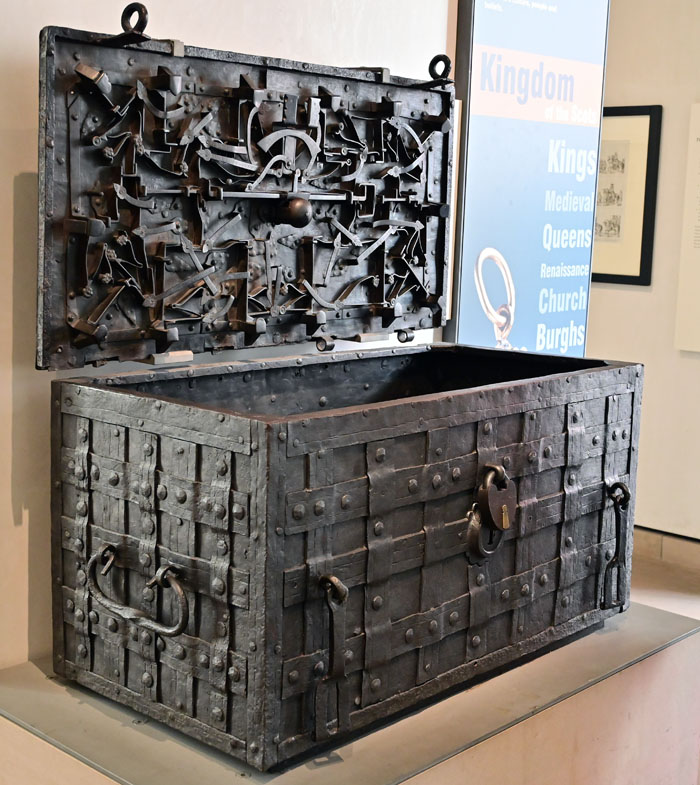
Scottish company treasure chest in the museum of Scotland

Edinburgh felt Like stepping into a Painting. The whole city is a living canvas—performers, painters, tourists spilling into the streets. For centuries, artists have tried to capture it and never quite succeeded. The city always keeps one shadow, one slant of light, one impossible angle still waiting to be drawn.

You can’t call Edinburgh a regular European town. It’s haunted, proud, ancient, mysterious, beautiful, alive. It makes you want to create. It makes you fall stupidly in love with a city you just met.

I did take a ton of pretty pictures. But Edinburgh gave me more than awesome views. It reminded me why I started painting in the first place. If you’re tired, lost, or just need to feel something again… come here. This city still believes in light, Love, and magic. And for 3 days, it made me believe again, too.

So if you’ve ever wanted to feel like the main character in a novel…Come here. Bring a sketchbook and an open heart. Edinburgh will do the rest. The most fascinating city in Europe is yours. i can promise you that Edinburgh is Even More Beautiful Than the Movies.

Drop a heart if this city lives in your soul now, too.
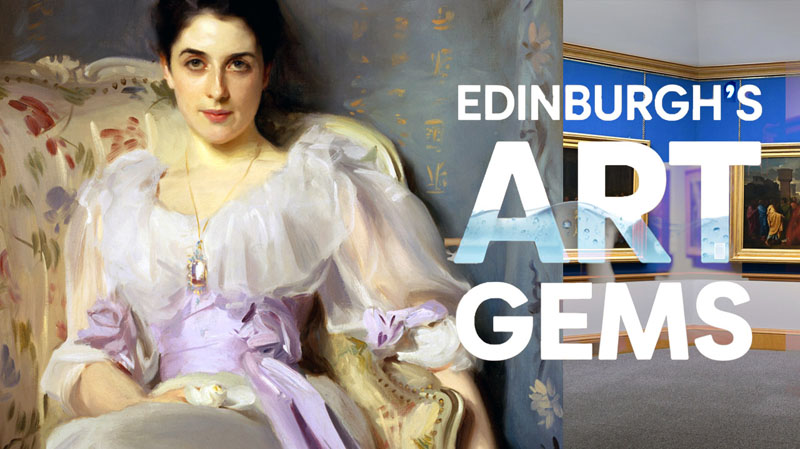
Reformation to Revolution in Scotland

*The following information comes from the museum’s description in Scotland.

At the beginning of the sixteenth century Scotland was a Catholic state governed by the Stewart dynasty (who later spelled their name Stuart). By the close of the seventeenth century the monarchy, church and parliament had all changed drastically. After 1603 the Stuarts, now based in London, were absentee rulers, and the nature of kingship was itself increasingly contested. The huge upheavals of the Reformation saw Protestantism become the nation’s official religion. The collapse of the old church and the dispersal of its lands and wealth brought about a major shift of power and income: new landed classes vied with established noble families for status and influence.

These complex changes had important cultural consequences. With religious painting no longer acceptable there was an increase in demand for secular art forms, portraiture in particular. This coincided with a growing merchant and professional class beginning to commission works of art to display their increased ambition and economic strength. Painted portraits were expensive, and those who acquired them came from the wealthiest levels of society, both old and new. These men and women used portraits to assert ideas of social status as well as to record an individual likeness. Their images played a significant role in the struggles for power, identity and nationhood during this period.
.
Between 1760 and 1860, Scotland’s place in the world was dramatically transformed. With the collapse of the Jacobite cause after the Battle of Culloden in 1746, Scots became less politically divided and began to focus instead on cultural, economic and personal advancement.

Edinburgh and Glasgow became centers of philosophical and scientific thought. Scotland’s trade with Britain’s vast overseas Empire expanded dramatically. ‘Improving’ landowners and adventurous entrepreneurs developed new products and processes. With growing confidence and ambition, Scots now took their place across the wider world as soldiers, sailors, and traders; as poets, novelists, and artists; and as politicians and administrators. And while they did so they took increasing pride in their own identity, a development that bore fruit in the poetry and novels of Scotland’s great romantic writers. But this transformation came at great cost. The new imperial economy was built on slavery and warfare, while industrialization destroyed established trades and the mining and burning of coal ravaged the natural environment. The result was a period that has left a complex, and sometimes troubling, legacy – a legacy that we, in our own era of economic and environmental crises, are still struggling to manage and understand.

Cultural Revival in Scotland
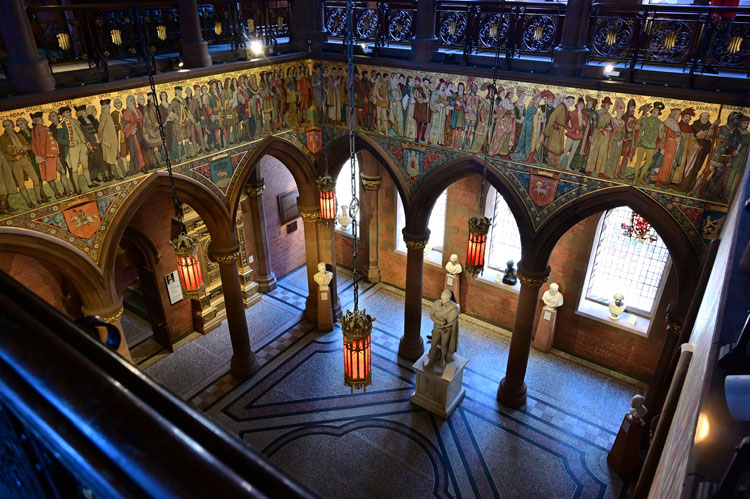
Scottish National Portrait Gallery hall

In the later eighteenth century, Scotland’s cultural revival gave it a central role in European life. Scientists like the chemist Joseph Black and engineers like James Watt laid the foundations for modern science and industry. These achievements were paralleled in literature by the intoxicating romanticism of Robert Burns and Sir Walter Scott. These changes, however, also gave rise to new challenges. Science and technology eroded the religious beliefs that had previously given society its shared values. Mechanical power marked the beginning of our destructive dependence on fossil fuels. The spell woven by Scott’s poetry and novels could all too easily hide Scotland’s rapidly changing social reality behind a veil of romantic escapism.

Nowhere are these paradoxes sharper than in Scotland’s extensive involvement in Britain’s growing empire. Able colonial administrators, such as the lawyer Sir Thomas Strange, sought to apply enlightened principles to their work. At the same time. however, the Atlantic ‘triangular trade’ was taking thousands of slaves from Africa to the plantations of North America and the Caribbean, and shipping slave-produced sugar, rum and tobacco to the British Isies. The plantation trade enriched Glasgow’s merchant elite and provided secure incomes for the thousands of middle and upper class Scots with plantation investments. Others, however, were moved by the sufferings of slaves such as George Dale, whose biography is reproduced on this panel. Often drawing strength from deeply held religious and moral principles, they opposed the appalling human cost of the slave trade, in the face of fierce resistance, abolitionists, including the prominent Scottish liberal lawyer and politician, Lord Brougham, finally brought slavery to an end in 1838.
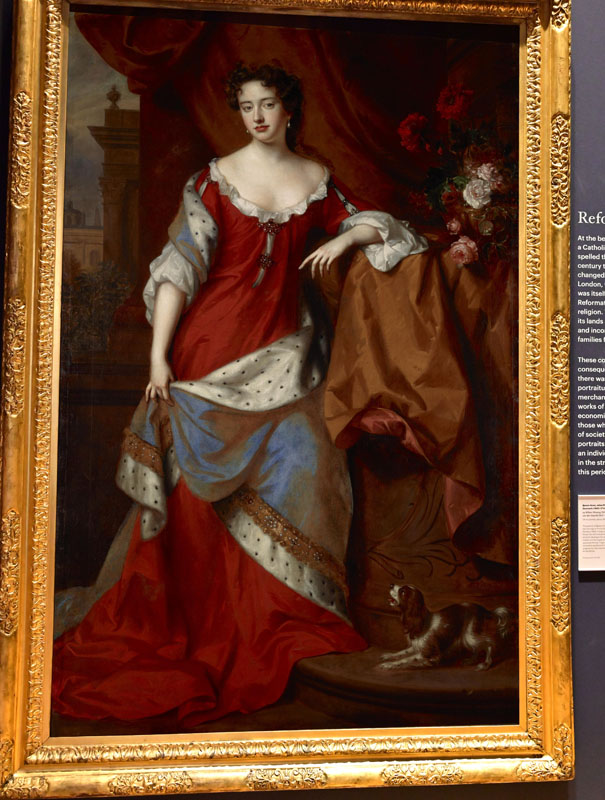
Jan van der Vaardt, Queen Anne

The Most Underrated Art Gallery in Europe? Edinburgh Stole My Heart in 4K

Art books from the artist:
https://amzn.to/4bbYT81
colored pencil manual veronica winters
https://amzn.to/3xoJjbi
thailand-book-cover-front
The Enigma of Thailand, 2013 https://amzn.to/4qOouLS
https://amzn.to/46mDs4z

An Artist’s Love letter to the Scottish National Gallery

Are you traveling to Edinburgh in Scotland? Here you’ll discover hidden treasures of the Scottish National Gallery, home to the best Scottish art in national gallery Edinburgh. I’m on a mission to uncover as many stories in famous paintings in Scottish National Gallery as I can before my time runs out. From brutal dramas to national controversies, these are the details most visitors walk right past. The clock is ticking… let’s go! To read and see pictures of the gallery, go here: https://veronicasart.com/5-undeniable-reasons-to-love-scottish-national-gallery/

If you’d like to support my work, subscribe & rate this podcast on Spotify and Apple | Show your support for the podcast: here | Host: Veronica Winters, MFA | veronicasart.com
5 Undeniable reasons to love Scottish National Gallery by veronica winters art blog

5 Undeniable reasons to love Scottish National Gallery

(First published in December 12, 2019. Updated in November, 25, 2025.)

In this article, I’d like share why this free art museum feels more luxurious than any paid one. The Scottish National Gallery is a much less known art museum, but it offers beautiful gems by famous artists and amazing Scottish artists alike. There are about 120,000 objects in Scotland’s collection of art! This art museum’s central location makes it an easy and pleasant stroll from the Edinburgh Old Town.

Please know that this gallery consists of three separate buildings. The National Gallery is on the Mound, the Modern Gallery is 73&75 Belford Road, and the Portrait Gallery is 1 Queen Street.

Eric Harald Macbeth Robertson, Miss Maidie and Miss Elsie Scott, detail, 1915, oil on canvas, closeup of a painting, Scottish National Portrait Gallery.
Eric Robertson was a significant figure in the artistic milieu of Edinburgh in the years immediately preceding and following the First World War. Born in Dumfries and trained at the Royal Institution, Robertson was hailed as ‘one of the most brilliant students of his period’. He was strongly influenced by the symbolist work of John Duncan, and it was through Duncan that he met his future wife, the artist Cecile Walton. They exhibited in the ‘Edinburgh Group’ exhibitions of 1912 and 1913. Robertson was a Quaker and so would not take up arms, but he served with the Friends’ Ambulance Unit in France during the war. The Scott sisters belonged to the group of artists and intellectuals in Edinburgh that included Robertson and Walton. Maidie Scott, who was married to the musician, Leonard Gray, became a companion of the poet Wilfred Owen during his time in Edinburgh as a patient receiving treatment for shell-shock at Craiglockhart. Through her account of their friendship, much is known about the poet’s last months before his return to the Front and death in November 1918.
The painting embodies a strong sense of the mood of the time. In particular, it expresses the role of the majority of women during the war – mothers, sisters, daughters, wives, sweethearts and friends – whose fate was to remain at home stoically and anxiously waiting for news. The women in this somber painting could be tragic muses in modern dress. (from museum’s description).

The gallery has expanded since my last visit in 2019, and I could enjoy looking at many 19th and 20th-century paintings by Scottish artists in 2025. This wing is fascinating because the displayed art is top notch, diverse, and sincere. Yet none of the presented artists and paintings are in major art history books. So, it’s a lot of discovery for me personally. There are many colorists, landscape art, portraiture with a contemporary feel, stylized paintings, and inspirational paintings of children, spiritual & religious art. William Brassey Hole, The Landing of St Margaret at Queensferry A.D. 1068 is a welcoming mural, painted on the first floor of the Great Hall in the Scottish National Portrait Gallery. It depicts the arrival of the Anglo-Saxon princess Margaret (about 1045-1093) in Scotland.

Scottish national gallery
John Duncan (1866-1945) St.bride, 1913, detail | Scottish National Gallery

# 1 A mix of big names and beautiful paintings

I found my new favorite painting, and it’s in Scotland! I was stunned to see Sargent’s Lady Agnew in this building!

John Singer Sargent

John Singer_Sargent_Lady_Agnew Scottish National Gallery
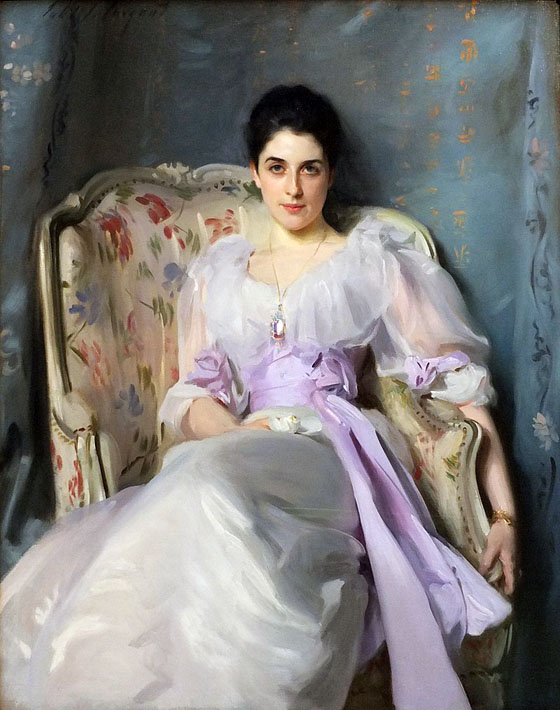
John Singer Sargent, Gertrude Vernon, Lady Agnew of Lochnaw (1864-1932). When the painting was exhibited at the Royal Academy in London in 1893, it was an instant success for both the artist and the sitter, launching their celebrity status in Britain. Look at this soft lilac and white next to her skin…Her confidence. I felt it in my chest. I had to stop taking pictures and just admire the beauty.

Although some famous artists like Sargent, Raphael, Hals, Gainsborough & Botticelli occupy the walls, it’s nice to see lesser-known painters presented in the art museum as well. In a way, they run the show with art pieces of greater impact. The gallery opens with Sargent’s Lady Agnew of Lochnaw, and Hugo van der Goes’ Margaret of Denmark, Queen of Scotland, altarpiece, 1478. The art museum pleasantly surprises with some 19th-century epic paintings of colossal size, produced in prints for the popular market during that time period.

Thomas Gainsborough

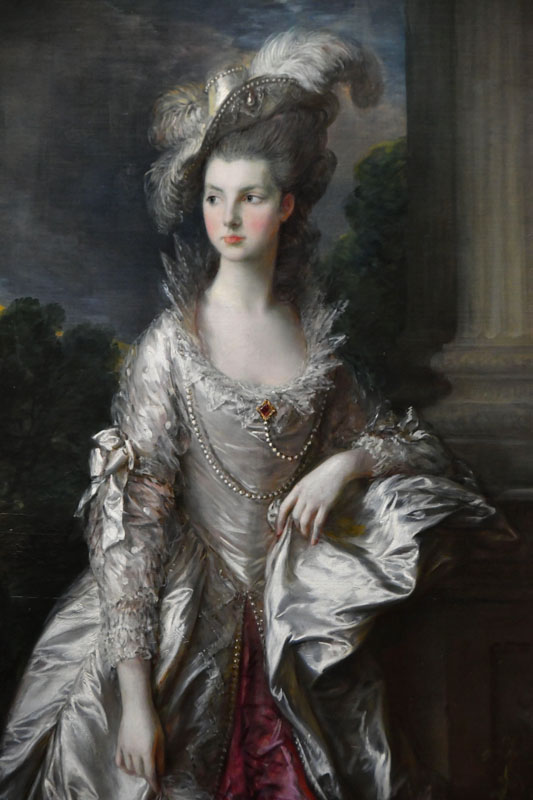
Thomas Gainsborough The Honourable Mrs Graham
Thomas Gainsborough The Honourable Mrs Graham (1757 – 1792) 1775 – 1777, painting close-up, Scottish National Gallery. According to the museum’s description, after Mary’s death, Graham could not bear to contemplate her picture.

English portrait and landscape painter, Gainsborough had a successful career. Like Van Dyck, he painted royalty but also included imaginative English landscapes behind the figures. A rival of Reynolds, the artist was a founder member of the Royal Academy in 1768.

The Honourable Mrs Graham is an amazing full-length portrait that features painterly brushwork and sophisticated shades of grey. Dressed in a beautiful gown, the young woman exhibits elegance and confidence. Daughter of Baron Cathcart, she married the Perthshire landowner Thomas Graham, and after her death, Graham passed the painting to her sister. Rediscovered in storage by his heir, It was bequeathed to the National Gallery by one of their descendants on condition that it never leaves Scotland.

Let’s dive deeper into the best Scottish art in national gallery Edinburgh. We’ll look at even more famous paintings in Scottish national gallery!

Art about Mary, Queen of Scots (reigned 1542 – 1567) in the National Gallery of Scotland:
Next, let’s dive into the heart of the Scottish collection, where art and national identity are locked together.

  • Sir William Allan (1782 – 1850), Scottish, The Murder of David Rizzio, 1833, oil on panel. This painting is not huge but presents a real historic scene captured in beautiful, energetic brushstrokes by the artist. Sir William Allan depicts the dramatic assassination of David Rizzio, the queen’s Italian secretary, in March 1566. According to the museum, the artist paid close attention to detail, being historically accurate. He established the identity and role of all people involved in the scene, and painted the exact interior of Mary’s rooms at the Palace of Holyrood (Unfortunately, the palace was closed both times I visited Edinburgh, but it’s definitely worth your visit! It’s located at the end of the Royal Mile, and buying tickets beforehand seems like a great idea. The artist depicted the Earl of Morton in a black hat to the far right, and Mary was restrained by her husband, Lord Darnley, who was part of the conspiracy but later denied any involvement.
  • Another classically-painted artwork of Mary is by Robert Herdman, Mary, Queen of Scots: The Farewell to France, 1867. In 1867 the Glasgow Art Union commissioned Herdman to complete 4 paintings depicting the life of Mary, Queen of Scots. This is the second picture in the set that depicts the young Queen’s return to Scotland in 1561 after the death of her first husband François II of France.
  • James Drummond (1816 – 1877), Scottish, Edinburgh, 16th June 1567 (formerly known as The Return of Mary, Queen of Scots to Edinburgh), 1870. Mary is shown encountering the banner with its hostile slogan, accusing her of Darnley’s murder. 
  • Unknown, Mary, Queen of Scots, 1542 – 1587, 19th century small painting on panel.
  • There are numerous engravings of the queen, such as by George Vertue (1684 – 1756), English, Mary, Queen of Scots, 1542 – 1587, line engraving on paper.


Sir Edwin Landseer

The Monarch of the Glen by Sir Edwin Landseer 1851_Scottish national gallery
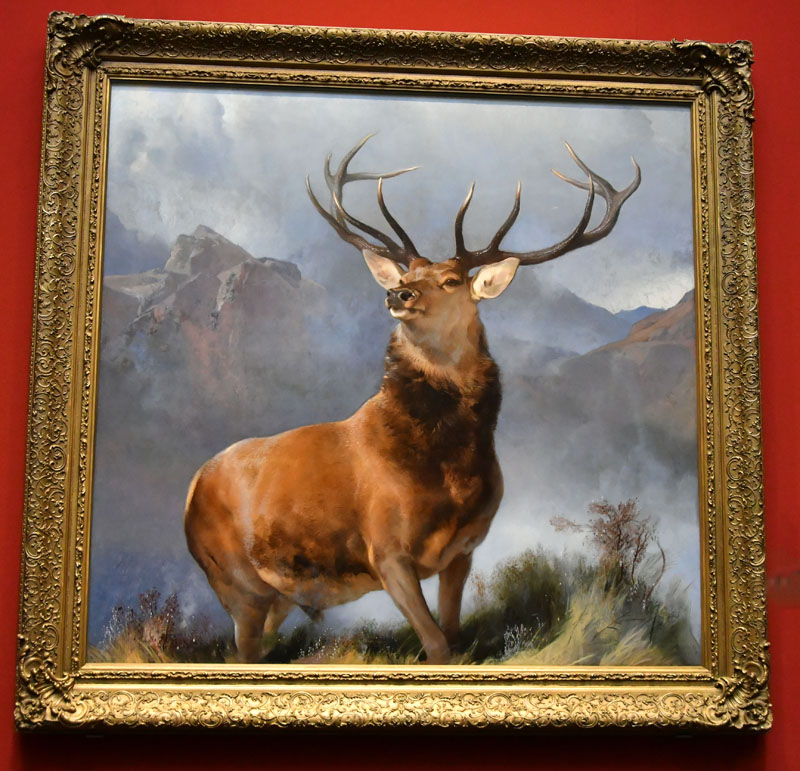
The Monarch of the Glen, Sir Edwin Landseer (1802-1873), oil on canvas, 1851, Scottish National Gallery

The Monarch of the Glen is one of the most famous British pictures of the nineteenth century. Painted in the 19th-century Romanticism era, this oil painting almost overwhelms viewers with its powerful representation of a majestic animal. Depicting a single deer as a symbol of the vastness and majesty of Scotland, this beautiful, realistic painting of a deer is huge, colorful, and breathtaking when viewed in person. The oil painting was reproduced in prints and achieved even greater success in the twentieth century when used in marketing campaigns. Famous artist, Landseer, was known for his technical skill and sensitivity in painting animals. He first visited Scotland in 1824 and made friends with Sir Walter Scott. The painting was planned as part of a series for the House of Lords in London, but was sold to a private collector.

#2 A great place for a family visit.

You won’t be overwhelmed by endless corridors, galleries, and installations. The art museum is quite intimate, which makes it easy to devote some quality time to art, education, and learning with children.

Sir Joshua Reynolds

Sir Joshua Reynolds The Ladies Waldegrave 1780_detail_scottish national gallery
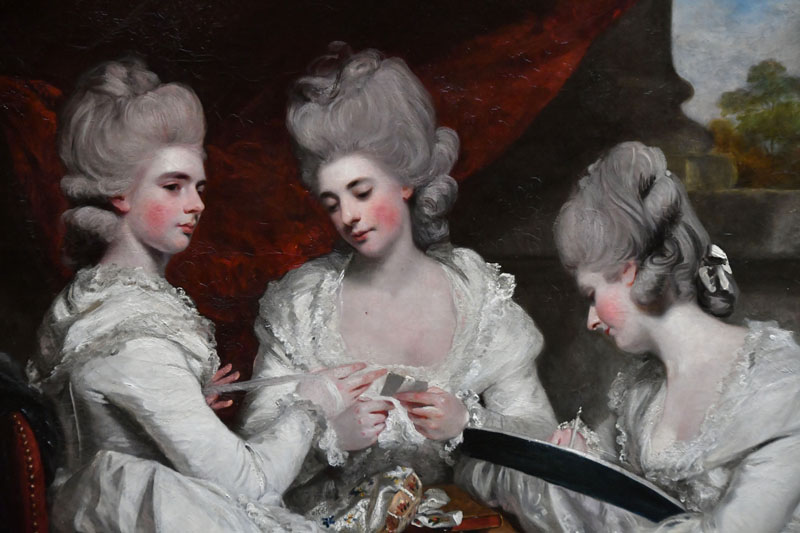
Sir Joshua Reynolds, The Ladies Waldegrave, 1780, painting close up, Scottish National Gallery

English artist Sir Joshua Reynolds was a founding member of the Royal Academy of Arts and its first president. He painted portraits of royalty and nobility in classical tradition, relying on strong compositions and referencing historical painting. Yet, his loose brushwork looks fresh and contemporary similar to Sargent.

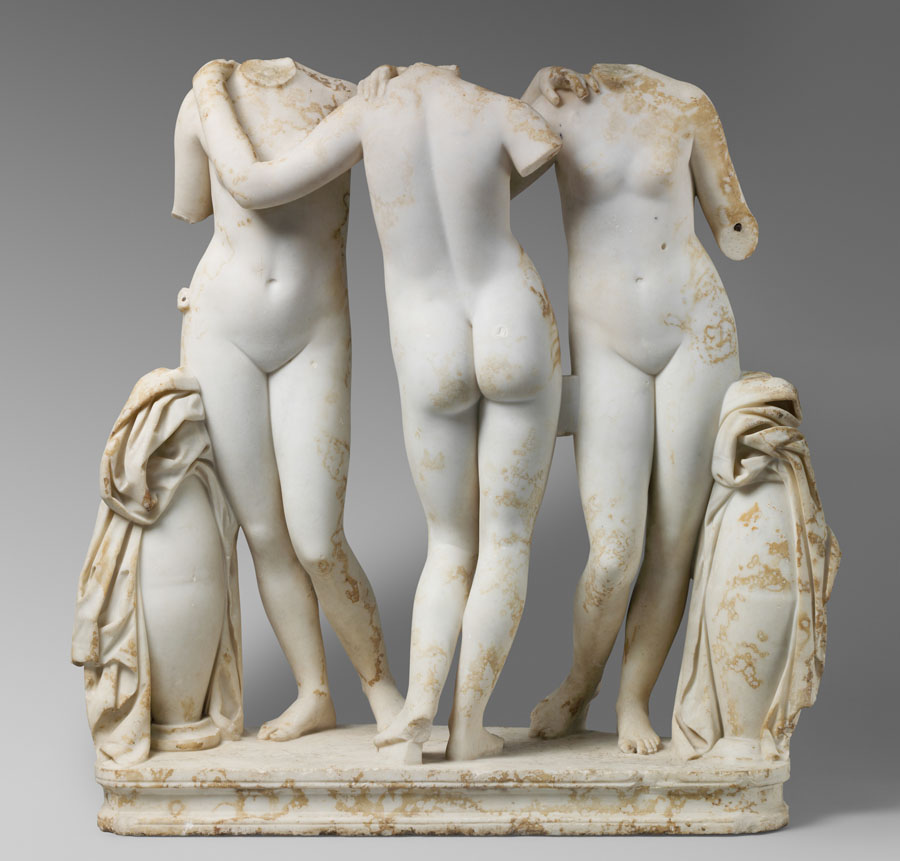
In a large-scale painting, we see three sisters, the daughters of the 2nd Earl Waldegrave, busy working on some needlework. Expertly painted, the composition draws us in with figures carefully arranged in a semicircle, reminiscent of the Three Graces found in antiquity. Commissioned by their great-uncle, the art collector Horace Walpole, this painting depicts Lady Anna Horatia on the right, who is making silk lace on a net-covered tambour frame, helped by her sisters.

Jan van der Vaardt & Willem Wissing

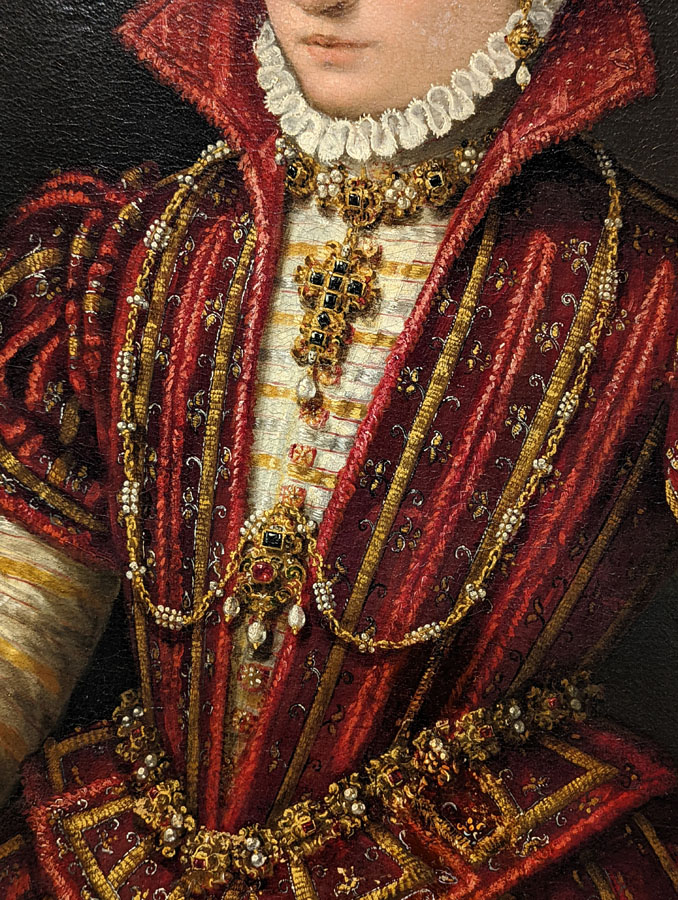
Jan van der Vaardt (1647 – 1721), Dutch and Willem Wissing (1656 – 1687) , Queen Anne, when Princess of Denmark, 1665 – 1714, 1685, oil on canvas.

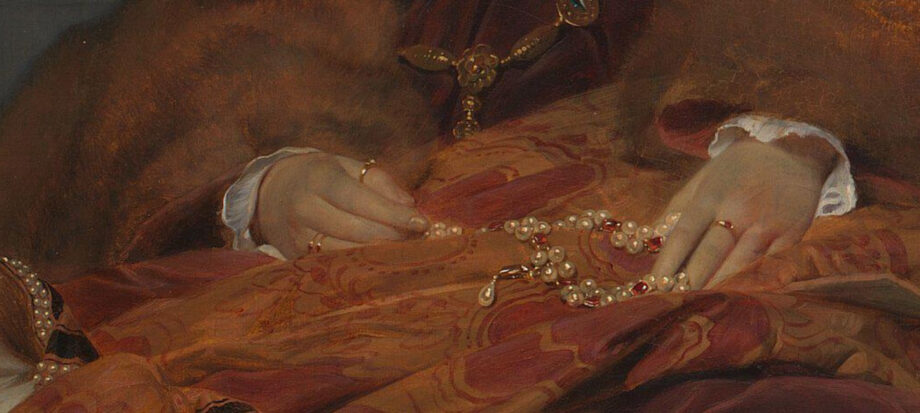
This is a very beautiful painting that depicts 18-year-old Queen Anne in a luxurious red dress and opulent interior. Queen Anne was painted after her marriage to Prince George of Denmark-Norway in 1683. Her tall figure forms a classical diagonal compositionally, with fabric’ folds complimenting her stance. White patches of color also create eye movement around the painting. The roses symbolize fertility. The tragedy of her life was 12 children dead either in infancy or miscarriages. She was the last of the Stuart dynasty on the British throne and her reign involved the war with the French. Under her rule, there was the union, which created Great Britain by uniting the kingdoms of England and Scotland in 1707.

Canova

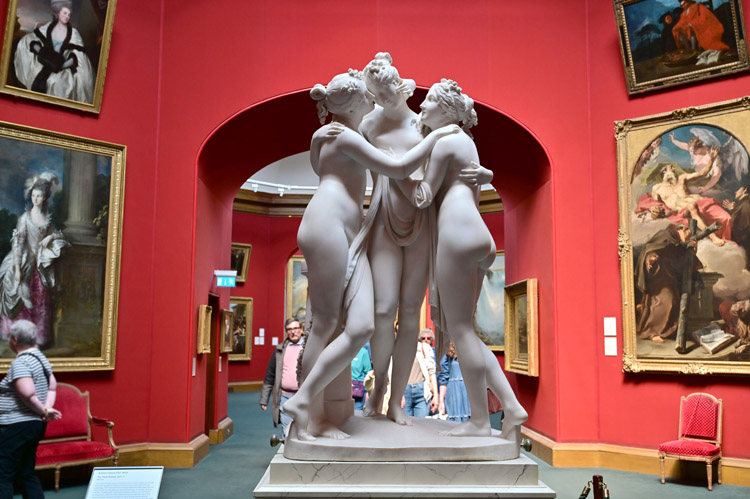
Antonio Canova (1757-1822), The Three Graces, 1815-17, Marble sculpture.

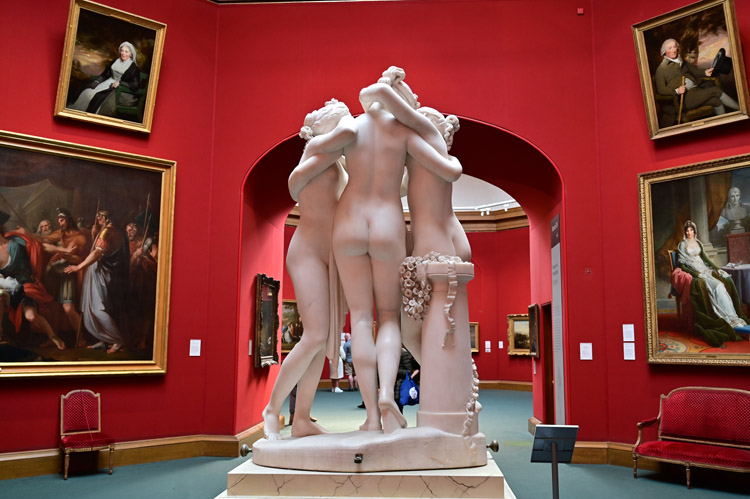
This beautiful Canova sculpture represents the three daughters of Zeus and Euryoneme- Euphrosyne, Aglaia, and Thalia. Since ancient Greek mythology, the Three Graces have been a popular motif in art depictions. The women symbolize chastity, beauty, and love. In Canova’s art, realistic graces have the interlocked movement and gentle beauty shared among the figures. According to the museum, the Duke and Duchess of Bedford commissioned the group from Canova in Rome in 1815. In two years, it was installed in the specially constructed Temple of the Graces at Woburn Abbey, the Bedfords’ country residence outside London. The first version of this realistic sculpture is in the Hermitage Museum, St. Petersburg.
Antonio Canova (1757-1822), The Three Graces, 1815-17, Marble sculpture, back view.

Besides Canova’s art, you’ll find several beautiful neoclassical sculptures on display decorating the main galleries of the art museum, like David Hill bust by Amelia Robertson Hill.


colored pencil manual veronica wintershow to color like an artist_coloring book_veronica winters
These art instruction books are on sale on Amazon!

#3 Scottish artists: famous paintings in Scottish national gallery

I spent a long time in the new art gallery, and it was perfect. When I revisited the Scottish National Gallery in 2025, I enjoyed viewing expanded gallery spaces presenting many famous Scottish artists who are largely unknown to the general public outside the country. There were many colorists and the 19th-20th-century landscape and portrait artists.

John Duncan

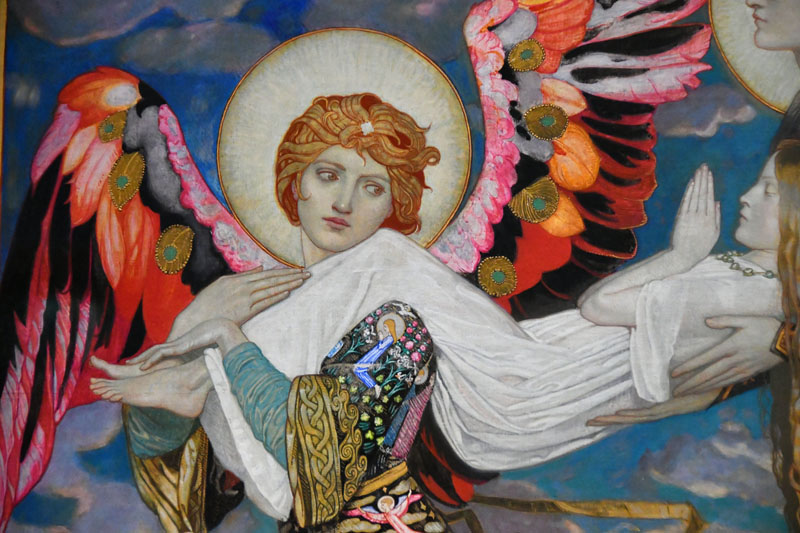
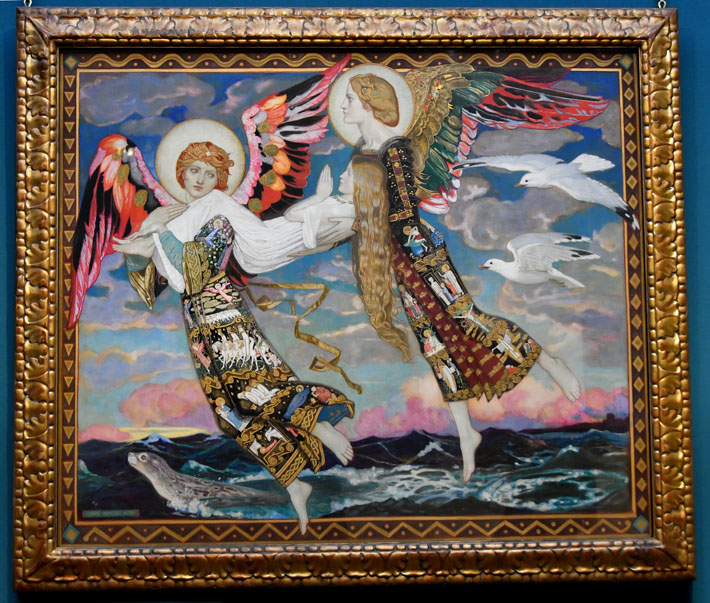
John Duncan (1866-1945), Scottish, St. Bride, 1913, tempera on canvas
This is one of the outstanding creations of the Celtic revival movement, which had begun during the last decade of the nineteenth century in Scotland. Known as ‘the foster mother of Christ’, the Irish saint Bride is shown being carried by angels over the Hebridean seas to Bethlehem to witness the nativity of Christ.
In the background on the right is the silhouette of lona Abbey. Duncan drew on his knowledge of Celtic design and the techniques and aesthetics of early Italian fresco paintings to create a dreamlike and
otherworldly image, subtly combining naturalism and formal pattern.

Duncan studied art in Scotland, England, and Belgium to settled in Edinburgh in 1892. The artist represents the Celtic Revival movement in Scottish art, and his illustrative style looks innovative even today. This colorful painting looks like it’s made of collaged pieces of religious symbols, and even the ornate frame mimics the artist’s unique style.

“According to the legend of the Irish Saint Bride she was transported miraculously to Bethlehem to attend the nativity of Christ. Here two angels carry the white robed saint across the sea. The seascape reflects Duncan’s fascination with the Outer Hebrides and the Isle of Iona. The birds and seal provide an effective naturalistic foil for the supernatural angels overlapping the patterned border. Scenes from the life of Christ decorate the angel’s robes, and may include the artist’s self-portrait as the tiny clown (a holy fool) accompanying the procession of the magi on the leading angel’s gown. “

from the website of Scottish National Gallery

William Bell Scott 

William Bell Scott Una and the Lion_national scottish gallery
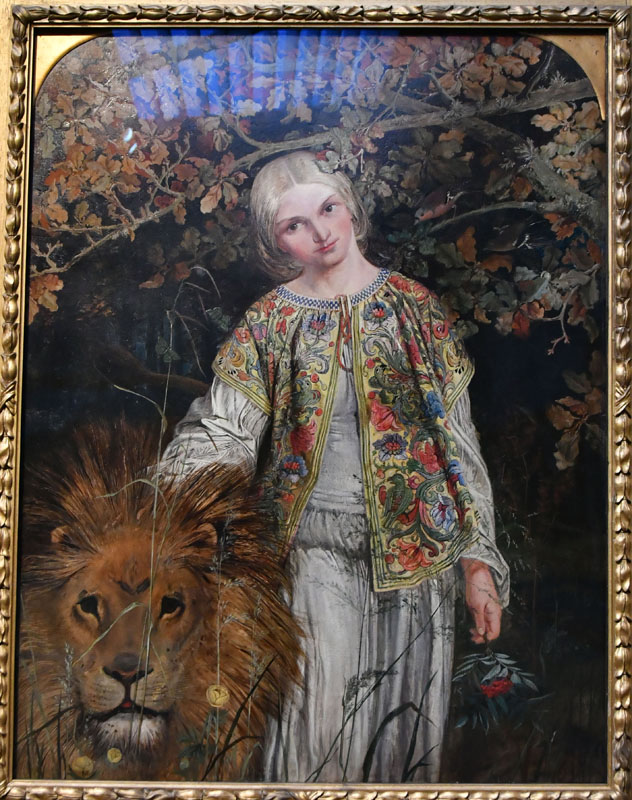
William Bell Scott (1811 – 1890), Una and the Lion, 1860, oil on canvas, the Scottish National Gallery.
Scott’s inspiration was Edmund Spenser’s late Elizabethan epic poem The Faerie Queene, an allegory of true chivalry. From the gallery’s description: The heroine Una, is surprised by a lion. Captivated and tamed by her innocence and beauty, it becomes her protector. The model for Una was Alice Boyd, whom the artist had recently met in Newcastle, when Master of the School of Design. Later, an intimate friend, Miss Boyd commissioned murals from Scott on the theme of The Kingis Quair for her Ayrshire seat at Penkill Castle.

Influenced by the Pre-Raphaelites, William and his brother were trained as artists at the Trustees’ Academy in Edinburgh and worked for their father, who was an engraver, before becoming full-time artists.

“Scott’s painting was inspired by Edmund Spenser’s sixteenth-century poem ‘The Faerie Queen’. In the poem, Una is the beautiful young daughter of a king and queen who have been imprisoned by a ferocious dragon. Una undertakes a quest to free her parents, but on her journey she encounters a fierce lion. The lion is so captivated by Una’s innocence and beauty that he abandons his plan to eat her, and vows instead to become her protector and companion. Scott shows Una gently resting her fingers in the lion’s terrific mane, as they make their way through the autumnal wood together.”

from the website of Scottish National Gallery

#4 Central location

The art museum’s central location makes it easy to get in and out. There is no standing in long lines (like going to the Castle).

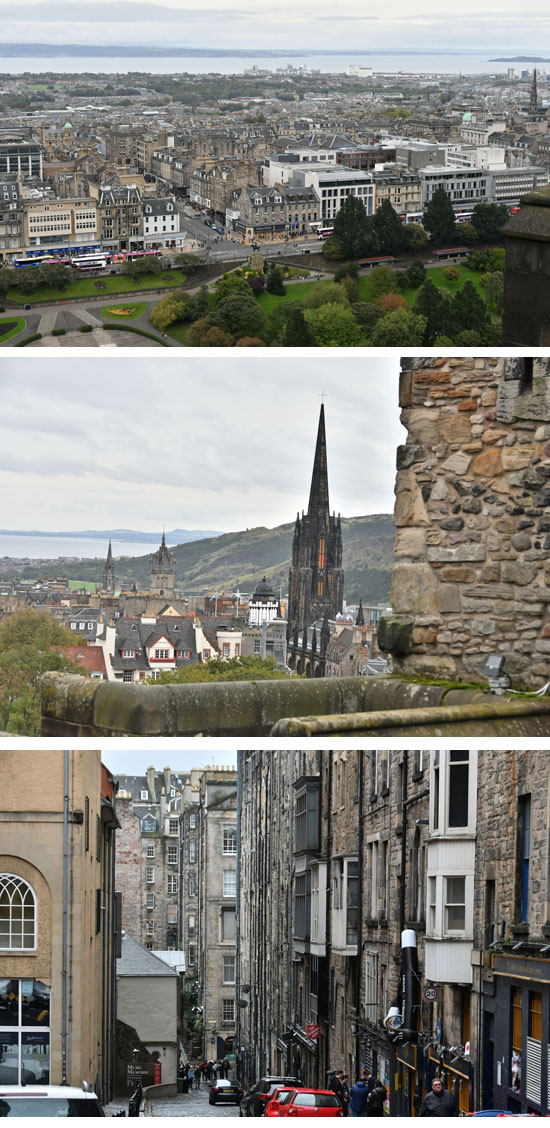
views of Edinburgh
Views of Edinburgh from the Castle and central streets

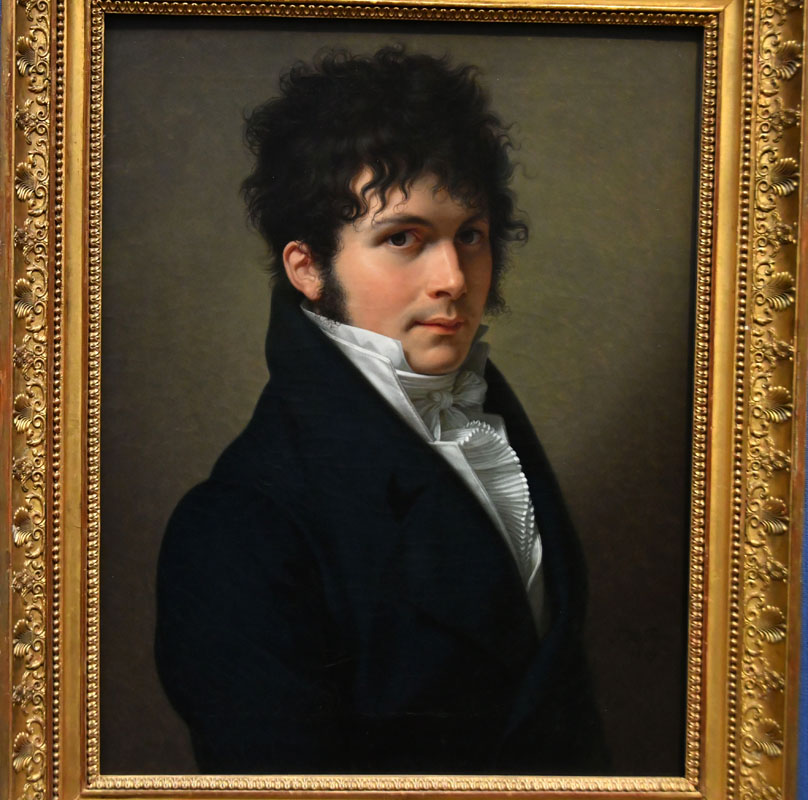
Francois-Xavier Fabre

Francois-Xavier Fabre Portrait of a Man 1809_scottish national gallery
François-Xavier Fabre, Portrait of a Man, 1809, Scottish National Gallery

By looking at this painting of Fabre, the influence of the neoclassical painter Jacques-Louis David is clear. This portrait is exceptionally painted with a masterful sense of color, light, and unseen brushwork (characteristic of the neoclassical painters). The unknown young man’s intense gaze is captivating, and his fashionable clothes and hair are beautifully arranged into a simple yet elegant composition. A pupil of David, the artist won the French Academy’s Rome Prize in 1787 and spent most of his life in Italy. Fabre was a very popular portrait and historical painter who was also an art collector! His art collection consists of 16-17th century Italian paintings housed in the Musée Fabre, Montpellier.

# 5 Free of charge

Free. You can’t beat that. Open daily, 10 am-5 pm. Thursdays until 7 pm. Location: The Mound, Edinburgh, Scotland. Check current hrs. and more here: https://www.nationalgalleries.org/visit/scottish-national-gallery

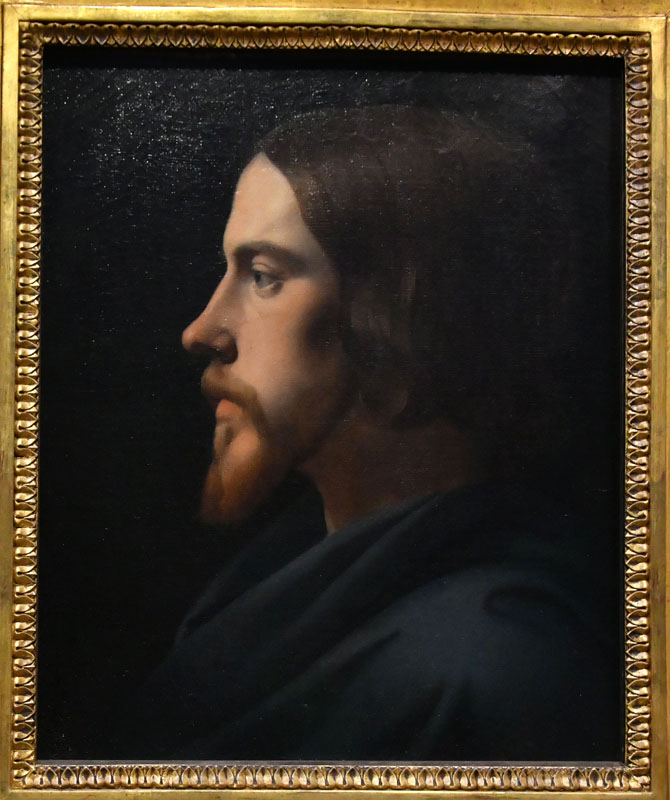
Paul Delaroche

Paul Delaroche_Study for the Head of Christ for La Madeleine_scottish national gallery
Paul Delaroche, Study for the Head of Christ for La Madeleine, (Portrait of Eugène Buttura) 1834, Scottish National Gallery

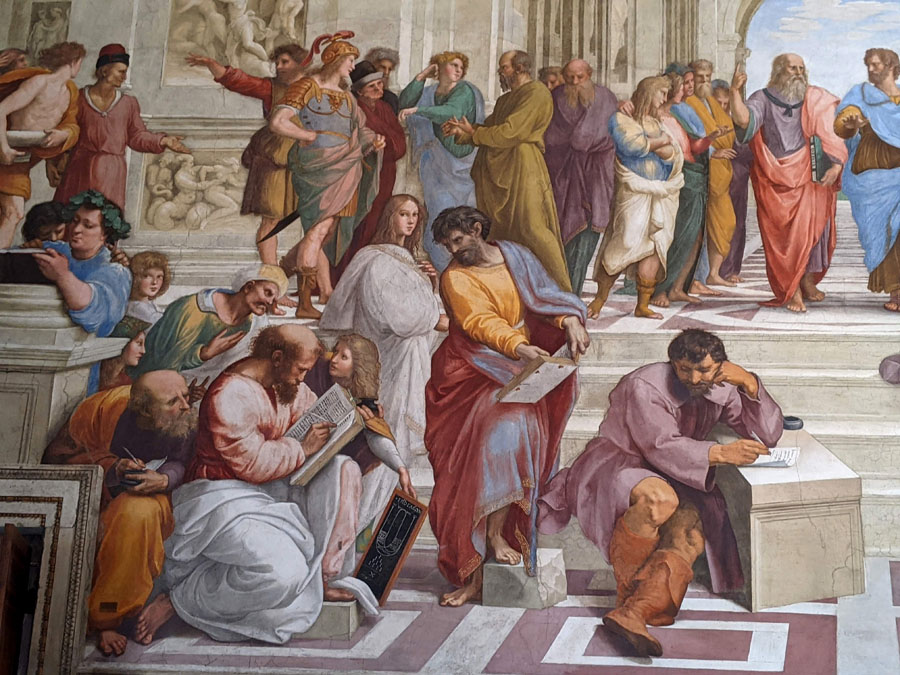
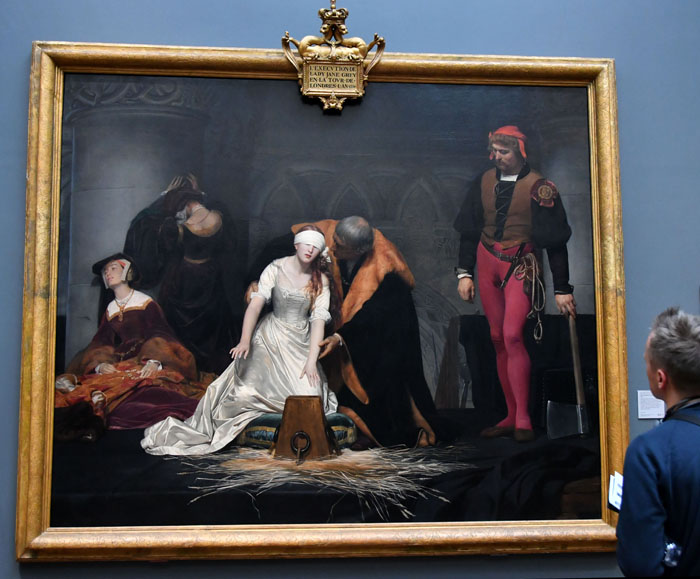
Classically trained French artist Paul Delaroche painted scenes from French and English history. Delaroche served as a professor at the École des Beaux-Arts in Paris, where he trained many students, including Couture and Gérôme. His two major, large-scale works include The Execution of Lady Jane Grey in the National Gallery in London and the 27-meter-long The Hemi-Cycle. This painting reminds of Raphael’s School of Athens, only here he depicts over seventy artists from various epochs caught in conversation.

This small portrait of his friend Eugène Buttura proves the artist’s great knowledge of anatomy and oil painting technique. Wrapped up in his thoughts, the man appears lifelike.

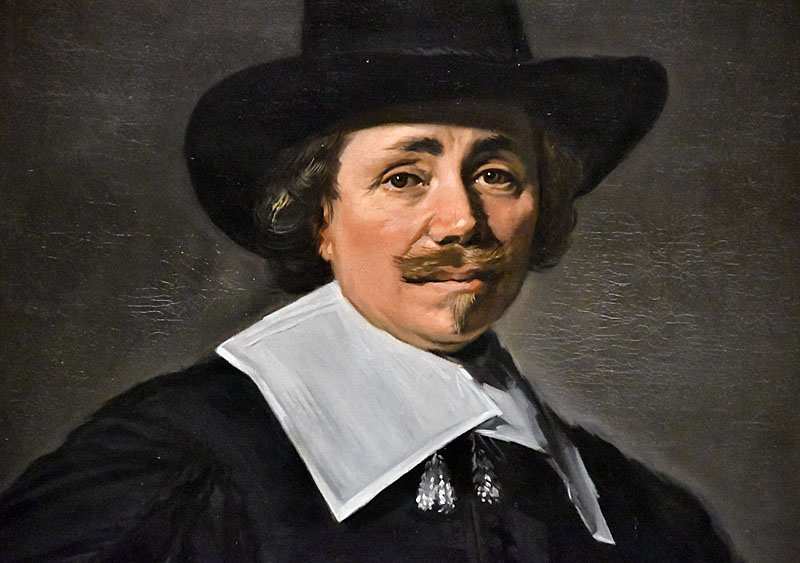
Frans Hals_detail_scottish national gallery
Frans Hals (1582/3 – 1666), Dutch, Portrait of Francois Wouter (1600-1661), 1645, oil on canvas, painting closeup, Scottish National Gallery.
The sitter has recently been identified as Franpois Wouters, a councilor, alderman, and mayor in Haarlem. Hals depicted him twice in group portraits: in 1639 as lieutenant of the S George Civic Guard and in 1641 one of the regents of the St Elisabeth Hospital (both paintings are in the Frans Hals-Museum
Haarlem).


Other famous artists in the Scottish National Gallery:

William Dyce (1806-1864), Francesca da Rimini, 1837, oil on canvas.

Dyce’s colorful and realistic painting is an example of artistic fascination with famous Italian poet, Dante Alighieri (1265-1321) in 19th-century England. The artist depicted a doomed affair between Francesca and her husband’s younger brother, Paolo. Francesca was in an arranged, political marriage to an old, ugly enemy husband, Gianciotto (the master of Rimini), who originally appeared on canvas to the left aiming to kill the lovers. The story comes from Dante’s divine comedy, Hell. In Dante’s writing, the murdered lovers were condemned to wander eternity in the second circle of hell. So the painting depicts the start of the illicit affair and the end of it. The presence of Gianciotto’s disembodied hand in the painting is the only part left from the original depiction of an old husband. The canvas was severely damaged and trimmed in 1882.

Sir James Guthrie, Sir Winston Churchill, 1874 – 1965. Statesman. Painted after the first world war, Churchill has been celebrated for his leadership as Prime Minister of Britain during the Second World War from 1940–45.

  • Paul Gauguin Vision of the Sermon (Jacob Wrestling with the Angel), 1888 (French). The scene is imaginary, intended to evoke the simple piety of the Breton peasant women of Pont-Aven. The biblical story of Jacob wrestling with the Angel – symbolising the struggle between spirit and flesh – is being recounted by a priest (bottom right) who has Gauguin’s facial features. The bold outlines, flattened perspective, and vermillion landscape were inspired by stained glass and Japanese woodcuts.
  • Paul Gauguin (1848 – 1903), French, Three Tahitians, 1899, Oil on canvas. The fusion of ‘primitive’ and Western mythologies is a frequent theme in Gauguin’s later Tahitian paintings. The young man with his back to the viewer appears to be offered a choice between vice and virtue, like Hercules at the crossroads. The woman with a mango promises a life of pleasure and indulgence, while the woman on the right displays a wedding ring, representing a more conventional route.
  • Gavin Hamilton (1723 – 1798), Achilles Lamenting the Death of Patroclus, 1760 – 1763, oil on canvas. In this classical oil painting, Patroclus’ body is painted beautifully.
  • Sandro Botticelli, The Virgin adoring a sleeping Christ child, 1485, Tempera on canvas. The image depicts a garden described in the Old Testament. This is contrasted with the geometric blocks of the rocky outcrop behind.
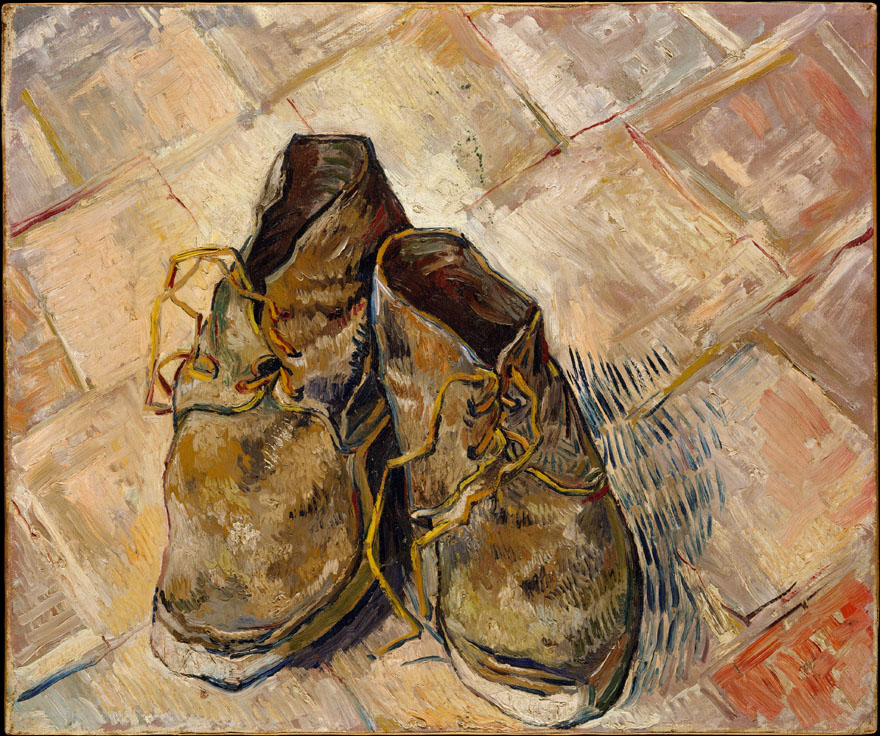
  • Van Gogh, Les Olievers, oil on canvas

Jan Steen (1626-1679), Dutch, A School for Boys and Girls, oil on canvas, 1670. This painting – Steen’s largest school scene of a classroom- shows the drawbacks of a place having no discipline via moral symbols. We can see a discarded print of the great scholar Erasmus on the floor, and a child who offers a pair of spectacles to the owl near the lantern. The boy’s action paints the Dutch proverb, ‘What use are
glasses or light if the owl does not want to see?’

Edgar Degas (1834-1917), Portrait of Diego Martelli (1839-96), 1879, oil on canvas. Martelli was a Florentine writer and art critic, closely associated with the progressive group of Italian artists. While visiting Paris, the artist painted two portraits of Martelli. The unusual point of view, color, and subject make this painting a standout. The writer is captured, lost in his thoughts among scattered papers inside a modest room.


Angelica Kauffmann, Alexander Gordon, 4th Duke of Gordon (1743-1827), oil on canvas, 1774. Angelica Kauffmann was a rare female artist at that time, but the duke noticed her talent and commissioned a series of copies of Italian masters for her. They met in Rome in 1762, and a young Swiss woman painted her patron in a dashing red dress similar to van Dyck’s costumes to give him an air of opulence.

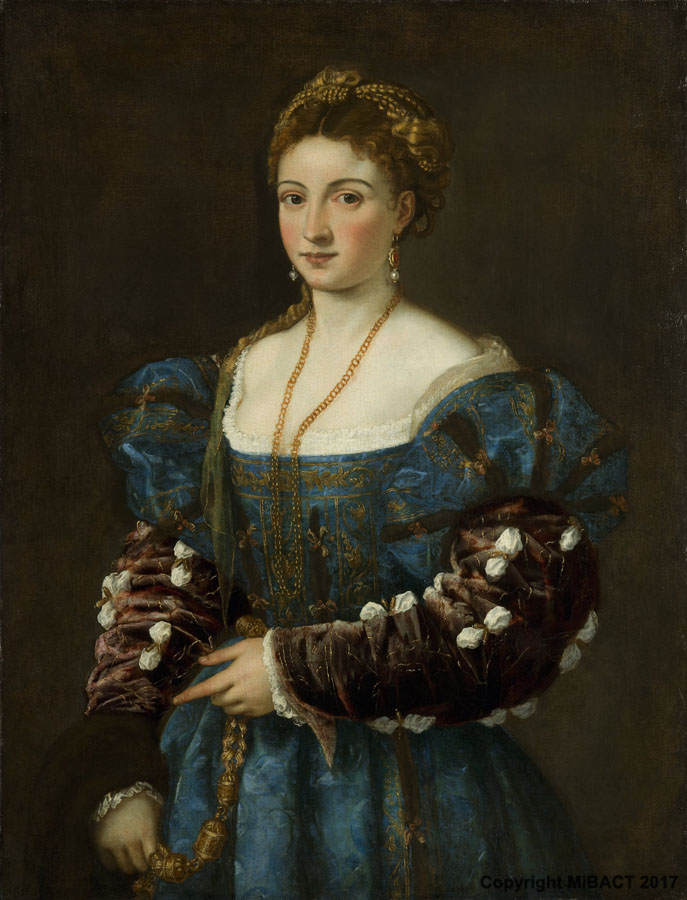
Titian (Tiziano Vecellio), (about 1485/90 – 1576), Italian, The Three Ages of Man, about 1512-14, oil on canvas. The painting captures the transient nature of human life and love through the allegorical theme of the Three Ages of Man. Titian paints an idyllic landscape with babies, Cupid and lovers. The old man stands in the background looking at the symbol of the skull. The church symbolizes salvation. Also, the Venetian master Titian gives us Diana and Actaeon. it’s a painting about the exact moment a man’s life is over before he knows it. Hunter Actaeon has stumbled upon bathing goddess Diana, and Titian has loaded the scene with clues to his fate. The stag skull mounted on the pillar is chilling foreshadowing for Actaeon, who will be turned into a stag and torn apart by his own dogs.

Poussin‘s gallery has a series of his large, religious paintings titled Seven Sacraments, 1644-1648. Painted in Rome by the 17th-century French artist Nicolas Poussin, the Seven Sacraments represent the seven holy rites of the Roman Catholic Church. Poussin aimed to convey the solemnity and religious importance of each rite, and he situated the scenes in early Christian times.

Diego Velázquez, An Old Woman Cooking Eggs, 1618, Oil on canvas. Velázquez painted a group of the poor in scenes of everyday life with unapologetic realism and conviction. Using a limited palette of browns and black, the artist re-created a scene from the past.

Sir James Guthrie, In the Orchard, (1859 – 1930) Scottish. There are several beautiful paintings of children hanging in the gallery.

Frans Hals, Verdonck,1627

Sir Anthony van Dyck. In the galleries you’ll find many paintings done by this famous and prolific Flemish artist, such as An Italian Noble, 1625 – 1627, oil on canvas and Marchese Ambrogio Spinola (1569 – 1630).

Attributed to Bernardino Lanino, (1509/13 – after 1581), Italian, St John the Baptist in the Wilderness
about 1550, Oil and gold on panel.
This small painting is very reminiscent of Leonardo da Vinci’s art in terms of subject, color, and composition. St John points towards the banderole wound round his cross, on which are inscribed the words ‘Ecce Agnus Dei’ (Behold the Lamb of God), in reference to Christ as God’s sacrificial lamb. The lamb itself appears in a
blaze of glory to the right. The pose of St John is based closely on a design by Leonardo da
Vinci (1452-1519).

Sir William Fettes Douglas (1822 – 1891), Scottish, The Spell, 1864, oil on canvas. This is a highly unusual painting depicting a priest or a magician, or an alchemist. An avid art collector, the artist channels his interests in mysticism and occult. In this painting, an old man is trying to raise the spirit of a dead one. The books in disarray, the stone walls with strange pentagram drawings create a strange surreal feeling.

Sir Francis Grant, Anne Emily Sophia Grant (known as ‘Daisy’ Grant), Mrs William Markham (1836 – 1880), 1857. This is a depiction of the artist’s daughter.

Arthur Melville (1855-1904), King Cophetua and the Beggar Maid, 1898, watercolor on paper. Melville travelled extensively in the Middle East, Spain and north Africa in the 1880s and 1890s. He used his travel experiences to imagine the settings for dramatic incidents and stories. According to legend, the African King Cophetua swore to shun the company of women, until one day he saw a woman begging, all dressed in grey. He fell in love at first sight, vowing to marry her or take his own life. Melville depicts the
King, dressed in orange and leading a leopard, approaching his future queen.

Louis Gauffier (1761 – 1801), French, Cleopatra and Octavian, 1787 – 1788. The painting is the depiction of Octavian’s meeting with the Egyptian queen Cleopatra after his victory over Mark Anthony at the battle of Actium in 31 BC. Octavian displays his distrust to Cleopatra. The painting was commissioned by the Comte d’Angiviller, the superintendent of the king’s art collection. It meant to be a pendant for a painting by another classical French artist, Jacques-Louis David.

Sir Peter Paul Rubens (1577 – 1640), Flemish, The Feast of Herod, 1635 – 1638, oil on canvas, Measurements: 208.30 x 271.50 x 5.00 cm. Commissioned by a Flemish merchant, this large, bold, energetic, and colorful painting depicts Herodias’ daughter, Salome. Herod had promised to grant her any wish for her beautiful dance, and so Salome asked for the head of John the Baptist. This was Herodias’ revenge for the Baptist’s outspoken criticism of her marriage to Herod. In this dramatic painting, the popular Biblical scene is Salome ‘s presentation of Saint John the Baptist’s head to King Herod. Herod shrinks back in horror. Herodias prods the Baptist’s tongue with a fork.


Guercino (Giovanni Francesco Barbieri), Erminia Finding the Wounded Tancred, 1650. Erminia has rushed to the spot where her lover Tancred lies severely wounded.

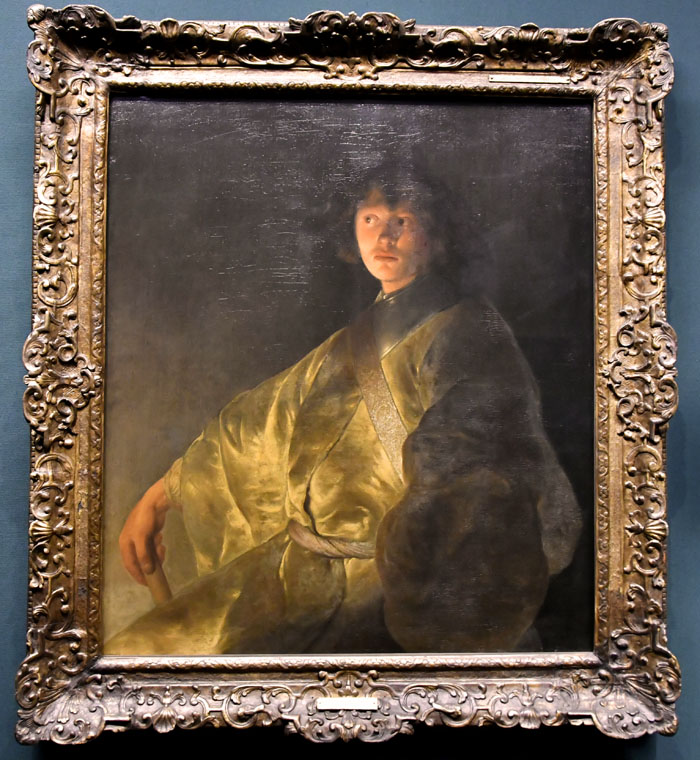
Jan Lievens (1607 – 1674), Dutch, Portrait of a Young Man, oil on canvas, about 1631.

A contemporary and friend of young Rembrandt, Lievens trained with Pieter Lastman together with Rembrandt in Amsterdam in the 1620s. Both young artists returned to their native Leiden for a while, where they collaborated and competed with one another. Rembrandt soon moved back to Amsterdam to have a thriving art career. You can read about Rembrandt’s Amsterdam house here. This painting was created at the end of this period, before Lievens left Leiden, and shows his talent and technical abilities. So similar to Rembrandt’s art style, this painting was probably a self-portrait.

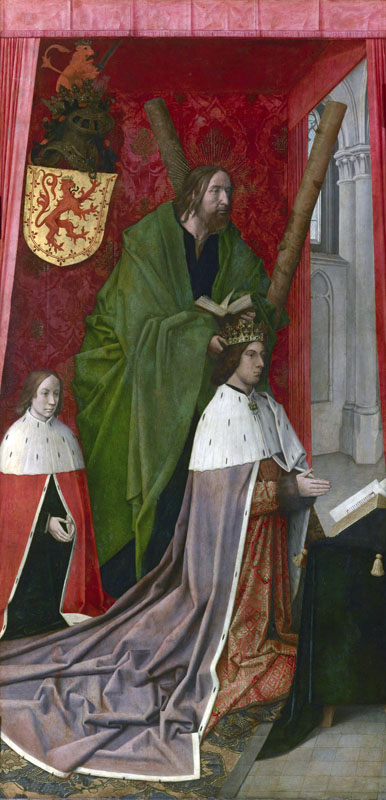
This is one of the panels painted by Hugo van der Goes,https://www.rct.uk/collection/403260/the-trinity-altarpiece-panels, Public Domain, https://commons.wikimedia.org/w/index.php?curid=81550161. It’s displayed under glass in the first, red gallery of the art museum.

Hugo van der Goes (died 1482), Netherlandish, The Trinity Altarpiece, about 1475 – 1480, oil on panel, Each panel: 202.00 x 100.50 cm.
Four panels formed the most important altarpiece painted for a Scottish chapel. This Northern Renaissance artwork was commissioned by Edward Bonkil, Provost of the Collegiate Chapel of the Holy Trinity in Edinburgh. Here, King James III wears the open crown.
The missing central panel probably depicted the Virgin and Child Enthroned. According to the museum, when the altarpiece is open, the wings show a devout King James III with his elder son and his queen Margaret of Denmark, accompanied by Saint Andrew and Saint George. The lion rampant on the king’s coat of arms is reversed in deference to the holy figures on the missing central panel. The closed wings feature a vision of the Holy Trinity appearing to the kneeling Edward Bonkil.

Open vs. Closed (Imperial) Crown:

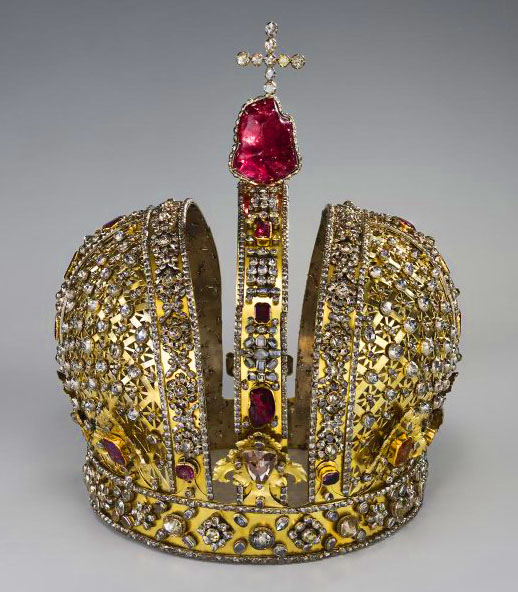
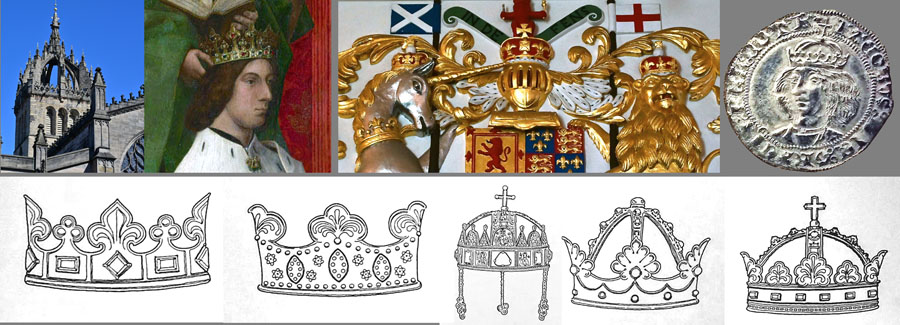
History of the Scottish Crown’s shape: The shape of the Scottish Crown changed at the end of the 15th century. A silver coin (right) from 1485 has a portrait of King James III (1460-1488) wearing an arched or imperial crown. It’s the only surviving image of King James III wearing the Imperial Crown. It must have been used at the coronation of his son, King James IV (1488-1513). Originally, only the Holy Roman
The emperor could wear an arched crown – symbolizing his worldwide dominance. Once imperial crowns became widely used, many styles emerged in Europe.

Before 1485, the crown had no arches, being open with fleurs de lis or lily circlets in it. The King of Scots was among several European monarchs to adopt the “closed” or arched or Imperial crown. The circlet or diadem of the new Scottish Crown consisted of eight fleurs de lis, and the four arches were surmounted by an orb and cross.

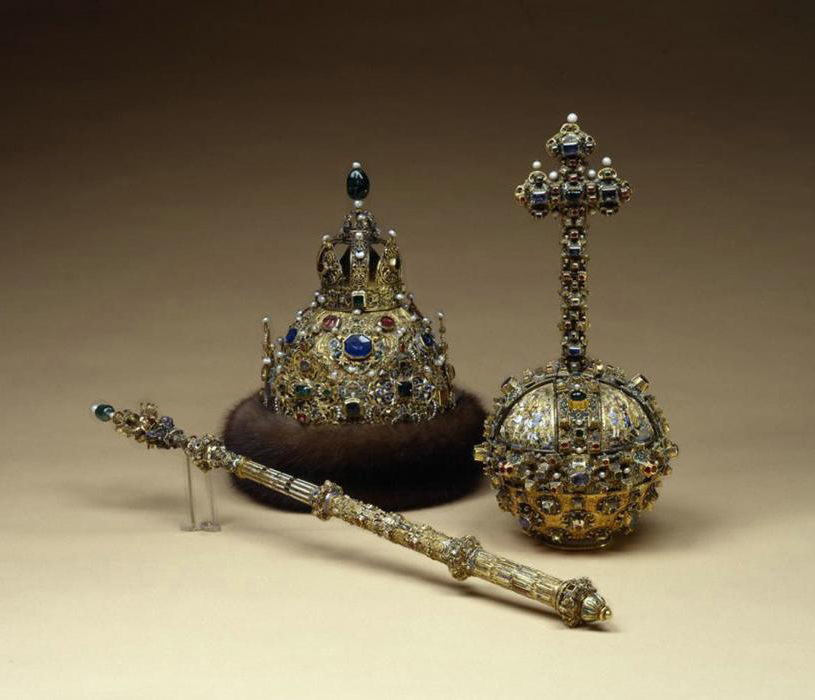
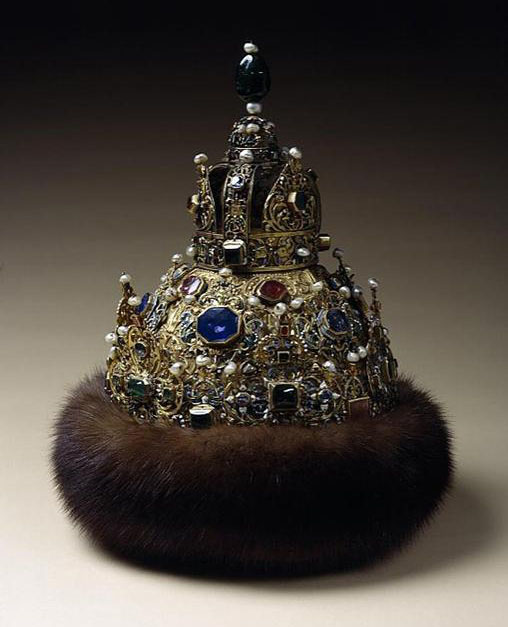
THE HONOURS of Scotland: the Scottish Crown Jewels- the crown, scepter, and sword of state used in the coronation of Mary, Queen of Scots in 1543 are displayed in the ancient Crown Room of the Castle. There’s a line to get there, and no pictures are allowed inside. 🙁 The scepter has a very beautiful, giant sparkling diamond.
* I don’t remember where I took pictures of this information, probably in one of the museums or the Castle.

Sir Daniel Macnee (1806-1882), Scottish, A Lady in Grey, 1859, Oil on canvas
From the museum’s description: Macnee was the leading portraitist in the west of Scotland from the 1840s to the 1860s and was eventually elected President of the Royal Scottish Academy. First shown in London in 1859, this is an unusually ambitious likeness of the artist’s daughter, Isabella Wiseman. Two
years earlier, Reynolds’s enchanting portrait of the actress Nelly O’Brien (The Wallace
Collection, London, had been one of the greatest attractions of the Manchester Art Treasures Exhibition – an event which drew artists from all over Britain. This Reynolds was almost certainly the source for Isabella’s pose and the very striking lighting effects.

Joseph Farquharson (1846-1935), Scottish, Winter Day, Finzean, about 1901, oil on canvas. A famous painter of the snow textures, Farquharson combined a successful career as a professional painter with his inherited role as Laird of Finzean in Aberdeenshire. His beautiful wooded estate, far up the Dee Valley, inspired many of the snowy landscapes for which he is renowned – mostly painted from the shelter of a moveable hut on wheels. Large editions of prints earned him wide popularity and the nickname of ‘frozen mutton Farquharson’ by allusion to the sheep which populate many of his pictures. With its exquisite treatment of the textures of snow and iridescent shadows, this is the only known Farquharson with a garden motif.
Jan van Huysum (1682 – 1749), Dutch, Flower Still Life in a Sculpted Stone Vase with bird’s nest, 1718, Oil on copper, Measurements: 80.10 x 61.40 cm.
According to the taste and fashion of the Dutch at that time, this extravagant bouquet consists of a variety of flowers from different seasons, insects, and butterflies. Jan van Huysum was the leading Dutch painter of flowers in the eighteenth century, and he received prestigious commissions from royal households and aristocrats around Europe. This is his largest painting done on copper, a support he only occasionally used. It once formed part of the famous Czernin collection in Vienna.
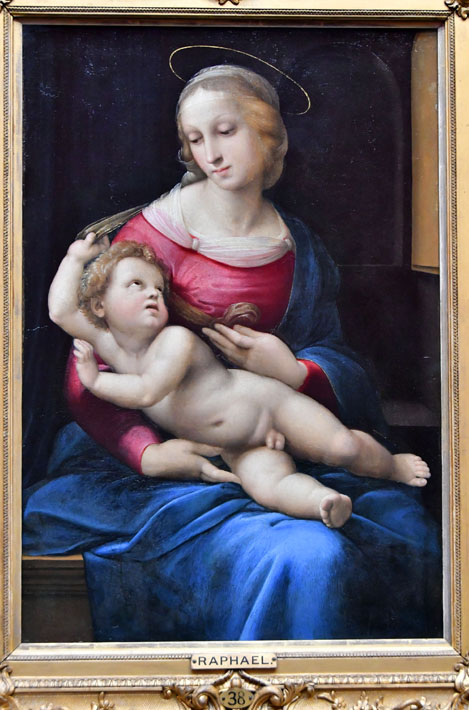
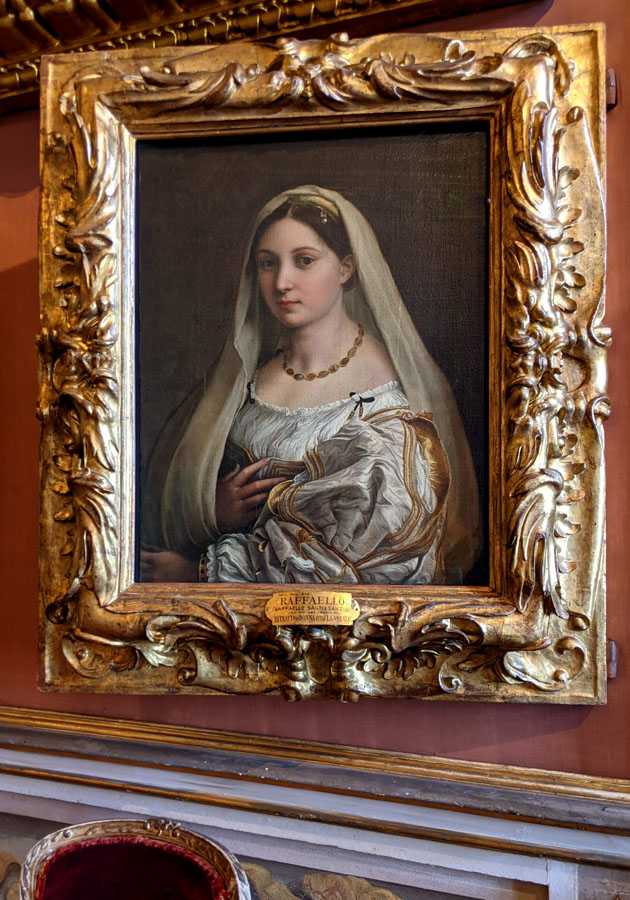
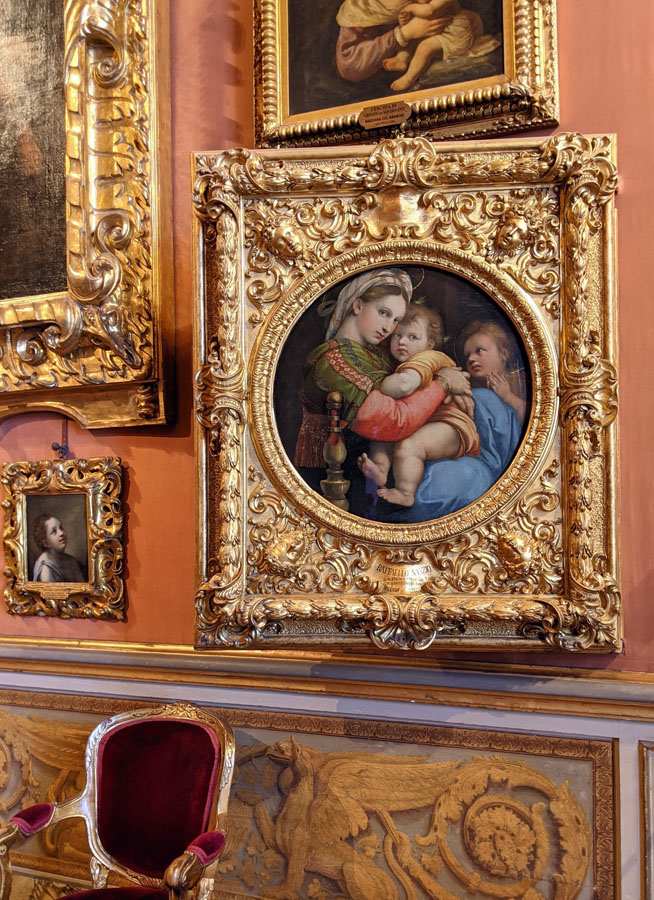
raphael
Raphael, Mary, and Child, around 1507

Scottish landscapes

There are a number of beautiful, colorful landscapes painted by Scottish artists. One of such examples is James Paterson (1854-1932), Autumn in Glencairn, Moniaive, 1887, Oil on canvas. He painted rural Dumfriosshire, south-west Scotland. Paterson explored the surroundings painting different seasons. Another one is by Sir William Fettes Douglas (1822-1891), Stonehaven Harbor, 1874. Waller Hugh Paton (1828-1895), Entrance to the Cuiraing, Skye, 1873 paints a unique landscape with a rock formation called the Needle from his pencil sketch only. Peter Groham (1836-1921), D’er Moor and Moss is a colorful local landscape of sunset hues and trees.


Robert Burns, The Hunt, 1926, Scottish National Gallery.

Burns painted in the Art Nouveau style in Scotland and was a fantastic colorist. His beautiful combination of textures and materials, colors, and lines makes this painting a standout. His most famous interior designs were for Crawford’s Tea Rooms on Princes Street. He combined commercial projects with teaching and became Head of Painting at Edinburgh College of Art.
painting of angel
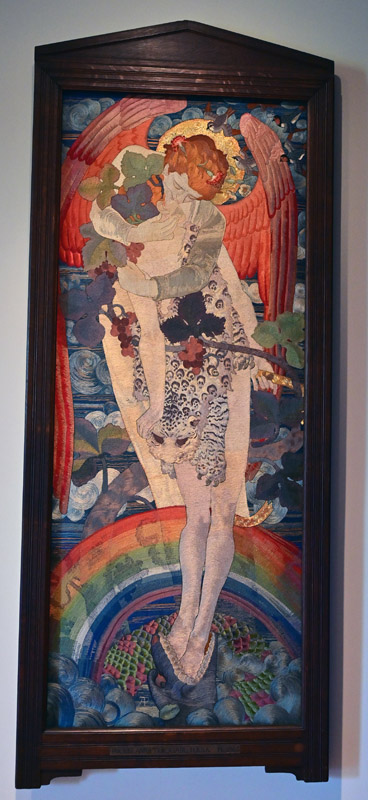
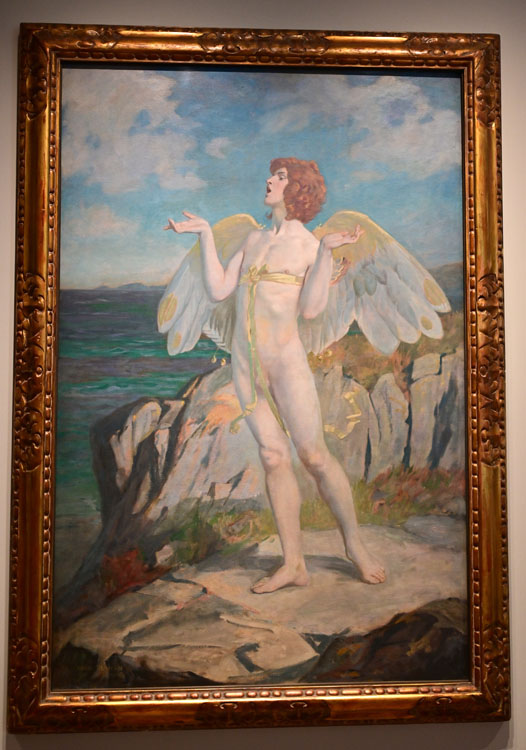
Phoebe Anna Traquair Progress of a Soul: Victory, embroidery. The National Gallery of Scotland.

This colorful embroidery is the final artwork in a series of four called The Progress of a Soul and was made between 1899 and 1902. The human soul is represented by an ideal young man dressed in an animal skin, who was based on the character of Denys L’Auxerrois from Imaginary Portraits by the English critic and writer Walter Pater. In this panel, The Victory, Denys is seen after death, reborn into eternal life. He has been awoken with a kiss from a red-haired, red-winged seraph, suggesting he has entered the realm of heaven. (museum’s description).
Painting of a singling angel in the Scottish National Gallery

Scottish National Portrait Gallery

There is also a smaller portrait gallery located 15 minutes away from the main building of the National Gallery of Scotland. It has a very beautiful entrance with paintings on the walls, elegant lights, and some classical and contemporary art inside. Very few people get there as it’s off of Edinburgh’s Royal Mile, but it’s totally worth a visit if you are an artist. It would take an hour or so to walk through it. One of the interesting large, contemporary art paintings is “Alan Cumming” by Christian Hook (b.1972), 2014. Alan Cumming is a very talented Scottish actor who has appeared in numerous films, TV, and plays in Scotland, London and New York. The painting is the winner’s commission for the Sky Arts Portrait Artist of the Year 2014 competition. Christian Hook is from Gibraltar.

From museum’s descriptions that I captured while looking at art that caught my attention:

David Roberts (1796-1864) by Robert Scott Lauder, oil on canvas, painted in 1840. The artist David Roberts was born in Edinburgh. After serving an apprenticeship with a house-painter, he became a theatrical scene-painter, working in Glasgow, Edinburgh and at Drury Lane, London. From 1830, he devoted himself to topography. His exhibited pictures, which were inspired by his travels, included Departure of the Israelites from Egypt (1829), Jerusalem (1845), Rome (1855) and Canal at Venice (1856). Roberts undertook his expedition to the Near East in 1838-9. He visited Sinai, Syria, Palestine and Lebanon. In Lauder’s portrait, Roberts wears his traveler’s disguise, adopted when it was necessary to be inconspicuous. There is something of the actor evident in Roberts’s adoption of eastern dress for his portrait. (from museum’s description).

David Octavius Hill (1802-1870) by Amelia Robertson Hill, marble, made in 1868. This sculpture of the painter and pioneer photographer David Octavius Hill is by his second wife, Amelia Robertson Hill. She has depicted him in the form of a ‘heroic’ portrait bust, in which the sitter wears classical drapery rather than contemporary dress. Amelia encouraged her husband to complete his most ambitious painting, The Signing of the Deed of Demission. The painting, which commemorated the establishment of the Free Church of Scotland, contained portraits of over 400 ministers. It was begun in 1843, and when it was finally exhibited in 1867, a reviewer wrote that Hill had completed his picture ‘with a heroism unsurpassed in the history of art’.

Sir Winston Churchill (1874-1965) by Sir James Guthrie, oil on canvas, painted 1919-21. Churchill was MP for Dundee from 1908-22. He later served as Prime Minister from 1940-45 and 1951-55. Although usually discussed as a hero in the context of the Allied victory of the Second World War, this portrait was completed shortly after the First World War. It was painted in preparation for Guthrie’s large-scale painting Statesman of the Great War. Churchill’s legacy in the earlier conflict was mixed, a major contribution to the outcome of the war was his part in the introduction of the tank. He was demoted from First Lord of the Admiralty after the failure of the 1915-16 Gallipoli Campaign, resulting in over one hundred thousand casualties on both sides. He later returned to government founding the Imperial (now Commonwealth) War Graves Commission, establishing the principle that in death, all military ranks would be honored equally. As Secretary of State for the Colonies after the war, he oversaw British withdrawal from Ireland, a catalyst for the 1922-23 Civil War. Churchill endorsed the division of the former Ottoman Empire in the Middle East into British and French spheres of interest, with long lasting consequences for the region. Later, as Chancellor of the Exchequer, Churchill played a controversial role in suppressing the General Strike of 1926.

Margaret Liddell Linck (1873-1943) by David Cowan Dobson, oil on canvas, painted in 1914. The actress Margaret (Maggie) Liddell Linck was a suffragette. She joined the militant Women’s Social and Political Union (the WSPU) in February 1907 and was arrested during a demonstration at the House of Commons. Linck refused to pay the fine imposed for which she was given a two-week prison sentence. She subsequently joined the non-violent Women’s Freedom League (WFL) and served as the treasurer of its Scottish council. Maggie Linck married the photographer, actor and playwright Graham Moffat, in 1897. Moffat was also an advocate of the equal rights of women. He formed the Glasgow Men’s League for Women’s Suffrage for ‘the husbands and brothers of active suffragettes and their male sympathizers. The green and purple colors associated with the suffrage movement are present in the portrait.

Alexander Murray of Elibank (1712-1778) by Allan Ramsay oil on canvas, painted in 1742. After Prince Charles’s secret visit to London in 1750, a group of Jacobites began to plan a coup d’état. Alexander Murray was deeply involved, so the project is known as the ‘Elibank plot’. The idea was to kidnap the ‘Elector’ (George II) and his family, and then take them to France or hold them hostage in the Tower of London. Murray also suggested poisoning George, but Charles vetoed any assassination attempt. The plot was betrayed by a co-conspirator, Alasdair MacDonnell of Glengarry, who operated as ‘Pickle the Spy’. The prime casualty was Archibald Cameron of Lochiel, who was captured in the Highlands where a diversionary uprising was to have taken place. He was hung, drawn and quartered in June 1753-the last Jacobite execution. Murray eventually returned to Britain with a pardon.

James Hamilton, 1st Duke of Hamilton (1606-1649) by Daniel Mytens (about 1590-about 1647), oil on canvas, 1629. James Hamilton, 1st Duke of Hamilton, was one of King Charles I’s most trusted councilors, especially in Scottish affairs. This portrait was painted at a turning point in Hamilton’s career, the year following his arrival at court in London. The Dutch artist Daniel Mytens was the King’s painter before he was eclipsed by the arrival of Anthony van Dyck in 1632. Mytens has depicted Hamilton wearing a magnificent, shimmering silver suit, standing before a stormy sky.

James Graham, 1st Marquess of Montrose (1612-1650), studio of Sir Anthony Van Dyck, oil on canvas, painted about 1636. Montrose was a poet and a royalist hero during the period of the Bishops’ Wars and the Civil Wars. He is shown here wearing a suit of armour to highlight his military career. He was chief of Clan Graham and originally supported the Covenanters. Later, after siding with Charles I, he was appointed The King’s Lieutenant of Scotland. In 1644 Montrose raised the Highland clans for the king and won a series of six victories but he was defeated at Philiphaugh, near Selkirk, in 1645. He was exiled to the continent but returned after the execution of Charles I. He was captured after the battle of Carbisdale and hung, drawn and quartered in the High Street of Edinburgh.

Henrietta Anne, Duchess of Orléans (1644-1670) by Jean Nocret, oil on canvas, painted about 1661. Henrietta Anne was the youngest daughter of King Charles I and Queen Henrietta Maria. At the height of the English Civil War she was smuggled out of England by her governess and reunited with her mother at the French court. Throughout her life she shared a close bond with her brother Charles II and they wrote to each other frequently, with Charles referring to his sister affectionately as Minette. Famed for her charming nature, impeccable manners and keen interest in the arts the princess became a favourite of the French royal family. She sat for this magnificent full-length state portrait shortly after her marriage in 1661, to Philippe, Duke of Orléans, brother to Louis XIV.

Sir James Balfour (1600-1657) by an unknown artist, oil on canvas, painted after 1630. James Balfour was an historian and herald whose writings included Annals of the History of Scotland. He was created Lyon King of Arms (a court office that regulated royal ceremony and heraldry) and knighted in 1630. He played a key role in the arrangements for Charles I’s Scottish coronation in 1633. This unusual portrait shows Balfour in his study. His informal appearance was fashionable for images of young men at this time and contemporary audiences would have understood the pose, with Balfour resting his head on his hand, as a representation of melancholy. He points to his family coat of arms with his other hand and wears his Lyon badge suspended from a sash over his shoulder, showing the status he gained through research into Scottish history.

Sir William Bruce (about 1625-1710) by John Michael Wright, oil on canvas, painted about 1664. Bruce was the great Scottish classical architect of the second half of the seventeenth century. He designed key buildings such as Kinross House and Hopetoun House and he remodeled the Palace of Holyrood house. He was one of a network of Scots who secretly worked for the exiled king during the Commonwealth. After the Restoration, Charles II appointed him Surveyor General of the King’s Works in Scotland. John Michael Wright had trained as a painter in Edinburgh under George Jamesone. He shows Bruce as a gentleman artist, wearing a fashionable Japanese rock, an informal, kimono-like gown that denotes the sitter’s status, and holding a crayon and a drawing.

Check out visionary art for sale

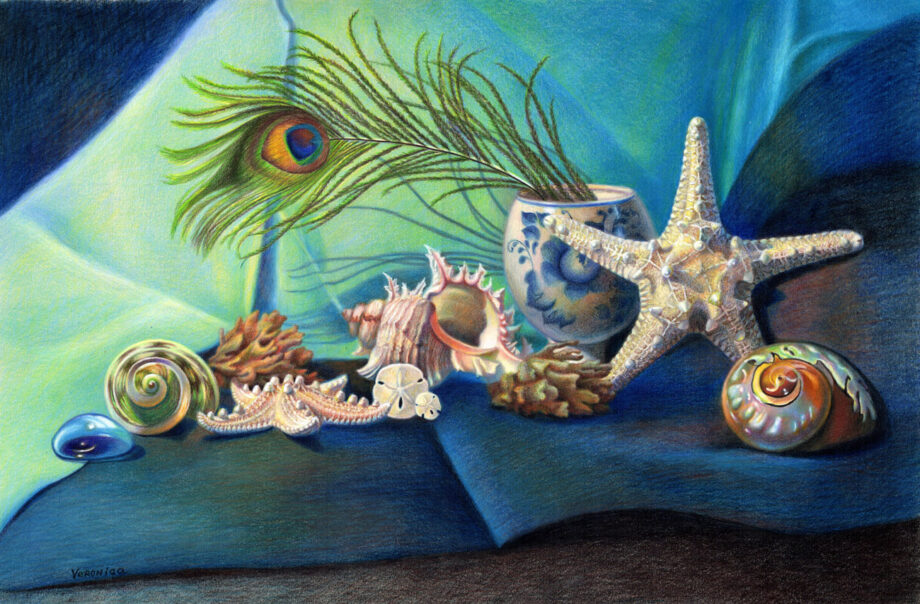
still life with shells and peacock feather, Veronica Winters, colored pencil, 14.5×22 in

Inside the Art Institute of Chicago: A Complete Guide for First-Time Visitors

For travelers drawn to art, few museums carry the quiet gravity of the Art Institute of Chicago. Inside its
stately Beaux-Arts facade, the museum holds one of the most remarkable and diverse collections
anywhere in the world. But with its numerous galleries, global holdings, and central location in downtown Chicago, first-time visitors often wonder how to make the most of their day. This guide offers a thoughtful approach to experiencing the museum’s many treasures—balancing highlights, pauses, and the natural rhythm of discovery. Whether you’re a devoted art historian or simply curious to stand before a few world masterpieces, the Art Institute invites you into a world where time slows and creativity expands.

Begin at the Modern Wing: Light, Space, and New Perspectives

If you are into modern art, then the best place to begin your visit is the museum’s Modern Wing, where Renzo Piano’s design allows sunlight to filter across white walls and polished stone floors. Entering here sets the tone: open, bright, and quietly dramatic. With its sleek lines and airy galleries, the space itself feels like a work of art.
The Modern Wing houses a formidable collection of 20th and 21st-century works. Start with the
European modernists: Picasso’s fragmented forms, Matisse’s bold colors, and Brâncuși’s smooth,
sculptural lines. Then move into the American section, where Warhol’s portraits and Lichtenstein’s
punchy comic panels capture both wit and cultural commentary. You can view many pictures from this art museum here.


One floor below, contemporary photography, design objects, and media installations push the boundaries of what defines art. The wing’s terrace offers views over Millennium Park and downtown Chicago. On clear days, this becomes a natural pause before stepping into the museum’s historical collections.

Personally, I’m not fond of modernism and thus go straight to classics!

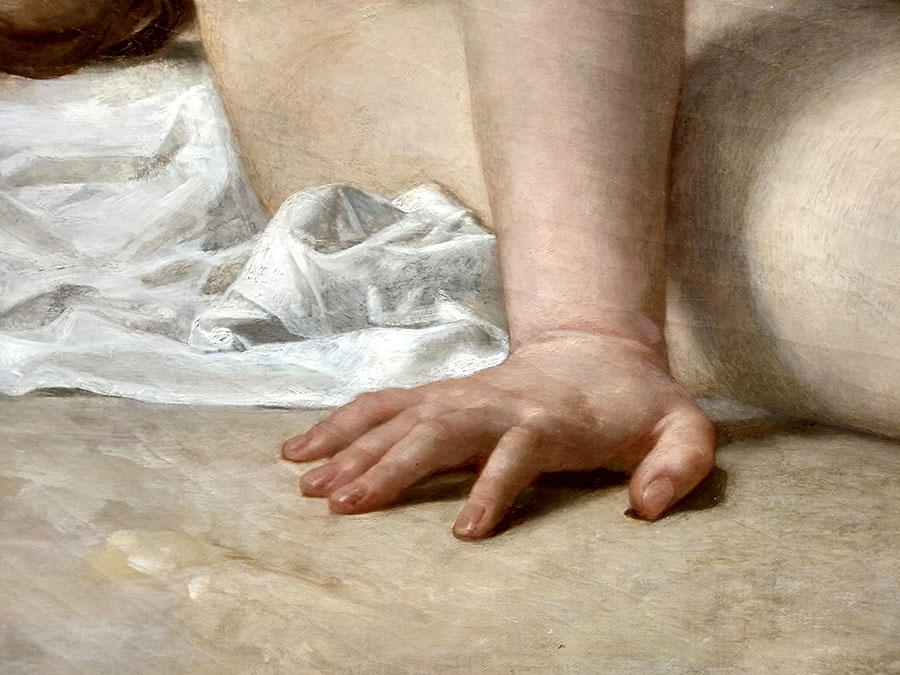
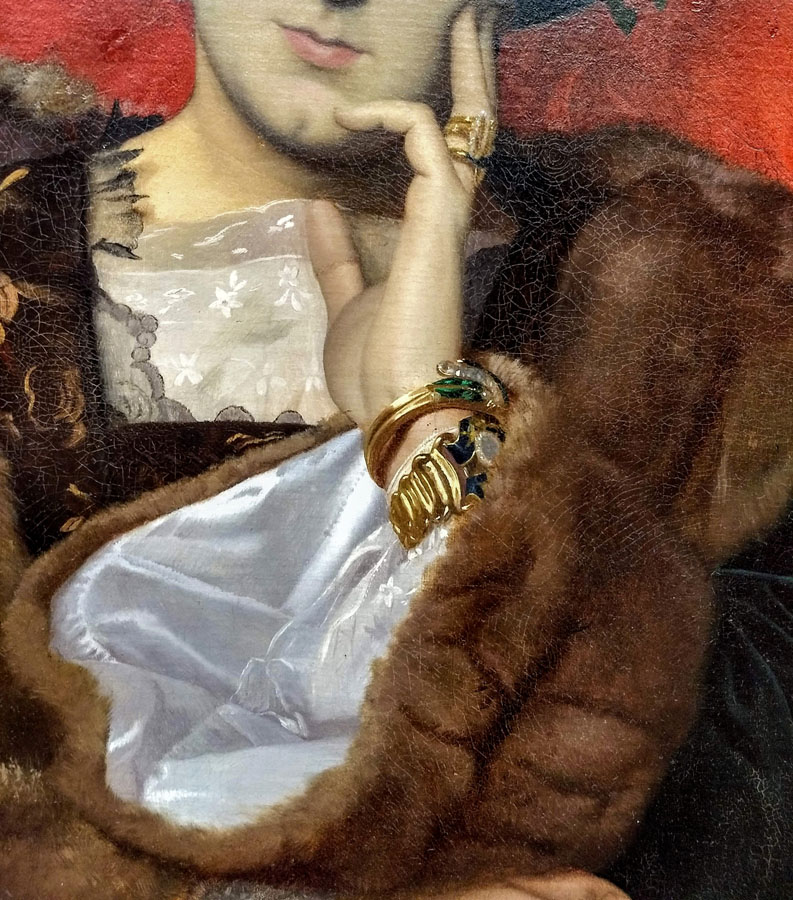
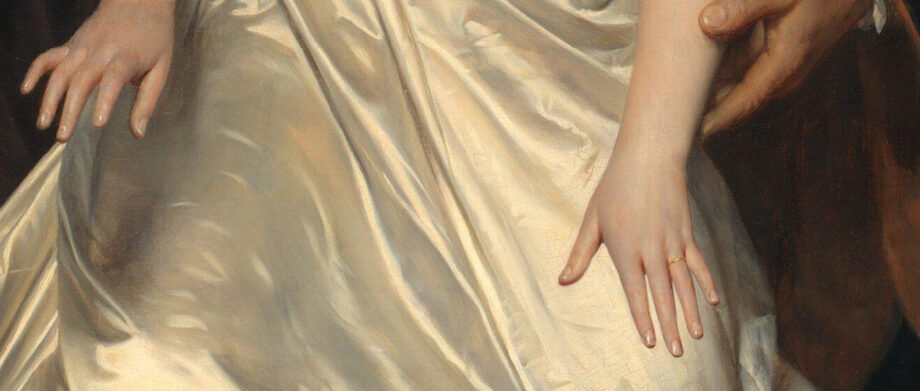
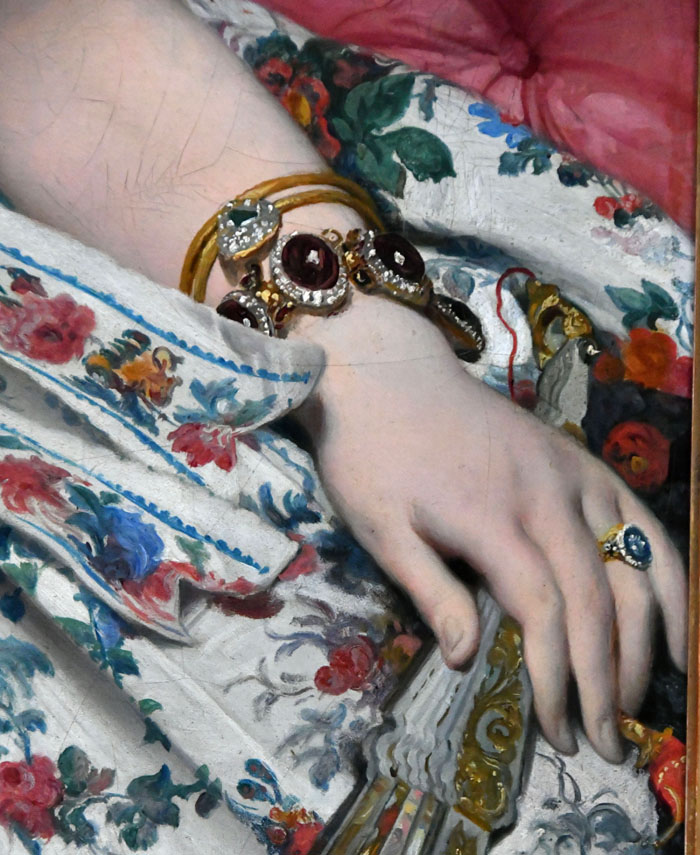
Bouguereau’s hand & white clothes, painting closeup, the Art Institute of Chicago

Cross into the Main Building: The Classics Await

From the Modern Wing, a glass bridge carries visitors into the original 1893 structure. Here, the weight
of art history presses gently. Begin with the museum’s celebrated Impressionist and Post-Impressionist galleries. Monet’s Water Lilies, Renoir’s soft portraits, and Seurat’s A Sunday on La Grande Jatte pull visitors into familiar yet endlessly rewarding works. Van Gogh’s The Bedroom glows with intimate warmth, while Cézanne’s precise still lifes showcase masterful balance.

Move further to encounter the American galleries, where Hopper’s Nighthawks offers one of the
museum’s most recognized images—a quiet, timeless scene of late-night urban solitude. Nearby, Grant
Wood’s American Gothic holds its iconic, ambiguous stare.
Elsewhere, the Thorne Miniature Rooms surprise many first-time guests. These elaborate models of historical interiors provide a captivating shift in scale and storytelling.

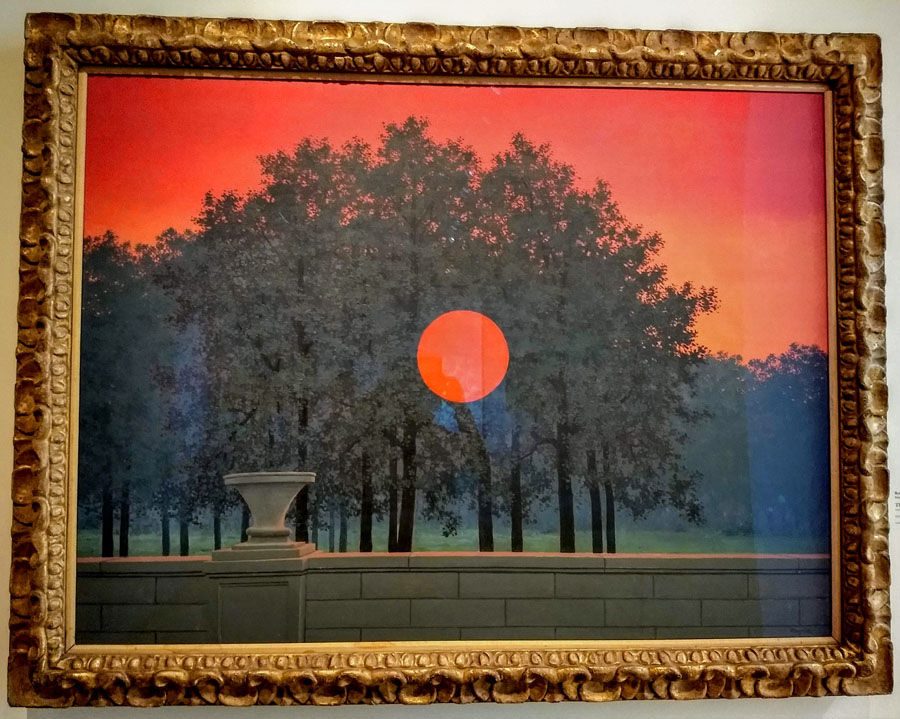
The Banquet by Magritte, 1958


The Art Institute also houses extensive holdings from Africa, Asia, and the ancient Mediterranean. Rich
textiles, intricate masks, and centuries-old Buddhist sculptures present entire worlds in single galleries.
Many visitors find themselves unexpectedly drawn into these quieter spaces, lingering longer than
planned.

best art museums-the art institute of Chicago

Here are a few famous artists and artworks that stood out on my visit to this art museum:

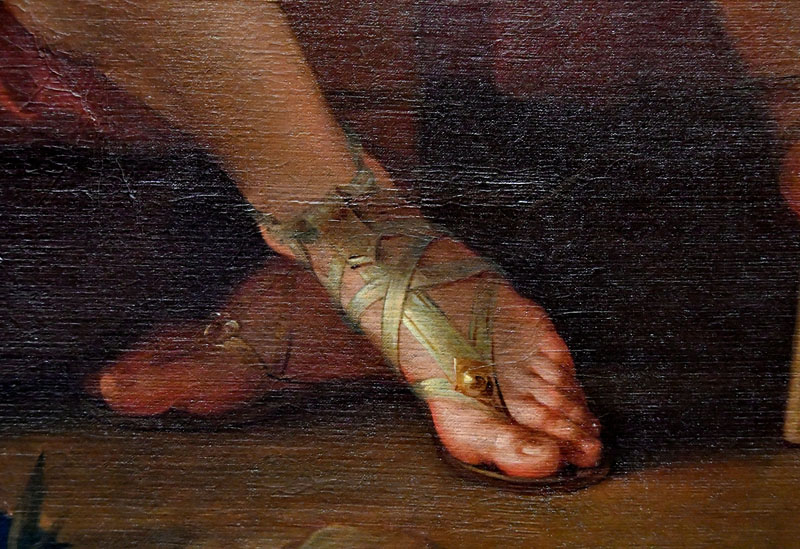
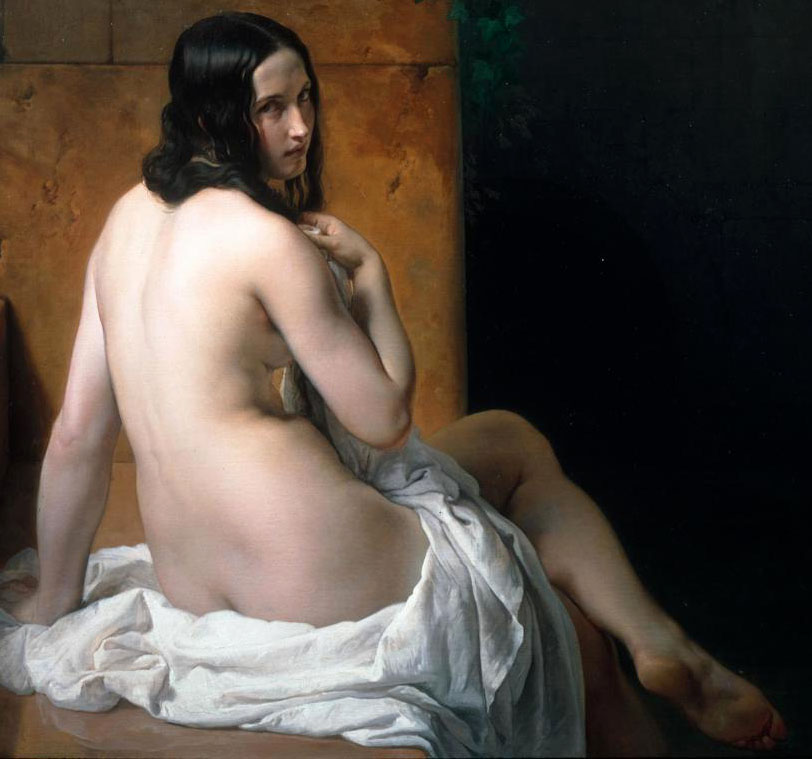
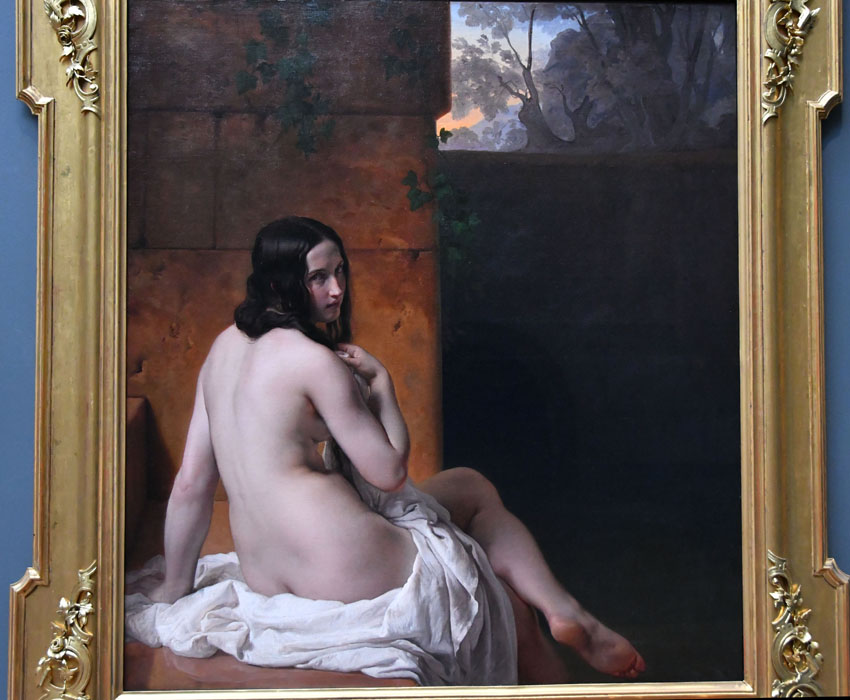
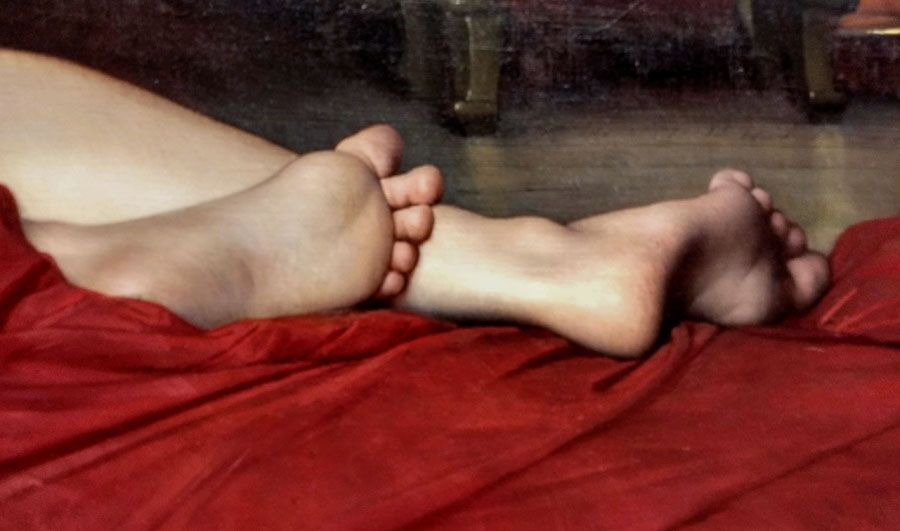
Lefebvre, Odalisque, 1874, closeup of feet
  • Sargent, Study of an Egyptian Girl
  • Rosetti, Beatrix
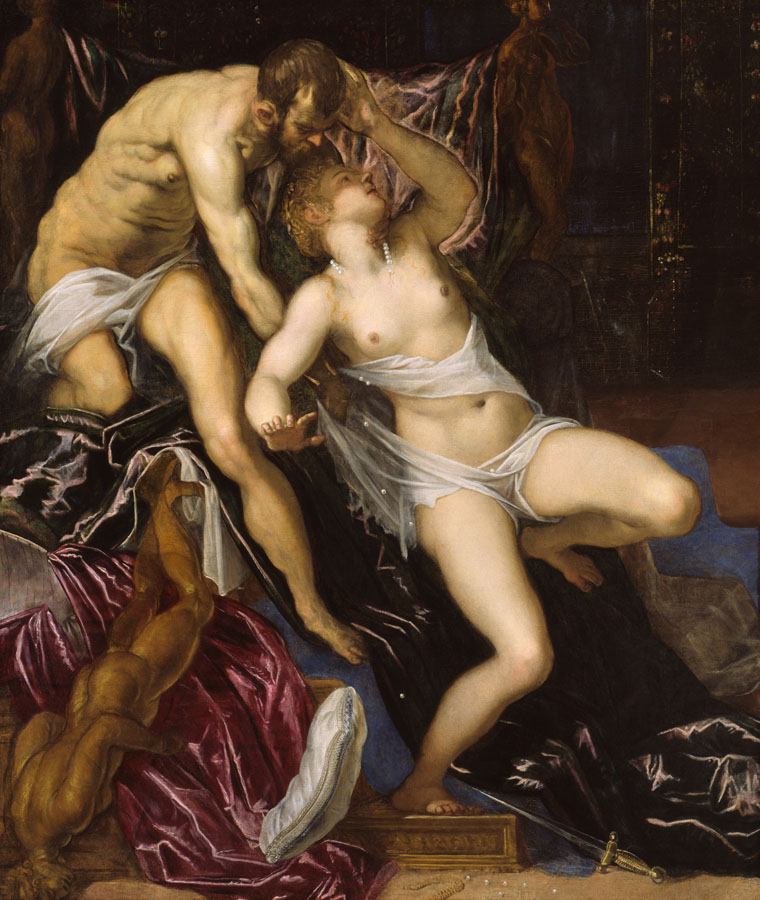
  • Tintoretto, Tarquin and Lucretia
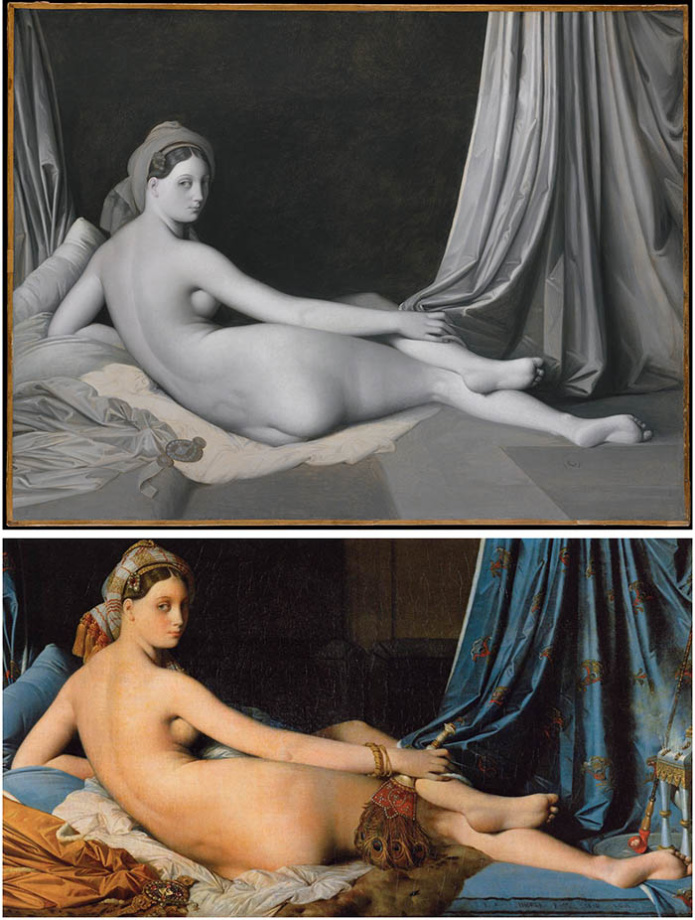
  • Lefebvre, Odalisque (One of David’s students)
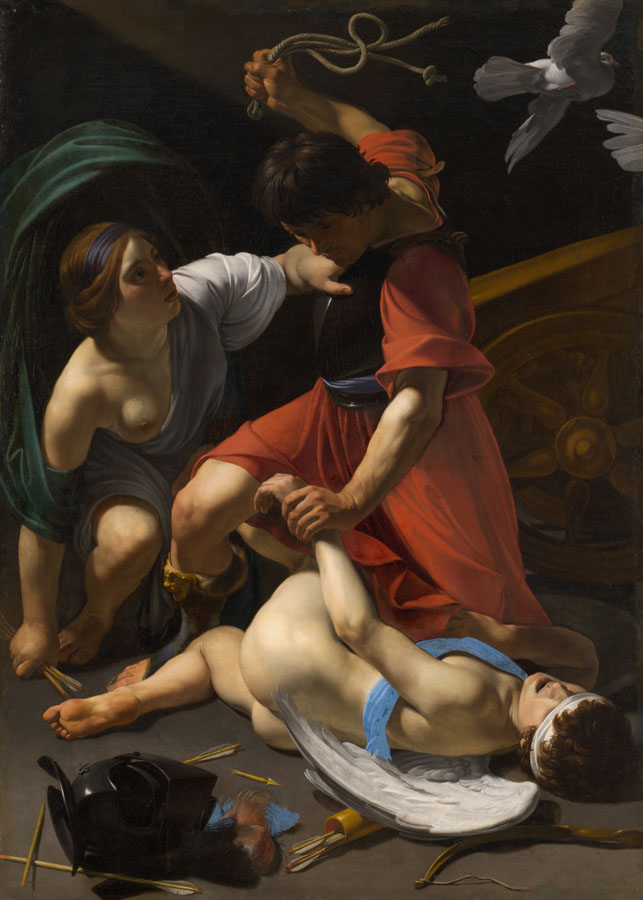
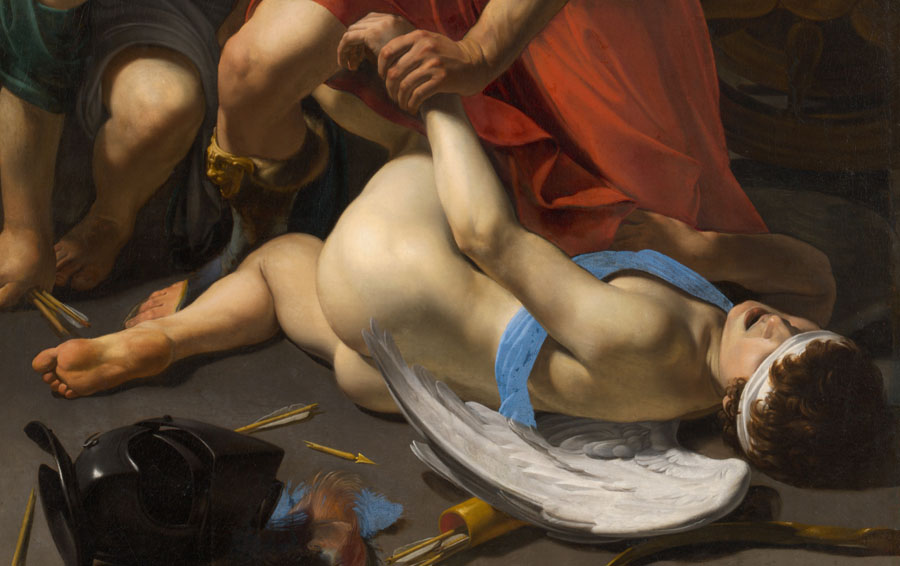
  • Manfredi, Cupid Chastised
  • Cassatt, After the Bullfight
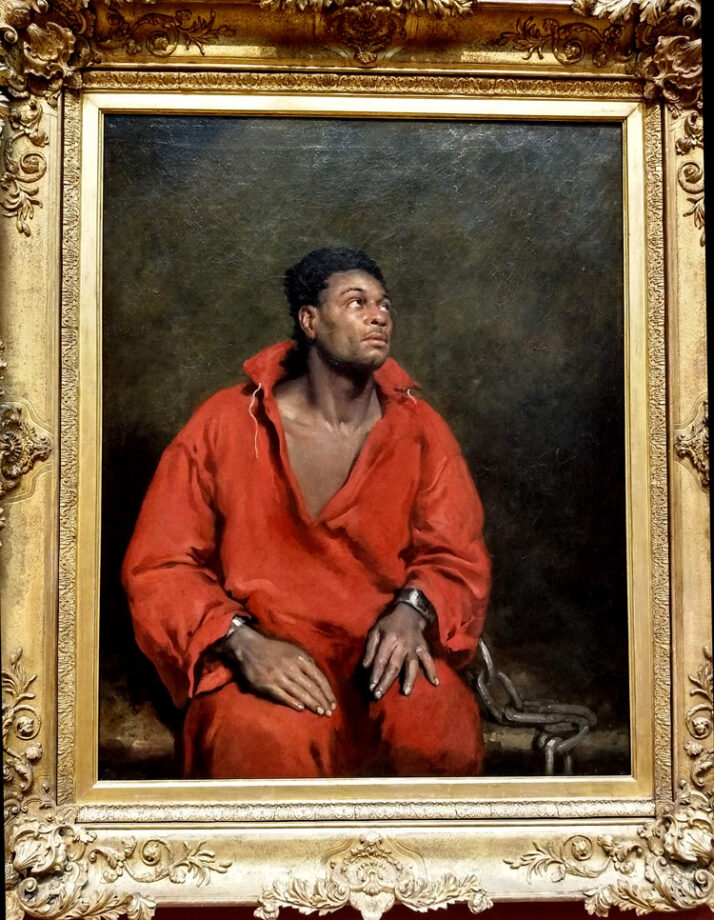
  • Simpson, the Captive Slave
  • Canova, Head of Medusa
  • Zurbaran, the Crucifixion
  • Titian
John Philip Simpson, English, 1782-1847, The Captive Slave, 1827, Oil on canvas

In 1827, when the English portrait painter John Simpson exhibited this heroic image of a manacled man, he was making a bold statement. The slave trade was still a controversial moral and political issue, and it would not be fully resolved in England until six years later, when Parliament passed the Slavery Abolition Act. As his model, the artist posed Ira Aldridge, the freeborn son of a lay preacher in New York who would go on to have an important career on the London stage. Here Aldridge’s expressive upward gaze conveys a yearning for freedom in an image that both speaks to and transcends its historical moment. +the museum’s description

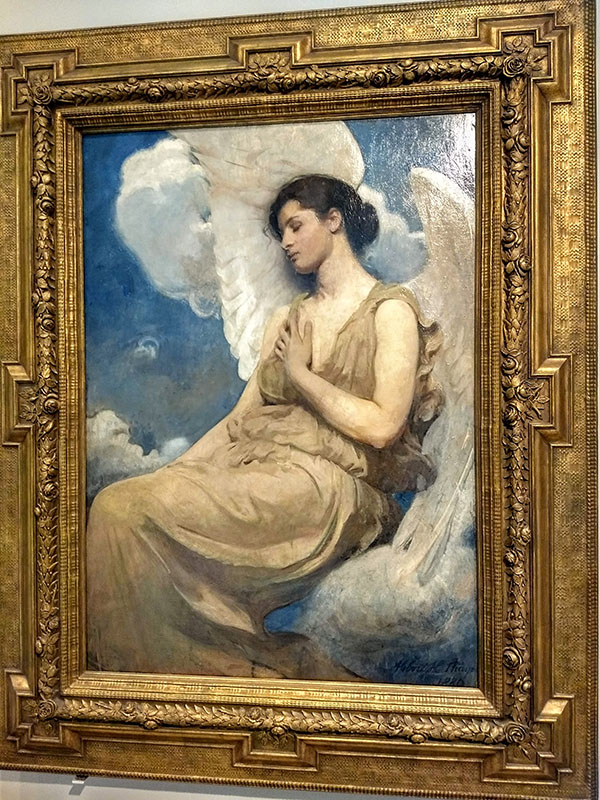
Winged Figure, 1889, Abbott Handerson Thayer, American, 1849–1921

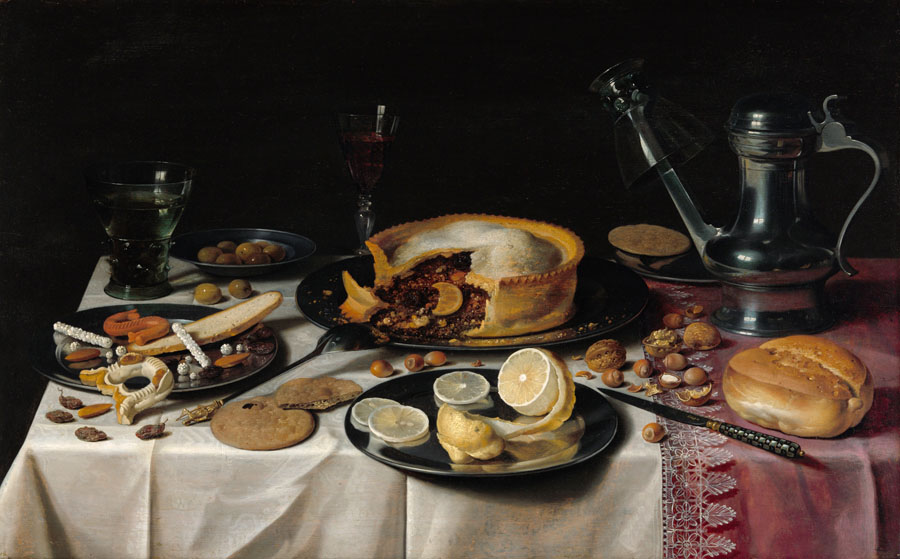
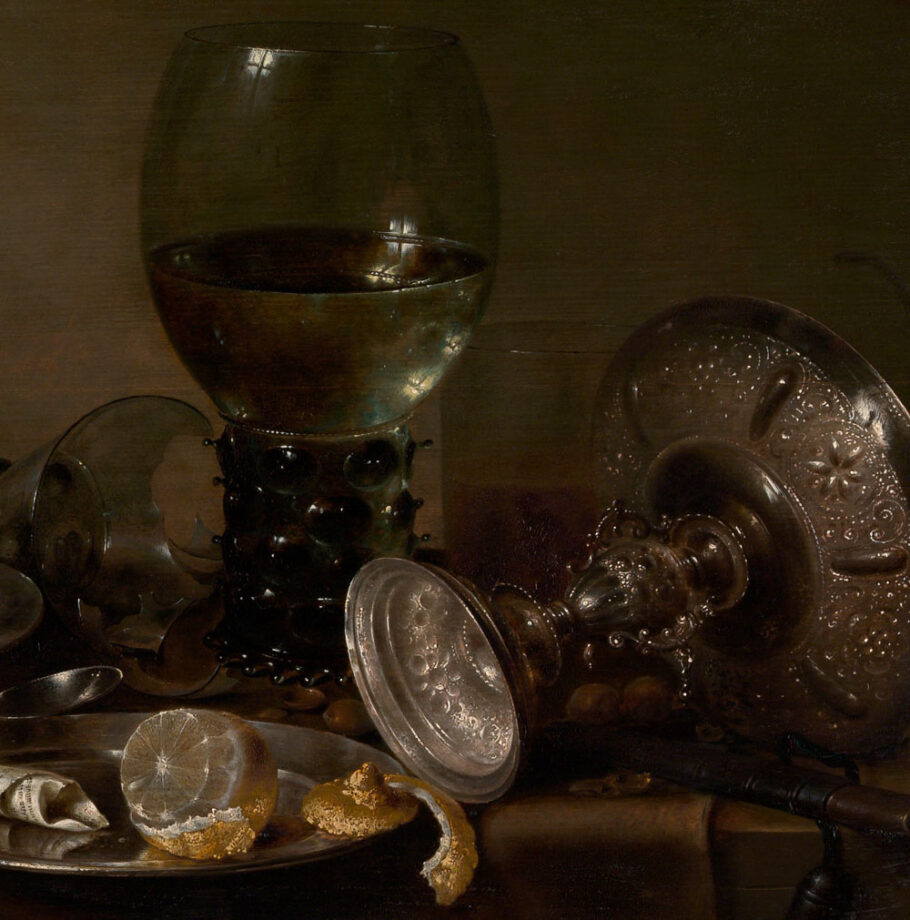
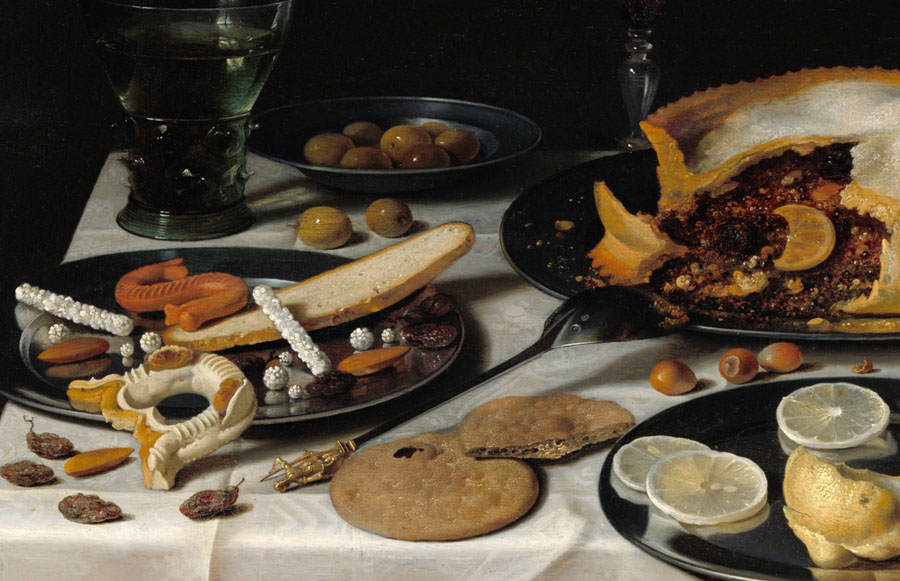
Pieter Claesz - Still Life-1625-the art institute of chicago
Pieter Claesz, Still Life, 1625, the art institute of Chicago. I love this artist for amazing talent to arrange objects in such beautiful and harmonious still life. And, yes, the details are incredible.

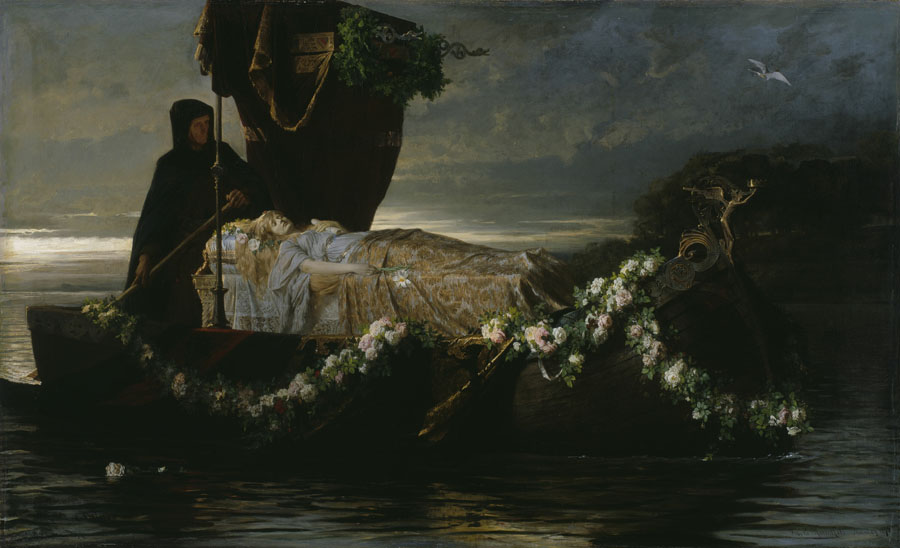
Toby Edward Rosenthal- Elaine-the art institute of chicago
Toby Edward Rosenthal, Elaine, the art institute of Chicago. This is a very beautiful painting when you see it up-close. It’s big and the picture doesn’t show amazing subtle color and brushstrokes of the artist!

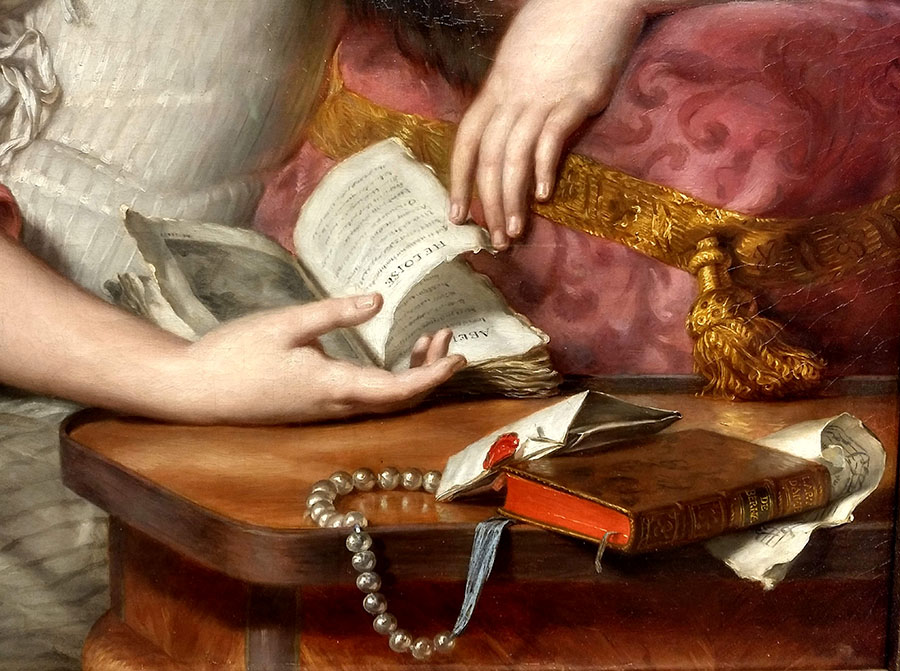
lady reading letters of Heloise and Abelard-1780-A. dAgesci
A lady reading letters of Heloise and Abelard, 1780 by Auguste Bernard d’Agesci, oil painting, Art Institute of Chicago. This is a small close-up of a painting. I love capturing the details in works of art. I can admire balance between all objects presented in this painting.

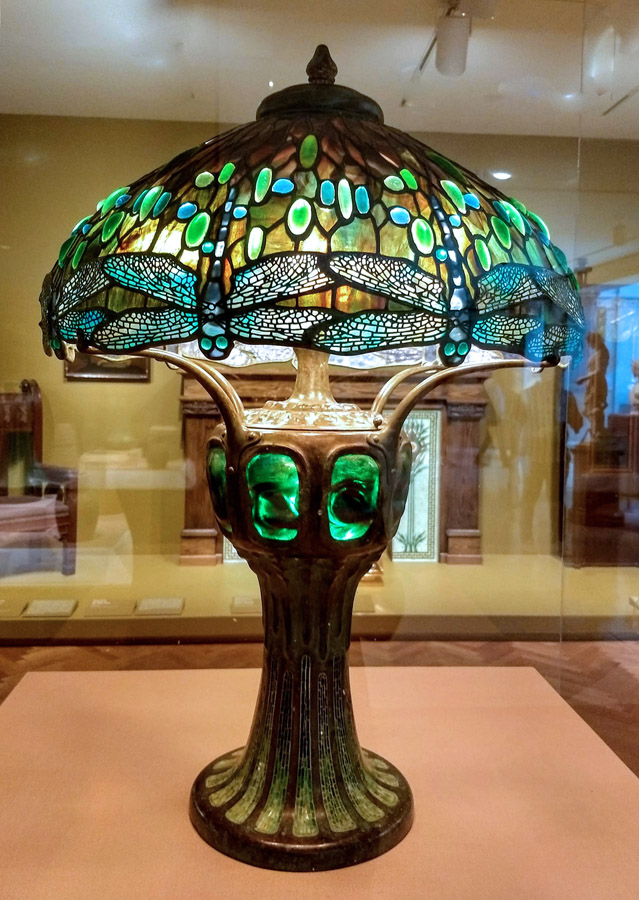
Tiffany Lamp

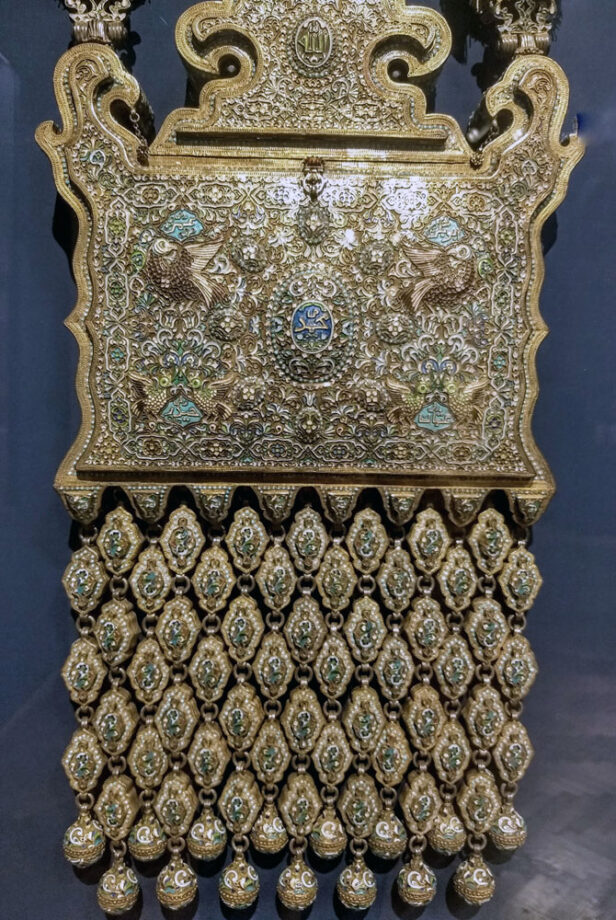
Islamic art collection is amazing at this art museum too!

Plan with Purpose: Tips to Shape Your Visit

Even the most art-loving traveler benefits from thoughtful pacing. With over a million square feet of
gallery space, the Art Institute rewards focus over speed.


 Buy tickets in advance. Online reservations help avoid long entry lines, especially during peak
hours.
 Start early. Arriving close to opening allows you to enjoy galleries before midday crowds grow.
 Dress for distance. The marble floors and expansive halls mean plenty of walking; comfortable
shoes matter.
 Use the app. The museum’s free mobile guide offers helpful maps, suggested routes, and in-
depth information.
 Keep bags small. Security screenings are smoothest when you travel light.
 Pause often. The on-site cafés provide comfortable places to rest while looking out at
Millennium Park.


Families visiting with children should stop by the Ryan Learning Center, where interactive displays and
creative workshops engage younger visitors at their own pace.


Since the museum sits in Chicago’s busy downtown core, visitors often arrange a Chicago limo service to
simplify the day. Avoiding traffic, parking garages, and navigation allows you to begin and end your
museum visit in a calm, unhurried way.

Beyond the Galleries: The City Completes the Experience

Part of what makes the Art Institute experience so rich is its place within Chicago itself. Just beyond the
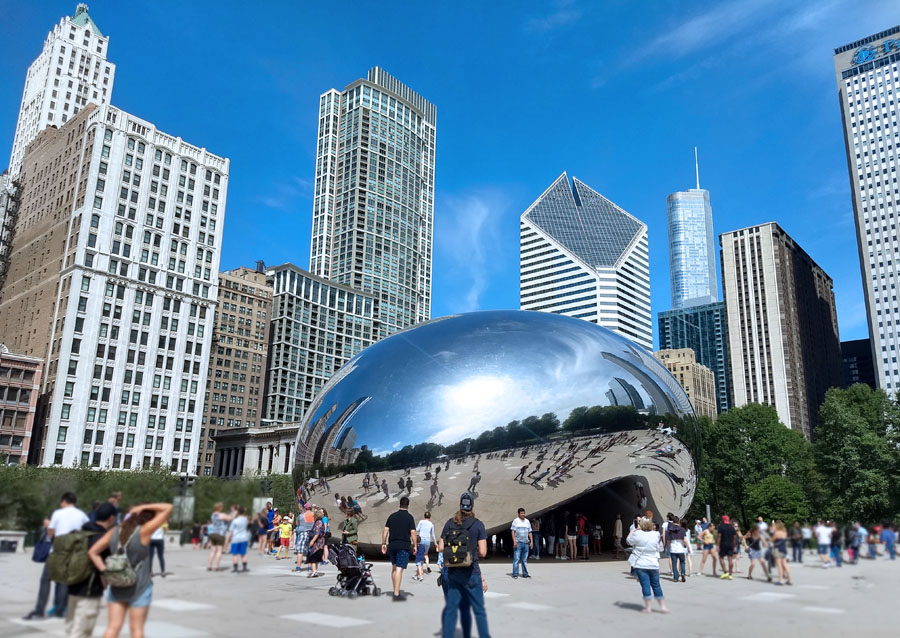
museum’s doors, Millennium Park offers an open-air extension to your art day. Cloud Gate,
affectionately known as “The Bean,” reflects city and sky in endlessly photogenic curves.

A short stroll leads to the Chicago Cultural Center, where free exhibitions and the world’s largest Tiffany
stained-glass dome offer an architectural treat. The nearby Riverwalk and Magnificent Mile extend the
day into riverside paths, boutique shops, and skyline views.


Depending on the season, visitors may choose to pair the Art Institute with outdoor festivals, lakefront
walks, or simply quiet time at one of the city’s rooftop cafés. In Chicago, the rhythm between seeing art
and simply being present often becomes its own reward.

One Museum, Many Moments

The Art Institute of Chicago doesn’t ask you to see everything in one visit. Instead, it invites you to find
your own pace, to pause before what draws you, and to let each work speak in its own time.
For many, the memory that stays isn’t tied to a single painting or sculpture. It’s the experience of
moving through spaces filled with history, beauty, and meaning—and the quiet moments between,
when art lingers just a little longer than expected.

To continue exploring:

The Ultimate NYC Art Tour: The Met, MoMA, and Frick Collection in One Trip

For art lovers, few cities offer the kind of visual feast that New York does. But with so many world-class
museums spread across Manhattan, how do you make the most of a single, inspiration-filled day? This
curated guide maps out how to explore three of NYC’s most iconic art institutions—the Met, the
Museum of Modern Art (MoMA), and the Frick Collection—in one thoughtfully paced itinerary.
Whether you’re a seasoned collector, an art student, or simply someone who wants to be deeply moved
by creativity, this route blends timeless masterpieces, modern provocations, and intimate works of
genius.

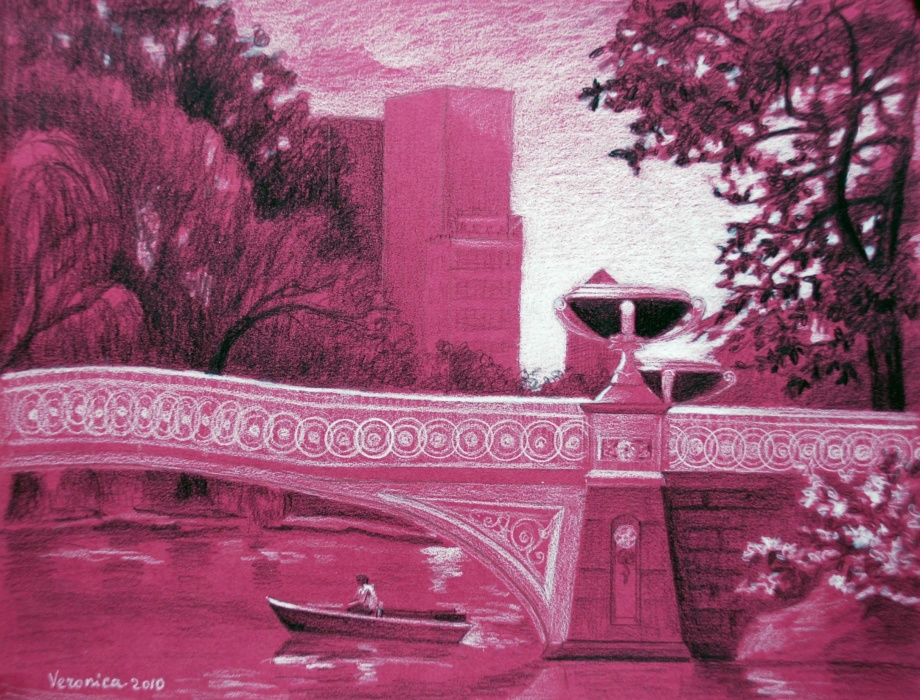
A study of Central Park in New York, 9x12 inches, lightfast colored pencils on paper
A study of Central Park in New York, 9×12 inches, lightfast colored pencils on paper

Start at The Met – A Walk Through Global Art History

Begin your day at the Metropolitan Museum of Art on Fifth Avenue, ideally arriving right at opening
time. With over two million works spanning 5,000 years, The Met is vast—and wonderful. In my opinion, it’s one of top art museums in the world, and I can get lost there for two full days, walking through all its galleries studying art. This art museum allows artists to write, draw, or take notes with pencil inside the galleries. So you might see artists sketching throughout the museum. Moreover, the Met’s copyist program can let you paint from chosen masterpieces, which could be exciting to see at the gallery.

To make the most of your visit, many art lovers focus on just a few wings rather than trying to see it all at once. Of course, your visit must depend on your interests. The Met often organizes exceptional exhibitions around a single artist or art movement that are included in the general ticket. So you might be interested in a specific show rather than in permanent exhibitions. If you have more time, spend a day there. If timing is critical, consider these highlights:

  • the Temple of Dendur in the Egyptian art section, beautifully staged with natural light;
  • the Greek & Roman art gallery filled with exceptional sculptures;
  • the European paintings wing, where Dutch Masters command quiet reverence;
  • and the Arms and Armor exhibit, a perennial surprise even for repeat visitors.

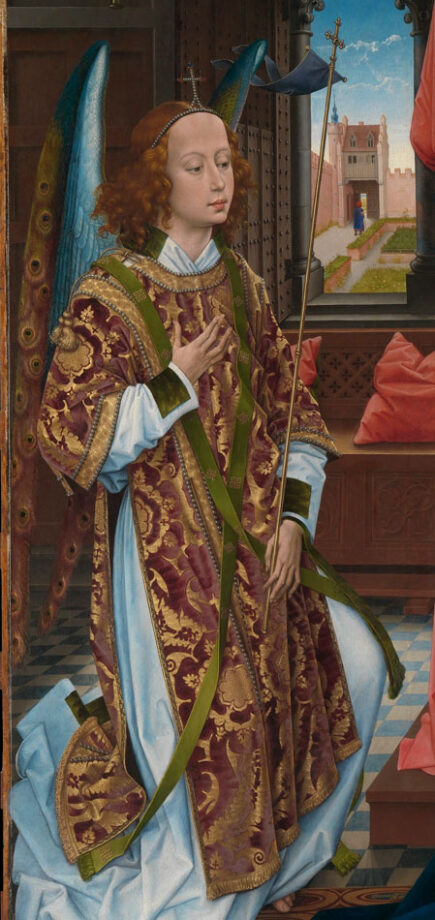
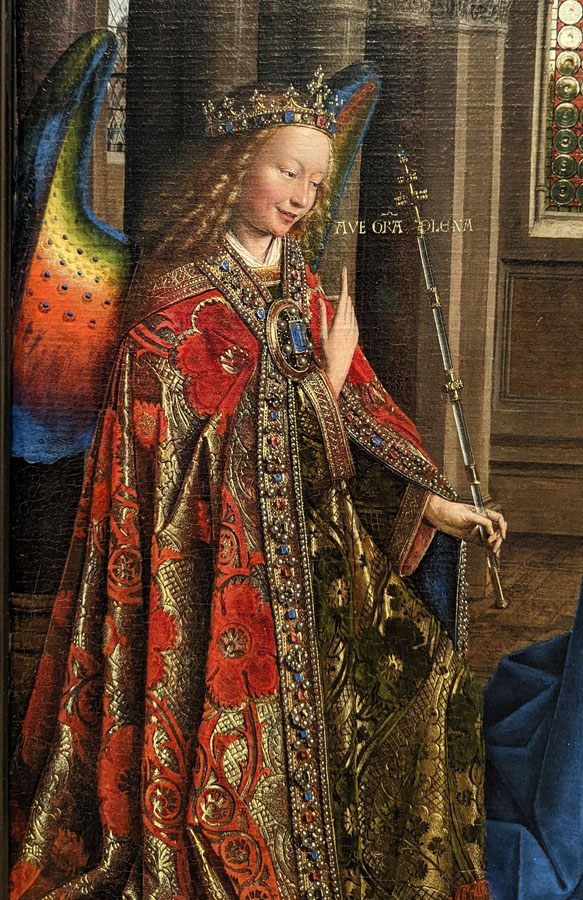
paintings of angels
The Annunciation, Hans Memling, Netherlandish, ca. 1465–70 http://www.metmuseum.org/art/collection/search/437490

The rooftop garden, when open, provides a unique view over Central Park and serves as a calming interlude before heading downtown. Stop by the café for a quick bite or espresso to refuel before the next leg of your tour.

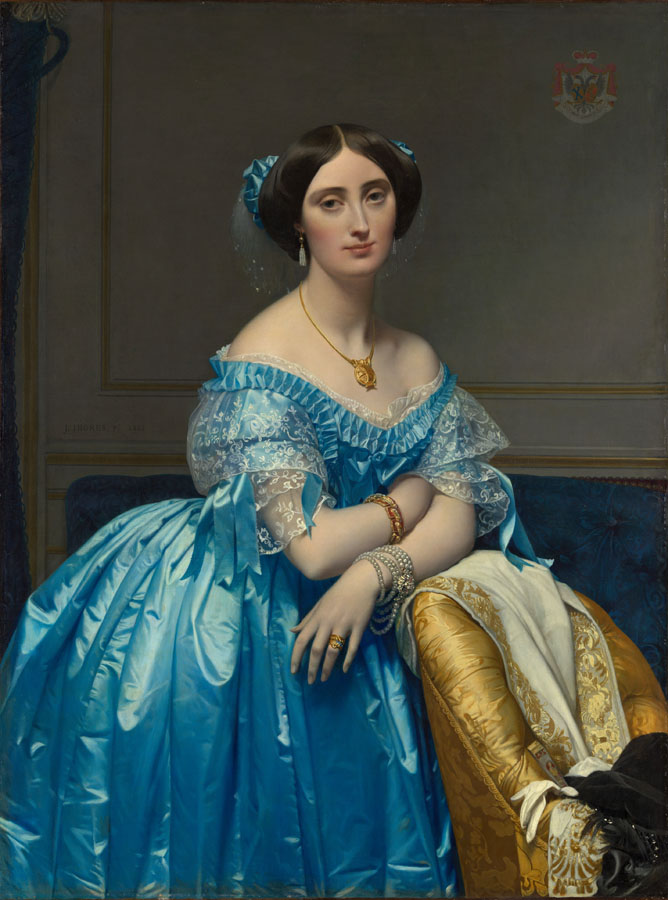
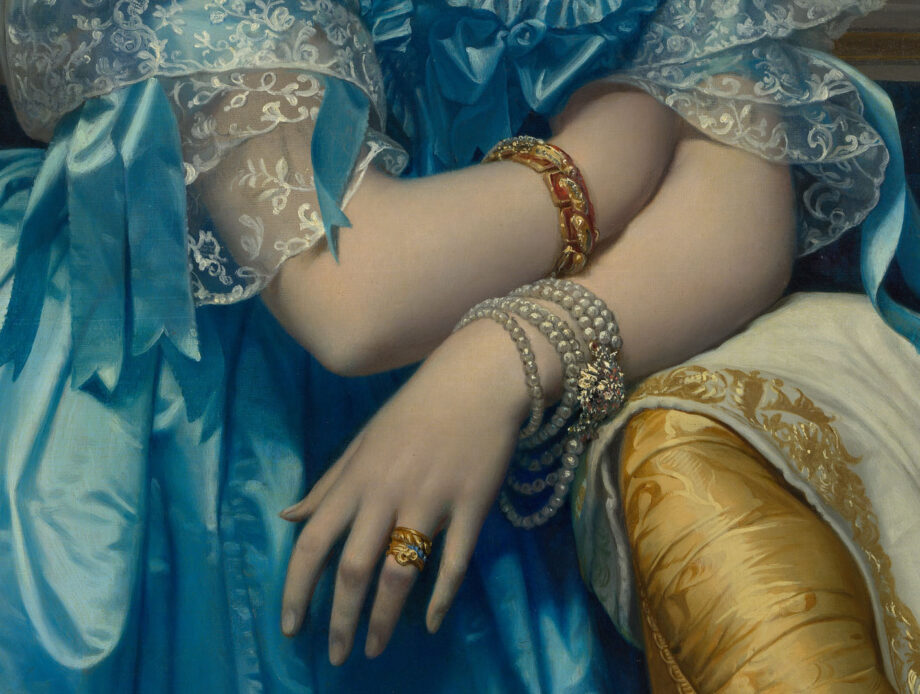
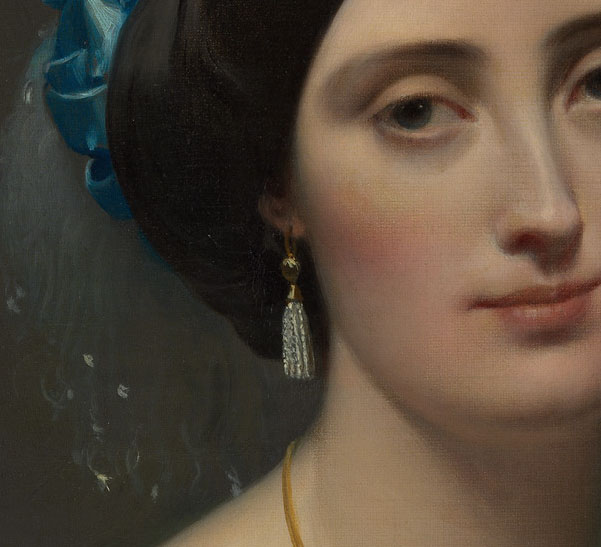
ingres-Princesse-de-Broglie-1853-the-met-best-art-museums
Ingres, Princesse-de-Broglie,1853, closeup, the Met

General admission tickets are $30 for adults; $22 for seniors; $17 for students. To buy pay-what-you-wish tickets online, you must have a New York State billing address. Small backpacks are allowed but must be worn on your front or carried in your hand. Water is ok in a secure bottle. No other liquids are permitted. Open 10 am to 5pm with Fridays & Saturdays open till 9pm. Closed on Wednesdays! Address: 1000 5th Ave, New York.

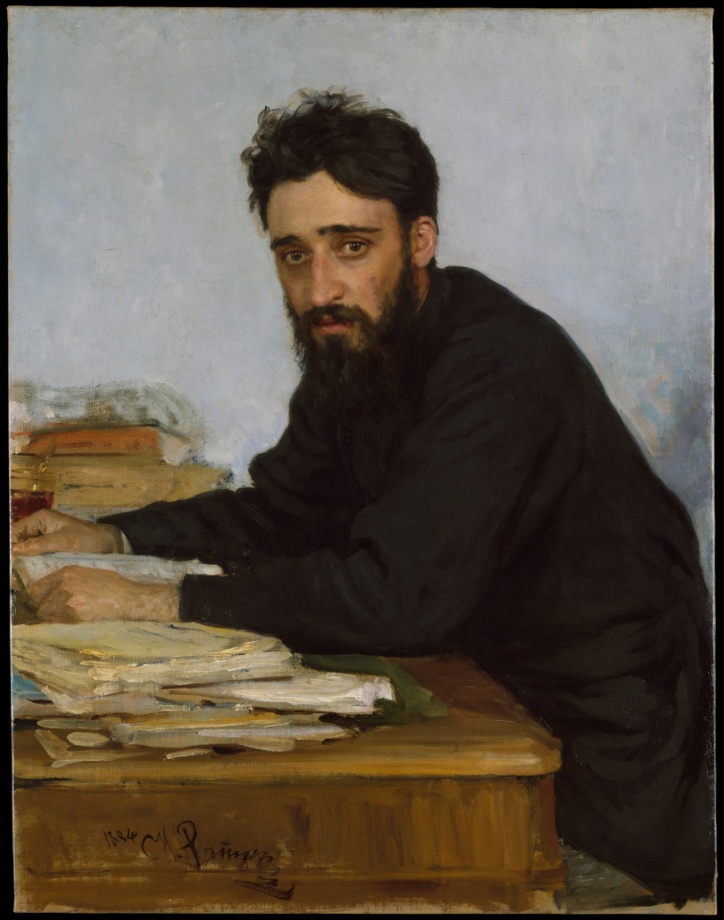
Ilya Repin, Portrait of Garshin, 35×27,” 1884, the Metropolitan Museum of Art

MoMA – A Jolt of Modernism and Innovation

From Fifth Avenue, head to Midtown and step into the Museum of Modern Art. MoMA doesn’t just
house modern art—it energizes and reframes it. A visit here challenges assumptions and often creates
memorable moments of discovery. Booking a timed-entry ticket in advance helps you navigate this
popular museum more efficiently.


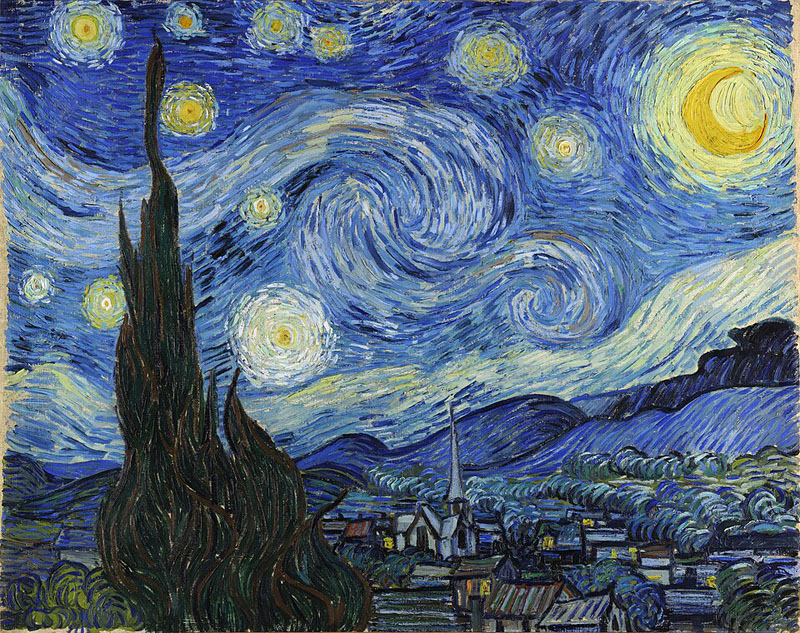
Start on the fifth floor—many visitors do—where you’ll find Van Gogh’s “The Starry Night,” Warhol’s
pop provocations, and the large, emotive fields of Rothko. As you move downward, each level unfolds
with purpose: Picasso’s fractured faces, Dali’s dreamy distortions, and immersive media installations
that stretch the very concept of “art.”

Van Gogh-Starry Night-Google Art Project-MOMA
Vincent van Gogh, Starry Night, oil on canvas,1889. Image by Google Arts & Culture — bgEuwDxel93-Pg, Public Domain, https://commons.wikimedia.org/w/index.php?curid=25498286


The sculpture garden is a favorite reset spot, while Café 2 provides a calm place to rest and recharge. By
the time you leave MoMA, the shift from The Met’s historical vastness to MoMA’s sharp focus feels like
a meaningful narrative arc.

Personally, I’m not a fan of modernism and I hold little affinity to huge spaces taken by gigantic canvases, media installations, and metal debris, but if you are a fan of these art styles, plan your visit by purchasing tickets online. MoMA is open until 5:30 p.m. daily and 8:30 p.m. on Fridays. Adult ticket is $30. Free tickets for selected colleges, military, etc.

Frick Madison – A Boutique Museum Experience

After MoMA, take a moment to slow the pace. Frick Madison, the temporary home of the Frick
Collection, offers the perfect setting for a reflective conclusion. Tucked away in a modernist building,
this museum feels more like a secret than a destination. It’s smaller, quieter, and elegantly arranged,
allowing each piece room to breathe and speak on its own terms. The art museum is a gem for artists, art collectors, and art enthusiasts because it shows beautiful, classical art with some famous artists like Rembrandt, Constable, Turner, Titian, Veronese, Bellini, Gainsborough and many more!


Inside, you’ll find yourself drawn into intimate encounters with Vermeer’s light, Goya’s bold contrasts,
and Whistler’s restrained elegance. Unlike the overwhelming scale of earlier stops, the Frick delivers
focus and restraint. Each room is curated with care, designed to make you linger longer, not rush to the
next thing.

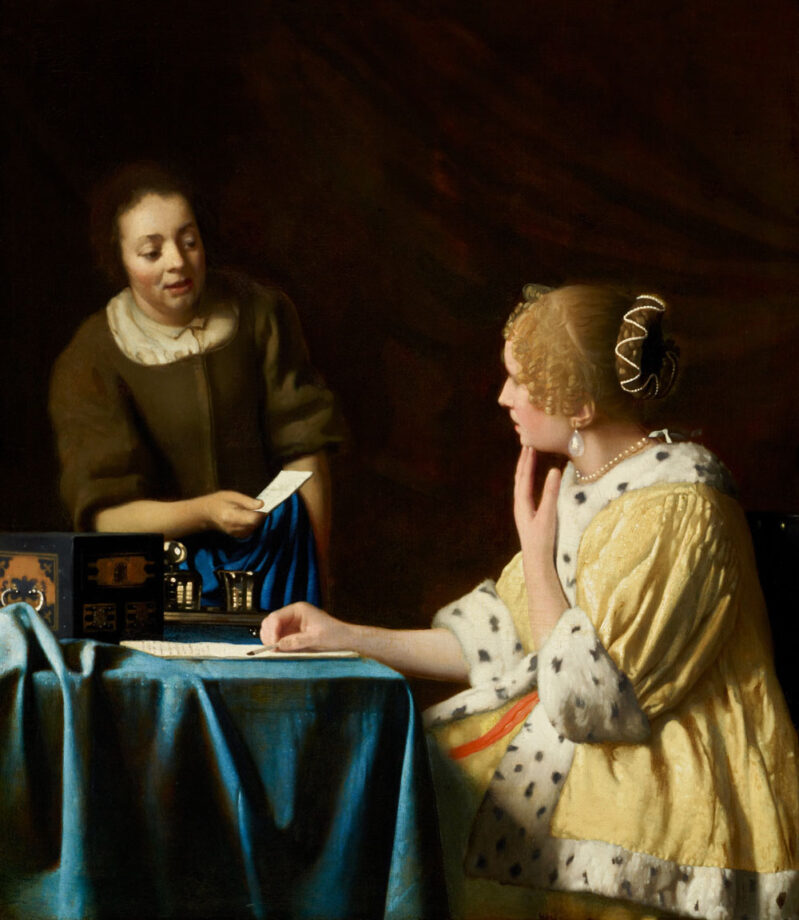
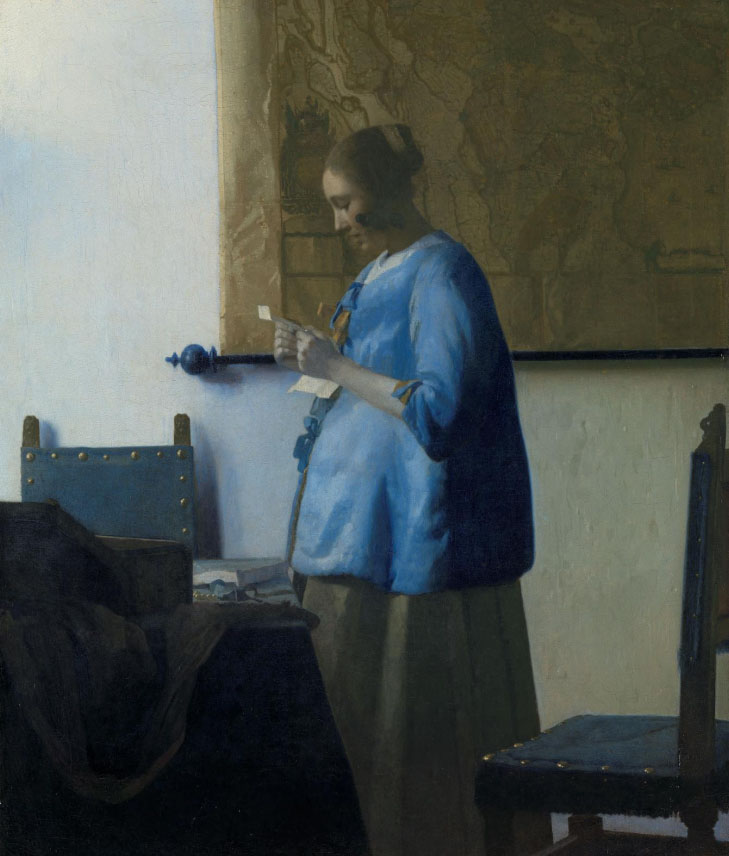
Johannes Vermeer-Mistress and Maid-Google Arts Project Frick collection
Johannes Vermeer, Mistress and Maid, 1667, image by Google Arts Project, Public Domain, https://commons.wikimedia.org/w/index.php?curid=149474060. The Frick art collection


The absence of crowds and the subtle presentation style provide visitors with a rare opportunity to
engage with art in near silence. Whether you’re listening to an audio guide or simply standing before a
single portrait for several minutes, the experience feels personal. It’s the kind of ending that doesn’t
wrap things up neatly, but rather leaves you with questions, reflections, and the quiet pleasure of seeing
more by slowing down.

Advance timed tickets are required to buy online unless you’re a member of this museum. Adult is $30 but the art museum offers Wednesdays for pay-what-you-wish admission from 2 to 6 p.m. Starting June 23, the museum will be open Mondays from 11 a.m. to 6 p.m. The Frick collection is located at 1 East 70th Street in New York.

Art Breaks & Planning Tips: Make the Most of the Day

Even the most passionate art lover needs a breather. These pauses between galleries often become
their own kind of memory. A quiet walk through Central Park, a hidden bookstore near Midtown, or a
slow moment with a latte on a museum terrace can refresh your eyes and your perspective. In a city
that moves quickly, these small resets let you absorb more deeply—and often help you connect dots
between eras, artists, and styles.


That said, thoughtful planning can elevate your entire art day from a series of museum visits into a rich,
cohesive experience. Here are a few practical strategies to keep your pace balanced and your attention
sharp:
 Book tickets ahead—especially for MoMA and The Met’s timed entry slots.
 Dress with purpose. Art is an all-day endeavor, and you’ll want shoes that go the distance.
 Use breaks wisely—every museum has at least one café worth pausing in.
 Don’t overpack your schedule. These three museums alone offer enough inspiration for days.
 Mind bag policies. Keeping things light helps you move through security and exhibits more
easily.


With these insights in mind, you can shape a day that’s full without feeling rushed, personal without
being overly planned. The rhythm you create between seeing, pausing, and moving on becomes part of
the experience itself.

Getting Around: From Art to Art with Ease

In a city where timing is everything, having dependable transportation can make the difference between
a rushed outing and a well-paced cultural experience. Pre-arranged car services provide a simple and
quiet way to move between destinations while giving you a few minutes to rest. If you’re flying in,
arranging a JFK limo service in advance sets a calm, prepared tone from the moment you land. Between
stops, that quiet ride becomes more than a convenience—it’s a breather between galleries, a space to
process.

One City, Three Museums, Endless Inspiration

Experiencing The Met, MoMA, and the Frick Collection in one day isn’t just possible—it’s powerful. It’s a
curated encounter with centuries of human expression, all within the span of a few city blocks. This kind
of day becomes a story you carry, a memory shaped not just by art, but by how you moved through it.
And for many, it’s not just the art that stays with them—but the feeling of having paused long enough to
truly see it.

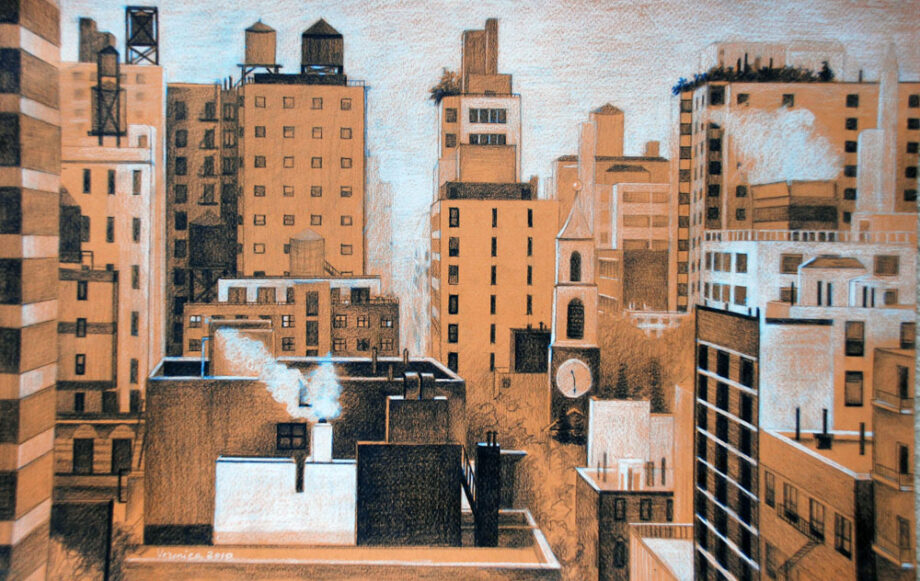
Upper East Side, colored pencil drawing, available for purchase, Veronica Winters

To continue exploring the best art museums in the world:

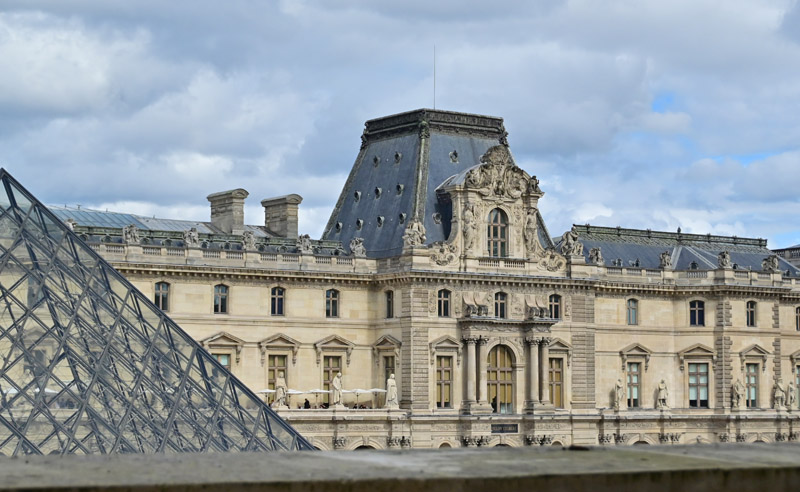
The best art in the Louvre art museum

What’s inside the Louvre? I take you on a virtual tour of the best art museum in the world.

To read the article and see art: https://veronicasart.com/the-most-beautiful-art-in-the-louvre-from-sculpture-to-painting-to-ancient-cultures-of-egypt-assyria-and-greece/

Video: https://youtu.be/5EkpVRnBkqg

Subscribe & rate this podcast on Spotify and Apple | Show your support for the podcast: here | Host: Veronica Winters, MFA | veronicasart.com
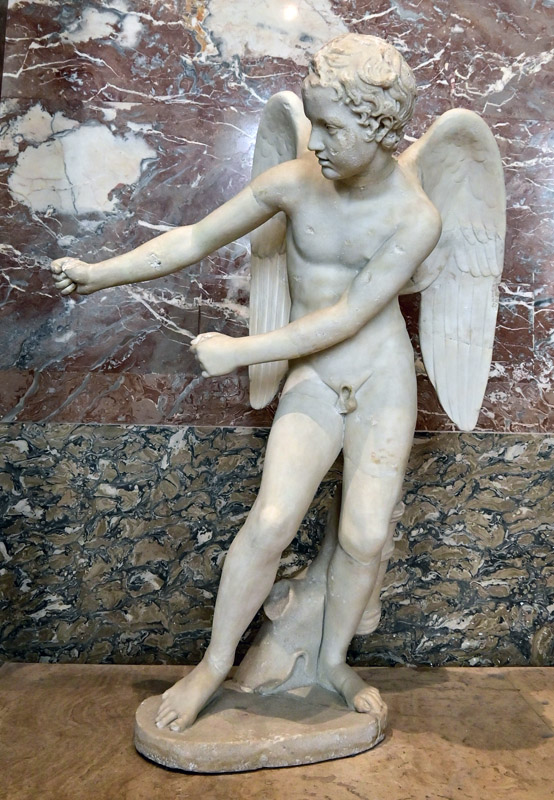
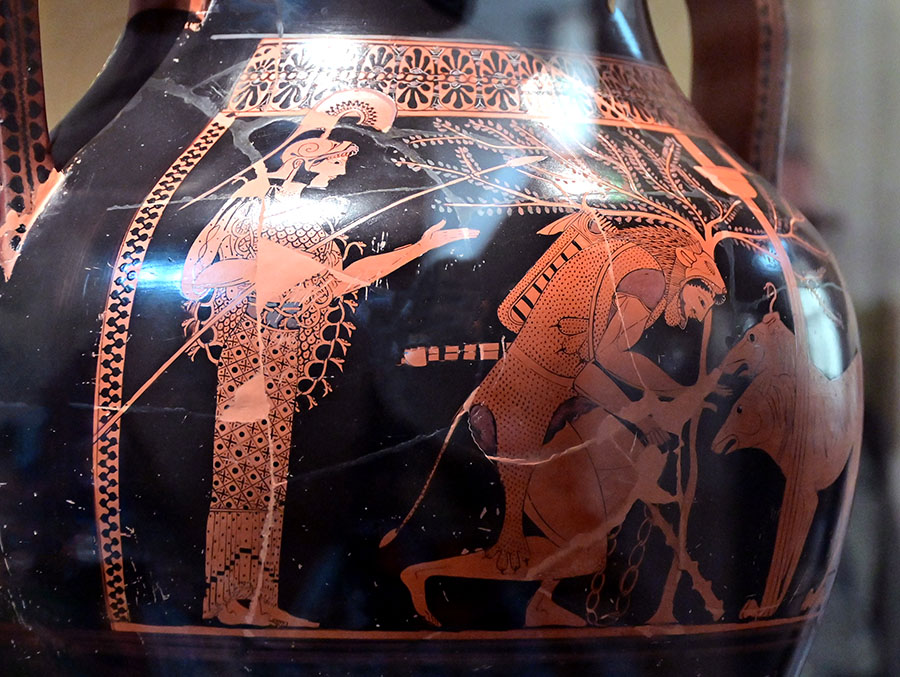
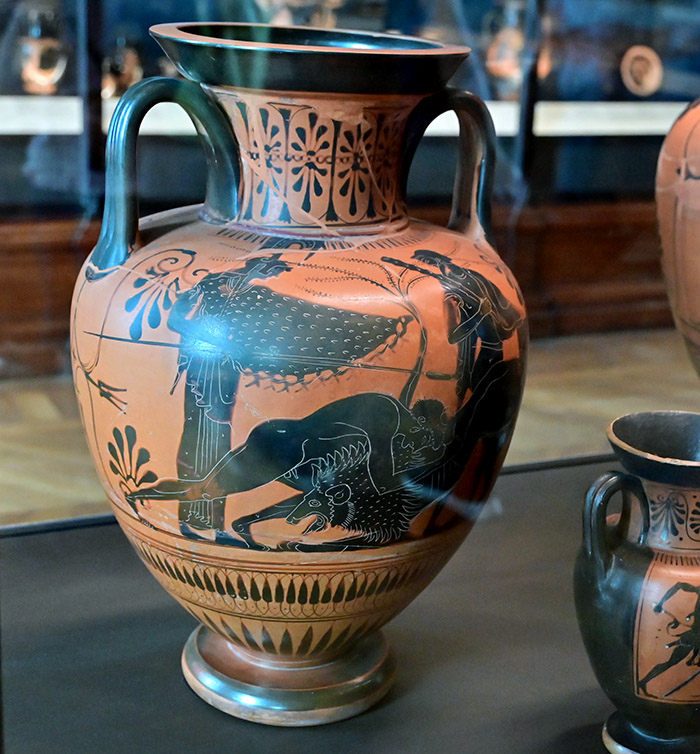
The most beautiful art in the Louvre from sculpture to painting to ancient cultures of Egypt, Assyria, and Greece

We spent two full days in the Louvre or about 15 hours, walking its lavish interior space filled with priceless art, jewelry, ancient sculpture, and furniture. The length of this famous art museum is remarkable. The Louvre covers about 60,600 square meters. Just imagine walking 652,000 square feet!
The Louvre’s art collection is even more impressive as this top art museum houses over 35,000 works of art, spanning from ancient Egypt to 19th-century art.
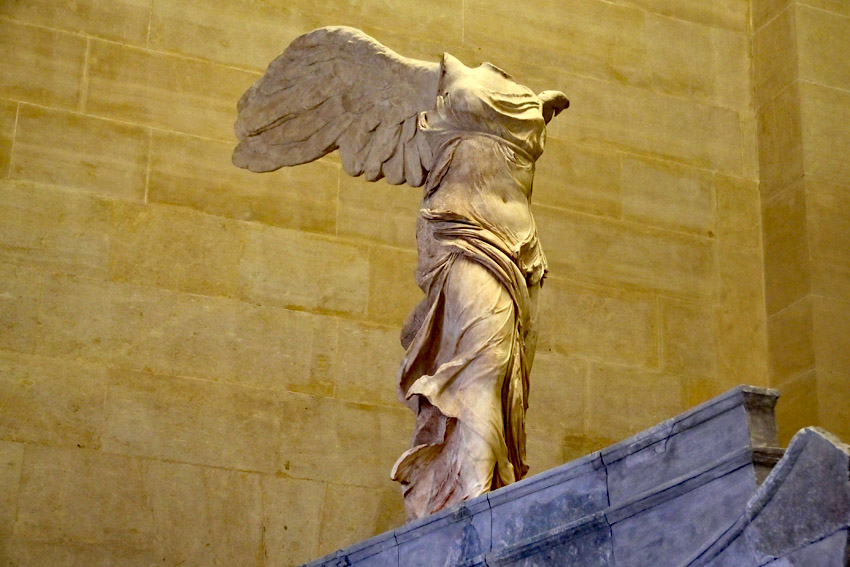
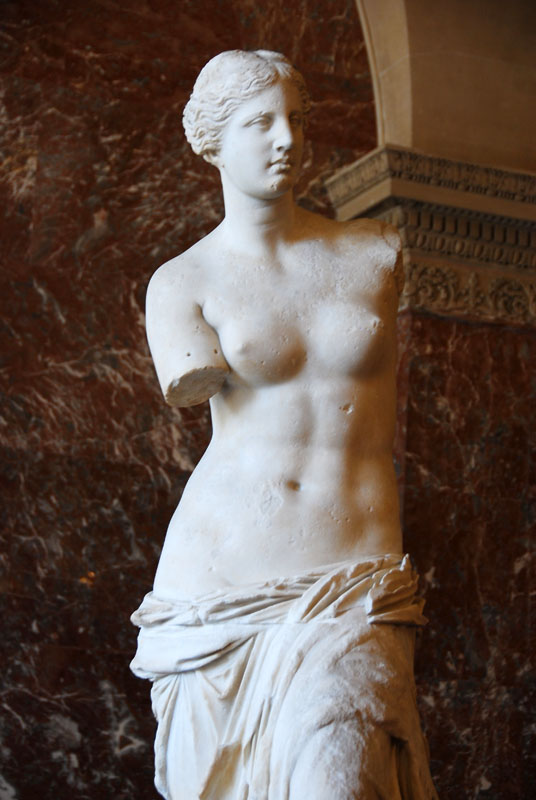
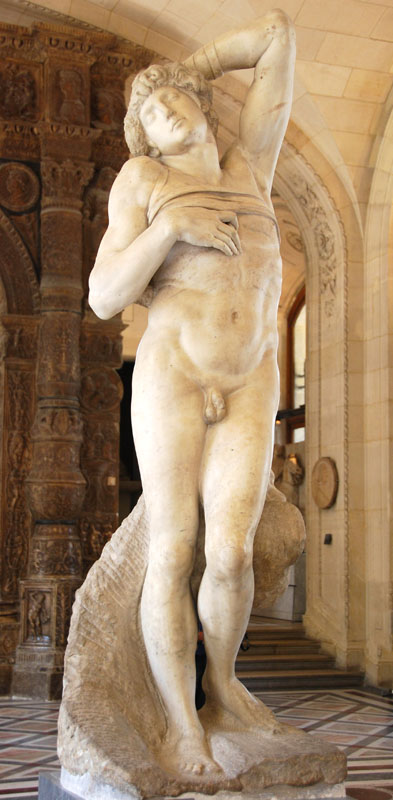
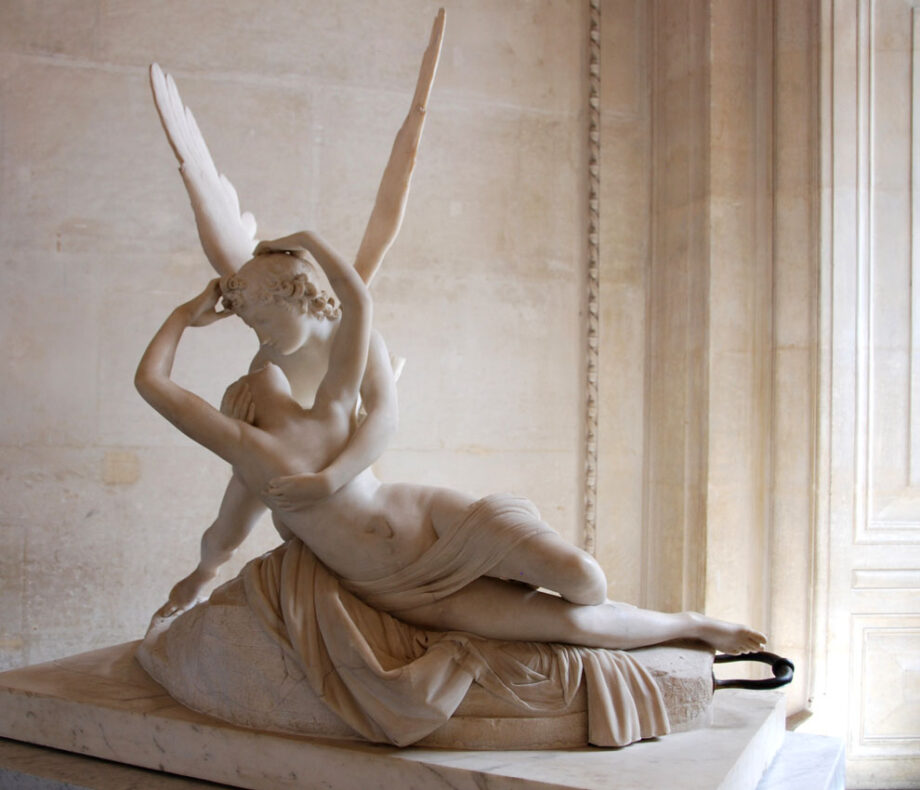
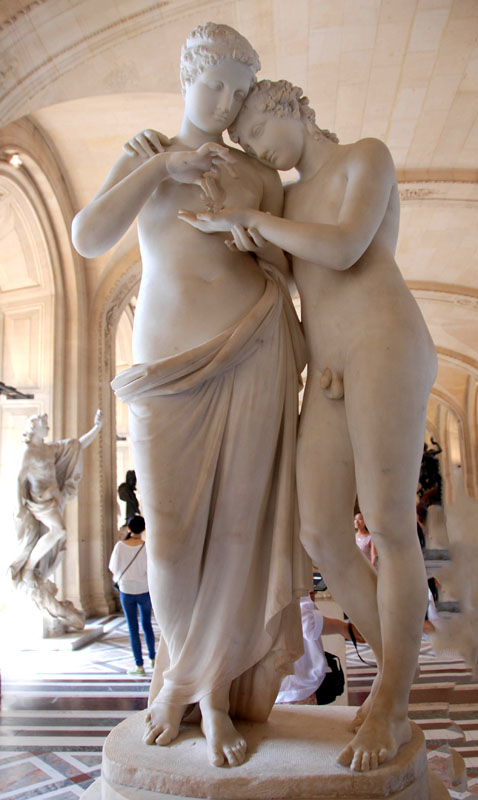
Yes, the Louvre is most famous for the Mona Lisa, Venus de Milo, Michelangelo’s Dying Slave, Canova’s sculptures, David’s paintings, and the Winged Victory of Samothrace. However, the palace displays so many other incredible pieces of art that I’d stay there for weeks to sketch and paint from this famous art if I could.

Video:
  • 00:00 Introduction to the Louvre Museum & its collection history
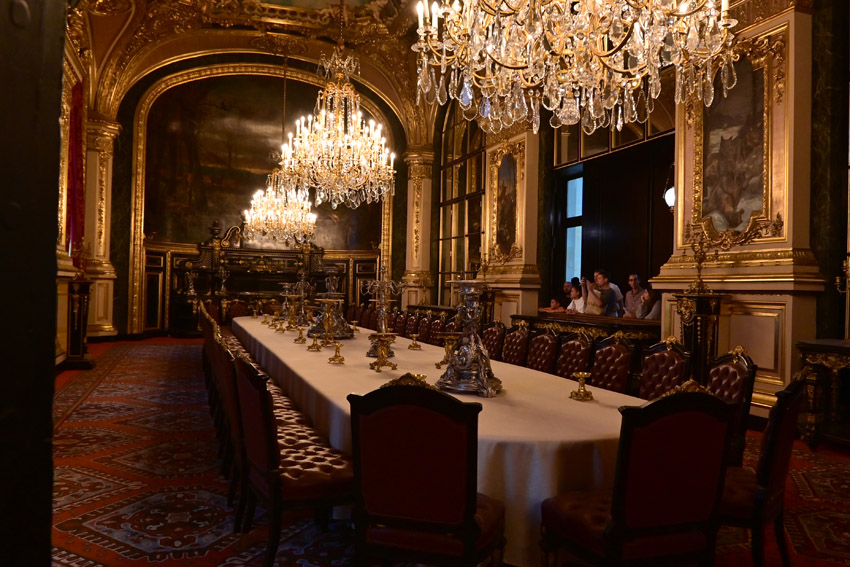
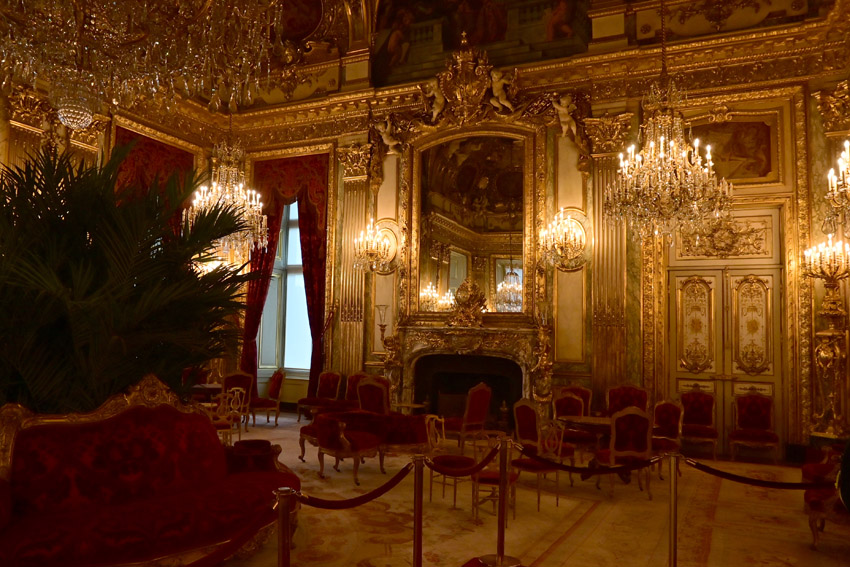
  • 05:50 The Napoleon III Apartments
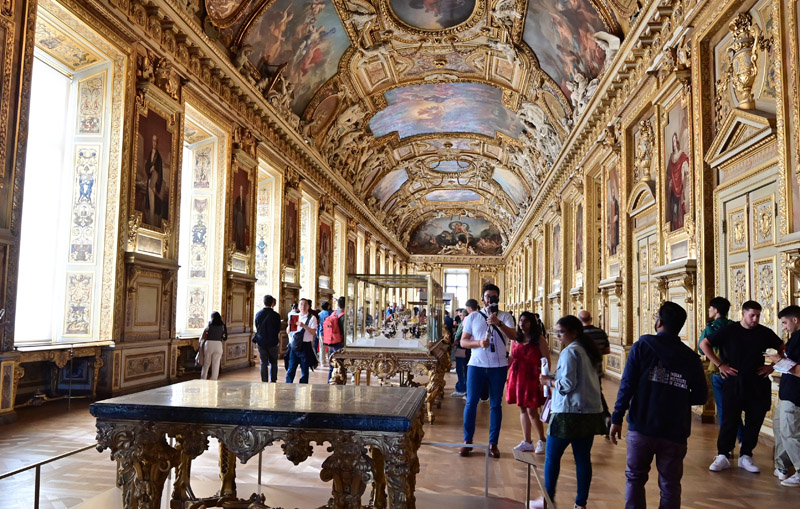
  • 08:02 The Apollo gallery & French Crown Jewels
  • 11:31 Ancient Egypt art collection
  • 14:15 The Palace of Sargon, Babylon & the Assyrian art
  • 16:42 Ancient Greco-Roman Art Collection
  • 19:36 The Michelangelo Gallery & classical art
  • 21: 42 Famous Paintings of the Louvre
  • 26:54 Islamic art collection
  • 29:41 The Sennelier Art Supply Store
  • 30:33 Views of Paris

History of the Louvre as a Royal Palace:

Let’s look at the history of the Louvre Palace before it became a museum. Construction began on a fortified castle on the right bank of the Seine River in Paris in the 12th century. In the 16th Century, King Francis I (1515-1547) transformed the castle into a luxurious royal residence, inspired by Italian Renaissance architecture. The king hired Leonardo to be his court artist in the last decade of the artist’s life and commissioned the Mona Lisa, among other pieces. (The famous Italian artist da Vinci passed away in France, and that’s why the Mona Lisa is in the Louvre, not Italy). When Louis XIV moved the royal court to Versailles in the 17th century, he left the Louvre as a royal palace for occasional visits and storage of art collections.

During the French Revolution in 1793, the Louvre transformed into an art museum as it was declared a “museum of the people.” In the 19th Century, Napoleon Bonaparte expanded the Louvre’s collection through conquests and purchases, making it one of the world’s largest and most prestigious art museums. Emperor of France from 1800 to 1814, made significant expansions of the art collections. A century later, the Louvre underwent extensive renovations and expansions under Georges-Henri Rivière, director of the Louvre from 1887 to 1908. The construction of the famous glass pyramid by architect I.M. Pei happened in 1989. https://www.louvre.fr/en/explore/the-palace

Athena/Minerva, the Louvre. Photo: Veronica Winters

The Louvre consists of several architectural styles present in the museum:

The earliest parts of the Louvre were constructed in the Gothic style (12th-16th centuries) with pointed arches, ribbed vaults, and stained glass windows. The oldest section of the museum, known as the “Old Louvre,” exhibits Gothic architectural elements.

King Francis I’s reign marked a significant shift toward the Renaissance style, inspired by Italian architecture in the 16th-17th centuries. The Renaissance portion of the Louvre features symmetrical facades, columns, and ornamentation. (Example: The Cour Napoléon, a central courtyard, showcases Renaissance architecture.)
The 18th century saw a revival of classical architecture, characterized by symmetry, proportion, and the use of Greek and Roman motifs, which is called Neoclassical style. ( Example: The Denon Wing, one of the main wings of the museum, is a prominent example of neoclassical architecture).

Modern Architecture of the 20th century includes I.M. Pei’s Glass Pyramid. Designed by Chinese-American architect I.M. Pei, looks very different from the older sections of the museum.


Mansard Roofs: A French Architectural Innovation

The roofs of the Louvre are a combination of several architectural styles. In some of the older parts of the Louvre, you might find slate roofs, which were common in medieval and Renaissance architecture. These roofs often have a steep pitch and are covered in dark, natural slate tiles. The newer sections of the Louvre, especially those built in the neoclassical style, often feature mansard roofs. These French roofs have a double-sloped design, with a steeper lower slope and a flatter upper slope. Mansard roofs were popular in the 17th and 18th centuries and are known for their practicality, offering added height and visual interest to buildings.

Mansard roofs, named after the French architect François Mansart, originated in France during the 17th century. King Louis XIV was a patron of arts & architecture who must have favored and influenced the popularity of mansard roofs in France.
These roofs offer several advantages. The sloped upper part of the roof allows for additional usable space within the attic or dormer. The steeper lower slope helps to shed rainwater more efficiently, reducing the risk of leaks and water damage. Also, the Mansard roofs can provide additional structural support to a building, especially in areas with heavy snowfall or strong winds. The symmetrical, balanced, and unique visual design of mansard roofs offers a distinctive silhouette that Paris is known for.


It’s not the first time I visit the museum, but I’m thrilled to share incredible genius of artists who created these pieces. I found the Louvre’s best art, some of it overly famous and other is not. Let’s explore the museum’s art collection together.

The Napoleon III Apartments

Napoleon III Apartments: the Grand Salon, Room 544, Richelieu Wing, Left 1. Photo: Veronica Winters

These luxurious red rooms are the most astonishing ones in the whole palace! You can’t skip them even if you’re short on time. You’d be stunned by the richness of its decorations. In 1861, these rooms became the apartments of Napoleon III, Minister of State, in the Richelieu wing. These opulent rooms in red, gold, and art, with crystal chandeliers, were used for various receptions, balls, dinners, and meetings between 1852 and 1870. It’s one of the most opulent rooms I’ve seen in many European palaces. Made around 1860, the largest chandelier sparkles with 180 lights and measures 4.7 by 3.27 meters.

One of the rooms displays the portrait of Emperor Napoleon III (1808-1873). The salon-theatre displays the portrait of Empress Eugénie and could house up to 250 guests. There was a special musicians’ platform above the stage hidden at first sight. The rooms have novel-designed red chairs and three-seater armchairs that zigzag to seat several people at once to have conversations. The Ministry of Finance occupied the rooms until the day the Louvre became a museum in 1993.

The Napoleon III Apartments in the Louvre, Photo: Veronica Winters

French Crown Jewels collection in the Apollo gallery

Apollo gallery in louvre
The Galerie d’Apollon, Room 705, Denon Wing, Level 1, the Louvre, Photo: Veronica Winters

Being just 23 years of age, King Louis XIV aligned himself with the ancient Greek god Apollo to become the sun king in France. He hired the best artists of the day, including the architect Louis Le Vau and Charles Le Brun, the first artist to the king, to work on one of the most beautiful rooms in a palace after it burned in fire. These famous artists later worked on the Hall of Mirrors at the Château de Versailles, the preferred residence of the Sun King.

Apollo gallery paintings in the louvre

Le Brun created a whole journey of the God Apollo in a series of ceiling paintings. The sun god rides his chariot across the sky from dawn to dusk. Apollo’s journey is set with many images, symbols, and representations of time, zodiac, and calendar to show the rule over the Universe. In 1850, famous French artist Eugène Delacroix received a commission to decorate the ceiling’s centerpiece – a 12-metre wide painting. Delacroix depicted the most famous scene from the ancient Greek mythology, Apollo Slaying the Serpent Python, in a style of French Romanticism. At the same time, beautiful portrait tapestries of 28 monarchs and artists were added as wall decorations.

Hardstone vessels in Apollo gallery in the Louvre-blog
The royal collection of vessels in the Apollo gallery, the Louvre, Photo: Veronica Winters

Today, you can view the royal collection of 800 hardstone vessels and the French Crown Jewels in the Galerie d’Apollon. These unique, artful vessels are made of precious stones, like agate, amethyst, lapis lazuli, jade, and crystal. Louis XIV had great taste!

THE FRENCH CROWN JEWELS (1530-1789)

french crown louvre

On 15 June 1530, François I, king of France from 1515 to 1547, established the French Crown Jewels, selecting eight pieces of royal jewelry that were to remain the inalienable property of the monarchy. King Louis XIV (reigned 1643-1715) added more items to the collection during his reign. Under the subsequent sovereigns, for various occasions, the gemstones were used and remounted to create new items.

Today, you can admire natural beauty of precious stones and artistic achievement captured in a crown of Louis XV, a crown and diamond brooch of Empress Eugénie, Tiara of the Duchesse d’Angoulême, jewels of Queen Marie Amélie, necklace and earrings from the emerald parure of Empress Marie Louise, the Regent and pink diamonds, and many more fantastic pieces!

Badge of the Order of the Holy Spirit: 400 brilliant-cut diamonds and a ruby mounted on silver

The Order of the Holy Spirit, founded in 1578 by King Henri III, was a French order of chivalry. There are two hypotheses as to who received this badge from King Louis XV (reigned 1715-1774): his son-in-law, Philip, Infante of Spain and Duke of Parma, named Knight of the Order in 1736; or his grandson, Ferdinand, Infante of Spain and future Duke of Parma, named Knight of the Order in 1762. It was modelled on the badge from the white insignia of Louis XV, created by Pierre-André Jaqmin about 1750.

Eternal Egypt: Best Egyptian artifacts to see at the Louvre

Lionesses, Statues of the goddess Sekhmet (Le Temple) Room 324, Sully wing, Level 0, the Louvre

The Egyptian art collection at the Louvre primarily came about through three main avenues, Napoleon’s conquests, 19th century acquisitions, donations, and purchases.

Did you know that Jean-François Champollion was the French scholar who deciphered Egyptian hieroglyphs in 1822. He was just 32 years old. He founded the Egyptian museum in Turin, Italy and the Egyptian collection in the Louvre by convincing Charles X to purchase the Egyptian artifacts.


The role of Napoleon in shaping the Louvre’s art collection:

During his military campaigns in Egypt (1798-1801), Napoleon and his troops discovered and plundered numerous ancient Egyptian artefacts. These treasures were then brought back to France and eventually housed in the Louvre. The 19th century saw a surge of interest in Egyptology, leading to numerous archaeological expeditions and discoveries. Many of these artifacts were acquired by European museums, including the Louvre. Also, over the years, the Louvre has acquired Egyptian artefacts through donations from private collectors and purchases from antiquities dealers and art collectors. These additions have further enriched the museum’s Egyptian collection.


The Louvre today boasts one of the world’s most extensive and significant collections of Egyptian art of over 6,000 works spanning 5,000 years of Egyptian history, including iconic pieces such as the Sphinx of Tanis. Egyptian art collection is rich and occupies two floors of the palace. Let’s look at the best Egyptian artifacts at the Louvre.

To house the Egyptian collection, some rooms were redone into the Museum of King Charles X (Egyptian Antiquities, Room 637, Sully wing, Level 1).  The architects linked nine rooms together with high openings and stucco decorations. These are very beautiful rooms with painted ceiling decorations that were done by several famous French artists of the period, Antoine-Jean Gros, Horace Vernet, and Jean-Auguste-Dominique Ingres. Painted scenes depict ancient Egypt in Greco-Roman style. One of the paintings by Jean-Auguste-Dominique Ingres, The Apotheosis of Homer, was replaced with a copy, and the original hangs in room 702 (Salle Daru), Denon Wing, Left 1.

https://www.louvre.fr/en/explore/the-palace/a-royal-setting-for-egyptian-antiquities

Look at these beautiful, perfect cuts shaping the texture of the sphinx. I wonder what kind of tool they used to cut into the hard stone of granite so perfectly. It’s one of the Egyptian sphinxes exhibited at the Louvre.

Some of the most famous and best Egyptian artifacts to see at the Louvre include a Seated Scribe figure, jewelry, sarcophagi, tomb of Akhethotep, furniture, clothes, granite statues of kings and queens (Sesostris III, Ahmose Nefertari, Hatshepsut, Amenophis III, Nefertiti, Akhenaton and Ramesses II), standing statue of Horus, and numerous artifacts I list below.

Pectoral with the name of Ramesses II, Room 642, Sully wing, Level 1. 1279 / -1213 (Ramses II), cloisonné inlay, glass, electrum. It was found in a tomb of Ramses II.

Osorkon Triad in the Louvre
Osorkon Triad, 865 /830 (Osorkon II), sculpture, gold, lapis lazuli, inlay. Found in Karnak, this golden pendant is in the form of a statue depicting a family of 3 gods, Osiris (center), Isis, and Horus, who stand in a protective pose with raised arms. It was purchased by the museum from a collector in 1872. https://collections.louvre.fr/ark:/53355/cl010006343

Osiris, Isis and Horus represent a founding myth of Egyptian religion. Osiris was killed by his brother Seth but he was revived by his wife Isis who also birthed their son Horus, the falcon god. Horus symbolizes victory over evil and the enduring power of the pharaohs.

The cat goddess Bastet, 664 / -610 (Wahibrê Psamtik I), copper alloy, gold. Museum’s purchase in 1852 from a collector.

Musée du Louvre, Département des Antiquités égyptiennes, E 27112 – https://collections.louvre.fr/ark:/53355/cl010003776 | Bust of Akhenaten, stoneware, 1352 / 1335 (Amenhotep IV Akhenaten). Place of discovery: Temple of Amenhotep IV Akhenaten. Display: Sully, Room 638, The New Empire, in the time of Akhenaten and Nefertiti.
This is one of the most fascinating portrait sculptures of the Egyptian pharaohs I’ve seen. The face has an unusual, elongated shape with wide eyes, a long nose, and full lips. It’s not an idealized view of the Egyptian pharaoh but rather a portrait of a real person.

Statue of Horus in the Louvre
The Statue of Horus Posno, the falcon-headed Egyptian god, is standing with outstretched arms in a purification pose. The statue is made of copper alloy and attributed to the Third Intermediate Period (attributed according to style) (-1069 – -664). Display: Sully Wing, Room 643
Statue of Amun and Tutankhamun in louvre
Statue of Amun and Tutankhamun, 1330 /1321 (Tutankhamun), Place of origin: Temple of Amon-Re (?). Made of diorite, the seated statue holds a crown of Amun. Discovered at Karnak, the statue was sold and resold to the Louvre in 1920. https://collections.louvre.fr/ark:/53355/cl010009969

The ‘mastaba’ tomb of Akhethotep

“The mastaba of Akhethotep was purchased from the Egyptian government in 1903 and reconstructed in the Louvre. During the Old Kingdom (2700–2200 BC), members of the king’s circle were entitled to be buried in an elaborate mastaba – a massive structure built over a shaft leading down to an underground chamber, where the mummy of the deceased lay in a sarcophagus. The superstructure above the shaft contained a funerary chapel, where offerings were made to the deceased” -the Louvre

The Crypt of the Sphinx & Great Sphinx of Tanis

Room 338, Sully wing, Level -1

Great Sphinx of Tanis, 2620 / 1885, Height: 183 cm; Length: 480 cm; Width: 154 cm; probably IVth dynasty. Photo: Veronica Winters.
Made of pink granite, the statue was discovered in Tanis and purchased by the museum in 1826. For some reason, this statue receives a lot of attention from visitors, although there are some other similar, if not better, statues displayed in other parts of the Louvre that don’t get much attention at all.

Naos, once housing the statue of Osiris

Naos housing Osiris in Louvre
Naos, once housing the statue of Osiris in the Louvre, granite

The pharaoh Amasis (570-526 BC) had this pink granite naos bearing his name made for a temple in the Nile Delta dedicated to Osiris. A naos is a wooden or stone chapel, large or small, present in each temple and housing the cult statue of the god to whom the monument is dedicated. Every day, priests would open their doors, bringing offerings of purified food and drink to the god, who was dressed in special attire. Carved from a single block of granite, the naos bears depictions on its outer walls of the many deities constituting the personal guard of the god Osiris. Through augmented reality, the statue of the god Osiris regains its position in the temple sanctuary and receives offerings once again. By walking around the monument, you can explore the reliefs portraying the other gods. **From the museum’s description.

Crypt of Osiris: Room 323, Sully Wing, Left -1. Photo: Veronica Winters

Reign of Amasis (570-526 BC), 26th Dynasty

The Dendera Zodiac

Made of sandstone, it was created between 15 June-15 August 50 BC, and purchased in 1822. Place of discovery: Temple of Hathor.

Various astronomical phenomena are recorded here, on the ceiling of one of the rooftop chapels of the temple of the goddess Hathor in Dendera. Inside a circle showing the year divided into ten-day periods (decans), we can see the twelve constellations of the zodiac, the five planets known at the time, and two eclipses – one solar and one lunar.

Upon its discovery in 1798, archaeologists hoped to date the Egyptian civilization correctly, but it raised great concerns over the established biblical chronology. Jean-François Champollion (1790-1832) was off by a hundred years, proposing the 50 AD date to reassure the pope of the established date of the Flood. Today, the temple’s inscribed dedications suggest its establishment in 54 BC, under Cleopatra’s reign. Through augmented reality, you can explore the three-dimensional details of these decorations and travel through the different levels of this celestial vault.https://collections.louvre.fr/ark:/53355/cl010028871

The Palace of Sargon II: History of the Louvre’s collection of ancient Near Eastern art

This is one of the most fascinating galleries in the Louvre because it displays the 8th century BC excavations of the ancient city, decorations, and the palace of King Sargon II at Dur-Sharrukin, present-day Khorsabad (Room 229, Richelieu wing, Level 0).

These wall sculptures represent the Assyrian Empire of King Sargon II, who built a new capital at Khorsabad, the largest city in the ancient world, with a huge palace. Unfortunately, his city soon declined after his death on a battlefield in 705 BC. French archeologists rediscovered the place buried in sand in the 19th century and brought the artifacts into the Louvre. Paul Émile Botta, the French vice-consul in Mosul, excavated the site that began the Mesopotamian and Near Eastern archaeology. https://www.louvre.fr/en/explore/the-palace/the-palace-of-sargon-ii

Félix Thomas, The Pasha of Mosul visiting the excavations of Khorsabad
Félix Thomas, The Pasha of Mosul visiting the excavations of Khorsabad. The 19th century Painting shows the discovery of this ancient city. https://collections.louvre.fr/ark:/53355/cl010067586
Large carved in low-relief alabaster stone slabs, many of which stood in a courtyard of the palace, were painted in bright blue and red. They showed life in a court, hunting and even construction scenes. Decorations and palace of King Sargon II

Carved into the entrance walls of the palace for protection, the protective genii (called aladlammû or lamassu) watched over the city and its palace. These colossal winged bulls weigh 28 tons each. Carved from a single alabaster block, the mythical, protective creatures look like bulls with eagle wings and human heads. These are fascinating creatures that resemble the art style of ancient Egypt with strangely moving legs, faces in profile, and flattened wings. This protective creature smiles gently and wears a hat with 3 sets of horns representing the divine power of the Mesopotamian region.

Mesopotamian wall Gilgamesh overpowering a lion and Protective genii in the Louvre
Mesopotamian wall: Gilgamesh overpowering a lion (left) and the Protective lamassu (right)

In these galleries, you can view “Gilgamesh overpowering a lion”, the high-relief sculpture that lacks original color but keeps its rough beauty. (Room 229, Richelieu Wing, Level 0). We look straight at the mad face of Gilgamesh squashing a lion. It’s not a side view, which is an unusual depiction of the hero. 721 /705 (Neo-Assyrian: Sargon II). It’s interesting to see how different people were in that region of the world. The man wears a bushy beard and curly hair. His long robe covers a loincloth. He wears sandals, earrings, and even a couple of different bracelets that were probably signs of his high status. This dark-toned sculpture was probably colored in white and other hues. Unlike the most refined granite sculptures of ancient Egypt, this figure lacks perfect proportions of the body but keeps stylization in place.

Passing lion, glazed terracotta, neo-Babylonian period, reign of Nebuchadrezzar II (605 BC–562 BC), Babylon, Iraq. Displayed at the Louvre. Photo: Veronica Winters

Cuneiform Script:


Sumerians developed cuneiform, a system of writing using wedge-shaped marks impressed into clay tablets, around 3500 BCE. The Louvre’s Near Eastern Antiquities collection, housed in the Galerie d’Angoulême (Room 301, Richelieu wing, Level 0), features Sumerian artifacts including cuneiform tablets, statues, stelae, and other objects.

The Louvre houses a Sumerian document with microscopic cuneiform, containing more than 30 lines of text and six to seven times as many signs as an ordinary cuneiform tablet. The Louvre also has a fragment of the Lament for Sumer and Ur, a Mesopotamian city lament.

Highlights of the Greek and Roman antiquities at the Louvre

This Ancient Greco-Roman Art Collection spreads across many rooms and levels. Obviously, it’s impossible to list everything that’s in this spectacular ancient Greek and Roman art collection but here are a few of my favorites.

Artemis Dianna-Louvre -Veronica Winters Art blog
Artemis/ Dianna (and the Caryatids behind her) stands in a beautiful ballroom gallery in the Renaissance style inside the Louvre, the Salle des Cariatides, Room 348, Sully wing, level 0. The gallery also displays ancient Roman marble copies of Greek bronze originals. Artemis with a Doe is a marble sculpture from the 2nd century BC and was based on a bronze original made in about 330 BC. It is also known as the Diana of Versailles, as it used to adorn the Hall of Mirrors at the Château de Versailles.
Artemis, known as Diane de Gabies 
Artemis, known as Diane de Gabies, Parian marble, found in Italy, displayed in room 348, Sully wing, Level 0, the Louvre. Original Greek sculpture, 4th quarter 4th century BC. The model was long identified with Praxiteles’ Artemis Brauronia, mentioned by writer Pausanias. The sculpture belonged to Camille Borghese before it was purchased by the State in 1807. Photo: the Louvrehttps://collections.louvre.fr/ark:/53355/cl010278726

Apollo lizard slayer-Louvre-Veronica Winters Art blog
Apollo, the lizard slayer, the Louvre. Veronica Winters Art blog. Marble statue from the original by Praxiteles (400-325 bc). Achat, 1807, collection Borghèse. The god of the arts, shown as an adolescent, prepares to kill a lizard. The scene is a reference to the protective nature of the god or, in an indirect way, to his struggle against the serpent Python

The Louvre’s Greek art collection is a result of centuries of collecting, discoveries, and acquisitions. The first significant Greek artifacts were acquired by French collectors in the 16th century, primarily through diplomatic missions and personal travels. In the 17th Century, the Louvre began to acquire a small number of Greek antiquities, often as part of larger collections or gifts from wealthy individuals.

In the 18th Century, the Grand Tour, a cultural pilgrimage to Italy and Greece, became popular among European aristocrats. Many of these travellers returned with collections of Greek antiquities, which were often donated or sold to museums like the Louvre. Lord Elgin, a British ambassador to the Ottoman Empire, is perhaps the most famous collector of Greek antiquities from this period. His controversial removal of the Parthenon Marbles from Athens remains a subject of continuous debate. You can read about the Parthenon’s fate here.


The 19th century saw a surge in archaeological excavations in Greece, leading to the discovery of numerous ancient Greek sites. Many of the artifacts found during these expeditions were acquired by museums, including the Louvre. Heinrich Schliemann, a German archaeologist, is famous for his excavations at Troy and Mycenae, he also wanted to excavate Knossos. The Louvre continued to acquire Greek antiquities through donations and purchases from private collectors throughout the 20th century.
The Getty Museum in Los Angeles and the Metropolitan Museum of Art in New York City are among the other major museums with significant ancient Greek art collections.

The galleries dedicated to Classical and Hellenistic Greece are found in Room 344, Sully Wing, Left 0. They were transformed into a large space from the royal apartments to display ancient Greco-Roman sculptures in the Louvre.

The galleries have several different sculptures of Athena, the Greek goddess of war, victory, and power. Mattei Athena stands tall with both hands in a resting pose gesture, and Athena, known as ‘Pallas of Velletri’ has one hand raised up and another down. Athena without arms is probably an ancient marble copy of a colossal sculpture that was standing on the Acropolis Hill in Athens.

Athena Parthenos, the Louvre

Torso of the ‘Diadumenos’ type, Imperial Roman, marble, 100 / 150 (1st half of the 2nd century AD),  Room 344, Sully wing, Level 0https://collections.louvre.fr/ark:/53355/cl010250998

Statue of Eros stringing his bow in the Louvre, photo: V. Winters

The galleries with ancient Greek vases are located in a different place, the Galerie Campana. This is a long space of rooms with thousands of high-quality ancient Greek vases, cups, and other vessels. These galleries have several famous vases, like Hercules stealing the tripod from Apollo or Athena helping the hero win his battles, etc. The Marquis Giampietro Campana (1807–1880) was a super wealthy art collector who also led some archeological finds. After his arrest for financial fraud, his art collection was confiscated and sold off to czars and Emperors of Europe including Napoleon III. It’s a truly remarkable collection of ancient Greek pottery that can’t be missed! https://www.louvre.fr/en/explore/the-palace/the-marquis-greek-vases

Ancient Greek vase Athena & Herakles-Louvre-Veronica Winters Art Blog
Ancient Greek vase Athena & Herakles, the Louvre, Veronica Winters Art Blog

What shocked me about the Louvre’s Greek art collection is its high quality and vast size. I’ve been to Greece before, and the archaeological museums in Athens and the islands have little high-quality ancient Greek art left in situ. It was disappointing but clear that Greece “gave away” numerous art pieces to private and public art collections around the world. Besides the Greco-Roman sculpture hall, the Louvre displays numerous, high-quality, ancient Greek vases in several rooms of the palace, the Galerie Campana.

Model of the temple of Zeus in Olympia

Model of the Temple of Zeus in Olympia, 500-30 BC, by Michel Goudin with the help of Patrick Lizon, 1997, wood, 1/50 scale, 1997
Ancient Greek temple model showing construction inside. Model of the Temple of Zeus in Olympia, 500-30 BC, by Michel Goudin with the help of Patrick Lizon, 1997, wood, 1/50 scale, 1997, the Louvre

Built around 460 BC by the local architect Libon of Elis, the temple of Zeus in Olympia was the largest of its kind in the Peloponnese (27.68 m x 64.12 m). Surrounded by a colonnade, it was made of stuccoes and painted limestone, with its sculpted decoration made of marble. The pediments were dominated by the statues of Zeus on each facade, the patron god of the sanctuary. The east pediment depicted the preparations for the chariot race between the king of Pisa, Oinomaos, and the hero, Pelops. Pelops won, gaining dominion over the region. The west pediment depicted the victory of a mythical Greek tribe, the Lapiths over the Centaurs. It was an allegorical battle between civilization and the Barbary.
Inside the temple colonnade, above the entry porch (pronaos) to the east and the rear porch (opisthodomos) to the west, twelve metopes (rectangular elements with sculpture in high relief) of the Doric frieze featured the labors of Herakles, a hero considered one of the founders of the Olympic Games. The temple chamber (naos or cella) housed a colossal statue of Zeus in gold and ivory with a wooden core (about 460-450 BC). A masterpiece of the sculptor Phidias, the statue is considered one of the seven wonders of the ancient world.


The Greco-Roman art collection includes many sculptures of goddesses in the Louvre collection, including the Winged Victory, Venus de Milo, and Venus of Arles.

The Winged Victory of Samothrace

Who was the Goddess of Victory? In antiquity, the winged goddess Nike expressed the will of the gods. She announced, rewarded and glorified the victors. We often encounter the figure of Nike in sculpture, pottery, and goldsmithing. The Nikes found at the sanctuary of Delphi come from public buildings, where they were used as symbols of victory in literal or metaphorical battlefields.

The Winged Victory of Samothrace
The Winged Victory of Samothrace is located in the Daru staircase inside the Louvre. Photo: Veronica Winters Art Blog

The Winged Victory of Samothrace is one of the rare Greek statues whose exact original location is known as the Greek island of Samothrace. This beautiful sculpture was made as an offering to the gods for a sanctuary there. The Parian marble statue dates to 190 BC and was commissioned to celebrate the sailor’s victory. The winners, probably from the island of Rhodes, erected it in Samothrace to thank the Gods of the island. Located in the Aegean Sea, the broken into 110 pieces sculpture was discovered by Charles Champoiseau in 1863. The Winged Victory of Samothrace was placed in the Louvre 20 years after its discovery. The goddess of Victory’s wings were partially retrieved and restored with plaster. The pieces of the ship that form the base of this beautiful sculpture were found later on. Also, other excavations found one of her hands with missing fingers. https://www.louvre.fr/en/explore/the-palace/a-stairway-to-victory

The Venus de Milo

the Venus de Milo from the galleries dedicated to Classical and Hellenistic Greece -louvre-veronica winters art blog
The Venus de Milo from the galleries dedicated to Classical and Hellenistic Greece in the Louvre was made between 130 and 100 BCE, during the late Hellenistic period. Photo: Veronica Winters.

The Venus de Milo name comes from the Greek island of Melos, where she was found in 1820. The Marquis de Rivière, the French ambassador to Greece, bought the piece and presented the sculpture to King Louis XVIII. This is one of the best-preserved female nude sculptures existing today. The proportion, movement, and simplicity are divine. Venus was the only goddess depicted in the nude, and Greek sculptor, Alexandros of Antiocha, carved the woman in a beautiful, natural pose. https://www.louvre.fr/en/explore/the-palace/ideal-greek-beauty

Aphrodite as Venus of Arles in the Louvre-Veronica Winters Art blog
Aphrodite as Venus of Arles in the Louvre, Veronica Winters Art blog. Aphrodite, known as the ‘Venus of Arles’, Marble. This Venus was presented to King Louis XIV of France as a gift in 1683. François Girardon, the king’s sculptor, added the attributes of the goddess of love: a mirror and an apple, references to her victory in the Judgement of Paris. This work may be a copy of the Aphrodite of Thespiae (Boeotia, Greece), commissioned around 360 BC from the sculptor Praxiteles by the courtesan Phryne.

Aphrodite by Praxiteles Louvre
Aphrodite by Praxiteles, the Louvre. Female head of the ‘Aphrodite of Knidos’ type, known as the ‘Kaufmann Head’, Room 344, Sully wing, Level 0.


The Michelangelo Gallery inside the Louvre

Napoleon III ordered the redesign of this gallery during the Second Empire (1852–1870). The Michelangelo gallery houses the unfinished work by Michelangelo and Canova’s masterpieces, among other Italian sculptures from the 16th to the 19th century. Built between 1854 and 1857, the Michelangelo gallery led to the Salle des États (the rooms that served for the legislation of the country). This new gallery also became an open space for a prestigious annual art competition, the Salon, for sculpture.

michelangelo, the dying slave, louvre-veronica winters art blog
Michelangelo, the dying slave at the Louvre | Photo: Veronica Winters | This sculpture is part of a series of sculptures known as the “Prisoners” or “Slaves.” It dates between 1513 and 1530, during Michelangelo’s time working on the tomb of Pope Julius II in Rome. I love how the artist curved the body creating movement in the figure. It looks so beautiful even without the polished luster of finished marble.
Room 403, Denon wing, Level 0

Canova, Cupid and Psyche, marble sculpture, 1793, louvre-veronica winters art blog
Antonio Canova, Psyche Revived by Cupid’s Kiss, marble sculpture, 1793, Room 403, Denon wing, Level 0, the Louvre, photo: Veronica Winters art blog

Canova, Cupid and Psyche, marble sculpture, louvre-veronica winters art blog
Canova, Cupid and Psyche, marble sculpture, 19th century, Room 403, Denon wing, Level 0, the Louvre | Photo: Veronica Winters. I love Canova’s art although it’s a bit too sweet for my taste but the sculptor was an incredible talent who created such beautiful works of art.
Lorenzo Bartolini, Nymph with a Scorpion,1835 / 1845, Room 403 (Michelangelo Gallery), Denon wing, Level 0. Probably commissioned in marble from the plaster model created around 1835 and remaining in Bartolini’s studio. Acquired by Prince Charles de Beauvau for his Château d’Haroué around 1843.

Sleeping Hermaphrodite in Louvre
Sleeping Hermaphrodite, Room 348, Sully wing, Level 0, the Louvre. Hermaphroditos was the son of Aphrodite and Hermes, the messenger god. When he was a young man, the nymph Salmakis fell in love with him, but he rejected her advances; disappointed, she asked Zeus to join their bodies into one. This is an ancient Roman marble sculpture, unknown artist, c. 100-500 AD, first in the Borghese Collection

13 Famous Artists inside the Louvre

These are some of the most famous artists in the world, listed in no particular order. There are many more inspiring artists in the Louvre that I simply don’t have space to do so.

1. Leonardo da Vinci

Who painted the Mona Lisa and when, you may ask?

Leonardo da Vinci’s “Mona Lisa”, closeup. 30×20 in, oil on polar wood. This small portrait of a woman is the most famous painting in the world and is considered a masterpiece of early Renaissance art. Painted between 1503-1519, it depicts Lisa Gherardini, the wife of Florentine silk merchant Francesco del Giocondo. That’s the official story of the model. However, there are rumors that the woman is a younger Leonardo himself (the artist is believed to be gay), and other theories include him painting a mistress of the Medici rather than a merchant’s wife… No one knows this for sure. Leonardo created this and other rare paintings of his using the sfumato technique, which gives this soft and hazy appearance. Although the original colors of this painting were not brown but rather vivid and colorful. Here you can read about the painting in greater detail. You can also read about another, even more controversial painting of the artist here.

2. Eugene Delacroix

The Delacroix Palette is displayed in his museum in Paris. I don’t suggest visiting this museum if you’re short on time. The museum is a fair walk from the Louvre, and it has very little art. But if you go, stop by the art supply store, the Sennelier.
Liberty Leading the People by Delacroix
Liberty Leading the People. 1830. Oil on canvas, 260 x 325 cm.

Eugene Delacroix’s “Liberty Leading the People” – This painting depicts the allegorical figure of Liberty leading the people of France during the Revolution of 1830 and is considered a symbol of the fight for freedom and democracy.

3. Arcimboldo

Arcimboldo, 4 seasons at the Louvre
Arcimboldo, Four Seasons at the Louvre, Paris, France

https://collections.louvre.fr/en/ark:/53355/cl010065017 | Commissioned by Emperor Maximilian II (1527 -1576) for Elector Augustus of Saxony (1526-1586), the paintings show some symbolism representing the royal court. The crossed swords of Meissen and the coat of arms of Saxony appear on the winter coat, and the date of 1573 is inscribed on the shoulder of L’ Summer, signed by the artist. The Four Seasons have multiple layers of meaning. The obvious one is the change of seasons, but the four paintings may also suggest the four ages of man: childhood, adolescence, maturity, and old age, as well as everlasting peace and abundance of the Hapsburg’s empire. You can read about this artist here.

4. Jean-Auguste-Dominique Ingres

Jean-Auguste-Dominique, the Valpinçon Bather, 1808
Jean-Auguste-Dominique, the Valpinçon Bather, 1808, the Louvre. Room 940 Sully Wing, Level 2. https://collections.louvre.fr/ark:/53355/cl010066528 . This is one of my favorite paintings because it has a perfect balance between a sensual figure and beautiful folds of fabric.

ingres odalisque
http://www.metmuseum.org/art/collection/search/436708. Ingres, An odalisque, called The Great Odalisque, 1814. The grey version is an underpainting/study of the finished painting displayed at the Louvre. It’s also reduced in size and much simplified. The 19th-century artists were fascinated with the Orient and painted their ideas with the props from the orient world. Here, Ingres shows his concept of ideal beauty captured in this woman, an imagined concubine in a Middle Eastern harem.
Ingres, Jean-Auguste-Dominique, France, Musée du Louvre, Département des Peintures, RF 1158 – https://collections.louvre.fr/ark:/53355/cl010065566 | This photo shows the closeup of a beautiful contrast between the fabric and face.
Ingres in the Louvre
Ingres, Jean-Auguste-DominiqueFrance, Musée du Louvre, https://collections.louvre.fr/ark:/53355/cl010059986
Ingres painted several versions of the Oedipus and Sphinx in the neoclassical style. The Walters art museum, the National Gallery in London and the Louvre have these paintings. Oedipus explains the riddle of the Sphinx, 1808, oil on canvas, Height: 1.89 m x Width: 1.44 m. On view at Denon, Room 702 – Daru Room, the Louvre.

5. David

David was the leading artist of the neoclassical art style being admirer of Michelangelo and Caravaggio. David is famous for his large-scale historical painting. His paintings ,like The Oath of the Horatii and The Intervention of the Sabine Women are on display in the Louvre, Room 702 (Salle Daru), Denon wing, Level 1.

Jacques-Louis_David death of marat
Jacques-Louis David, Death of Marat or Marat assassinated, 1800, oil on canvas. Height: 1.625 m; Height with accessory: 1.9 m; Width: 1.3 m. Room 702, Denon Wing, Level 1, The Louvre. Replica of the painting donated by David to the Convention on 14 November 1793 (displayed in the Royal Museum of Fine Arts, Brussels). Bequest of Baron Jeanin, descendant of the artist, 1945.

David painted his assassinated friend and French revolutionary leader, Jean-Paul Marat. David was the leading French Neoclassical painter and supporter of the French Revolution. Being a member of the revolutionary Committee of General Security, he voted for the death of French king Louis XVI. Marat had a skin condition, the pain of which was elevated by taking a long bath. He was assassinated by Charlotte Corday in it on 13 July 1793. He painted Marat in a pose resembling the Pieta.

Jacques-Louis David’s “The Coronation of Napoleon”1805-1807. This incredibly large painting depicts Napoleon Bonaparte and his wife Josephine being crowned emperor and empress of France in Notre-Dame Cathedral in 1804. This gigantic painting (20ft x 32ft) has remarkable detail that you must see up close. It’s an incredible fit of artistic genius to design such a balanced composition in a gigantic oil painting, which measures 6.21 meters tall and 9.79 meters wide, making it one of the largest paintings in the Louvre Museum in Paris.
Jacques-Louis_David_madame recamier
Jacques-Louis David, Portrait of Madame Récamier, 1800, is one of my favorite neoclassical paintings by the master. It’s a commissioned portrait of the Parisian socialite Juliette Récamier shown reclining on a classical, Pompeian-style recliner. Because the painting is unfinished, it shows brushwork and simplified color choices that are great for a study if you’re a realist artist.

6. Georges de La Tour

The Card Sharp with the Ace of Diamonds is an oil-on-canvas painting 1636–1638 by the French artist Georges de La Tour-veronica winters.
Georges de La Tour, The Card Sharp with the Ace of Diamonds, oil painting, 1636–1638, photo: Veronica Winters. This French artist became famous for his art style depicting figures in a strong, directional candle light. Many ‘candlelight’ painters imitated his style.
Georges de La Tour, The Card Sharp with the Ace of Diamonds, oil painting 1636–1638, closeup, the Louvre | Photo: Veronica Winters

7. Caravaggio

The Fortune Teller – Caravaggio 1595

Death of a virgin – Caravaggio 1606

Portrait of Alof de Wignacourt and his Page

8. Johannes Vermeer

Johannes Vermeer, The Astronomer, 1668. This small but exquisite painting depicts a scholar examining the stars and is considered one of Vermeer’s masterpieces. I love the quietness and natural light in his paintings, as well as the suggested detail and mysterious nature of the figures.

9. Théodore Géricault

Théodore Géricault, “The Raft of the Medusa”. It was a revolutionary painting because it depicted a controversial subject of the day. This monumental painting depicts the aftermath of the shipwreck of the French frigate Medusa in 1816 and is considered a masterpiece of the Romanticism movement that created much controversy during the painting’s reveal. The artist depicted figures with stunning realism and movement characteristic of the Romanticism style.

10. Anne-Louis Girodet de Roucy-Trioson

The funeral of Atala,1808,Girodet_de_Roussy-Trioson
Anne-Louis Girodet de Roucy-Trioson, The Entombment of Atala, oil on canvas,207 cm × 267 cm (81 in × 105 in), 1808, Room 702 (Salle Daru), Denon wing, Level 1. A student of David, Girodet painted a picture of love. Being Christina, Atala chose death by poison to end her struggle between her faith and love for an Indian boy. It was a very influential painting among French artists for decades to come. It was painted in neoclassical style with some romantic notes that led to the development of the Romanticism style in 19th century France.

11. Elisabeth-Louise Vigée Le Brun

Elisabeth-Louise Vigée Le Brun, La Paix ramenant l’Abondance

12. Titian

Titian, The woman in the mirror, oil painting, 1525 / 1550

13. Paul Delaroche

Delaroche, Paul, The Young Martyr, oil on canvas, 1854 / 1855, 67.3×58.3 inches. Although the subject is one of sadness, I love how the artist painted the light on her face and the water. These subtle grey-green colors of water are so beautiful that I can’t stop looking at this painting!
Ary Scheffer, The Shades of Francesca da Rimini and Paolo Malatesta Appear to Dante and Virgil

 Room 700 (Salle Mollien), Denon wing, Level 1
Scheffer, AryFrance, Musée du Louvre, Département des Peintures, RF 1217 – https://collections.louvre.fr/ark:/53355/cl010065982 Ary Scheffer, The Shades of Francesca da Rimini and Paolo Malatesta Appear to Dante and Virgil, Room 700 (Salle Mollien), Denon wing, Level 1. Repetition of the painting exhibited at the Salon of 1835 (booklet no. 1943, currently London, Wallace Collection, P. 316); remained in the artist’s family; bequeathed to the Louvre Museum by Madame Cornélia Marjolin Scheffer (1830-1899), the artist’s daughter, in 1900.
I absolutely love this painting for its emotion and artistic use of diagonals and contrast to create movement in this oil painting.


The Islamic Art Collection

What kind of Islamic art is in the Louvre Museum?

The Islamic art collection has amazing artifacts displayed in spacious, dark galleries below the ground floor in Cour Visconti. Some of the pieces display remarkable artistic skills. The collection spans from the rise of Islam in the 7th century to the late 19th century. Geographically, the collection comes from four regions: Spain, India, North Africa, and Egypt. Room 185, Denon Wing, Left -1

There are several Islamic zodiac/astral/celestial tools displayed throughout the museum, but i don’t remember what room they belonged to.

Planispheric Astrolabe in the Louvre
Planisphere Astrolabe in the Louvre, made around 1800 in Morocco.

The inscriptions are engraved in a Maghrebi Kufic script, suggesting Morocco as its place of origin. The names of the stars on the “spider” (a cut-out copper plate rotating inside the case), except one, are in cursive style. Only twenty of the twenty-five star indexes bear names. It looks like the “spider” remained unfinished and was partially completed later. Inside the case (or mother), under the “spider”, is a metal disc engraved on both sides (or “tympanum”) to indicate the latitudes, which could be turned over as needed, depending on where the astrolabe was used (on one side, Meknes; on the other, Fez). The astrolabe also contains five other tympanums. The back of the astrolabe has the Julian zodiacal calendar (O° Aries = March 7), a chart of unequal hours, and a square of shadows. https://collections.louvre.fr/ark:/53355/cl010115734
Islamic arts in the Louvre
Iznik pottery, walls of Islamic decorations. Room 186, Denon wing, Level -2

I hope you enjoyed traveling across centuries of beautiful art with me. You can watch my video about the Louvre to see even more beautiful art, the interiors of the palace, the streets of Paris, and the beauty of France! Let me know what your favorite art is in the comments section of the video.

Shop unique visionary art, art instruction books, prints, and art gifts https://veronicasart.com/

Further reading:

The 15 best art museums in the world you must visit

The best art museums in the world for art lovers offer a unique experience to learn about art history and humanity as we can study art masterpieces in the context of socio-economic and political changes rather than from a technical point of view. Top art museums for art lovers offer visitors a chance to appreciate the beauty, cultural significance, creativity, and history of different people from across the world regardless of current views on culture appropriation or colonialism issues. While we can argue which must-see museums are the best ones because art is always subjective, I list the 15 best art museums in the world based on the art collection variety, size, and overall museum experience. Every art collector and art enthusiast is going to be inspired by these top art museums in Europe and the US.

#1 The Vatican Museums, Vatican City, Italy

The Vatican Museums house an extraordinary art collection of the most famous ancient Greco-Roman art, Egyptian art, Italian Renaissance art, and Baroque art. The Vatican City has a maze of rooms, hallways, museums, chapels, pavilions, and apartments, including the Ethnological Museum and the Pio Clementino Museum as well as beautiful gardens and St. Peter’s Basilica. The Vatican Library houses an incredible collection of books, manuscripts, and other documents. Plan to spend a day on the grounds of the Vatican City. You must see:

The Sistine Chapel Ceiling by Michelangelo: This masterpiece is one of the most famous artworks in the world, depicting scenes from the book of Genesis. The ceiling, completed in the early 16th century, is renowned for its monumental beauty and complexity of figures placed in space. Figures twist, turn and stare, carrying Michelangelo’s sculptural quality in painted form. No photography or talking is allowed in the chapel.

The School of Athens by Raphael: This fresco is one of the most famous paintings of High Renaissance art significant as a reflection of Renaissance humanism, depicting a group of ancient Greek philosophers and thinkers. Located in the Vatican Palace, The Raphael Rooms are a series of 4 rooms that include The Transfiguration mural. Just like Leonardo and Michelangelo, Raphael showed thorough planning designing the figures in space with correct perspective and balanced composition.

Raphael fresco closeup-veronica winters art blog
Raphael, the School of Athens’ fresco closeup. Photo by Veronica Winters, 2021 | These pictures get distorted because of the camera’s angle and lens. In this part of the mural you can see the Michelangelo figure (right).
One of Raphael’s frescoes in the Vatican rooms. Photo by Veronica Winters, 2021

The Laocoön Group: Found in 1506, a Hellenistic sculpture from ancient Greece dating from around 40-30 B.C., depicts a priest of Apollo in the city of Troy, Laocoön, and his sons being strangled by sea serpents.

Laocoön and his sons in Vatican courtyard-veronica winters art blog
Laocoön and his sons in Vatican courtyard, Photo by Veronica Winters, 2008 | According to the museum’s notes “Laocoön warned the Trojans against taking in the wooden horse left by the Greeks outside the city gates. Athena and Poseidon, who favored the Greeks, sent two great sea serpents to kill them. From the Roman point of view, the death of these innocents was crucial to the decision of Aeneas, who heeded Laocoön’s warning, to flee Troy, and this led to the eventual founding of Rome.” Pope Julius II (1503-1513) bought the marble sculpture to display it in the Cortile delle Statue. I don’t know if the information is still correct but I remember from my art history class that Michelangelo ran to see the newly found sculpture to figure out if it was made from a single marble block (and it wasn’t).
  • The Apollo Belvedere: This ancient Roman sculpture depicts the god Apollo, and is considered one of the greatest works of antiquity because it captures the perfection or the highest ideal of art in the human figure. ‘Belvedere’ roughly translates as a ‘beautiful view’ in Italian. A youthful, nude man has just released an arrow from his bow allowing viewers to admire his lifelike beauty made of marble. According to the museum, the sculpture has been dated to the 2nd century A.D. and is considered to be a copy of an original bronze statue of 330-320 B.C.
  • The Gallery of Maps – a long corridor lined with colorful maps of Italy, commissioned by Pope Gregory XIII in the late 16th century. But to be honest, any hallway or corridor in the Vatican is an amazing work of art that beats the gallery of maps.
the vatican soldier-costume design by Raphael-Veronica Winters art blog
The Vatican’s soldier dressed in a form originally designed by Raphael. Photo by Veronica Winters, 2021

The Belvedere Torso is the marble torso with the identity of the figure being open to interpretation for centuries! It’s a beautiful fragment of a Hellenistic statue from ancient Greece. This fragmented statue was found in Rome at the end of the 15th century. “Current hypothesis identifies the male marble sculpture as the Greek hero Ajax, contemplating his suicide. According to the museum’s notes, Ajax becomes enraged when Achilles’ armor is awarded to Odysseus and not him during the Trojan Wars and so he kills himself. “The head was leaning sadly towards the right hand which was gripping the sword with which the hero would take his own life. The sculpture dates from the 1st century B.C. and is signed by the Athenian sculptor Apollonios, an artist of the neo-Attic school, who was most probably inspired by a bronze from the first half of the 2nd century B.C.”

The Pietà and St. Peter’s Basilica

pieta closeup-Michelangelo-Veronica Winters Art Blog
The Pietà, a closeup of the marble sculpture by Michelangelo, 1499. Photo by Veronica Winters, 2021

Located in the St. Peter’s Basilica in Vatican City, the Pietà is an emotional sculpture by the Italian Renaissance artist Michelangelo. It depicts the Virgin Mary holding the dead body of Jesus after his crucifixion. The Renaissance sculpture is one of the most famous artworks in the world. The Pietà was commissioned by Cardinal Jean de Bilhères, who was a French ambassador in Rome. Michelangelo was just 23 years old when he carved the ethereal statue from pure white, Carrara marble in 1499. It is the only piece of sculpture that Michelangelo ever signed.

The Pietà is a powerful and moving work of art. The Virgin Mary is shown grieving the death of her son holding him on her knees, but she is also shown with a sense of peace, hope, and faith. Michelangelo was a religious man and he created an emotional depiction of the Christian faith. From the technical point, Mary appears to be disproportionally tall in comparison to the body of Christ but who cares when this beautiful sculpture speaks volumes of human emotion.

St. Peter’s Basilica is an architectural marvel on its own right that can’t be missed! It was designed and constructed by several famous architects and artists including Bramante, Michelangelo, Bernini and Maderno. The Baroque art, sculptures, tabernacle and dome inside the basilica impress with their overflowing rich decorum, monumentality, life-like appearance and scale. And while it’s not a museum in a traditional sense, it is one of the top must-see attractions for art lovers in the world.

#2 The Hermitage Museum, Saint Petersburg, Russia

the Hermitage with carriage- winter palace-veronica winters art blog
The Hermitage with a Carriage, Photo by Veronica Winters, 1997

The Hermitage Museum is one of the largest, top art museums for art lovers in the world, housing over 3 million works of art and artifacts in a Winter Palace where Catherine the Great ruled Russia for 34 years, from 1762 to 1796. Catherine came to power after overthrowing her weak-minded husband, Peter III. The Empress was a highly intelligent woman, shrewd politician, and powerful ruler who oversaw a period of great change and expansion for Russia. She promoted education and the arts, and she expanded the Russian Empire into new territories.

Located in the beautiful northern capital of Russia -Saint Petersburg, one of the best art museums in Europe was founded in 1764 when Empress Catherine the Great acquired 225 paintings by Western artists. She displayed her art collection in the private apartments of the palace first, which she called the Hermitage, which means “my solitude” in French. (Russian nobility spoke French until the revolution in 1917). As an avid art collector, Catherine the Great kept expanding her art collection which included antiques, sculpture, porcelain, furniture, giant semi-precious stone vases, jewelry, and paintings. So she expanded the building for it as well which was called the Great Hermitage and then the New Hermitage Palace after that. Consisting of 6 connected buildings, the “Hermitage complex” is also called the Winter Palace (one of the buildings) because the Empress spent most of her time in it. Her Summer Palace is located in Tsarskoye Selo. Catherine the Great loved to entertain Russian and European royalty with balls, theatre, and masquerades at the palace. The Winter Palace also held grand receptions and ceremonies for state and government officials. The Hermitage buildings served as a home and workplace for nearly a thousand people, including the Imperial family.

Main rooms in the Hermitage:

The Pavilion Hall

pavilion room-hermitage-veronica winters art blog
The Pavilion room in the Hermitage, photo: Veronica Winters

The pavilion hall is the most stunning room in the Small Hermitage, designed in the mid-19th century in white and gold hues with oriental and classical decorum by Russian architect Andrei Stakenschneider. It’s so ethereally beautiful it reminds me of a magical, white wedding cake. Big, crystal chandeliers are reminiscent of the Versailles grandeur. In that room, you can find a big, mechanical clock with a peacock and moving figures, presented to Catherine by her lover Potemkin.

the pavillion room in hermitage-veronica winters art blog
The Pavilion Room in hermitage, veronica winters art blog

St. George’s or the Great Throne Hall. Designed in neoclassical style in white and gold, the hall features the royal throne for the reception.

The Armorial Hall. Used for special events, this great hall was created for celebrations. The Alexander Hall is named after Alexander I. In the Concert Hall you’ll find a silver shrine of Alexander Nevsky, the patron saint of St. Petersburg, entirely made of silver.

This short video gives a great overview of the Hermitage showing main rooms in the palace as well as major art collection.

The Malachite room at the Hermitage

Created in 1838, the Malachite room is one of the most valuable drawing rooms in the palace because of its precious stone columns, tables, vases, and fireplace decorum. Malachite is a dark green, semi-precious stone coming from the mountain region of Russia – Ural. The room also features golden doors, dark red curtains, gilded element,s and incredibly rich, ornate ceilings and wooden floors.

The Diamond Storeroom

The treasury is located away from the excursion routes around the museum, and not everyone knows about it. The secret room displays the jewels of the Romanov dynasty and St. Petersburg collectors, as well as diplomatic gifts, church utensils dating back to the Byzantine era, as well as masterpieces by Faberge, Pozier and other court jewelers. It requires a separate ticket that’s sold in addition to the general admission ticket to the Hermitage.

Art Collection at the Hermitage

If you look at every displayed art object and painting in the palace, it will take you about 8 years to go through everything. At least that’s what they say! In all seriousness, this top art museum is so massive, you can easily spend two days in it. Featuring an extensive collection of European art, the most popular art museum in Russia includes works from the old masters and other famous artists such as Rembrandt, Leonardo da Vinci, Rubens, Van Dyck, Hals, and Vincent van Gogh. The art museum’s collection includes works of art from ancient Egypt, Greece, and Rome; paintings from the Renaissance, Baroque, and Rococo periods; and sculptures, tapestries, and other decorative arts from around the world. The Hermitage also has a large collection of Russian art, including paintings by Ilya Repin, Vasily Kandinsky, and Kazimir Malevich. You must reserve the entire day to walk through the best art museum in the world!!!

The Soviets sold over 250 works to the West in early 1930s and so Russian people said goodbye to Jan van Eyck, Titian, Rembrandt, Rubens, Raphael, and many more famous artists! One of super wealthy art collectors was Andrew Mellon who purchased the art and ended up donating his art collection to the government. So these famous paintings are now displayed at the National Gallery of Art in Washington, D.C.

Leonardo_da_Vinci_Benois_Madonna
Leonardo daVinci, Benois Madonna, 1478

Today you can view the following works in the Hermitage’s art collection:

  • The Kolyvan vase is a giant stone vase made of jasper by Avraam Melnikov, in 1843. It weighs almost 19 tons with 8.55 ft in height.
  • Leonardo da Vinci’s “Benois Madonna” got its name from a family who owned this painting before it entered the Hermitage’s art collection. it is considered one of the most important works in the museum’s collection.
  • A copy of an ancient Roman mosaic floor is located in the Pavilion Hall. The artist is unknown.
  • Canova’s “Cupid and Psyche” marble sculpture, 1808, and “Three Graces”, 1816 are so beautiful, they can make you cry. The Hermitage has a collection of 9 sculptures by Canova from the Yusupov collection. Canova’s Psyche Revived by Cupid’s Kiss, exists in two iterations only. In the Hermitage one, the artist draped the legs of Psyche completely unlike in the second one housed in the Louvre. Yusupov’s sculpture was damaged during the fire in his residence and it was transported and restored in the Hermitage later on.
  • Tenerani, “Psyche in a Faint”, a marble statue of the 19th century
  • Bartolini, “Nymph with a scorpion,” marble statue of the 19th century commissioned by tsar Nicolas I. Bartolini was one of David’s students and a friend of Ingres, he created utterly beautiful, neoclassical sculptures that were often copied.
  • James Cox, The Peacock clock,1770s is displayed in the Pavilion Hall.
  • Giorgione, Judith.
  • Diego Velazquez’s “Lancheon”, 1617.
  • Rembrandt’s “The Return of the Prodigal Son”, 1665 – This monumental painting is considered one of the greatest works of art ever created and is a masterpiece of Dutch Baroque painting because it shows the triumph of love and forgiveness over bitterness and loss. There is also Rembrandt’s “Flora”, 1634 that he painted after marrying his wife.
  • Michelangelo’s “Crouching Boy” – This sculpture is one of only a few surviving works by Michelangelo that are not in Italy, and it is considered a rare example of his early, unfinished work.
  • Raphael’s “Conestabile Madonna” – This painting is considered one of the most beautiful and important works in the Hermitage’s collection of Italian Renaissance art.

#3 The Louvre, Paris, France

The Louvre Art Museum is located in Paris, France. The Louvre is the most famous and visited art museum in the world. It houses an extensive collection of Western art from the Middle Ages to the 19th century, including Rembrandt, Michelangelo, and Leonardo da Vinci’s iconic masterpiece behind glass, the Mona Lisa.

The Card Sharp with the Ace of Diamonds, closeup detail, oil painting 1636–1638 by the French artist Georges de La Tour, the Louvre | Veronica Winters

The Louvre, the best art museum in Europe, is home to numerous masterpieces including:

  • Grande Odalisque”, also known as ”Une Odalisque or La Grande Odalisque”, completed in 1814, is a Jean Auguste Dominique Ingres oil painting depicting an odalisque or concubine. It is currently housed in the Louvre, Paris.
  • “The pastoral concert” by Titian, 1509
  • The Virgin, Saint Anne, and the Child Playing with a Lamb, da Vinci, 1503-19
  • Saint John the Baptist, da Vinci 

Canova, Cupid and Psyche, marble sculpture, 1793, louvre-veronica winters art blog
Canova, Psyche Revived by Cupid’s Kiss, marble sculpture, 1793, the Louvre | Photo: Veronica Winters | Cupid and Psyche exists in two variants made by Canova. In the Hermitage one, the artist draped the legs of Psyche completely unlike in the second one housed in the Louvre. I absolutely love the movement of arms and the diagonals of legs and bodies in these perfectly made, marble figures.
michelangelo, the dying slave, louvre-veronica winters art blog
Michelangelo, the dying slave at the Louvre | Photo: Veronica Winters | This sculpture is part of a series of sculptures known as the “Prisoners” or “Slaves.” It dates between 1513 and 1530, during Michelangelo’s time working on the tomb of Pope Julius II in Rome. I love how the artist curved the body creating movement in the figure. It looks so beautiful even without the polished luster of finished marbles.
Canova, Cupid and Psyche, marble sculpture, louvre-veronica winters art blog
Canova, Cupid and Psyche, marble sculpture, 19th century, Louvre | Photo: Veronica Winters. I love Canova’s art although it borders sweetness. An incredible talent and perseverance he possessed to create such beautiful works of art.
the Venus de Milo from the galleries dedicated to Classical and Hellenistic Greece -louvre-veronica winters art blog
The Venus de Milo from the galleries dedicated to Classical and Hellenistic Greece in the Louvre, made between 130 and 100 BCE, during the late Hellenistic period. Photo: Veronica winters. This is one of the best Greco-Roman sculptures existing today. The proportion, movement, and simplicity are divine.
  • Leonardo da Vinci’s “Mona Lisa” – This small portrait of a woman is the most famous painting in the world and is considered a masterpiece of early Renaissance art.
  • “The Winged Victory of Samothrace” – This ancient Greek sculpture depicts the goddess Nike (Victory) standing on the prow of a ship and is considered one of the greatest masterpieces of Hellenistic art. I love this sculpture’s force and movement that communicates confidence and vigor.
  • Eugene Delacroix’s “Liberty Leading the People” – This painting depicts the allegorical figure of Liberty leading the people of France during the Revolution of 1830 and is considered a symbol of the fight for freedom and democracy.
Jacques-Louis David’s “The Coronation of Napoleon”1805-1807. This incredibly large painting depicts Napoleon Bonaparte and his wife Josephine being crowned emperor and empress of France in Notre Dame Cathedral in 1804. This gigantic painting (20ft x 32ft) has remarkable detail that you must see up close. It’s an incredible fit of the artistic genius to design such a balanced composition in a gigantic oil painting, which measures 6.21 meters tall and 9.79 meters wide, making it one of the largest paintings in the Louvre Museum in Paris.
Johannes Vermeer’s “The Astronomer” 1668 This small but exquisite painting depicts a scholar examining the stars and is considered one of Vermeer’s masterpieces. I love the quietness and natural light in his paintings, as well as the suggested detail and mysterious nature of the figures.
  • Théodore Géricault’s “The Raft of the Medusa” – This monumental painting depicts the aftermath of the shipwreck of the French frigate Medusa in 1816 and is considered a masterpiece of Romanticism that created much controversy during the painting’s reveal.
  • Elisabeth-Louise Vigée Le Brun, La Paix ramenant l’Abondance
  • The Woman in the Mirror, oil painting, 1525 / 1550 by Titian
  • Egyptian colossal statue of Sphinx de Tanis
  • Jacques-Louis David, Portrait of Madame Récamier, 1800 is one of my favorite neoclassical paintings by the master. It’s a commissioned portrait of the Parisian socialite Juliette Récamier shown reclining on a classical, Pompeian-style recliner. Because the painting is unfinished, it shows brushwork and simplified color choices that are great for a study if you’re a realist artist.
The Card Sharp with the Ace of Diamonds is an oil-on-canvas painting 1636–1638 by the French artist Georges de La Tour-veronica winters.
The Card Sharp with the Ace of Diamonds, oil painting, 42x57in, 1636–1638 by the French artist Georges de La Tour, the Louvre | Veronica winters. The second version of this painting is located in the Kimbell Art Museum, TX

Aphrodite as Venus of Arles in the Louvre-Veronica Winters Art blog
Aphrodite as Venus of Arles in the Louvre, Veronica Winters Art blog. Aphrodite, known as the ‘Venus of Arles’. Made of marble. This Venus was presented to King Louis XIV of France as a gift in 1683. François Girardon, the king’s sculptor, added the goddess of love’s attributes: a mirror and an apple, references to her victory in the Judgement of Paris. This work may be a copy of the Aphrodite commissioned around 360 BC from the Greek sculptor Praxiteles by the courtesan Phryne.

#4 The National Gallery of Art, Washington D.C, USA

elizabeth le brun-madame daguesseau de fresnes-closeup detail-1789-veronica winters art blog
Élisabeth-Louise Vigée Le Brun, Madame d’Aguesseau de Fresnes, 1789, closeup detail, oil painting on wood, 42x32in, 1789 | Photo: veronica winters | A court painter to Marie Antoinette since 1779, rare female artist fled France during the revolution. In her portraits she didn’t reveal the turmoil painting classical ideals mixed with the Orient costumes popular in art during those times.

The National Gallery of Art – Washington D.C, USA is one of the best art museums in the United States and the world located in the National Mall among other Smithsonian museums and institutions. Free to visit, it offers an extensive art collection with incredible paintings, sculptures and objects. Build in 1937, The National Gallery of Art is a must-visit art museum for art lovers in the United States, featuring a vast collection of European and American art, including works by Vermeer, Monet, David, Manet, Bosch, Whistler, Sargent, Fragonard, and Van Gogh. Some famous artists include:

  • Titian, Doge Andrea Gritti, c. 1546/1550, oil on canvas
  • Rembrandt van Rijn, Lucretia, 1664, oil on canvas
  • Hiram Powers (sculptor), The Greek Slave, model 1841-1843, carved 1846, marble
  • Titian, Woman Holding an Apple, c. 1550, oil on canvas
  • Georges de La Tour, The Repentant Magdalen, 1635/1640, oil painting
  • Leonardo da Vinci, Ginevra de’ Benci, 1474/1478
  • Jean Siméon Chardin, The House of Cards, 1737, oil painting
  • William Michael Harnett, The Old Violin, 1886, oil painting
  • John Singer Sargent, Nonchaloir (Repose), 1911, oil painting
  • Sir Anthony van Dyck, Marchesa Elena Grimaldi Cattaneo, 1623
  • Raphael, The Alba Madonna, 1510, tondo painting
  • Joseph Mallord William Turner, Keelmen Heaving in Coals by Moonlight, 1835
  • Hieronymus Bosch, Death and the Miser, 1485/1490, Painting
  • Titian, Venus with a Mirror, 1555, oil painting
  • Auguste Rodin, The Thinker (Le Penseur) model 1880, cast 1901, sculpture
  • Edgar Degas, Little Dancer Aged Fourteen, 1878-1881, sculpture
  • Gian Lorenzo Bernini, Monsignor Francesco Barberini, 1623, sculpture
  • Jacques-Louis David, The Emperor Napoleon in His Study at the Tuileries
    1812
Caspar David Friedrich, Northern Landscape, spring, 1825. I love how this German artist depicted nature – powerful and somber. His mastery of subtle color shifts can be admired in the museum. The pictures just don’t do it justice.
a young woman and her little boy-bronzino-1540-national gallery of art-washington dc
A young woman and her little boy by Florentine artist Agnolo Bronzino, 1540, the National Gallery of art, Washington DC. | Bronzino was the principal portraitist in the court of Cosimo I de Medici, Duke of Florence in the mid-sixteenth century. A master of rich textures and detail, this artist is so intriguing to me because all his paintings show painted figures of royalty with very restrained emotion. The x-ray study of this painting revealed significant changes made to it where the boy and gloves were added later on, while her gown got enlarged and embellished.
Titian, Woman Holding an Apple, closeup of hands, 1550 oil on canvas
jewels closeup of Lavinia Fontana’s painting at the National Gallery in Washington DC
Lavinia Fontana, Portrait of Costanza Alidosi, closeup of jewelry,1595, oil on canvas, National Museum of Women in the Arts, Washington |  Fontana was one of few successful Italian Renaissance and baroque women artists who made it in the history of art.
Giuseppe Arcimboldo, Four Seasons in One Head, 1590, the National Gallery in Washington DC. This is one of the most fascinating artists of the late Renaissance who was a court painter in Vienna and Prague. He painted the heads combining plants, animals, and other objects that were optical illusions.

“The flowers and fruit (apples, plums, grapes, and cherries) in the Four Seasons compare with the same or similar nature motifs in Arcimboldo’s other works. In particular, the gnarled and rather menacing tree trunk and branches find exact parallels in the versions of Winter in the Louvre and in the Kunsthistorisches Museum, Vienna. The Four Seasons has the additional interest of the more engaging three-quarter view, unlike the strict profile Arcimboldo adopted for the Seasons and the Elements. The Four Seasons stands out in other respects as well. In contrast to the whimsical character of much of Arcimboldo’s work, the mood is darker and more somber. The Four Seasons is also the most closely related of all Arcimboldo’s composite heads to the physiognomic studies of Leonardo da Vinci, Arcimboldo’s predecessor in Milan. Painted around 1590, after Arcimboldo had returned to his native city, the Four Seasons is one of his last works. If not a self-portrait of the artist in the “winter” of his life, the painting is a summa of his career.” from: https://www.nga.gov/collection/art-object-page.142008.html

The Annunciation, closeup, Van Eyck, 1436. I think this is one of the paintings that was sold to Mellon from the Hermitage collection. This is a closeup of a larger painting to show the incredible mastery of the Flemish artist. Van Eyck was one of the first artists to master the technique of oil painting. Glazing was one of the oil painting techniques he used to describe the light passing through objects. You can explore the symbolism of this painting here: https://www.nga.gov/collection/highlights/van-eyck-the-annunciation.html

As you can see the National Gallery of Art in Washington DC is one of the best art museums in the United States to visit for art lovers.

#5 The Metropolitan Museum of Art, New York, USA

The Met is the largest art museum in the United States with one of the most comprehensive art collections in the world. It contains more than 2 million works of art, including ancient artifacts, European paintings, glassware and tableware, furniture, and some contemporary art. I love how well-lit and structured the art displays are at this top art museum.

ingres-Princesse-de-Broglie-1853-closeup-the-met-best-art-museums
Ingres, Princesse de Broglie, 1853, detail closeup of jewelry and fabric at the Met

The art collections at the Met are divided into the following groups: African Art, American Art, Ancient American Art, Ancient Near Eastern Art, Arms and Armor, Asian Art, The Costume Institute, Drawings and Prints, Egyptian Art, European Paintings, European Sculpture and decorative Arts, Greek and Roman Art, Islamic Art, The Robert Lehman Collection, The Libraries, Medieval Art and The Cloisters, Modern and Contemporary Art, Musical Instruments, Oceanic Art, Photography.

Still Life with Oysters a Silver Tazza and Glassware by Heda-closeup-the Met-best art museums
Still Life with Oysters a Silver Tazza and Glassware by W. Heda, oil on wood, 1635, closeup of the painting displayed at the Met. I absolutely love Golden Age Dutch painters for their use of contrast, detail and composition. Heda was one of the best still life painters in the seventeenth century.

Art Collection Highlights

There are several Post-Impressionism paintings on view created by Vincent van Gogh. Irises, Self-portrait with a straw hat, sunflowers, roses, and some more!

vincent-van-gogh-shoes-18x21-1888-the-met-best-art-museums
http://www.metmuseum.org/art/collection/search/436533 | Vincent van Gogh, shoes, 18×21 in, 1888 at the MET
  • Emanuel Leutze’s “Washington Crossing the Delaware” 12′ 5″ x 21′ 3″, 1851- This large-scale painting depicts George Washington leading his troops across the Delaware River during the Revolutionary War and is considered a symbol of American patriotism.
  • Ancient Egyptian Temple of Dendur – This ancient temple was built over 2,000 years ago and was gifted to the United States by the Egyptian government in 1965. Roman Period, completed by 10 B.C.
  • There are several, exquisite paintings by Jan Vermeer.
Marble Statue Group of the Three Graces-the met-best art museums
Marble Statue Group of the Three Graces, marble sculpture at the MET | Roman copy of a Greek work of the 2nd century B.C. These dancing girls represent The Three Graces: Aglaia (Beauty), Euphrosyne (Mirth), and Thalia (Abundance).

There are several portraits displayed at the Met painted by Spanish artist Diego Velazquez.

Diego-Velazquez-Maria-Teresa-infanta-of-spain-1651-the-Met-best-art-museums
http://www.metmuseum.org/art/collection/search/437870 | Diego Velazquez, María Teresa (1638–1683), Infanta of Spain, 13 1/2 x 15 3/4 in, oil on canvas, 1651, at the Met. The daughter of King Philip IV of Spain, María Teresa became the heir to the throne in 1646. In 1660 the infanta married Louis XIV, her first cousin, becoming queen of France. This portrait of a royal girl attracted my attention because of its unusual headpiece. She probably wore a wig with these beautiful ribbons that remind me of the lemon slices. I love how the artist painted the sparkle so freely.
Still Life with Oysters a Silver Tazza and Glassware by Heda-the Met-best art museums
Still Life with Oysters, a Silver Tazza, and Glassware, Willem Claesz Heda, Dutch, 1635 | I’ve seen several very similar still life paintings in Europe painted by Heda using the same wineglass, cut lemon and a silver goblet as his props. So don’t be confused!
man-in-a-turban-Rembrandt-the-met
“Man in a Turban,” Rembrandt van Rijn, Dutch, 1632. I love this painting for dramatic light and heavy brushwork that defines textures so well. He always illuminated the faces in his art leaving the rest of the composition in a shadow. Rembrandt collected a lot of props for his art, so when he got broke he had to auction off most of his collection. Orientalism was a popular theme in art due to the trade between the republics.
"Man in a Turban," Rembrandt (Rembrandt van Rijn) Dutch, 1632
“Man in a Turban,” closeup of a painting showing incredible textures and details, Rembrandt van Rijn, Dutch, 1632
rodin the thinker-the met-best art museums
Auguste Rodin, bronze sculpture, “The Thinker” is one of the best-known works by the artist. Thinker was made to sit over the doorway of the Gates of Hell, contemplating the fate of the damned. The sculpture got popular among the art patrons and the artist produced several castings of this pose.
rodin-st-john-the-baptist-the-met-best-art-museums
Auguste Rodin, St. John the Baptist at the Met. I remember seeing the same cast at the Princeton Art Museum in California. I thought the facial expression was very life-like seeing it in person that gets lost in photography.

ingres-Princesse-de-Broglie-1853-the-met-best-art-museums
Joséphine-Éléonore-Marie-Pauline de Galard de Brassac de Béarn (1825–1860), Princesse de Broglie
Jean Auguste Dominique Ingres,
French, 1851–53. The Virgin Adoring the Host, Jean Auguste Dominique Ingres French, 1852. The museum also has many preparatory drawings produced by the artist.

ingres-Princesse-de-Broglie-1853-closeup-of-face-and-jewelry-the-met-best-art-museums
Amazing details of the realistic earring and soft skin. Ingres, Princesse de Broglie,1853, closeup, The MET.
Oedipus and the Sphinx, g. moreau 1864-the met-best art museums
Oedipus and the Sphinx, Gustave Moreau, French, 1864, at the MET. Moreau exhibited his painting at the Paris Salon of 1864. He found inspiration in painting mythological scenes and stories from the Bible using his wild imagination that inspired other artists like Odilon Redon and Oscar Wilde.
 Gustave Moreau French, 1864
Oedipus and the Sphinx, Gustave Moreau French, 1864, closeup detail. “The Greek prince Oedipus confronts the malevolent Sphinx, who torments travelers with a riddle: What creature walks on four legs in the morning, two legs at noon, and three legs in the evening? Remains of victims who answered incorrectly litter the foreground. The solution is the human, who crawls as a baby, strides upright in maturity, and uses a cane in old age.” -taken from the description at the Met.

#6 The Prado Museum, Madrid, Spain

The Prado Museum is Spain’s national art museum that houses the incredible art collection of over 35,000 artworks including collections of European art from the 12th to the 19th century. It includes works from famous artists such as Francisco Goya, Diego Velázquez, and El Greco. I greatly enjoyed visiting one of the top art museums in the world to see some amazing Spanish artists who painted large-scale art that’s off the art books for some reason. Here is an example of one unbelievably talented Spanish artist- Jose Moreno Carbonero (Malaga, 1860 – Madrid, 1942).

El príncipe don Carlos de Viana-Jose M Carbonero-Prado
El príncipe don Carlos de Viana, oil on canvas, 1881, Height : 311.5 cm ; Width : 243cm, Jose Moreno Carbonero at Prado art museum. You can read the details about the subject for this painting here https://www.museodelprado.es/coleccion/obra-de-arte/el-principe-don-carlos-de-viana/0803bb04-cec0-4544-9890-94c329fef4af the artist painted it at the age of 21! The painting shows the prince who had to live the life of an outcast until his death at 40 years of age. Despised by his father for the succession to the Crown, the prince lived a life of seclusion and constant intrigue. I love how the artist painted his emotional state visually referencing a sad dog, old books, dust, and clutter. The prince looks disappointed and resigned. Technically, this oil painting is incredible being painted in lush, broad strokes looking so real.

The second painting created by Carbonero is even more striking. I wish you could see the sheer scale and all the details in the painting!

Conversión del duque de Gandía-Jose Moreno Carbonero-Prado-best art museums
Conversión del duque de Gandía, Jose Moreno Carbonero,oil on canvas, 315 x 500 cm at Prado. |
Conversión del duque de Gandía-Jose Moreno Carbonero-detail-prado
Conversión del duque de Gandía, Jose Moreno Carbonero, painting closeup at Prado, Madrid.
Las meninas-closeup-prado-the best art museums
Las Meninas, oil on canvas, 320.5 x 281.5 cm by Diego Velazquez, closeup: This 17th-century painting is perhaps the most famous artwork in the Prado. It depicts a group of people, including the Spanish royal family, in a large room, with Velazquez himself appearing behind the infanta.
the best art museums
The Garden of Earthly Delights by Hieronymus Bosch, 1490 – 1500. Oil on oak wood panel.
Closeup | The Garden of Earthly Delights by Hieronymus Bosch: This triptych painting is one of Bosch’s most famous works, depicting scenes of paradise, earthly pleasure, and damnation. It’s speculated that Bosch (1450 –1516) died of cholera.
  • The Third of May 1808, 1814 by Francisco de Goya: This painting depicts the execution of Spanish citizens by French troops during the Peninsular War. It is considered one of the most important works of Spanish Romanticism.
  • The Descent from the Cross, created c. 1435 by Rogier van der Weyden: This Flemish masterpiece depicts the moment when Jesus’s body is taken down from the cross after his crucifixion using unusual composition in which the Mary’s figure mimics the Christ’s.
  • “The Triumph of Death” 1562 by Pieter Bruegel the Elder: This haunting painting depicts a landscape filled with death and destruction, with skeletons and corpses littering the scene. It is a powerful commentary on the transience of human life.

#7 The Art Institute of Chicago

Chicago downtown

The Art Institute of Chicago is one of the best art museums in the world for art lovers. This top art museum in the United States has an extensive collection of over 300,000 works of art, spanning over 5,000 years of human creativity, including works by renowned artists such as Monet, Picasso, Dali, O’Keeffe, Magritte, and many more. The art museum’s collection includes a wide range of artistic styles and mediums, from classical antiquities to contemporary art installations. The Art Institute of Chicago is also known for its exceptional architecture, with its iconic lion statues guarding the entrance and its notable Modern Wing designed by Renzo Piano. In addition to its permanent collection, the top art museum hosts a variety of temporary exhibitions throughout the year, making it a dynamic destination for art lovers. artic.edu

  • American Gothic by Grant Wood: This iconic painting is a quintessential representation of American folk art. It depicts a stern-looking farmer and his daughter standing in front of their farmhouse.
  • Nighthawks,1942 by Edward Hopper, American, 1882–1967: This painting is one of the most recognizable works of American art of the 20th century. It depicts a late-night diner scene, with a group of customers sitting at the counter.
  • Virgin and Child with an Angel, 1485 by Sandro Botticelli, Italian, 1445-1510: is a beautiful gentle painting of the mother and son. While it’s not the best painting by the artist, it offers a good representation of the early Italian Renaissance art.
  • A Sunday Afternoon on the Island of La Grande Jatte by Georges Seurat: This pointillist masterpiece is known for its intricate technique of using tiny dots of paint to create an image. It depicts a scene of people relaxing on a grassy bank by the river.
  • The Bedroom, 1889 by Vincent van Gogh, Dutch, 1853-1890: This iconic painting depicts the interior of Van Gogh’s bedroom in Arles, France. It is known for its vibrant colors and bold brushstrokes. The gallery also displays one of his self-portraits, from 1887.
  • Water Lilies,1906 by Claude Monet: This series of paintings depicts the tranquil water lily pond in Monet’s garden at Giverny. The paintings are known for their luminous colors and impressionistic style.
  • The Child’s bath, 1893 by Mary Cassatt is one of the famous paintings by the female artist who liked to depict women and children at daily activities.
  • At the Moulin Rouge, 1892-95 by Henri de Toulouse-Lautrec. The artist spent a lot of time drawing singers and other characters at the Moulin Rouge. This painting features unusually colored singer May Milton sticking out from the right edge of the painting, which gives the sense of immediacy to the scene. Her face was cut off from the painting at some point but then reinstated.
  • Doge Andrea Gritti, 1530/1540 by Workshop of Titian, Italian, 1477-1576
  • John Singer Sargent, Life study of an Egyptian girl, oil on canvas, 1891 – it’s a beautiful painting of a young nude girl fixing her hair in a complicated pose. Created in classical style, this artwork has little visible brushstroke. This painting is a full-length figure study painted in Cairo.
  • Magritte, time transfixed, 1938. This is one of the most famous surrealist paintings by Magritte who combined and juxtaposed unrelated objects together playing with scale.
  • Abbott A. Thayer, Winged Figure, oil on canvas, 1889. This is an allegorical painting of a female figure with wings that looks very contemporary due to its freedom of brushstrokes yet it’s rooted in classical painting.
  • Rembrandt, a young woman at an opened half-door, oil on canvas, 1645
best art museums-the art institute of Chicago
Tintoretto- Tarquin and Lucretia-art institute of chicago
Tintoretto, Tarquin and Lucretia, 1580, oil on canvas, Italian, 1518-1594, The Art Institute of Chicago | The rape of Lucretia by Tarquin, son of the king of Rome, incited the people to overthrow the monarchy and establish a republic around 510 BCE. Lucretia committed suicide after the rape not to dishonor her family. Tintoretto depicted violence with distortions of the anatomy and perspective, placing figures at a diagonal and letting colorful fabric and pillows fly to create movement. The pearl necklace breaks off her neck, dropping down to the floor next to a dagger.
Eustache Le Sueur- Meekness, bst art museums
Eustache Le Sueur, Meekness, Oil on panel, 39 7/8 × 26 3/8 in., 1650, French, 1616-1655 | French artist painted 8 Beatitudes, the ideal qualities Jesus identified in his Sermon on the Mount in the Bible. Guillaume Birssonnet commissioned the pieces for his chapel in Paris home. Only the Annunciation altarpiece and two of the Beatitudes survive to the present day.
Manfredi- Cupid Chastised-art institute of chicago
Bartolomeo Manfredi, Italian, 1582-1622, Cupid Chastised, oil on canvas, 1613, The Art Institute of Chicago | Manfredi launched his artistic career by making copies of the famous Caravaggio. So he assimilated many elements from Caravaggio’s art style, such as visual balance, light and shadow drama, and the use of common people in mythological scenes. Manfredi painted this beautiful piece after now lost Caravaggio. In this artwork, the god of war, Mars punishes Cupid for his involvement in the embarrassing love affair between Mars and Venus (the boy’s mother). This visual story may also comment on the conflict between love and war. I’m amazed by the breadth and delicacy of Cupid’s skin tone. Also, the rotation of figures and the movement of bright fabric creates a beautiful, dynamic composition.
The Banquet, 1958, René Magritte, oil painting, Belgian, 1898–1967. This is one of 4 oil paintings existing with this title. There are also 5 versions in gouache. Magritte loved to superimpose objects placing them in non-existing relationships. He played with the visible and the invisible motifs to create this painting.
Toby Edward Rosenthal- Elaine-the art institute of chicago
Toby Edward Rosenthal, Elaine, 1874, 38 9/16 × 62 1/2 in., American, 1848–1917 | The Art Institute of Chicago | Toby Edward Rosenthal found inspiration for this composition in Idylls of the King, a 19th-century version of the Arthurian legends written by Alfred, Lord Tennyson. In the poem, Elaine dies of a broken heart after being spurned by Sir Lancelot; Rosenthal’s painting depicts Elaine’s postmortem voyage from Astolat to Camelot: “In her right hand the lily, in her left / The letter—all her bright hair streaming down.” Rosenthal’s artistic choices reflect the influence of the Pre-Raphaelites, a group of English artists who favored highly naturalistic details, richly colored surfaces, and subjects drawn from medieval literary sources. After it was purchased by an American patron, Rosenthal’s work sparked Elaine’s hysteria: clubs were formed in her honor, dirges and waltzes were composed, and copies of Idylls of the King sold out in bookstores. Source: museum’s plague
Pieter Claesz - Still Life-1625-the art institute of chicago
Pieter Claesz, Still Life,18 7/8 × 30 1/4 in, oil on panel, 1625, Dutch, 1596/97–1660 | The art Institute of Chicago | Another famous Dutch still life artist who painted realistic and detailed images of food, glass and tableware.

Pieter Claesz, Still Life, 1625, closeup

Learn about famous ancient Greek sculptors and more! https://veronicasart.com/untold-story-of-famous-ancient-greek-sculptors-an-artist-perspective-on-realist-techniques-in-search-of-the-divine/

#8 The National Gallery – London, UK

The National Gallery is one of the best art museums in Europe for art lovers to see. Located in Trafalgar Square, London, and it boasts one of the most extensive collections of Western European paintings in the world. It includes works from famous artists such as Leonardo da Vinci, Van Gogh, Bellini, Ingres, Rubens, Holbein, and Rembrandt.

Hans Holbein the Younger-the ambassadors-national gallery in London
Hans Holbein the Younger, The Ambassadors, oil on oak, 207x20cm, 1533 at The National Gallery in London. | The man on the left -Jean de Dinteville was a French ambassador to the court of Henry VIII in 1533. If you zoom in on the golden dagger, you’ll see the number suggesting that he was 29 years old. The second man is George de Selver, Bishop of Lavaur who is 25 years old. The book under his arm reveals his age. The painting was commissioned by de Dinteville for his home in Champagne. This painting is highly symbolic because every element has a special meaning in it. The broken string of the lute may represent the political and religious discord. There is an array of beautifully painted objects behind the men that seem to suggest their interest in the sciences of measuring time and space.

This is one of the most fascinating paintings displayed at the art gallery not only because of all the intricate, realistically painted details but also because of this bazaar skull-the symbol of mortality- that looks extremely elongated when you face the painting. When you move to the right of the painting, the same skull looks almost right. It seems that the artist used a special instrument to create such distortion similar to the one you see in the painting below.
In the second painting below the distortion is incredible but when you look through the monocle-like instrument it looks just right. Holbein painted the royalty of the Tudor court for the most part but I think this painting represents the height of his mastery. The artist is most known for his portrayal of Henry VIII who stands in an overly confident pose looking directly at the viewer. The original was lost during fire but we know about it thanks to multiple copies made from that painting. Holbein died of the plague around 45 years of age!

Highlights from the art collection

  • Rembrandt, Self Portrait at the Age of 34 plus 25 more artworks by the artist!
  • Hans Holbein the Younger, the Ambassadors,
  • Jean-Auguste-Dominique Ingres, Madame Moitessier
  • Giovanni Bellini, Doge Leonardo Loredan
  • Jan van Eyck, The Arnolfini Portrait
  • Joseph Mallord William Turner, The Fighting Temeraire
  • John Constable, The Hay Wain
  • Michelangelo Merisi da Caravaggio, The Supper at Emmaus
  • Diego Velázquez, The Toilet of Venus (‘The Rokeby Venus’)
  • Leonardo da Vinci, The Virgin of the Rocks
  • Paul Delaroche, The Execution of Lady Jane Grey
  • Giovanni Battista Moroni, Portrait of a Lady (‘La Dama in Rosso’). There are several portraits displayed in the art collection. All of them are remarkable.
Paul Delaroche-the execution of lady jane grey-national gallery London
Paul Delaroche, 1797 – 1856, The Execution of Lady Jane Grey, oil on canvas, 246 × 297 cm, 1833 at the National Gallery London
Paul Delaroche, 1797 – 1856, The Execution of Lady Jane Grey, oil on canvas, 246 × 297 cm, 1833, closeup details of painted jewelry, fabric, and hands. Lady Jane Grey reigned for 9 days as Queen of England in 1553. The 17-year-old Lady Jane was deposed by the faction supporting King Edward VI’s half-sister and heir, Mary Tudor. Tried for treason, she was beheaded at Tower Hill in 1554. Delaroche shows the moment right before the execution with two ladies-in-waiting unable to watch the horror scene. This painting feels very real with high-contrast lighting and life-size figures. It’s also unbelievably well painted where you can spend hours examining all the details in Delaroche’s art.
Moroni-the Tailor-national gallery London
Giovanni Battista Moroni, (1520/4 – 1579), The Tailor, 1565-70, oil on canvas, 99.5 × 77 cm | Walking through the gallery, this oil painting stopped me in my tracks because the tailor’s face looked so real and thoughtful, which was probably the effect of painting this person from life. Painting from life always looks more real and natural even if there are no details or the anatomy isn’t quite correct. I love how the artist shows this person caught up in a simple task. His outfit and a sword belt suggest his high status in a guild.
Giovanni Battista Moroni, (1520/4 – 1579), The Tailor, closeup, 1565-70, oil on canvas, 99.5 × 77 cm
Giovanni Battista Moroni, (1520/4 – 1579), The Portrait of a Lady, closeup, 1556, oil on canvas. In the gallery, you can find another painting by Moroni – The Lady in red, which is also very beautiful and skillful depicting the jewelry and fabric of the sitter.


I wanted to include this picture to show you how small most of the Vermeers are. Yet, all of them have amazing detail, composition, and light.
Diego Velázquez, The Toilet of Venus-The Rokeby Venus- national gallery London
Diego Velázquez, The Toilet of Venus, The Rokeby Venus, National Gallery London | The Rokeby Venus, also known as “The Toilet of Venus,” is a painting by the Spanish artist Diego Velázquez. It was acquired by the National Gallery in London in 1906 and has been a part of the gallery’s collection ever since.
However, in 1914, the painting was attacked by a suffragette named Mary Richardson, who slashed the canvas seven times with a meat cleaver. She was protesting the arrest of fellow suffragette Emmeline Pankhurst and chose the painting because she believed it represented the objectification of women.
Fortunately, the damage was not severe, and the painting was restored by the gallery’s chief restorer, Helmut Ruhemann. Today, the cuts are still visible, but they have been carefully repaired, and the painting remains on display at the National Gallery.
The Rokeby Venus was painted by Diego Velázquez between 1647 and 1651. Velázquez was the court painter to King Philip IV of Spain, and the painting is believed to have been commissioned by the king’s minister, Gaspar de Guzmán, Count-Duke of Olivares. The painting depicts the Roman goddess Venus, who is shown reclining on a bed, looking into a mirror held up by Cupid, while her attendants help her with her toilette. It is considered one of Velázquez’s greatest masterpieces and one of the most famous depictions of the female nude in Western art.
Rembrandt, Self-portrait at the age of 34, closeup, The National Gallery, London
Jan van Eyck, portrait of a man, 1433
Leonardo da Vinci, The Virgin of the Rocks-national gallery London
Leonardo da Vinci, The Virgin of the Rocks, painted between 1495 and 1508, National Gallery London | This is the second version of the painting. The first version is in the Louvre. It’s always fun to see famous paintings in situ because the scale and presentation of art vary so much, affecting our perception of paintings. A lot of Italian Renaissance paintings have custom-built frames of incredibly high quality and elaborate detail since most of them decorated the churches.
Ingres, Madame Moitessier-closeup of jewelry and hand-national gallery London
Ingres, Madame Moitessier, closeup of jewelry and hand, National Gallery, London

Francesco Hayez Suzanna at her Bath
Francesco Hayez (1791 – 1881) Suzanna at her Bath, closeup. I think it’s a beautifully painted nude with subtle shifts in skin tone we all can study. Just like in the Valpinçon Bather,1808 painted by the French Neoclassical artist Jean-Auguste-Dominique Ingres, we can observe a beautiful play between smooth, white skin and the gentle folds of the fabric.

#9 The Rijksmuseum, Amsterdam, Netherlands

The Rijksmuseum is the most extensive art museum in the Netherlands, housing over 1 million works of art from the country’s cultural heritage, ranging from paintings and sculptures to decorative arts, prints, and photographs. One of the best art museums in Europe, it includes art from famous Dutch painters such as Rembrandt, Vermeer, and Frans Hals. Located in Amsterdam, it’s famous for its collection of Dutch art and history. Some of the most famous works in the collection include:

“The Milkmaid” by Johannes Vermeer: This painting, completed in 1658, depicts a young female servant pouring milk. There are a few more paintings by the artist – “Woman reading a letter” 1663, “View of the Houses in Delft” 1658 and the “”Love letter” 1670.

Woman Reading a Letter, Johannes Vermeer, c. 1663 oil on canvas, h 46.5cm × w 39cm × d 6.5cm, The Rijksmuseum
  • “The Night Watch” by Rembrandt: This large-scale painting, completed in 1642, depicts a group of Dutch militiamen and is considered one of the greatest masterpieces of the Dutch Golden Age.
  • “The Jewish Bride” by Rembrandt: This intimate portrait, completed in 1667, depicts a young Jewish couple in a tender embrace and is considered one of Rembrandt’s most romantic works. Actually, there are many artworks displayed in the museum including etchings and lesser known paintings next to the famous paintings, such as Self-portrait as the Apostle Paul, Rembrandt van Rijn, 1661; Portrait of a Woman, Possibly Maria Trip, Rembrandt van Rijn, 1639 and so on.
Portrait of a Woman, Possibly Maria Trip, Rembrandt van Rijn, 1639, The Rijksmuseum, Amsterdam

  • “The Battle of Waterloo” by Jan Willem Pieneman: This large-scale painting, completed in 1824, depicts the final battle of the Napoleonic Wars and is considered one of the most significant historical paintings in Dutch art.
  • “The Doll’s House” by Petronella Oortman: This miniature dollhouse, completed in the late 17th century, is one of the most elaborate and well-preserved examples of a Dutch dollhouse and provides a fascinating glimpse into the daily life of a wealthy Dutch family. There is an array of the dollhouses at the museum.
  • “Still life with gilded beer jug,” by Willem Claesz. Heda, 1634 – a very similar still life painting I mentioned earlier. Heda created dramatic, hyperrealist paintings with the items of luxurious living at that time.
  • “Rest on the Flight into Egypt,” by Jan Brueghel (I) (manner of), 1600 – 1699, oil on copper.

#10 The Pitti Palace, Florence, Italy

The Pitti Palace, located in Florence, Italy, has a remarkable art collection that often gets overlooked by tourist guides. And while everyone visits the Uffizi Gallery, the palace offers an equally beautiful experience and inspiration. This is one of the best art museums in Europe. The palace was designed in the 15th century by Filippo Brunelleschi, the architect of the famous dome of the Florence Cathedral. The building features a grand façade and spacious interior courtyards. The Pitti Palace has been home to several prominent Italian families, including the powerful Medici family, who lived in the palace during the Renaissance. The palace was also used as a residence by the King of Italy after the unification of Italy in the 19th century. The palace is surrounded by expansive gardens that are not well-maintained and were a disappointment for me on my visit back in 2021. The Boboli Gardens, located behind the palace seem to be overrated and in desperate need of funding to bring them back to their former glory.

Raphael-woman with a veil-Pitti Palace-Florence
Raphael, woman with a veil, 1515, the Pitti Palace in Florence | The Pitti Palace holds a number of beautiful Raffaels!

With a collection of over 200,000 works of art, The Pitti Palace is so incredibly rich in art, it’s a must-see art museum for art lovers! It houses a vast collection of Renaissance and Baroque paintings, as well as works by Italian artists from the 18th to the 20th centuries. The palace also contains the Royal Apartments, which are decorated with ornate furnishings and artworks. Some rooms have so many famous artists on their walls including Raphael, Botticelli, Perugino, Van Dyck, and Rembrandt it’s truly stunning! Famous paintings occupy every inch of the wall space.

Portrait of a Lady -La Bella-titian-1536-la-bella-totale-Pitti palace
Portrait of a Lady, La Bella, Titian, 1536, Pitti palace

Some of the most famous paintings in the Pitti Palace include:

  1. Madonna of the Chair by Raphael: Madonna della Seggiola, completed in the early 16th century, is one of Raphael’s most famous depictions of the Madonna and Child. The circular painting is noted for its tender depiction of the mother and child. Uniquely presented in space, famous art has beautiful color harmony and a graceful flow of lines. There are many paintings by Raffael in the Pitti palace. I think their presentation is also very interesting with unique, elaborate golden frames, some of them suspended on the wall like the opened shutters.
  2. Raphael (Urbino 1483 – Rome 1520), Woman with a Veil, 82 x 60.5 cm, 1515
  3. Bust of Antoninus Pius, Roman Art, Mid 2nd century A.D., Greek Marble, 67.5 cm
  4. Bust with the Head of Aristotle, Roman Art, reek marble and onyx, 2nd century AD
  5. Titian (Pieve di Cadore 1488/90 – Venice 1576), Portrait of a Lady (“La Bella”), oil on canvas, 1536-1538, 89 x 75.5 cm
  6. Canova, Venus, marble sculpture, Height 171.5 cm, 1812. There are some really beautiful neoclassical sculptures including Venus and the bust of Napoleon besides painting at the palace.
  7. Judith with the Head of Holofernes, Cristofano Allori (Firenze 1577-1621)
  8. Martyrdom of St. Cecilia, Orazio Riminaldi (Pisa 1593- 1630), oil on canvas, 334 x 216.6 cm, 1625
  9. Bust of Cosimo I de’ Medici, Baccio Bandinelli (Florence 1493 – Florence 1560)
  10. Charity, Lorenzo Bartolini (Savignano, Prato 1777 – Firenze 1850)
  11. The Seven Wonders of the World, Bernard Rantwyck (Flanders, active c. 1573 – 1596),
    36×47 cm,1611
  12. Monumental vase, Sèvres Factory, 1784, 200 cm, Porcelain painted in “blue Nouveau” and gilded; gilded bronze
  13. Still life with fruit and a crystal vase, Willem van Aelst (Delft 1626-27 – Amsterdam post 1683)
  14. St. Francis of Assisi, Jusepe de Ribera (1591-1652)
Psyche Abandoned by Pietro Tenerani, 1819, gallery of modern art at the Pitti palace

Canova, Venus, marble sculpture, Height 171.5 cm, 1812

Statue in Amour, Roman art, Carrara marble, mid 2nd century A.D.

Andrea del Sarto, St. John the Baptist, c. 1523

Raphael

Self-portrait, Raphael, oil on panel, 1506

Have I convinced you to visit the Pitti palace in Florence???

#11 The Palace of Versailles

Located just outside Paris, the Palace of Versailles is a stunning French royal palace located in the town of Versailles built in the early 17th century as a hunting lodge for King Louis XIII, but it was greatly expanded and renovated by his son, King Louis XIV, who transformed it into one of the most opulent and extravagant palaces in the world. During the reign of Louis XIV, the Palace of Versailles became the center of political power in France. Consider spending most of the day in this must-see art museum walking through its opulent rooms, gardens, and furnishings containing over 60,000 works.

The art collection at Versailles includes decorative objects, tapestries, furniture from the 17th-18th centuries, and art by famous artists of the period, such as Jacques-Louis David, Jean-Marc Nattier, François Boucher, Elisabeth Vigée Le Brun, Ingres, Adélaïde Labille-Guiard, Jean-Marc Nattier, and Hyacinthe Rigaud. These works are primarily portraits of the royal family, as well as mythological scenes and landscapes. The palace is famous for its stunning architecture and lavish interior design, including the Hall of Mirrors, the Royal Chapel, and the Grand Apartments. It also features extensive gardens and fountains, which were designed by the famous landscape architect André Le Nôtre. The Hall of Mirrors and the garden designs were copied by other European royalty to match the grandeur of their courts. Several famous paintings of Napoleon Bonaparte can be found in the Palace of Versailles that document the life and legacy of Napoleon Bonaparte, who was one of the most significant figures in French history.

Marie-Antoinette-with-a-rose_1783 by le Brun
Marie Antoinette with a rose, 1783, Elizabeth le Brun. The artist showed the queen in a classic, blue-gray silk gown. There were several copies of this painting made, including the one kept at the Palace of Versailles. It was rare to be a woman artist in the 18th century as only artist-fathers could train their daughters to become artists. Elisabeth Vigée Le Brun was so talented she became a court painter to Marie-Antoinette, Queen of France (1755-1793) whom she painted many times. Marie-Antoinette spent nineteen years at Versailles living a very lavish lifestyle for which she lost her head during the revolution.

Versailles gate of Louis XIV the sun king-veronica winters art blog
Versailles gate with the emblem of Louis XIV the Sun King, Photo by Veronica Winters, 2014. Louis XIV was the French king who was known as the “Sun King” (1638-1715). He ruled France for 72 years, making him the longest-reigning monarch in French history. Louis XIV was known for his extravagant lifestyle and his lavish court at Versailles. He was also a powerful and successful military leader. He led France to victory in several wars, including the Franco-Dutch War and the War of the Spanish Succession. Louis XIV was a controversial figure. Some historians see him as a brilliant leader who brought France to the height of its power. Others see him as a tyrannical ruler who squandered France’s resources and led to the French Revolution. But isn’t the controversy necessary for any great leader to be one?

the hall of mirrors chandelier-veronica winters art blog
  1. The Hall of Mirrors – This is perhaps the most famous feature of the Palace of Versailles, with its 17 mirrored arches that reflect the sunlight streaming in through the windows. The hall is also adorned with beautiful ceiling paintings by Charles Le Brun.
  2. The Royal Chapel – This stunning chapel features marble floors and walls, a vaulted ceiling, and elaborate stained glass windows. It is also home to a famous sculpture of the Assumption of the Virgin Mary by Antoine Coysevox.
  3. The Grand Apartments – These apartments were once used by the king and queen and are adorned with beautiful frescoes and gilded furnishings. One of the most famous rooms is the Queen’s Bedchamber, which features a magnificent bed decorated with carvings, gold leaf, and richly colored textiles.
  4. The Gallery of Battles – This gallery features paintings depicting the most significant battles in French history, from the Battle of Tolbiac in 496 to the Battle of Wagram in 1809.
  5. The Gardens – The gardens of Versailles are a work of art in themselves, with fountains, sculptures, and geometrically designed paths. They are also home to many statues and other works of art, including the famous sculpture of Apollo by Jean-Baptiste Tuby.
Versailles-the hall of mirrors-veronica winters art blog
Versailles, the Hall of Mirrors, Veronica Winters, 2014 | The Hall of Mirrors is a grand Baroque style gallery was intended to illustrate the power of the absolutist monarch Louis XIV that was originally designed by the architect Jules Hardouin-Mansart in the late 17th century. The Hall of Mirrors is a long, rectangular that runs the length of the palace’s central building, with 17 large arched windows on one side and 17 mirrored arches on the other side, facing the gardens. The windows are framed by gilded mirrors, which reflect the light from the gardens outside. The walls are decorated with marble and gold leaf, and the ceiling is painted with a fresco depicting the history of France by Charles Le Brun. The paintings depict important events from the reign of Louis XIV, such as his military victories and the founding of the French Academy of Sciences. It is 73 m (240 ft) long and 10.50 m (34.4 ft) deep. With its height of 12.30 m (40.4 ft). The mirrors in the Hall of Mirrors are an important feature of its design, as they reflect the light from the windows and crystal chandeliers to create a dazzling effect. The mirrors were made using a complex process that involved coating glass with a mixture of tin and mercury to create a reflective surface. This was a highly skilled and expensive process at the time, and it is estimated that over 350 mirrors were used in the construction of the gallery.

The Catherine Palace has a ‘copy” of the Versailles Hall of Mirrors in St. Petersburg, Russia. The Hall of Mirrors in the Catherine Palace was designed in the late 18th century by the architect Francesco Bartolomeo Rastrelli, who also designed many other rooms in the palace. The Hall of Mirrors in the Summer Palace is a large ballroom with a series of large mirrors along one wall, similar to the Hall of Mirrors in Versailles. However, unlike the French version, the mirrors in the Summer’s Hall of Mirrors are not arched, but rectangular in shape. The mirrors are surrounded by gilded woodwork and decorative paintings on the ceiling and walls. The Hall of Mirrors in St. Petersburg was used for grand receptions, balls and treaty signings during the reign of the Russian tsars.

#12 The National Museum of China, Beijing

While I’ve never been to China, I’d like to list the National Museum of China because it’s also one of the largest art museums in the world, showcasing the country’s rich history and culture through art, artifacts, and exhibitions. It includes works from ancient Chinese dynasties, modern art, and calligraphy. National Museum of China, Beijing: The National Museum of China is the largest in the country, featuring an extensive collection of Chinese art and artifacts dating back over 5,000 years. It is located in Beijing, on the eastern side of Tiananmen Square. The NMC has a permanent collection of over 1.4 million objects, covering various aspects of Chinese history and culture.

#13 National Museum of Anthropology, Mexico City

Museo Nacional de Antropología is located in Mexico City. While it’s not an art museum per se, you can’t skip it if you’re in town! I spent almost all day there walking from one gallery to the next. This is one of the best art museums for archeology lovers that consists of 23 permanent archeology exhibit halls with each culture presented in a separate gallery organized in chronological order. The further you go, the more interesting it gets. After visiting this archeological museum I got a much better overview of the tribes, gods, ancient culture, and art of the Mexico region. The Oaxaca, Maya, and Aztec rooms impress with rich archeological collections, including the pyramid’s design and decorum, and the most famous Aztec Calendar, commonly known as the “Sun Stone,” which turns out to be the sacrifice stone to rip the hearts out from people’s chests!!

snakes -feathered serpent at National Museum of Anthropology in mexico-veronica winters art blog
Ancient statues of snakes (the feathered serpent god) at the National Museum of Anthropology in Mexico city. Photos by Veronica Winters, 2023

In recent excavations, archeologists have found mass-burials of sacrificed people dressed as warriors buried inside the pyramid in the Teotihuacan -the most important political and religious center erected in 150-200 AD (now about 30 km away from Mexico City). The number of victims and the symmetrical arrangement of sacrificed bodies indicate that the building and the rituals were in direct relationship to the culture’s astronomy, agriculture, and calendar.

Mayan calendar-sacrificial stone-knives-veronica winters art blog
“Mayan calendar” was named as such when it was first discovered, however the true meaning of this stone is different. It was the place for human sacrifice, which the indigenous people loved to do to appease the god of rain. The stone knives were made to cut people’s chests and take their hearts out!! In the museum in Mexico City you can find other “tools” that Mayans made to make people bleed in other parts of their bodies. | Images: Veronica Winters, 2023

#14 Moscow Kremlin Museums, Moscow, Russia

I was torn on this one. Although the Uffizi Gallery in Florence does have a great collection of Italian art so does the State Russian Museum in St. Petersburg, which has a wonderful collection of Russian art. Also, the Great Peterhof Palace with its golden fountains is a must-see art museum. And the Catherine’s Summer Palace in St. Petersburg is another art marvel. So I decided to list a historic site here that’s not an art gallery per se. However, it offers a unique cultural experience that’s very different from the rest of Western Europe.

Every nation has its historic center. The Kremlin is a historic fortress located in the heart of Moscow and is a UNESCO World Heritage site and a symbol of Russian statehood. It is a complex of buildings that includes the Armoury Chamber and the architectural ensemble of the Cathedral Square, consisting of the Assumption, Archangel, and Annunciation cathedrals, the Church of Laying Our Lady’s Holy Robe, the Patriarch’s Palace with the Twelve Apostles Church and the ‘Ivan the Great’ Bell Tower complex, as well as the exhibition halls in the Assumption Belfry and in the One-Pillar Chamber of the Patriarch’s Palace. Reserve several hours to visit everything and be aware that the must-see diamond fund may have a separate entry ticket. Some of the top attractions to see within the Kremlin complex are:

st basil cathedral-christmas lights-veronica winters art blog
St.Basil Cathedral during the Christmas season

The Armoury Chamber: This museum houses an impressive collection of royal treasures, including Fabergé eggs, carriages, and ceremonial weapons.

The State Kremlin Palace: This grand concert hall is one of the largest in Russia and is used for major events and performances.

The Ivan the Great Bell Tower (left): This iconic tower is one of the tallest structures in Moscow and offers stunning views of the city. The Archangel Cathedral (right), constructed in 1505-1508 by the Italian architect Aloisio Novyi, is the most unique monument in the whole ensemble of the Cathedral Squire of the Moscow Kremlin. It was the residence of grand princes, which was planned and realized by Ivan III – the Grand Prince and the sovereign of All Russia (1462-1505). During his reign Russia became free from the Mongol-Tatar Yoke in 1480). It was also the burial place of grand princes of Moscow. The cathedral is dedicated to the Archangel Michael, the patron saint of princes.

The Cathedral of the Assumption: This cathedral was the main church of the Russian Orthodox Church and was used for the coronation of Russian tsars.

Annunciation Cathedral in Kremlin. The current appearance of the church with enclosed galleries and 9 golden domes was formed in 1560s. Having a square footprint under the central part of the building, the Cathedral lost its symmetrical silhouette and balanced interior of a small Moscow church of the 15th century. The design is close to the times of Ivan the Terrible.

The Grand Kremlin Palace: This palace was built in the 19th century and was used as the residence of Russian tsars and later Soviet leaders.

The Tsar Bell also known as the Tsarsky Kolokol, Tsar Kolokol III, or Royal Bell, is a 6.14-metre-tall (20.1 ft), 6.6-metre-diameter (22 ft) bell.

The State Historical Museum: This museum contains a vast collection of artifacts and exhibits that tell the story of Russia’s rich history.

kremlin at night and st basil cathedral-veronica winters art blog

The Diamond Fund:

Cap of Kazan. 1553-1558; frame of the top – 17th century. Photo of the museum. Gold, yellow sapphire, rubies, tourmalines, turquoise, pearls, fur, Embossing, casting, engraving, niello, filigree, enamel, Height: 24,8 cm; circumference: 65,0 cm

The Diamond Fund: is a museum located within the Kremlin complex in Moscow, Russia. It contains an impressive collection of jewels, precious stones, and artifacts related to the Russian royal family and nobility in Russian history. Some of the items on display at the Diamond Fund include:

Throne of Tsar Mikhail Fyodorovich, The Orient; Russia, The Moscow Kremlin Workshops, before 1642.
Gold, precious stones, pearls, wood, velvet, brocade; embossing, flat chasing
  • The Imperial Crown of Russia: This crown was made in 1762 for the coronation of Catherine the Great and contains more than 4,000 diamonds, including the famous Orlov diamond.
  • The Orlov Diamond: This diamond is one of the largest and most famous in the world, weighing 189.62 carats. It is said to have belonged to the Mughal Emperor Shah Jahan before being acquired by Catherine the Great.
  • The Shah Diamond: This diamond weighs 88.7 carats and is said to have been owned by the Persian ruler Nadir Shah.
  • The Imperial Sceptre: This scepter was made in 1741 for the coronation of Empress Elizabeth and is adorned with a large diamond known as the Great Imperial Crown Diamond.
  • The Imperial Sword: This sword was made in 1801 for the coronation of Tsar Alexander I and is adorned with more than 1,000 diamonds.
Russian Cap of Monomach
Russian Cap of Monomach, Russian State Regalia, photo of the museum. The Monomakh’s Cap: This crown was made in the first half of the 14th century and is the oldest surviving Russian crown. It is made of gold, silver, and is adorned with pearls and precious stones, pearls, velvet, satin, fur; casting, forging, embossing, engraving, granulation, carving, filigree, enamel.

Barmy (regalia collar) of Tsar Alexey Mikhailovich, Istanbul, 1660-1662, gold, diamonds, rubies, emeralds, sapphires, fabric; chasing, enamel, carving

Sceptre and orb of the grand attire
Crown, scepter and orb of the grand attire, photo of the museum. Cap of Tsar Mikhail Fyodorovich – Moscow Kremlin Workshops, 1627. Gold, silver, precious stones, pearls, fur; casting, embossing, engraving, enamel. Scepter and orb – Western Europe, late 16th century. Gold, precious stones, pearls; casting, chasing, engraving, enamel, flat chasing.

Gold Chain of Tsar Mikhail Fyodorovich, The Moscow Kremlin Workshops, 1613-1626, gold, chasing, carving, flat chasing, riveting.

The Crown of the Tsarina Alexandra: This crown was made in 1900 for the coronation of Tsar Nicholas II and is adorned with diamonds, sapphires, and other precious stones.

Cap of Tsar Mikhail Fyodorovich
Cap of Tsar Mikhail Fyodorovich, photo of the museum, The Moscow Kremlin Workshops, 1627.
Gold, silver, precious stones, pearls, fur; casting, embossing, engraving, enamel.
Crown of Empress Anna Ioannovna, kremlin
Crown of Empress Anna Ioannovna, 1730. Silver, diamonds, rubies, tourmalines
Casting, chasing, engraving, gilding, Height: 31,3 cm; circumference: 68,0 cm. Photo of the museum.

#15 The British Museum & the National Gallery- London, UK

The British Museum is one of the best art museums in the world that has over 8 million works in its collection, covering the history of human civilization from the beginning of time. It is also home to some of the most impressive pieces of art from ancient Egypt and Greece, including the Rosetta Stone, the Parthenon sculptures, and the Elgin Marbles. I think your desire to visit this museum will depend on your interests because if you don’t care about history and archeology, this museum might not be great for you. Some of the most popular and significant areas of the museum’s collection include:

Greek and Roman antiquities: The must-see art museum has an extensive collection of ancient Greek and Roman artifacts, including the Parthenon sculptures (also known as the Elgin Marbles) and the Rosetta Stone.

I must say that if you go to the British museum for ancient Egyptian art, travel to Florence and visit their archeological museum that has an amazing art collection of well-preserved Egyptian art and artifacts.

Ancient Egypt: The British Museum’s collection of ancient Egyptian artifacts is one of the largest in the world, with over 100,000 objects ranging from mummies and sarcophagi to sculptures and hieroglyphic inscriptions. You’ll see coffins from 240 BC, the wall paintings from Nebamun’s tomb chapel from 1350BC, Book of the Dead of Hunefer papyrus from 1450BC and many more other exciting artifacts that are fun for the kids to learn about.

Ancient Egyptians mummified not only people but also animals, birds, and even crocodiles because animals were sacred to the gods in Egypt. The afterlife was incredibly important to the Egyptians. They consulted the Book of the Dead for proper spells to go through challenges on the way to ‘heaven’ or immortality. Ancient Egyptians mummified the dead by removing most internal organs and placing them in designated jars. The brain wasn’t preserved and the body was wrapped up in bandages after treatments with salt and oils.
You can see the Gayer-Anderson cat in the Egyptian sculpture gallery in Room 4. The Gayer-Anderson cat is a small bronze statue of a seated cat that is currently housed in the British Museum’s Department of Ancient Egypt and Sudan. The statue is named after Major Robert Grenville Gayer-Anderson, a British army officer and collector who donated it to the museum in 1939. The statue is believed to date back to the Late Period of ancient Egypt, which lasted from around 664-332 BCE. It is thought to have been made as a votive offering to the goddess Bastet, who was the protector of the home and the goddess of cats.

The Gayer-Anderson cat is a beautifully crafted piece, with intricate detailing on the fur and a regal expression on its face. It is also notable for its inscriptions, which include the name of a high-ranking priest named Udjahorresnet, who served during the reign of the pharaoh Psamtik I. The statue has become famous for its association with Gayer-Anderson, who was an eccentric collector and scholar of Middle Eastern art and architecture. He acquired the statue during his time in Egypt in the 1920s and 1930s, and it became one of his most prized possessions. You can find it here: https://www.britishmuseum.org/collection/animals/gayer-anderson-cat

The Rosetta Stone is a large slab of black basalt inscribed with a decree issued at Memphis, Egypt in 196 BC. The decree is written in three scripts: ancient Greek, demotic (a form of Egyptian script used by ordinary people), and hieroglyphics (a script used by priests and nobles). The stone was discovered by a French soldier during Napoleon’s campaign in Egypt in 1799 and eventually ended up in the possession of the British after the defeat of Napoleon’s forces. The Rosetta Stone was a breakthrough in the decipherment of Egyptian hieroglyphs. The Greek text was relatively easy to translate, and by comparing it to Egyptian texts, scholars were able to begin to understand the meaning of the hieroglyphs. The decipherment of the hieroglyphics on the Rosetta Stone was a breakthrough in the understanding of ancient Egyptian culture and language. It allowed scholars to translate many other Egyptian texts and provided important insights into the culture, religion, and history of ancient Egypt. It’s on permanent display in the Egyptian Sculpture Gallery. Despite its historical significance, the stone looks quite boring in comparison to other Egyptian statues. It’s 1 meter in length and 70 centimeters in height and weights around 760 kg. However, its role in unlocking the secrets of ancient Egypt has made it one of the most important artifacts in the world.

Middle Eastern civilizations: The museum has an impressive collection of artifacts from the Middle East, including the Cyrus Cylinder, which is considered the world’s first declaration of human rights.

Gold griffin-headed armlet, from the Oxus treasure, Achaemenid Persian, found in Takht-i Kuwad, modern Tajikistan and dated 5th – 4th century BC. Ancient Iran room 52

The Standard of Ur: This is a Sumerian artifact from ancient Mesopotamia, dating back to around 2500 BCE. It is a wooden box that is decorated with inlaid panels of shell, lapis lazuli, and red limestone and is thought to have been used as a military standard.

Asia: The museum’s collection of Asian art and artifacts is also significant, with highlights including the Admonitions Scroll, a Chinese painting from the 6th century, and the Amaravati sculptures, which date back to the 2nd century BC.

Contemporary art: In addition to its historical collections, the British Museum also has a collection of contemporary art, including works by famous artists such as Damien Hirst and Ai Weiwei.

The Middle East

While Thailand has unbelievably rich and beautiful palaces and Japan offers peaceful temples, big art museums are not there. I’ve never been to India, the Middle East, or China, so it’s difficult for me to make a comparison although I wish to see the Indian temples in situ one day. Several excellent art museums in the Middle East showcase the region’s rich artistic and cultural heritage.

  1. The Museum of Islamic Art, Doha, Qatar: This museum, located in the heart of Doha, is dedicated to Islamic art and culture from across the Islamic world, including North Africa, the Middle East, and Central Asia. The museum’s collection includes ceramics, textiles, jewelry, calligraphy, and other works of art, dating from the 7th to the 19th centuries.
  2. Louvre Abu Dhabi, United Arab Emirates: Opened in 2017, the Louvre Abu Dhabi is the first outpost of the famous Parisian museum outside of France. The museum features a collection of art and artifacts from around the world, with a particular focus on bridging the gap between Eastern and Western art. The collection includes ancient artifacts, contemporary art, and everything in between.
  3. The Sharjah Art Museum, Sharjah, UAE: This museum, located in the emirate of Sharjah, is one of the largest art museums in the Middle East, featuring a collection of contemporary art from across the region and beyond. The museum regularly hosts exhibitions and events that showcase the work of emerging and established artists.

Rome

I also want to make a special note about Rome because it’s the center of so much ancient Greco-Roman art! More ancient architecture is being discovered underground or meshed between the modern apartments in central Rome even today. Here are some of the top art museums in Rome (in addition to the Vatican museums):

Galleria Borghese

Borghese gallery, Damien Hirst, the Minotaur sculpture, Archaeology Now
Borghese Gallery, Damien Hirst, the Minotaur sculpture, Archaeology Now, exhibition, 2021
Apollo and Daphne, Bernini 1625-veronica winters art blog
Apollo and Daphne, Bernini, 1625, Borghese gallery. Photo by Veronica Winters, 2021

The Galleria Borghese is a stunning 17th-century palace-turned-museum that houses a collection of masterpieces by renowned Italian artists commissioned by Cardinal Borghese. Its collection includes sculptures, paintings, and decorative arts, all displayed in opulent rooms that evoke the grandeur of Baroque Rome. While some rooms are going overboard decorated with art, they house very famous Baroque sculptures by Bernini like Apollo and Daphne, David, and the rape of Proserpina. There’s an entire wall dedicated to the Caravaggio’s art. And you can find Raphael and Titian there too. You can see pictures here: https://veronicasart.com/damien-hirst-genius-or-imposter-solo-show-at-villa-borghese-in-rome/

caravaggio wall in borghese gallery-veronica winters art blog
You can see the entire wall filled with Caravaggio’s paintings at the Borghese Gallery in Rome. Photo by Veronica Winters, 2021

Capitoline Museums are a group of art and archaeological museums located on Capitoline Hill in Rome. They feature an impressive collection of ancient Roman sculptures, as well as Renaissance and Baroque paintings, including works by Caravaggio and Titian. And National Roman Museum is a network of four museums in Rome that focus on the ancient Roman world. Its collections include ancient Roman sculptures, mosaics, and frescoes, as well as other artifacts from ancient Greece and the Near East.

Galleria Nazionale d’Arte Antica at Palazzo Barberini, Rome is a fairly modest gallery that displays some of the most famous paintings like Caravaggio’s Judith Beheading Holofernes, 1602. 

Caravaggio, Judith Beheading Holofernes, 1602, Barberini palace, Rome-veronica winters art blog
Caravaggio, Judith Beheading Holofernes, 1602, The Barberini Palace, Rome. Photo by Veronica Winters, 2021

I hope you enjoyed traveling across the world and visiting the best art museums in the world virtually. If you have a chance, visit each one in the near future. Subscribe to my monthly VIP email list. 🙂 And share this article with your friends!!!

What are your favorite? Let me know! Connect with me here:

Start Shopping!

Check out other art museums and residencies:

https://veronicasart.com/vizcaya-museum-and-gardens-floridas-best-mansion-to-see/