Visiting Bergamo’s Archaeological Museum: The Ankhekhonsu Mummy and Sarcophagus
Located in the charming Città Alta (Upper Town) of Bergamo, Italy, the Archaeological Museum is a compact regional institution well worth a short visit, especially for those interested in ancient Egypt. If you plan to go, note that many Italian museums close for a lunch break, and the entire exhibition here can be explored in under 10 minutes.
Address: Piazza della Cittadella 9, 24129 Bergamo.
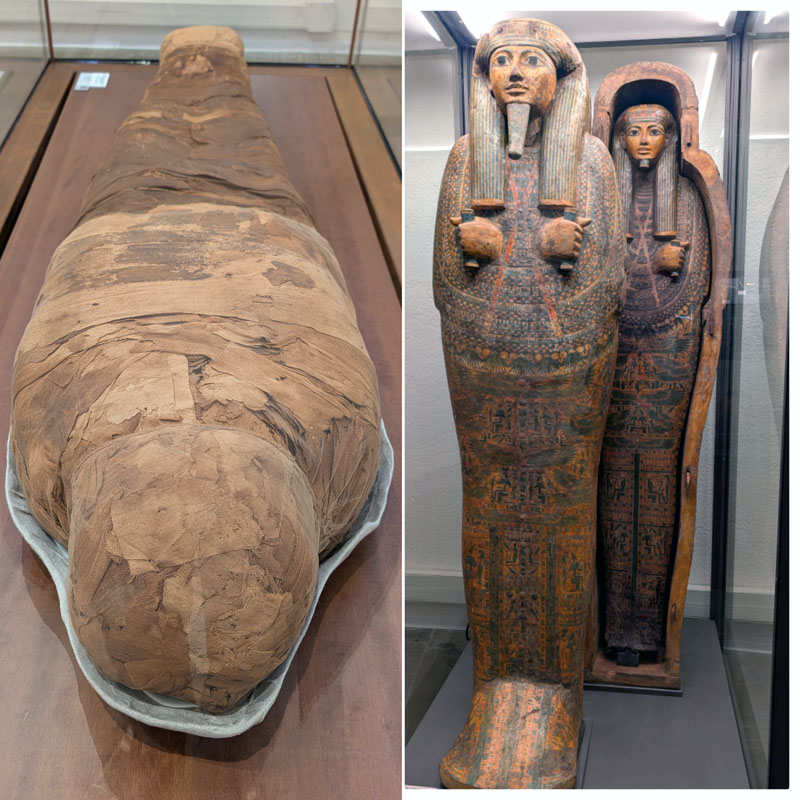
The museum is very modest in size. The centerpiece is the mummy and sarcophagus of Ankhekhonsu, a priest of Amun. Other displayed artifacts include shabtis (funerary figurines), bronze statuettes, amulets, and a faience necklace. Egyptian items are thoughtfully mixed with local Roman-era finds and other regional archaeological material.
For visitors seeking more extensive Egyptian collections in Italy, consider these excellent alternatives:
- Sforza Castle in Milan
- Archaeological Museum in Florence
- Archeological museum in Turin
All three offer high-quality, varied, and well-preserved Egyptian artifacts on a much larger scale.
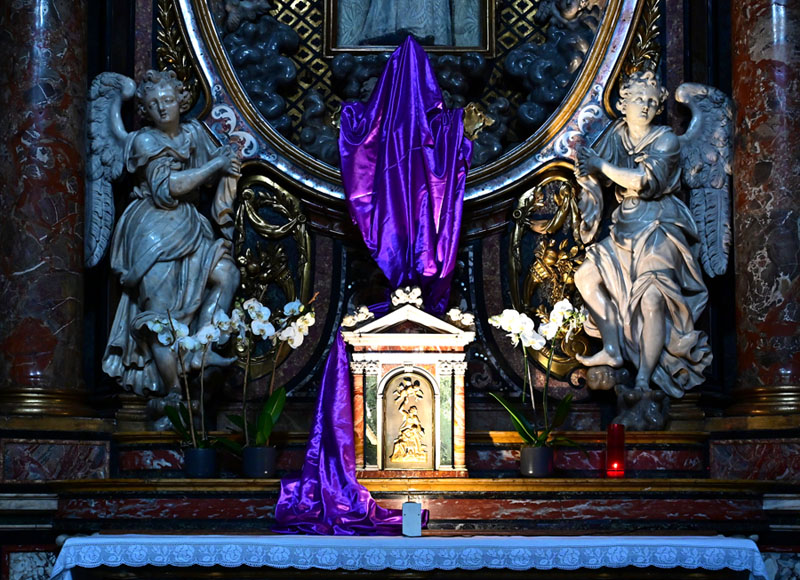
Beyond the museum, Bergamo — though relatively small — boasts an astonishing number of beautifully decorated churches. Their rich art and architecture often surpass those found in Venice or Milan, making them a must-see if you are traveling to Milan or Lake Como.
History and Provenance of the Egyptian Collection
The Archaeological Museum of Bergamo’s Egyptian holdings reflect the 19th-century European fascination with ancient Egypt, a period often called the “Epoch of the Consuls.” During this time, European consuls in Egypt played a major role in acquiring and exporting antiquities to museums across the continent.
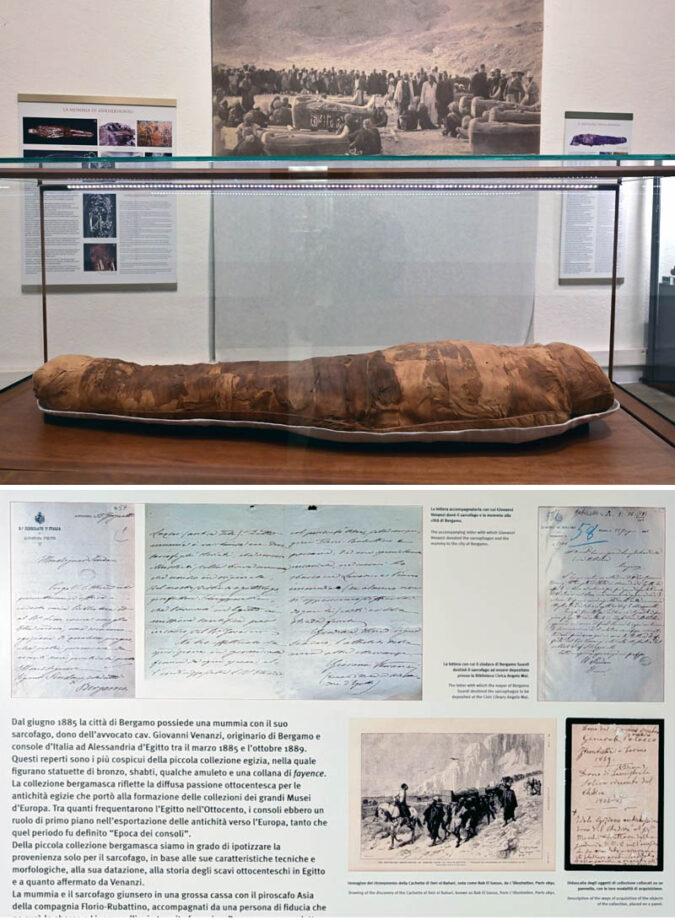
In June 1885, the city received its most significant Egyptian donation: a mummy and its sarcophagus, gifted by Giovanni Venanzi, a Bergamo-born lawyer who served as Italian Consul in Alexandria from March 1885 to October 1889. These two objects form the core of this tiny collection, which also includes three bronze statuettes, several shabtis, amulets, and a faience necklace.
The sarcophagus can be reliably traced thanks to technical details, historical context, and Venanzi’s own records. It arrived in a large crate aboard the steamer Asia of the Florio-Rubattino company, accompanied by documentation and an expertise from the renowned Egyptologist Ernesto Schiaparelli. Venanzi’s letter to the mayor of Bergamo confirms the sarcophagus originated from Luxor (ancient Thebes).
Ankhekhonsu’s sarcophagus belongs to the class of “yellow sarcophagi.” It was likely acquired shortly before 1891, when the official discovery of the tombs of Amun’s priests at Deir el-Bahari (Bab el-Gasus cache) took place. Many such sarcophagi had already been removed by clandestine excavators. The inscriptions identify Ankhekhonsu as a wab (pure) priest and scribe of the temple of Amun.
The origins of most smaller objects remain unknown. A few items carry partial provenance labels, such as gifts from Polish General Jlembiski (Turin, 1859), Temistocle Solera (received from the Khedive, 1864–65), and others linked to railway director Mr. Mocchi. In 2002, three additional Egyptian finds were transferred from Bergamo’s Natural Science Museum, including an “Egyptian gallinaceous mummy” (1902) and a mummy hand with a terracotta oil lamp (1933).
Restoration of the Mummy
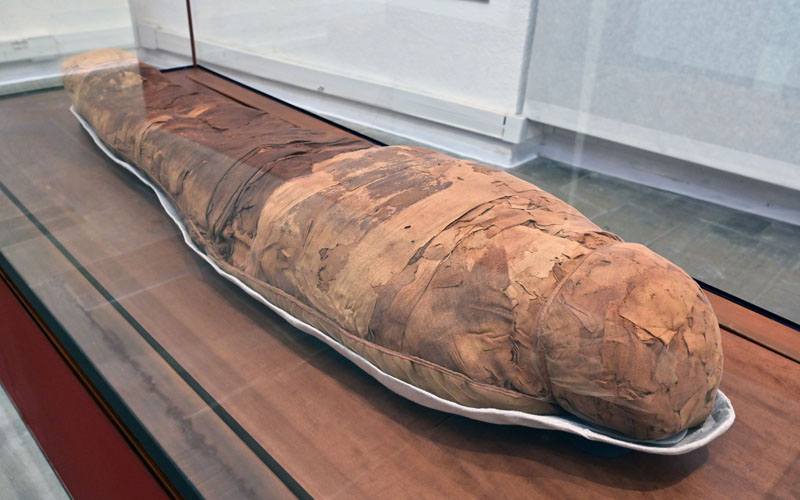
The mummy of Ankhekhonsu arrived in poor condition after centuries of degradation and earlier looting. A clean cut through the bandages on the chest and head suggests past attempts to retrieve jewelry or amulets. The skull had become detached and was repositioned on a modern support made of cotton wadding, straw, wood shavings, and original bandage fragments.
Previous iron hooks used to secure it to a wooden board had caused further damage. Like many mummies, it suffered from environmental factors: humidity fluctuations, light exposure, mechanical stress, and possible issues from the original embalming process.
Recent restoration followed the principle of minimum intervention. Conservators stabilized the organic material by removing dust, pollutants, and mechanical stress without using glues or adhesives that could cause long-term contamination. The original shape was restored, and the wrappings were reinforced with a protective nylon tulle sewn with polyester thread over a linen ribbon.
Analysis confirmed the bandages are made of linen in a simple canvas weave with an S-twist. The wrapping spirals around the body, varying in width — narrower at the skull and pelvis, wider over the chest. A second, finer fabric layer was identified at the shoulders.
From the museum’s description:
The mummy belongs to a man of Caucasian descent, who died at about the age of 40-45. He was between 168.65 and 177.7 cm tall, that is taller than the average for his times. His name, written on the sarcophagus, was Ankhekhonsu. He was a wab priest and a scribe in the temple of Amon Ra, in Thebes.
Its radiocarbon dating, obtained from a bone fragment, is 1107-912 BC. This data was obtained from the studies on Ankhekhonsu’s mummy with non-invasive investigation techniques. The skeletonized skull, which was exposed and
placed on a ‘pillow’ made with bandages and textile material, is the only part of the body studied in an autoptic way.
Before the restoration, the mummy was placed on a wooden board and fastened with iron hooks on the abdomen and on the ankles. This arrangement allowed to display it vertically, upon its arrival in Bergamo. It was evident that the conditions inside the thick wrapping were not good, as documented by old radiographies. In the empty space left in the neck area there were vertebrae, phalanges and some teeth.
The mummy was subjected to computed tomography (CT) to carry out a thorough study without opening the bandages; the body was completely skeletonized and devoid of almost all anatomical connections. An endoscopy allowed us to explore inside the mummy and confirmed the state of alteration of the skeleton; it also allowed us to take samples without compromising its state of preservation.
On the basis of the skull morphology it was possible to establish that the mummy belongs to a male adult, approximately between 40 and 45 years old, of probable Caucasian descent; in ancient Egypt genetic exchange was favored by the movement of different peoples. The ethmoid bone, at the base of the skull, is intact and this, together with the presence of decomposed brain tissue inside the cranial cavity, allows us to believe that the perforation to extract the brain during the embalming process did not take place.
The chest and abdomen section is filled with disarticulated bones belonging to the collapsed thoracic area and to the hands. Above them a wrap, probably made of fabric, could be the visceral package, used to fill the mummy after the organs had been removed. The arms had been bandaged separately. The forearm joint is intact, while the shoulders are dislocated. They were probably stretched along the sides and not crossed on the chest. The femurs and pelvis are located at the abdominal level, without connection, and the feet bones are scattered, too. Only the tibiae and fibulae are still properly connected, perhaps due to the fact that they were wrapped separately.
Ankhekhonsu’s Sarcophagus: A Masterpiece of the Third Intermediate Period
Ankhekhonsu (“The god Khonsu lives”) lived between the late 21st and early 22nd Dynasty (approximately 969–900 BC) during the Third Intermediate Period. His anthropoid sarcophagus, made of cedar wood, consists of a trough, outer lid, and an inner lid placed directly over the mummy. The shallow trough suggests it was originally housed in a larger outer sarcophagus that is now lost.
The wood shows 42 holes in the base, likely for drainage of mummy ointments and fluids. Three layers of stucco prepare the surface: coarser straw-and-mud mixtures underneath, finished with fine white gypsum plaster for the vibrant yellow background and multicolored paintings.
Key decorative features include:
- Relief face with large eyes, defined ears, tripartite wig, and ritual beard.
- Red stole over the shoulders and a broad collar with lotus petals.
- Crossed hands holding papyrus rolls.
- Scenes featuring Osiris, Isis, Anubis, Nut, Maat, Ra, Horus, and Hathor.
- Hieroglyphic inscriptions and a frieze of uraei and Maat feathers.
Ankhekhonsu and his wife, Henut-neferet (“Lady of the house and singer of Amun-Ra”), appear multiple times in offering scenes. This sarcophagus exemplifies the high-quality “yellow sarcophagi” of the 21st Dynasty, with shiny orpiment yellow pigment, Egyptian blue, iron oxide reds, and other colors.
Non-invasive analysis confirmed the pigments: orpiment (yellow), Egyptian blue (blue), iron oxides (red), and calcium carbonate (white). Some green and ocher tones likely come from later restorations.
This small but fascinating collection offers a personal glimpse into ancient Egyptian funerary practices and the adventurous 19th-century world of antiquities collecting. A quick stop in Bergamo’s Città Alta pairs perfectly with a deeper exploration of Italy’s richer Egyptian holdings in Milan and Florence.
This information is based on the display I saw in the Bergamo’s archeological museum.
Ernesto Schiaparelli’s Excavations:
Ernesto Schiaparelli (1856–1928) was a prominent Italian Egyptologist, director of the Museo Egizio in Turin (from 1894), and founder of the Italian Archaeological Mission (Missione Archeologica Italiana, or MAI) in Egypt. His work significantly expanded the Turin museum’s collection, making it one of the world’s leading repositories of Egyptian artifacts (with roughly 30,000 objects from his expeditions). Before leading major excavations, he reorganized the Egyptian collection at the museum in Florence (1881–1894). As director in Turin, he focused on building a world-class collection through systematic fieldwork rather than just purchases.
Major Excavations and Discoveries:
In 1902–1903, with support from King Vittorio Emanuele III (and later the Italian Ministry), Schiaparelli established the MAI. Between 1903 and 1920, he led about 12–13 excavation seasons across 11 sites, primarily in northern and southern Egypt. The mission operated under official concessions from the Egyptian Antiquities Service and used the partage system (dividing finds between the excavators and Egypt).
Schiaparelli’s campaigns covered a wide range of periods and sites:
- Valley of the Queens (1903–1906): Pioneering systematic work here (with collaborator Francesco Ballerini). He explored over 80 tombs. The standout discovery was the tomb of Queen Nefertari (QV66), great royal wife of Ramesses II, in 1904. Though looted in antiquity (mummy and treasures gone), it is renowned for its exceptionally preserved, vibrant wall paintings. He also found tombs of princes (sons of Ramesses III) and other royals.
- Deir el-Medina (1905 onward): The workmen’s village for those who built the royal tombs in the Valley of the Kings. In 1906, he discovered the intact tomb of Kha and Merit (TT8), an architect and his wife from the reign of Amenhotep III (c. 1400 BC). This tomb, with its complete funerary equipment, is one of the most important non-royal discoveries and is displayed in Turin.
- Giza (Western Cemetery, from 1902): Italian concession in the southern section (shared with German and American teams). Focused on Old Kingdom tombs.
- Heliopolis (1903–1906): Excavations in the temple area (“Tempio del Sole”), uncovering structures, artifacts, and evidence from various periods, including a prehistoric village.
- Other sites: Asyut/Assiut (rock-cut tombs, Middle Kingdom material), Hermopolis Magna (initially for papyri), Gebelein (Predynastic burials), Qaw el-Kebir, and Aswan (including the tomb of Harkhuf).
His work spanned Predynastic to New Kingdom periods, yielding artifacts that illuminated daily life, religious practices, royal burials, and more.
Legacy and Publications of the egyptologyst:
Schiaparelli’s excavations enriched the Museo Egizio immensely and professionalized Italian Egyptology. Many finds remain key exhibits today, including material from Nefertari’s tomb and the Kha/Merit assemblage. He published scholarly works such as studies on the Egyptian Book of the Dead, religious feelings of the Egyptians, and reports on specific tombs (e.g., La Tomba Intatta Dell’architetto Kha, 1927). He died on February 14, 1928. Modern projects continue to study and publish his unpublished excavation records.
In regards to the Bergamo’s mummy, Schiaparelli provided an expertise (authentication/report) for the Ankhekhonsu sarcophagus and mummy when they arrived in Italy in 1885 — consistent with his expertise as a leading Egyptologist and museum director by that time.
https://www.britishmuseum.org/blog/learn-maths-egyptian-secrets-rhind-mathematical-papyrus
The Egyptian Amulets Meaning:
Amulets in Ancient Egyptian Culture
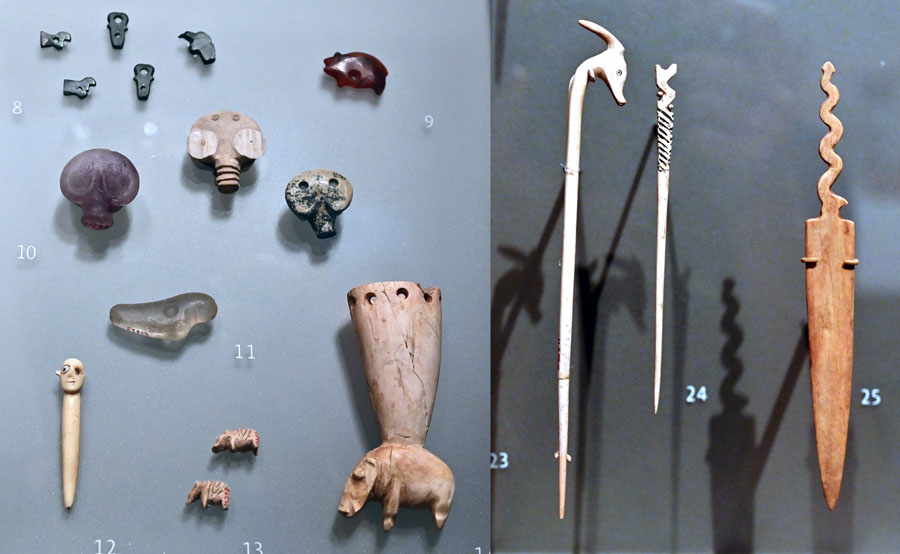
Ancient Egyptians placed great faith in amulets, believing they possessed powerful magical properties that could protect, heal, and aid the deceased in the afterlife. The Egyptian language had four main terms for these objects: meket, nehet, sa, and udjat (or udja). The first three conveyed ideas of vigilance and protection, while udjat carried the same sound as the word for “well-being” and referred to the protective Eye of Horus.
The Power of Amulets
An amulet’s effectiveness depended on several factors:
- Its shape and symbolic form
- Magic formulas or spells engraved upon it
- The material it was made from
- Its color
Different materials and colors carried specific meanings:
- Lapis lazuli symbolized youth and vigor.
- Turquoise represented fertility and rebirth.
- Green stones such as feldspar and serpentine evoked fertility, life, and resurrection.
- Red jasper embodied fire, blood, and vital life force.
When precious stones were too costly, Egyptians frequently used faience — a glazed ceramic that could be colored to imitate more expensive materials like turquoise or lapis lazuli.
How Amulets Were Used
Amulets were worn or placed in various ways:
- Hung individually around the neck or strung into necklaces
- Sewn onto clothing
- Wrapped within mummy bandages
- Set into finger rings as bezels
Common Types and Their Meanings
Divine Figures and Symbols Many amulets depicted gods and goddesses, placing the wearer under their divine protection. Popular symbols included the Isis knot (tyet) and the udjat eye (Eye of Horus).
Animal Forms Animals were common because many gods manifested in animal form and because of the creatures’ perceived special qualities.
- The frog amulet promised fertility to the living and regenerative powers to the dead.
- The scarab beetle, often placed on the mummy’s chest, symbolized renewal and resurrection. The so-called “heart scarab” bore a magical spell on its underside instructing the heart not to testify against the deceased during the Weighing of the Heart ceremony (psychostasis) in the afterlife judgment.
Human Body Parts Amulets shaped like parts of the human body were believed to heal, strengthen, or protect specific areas from illness and injury.
These small but meaningful objects formed an important part of the Egyptian collection in Bergamo’s Archaeological Museum. Their presence alongside the mummy of Ankhekhonsu helps illustrate the rich funerary beliefs and protective magic that accompanied ancient Egyptians into the afterlife.
Art books from the artist: