Art AI Scraping Protection
Ever wondered how to stop AI from stealing art?
Putting art online has always involved a trade-off. While artists gain clients, gallery interest, and wider recognition, they also surrender a degree of control over every uploaded image. Collectors face a similar dilemma; a casual post can inadvertently reveal provenance details, private ownership, or a high-quality reproduction that was never intended for public use.
Today, AI scraping has made these concerns impossible to ignore. Automated bots can harvest massive volumes of images, captions, names, and descriptions without ever contacting the copyright owners. To navigate these challenges, creatives must employ a practical defense that combines thoughtful publishing habits, robust website controls, meticulous record-keeping, clear legal agreements, and a decisive response plan.
Because laws and platform policies vary globally, these points serve as general educational guidelines rather than specific legal advice for your situation.
Understand What Can Go Wrong
The risks of digital exposure are varied and widespread. An illustrator might discover an uncredited image inside a fraudulent portfolio, while a painter might find their artwork replicated on merchandise months after sharing a photo online.
Collectors, too, must look beyond the obvious threat of physical theft. High-resolution photographs can expose sensitive details such as signatures, labels, frames, structural condition issues, or even the physical location of a valuable collection. Furthermore, legal complications often arise without any malicious intent; a collector might own a physical canvas but lack the legal copyright to the artwork or the professional photograph taken of it.
Because of this overlap, artists and art collectors require a unified approach: one side protects authorship and commercial income, while the other safeguards privacy, asset value, and agreed-upon usage.
Share Enough to Attract Interest, Not Enough to Supply a Copy
A public portfolio should showcase the emotional and technical quality of a piece without exposing a print-ready, high-resolution file. Keep your master scans, layered working documents, and print-ready exports securely stored in private, offline environments.
Before uploading any image to social media, evaluate its core purpose. A standard promotional post rarely requires a pristine, front-facing view. Instead, consider sharing a dynamic studio shot, a close-up angled view featuring your art supplies, or a cropped section of the piece. Meanwhile, serious curators and prospective buyers can be given high-resolution images upon request via secure, private links.
Create Separate Display Versions
Using a single image across all digital channels creates unnecessary vulnerabilities. Instead, prepare distinct file variations tailored for Instagram, personal websites, press requests, physical catalogues, and insurance records.
Safer publishing strategies include:
- Lower-Resolution Previews: Export images at a resolution that remains sharp on digital screens (e.g., 72 DPI to 96 DPI, and under 1200 pixels on the longest side) but lacks the pixel density required for high-quality printing or precise AI dataset training.
- Partial Views: Share macro close-ups, specific textures, or partial crops of unreleased or high-value pieces.
- Strategic Watermarking: Place subtle, semi-transparent watermarks across complex, textured areas of the image rather than solid backgrounds, making them significantly harder for editing software to erase cleanly.
- Glaze and Nightshade for artists: Consider processing your digital images through advanced cloaking software like Glaze (which alters microscopic pixel details to disrupt style-mimicking AI) or Nightshade (which confuses generative AI models by turning the image into “poison” data).
- Password-Protected Galleries: Safeguard sensitive portfolios or upcoming collections behind user authentication or private passwords reserved for verified buyers, advisors, and curators.
While these steps may not completely stop a determined bad actor, they drastically minimize the commercial utility of stolen files. For collectors, avoiding the temptation to treat an Instagram grid as a public inventory log is equally important; a single installation photograph can convey the spirit of a collection without exposing every individual asset.

Standard text watermarks do not stop AI models from learning an artist’s style or composition; modern AI can easily ignore or digitally erase text overlay. Therefore, you can try using tools like Glaze or Nightshade, as they alter the pixels on a deeper level that AI reads, whereas watermarks only deter human image thieves.
Protect Art Online Through Legal Awareness
As the legal frameworks surrounding copyright ownership, machine learning licensing, and unauthorized intellectual property use become more complex, staying informed is critical. Many creators utilize educational platforms and specialized legal assignment resources, including law assignment help, to better grasp how digital copyright principles apply to modern technology. A foundational understanding of these concepts empowers both artists and collectors to make safer decisions when publishing portfolios online.
Copyright law remains the primary legal mechanism for addressing unauthorized duplication, redistribution, or data harvesting. In most jurisdictions, copyright protection attaches automatically the moment an original work is created and fixed in a tangible medium. However, enforcement strategies and statutory damages heavily depend on local registration and regional regulations.
Let’s Differentiate Between Art Ownership vs Copyright on Art
A common point of confusion in the art world is the distinction between owning a physical piece of art and owning the intellectual property rights to it. It is vital to understand that buying a physical painting, sculpture, or print does not grant the buyer the copyright.
- The Artist’s Rights: Unless explicitly transferred via a signed written contract, the copyright remains exclusively with the artist. This includes the sole right to reproduce the work, sell prints, license the image for commercial merchandise, or use it in digital media.
- The Collector’s Rights: The collector owns the physical object as property. They have the right to display it privately, loan it to a museum, or resell the physical piece itself. However, they cannot legally print t-shirts of the image, sell digital copies, or authorize an AI company to scrape it for training models without the artist’s express permission.
- Photographic Copyright: Furthermore, if a collector hires a professional photographer to document their collection, the photographer often owns the copyright to those specific digital photos. Consequently, a collector may need permission from both the living artist (or their estate) and the photographer before publishing a high-quality image online.
Collect and Store Evidence Before a Problem Arises
Proactive documentation is your best defense. Artists should meticulously organize and retain preliminary sketches, camera RAW files, timestamped working layers, dated exports, invoices, and client correspondence. Together, this trail establishes an unassailable timeline of creation and original authorship.
Collectors should safely archive acquisition papers, certificates of authenticity, condition reports, museum loan agreements, and explicit image permissions. These records protect the provenance of the artwork during future resales or exhibition planning.
Because metadata and watermarks can be easily stripped by social media algorithms or editing software, they should not be your only line of defense. Instead, build a dedicated digital folder for every major artwork. Store the complete image history, signed contracts, payment receipts, and relevant email threads together so you can act immediately if an infringement occurs.
Limit Automated Access to Your Website: Robots.txt Google Extended art
A personal website or hosted portfolio grants artists and collectors far more control over data than standard social media networks. On your own domain, you can explicitly restrict known web scrapers and secure sensitive imagery.
Google and other major tech firms support specific directives within a website’s robots.txt file.
For example, adding the Google-Extended token allows website owners to opt out of having their content used for Gemini training and grounding models, without penalizing the site’s visibility in standard Google Search results.
However, remember that a robots.txt file is essentially a polite request to compliant crawlers—it is not a security firewall. To genuinely secure high-value images, combine crawler rules with server-side protections such as:
- Hotlink Blocking: Preventing external sites from directly embedding and displaying images hosted on your server.
- Right-Click Disablers: Implementing basic scripts to discourage casual “right-click and save” actions (though tech-savvy users can bypass this).
- Rate Limiting: Restricting the number of requests a single IP address can make to your site within a short timeframe, effectively slowing down automated scraper bots.
Be careful not to block every search engine crawler blindly. Artists still rely on search visibility so that buyers, galleries, and journalists can discover their practice. Personally, I wouldn’t limit traffic to my site but I could block right-clicking on the image or upload lower-resolution image. It’s your choice.
Use Instagram Without Treating it as an Archive: Instagram artist copyright
Instagram is a powerful discovery engine because the global art community actively uses it. However, once a image is posted publicly to the grid, screenshots and automated scraping remain persistent risks.
According to Instagram’s Terms of Service, the platform does not claim ownership of your content, but by uploading it, you grant them a non-exclusive, royalty-free, transferable, sub-licensable, worldwide license to host and use your imagery.
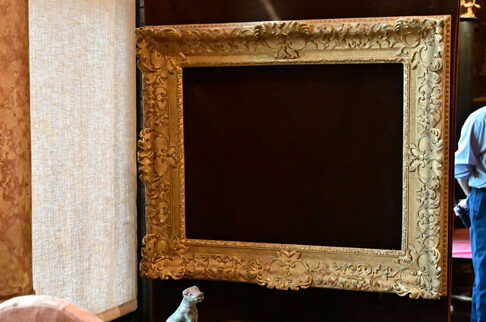
To mitigate risk, adapt how you showcase your art. Instead of uploading a flat, high-fidelity digital scan, post a photo of the artwork displayed in an elegant frame, shown with art supplies, hanging on a gallery wall, or sitting on an easel in your studio. These contextual, lifestyle-focused images are highly engaging to followers but fundamentally useless for high-quality printing or clean AI training datasets.
Additionally, use your captions effectively. Always include a clear copyright notice alongside the artist’s name, title, date, and medium (e.g., © 2026 Artist Name. All Rights Reserved.). While attribution will not stop an automated bot, it eliminates any ambiguity regarding ownership for human viewers. Lastly, remember that setting an account to private offers minimal security against data scraping, as approved followers can still manually download or screenshot your portfolio. Confidentially sensitive works belong exclusively in a secure, controlled viewing room.
Put AI and Digital Permissions Into Contracts
Legacy art contracts frequently address physical exhibitions, print catalogues, and resales while completely overlooking digital datasets and automated machine learning reuse. Modernizing your legal paperwork is essential to preventing future exploitation.
A contemporary art bill of sale or consignment agreement should explicitly define:
- Who holds the right to photograph, digitally scan, crop, or modify the artwork.
- Exactly where the images may be published online and for what duration.
- Whether commercial partners or galleries are permitted to share the digital files.
- An explicit clause stating whether AI training, LLM dataset inclusion, or automated data scraping is strictly prohibited or requires separate licensing.
- How collector identities, financial details, and physical locations will remain confidential.
- Which party is responsible for monitoring infringements and covering the costs of digital takedowns.
A vague ban on “all AI” can create loopholes. Utilizing precise legal language detailing “generative AI model training, data harvesting, and machine learning adaptation” is much easier to enforce. Ensure both parties retain fully signed physical or digital copies of these contracts, as verbal assumptions are incredibly difficult to prove once an image has spread across multiple online accounts.
Respond Calmly and Quickly to Misuse
If you discover that your artwork has been scraped or misused, gather concrete evidence before launching public accusations. Save the offending webpage, document the account name, copy the exact URLs, note the date, and take comprehensive screenshots of the infringement and any associated commercial sales listings.
Once your evidence is securely compiled, follow this systematic response sequence:
- Verify the Source: Compare the copied image against your original source files to confirm it originated from your digital footprint.
- Confirm Copyright Ownership: Verify who holds the underlying reproduction rights (the artist, an estate, or a hired photographer).
- Issue a Cease-and-Desist: Reach out to the uploader directly with a polite but firm professional request to remove the content.
- Utilize Platform Takedowns: If the uploader ignores your request, submit an official intellectual property report through the hosting platform. In the United States, the Digital Millennium Copyright Act (DMCA) notice-and-takedown system requires online service providers to quickly remove infringing material once a valid, properly formatted notice is submitted.
- Consult Legal Counsel: For flagrant, repetitive, or highly profitable commercial exploitation, consult an intellectual property attorney to explore statutory damages.
Maintain a dedicated log of all correspondence, sent dates, and responses. If you are a collector who discovers a piece from your collection has been scraped but you do not own the underlying copyright, contact the artist or their estate immediately, as owning the physical object does not grant you the legal standing to file a DMCA takedown.
How to check if art was used for AI
How do I check if my art has already been stolen by AI?
Artists can search for ways to audit existing datasets (like LAION) to see if their intellectual property was used without permission. As an artist you can try using tools like “Have I Been Trained?” (by Spawning), which allows creators to upload images or search their names to find out if their work is included in major AI training datasets. You can also try using “Google Reverse Image Search” or “TinEye” to find unauthorized copies of art across the web.
Does Cara protect art from AI scraping?
As creators are actively searching for safe alternatives to Instagram, Cara is an emerging art portfolio platform that’s similar to Instagram but built specifically for artists with built-in anti-AI scraping rules. The problem is, if you have a large following on Instagram that you’ve nurtured for many years, it would be hard to give up all that work starting a brand new social media channel. If it’s not an issue for you, while no platform is 100% foolproof against manual screenshots, platforms that automatically apply “NoAI” tags and block aggressive web scrapers are becoming excellent alternatives for hosting primary art galleries. For how long would it last though?
Can I opt out of AI training on DeviantArt, ArtStation, or Pinterest?
As a creator, you must review the privacy settings of every platform you use. While platforms like ArtStation and DeviantArt have introduced “NoAI” checkboxes, artists must often manually opt out in their account settings to activate these protections!
Build Protection in Layers
Securing digital art requires a multi-layered approach. Artists can safeguard their practice by publishing low-resolution previews, keeping immaculate creation logs, managing server-side crawler rules, defining strict contract terms, and utilizing technological cloaking tools. Simultaneously, collectors can do their part by respecting copyright boundaries and protecting sensitive provenance documentation.
Ultimately, strong protection of art online begins with a transparent conversation before an artwork ever debuts online. Establishing clear, documented expectations preserves professional relationships and makes enforcement practical. While maintaining online visibility is vital for finding success in the modern market, picking the right digital venues, audiences, and opportunities is an ongoing part of a creative professional’s career. Strategic choices cannot eliminate every digital risk, but they make unauthorized exploitation significantly harder to achieve and far easier to challenge. Personally, I upload low-res. files on the internet that’s good quality to view but not to print or misuse. I hope this article helps you deal with AI scraping problem.