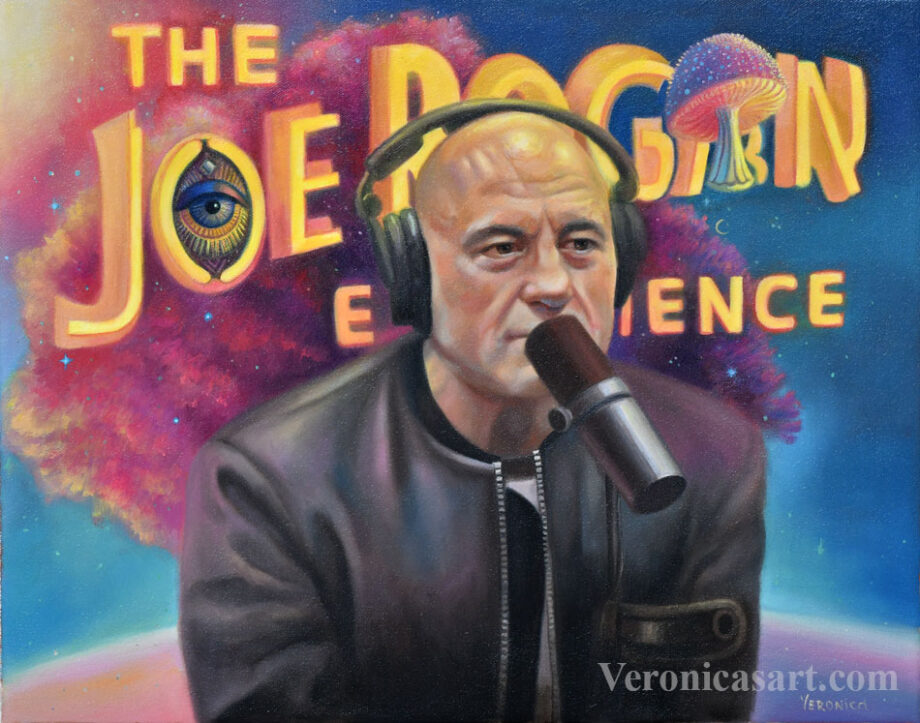
From Standing Against Mainstream Pressure to Hosting Unchallenged Speculation?
During the COVID pandemic, Joe Rogan faced heavy criticism from outlets like CNN and NPR. They mocked him by turning his photo yellow and calling ivermectin a “horse de-wormer.” This seemed designed to discredit anyone who stepped outside the mainstream view. As a longtime NPR listener, I found their coverage so misleading that I stopped tuning in. That familiar feeling of dissonance — when people say one thing while reality suggests another — stayed with me.
“Trust the science” became a slogan that many felt was used in questionable ways. Lockdowns, forced testing, masking, vaccine mandates, online bulling, and canceled surgeries created real hardship for millions. Yet after the pandemic, few of the experts, politicians, or tech leaders who shaped those policies faced serious investigation or consequences. This lack of accountability left many people uneasy.
Joe Rogan stood out at the time for defending personal choice, freedom, and independent thinking. As a regular listener, I appreciated his variety of guests and his apparent desire to explore various ideas openly. But over time, something seems to have changed.
These days, Rogan’s show often features “alternative” archaeologists, researchers, and people who present themselves as victims of the scientific community. They speak with great confidence about ideas that challenge mainstream views. Guests like Terrence Howard, Billy Carson, Jimmy Corsetti, Ben van Kerkwyk, Dan Richards, David Grusch, Christopher Dunn, Filippo Biondi, and so many others bring dramatic stories — some about ancient civilizations, lost technologies, or extraterrestrial precision. To me, many of these episodes feel more like engaging science fiction than careful inquiry.
A common pattern appears: Rogan and his guest begin by criticizing mainstream scientists for alleged problems like gatekeeping, arrogance, or hiding evidence.
Scientists are trashed for (and sometimes rightfully so):
- misinformation
- inflated egos
- gatekeeping
- arrogance
- close-mindedness
- pursuit of status
Then Rogan and his guest spend hours exploring insane new interpretations that they suggest experts have ‘missed’ or ignored. What concerns me is that these claims often seem presented as facts rather than as speculation/opinion. One storyteller after the next tells 10 million followers of Rogan about the super-precision in Egyptian stone vases, underground plant under the pyramids, aliens descending from the darkness. The result is horrific. The show rarely presses hard on the evidence behind them or thoroughly examines the guests’ credentials. Rogan appears to believe and accept many of their stories more readily than he once challenged official narratives. Buddies get free pass intentionally misleading a vast audience.
Humans are imperfect everywhere — in mainstream science, alternative circles, and podcasting alike. Inflated egos, desire for attention, and financial motives can appear on any side. Rogan himself often says he’s “just a comedian” and not to take him too seriously. Yet with leadership and millions of listeners comes responsibility. Rising to the occasion is a doable challenge for an extraordinary person like Joe.
I’m not asking for perfect balance, but for more consistent skepticism. It seems reasonable to check credentials, published work, and supporting evidence with the same rigor applied to mainstream guests. When claims involve super-precise ancient artifacts, hidden structures, or extraordinary reinterpretations of history, shouldn’t those story-tellers face tougher questions?
Many of these guests are articulate and confident. They tell compelling stories, build audiences, sell books, tours, and attract attention. Some appear to promote specific narratives while dismissing well-researched evidence. This approach can leave listeners with dramatic but poorly supported ideas. Multiplied across millions of listeners, it might contribute to widespread confusion rather than clearer understanding.
Some guests with no degrees or credentials of published research whatsoever show off as experts and perpetuate unsubstantiated claims because of their charm and confidence. What those guests actually do talking on podcasts:
- They (often intentionally) conflate different topics, misguiding people. In other words, the absence of evidence is replaced by conflation or (unsupported by facts) opinion.
- They show deliberate ignorance of existing literature/data/evidence/research in favor of fabricated/imagined/speculated data.
- They repeat the same lie over and over again to drain you out of your own judgment, so you begin to repeat their nonsense!
- They look like geniuses or experts while nothing valid is published in the scientific community under their names. (And to publish anything of value requires a lot of work and research). In other words, they pose as professionals without documentation.
- They show no shame presenting speculative stories as the truth or fact.
- They often express a victim syndrome ‘being an outsider.” They often divert a conversation about a specific argument by becoming a victim: instead of replying with valid arguments they say the scientific community hates them.
- Some belong to a cohort of friends pedaling specific narratives and unsupported claims.
- They search for credibility by association with other scientists, doing name-dropping at the right time to prove their point. However, not every scientist is honest just like not every ‘outsider’ is.
- They talk with confidence about sciences and archeology without any substance, knowledge or scientific background.
- They are well-spoken, talented actors with fancy accents or rhetoric.
- They argue that by being there they know things. However, just by visiting the archeological site as a tourist doesn’t make you a researcher, archeologist, or a person who speaks the truth.
- Some try to smear or troll scientists who speak against their stories that should be classified as science fiction, not facts.
- A few pump the art/antiquities market prices with their stories.
- They also promote their books, personalities, speaking gigs, tours and videos via nonsense content.
But most importantly, they magnify ignorance and confusion. Their inability to read available literature translates into massive, perpetuated ignorance online. Multiplied across millions of listeners, it contributes to widespread nonsense that’s often painful to listen to because of this hubris and dishonesty.
Are people acting in bad faith? We want to trust the selected guests as we hope to learn something new. Guests can be mistaken, enthusiastic, or genuinely convinced of their ideas. Although, some have no shame or moral compass to tell the truth. Therefore, distinguishing solid evidence from speculation requires careful work — work that feels completely missing on the show.
To start, let’s check each guest’s credentials, publications, and relevance to the discussion equally (on both sides of the isle). If you’re an aerospace engineer, show credentials. If you’re an alternative archeologist and researcher, show your published research. If you’re a neuroscientist, show your published record, please and so on. Otherwise, your genius is self-proclaimed. All camps have bad apples–alternative or not– they are plugged by the same human factor. It’s easy to lie, pretend, and even scam. It’s much harder to do the work.
So why do archeologists and scientists are not believed by the general public and Rogan himself? It seems to me that while ‘independent researchers’ are not questioned on Rogan’s podcast at all, scientists are not fun to invite because they are ‘closed-minded’ egomaniacs. Some are, but some are not. It comes down to an individual. Because Rogan was criticized by the government during the COVID lockdown, he’s dismissive of the scientific community now, encouraging ‘alternative experts’ who display ignorance, victimhood, and hubris.
When Dibble debated Hancock on Joe Rogan podcast, facts didn’t work. What worked? The intentional smearing of Dibble by Dan Richards afterwards (the DeDunking channel). At first sight it’s unclear why Mr. Rogan chose to believe that guy, who is a content creator, not a legit archeologist, scientist, author, or researcher! (We don’t see such figures on Lex Friedman’s podcast who seems to do better at checking the legitimacy of his guests).
Taking a second look, it makes sense why Dibble was brushed aside. Joe Rogan had strong attachment to Hancock because it’s he and his incredible stories put the podcast on the map many years ago. They have known each other for over a decade. Rogan is loyal (and admirably so) to his friends. Plus, Dibble said about the Hancock’s sited sources that were misinterpreted as racism towards the man. (Hancock implied that the indigenous people couldn’t build large structures, thus those were aliens or people of the supreme and advanced civilization, and Dibble called that part racism towards the indigenous nations, as far as I understand it). The result is insane! In the following shows Rogan gave free pass to himself and his pod buddies (Richards, Corsetti, etc.) to bully Dibble. As a result, what was done to Rogan during the COVID pandemic by the scientific community/government was turned over and acted out on this archeologist. What about the open-mindedness or the ability to change your opinion in light of new facts?
Real scientists and archaeologists often focus on their research rather than content creation. They may not produce flashy videos or dramatic claims, which makes them less visible online. Meanwhile, charismatic storytellers fill the gap generating clicks on YouTube. Deliberate ignorance and conflation of facts antagonizes people against scientific community and diverts resources and attention from real work.
Most importantly, we shouldn’t judge people based on categories, rather look at every individual as such, an individual! Every human is unique with his own set of morals, values, greed, and kindness. It does take a while to separate potatoes from tomatoes but at the end of the day, it’s totally possible. We all make mistakes, lacking knowledge. Science and knowledge is a process. However, each person from either camp has freewill to choose which road to go: to lie or to pursue the truth. Pursuing the later is much harder in our reality.
Joe Rogan has real talent and built something unique. Many listeners, including me in the past, valued his openness. That’s why it feels disappointing to see what looks like a drift into nonsense territory and grifting. As of now, Joe is surrounded by incompetent guests in a thick bubble of his own creation. If the goal is truly seeking the truth, applying the same skepticism to all sides — mainstream and alternative guests— seems essential.
As a listener, I’m left wondering: Has the show evolved into something different? And if so, is it still the place for honest exploration, integrity, creativity, and excitement I once thought it was?
Art books from the artist: