Tag: cultural heritage

Untold story of famous ancient Greek sculptors: an artist perspective on realist techniques in search of the divine

Famous Ancient Greek Sculptors: An Artist’s Perspective on Realism

Townley Discobolus, Roman, 2nd century AD, after a Greek original by the sculptor Myron of
450-440 BC.
A close-up of the hand. The British Museum.

Ancient Greece, a society that had enormous influence on Western thought and culture, held the human form in the highest esteem. The trajectory of ancient Greek sculpture shows an evolution from the stylized forms of the Archaic period to the elevated naturalism of the Classical and Hellenistic eras. Greek sculptors sought to capture the divine essence in art not only by perfecting anatomy but also by pioneering innovative methods for lifelike portrayal.

Unlike in previous cultures, Greek sculptors expressed emotion through striking body movement and unique facial features, especially in the Hellenistic period. Capturing movement in realistic figures in the round is much harder to achieve than in sculptures that have a specific location or point of view. (Most sculptures were made as decorations for temples and buildings with a wall or support behind the figures, thus limiting the viewership.) When the sculpture is a stand-alone piece, we can look at it from different angles, and each viewing point must give us an interesting pose.
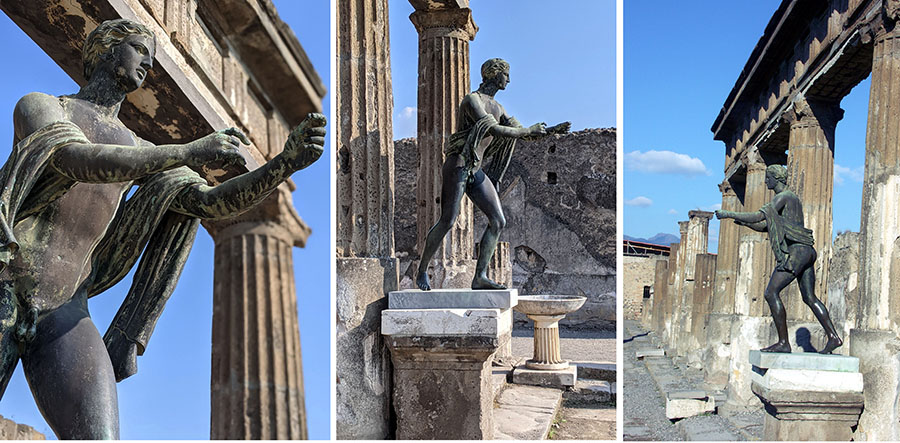
Apollo the archer in Pompeii
Apollo as an Archer (Apollo Saettante), Roman, 100 B.C.–before A.D. 79, Pompeii

I’ve traveled to Italy multiple times to marvel at the naturalistic beauty of Roman sculpture, a feat so exquisite it seems beyond the reach of modern hands, especially in an era where Beauty is often overlooked by contemporary curators, advisors, museums, and collectors chasing flashy, high-priced works. Since the late 19th century, classical ideals have been largely abandoned, and humanity has lost touch with the artistry and ideals of ancient Greece.

When Rome conquered Greece, many Greek artists relocated to Rome, passing their expertise to future generations. The Greco-Roman art we cherish today, primarily Roman copies of lost Greek originals, reflects Rome’s deep admiration for Greek ideals. Roman sculptors, who didn’t sign their works, meticulously replicated Greek sculptures, underscoring their reverence for the unparalleled cultural and artistic achievements of ancient Greece.

It’s mind-blowing to see how ancient Greeks achieved such an incredible level of realism, depicting life-like figures in bronze and marble, and it’s no less surprising to witness some Roman artists being able to copy the most beautiful sculptures in marble. Both cultures figured out the tools, techniques, and materials to do so with incredible skill. Most importantly, these artists applied their genius to create unsurpassed principles in lifelike representation of human form that spoke with emotion and ethereal beauty.

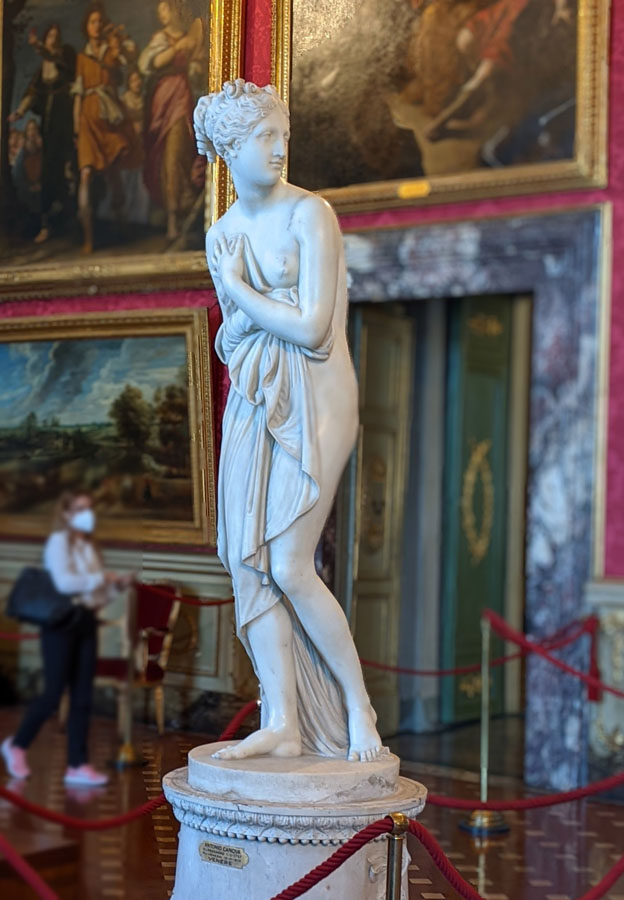
While some contemporary sculptors work in the realist tradition, few capture the divine essence of beauty found in ancient art. Modern works may achieve anatomical accuracy, but they often lack the elusive perfection, flow, and luminescence of their ancient counterparts. The 19th-century sculptor Antonio Canova came close, masterfully crafting human forms, particularly female figures, with airy grace and refined elegance. Yet, Canova’s marble sculptures, infused with perpetual sweetness and idealism, differ from Greek works due to his distinct aesthetic and love for naturalism.
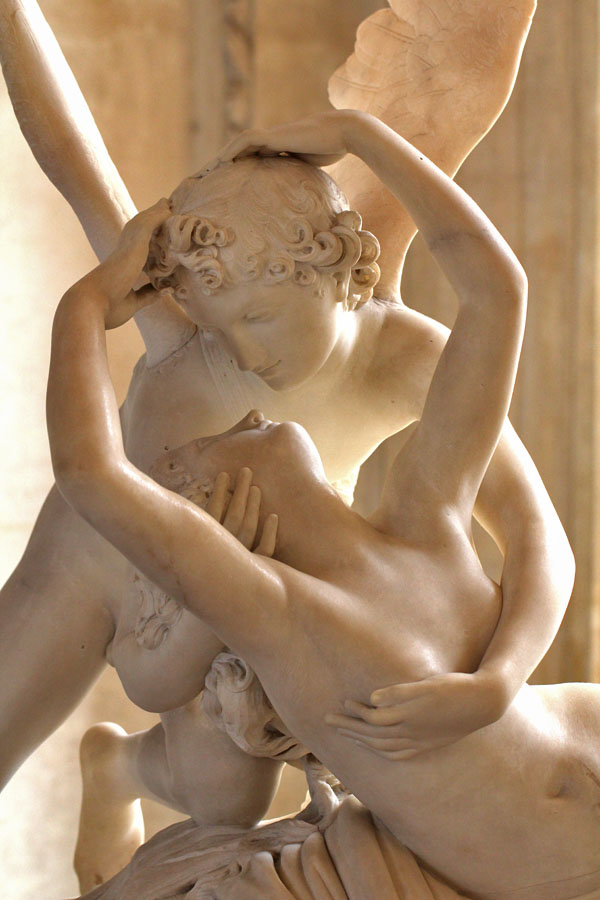
Antonio Canova, Psyche Revived by Cupid's Kiss, 1794-1799
Antonio Canova, Psyche Revived by Cupid’s Kiss, 1794-1799, the Hermitage version

Two contemporary Spanish sculptors, Coderch and Malavia, stand out for their work in the classical tradition. Their hauntingly beautiful sculptures echo the elegance and ethereal quality of Greek art. Though their poses, patina finishes, and subjects feel modern, the emotional essence of their art resonates with the timeless spirit of ancient sculpture.
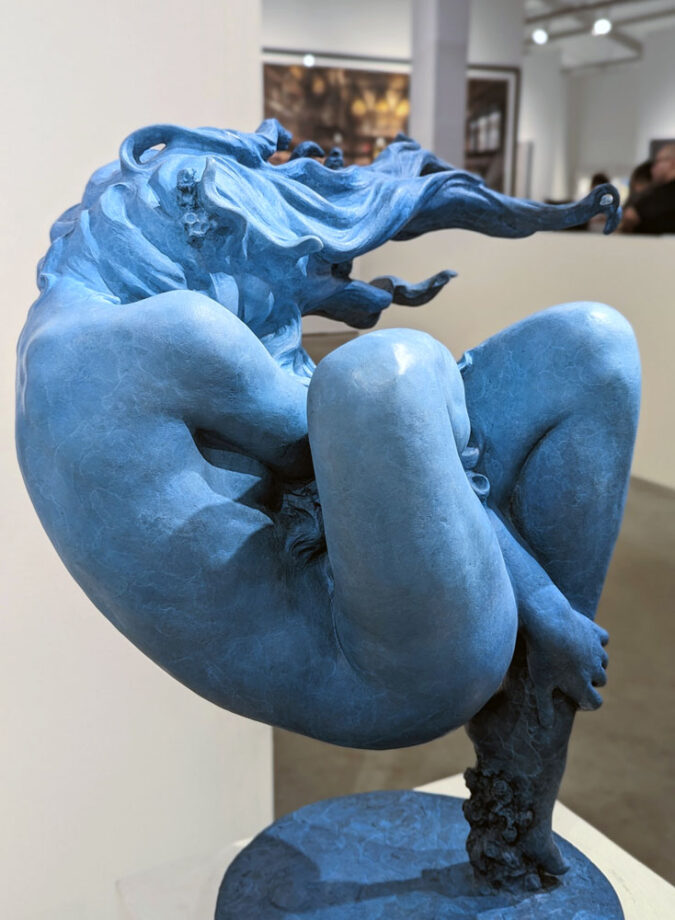
Coderch and Malavia-Kymo-bronze sculpture-miami 2023
Coderch and Malavia, Kymo, bronze sculpture, Miami Art Context, 2023

Pliny the Elder, the earliest art historian, lived during the Roman Imperial Period and documented his observations in Natural History, much like Vitruvius and Vasari. He chronicled the works of renowned Greek artists such as Myron, Polykleitos, and Lysippos, describing their colossal statues decorating temples, including Pheidias’ Athena in the Parthenon and Olympian Zeus. Pliny admired Polykleitos’ athletic figures, noting his influential Canon of proportions and invention of contrapposto, which revolutionized figurative art. He compared Myron and Polykleitos, observing that both focused on physical form but conveyed little emotion. Myron prioritized symmetry and productivity, while Polykleitos emphasized idealized proportions. Pliny also praised Lysippos’ prolific output and distinctive style, characterized by slender figures, smaller heads, and unique hair treatments, noting that Emperor Tiberius cherished Lysippos’ bronze Apoxyomenos. Additionally, Pliny highlighted marble sculptors Praxiteles and Scopas. He celebrated Praxiteles’ fame and wealth, particularly for his famous nude Aphrodite of Knidos. Scopas, alongside contemporaries Bryaxis, Timotheos, and Leochares, worked in marble and collaborated on the grand Mausoleum at Halicarnassus (359 BC), a masterpiece now lost.

From the pages of the book at the British Museum: PLATES XXXV. XXXVI. & XXXVII. WHETHER the statues of Niobe and her children, which in the time of Pliny adorned the temple of Apollo Sosianus, at Rome, were the work of Scopas or Praxiteles;’ this head, which is probably a fragment of the original, from which the figure, formerly in the Villa Medici, and afterwards in the Florentine gallery, was copied, affords abundant proof of the genius, taste, and skill of the artist; and of the loss which the world has suffered in being deprived of such monuments: for justly as the antient copies have been admired, their inferiority to this exquisite specimen is such as to put them below comparison. It represents Niobe embracing and entreating her last remaining child. ….. quam toto corpore mater, Tota veste tegens, Unam, minimamque relinque De multis minimam posco, clamavit, et unam; And the mixture of maternal tenderness, regal pride, and earnest supplication is expressed with all the impassioned energy of strong feeling; but without any distortion or deviation…


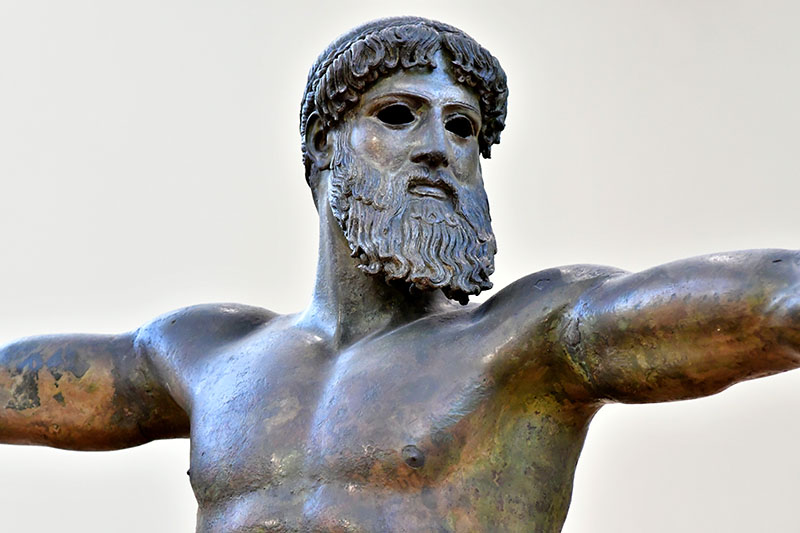
bronze statue of Zeus in Athens
Bronze Statue of Zeus, 460 BC, Athens

Greek sculptors aimed to portray idealized forms rather than strict realism. Their figures embodied perfect proportions, balance, and beauty, representing a higher ideal rather than everyday human flaws. Thus, youthful figures of gods and athletes supported that idealism without expressive emotions or unique, individual features, portrayed later on in the Hellenistic and Roman sculptures.

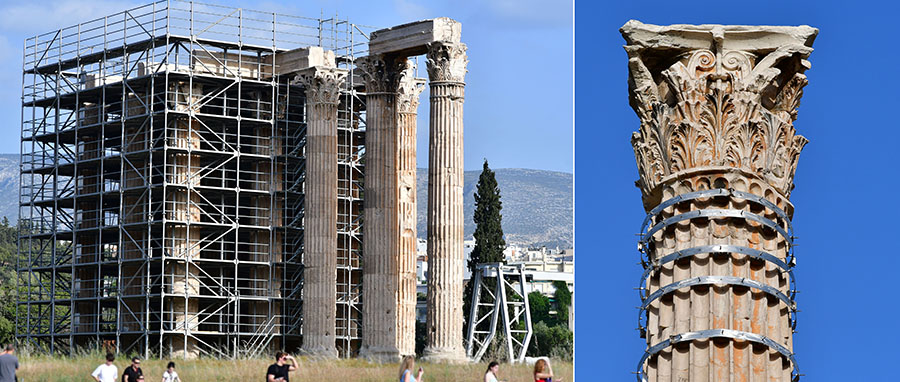
Ancient Greek sculptors predominantly cast their works in bronze, valuing its durability for artistic creations. They fashioned colossal bronze statues of deities for temples such as the Temple of the Olympian Zeus. The large, free-standing, and captured-in-motion statues became known as the severe style figures. (The bronze statue of Zeus, 460 BC). The severe style evolved into Classical and Hellenistic art later on (more on this below).
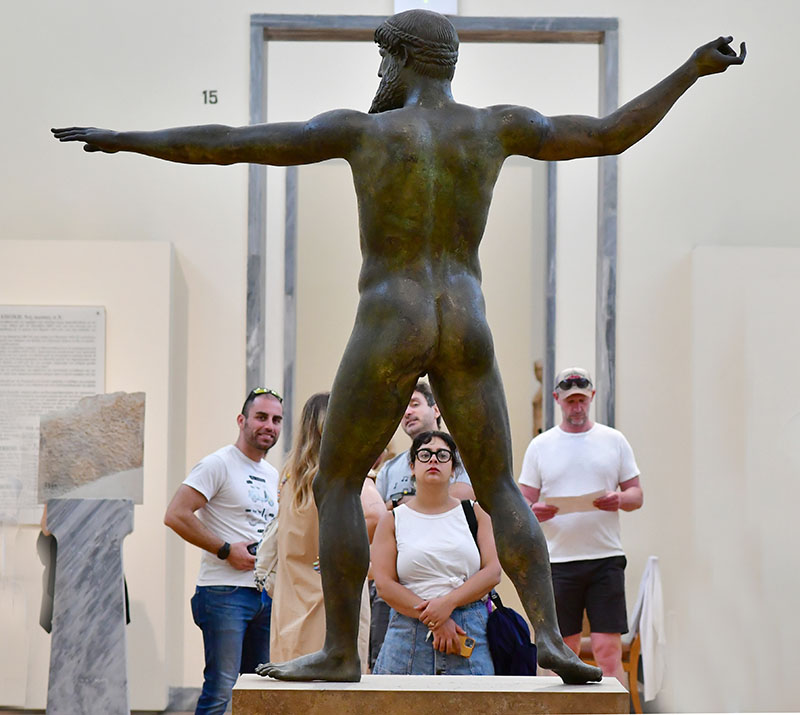
bronze statue of Zeus in Athens

While some artists also utilized a soft, white marble, requiring another set of tools and techniques, the fate of many ancient Greek bronzes was unfortunate: they were often melted down and repurposed for weaponry or other endeavors. Consequently, the rare bronze sculptures surviving today owe their preservation to unusual circumstances, including accidental underwater discoveries that kept them in nearly perfect condition. Although no colossal bronze statues remain, historical records attest to their former fame. Smaller bronzes were found in Rome and throughout Europe, concurred by the Romans who revered the art and other cultures, and thus preserved them in private collections. This article will trace the progression of ancient Greek sculpture through famous sculptors and their art across various periods and styles.

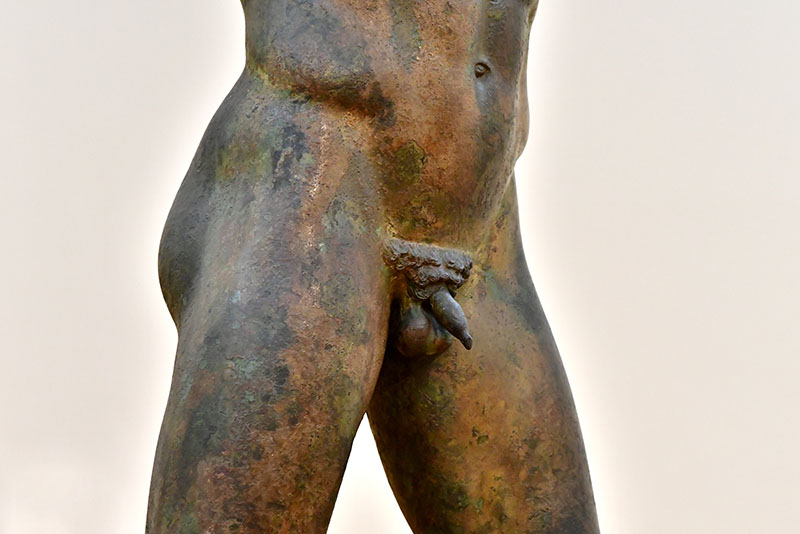
Bronze statue of a young man at the British Museum
Bronze statue of a young man, 1st century BC, from Ziphteh, near ancient Athribis (modern Tell Atrib) in the Nile Delta, northern Egypt. The British Museum.

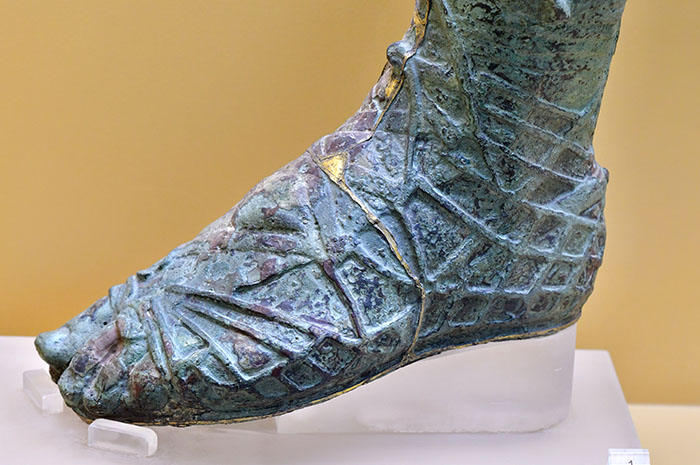
Ancient Greek and Roman public spaces, cemeteries, and sacred sanctuaries brimmed with bronze and marble sculptures. Bronze was favored by some sculptors for its ability to capture dynamic poses. Over time, nearly all bronze statues were melted down for reuse, making surviving examples exceptionally rare. This Roman bronze (copper-alloy) statue, possibly inspired by a Greek prototype, has an unidentified subject. Its eyes, originally crafted with silver, glass, or precious stones, lent a lifelike quality. Copper inlays on the lips and nipples created a vivid red hue. Cast in multiple pieces and mechanically assembled, the statue’s surface was polished to a seamless finish, obscuring the joins.

Croatian Apoxyomenos by an unknown Greek artist, bronze, 4th century BC. Ancient Greeks applied olive oil to their skin before their exercises. Apoxyomenos is a type of athlete scraping himself or scraping his strigil after his exercise.© Marie-Lan Nguyen / Wikimedia Commons / CC-BY 2.5 You can read about new Results on the Alloys of the Croatian Apoxyomenos done by the Getty Museum.

Major periods:

Kouros in Delphi
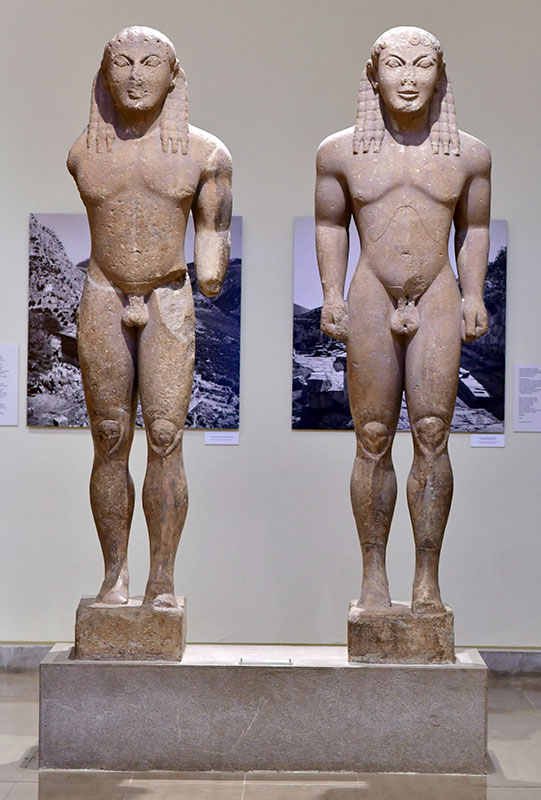
Kouros in Delphi, Kleobis and Biton. These early Greek sculptures look stiff, frozen in Egyptian-like poses. Early archaic period
  • Early archaic period (600-480 BCE): Stiff, stylized figures
  • Classical period (480-323 BCE): Anatomical accuracy & beauty. Balanced mathematical proportions with artistic interpretation. (The Kritios Boy, 480 BC, becomes one of the first sculptures to depart from the archaic period statues. The boy stands in a natural Contrapposto pose that resembles the Kouros but has a natural pose shifted to one leg.
  • Hellenistic period (323-31 BCE): Detailed, emotionally expressive, and anatomically correct representations
Who were the Mycenaeans in ancient Greece? https://veronicasart.com/from-perseus-to-trojan-war-7-mind-blowing-myths-about-mycenae-that-changed-ancient-greece/

Myron: Capturing Emotion & Character in Bronze (c. 480-440 BCE)

Boxer, the Capitoline museums attributed to Myron, marble from a bronze original. By Copie of Myron – Marie-Lan Nguyen (User: Jastrow) 2009, CC BY 2.5, https://commons.wikimedia.org/w/index.php?curid=7817229

Myron of Eleutherae, an Athenian sculptor active during the mid-5th century BCE, stands as the first famous ancient Greek sculptor who transitioned towards realism in ancient Greece. The first famous Greek sculptor of classical antiquity and the pupil of the sculptor Ageladas of Argos, Myron, is known for his creation of the athletes in motion. Myron’s active period is generally placed around 480-440 BC, as he crafted statues to commemorate the victories of athletes in the Olympic Games during the mid-5th century BCE.

Discobolus (Discus Thrower), 450 BC

Among his most famous creations is the Discobolus (Discus Thrower) (450 BC), a work that captures the fleeting moment of an athlete poised to release the discus. The athlete’s pose, originally frozen in bronze, represents a perfect balance, harmony, and rhythm in a coiled figure. Ancient accounts emphasize the sculpture’s lifelike quality. While the original is lost to time, Romans made numerous marble copies, and one of them stands in the British Museum today. It’s named the “Townley Discobolus”, dates to the second century AD, and comes from the art collection of Charles Townley (1737-1805).

Townley Discobolus, Roman, 2nd century AD, after a Greek original by the sculptor Myron of
450-440 BC.
This statue was discovered in 1791 in the Villa of the Roman Emperor Hadrian AD 117-138) at Tivoli outside Rome. The head, although ancient and found with the statue, is not the original. Formerly in the collection of Charles Townley in London. Displayed at the British Museum.

Technically, Myron did complex bronze casting of figures, exploring the dynamic poses and life-like movements of male figures. Myron’s artistic style marked a significant shift from stylized figures of the Archaic period by introducing life-like dynamism, rhythm, beauty, and natural balance in poses. The lost-wax method gave him the advantage of depicting human form in hollow statues that would have been considerably more difficult, if not impossible, to realize in stone during that era. The hollow-cast segments were put together and polished at the end of the artistic process. To further enhance the lifelike quality, contrasting metals might have been used for details such as nipples and lips, and the eyes were often inlaid with materials like ivory, glass, or semi-precious stones.

The colossal groups:

Athena and Marsyas by Myron,  Roman, original copy of 450 B.C.E. Photo: modified from original image by Sailko – Own work, CC BY-SA 3.0, https://commons.wikimedia.org/w/index.php?curid=30525254

His gift was the ability to capture life and moral stories in bronze. Myron often created grouped sculptures to tell a moral story, illustrating a Greek myth. One of such pieces is the group of Athena and Marsyas, which depicts a moment of dramatic tension between the goddess and the satyr displayed on the Athenian Acropolis. In her youth, goddess Athena is credited with the invention of the musical instrument auloi or double-flute that required subtle breath control.

Marsyas, marble copy from the original bronze by Myron in the Vatican

According to the Roman writer Strabo, a group of three colossal figures, Herakles, Zeus, and Athena, created by Myron, once stood on the sacred way leading to the Temple of Hera on the island of Samos. The Roman General Mark Antony is said to have carried the sculptures off as a trophy, but the emperor Augustus restored two of them to their original location and took the Zeus sculpture to Rome.

Myron’s artistic repertoire included statues of gods, heroes, and animals, with his bronze cow gaining particular renown for its realism, as it was said to be mistaken for a real animal. Romans were fascinated by the art of Myron, and some sculptures were discovered in Rome.

Other Famous Sculptures of this period:

Severe style (480-450BC): figures capture emotion and character through body movement and facial features.

Zeus, Athens
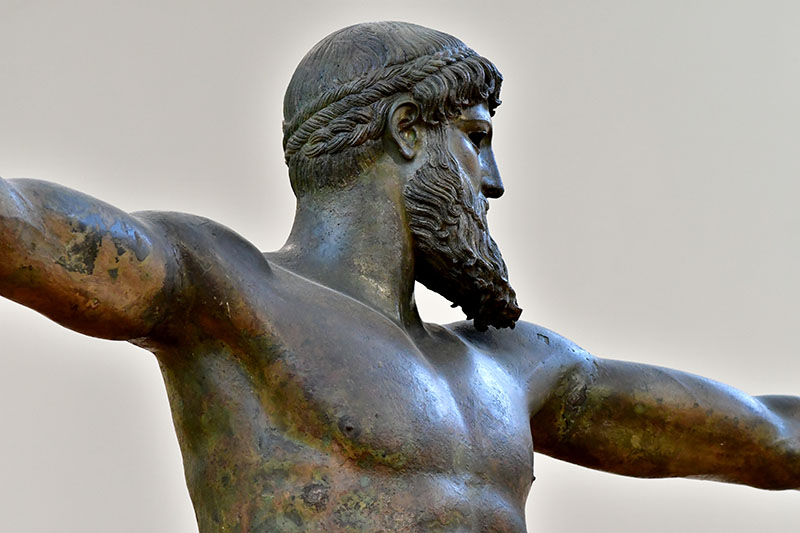
The bronze statue of Poseidon or Zeus, 2.09 meters tall, is displayed at the National Archeological Museum of Athens.

The large, free-standing, and captured-in-motion statues became known as the severe style figures. One such example is the bronze statue of Zeus (460BC). It captures continuous movement and has a strange, smiling face with traces of copper on its lips. Bronze sculptures often had ivory and glass-paste eyes, bronze eyelashes, and copper lips. This sculpture stands tall in the museum in Athens.

Bronze Charioteer, Delphi
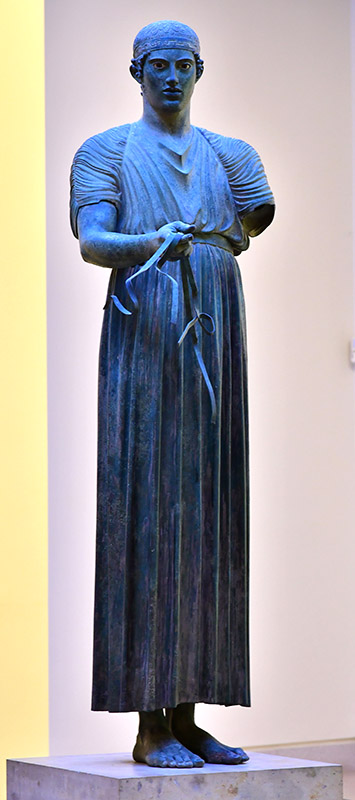
The Charioteer, close-up of a bronze sculpture, 478 BC, 1,82m in height.

Bronze Charioteer, Delphi. Chariot races were competitions for divine favor in ancient Greece. I saw this sculpture in Delphi and thought of a female form, rather than a male depicted in bronze. The sculpture has beautiful feet, color-inlayed eyes, and a calm face. The pose looks restricted, reminiscent of a Doric-style column with its fabric folds streaming down the figure.
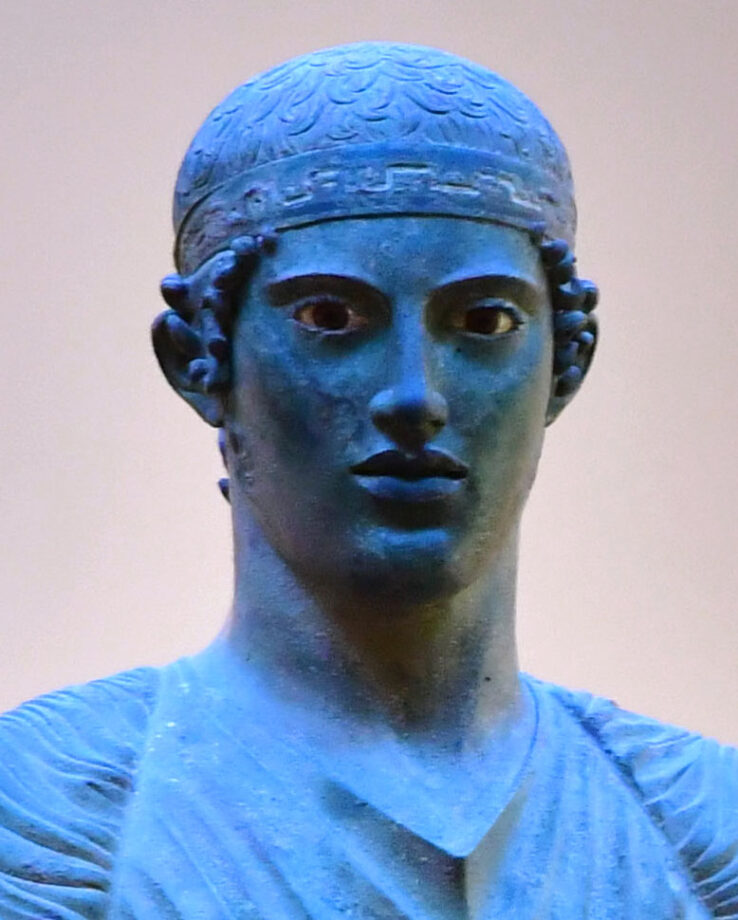
Bronze charioteer of Delphi face closeup
Bronze Chariotier, close-up showing inlaid eyes

The Niobid, 450BC

Classical style: Unification of motion and feeling in a sculpture.
The Niobid, 450BC, is the earliest found example of a large female nude in Greek art. The woman shows the pinwheel stance of the ancient Gorgon relief from Corfu. From the History of Art

Phidias: The Ideal Made Tangible (c. 490-430 BCE)

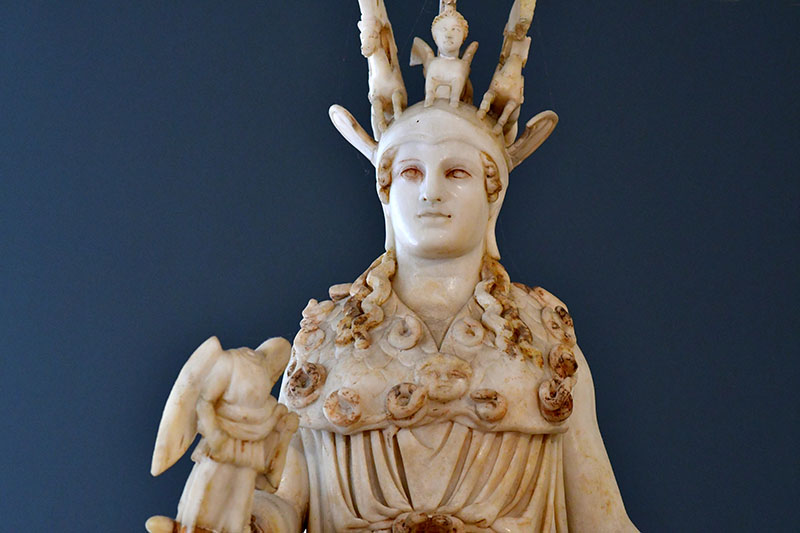
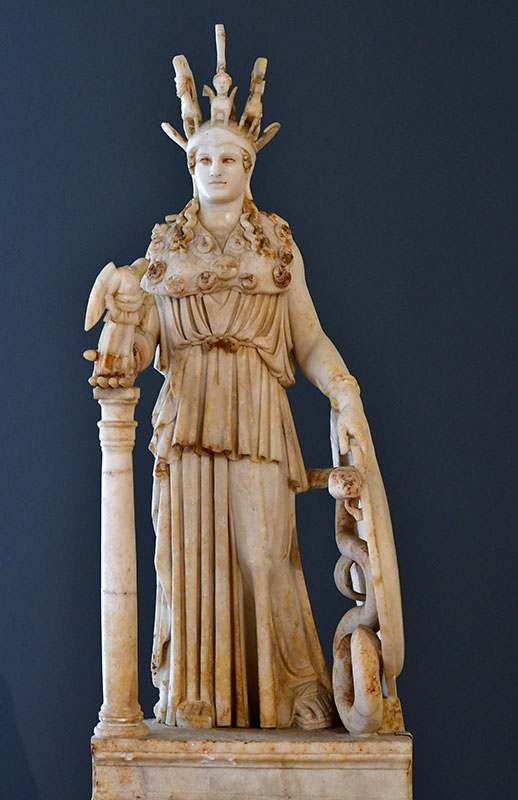
The ”Varvakeion” Athena Copy from AD 200-250 of the original from 438 BC, closeup, Athens

The artist’s most significant works were realized during the Athenian Golden Age under the patronage of Pericles. Chief sculptor Phidias oversaw the production of all sculptures in the Parthenon and is famous for the lost gold statue of Athena in the Parthenon, a colossal gold-ivory statue of Zeus in Olympia, and a huge bronze statue of Athena that stood on the Acropolis facing the Propylaea (Main Entry). The “Phidian style” dominated Greek sculpture until the end of the 5th century. Figures had a harmonious composition, “wet” garments, strong diagonals, and movement in often confined spaces. In my opinion, the colossal statues were not as realistic or anatomically accurate as those of other famous Greek sculptors, based on remaining copies seen today; however, the artist employed a unique combination of materials and techniques to create them. The artist possessed remarkable skill in sculpting across a diverse range of materials, including stone, bronze, silver, gold, wood, marble, ivory, and the complex combination of gold and ivory known as chryselephantine. Phidias also established the iconic visual representation of Greek gods and goddesses that we see represented in late marble sculptures. Phidias is widely recognized as the originator of the High Classical style, which emphasized idealized beauty, harmony, and balance. He’s associated with the early application of the “Golden Ratio” in his work.  

Athena Parthenos
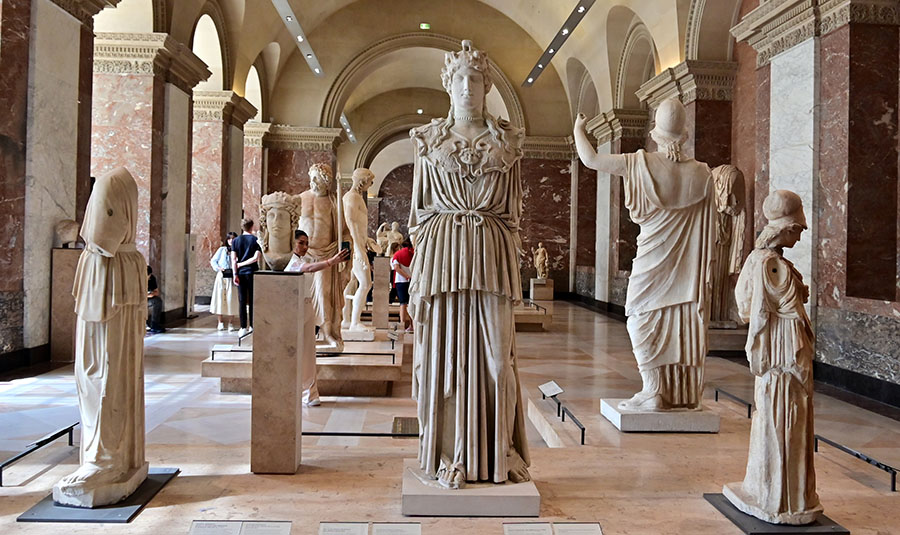
Athena Parthenos, marble copy, the Louvre

Among his most iconic creations is the Athena Parthenos, a colossal statue crafted using the chryselephantine technique (gold and ivory) and housed within the Parthenon (lost today). Constructed from wood and partially overlaid with plates of ivory for the flesh and solid gold for the drapery and ornaments, this colossal statue showcased unparalleled craftsmanship using precious materials. Its sheer scale and elaborate details served as a powerful reflection of Athens’ wealth, power, and profound devotion to its patron goddess.
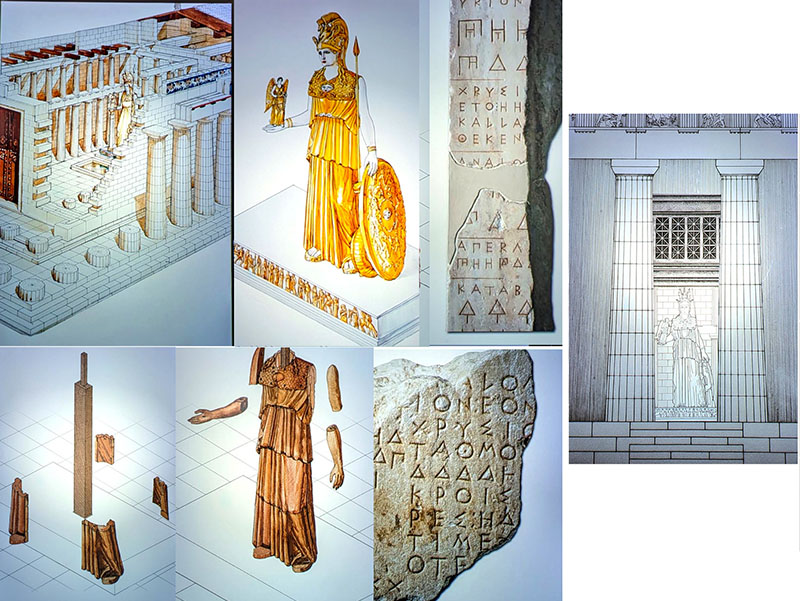
statue of Athena in Parthenon, drawings
The statue of Athena in the Parthenon, drawings illustrating how the statue was built and placed inside the Parthenon. These images were shown in the archaeological museum in Athens. A big bathtub was permanently placed in front of the figure in the temple to add humidity for the wooden sculpture.

The ''Varvakeion'' Athena
The ”Varvakeion” Athena Copy from AD 200-250 of the original from 438 BC, Athens, Veronica Winters’ art blog

The Parthenon frieze’ sculptures

Furthermore, Phidias is credited with the design and the supervision of the Parthenon Frieze, an extensive series of marble sculptures that decorated the temple in its original form. These sculptures, depicting the Panathenaic procession, are celebrated for their life-like quality of both human and animal anatomy. The frieze blends idealized forms with anatomical details, creating a sense of movement and life in a constrained space. The Parthenon’s sculptures are displayed in the British Museum today as they were removed from the original location in the 19th century. They show deities witnessing the birth of Athena from the head of Zeus. The Parthenon sculptures were meticulously carved from marble and originally covered in vibrant paint. Phidias had a thorough understanding of anatomy and chose to depict the divine through idealized forms.

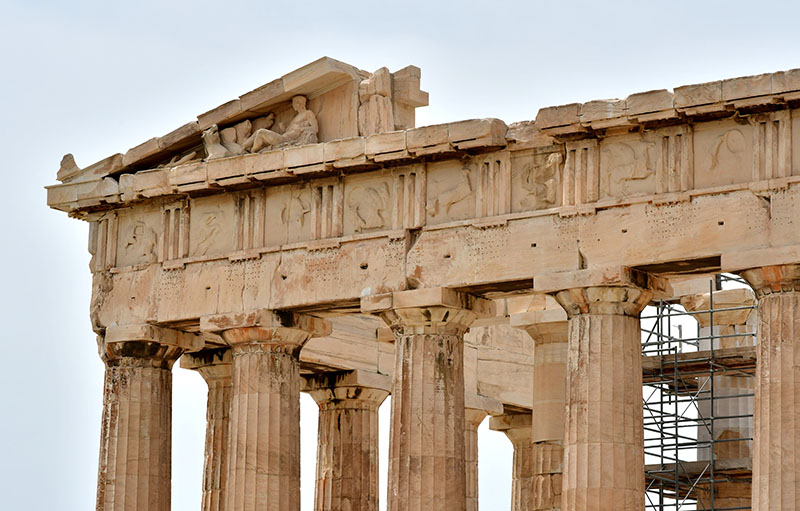
Three sculpture types decorated the Parthenon sculptures: Pediment sculptures were carved all the way around; square and high-relief Metopes, and a low-relief frieze. The image is from the British Museum.
Sculpture example: Iris is a messenger goddess. She acted as herald for the chariot group of Poseidon. She had wings and descended to Earth from flight. The bronze wings were made separately. The drapery rushes against her body, flapping in the wind. Blue color has been found on her belt. WEST PEDIMENT N
The Parthenon sculptures, Horsemen of North Frieze, at the British Museum.
The north frieze begins with a preparation scene reminiscent of those on the west. A boy helps a rider to adjust the length of his tunic, while another horseman waits in readiness. As this man restrains his horse, he anxiously looks back at his unprepared comrade. NORTH FRIEZE XLVII, 132-136

The horsemen of the north frieze: The composition of the north frieze is less varied than the south frieze. The 60 horsemen are arranged into ten ranks. The dress and armor vary from figure to figure.
The north frieze occupied one of the long sides of the Parthenon, continuing the cavalcade that began on the west side. Chariots ran ahead of the horsemen, and ahead of them came various groups of pedestrians.

The Horse of Selene, from the East Pediment in the Parthenon, at the British Museum. This horse’s head was one of those that drew the chariot of the moon-goddess Selene. She balanced the group of Helios in the other corner of the pediment. The horse is weary from its night-long labor. You can read about the Parthenon in great detail here.

The Parthenon’s Metopes:

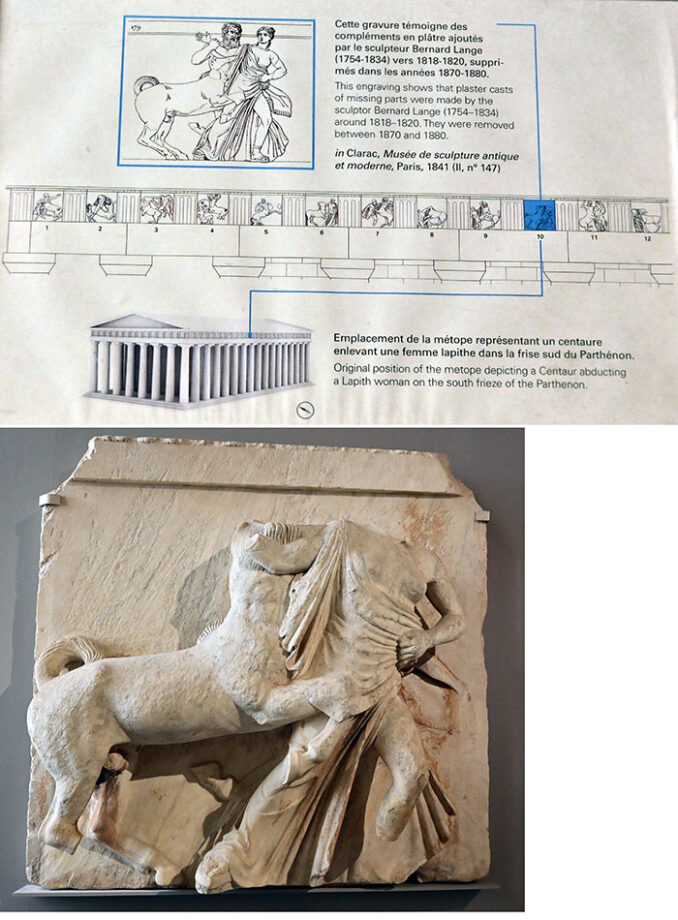
The Parthenon’s metopes captivate due to their dynamic figure compositions within constrained spaces. Striking diagonals, precise anatomy, thoughtful compositions, and expressive faces elevate these sculptures, making them beautiful.

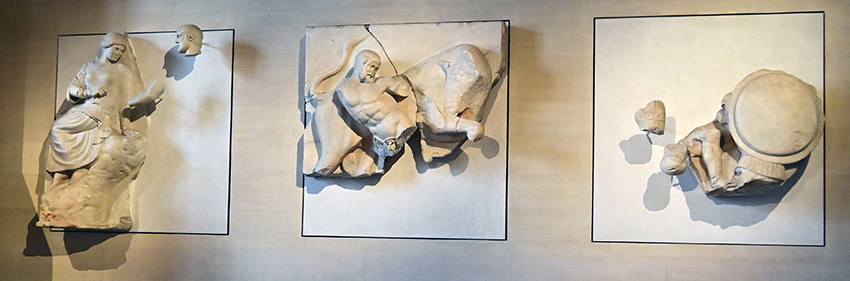
Parthenon’s metopes, the battle of Centaurs & Lapiths, the British Museum. One of the descriptions from these metopes: Centaur and Lapith tussle like wrestlers. The Centaur has his opponent by the throat while the Lapith attempts to fend him off with a fist and a knee. The Centaur opens his mouth in pain and bares his teeth. His face is evocative of an ancient Greek theatre mask, and his hair resembles a wig. South Metope YXYI

Zeus at Olympia

Zeus at Olympia, drawing by Quatremère de Quincy – Kansalliskirjasto, Public Domain, https://commons.wikimedia.org/w/index.php?curid=9836045

Phidias also created the gigantic Zeus at Olympia, another colossal chryselephantine sculpture considered one of the Seven Wonders of the Ancient World. Depicting the king of the gods seated majestically on a throne, its immense size at 12 meters high and the opulent use of ivory and gold evoked a profound sense of divine presence. Lost today, we can only imagine the statue’s power and might.

Polyclitus: The male ideal of body proportions (c. 450-415 BCE)

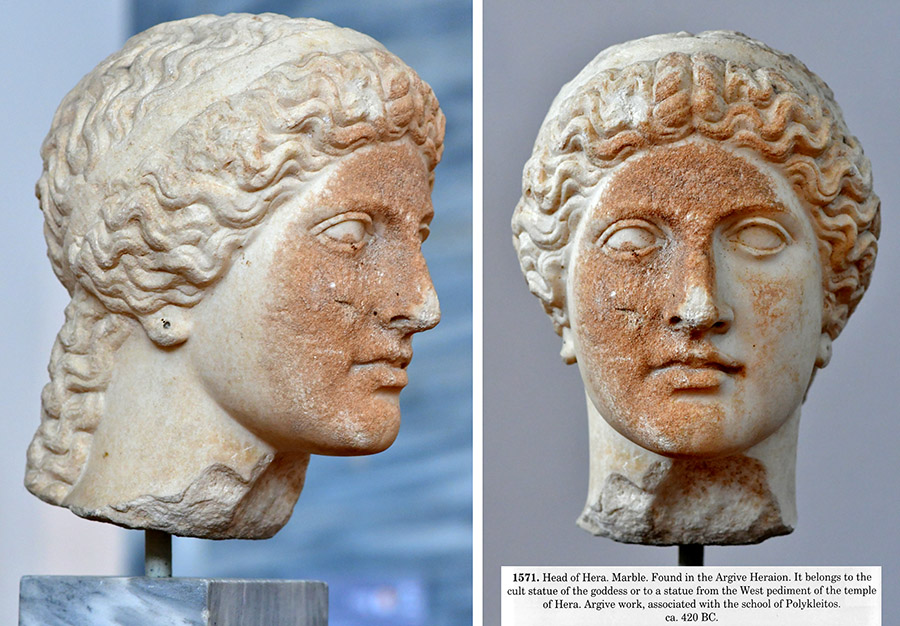
Polykleitos or Polyclitus of Argos, a sculptor from the distinguished Argive school, flourished in the mid to late 5th century BCE and is celebrated for his masterful bronze sculptures, particularly his depictions of youthful, beautiful athletes. Beyond his sculptural achievements, Polyclitus was a highly influential aesthetician, best known for his theoretical treatise, the Canon, which outlined ideal mathematical proportions for the human body, which are still debated today.  Polyclitus was a contemporary of Phidias, and together they created classical Greek style, although they were different in their artistic aesthetic. I think Phidias’ frontal statues in the round looked quite stiff and static in comparison to the beautiful, flowing figures made by Polykleitos that we could admire from different points of view. Only Roman copies of his bronzes (450 BC) exist today. But we can see that Polykleitos was a master of human proportion and aesthetic beauty, as he invented the visual ideal of a flowing figure, the contrapposto style (which is a relaxed pose of the figure as the body’s weight is placed on one leg). His figures were meticulously crafted, exhibiting balance, rhythm, and anatomical perfection not seen before in free-standing figures. The artist also promoted the cult of the athlete through his art. Athletic competition was highly valued in Greek culture, and you can read about the Olympic Games in my article about Delphi. The male nude became a way to glorify the perfect athletic form, representing strength, power, glory, and civic virtue. These qualities were highly desirable in male citizens of the state. Polyclitus’s innovations in the realistic depiction of the human figure, the creation of the Canon and contrapposto, became the principles of classical art that are revered by realist artists up to this day. The artist created the universal representation of a male figure for centuries to come.

Marble copy of Polykleitos’ Torso of the Diadumenos type. Roman copy of the early 2nd century CE after a Greek original of ca. 440–430 BC. Previously restored as a Germanicus. the Louvre
Polyclitus considered ratios to have a spiritual dimension: contemplation of harmonious proportions equaled contemplation of the good. Human and divine beauty harmonize to become one. From the History of Art

Technically, Polyclitus primarily worked in bronze, except for his Hera of Argos, which was created using the chryselephantine method. He utilized the lost-wax casting technique, a method that allowed for great precision and detail in his bronze art.

The Doryphoros (Spear-Bearer)

The Doryphoros (after Polykleitos), 27 BCE–68 CE, Copy of work attributed to Polykleitos, MIA, US

His renowned artwork, the Doryphoros (Spear-Bearer), is widely considered the quintessential embodiment of Polyclitus’ Canon, illustrating his principles of ideal mathematical proportions and the concept of ‘symmetria’. The Doryphoros is famous for its innovative use of contrapposto, a pose that depicts a figure in a balanced yet dynamic stance, with the weight of the body shifted onto one leg, creating a beautiful, natural ‘flow’ of the figure. A young man has a relaxed expression, yet he is about to walk off his pedestal. One of the marble copies is displayed in Naples, Italy. Depicting natural forms, the sculptor perfected proportions, composition, and movement, as ratios were fundamental for Greek philosophers, musicians, mathematicians, and sculptors.

The Diadumenos
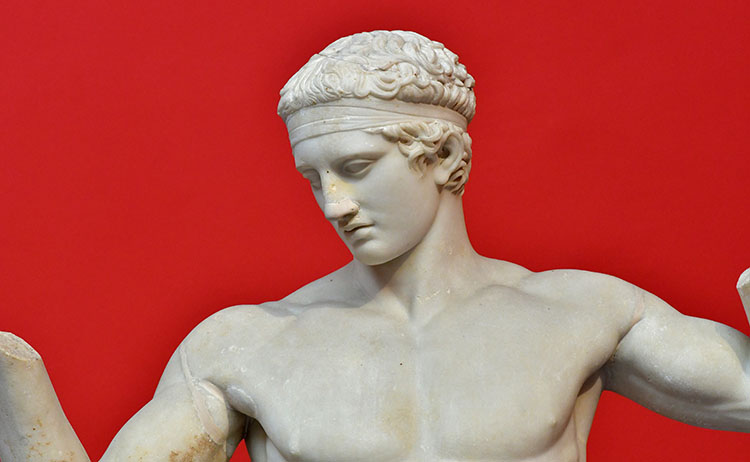
Diadomumenos athlete marble-veronica winters art blog
Diadumenos, athlete, marble copy of the original bronze, Athens, photo: Veronica Winters

Another famous statue by Polyclitus is the Diadumenos (Man Tying on a Fillet). It portrays a young athlete tying a ribbon around his head after his victory in an athletic competition, showcasing a sense of youthful grace, lightness, and effortless poise in a realistic figure. There are several marble copies made from the original bronze sculpture in existence today. I saw one in Athens, the British Museum, and the Met. The marble copy standing at the British Museum was found in a Roman villa in France. It’s recorded that the original fetched the price of a hundred talents, an enormous sum in the ancient world.
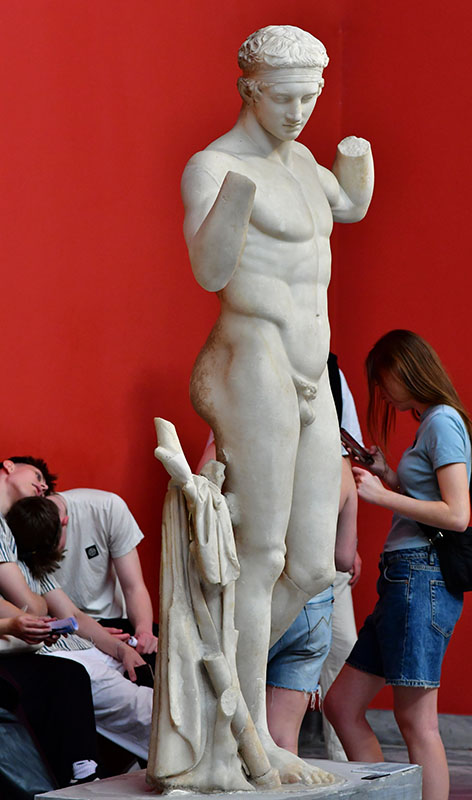
Diadumenos athlete marble-veronica winters art blog
Diadumenos athlete, Polykleitos, marble version from the bronze original, 430 BC, Athens, photo: Veronica Winters

The original bronze probably stood in a sanctuary such as that at Olympia or Delphi. “The figure’s thorax and pelvis tilt in opposite directions, setting up rhythmic contrasts in the torso that create an impression of organic vitality. The position of the feet—poised between standing and walking—gives a sense of potential movement. This rigorously calculated pose, which is found in almost all works attributed to Polykleitos, became a standard formula used in Graeco-Roman and later Western European art.” From the description at the Met.

Other works:

His other artistic contributions include a colossal gold and ivory statue of the goddess Hera of Argos, which was favorably compared to Phidias’s monumental Zeus at Olympia, as well as various statues of Amazons and other athletes, further demonstrating his mastery of the human form.  

Bronze statue of an athlete from Ephesus cleaning his strigil; 1st century CE copy of a possible original by Polykleitos. edited.
By Manfred Werner (Tsui); cropped and edited by Mary Harrsch – Own work, CC BY-SA 3.0, https://commons.wikimedia.org/w/index.php?curid=80929320

The artist’s sense of naturalism and dynamism in representing a strong, male figure in the nude became a standard for classical artists in achieving lifelike representation.

Praxiteles: Infusing Grace and Sensuality (active around 370-330 BCE)

The Late Classical Era and Evolving Realism

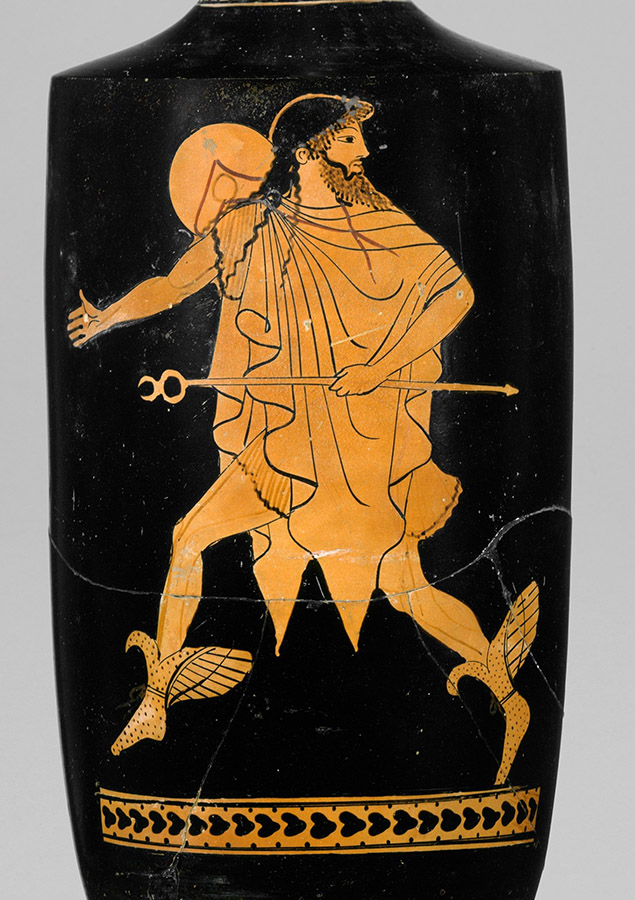
Hermes Farnese, close-up of feet with wings, Roman, 2nd century AD, after a Greek original of the 4th century BC from the school of Praxiteles. Statue of Hermes (Mercury) with winged sandals, holding his herald’s staff. Formerly in the Farnese Collection in Rome.

Being a younger contemporary of the sculptor Scopas, an exceptionally talented artist, Praxiteles became one of the most famous Greek sculptors, with his art still found in London, the Vatican, the Louvre, Olympia, and Rome today. Praxiteles of Athens, active in the 4th century BCE, rose to become the most celebrated of the Attic sculptors, renowned for the elegance, beauty, and sensuousness of his art. He is notably credited as the first sculptor to depict the nude female form in a life-sized statue, marking a serious departure from earlier conventional representations.
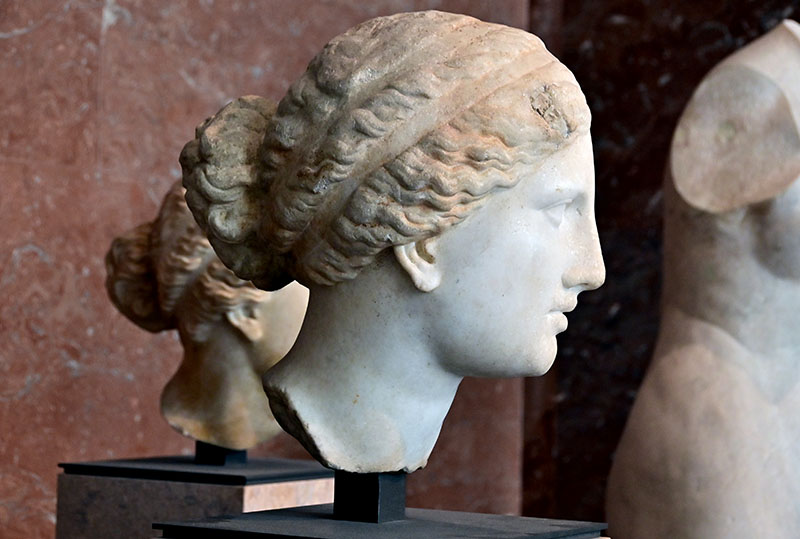
Aphrodite by Praxiteles Louvre
The Head of Aphrodite Kaufmann by Praxiteles, the Louvre

Aphrodite of Knidos:

Among his most famous works is the Aphrodite of Knidos, a groundbreaking sculpture that portrayed the goddess of love in complete nudity, establishing a new artistic standard for the depiction of the female nude in Western art. Its sensuous rendering and graceful pose contributed to its status as one of the most celebrated sculptures of antiquity. The first known completely nude goddess is ‘Cnidian Aphrodite,’ a marble Roman copy after the 340 BC original, located in the Vatican. 

Aphrodite of Knidos Praxiteles
Praxiteles, Aphrodite of Knidos, photo: marble copy of Praxiteles; restorer: Ippolito Buzzi (Italian, 1562–1634), Marie-Lan Nguyen (September 2009), Public Domain, https://commons.wikimedia.org/w/index.php?curid=1343576

Male statues:

Praxiteles’s artistic style is characterized by a shift from the more rigid idealism of the High Classical period towards a greater emphasis on grace, sensuality, and a more humanized depiction of the gods. His male figures exhibit the ethereal beauty, elegance, and unbelievable knowledge of anatomy, proportion, and scale. He is one of my favorite artists as his statues show harmonious beauty and naturalism in sensual, relaxed, gracefully flowing poses, so hard to achieve in classical art. Praxiteles’ sculptures of male figures had a lot more anatomical detail and precision than the female form, which was characteristic of ancient Greek sculpture in general. In his work, the marble sculptures have sensual curves in the torso, perfectly proportioned legs, gentle arms, and faces, which exemplify his art style and aesthetic. He famously employed the “Praxitelean curve,” a sensual S-shaped contrapposto that lent a languid and elegant quality to his figures, distinguishing them from the more upright postures of his predecessors. His works are also famous for their smooth surfaces and the delicate modeling of forms, creating a sense of softness and naturalism.  

HERMES FARNESE, Roman, 2nd century AD, after a Greek original of the 4th century BC from the school of Praxiteles. Statue of Hermes (Mercury) with winged sandals, holding his herald’s staff. Formerly in the Farnese Collection in Rome.

Such an example is “Hermes and Infant Bacchus“, a Roman copy of the 320 bc original, Olympia. It stood at the temple of Hera in Olympia. Hermes with the Infant Dionysus is a marble statue renowned for its delicate modeling and exquisite surface finish. This piece exemplifies the grace and life-like charm that Praxiteles brought to his portrayals of deities, moving away from the more austere representations of earlier periods. https://ancientolympiamuseum.com/index.php/2022/07/18/hermes-of-praxiteles
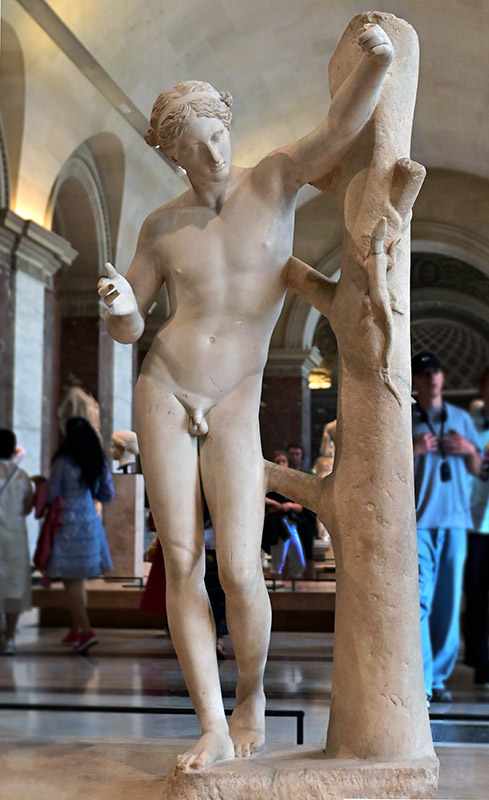
Apollo lizard slayer-Louvre-Veronica Winters Art blog
Apollo, the lizard slayer, by Praxiteles (400-325 bc), Parian Marble, the Louvre


The god of the arts, shown as an adolescent, prepares to kill a lizard. The scene is a reference to the protective nature of the god or, in an indirect way, to his struggle against the serpent Python

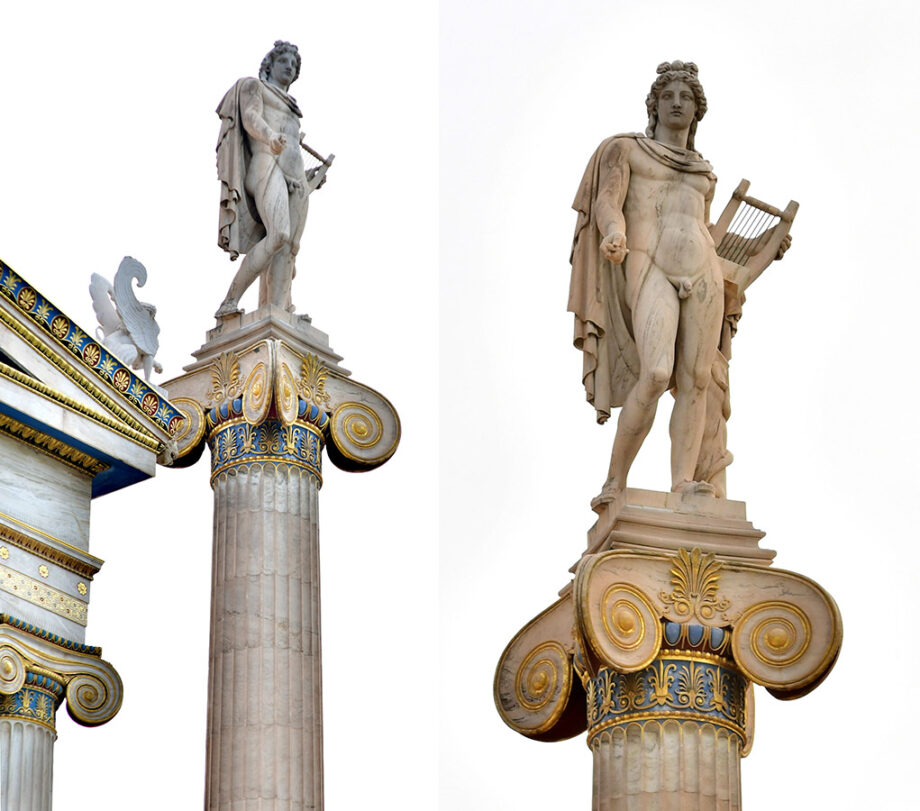
“Apollo Belvedere,” a Roman marble copy of a Greek original, 4th BCE, is another famous example of an artist’s talent that exemplifies harmonious beauty. His artistic output also included Apollo Sauroktonos (Apollo the Lizard-Slayer) and various other depictions of gods, satyrs, and nymphs.

The Cleveland Apollo: Apollo Sauroktonos (Lizard-Slayer) or Apollo the Python-Slayer
c. 350–200 BCE
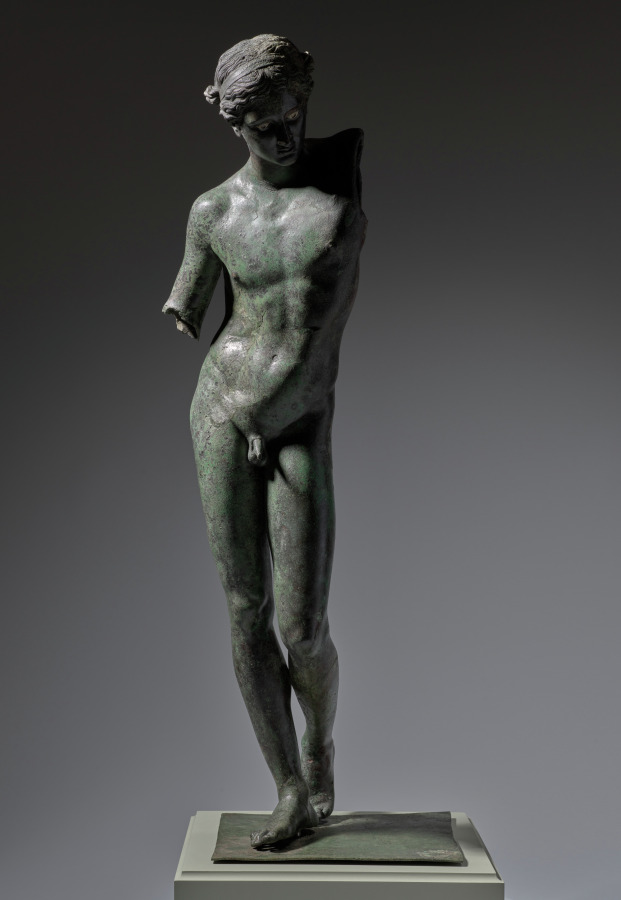
The Cleveland Apollo Apollo Sauroktonos
The Cleveland Apollo Sauroktonos (Lizard-Slayer) or Apollo the Python-Slayer c. 350–200 BCE

Technically, Praxiteles primarily utilized marble as his medium, particularly the highly prized marble from the island of Paros, which allowed for a fine level of detail and a luminous finish. However, he also worked with bronze, demonstrating his proficiency in metal casting as well. He valued the surface finish of his marble sculptures and reportedly held in high regard those that were further enhanced by the application of paint by the renowned artist Nikias, indicating the importance of color in ancient sculpture.  
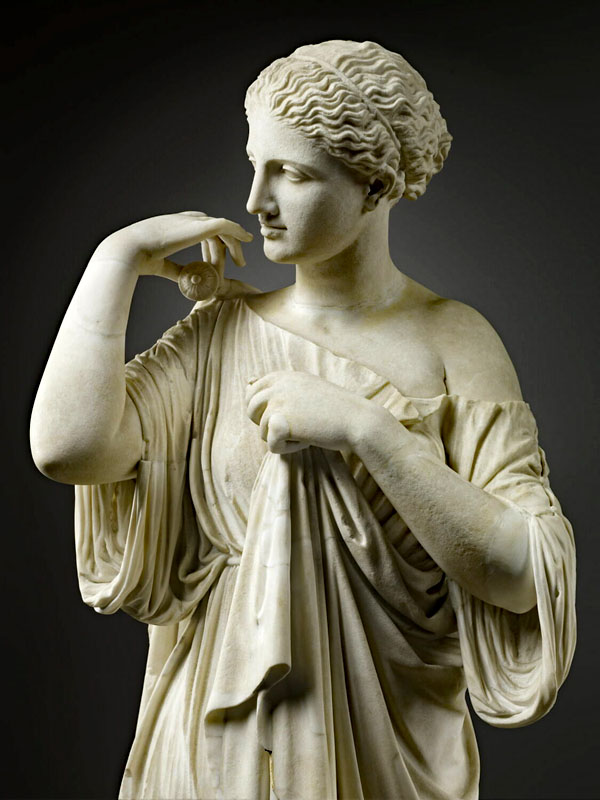
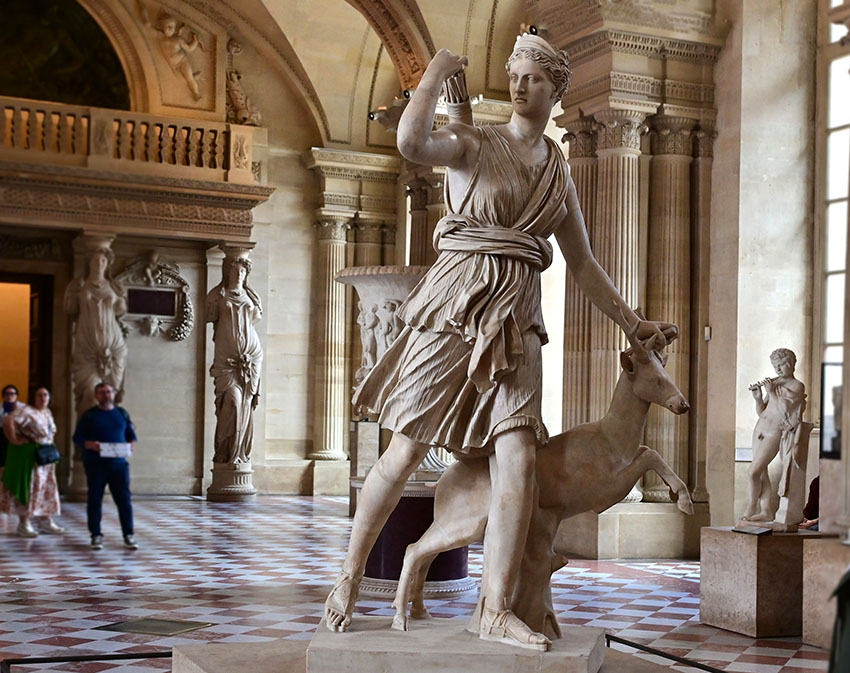
Artemis, known as Diane de Gabies 
Praxiteles, du Louvre, Département des Antiquités grecques, étrusques et romaines, Ma 529 – https://collections.louvre.fr/ark:/53355/cl010278726 – https://collections.louvre.fr/CGU

Praxiteles’s emphasis on the nude female form, particularly in his Aphrodite of Knidos, and his overall sensual style represent a significant evolution in artistic and cultural attitudes towards the human body and the depiction of divinity. The creation of a life-sized female nude for public display was a groundbreaking act, suggesting a changing societal perspective that allowed for a more direct and sensual representation of the female form, even within a religious context. Furthermore, the reported collaboration between Praxiteles and the painter Nikias underscores the significant role of polychromy in ancient Greek sculpture. (To read about polychromies in ancient Greek art, go to this article I wrote about ancient Greek Sphinxes.) This practice highlights that these sculptures were not intended to be viewed as pristine white marble but were likely enhanced with vibrant colors to further the illusion of life and contribute to their overall impact.
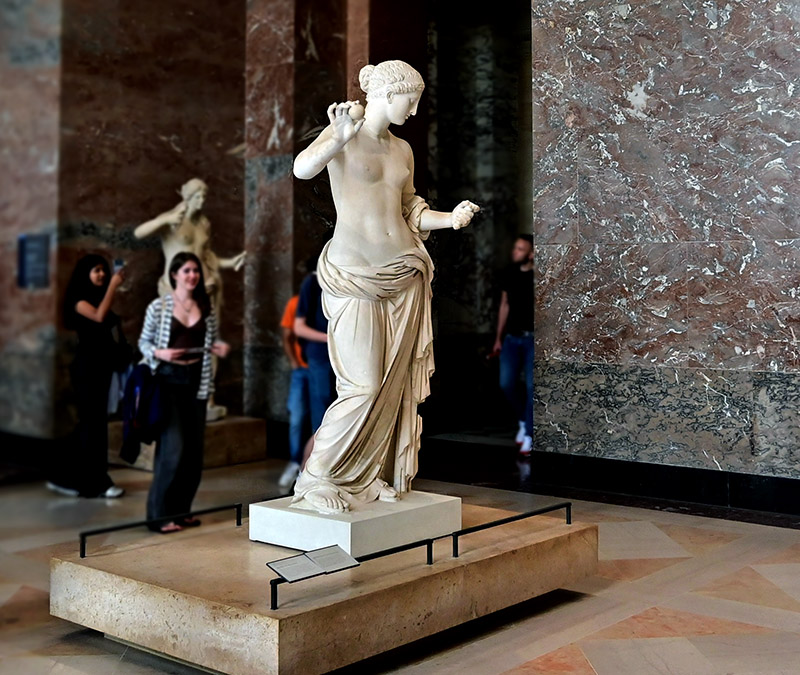
Aphrodite as Venus of Arles in the Louvre-Veronica Winters Art blog
Praxiteles, Aphrodite as Venus of Arles in the Louvre, marble, Veronica Winters Art blog.

This Venus was presented to King Louis XIV of France as a gift in 1683. François Girardon, the king’s sculptor, added the goddess of love’s attributes: a mirror and an apple, references to her victory in the Judgement of Paris. This work may be a copy of the Aphrodite of Thespiae (Boeotia, Greece), commissioned around 360 BC from the sculptor Praxiteles by the courtesan Phryne.

Scopas: The Sculptor of Emotion (c. 370-330 BCE)

Scopas of Paros, a prominent Greek sculptor and architect of the Late Classical period, is considered one of the foremost sculptors of the second half of the 4th century BCE. He played a crucial role in establishing the expression of powerful emotions as a central theme in artistic representation, marking a shift towards a more dramatic and psychologically engaging art style.  

Scopas’s artistic style is distinguished by its emphasis on intense emotional expression, dynamic and often twisting compositions, and a departure from the more restrained and passionless features characteristic of earlier Classical sculpture. His figures frequently exhibit deep-set eyes, furrowed brows, and slightly opened mouths, all contributing to a palpable sense of pathos and inner turmoil. He also moved towards more fluid and naturalistic representations of movement within his sculptural compositions.  

Scopas primarily worked in marble, utilizing the marble from his native island of Paros, known for its luminosity and fine quality. He also employed Pentelic marble for some of his sculptures.

In addition to his sculptures, Scopas was also a practicing architect, responsible for the design of the Temple of Athena Alea at Tegea, demonstrating a close integration of sculpture and architecture in his artistic practice. The sculptures from the Temple of Athena Alea at Tegea include the pediment statues depicting the Calydonian Boar Hunt and the Battle of the Amazons, renowned for their intense emotions and dynamic compositions. 

Drawing of the Mausoleum at Halicarnassus 359-351 BC. Much bigger, the Mausoleum took inspiration for its design from the Nereid Monument of Xanthos, which was a city in ancient Lycia, Turkey.
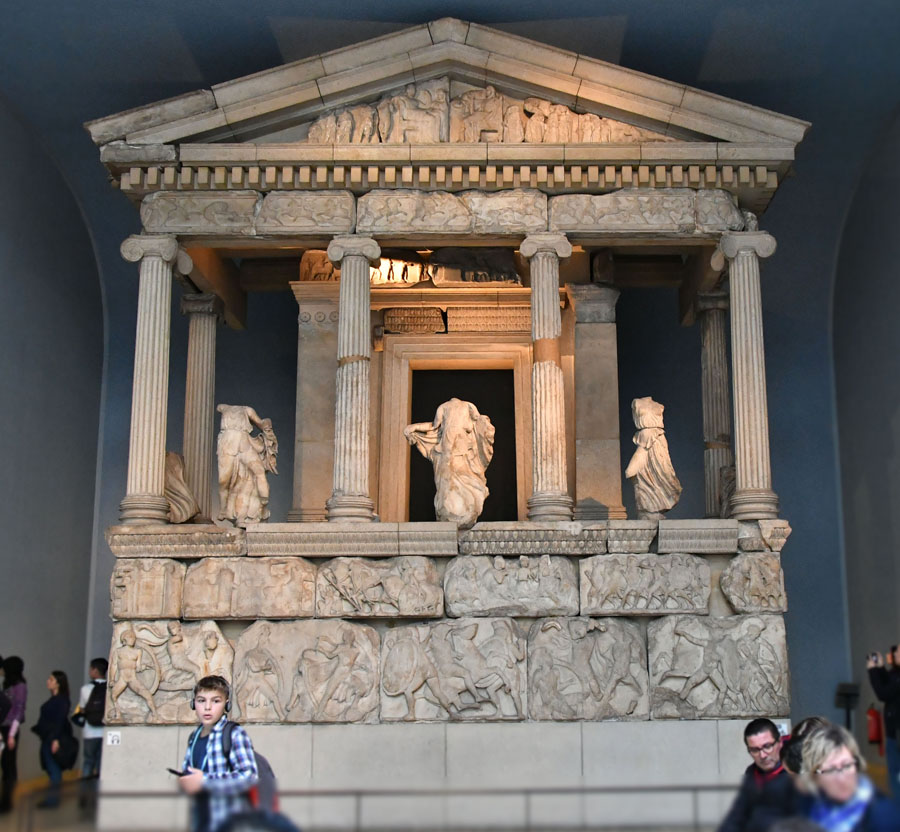
The Nereid Monument of Xanthos, 390-380BC, the British Museum. The Nereids, statues on the podium, were sea nymphs in Greek mythology. They helped sailors survive brutal sea storms. The monument is influenced by the Ionic temples of the Acropolis of Athens.

Scopas also contributed his talent to the elaborate reliefs decorating the Mausoleum at Halicarnassus, one of the Seven Wonders of the Ancient World, working alongside other distinguished sculptors, Bryaxis, Timotheos, Leochares. Writer Pliny the Elder described the architecture of the project and the artists working on it as a team. Each sculptor carved his side of the building. Destroyed today, the Mausoleum at Halicarnassus, 359-351 BC, was a gigantic tomb built in present-day Turkey. Height 260 ft. Base 117×82 ft. 36 Ionic columns are 40 ft tall. Friezes’ lengths were similar to the Parthenon’s!

Marble Colossal horse, from the chariot-group of the Mausoleum at Halicarnassus, 350 BC (found in Turkey). The bronze bridle and bit are still attached. © The Trustees of the British Museum. Shared under a Creative Commons Attribution-NonCommercial-ShareAlike 4.0 International (CC BY-NC-SA 4.0) licence.

From the History of Art: “The monument combined Greek thought about life as a magnificent struggle depicted in battle scenes and the Egyptian pyramid as a roof to show the divine powers of the ruler. The word ‘mausoleum’ became a generic term derived from that funerary building. Scopas was one of the artists working on the friezes. His figures show lots of energy, action, and violence with the Amazons on the battlefield.” Scopas also worked on the temple of Artemis at Ephesus (present-day Turkey). You can see some restoration images here.

Other famous pieces attributed to him include the Dresden Maenad, a depiction of a woman in a Bacchic frenzy, the statue of Pothos, conveying a sense of longing and desire, and possibly the Ares Borghese, a dynamic portrayal of the god of war.  Youthful hero or god is a well-preserved sculpture, probably a Roman copy after Scopas, displayed at the Fogg Art Museum (Harvard). It shows the flawless body of a young man in classical proportions and expressive rotation of the head.

Scopas, Marble female head, possibly of Hygieia, found at Tegea, Arkadia, 350-325 BC

There are several classical heads attributed to Scopas displayed at the National Archaeological Museum of Athens, such as the head of the goddess Hygieia from the temple of Athena Alea at Tegea. Because the heads show a lot of wear and tear, it’s difficult to judge their former beauty. The Hunter stele by Scopas at the same museum shows well-preserved classical figures in limited view.

The Hunter stele by Scopas, close-up, Archaeological museum in Athens

There is a marble torso of Youthful Hero or God,a Roman copy after Scopas, displayed at the Harvard Museum. I love the S-curve in the back of that sculpture.

After Scopas. A Roman 1st-century AD marble Meleager with chlamys, a free improvisation on Scopas’ model, from the Fusconi-Pighini collection (Museo Pio-Clementino, Rome), copy after Skopas (?), Jastrow (2006), Public Domain, https://commons.wikimedia.org/w/index.php?curid=1302961

Scopas’s focus on conveying intense feelings in his sculptures marks a significant transition towards the Hellenistic aesthetic, where the inner lives and passions of the figures depicted became a central concern of artistic representation. This emphasis on emotion, contrasting with the detached or idealized expressions of previous periods, reflects a growing artistic interest in portraying the full spectrum of human experience, including suffering and passion. Furthermore, similar to Phidias, Scopas’s significant involvement in major architectural projects highlights the integral relationship between sculpture and architecture in ancient Greece. Sculpture was not a simple decorative element; rather, Greek statues played a vital role in conveying narrative, meaning, and enhancing the overall grandeur and impact of the temples.

Lysippus: Naturalism and Individual Character (c. 370-300 BCE)

Transition to the Hellenistic Era

Lysippus of Sicyon, a famous Greek sculptor of the late Classical period, is recognized for his pivotal role in the transition towards the highest realism of the Hellenistic era. He worked between 370-300 BC and held the distinguished position of official sculptor to Alexander the Great and was celebrated for the lifelike naturalism and slender proportions, a modification of Polykleitos’s system.

The Apoxyomenos

Among his most famous sculptures is the Apoxyomenos (The Scraper), a statue depicting a young, handsome athlete meticulously cleaning himself with a strigil after exercising. (Greek athletes applied oil before the exercise and then removed it after it.) This sculpture exemplifies the artist’s focus on capturing natural movement and his shift towards super-realistic body proportions compared to the idealized forms of earlier periods. A marble copy of the original bronze (330bc) is in the Vatican. It shows an unusually active pose, and a smaller head, but the same slender, elegant, and well-proportioned male body of an athlete.

The artist said that the difference between himself and them was that they represented men as they were, and he as they appeared to be.

From Pliny’s writings, we learned a lot about Lysippus’s artistic style. It’s distinguished by its commitment to lifelike naturalism, the use of slender and often elongated proportions in his figures, and a pronounced focus on portraying individual character rather than adhering to idealized types. His main characteristic was extreme attention to detail. He introduced a new canon of body proportions that differed from the earlier standards set by Polyclitus, featuring smaller heads and leaner bodies, which created the visual impression of greater height in his sculptures. Furthermore, Lysippus’s compositions were designed to be viewed from multiple angles, inviting viewers to move around the sculpture to fully appreciate its three-dimensional form, a departure from the single optimal viewpoint often favored by his predecessors.  

Portraits of Alexander the Great

After Lysippos, Alexander the Great statuette at the Getty Villa, 2nd century B.C., Unknown artist/maker. Worshipped as a god, Alexander the Great had numerous statues complete by the artist.
From the museum’s description: “This broken statuette, carved in the 100s B.C., is a small-scale variant of a statue made in the 320s B.C. by Lyssipos. The “Alexander with a Lance” portrayed the king armed and naked, similar to the great heroes of Greek mythology, such as Achilles, with whom Alexander identified. The ruler stands with his weight on one leg, his right arm extended and holding a spear, the left hanging down at his side.”

Lysippus also gained significant recognition for his numerous portraits of Alexander the Great. It was said that Alexander would only allow Lysippus to sculpt his likeness, leading to the creation of a recognizable image of the king featuring tousled hair and an upward-looking gaze, often associated with divine inspiration.

Other work:

Hercules, Roman copy after the original by Lysippos, about 325-300 BC. Said to be found near mount Vesuvius. Restored and set into a modern bust by the English sculptor Joseph Nollekens. The British Museum
Portrait Head of Euripides, 2nd century A.D., unknown artist, after an original by Lysippos, Getty Museum, public domain
Aristotle sculpture after Lysippos. Bust of Aristotle. Marble, Roman copy after a Greek bronze original by Lysippos from 330 BC; the alabaster mantle is a modern addition. – Jastrow (2006), Public Domain, wikimedia https://commons.wikimedia.org/w/index.php?curid=1359807

His artistic output also included statues of the hero Heracles, the king of the gods, Zeus, and various other athletic figures, demonstrating his talent in mastery of the human form.  

Lysippus’s exclusive role as the official sculptor of Alexander the Great underscores the potent influence of art in shaping public perception and immortalizing historical figures. His close association with Alexander allowed him to define the visual representation of this pivotal leader, significantly impacting how Alexander was perceived by both his contemporaries and subsequent generations. Moreover, Lysippus’s innovative shift towards slenderer proportions in his figures and his emphasis on a 360-degree viewing experience indicate a growing artistic interest in creating sculptures that were not only anatomically accurate but also dynamic and engaging from a multitude of perspectives. This evolution in artistic thought moved beyond the concept of a single, ideal viewpoint towards a more immersive and spatially aware sculptural encounter.  

Technically, Lysippus primarily worked in bronze, and ancient sources suggest that he was an incredibly prolific sculptor, creating over 1500 works throughout his career. He paid meticulous attention to even minor details, such as the rendering of eyelids and toenails, further enhancing the realism of his figures. His brother, Lysistratus, is credited with pioneering the technique of creating molds directly from living bodies, a method that may have significantly influenced Lysippus’s approach to portraiture and his ability to capture individual likeness with such accuracy. Contemporary artist, Carole Feuerman, does exactly that technique of making molds from living people, thus creating perfect figures she paints and decorates with the Swarovski crystals. I’ve seen her work worldwide, such as at the Venice Biennale 2017 and the King Woman art show in New York. I also see her beautiful sculptures at the Miami art fairs every year.

Carole Feuerman, Survival of Serena, hyper-realism sculpture
Carole Feuerman, Survival of Serena, hyper-realism sculpture, Miami

Another contemporary artist, Karen LaMonte, does sculptures of dresses and garments cast in glass and bronze. If you look at her method, you can imagine a similar technique being used in the past to get the perfect anatomical shape and precision.
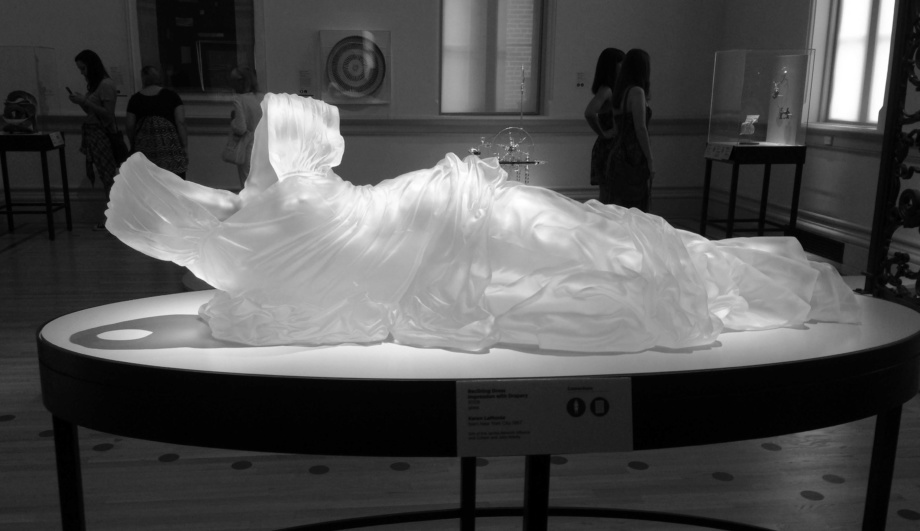
This is one of the sculptures I saw at the Smithsonian Institution. This is a glass cast, Reclining mode, artist: Karen LaMonte.

 We can see that this ancient Greek bronze “Draped male figure” is strikingly similar in technique to the two contemporary artists above.

Draped Male Figure, c. 150 BCE–200 CE. Roman or possibly Greek Hellenistic. Bronze, hollow cast in several pieces and joined; overall: 193 cm (76 in.), The Cleveland Museum of Art.

The final stage: works of the late Classical and Hellenistic period (4th-3rd century B.C.E.)

In classical Athens, during the 5th-4th century B.C.E., sculptors created the most beautiful and powerful art for the democratic Athenians. These pieces were commissioned to decorate temples and public buildings, projecting idealism and youthful, eternal beauty. Later, in the Hellenistic period (late 4th-1st century B.C.E.), artists shifted their focus to glorifying the power and wealth of the contemporary rulers and the elite.

Fourth-century sculpture (400-200 B.C.E.) marked the final stage in Greek art development. This period, labeled as Late Classical or pre-Hellenistic and Hellenistic, followed the conquests of Alexander the Great, who established Alexandria as a new, prominent citadel of power and culture. Consequently, Greek art expanded its influence to Asia Minor (modern-day Turkey), Egypt, Mesopotamia, and even India. New major cosmopolitan cities emerged, such as Pergamon, Antioch, and Alexandria.

Chatsworth head Apollo
The ‘Chatsworth Head’ of Apollo, 450 BC: This beautiful bronze head of an athletic youth is all that’s left from a once life-size statue. First found in 1836 near Politiko in central Cyprus, the statue was complete but soon broken up for scrap! The only two parts that escaped melting down were the head and the right leg, now displayed in the Louvre.
The statue is probably of the god Apollo, who received his modern name from the dukes of Devonshire, where the statue was displayed in Chatsworth House in Derbyshire. This ‘Chatsworth Head’ is one of the very few complete bronzes to survive, showing the result of a complex lost-wax method. This technique allowed the artist to create the super-fine details on his hair. His eyes would have been made of ivory or a semi-precious stone. This statue was probably made at the wealthy city-state of Tamassos probably by a talented Greek sculptor. The surrounding area was rich in copper, and also the timber needed as fuel to cast the statue. Expensive tin had to be imported to Cyprus to make the bronze alloy. Politiko, Sanctuary of Apollo. Displayed at the British Museum.

From the end of the 4th century B.C.E. onwards, Greek sculpture displayed two distinct trends. The first, classical and conservative, showed respect for past art and academicism, producing new sculptures that either transformed or copied classical prototypes. The second trend, however, rejected Classical idealism in favor of innovation, depicting unique human features, individualism, age, and ethnicity.

Hellenistic sculpture became extremely realistic, varied, and emotional. Unlike the timeless ideals of the Classical period, Hellenistic portraits emphasized individualism, complex character, emotion, and likeness (e.g., the portrait head from Delos, an 80 B.C.E. bronze now in Athens). Beyond sculpture, figures and later portraits of rulers were also depicted on silver and gold coins to assume even more authority and power.
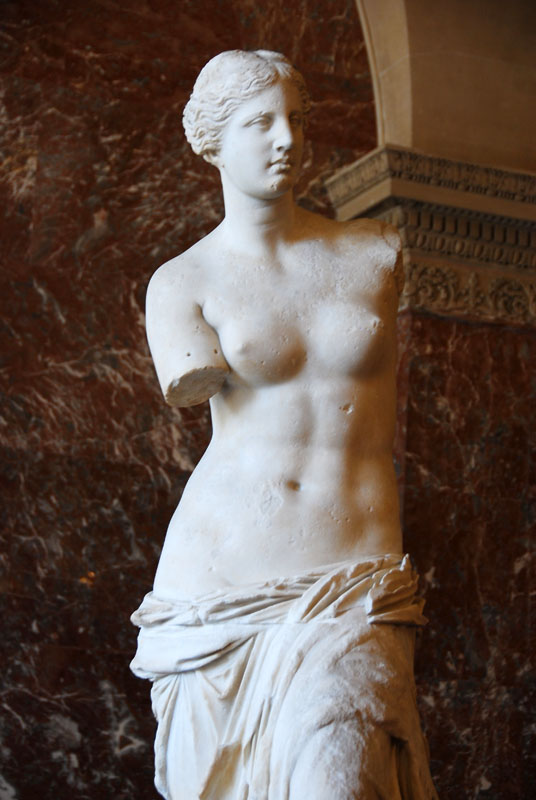
the Venus de Milo from the galleries dedicated to Classical and Hellenistic Greece -louvre-veronica winters art blog
Venus de Milo, an ancient statue commonly thought to represent Aphrodite, the ancient Greek goddess of sexual love and beauty, and identified with Venus by the Romans. 150 BCE. “Alexandros, son of Menides, citizen of Antioch of Maeander, made the statue.” The figure’s origin on the island of Melos has led some to think she may be Amphitrite, the Greek goddess of the sea.

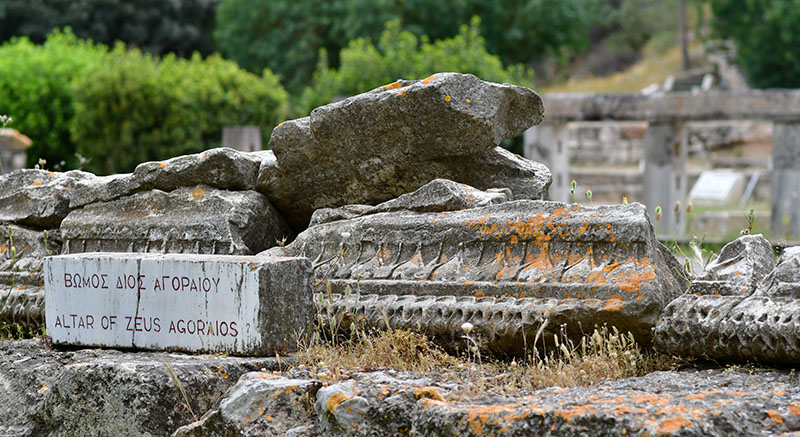
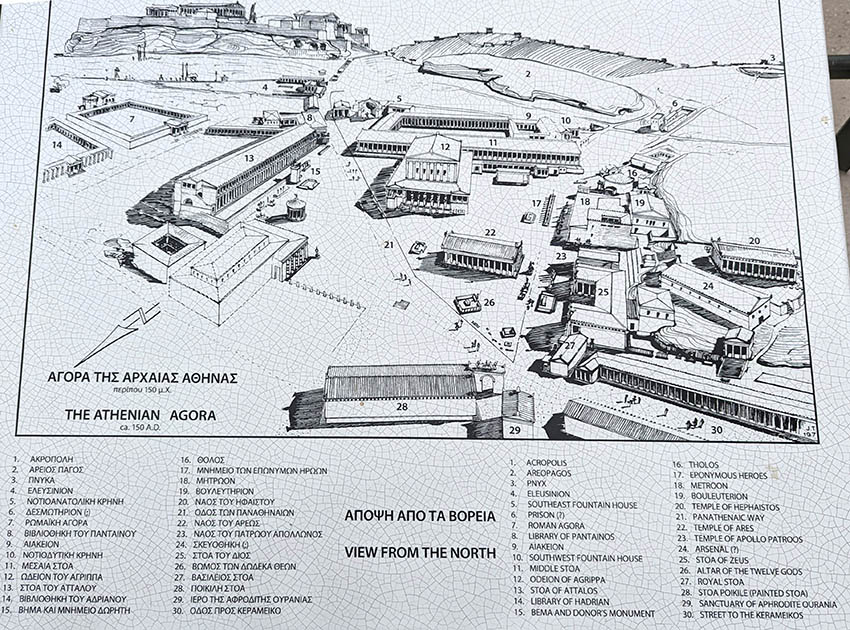
During the Hellenistic period, the Agora’s public spaces continued to house statues of gods and heroes. However, renewed interaction between ancient Greece and the East spurred interest in colossal sculpture, and naturalistic portrait sculpture reached new heights. The Agora featured portraits of politicians, orators, and philosophers depicted as individuals, moving away from classical ideals. Dynastic members of the Hellenistic kingdoms also received honorary statues to encourage their benefaction.

Even as late as the 2nd century A.D., at the time of the traveler Pausanias, statues representing queens of the Hellenistic period stood in the public spaces of the Agora for admiration. Upper-class women had dedicated marble sculptures placed in sanctuaries, while cemeteries remained the sole place for middle-class men and women to have idealistic marble images created as a memorial.

(This writing is based on the displayed info at the archaeological museums in Athens, Greece.)

Hellenistic sculptures:

Crouching Venus or Aphrodite, Hellenistic art at the British Museum
This is a Roman marble sculpture of the Crouching Venus, dating to approximately 1-200 AD. It’s a Roman copy of a Hellenistic Greek original, possibly from around 200-100 BC, displayed at the British Museum
Venus (Aphrodite in Greek mythology), the goddess of love, is shown crouching, as if surprised while bathing. She attempts to cover herself with her arms, a gesture that ironically draws attention to her nudity. The sculpture’s design encourages the viewer to become a voyeur, observing the goddess in a vulnerable moment. This interplay between the art and the viewer was a style of many Hellenistic sculptures.
The dynamic, twisting pose, meant to be appreciated from multiple angles, reflects the artistic trends of the Hellenistic period (323-31 BC).
Crouching Venus has been part of the collections of Sir Peter Lely and King Charles I. This particular piece is also known as the “Lely Venus” due to its ownership by the artist Sir Peter Lely. It eventually returned to the Royal Collection and is now on loan to the British Museum.
The “Crouching Aphrodite” was a popular subject for both Greek and Roman sculptors, with various copies and interpretations existing from antiquity and beyond. The Roman copies of this type were frequently used for decoration in private villas and public baths.
Venus, Roman, 2nd century AD. Nude Venus of the Capitoline type. Found at Campo Iemini in 1794 in
excavations conducted by Robert Fagan and sponsored by Prince Augustus Frederick, son of George III. restored. Subsequently, in the collection of George, Prince of Wales (later George IV). Given to the British Museum by William IV in 1834.
Alexander the Great ruled Greece as a kingdom, and his rule brought to an end the political independence of the individual Greek cities. His conquest of the old empires to the east and south
opened up vast new areas to the influence of Greek culture.
The Hellenistic period spanned from the death of Alexander the Great in 323 BCE to the rise of the Roman Empire, marked by the Battle of Actium in 31 BCE. After Alexander's death, his generals divided his empire into a series of independent kingdoms, like the Ptolemaic Kingdom in Egypt and the Seleucid Empire in the Middle East. These lands were 'Hellenised' (Hellas means Greece), and the term 'Hellenistic' is used to describe the period between Alexander's death and the fall of Egypt taken by the Roman Empire.
The defeat of Cleopatra and Antony at Actium in 31 BC is the political end of the Hellenistic age, but not the cultural one. Greek culture interacted with existing cultures, leading to new forms of art, literature, and thought.  
The loss of autonomy at civic level prompted a new emphasis on individualism. Intellectual and artistic creativity received the highest regard, and the pursuit of cultivated taste encouraged modern activities such as art collecting. The rise of the wealthy generated a new interest in luxury goods, for both private consumption and public display.
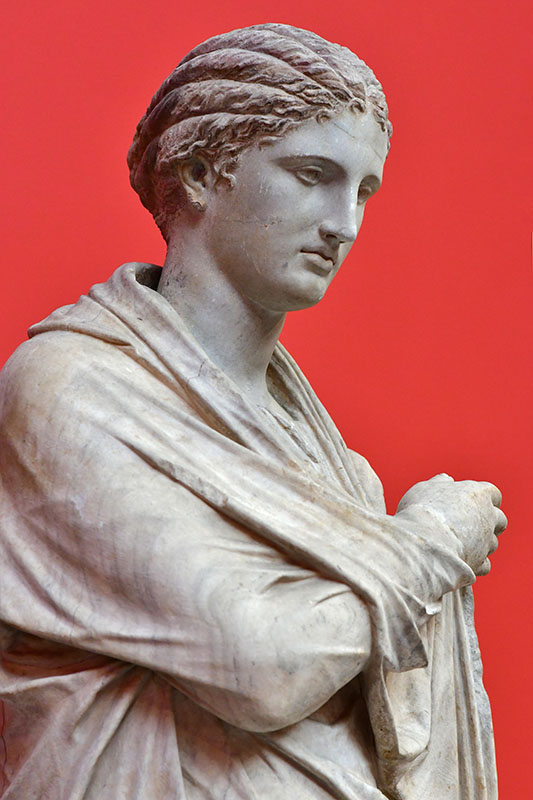
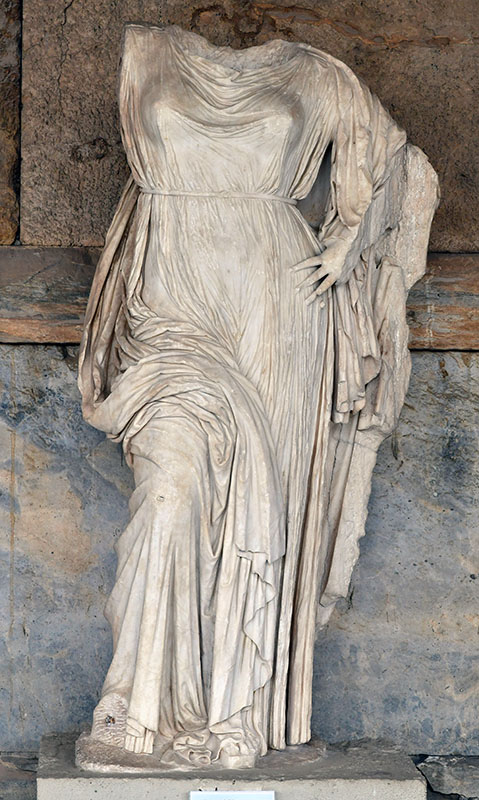
Marble female funerary statue, found on Delos, Cyclades. Copy made in the 2nd century. BC of an original dating from about 300 BC. Height 1,75 m. Displayed in the National Archaeological Museum in Athens. The female figure is rendered in the style of the Small Herculaneum Woman. She wears a full-length chiton and a himation that covers her entire body and arms. Traces of colour are preserved on the hair and the garments of the figure.

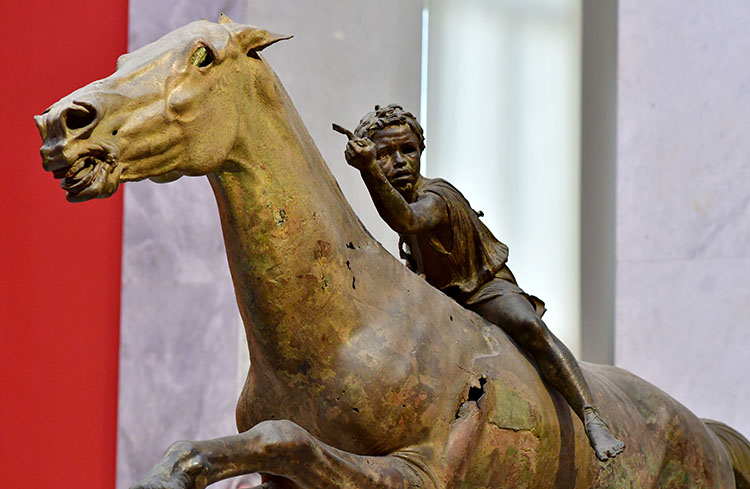
Bronze statue of a horse and a young jockey, found in the sea off Cape Artemision, north Euboea, ca. 140 BC. Displayed in the National Archaeological Museum in Athens.
Dying Trumpeter, a Roman marble copy of a bronze original of 230-220 BC in Pergamum, Rome It shows a dying Celt in a raw human pose.
Image: By Jastrow – Own work, Public Domain, https://commons.wikimedia.org/w/index.php?curid=1226315

Pergamum altar with Ionic colonnade, 180 bc, is famous for its gigantic carving of dramatic and dynamic figures in the friezes (Pergamum was the city in now present Turkey). One frieze depicted the battle of gods and giants, symbolizing Eumenes’ victories as the victories of the gods. Another frieze showed the life of Telephos, founder of Pergamum and the son of Herakles. This signified the idea of divine kingship enjoyed by Alexander the Great and later Imperial Rome.
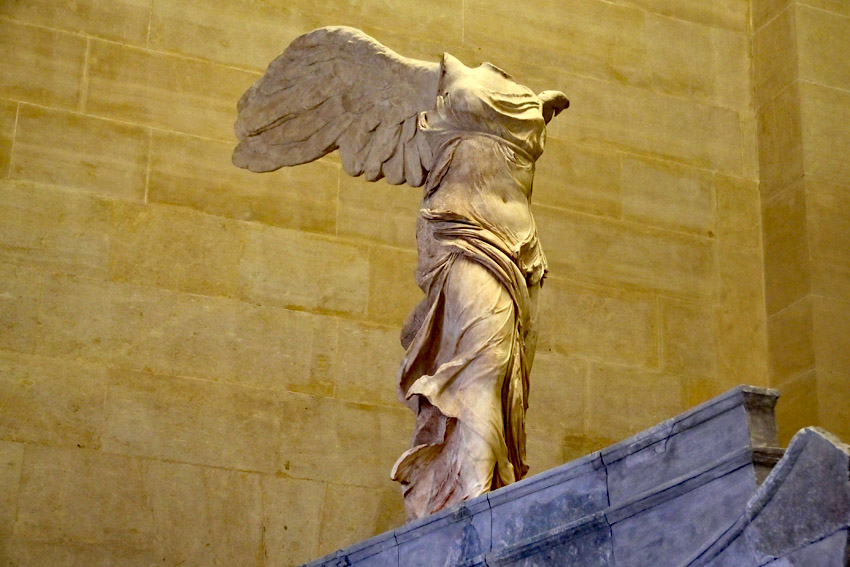
The Winged Victory of Samothrace
The Winged Victory of Samothrace by Pythokritos of Rhodes, 200-175 (1st quarter 2nd century BC), Place of creation: Rhodes (?), place of discovery: Samothrace Paleopolis, marble, the Louvre. It commemorated the naval victory of Eudamos of Rhodes over Antiochus the Great in 190 BC. The figure shows thrust and energy with wind-blown clothing, unlike earlier figures with wet drapery.
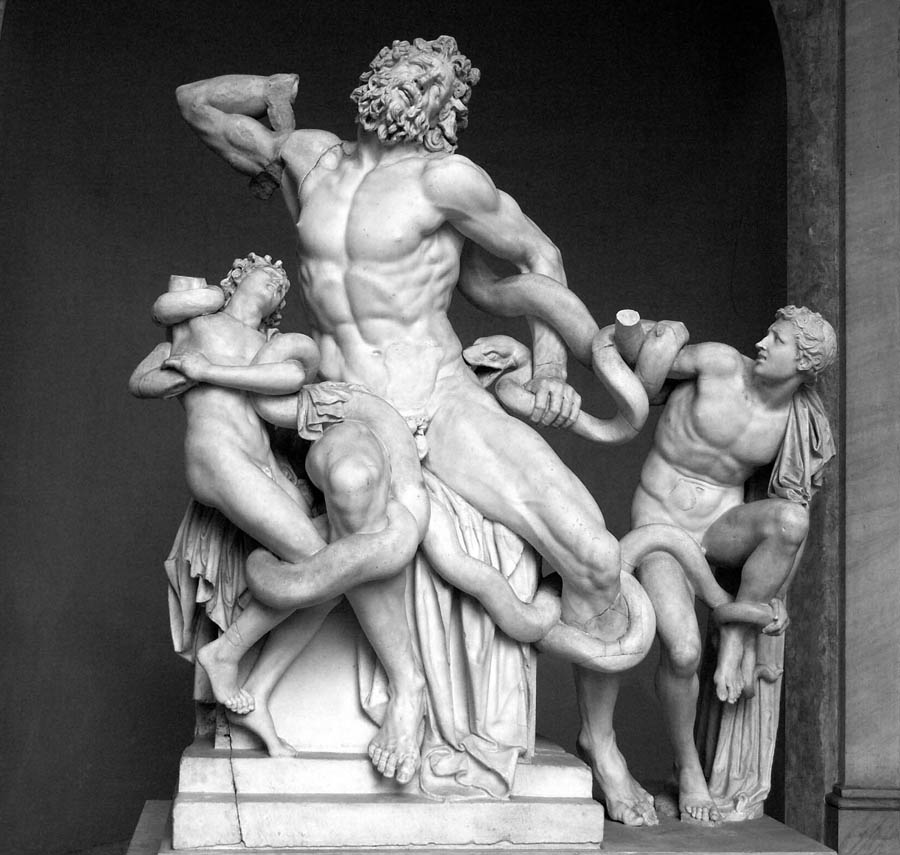
Laocoön and his sons in Vatican courtyard-veronica winters art blog
Laocoön and his sons, The Laocoon group, by Hagesander, Athanodorus of Rhodes, and Polydorus of Rhodes, 1 BCE, marble, Vatican. Discovered in Rome in 1506, the sculpture shows the death of Laocoon, the priest, and his sons in tragic agony and twisting of three figures. The gods punished Laocoon for warning the Trojans not to take the wooden horse into the city. From the History of Art. Writer Pliny mentions this fantastic sculpture in his books. The Lacokoon stood in the Palace of the Emperor Titus. Pliny described it as “a work superior to all the pictures and bronzes of the world.” Because this sculpture involved teamwork, none of the artists could claim full fame for this project.

Molossian Hound
Hellenistic art’s realism vividly captured animals, too, with many bronze animal sculptures from this era surviving only as Roman marble copies. The Molossi, an ancient people of Epirus (modern northwest Greece and Albania), bred the Molossian hound, an ancestor of the modern mastiff known for its ferocity. These dogs served as guard dogs for herdsmen and urban households. Aristophanes, the 5th-century BC playwright, humorously described the challenge of passing a Molossian guarding a doorway, and Alcibiades, the notorious Athenian statesman, reportedly owned one with a docked tail.
This sculpture, once wearing a collar, showcases the hound’s powerful jaws and teeth, yet its relaxed posture and upward gaze convey obedience. Five similar sculptures, found near Rome, are believed to be Roman copies of a lost 2nd-century BC Greek bronze original. This particular piece, dubbed the “Jennings Dog,” was acquired in Rome in the 1750s by Henry Constantine Jennings (1731–1819). (Based on a description at the British Museum)


Roman Period: Adoption & Adaptation

Roman sculpture: 1st century BC – 5th century AD

Colossal Foot, Roman, 1st-2nd century AD, marble. The right foot wearing a Greek sandal, originally part of the colossal statue of a senior god. From near Naples, presented to the British Museum by Sir William Hamilton in 1784.

I think it’s important to include art of the Roman period here because it shows a continuation and adoption of ancient Greek ideals and knowledge in sculpture and architecture to the next generation. The Romans conquered Greece in waves from the 2nd century BC to 31 BC, marking the end of the Ptolemaic Kingdom with Cleopatra’s rule. Rome’s building programs had a dual effect on Greek art. Despite losing their independence, Greek art experienced an unusual revival soon thereafter. Romans took a lot of Greek art with them to Rome, and Greek artists also relocated to the city to start anew. Greek artists’ workshops became popular among the wealthy Romans and the government to produce copies of Classical and Hellenistic artworks.

Bronze head from an over-life-sized statue of Augustus (The Meroe Head). Roman, probably made in Egypt, about 27-25 BC, found at Meroe, Sudan.

Statues of the emperor, together with images of him on coins and painted panels, were essential to imperial propaganda. They showed his far-flung subjects who he was and reminded them of his power.
This head has glass and stone eyes to make it more life-like and imposing, and was taken from a statue showing the emperor in uniform. It was discovered in 1910 during excavations at Meroe, the ancient capital of Kush in modern Sudan.
The Roman writer Strabo tells us that the Kushites invaded southern Egypt and carried off treasure, including statues of Augustus. A Roman force was sent to retrieve them, but this head escaped them, because it had been ritually buried in front of a temple. In this way, visitors to the temple would step on the emperor’s head, a sign of extreme disrespect. The Kushites intended the burial to be a sign of triumph over the Roman Empire and its emperor. But by a twist of fate, it ultimately preserved this fascinating symbol of power. (Description from the British Museum)
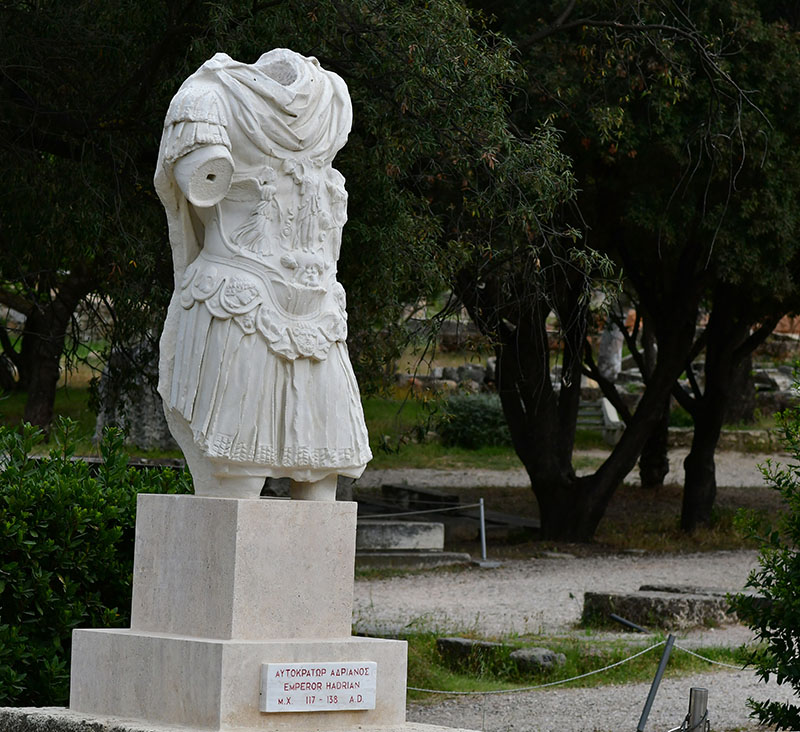
Emperor Hadrian
Emperor Hadrian, Athens

By the 2nd century AD, Athens experienced an artistic resurgence, largely due to the patronage of Roman Emperors Hadrian and Antoninus Pius. This period saw the emergence of Neo-Attic production, characterized by decorative reliefs (marble wall panels), marble sarcophagi, and trapezophora (marble table supports).

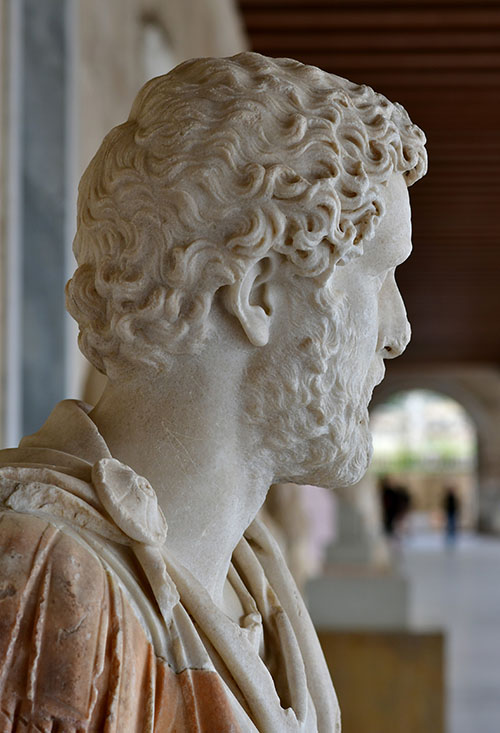
Antoninus Pius marble bust at the British Museum
Marble bust of the emperor Antoninus Pius (AD 138-161) in military dress, about 140 AD. From the house of Jason Magnus at Cyrene, North Africa. This image of Antoninus Pius was created in the early years of his reign. This bust may be a replica made in the 160s. The British Museum

Because Romans liked to co-exist with other cultures, they’ve concurred, they absorbed and built upon other societies to advance theirs. Romans were deeply impressed by Greek sculptural techniques and actively copied and collected Greek art. The purpose of art changed, however. Instead of glorifying gods, beautiful sculpture played a vital role in promoting the Roman rule. This included portraits of emperors, their families, the wealthy, and scholars. Wealthy Romans collected Greek sculptures as a sign of status and education. Some examples include the bronze equestrian statue of Octavian Augustus, discovered between Euboea and Hagios Eustratios, and the portrait of Antinous, Hadrian’s companion, who drowned in the Nile.

Apollo with kithara at the British Museum
Marble statue of Apollo holding a kithara, Roman copy of the 2nd century AD of a Hellenistic original of about 200-150 BC. From the temple of Apollo, Cyrene. The British Museum, London.

In this elaborately carved figure, the iconographical features of both Apollo and Dionysus, the wine-god, have been fused; the slipping himation and the sensual treatment of the flesh are typical of Dionysus, while the kithara and quiver characterize Apollo.

Bust statue of Athena/ Minerva in the British Museum
Marble and bronze bust of helmeted Athena/ Minerva. Found in Villa Casali in ruins in 1783, Rome. Height: 68.58 cm. The British Museum, London.
The eyes were originally inlaid with precious stones or vitrified pastes.
This is the Roman version of the 4th-century BCE Greek sculpture. The bronze helmet and drapery were restored by the sculptor Albacini, copying a bust of Athena now in the Vatican Museum.


While maintaining Greek techniques, Romans introduced several innovations and modifications:

  • Increased use of marble quarried from newly conquered territories, with advanced transportation techniques for large marble blocks
  • Development of advanced bronze casting techniques with improved metal joining methods
  • Introduction of concrete, which allowed for larger and more complex sculptural bases
  • More widespread use of realistic portrait sculptures depicting specific individuals, not idealized gods and athletes
  • Integration of historical and political narratives into sculptures
  • Creation of more elaborate narrative relief sculptures
  • Development of equestrian statues to celebrate military achievements
  • Continued integration of sculpture into architectural designs
  • Complex surface finishing techniques
bronze head Dionysus Greco-Roman at the British Museum
Bronze head of a statue of Dionysus, Roman, about 50BC-AD50. The god wears two fillets, which are decorated with vine leaves, which may indicate that this the the god of wine, Dionysus. The eye sockets were originally filled with another material, such as enamel, glass, or stone. The head is an example of the classicizing style current in the age of Augustus.

The Romans significantly contributed to our understanding of ancient Greek art by recreating sculptures from original bronze works and marble sculptures. Romans developed more efficient mass-production methods in established workshops that directly copied Greek style and techniques. Roman’s fascination with ancient Greek culture has allowed us to see otherwise lost art through their reproductions, preserving a crucial part of ancient Greek cultural heritage that would otherwise be severely limited.

The Roman army organization & its armor

The Roman Army is famous for its tactics and organization, which kept evolving depending on politics and battles. The unique feature of the Romans was to absorb, adapt, and improve the armor and tactics of their enemies. So the conquered cultures co-existed under Roman rule. The Romans did innovate in the organization of a professional army. Romans were also known for their advanced engineering skills.

So, who was the Roman soldier? The citizen was a young, fit man who worked the land in the 6th century BC. Although Romans introduced a small payment for the service in the 4th century, the soldiers had to pay for their own armor, receiving income from their business. Romans could start their service at the 17 years age of and retire late in life with another piece of land. In the 2nd century BC, Romans expanded their pay and hiring of new citizens, and generals began paying more money and land to their troops to maintain loyalty. (Based on writing at the British Museum).

Greek bronze armor-British museum
Greek bronze armor at the British Museum:
Bronze greaves with the depiction of a goddess.
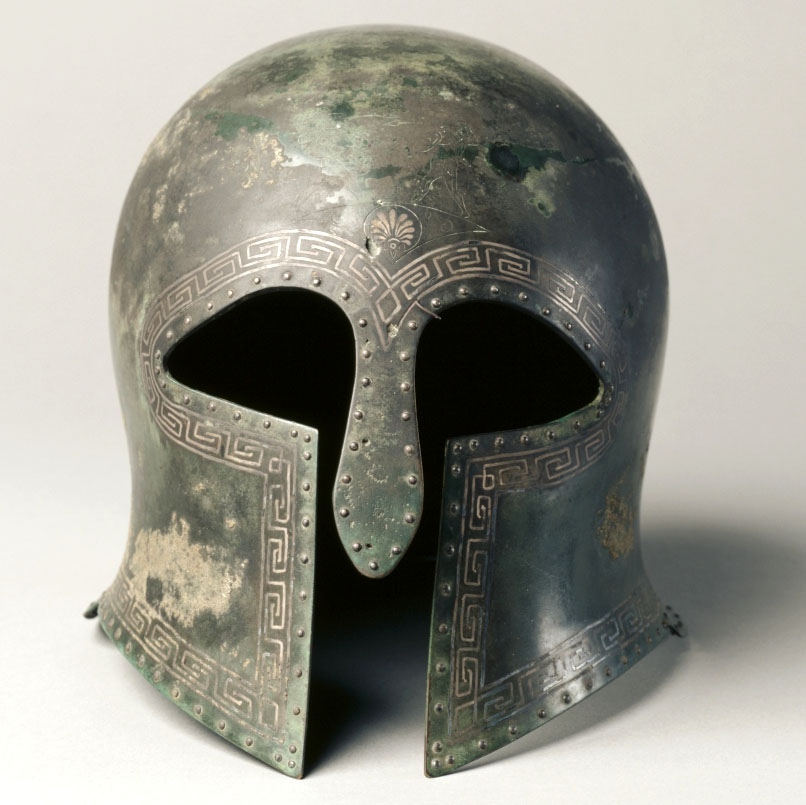
Bronze helmet of the Corinthian type (center), made in Apulia about 600 BC.
Bronze helmet of a Murmillo (right), Roman, 1st century AD,
Probably from Italy. The helmet of the Murmillo was heavy (3.5kg = approx 81b) and heavily protected, with a broad brim, angular crest, and visored front with two eye gratings. Above the brim of the helmet is a small bust of Hercules, the embodiment of bravery. When new, the helmet had a golden sheen and was
decorated with plumes.
The design of defensive armor (helmets, cuirasses and greaves) worn by the Greeks in southern Italy followed the types used on the Greek mainland and in turn influenced that worn by the Italic peoples.
From the middle of the seventh century the Greek infantry (hoplitai) fought in tightly massed ranks (phalanges). Each hoplite was equipped with a thrusting spear, sword, helmet, cuirass, greaves and round shield. Two of the early types of helmets were particularly popular in southern Italy, the Corinthian helmet, as the Greeks called it, and the Chalcidian, a modern name.
Bronze cuirasses with elaborately modelled muscles were greatly favored in southern Italy in the fourth century. They are also to be seen held by the deceased in representations of the sculptured funerary monuments (naiskoi) of Taranto. On exceptional examples the shoulder-pieces were elaborately decorated with relief figures. Greaves, which protected the shins, were also an essential part of hoplite armor. Similarly equipped heavy cavalry was equally very important in southern Italy, for there were
large plains in which it could be successfully deployed. (description from the British Museum)

Bronze statue of a satyr, Roman

Sculptures of this period are displayed at the museum in Athens:

Marble statue of Hermes, Height 1,71 m. found at Aigion, Peloponnese work of the Augustan period (27 BC-AD 14). In his right hand, he held a purse, and in his left the caduceus. The statue is a work of the Augustan period (27 BC-AD), inspired by Lysippean models of the 4th c. BC.

Marble statue of a sleeping Maenad, found at the Acropolis in Athens. The type is known as the reclining Hermaphrodite. The work expresses the Classicising trend of an Attic workshop. Length 1,36 m. Time of the emperor Hadrian (AD 117-138).

Marble portrait bust of Antinoos, from Patras, Peloponnese, AD 130-138, Thasian marble. Hadrian deified Antinoos after his death and erected numerous statues, busts, and portraits of him in various cities and sanctuaries throughout the Roman Empire.

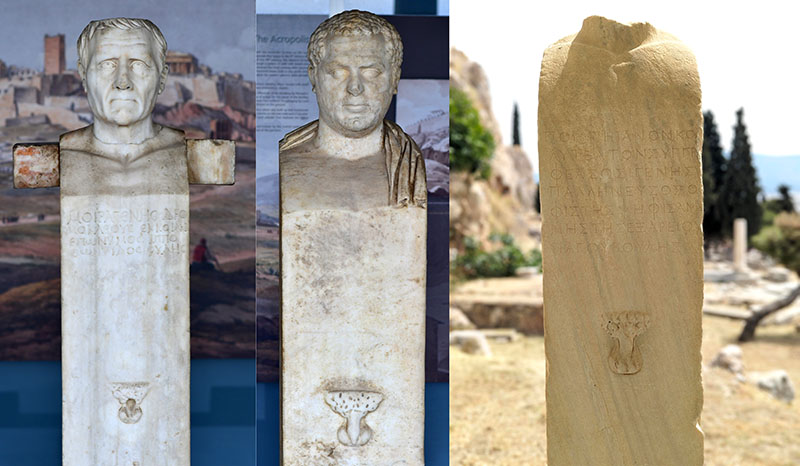
Marble herm portrait of the kosmetes (magistrate) Sosistratos, from Athens AD 141/42, the stele, Height 1,94 m.

Part of the marble grave stele of Alexandra, found in the ancient cemetery of Kerameikos, Athens, Time of the emperor Hadrian (AD 117-138). Height 1,69 m. As a priestess of Isis, she is depicted in the dress and with the symbols of the goddess: the himation, on her breast with a characteristic knot, and the kados (ritual vase) in the left hand. The frequent representation of figures accompanied by Isis’s symbols on reliefs of Roman times attests to the wide dissemination of the cult of the Egyptian goddess in Greece at that time.

Marble statuette of Ephesian Artemis, 1st c. BC, Height 0,78 m.. Artemis was worshipped by the Greeks as the great goddess of nature and patron goddess of animals. Her dress is adorned by fertility symbols (28 breasts), figures of Nike, griffins, sphinxes, and bees. Lions sit on the goddess’s arms.

Bronze statue of the emperor Augustus (27 BC – AD 14), Height 1,23 m. The aging emperor is about to ride a horse. He’s dressed in a tunica with a vertical purple stripe and a fringed paludamentum decorated with a maeander pattern. The right hand shows an official greeting. On the bezel of his finger-ring a staff of divination (lituus) is engraved, symbolising the supreme religious office of Pontifex Maximus, assumed by Augustus in 12 BC.

Roman period at the National Archeological Museum in Athens: https://www.namuseum.gr/en/collection/romaiki-periodos/

Conclusion:

Masters such as Myron primarily focused on capturing dynamic movement, often in the context of athletic subjects, effectively utilizing the fluidity and tensile strength of bronze to achieve poses that conveyed a sense of arrested motion.

Phidias, on the other hand, aimed for an idealized representation of both human and divine forms. His approach was grounded in a deep understanding of anatomical structure, which he executed with meticulous attention to detail using a diverse range of available materials, including the chryselephantine technique and finely worked marble.  

Polyclitus developed a comprehensive theoretical framework for achieving ideal human proportions, utilizing mathematical principles as the foundation for his art. His primary medium was bronze, and his subjects were often athletic figures, perfectly embodying the balance, beauty, and harmony he sought to represent.  

The Late Classical period witnessed a shift towards more humanized and sensual portrayals of the divine, exemplified by the work of Praxiteles. His focus was on achieving natural poses, grace, and delicate forms, primarily working in marble to capture the soft contours and smooth surfaces that characterized his elegant style.  

Scopas introduced a new dimension to the pursuit of realism by emphasizing the intense emotions in his marble figures. His work conveyed a strong sense of drama and pathos, moving beyond the more detached, idealized expressions seen in earlier sculpture.  

Lysippus marked the transition into the Hellenistic era with his distinct focus on lifelike naturalism. His figures had slenderer proportions, 3D view, and individual character, predominantly working in bronze to achieve a sense of immediacy and engagement with the viewer.  

Bronze folds of a cloak, decorated with a Maeander pattern, inlaid with strips of copper, made in Taranto, 470-450 BC, the British Museum

The evolution of realistic sculpture in ancient Greece reveals a continuous artistic dialogue and the pursuit of excellence, where each generation of sculptors built upon the achievements and explorations of their predecessors. This progression demonstrates an artistic journey, moving from the initial attempts to capture the essence of motion by artists like Myron to the pursuit of idealized forms grounded in correct anatomical representation by Phidias and Polyclitus. The Late Classical period then saw a shift towards a more humanized and sensual representation of the divine with Praxiteles, followed by Scopas’s unusual exploration of intense feelings. Finally, Lysippus ushered in the Hellenistic era with his emphasis on lifelike naturalism and the portrayal of individual character. Most sculptors worked in specialized workshops, and apprentices would assist master sculptors. Techniques were closely guarded and passed down through generations of artists. Most sculptures were commissioned by wealthy patrons or for religious purposes. This continuous development highlights an artistic commitment to representing the divine nature through perfection in human form. The changing preferences in materials, from the prominence of bronze in the Early and High Classical periods to the greater utilization of marble in the Late Classical and Hellenistic eras, likely reflect a combination of factors. These could include advancements in sculpting techniques, such as improved methods for quarrying and carving marble, as well as shifting aesthetic ideals and a growing appreciation for the unique tactile and visual qualities offered by different materials.


The Colored Pencil Manual

How to Color Like an Artist
colored pencil manual veronica winters
https://amzn.to/3xoJjbi

Materials and Techniques in Detail: The Artist’s Craft of ancient Greek sculptors. How they assembled the pieces

Bronze statue of a young man at the British Museum

Marble

As a material, marble found its use before bronze, and it was often used alongside other materials. Marble was a highly favored material in ancient Greek sculpture, prized for its fine grain and its capacity to be polished to a high sheen. These qualities allowed sculptors to achieve delicate details and exceptionally smooth surfaces, contributing to the realistic depiction of skin and drapery. Different varieties of marble, such as the close-grained and sparkling marble from Naxos, the rougher-grained and more translucent Parian marble, and the more opaque Pentelic marble that developed a honey color with age, were favored for their unique features. For larger marble sculptures, it was common practice to sculpt the figures in separate sections, such as the head, limbs, and torso, which were then joined together using dowels made of metal or stone. It appears that ancient Greek sculptors used different techniques to create their art, and I include video illustrations of marble carvings below. One is carving from a plain marble stone, and another method is actually making a clay model and then casting it.

Ancient Greeks and then Romans painted the marble in bright colors, dressed the figures in clothes and jewelry, floral garlands, and perfume to create a multidimensional experience to revere the gods in rituals like the one in Delphi.

Perfumed marble sculptures:

Recent research in archaeology is revealing a surprising aspect of ancient marble sculptures: they were often perfumed. This discovery challenges the modern perception of these artworks as purely visual objects. Ancient Greek and Roman statues were designed to engage multiple senses, not just sight. Perfuming statues, particularly those of deities and royalty, was a significant practice with religious and symbolic meaning. This practice helped to make the sculptures appear more lifelike and to honor the gods and goddesses they represented. The evidence comes from various sources: Writers like Cicero and Callimachus describe rituals involving perfumed statues. Inscriptions found at sites like the Sanctuary of Delos detail the ingredients and costs of perfumes used for statues of deities. Traces of beeswax have been found on statues like the portrait of Queen Berenice II, suggesting they underwent perfuming treatments. The discovery of perfume workshops in ancient sites also supports this practice.

Application: Ancient texts describe methods like ganosis, which involved coating statues with waxes and fragrant oils (such as olive oil and beeswax) to enhance their aroma and preserve their surface. Applying perfumed oils and waxes with sponges or by rubbing them in was also a practice known as kosmesis.

Scent: Common scents included those made from roses, beeswax, and olive oil. Dioscorides, a Greek physician, provided a recipe for myron rhodinon, a rose-scented perfume.

In summary, the archaeology of perfumed marble sculptures today reveals a richer, multisensory understanding of ancient Greek and Roman art and the rituals surrounding it. 

Source: The Scent of Ancient Greco-Roman Sculpture by Cecilie Brons, Oxford Journal of Archeology.

Marble Sculpting Techniques:

The creation of marble sculptures relied heavily on carving techniques. Sculptors utilized a variety of tools, including chisels of different sizes and shapes, hammers to drive the chisels, and drills for creating detailed work. The techniques differed depending on the time period and scale.

While many sculptures appear monolithic, large-scale works were often assembled from multiple pieces. There’s still some debate about the exact assembly techniques used. Scholars rely on archaeological evidence, tool marks, and remaining fragments to piece together the construction methods. Some of the techniques included:

  • Tenon and Mortise: This joinery technique involves creating a projecting peg (tenon) on one piece that fits into a corresponding carved recess (mortise) on another. They might have used dowels or pins for additional reinforcement.
  • Metal Braces: Bronze clamps or pins could have been used to secure different pieces together, especially for sections with complex angles or under heavy stress.
  • Wet-drapery Technique: For figures with flowing drapery, sculptors might have created the drapery folds in wet clay and then used these clay models to guide the sculpting of the marble pieces. After carving the individual sections, they would be assembled to form the final figure.
Marble carving tools and techniques displayed at the British Museum:
1. Two wedges, Greek, 6th-4th century BC, from the site of the Temple of Artemis at Ephesus, western Turkey. Wedges were used for splitting stone in a quarry or for reducing large blocks of stone on site.
2. Punch-chisel, Greek, about 350-340 BC, from the sanctuary of Athena Polias at Priene, western Turkey
Used for rough dressing of stone.
3. Pick-hammer, Greek or Roman. Said to be from a quarry on the island of Thasos, northern Greece
Fitted with a short handle, this is an effective tool for the rough shaping of blocks in the quarry.
4. Marble angle-molding with an Egyptian motif, Greek, about 535-500 BC From the second Temple of Apollo at Naucratis, Egypt. Sculpture and architecture were enhanced with added color. Here, traces of blue have been applied over a base of red.
6-8. Fragments of molding from the mausoleum at Halicarnassus, Greek, 350 BC
Wooden Mallet, Egyptian, 1300BC

The Stone-Carver:

  1. The stone-carver’s tools in ancient Greece were about the same as they are today. The work began at the quarry, where rough shapes emerged as trenches were cut around the stone blocks with wedges. Much lighter, the stone journeyed to the workshop next. Artists paid attention to the marble quality while selecting the stone, and typically quarried from places like Mount Pentelicus near Athens.
  2. To develop the figure, artists created sketches and clay models. Then, they’d transfer the line drawing onto the marble. Once the drawing (probably with the grid) was on the stone, they used it as a guide to carve out the drawing.
  3. Artists roughed out the stone with a metal point, struck by a wooden mallet, to chip away excess. A claw chisel refined the surface, and the flat chisel removed the marks. Tools: They used various chisels (pointed for rough shaping, flat for smoothing surfaces, and toothed for texture and detail) to rough out the basic shape. They also used hammers and abrasive stones. Smaller, more precise chisels were used for detailed work like facial features and muscle definition. There were compasses and measuring instruments like calipers used for precise measurement. Other instruments included punches for fine details and drills for making holes, and some details.
  4. To create the flowing drapery or architectural curves, craftsmen used a rounded chisel. For deep-fold carving, they used a bow drill. The process was incredibly time-consuming, often taking months or even years for a single sculpture to make.
  5. For marble’s final glow and smoothness, artists used a rasp or even emery to achieve a high polish of the sculpture.
  6. In ancient hands, sculptures came alive with color. Many ancient Greek sculptures were not left as plain white marble but were often painted in vibrant colors called ‘polychromies’. Paint might highlight a detail, pattern or cloak the entire form in vibrant hues. Even the “white” of flesh was often covered in wax or resin. “Polychromy” means “many colors” in Greek. You can read about the sculptures’ color in Ancient Greece here.

How ancient Greeks carved heads in antiquity: According to the Met, the head of a statue in antiquity (4th century BCE) was often carved separately from the body of the statue. The head was made with a convex tenon that would be set into a specially prepared cavity in the statue. The juncture of the head and the body was concealed by a line of drapery.

Bronze

bronze model of a chariot wheel
Bronze model of a chariot wheel (left). The British Museum. Greek, 6th century BC, said to have been found near Argos. This was dedicated to Zeus by Eudamos to celebrate the winning of the race, probably in the Nemean Games (left).
Bronze model of a chariot wheel from the Temple of the Kabeiroi at Thebes, Greek, 5th-4th century BC (right). This was dedicated by Xenon Pyrrhippa to the Kabeiros and his son, presumably as a token of gratitude for a winning race. There is little known about the Kabeiros, as they were worshiped in cults as protectors of fertility and seafaring and had a connection to blacksmiths.

Bronze was another highly valued material in ancient Greek sculpture, prized for its strength and versatility. Its inherent durability and flexibility once molten made it particularly suitable for creating dynamic and delicate work, especially for capturing the illusion of movement. The lost-wax casting technique was the prevalent method for producing bronze statues. This process involved creating a model of the sculpture in wax, encasing it in clay to form a mold, melting out the wax, and then pouring molten bronze into the resulting cavity. For larger bronze figures, individual parts were cast separately and subsequently joined together, showcasing the incredible skill of ancient metalworkers.  If you watch the videos of contemporary artists doing bronze casting, you’ll see how labor-intensive and difficult the process is.
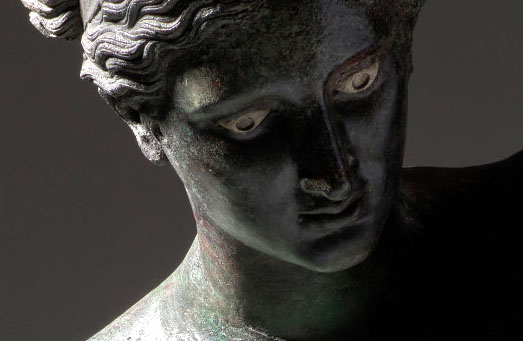
https://clevelandart.org/art/2004.30

Additionally, ancient Greeks sometimes incorporated inlaid eyes made of bone, crystal, or glass to enhance the lifelike appearance, and added accessories made of metal, like you see in the picture above, the Cleveland Apollo.  

Bronze statue of cupid dancing, Roman, the British Museum

Bronze Casting Techniques:

The Cleveland Apollo Apollo Sauroktonos
The Cleveland Apollo Sauroktonos (Lizard-Slayer) or Apollo the Python-Slayer
c. 350–200 BCE

The Cleveland Apollo at the Cleveland Museum of Art is a rare example of a large-scale ancient bronze sculpture of such high quality. Lifelike hair, fingernails and inlaid copper lips and nipples show incredible artist’s skill and talent. Cast in hollow bronze sections using the indirect lost-wax technique, this Apollo is attributed to Praxiteles (Greek, c. 400–c. 330 BC). Bronze, copper, and stone inlay; 150 x 50.3 x 66.8 cm. According to the museum, the Cleveland Apollo is the only surviving large-scale bronze sculpture of its type, Apollo Sauroktonos (the Lizard-Slayer). You can read about the investigation of bronze casting methods here.

Greek bronze tools for carving and measurement:
Bronze flat chisels originally fitted to wooden handles, Greek (left), Probably Roman, From Southern Italy,
Greek Bronze Age, From the island of Saria, Greece; Probably Greek, Said to be from Ephesus.

Bronze tools of the kind used by masons and stone-carvers in setting out their block (right)
Stylus for marking the surface, Greek Bronze Age, 1400-1200 BC, From Ialyssos, Rhodes, Greece.
Dividers, probably Roman, 1st century AD; Cat Bronzes, Roman, 1st-3rd century AD, from Ephesus, western Turkey.
Greco-Roman bronze casting techniques: gilt bronze arm, Roman, 2-3d century AD found in a well near Rheims, France. Gold leaf was glued and burnished to the surface to create a unique, golden patina for the statue.

Bronze casting method:

For bronze sculptures, the lost-wax casting process was fundamental. After casting, finishing techniques such as scraping, fine engraving, patina coloring, and polishing were employed to refine the surface and add further details.

  1. A clay core was first sculpted in the desired shape and wax was carefully applied over it. Once the details were completed, the wax model was disassembled into pieces to facilitate casting in bronze.
  2. Wax rods were attached to the exterior of each wax piece, and the interior was packed with clay.
  3. The sculpture was covered in clay, creating a mold, and the wax was melted out.
  4. Molten bronze was poured in through the channels- hollows left by the wax rods, melting the wax (hence “lost-wax”).
  5. Once cooled, the clay mold was broken from the exterior to reveal the bronze sculpture.
  6. Multiple bronze pieces were joined together by fusion welding or soldering techniques—heating the edges of the pieces and using more molten bronze to unite them. Polishing and patina application finished the work

Getty Museum has an excellent, simple, visual explanation of The Lost-Wax Casting Technique. A sculpture is molded in wax in multiple pieces, which is then melted away and replaced by molten metal.

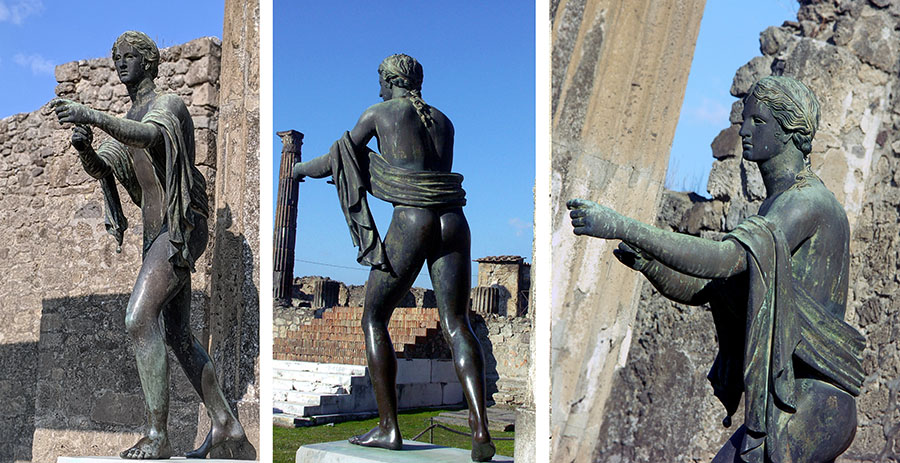
Direct vs indirect bronze casting techniques for hollow-cast bronzes shown at the British Museum. The advantage of the Indirect lost-wax method Tis that the original model can be preserved, so that further castings can be attempted in the event of failure, or if more copies are required.

Apollo the archer in Pompeii
Apollo in Pompeii, A statue of Apollo, the archer, was one of the first large-scale bronzes to be excavated at Pompeii, Italy. It was found in fragments in 1818, centuries after the city was destroyed by the eruption of Mount Vesuvius in A.D. 79.

Other Materials:

While marble and bronze were the most prominent materials, other materials also played a role in ancient Greek sculpture. Wood was likely used, particularly in earlier periods, although few examples have survived due to its perishable nature. For the creation of highly revered cult statues, the combination of gold and ivory, known as chryselephantine, was employed. Greeks also used terracotta, a type of fired clay, for crafting smaller figurines and numerous decorative vases. Greeks used limestone as well. 

The Goldsmith and Silversmith
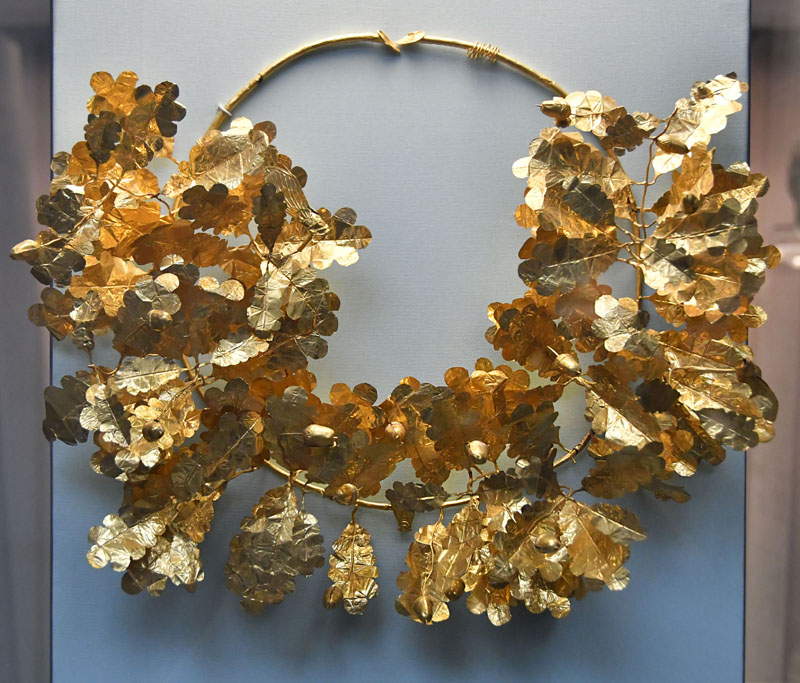
Dardanelles Tomb Group, Gold oak wreath with a bee and two cicadas, 350-300 BC.

The oak wreath and belt were acquired in 1908 from a dealer who reported that they came from the same tomb, somewhere on the Dardanelles. Another gold oak wreath was discovered in a tomb in what was probably the same area, at Coban Tepe, near Pinarbasi on the north coast of Troy in March 1887. The tumulus contained a rectangular, stone-lined chamber in which were also found three embossed gold strips, myrtle sprigs. a bronze mirror, a bronze bowl, and an alabaster alabastron.
Each branch, made of sheet gold tubes, has six sprays with eight leaves and seven or eight acorns, as well as a cicada. Perhaps the most famous oak wreath is that from a tomb at Vergina, identified as the tomb of Philip II. Another comes from the nearby Prince’s tomb. A particularly fine example was discovered in a tumulus at Pergamon.
Such wreaths were regularly made to be worn in life, usually in religious processions, as those reported to have been made for Demosthenes by the goldsmith Pammenes, son of Pammenes of Erchia, who had a workshop near the Athenian Agora. Gold wreaths were also given to winners in musical contests at the Panathenaic Games in Athens, as well as money, at least by the end of the fifth century BC.

Highly refined gold jewelry was highly valued and in demand. A soft metal, gold was shaped by a variety of processes. Gold and silver were worked into jewelry in sheet form, as wire, or in cast sections. Artists often combined all three methods to create a single jewelry piece with soldering. They also embellished the surface with filigree or granulation designs.

The Herakles knot, Roman Jewelry. Ancient Greeks believed that this bracelet type could cure wounds and had the power to avert evil.
Stoic, colored pencil drawing, Veronica Winters. I used the symbol of the Herakles knot on the jewelry decorating the cat.


Early work featured gold beaten into sheet metal with raised decoration (repoussé). The simplest repoussé consists of denting the surface with a blunt instrument. Other methods include stamping the gold with a punch or beating it into a mold. Another way of shaping sheet gold was to beat it over a core.
A model was first made in wood or bronze, and the gold was then worked over it.
Golden wire was common in ancient jewelry pieces. Craftsmen made it from thin blocks
of metal twisted and stretched to the diameter required and then rolled between plates of stone
or bronze. (Based on the description from the British Museum)

Greek & Roman Jewelry Pieces, the British Museum

The Seal-stone Engraver:

Engraver’s bow-drill and cutting wheel. The British Museum.
A gemstone, carved with care, becomes a seal when pressed into soft clay or wax. Seal manufacture was the primary goal in ancient Greece, but they also shimmered as amulets, and others glowed as pure adornment. From Minoan culture through the Roman era, artisans shaped these stones. As Minoans used seals to label goods, seals helped with attribution in later years. Craftsmen chose vibrant, precious gems for their hues and stone strength. Most were etched in intaglio, designs sunk deep in the stone like a mold. Later, in Hellenistic and Roman times, cameos rose figures carved in relief. These stones, too hard to carve with simple tools, demanded a delicate balance of drills or tiny cutting wheels, spun by a bow. After dusting the surface with an abrasive powder, the drill’s grinding carved the art. Some gems, pierced, dangled as amulets or twirled in swivel rings. Some rings had gold settings.

Ancient Greek sculptors achieved their anatomical accuracy through several techniques:

  1. Greek Philosophers and mathematicians developed theoretical frameworks for ideal human proportions that showed harmony and beauty in everything. You can find out about their ideals in my article about ancient Athens. The athletic body represented heroism and divinity, showing character represented in gods and the ideal human form.
  2. Greeks made extensive studies of human anatomy via observation at athletic contests and gyms. Artists probably did a lot of life sketching and clay modeling of those athletes to gain a thorough understanding of human anatomy. Polykleitos created the “Canon of Proportions” for himself and others to create perfect, anatomically correct figures. Every classically trained artist goes through this rigorous period of anatomical study of the figure, drawing people from life in different poses and angles to gain knowledge and skill.
  3. Ancient Greek artists used precise measurement techniques and instruments, such as compasses, calipers, plumb lines, grids, and standard units in measurement.

A combination of these methods allowed artists to create idealized versions of human beings.

Conclusion: The choice of material played a crucial role in shaping the artistic possibilities and the ultimate aesthetic qualities of the sculptures. Marble, with its fine texture, allowed for the creation of delicate details and smooth, polished surfaces, contributing to the realistic rendering of skin and soft contours. I think marble has a beautiful surface and luminosity, perfect for the depiction of people. In contrast, bronze, with its inherent strength, enabled sculptors to explore dynamic movement in poses that would be hard to achieve in marble (because of its softness). However, bronze doesn’t have the same visual appeal as marble does. The bronze surface looks heavy and doesn’t imitate the skin’s luminosity. Perhaps ancient Greek artists used specific patinas to compensate for that. No doubt, marble is a very soft material, and sculptures broke off quite easily (because of this limitation, marble sculptures usually have support near the leg or arm), while the art made of bronze was incredibly durable and stood the test of time. The distinct properties of each material thus guided the artists’ creative processes, placement of pieces, and influenced the visual language of their art. In any case, each material the Greeks used required incredible talent and skill to create sculptures. Some art museums and institutions do extensive research of past techniques. Some academic research continues to uncover ancient methods. Advanced imaging like X-ray and CT scans reveals internal sculpture structures, and digital reconstruction allows detailed analysis of creation processes that let us understand ancient techniques today.

A list of museums and institutions that offer detailed insights into ancient Greek sculpture creation:

The British Museum Interior
  • The British Museum (www.britishmuseum.org)
  • The Louvre Museum (www.louvre.fr/en)
  • Archaeological Institute of America (www.archaeological.org)
  • The Metropolitan Museum of Art (www.metmuseum.org) + Metropolitan Museum of Art YouTube Channel
  • Perseus Digital Library (www.perseus.tufts.edu)
  • Ancient History Encyclopedia (www.worldhistory.org)
  • The Getty Museum (www.getty.edu) + The Getty Conservation Institute YouTube Channel

IF YOU LIKE READING MY ARTICLES, PLEASE CONSIDER CONTRIBUTING BY SHOPPING AT MY ART STORE! THANK YOU!

Visit Visionary Art shop and art gifts!
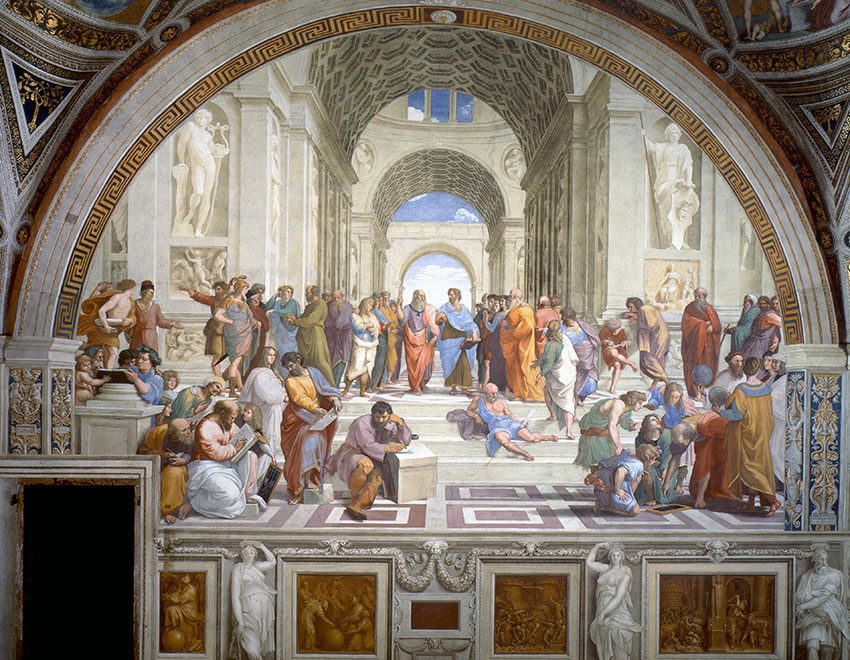
The GODS of Ancient Athens: where Art, Astrology, Architecture and Mythology meet the Divine

This article is based on my trip to Greece with some information coming from Greek sites and books (links are included). I spent two months collecting and presenting the information here I hope you’ll find it useful to satisfy your curiosity to the max! Here, I delve into the world of ancient Greece to uncover the secrets of the gods of ancient Greece. I look at ancient architecture, Aristotle’s philosophy, the Antykithera mechanism, mythical creatures, archeological discoveries, ancient Greek lifestyle, and much more!
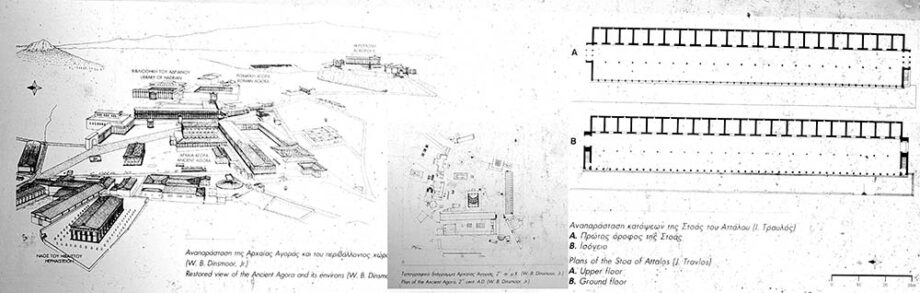
The Gods of Olympus as the Divine in Marble: A Sculptural and Astrological Exploration

Athena flanking the column at the modern academy of Athens.

Did you know that ancient Greeks had no holy books? Religion was taught through the act of worship. Ancient Greeks believed in the power of fate that was predetermined by the gods. This notion let them create stunning temples, festivals, and rituals worshipping gods. Ancient Greeks went to battles following oracles, commemorated wins in memorials to gods, and discovered mathematical principles used in architecture that reflected the divine harmony of the cosmos. Their philosophical view of the world and the pursuit of ethereal beauty in art paved the way for the Italian Renaissance many centuries later. We can argue if the beauty and power of ancient Greek classical sculpture was surpassed by Michelangelo or Canova, but one thing is clear. Ancient Greece was an advanced civilization with philosophical views on democracy, art, astrology, and god’s power that may as well rival our society today.

Attributed to the Nikon Painter, Terracotta lekythos (oil flask), ca. 460?450 B.C., Terracotta, H. 15 in. (38.1 cm). The Metropolitan Museum of Art, New York. Gift of Mr. and Mrs. Leon Pomerance, 1953 (53.224)

I was always inspired and puzzled by the divine skill of ancient Greek artists able to depict human form with such perfection and naturalism. Their strive for visual harmony in sculptures depicting gods was expressed through the mathematical principles, novel poses, and perfect proportions they believed reflected the divine cosmic order. Every ancient civilization tried to explain the origins of our existence in the Universe. It’s not a surprise that ancient Greek myths took a central stage in the lives of regular people. A combination of pagan deities and the Olympian gods probably came from the Near East but the Greek gods and goddesses were often unfair and capricious although powerful and divine. Greek gods and goddesses are reminiscent of regular people with their flaws, wants, and beauty. Also, the names of the gods relate to some planets in astrology. For instance in myths, Zeus (Jupiter) is immovable. Apollo (the Sun god) ran in his chariot. Hermes (Mercury) was a messenger running on tasks. The god of war, Aries was a lover of Aphrodite (Mars-Venus relationship). Let’s explore a few of these gods depicted in ancient sculptures found in Athens and beyond.

Diadomumenos athlete marble-veronica winters art blog
Diadomumenos athlete, marble, 100 BC copy of the famous statue of the “Diadoumenos” made by Polykleitos, about 450-425 BC.

There were 5 famous ancient Greek sculptors: Phidias (c. 480-430 BCE), the designer of colossal Athena in marble, gold and ivory and chief sculptor of the Parthenon in Athens. Myron (c. 480-440 BCE) who developed advanced bronze casting methods. Polykleitos (c. 450-420 BCE) created precise, mathematical ratios and proportions to depict human figure. Praxiteles (c. 400-330 BCE) was the master of realistic marble sculpture, many of which are in the Louvre including Venus. Lysippos (c. 390-300 BCE) was the official sculptor to Alexander the Great who made naturalistic bronze sculptures. 

Zeus

bronze statue of Zeus in Athens

The bronze statue of Poseidon or Zeus, 2.09 meters tall, is displayed at the National Archeological Museum of Athens.

Zeus (Jupiter), the king of the gods in Greek mythology, was the ruler of Mount Olympus and the god of the sky, thunder, lightning, law, order, and justice. He was the son of the Titans Cronus and Rhea and overthrew his father to establish his powerful rule over everything. (Cronus knew about the prophecy that one of his children would kill him, but Zeus escaped his fate because his mother hid him from Cronus when he was born.) After the defeat of his father, Zeus divided the universe with his brothers Poseidon (Neptune), ruler of the sea, and Hades (Pluto), the god of the underworld. Zeus was a powerful god, often holding a thunderbolt in his hand. He was known for his numerous love affairs, both with goddesses and mortal women, which resulted in a large number of offspring, many of whom became important figures in mythology. While revered as a supreme god, Zeus was not without his flaws. He could be impulsive, capricious, and unfaithful to his wife, Hera, whose jealousy and vengeance were legendary. He fathered numerous children with other goddesses and mortals, including Ares (Mars, the god of war), Hephaestus (Vulcan, the god of armor and the forge), and Hebe (the goddess of youth) with his queen. Despite these shortcomings, Zeus had unlimited authority and was the ultimate arbiter of fate and a symbol of divine power. His influence permeated every aspect of Greek mythology and culture.

bronze statue of Zeus in Athens
The bronze statue of Poseidon or Zeus, 2.09 meters tall, is displayed at the National Archeological Museum of Athens. Found in the sea area near Cape Artemision, Northern Euboea. About 460 BC, early Classical period. The King of the gods is depicted in a wide stride, possibly holding a trident or a thunderbolt. His face used to have inlaid ivory eyes, silver eyebrows, and a copper mouth. The original bronze statue is a rare survivor, depicting the god in the Severe Style (480-450 bc) by an unknown sculptor.
The bronze statue of Poseidon or Zeus fragment
Zeus is often depicted symbolically as a big and muscular man with a lightning bolt, scepter, and an eagle. Often associated with the planet Jupiter, Zeus also represented the supreme cosmic order. In astrological interpretations, Jupiter was linked to expansion, wisdom, and divine authority. Sculptural representations typically showed Zeus with an eagle, a constellation symbol representing his power over the heavens. The Statue of Zeus at Olympia (one of the Seven Wonders of the Ancient World) depicted him seated on a throne, embodying celestial majesty.

The Temple of Olympian Zeus

Temple of Olympian Zeus Athens with column at veronica winters art blog
The Temple of Olympian Zeus in Athens (left), its Corinthian order column (right).

The Temple of Olympian Zeus is located not far from the Acropolis Hill in Athens. Today the temple consists of a few Corinthian columns in a restoration mode and a couple of free-standing ones on a vast and empty field. So while there’s not much to see there visually, we can appreciate a historical place of power and worship.

The Temple of Olympian Zeus, also known as the Olympieion, was a construction spanned centuries, beginning in the 6th century BC and completed in the 2nd century AD under the Roman Emperor Hadrian. He adorned it with statues and a massive gold and ivory statue of Zeus, making it a symbol of both Greek culture and Roman power. Construction first began under the rule of the Athenian tyrants, who envisioned a temple that would surpass any other in the ancient world. However, the project was abandoned several times due to political upheavals and wars.


Made of Pentelic marble, the finished temple consisted of 104 towering Corinthian columns, each 17 meters (56 feet) tall, making it one of the largest temples in the ancient world.
Unfortunately, the temple’s splendor was short-lived. It was looted and damaged during a barbarian invasion in the 3rd century AD, and likely never fully repaired. Over time, it was further ravaged by earthquakes and the removal of building materials for other construction projects in the city.

altar of Zeus-Athens
The altar of Zeus near the Hephaestus temple in Athens

Hera

Hera (Juno), the queen of the gods in Greek mythology, was the wife of Zeus. She was the goddess of marriage, women, childbirth, and family. While a powerful and majestic figure, Hera is often portrayed as jealous and vengeful, particularly towards Zeus’s numerous lovers and illegitimate children. She relentlessly pursued them, often inflicting harsh punishments. Despite this shortcoming, Hera was also revered as the protector of married women and a symbol of marital fidelity. She was a key figure in many myths and played a significant role in the Trojan War, often siding with the Greeks. Hera’s complex character, embodying both regal power and fierce resentment, makes her one of the most compelling goddesses in the Greek pantheon.

This fragmentary sculpture of the head of Hera was found in Argive Heraion. Made of marble, it’s on view at the museum in Athens. This statue comes from the Temple of Hera made in the workshop of Polykleitos in 420 BCE.
Hera, Queen of the gods, was often depicted wearing a crown and holding a staff.
Video Part 1.
If you’d like to skip to chapters: 00:00 Intro 01:07 #1 The Gods of Olympus as the Divine in marble and Bronze 01:13 Zeus, the god of all gods & the Temple of Olympian Zeus in Athens 01:47 Hera, wife of Zeus 01:58 Athena & the sculptures of Athena inside the Parthenon and on the Acropolis Hill 03:08 Aphrodite & her depictions by famous artists in ancient art world 03:58 Apollo, the god of prophecy & music 04:50 Artemis, celestial goddess of the Moon and the hunt 05:17 Dionysus, the god of wine & the theatre of Dionysus in the Acropolis Hill 05:55 Hermes, the messenger god 06:13 Demeter, the goddess of harvest 06:28 Hephaestus & the Temple of Hephaestus in Athens 07:16 Asclepios, the god of medicine, & the temple of Asclepios in the Acropolis 08:09 #2 Philosophy of Aristotle about cosmos, beauty, reality & art 08:13 the Lyceum of Aristotle in Athens 08:36 Aristotle’s view of reality 08:51 Aristotle’s cosmology 09:09 Aristotle on Beauty in Art 09:33 #3 Discovering the origins of our constellation system & zodiac 09:34 Ancient Greek discoveries & history 10:46 Ancient Greek Technology that still baffles scientists: the Antikythera mechanism

Video part 2: released on March 29 https://youtu.be/SuPsFSTzUFY Part 2: the Secrets of Acropolis Hill revealed: Timestamps: 00:00 About part 1: ancient Athens 00:24 #4 decoding the divine in the architecture of the Acropolis Hill 00:34 Conversion of the Acropolis into a sacred space in ancient history of Athens 01:48 Unveiling the history and beauty of the Parthenon 01:55 the Parthenon’s art sculptures & ancient Greek Temple structure 04:31 The optical illusion and secrets of the Parthenon’s geometry 05:04 Goddess Athena, her sculpture inside the Parthenon & history of the Parthenon to the present day 05:53 What’s inside the cella & naos of the Parthenon? 06:14 Three architectural orders \ art styles of ancient Greek columns 07:43 The geometry of the Parthenon’s building 08:33 The monumental gateway 09:08 the Erechtheion, statues & Caryatids 10:19 Statue of Athena on the Acropolis Hill 10:28 Temple of Athena Nike 11:25 Theatre of Dionysus 11:39 The amphitheater-the Odeon of Herodes Atticus 12:30 other structures & temples 12:39 the monument of Agrippa 13:03 Use of Colors in ancient Greece to paint temples, monuments, etc 13:19 Bronze foundries 13:35 #5 War & peace: Games, Gym & the Battle of Thermopylae 13:40 ancient gymnasium history 14:26 the origins of the games 14:53 the Spartan battle of Thermopylae 16:34 #6 The Roman Forum: the heartbeat of Athenian democracy 16:55 The Stoa of Attalos 17:38 the Roman Agora & the tower of the winds 19:15 The library of Hadrian 19:45 The Aeropagus Hill 20:06 Ancient Greek jury service 20:18 What Athens looks like today

Gaea

Gaea was the primordial goddess or personification of the Earth and everything living. Gaia was the mother and wife of Uranus (Sky or Heaven) and Pontus (sea god). She was also the mother of the Titans and Cyclopes who made the armor of the Olympians. One of the descendants of the Titans was Atlas who held up the earth. There was also Hecate (an underworld goddess), Selene (goddess of the moon), Helios (a god of the sun), and Prometheus (a demi-god, who gave humanity the gift of fire and was severely punished for his action). In one of the mythological stories, she advised Zeus to free the Cyclopes and the Hecatoncheires from Tartarus, which helped the Olympians win the war against the Titans. In Roman mythology, this goddess has the name of Terra.

Red-Figure Squat Lekythos (Oil Vessel): Birth of Erichthonios, c. 420–410 BCE, attributed to Meidias Painter
(Greek, Attic, active c. 420–400 BCE).
Athena receives the baby Erichthonios from the hands of the earth mother, Gaia

Athena

One of many children of Zeus, Athena (Minerva, Virgo) is the patron goddess of Athens, an honor she won in a contest with Poseidon. Athena, in Greek mythology, is the goddess of wisdom, war, peace, and protector of heroes, and a patron of arts and crafts. Born, grown in armor from the head of Zeus (Metis was her mother), Athena represents the balance of intellect and strength. Zeus knew about the prophecy and thus swallowed Metis alive not to give birth to Athena. Hephaestus split Zeus’s head open for Athena to emerge from it. Weird story, right?

Academy of Athens -Athena decoration
Modern Academy of Athens with the sculpture of Athena and olive tree decoration
Athena gave a gift to Athens- the olive tree to grow on the Acropolis hill. Athena's domain is wisdom, warfare and crafts. Her Roman version is Minerva. You can recognize the goddess visually on pottery and sculpture by looking at her unique dress. She often stands tall and wears an Attic helmet ( with raised cheekpieces and three crests with a sphinx and winged horses), the Attic peplos and aegis (the protective leather mantle) with little snakes and the beheaded Medusa. She often holds a spear and a shield with a Erichthonios, coiled as sacred snake behind her shield. Another hand holds either an owl or a Nike (Victory). Created by Pheidias, the colossal statue of Athena holds a Nike in her right hand and the left arm rests on her shield. 
This is one of numerous ancient Greek vases displayed at the Louvre. It shows the goddess Athena helping Hercules in his labors.

The statue of Athena Parthenos inside the Parthenon:

Lost today, a colossal, 11.5 meters tall (with the base), ivory-gold statue of Athena graced the interior of the Parthenon. Made by Pheidias in the 5th century BC, the sculpture’s existence and construction are proven by ancient literary sources and inscriptions inside the Parthenon made in antiquity. As a democratic action, all Athenian citizens could access and see the inscriptions of the accounting because the temple and statue construction was a public expense. The text was divided into two vertical columns, the left column had sums only, and the money paid was inscribed in capital letters into the stone. The inscriptions also recorded the names of the officials who oversaw the project’s construction. Accounting included both expenses and revenue.

The ''Varvakeion'' Athena
The ”Varvakeion” Athena, a copy ( AD 200-250) from the original made in 438 BC. The Statue of the goddess Athena is made of Pentelic marble with traces of red and yellow paint left on it. Height: 1,05 m.

Found in 1880 in Athens, near the Varvakeion school, hence the name of the statue. This marble statuette is the most faithful and best-preserved copy of the cult statue of the Athena Parthenos created by Pheidias for the Parthenon in 438 B.C. The original statue was about twelve times larger than the Varvakeion copy. Her skin was made of ivory and the rest of the gold leaf. https://www.namuseum.gr/en/collection/klasiki-periodos-2/ Photo: veronica winters

Statue construction & appearance:

A shallow pool filled with water stood in front of the statue to provide the necessary humidity level needed for its preservation. Today, only the traces of the statue’s pedestal and water tank exist inside the temple. A square hole in the floor indicates the precise location of the colossal statue. Ancient Greeks constructed the pedestal around the hole and then inserted a cypress tree wooden beam into it. This wooden pole served as the statue’s central structural support. The statue’s wooden parts were pieced together and joined to the core. Next, the artists used about 44 talents (1,051 kg) of gold leaf to cover the goddess’s dress and armor. Athena’s skin was made of ivory to imitate the figure. The pedestal’s front was also covered in gold leaf. The pedestal’s decoration consisted of a myth of Pandora’s creation, the creation of the first woman.

statue of Athena in Parthenon, drawings
These images illustrate a possible construction of the statue of Athena in the Parthenon. These images were shown in a video at the Archaeological Museum in Athens

Mythical creatures embellished Athena’s helmet as she held a gold-leafed spear. As part of her classical Greek clothing she wore a peplos and aegis over it. The aegis was made of leather, showing the Medusa’s ivory head as the golden snakes swirled around it. Athena’s right hand was stretched up to hold a smaller sculpture of Nike (Victory) made of ivory and gold. Nike was about to crown Athena with a golden wreath lying in her hands. Athena’s shield was decorated with a relief battle scene of the Athenians and Amazons. The back side of the shield had a color decoration of another battle – gods fighting giants. A giant, curling golden snake stood behind the figure and the shield. It was the sacred snake and Athena’s companion. Done in relief, Athena’s sandals showed a battle between the Greeks and Centaurs. 

The statue of Athena Parthenos was a symbol of Athens’ power and Pericles’ imperial rule. During a bitter political squabble, both Pericles and Pheidias were accused of stealing some of the gold from the statue. Pheidias’ monumental sculpture stayed inside the Parthenon for about 1,000 years! 

Perseus beheading Medusa, ancient Greek myth, Canova sculpture
Perseus beheading Medusa, marble, Canova. on view at the Met http://www.metmuseum.org/art/collection/search/204758

The Gorgon Medusa was the mythological monster killed by Perseus with Athena’s help. Its severed head, named the Gorgoneion by the ancient Greeks, still retained the power to turn to stone anyone who looked into her eyes. Perseus gifted the head to Athena. According to Greek mythology, the goddess placed it either on her shield or her aegis, the protective leather mantle worn on her upper torso that you can see on all ancient Greek sculptures depicting Athena.
http://www.metmuseum.org/art/collection/search/248902
Ancient Greek vase Athena & Herakles-Louvre-Veronica Winters Art Blog
Ancient Greek vase showing Athena & Herakles, the Louvre, Veronica Winters Art Blog

The Statue of Athena Pronachos on the Acropolis Hill

The colossal, 9-meter-tall, bronze statue of Athena Pronachos (475-450BC) and other votive offerings stood between the Propylaea (entrance) and the Erechtheion on the Acropolis Hill. The statue’s name means “Athena who fights in the front lines.” Long ago destroyed this statue of Athena, only keeps the 5-meter tall pedestal to the present day. Created by the renowned sculptor Pheidias, the Athenians dedicated this statue to Athena after their victory in the Persian Wars and probably used the spoils from the war to fund the project.

There’s no exact copy or visual of the original statue existing today, but late copies and images on Roman coins suggest that Athena was a standing figure, wearing traditional dress. Another version suggests that she had one outstretched hand holding either a Nike (Victory) or an owl. Pausanias, the 2nd century AD traveler and writer, mentions that her shield was decorated with scenes from the Centauromachy, the battle between Centaurs and Lapiths. According to ancient tradition, the point of her spear and the crest of her helmet were visible to sailors off Cape Sounion.

The Statue of Athena was taken to Constantinople and placed at the Hippodrome around the 5th century AD. Unfortunately, people destroyed it completely during the siege of the city by the Franks in 1204 because Athena’s outstretched hand beckoned the enemy in their view.

Athena Parthenos, Louvre, ancient marble copy of the original statue

Aphrodite

Aphrodite by Praxiteles Louvre
Aphrodite head by Praxiteles, ancient marble copy of the original statue by the artist, Louvre

Zeus became the father of many goddesses, including Aphrodite, the goddess of love, beauty, and fertility. She became the wife of Hephaestus and a lover of Ares. Aphrodite had several children, Harmonia, Eros, and Anteros. Aphrodite was also the mother of Hermaphroditus (with Hermes), Priapus (with Dionysus), and Aencas (with the Trojan prince Anchises).

Aphrodite 4 BCE Athens-blog
Aphrodite, 4th century BC, shown in the museum in the ancient Agora, Athens
the Venus de Milo from the galleries dedicated to Classical and Hellenistic Greece -louvre-veronica winters art blog
The Venus de Milo, from the galleries dedicated to Classical and Hellenistic Greece, the Louvre, photo: Veronica Winters art blog
Aphrodite is Venus in Roman mythology. She also has a distinct appearance in Greek vases and sculpture, being a very beautiful, young and often nude woman with an apple or bird. Venus symbolizes love in astrology but the Moon symbolizes motherly love.
Canova, Venus, Pitti Palace, 1812

Aphrodite as Venus of Arles in the Louvre-Veronica Winters Art blog
Aphrodite as Venus of Arles in the Louvre, marble, Veronica Winters Art blog.

This Venus was presented to King Louis XIV of France as a gift in 1683. François Girardon, the king’s sculptor, added the goddess of love’s attributes: a mirror and an apple, references to her victory in the Judgment of Paris. This work may be a copy of the Aphrodite of Thespiae (Boeotia, Greece), commissioned around 360 BC from the sculptor Praxiteles by the courtesan Phryne.

Hermes

Marble statue of Hermes, found at Aigion, Peloponnese Work of the Augustan period (27 BC-AD 14) -veronica winters art blog
Marble statue of Hermes, found at Aigion, Peloponnese, Work of the Augustan period (27 BC-AD 14), Athens

Zeus became the father to Hermes as well. Hermes (Mercury), son of Maia, was the messenger of the gods, conductor of souls to Hades (the god of the underworld), and the god of travelers and commerce. So his domains were travel, magic, and trade. It’s believed Hermes invented the lyre and the shepherd’s flute.

In Greek mythology, Hermes is often depicted as a young and slender man wearing the winged boots, cap and herald's staff. Mercury in astrology is androgenous (no definite sex) with strong analytical skills and communication abilities. Mercury takes on the nature of the planets with which it has a connection. 

Hermes
Hermes, Terracotta lekythos (oil flask), Attributed to the Tithonos Painter, ca. 480–470 BCE http://www.metmuseum.org/art/collection/search/251800 The Metropolitan Museum of Art, New York. Fletcher Fund, 1925 (25.78.2)

Apollo

The Cleveland Apollo Apollo Sauroktonos
The Cleveland Apollo Apollo Sauroktonos (Lizard-Slayer) or Apollo the Python-Slayer c. 350–200 BCE

Ancient Greeks believed in Fate and personality to determine the result of events and their life. Apollo, the god of art, music, light, and prophecy, personified the Greek ideal of moderation in everything and channeled his prophecies through Pythia in Delphi. Apollo (Sun) is the god of light, music, poetry, philosophy, medicine, and prophecy, he was linked to solar symbolism by riding his chariot in the sky. In astrological interpretations, he represented the sun’s life-giving energy, artistic inspiration, and prophetic insight.

Many Apollo sculptures often feature the god holding a lyre, laurel, wreath and sometimes bows with arrows (as he killed the Python in Delphi). The god has perfect, slender, youthful body and a handsome, calm, idealized face with long, vawy hair. Apollo was the opposite in temperament to Dionysius.

God Apollo, a contemporary statue, the Academy of Athens, Greece

To see the most beautiful and famous sculptures of Apollo, go here.

Apollo lizard slayer-Louvre-Veronica Winters Art blog
Apollo Sauroctonus, lizard-slayer, Praxiteles (400-325 bc), Parian marble, the Louvre, 1807, Borghèse collection.
The god of the arts, shown as an adolescent boy, prepares to kill a lizard. The scene is a reference to the protective nature of the god or, in an indirect way, to his battle with Python, the serpent.
The assembly of the Gods: Apollo, Zeus, Hera, Isis, ancient Greek vase, the Louvre

Artemis

Artemis (Diana the Moon), with her twin brother Apollo, was born of Leto and Zeus. Artemis was the virgin goddess of the hunt, animals, childbirth, and the Moon. She was also considered a moon goddess with Selene and Hecate. As the moon goddess, Artemis embodied lunar cycles and feminine mystique. Astrologically, she represented intuition, wilderness, and cyclical transformation.

Artemis Dianna-Louvre -Veronica Winters Art blog
Artemis / Dianna, the Louvre
Sculptures and art of Artemis often incorporated lunar crescents, hunting motifs, and celestial symbolism that reflected her connection to natural rhythms. Dressed in short garments, half-nude, she's often depicted running or almost floating above ground with a bow, arrows, and animals.

Dionysus

Apollo or Dionysus, on view in the Archeological Museum of Athens

Dionysus (Bacchus) was the son of Zeus and of either Persephone (Proserpina), queen of the underworld, or the moon goddess Semele. Dionysus was the god of fertility, vegetation, peace, hospitality, and theatre. Raised on Mount Nysa, Dionysus invented wine-making and was often depicted as a wine god. His followers were the half-man, half-goat satyrs (Silenus, the tutor of Dionysus) and the nymphs and maenads (bacchantes). He was the opposite of the god Apollo but both gods were revered in festivals and rites almost interchangeably in ancient Greece. You can read bout the ancient rites in Eleusis here.

Visual appearance of Dionysis in art is often similar to Apollo's. He has a youthful appearance with beautiful, well-proportioned features. He's depicted with wine, ivy, satyrs, maenads, and lyre.
the anthemion flower design on a Greek vase

Demeter

Demeter and Persephone marble relief from the Met
Demeter and Persephone marble relief from the Met http://www.metmuseum.org/art/collection/search/248899

Daughter of Cronus and Rhea, Demeter was the Greek goddess of agriculture, harvest, and Earth. You can read an extensive summary of the Greek myth of Demeter here.

She was depicted as a woman in full clothing wearing a crown. She often held grain or torch.
temple of Eleusis cult of Demeter-veronica winters art blog
Eleusis, attributes of goddess Demeter

Learn about famous ancient Greek sculptors and more! https://veronicasart.com/untold-story-of-famous-ancient-greek-sculptors-an-artist-perspective-on-realist-techniques-in-search-of-the-divine/

Hephaestus

Hephaestus, the son of Hera and possibly Zeus, was born as a sick child. Hera felt embarrassed and threw him out of Mount Olympus. He survived the drop to the sea to be rescued by two goddesses, who raised him in an underwater cave. He began forging jewelry there, soon to be noticed by Hera who returned him to Olympus, married him to the most beautiful goddess, Aphrodite, and let him work on his craft on the mountain. The life of Hephaestus has many ups and downs, and quarrels with Zeus and other gods because of Aphrodite’s many love affairs, to name a few.

Hephaestus, the god of fire and metalsmithing, had the Roman version, named Vulcan. He was often depicted with a hammer, tongs, donkey, and lame foot.

The temple of Hephaestus in Athens

The temple of Hephaestus with city view-veronica winters art blog
The Temple of Hephaestus with the view of Athens

The Temple of Hephaestus, also known as the Theseion, is one of the best-preserved ancient Greek temples in existence. It was situated in the Ancient Agora of Athens, a bustling marketplace and center of civic life. A classic example of Doric architecture, featuring 34 columns of Pentelic marble, the temple was built in the mid-5th century BC (around 449 BC), during the Golden Age of Pericles’ rule, alongside other Athenian structures like the Parthenon. It was dedicated to Hephaestus, the Greek god of fire, metalworking, and crafts, and Athena Ergane, the goddess of crafts and skilled labor.
The temple’s decorations include depictions of the Labors of Hercules, the battles of Theseus, and the fall of Troy. The temple was converted into a Christian church dedicated to Saint George in the 7th century AD and served as a museum in the 19th century.

temple of Hephaestus doric order columns and decorations veronica winters art blog
The temple of Hephaestus, the Doric order columns and decorations

temple of Hephaestus view from Stoa- veronica winters art blog
The temple of Hephaestus, view from Stoa, Athens

Asclepios & The Temple of Asclepios

Asclepius was the ancient Greek god of medicine who was often depicted with a snake. His daughter Hygieia was the personification of “Health”. The Asclepielon, the sanctuary of these two gods, was founded in 420/19 BCE by an Athenian citizen from the deme of Acharnai, named Telemachos. ( To read about the symbolism of snakes in ancient Greece, go here.)

temple of Asclepios-acropolis-blog
The temple of Asclepios, Acropolis, Athens

Today, the sanctuary is a partial reconstruction made after 2002. Among scattered stones and marble pieces, you can see the west part of the Doric Stoa’s ground floor, the Sacred Bothros (water spring), and the temple of Asklepios that stands behind the Acropolis’ walls. The temple’s location is a short walk around the Acropolis Hill on your way to the Theatre of Dionysos.

The founding of the Asclepieion is recorded in the Telemachos Monument. It was a votive stele consisting of a narrow shaft, crowned by two slabs with relief panels, which commemorated the arrival of the god in Athens from the Sanctuary of Epidaurus and presented him in his new residence at the sanctuary on the South Slope of the Acropolis. A copy of the Monument of Telemachos is exhibited in the Doric stoa of the sanctuary today.

temple of Asclepios-acropolis-blog

The monumental entrance led to two courts of the sanctuary. The eastern court housed the temple, the altar of the god, and two stoas. Both the Doric Stoa on the north side and the Roman Stoa on the south side (added during the Roman period) accommodated many sick pilgrims traveling to the sanctuary. The Doric Stoa served as a hostel for the visitors to the Asclepieion, who stayed there overnight to be miraculously cured by the god, who appeared in their dreams. The Ionic stoa, the most important building of the Western court, served as a guest house and refectory for the priests and visitors to the shrine.

pillar with offering to Asclepios-veronica winters art blog
Pillar with the offering to god Asclepios, the Athens archaeological museum. This is one of the weirdest things I’ve ever seen in Athens. This is a partial marble face placed inside a stone monument to receive offerings. Praxias dedicated this monument to the god Asclepios after his wife’s eyes were cured.
These are sard sealstones showing Asclepios and other figures, Roman, 1-2 century AD.

In the 1st century BC, the Temple of Asclepios was a building with a two-column façade and a small cella (inner temple), which housed the statues of Asklepios and his children, according to notes by Pausanias, who visited Athens in the 2nd century AD. In the 3rd century AD, the temple expanded its entrance to have a four-column façade.

The Doric Stoa consisted of two stories and the 17 Doric column facade was built in 300/299 B.C. The stoa’s design integrated with the Sacred Spring, a small cave with a natural spring flowing from the Acropolis rock. Water was an important attribute to the worship of the god and was combined with the Sacred Bothros, the sacrificial pit dated to the 5th century BCE. Ancient Greeks made sacrifices to the chthonian deities and Heroes. The Ionic Stoa also dates to the late 5th century BC. It was a one-story building with four rooms and a colonnade with ten Ionic columns.

When Christianity replaced paganism in the 6th century AD, all buildings of the Asklepieion sanctuary were integrated into the Early Christian Basilica, which was added to and rebuilt for centuries to come.

attic funerary monuments in Greece with description

Philosophy of the ancient Greeks

School of Athens, Raphael
Raphael, School of Athens, fresco painted between 1509 and 1511, the Vatican. This painting is famous for its correct use of perspective and overall balanced design of figures and architecture. It features famous ancient philosophers, mathematicians, and scientists. Plato and Aristotle walk at the center. Also, there are depictions of Socrates, Pythagoras, Archimedes, Heraclitus, Averroes, Zarathustra, Plato and Heraclitus ( painted by artists Leonardo da Vinci and Michelangelo). Raphael looks at us standing next to Ptolemy. Dressed in white, Hypatia stands between Parmenides and Pythagoras looking straight at the viewer as well. To see it in the virtual room, go to the Vatican Museum.

The Lyceum of Aristotle:

The archeological site of the Lyceum of Aristotle is a considerable walk from the Acropolis in Athens. Today it represents a small field with a few rows of foundation grey stones surrounded by modern apartment buildings and a music school. The site is disappointing visually and if you’re short on time, it’s not worth your visit. However, if you think about the historical value of the place, it’s pretty amazing to find its existence here because Aristotle’s philosophy influenced humanity for centuries to come long after his death.

the Lyceum of Aristotle today in Athens-blog
The Lyceum of Aristotle in Athens today

Aristotle was born in 384 BC at Stagirus in Thrace. His father Nickomachus was a physician at the court of King Amyntas II. In childhood, he was taught music, athletics, and Homeric poetry. When he was seventeen, he entered the School of Plato, the Academy in Athens, where he remained until Plato died in 347 BC. Aristotle diverged in his philosophy from his famous teacher, which prevented him from taking a leading position at the Academy. When Aristotle went to Mytilene, he met Theophrastus, a companion who later became his successor at the School in Athens.

Aristotle didn’t share Plato’s skepticism when he wrote his first draft of the Metaphysics. In 343/342 BC, the king of Macedonia Philip II invited him to Pella, as a tutor to his son Alexander. Aristotle introduced the young royal to the masterpieces of Greek literature and wrote the Iliad there. After the victory of the Macedonians in Chaeronia (338 BC), Aristotle returned to Athens to set up his School of Philosophy at Lyceum in 335 BC.

The Roman writer, Aulus Gellius, wrote that Aristotle strolled with his students every morning. Thus the School was named “Peripatos” which translates to the ‘morning stroll.’ Aristotle held intense discussions with his advanced students during the evening strolls. The philosopher and his circle collected numerous manuscripts and maps, establishing the first comprehensive library in Lyceum. During his 12 years there, Aristotle wrote his opera titled Politics, a large part of Metaphysics and Nicomachean Ethics. The Athens government was overthrown after the death of Alexander the Great in 323 bc, and to escape prosecution, Aristotle fled the city. He left Athens for Chalkis, the birthplace of his mother, where he died a year later. His body was taken to Stageira (Stagirus), where he was buried with honors, and people established a festival in his honor.

Looking at the remains of the school of Aristotle in Athens, it isn’t easy to appreciate the significance of this place. But Aristotle systematized the organization of “Cosmos” and beauty here. He launched systematized Logic (reasoning), Ethos (Morality), Psychology, Metaphysics, and Physics. His works on Logic were compiled under the title Organon in Byzantine times. His studies of Physics include works on practically all modern sciences, such as cosmology, mechanics, biology, anatomy, botany, and astronomy. Moreover, Aristotle engaged in philosophical, historical, and aesthetic studies, the latter comprised Rhetoric and Poetry.

The monumental intellectual work of Aristotle and his circle systemized all philosophical and scientific inquiries of the classical world. Aristotelian thought had an enormous impact on the formation of Christian theology. For Christian Scholasticism and Medieval Arab philosophy, Aristotle was the epitome of human wisdom and the undisputed authority in every discipline for eighteen centuries.

Aristotle with a Bust of Homer
Aristotle with a Bust of Homer, a cropped view of one of the most beautiful and lush paintings created by Rembrandt, 1653, oil on canvas, 56 1/2 x 53 3/4 in., on view at the Met: http://www.metmuseum.org/art/collection/search/437394

According to the museum, this painting conveys Rembrandt’s meditation on the meaning of fame. Rembrandt depicts the Greek philosopher Aristotle (384–322 BCE) dressed in rich clothes and looking at a bust of Homer, famous for his Iliad and Odyssey. Aristotle wears a gold medallion with a portrait of his most famous student, Alexander the Great.

Aristotle’s Philosophy about the Cosmos, Beauty, and Reality

Philosophy was connected to astrology in ancient Greece. Like Plato, Aristotle wanted to define time but he viewed the workings of the Universe as mechanical, not divine. Although he believed that celestial bodies were made of ether.

Aristotle’s cosmology, outlined in his work “On the Heavens,” envisioned a geocentric universe with Earth at its center. Earth was considered the immovable center of the cosmos, surrounded by concentric spheres carrying the celestial bodies. The divine realm of the stars occupies the highest position. This mirrored the hierarchical order of society. He envisioned the cosmos as two realms:

Sublunary Realm: The region below the Moon, characterized by change, imperfection, and the four elements (earth, water, air, fire).

And Supralunar Realm: The region above the Moon, consisting of a fifth element (aether), is considered divine, unchanging, and perfectly spherical, exemplifying the highest form of beauty. Celestial bodies in the supralunar realm were believed to move in perfect circles, reflecting their divine nature or celestial motion. This inherent order was seen as a reflection of divine intelligence. Aristotle believed in a natural motion for all objects, with each element seeking its natural place.

Aristotle's cosmology was deeply rooted in teleology, the belief that everything in nature has a purpose or final cause. The universe was seen as a grand, divinely ordered system with a specific function or purpose "telos". This sense of purpose contributed to the overall sense of beauty.

For Aristotle, the cosmos itself was the epitome of beauty because it offered perfection, order, and harmony. Aristotle saw beauty in individual objects and the grand cosmic order itself. The universe, with its workings and inherent purpose, was considered the most magnificent creation. Aristotle’s views on beauty extended beyond the cosmos. He believed that beauty in art and other human creations also resided in order, proportion, and harmony.

Marble female funerary statue, found on Delos, Cyclades, Copy made in the 2nd c. BC of an original dating from about 300 BC, Athens

Aristotle’s Philosophy of Beauty in Art

Aristotle believed that beauty in art, much like beauty in nature, arises from:

  1. Order and Symmetry: A well-structured artwork, with its parts arranged in a harmonious and balanced way, is inherently beautiful. Think of the symmetry and balance in a classical Greek sculpture or a sonnet.  
  2. Proportion and Magnitude: Beauty lies in appropriate size and scale. An object that is too large or too small can be considered disproportionate and therefore less beautiful.  
  3. Definition & Clarity: Artwork should be clear in its form and meaning.  
Aristotle believed that art is not a copy of reality but an imitation of it. Artist selects and arranges elements of reality to present a universal truth or a heightened sense of reality. In his famous work "Poetics," Aristotle argued that tragedy, through the depiction of powerful emotions like pity and fear, can have a purifying effect on the audience, purging them of these emotions. Aristotle saw beauty in art as an objective quality, rooted in principles of order, proportion, and clarity. He believed that art while imitating reality, should also offer insights into human nature and the human condition.  

Aristotle’s cosmology dominated Western thought for centuries, influencing both scientific and religious thinking. While ultimately superseded by heliocentric models, his ideas about natural motion, the elements, and the importance of observation and reason laid the foundation for much of subsequent scientific inquiry. Aristotle’s view of beauty was re-established during the Renaissance in Italy.

Aristotle’s view of reality

Aristotle believed that reality is found in the physical world around us, not in some abstract realm of ideas. Unlike his teacher Plato, who believed in a separate realm of perfect, unchanging forms, Aristotle argued that reality resides in the concrete, individual objects we experience through our senses. For Aristotle, the fundamental building blocks of reality are “substances.” These are concrete things like a particular tree or a specific person. Every substance is composed of two essential elements; form and matter. Aristotle believed that everything in nature has a purpose or “telos” – a final cause or goal towards which it strives. This teleological view influenced his understanding of how things change and develop. In other words, Aristotle’s view of reality was grounded in observation and experience. He emphasized the importance of studying the natural world to understand its underlying principles and how things function. While Plato sought truth in a realm beyond our senses, Aristotle believed that true knowledge could be found by carefully examining the world around us.

Poseidon-ancient Greek vase- veronica winters art blog
Poseidon depicted on the ancient Greek vase

Discovering the origins of our constellation system & zodiac

Astronomy is the scientific study of space, while astrology is a belief system that uses the stars to predict human events.

Astronomy tools, the Louvre

Hellenistic astrology:
Geocentric theory, which involves the Earth being the center of the Universe, originated either in ancient Greece or Egypt before 300 BC. Ptolemy wrote down this theory of the geocentric view for astrological use, although another Greek philosopher proposed the heliocentric rotation of the Earth and other planets around the Sun. This man, Aristarchus of Samos (310-230 BC), also guessed the Earths rotation on its axis daily. Centuries later, It was Copernicus (1500) who revived the correct theory of heliocentric model of the Universe for which he was burnt by the Church.
In Classical Greece, philosophy schools emerged to produce many theories in science, astronomy, ethics, etc. The founder of Greek astronomy was the founder of the Ionian School, Thales. Next, Anaximander believed that the fire rim held the Universe in place. Pythagoras wrote down the systematic views on religion and science, philosophy of astrology, that influenced humanity until the 17th century. Ancient Greeks incorporated Babylonian divination into their model of the Universe. Current names of the planets and their myths come from ancient Greeks of Hellenistic period.

The origins of our constellation system came from the ancient Greeks who had continued cultural exchange with ancient Egypt and beyond. The Greek poet Aratus wrote a poem about constellations titled ” Phaenomena” around 270 BC.  The Greek knowledge of constellations descended from the Sumerians and Babylonians. Babylonia is home to astrology as they observed weather conditions and celestial bodies’ movement around 2000 bc. In a few centuries, they incorporated the sun and the moon, planets, and zodiac into their system around 1700 bc. Astrology became a subject of individual fate, future, and time predictions. So this interest evolved into a personal horoscope creation around 600 bc.

The word ‘planet‘ is derived from the Greek language and means ‘wanderer.’ The word ‘zodiac‘ means ‘little animals/creatures‘ from Greek. The zodiac is a band in the sky with the majority of planets’ motions inside it.

Interest in Astronomy declined after the fall of Babylon in 538 bc. Around this time, Egyptian astronomy became a system of magic with dreams’ interpretation to predict the future. Astrological writings and books appeared between 1-2 centuries bc in Egypt stored in the library of Alexandria. An Egyptian astronomer, mathematician and geographer, Ptolemy was born in Egypt and became head librarian at the Library of Alexandria. He built upon that knowledge as he probably derived his ideas from ancient Egyptian texts on astrology found at the Library. In AD 150 Ptolemy published The Almagest, a summary of Greek astronomy, including a catalog of 1,022 stars and their brightness, arranged into 48 constellations, the basis for our modern constellation system. Ptolemy’s work influenced his contemporaries in Egypt. Later, astronomers have added other constellations to the 88 constellations in total. The Aztecs and Mayans also developed a precise calendar for timekeeping, 365 days short of the solar year, although most of their knowledge got wiped out by the Spanish conquests in the 16th century. Their astrological system consisted of multiple circles that formed different calendars.

You can read more about the origins and history of astrology in a book titled “Astrology“, edited by Kim Farnell. This book has many beautiful illustrations in art depicting the zodiac, astronomy, and human view of the celestial world.

Decoding the Antikythera mechanism

Antikythera mechanism clock with plates, Veronica Winters art blog

Made of bronze, the Antikythera mechanism is an ancient Greek analog computer used for astronomical calculations, especially the Solar and Moon cicles. It's also an orrery, a mechanical model of the solar system, representing an extraordinary technological achievement from approximately 100-150 BCE. Composed of at least 30 bronze gears and plates, the mechanism was housed in a wooden box approximately the size of a mantel clock. It also calculated the four-year cycle of athletic competitions like the Olympic Games, and modeled the complex motions of (known) celestial bodies. Discovered in 1901 in a shipwreck off the coast of the Greek island Antikythera, this mechanical bronze device is often considered the world's first known complex scientific instrument as the mechanism used differential gears - a technology not seen again until the development of mechanical clocks in the 14th century.

While in one of the archeological museums in Athens, I saw an exhibition about the Antikythera mechanism. The information below comes from that show that I re-wrote for a better reading experience.

If you plan to visit any of the Greek museums, pay attention to working hours as they vary and often close in the afternoon! The National Archeological Museum of Greece – https://www.namuseum.gr/en/collections/

Ancient Astronomical Cycles of the Moon

The Metonic Cycle

Metonic (lunar) cycle has its origins in Babylon, but the astronomer Meton discovered the Moon’s 19-year period in 432 bc. The end of each period marked the new Moon on the same day of the year. A calendar year doesn’t fit a whole number of lunar months. Named after the Athenian astronomer, the Metonic Cycle addresses this problem by using the close identity of 235 lunar months with 19 years and 6.940 days. Meton proposed a calendar based on this cycle, starting at the summer solstice in 432 BC. Today, the date of Easter changes depending on the Moon’s phase and is calculated using the Metonic Cycle.

The Callippic Cycle

A century later, another astronomer Callippos improved the accuracy of the cycle by equating four Metonic periods (4 times 19, equal to 76) with 27.759 days (4 times 6.940 minus one day).

Saros and Exeligmos Cycles

The Babylonians came up with a different Lunar cycle. They observed repetitions of the lunar eclipses every 223 lunar months (6.585 and 1/3 of a day, i.e. approximately 18 years) – the Saros Cycle. The Saros period doesn’t have a whole number of days. Therefore, the repeat eclipse shifts by about 8 hours.

The ancient astronomers identified a triple Saros cycle of 669 lunar months, which consists of a whole number of days. They called this cycle the “Exeligmos Cycle“. Ptolemy named the “Saros Cycle” as “Periodic Cycle” but it was renamed back to the original by the English astronomer Edmund Halley in 1691, based on a misinterpretation of a Hellenized Babylonian word.

The Moon’s Motion & Pin-and-Slot Device in the Antikythera mechanism

Recent research has led to the discovery of how the Antikythera Mechanism calculates and displays the complicated motion of the Moon.

The gear train that drives the Moon’s pointer on the front dial passes through four gears e5, k1, k2, and e6. Instead of being fixed to the same axle as k2, gear k1 uses a pin to turn gear k2 by pushing on the edge of a radial slot in k2. The two gears are mounted slightly off-axis from each other, so that as they turn the pin is sometimes nearer, sometimes further away from the axis of k2, causing a slightly varying rate of rotation to the lunar drive. This “variable speed device” introduces a variation in the Moon’s motion that’s observed in the sky. The moon moves across the sky at a slightly different rate every night because of its elliptical (and not circular) orbit around the Earth.

Today’s “first anomaly of the lunar motion” was known to the ancient Greeks designing the Mechanism. Although its cause was not fully understood, Hipparchos had worked on a theory to explain it. In a sophisticated, refined design, the variable speed device gears are mounted on the big turntable gear e3, which makes the variation occur at the correct observed period, which is slightly different from the period of the Moon’s orbit around the Earth. The mounting of gears on other gears, known as “epicyclic gearing”, was a technological breakthrough of ancient Greeks.

The epicyclic gearing or planetary gearing, is a gear system consisting of one or more outer, or planet, gears revolving about a central sun gear.  The Sun gear is the central gear. Multiple gears orbit the sun gear. An outer gear (ring gear) that meshes with the planet's gears. There is a Carrier, a component that holds and rotates the planet gears around the sun gear. The sun gear, planet gears, and ring gear mesh together but begin moving when one component (sun, carrier, or ring) is held stationary, the rotation of another component causes the third component to rotate at a different speed and/or direction.
What's fascinating that this system of gear rotation is widely used today in mechanical systems, like automatic transmissions, wind turbines, construction equipment and robotic joints because Epicyclic gear systems can achieve significant gear ratios in a relatively small space and can transmit high torque, and provide controlled, precise motion!

The Antikythera mechanism Function:

The turning of a handle through the side of the casing moved all the pointers simultaneously using gears and axles connecting them. By selecting a specific day on the front dial’s calendar and the desired year and month on the upper back dial, the rest of the pointers calculated corresponding astronomical information. Conversely, by setting the pointer on an astronomical event, its past or future date was estimated.

For instance, the user could check the position and phase of the Moon, and the eclipses that might occur for a given day of the selected month. However, the most remarkable ability of the Antikythera Mechanism is to show the variable motion of the Moon, realized through an extraordinary epicyclic gear train.

Gears & Astronomical Periods:

How can gears transmit ratios that are connected to astronomical periods?

For example: if a 100-teeth gear meshes with a 50-teeth gear, the second will rotate with half the period, twice as fast: when the larger gear has revolved once, the smaller has revolved twice in the opposite direction. With the appropriate combination of gears, rotations can be multiplied and divided to correspond to astronomical periods. The particular number of teeth on the gears of the Mechanism has been chosen by the original designer to reproduce the Metonic and Saros periods, as well as to simulate the apparent variable motion of the Moon.

Two particular gears from the Mechanism are named b2 (with 64 teeth) and cl (with 38 teeth). So their ratio is -64/38 (the minus sign means that the rotation of the first one, the “input”, is opposite to the rotation of the second one, the “output”). The number 38 contains the prime number 19, i.e. the number of years in the Metonic Cycle.

Music of the Spheres:

Can the solar system movement relate to musical harmony? It was ancient Greek philosopher & mathematician,  Pythagoras, who figured out that the pitch of a musical note depends on the length of the string that produces it. He also correlated the intervals of the musical scale with simple numerical ratios. He and his followers believed in earthly music that echoed the 'harmony of the spheres' that ascended from Earth to Heaven. Each sphere was a specific note of a musical scale. The tones emitted by the planets depended upon the ratios of their orbits. Medieval cathedrals' architecture was based on the proportions of musical and geometric harmony thanks to Pythagoras.

Two Devices with Gearwheels

Aristotle, who is probably the author of Mechanika, offers a remarkable description regarding motion transmission using several small bronze or iron discs tangent to each other (848a). When one disc is set in motion, several other discs, being in touch with each other, are set in opposing motion. The author is referring to a small device containing many little wheels, destined for temples.

Heron’s Hodometer consisted of a set of toothed wheels, which, meshed with worm gears, transmit the movement of a chariot wheel and convert it into units of length. The three discs on top of the hodometer record the distance covered in units of length. In the recent reconstruction, the chariot is a scale model, while the hodometer is the full size since it can be fitted to a larger vehicle.

Two Astronomical Instruments

The planisphere astrolabe is a disk-shaped instrument used in the measurement of time, the celestial body’s location, and the measurement of angles. Ptolemy’s astrolabe is an observational instrument whose rings represent the celestial globe or how the ancient Greeks saw Cosmos. It’s a spherical astrolabe named “armillary sphere” in the West. The Latin word armilla means bracelet. Circular laminas represent the circles of spherical celestial geometry.

Decoding the Divine in the architecture of the Acropolis in Athens

view of acropolis propylaea-blog

The Acropolis of Athens is a sacred landscape that embodies the pinnacle of Greek architectural, philosophical, and religious thinking. The layout is a masterpiece of intentional design, reflecting complex astronomical, mathematical, religious, and cultural principles. Here, I’ll explore these concepts based on my visit to the Acropolis in Athens in 2024.

The Acropolis: conversion into a sacred space

The ancient Greeks have inhabited the Acropolis Hill in Athens since the Neolithic era. It became the seat of a local, Mycenean ruler who fortified the Hill in the 13th century. BC. As the Mycenaean civilization collapsed around 1100 BC, three centuries of economic and cultural decline followed. (To read about the Mycenean civilization, discover the Palace of Knossos). People lived through the “dark ages” until the 8th century BC when the Hellenic world entered a new era. The organization of the political city-state, colonization, and boasting trade led to economic and cultural rebirth. The establishment of the Olympic Games (776 BC) contributed to the creation of major sanctuaries of panhellenic religious and political significance.

early geometric period vase in Athens museum
Example of an early geometric period vase in the Athens museum

In Athens, the institution of hereditary kingship weakened gradually. Political and religious authority passed to a few wealthy, aristocratic families with large ownership of land. The citizens, mostly poor farmers, lived throughout the Attica countryside and around the Acropolis. They were organized by lineage into clans (“phratries”), each with a common founding ancestor or patriarch, and each with its own religious rituals. These citizens depended on their landowner-patrons.

The new rulers transferred the administrative functions of the city-state from the Acropolis to the city below, where the first Agora began to develop as the citizens’ main gathering place. Gradually, public offices and functions moved to the Agora. This place became the focal point for all social and economic life including athletic and theatre contests.

The summit of the hill became the central religious sanctuary of the city to worship the protectress of the city, Athena, and other gods. In the 7th -8th centuries BC, a small wooden temple appeared dedicated to Athena Polias, and the mythical King of Athens, Erechtheus. Homer named this temple “the house of Erechtheus and Athena”. Only two stone column bases from the original temple remain from this original temple in the Acropolis today. The second remainder of the temple is a bronze sheet with a Gorgon, which probably adorned the temple’s pediment.

In the 6th century BC, the Acropolis became the most important sanctuary in the city dedicated to the goddess Athena. Worshippers dedicated numerous votive offerings to the monumental temples, such as marble statues of Korai, horsemen, clay and metal vases, and figurines. Wealthy Athenian aristocrats would bring and place expensive bronze tripods and offerings to the temple of Athena. This temple and the Erechtheion comprised Athens’ most sacred place of worship at the Acropolis. Carved from the olive wood, the cult statue (xoanon) of the goddess Athena stood here. The Athenians believed that Zeus sent it to them from heaven.

The construction of temples, votive offerings, and monuments continued until the Roman Period. The temples that we see today in Acropolis, like the Sacred Rock, Propylaia, Parthenon, Erechtheion, and the Temple of Athena Nike, were erected in the 5th century BC on the initiative of politician Pericles who made Athens a hegemonic power among the ancient Greeks. The monuments erected under his rule symbolize the political, economic, and artistic peak of Athenian democracy. The history of the Athenian Acropolis is not limited to antiquity. Its monuments underwent many transformations under Christianity and during the Frankish and Ottoman rule.

(Writing is based on descriptions seen at the site in the Acropolis).

The Acropolis embodied the highest achievements of Greek civilization – a perfect synthesis of art, science, philosophy, and religious understanding. You can read about the Acropolis here as well: https://whc.unesco.org/en/list/404/#:~:text=The%20Acropolis%20of%20Athens%20is,are%20approximately%20170%20by%20350m.

The Parthenon’s sculptures

Three sculpture types decorated the Parthenon sculptures: Pediment sculptures were carved all the way around; square and high-relief Metopes, and a low-relief frieze . The image is from the British Museum.
Sculpture example: Iris is a messenger goddess. She acted as herald for the chariot group of Poseidon. She had winged and descends to Earth from flight. The bronze wings were made separately. The drapery rushes against her body, flapping in the wind. Blue color has been found on her belt. WEST PEDIMENT N
Some Figures from the pediment at the Parthenon, displayed at the British Museum.
A goddess reclines in the lap of her companion. Caved from one block, possibly goddess Aphrodite in the lap of her mother Dione. Two figures are balanced by the third figure of a nude youthful god.

The original Parthenon’s sculptures from the pediment are displayed in the British Museum, in London, but you can still see the model & composition of figures in the Archaeological Museum in Athens. They show deities witnessing the birth of Athena from the head of Zeus. All figures flow in a continuous, soft movement of relaxed and reclining figures. The artist masterfully puts the figures in a boxed-in environment of the pediment, considering the steep angle of our viewership, so you see fragments of the figures on the sides of the pediment. Chief sculptor, Phidias oversaw the production of all sculptures in the Parthenon.

The Horse of Selene, from the East Pediment in the Parthenon, at the British Museum. This horse’s head was one of those that drew the chariot of the moon-goddess Selene. She balanced the group of Helios in the other corner of the pediment. The horse is weary from its night-long labor.

The continuous frieze of the Parthenon is about 525 feet long. The main scene illustrates King Erechtheus’s sacrifice of his three daughters as the oracle at Delphi commanded to save Athens from enemies this way.

The Parthenon sculptures, Horsemen of North Frieze, at the British museum.
The north frieze begins with a preparation scene reminiscent of those on the west. A boy helps a rider to adjust the length of his tunic, while another horseman waits in readiness. As this man restrains his horse, he anxiously looks back at his unprepared comrade. NORTH FRIEZE XLVII, 132-136

The horsemen of the north frieze: The composition of the north frieze is less varied than the south. The 60 horsemen are arranged into ten ranks. The dress and armor varies from figure to figure.
The north frieze occupied one of the long sides of the Parthenon, continuing the cavalcade that began on the west side. Chariots ran ahead of the horsemen, and ahead of them came various groups of pedestrians.

Unlike all other sculptures in the Parthenon’s decoration, the metopes ( 440 bc), show violence. (more images down below).

  • 1. The combat between the gods and giants
  • 2. The battle of Lapiths and Centaurs 
  • 3. The Sack of Troy by the Greeks
  • 4. Greeks fighting Amazons, who, according to legend, had desecrated the Acropolis. It’s a disguised myth of Athenians’ victory over the Persians who destroyed the Acropolis.
Parthenon metopes fragments-Louvre-Veronica Winters Art Blog
Parthenon metopes fragments, the Louvre, Veronica Winters Art Blog

Unveiling the history & visual beauty of the Parthenon:

Brief History:

The Parthenon, a temple of the Doric order, was dedicated to Athena Parthenos (Virgin). The Parthenon was built in 447-438 В.С. and its sculptures were completed in 432 B.C. It was the central and most important building of the Pericles’ order to re-establish Acropolis as a sanctuary after the sack by the Persians in 480 B.C.

The entrance to the Greek temple faces east, towards the rising sun. Unlike ancient Egyptians, Greeks designed their temples to experience them from the outside the most with outdoor altars and festivals. The Greeks learned stonecutting and masonry skills, geometric architectural design and ornamentation from artists of the ancient Egypt. The Greeks  designed their temples around the idea of "Perfection" unlike the Egyptians whos idea was 'Foreve.r' Greek architecture of Doric and Ionic order designs expressed a perfect balance of forces and harmony of sizes and shapes. (based on "The History of Art," Janson H.W.)

The Parthenon was built from the Pentelic marble in the place of the original, incomplete temple started under Aristeides. The Greeks left no notes of how they built the temple. They worked stones to perfection as each one was dedicated to the individual function. Therefore, the broken stones we see scattered on the Acropolis today can be identified and allocated to specific buildings they originally belonged to. Most of the foundation consisted of marble blocks that joined the temple to the rocky soil (the rock on the eastern side was hewn into shape). The geometric plan for the Parthenon’s facades consisted of circles and semicircles. The stylobate was the base of the temple that rose 3 steps over the foundation level. The cella’s base consisted of a smaller platform raised over the stylobate.

Artists created intentional optical illusions with the temple’s design. Was it done to heighten our perception of beauty? While ancient Greeks made other temples with perfect geometry, in the Parthenon, the stepped platform and entablature curve gently from the angle to the center (being higher in the center than the ends). So the columns lean inwards and the columns’ heights vary in their place and function. None of the columns is the same, including different spaces between the corner column and the others. Moreover, every capital of the colonnade is slightly adjusted to fit the architrave’s curvature, being cut individually as unique sculptures would be cut.

Parthenon Doric order columns-veronica winters art blog
Front view of the Parthenon with the Doric order columns

The team of architects of the temple consisted of Iktinos and Kallikrates (Iktinos, Callicrates, and Karpion). Famous sculptor Pheidias collaborated with them too to design and build the main decoration of the temple – the statue of Athena made of chryselephantine (gold and ivory). Athena stood in the cellar inside the Parthenon. In the following centuries, several votive offerings were added to the Parthenon. Such gifts included the bronze shields by Alexander the Great dedicated to his victory at the Granikos River (334 B.C.). The shields hung along the east architrave. The bronze letters of a decree by the Athenians in honor of the Roman emperor Nero (61 A.D.) were fastened on the east architrave.

In the 3rd-4th century A.D., the interior of the temple vanished in a fire set either by the Germanic tribe of the Heruli (267 A.D.) or by Alaric’s Visigoths (396 A.D.). During the early Christian period in the 6th century A.D., the Parthenon was converted into a church dedicated to the “Holy Wisdom”, and later to the Virgin Mary. During the construction of the Christian apse at the east porch, the central scene depicting the birth of Athena on a pediment was lost. In 1204, the Frankish crusaders, the Dukes De la Roche, besieged Athens and converted the monument into a Catholic church of Notre Dame. When Athens was surrendered to the Ottoman Turks in 1458, the temple became a mosque with a minaret. The Parthenon is the only sanctuary that served 4 different religions in succession -the Athena temple, the Byzantine church, Catholic cathedral, and a Turkish mosque.

Finally, the temple exploded with Turkish gunpowder in 1687 causing the most damage to its interior. It happened during the siege of the Acropolis by the troops of Venetian general Francesco Morosini. A cannonball made a direct hit into the interior of the temple, which the Turks used as a storage place for gunpowder. The horrific explosion blew up the roof and destroyed the long sides of the temple as well as its sculptures.

The most severe manmade damage to the monument happened between 1801-1802. The Scottish ambassador of England to Constantinople, Thomas Bruce, 7th Earl of Elgin, removed the majority of structural sculptures from the temple. By bribing the Turkish garrison of the Acropolis and employing teams of the Italian artist G.B. Lusieri, Elgin removed 19 pedimental sculptures, 15 metopes, and the reliefs from the frieze of 56 sawn blocks to ship to England. Today, these sculptures are on view at the British Museum in London.

The Anthemion flower shapes from different time periods of ancient Greece

Unlocking the Divine Beauty Through the Architectural Design of the Parthenon:

The following information is a summary taken from the book titled “Rhythmic form in art” by Irma Richter, p.64-88, Dover Publications, 2005. Please use the link to view and purchase this book that explains the principles of design in art and architecture, including the Parthenon.

So let’s look at the Parthenon’s features in greater detail to understand and appreciate the genius of ancient Greek artists who created this and other temples as dwellings for the deity.

The Cella & Naos:

The Parthenon was the dwelling of Athena. The vestibule consisted of a portico with columns that were repeated in the back. The cella, an enclosed shrine or structure in the center of the temple, was the most important part of the building. If we think of the Matreshka doll design with figures being placed one into another, the cellar was a small temple placed inside a big one. Raised on a stylobate, the cella was surrounded by the colonnades of parallel walls supporting the roof that harmonized well with the rest of the building.

The cella was unconventionally wide with an extra row of slender columns at both entrances. Created in a classical Doric style, it gave an impression of lightness. Artists didn’t follow strict geometric rules intentionally to create aesthetically pleasing cella.

Greek temple model showing its construction with a colossal figure inside, the Louvre. Model of the Temple of Zeus in Olympia, 500-30 BC, by Michel Goudin with the help of Patrick Lizon, 1997, wood, 1/50 scale, 1997


Naos was the eastern chamber or shrine of the cella where the statue of Athena stood in the center of all geometric circles forming the divine proportion. The Pentelic marble floor had varied paving depending on the placement of the columns and sculptures above it. The architects made 23 columns to surround the Goddess, with 10 columns on each long side. Two corner columns stood on squares, while the rest of them stood on the joints between two stones.

By standing at the very center of the temple next to the statue of Athena we could see the conceived divine architectural beauty expressed in rhythmic placements of triglyphs, metopes, and fluted columns to create symmetry and order to alternate with glimming landscape beyond the temple’s walls.

What are the three styles of Ancient Greek Architecture? Architectural Orders of Columns

Ancient Greeks created three classical architectural orders: Doric, Ionic, and Corinthian. (The Corinthian is the variant of Ionic).

3 column styles of ancient Greece-veronica winters art blog


#1 The Doric order is the oldest one, developed on the mainland. There were 3 sources of inspiration for the early creators, pre-archaic Greek, Mycenaean, and Egyptian architecture. The main source of inspiration for the Doric order design was Egypt around the 8th century BC. (The Hatshepsut’s Temple has a proto-doric colonnade built around 1480 BC.) However, it’s not clear if the Greeks took the alternating triglyphs and metope designs from general Egyptian construction or came up with their unique design.

ionic capital and column from the stoa of Attalos- veronica winters art blog
The ionic capital and column from the stoa of Attalos, marble, Athens, Veronica Winters art blog


# 2 The Ionic order:
The Ionic order developed on the Aegean Islands and the coast of Asia Minor. The Ionic-order temples exist in the Acropolis only. The continuous frieze of the Ionic order features continuous sculpture in high relief and doesn’t have alternating triglyphs and metopes of the Doric order.

The Ionic column has a different design too that’s more elaborate, light, and beautiful. It has an ornate base, a slender shaft, and a smaller tapering. The capital presents a large double scroll, called volute, that is reminiscent of a curving leaf, petal, or papyrus, the shape of which originates from Egypt stylistically. (Example is the North palace, funerary district of King Djoser, Saqqara)


# 3 The Corinthian order:
The Corinthian capital shape of a sprouting and curling acanthus leaves got created around the late 5th century to substitute the Ionic style columns. These elaborate columns were used for interiors only for about 100 years. Then, the Corinthian order became commonplace in the exterior use as well.

Beauty Memory Unity: A Theory of Proportion in Architecture, 2019, written by Steve Bass. If you’d like to get a thorough understanding of classical architecture, design, and the meaning behind geometric constructions, you’ll enjoy reading this book.

Decoding the secret behind Greek columns’ design:

The team of architects worked on every part of the building to create visual harmony through the proportion and balance of each element to form the overall harmony of the temple. Greeks had made many temples before completing this one with deliberate columns adjustments.

Model of the Temple of Zeus in Olympia, 500-30 BC, by Michel Goudin with the help of Patrick Lizon, 1997, wood, 1/50 scale, 1997, displayed in the Louvre, France. This model shows classic ancient Greek temple style with the Doric columns and triglyphs.

"What then is the foundation of this wonderful harmony? When we examine the various measurements more closely we are puzzled to find variations, which to craftsmen would seem inexact and careless. The stylobate is wider on one side than on the other, the steps vary in height. There is not a single intercolumnation of the peristyle which tallies exactly with another. The heights of the columns and their diameters vary and their axes are not perpendicular. The lines of the stylobate and of the entablature are not level. Under the circumstances in which the temple was built we cannot admit that these deviations from mathematical accuracy were due to carelessness." Irma Richter
Delphi-Greek Doric order-architectural style. Delphi architecture
Delphi, Greece | Greek Doric order architectural style

Parthenon triglyphs and facade -veronica winters art blog
Parthenon’s alternating triglyphs and metopes

How did the architects determine the correct spacing between the columns?

The triglyphs look uniform around the entablature. Each end of the temple has a triglyph at the angle but the columns’ spacing isn’t regular to fit them at the angles. To determine the spacing for the triglyphs, artists used mathematical divisions to form a geometric progression in which the third term equaled exactly the triglyph’s width. The builders probably calculated the location of the triglyphs to reduce the spacing of the columns. (p.74)


To determine the position of the corner-stones:
The cornerstones of the Parthenon are incorporated into the steps leading up to the platform of the peristyle. The length of this step in front measures 110’64 ft. and is exactly equal to forty times 2.766 ft., the width of the triglyph. Thus, the frontage of the building was obtained by multiplying the width of the triglyph by forty. (p.75)

The Peristyle:
The peristyle is a row of columns surrounding a space within a building. Greeks built 46 columns over the uneven floor that curved gently upwards from the angles towards the center. Its convex surface has been compared to a gigantic lens cut in a rectangular shape. The entablature ( a horizontal, continuous lintel on a classical building consisting of the architrave, frieze, and cornice) has a similar, slight curve so that the columns at the angles are higher than in the middle. The axes of the columns are not perpendicular but lean inward gently towards the Temple’s center. Except for the columns at the angles, the columns’ axes on each front or flank are parallel to each other. The angle columns, participating in the inclinations of the two contiguous colonnades, have a greater inclination than the ordinary columns. This elaborate optical illusion design required setting huge drums on a slightly convex floor and adapting them to the inward inclination of the columns’ axes. Moreover, it required the adaption of the capitals to the entablature’s curve and a slight swelling to the outline of tapering shafts. The architects also rethinked overall proportions viewed from the distance to pursue the divine beauty of the temple as a whole. As a result, the entire temple is mathematically imperfect intentionally to be perfect in our eyes.

Sculpture compositions:

A centaur & Lapith woman abduction, metope fragment from the Parthenon, the Louvre, Veronica Winters Art blog

High-relief sculptures in the metopes depicted the battles between Centaurs & Lapiths. The arrangement of figures follows placement within the tree circles in divine proportion.

Parthenon’s metopes, the battle of Centaurs & Lapiths, the British Museum. One of the descriptions from these metopes: Centaur and Lapith tussle like wrestlers. The Centaur has his opponent by the throat while the Lapith attempts to fend him off with a fist and a knee. The Centaur opens his mouth with the pain and bares his teeth. His face is evocative of an ancient Greek theatre mask and his hair resembles a wig. South Metope YXYI

"Suggestive of the circular motion of heavenly bodies, Helios, the Sun-god, was seen on one side of the East pediment rising out of the sea, guiding with outstretched arms his fiery team, while on the other side the moon goddess was dipping her horses below the horizon." (p.78)
The proportions of the peristyle columns capitals are repeated on a gigantic scale in the plan of the building.

"Vitruvius sets forth a rule which is often referred to in descriptions of ancient architecture. He said that a columned building was designed with reference to the lower diameter of the column. By means of this measure the proportions of the other parts of the composition were regulated and brought into harmony. The so-called module was usually the half-diameter of the bottom of the shaft, its radius. In the column of the Parthenon this measure corresponds to the diameter X of the major scale. It may therefore very well have served as module; but the module was the tenth term of a geometric progression of which the total length of the building was the first." Irma Richter

The Façade:

“The distance between two column axes corresponds to one-half the radius of circle IV of the major scale, a procession of three columns corresponds to the radius, of five columns to the diameter of the same circle.

The columns divide the space vertically. The column centers were marked beforehand for the builders to set the lowest column drums on the stylobate. They put the angle columns on squares and the rest over a joint in the pavement. The alternating triglyphs and metopes in the frieze followed the mathematical division of space. The width of the metopes corresponds to the radius VIII of the major scale. And the width of each glyph to half the radius of the circle X of the minor scale.

The horizontal lines of the temple harmonize with the vertical division of the space. “The most important line is the division between the columns and entablature. The total height from the apex to the bottom of the euthynteria is divided into the divine proportion by this line. Within this main division, the subordinate elements are ranged with measures set in the major and minor scales. The height of the building from the upper step to the apex of the pediment corresponds to half the radius I of the major scale. The height of the flanks from the upper step to the cymatium equals the radius III of the major scale. The height of the pediment equals half the radius IV of the major scale. The height of the cornice equals the diameter XI of the same scale, while its projection equals the diameter X of the minor scale. The height of the frieze is equal to one-third of the diameter VII of the major scale. The average rise of each of the three steps of the stylobate is equal to the radius of circle IX of the minor scale. The open spaces between the columns partake of the rhythm; their outlines may be likened to the contours of a row of gigantic Greek vases.”(p.80) Irma Richter

The original size of the anthemion flower topping the Parthenon, the Acropolis museum, Veronica Winters art blog

In conclusion, the Parthenon’s beauty lies in its harmonious proportions that are not only mathematical but also visual. While the Parthenon is renowned for its symmetrical design, the architects had an excellent understanding of optical illusions and human perception, “correcting” the structure visually to be more beautiful to the human eye. They incorporated subtle curves and adjustments to the floor and column’s design to create an illusion of perfect symmetry being imperfect on purpose. It’s a big question of how the Parthenon would look in its former glory and if we would be able to see the original thought and difference in the building’s design in comparison to contemporary buildings created in this style. For instance, there’s an exact copy of the Parthenon built in Nashville you can go and see in the US. Many American buildings were inspired by the classical architecture of Rome. In my opinion, contemporary buildings designed in the Greco-Roman style lack the profound beauty, often looking heavy and cold, although perfectly symmetrical and complete. I think the genius of ancient Greek artists was in the creation of light and airy buildings despite the use of heavy stone, numerous columns, and huge scale.

Propylaea (The Monumental Gateway)

The Athenian politician and general, Pericles commissioned the Propylaea, the monumental entry gate, in 437-432 BC. This entrance served as a dramatic gateway to sacred space from a secular one. If you go there, it requires a considerable effort walking up the steep stairs. The architect, Mnesicles, transformed this steep & difficult terrain into a beautiful marble entrance in Doric style. The rest of the project remained unfinished due to the Peloponnesian War.

Of the two porches (facades) at either end, only the eastern one exists today. It looks like a Doric temple with a wide opening (intentionally missing a column) in the middle of it. The western porch had two wings. The large one included a picture gallery (pinakotheke), the first known room specially designed for the display of paintings. The central roadway that passes through the Propylaea has Ionic columns. Below is a reconstruction drawing that shows the beauty of the former Propylaea in its full glory.

Propylaea and Temple of Athena Nike at the Acropolis. Drawing of a reconstruction: image is in public domain, https://commons.wikimedia.org/w/index.php?curid=156815
Partial view of the other side of the main entrance to the Acropolis

The Erechtheum (Erechtheion)

Erechtheum Caryatids

According to myths, this exact place under the temple was the sacred place for the Athenians because their goddess, Athena was born here. Erechtheum looks like a much larger and more complex temple than the Athena Nike Temple built by Mnesicles between 421 and 405 BC. It graces over the irregular terrain of a sloping hill. The Erechtheum consisted of four rooms plus the basement. It’s known that the statue of Erechtheus, a king of Athens, once stood in one of the rooms. The eastern room belonged to Athena Polias (Athena the city goddess) with an old statue. The statue of Poseidon occupied another room. There are no statues left there today.
The unusual part about this temple is that the Erechtheum has two porches instead of the facades. The small one is famous for its six figures of Maidens or Caryatids replacing the columns. (Read about the origins of Caryatids here). This temple features beautiful carvings on the columns, windows and door frames that were more expensive to make than the carved figures themselves! It’s located north of the Parthenon in the Acropolis complex.

Erechtheum windows
Erechtheum ionic columns and decoration-veronica winters art blog
Erechtheum’s ionic columns and decorations, Veronica Winters art blog
Original Caryatids are displayed at the Acropolis museum.
Caryatids in Athens-veronica winters art blog
This is a partial view of the Erechtheum showing one of the attached porches to the main temple. The Caryatids are copies of the real ones shown at the archaeological museum in Athens. Photo: Veronica Winters To read about the history of Caryatids, go here

The Temple of Athena Nike


Dedicated to the goddess and protector of the city, the little temple of Athena Nike was built in Ionic style between 427 and 424 BC from a design created 20 years earlier by Callicrates. Ionic structures existed in small, simple temples at that time and this little temple dedicated to Nike (Victory) is one of such structures in ancient Greece. It guarded the southwest end of the Acropolis since the Mycenaean period (late 13th century BC). The Classical temple was built over the original temple made of porous stone dated after 468 BC. The first temple housed the xoanon, the wooden cult statue of the goddess. A considerable part of this temple and remains of the early shrine (6th cent. B.C.) are preserved in a specially arranged basement space in the Classical bastion.

Built around 410-407 bc, the temple of Athena Nike marble balustrade shows a procession with winged Nikes (Victories), not the Athenian citizens. Seated Athena was added around 415-405 B.C.


The temple’s rich sculptural decoration praises the victorious battles of the Athenians. From the preserved architectural sculptures, it is assumed that the Gigantomachy – the battle between gods and giants – was presented on the east pediment, and the Amazonomachy- battle between Athenians and Amazons on the west. The Ionic frieze, which runs along the upper part of the temple, depicts battles between Greeks and Persians (south side), battles of Greek warriors (hoplites) against other warriors (north and west side), while on the east side the assembly (agora) of the Olympian gods. The corners of the pediments were decorated with gold-plated bronze Nikai (acroteria).

Nike adjusting her sandal, photo by Niko Kitsakis – Own work, CC BY 4.0, https://commons.wikimedia.org/w/index.php?curid=154902483

The Nike Fixing her Sandal is a marble relief sculpture of the Greek goddess Nike. It was part of the parapet that decorated the Temple of Athena Nike on the Athenian Acropolis. The sculpture is now in the Acropolis Museum in Athens. In this relief sculpture, a single Nike figure is taking off her sandals to step onto the holy ground of the temple. This artwork speaks of the religious views of ancient Greeks and the artist’s ability to create moving figures in a constrained space.

The Temple of Athena Nike drawing

Sadly, this beautiful monument was torn down during the Ottoman occupation in 1686. The Venetian troops were under the command of General Francesco Morosini storming Athens. So, the temple’s stones were incorporated into the bastion constructed in front of the Propylaia. After the bastion’s demolition in 1835, the temple’s pieces were recovered.

The Theatre of Dionysus Eleuthereus

Theatre of Dionysus Eleuthereus-acropolis-blog
Theatre of Dionysus Eleuthereus, Acropolis
Greek theater combined music, poems, and dance derived from pagan festival dedicated to Dionysus. Greeks sang songs until 534 bc when the actor, Thespis, introduced spoken texts into the theater. As a result, Greeks began to write plays. And the idea of tragedy as the highest form of drama in theater comes from the philosophy of Aristotle.

This is the place where ancient Greek theatre was born. It originated from the ancient temple of the god Dionysus. Ancient Greeks had a dedicated festival to this god. A festive procession consisted of dancers dressed in animal and satir masks, who sang songs in the god’s honor. The theatrical competition also had additions of comedy and satyr plays later on. Thespis became the founder of the earliest documented tragic play in 534 BC.

The first wooden theatre with seats for the spectators extended over the southern slope of the Athenian Acropolis. Ancient sources mention a wooden framework with huge wooden posts supporting the theatre’s seats. This wooden structure went through renovation and extension to a stage building after the 5th century BC.

Work on Athens’ first monumental stone theatre was interrupted by the devastating Peloponnesian War (431- 404 BC), but continued later with an introduction of a new architectural design, revolving around a circular orchestra. This theatre design became the established design to the present day. The ancient theatre’s capacity was about 17.000-19.000 people!

Marble seats of the theatre, the Acropolis

During the Roman period, the theatre design evolved to become monumental. During the emperor Hadrian’s reign (AD 117-138), the theatre assumed a new role in hosting celebrations of the emperor as a New Dionysus. The stage became decorated with monumental statues personifying three genres of Dedmatic Poetry (Tragedy, Comedy, and Satyrical Play). In addition, thirteen bases for the statues of the emperor were installed among the seats, and honorary thrones led to the emperor’s throne.

In 267 AD, the theatre went through a reconstruction cycle but the national ban of pagan religion brought the theatre to its end just like most other ancient Greek temples.

Dionysus theatre drawing and bronze sculpture-acropolis-blog
Dionysus’s theatre drawing and bronze sculpture of the god, the Acropolis

The Odeon of Herodes Atticus was the third amphitheater erected in ancient Athens, after the Odeon of Pericles, also on the South Slope (5th century BC), and the Odeon of Agrippa in the Ancient Agora (15 BC). The Odeon of Herodes Atticus was built in the 2nd century AD with the help of donations made by a wealthy Athenian, Tiberius Claudius Atticus Herodes, in memory of his wife.

the Odeon of Herodes Atticus -acropolis-veronica winters art blog
The Odeon of Herodes Atticus, the Acropolis, Veronica Winters art blog

A very expensive project, the conservatory consisted of a porous stone, marble rows of seats, and a cedar wood roof with a 5,000-person capacity. The orchestra had a semicircular shape made of marble 19m in diameter, that repeated the overall semicircular design of the monument. The elevated stage had a 28m wall with 3 floors still standing today. The lower arches used to have Roman statues inside them for decoration purposes. Other decorations included mosaic floors with geometric patterns at all entrances. The eastern side was connected to the Stoa of Eumenes, erected by the king of Pergamon Eumenes (197-159 BC).

The conservatory was destroyed in 267 AD by the Heruli, who burned many buildings in ancient Athens. To read more about this monument, check out the Odeon of Herodes Atticus archeological information in Greece

The Temple of Rome & Augustus

The temple of Rome and Augustus (restoration drawing by G. Kawerau).

The temple of Rome and Augustus is the sole Roman temple at the Acropolis Hill, and it’s the only Athenian temple dedicated to the cult of the Emperor. The foundations of a small building lay east of the Parthenon attributed to the Temple of Rome and the Roman Emperor Octavian Augustus. There are many scattered marble fragments and the architrave with the incised inscription indicating the existence of this temple dated after 27 B.C. ( Octavian was proclaimed Augustus between 19 and 17 B.C.) The Athenian deme (people) constructed it to appease Octavian Augustus and reverse the negativity surrounding the two parties. (During the Roman civil wars, the city of Athens had supported his opponent, Marcus Antonius).

The architectural fragments suggest that the Temple of Rome and Augustus was of the lonic order, circular and monopteral. It featured a single circular colonnade made of nine columns without a cella. Its diameter measured 8.60 m., and 7.30 m in height. The construction of the temple is associated with the architect who repaired the Erechtheion in the Roman Period, because the architectural details replicate those found at the Erechtheion. The temple probably housed statues of Rome and Augustus, although no fragments of sculptures have been identified to date.

(Writing is based on descriptions seen at the site in the Acropolis).

Τhe Monument of Agrippa

The Monument of Agrippa, Acropolis, drawing

The tall pedestal located west of the Propylaea originally supported a bronze life-size quadriga. This monument was dedicated to Marcus Vipsanius Agrippa by the Athenians. Agrippa was the son-in-law and general of the Roman Emperor Octavian Augustus, as well as the benefactor of the city, as indicated by the incised honorary inscription on the western face of the pedestal: The deme ( people dedicated the monument) to Marcus Agrippa, son of Lucius, thrice a consul, its benefactor. The dedication was made between 27 B.C., when Agrippa became consul for the third time, and 12 B.C., the year of his death.

Standing 8.9 m tall, the pedestal was made of gray Hymmetian and white Pentelic marble. Unfortunately, the quadriga with Agrippa is not there anymore. It’s interesting to note that the original monument was not intended for the Roman general.

The architectural features of the pedestal, the technical details on its upper surface, and traces of previous defaced inscription suggest that the monument appeared in the early 2nd century B.C. It had the chariot of one of the Pergamene kings, probably Eumenes II or Attalus II. The monument commemorated the victory of the Pergamene Kings in a chariot race in the Panathenaic Games. The Pergamene Kings funded the erection of two important public buildings, the Stoa of Eumenes to the south of the Acropolis and the Stoa of Attalus in the Athenian Agora.

(Writing is based on descriptions seen at the site in the Acropolis).

The choragic monument of Nikias

A magnificent choragic monument is situated west of the road between the Sanctuary of Dionysus and the Acropolis. The institution of the Choregy opened in the 6th century B.C. Wealthy Athenians sponsored the rehearsals and performances in the drama-theatrical contests. These events took place in the theatre during the festival of Dionysus in March-April. The winner’s prize for men was a bronze tripod handed over in a ceremony near Dionysus’s sanctuary theatre.

In ancient Greece, a choragus was a wealthy Athenian citizen who paid for festival theatrical productions. 

The monument of Nikias looked like a small Greek temple with six Doric columns in front and pediments on its sides. At the end of antiquity (around the 3rd century A.D.), the monument was dismantled to aid in the construction of another monument- the Beulé gate of the Acropolis, named after its excavator. Visitors can still find the original inscription engraved in the center of the architrave of the façade.

It says, “to Nikias, son of Nikodemos, who won teaching the chorus of the boys in the archonship of Neaichmos (320/319 В.С.)”.

The Stoa of Eumenes built 160 years later, respects the position of the choregic monument of Nikias. Scattered architectural parts have been pieced together to view the original position of this building.

Standing in front of the Parthenon in Athens. Veronica Winters, MFA
https://instagram.com/veronicawintersart
https://youtube.com/@veronicasart

 The Areopagus Hill & the Church of St. Dionysios the Areopagite and the Archbishop’s Palace (16th century)

The Areopagus hill, the church of Dionisius, drawing

The Areopagus is a rocky hill (115 meters high) next to the Acropolis. In the Mycenaean and Geometric periods (1550-700 B.C.), the northern slope of the Hill was a cemetery with chamber tombs and simple box-shaped graves. Its name probably comes from Ares, the god of war, and the Arai-Erinyes or Semnai (also called the Eumenides), goddesses of punishment and revenge related to the underworld or Arae- female spirits of curses from the underworld.

A judicial body, the Areopagus Council, met on this hill to preside over cases of murder, sacrilege, and arson. The Areopagus was also a place of religious worship with several sanctuaries built on this hill including the Semnai or Eumenides.

Greek jury service-cleroteria
The Ancient Greek jury service machine is displayed at the archeological museum in Athens. The citizens who were eligible for jury service carried the bronze identification tickets. A “kleroteria” was essentially an ancient Greek random selection machine, used to choose citizens for jury duty by inserting their bronze identification tokens (pinakia) into slots on a stone or wooden slab, with a crank mechanism to randomly release bronze black or white colored balls one by one to determine who was accepted or rejected based on which row the ball came from, effectively acting as a lottery system for jury selection at the entrance of every court. Black and white bronze balls were randomly placed into a metal tube on the side of the kleroteria. 
Depending on whether a white or a black ball emerged, all the citizens represented by one horizontal row of pinakia were accepted or rejected for jury service that day. If a white ball came out, all citizens in the corresponding horizontal row were selected for jury duty. If a black ball came out, the citizens in that row were rejected.  Kleroteria stood at the entrance to every court.

From the 6th century B.C., the Areopagus Hill became a residential quarter, hosting a prestigious district of Melite. Cuttings in the bedrock suggest that the place inhabited many roads, wells, drains, reservoirs, floors, and irregular buildings. Access to this neighborhood was provided by cut-into-the-rock stairways. By the Late Roman period (4th-6th centuries A.D.), four luxury houses, the schools of philosophy, were built over the buildings’ remains.

Ancient Greek vessels, geometric period, Athens

The Areopagus is also associated with the spread of Christianity in Greece. In 51 A.D. Apostle Paul is said to have taught the Athenians the new religion from the hill’s summit. Among the converts was Dionysios the Areopagite, the patron saint of the city of Athens, who was the city’s first bishop. The remains of a church named in his honor are preserved on the hill’s northern slope.

The church of St. Dionysios the Areopagite was a three-aisled basilica built in the 16th century and destroyed in the earthquake in 1601. The monumental Archbishop’s Palace surrounded the church. This two-story Palace was built between the 16th and 17th centuries and consisted of many rooms, which included warehouses, a kitchen, a dining hall, and two wine presses.

(Writing is based on descriptions seen at the site in the Acropolis).


Ancient gymnasium

Public and private gyms existed in ancient Athens till the late Roman period. The palaestra is the main building of a gymnasium in ancient Greece. It was a large training area for athletes to exercise, box, wrestle, etc. The pankration, a combination of wrestling and boxing, was more dangerous than these sports because athletes were permitted to do anything to their opponent but biting or gouging out the eyes.

The palaestra of the Lykeion covered an area of 0.25 hectares (50 x 48 m). The foundations for a large building were laid in the 4th century BC, although this space was probably used as early as the 6th century BC. The gymnasium complex existed for 700 years until the early 4th century AD.

The palaestra had an inner court (23 x 26 m.) surrounded by three sides of porticoes (3.5 to 4 m. wide). Spacious, rectangular rooms existed behind them built with remarkable symmetry. The Roman architect Vitruvius (1st century BC) describes the Greek palaestra and the space used in detail in his work “On Architecture”. According to his writing, the largest hall in the center of the north side was a lecture hall with seating. To the east and west of this hall, were the rooms where athletes smeared their naked bodies with oil before exercising. The “konisterion or “conistta” was a space filled with sand in which the wrestlers rolled in exercise and tournament. The “korykeion” was another room with leather punch bags filled with flour or sand for young men to punch and exercise.

The northeast part of the court occupied a 4th-century BC well. There was a 1st century AD cistern with apsidal narrow sides, in which athletes took cold baths. The symmetrical bath complexes were a part of the gym’s architectural design. Most of the walls of the building stood on a bedrock and the rooms’ floors were made of beaten earth.

Diadomumenos athlete marble-veronica winters art blog
Diadoumenos, a Statue of a youth binding his hair, Island marble. Height 1,95 m. 100 BC, Cyclades. Found in the House of the Diadoumenos building, on Delos, a handsome young man is nude. He’s binding a ribbon in his hair suggests that he’s an athlete. This marble statue dates from about 100 BC and is a copy of the famous statue of the “Diadoumenos” made by Polykleitos, about 450-425 BC. The support in the form of a tree trunk, with his himation laying on it, is an addition created by the copyist to make stable support for the sculpture. Recent research proved that the surface of the sculpture was gilded.

Bronze Foundries in the Acropolis 

A foundry site existed not far from the Sanctuary of Asklepios in the 5th-4th century B.C. The 1877 excavations revealed four pits cut into the rock of the Acropolis Hill. These pits were the place of bronze casting in ancient Athens. The two largest, A&B pits are 2.30 meters long. Both pits have stairways and facilities inside.

Foundry A was excavated in 1877 and 1963. Its lower level consists of two facilities that include a rectangular stone base plastered over with clay. A clay channel runs around this structure, ending at each of the four corners with spouts to dispose of the metal waste and the melted wax used in casting. The second facility retains an oval base and a clay channel enclosed by a brick wall. There is an ancillary chamber with a small pit and a clay channel. Foundry D was excavated in 2006. This foundry has a square base of clay-plastered porous plinths at its center. One of its sections preserves a trace of a statue mold, depicting the termination of long garment folds. A brick, 1.30 m long, wall goes along the sides of the foundry.

The archeologists discovered thousands of mold fragments during the excavations here. This was an extensive manufacturing facility that probably made bronze statues for the monuments of the Asklepieion or the Acropolis. Perhaps, this was the place where artists cast the statue of Athena Promachos by Pheidias.

Bronze statue of a horse and a young jockey (the Artemision Jockey). Found in the sea off Cape Artemision, North Euboea. About 140 BC, the Hellenistic period. Retrieved in 1928 and 1937 in pieces from the seafloor off Cape Artemision, north Euboea. The young jockey, probably of African descent, held the reins of the galloping horse and a whip. The contractions and furrows in his face, make the boy look much older and in agony.

Colors of the ancient Greek Temples in the Acropolis and beyond:

Ever wonder how the Greek temples looked in color? You will probably be quite surprised to see the myriad of bright colors used by the Ancient Greeks in painting their temples. What we see as white and yellowish-white in broken ceilings, facades, and sculptures used to be vivid decorations in blue, red, yellow, and black.

colors of ancient Greece
Colors of ancient Greek Temples. I took this picture of a restored ceiling of the Academy of Athens. Ancient Greeks used reds, blues, greens, and yellows to decorate their sculptures and buildings. So you can imagine how ornate their temples were! I took some pictures of the pigments artists used to decorate ornaments, etc. You can read about ancient Greek Colors or Polychromies here.
“Kunsthistorische Bilderbogen”, Verlag E. A. Seemann, Leipzig. Image: Public Domain

You can also see the reconstructions and examples of color schemes used presented by the Acropolis Museum here: https://www.theacropolismuseum.gr/en/research-programs/archaic-colours

The Academy of Athens

What’s interesting about this building is that it looks like a complete restoration of the original Greek temple. While I wasn’t inside this building, I could actually see beautiful ornamentations and decorations of the building with Apollo and Athena flanking tall columns next to it.

The Academy of Athens is an organization that promotes the arts, humanities, and sciences through research and collaboration. It was founded by Plato in 387 BC but destroyed by Lucius Cornelius Sulla in 86 BC when he conquered the city.

Ancient Greek Language

The Phaistos disc, Crete, Greece. Photo: V.Winters.

You can read about the origins of ancient Greek writing, the Linear A & Linear B texts, here

The Stoa of Attalos

The stoa of Attalos

Built between 159 and 136 bc, the Stoa of Attalos is a very long, rectangular building with two floors, 20 by 20m long. One of the few restored buildings, it’s located on the east side of the ancient Agora. The stoa was a gift of Attalos II, King of Pergamon, as a fragmentary inscription on the epistyle of its lower colonnade says, “King Attalos, son of Attalos and of Queen Apollonia.” The Stoa of Attalos was a place for the Athenians to meet and socialize.

The stoa of Atallos, Athens. You’ll find a good museum inside this building.

The ground floor has the exterior colonnade in the Doric order and the interior colonnade built in the Ionic style without fluting. The upper floor exterior has the Ionic colonnade, while the interior has the Pergamene type capitals. The Heruli destroyed it and its ruins were incorporated into the Late Roman Fortification Wall in 267 AD. The restoration, based on the architect John Travlos’ notes, was carried out in 1953-1956 by the American School of Classical Studies, with the financial support of John D. Rockefeller, Jr.

The Library of Pantainos

The Library of Pantainos is located next to the Stoa of Attalos. It consists of a large square room and a paved courtyard, surrounded by three stoas with shops behind their colonnades. In Roman times, it connected to the Roman Agora. According to the inscribed marble lintel block, the library was dedicated to Athena Archegetis, the emperor Trajan, and the Athenian people in the years around 100 A.D. The dedication came from Titus Flavius Pantainos, “a priest of the philosophical muses as well as the son of the head of a philosophical school.”

The library’s rules were inscribed into the building: “No book is to be taken out since we have sworn an oath. The library is to be open from the first hour until the sixth.”

It’s believed that Trajan may have been worshipped inside the library because the archaeologists found broken parts of the sculpture in the ruins. Also, the Library of Pantainos served as one of the philosophical schools of Athens that later became a residence.

archaic sphinx 570 bc pentelic marble-spata
archaic sphinx 570 bc Pentelic marble, Spata. To read about the origins of ancient Greek Sphinxes go here

Roman Forum of Athens: Heart of Athenian Democracy

Roman Forum is a fairly small place in the heart of Athens that stands on the slope of the Acropolis Hill. You can see some remains of the agora, mainly broken columns and an octagonal tower built by the Romans.

Tower of the Winds is on the left. The drawing above is a reconstruction drawing of the facade of the “Agoranomeion,” a public building located in the Roman Agora of Athens, Greece, as depicted by archaeologist J. Travlos in 1968. The Agoranomeion was built during the middle of the 1st century AD. While considered a public building, the exact purpose of the Agoranomeion remains unclear. The structure had a wide staircase leading to a facade with three prominent archways, with preserved parts of the north and south walls. An inscription on the building’s epistyle indicates it was dedicated to Athena Archegetis and the “divi Augusti” (divine Augustus), suggesting a connection to the Roman Imperial cult. Address: Polignotou3, Athens

Classical Agora drawing

Greek Democracy

The Battle of Marathon was a pivotal event in Athenian history, as it not only defeated the seemingly invincible Persian army but also significantly boosted the development of Athenian democracy and freedom by demonstrating the power of the “demos” (common people) and solidifying their role in governance, leading to a more democratic political system where institutions like ostracism were further utilized to protect democracy. ( Ostracism was a process where citizens could vote to exile a potentially dangerous individual from Athens.) Athens became a powerful force rivaling Sparta. The city-state built the warship fleet under Themistocles to control power over the Aegean Sea. Finally, the victory over the Persians offered the necessary conditions for the supreme development of the intellect and the arts in the classical era.

The Tower of the Winds

Made of Pentelic marble, the octagonal tower, the Horologion of Andronikos, also known as the “Tower of the Winds” or “Aerides” (the blowing winds), is one of few remaining buildings standing near the Roman Agora in Athens built around the 2nd century BC. The edifice has 8 sides with corresponding incised lines of sundials. The frieze above the edifice has the personifications of eight winds or gods with their symbols sculpted in relief, hence the name of the tower.

Created by the architect and astronomer Andronikos of Kyrrhos in Macedonia, the Tower of the Winds has an unusual, octagonal shape. Rising at 13.85 meters high, the octagonal tower has a porous stone foundation and a 3-stepped base. The preserved roof of the building consists of twenty-four slabs and a circular “keystone”. The Corinthian capital above it was probably the base for a Triton, a bronze wind vane. Blue paint covered the inner surface of the roof, one of the few preserved ancient Greek roofs.

When you walk in inside, it’s dark and not welcoming. The walls are oxidized and appear dirty so it’s hard to see some faint 13-14th-century frescoes and decorative colonettes. They were made later on when the tower was converted into a Christian church. These fresco fragments on the tower’s edifice depict an angel (Epitaphios lamentation) and a saint riding a horse. Also, there are traces of ancient wall paintings, such as palmettes, lotuses, and meanders. Finally, there’s the incised Roman ship dating to the 4th century AD and some graphite drawings of sailboats from later years. The original building, however, had an operating hydraulic mechanism that powered (with water pressure) a water clock or a ‘planetarium’ device similar to the Antikythera mechanism. Inside the monument, you can see the holes used to mount the hydraulic mechanism. Some cuttings on the floor were intended for water supply conduits and mechanism isolation.

This is a fragment of the tower of the winds with a relief sculpture.

During the Ottoman occupation, the building was used as a tekke of the Mevlevi order. In 1838-1839, the Archaeological Society at Athens unearthed the entire monument, which was partly buried by then. You can’t pass by this tower if you’re in the area but check the working hours of all archeological sites on Google as Greeks like to close after 2 pm, although this place was open late in the day when we visited it.

If you are interested in learning about the history of Byzantine painting, go here.

The Latrines or Public Bathrooms:

Did ancient Greeks go to the public bathroom? You bet! By walking around the Acropolis, I found a picture with a description of a rectangular building with a lobby and hall. The roofed hall had a bench with round holes in it that stretched along all four sides of the building. The great hall’s center of the latrines didn’t have any roofing for light and ventilation purposes. There was a system of running water that flushed the waste away through a deep peripheral canal to the main drain of the city built around the 1st century AD. It was a real public bathroom made for people visiting the Roman Agora.

Water Supply

Water was often in short supply during the long hot summers of the Mediterranean climate. In towns, people collected rain water in private and public cisterns, or water was redirected by aqueducts from mountain streams. Small fountain-houses fed by piped water from streams were a feature of Greek cities. In the 6th century BC the tyrant Peisistratos renewed the fountains of Athens, and these are shown on
Greek vases of the period.

In Roman times such fountain-houses (nymphaea) were huge architectural complexes, supplied by aqueducts. The remains of aqueducts are found throughout the Roman Empire; these were sophisticated
feats of engineering, bringing water many miles through or around hills and over built-up bridges. Many cities relied on stored water collected during wet weather in underground cisterns. Some Roman town-houses had inward-sloping roofs to direct water into a pool, which overflowed into a cistern below. In town and country many households without access to a spring or fountain relied on wells. Excess water from cisterns drained away into street gutters, through terracotta pipes socketed into one another.
Decorative fountains were often a feature of gardens. They were supplied through lead pipes from high water-towers that also fed public water points in the street. (from the description at the British Museum)

The Library of Hadrian

Library of Hadrian, side view with the Corinthian-style columns

You can’t pass the Library of Hadrian archaeological site that’s located next door to the old city center. It’s situated on the north side of the Acropolis, near the Roman Agora. Unfortunately, there’s not much left from the rectangular enclosure but the wall with the Corinthian columns. A blend of Greco-Roman styles, it was the library, archive, lecture hall, and cultural center built under the Roman emperor, Hadrian, who loved Greek culture and gifted this library to Athens in 132 AD. The library also had reading rooms, a garden, and a pool.

There used to be a tetraconch church right in the center of the courtyard, built around 410s AD. There’s nothing left but the remnants of the mosaic floor with floral patterns lying in grass and poppy flowers. Two other churches were built over this one after its demolition in the 6th century.

Emperor Hadrian
Emperor Hadrian

The Spartan battle of Thermopylae

Ancient Greek Vase depicting the Warrior’s outfit, the Louvre

If you’re in Athens and travel to other places around it, you can visit the legendary Thermopylae. Today it’s a field with mountains, grass, and trees. It has a small museum (closes in the afternoon) and a contemporary art sculpture with the warrior dedicated to the battle of Spartans against the Persians.

Three hundred Spartans and seven hundred Thespians under the orders of Leonidas, king of Sparta, decided to fight against the Persians and win or die defending the freedom of their country. According to the historian Herodotus, the Persian army consisted of about one million seven hundred thousand soldiers who were under the command of king Xerxes. The Persians asked the defenders to give their arms up, but Leonidas replied to them with the heroic phrase; "COME AND GET THEM." 
The Spartan Warrior is a contemporary monument to mark the place of the battle of Thermopylae. Although it lacks the perfection and grace of ancient Greek sculpture, it’s created in the tradition of ancient Greek art.

The Battle of Thermopylae, fought in 480 BCE, was a pivotal clash between the invading Persian Empire under Xerxes I and a defending force of allied Greek city-states led by King Leonidas of Sparta.

The Persian Empire, under Xerxes, sought to conquer Greece. A Greek alliance was formed to resist the invasion. However, many Greek city-states remained neutral or even sided with the Persians. The Greeks chose Thermopylae, a narrow mountain pass, as a strategic location to defend. The pass offered a choke point where the vast Persian army wouldn’t be able to fully utilize its numerical advantage. King Leonidas of Sparta led a contingent of 300 Spartan warriors, along with approximately 7,000 other Greek soldiers from various city-states. The Spartans fiercely defended the narrow pass for three days, inflicting heavy casualties on the Persians. A Greek traitor named Ephialtes revealed a secret mountain path that allowed the Persians to outflank the Greek position. Knowing they were surrounded, Leonidas dismissed most of the allied Greek forces and led his 300 Spartans, along with some remaining allies, in a suicidal last stand against the Persians. Although the Persians eventually overwhelmed the Greeks, their victory came at a great cost. The Greeks inflicted heavy losses on the Persian army, demonstrating their courage and resistance. This boosted Greek morale for the remaining battles of the Greco-Persian Wars.

Red-Figure Lekythos (Oil Vessel): Warrior Cutting Hair, c. 480–470 BCE. Attributed to Oionokles Painter (Greek, Attic, active c. 480–460 BCE). Ceramic; overall: 43.5 x 16.5 cm (17 1/8 x 6 1/2 in.). The Cleveland Museum of Art, The Charles W. Harkness Endowment Fund 1928.660 https://clevelandart.org/art/1928.660
Corinthian Helmet of Ancient Greece
The Corinthian Helmet, 500–475 BCE. Greece. Bronze with silver inlay; overall: 21.5 cm (8 7/16 in.). The Cleveland Museum of Art, Gift of J. H. Wade 1926.54 https://clevelandart.org/art/1926.54

The Battle of Thermopylae became a legendary symbol of Greek courage and resistance against overwhelming odds. The Spartans’ sacrifice inspired other Greek city-states to continue fighting the Persians. Although a tactical defeat, Thermopylae bought valuable time for other Greek forces to prepare and ultimately defeat the Persians at the Battle of Salamis.

Travel tips for Athens & Greece:

I must say that it’s almost shocking to see how poor this country is considering the value of Greece’s history and archeological sites. The very center of Athens, like the Monastiraki area, has many dilapidated buildings. The entire city is covered in street ‘art’ writings and many public places close at 2-3pm! Restaurants work, of course, but the country exhibits a perpetual decline. Having said this, the upside surprise is that Greeks speak English very well even at grocery stores. They are helpful and in general, I felt safe walking around Athens.

To visit the Parthenon you must buy your tickets in advance, especially if you go during the season. Buy them before your departure. Every other site is easy to get into. We rented a car and drove around Athens and to Delphi & Holy Meteora. The roads are exceptional but are not free. You’d be stopped to pay a toll every half an hour… Also, people don’t seem to drive cars as the roads are empty. Tourists travel by bus and other transportation. If you want to visit the islands, both the small airplanes and ships work well, although the ships can be canceled because of the weather more often than you think.

Finally, if you’ve traveled a lot around Europe, it’s a fact that there’s not much left from the temples and other archeological sites in Athens and Greece, which could be very disappointing if you are a visual person. While Rome was a ‘copy’ of ancient Greek architecture, built much later, a lot remains in Rome to see, unlike in Greece. Most of Ancient Greece is thoroughly destroyed. To top it off, the Louvre has several rooms filled with exceptional ancient Greek vases and classical sculpture as well. The Met has a large collection of Greco-Roman art, but the archeological museums I visited in Greece were relatively poor in terms of their collection in comparison to these museums. I know many people visit Greece for its sea, sun, and beaches and probably won’t share my opinion about this beautiful country. It’s still worth the visit, of course, but I wish the nation took care of its heritage more.

The beautiful interior of the Greek church in Athens

To read more about ancient Greece’s History:

If you enjoyed this historical exploration, be sure to check out my other videos and articles about ancient Greece!