Why contemporary art sucks
Have you visited a contemporary art museum lately? Over the summer and early fall of 2025, I toured at least eight such museums and galleries across Florida, Massachusetts, and Texas. For years, I’ve harbored a quiet skepticism toward certain trends in contemporary art, but these recent visits finally broke the camel’s back. I can no longer stand by and watch this fakery unfold. Complaining about budget cuts, directors and curators continue to flood vast, often exorbitantly expensive contemporary art museum spaces with mediocre pieces masquerading as “abstract” art in joined art museum corruption schemes. Visitors murmur that they “don’t understand it,” but lacking a better label for this nonsense, they settle for uneasy silence while staring at what feels like horrible art. No one wants to be offensive or uninformed by voicing their judgment, but if we all stay quiet, who will call out this travesty? The first step toward any kind of change is refusing to pretend this is normal and participating in contemporary art debate.

Here is why people hate contemporary art. I can give you one particularly striking moment at the contemporary art gallery in Harvard’s museum. Frustrated by the parade of ugly pieces in empty rooms, I started snapping photos—not out of admiration, but as evidence of the art world’s fakery. A woman nearby approached me with irritation. “What could be so interesting about this abstract stuff?” she asked. “It doesn’t speak to me at all!” When I explained that I was documenting the mediocrity rather than celebrating it, her expression shifted from annoyance to visible relief. It’s a common plight: the fear of appearing culturally illiterate keeps us all compliant. Yet, by normalizing this soulless art, we’re eroding our inner life, perception, and reality. We owe it to ourselves—to speak up.
At its core, beauty is a harmonious blend of shape, line, color, and form that delights the aesthetic senses, particularly the eye. As Professor Paul Monson puts it in one of his videos on YouTube, “The purpose of beauty isn’t subjective. Its purpose is to bring us back into unity with the divine.” If we accept this flood of so-called art without question, we’re forced to reevaluate our very notions of beauty, emotion, and aesthetics. What happens when the divine feels more like a demolition site?
True Art is the expression of human highly creative skill, imagination, and vision in a visual form such as painting, drawing, sculpture, or multi-media installation producing works to be appreciated primarily for their emotional beauty and power. These works gain prominence and value not just for their technical skills but for feelings and raw power they evoke. Art is a test of empathy. It invites us to peer into the artist’s inner world, experiencing emotions and perspectives we might otherwise never encounter or express. Powerful art is a reflection of our inner life, soul, and aspirations. Through this beautiful visual story, we connect to the Divine without words.
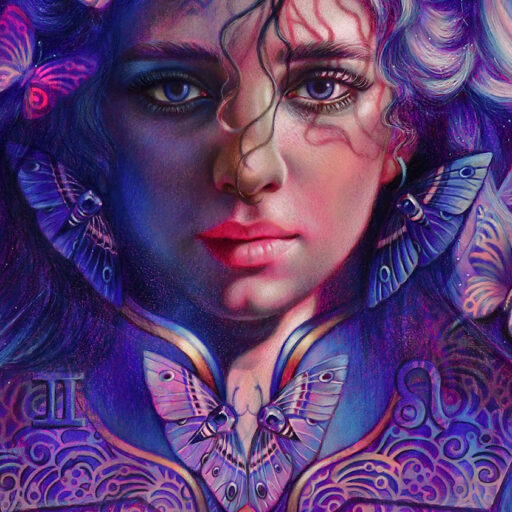
Scroll through Instagram, and you’ll find an abundance of genuine creativity that captures the human spirit in ways that feel pure, emotional, and authentic. Why, then, do our contemporary art museums prioritize this horror-show alternative? People deserve better; they deserve art that uplifts rather than repels.
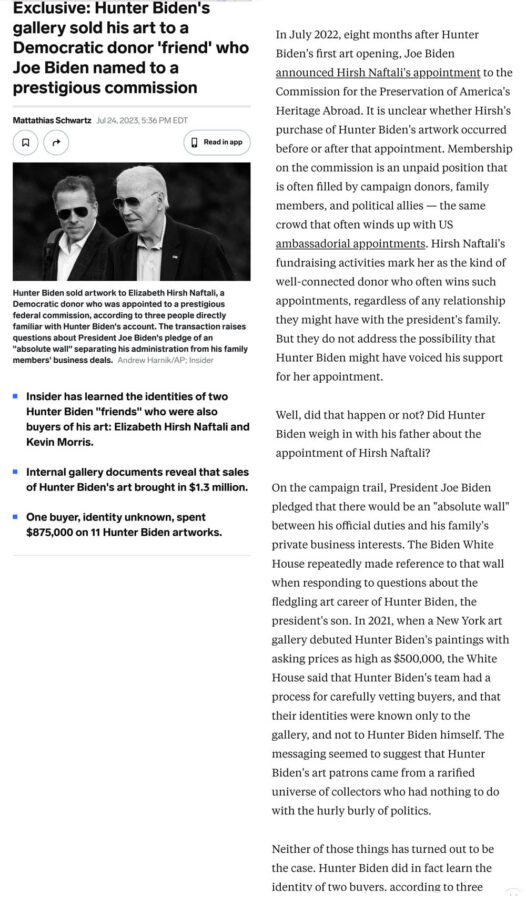
Let’s not ignore the issue of corruption propping this up. Galleries and museums operate like gated enclaves, where insiders peddle subpar work under the guise of innovation, while outsiders remain too intimidated to protest. I’m exhausted by it all—this soulless occupation of sacred spaces. Why shell out $22 for a ticket to endure it? And taking the family? Dropping $60–$80 for an afternoon of bewilderment? Most wouldn’t do it, and who can blame them?
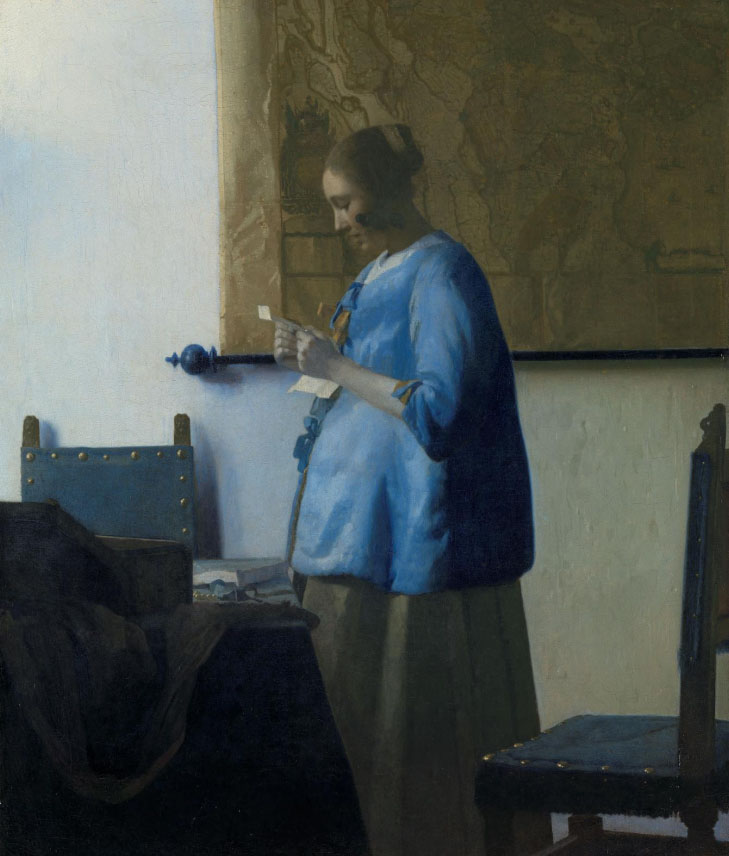
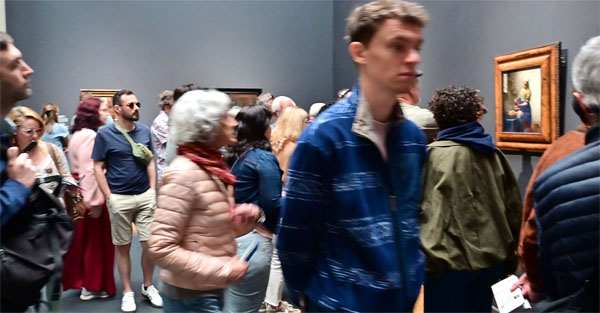
Consider the Rijksmuseum in Amsterdam, where galleries brim with admirers lost in the soft glow of Vermeer’s masterpieces—crowds drawn to the emotional depth and technical brilliance of the artist. Now picture the echoing voids of empty contemporary galleries: sterile expanses begging for occupancy but repelling it. This isn’t a coincidence; it feels deliberate, a subtle ploy to divert us from “real” art toward hollow expressions that starve the soul. When we’re robbed of inspiration, beauty, and emotion, we grow numb. Empathy withers, thoughtfulness fades, and sincerity erodes. In a desensitized world, we interact with others not as fellow neighbors, but as distant shadows—less connected, less alive, and less human.
Of course, some might dismiss me as overly critical or simply “not getting it.” Contemporary art criticism isn’t as common as we may think. But here’s the truth: we all grasp art’s essence on an intuitive level. No amount of intellectual posturing or institutional gatekeeping can brainwash us out of that primal knowing. Beauty moves us because it’s universal; ugliness repels for the same reason. Dismissing honest critique as ignorance only heightens the problem.
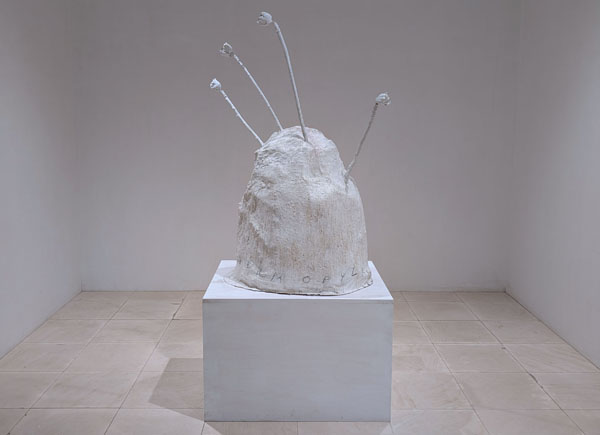
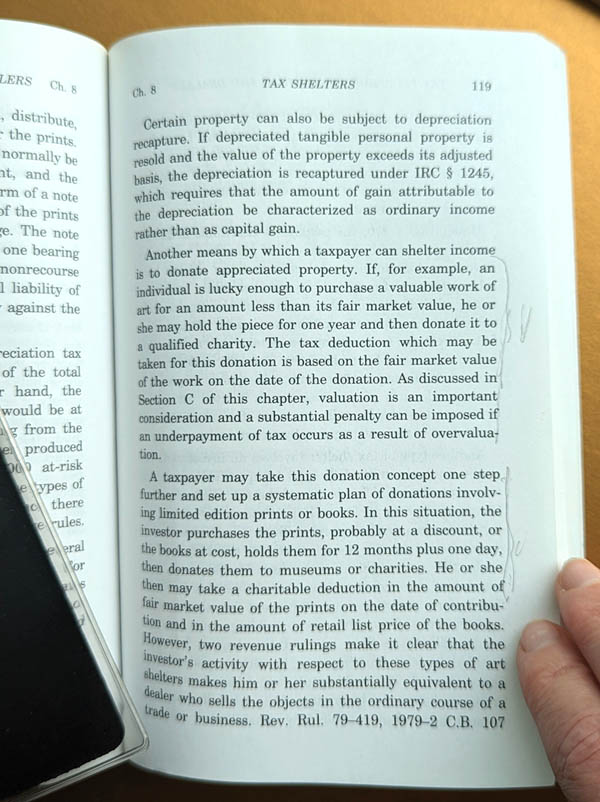
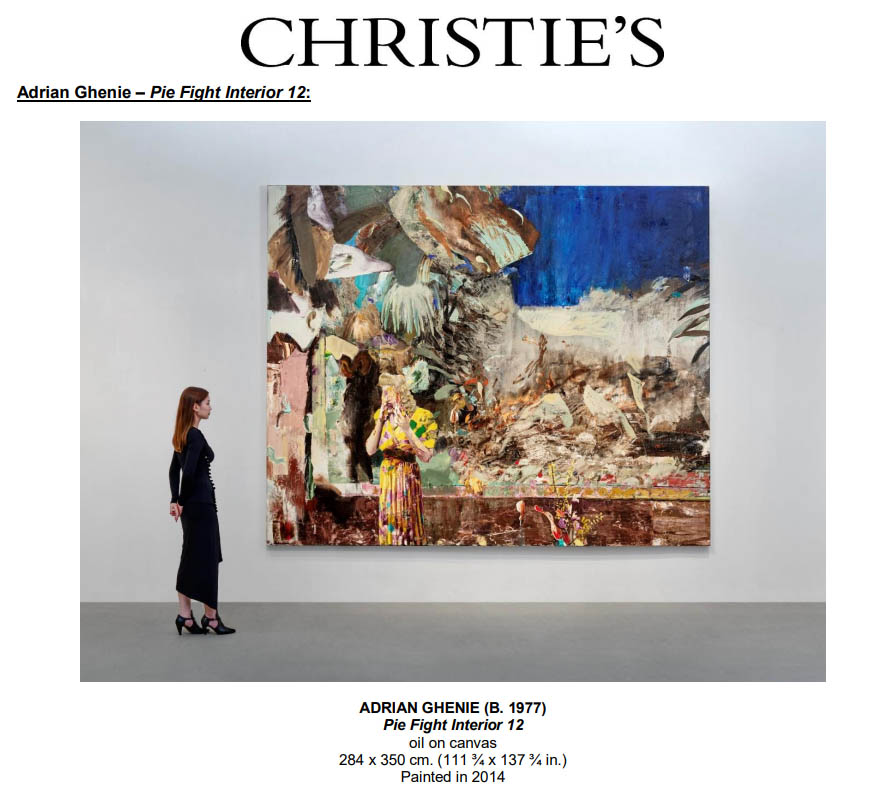
We crave positive change in our lives, yet we often defer it to others, shying away from possible problems and outcomes. Perhaps it’s time to apply that energy here. I think director-curator’ selections must be questioned when they present this ‘abstract art’ to us in art museums. The installed shows must be rated. Organizers can be fired on occasion. Audiences have already voted with their feet, boycotting these venues as a drain on their resources. The result? Perpetually empty contemporary art spaces existing for themselves. Art museums, ever pragmatic, often sustain themselves through lavish donations or endowments, so low foot traffic barely registers. But if not for visitors, then for whom is this spectacle staged? A self-congratulatory echo chamber for the elite pampering prices for famous contemporary art they already own to resell in the future?
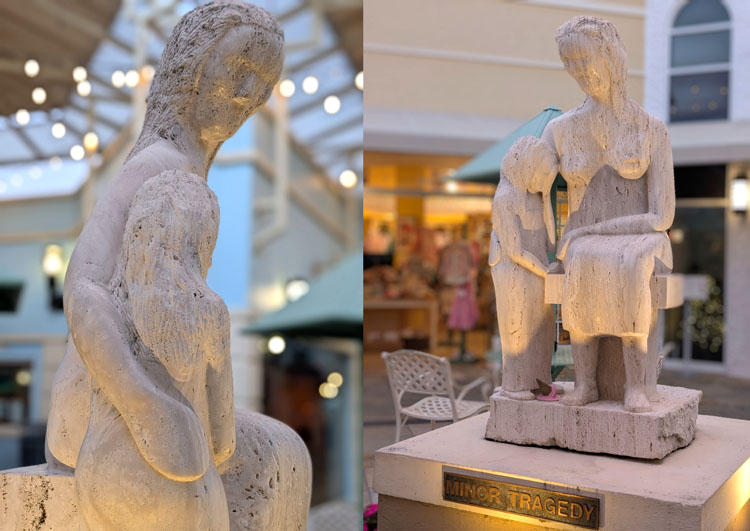
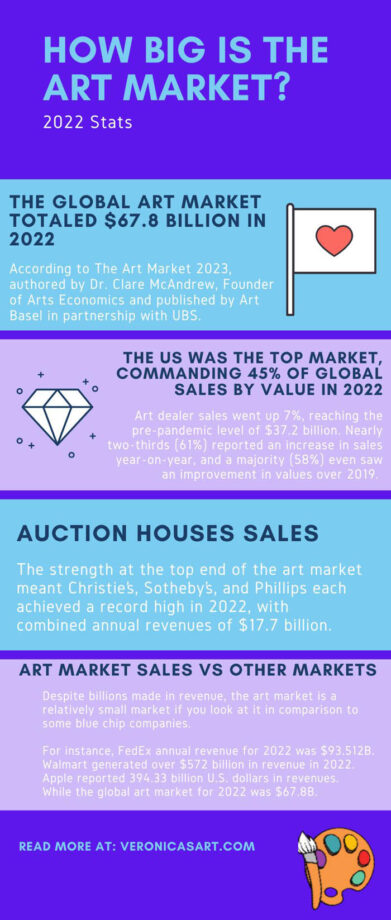
The numbers don't lie: While the global art market hit $68 billion in 2025—fueled by emerging digital trends and younger collectors—contemporary segments saw a 15% dip in foot traffic at major museums, with "woke fatigue" cited as a factor in post-exhibit surveys.
The Fraud of Modern Art: Why People Hate Contemporary Art
With my frustration of wandering through vast modern and contemporary art galleries, staring at soulless contemporary art, let’s dig deeper into this modern art controversy—the outright fraud. Here is why contemporary art sucks for so many. It’s not just about bad taste; it’s a systemic betrayal of what art should be. I’d like to look at the key characteristics of true art, expose the cultural extinction it’s causing, and demand better work from contemporary art museums that flood us with abstract art horror and soulless art installations.
Timeless Principles of Real Art
In essence, art is a deliberate act judged by timeless principles:
- Does it evoke any kind of emotion that pulls you into the artist’s raw inner world?
- Is it inspiring? Great pieces don’t just hang on walls; they bring so much inspiration, you want to create something new in your life. You feel alive.
- How difficult is it for the artist to create and recreate? True mastery demands sweat—years of honing vision, style, subject, color, point of view, composition, and material into something irreplaceable.
- Is it thoughtful?
- What’s so innovative about the piece? Innovation isn’t chaos; it’s a fresh take on beauty in art that honors aesthetics in traditional art without descending into gimmicks.
- Quality? Uncompromising craftsmanship that withstands scrutiny.
- And finally, is it something to be admired?
Contrast this with the best vs. worst contemporary art flooding our feeds and museums. The worst? Talentless voids peddled as “edgy.” The best? Evocative art that blends traditional vs. contemporary art seamlessly, proving innovation can coexist with soul. A good example of innovative, contemporary art is Studio Drift.
Studio Drift: Pioneers of Kinetic Nature-Tech Art
Studio Drift (often stylized as DRIFT) is an Amsterdam-based multidisciplinary art and design collective founded in 2007 by Dutch artists Lonneke Gordijn (1980) and Ralph Nauta (1978) . With a multidisciplinary team of 45 collaborators, they specialize in experiential sculptures, kinetic installations, and performances that fuse technology with natural phenomena, aiming to reveal hidden properties of the Earth, connecting us to nature and each other.
Their work often employs biomimicry—mimicking biological processes like flocking birds or flowing water—through mechanics, light, and sound, creating immersive, poetic experiences that evoke wonder, transience, and emotional resonance on a grand scale. Signature projects include The Shylight, and large-scale public works like drone swarms simulating starling flight, blending sculpture with digital motion for meditative, audience-engaging art.
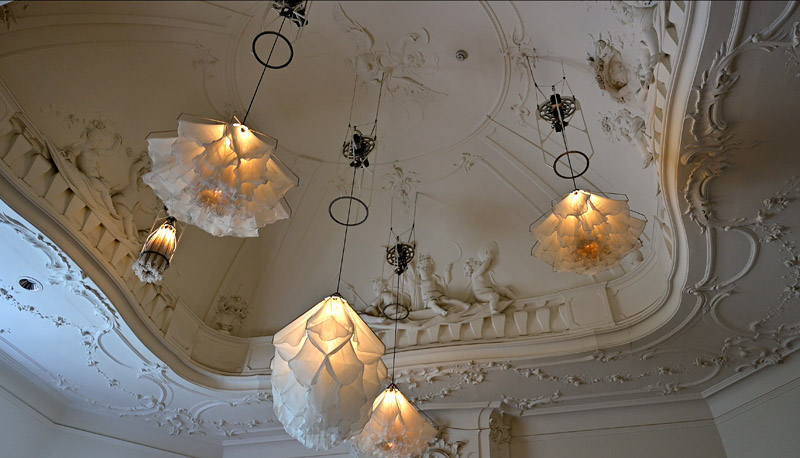
Shylight: Their Iconic Installation at the Rijksmuseum
One of Studio Drift’s most celebrated works, Shylight (2014), is a permanent kinetic lighting installation acquired by the Rijksmuseum in Amsterdam in 2014 and installed in the museum’s ornate 18th-century room. Comprising five large, suspended silk-covered mechanical sculptures resembling oversized flowers or chrysalises, the piece dramatically unfolds and retracts in a choreographed cycle: petals bloom open to reveal glowing, illuminated cores, then gracefully close, mimicking the natural lifecycle of growth, fragility, and renewal. Powered by hidden mechanics and soft LED lighting, it creates a mesmerizing interplay of light and shadow against the room’s historical grandeur, symbolizing the harmony between organic beauty and technological precision. Visitors often describe it as a “performative light ballet,” evoking quiet awe and serving as a modern counterpoint to the museum’s classical masterpieces— a testament to Drift’s idea of re-enchanting everyday spaces with nature’s fragile beauty and elegance.
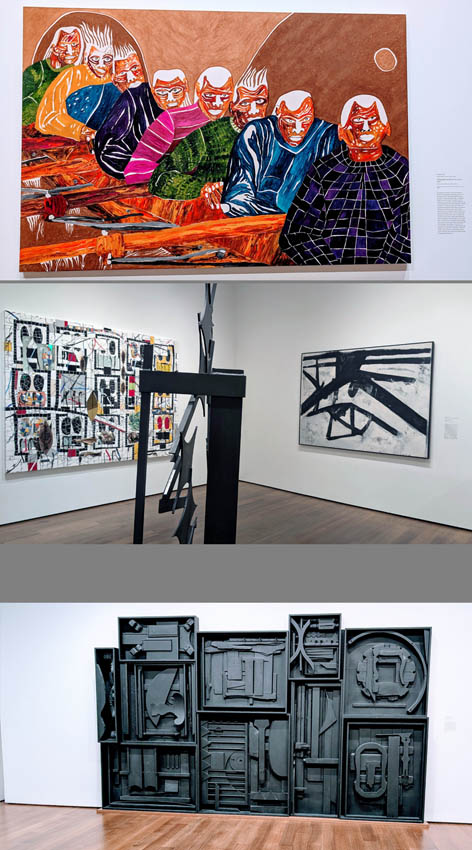
Cultural Extinction: How Modernity Killed Skillful Art
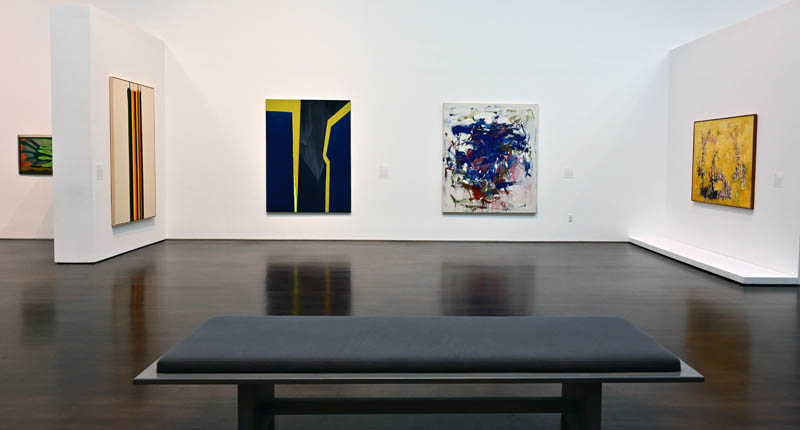
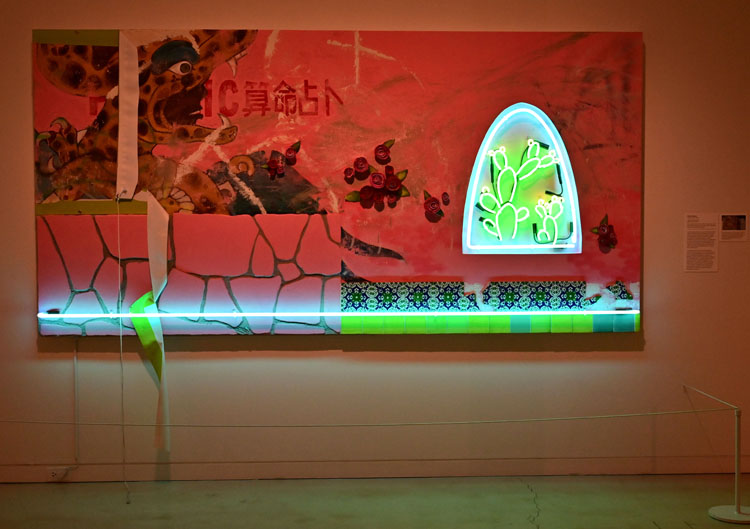
Modernity didn’t just evolve art—it purposefully murdered emotional and skillful art, replacing it with fake admiration and art museum corruption. Often inspired by Duchamp’s presentation of an everyday, mass-produced objects named a “readymade,” became an icon and a call to aspire to in art selections. Consider a museum purchase of Patrick Martinez, Jaguar Guardian, 2024 as an example of this notion.
So many talented contemporary artists are left to perish in obscurity, while corruption in modern art museums elevates the mediocre. Contemporary art criticism often tiptoes around this, but let’s say it: our society needs to wake up and demand good art from museum curators, critics, art influencers, directors, and gallery owners. Why people hate contemporary art boils down to this betrayal—talentless works promoted as great, while genuine creators sink into poverty, desperately honing their craft just to scrape by.
Who are these fake artists? They’re money-making machines, thriving on social savvy, connections, and business acumen, not raw talent. Real artists see and feel profoundly, translating the ineffable into highly-skilled Art in ways no one else can. We wouldn’t tolerate fake musicians butchering melodies or fake ballerinas stumbling through routines—yet we pretend to admire horrible art in contemporary art institutions. Where did aesthetics, art history, and taste go? Vanished in the haze of Duchamp’s urinal, that 1917 stunt declaring anything “art.” Perhaps when we weave these parameters into daily conversations—debating the emotional power of art over some soulless contemporary art—we’ll see fewer ugly sculptures and paintings hyped as masterpieces. How many more fools will fall for the taped banana? It’s entertainment for the rich, an assault on real artists and adults alike.

Fast-forward to 2025, and the modern art controversy rages on with boundary-pushing stunts that feel less like innovation and more like desperate bids for relevance. For large-scale LEDs critiquing consumerism—check out Barbara Kruger’s immersive exhibition at the Guggenheim Museum Bilbao (June 24–November 9, 2025): https://www.guggenheim-bilbao.eus/en/exhibitions/barbara-kruger. It features text-overlay LEDs on everyday scenes, skewering power, identity, and consumer culture in giant, room-filling displays with text, letters, and messages. It’s neither terrible nor awe-inspiring…This type of art doesn’t feel like progress; it’s a pivot where “transformative dialogue” masks the loss of aesthetics, beauty, creativity, and the original purpose of art.
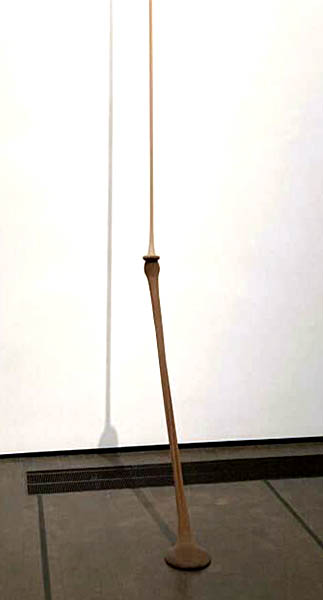
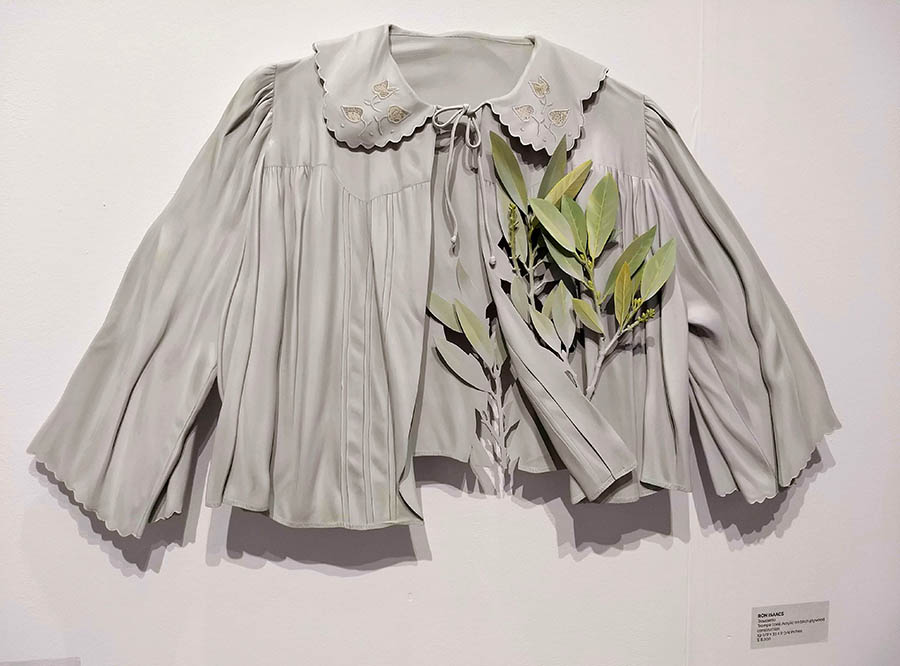
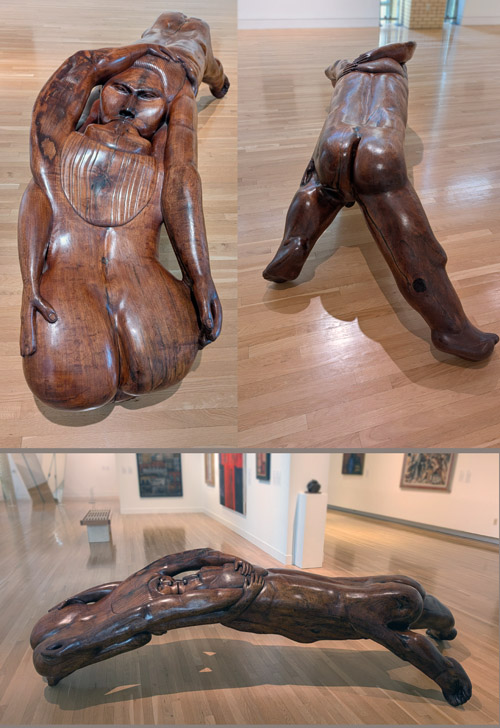
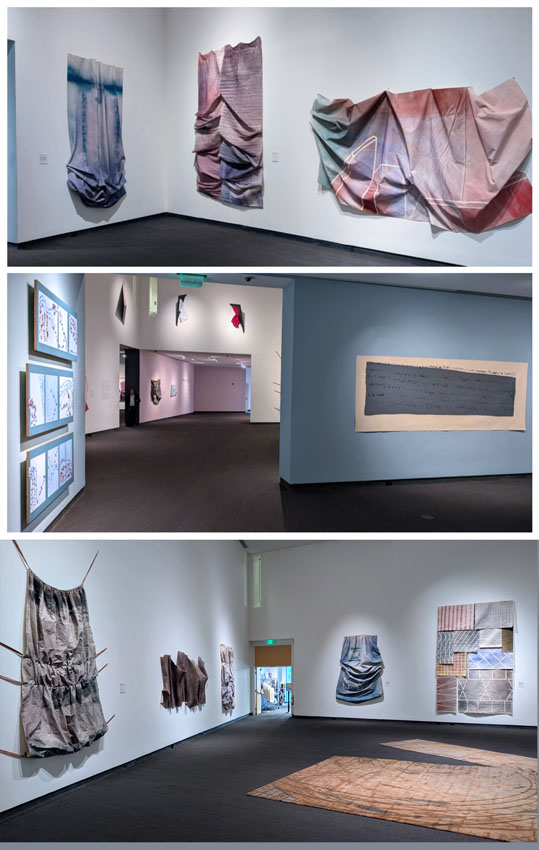
In the Museum of Fine Arts Houston (MFAH), you’ll find visually empty contemporary art, some of which is in the Fiber Arts exhibits. For instance, Ernesto Neto’s “Cópula” is a Nylon stocking stretched, filled with lead beads, and hung by a rope against a white wall. How come stockings are art? Yet, it deserves space in this art museum (gallery 312), gifted by Martin and Rebecca Eisenberg. Another nylon marvel made by Senga Nengudi is a museum purchase! Titled “R.S.V.P. Reverie ‘Bow Leg”, this ‘sculpture’ is a torn and stretched stocking…Contemporary art sculptures like the Melanesian Venus by John Duff make me wonder why such excellent art museums waste resources on such ‘art’ that include storage space as well. A shocking amount of “artistry, vision, and creativity” on display inside the MFAH contemporary art galleries, although the museum has rich and diverse art collections overall, and definitely deserves your time and money!
Titled Satellite, a large outdoor sculpture by famous contemporary artist Simone Leigh, is also a museum purchase. This bronze is reminiscent of the African female body, featuring sagging breasts, thin legs, and a large, plate-shaped head without eyes and mouth. Although its purpose may be the nurturing of women, it doesn’t appear to be a highly inspirational and creative masterpiece. At least, not in my view. Perhaps, if we ask black women about this sculpture reminiscent of African masks, they’ll give you a different opinion.
Big Art Museums Face Big Spending Cuts due to political and ideological changes:
Contemporary art museums across Europe and the United States are wailing under the weight of impending government funding cuts in 2025 and beyond, a gut-punch to the arts sector that’s now amplified by a volatile political landscape. As detailed in a recent Artnet News report, institutions face a “seismic shift” in support: in the U.S., the Trump administration’s slashes to the National Endowment for the Arts and related bodies have already cost millions, with examples like the Japanese American National Museum losing $659,000 for resisting DEI content removals and the Smithsonian under scrutiny for “woke” exhibits. In Europe, Berlin’s cultural budget cratered by €130 million last year, while UK museums endure 14 years of austerity, prompting fears of reduced budgets at places like the Royal Academy, the National Gallery, and Tate. Experts warn of eroded autonomy—curators muzzled on politics, from Gaza stances to anti-DEI mandates—and urge pivots to private donors, admission fees, and relevance-building, though generational philanthropy gaps loom large. Shocking? Sure, but predictable—the arts are always the first to be cut. These public organizations, ostensibly for the people, must now confront their paper-thin mandate: while I oppose cutting jobs for dedicated researchers and staffers, this crisis screams for a reckoning. It’s time to ditch the special exhibitions’ fakery, peddling soulless conceptual dreck, and reclaim spaces that truly inspire the public. While art is essential to our mental health and deserves financial support, all these millions spent on grants, funds, and donations for art museums must be questioned to shake out the corruption, management, and ideology besieging contemporary art museums.
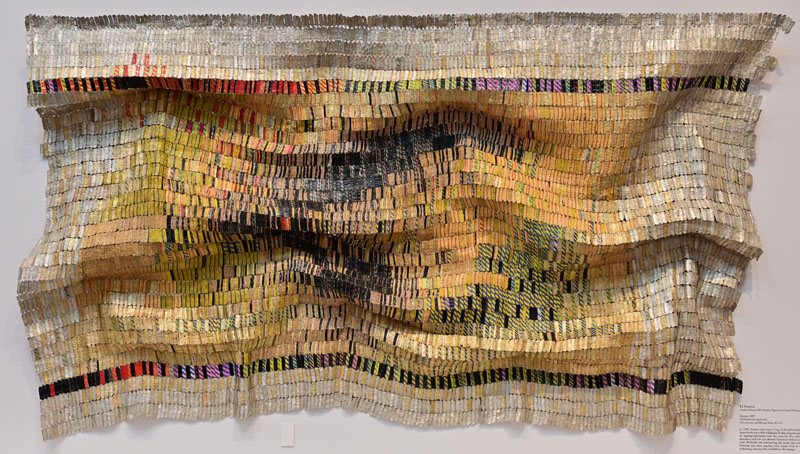
Museum’s description:
“Seepage” is composed of thousands of flattened aluminum wrappers from Nigerian liquor bottle caps that the artist El Anatsui and his team of assistants tied together with twisted strands of copper wire. Its shimmering metal surface resembles a mosaic while its undulating form suggests a regal tapestry. The bold coloration and pattern also suggests traditional Kente textiles that are made by male weavers and traditionally used for religious and ceremonial occasions in Ghana, where Anatsui is from. Since 2002, Anatsui has been making these bottle-cap reliefs as a way of addressing the legacy of colonialism in Africa and the historic triangle trade, in which European countries imported alcohol into Africa in exchange for slaves, ivory, and gold. “Seepage” reminds us of the way that African people were treated as commodities or currency. This is one of very few double-sided bottle-cap works that Anatsui has ever made and the only one in a museum collection. This is the first time the Blanton Museum of Art, Austin has exhibited the red side of the relief.
One glaring flaw in these financial and staffing cuts is their indiscriminate, across-the-board approach: they disproportionately axe entry- and mid-level roles held by everyday workers, while sparing the lofty salaries of top directors and curators. Sure, some pruning feels essential—like a natural wildfire or flood that scorches the underbrush to pave the way for renewal—but others inflict lasting harm, gutting vital research, overburdening dedicated museum staff, and sidelining exhibitions that actually deserve the spotlight. Compounding the chaos, we Americans (and increasingly the world) frame every crisis in stark black-and-white binaries, laced with partisan politics, religious fervor, and cultural crusades. This polarization doesn’t just stall progress; it paralyzes art institutions, starves artists of support, burdens directors with impossible choices, and alienates the very public these spaces are meant to serve.
As famous photographer Sally Mann warned in her latest memoir, we’re entering a “new era of culture wars,” where police raids on “offensive” exhibits, like her own boundary-testing nudes pulled from a gallery in September. The Danbury Institute, a conservative Christian advocacy group, accused the museum of displaying “child pornography” in a December 2024 open letter. Backed by some local elected officials, they demanded the photographs be removed, according to the article on NPR. Some of her old pictures depicted her beautiful children half-nude. As a result, Sally Mann’s work has become sandwiched between current politics, trends, and ideology.
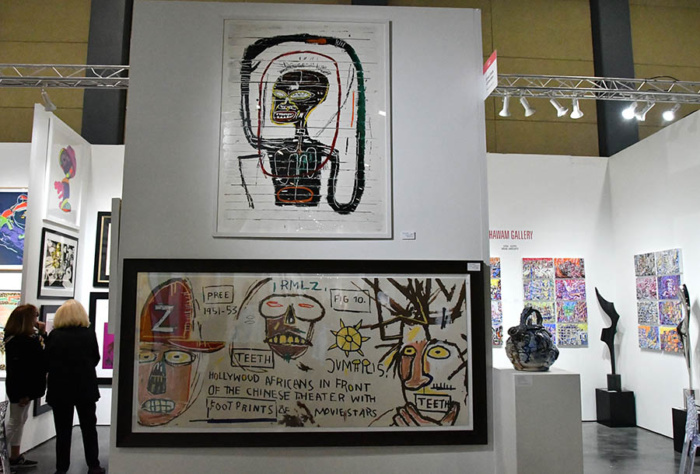
Mann’s work isn’t an isolated example. I think other famous artists are a lot more shocking. Chris Burden, Chris Ofili, Damien Hirst, Maurizio Cattelan, Robert Mapplethorpe, Tracey Emin, and Marina Abramović, of course. Famous controversial artists are symptoms of a system where politics, ugliness, and corruption warp the art market. How many more shocking art installations or performances must we endure before we demand pieces that evoke beautiful emotion, not shock value?
While art reflects culture and drives social change, installed ideology on art of any party isn’t fruitful in the long run. However, politics has always played a role in the arts. For example, Roman art modernized classical Greek art by adding real faces of contemporary politicians and the wealthy to classical ideals. The Italian Renaissance saw a rise of humanism expressed in realistic portraiture and sculpture, supported by the Medici’s, the Pope, and alike. This 19th century Russian art movement responded to social inequality that wasn’t supported by the government directly. While the Soviet Art was a pure creation of the government’s ideology: the Soviets supported artists and art organizations heavily to create mass propaganda across a vast country landscape, which is quite similar to what we see today in the US.
A lot of contemporary art has lost its most sacred principle: the sense of beauty. There’s so much ugly, empty, talentless “art” that no one should endure—yet it’s curated into numerous museums of contemporary art, sold at exorbitant fairs, and defended in endless contemporary art debates.
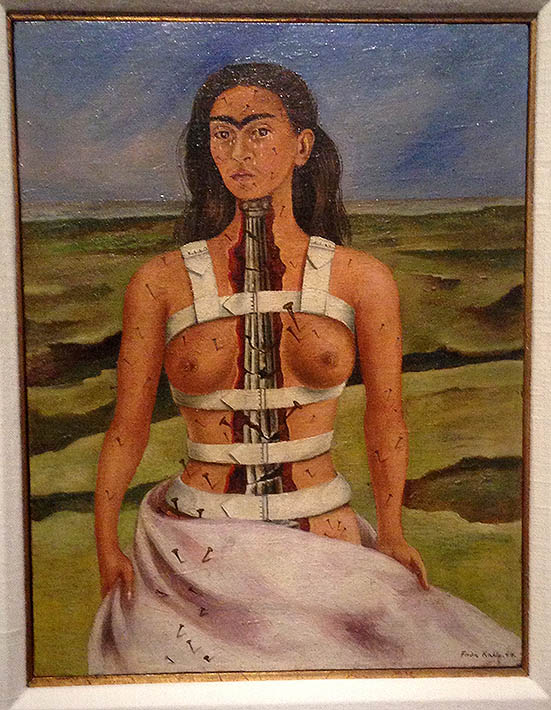
I think public art museums should stop catering to weird trends and notions. Rather focus on contemporary art programming, incorporating people’s participation, surveys, and responses to past exhibitions as one of the options. Another option would be social media voting for possible future exhibits and artists. Personally, I’m tired of seeing endless Frida Kahlo exhibitions in art museums across the US (Visit Frida’s museum in Mexico). It seems the art museum management knows that people know one name, and they drag this brand name across the US to either make money or beat a dead cow. Instead, let’s enjoy art of so many underrated female artists who deserve to have a retrospective show, for instance Remedious Varo or Cecilia Beaux.
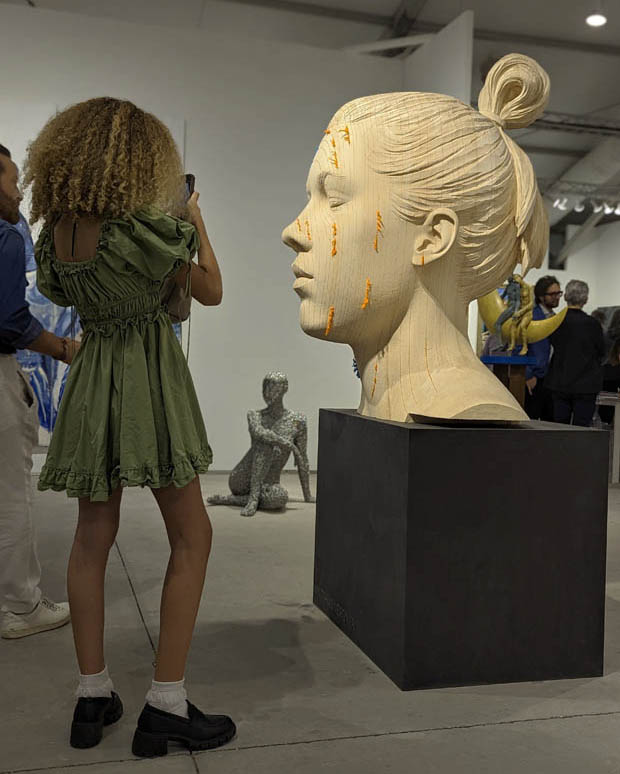
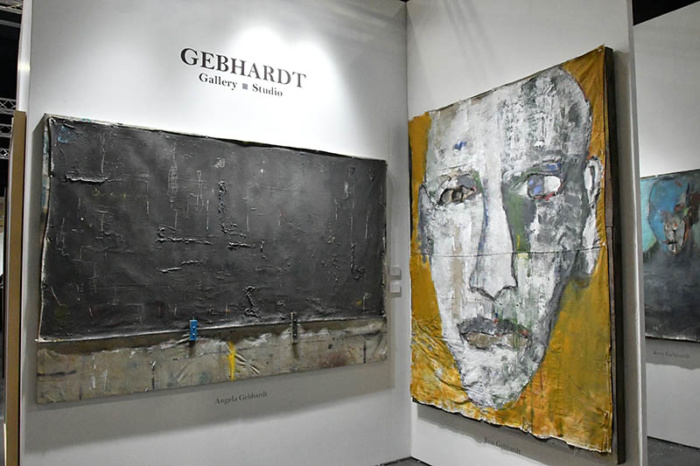
The solution for today’s art institutions’ crisis might be a different focus. Stop following the ideological trends to brainwash the public, and start aiming at timeless principles in art. This doesn’t mean showing ‘boring classics’. There are plenty of contemporary artists who push the boundaries, combine different art materials, and create mind-blowing art. Here are some examples from Context Art Miami 2023.
It’s an amazing trend to watch: artists once apprenticed for many years, training to capture beauty in every line, curve, and body, face indifference at best. Color, composition, originality, and anatomical knowledge weren’t optional for centuries of fine art. These principles crumbled under modernism, much like realism was crushed in the Middle Ages, only to come back in the Renaissance. America got taken over by the Abstract Expressionism for decades to drown in all forms of shocking performance, ugly installation, and soulless abstract ‘art.’ However, slowly but surely today we begin to witness a revival of realism—a quiet rebellion against traditional art beauty vs. modern emptiness. It’s just a start.
How to spot art market fraud in the contemporary art world

Summary of Salaries in Art Museums and Institutions (2024-2025)
Salaries in the art museum sector vary widely by institution size, location, and role, with top-tier (large national museums like MoMA or the Met, budgets >$50M), mid-tier (medium-sized urban or state institutions, budgets $10-50M), and regional/small (local or rural museums, budgets <$10M) showing clear disparities. Data is drawn from 2024 BLS medians, Glassdoor/Zippia averages, AAMD surveys (2022 baseline, as 2025 full details are paywalled), and anecdotal Reddit transparency threads (2024).
Overall trends: Modest 3-5% increases from 2023; inflation outpaces raises in smaller institutions. Note: Figures are annual USD medians/averages; benefits add 20-30%. *The following data is compiled by Grok and I don’t know how accurate the numbers are…
| Role | Top-Tier (e.g., NYC/SF) | Mid-Tier (e.g., Midwest/South cities) | Regional/Small (e.g., Rural/Southwest) |
|---|---|---|---|
| Director | $300,000–$500,000+ (avg. $344k) | $120,000–$200,000 (avg. $150k) | $70,000–$120,000 (avg. $85k) |
| Curator | $90,000–$150,000 (avg. $100k) | $60,000–$90,000 (median $62k) | $45,000–$70,000 (avg. $55k) |
| Staff (e.g., Registrar/Assistant) | $60,000–$90,000 (avg. $75k) | $45,000–$65,000 (avg. $55k) | $35,000–$50,000 (avg. $42k) |
Therefore, top-tier pay reflects high-stakes fundraising; regional roles often lack benefits. BLS notes 4% job growth to 2034, but turnover is high due to low pay in smaller venues. For 2025, expect 2-4% bumps amid budget pressures.
Comparison of Top Museum Directors’ Salaries: US vs. Europe (2024-2025)
To compare, I’ve selected comparable top-tier institutions in major cities, using total compensation where available (base + bonuses/perks). US figures are from IRS filings and surveys; European data is sparser due to privacy laws but drawn from public reports, job listings, and salary surveys. All converted to USD (approx. rates: £1=$1.30, €1=$1.09 as of Oct 2025). European salaries are generally lower (often 20-70% less for equivalents), reflecting public funding models, cost-of-living differences, and less emphasis on private-sector perks. Averages: US top ~$1.5M; Europe top ~$200k. *Compiled by Grok, so beware that the numbers might be off.
| Region/City | Museum | Director | Total Compensation (USD) | Year/Source Notes |
|---|---|---|---|---|
| US – New York | Metropolitan Museum of Art | Max Hollein | $1,602,410 | 2024; base ~$1.33M + perks. |
| US – New York | Museum of Modern Art (MoMA) | Glenn D. Lowry | ~$2,260,000 | Pre-2025; base $1.55M + $706k other. |
| US – Los Angeles | LACMA | Michael Govan | $2,496,238 | FY2024; includes bonuses/housing. |
| US – Los Angeles | J. Paul Getty Museum | Timothy Potts | ~$1,100,000 | 2023 baseline; stable trend. |
| US – Denver | Denver Art Museum | Christoph Heinrich | $409,322 | 2024; base $340k + other. |
| US – Phoenix (AZ) | Phoenix Art Museum | Jeremy Mikolajczak | $229,881 | 2024; base pay. |
| Europe – London | British Museum | (Vacant/Interim) | ~$280,000 (£215,841) | 2024 job listing; paltry vs. US peers. |
| Europe – London | National Gallery | Gabriele Finaldi | ~$221,000 (£170,598) | FY2024; basic salary, public sector. |
| Europe – London | Tate (Modern/Galleries) | Nicholas Serota (or successor) | ~$140,000 (£108,046) | 2024 estimate; 29% above UK avg. |
| Europe – Paris | Louvre | Laurence des Cars | ~$103,000 (€94,369 avg. Paris) | 2025 avg. for Paris directors; specific not public, est. higher (~$150k-200k cap). |
| Europe – Amsterdam | Rijksmuseum | Taco Dibbits | ~$100,000 (€91,509 avg.) | 2025 Netherlands avg.; bonus ~$12k. |
| Europe – Berlin US – Chicago US – Boston | Staatliche Museen zu Berlin Art Institute of Chicago Museum of Fine Arts, Boston | Hermann Parzinger (general dir.) James Rondeau Matthew Teitelbaum | ~$110,000 (€101,059 avg.) $1,009,815FY2023 $1,055,830 | 2025 Germany avg.; bonus ~$13k. |
High-end US peers are far exceeding European equivalents due to private funding reliance. Gaps widen for mid-tier roles. Data limitations persist for Europe.
Conclusion: US directors at elite institutions command 5-10x higher pay, driven by private donations and market competition, while European roles (often civil service) emphasize stability over extravagance. Smaller/mid-tier gaps narrow (e.g., Denver vs. Rijksmuseum: $409k vs. $100k). Data limitations: Europe relies on averages due to less transparency. * These numbers are summarized by Grok.
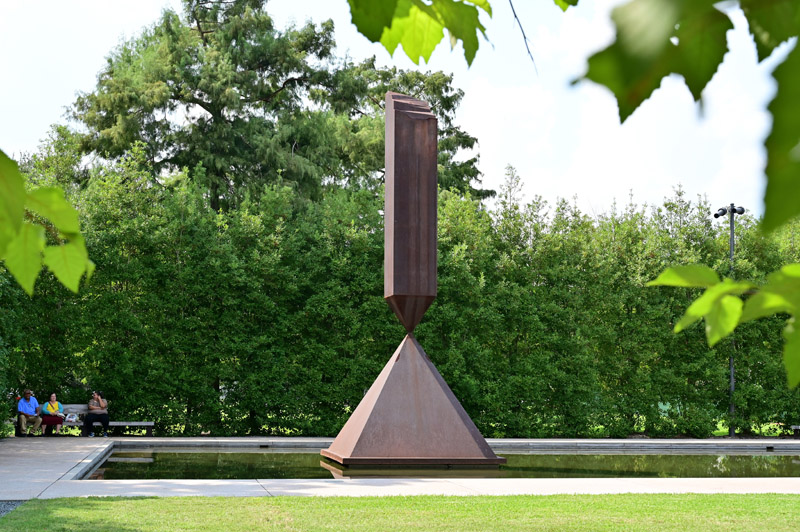
Innovation in a Crowded Art Museum Space: The High Bar for Today’s Artists
Mastering classical principles of beauty isn’t enough in the contemporary art world. There must be innovation or originality in the artist’s voice—a personal seal that sets it apart in this century. Inspired by giants like Michelangelo, Caravaggio, or Van Dyck, the great contemporary artist innovates beyond expectation, infusing personal sensitivity, aesthetic depth, and an innate sense of design steeped in art history. It’s a sky-high bar: influenced by the past, yet utterly different from everything done before him.

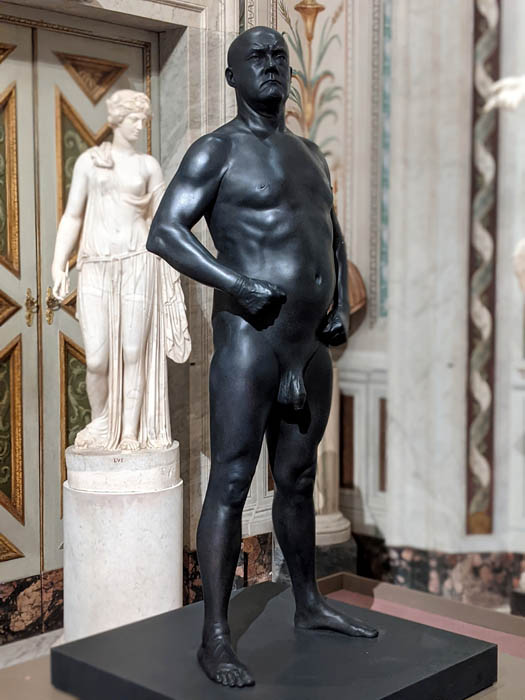
Take Kehinde Wiley or Chuck Close as prime examples of famous contemporary artists. Wiley reimagines historical portraits with modern people of color, blending Renaissance grandeur with street-level grit—innovation that honors empathy in art without sacrificing beauty. It’s often cliche and almost grotesque, but vastly different from hyped modern art. Close’s hyper-detailed portraits, built from fragmented grids, turn the mundane face into a monumental puzzle, demanding we confront identity up close. These aren’t abstract art horrors; they’re thoughtful modern paintings that provoke and uplift, proving the best vs. worst contemporary art divide is wider than ever.
What can I say about the state of contemporary art? To be honest, a lot of it sucks, and many of us are just afraid to say it aloud. Why? Fear of looking stupid or uncultured, especially when sparring with famous art critics, directors, or curators. But there’s no standard left—post-Duchamp, anything qualifies as art. I wonder when real change will hit: when the public stops tolerating enormous, empty contemporary galleries stuffed with crappy installations, or when major art fairs quit peddling such “art” as famous, approved, or important. When will we end this pretense and encourage real talent in major venues? Only time will tell…
Auction Sales Comparison for Hot Contemporary Artists: 2020 vs. 2025
Based on available data from auction reports (primarily post-2000 works, as this segment defines “contemporary” in key analyses like Hiscox), here’s a comparison of total auction sales for select hot contemporary artists in 2020 and 2024 (the latest full-year data for the 2025 reporting period). Note that 2025 data is partial (through H1), so 2024 figures are used as the proxy for recent performance. Numbers are in USD millions and focus on major houses (Christie’s, Sotheby’s, Phillips). (*Data compiled by Grok).
| Artist | 2020 Total Sales | 2025 (2024) Total Sales | Change (%) | Notes |
|---|---|---|---|---|
| Yayoi Kusama | 18 | 58.8 | +226% | Top seller in both years; post-2000 works drove resurgence. |
| Banksy | 31.9 | 20 | -37% | Originals and prints; H1 2024 alone ~$10M, full year est. $20M. |
| Damien Hirst | N/A (est. ~10) | 9.5 | -5% (est.) | Ranked #12 in Hiscox 2025; spotty 2020 data, but decline in recent years. |
| Jeff Koons | N/A (est. ~50) | 27.8 | -44% (est.) | Post-2019 peak; 2023 figure used as proxy for 2024 trend. |
| Gerhard Richter | N/A (est. ~100) | N/A (est. ~150) | +50% (est.) | High-volume abstract sales; 2021 peak $247M, stable high end. |
Overall contemporary market: $1.1B in 2020 vs. $698M in 2024 (down 37%). Data gaps exist for exact 2020 totals (pandemic impacted reporting), but trends show a post-2021 correction with resilient blue-chips like Kusama.
The Floating World in Houston, TX: A.A. Murakami
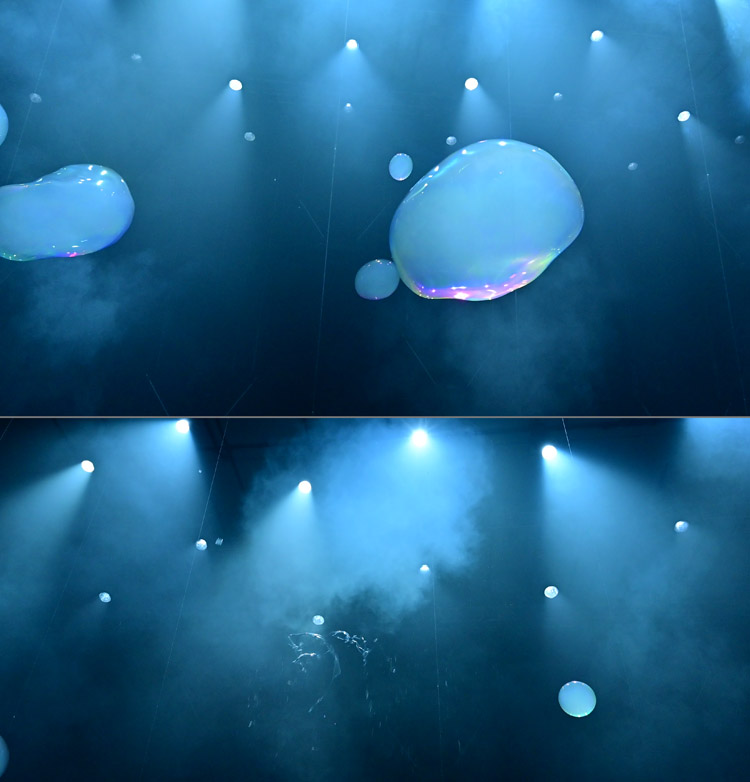
A surprisingly meaningful, dream-like art installation, titled the "Floating World: A.A. Murakami", made me think that not everything is lost in the contemporary art world of soulless installations. The meditative floating world was a genuine sensory immersion into a surreal space of thoughts, beauty, calmness, peace, and simplicity.
The “Floating World: A.A. Murakami” exhibition, which wrapped up on September 21, 2025, at the Museum of Fine Arts, Houston (MFAH), was the U.S. debut of this ambitious immersive project by the Tokyo- and London-based artist duo A.A. Murakami, established in 2020 by artists Alexander Groves (born 1983) and Azusa Murakami (born 1984). Spanning 25,000 square feet across the Beck Building’s galleries, it transformed the space into four interconnected sensory landscapes that fused cutting-edge technology with natural phenomena, evoking the transient beauty of Japan’s Edo-era ukiyo-e (floating world) tradition and auspicious cloud motifs from Asian art. Thematically, it explored life’s ephemerality—bridging earthly chaos and heavenly serenity through “Ephemeral Tech,” where mechanical wizardry mimicked fleeting natural forces like fog, plasma, and light. Curated by Bradley Bailey, the Chao curator of Asian art at MFAH, this was the duo’s largest show to date and their first solo U.S. museum presentation.
The Four Immersive Installations
Each room built a progression of wonder, prioritizing physical, analogue experiences over screens or apps—inviting visitors to feel the art through sight, sound, and even touch.
According to the MFAH description, Floating World comprises five intertwined works that feed seamlessly into each other: Cell, a garden of aluminum forms akin to the volcanic rocks at the bottom of the sea; Neon Sun, which mimics the Northern Lights through an incredible array of plasma tubes; Beyond the Horizon, an ethereal experience that challenges perceptions of reality and technology; Passage, a new installation created specifically for the MFAH; and the hypnotic lightning patterns of Under a Flowing Field.
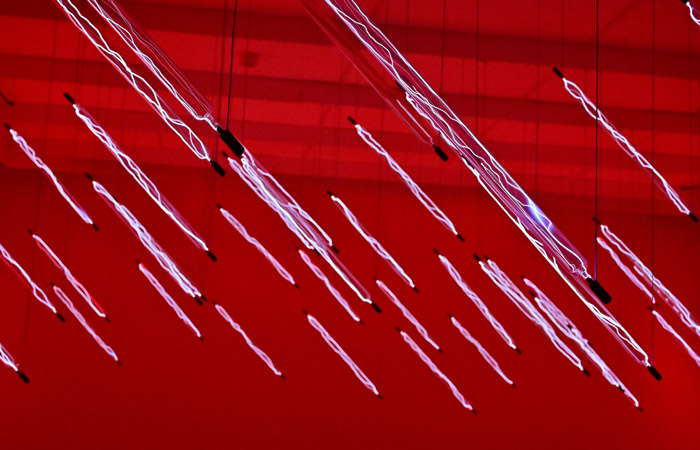
everywhere except our planet. Typically unseen, it can be rendered visible through carefully calibrated electric currents, causing arcs of plasma to flicker in and out of visible existence, generating literal “lightning in a bottle,” their naturally pulsing patterns creating a fluid, living effect. Unlike the sterile silence of LEDs, the tiny lightning strikes produce sound, resonating against the glass of the tubes. This sound and the title reference the suzumushi or Japanese bell cricket (Meloimorpha japonica), whose distinctive chirps mark the arrival of the fall; suzumushi is a kigo, or seasonal word, and appears frequently in haiku to designate the passage of time. With this piece, A.A. Murakami invites the viewer to return back to a natural measurement of time: the changing of the seasons.
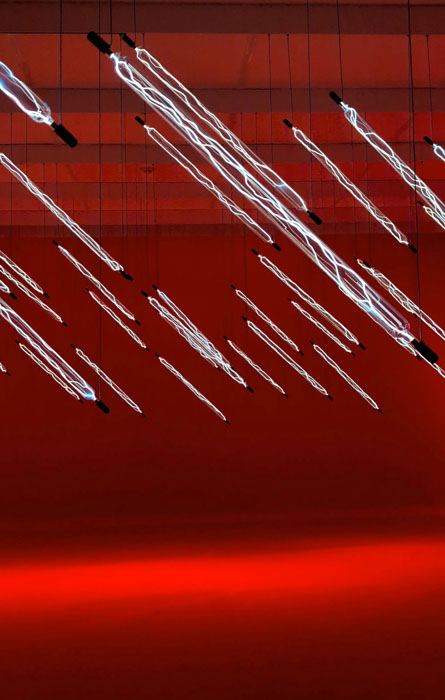
- Under a Flowing Field (2023): A ceiling-suspended network of glass tubes filled with krypton gas pulses with lightning-like white lines. Set against a stark red monochrome backdrop, it hummed with strange energetic sound, creating an unsettling yet beautiful feeling.
- Beyond the Horizon (2024): In a vast, dimly lit chamber, mechanical “arms” inflate and release massive, amorphous soap bubbles laced with fog inside. These orbs drift unpredictably, catching synchronized LED lights that shift from glow to dim, bursting into misty clouds. This constant release and collapse of giant, milky bubbles created meditative sensory experience for me.
- Passage (2023): The standout for many, this featured 18 fog cannons on a towering scaffold launching hypnotic smoke rings into a blue-lit void. The rings expanded, intersected, and dissolved in slow motion, creating a mesmerizing portal-like. Ethereal, soft rings created a dark blue dreamscape.
- Cell (2020) and Neon Sun (2020): Earlier works anchored the show—Cell with futuristic steel-and-aluminum sculptures nodding to Zen rock gardens and oceanic origins, while Neon Sun uses noble-gas-filled tubes to simulate the Aurora Borealis, flickering between serene greens and fiery oranges via electromagnetic fields.
The Palette of Possibility: Color as a Window to the Soul
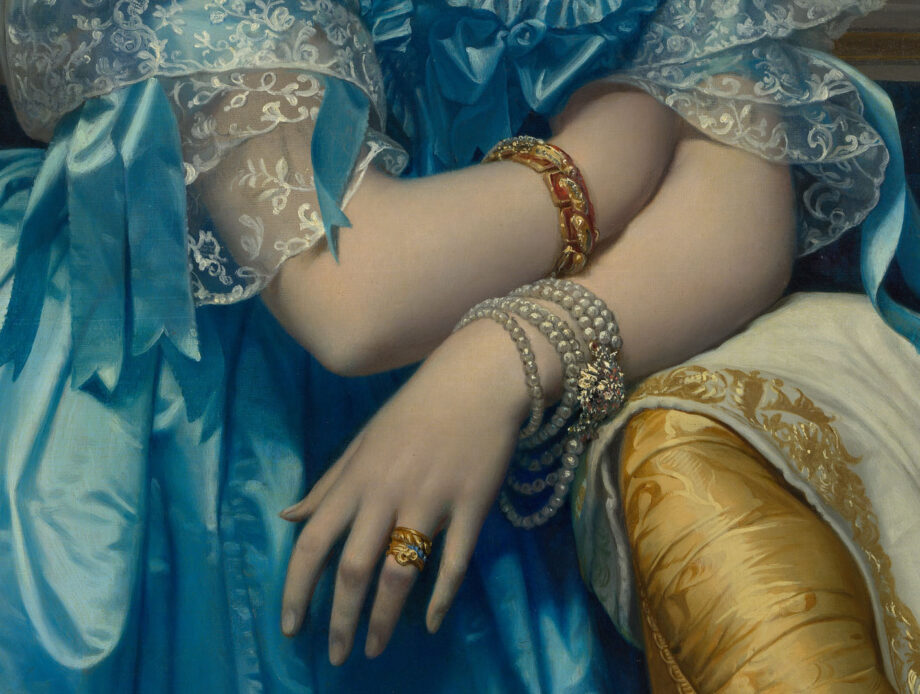
In painting, color mixing reveals an artist’s soul. The Impressionists ditched black, teaching us to spy hues in shadows. Old Masters like Velázquez, Rembrandt, and Caravaggio wielded black masterfully. Vermeer and Ingres? Subtle, controlled palettes unveil beauty through carefully created unity.
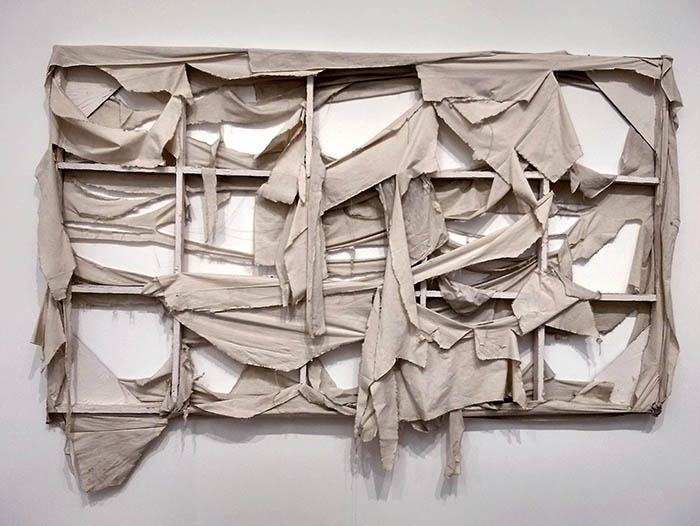
A lot of contemporary painting is about nothing: no color, no ideas, no light, and as a result, no beauty. It’s up to the artist—what do you want to paint or see? In this critique of abstract art, I choose works that breathe, that challenge us to rediscover aesthetics in traditional art amid the modern art controversy.
Defenders cry, “Art must evolve—2025’s trends demand bold experimentation on social issues and tech!” Fair, but when “evolution” means more abstract art voids over Caspar David Friedrich-inspired innovation, it’s regression. Even Hyperallergic’s “Dos and Don’ts for 2025” urges ditching performative wokeness for genuine joy—aligning with my call to revive emotional power. Gatekeeping? Sure, but not when it protects fraud from scrutiny.
Art is subjective, sure—but that doesn’t excuse the mess. People don’t want to feel stupid dissecting a piece or dropping cash on it, so they treat it like an investment: chasing famous contemporary artists for resale hype, driving crazy pricing. That’s why conceptual painting thrives—forcing ideas on viewers that you can’t grasp just by looking. You need the wall of text, assuming it’s provided next to the painting in that sterile contemporary art museum.
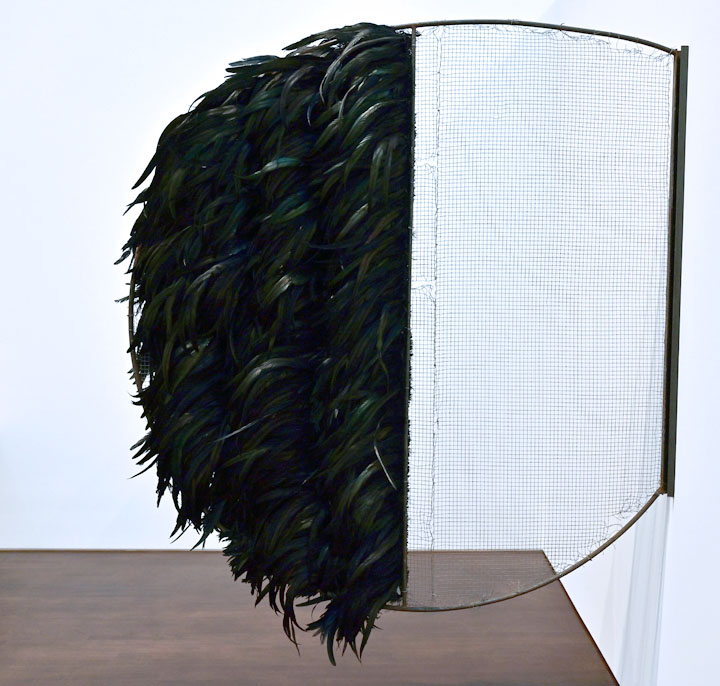
Purchase through the Archer M. Huntington Museum Fund and with support from the Blanton Contemporary Circle.
Museum’s description:
Terry Adkins’s work bridges past and present, striving to revive the lives and impacts of forgotten or underrepresented cultural figures. To commemorate particular people and places, he often created elegant, eloquent sculptures and installations using salvaged materials that hold specific meaning. Made when Adkins was invited to create a series of works in the remains of the Finesilver Uniform Factory in
San Antonio, Single Bound is a meditation on the unnamed factory workers and early Texas blues musicians who made pivotal recordings in that city in the 1920s. Consisting of a metal D-shaped hoop interlaced with lustrous black rooster feathers, the sculpture projects outward, hanging perpendicular to the wall. The rooster feathers are a tribute to blues troubadours, referencing everything from Rooster
Blues, the label dedicated to blues music of the Mississippi Delta, to the ways feathers symbolize sexual boasting and masculinity in both lyrics and in performances. The exposed metal mesh and D-ring shape reference the history of industrial manufacturing and its often-anonymous workforce. Collectively, the materials assert the heroism of those who never truly have gotten their due. In 2003, Single Bound was included as part of one of Adkins’s major recitals: Towering Steep. Recitals, often featuring his
sculptures, were a major element of Adkins’s work. Towering Steep was composed almost entirely of works produced at Finesilver. It continues to commemorate anonymous factory workers, blues music, and the connected legacy of the more than six million African Americans who moved from the South to cities and towns in the Northeast, Midwest, and the West between 1916 and 1970 during the Great Migration.
Daring to Dream as a Contemporary Artist
Artists crave freedom to paint the truth, unswayed by fashion, opinions, trends, or markets. We get one endless question: “How long did it take to paint?” But flip it—imagine you spending that time on it. Would you match the result? Chances are, no. Artists have vision; no one’s handing it over. No one cares enough to prop you up forever. Only you stay tenacious, believing in yourself to make dreams a reality. Reject current trends to pursue your vision. Don’t sideline yourself with bad advice. Seek those who can share your values as well as challenge your views and possibilities. Listen to your heart, craft a strategy, embrace constant change, and focus relentlessly on your craft.
Being an underdog artist in the contemporary art world? It’s a grind. Over the years, I’ve chatted with folks who adore the arts—some snag a print or original for $50. They beam, assuming their home-dotted with prints, means they’re fueling artist’s journey. Sure, there’s truth there that deserves some admiration, but at those prices, artists rarely break even amid sky-high studio costs: jury fees, festival booths, shipping, supplies. Buying prints beats nothing—it’s a win for exposure and your walls—but claiming deep involvement in an artist’s career? That’s a bit of a stretch.
Worse: most “likers” on social media never become meaningful supporters. Likes don’t cash checks. For artists, social media’s a tease; for fans, it’s a self-entertaining “contribution” without the commitment of an art book, original painting, or theater ticket. Collecting? It’s brand-chasing, not passion. Confronting the values and aesthetics is necessary. With goods so cheap, art feels like a luxury waste to the middle class, stretched by so many bills, costs, and inflation.
As a highly-developed society, we must revive art programs with professional artists visiting high schools for emotional stability and cultivation of aesthetics in children. Let public art unite communities with good art, artists, and vibes. Demand better—because in the end, real art isn’t fraud; it’s the passion we all crave.

In the midst of this contemporary art critique, it’s worth remembering that not all contemporary art is lost—and that true artists, even today, can cut through the noise. Every person is born with innate talents, but brilliance emerges not from raw gift alone, but from relentless effort. We glimpse the polished results in a Sargent or a modern innovator, yet rarely consider the grueling path: the late nights, the self-doubt, the cascade of debilitating failures that make us stronger in mastery. Growth demands struggle; it’s in wrestling with our flaws and fears that we evolve and succeed. To create anything worthwhile, we must own our journeys—taking full responsibility for our craft and career.
So, to the aspiring artist reading this: the next time fear overwhelms you, push back. Declare it: “I’m going to do this anyway!” After all, fortune favors the ambitious. Channel your passion into your art that creates genuine emotion and beauty. The museums may be adrift, but art’s true power lies in those who dare to reclaim it—for themselves, and for all of us. In my belief, Art is a search for the truth that’s filled with light.
Are you interested in learning what makes contemporary art great? and Why artists create ?
Join the chorus on your favorite social media platform—tag #StopArtFraud and share your museum horror stories. Real change starts when we stop pretending.
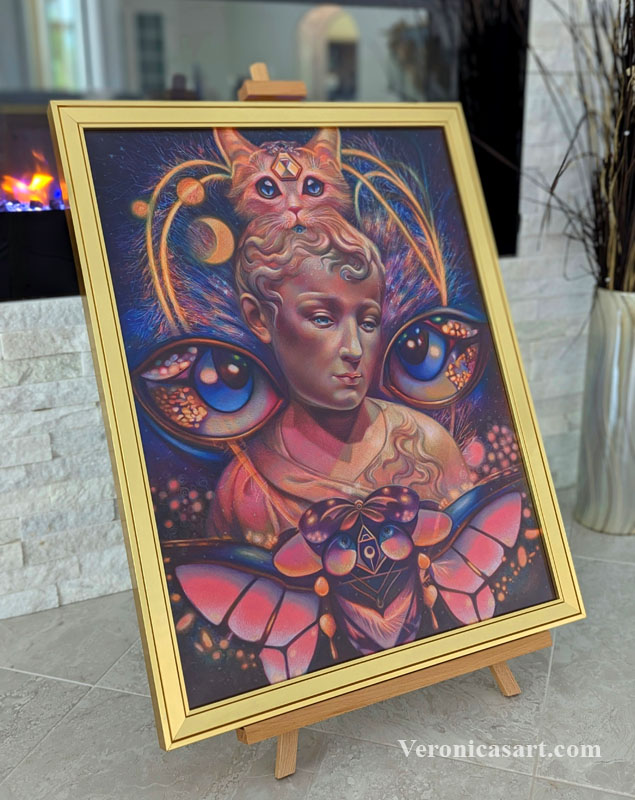
You can find my visionary art | Instagram | YouTube