Ancient Egyptian stone vessels: high precision or complete delusion?
After studying the Predynastic Egyptian vessels for a year and a half by going to various museums, reading numerous archeological papers, dissertations, and books (main reading list you’ll find at the end of my article about the Naqada culture), I changed my initial view about these ‘super-precise’ granite vases. Let me explain why. I’m going to debunk Ben & Friends’ major arguments that are often mentioned in their videos. As an example, I’ll take one of his videos posted above and let you dwell on some of Ben’s arguments vs. facts. Let’s begin.
At first, I was fascinated by Ben’s story about the vases and asked my husband, Max, to study them under the microscope. This is when Ben & Friends appeared on our doorstep. I must say that Ben has a natural talent for storytelling, charm, confidence, and charisma necessary to make an impression. Although that initial impression faded quickly for me personally after looking into the substance.
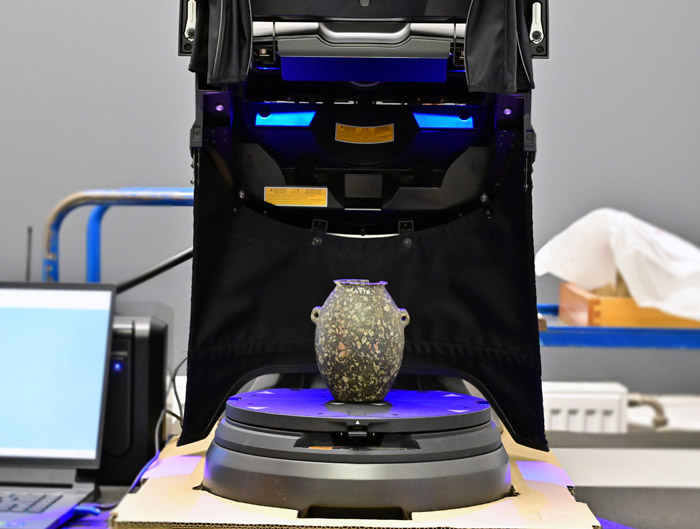
My family and I went to the Petrie Museum in May 2025, and we spent 2 full days scanning the vases from the collection. For that, we had to buy the high-end Keyence scanner, transport it in separate boxes from the US to London and back, use Uber to drive it around town, and rent some storage space in a hotel for a week (because the museum’s appointments had a week of wait in between them). During the first appointment at the museum, Max scanned the metrological standard to check the precision and accuracy of his scans. Back in the hotel, he began to check the numbers of scanned stone vases in greater detail, looking for advertised ‘aerospace precision’ in those vessels. There was none…
After our return home with the scanner, Max spent weeks looking into his code, trying to find a mistake. The ultimate result of his research process is in his paper: Fomitchev-Zamilov, M. A metrological method for manufacturing quality assessment and classification of ancient Egyptian stone vessels. npj Herit. Sci. 13, 659 (2025). https://doi.org/10.1038/s40494-025-02196-7
I felt disappointed, I deleted most of my videos from the first visit to the museum, and decided not to come back to this topic ever again. This project seemed like a huge waste of our time, emotion, and resources, resources we could have spent on other useful things. On several occasions, Max offered Ben & Friends the opportunity to work together, but no real interest was expressed in doing such research. We were useful idiots until the day we were not. Meanwhile, I learned about Stine and her previous work for Ben & Friends. You can read about the outcome of it here. It’s easy to call someone ‘close-minded’ or ‘toxic,’ but if such things happened to you as they happened to Stine, would you be upset? To continue, I also saw how one of the collectors (not Matt Beall) of ancient Egyptian vases felt so conflicted, disappointed, and upset, he couldn’t reconcile the fact that a few of his vases were machine-made while the rest of his collection was genuine predynastic Egyptian!
I could understand his feelings well because it was more than just wasted money; it felt like a betrayal of a dream. I saw Max putting in weeks to finalize the paper, and after its publication, we saw quite a storm of online hate. After all, a lot of people got sold on this ‘high-precision’ vase idea, and few were ready to part with a dream of ancient tech. So, I wanted to forget about all of this until the day I saw Ben online again. He appeared with his vase videos once more, doubling down on his claims of precision, archeologists’ ignorance, and private collectors’ greatness. I didn’t want to continue with this project, as it was clear to me what it was. But Max scheduled his appointments in museums half a year in advance, and so we went to England again.
We flew to London in December 2025 for another visit to the Petrie Museum and the Manchester Museum. Both museums were very nice and accommodating to our research. The curator of the Egyptian collection in Manchester was so unbelievably accommodating and sweet that I was ready to stay there longer, being interested in those vases again.
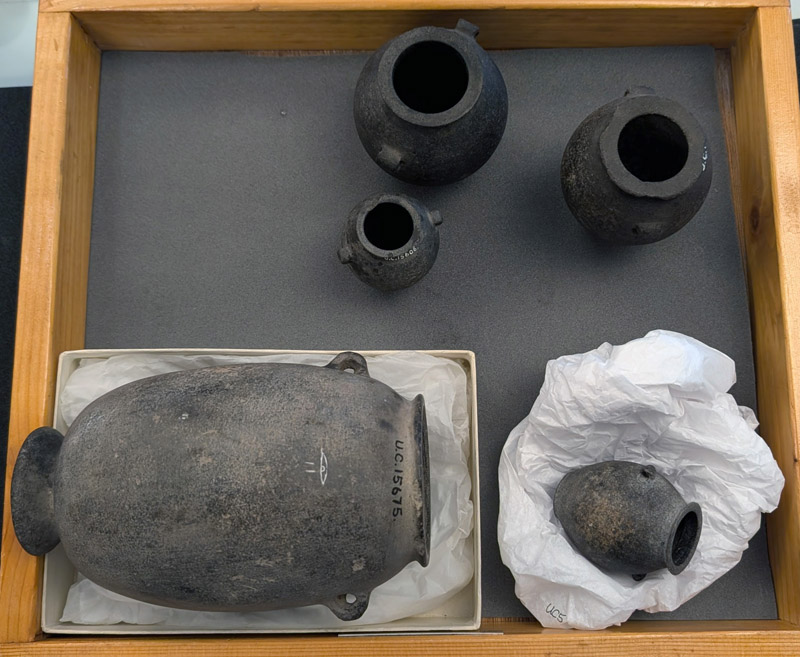
On our trips, I did the photography, documentation, and video recordings. So after a while, I began to recognize the predynastic stonework, and Naqada’s wide variety of pottery became much less overwhelming. I looked inside all the vessels, turned them upside down, and took pictures of objects from various points of view.
We visited many other art & archeological museums as regular visitors:
- MFA Boston
- San Antonio Museum of Art,
- British Museum,
- Houston Museum of Natural Science,
- the Louvre in Paris,
- Harvard Museum,
- the Met,
- Archeological Museum in Florence,
- archeological museum in Sforza castle in Milan,
- archeological museum in Bergamo,
- Manchester museum,
- etc
I took pictures of displays with Naqada culture and other Egyptian art. In addition, I spent countless hours browsing online collections of many museums, including the Met, the Cleveland Museum of Art, Penn Museum, to mention a few. When you see the ‘same’ thing over and over again, ‘other’ things jump out as odd artifacts.

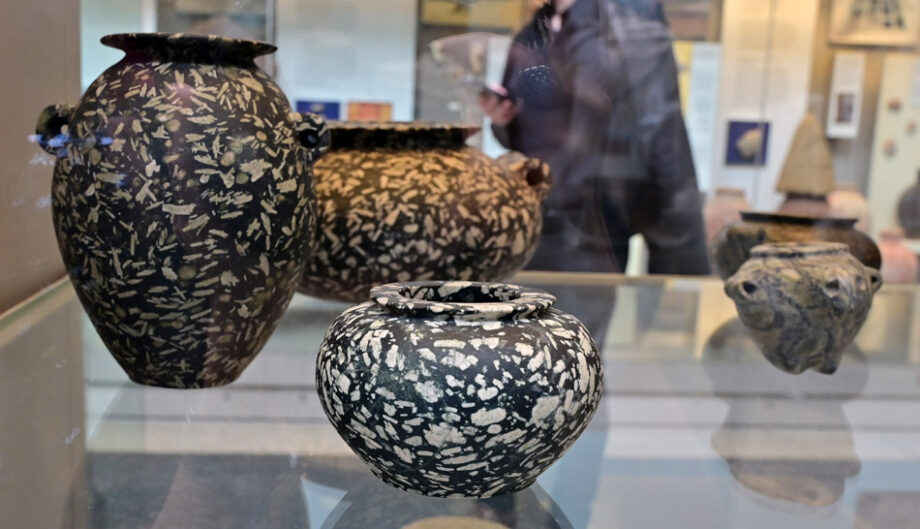
What jumps out in the ‘super-precise’ vases is a complete absence of weathering on the surface, the strange color of a ‘super-precise’ vase stone, slightly different shape of either the object, rim, or lug handles (famous ‘spinner’ vase). I’m not saying I know everything or I’ve seen everything there is to see in the collections, but it’s important to question the oddities. I’ve seen several samples from different museums with similar results of Naqada culture presentation…
Unanswered questions about these super-precise vases:
- How come all super-precise vases shown by Ben & friends are shared between the two people – Adam Young & Matt Beall?
- What about the provenance of THESE vases, not some other ones held in private collections?
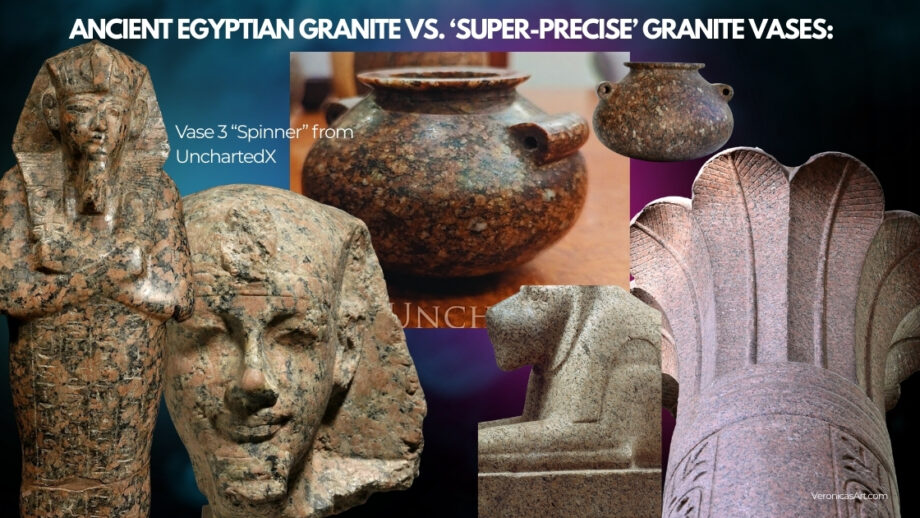
- Why is the granite of ‘super-precise’ vases different from the ancient Egyptian one?
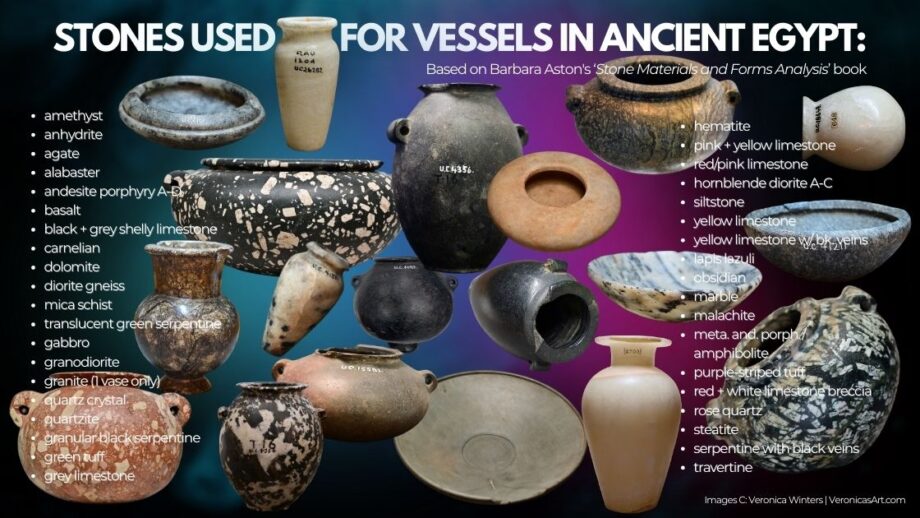
- Why did ancient Egyptians rarely used granite for vases but used it for statues & architecture?
- Why does the mathematical algorithm consistently shows modern-machining on the ‘super-precise’ vases?
- What happened to all those advertised scans of Egyptian objects in museums and Egypt that were done by the Artifact Research Foundation with Karoly Poka?
- Why can’t we find any other super-precise, granite vases from a specific tomb in Egypt or a museum with provenance? I listed 3 granite vases found-one from Aston’s book, one from Christie’s website, and one from the Pyramid complex of Djoser, Imhotep museum. Some of you refer me to the Arnold Meijer archives of Egyptian art, but many stone pieces are mislabeled there! You can find several bowls and vases there labeled as granite and black breccia but the actual stones are different.
- When you write an argument about seeing a “super-precise” vase, please link to a specific page, photo, literature page, provenance publication, article, etc. Otherwise, it’s impossible to know what vase you’re talking about!
- Well-made scanned predynastic Egyptian vases look precise at first sight, which suggests that a potential collector wouldn’t be able to make a difference between the artifacts in the past (without a scan). How come the precise ones come from private collections only, according to Ben?
- It’s easy to dismiss scientific work and scientists and archeologists in general who actually do all the heavy-lifting researching the topics, writing about it, and publishing data. But what are the FACTS going for these 3 super-precise, granite vases then? There are NO predynastic Egyptian artifacts found with super-precision just yet, only the ones Ben keeps showing us!
In his discussions about ancient Egyptian stone vases, Ben van Kerkwyk (from the channel UnchartedX) explains that the most precise and high-quality artifacts are often found in private collections rather than museums. He notes that collectors typically sought out the most “precise” and “beautiful” examples, while museums often hold thousands of broken or less remarkable specimens. Ben appeared on numerous podcasts talking about this.
Ben says:
- Collectors historically sought out the “most beautiful” and “most precise” vases, often leaving the more mundane or broken items for museums.
- Because these “perfect” vases are often in private hands, Ben has worked with private owners to use structured light scanners and metrology to prove they have aerospace-level precision (within thousandths of an inch).
- He argues that these vases were “heirlooms” or inherited by the early Dynastic Egyptians, rather than being made by them, because the technology to create them (high-speed lathes) disappeared later in Egyptian history.
Summary of Ben’s arguments from this video alone:
The ancient Egyptian hard stone vases are considered highly significant due to their incredible precision, meticulous design, and immaculate execution in extremely hard types of igneous rock (0:50-5:22).
These artifacts, many of which date back to pre-dynastic times (7:27-7:55) (some as far back as 15,000 years ago), present a major challenge to the orthodox view of human civilization history (7:19-7:27, 10:47-11:05). Their advanced manufacturing level, including features like incredible symmetry, delicate wall thickness, and mathematical encoding (5:15-5:22, 45:07-45:21), suggests a level of technological sophistication that was, according to mainstream history, undiscovered by humans during those periods (45:14-45:21).
The fact that these precise hard stone vases essentially disappear from the dynastic Egyptian civilization after the Old Kingdom, being replaced by cruder, handmade alabaster vessels (18:54-19:01, 20:23-21:21), further supports the idea that they were inherited or found artifacts rather than products of dynastic Egyptian craftsmanship (17:59-18:03, 21:27-21:37).
Ben talks about some of the best vases in private collections, specifically those owned by Matt Beall, around these timestamps:
-Discussion of a perfectly round serpentine vase from Matt Bell’s collection (1:25:21-1:25:54)
-Matt Bell’s acquisition of vases (54:44-55:04)
-Description of a translucent vase (32:14-32:20)
Facts vs. Ben’s claims about super-precise granite vases from a single video (and repeated in many others):
#1. Kush & Toshka sites: ancient stone vases

“As far back as to the Neolithic Stone Age peoples of Kush which is the area made up today by Northern Sudan and Southern Egypt these cultures date as far back as some 15,000 years ago and yes hardstone artifacts were 100% found in burials like toshka that have been carbon 14 dated to those times you can quite clearly see these Stone vessels in the photographs that were taken of these excavations around… “
Questions I have:
First of all, what do you really see here? Stone vessels or pottery?
What the Toshka site actually represents:
The Toshka burial sites comprise several archaeological locations in Lower Nubia, primarily excavated in the early 1960s before the area was flooded by Lake Nasser.
These sites span from the Middle Kingdom (c. 2000 BCE) to the X-Group period (c. 4th–6th centuries CE).
Archaeologists have found stone artifacts and materials related to stone vessel production at the Toshka sites, though the burials themselves are more famous for their pottery and luxury jewelry. Most of the original riverbank sites were submerged by the Aswan High Dam project. However, salvaged materials and unpublished data are currently being re-examined by the Yale Peabody Museum.
- Toshka West Cemeteries: Excavations in C-Group and Meroitic cemeteries (such as Cemeteries B, C, and D) primarily yielded pottery vessels, copper mirrors, and jewelry made of ivory, carnelian, and ostrich eggshells. While stone beads were common, complete stone vessels were not the primary grave goods reported here.
- Relationship to Stone Working: Toshka’s major link to stone vessels is its role as the river terminus for the desert route to Chephren’s Quarry (located about 50 miles west). This quarry was the ancient world’s oldest large-scale source for diorite used specifically for royal statues and fine stone vessels during the Old Kingdom.
- Associated Desert Sites: Surveys by the Yale Toshka Desert Survey identified stone tools like mortars, rubbing stones, and grinding stones at nearby desert outposts (e.g., Nuq‘ Maneih), as well as ink inscriptions on stone pebbles.
In Conclusion:
Correction of Common Misconception: There have been recent viral claims on YouTube suggesting “12,000-year-old precision granite vases” were found at Toshka. However, archaeological consensus and peer-reviewed data from the Penn Museum and Yale confirm that the Toshka burials date to the much later Middle and New Kingdoms, and such fine, stone vessels are typically found in Early Dynastic sites like Saqqara, not the Toshka burial pits.
These articles debunk viral claims about stone vessels at Toshka and clarify their connection to ancient quarrying sites. * Summarized by Gemini
“Nubia.” Expedition Magazine 4, no. 4 (July 1962): -. Accessed March 07, 2026. https://www.penn.museum/sites/expedition/nubia/
#2. Cryptographer Mark Qvist findings about the radial traversal pattern on the OG vase:

Ben: 43:06-46:
“That vase was designed. It was not the result of some primitive artisan eyeballing a piece of stone and then rubbing on it for years with rock and sand…it was designed mathematically, elegantly…”
Mark Qvist (a software developer, cryptographer, and metrology enthusiast behind unsigned.io) first gained attention in the ancient-precision community for his March 2023 analysis of 3D scan data from one of the so-called “OG” granite vases (PV001 / Adam Young’s private collection piece). In his article “Abstractions Set in Granite,” he concluded that the vase showed a mathematically coherent radial traversal pattern (involving phi ratios, precise concentricity, and geometric relationships far tighter than expected), and that it was produced via sophisticated subtractive manufacturing requiring high-precision mechanical technology—beyond what conventional hand tools or even modern CNC could easily replicate.
His most recent public view (updated after higher-resolution 2025 CT scans and the broader Vase Scan Project dataset) is a clear reversal of the ultra-precise private-collection examples he originally examined. He now states that the object (or at least its current form) “is definitely not 5,000 years old—it is either a modern replica, a contemporary piece, or an ancient artifact that was later reworked.”
This shift came after the 2025 scans provided over 5× more vertices and finer resolution, revealing details that undermined the earlier “impossible ancient tech” interpretation. The ultra-precise vases (only ~4 out of ~56 scanned, all from private collections like Adam Young’s PV001 and Matt Beall’s V18) lack verifiable provenance; claimed histories contain errors (e.g., references to a pre-1918 Czechoslovakian ambassador). Museum-held Predynastic pieces show far lower precision consistent with hand craftsmanship.
On Stine Gerdes’ work: Gerdes (of Arc Scientific/arc sci.org) was directly inspired by Qvist’s 2023 article; she has said it sparked her 30-month deep dive into 3D metrology of ancient stone vessels. She collaborated on the Vase Scan Project (providing precision reports and statistical analysis for Adam Young’s collection for nearly two years) before publishing her own 2025 comparative study of 32 Petrie Museum artifacts.
Her key findings:
- Museum Predynastic vases are statistically indistinguishable from modern handmade replicas (using copper tools/abrasives).
- They show multi-stage hand-guided repositioning marks, axial misalignments, and tolerances (often 70–100+ μm RMSD) fully consistent with pre-industrial craftsmanship—no evidence of lathes, electricity, or lost high-tech.
- Private ultra-precise pieces (like PV001) are statistical outliers that exceed even industrial CNC benchmarks in some metrics, but their provenance is unverified, and their interior/exterior heat-map patterns more closely resemble modern machining.
Gerdes has also publicly criticized data-handling issues in the private-collection scans (e.g., Adam Young allegedly substituting incorrect scan data from one vase for another to exaggerate precision differences, plus flawed geometric-mean methodology). Qvist’s opinion change explicitly followed the “2025 report with new data” that incorporated exactly this kind of museum-comparative metrology Gerdes produced.
In conclusion:
In short, Qvist’s updated stance and the broader analyst consensus (including Gerdes and Dr. Max Fomitchev-Zamilov) now treat the ultra-precise “OG” vases as anomalous outliers whose claimed ancient origin and technological implications do not hold up under rigorous, provenance-aware scrutiny. The museum pieces remain impressive examples of Predynastic skill—but achievable with hand tools. Gerdes’ systematic, open-source metrology work is the foundation that enabled this re-evaluation, and Qvist’s own reversal is presented in direct connection with it. No newer public statements from Qvist (as of early 2026) contradict this updated position. *This is summarized by Grok
#3. Rose granite used in super-precise vases?
Questions I have:
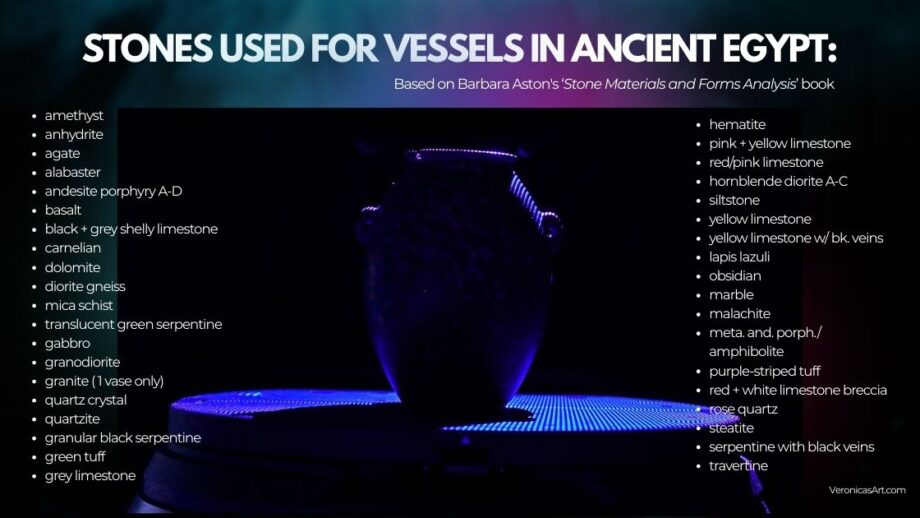
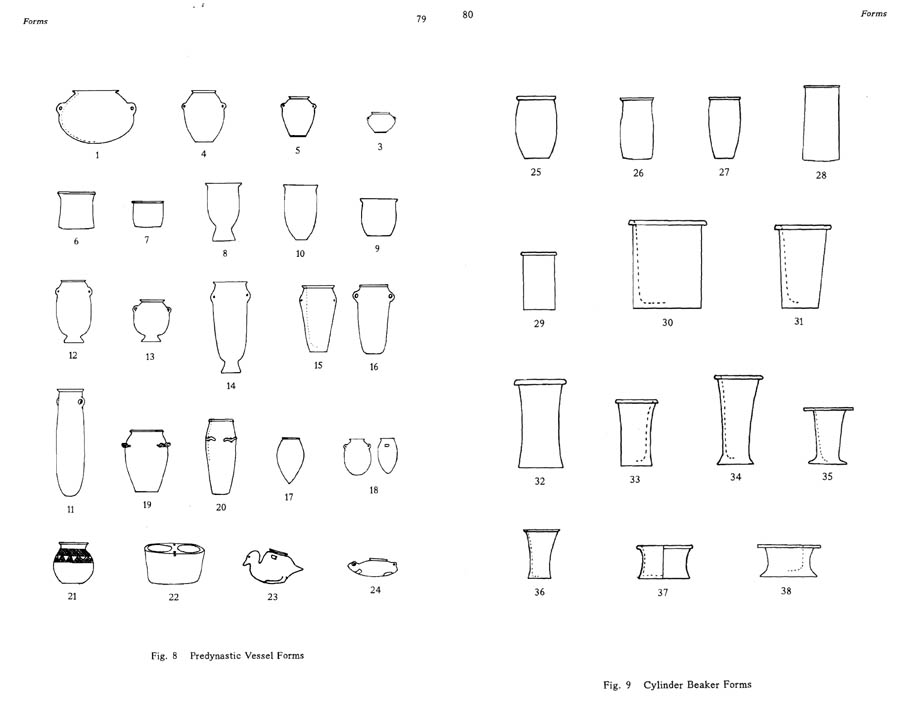
There are no predynastic rose granite vases found in tombs in Egypt besides very few (the awkward granite vase is pictured in Barbara Aston’s book is the only one she found at the time of her book writing. More on this later)
Ben: (1:08:23) “..Radial traversal pattern the < TK of 6/2 to the power of n very much seems to be a design element of two other vases that have been analyzed, the thin wall vase that we’ve looked at as well as the spinner vase, both made from rose granite and classified as pre-dynastic.”
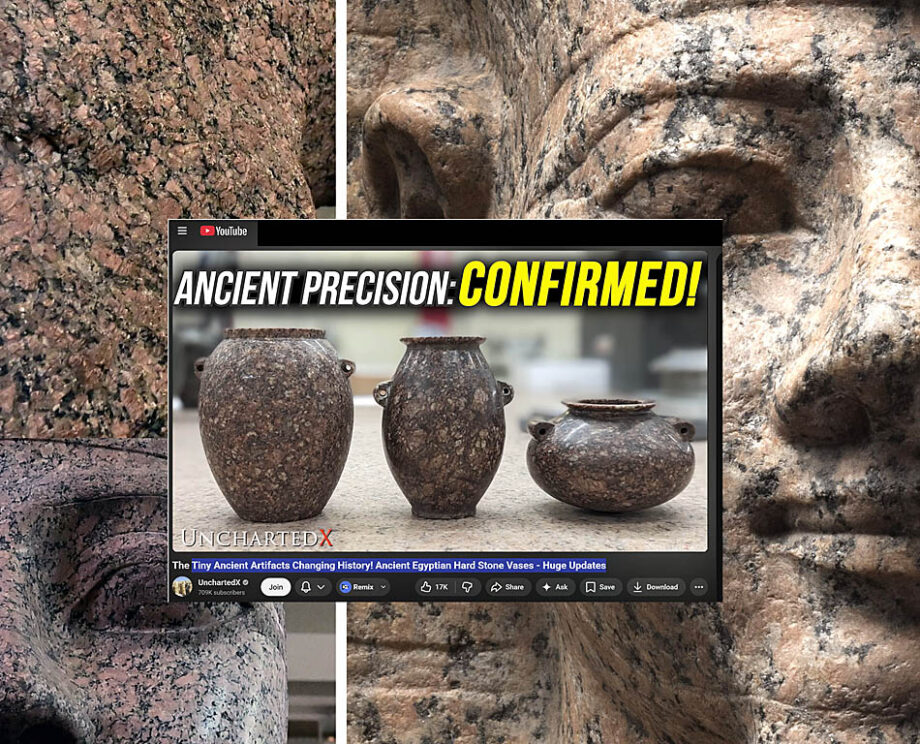
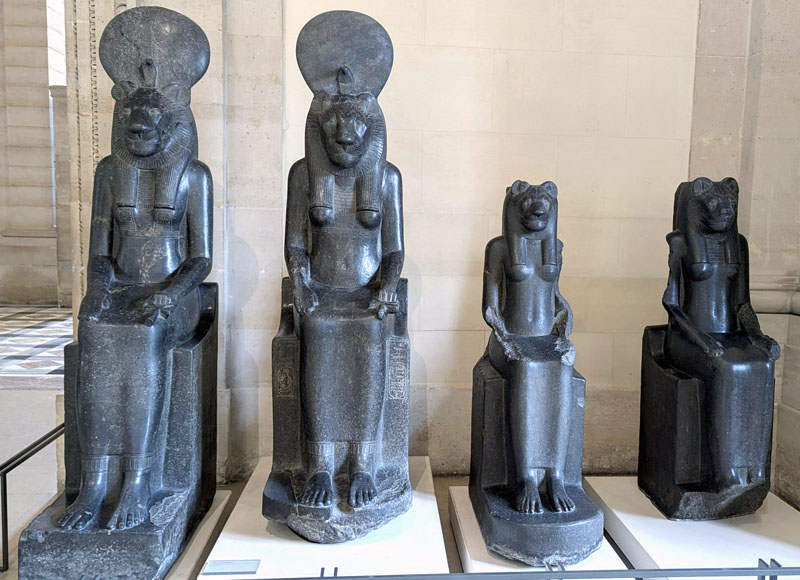
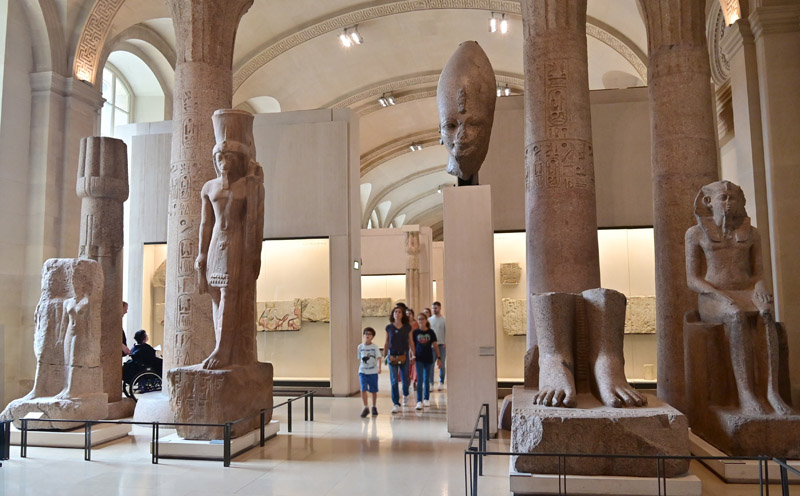
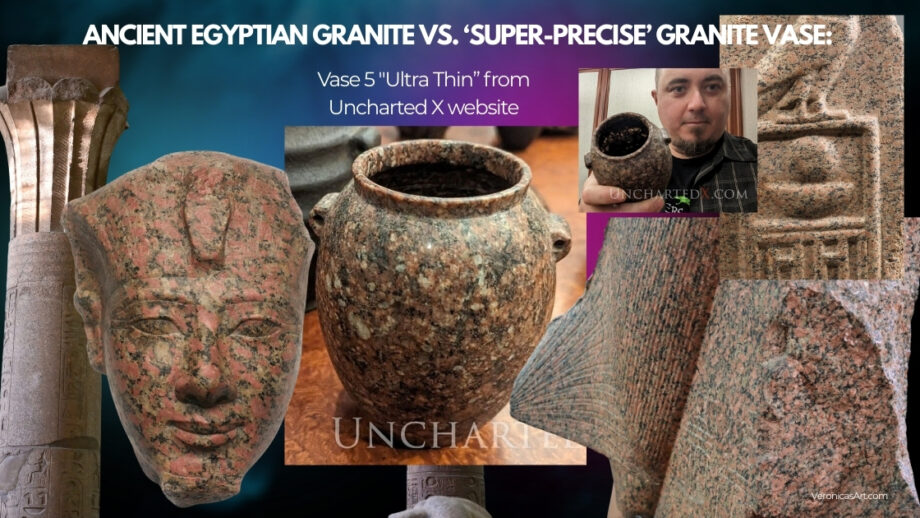
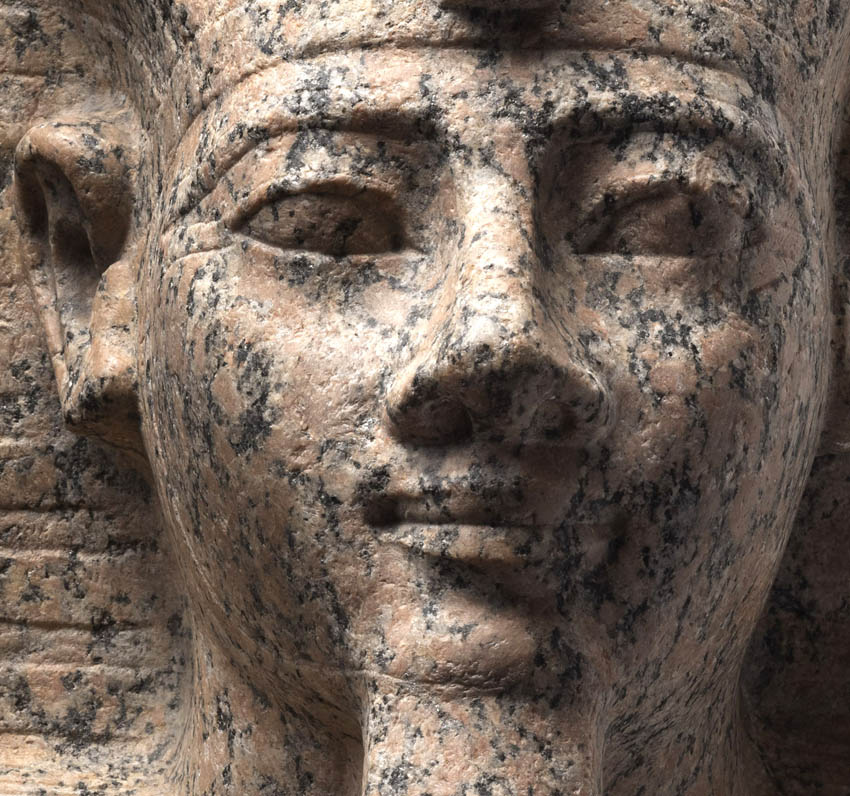
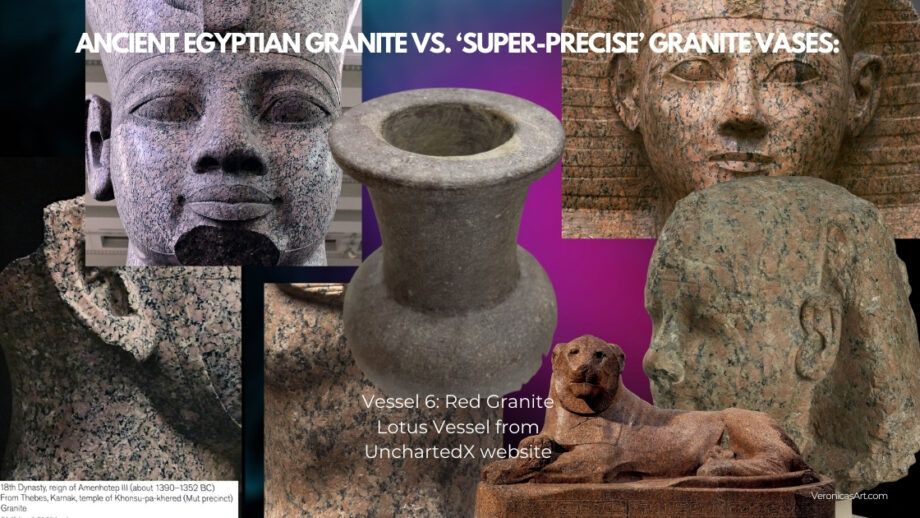
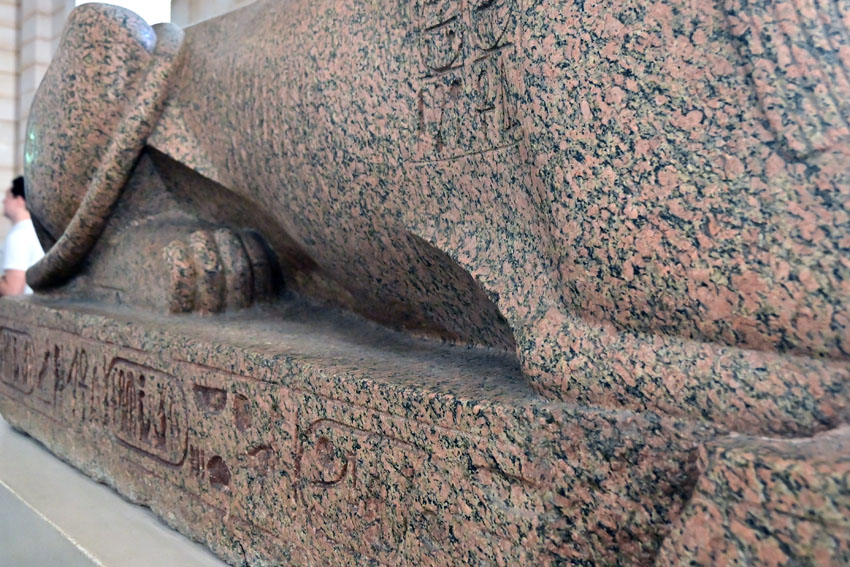
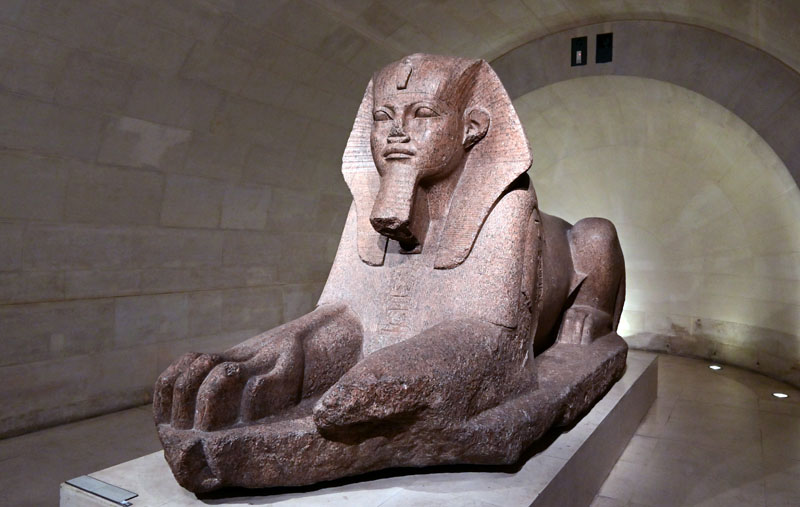
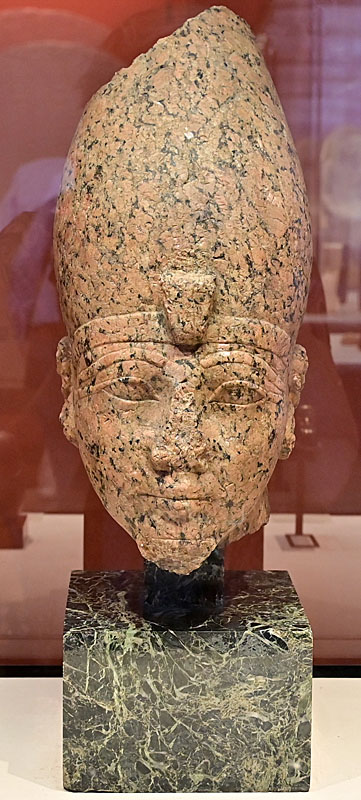
I collected several photos of ancient Egyptian granite used in statues and put them around this screenshot. The mottled rock pattern on statues is very different from the granite of these ‘super precise’ vases.
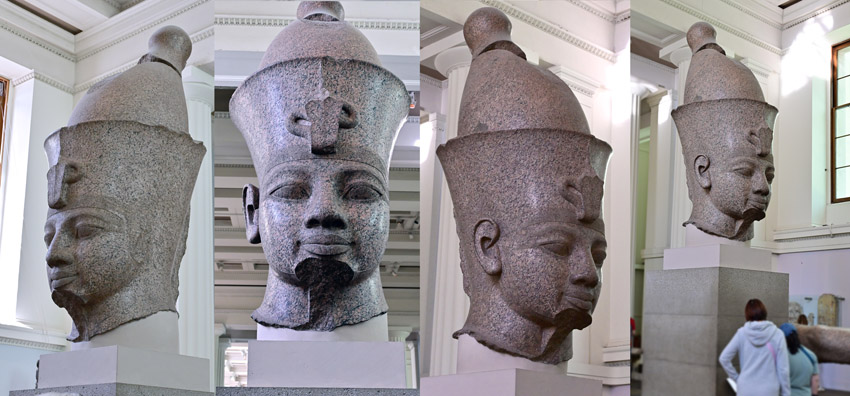


These precise vases look dark brown to me while every Egyptian granite piece I’ve seen looks fairly light under strong museum’s light. It usually has a light reddish color with black infusions. White quartz infusions also look different from the ones seen on these vases.
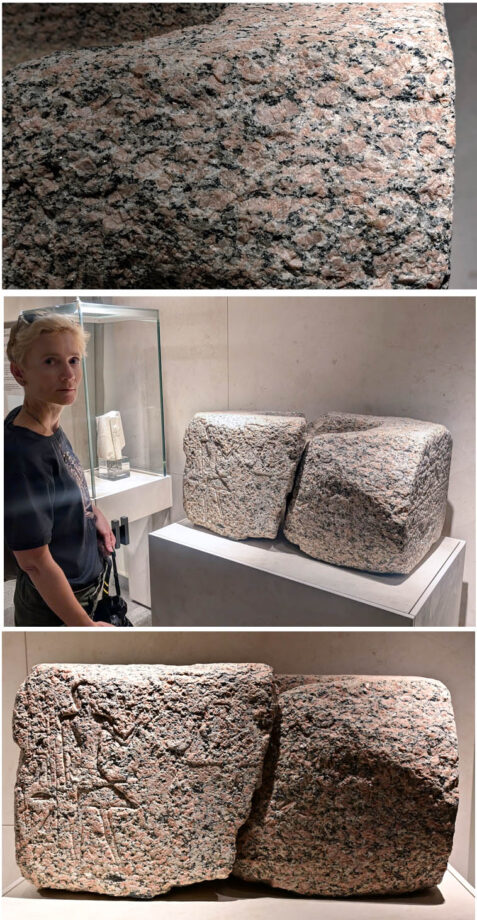
What you’ll see there is an ancient Egyptian granite block. Pay attention to its color and pattern to understand how that granite looked like in ancient Egypt. Its color and texture don’t look anything like the proposed ‘super-precise’ stone vases.
Block inscribed with Khaemweset name: Granite, 19th Dynasty, reign of Ramesses II, c. 1279-1213 BCE, From Medinet Madi. Museum’s description:
The block may have served as a support for a stele commemorating work done in the temple of Medinet Madi. Completed for the prince Khaemweset, he is depicted worshiping a deity (broken off) on the front of the stone. The prince’s name and titles are inscribed with the hieroglyphs on the back of his figure. Other inscriptions on the block are of his mother (the second wife of Ramesses Il, Isetneferet).
You can read about the collection and popular Egyptian artifacts here: https://www.comune.milano.it/en/w/cultura.-al-castello-sforzesco-apre-la-nuova-galleria-antico-egitto
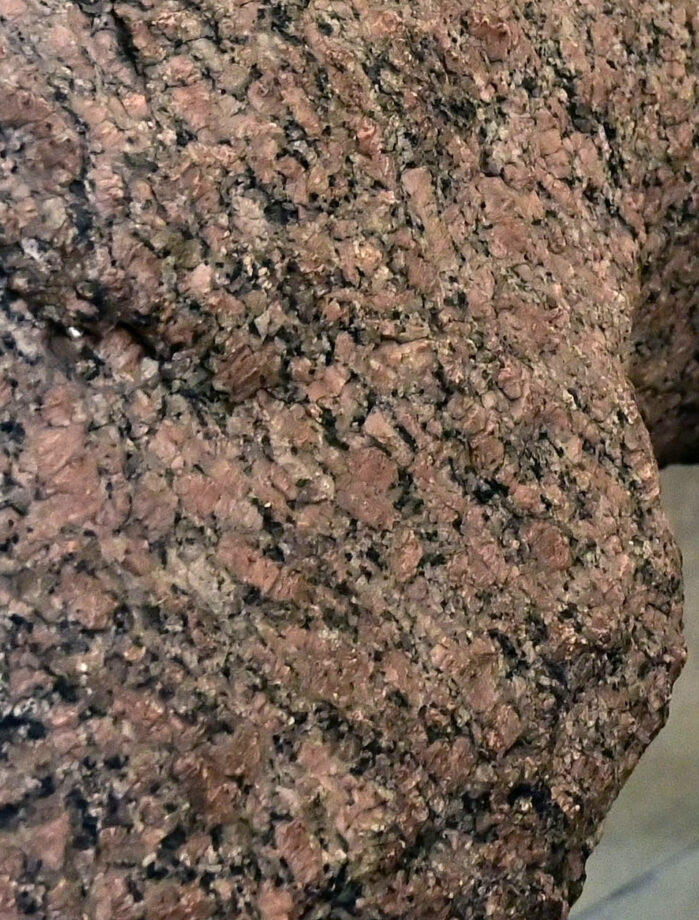
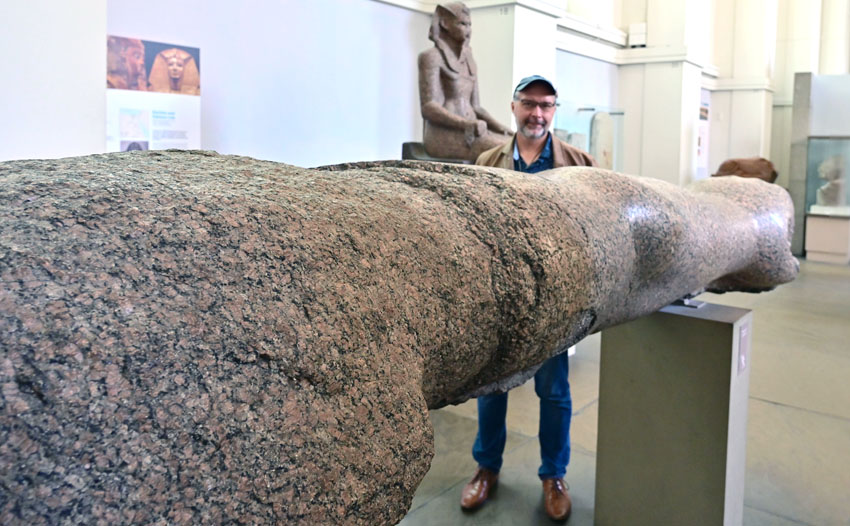
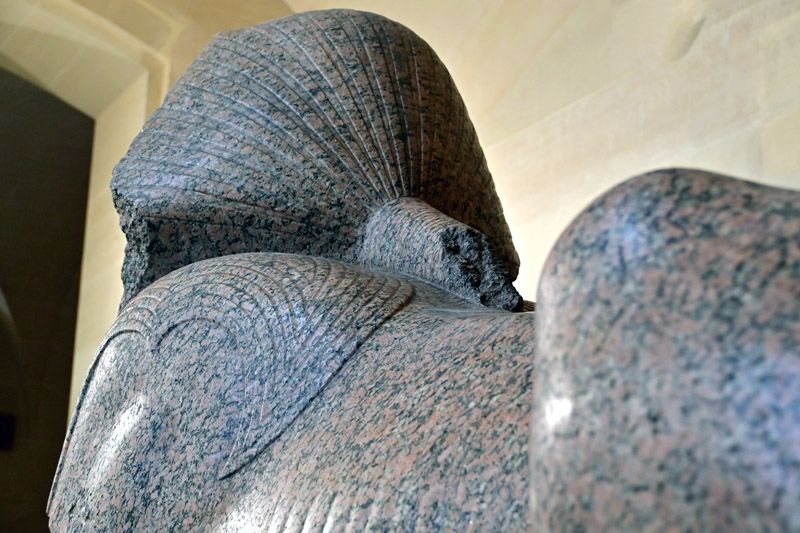
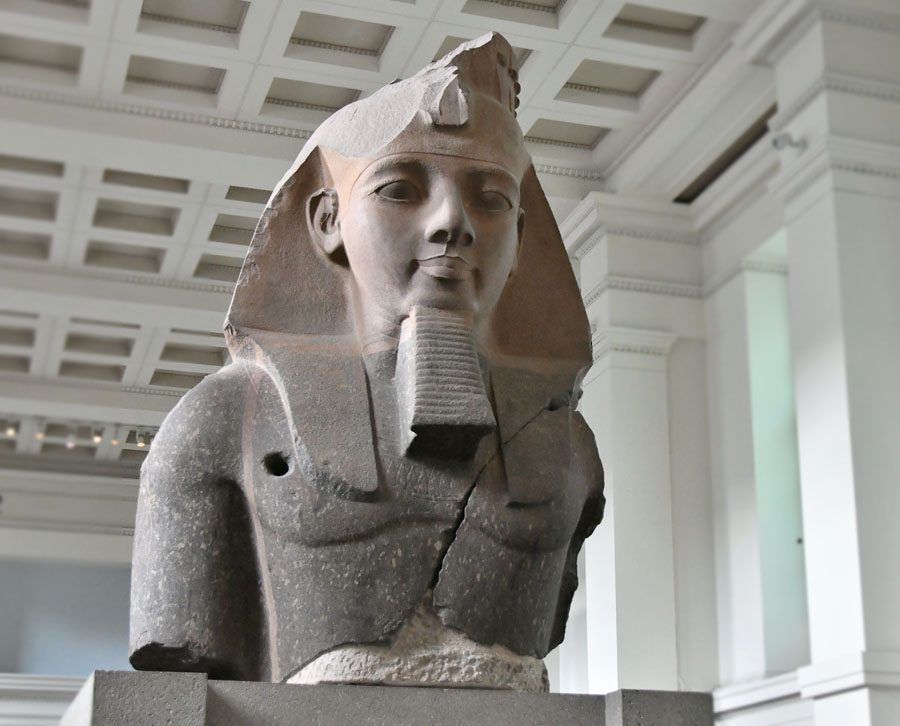
The king stood with both arms straight down, holding containers for papyrus documents. This statue and a slightly smaller companion flanked a doorway in the temple precinct of Mut, consort of Amun-Ra, in Karnak. The head of the second statue is also in the British Museum; both bodies are still in Karnak. Amenhotep’s peaceful reign was a time of opulence and outstanding artistic refinement, often displayed on a grand and ambitious scale. Most of the biggest statues in this room
were made on his orders. The statues originally represented Amenhotep III but a century later the facial features were partly reworked for Ramesses II to resemble his own official ‘portrait’. Ramesses appropriated countless holding containers for papyrus documents. Statues remained common for several centuries, but only Ramesses would have their features modified.
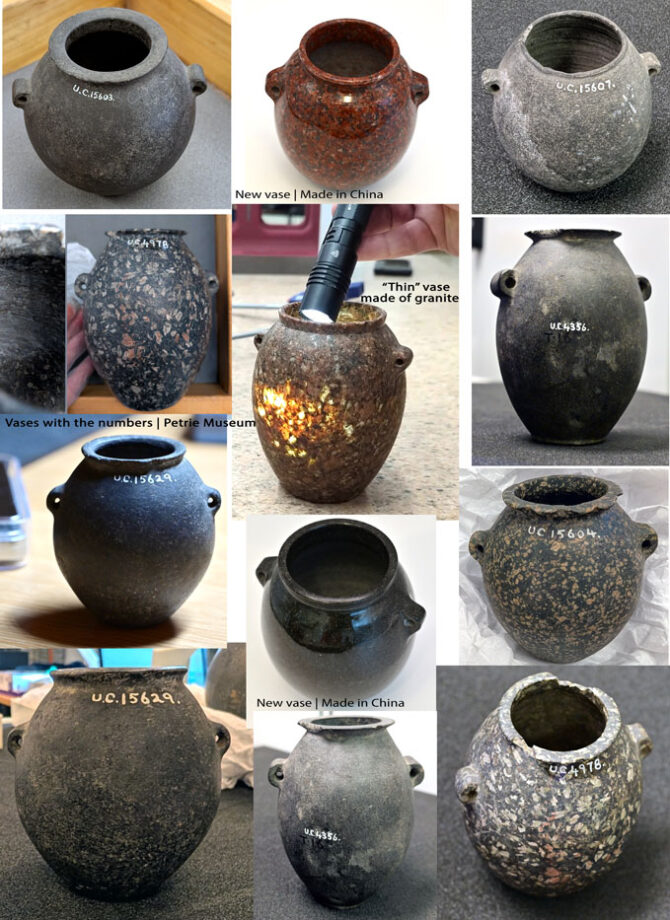
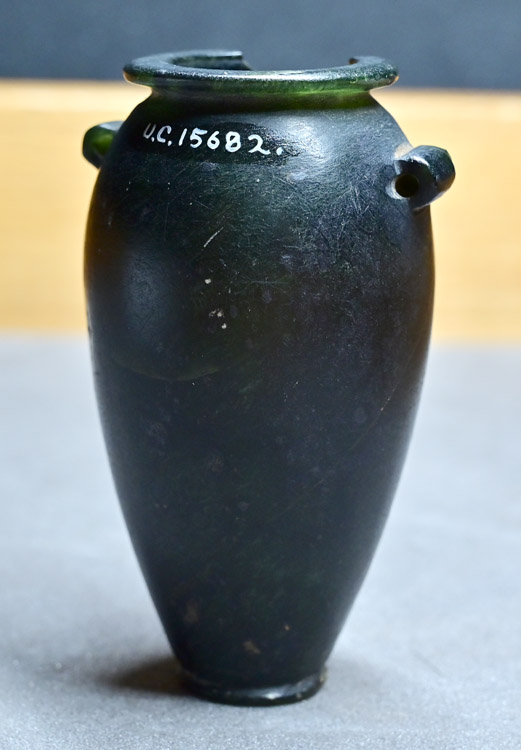
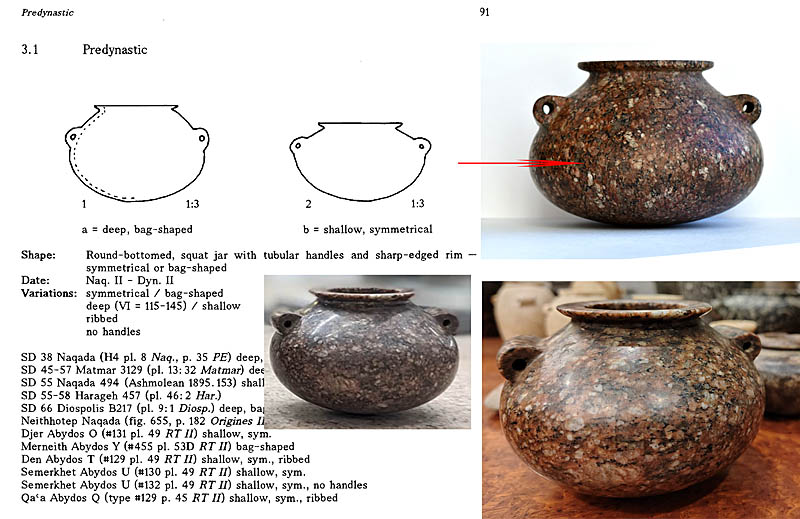
At first sight, the rim of a ‘super-thin’ vase looks the same as in other Predynastic Egyptian vases. The difference is subtle. The opening of a rim in a thin, see-through vase is considerably wider than in the ancient vases I’ve seen thus far. The rim shape of this thin vase is also not quite the same as in predynastic vessels.
Moreover, I was stunned to see the first version of a vase we ordered in China. They made exactly the same rim and opening in their vase as in the super-thin vessel!
Granite vases found:
Also, I haven’t seen a single predynastic Egyptian granite vase in any of the museums I visited.. However, I found one in the book. The other two were found by Alexandr Sokolov who sent two images of granite vases he found. See below!
#1
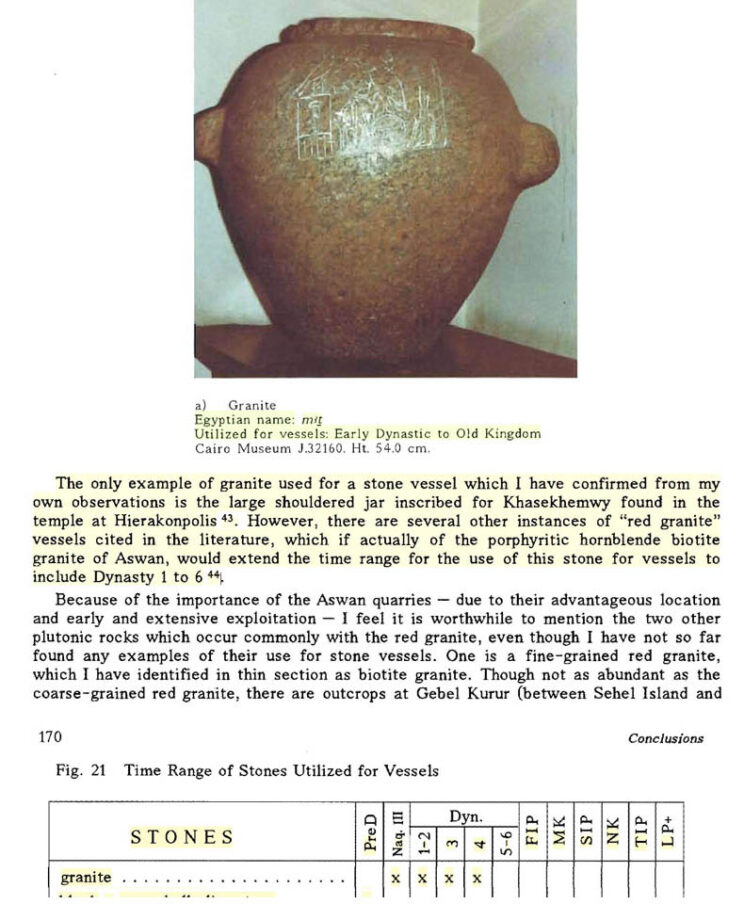
#2
Assuming the provenance of this granite vase checks out in actual paperwork, this looks like an Aswan granite to me because the stone pattern is very similar to the pattern I’ve seen in granite statues. Also, the vase looks well-made at first sight, and if you go to the Christie’s site you’ll see a high-resolution image showing some surface wear and slight unevenness of a well-made handmade work. It will be fascinating to scan and analyze such a vase through the algorithm to see if it has the same unique predynastic Egyptian vase pattern or not.
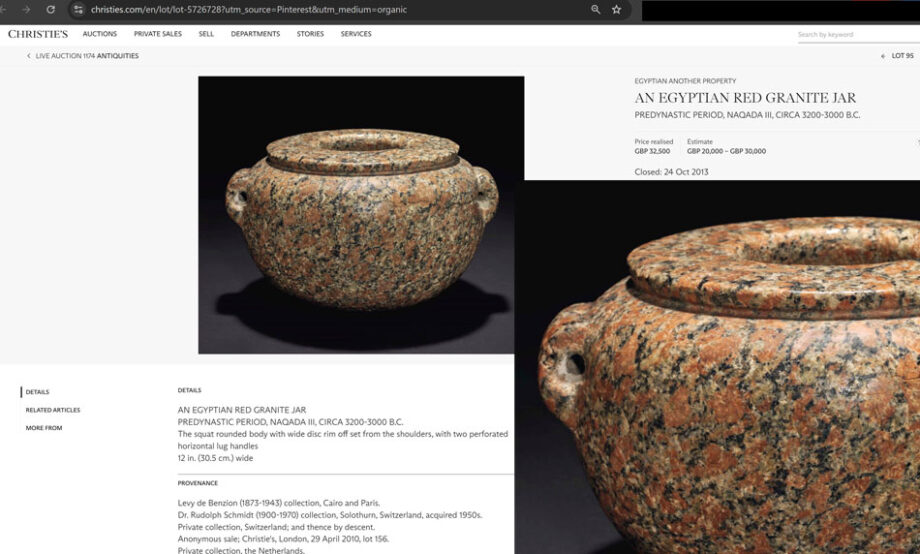
The squat rounded body with wide disc rim off set from the shoulders, with two perforated horizontal lug handles, 12 in. (30.5 cm.) wide.
Provenance:
Levy de Benzion (1873-1943) collection, Cairo and Paris.
Dr. Rudolph Schmidt (1900-1970) collection, Solothurn, Switzerland, acquired 1950s.
Private collection, Switzerland; and thence by descent. Anonymous sale; Christie’s, London, 29 April 2010, lot 156. Private collection, the Netherlands. Sold for GBP 32,500 in 2013.
#3
The second granite vase Mr. Sokolov shared is this one: Both the color and pattern of the stone is similar to the Aswan granite in Egyptian statues. Does it look super-precise to you? Only the scan and the algorithm can sort it out.
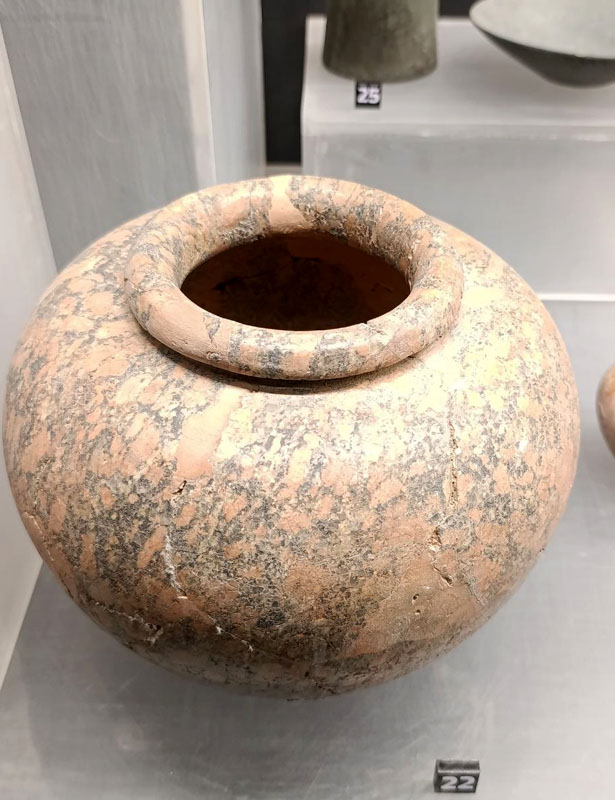
So, while these two granite vases look Egyptian in terms of stone, the three vases Ben promotes, don’t.

#4. Hard data & provenance claims:
Ben: (1:15:23):
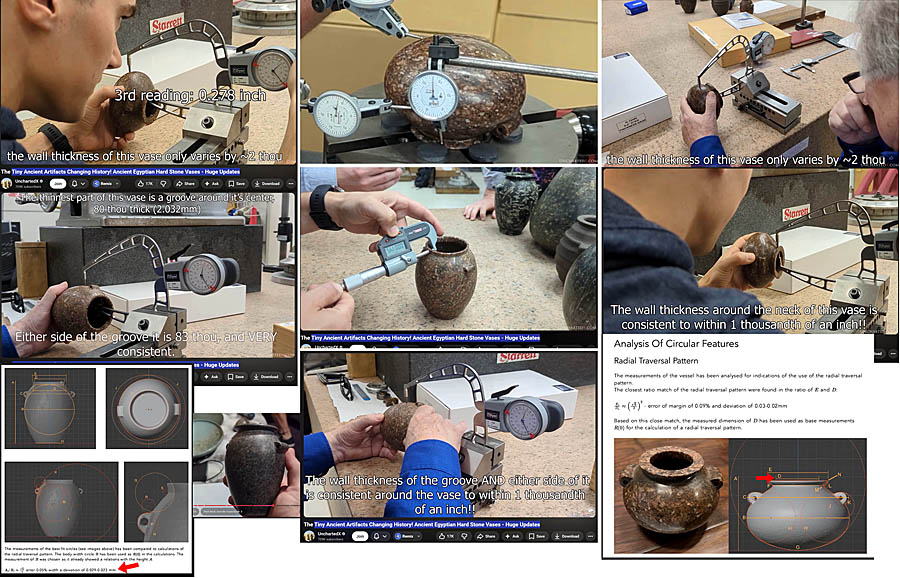
“…And have gone on personal crusades to debunk the findings any way they can well I say any way they can but given all of the open-source scans and the hard data the only way that’s emerged is to yell fake on the internet like a flat earther who’s looking at Globe photos from a Japanese satellite no one can argue with the actual data so it generally boils down to noisily trying to discredit the (1:15:52) origins of the artifacts and distract the audience away from the significance of the findings that’s more or less what the whole Providence argument is. It’s a fancy word used to suggest that most of these phases are nothing more than modern fakes there’s been a couple of reaction videos that have taken this approach implying that because we don’t know the exact circumstances of when where how and by whom all of these ancient artifacts were extracted from Egypt then they must just be modern fakes and we could ignore all this pesky data and hard facts about (1:16:30) precision right there’s so much stupid in this statement that it’s tough to know where to start but let’s give it a go as previously mentioned it’s easy to just throw out an unqualified assertion like that yelling fake on the Internet only takes a sentence or two but adequately responding to it requires paragraphs as the actual discussion and Providence topic is full of context and Nuance seeing as we’re here let’s point out a few of the many ways this modern forgery argument just doesn’t hold up… (1:17:03)
Ben: “First of all I don’t think that the people making this accusation fully understand how Providence or the Antiquities market for that matter actually work or they’re deliberately misrepresenting it they seem to act like any artifact not in a museum say for example one in a private collection must be either stolen or fake and on that basis try and discredit everything about it even Flint Dibble shamefully took this approach when in a discussion about analysis with Matt Bell on Twitter petulantly responded to him by throwing shade on the origins of the artifact suggesting Matt stops buying looted vases and then rage quitting the conversation and blocking Matt you see how it works do whatever you can to distract away from the actual evidence and the important parts of the discussion which is of course the utterly astonishing precision and just loudly make unfounded accusations for what it’s worth and while we’re talking about everyone’s favorite budget Indiana Jones let me address the many people who have suggested that I should debate or discuss these topics with Flint I generally disagree with this idea I think it would be both frustrating and to be honest an utter waste of time because he’s got quite literally nothing to offer on the topic he’s not an engineer he doesn’t understand precision and look none of this is his fault nor is that a negative statement it’s just not what archaeologists do that said I also find it incredibly unlikely that he would ever even accept or acknowledge the data and findings of this project I suspect any discussion between him and I would just be us talking past each other..”
Questions I have:
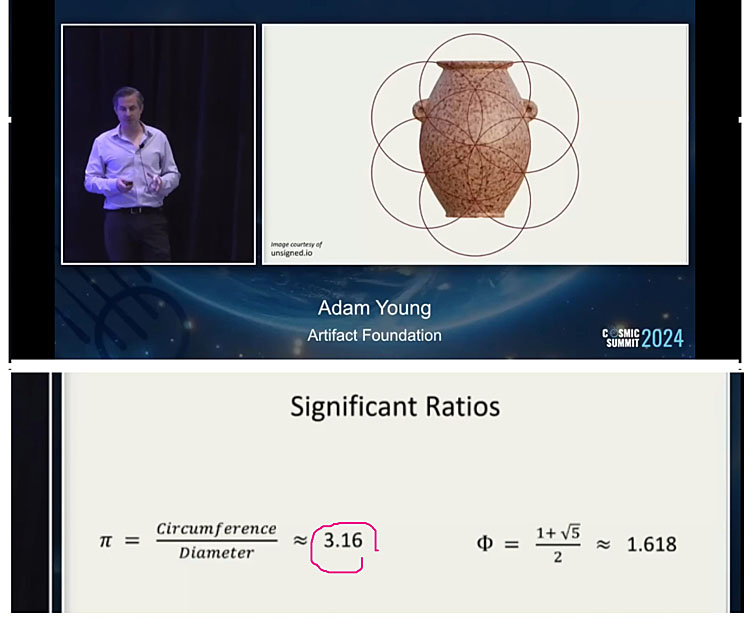
Btw, not everyone from the finance industry knows the numbers…
Ben: (1:24:07)
“…Just magically has impeccable Provence purely because it’s in a museum, lots and lots of artifacts in museums are classified and dated according to form style. Stone type those types of things 1:24:20yet the little plark next to it might say pre-dynastic or 26 Dynasty but in reality we really have no idea exactly where it came from or of its history before it landed in a display case in the museum it’s generally all the same stuff of course many artifacts do happen to have impeccable Providence and in a shocking turn of events the people on the internet yelling fake never seem to…”
Questions I have:
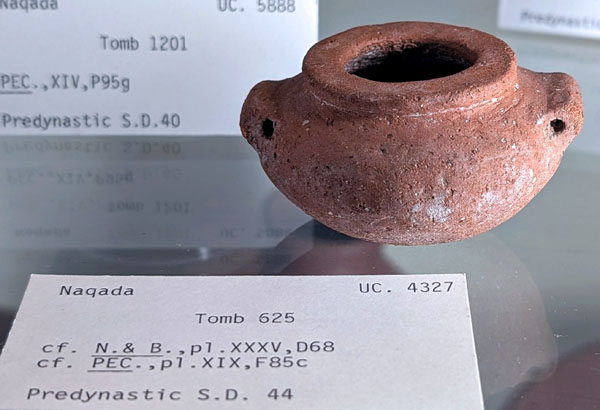
Museums pay attention to their labels and put a summary of provenance on them, including the names of private collectors if applicable.
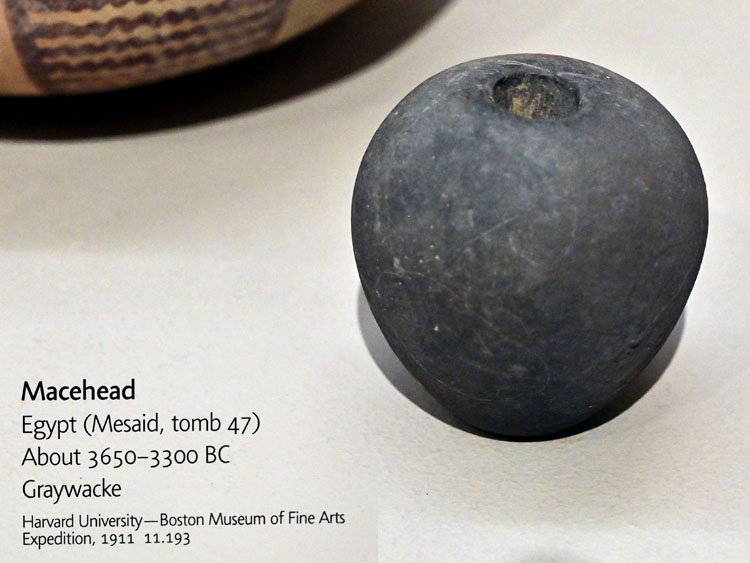
#5 Adam’s vase from the Czech Ambassador
Ben: (1:24:44)
“Acknowledge that artifacts with impeccable Provence also exist in private collections in fact several such vessels have been analyzed by the vascan project Adam Young has a large vase dated well into pre-dynastic times by carbon 14 analysis of the burial that it was found in and that was legitimately given to a Czech Ambassador in the 1930s as a gift people then die estate sales happen 1:25:09ultimately ends up in an auction house and onto the market and in this case it was eventually acquired by Adam.”
Questions I have:
While I haven’t seen the document stating that the vase was dated to the pre-dynastic times, I know that there were 4 Czechoslovak Diplomats (not Ambassadors) in the 1930s. If the diplomat has a name, he should have a document showing provenance.
#6 Petrie Museum Collection: good and bad in the same argument?
Ben: (1:26:34)
“..Stupid that I have to keep saying it but it’s always been a stated goal of the vase scan project from day one to get into museums to analyze as many artifacts as possible and to analyze those with the best possible Providence that work is ongoing and it’s gaining Traction in 2024 at Adam Young and other members of the vase scan team spent 2 Days in the Petrie museum in London using structured light scanners and doing photogrammetry on a number of artifacts according to the curators of that museum the many thousands strong collection in the Petrie Museum which is a teaching Museum on the grounds of the University College of London only represents the bottom five maybe 10% of Flinders Petrie artifacts his teaching stock if you will the good stuff he gave to his benefactors his friends all kept for himself much of which ID wager is still in private collections I guess they must be fake then the analysis work from this field trip is still ongoing but here are the cliff notes from Adam (1:27:38) Young directly at least half the vases they analyzed are precise meaning they’re in the same ballpark low singled digit thousands of an inch as the other vases previously detailed on this channel I wonder what the Skeptics will have to say say about that finally let’s look at this fake claim from a logical perspective logically claiming these vases of modern forgeries makes zero sense when you consider what we know about them the people making these claims never seem to want to deal with…”
Questions I have:
- So, where is the published data from those trips to the Petrie Museum? There are a few files posted on UnchartedX website showing the same three or four super-precise vases from Adam and Matt’s collections only.
- Petrie didn’t give away his finds left and right and adhered to a work ethic that some may not understand. See more on this below.
- Top museums and super-wealthy collectors/donors/ subscribers to Funds kept the best artifacts from the first excavations, according to the book, Scattered Finds. Those artifacts were stelas, mummies, statues…
- So, at first Ben mentioned that Petrie Museum had the bottom 10% artifacts, yet Adam Young stated that at least half of the analyzed vases were precise… We spent 3 days in total with over 20 objects scanned there, and only one vase showed the precision with handmade quality, not modern machining. No published data from reputable museums, no proof, guys.
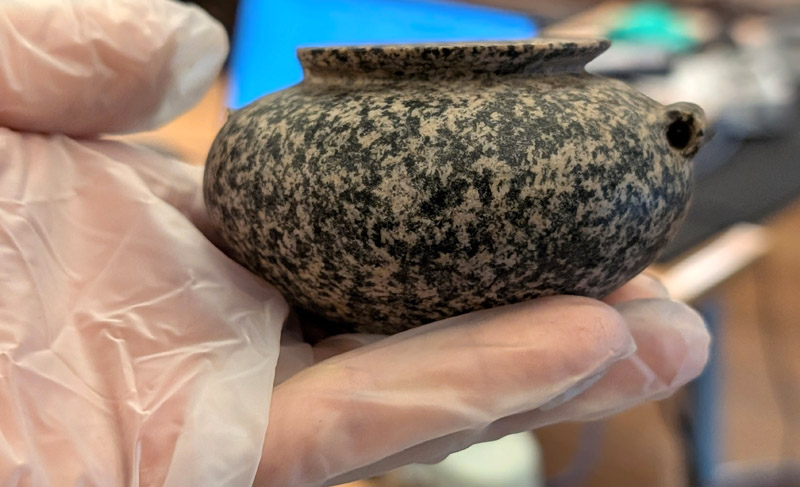
Three crucial figures were leading the first excavations and dispatch of ancient Egyptian artifacts from Egypt- famous archeologist Flinders Petrie (ERA fund+), Victorian writer Amelia Edwards (who presided over the Egypt Exploration Fund (EEF), founded in 1882), and Oxford University mathematics graduate John Garstang.
The notes or letters of these three organizations lead to a specific tomb or the names of wealthy individuals who sponsored the excavations in Egypt. Notes, letters, lists, papers, and photos also listed the names of the subscribers receiving the artifacts, even when they were gifts. There were also distribution grids with a catalog classification system like the one from 1901, organizing the dispatch of artefacts from royal Second Dynasty tombs at Abydos to museums around the UK. (p.47).
In the book Scattered Finds, you’ll find out that Petrie had a documented work ethic showing his genuine interest in excavated objects, not sales. Moreover, donors and the wealthy who sponsored the digs were also mentioned in papers.
“Dignitaries who visited active digs, such as Princess Henry of Battenberg, who witnessed some of the excavations at Deir el-Bahri in 1904, might be presented with personal gifts. The EEF later sent
a small crate to Buckingham Palace, containing beads, scarabs, a bronze cat’s head, amulets, and a stone statue of a couple.” (p.14)
Several women working at the excavation sites in Egypt held several responsibilities alongside male participants, such as marking objects with context numbers, drawing and photographing finds, packing
crates of artefacts, surveying sites, and occasionally directing fieldwork itself. Excavations in Egypt produced masses of finds, and it was often the women who were responsible for the heavy burden of ensuring ‘the general orderliness of the ever-growing collections’. This is clear from Petrie’s introductions to his archaeological memoirs, like that for Abydos, published in 1901” (p.60).
While deaccessioning in the museums and funds’ collections happened after the war, the best artifacts still should have the provenance leading to a tomb, a famous name/donor/sponsor, or an excavation site. Read the rest here: https://veronicasart.com/tracing-the-source-the-provenance-of-ancient-egyptian-artifacts/ or directly in the book Alice Stevenson’s book, Scattered Finds: Archaeology, Egyptology and Museums.
#7 Cost of making them…
Ben: (1:28:24)
“So precisely what about the radial traversal pattern why design them with such subtle mathematical Elegance if we were to make these today as they would cost an absolute bomb and it would take our best five axis machines burning up expensive tool tips to grind into granite you simply wouldn’t go to these links if they are purely for profit if you’re just making fakes to sell on the Antiquities market then why not just pump them out from a Chinese lathe shop they’d never be super precise but who cares no one was doing precision..”
Questions I have:
Making granite vases doesn’t cost a fortune. However, it does require a considerable cost to sponsor management of the entire process oversees that usually has several steps before the vases look close to being done. It also involves multiple DHL shipping charges to get every new batch of the vases to the US.
Ben: (1:29:23)
“..Have made them with the precision that they show back then maybe but it would take an incredibly talented craftsman as these vases with their lug handles have very complex geometry you can’t just make them on a lathe and in fact evidence suggests that they had to have been made on a machine with five axes of Freedom again check out this video or..”
Questions I have:
And here I agree with Ben, whoever made these ‘super-precise’ vases was more than a craftsman. This type of refinement comes from an artist who is highly likely to have used the machine-made tools to create these artful vessels.
#8 Scanning hardstone vases’ chips below the ground:
Ben: (1:32:34)
“…Going to hold up when here we are literally 150 ft below the step pyramid scanning large fragments of hardstone vessels that are still there and these are fragments that have been there for thousands of years what happens when some of these turn out to be precise as I expect them to be just as some of the vases in the Petrie museum were….”
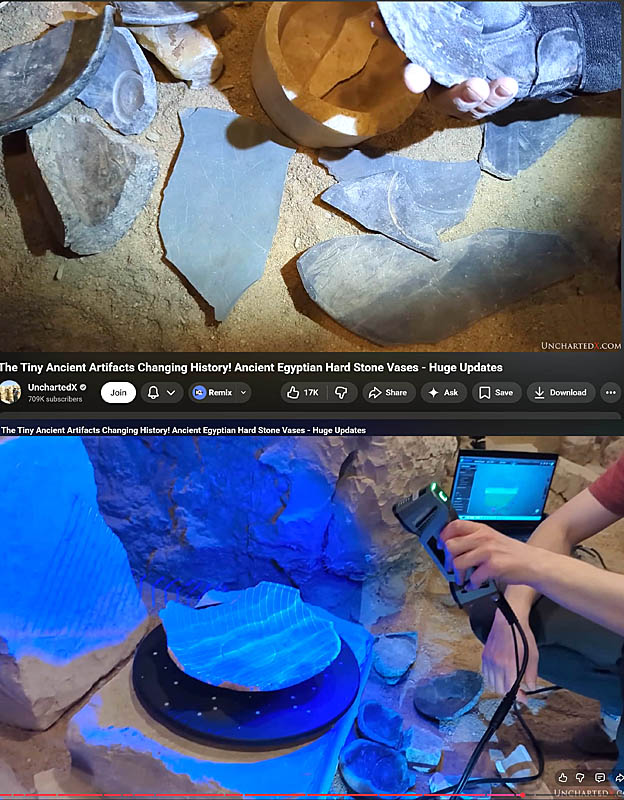
Questions I have:
These broken pieces look like plates or bowls to me, not stone vases, because of the shape and color of the stones. I’d like to see proof that these are stone vases. What do you see here?
Ben’s arguments continued on the recent Joe Rogan Experience:
#1 Precise vases are all in private collections, not museums:
In this clip from the Joe Rogan Experience, Ben explains that the most precise vase he has ever had scanned came from a private collection.
He mentions that many archaeologists and museum curators are not engineers and are often uninterested in the manufacturing precision, which is why some of the most “perfect” specimens were acquired by private collectors who appreciated their unique geometry.
Video: How Ancient Civilization Made Perfect Vases – Joe Rogan
Questions I have:
I’m pretty sure archaeologists would be very interested to study the precise, granite vases if they were found in tombs in Egypt! The best artifacts are in the museums or collections of a super-wealthy.
#2 Museum Collections are hard to study as opposed to private collections:
Ben discusses how entrepreneur Matt Beall began acquiring hard stone vessels specifically to subject them to CT X-ray scanning because these high-precision examples were in private hands and available for study, whereas museum pieces are often harder for independent researchers to access for technological analysis.
Video: Ancient Egyptian Hard Stone Vases – The Tiny Artifacts Changing History!
Questions I have:
I agree with Ben here that it might be easier to study private collections rather than making appointments, doing paperwork, waiting for a reply from museums, and traveling abroad, although we did all of that. Max studied both museum and private collections. The mathematical algorithm doesn’t look at the names of collectors or museums; it looks at concentricity and circularity of vases to determine what objects are predynastic Egyptian and what artifacts are machine-made.
#3 Collectors and Precision:
Ben explicitly states that the vase that “puts the whole concept of ‘can these even remotely be made by hand’ to bed” was found in a private collection. He elaborates that collectors would often hunt for these “precise” vases because of their aesthetic and mathematical perfection, which distinguishes them from the mass-produced pottery typically studied in mainstream archaeology. According to Ben, ‘Collectors historically sought out the “most beautiful” and “most precise” vases, often leaving the more mundane or broken items for museums.’
Video: How Ancient Civilization Made Perfect Vases – Joe Rogan
Questions I have:
First, museums sold off ‘duplicates’ during deaccessioning years, leaving the most precious objects in their collections.
Second, Ben mixes up Naqada pottery with their stonework. Pottery looks primitive in comparison to the stonework of the Naqada culture because they used different methods to make the vessels. Stone vases were made by skillful artists for royal tombs and the elite. Pottery consisted of vessels for everyday use and burials of regular Egyptians. Both types of vessels are studied by the archaeologists. In fact, a lot of artifacts are studied when found in tombs and graves. It’s hard to study something that wasn’t found there. Hence, research provenance. While the collectors can hunt for precise objects at inflated prices now, thanks to Ben’s talent for promotion, it wasn’t the case before. In the book Scattered Finds, the author explains how museum and private collections formed and what artifacts were in demand. Objects in demand were large stelas, architectural pieces, columns, mummies, statues, etc. “Broken items,” as Ben calls them, were sold off from the museums after the war during the deaccessioning period. These were shabtis, beads, ‘duplicates,’ pottery, etc. Of course, some good things do end up in private hands,but those good things would have a solid provenance record leading to the original excavations, tomb, donor name, or funds.
As a result, it’s still unclear where Ben’s three granite vases came from, isn’t it? Well-made scanned predynastic Egyptian vases look precise at first sight, which suggests that a potential collector wouldn’t be able to make a difference between the artifacts in the past (without a scan).
#4 Engineering Evidence:
Because these “perfect” vases are often in private hands, Ben has worked with private owners to use structured light scanners and metrology to prove they have aerospace-level precision (within thousandths of an inch).
Questions I have:
That’s great to use the light scanners and metrology, although it’s super important to use them on the predynastic Egyptian artifacts with provenance and scan a metrological standard before scanning the objects. Otherwise, we’re possibly looking at an ‘aerospace-level-precision’ of the machine-made artistic pieces, are we not?
#5 Inherited Technology:
He argues that these vases were “heirlooms” or inherited by the early Dynastic Egyptians, rather than being made by them, because the technology to create them (high-speed lathes) disappeared later in Egyptian history.
Questions I have:
I’d like to see proof/facts of this statement because this is really interesting! As of now, it sounds like an ad hoc argument. *An ad hoc argument definition: (Latin for “to this” or “for this purpose”) is a logical fallacy where a person creates a specific, “tacked-on” explanation to save their theory from being disproven.
The conversation covers the recent Vase Scan Project, where precise measurements were taken on ancient Egyptian hardstone vases at Danville Metal Stamping. Dunn emphasizes the extraordinary precision found in these artifacts, achieving tolerances of roughly 1 to 3 thousandths of an inch, which matches modern machinist tolerances (18:15).
Super-precise vases: key arguments from in this video
#1. Ben and Christopher talk about the inability of others to understand their work.
The problem is not that. There are plenty of engineers around more than capable of understanding it. The real problem is showing measurements and numbers of three precise granite vases that have no clear record of where they came from. While Ben often mentions the ‘impeccable provenance,” it’s unclear about what provenanced vases he’s talking about…There is no clear evidence of the provenance of these 3 granite vases. The super-precise vases look new, made of granite and somewhat different in shape from the predynastic Egyptian vases. So what’s the point of measuring the granite vessels and not the provenanced ones from Matt Beall’s collection?
#2 Mr. Dunn says it’s impossible to make them on a potter’s wheel.
It’s not surprising, because the known potter’s wheel was used for pottery, not stonework! Egyptians seemed to use a different grinding method with sand and water, and some rotational device for stone vessels. The predynastic Egyptian vases were handmade and clearly show in Max’s analysis, contradicting Ben’s statements.
#3. (23:37) Ben talks about the rose granite and that the three most precise vases were made of it, that they are at least 5,000 years old, and damaged in spots. He’s amazed by the consistent precision seen in those vases.
The problem here is that the predynastic Egypt didn’t use granite to make stone vases in general. There are few found so far that I list above in this article. Only one was found years back in Aston’s book.
#4. Drill Cores and Petri’s Core #7: (38:29-1:18:56)
They discuss the debate regarding Petri’s Core #7. Petrie’s Core #7 is the most famous piece of evidence used by Christopher Dunn to argue for high-tech machining in Ancient Egypt. Dunn explains the spiral groove found on the core as evidence of advanced machining, noting that it advances at a rate of 100,000ths of an inch per revolution (40:43), which is impossible with primitive tools. No human could push a hand drill hard enough to sink 0.1 inches into granite in one turn; therefore, it must be a machine.
The core is a piece of granite debris from a tubular drill (hollow drill bit), discovered by Sir William Flinders Petrie in 1881 near the Great Pyramid. It is currently housed in the Petrie Museum of Egyptian Archaeology in London.

The main problem with Dunn’s argument lies in neither seeing nor unseeing the continuous groves. The problem is that the copper drill gives the specific, cone-like shape to the core because of uneven drilling down the granite. If it were drilled with a CNC machine, it would go into the granite like butter, leaving the edges straight in this core. Therefore, arguments about the spiral, continuous groove are pointless!
But if you’re unconvinced, let’s sponsor the research to scan the Petrie core #7 with a good scanner to see if the grooves are really continuous or they are simply a series of stochastic (random) scratches caused by individual grains of abrasive (quartz sand or emery) being dragged around by a copper tube to close this argument for good!
#5. (1:03) In their arguments for super-precision, Ben & Dunn try to discredit Denys A. Stocks, who is one of the world’s leading experimental archaeologists, specializing in replicating ancient Egyptian manufacturing techniques.
Stocks is a trained mechanical engineer. He has worked as a researcher at the University of Manchester and has extensive experience teaching high school design and technology. He is widely respected in academia for bridging the gap between historical theory and practical engineering, having conducted over 20 years of hands-on experimental research. I read Stocks’ book and found it enlightening because he demonstrated how ancient Egyptians used primitive tools to make their stonework.
His book, Experiments in Egyptian Archaeology: Stoneworking Technology in Ancient Egypt (first published in 2003, with an expanded 2nd edition in 2022), serves as a technical manual for how the Egyptians could have achieved their feats using only the tools found in the archaeological record.
Stocks documents the creation and testing of over 250 replica tools, including copper saws, tubular drills, and bow-driven lathes. His central thesis is that the “work” was not done by the soft copper tools themselves, but by quartz sand abrasives. The copper acted merely as a carrier to rub the sand against the stone.
He provides a step-by-step breakdown of how hard-stone vases (like those made of diorite or granite) were carved and hollowed using twist-reverse-twist drills and flint scrapers.
Stocks doesn’t just show how it was done; he calculates the man-hours and resources required, arguing that the massive scale of Egyptian production was a result of organized, high-volume labor rather than high-speed machinery. He explores how the Egyptians evolved their tools—such as developing multiple-bead drilling systems—to increase efficiency during the New Kingdom.
Dunn often suggests that academic archaeologists lack the industrial background to recognize machine marks. He states that someone like Stocks is looking for a “primitive” solution, which leads him to ignore features that an engineer would immediately recognize as the result of a high-speed tool [12:18].
While Christopher Dunn looks at a granite core and sees machine feed rates, Denys Stocks looks at the same core and sees the natural behavior of sand grains under a manual copper tube. Stocks’ book is essentially the “technical Bible” for the mainstream view that “primitive” tools, when combined with engineering ingenuity and infinite patience, were sufficient to build the wonders of Egypt.
While I also have my doubts about the manpower working stone in ancient Egypt, what has Christopher Dunn done to prove his point about advanced stone machining, besides visiting the museum and rolling the thread around its core? Dunn is often presented as an airspace engineer but who is he really?
Ben & Dunn argue that while Stocks has shown it is possible to make a crude approximation, he has failed to replicate the specific geometric precision and feed rates seen in the actual artifacts. However, Stocks didn’t have to do it as there are NO predynastic Egyptian artifacts found with super-precision, only the ones Ben keeps showing us!
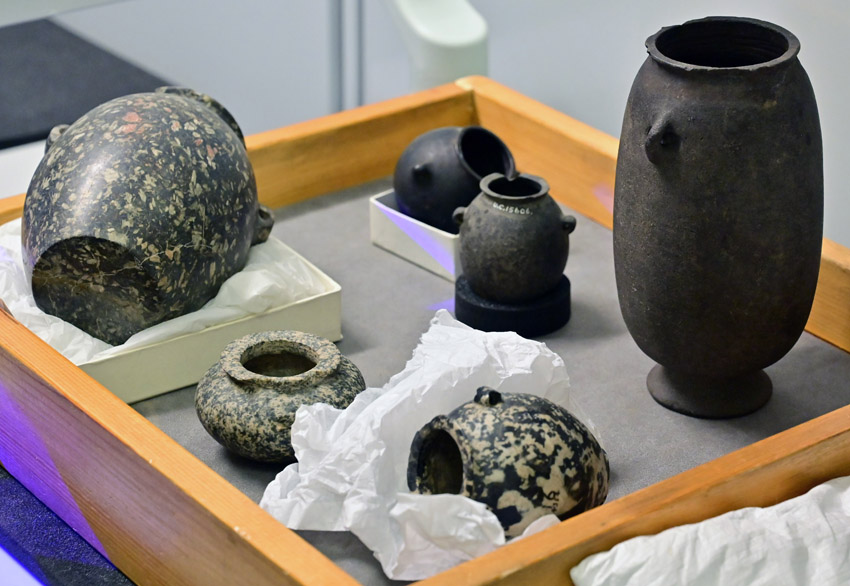
Petrie Core #7: Dunn vs. Scientists Against Myths
The Scientists Against Myths team—led by experimentalist Nikolay Vasyutin—presents several evidence-based arguments to show that the core’s features are consistent with primitive copper drilling.
Vasyutin’s experiments demonstrate that high RPM (speed) is not necessary if you have sufficient abrasive. By using a simple bow-drill or a weighted hand-cranked drill, they successfully cut through granite. The depth of the “groove” is determined by the hardness of the abrasive grain (quartz/corundum) rather than the pressure of the drill.
| Feature | Christopher Dunn’s Argument | Scientists Against Myths Argument |
| Groove Shape | Continuous mechanical spiral. | Discontinuous random scratches. |
| Feed Rate | 0.1″/rev (Impossible for humans). | Not a feed rate; just spacing of grains. |
| Tool Material | Unknown high-tech material. | Copper tube + Quartz sand (Abrasive). |
| Core Taper | Intentional or machine byproduct. | Natural result of copper tube thinning. |
Main Questions Remain Unanswered:
What I see in Ben’s videos:
He’s walking around the scientific community trying to find an ‘open-minded’ person to support Ben’s high-precision idea for authority reasons. As it turns out, it’s not that difficult to be open-minded, searching for ancient tech, as Stine Gerdes, Max Fomitchev, Mark Qvist, and Christopher Dunn, signed up for this journey easily. However, when three people out of four were confronted with data/facts after extensive and deliberate research in their respective fields, they changed their opinion about what Ben said of super-precision in stone vases.
How the algorithm determines whether the vase is Predynastic Egyptian or machine-made:
Bases on high-quality scan, the algorithm looks at the concentricity and circularity of any vessel to sort it as machined, handmade, or predynastic Egyptian. It doesn’t look at names, donors, or collections’ value.
This vase is sorted out as machine-made. Visually, it looks Egyptian but the color of this stone is highly unusual. The handles are of slightly different shape (although the shape of the handles does very in the predynastic Egyptian vases).

https://maximus.energy/index.php/2026/01/16/i-solved-the-vase-problem/
Bottom screenshot: Fig. 4. Outer vs. inner quality chart illustrating clustering of modern lathe-made objects (yellow ), modern handmade objects (magenta and red), and Petrie museum objects (violet).
https://maximus.energy/index.php/2025/08/11/predynastic-egyptian-stone-vessels-how-were-they-made/
A metrological method for manufacturing quality assessment and classification of ancient Egyptian stone vessels. https://doi.org/10.1038/s40494-025-02196-7
Questions I have:
Willing to call me ‘close-minded’, ‘toxic’, or ‘delusional’? These questions remain:
- How come all super-precise vases shown by Ben & friends are shared between the two people – Adam Young & Matt Beall?
- What about the provenance of THESE vases, not some other ones held in private collections?
- Why is the granite of ‘super-precise’ vases different from the ancient Egyptian one? Why does it have a similar pattern that looks more like it’s possibly coming from India?
- Why did ancient Egyptians rarely used granite for vases but used it for statues & architecture?
- Why does the mathematical algorithm consistently shows modern-machining on the ‘super-precise’ vases? (see chart above)
- What happened to all those advertised scans of Egyptian objects in museums and Egypt that were done by the Artifact Research Foundation with Karoly Poka?
- Why can’t we find any other super-precise, granite vases from a specific tomb in Egypt or a museum with provenance? I listed 3 granite vases found-one from Aston’s book, one from Christie’s website, and one from the Pyramid complex of Djoser, Imhotep museum. Some of you refer me to the Arnold Meijer archives of Egyptian art, but many stone pieces are mislabeled there! You can find several bowls and vases there labeled as granite and black breccia but the actual stones are different.
- When you write an argument about seeing a “super-precise” vase, please link to a specific page, photo, literature page, provenance publication, article, etc. Otherwise, it’s impossible to know what vase you’re talking about!
- Well-made scanned predynastic Egyptian vases look precise at first sight, which suggests that a potential collector wouldn’t be able to make a difference between the artifacts in the past (without a scan). How come the precise ones come from private collections only, according to Ben?
- It’s easy to dismiss scientific work and scientists and archeologists in general who actually do all the heavy-lifting researching the topics, writing about it, and publishing data. But what are the FACTS going for these 3 super-precise, granite vases then? There are NO predynastic Egyptian artifacts found with super-precision just yet, only the ones Ben keeps showing us!
Until these questions are answered clearly with peer-reviewed, published papers or some other honest method that can be verified independently, I’m highly skeptical that the ‘super-precise’ vases are genuine predynastic Egyptian artifacts of a lost technology. And I’m done with this project.