Ben van Kerkwyk (from the UnchartedX) has claimed that the archeologist, Petrie wrote about a vase he found under the Step Pyramid with walls 1/40′ thick (Look up the JRE #1928 podcast among others). Ben made this ‘high-precision vase’ idea very exciting for thousands if not millions of people thus far.
Let’s look at this claim in greater detail via actual information available in the archeological papers today. For cultural context, Djoser (also read as Zoser) was an ancient Egyptian pharaoh of the 3rd Dynasty in the Old Kingdom’s Egypt. I used paid version of Chat GPT to go through archeological data and publications.
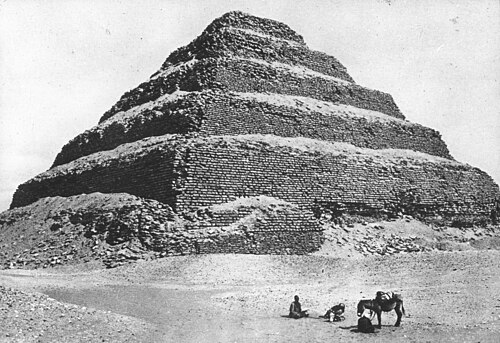
What Vessels were found under the Step Pyramid of Djoser
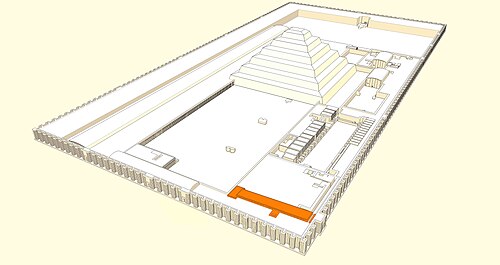
By MONNIER Franck – own work, CC BY 2.5, https://commons.wikimedia.org/w/index.php?curid=1869752
The archaeological literature gives an estimate around 30,000–40,000 pieces/vessels, with many fragments found under the pyramid of Djoser. The Djoser cache is real, huge, and mostly stone vessels — but there is no archaeological source giving “1/40 inch” wall thickness for the Djoser Step Pyramid vessels. That number appears to be Ben van Kerkwyk’s claim/Petrie-attribution claim (JRE episode #1928 among many other quest appearances), not a published measurement for the Step Pyramid cache.
| Question | Best answer from archaeological sources |
|---|
| How many vessels were found under the step pyramid? | The defensible archaeological range is about 30,000–40,000 pieces/vessels. Fritschy summarizes the galleries as containing “no fewer than c. 40,000 stone vessels,” and her footnote quotes Lauer’s original figure as “30 à 40.000 pièces” while Lacau & Lauer also spoke of “millions de fragments.” So “40,000” is an estimate/round figure, not a count of 40,000 intact vases. https://journals.sagepub.com/doi/10.1177/0307513319856853 |
| Were they made of stone? | Yes. The published description is stone vessels / French vases de pierre. Fritschy states that the large majority were calcite-alabaster; only 13 of 905 vessel inscriptions were on pottery vessels, while nearly all the inscriptions were on stone vessels. https://journals.sagepub.com/doi/10.1177/0307513319856853 |
| Are they all vases, not plates? | “Vase” is potentially misleading. In the archaeological literature this is a broad corpus of stone vessels, including bowls, jars, open forms, and fragments. A typology source lists Early Dynastic/Old Kingdom basic stone-vessel forms such as squat jar, cylindrical jar, and bowl, with a selection from Gallery VII at Djoser; Kahl’s catalogue examples from the Step Pyramid include schist bowls and fragments of a schist plate. So: not just plates, not just narrow-necked vases. https://www.academia.edu/37159008/Stone_Vessels?utm_source=chatgpt.com |
| Where were they found? | In the underground galleries near / beneath Netjerikhet-Djoser’s Step Pyramid, especially the galleries Lauer described as “galleries VI and VII filled with stone vases.” https://journals.sagepub.com/doi/10.1177/0307513319856853 |
| Do the archaeological sources give wall thickness? | Chat GPT found no exact wall-thickness measurements for the Djoser cache in the excavation/corpus sources checked. The key archaeological sources give counts, materials, inscriptions, provenience, dating, and shapes — not a metrological wall-thickness table for the Step Pyramid vessels. |
The key excavation-specific references are Quibell’s two ASAE papers, “Stone vessels from the Step Pyramid,” ASAE 34 (1934), 70–75 and ASAE 35 (1935), 76–80, listed by IFAO’s Early Egypt bibliography. Those are the primary “stone vessels from the Step Pyramid” publications, but the accessible bibliographic records do not give a “1/40 inch” wall-thickness figure. (source: https://www.ifao.egnet.net/bases/beo/?nb=25&page=39&subj=Stone+vessels&total=975)
On the Ben van Kerkwyk / Joe Rogan claim: the JRE transcript has Ben saying that Petrie “talked about a diorite vessel” about 1/40 inch thick, “the thickness of [a] stout playing card.” But in that same exchange, the object being shown is said to be about 2 mm thick and identified as one of Matt Beall’s vases, not a Djoser excavation object.
Numerically, 1/40 inch = 0.635 mm. By contrast, 2 mm = 0.0787 inch, about 1/13 inch, not 1/40 inch. Even Ben’s later “less than 2 mm / <1/14 inch” claim is about 1.8–2.0 mm, roughly three times thicker than 1/40 inch.
Conclusion:
Archaeology supports: a very large cache, roughly 30,000–40,000 stone vessels/pieces, mostly calcite-alabaster, mostly earlier than Djoser, with bowls/jars/vessels and some plate fragments.
Archaeology does not currently support: the statement that “the stone vases found beneath Djoser were 1/40 inch thick” as a documented excavation fact. That number may trace to a Petrie-related claim about a diorite vessel, but it’s not tied to the Djoser Step Pyramid cache in the archaeological sources located.
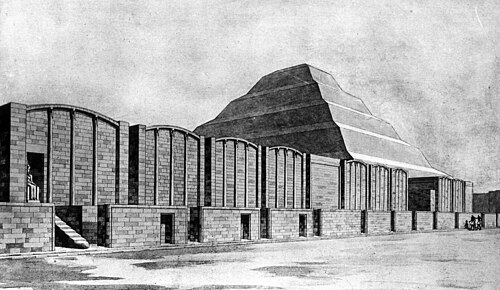
By William Henry Goodyear – Brooklyn Museum. http://www.brooklynmuseum.org/opencollection/archives/image/4586/image, Public Domain, https://commons.wikimedia.org/w/index.php?curid=31143258
What types of stone vases were found in the Djoser pyramid?
The Djoser “vases” are better described as a mixed corpus of stone vessels. Archaeological sources do not mean only tall, narrow, modern “vases.” They include jars, bowls, plates/dishes, pots/jugs, fragments, unfinished pieces, and probably heirloom vessels from earlier First–Second Dynasty contexts. Fritschy summarizes the underground galleries near Netjerikhet-Djoser’s pyramid as containing about 40,000 stone vessels, largely calcite-alabaster, with most inscriptions on stone vessels rather than pottery. (https://journals.sagepub.com/doi/pdf/10.1177/0307513319856853)
| Type found / represented | What that means |
|---|---|
| Cylindrical jars / cylindrical vessels | A very common Early Dynastic/Old Kingdom type. Bibliotheca Alexandrina catalogues Djoser-context examples as “cylindrical-shaped vessel”, category “vessels, cylindrical jars,” made of alabaster, including examples 17 cm high × 15 cm diameter and 30 cm high × 16.1 cm diameter. Brooklyn Museum also has a large Egyptian alabaster/calcite cylindrical jar from Djoser’s pyramid complex, 62.5 cm high × 22.4 cm diameter. (antiquities.bibalex.org) |
| Squat jars / heavy jars | These are part of the standard Early Dynastic stone-vessel repertoire. Sowada’s summary of Egyptian Early Dynastic/Old Kingdom stone vessels lists basic types as heavy squat jars, cylindrical jars, and bowls with recurved rims, and specifically notes a selection of vessels from Gallery VII of Djoser’s Step Pyramid published by Lauer. (Academia) |
| Bowls | A major class, not incidental. Bevan says the majority of vessels from the Netjerikhet-Djoser complex are bowls and oil or wine jars. He also notes hardstone bowls, including anorthosite gneiss and other hardstone examples. (dokumen.pub) |
| Thick-walled heart-shaped / lugged bowls | Bevan reports over 400 thick-walled, heart-shaped bowls from a pit near the entrance colonnade of the Step Pyramid complex, made of porphyritic stones. These are not thin-walled precision “vases”; he describes them as thick-walled and often poorly finished. (dokumen.pub) |
| Oil or wine jars | Bevan explicitly identifies many of the vessels as oil or wine jars, mostly in travertine. This fits the broader Early Dynastic use of stone vessels for oils, ointments, cosmetics, and liquids. (dokumen.pub) |
| Plates / dishes / platters | Yes, some are plates, not vases. Bibliotheca Alexandrina catalogues a Djoser-context plate from Saqqara, material siltstone / schist, 6.2 cm high × 21 cm diameter. The museum text also says “thousands of vessels and plates” were found in the underground passages. (antiquities.bibalex.org) |
| Pots / jugs / small vases | Bibliotheca Alexandrina catalogues a Saqqara Djoser-context object simply as “Vase,” category “vessels, vases / pots / jugs,” made of basalt, 15.1 cm high × 17.9 cm diameter. (antiquities.bibalex.org) |
Conclusion:
By material, the dominant group is Egyptian alabaster / calcite-alabaster / travertine. But the corpus also includes harder and darker stones: anorthosite gneiss or “diorite gneiss,” basalt, porphyritic stones, schist/siltstone, granite/red granite, limestone, and quartz in various catalogues and summaries.
Djoser’s Step Pyramid cache = mostly calcite-alabaster/travertine stone vessels, especially cylindrical jars, bowls, and oil/wine jars, plus hardstone bowls, plates/dishes, basalt pots/jugs, schist/siltstone plates, and many fragments or unfinished pieces. It is not a uniform cache of ultra-thin “precision vases.” This means that Ben comes up with high-precision claims without any data and evidence supporting his claims.

How many granite vases did they find there according to archeological research? Is there a recording of hard stone vase thinness/thickness?
The best archaeological number I can cite for granite vessels from the Step Pyramid galleries is three — but with an important caveat: they are not described as slender “precision vases.” They are large lugged vats/tubs in pink Aswan granite. Lauer says three nearly intact specimens of this type were in pink Aswan granite, and Macramallah’s catalogue caption says of a “large lugged vat in pink granite” that three were found in this material. (source: https://archive.org/stream/ASAE-36-1936/ASAE%2036%20%281936%29%20LR_djvu.txt )
Archaeological publications record three pink-granite examples of a large lugged-vat type from the Djoser Step Pyramid vessel material.
For context, the overall cache was enormous — Lauer estimated roughly 30,000–35,000 vessels from galleries VI–VII — but the dominant material was alabaster/calcite/travertine, while hard stones were much less common. Gallery VII was noted as richer in hard-stone vessels, including porphyritic stones, diorite, and black/bluish schist. (https://archive.org/stream/ASAE-36-1936/ASAE%2036%20%281936%29%20LR_djvu.txt)
On hard-stone vase thinness/thickness: I do not find a published archaeological measurement saying that Djoser granite, diorite, schist, or gneiss vessels had walls 1/40 inch thick.
| Published observation | Material | Exact thickness? |
|---|---|---|
| Type 13 included about 150 alabaster examples and about 100 hard-stone examples | alabaster + hard stones | No thickness given |
| A distinctive heavy dish, commonest in dark diorite, with 20 found | dark diorite + alabaster | No thickness given |
| Tubular vases in schist: 86 counted | schist | No thickness given |
| One object’s internal panels were only 2 mm thick | alabaster, not granite/diorite | Yes: 2 mm |
| Very large “thin” dishes, including a 0.57 m diameter dish | alabaster | Qualitative only |
| “Very thin” veined alabaster bowl | alabaster | Qualitative only |
Quibell’s exact 2 mm note is real, but it concerns alabaster panels dividing a box/tray into four compartments, not a hard-stone vase wall. Quibell also calls some large alabaster dishes “very large and thin,” but again gives no wall thickness; Macramallah likewise describes a “very thin” veined alabaster bowl, but without a numerical thickness. (https://archive.org/stream/ASAE-35-1935/ASAE%2035%20%281935%29%20LR_djvu.txt)
Numerically, 1/40 inch = 0.635 mm. The one exact thinness figure I found in the Djoser excavation material, 2 mm, is about 0.079 inch, or roughly 1/13 inch — more than three times thicker than 1/40 inch, and it is alabaster, not granite.
Conclusion: archaeological research supports three published, large pink-granite lugged vessels/vats from the Djoser material, but I do not find an archaeological record of hard-stone Djoser vase walls being 1/40 inch thick.

Did archeologists find gneiss bowls or other vessels under this pyramid?
Yes. Gneiss vessels were found in the subterranean storerooms/galleries of Djoser’s Step Pyramid. The best exact figure I found is:
892 vessels made from “Chephren gneiss” among “no less than 30,000 vessels” in the subterranean storerooms of Djoser’s Step Pyramid, as stated by Heldal, Storemyr, Bloxam & Shaw, citing Firth and Quibell’s 1935 excavation publication. ( https://www.erudit.org/en/journals/geocan/2016-v43-n1-geocan02417/1035661ar.pdf )
Important nuance: I would say “892 gneiss vessels,” not “892 gneiss bowls,” unless a full catalogue proves all 892 were bowls. Bevan says the majority of Djoser-complex vessels were bowls and oil/wine jars, and specifically notes that anorthosite gneiss and other hardstone bowls occurred “in great quantities,” especially near the king’s tomb area. https://dokumen.pub/stone-vessels-and-values-in-the-bronze-age-mediterranean-9780521880800-9780511335402-0511335407-0521880807.html
Chephren Gneiss:
“Chephren gneiss” does not mean the vessels belonged to Khafre/Chephren. It is a modern geological/material name for a plagioclase–hornblende gneiss, varying from almost white/anorthositic to nearly black/gabbroic; the stone was already used long before Khafre, with highly crafted vessel production peaking from the Early Dynastic Period into the Old Kingdom. https://www.erudit.org/en/journals/geocan/2016-v43-n1-geocan02417/1035661ar.pdf
The quarry paper also says the preferred vessel stone was the light-speckled variety of Chephren gneiss, and that evidence of vessel production is concentrated where this subtype occurs. It concludes that the stone’s properties allowed the making of “bowls and vases of extreme delicacy,” but this is qualitative, not a published wall-thickness measurement for the Djoser cache. https://www.erudit.org/en/journals/geocan/2016-v43-n1-geocan02417/1035661ar.pdf
Conclusion:
Yes — Djoser’s subterranean galleries contained gneiss vessels, including gneiss/hardstone bowls. The exact cited number is 892 Chephren-gneiss vessels, but the archaeological sources I found do not let me say all 892 were bowls, nor do they give a wall-thickness table for those gneiss vessels.