
Welcome to Amsterdam, the beautiful heart of the Dutch Golden Age, where art, commerce, and culture flourished in the 17th century. At the center of this creative explosion was Rembrandt van Rijn, one of history’s greatest painters and printmakers. Today, let’s step into the Rembrandt House Museum, the very home where he lived, loved, flourished, and created some of his most famous paintings. Join me to explore Rembrandt’s life, his art, oil painting techniques, and what makes this house a unique window into his world. Take a peek into the newly reopened Rembrandt House Museum and its hidden spaces!

Unveiling Rembrandt’s Life in Amsterdam Inside the House Museum
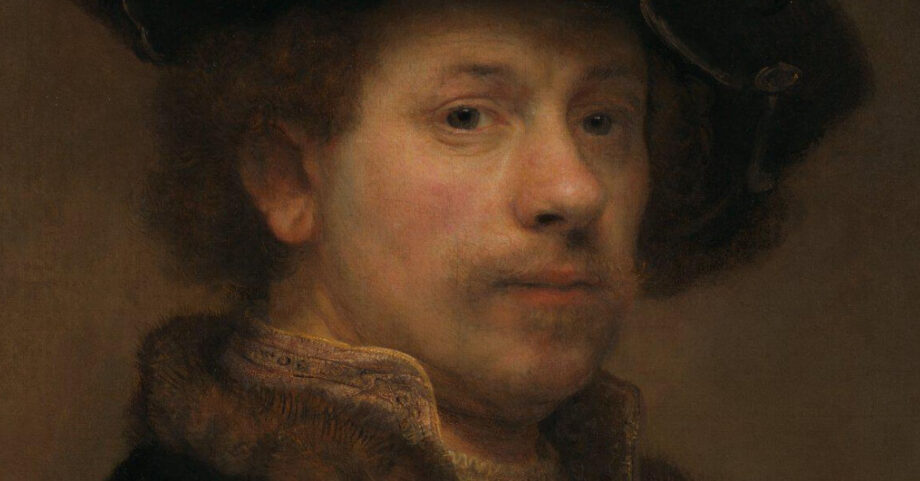
Born in 1606 in a miller’s household in Leiden, Rembrandt moved to Amsterdam around 1631, driven by financial needs and career opportunities. Leiden’s declining economy and lack of protections for local artists against outside competition pushed him toward the thriving city, nicknamed “the golden swamp.” (The Guild of St. Luke, the Artist’s Guild, appeared in Amsterdam later in Rembrandt’s career, which protected local artists from competition.) Amsterdam’s robust art market and relative lack of royal patronage in The Hague made it an ideal destination. There, Rembrandt quickly rose as a leading portrait artist. By 1639, at age 33, he was married to Saskia van Uylenburgh and managed a flourishing studio, mentoring students like Carel Fabritius, Isaac de Jouderville, Ferdinand Bol, Jacob Backer, Gerbrandt van den Eeckhout, and Govert Flinck. Teaching provided substantial income, and while some students, like Flinck, became technical rivals, none matched Rembrandt’s visionary genius.
Before purchasing his own home, Rembrandt lived in a grand house owned by Hendrick Uylenburgh, a prominent international art dealer who had facilitated Rembrandt’s first sale back in Leiden. Uylenburgh invited him to join his “Uylenburgh Academy” in Amsterdam, a hub for producing and trading art, importing works from Italy, and handling commissions, etchings, and appraisals. Rembrandt’s eventual split with Uylenburgh reduced his portrait commissions but marked a pivotal shift in his career.

Saskia, the cousin of art dealer Hendrick Uylenburgh, married Rembrandt at 21, elevating his social standing. Orphaned at 12, she hailed from a prominent bourgeois family, while Rembrandt, though talented and well-connected, came from a modest background of bakers and millers. His deep affection for Saskia shone through in numerous paintings, including Saskia with a Veil, Self-Portrait with Saskia, and Saskia as Flora. The couple had four children, but three died in infancy; only their son Titus survived to adulthood, though Rembrandt outlived him. Saskia’s death shortly after childbirth left a joint estate of 40,000 guilders, combining her dowry and Rembrandt’s earnings.
After Saskia’s passing, Geertje Dircx was hired to care for Titus and became Rembrandt’s mistress. Depicted in works like Young Woman in Bed and several erotic etchings from the 1640s, she was later dismissed amid financial disputes with Saskia’s family, who contested her promised marriage to Rembrandt. His subsequent relationship with Hendrickje Stoffels, a servant 20 years his junior, brought love but also controversy. They could not marry due to conditions in Saskia’s will, which provided Rembrandt with income, and a second marriage risked alienating his Calvinist clientele in Amsterdam. The Church banned Hendrickje from Communion for life due to their relationship. Despite this, she and Rembrandt lived together for 20 years, raising their daughter, Cornelia, in a loving household. During this time, Rembrandt resumed painting, which he had nearly abandoned during his affair with Geertje.

In 1639, at the height of his fame, Rembrandt purchased a grand house on Sint Antoniesbreestraat (now Jodenbreestraat) for 13,000 guilders to be paid in installments—a staggering sum that reflected his success as an artist as well as his ambition and lavish lifestyle he always gravitated towards. However, he didn’t have the entire sum to pay for it, even in installments. This house, built in 1606 and remodeled by architect Jacob van Campen, became his home, studio, and art dealership for nearly two decades, until financial ruin forced him to leave around 1660.
Success, Art & Techniques during his life in the house
During his residence in the house, Rembrandt created some of his finest oil paintings, establishing himself as Amsterdam’s most sought-after painter in the 1630s. Early in this period, he completed roughly one commissioned portrait per month alongside his other artistic pursuits, a remarkable feat given the exceptional quality and originality of his art. While his paintings of female figures may not appeal to all, his male portraits are often extraordinary. His clients included merchants, Mennonites, and Remonstrants, though never royalty. Beautiful art from the 1630s includes Young Man Sharpening a Pen, Portrait of Marten Looten, Self-Portrait in Fancy Dress, The Shipbuilder and His Wife, and The Polish Nobleman. In the 1640s, his commissioned portraits grew more introspective and humanistic, with subjects rendered vividly lifelike, their emotional depth and soul captured in their eyes. Exceptional examples include Portrait of Herman Doomer and Agatha Bas.
Fun fact: Only the wealthiest men wore black clothes due to its high price tag because the indigo dye came from India.
Faced with the restrictive and often drab black clothing of his time, Rembrandt devised creative ways to portray Amsterdam’s wealthy in his numerous commissioned portraits. He employed unique poses, incorporated luxury items, or crafted unusual group compositions to bring individuality to his work.
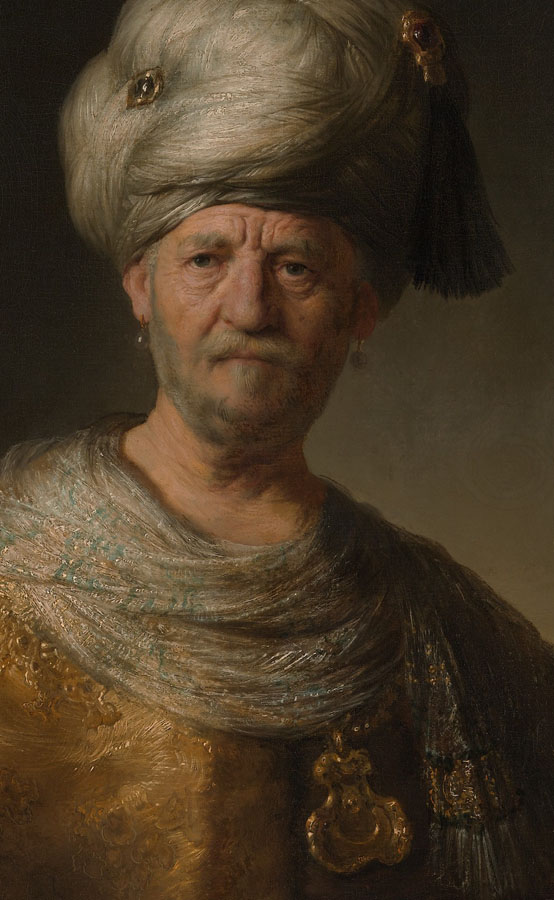
Unlike many artists who idealized their subjects, Rembrandt captured their raw humanity, portraying them in contemplative, subtle poses without regal attire. His subjects appear thoughtful and introspective, set against sparse backgrounds, sometimes dressed in exotic clothing from his prop collection.
Rembrandt had an amazing sense of light, focusing illumination on the face while allowing the rest of the composition to recede into shadow. His portraits feature dramatic contrasts, distinctive brushwork, and thick paint application. Up close, the textured, almost abstract paint appears as mere lumps, but from a distance, it transforms into strikingly realistic forms. One of the early examples is Johannes Wtenbogaert, 1633, a beautiful painting of the old minister with subtle body movement, eye gaze with emotion, and soft blue-grey background.

Rembrandt gained fame in Amsterdam with his 1632 masterpiece, The Anatomy Lesson of Dr. Nicolaes Tulp. Commissioned by the Surgeons’ Guild, each member contributed to the cost, and the painting became the property of the civic organization. Rembrandt transformed the typically static group portrait into a dynamic, life-like composition. Featuring Dr. Nicolaes Tulp, a prominent Calvinist physician, the work depicts a dissection, portrayed as a divine exploration of God’s creation. Guild regulations strictly limited dissections to executed criminals, adding gravity to the scene.

Inspired by Rubens’ canvas grandeur and skill, Rembrandt frequently explored Biblical themes, a popular genre until the mid-19th century. His religious works include The Sacrifice of Isaac (1635), Susanna Surprised by the Elders (1634), and Belshazzar’s Feast (1638). He also tackled mythological subjects such as The Abduction of Proserpina, The Rape of Europa, and Andromeda. Unlike his contemporaries, Rembrandt avoided sexualizing women in mythological scenes, often depicting them clothed, though he produced many nudes. His figures, far from idealized, bore human imperfections, with facial features resembling his wife or himself. His nudes, like Danae, defied conventional beauty with stark, unembellished portrayals of female bodies—complete with rounded bellies, heavy legs, and uneven breasts—likely shocking Amsterdam’s religious society.
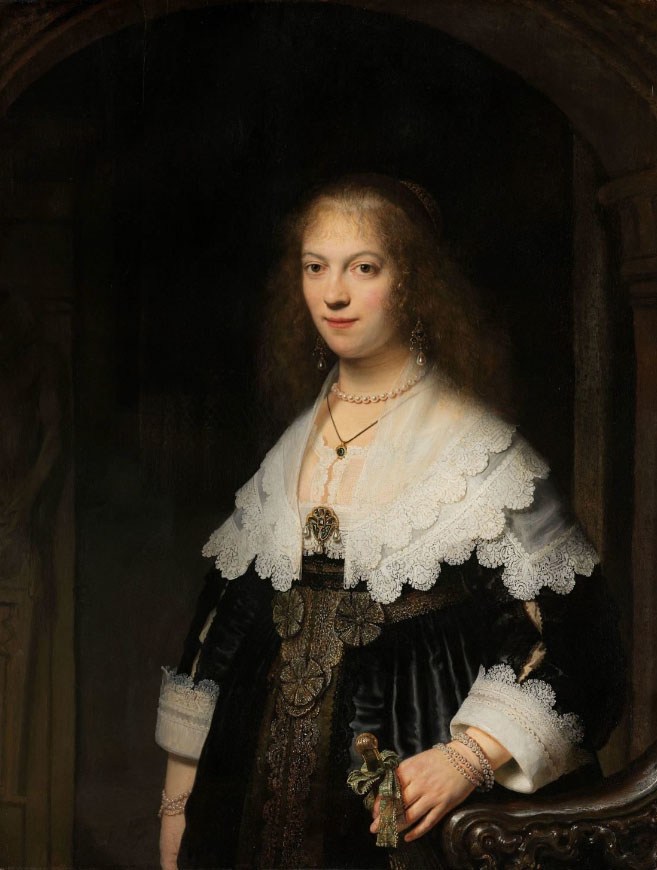
Rembrandt’s brief court patronage under Frederick Hendrik waned due to his divergence from the polished Flemish style. His artistic approach emphasized raw humanity over classical idealization, portraying aged men, heavier women, and unembellished self-portraits with ordinary features. Rejecting stylized beauty essential for royal commissions, Rembrandt focused on emotional depth in his portraits. His numerous self-portraits, often with near-grotesque expressions in etchings, studied human features with unflinching honesty. His lack of diplomatic finesse may have strained professional relationships, though his talent was universally acknowledged.

In 1642, Rembrandt completed The Night Watch, a monumental group portrait of Amsterdam’s civic guard, now a highlight at the Rijksmuseum, currently under renovation. This masterpiece defied tradition with its dynamic composition, striking use of light, color, and shadow, fluid figure movement, and vivid, lifelike energy. In 1578, Amsterdam shifted allegiance from King Philip II to William of Orange, and the civic militia, beyond defending the city, symbolized the power of the wealthy elite. The city’s 20 militia companies held significant influence, and Rembrandt’s commissioned work was displayed among other artworks in the Great Hall. Completed in just two years, the painting, measuring 143×172 inches (363×438 cm), featured figures with varying prominence based on their financial contributions, totaling 1,600 guilders. The richly dressed captain and lieutenant dominate the foreground, with Rembrandt crafting a lively scene of moving figures rather than static, aligned portraits. When relocated to the Old Town Hall, the canvas was trimmed on all sides, with a significant 24-inch cut on the left. Despite its brilliance, The Night Watch did not lead to more group commissions for Rembrandt, though he remained popular, approachable, and fashionable.

There are a few more huge canvases of militia guards hanging in the Rijksmuseum. Personally, I like one of them more (by Bartholomeus van der Helst) than the Night Watch because of the color use, elaborate costumes, and fascinating faces that make the compositions less staged. The Amsterdam civic guard commissioned art for their renovated militia Grand Hall. In addition to Officers and Other Civic Guardsmen of District XVIII in Amsterdam, under the Command of Captain Albert Dircksz Bas and Lieutenant Lucas Pietersz Conijn, 1645, by Govert Flinck, art included the Night Watch by Rembrandt and civic guard paintings by Joachim von Sandrart and Bartholomeus van der Helst (Banquet at the Crossbowmen’s Guild in Celebration of the Treaty of Münster, 1648). This artist also painted Militia Company of District VIII in Amsterdam under the Command of Captain Roel of Bicker, 1640 – 1643.
Rembrandt also took an interest in local landscapes, creating etchings and oil paintings. Landscape with a stone bridge, 1638, is one of my favorites that I copied years ago, learning painting techniques. Unfortunately, landscapes were not popular among his clients, and the artist stopped creating them in 1650s.
Painting of nudes wasn’t prohibited, but at the same time, it was considered immoral in Amsterdam. So, such paintings as Bathsheba Bathing, 1642 (the Met) or Woman bathing in a stream,1654 (National Gallery, London) were considered edgy and inappropriate. His lover, Stoffels, was the model for those. Mostly, she posed for portraits like Flora, 1654. Rembrandt wasn’t interested in making his women sexual in art. Lucretia, 1664 (National Gallery, Washington) is a fully-clothed figure, defying the convention of painting her in the nude.
The artist’s etchings:

Rembrandt also created around 400 surviving etchings to this day, including the Hundred Guilder Print (c. 1648), renowned for its emotional depth and technical mastery. There are small rooms in the house that display Rembrandt’s etchings. Many are covered with a piece of heavy cloth to protect them from light. Both Rembrandt and Lievens were known for paintings and etchings. They worked in gentle rivalry, creating etchings as reproductions of their paintings.

Etching is a process of creating drawings on a surface, typically metal plate or glass, by using acid or other corrosive substances to eat away at the material. In printmaking, it involves incising lines or areas into a metal plate to hold ink and create an image that can be transferred to paper.
A metal plate (copper, zinc, or steel) is coated with an acid-resistant ground (a waxy substance). Rembrandt used copper plates. The artist scratches or draws through the ground with a needle, exposing the metal underneath. This process requires a drawing skill as you can't erase the mistakes on a plate (It's similar to the scratchboard art as you scratch out the surface to reveal a drawing that allows for no mistakes).
The plate is placed in an acid bath, which etches away the exposed metal, creating recesses. The surface is wiped clean, leaving ink only in the recesses. Rembrandt liked to smear paint with fingers to create different effects. He also took the copper plate out of the acid bath quickly to create faint lines, which otherwise would etch darker.
Damp paper is placed on the plate and passed through a printing press, transferring the image. Rembrandt used various kinds of papers including the Japanese one. The drawings on metal plates could be re-worked and re-printed in a new "state" by repeating the process of drawing with a super fine needle, but the print was always monotone that could be hand-colored.
Rembrandt also employed drypoint in combination with etching to make heavier lines and textures.

Etchings always existed in several states. The first state involved the first drawing stage or the proof. If the artist didn't like something in the first print, he could add more details, shadows, etc to that plate, ink and bath it in acid again, and then print it in the second state. The process could be repeated to create more depth and detail in such etched drawing. Rembrandt often had reworked plates in 6-8 states over many years!
The artist’s oil painting technique:
Because Amsterdam was built on marshy land, it made sense to paint on wood panels, rather than on canvas. People made glass storage cases to protect stuff from mold and foxing. Rembrandt did paint on huge canvases that were lighter than panels and could be rolled up. He used a unique mixture of quartz and clay to prepare his canvases, a practical and cost-effective method discovered through artifacts found in the house’s cesspit.
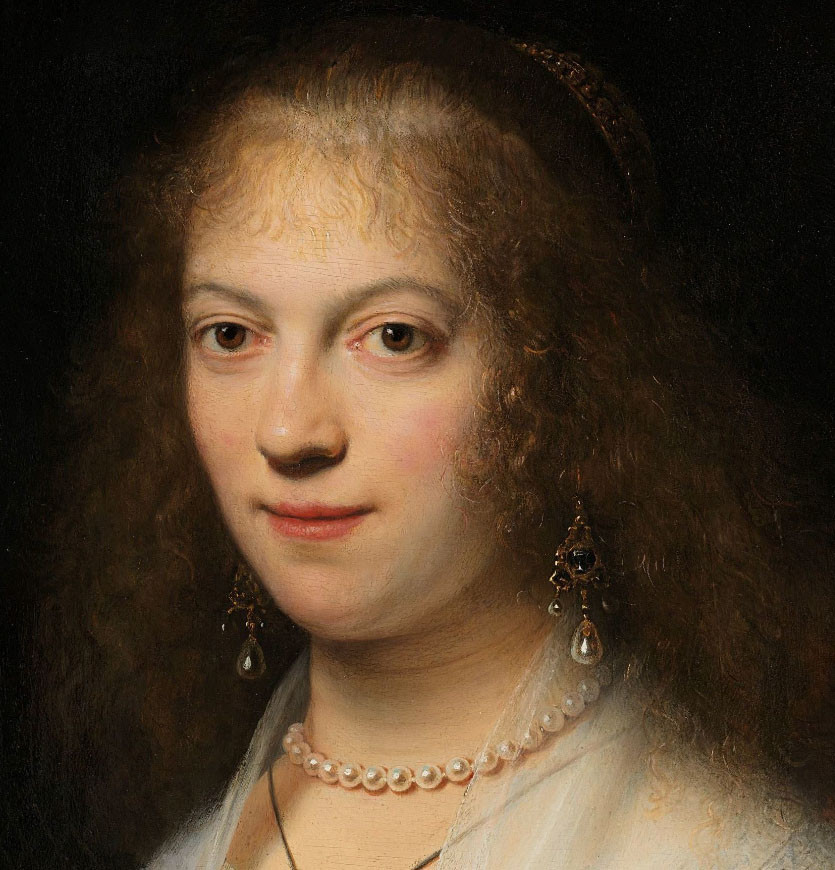
One of his oil painting techniques was to use the back of his brush, scratching out the wet paint to reveal lighter passages to make the light on the hair strands and such. He also created a mottled effect on an old skin by adding tiny spots of color after the paint has dried.
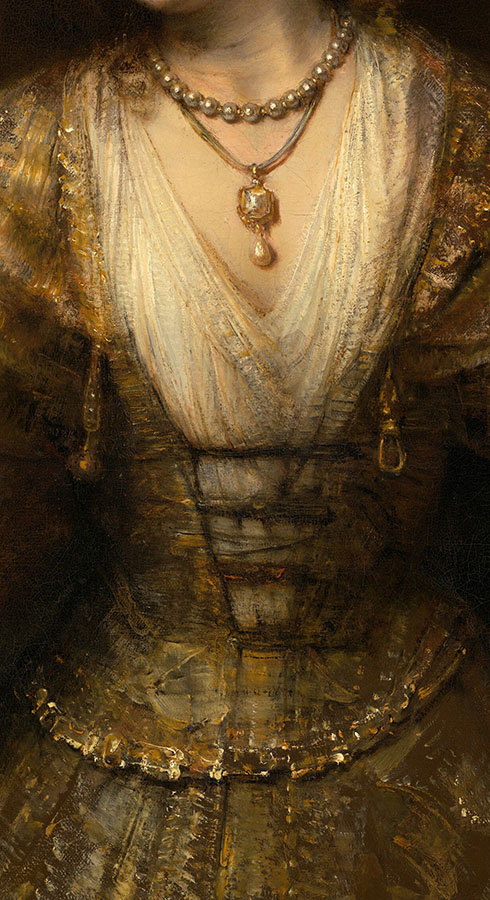
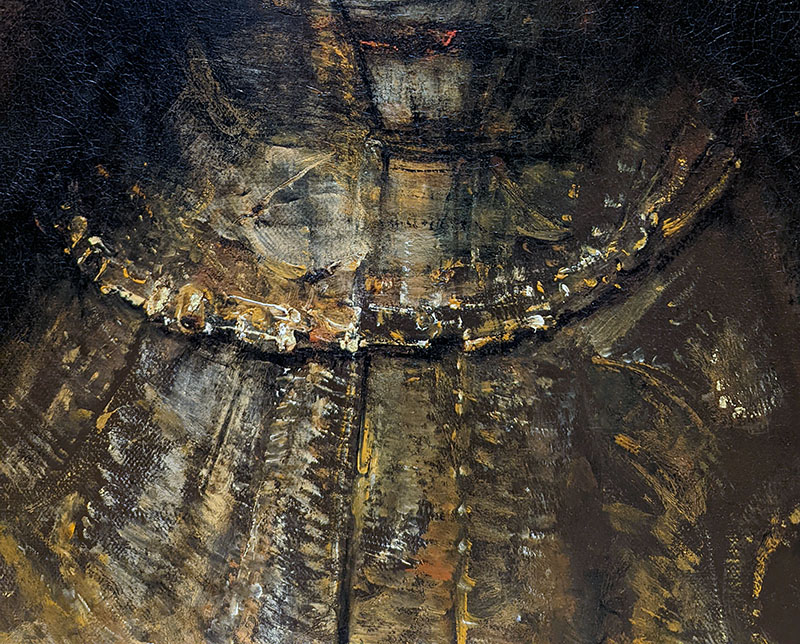
His realistic jewelry pieces consisted of abstract lumps of thick paint. This rich layered impasto technique (Lucretia's or the Jewish Bride's clothes) looks 3-dimentional, sculptural, and unique to Rembrandt. He applied paint with a palette knife, probably in many layers and with addition of other materials like charcoal, bits of egg and grit, to build the varied, thick textures. He was a master of light and its placement on a face was always deliberate.
In grouped paintings he made some figures backlit diagonally and others in bright clothing to differentiate among them. Soft, glowing light feels like a real lamp is hidden somewhere behind the canvas to lite up the scene. If you paint, you know how difficult it is to create and control the light in oil painting.
Besides his paint studies, he always signed his work, first with his initials and then with his first name only like great Italian masters. His voracious collecting—busts of Roman emperors, Venetian glassware, shells, and weapons—fed his art, filling his home with inspiration for his art.

Rembrandt’s downfall

Rembrandt’s lavish lifestyle and a faltering art market led to his bankruptcy in 1656, with his house auctioned off in 1658 for 11,000 guilders. In his early 50s, the artist’s downfall was not solely due to excessive spending but stemmed from a complex mix of factors. Despite falling out of fashion around 1649, Rembrandt never lacked clients and continued to secure portrait commissions. However, patrons-friends like Jan Six (Portrait of Jan Six, 1654) commissioned less in the 1650s, favoring classical Italian art. Successful former students, such as Govert Flinck and Ferdinand Bol, emerged as rivals, embracing the fashionable Flemish style. Rembrandt grew less sociable, possibly more cantankerous, which hindered his ability to attract prominent merchants and industrialists, though he still painted for surgeons and physicians. Uncompromising, he refused patrons’ requests to alter finished works unless fully paid, often opting to auction his art instead.
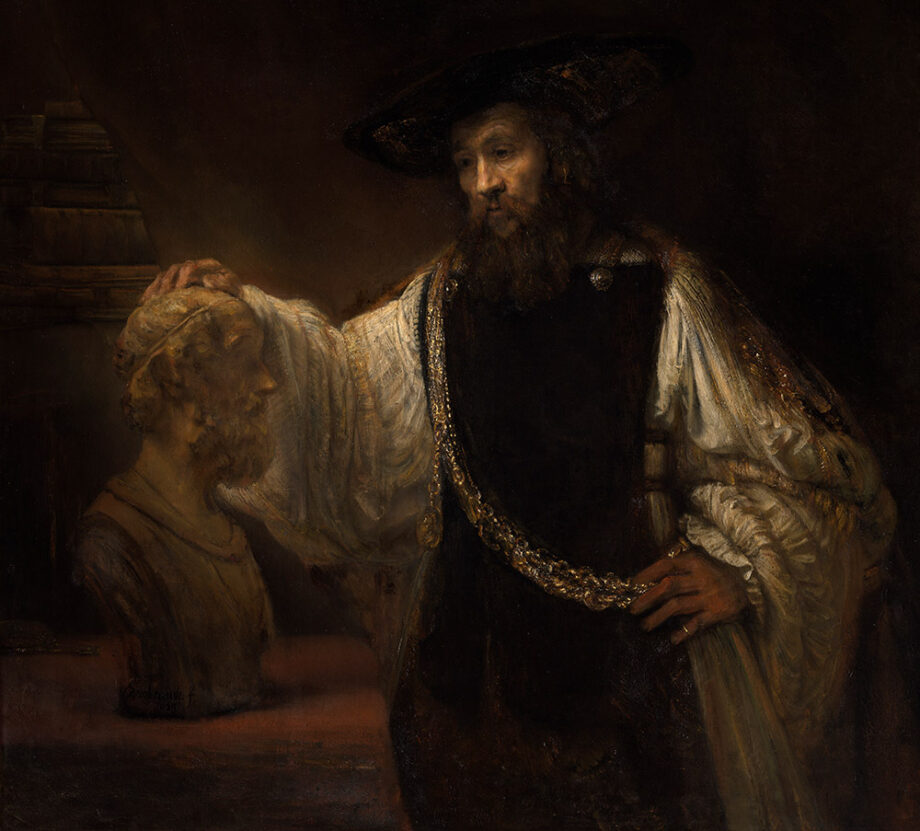
Italian art collector Don Antonio Ruffo commissioned one of Rembrandt’s finest paintings, Aristotle Contemplating a Bust of Homer (1653), a painting with a thoughtful figure, masterful use of light, restrained color, and richly textured details, like the golden chain, rendered in thick, abstract oil paint. Another piece for Ruffo, Alexander or A man in an armor, initially met with criticism, but Rembrandt stood firm on its quality. Additionally, Holland’s 1650s recession, driven by foreign conflicts and wars, impacted the artist and his potential clients, further complicating his financial struggles.

oil on canvas, 54x41inches, 1655, Amsterdam
Rembrandt’s introspective self-portraits from the 1650s show the most beautiful, loose brushwork, painting wrinkles and uneven skin tone on a dark background. Some have a sad, troubling gaze (Self-portrait, 1659), others exhibit the calm and confidence of an older man (Self-portrait, 1658). Unlike faces in numerous commissions, these self-portraits were records of his own life, age, bankruptcy, and sadness. Nonetheless, even this art got sold off to European courts.
Some of Rembrandt’s portraits feature his handsome son with curly hair, Titus. Titus reading, 1656; Titus at his desk, 1655; Titus, 1658. Trained as an artist, he didn’t become one, but he helped his father greatly after bankruptcy. He and Rembrandt’s girlfriend-Stoffels established an art dealership, and Rembrandt worked for them. Unfortunately, both of them died from the plague at different times, bringing Rembrandt into his last years of melancholy.

The Syndics (of the cloth-makers guild, 1661) is Rembrandt’s late grouped painting that shows amazing balance among all figures, an unusual point of view, and a beautiful play of light and shadow.
Rembrandt’s financial mismanagement, lavish lifestyle, change in art style popularity, the country’s economy, and the artist’s short temper led to his downfall, forcing him to move to a modest rented house on Rozengracht in 1658. He spent his last decade in a rented house on the other side of town, paying 225 guilders a year. The neighbors were quite poor and not the customers who ordered commissions. There were many gossip stories about Rembrandt’s spending habits, and some of them may be true, as Saskia’s family was always at odds with Rembrandt, trying to protect her inheritance from him. It was also said that Rembrandt sold Saskia’s grave, tapped into his daughter’s small inheritance from her mother, and even his granddaughter’s one (Titus and Magdalena had a baby)! There are records of Rembrandt’s borrowings from his patrons and others willing to lend him money in exchange for his art later on. He died at 63 and had no customary funeral of the rich in Amsterdam with food, drinks, music, and a night torch-lit procession. One of the world’s greatest artists was buried in a rented grave in the Westerkerk.
Life of the merchant class, the artist, and the average person in the 17th-century Amsterdam
To understand Rembrandt’s world, let’s compare his life to that of the average Amsterdammer. The Dutch Golden Age was a time of prosperity, with Amsterdam as a global trade hub. The smells of the city would be considered vicious today. With little hygiene and rare baths, the people stank, and the streets were filled with dead fish and rubbish. Some night boats carried tons of animal poop to fertilize crops and orchards. However, foresty fragrance from cut wood, herbalists, bakers, and soap-boilers compensated for that terrible smell. The fragrance of various spices must have been heavenly. The city’s commotion came from noises created against cobble streets, woodworking, as well as the sounds of church bells and chiming clocks that were everywhere in Amsterdam.

During this period, the city quadrupled in population size. Only one-quarter were native born and the rest were newcomers. The city’s prosperity was the result of Antwerp’s downfall. (It stagnated due to the imposed long blockade by the Northern Dutch). Also, the famine in Europe made the Amsterdammers enormous fortunes in the Baltic grain trade. They also traded luxury goods- jewelry, silk, spices, and furs on top of fish, timber, and hides. Those merchant family oligarchs made hundreds of thousands of guilders and controlled the city’s government to promote their interests. Holland collected hefty taxes in return, with one-quarter coming from Amsterdam alone! This oligarchy patronized both artists and culture by sponsoring portrait commissions, buying books, and supporting the art academy. They were supportive of religious freedoms and allowed for the co-existence of the Remonstrant church, a Jewish synagogue, Lutheran, Mennonite, and Catholic churches. These were all customers of Rembrandt.
The Reformation was against the arts, preferring bare walls in the churches. However, other faiths created demand. The Catholic Church was one, and Rembrandt painted many biblical scenes for patrons. One of the most unusual paintings of this kind is The Evangelist Matthew, inspired by the angel, 1661, in the Louvre.
The word “Remonstrant” reflects the document written to the Reformed Church by the liberal preachers. They believed in self-determination and self-salvation.
Other artists-contemporaries of Rembrandt: Pieter Lastman, Thomas de Keyser, Nicolaes Eliasz, Pickenoy (also painted militia companies), Frans Hals, and Anthony van Dyke. Lievens was a friend of Rembrandt from Leiden. Both were students of Pieter Lastman, painted the same subjects, shared models, and art style. They collaborated in the early 1630s until Lievens relocated to London and Rembrandt moved to Amsterdam. Rubens was the most stark contemporary to old Rembrandt, who was enormously successful and rich, painting for four royal courts, owning several estates, and running a large workshop.
What Makes the Rembrandt House Special

The Rembrandt House Museum, located at Jodenbreestraat 4, is the only place in the world dedicated entirely to Rembrandt’s life and work, thanks to two artists who decided to buy the house to convert it into a museum. Restored in the early 20th century and reopened in 1911, it uses a 1656 bankruptcy inventory document of forced sale to reconstruct Rembrandt’s living and working spaces with necessary accuracy. The list that was drawn up before the sale, listing all of Rembrandt’s possessions, room by room. When you visit the house, find this inventory list in the Epilogue Room of the museum.

Rembrandt lived far above the average. You’d be surprised to see the size of his 3-story house. His mansion, with its elegant facade and spacious rooms, was in an upscale neighborhood alongside other artists, merchants, and dealers. Although the demographic did change during his stay there. His studio, filled with exotic collectibles, was a stark contrast to the utilitarian workshops of artisans. Rembrandt’s wealth, fame, and spending habits during this period allowed him to amass a vast art collection and employ art students as assistants. Visitors can step into his kitchen, with its cozy fireplace; his bedroom, with a 17th-century box bed that looks like a chest with doors; and his studio, where he painted his commissions and masterpieces.

There are many art items on display in the rooms. For example, shown artifacts like the pipes for smoking tobacco, traces of pigments, and the quartz-clay pots found in the cesspit connect us to his creative process and daily life. You’d be lucky to catch a paint-making demonstration in the artist’s studio, where tools are on display, but I didn’t. There are old books, brushes and palettes, canvas, easels, and art on the walls, Rembrandt probably collected for himself.
The artist was an avid collector and spent enormous sums of money at auctions on exotic clothing, props, jewelry, musical instruments, books, ceramics, a death mask of Frederik Hendrik, and numerous costumes, some of which he used in his paintings. The collections continue with Roman plaster casts, furniture, armor, weapons, porcelains, exotic objects like turtles and alligator, corals, precious metal coins, and so on. Rembrandt had a great appreciation of classical art that’s apparent in his immense collection of drawings and engravings, especially after Raphael and Andrea Mantegna.

There is a dedicated floor for art students with easels installed in a subdivided space with partitions. In the book Rembrandt, D.M. Field mentions that the artist had about 50 art students at any given time, and they lived on his premises or a rental warehouse next door. Some students made official copies of Rembrandt’s work that were marked as such and sold for a different sum of money to art collectors during his lifetime, but this habit often presents an attribution problem now.
The museum has an attic space dedicated to Rembrandt’s etchings. The museum’s collection includes nearly all of Rembrandt’s 400 etchings, some of his original copper plates, and works by his teacher Pieter Lastman and pupils like Ferdinand Bol. There is a printing press and tools around it where a local artist does demonstrations in printmaking, showing Rembrandt’s techniques from replicas of his copper plates.
Main rooms on the first floor are decorated with furniture, vases, black-and-white tile, and art on the walls that reminded me of Vermeer’s interior paintings. There is also a cute, tiny room in the house showing a table with a chair to write letters, I guess.

What sets this museum apart is its immersive experience. Daily demonstrations show how Rembrandt ground paint and etchings, bringing his art techniques to life. A 2023 renovation added 30% more exhibition space, including an etching attic and multimedia tours in 13 languages that trace Rembrandt’s journey from ambitious artist to bankrupt genius. The modern wing hosts temporary exhibitions, showcasing Rembrandt’s influence on contemporaries and modern artists. The house also launched an artist residency program in 2023, keeping Rembrandt’s legacy alive by inviting contemporary artists to work in his studio.

The Rembrandt House Museum is a visual portal to the 17th-century prosperous Amsterdam, where you can walk in the footsteps of a genius. Rembrandt’s art, defined by light, darkness, and raw humanity, was born in these rooms, amidst personal triumphs and tragedies. His nearly 2,000 drawings, 300 paintings, and 400 etchings from his career demonstrate his versatility across portraits, history paintings, and self-portraits that reveal his creative output. It takes about one hour to walk through the entire house museum. So, visit the Rembrandt House, and discover an intimate side of Rembrandt’s life and art.
I recommend booking the tickets online rembrandthuis.nl, as Amsterdam is a popular destination in Europe and there are droves of tourists in all major attractions, especially during the season. The house is crowded with tourists, and it may be wise to visit it earlier in the day. The Rembrandt House Museum address: Jodenbreestraat 4, open daily from 10 AM to 6 PM. Follow in Rembrandt’s footsteps and let his art inspire you.

Sources for this article:
Rembrandt, Paperback book, published January 1, 2002 by D. M. Field, B&N Publisher, 437 pages
Rembrandt House Museum Official Website: www.rembrandthuis.nl
The Leiden Collection, the Met, the National Galleries in Washington, DC and London display Rembrandt’s art.