Update: December 2025: Vase Mystification
- Naqada periods
- Predynastic Egyptian Vessels, Tools, and Technology
- Pottery
- Naqada stone vessels, materials & tools
- Basic Stone Tools & Maceheads in Predynastic Egypt
- Tools and Techniques for Stone Vessel Production in the Naqada period based on Denys A. Stocks’ Experiments
- Maceheads Types
- Seals Types
- Figurines & Cosmetic Palettes
- Jewelry & Amulets
- Egyptian Writing & the Rosetta Stone
- Provenance of Ancient Egyptian Artifacts
- Barbara Aston’s Book review: Were the ancient Egyptian vessels made of granite?
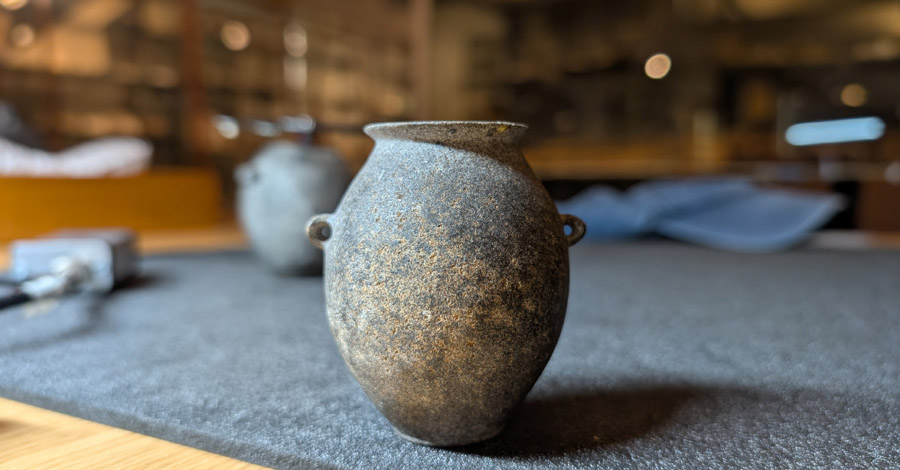
In this comprehensive article, titled Predynastic Egyptian Vessels, Tools, Materials, and Technology I want to create a visual landscape of the first peoples inhabiting ancient Egypt and share what tools, objects, art, trade, politics, and technologies they used that predated the building of the Great Pyramids in Giza. The online world is abuzz with discoveries and suggestions about alien technology used in ancient cultures, so my curiosity led me to start researching pre-dynastic Egypt to see if mainstream archaeologists may have overlooked or perhaps exaggerated in their search for the truth. My research draws on findings from major museums such as the British Museum, the Louvre, the Met, the Cairo Archaeological Museum, several books about history and archeology of ancient Egypt, and some scholarly papers published in the past decade available at ResearchGate, Academia.edu, Google scholar, etc., providing a comprehensive overview of the Naqada culture and its people. In this article, I aim to discover the evidence of a high-tech civilization that predates the unification of Egypt or prove the absence thereof. Let’s begin.
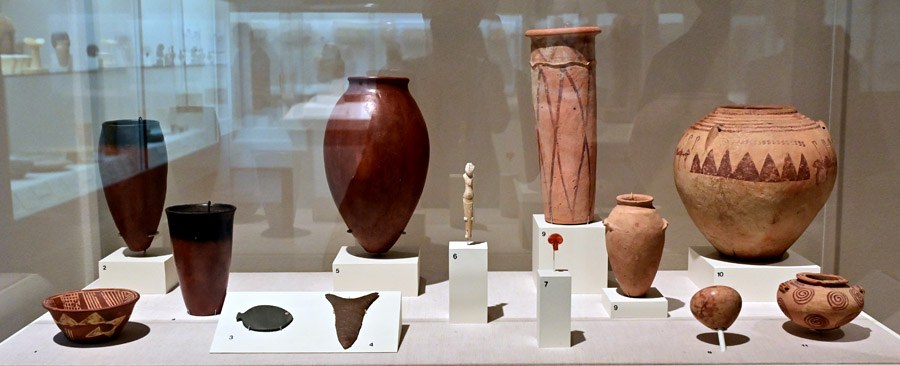
The Naqada culture: Exploring Major Periods in Pre-dynastic Egypt
Neolithic, northern Egypt began around 5200 BC. The Predynastic period or Naqada I-III ( 4200-3050 BCE) is considered a Chalcolithic Predynastic culture, named after a large site near Naqada in Upper Egypt where archaeological evidence was first uncovered.
Flinders Petrie was the first archaeologist and researcher of ancient Egypt who did extensive excavations in the 19th century, and systematized a chronology for the Egyptian artifacts, including the Naqada Period. He directed excavations at the site of Nubt, mainly in a large cemetery at Naqada in 1894-95. By unearthing nine different vessel types, he developed the sequence dates for ancient Egypt’s chronology.
At first, Petrie divided the cultures into five major periods: Tasian, Badarian, Amratian (the El-Amrah cemetery), Gerzean (the Gerzeh cemetery), and Semainian (the Es-Semaina cemetery). In 1957, Kaiser made a slightly different classification to divide the Naqada period into three phases (steps): Naqada I (about 4200 – 3700 BC), Naqada II (3700 – 3500 BC), and Naqada III (3500 – 3100 BC). Other contemporary literature suggests slightly different dates, like Naqada I (4000-3600BC), Naqada II (ca. 3600–3200 BC), and Naqada III/Dynasty 0 (ca. 3200 – 3050 BC). This inconsistency in dates suggests the difficulty or limitations in dating cultures and objects in ancient Egypt.
The earliest evidence suggests that ancient Egyptians consisted of various, separate tribes, raising cattle, doing fishing, growing crops, and working in general farming on the land. The earliest settlements of farmers appear in Mesopotamia and possibly Egypt around 8000 BC. Semi-nomadic cattle herders lived in the eastern Saqqara. While Memphis became the royal residence of the Old Kingdom, Thebes was inhabited from around 3200BC with rural tribes living and herding cattle in the villages (Sherif Abd el-Monaem, Hanan Mahmoud, The Naqada period in Thebes, p.565,569). Those tribes were also hunting ostriches, giraffes, and gazelles, suggesting good irrigation of the land.
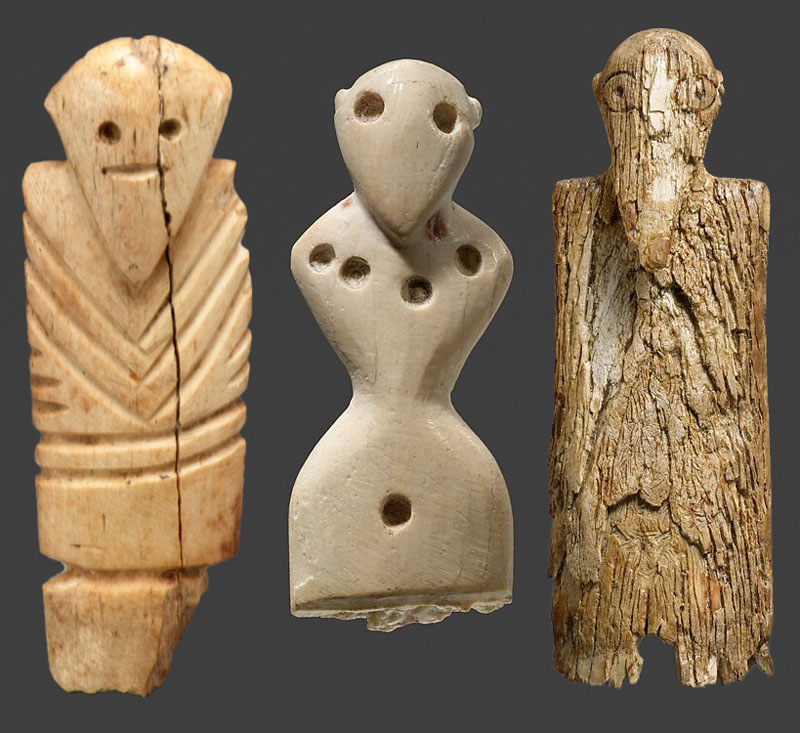
The climate change and shift in weather patterns around 5000 BC moved various cattle farmers closer to the valley tribes, the Badarians. The valley people were farmers who were organized in small communities, growing crops year-round in the Nile Valley. The river had a unique property: an annual flood that brought the fertile ‘dirt’ to the fields, supporting farming. This unique feature and the river’s shape let people flourish on the Nile. In Egyptian creation myths, people believed in the primordial water god Nun (also spelled Nu) from which the universe was created. He represented a powerful, chaotic, and scary force of water that existed before creation and contained the potential for all life.
The desert dried out around 3600 BC, quickly migrating desert tribes to the valley people. As the population grew, the elite emerged, creating demand for rare materials, goods, and craftsmen. Small rulers began to compete for power in lower, middle, and upper Egypt around 3300 BC, and Hierakonopolis emerged as the central citadel with about 90 local kings scattered in Egypt who ruled over a mix of many tribes of people until the unification of Egypt.
Hierakonpolis, Abydos, and Nubt (South Town) were large settlements of Naqada culture. Nubt is the largest settlement in Upper Egypt that represents the Naqada of all three periods. First discovered by W.M.F. Petrie and then further excavated by W. Kaiser, the site with 3,000 graves became abandoned and looted soon afterwards until 1968. The majority of the collected material in the 1960s was exported to Washington State University in 1982. Then the Naqada study collection was transferred from the USA to London and finally to Egypt’s Dakhla Oasis Magazine (Geoffrey Tassie and Joris van Wetering, The History and Research of the Naqada Region Collection).
King Narmer (he is also mentioned as Menes) becomes the last king of the Predynastic Period by unifying the country after hundreds of years of fighting among many tribes. The Egyptian state began with King Horus Aha (also mentioned as Menes in Cairo’s Museum) between 3111 BC and 3045 BC. Aha established the capital of the unified Egypt at Memphis. This unification of the land and strong central control in Memphis marked the beginnings of a long, despotic Egyptian rule, with kings aligning themselves with gods and divine power, committing to surveillance, propaganda, and festivals to keep their place on a throne and people in check.
I recommend an excellent book about the entire history of Egypt, written by Toby Wilkinson, The Rise and Fall of Ancient Egypt, Paperback, 2013. The audiobook is available on Spotify and is a fascinating listening experience!
In the introduction to the book, Ceremonial Slate Palettes in Relief and Corpus of Proto-Dynastic Pottery, 1953, Hilda F. Petrie outlined 5 culture periods of the Predynastic Egypt. I put them here, along with two cultures not mentioned in the book. Also, the detailed descriptions of their art, tools, and life would follow further down the article.
#1 The Tasian Culture (4500–4000 BC)
Named after the site Deir Tasa, near Badari, in Middle Egypt, this is one of the oldest known Predynastic cultures in Upper Egypt, dating back to approximately 4500 BC or even earlier. It preceded and partially overlapped with the Badarian culture (ca. 4400–4000 BC) and is considered a precursor to the Naqada cultures. There was no written language or standard of weight left from this culture. These people made flaked flints, igneous stone axes, white limestone axes, and simple, square stone palettes for eye-paint. They produced various shapes of pottery, including black-topped pottery, and in general, did farming of wheat and barley. Discovered by Brunton, people from the Tasian culture had larger skulls.
#2 The Badarian Culture (Neolithic Predynastic, 4800-4200BC; 4500-3800BC)
Named for the site of El-Badari, this culture of farmers dates from roughly 4400 to 4000 BC. The Petrie Museum dates this culture to 4800-4200BC. Dressed in leather and linen, the Badarians of Middle Egypt were Asian-looking farmers and herders with long and narrow skulls, resembling the primitive Indian ones, according to the book. These people began to worship the corn god Osiris with their use of emmer wheat. They changed the calendar year from 360 days to 365 days to celebrate the Osiris family. There was no written language found for them either, but the Badarians left a number of objects in their graves, such as various amulets, small oblong slate cosmetic palettes for malachite eye-paint, flint arrow-heads, quartz crystal, and some stone tools. They also made spoons, combs, statuettes, and bracelets of ivory.
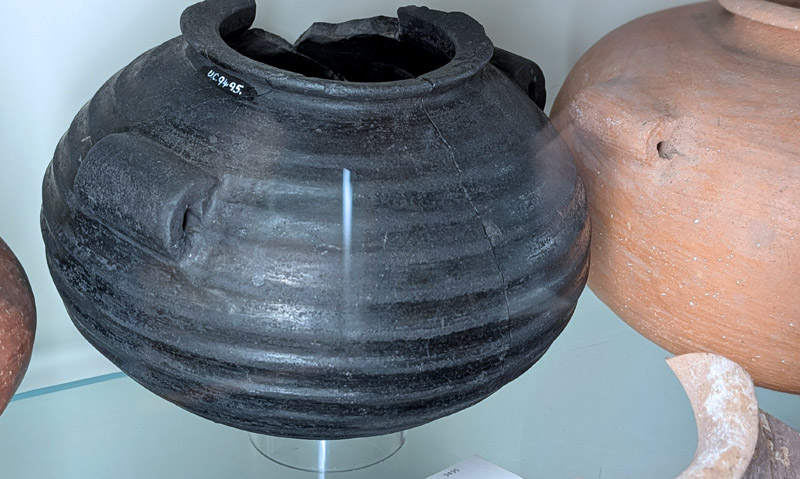
The Badarians are known for their glazing technique, as one of the excavations revealed a belt made of thousands of stone beads in green copper glaze. According to the Petrie Museum, Naqada I culture is similar to the Badarian culture (if not the same). Their dead were buried in modest oval pits with pottery and necklaces placed in front of the face (Some examples: Badari tomb 3731, Naqada tomb 1464, tomb 1613). A few larger tombs contained both painted and black-topped pottery.
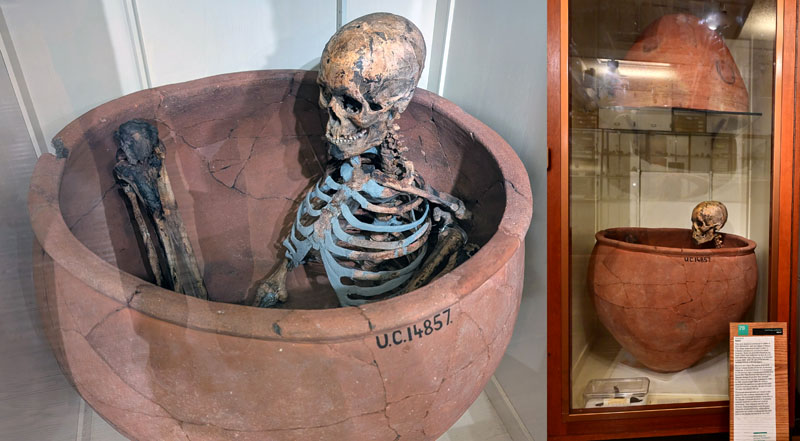
This is a pot burial UC14856-8 from Hemamieh, near the village of Badari. Ali Suefi excavated the Badarian civilization’ sites in 1923. Brunton and Caton-Thompson described this finding as ‘a large double pot burial, in excellent condition, of an adult female’. The skeleton is displayed in the position that it was found at North Spur Burial (59). In 1995, gynecologist Mark Broadbent identified the skeleton as a 2-meter-tall male, not a female.
The Merimde culture (also Merimde Beni-Salame or Benisalam) (5200-4300 BC)
Although not listed in Petrie’s book, this Neolithic culture was found during the 1928 excavations in the West Nile Delta in Lower Egypt, which corresponds to the Faiyum A culture and the Badari culture in Predynastic Egypt. It got its name from the excavated settlement site that was researched in the 1970s. These people were also early settlements of tribes living as farmers in small, mud slab huts with no elaborate burials of goods. The tribes started as multiple small communities with a mixed farming economy. They grew wheat and barley, and raised cattle, sheep, goats, pigs, etc. The Merimde people also did fishing, and some were mobile hunter-gatherers. People looked similar to the Tasian culture visually.

They made primitive stone tools, like bifacial sickle inserts, hand axes, and pounders that usually date to 4500-4000 BC. Radiocarbon dates place the earliest Merimde occupation between c. 5200–4250 BC. However, the radiocarbon measurements range from 4900 to 4000 BC (p.171/11, Joanne M. Rowland, “New Perspectives and Methods Applied to the ‘Known’ Settlement of Merimde Beni Salama,” in The Neolithisation of the Mediterranean Basin: The Transition to Food Producing Economies in North Africa, Southern Europe and the Levant, Berlin Studies of the Ancient World 68, edited by Joanne M. Rowland, Giulio Lucarini, and Geoffrey J. Tassie).
Ma’adi culture, northern Egypt, ( 4000–3300/3200 BC)
Not mentioned in the book, the Ma’adi culture is dated to approximately 4000–3300 BC, with some sources extending its influence to around 3200 BC. It emerged from earlier Neolithic cultures in northern Egypt, such as the Faiyum Neolithic, Merimde Beni-Salame, and El-Omari cultures, and is characterized by a gradual development of sedentary life and trade networks. The culture coexisted with the Naqada I and II phases in Upper Egypt but was distinct in its culture and economic practices. By around 3400–3300 BC, the Ma’adi culture was gradually replaced or assimilated by the expanding Naqada culture, which eventually led to the unification of Egypt under the First Dynasty around 3100 BC.
They lived in houses made of wood and matting, with pits, postholes, and hearths indicating lightweight, semi-permanent structures. Some structures were subterranean, dug into the ground, and resembled houses of the contemporaneous Beersheba culture in southern Palestine. Large storage jars were sunken into the ground, indicating communal storage of goods like cereals. Domesticated animals included cattle, sheep, goats, pigs, and the earliest evidence of domesticated donkeys, which facilitated overland trade with Palestine.
#3 The Amratian Culture (Naqada I, 4200-3700BC)
Dating to about 4200 to 3700 BC by Petrie, this culture saw the continuation of pottery production, with eighty plain varieties. They produced painted pottery with natural motifs. White-lined red pots were decorated with animal figures and geometrical patterns. The Amratian people had Libyan influence and didn’t come from the Badarian culture. While not much is known about their religious practice, they did believe in the afterlife. In some burials, their bodies were either covered with skins or wrapped in patterned, colorful leather. Unlike the previous cultures, these people used a system of linear or geometric signs that later became a derivative of all the Western alphabets. They also used a system of weights.
There are findings of alabaster, limestone, disk maces, and basalt stone vases during this period. These people wore amulets and carved ripple-flaked knives, and small, slate animal-shaped palettes. They also used quartz crystal, porphyry for weapons, garnet, imported obsidian, lazuli, and agate. They made small copper chisels and drills, and carved ivory into combs and cloaked figures.
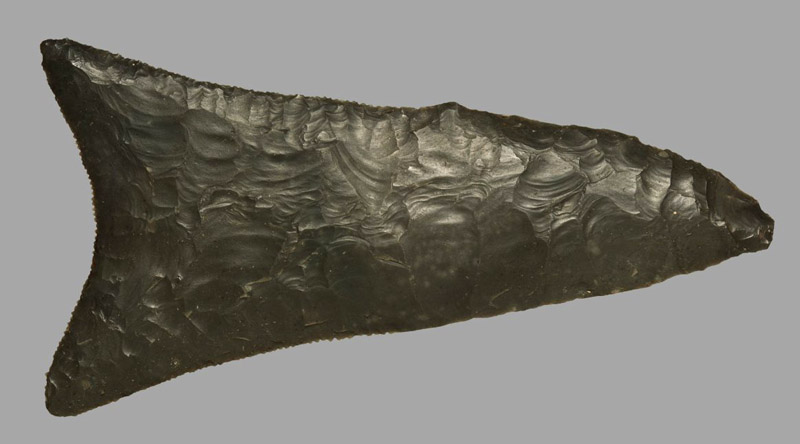
#4 Gerzean Culture (Naqada II, 3500-3200 BC)
Dating to about 3500 to 3200 BC (or 3650-3300BC), the Gerzean culture is seen as laying the groundwork for Dynastic Egypt. This period saw the growth of cities, mass-produced mud bricks, increased use of copper, and the construction of the first Egyptian-style tombs. Named from El Gerzeh excavations, near Meydum, this culture represents generations of people from the deserts or the Red Sea mountains.
Just to compare their living conditions and population size to existing Mesopotamian culture across the border, Gerzean Egyptians lived in large to medium villages, while tens of thousands of people condensed in Mesopotamian metropolises that covered up to 100 hectares.
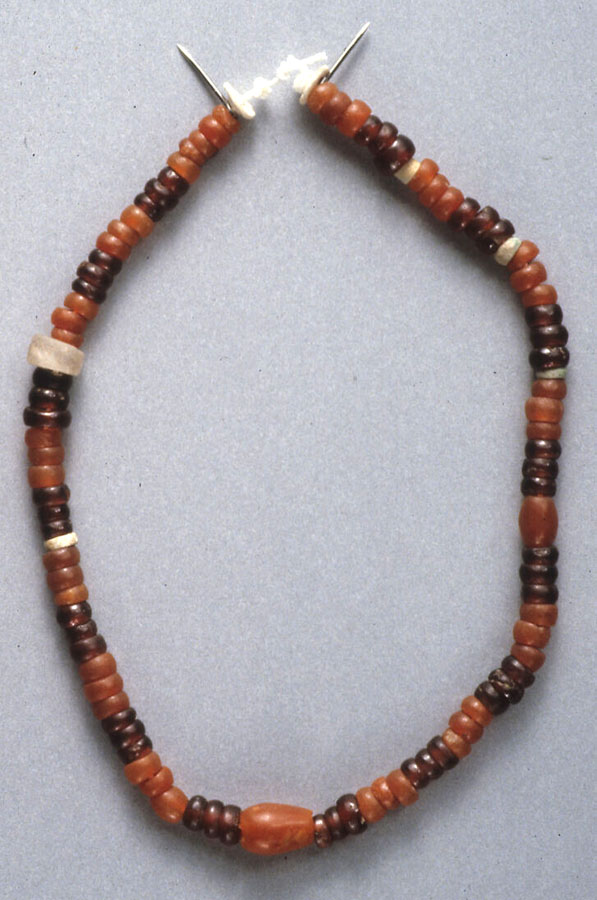
The Gerzian tribes had a writing system with word-signs and pictorial signs (hieroglyphs). They borrowed the Babylonian standard system of weight. They liked religious rituals, amulets, and trading across the sea. They made coarse basalt goblets, pear-shaped, white stone mace-heads, fine flints, flint armlets and vases in a variety of stones (syenite, breccia, serpentine, etc). Gerzean people knew turquoise, obsidian, garnet, lazuli, and dark blue glass, and made silver and gold beads. They carved ivory and did lots of leather work. Their pottery features distinctive red line decoration and marbling of vases with hunting and shipping scenes, as well as the wavy ledge-handled pots, black Incised, black-topped and red polished pottery.
Naqada II culture was excavated across the entire Egypt with many large graves and a different type of pottery discovered there that included Marl pottery, stone vessels, jewelry beads, iron beads, siltstone cosmetic palettes, flint knives, and copper harpoons.
#5 The Semainean Culture (Naqada III, 3300-3050BC, Protodynastic or Dynasty 0)
The Semainean civilization, named after the excavation site near Semaineh, close to Qena, emerged from groups originating in Elam and the Red Sea mountains. This culture was a blend of people with minimal social distinctions. Spanning approximately 3300–3100 BCE (or possibly 3300–3000 BCE), this period saw the rise of powerful individual rulers and the widespread influence of the late Naqada culture across Egypt.
During this time, approximately 90 local kings governed various regions of Egypt, leading to frequent tribal conflicts. These conflicts culminated in the unification of Upper and Lower Egypt under Narmer, marking the dawn of a centralized state. The era corresponds to the Dynasty 0 period, evidenced by burials at Hierakonpolis (Horizons I and II), with 17 royal names associated with this proto-dynastic phase.
The Naqada III period (ca. 3200–3000 BCE), overlapping with the Protodynastic Period, is characterized by large, elaborate burials of the elite in Upper Egypt. These graves contained distinctive artifacts such as cylinder jars (Tarkhan pottery), plates, and the earliest examples of writing. https://www.ucl.ac.uk/museums-static/digitalegypt/naqadan/chronology.html .
The Semaineans developed phonetic signs inscribed on cylinders, laying the foundation for Egypt’s hieroglyphic writing system. They established a standard of weight that persisted into the Roman period. While pottery and fine art were not priorities, the Semaineans innovated in crafting new forms of stone vessels, a variety of slate cosmetic palettes, ivory rings, spoons, and hairpins. Metal use became widespread, with heavy copper tools, iron beads, daggers, and other implements marking advancements in manufacturing.
The findings published in the journal Proceedings of the Royal Society A, a 2013 Oxford University radiocarbon dating study, further refined the chronology of the Naqada period in Predynastic Egypt, suggesting its beginning between 3800 and 3700 BCE. The study included samples from various burial sites of Naqada, Badarin, and the First Dynasty periods and focused on short-lived organic materials like seeds, reeds, and linen, which offer more accurate dating results, using the Oxford Radiocarbon Accelerator Unit (ORAU) at the Research Laboratory for Archaeology, Oxford. Its mathematical model also provided a more precise timeline for the early dynastic rulers of Egypt. https://www.ox.ac.uk/news/2013-09-04-pinpointing-when-first-dynasty-kings-ruled-egypt
Quick facts & timeline:
- The Predynastic Egypt consisted of powerful city-states, like Hierakonpolis (the largest Predynastic settlement in the south), Naqada, and Abydos (the first royal tombs and hieroglyphs).
- King Narmer, the first pharaoh, is credited with the unification of Upper and Lower Egypt in 3100 BC (Naqada III) and was the last king of the predynastic Egypt.
- The Unification of Egypt is symbolized visually in art by joining two crowns of different shape and color into one, as well as by binding the lotus and papyrus together.
- Aha or Mena, or Menes, becomes the king of the first dynasty.
- Hieroglyphs were invented about 3200 BC.
- Mummification began around 2500 BC.
- Contemporary archaeology places the building of the Great Pyramids of Giza around 2600 BC.
What was the social status structure of the Naqada tribes?
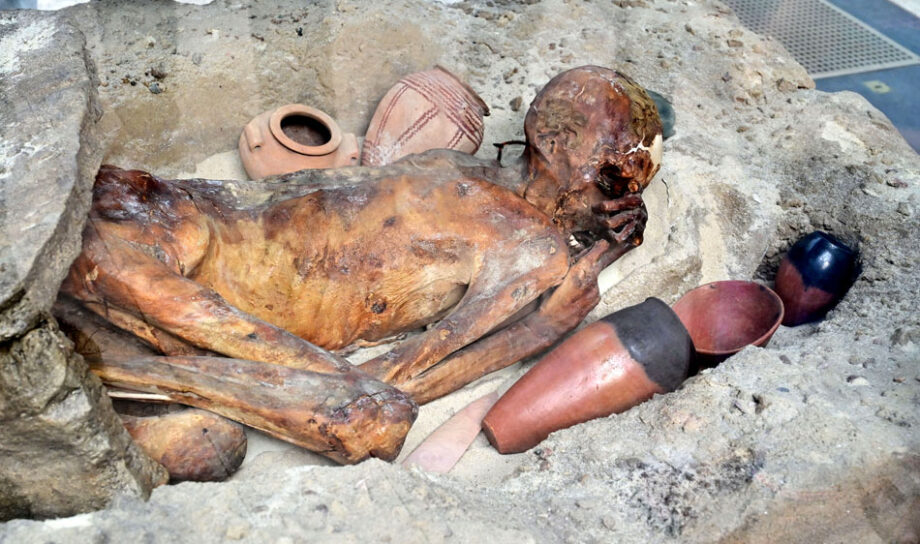
Most insights into this ancient culture stem from burial excavations, where grave size and contents reveal details about predynastic Egyptian society. To my surprise, even in pre-dynastic Egypt, social stratification was evident, with a two-tiered system of a few elite families and the broader population emerging by the Naqada II period.
The grave was a final resting place for eternity. Predynastic people who lived in Upper Egypt between 3900 and 3100BC buried their dead in shallow graves near the desert. They put reed mats on the ground and placed the dead in a fetal position facing the West to be reborn. Then, they covered the body with clothing, mats and placed a few objects next to the dead. These graves increased in size and contents in later periods. We can see such an example in the Gebelein man buried with some pottery and a modest cosmetic palette.
Egyptians often placed sandals and boats in the tomb with the dead for the dangerous journeys through the underworld. Archeologists find small wooden or clay model ships in the graves. The sandals corresponded to the foot size of the deceased to travel across the underworld.
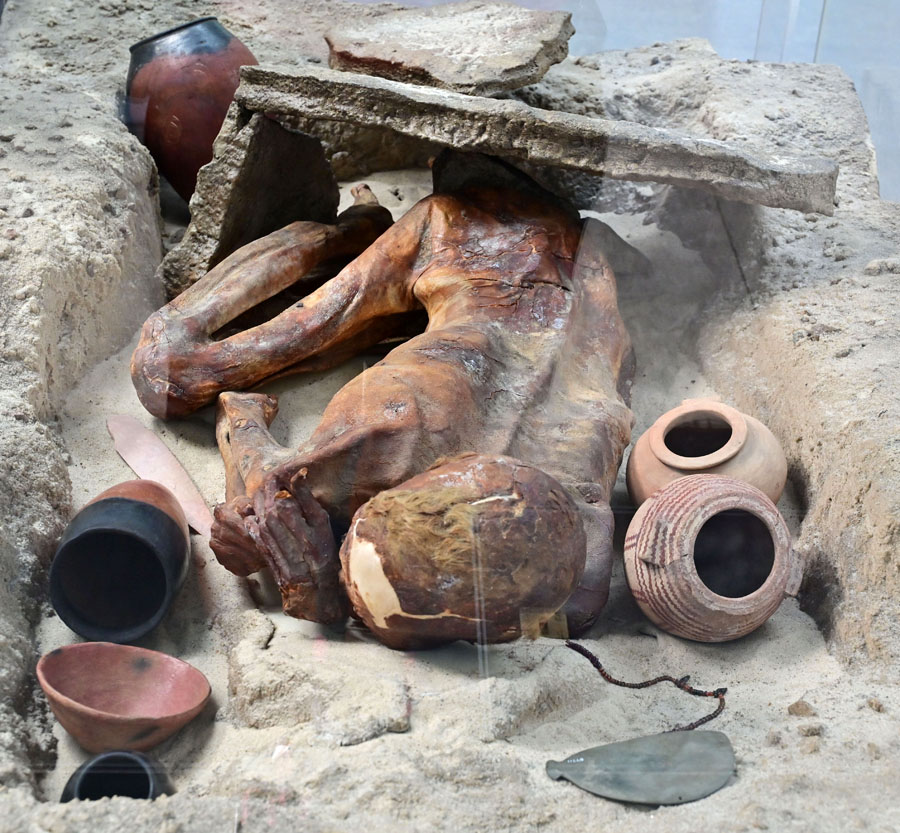
The Gebelein Man is one of the best preserved natural mummies from Predynastic Egypt. Living in Gebelein, he was a young man between 18-21 years old when he died from a stabbing into his shoulder. He probably died during the territorial violence before 3100 BC.
Excavated graves differed in size, quantity, materials, and quality of grave goods, suggesting this social stratification. Early graves were simple, containing small cosmetic palettes, flints, spoons, harpoons, and ivory hairpins (viewable at Penn Museum, USA). In contrast, the largest royal graves were multi-room structures with numerous grave goods. Tomb 100, known as “The Decorated Tomb” at Hierakonpolis, is unique for its mural and a single non-functional fishtail knife of the refined Naqada II type. The mural, depicting a king enlarged compared to other figures, smiting prisoners and animals with a mace, highlights social stratification and early kingship ideology (Andrea Gover, p. 14).
Elite burials, often of adult males but occasionally women and children, contained high-quality or imported items like Mesopotamian seals, obsidian, incense, or kohl. Non-elite graves, such as HK43 burial 333, sometimes included imported goods or finely crafted fishtail tools (Andrea Gover, p. 12), suggesting some individuals held significance despite not being elite. For instance, the elite cemetery HK6 (c. 3600 BCE) in Hierakonpolis, spatially distinct from the non-elite HK43, featured graves with imported obsidian, kohl, and non-functional fishtail knives, indicating trade with Nubia and the Red Sea. Non-elite graves occasionally contained high-quality flint, hinting at limited access to prestige items. Naqada IIb tombs at Umm El-Kaab in Abydos evolved from a single to multi-room structures. Burials contained the ripple-flaked knives, red-polished pottery, and trade goods like slate palettes. Naqada cemeteries had some elite burials with Syrio-Palestinian jars, but settlements like South Town revealed burials with functional tools (like flint axes, sickle blades).
Trade Networks:
The Naqada culture engaged in trade, with evidence from excavated graves. Egyptians also imitated items by making them locally, and used hieroglyphic inscriptions. Recent research suggests trade with the Near East during Naqada II, with imports like cylinder seals from Mesopotamia. The evidence leans toward trade with Nubia for pottery and stone vessels, the Levant for imported items, Ethiopia for obsidian, and so on. Petrie Museum lists main foreign contacts: https://www.ucl.ac.uk/museums-static/digitalegypt/themes/contact.html
- Nubia: Traded pottery, clothing, palettes, and stone vessels, with material evidence from grave sites. Imported materials like obsidian and chert found in elite graves confirm long-distance trade with Nubia, the Levant, and the Red Sea. Ripple-flaked knives’ caramel chert, possibly sourced from a single mine, suggests a centralized workshop (Holmes 1989).
- Eastern Mediterranean (Levant): Imported pottery, with a piece from Tel-El Farkha made from non-local clay, and cedar wood from Lebanon found in Nekhen tombs.
- Ethiopia: Sourced obsidian for blades. Obsidian, chert knives, knapped figurines with pressure flaking, and ivory and ground stone were found in tomb 47 HK6. Obsidian could only be procured in the Red Sea region, indicating long-distance trade (The Lithic tool economy in Upper Egypt in the Late Predynastic: The Naqada II proliferation of fine flint tools and its implications for socioeconomic complexity, Andrea Gover, p.11).
- Mesopotamia: Trade with this region was one of the most prolific ones. Egyptians imported the first seals, ideas for pottery designs (griffins and serpent-headed panthers), a simplified potter’s wheel, and pottery.
Predynastic Egyptian Vessels, Tools, and Technology of the Naqada People
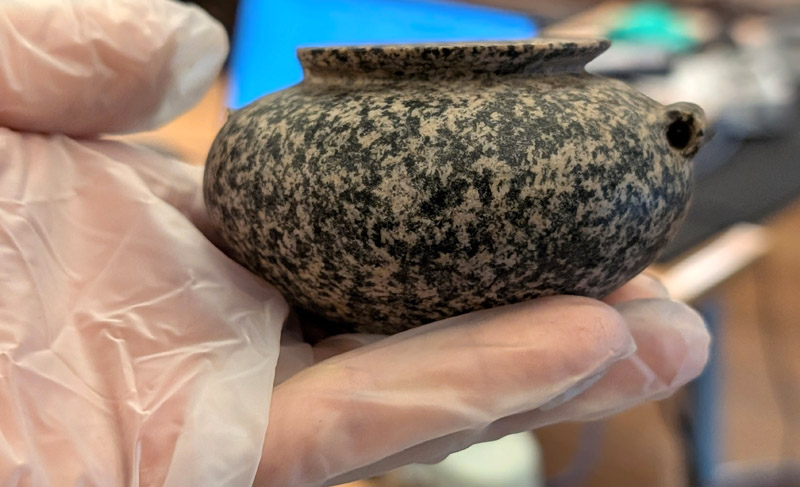
In this section, I’ll explore tools and objects made during all three Naqada periods in greater detail. As different tribes of people grew and evolved, so did the range of tools and capabilities of craftsmen in ancient Egypt.
Pottery & Small Stone Vessels:
Pottery was central to Naqada culture, with several distinct styles defining each period. Bowls, small jars, bottles, medium-sized neck jars, beakers, wine and beer jars, and wavy-handled jars, with decorations ranging from black-rim pink clay to white-colored geometric waves to animal and bird motifs in red. Some pots were manufactured in Egypt, while others were imported from countries like Crete, Syria, the Levant, and Mesopotamia.
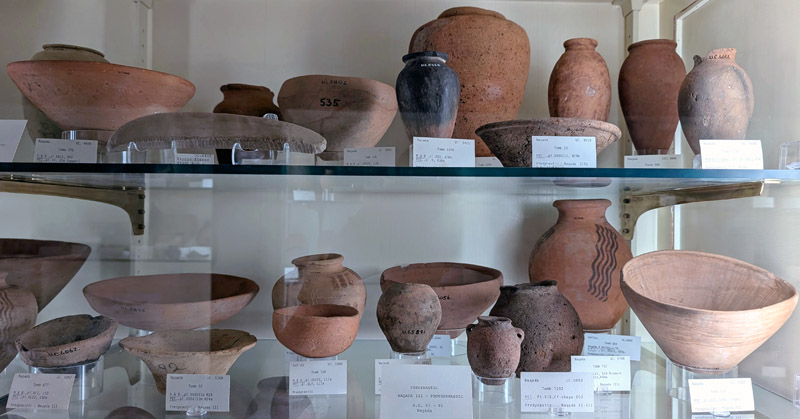
Case PC3 in the Petrie Museum displays the earliest excavated Egyptian objects, which are 7,000 years old. What’s surprising to see is the sheer variety of displayed clay pots that can make your head spin. Petrie distinguished nine types of pottery, each with its specific forms, colors, and firing techniques.
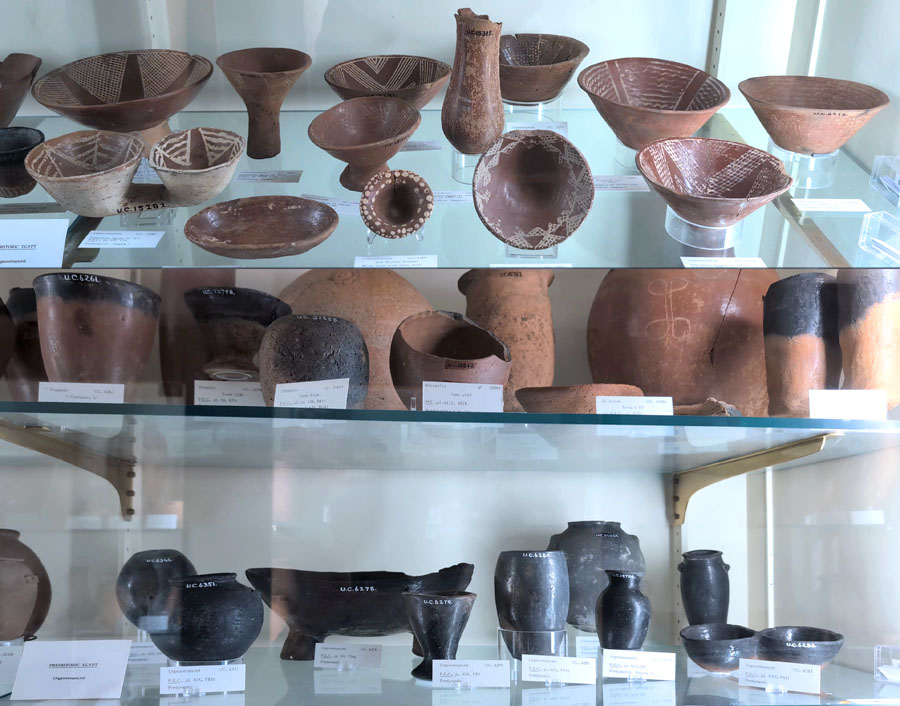
Petrie obsessively sketched the unearthed pots and eventually collected his findings in a book, Ceremonial Slate Palettes Corpus and Proto-Dynastic Pottery by Flinders Petrie. His determination with pot classification gave him the nickname “the Father of Pots.” The archaeologist used his observational skills to create sequences of prehistoric pottery based on the vessels’ material, color, and shapes. You can study his systematized pottery drawings on the pages of the 1953 book.
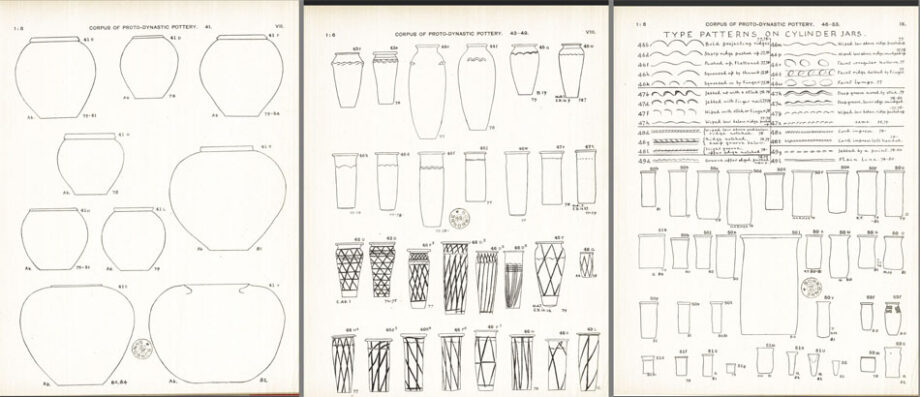
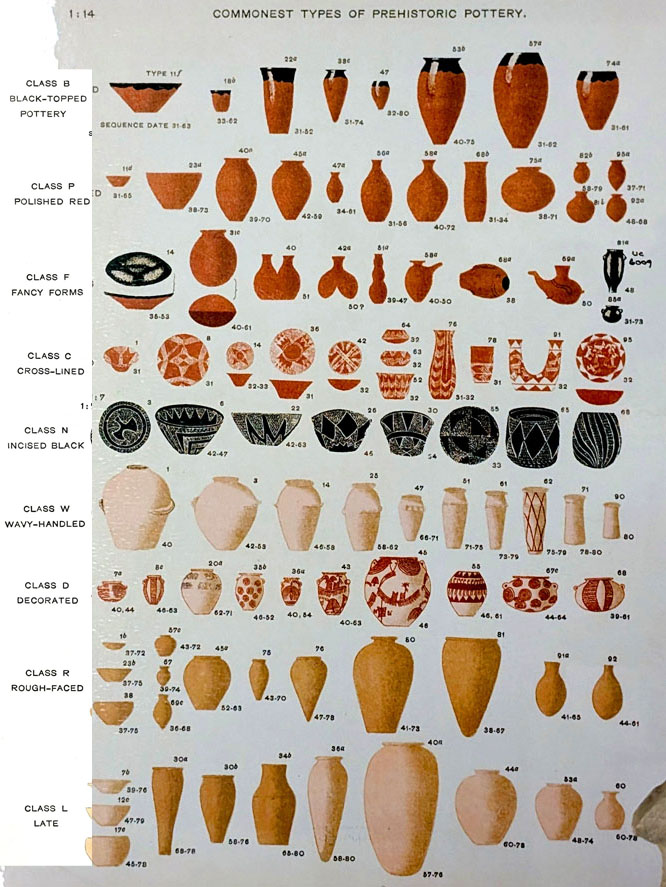
This image shows nine different types of vessels that Petrie first recorded in 1894-95 during his excavations of a large cemetery at Naqada.
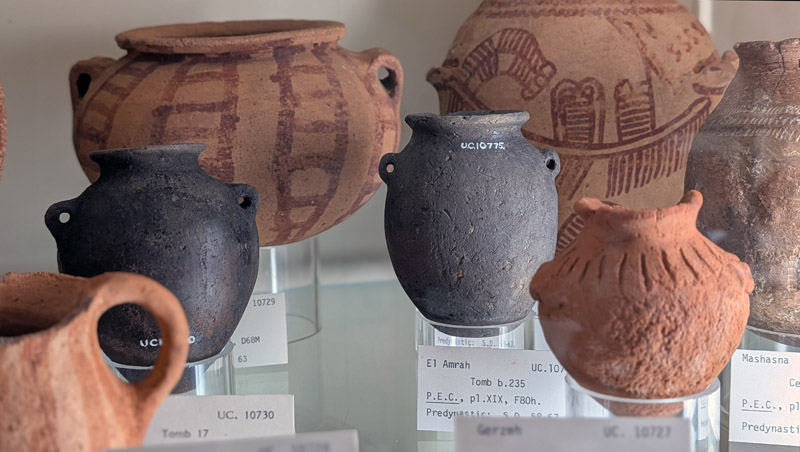
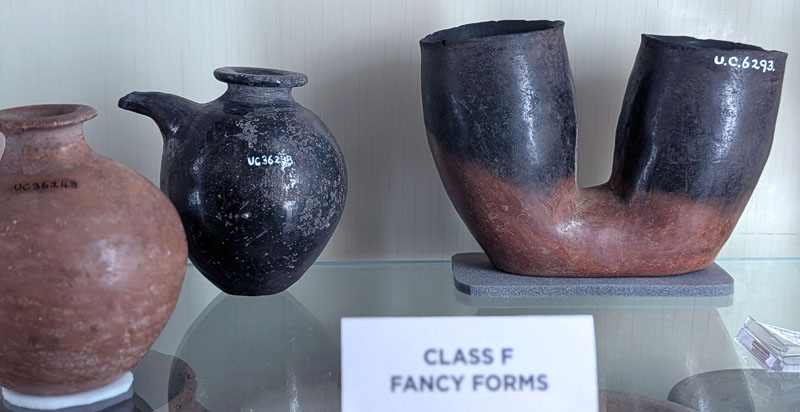
Class B Black-Toped Pottery, Class P Polished Red, Class F Fancy Forms, Class C Cross-Lined, Class N Incised Black, Class W Wavy-Handled, Class D Decorated, Class R Rough-Faced, Class L Late.
Based on this diagram, Naqada II-III black pottery and stone vessels made of basalt, porphyry, and diorite were classified under Class F, Fancy Forms.
Petrie’s Sequence Dating Slips (SD):
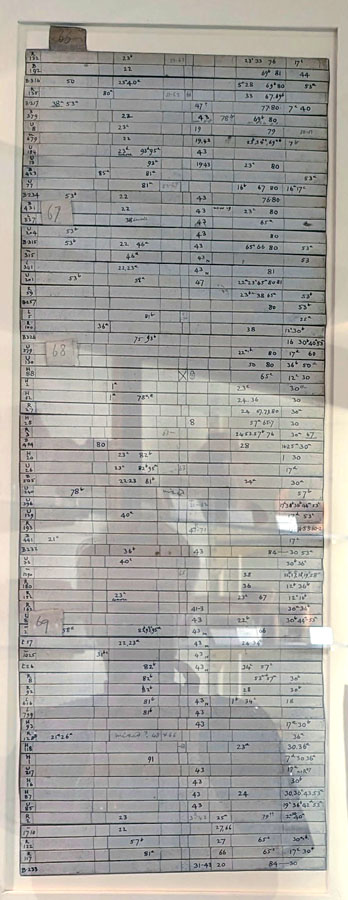
If you visit the Petrie Museum in London, you’ll find a framed sequence dating set made of cardboard strips by Flinders Petrie. It’s one of twelve sets of cardboard strips he invented to organize the excavated pottery from thousands of Egyptian burials after 1898. How would you date the found material in predynastic graves without a provided inventory list?
Petrie made about 900 cardboard strips. He grouped them into a sequence to date the graves with similar pottery types based on his visual observations. Some of his principles are recorded in the museum’s description:
‘Petrie theorized that over time, Class W changed from globular shapes with pronounced handles to cylindrical forms with only a representation of a handle around the top. Petrie observed that the two types of pottery with painted decoration, Class C and Class D, were never found together in the same tomb. The slips with these pottery types could be separated.’
Each slip records the pottery findings from one grave, sorted into nine columns according to the ceramic type he proposed. When Petrie established the probable age of each grave, he divided the slips into 51 sections. The sections were numbered 30 to 80 and called Sequence Dates (S.D.). Petrie saved the numbers before S.D. 30 for possible new discoveries. So that S.D. 79 is the beginning of the First Dynasty.
Purpose of Pottery: Many pots had utilitarian and transportation purposes, like molds for bread-making, incense burners, lamps, perfume bottles, storage jars, wine and beer vessels. However, a lot of pottery was specifically manufactured for burials only. The buried pots were placed next to the dead, but sometimes some people were placed inside the big pots.
Used Materials: Most pots were made of two types of clay. Egyptians gathered the Nile silt clay from the river’s banks, which was the major source for raw material. A finer, Marl clay got gathered in the desert’s edges (Ballas and Qena) to make a more refined pottery like Decorated, D-ware. The marl clay pottery had thinner walls and could crack during the higher temperature firing (Bourriau et al.: 124-125, 2000; Doherty: 62, 2015).
Pottery tools & techniques: Did ancient Egyptians invent & use a potter’s wheel?
It’s considered that the Naqada period (c. 4200 – 3050 BC) in ancient Egypt predates the widespread use of the potter’s wheel. Pottery in predynastic Egypt was handmade, using a combination of techniques for different pottery types, like pinching out and hollowing (non-radial method), coiling (Naqada I and II), slab building (free-radial method), and shaping with hand and tools, rather than relying on a wheel. While a turntable-like device for shaping rims may have been used in Naqada, the true potter’s wheel, as it’s known today, didn’t become common until the Old Kingdom (after 3000BC).
First Potter’s wheel in Egypt:
Egyptians had several types of potter’s wheel in later periods: pot stand, stick-spun potter’s wheel, hand-spun, and stone socket ‘mushroom pivot’ wheel, etc. In the PhD Thesis from 2013, The origins and the use of the potters wheel in Ancient Egypt, Sarah Doherty concludes that the original potter’s wheel was introduced to Egypt from the Levant during the reign of Pharaoh Sneferu in the 4th dynasty (c.2600 BC). Under Sneferu’s rule, Egyptian potters began using the elite-stone basalt potter’s wheel. The manuscripts and wall art in tombs from the 4th-6th dynasties give us visual evidence of the first potter’s wheel in Egypt (Doherty, p.255).
Invention:
The first rotational device came from Mesopotamia. The invention dates to 4000-4500BC as the potter’s wheel basalt disks-bearings were found in the Near East dating to 4000 BC. Egyptians eventually modernized the tool to increase rotation speed in the potter’s wheel (S. Doherty, p.257) to manufacture their pottery for the elites. There’s evidence of the first rotational device use in Egypt between 3500-3300BC, seen in Canaanite-style pottery. The potter’s wheel allowed male craftsmen to create a much greater variety of pottery with thinner, even, and symmetrical walls in any pot. Potter’s wheels were made of several materials, like baked clay, limestone, and basalt (S. Doherty, p.253). Found 5th Dynasty Egyptian potter’s wheel consisted of round, pierced bearings made of basalt or diorite. The basalt wheel bearing manufacture required hazardous desert mining of the stone and skillful manufacture in royal workshops, which was streamlined in Naqada II.
Methods of pot-making:
There were several steps in pottery creation: clay gathering and preparation, shaping, coiling, and slab construction, probably pressing the clay over a mold in some ancient pottery like plates, turning the upper part of a pot on a movable base or turntable, surface coloring, and firing. To join clay sections, refining shapes, and blending of the edges involved scraping, brushing, and paddling (Friedman, 1994: 236), and simply using a finger to smudge the clay together for blending.
Recent Findings about Potter’s Wheel Use in Egypt:
Some most recent evidence suggests the use of turntables, or simple wheels, to shape rims beginning Naqada I and especially in Naqada IIc-d periods, but these were not the fully developed potter’s wheel. For instance, vessels with wavy handles show the application of a partial rotation device on the rims, but they were not made with a potter’s wheel, rather manufactured by placing the pot on an unmovable base, and then a craftsman would hand-rotate the pot to make the rim (S. Donerty, p.261).
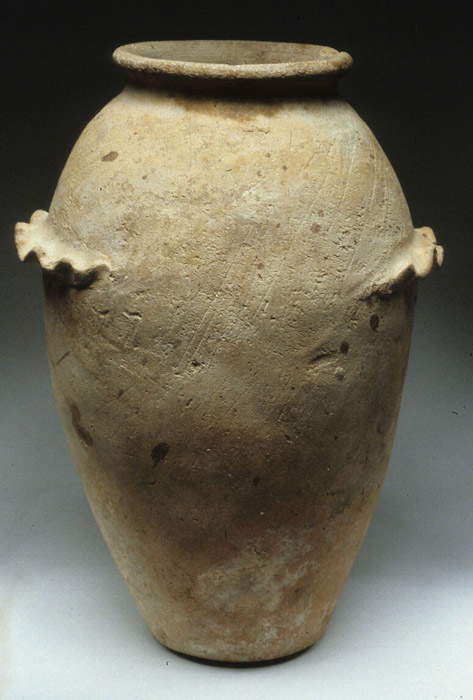
To better understand this theory, researchers Keita Takenouchi and Kyoko Yamahana analyzed the black-topped and decorated wares from Naqada I and II with the CT scans in 2021. They concluded that pottery had variations in the pressure applied, usually associated with the use of a turning device that consisted of a pot-stand or small bowl, in which the pot was placed in the center and rotated (Arnold and Bourriau, 1993; Doherty, 2015). This was a method used in Upper Egypt only.
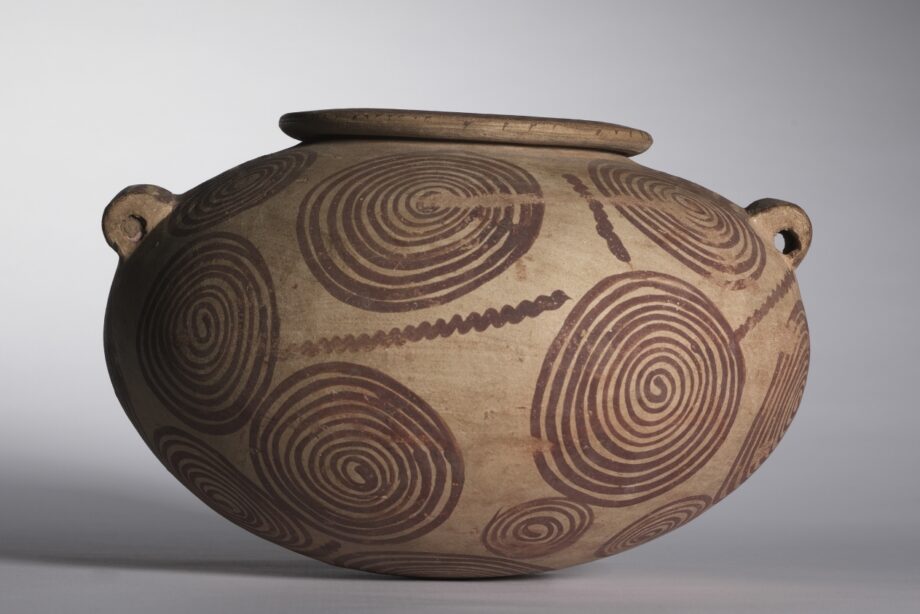
Their image analysis supports the reconstruction of a turning device being used for the entire body in the analyzed D-ware pots. The black-topped pottery of Naqada IC-IIA-B differs from the D-ware of Naqada IIC-D in the use of a turning device. The stage/timing at which a turning device was used and its speed differ between the two types of ware.
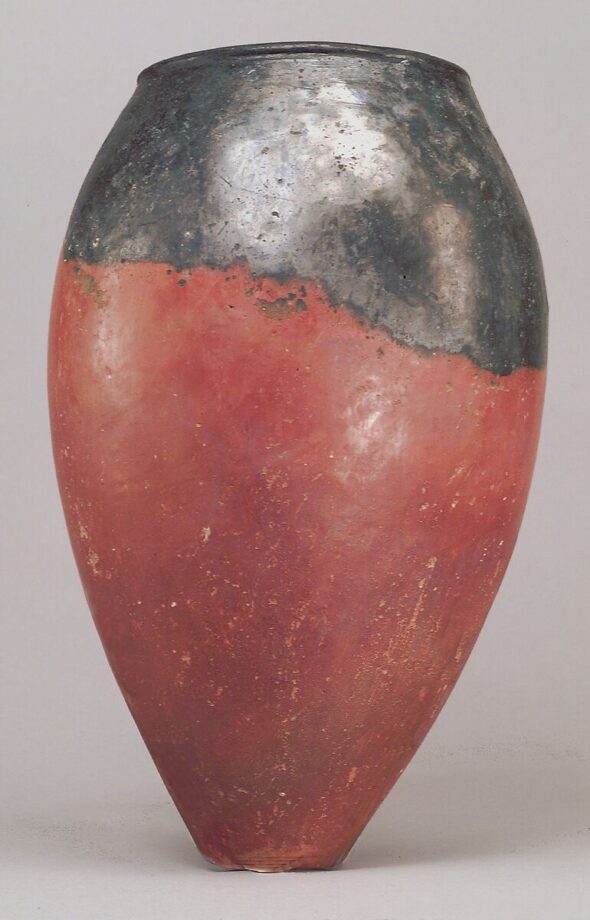
B-ware beakers’ rim was shaped by a turning device in the finishing stage. However, the entire body of the D-ware jars may have been thinned and shaped by a turning device with more RKE. The turning speed was needed to get rid of air inside the clay to prevent cracking during firing. (p.15, Fine pottery shaping techniques in Predynastic Egypt: A pilot study on non-destructive analysis using an X-Ray CT scanning system, 2021)
“Fine pottery shaping techniques in Predynastic Egypt: A pilot study on non-destructive analysis using an X-Ray CT scanning system,” Authors: Keita Takenouchi and Kyoko Yamahana, Journal of Archaeological Science: Reports, Volume 37, June 2021, 102989
The origins of miniature jars, black polished pottery & small basalt vessels:
The initial use of the early potter’s wheel or rotation device applied to ritual, lopsided, uneven, small pottery found in thousands at the pyramids’ temples. Those vessels date to the 4th dynasty and thus don’t relate to the Naqada culture directly. Rather, we can compare them in precision and style. Little, reddish or off-white pots were designed to be used for daily votive offerings once, thus archeologists found a very high number of vessels in burials that were discarded after just one use. (S. Doherty, p.196). (I don’t have the images of such vases). Sneferu realized the potential of population control with religious rituals, aligned himself with the god Ra, and built his legacy around worship of his divine powers. Stone vessels required both craftsmanship skill and expensive material to create vases for the elite burial.
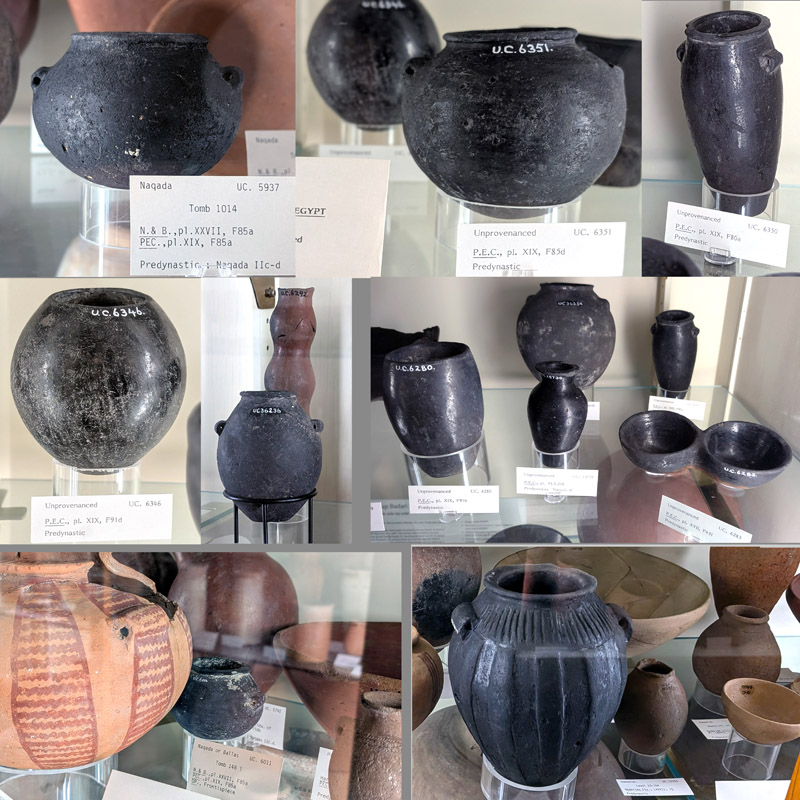
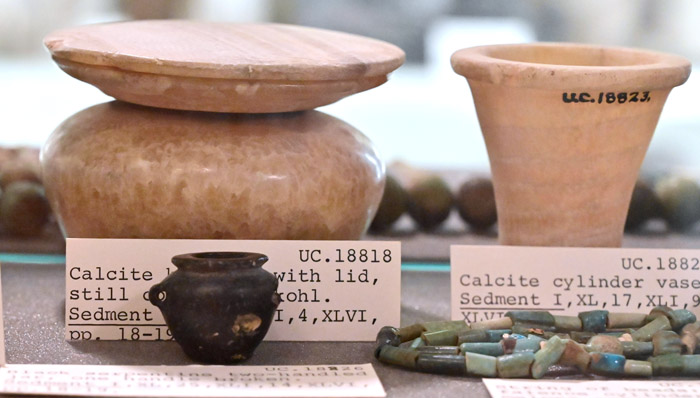
Another type of miniature pots was black polished pottery. In his book, Petrie was the first one to note the existence of small, black pots that emulated small basalt vessels he dated to the early Naqada II period. Such miniature vessels with lug handles and a raised base, on occasion, were all fired to a black hue during this period. The existence of these strange, non-functional handles makes them different from other manufactured pottery. Being softer and more prone to breakage, this black polished pottery could have been used for storage or cosmetics in burials. It could have been an affordable replacement for expensive, real basalt vases, but some were found placed on top of larger vessels as lids too. Meidum bowls were also ‘copies’ of some stone vessels. Sarah Doherty suggests that perhaps the first stone vessels came to Egypt via trade routes from Mesopotamia and Palestine (p.233), and the Egyptians copied their appearance in their pottery. This sounds plausible and explains the black pottery use as ‘copies’ of expensive basalt vessels reserved for the elites.
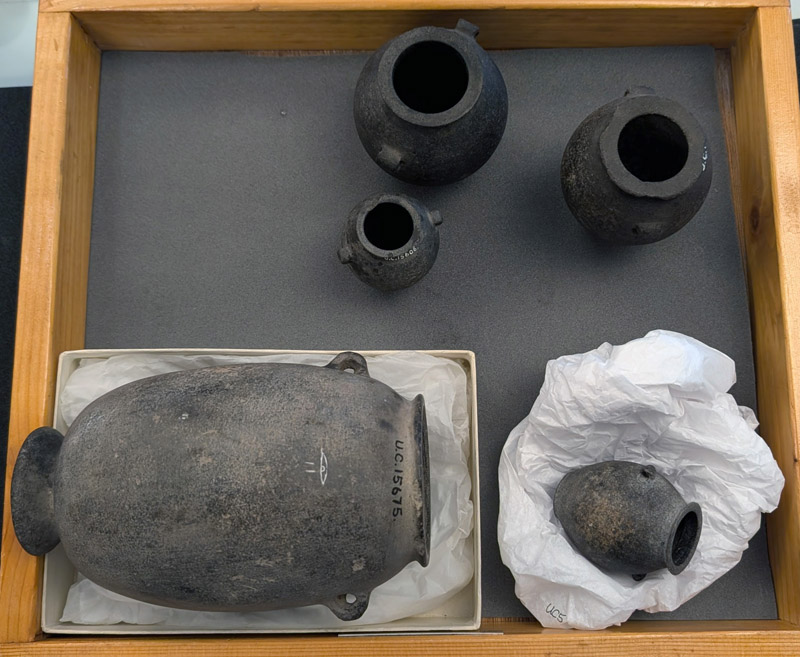
Real basalt vessels were found exclusively in the elite burials/tombs and didn’t have a utilitarian use. Archaeologists explain the use of such basalt vases as exclusive offerings to the god.
(Doherty, Sarah 2013. The origins and the use of the potters wheel in Ancient Egypt. PhD Thesis, Cardiff University)
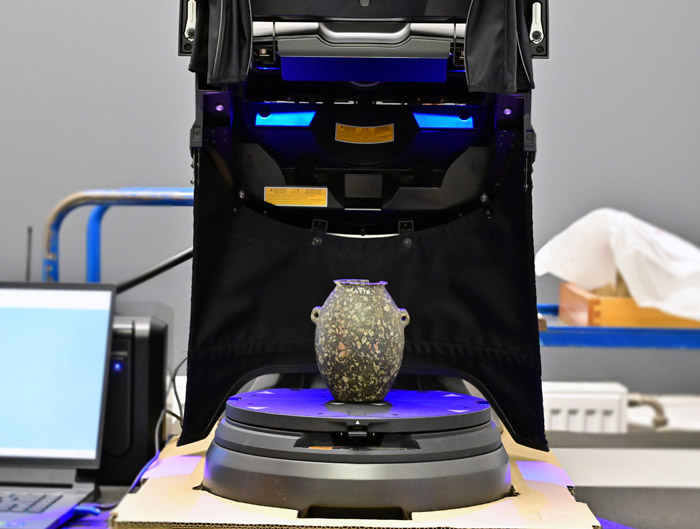
Dr.Max Fomitchev-Zamilov studies the precision of the predynastic Egyptian stone vessels that reveal surprising facts about their manufacturing process. You can follow his ongoing research by subscribing to his blog or sponsoring his research projects.
Key Pottery Types of Naqada between 3750–3100 BCE
The Naqada culture’s pottery of this period (ca. 3750–3100 BCE) in Upper Egypt, particularly the white cross-lined ware (C-ware), black incised ware (N-ware), and decorated ware (D-ware), showcases the introduction of painting and inlay decoration techniques, influenced by Nubian and southern Levantine traditions. These wares provide evidence of social stratification, trade networks, and cultural emulation. (Emulation in painted pottery styles in Egypt in the prehistoric period, Sakura Sanada, Studies in Ancient Art and Civilization, Vol 27, 2023, pp. 47-75.)
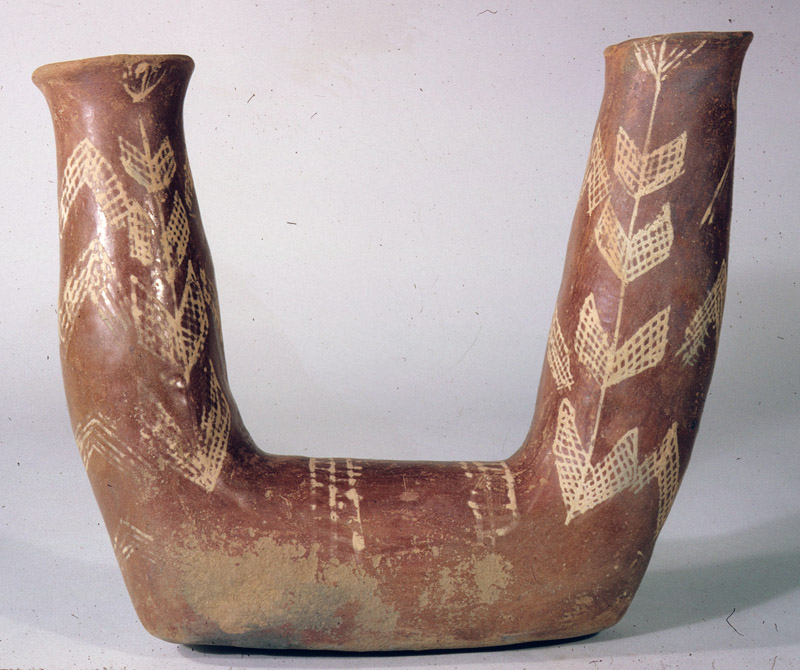
- C-Ware (White Cross-Lined Ware, Naqada I–IIA): Made from Nile clay, coated with ochre wash, burnished, and decorated with white gypsum paint applied before or after firing. Features geometric patterns mimicking basketry, as well as human, animal, and plant motifs. C-ware was found in Upper Egypt (e.g., Abydos, Naqada), with some vessels resembling caliciform beakers. The use of white pigment likely derives from Nubian pottery traditions, suggesting local innovation through hybridization with Nubian inlay techniques.
- N-Ware (Black Incised Ware, Naqada IIA–IID1): Features incised or impressed designs, often filled with white pigment, on black to brown surfaces. Includes caliciform beaker forms with geometric patterns like dots and dashes. This pottery has strong Nubian influence, particularly from Saharo-Sudanese traditions. Found in Upper Egypt (e.g., Mahgara 2, Armant), but not in Lower Egypt. The white-on-black contrast maximized visual impact but required significant effort, limiting its prevalence.
- D-Ware (Decorated Ware, Naqada IIA–IID2): Made from marl clay, painted with dull red-brown ochre on beige to light brown surfaces. Motifs include geometric patterns (wavy lines, zigzags, spirals) and figurative designs (boats, plants, animals). Longest-lasting of the three wares, possibly due to more efficient production techniques. Red-on-buff decoration offered strong pigment binding and scalability, though it provided less color contrast than C-ware or N-ware.
Influences and Emulation:
- Nubian Influence: Caliciform beakers, prevalent in the Tasian and Badarian cultures (ca. 5000–4000 BCE), introduced the use of white pigment inlay and geometric patterns to Upper Egypt. These beakers, found from Upper Nubia to Egypt’s deserts, influenced the form and decoration of C-ware and N-ware.
- Southern Levantine Influence: Painting techniques, particularly with red pigment, likely originated from the southern Levant, where such decorations were common before their adoption in Egypt.
- Emulation: Unlike Upper Mesopotamia’s “painted-pottery revolution” (ca. 6200–5900 BCE), where painted pottery became dominant (80% of assemblages) through increasing design complexity and color contrast, Upper Egyptian pottery showed complex designs from the outset. The shift from white (C-ware, N-ware) to red (D-ware) pigments prioritized efficiency over maximum contrast, reflecting local adaptation rather than competitive emulation.
Social Context:
- Social Stratification: Pottery variations, particularly the presence of prestige items like C-ware and N-ware in elite burials, indicate a two-tiered society with elite families distinguished by high-quality or imported goods (e.g., obsidian, kohl, Syrio-Palestinian jars). Non-elite graves occasionally included prestige items, suggesting limited access to status symbols.
- Trade Networks: The presence of imported materials in elite graves points to trade with Nubia, the Red Sea, and the southern Levant, highlighting a dual economy where settlements used functional tools (e.g., flint axes) and cemeteries featured prestige pottery.
- Cultural Hybridization: The integration of Nubian inlay techniques and Levantine painting methods into local pottery production suggests a robust cultural exchange, with Upper Egypt adapting foreign techniques to create distinct wares like C-ware.
- Context: Mesopotamian pottery was primarily domestic, while Upper Egyptian pottery data largely come from cemeteries, reflecting ceremonial or status-driven use.
- Design Complexity: In Upper Mesopotamia, painted pottery evolved gradually with increasing design complexity and color contrast to enhance visibility during commensal events. In Upper Egypt, designs were complex from the start, with no clear gradual increase.
- Color Contrast: Mesopotamian pottery maximized dark-on-light contrast (e.g., black-on-buff), while Upper Egyptian pottery shifted to red-on-buff (D-ware) for efficiency, despite white-on-red or white-on-black offering greater contrast.
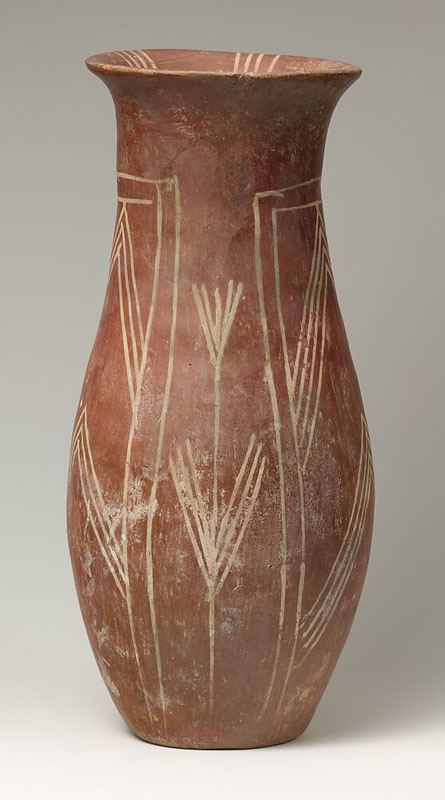
The study reflects that “the painting decoration made with white pigment seen on white cross-lined ware in Upper Egypt was the first kind of decoration made by the genuine painting technique in Upper Egypt and a kind of technique that might have been invented locally in Upper Egypt in the process of introducing both the inlay decoration technique using white pigment from the Nubian pottery traits and the painting decoration technique from the southern Levant.” (p.16)
Naqada pottery reflects an interplay of local innovation and foreign influence, with C-ware, N-ware, and D-ware showcasing the adoption and adaptation of Nubian and Levantine decorative techniques. The shift from labor-intensive white-pigmented wares to more efficient red-pigmented D-ware highlights a practical approach to pottery production, prioritizing scalability over visual contrast. While emulation drove innovation in Upper Mesopotamia, in Upper Egypt, it manifested as the localized adaptation of foreign techniques.
Pottery Examples:
Here I include some examples of pottery dating to the three Naqada periods. I aim to separate the pottery by periods to illustrate the gradual advancement in pottery techniques and styles.
Naqada I
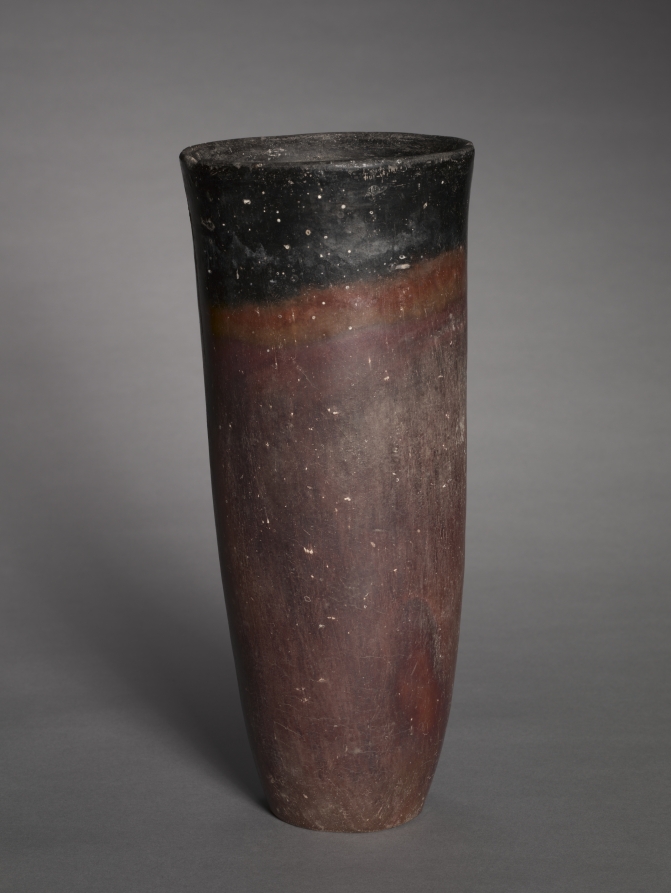
Naqada I featured black-topped red ware and white cross-line ware. Black-topped ware is hand-crafted from red clay and polished to a glossy finish using a smooth stone or pebble. To create this unusual black rim, craftsmen placed the vessel upside-down in ashes during kiln firing, a technique that creates a striking contrast with the red body. Red polished vessels with black rims (known as black-topped red ware or B-ware) were made for burials of the elite, not food consumption during the early Predynastic Period.
- Black-topped jar with incised figure of a ram, Nagada I, 3850–3650 B.C., Findspot: Egypt, Abadiya, Tomb B 83, Made of Nile silt clay, MFA Boston.
- Clay Pottery and vessels from the Ashmolean museum at the University of Oxford include the Black rim pots from Naqada I, and Open bowl Naqada I C, c. 3800 – 3450 BC, Abydos, grave B5, fired clay. https://images.ashmolean.org/search/?searchQuery=naqada
- Smooth pottery bowl, type R 1b, yellowish clay, from Naqada Tomb 1687,
LDUCE-UC5805 https://collections.ucl.ac.uk/Details/petrie/13172
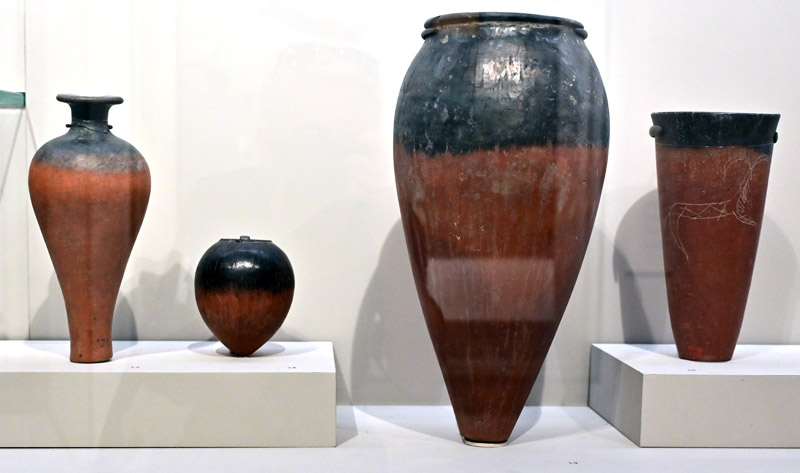
BLACK-TOPPED POTTERY:
During the Naqada I period, improvements in ceramic technology allowed artisans to make pots with a black rim and red body. The design must have occurred first by accident in the uncontrolled firing atmosphere of early kilns. Egyptians soon learned that by burying the mouth of the pot in the ashes of the kiln, the iron in the exposed part would fire red while the covered area turned black. This technique is the hallmark of Predynastic pottery, and it survived in Nubia long after it disappeared in Egypt. (Description from the art museum in Boston)
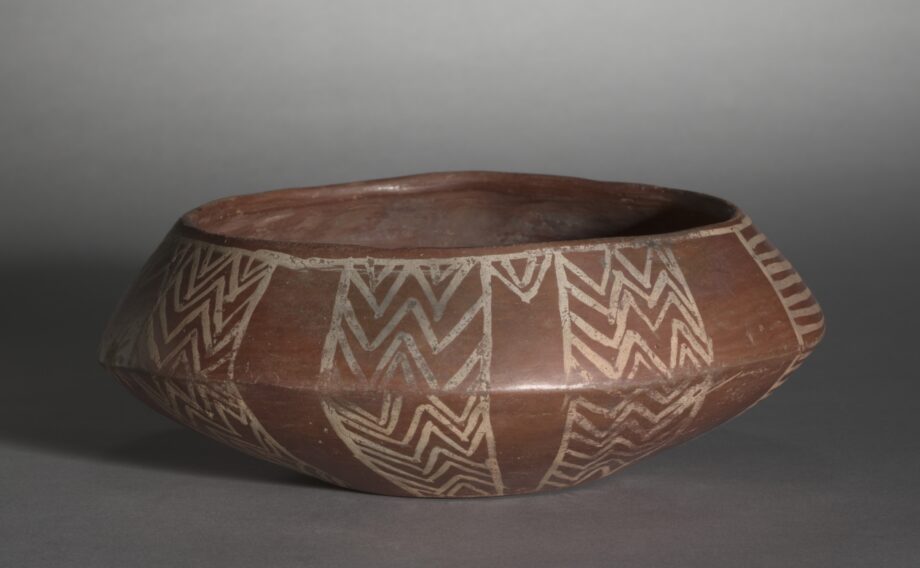
CROSS-LINED POTTERY:
Painted pottery first appeared during the Naqada I period (3850-3650 BC). The designs were applied in ocher on the surface of red polished pottery, usually before the pots were fired in the kiln. The characteristic decoration of crisscrossing lines may initially have imitated basketry, but the finest painters also included naturalistic decoration and scenes of hunting and daily life. Scholars have noted several
different types of decoration. These alternate designs seem to be associated with the major cult centers of the period. (Description from the art museum in Boston)
Naqada II
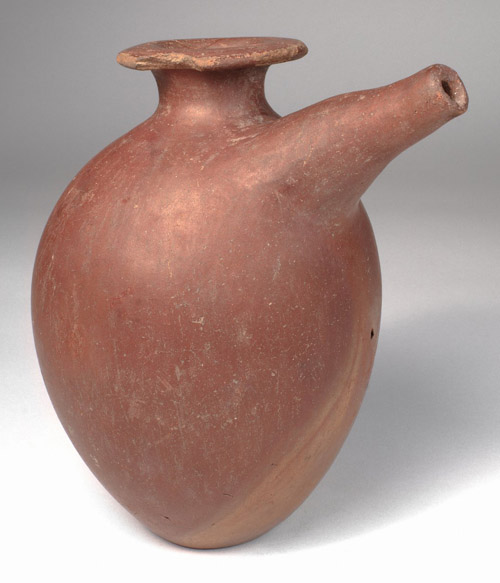
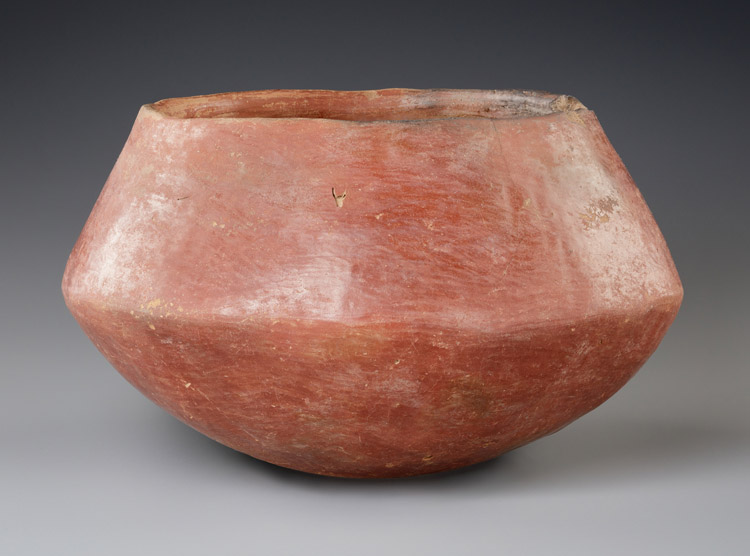
Naqada II introduced uncolored clay wavy-handled jars. These hand-turned clay necked jars have no drawing on them. There are many other objects, like pink clay jars, boats, and bowls, found from this period. Marl pottery appears at the end of Naqada II. You can look at Marl classification: https://www.ucl.ac.uk/museums-static/digitalegypt/pottery/marl.html
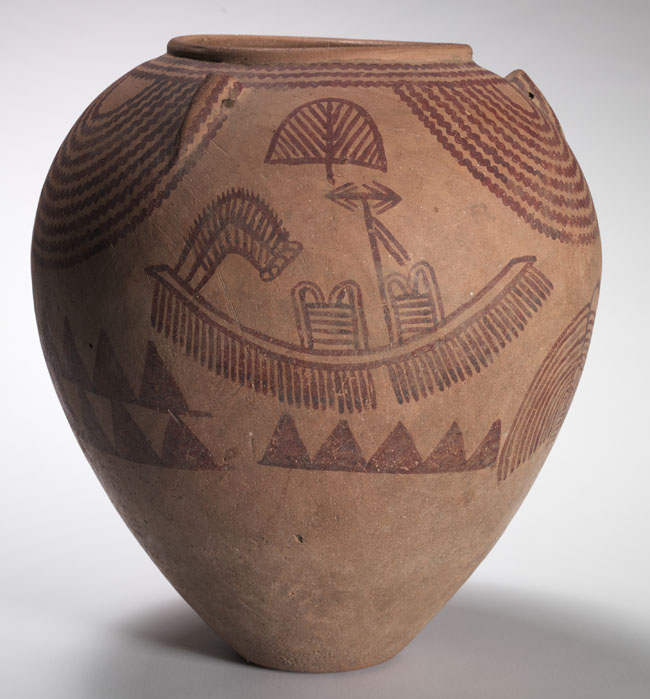
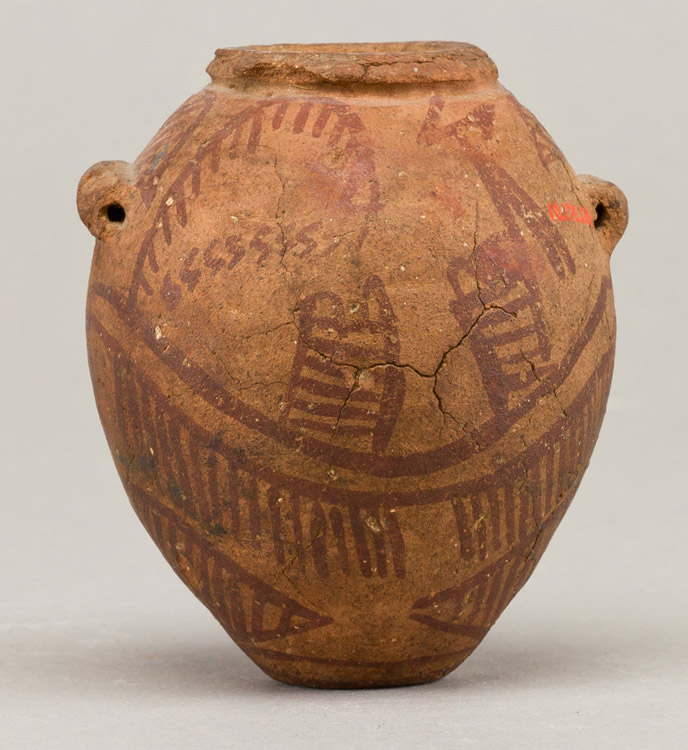
The decoration painted on this jar shows two multi-oared boats traveling through fertile riverbanks lined with trees and aloe bushes. Rows of triangles indicate the desert hills in the background. The Nile was Egypt’s primary means of transportation and communication, since river traffic was far more efficient than travel by land. The concept of boat travel permeated all aspects of Egyptian life and religion. The sun god Ra was believed to travel by boat across the heavens by day and through the underworld by night. Funerary texts describe the trip to the afterlife as a journey by boat, and scenes of boats figured prominently in tomb decoration. https://www.clevelandart.org/art/1914.639
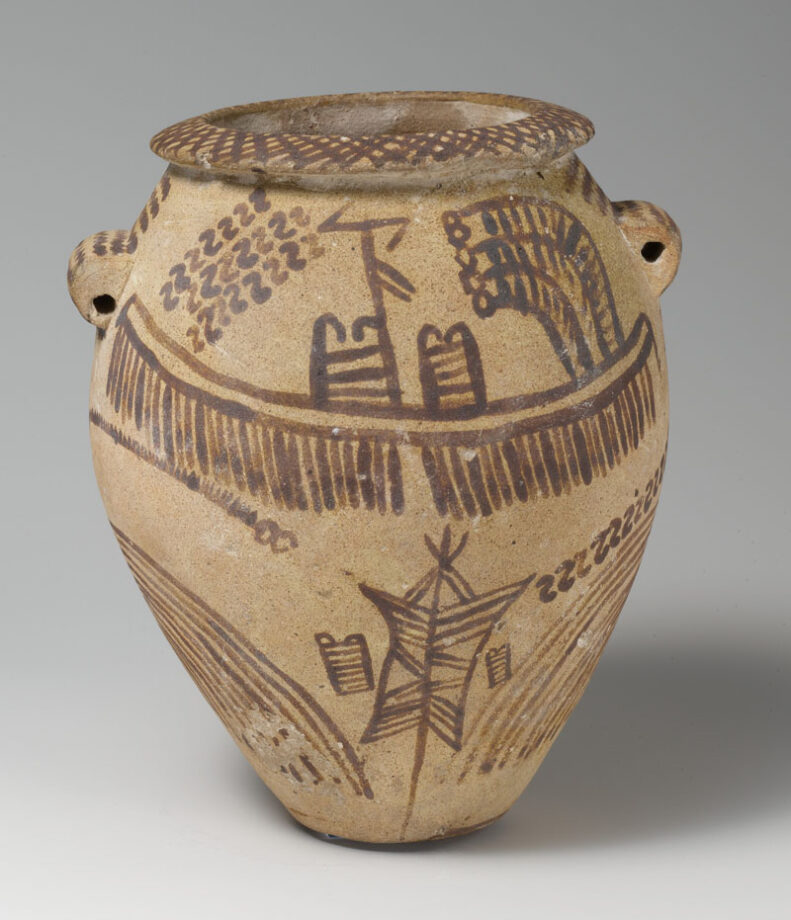
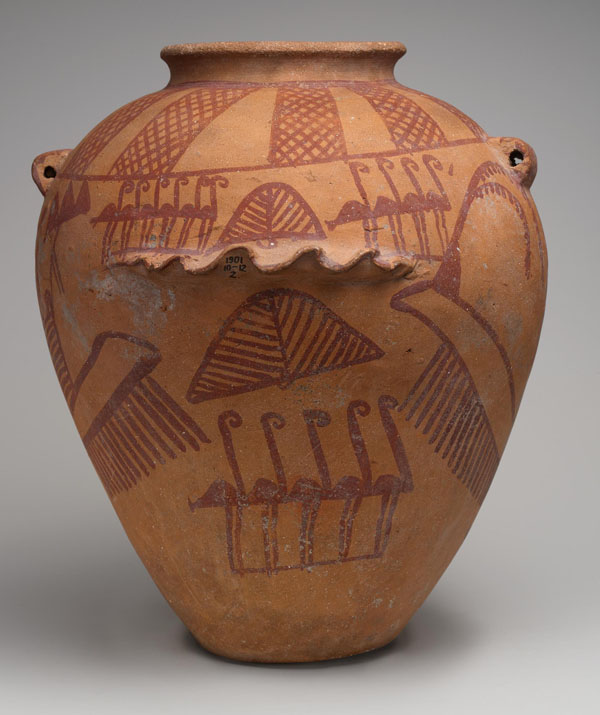
Red painted representations of dancing figures, ostriches and many-oared boats.
Asset number: 1528728001. © The Trustees of the British Museum. Shared under a Creative Commons Attribution-NonCommercial-ShareAlike 4.0 International (CC BY-NC-SA 4.0) license.
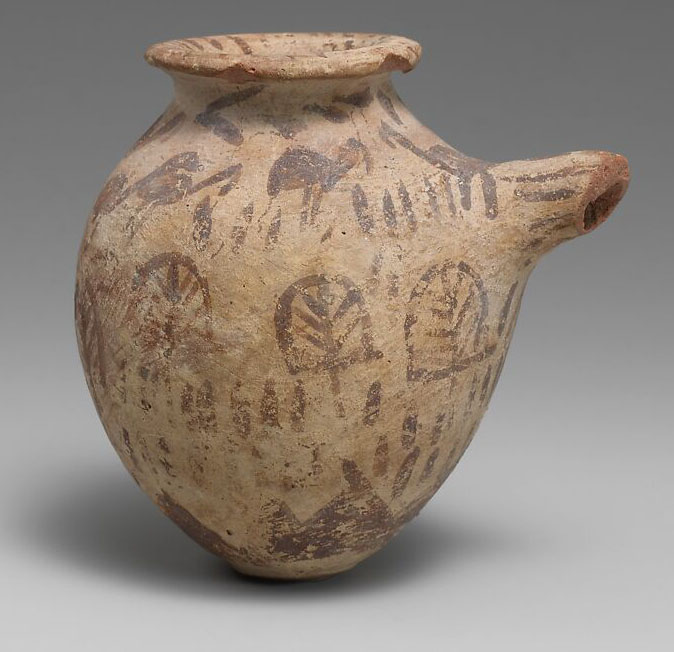
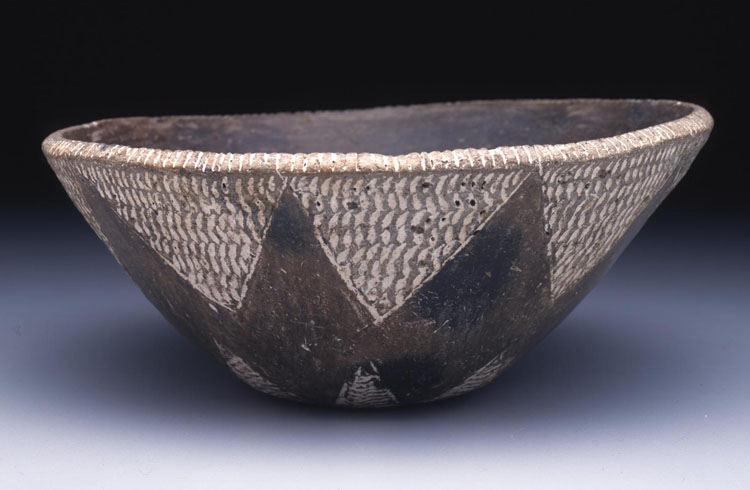
Black incised ware. Bowl has flaring sides, a rounded rim and a flat base. It is decorated with incised triangular patterns which are filled in with white paste. The bowl’s interior is lightly polished.
Other examples:
- Pottery and vessels from the Ashmolean museum at the University of Oxford include: Simple clay jar, Naqada II, Pink clay jars, Naqada II, Travertine bowl, Naqada II
- Boat model, Naqada II, 3650–3300 B.C., Marl clay, MFA Boston. Missing a prow and a stern, the clay boat is decorated with vertical stripes in the same style as the pottery of this period. They probably had a symbolic function of transporting the dead to the afterlife. The wooden boats replaced these later on.
- Squat Jar with Lug Handles, c. 3400–3300 BCE, Naqada IIb, (3650–3300 BCE), marl clay pottery, Cleveland Museum of Art. Buff-colored pottery decorated in red paint is characteristic of the later Predynastic period. The spirals and wavy lines on this jar imitate the appearance of more costly vessels made of hard stones. https://www.clevelandart.org/art/1920.1987
Naqada III
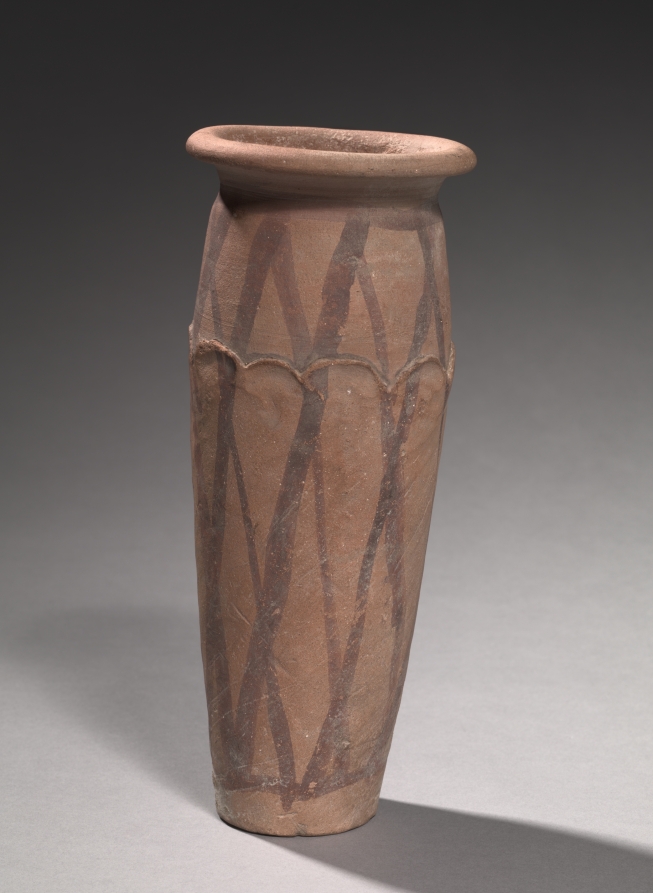
Tall, slender jars decorated with a wavy line in relief occur toward the end of the Predynastic Period. The netlike motif imitates the kind of rope sling or cradle that was used to carry this type of jar without handles. https://www.clevelandart.org/art/1920.1983
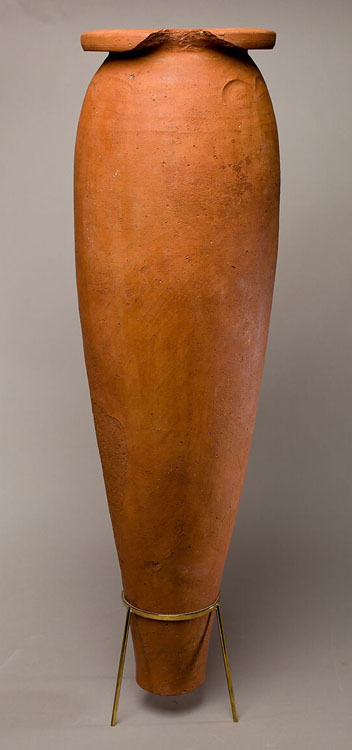
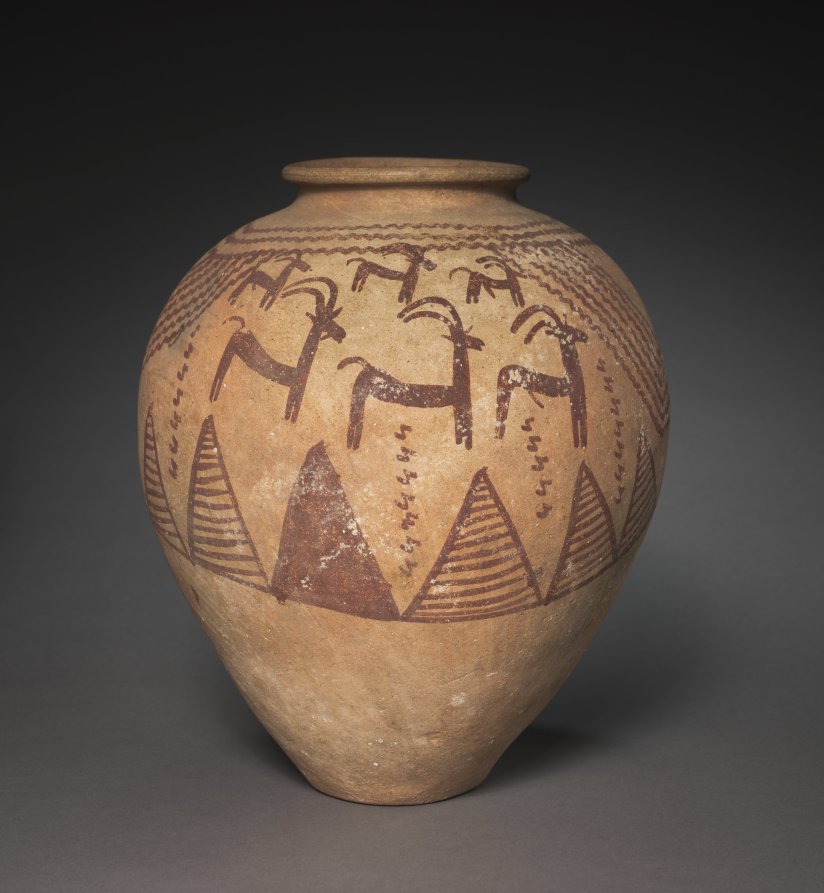
marl clay ware, Cleveland museum of art
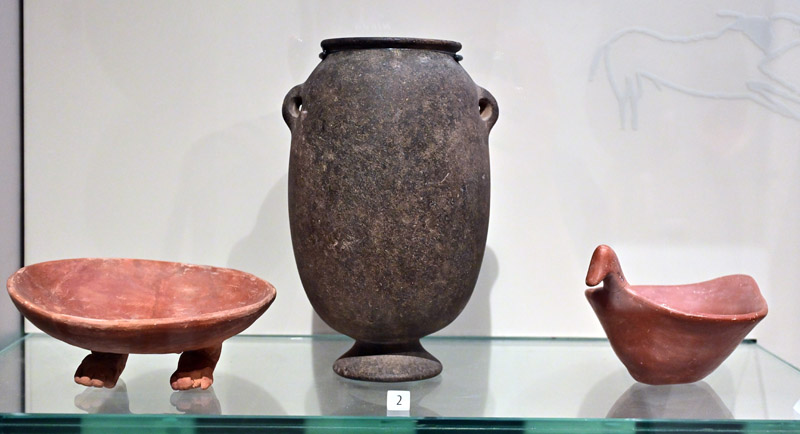
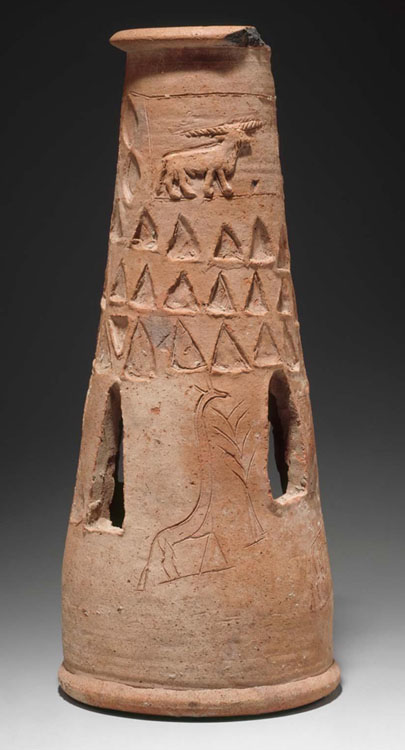
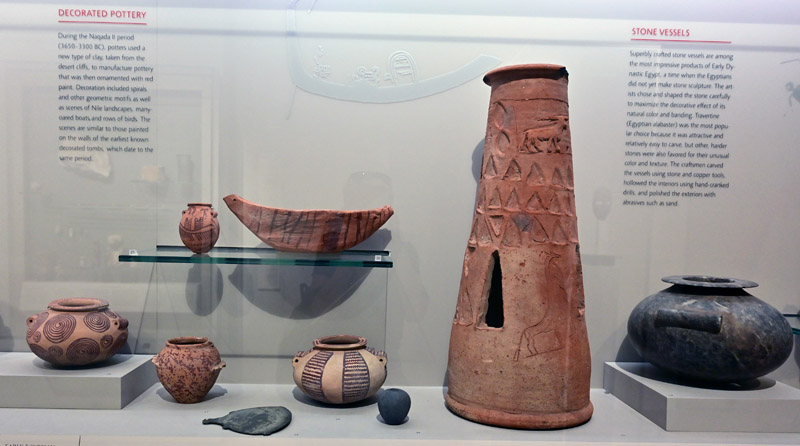
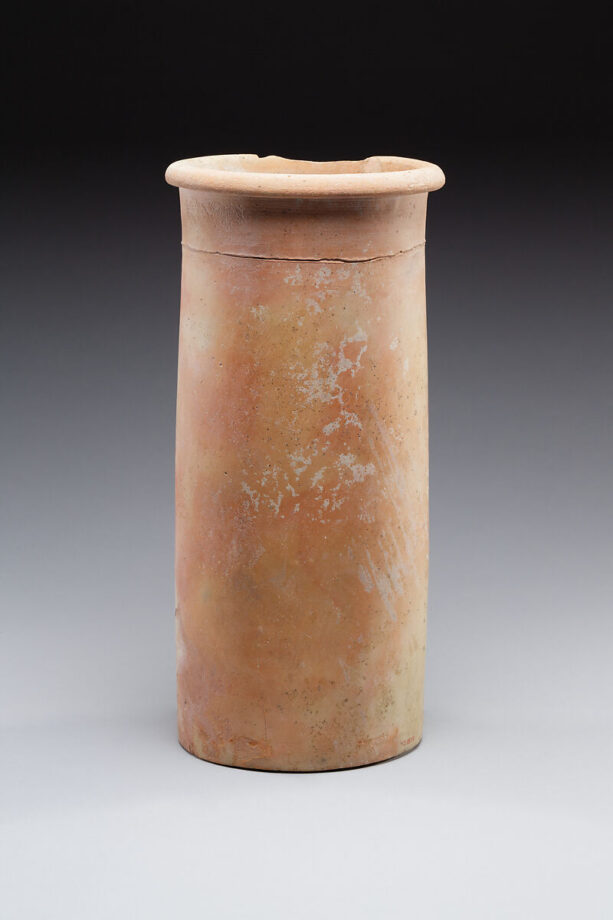
Other examples:
- Cylindrical jar of fired clay, Naqada III, Ashmolean Museum
- The Ashmolean Museum at the University of Oxford has some artifacts from the Naqada I-III and 1st dynasty periods in its collection: https://images.ashmolean.org/search/?searchQuery=naqada. They include knife handles, pottery chips, flakes, copper knife-blade (Naqada III), animal clay and fired clay primitive figurines from Naqada I-II, 3800 – 3450 BC, Bone figurines(Naqada I), and a Rhombic palette, Naqada I (c. 3800 – 3450 BC). Pink limestone animal figurines from Naqada II, wood cylinder seal, 1st Dynasty, Naqada IIIC-IIID (Egypt) (c. 3085 – 2867 BC); Blue lapis lazuli figure of woman, Dynasty 0, Naqada IIIA-IIIB (Egypt) (c. 3325 – 3125 BC), found in Hierakonpolis; Macehead of Narmer, Dynasty 0, Naqada IIIA-IIIB (Egypt) (c. 3325 – 3125 BC), Hierakonpolis; Siltstone The Two Dog Palette, Naqada III, Ivory cylinder seal with Narmer name, Naqada III.
Naqada stone vessels, materials & tools:
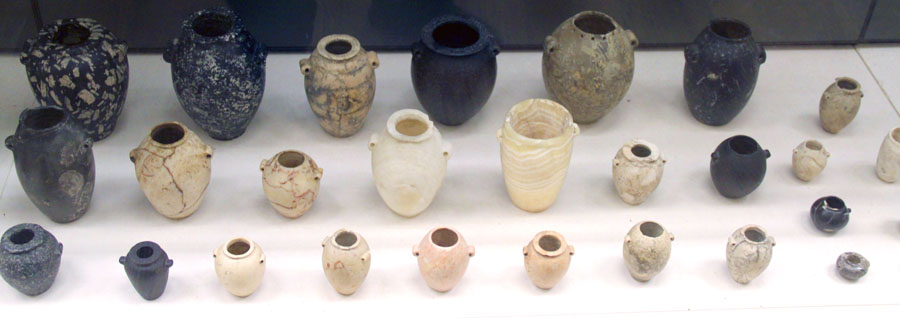
Only the elite could afford ownership of the stone vessels and mines in Predynastic Egypt. Unusual and multicolored stones were even rarer and belonged to the elite classes as well. During the first dynasties, softer stones became popular to meet the growing demand for rituals. According to Danys A. Stocks, a mechanical engineer and book author of Experiments in Egyptian Archeology, general large-scale manufacture of stone vessels dates to the Naqada II (ca. 3600–3200 BC) and the Naqada III/Dynasty 0 ( 3200–3050 BC) periods, although some rare examples of basalt vases date to the Badarians (4500–3800BC). Badarian ground stone vessels appeared around 4000 BC (p.12, Experiments in Egyptian Archeology).
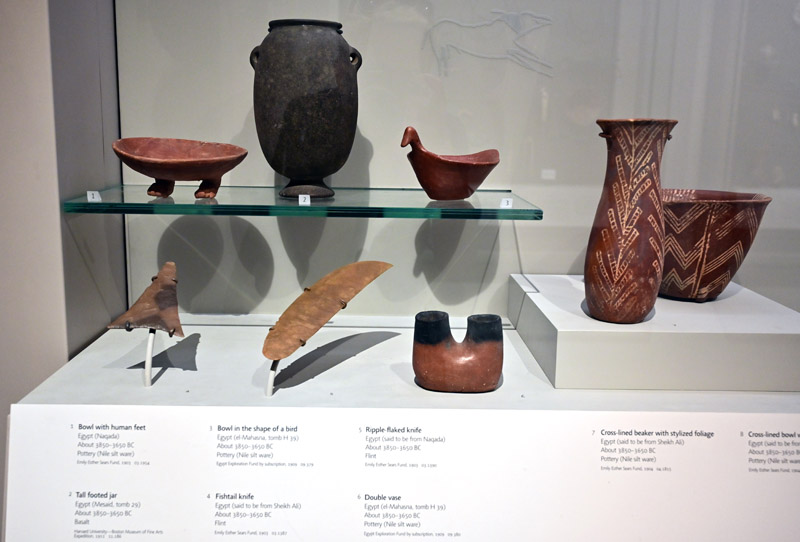
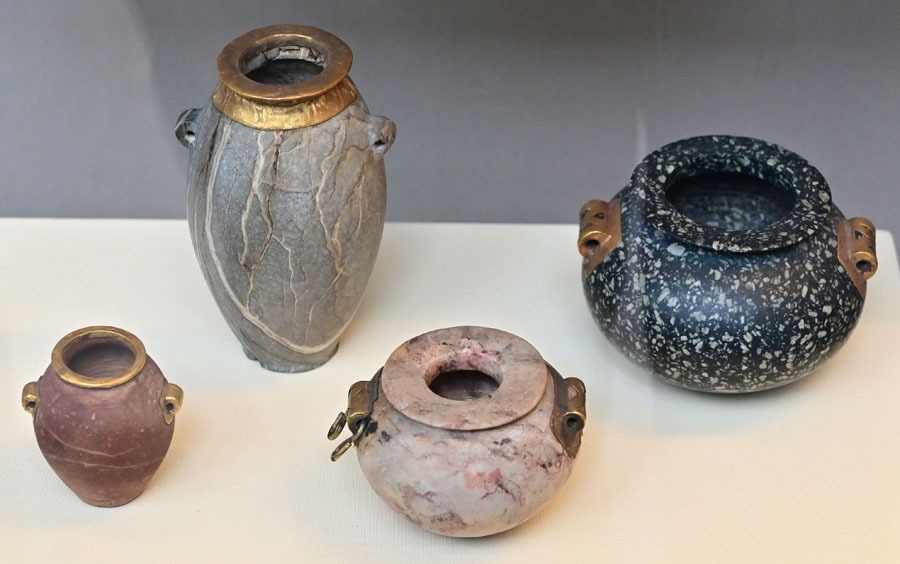
There’s an exhibit of the predynastic stone vessels in the British Museum, London, displaying different stones used in Egypt to make various pots. (The glass case makes it hard to photograph the display, and I include examples of stone vessels from various museums here.)
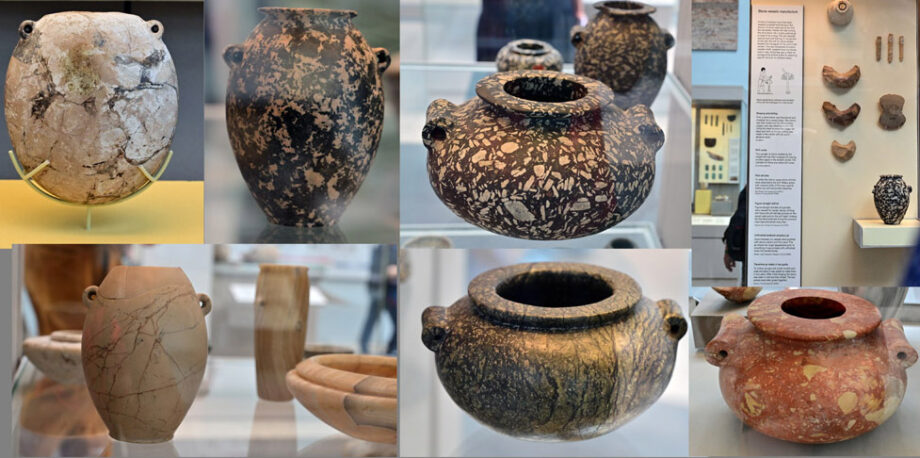
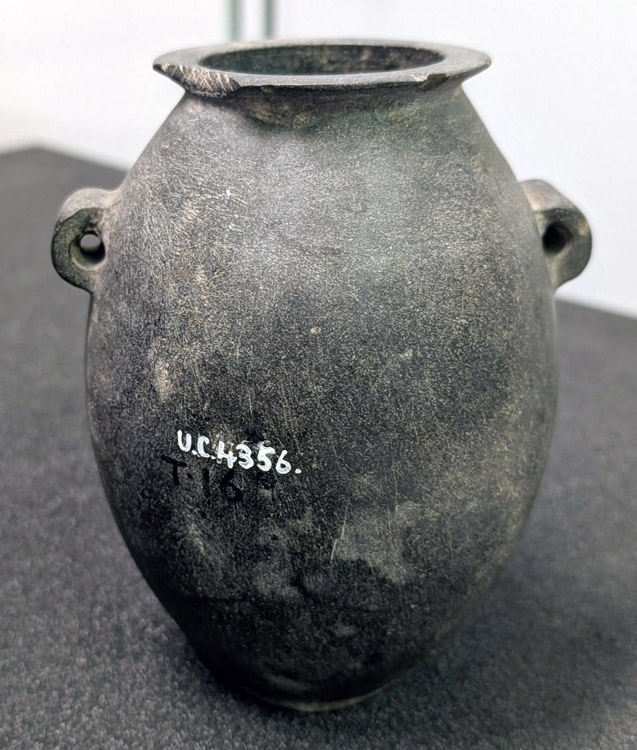
Basalt
Basalt was one of the most ancient and durable materials the Egyptians used in their stonework. Mohs hardness is 7. Mined in hazardous desert conditions near Cairo and Fayum, basalt was a rare material used and owned by the royalty in the Early Predynastic Period (Naqada I-IIA), EA 26655, 29923, and Naqada III Period (EA32634, British Museum).
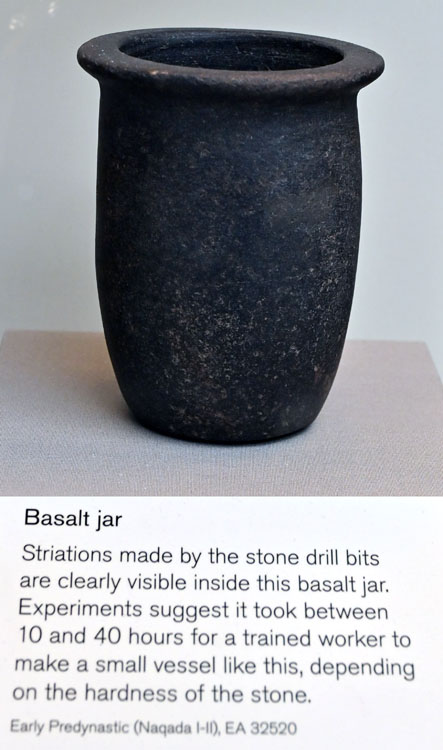
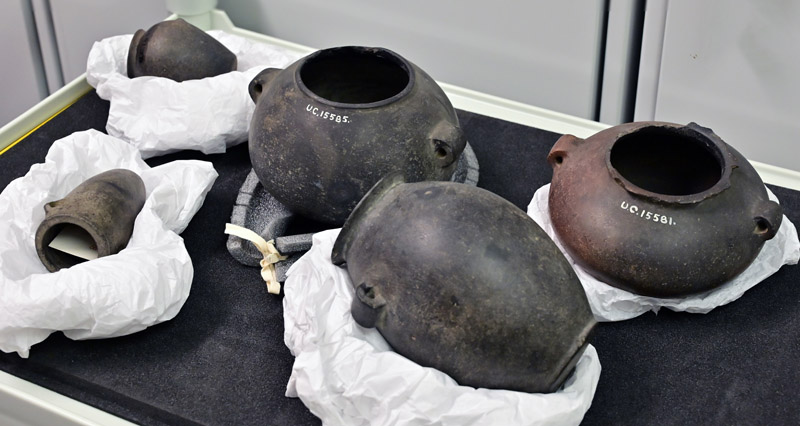
- Examples of Basalt barrel vases:
- UC4973 Naqada II, https://collections.ucl.ac.uk/Details/petrie/9083 Petrie Museum of Egyptian archeology
- from Naqada Tomb T 16 https://collections.ucl.ac.uk/Details/petrie/6564;
- From Naqada Tomb 259 https://collections.ucl.ac.uk/Details/petrie/6583
- Squat basalt vase with two cylindrical handles (Petrie type 3), UC15581, Naqada II https://collections.ucl.ac.uk/Details/petrie/23543
Basalt cylinder vase with broad rim, tapering at base, Naqada II https://collections.ucl.ac.uk/Details/petrie/24115
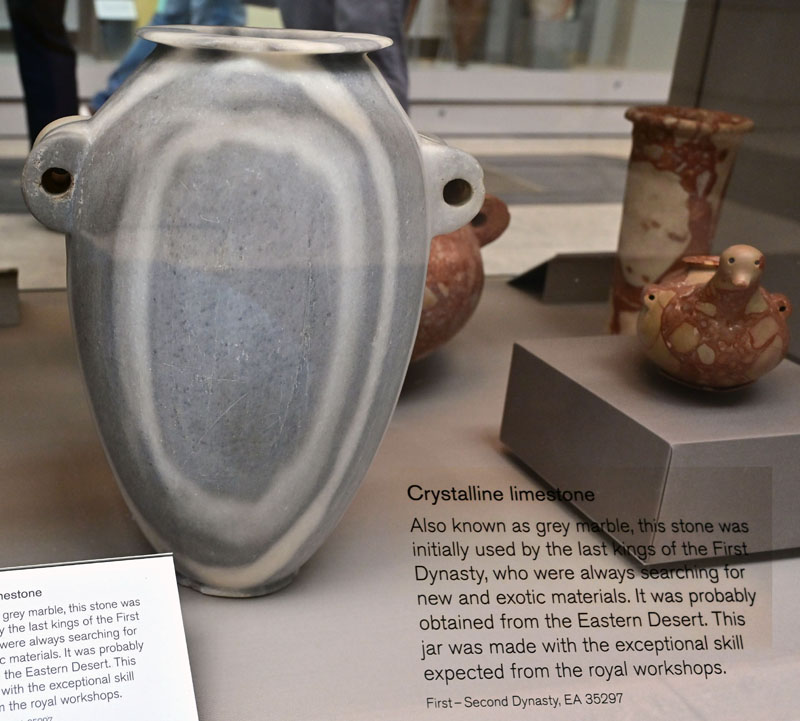
Limestone
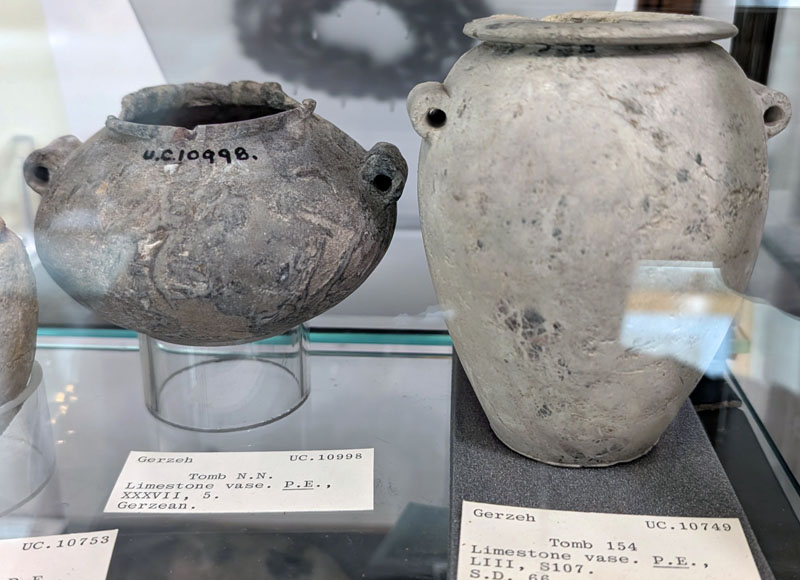
Composed of calcite, Limestone was an abundant material in ancient Egypt, but color varieties were rather rare. It’s a soft, easy-to-carve stone with a Mohs hardness of just 5-2.5. As a result, artists carved various objects out of limestone in the Predynastic period. This material was replaced with Travertine in dynastic Egypt.
Examples in the British Museum: the elephant jar, Nagada II, EA 53888, Naqada I-IIB, EA 53887, Nagada IIC-D, EA 32156, Naqada lIC-III, EA 26650, 21988
Breccia
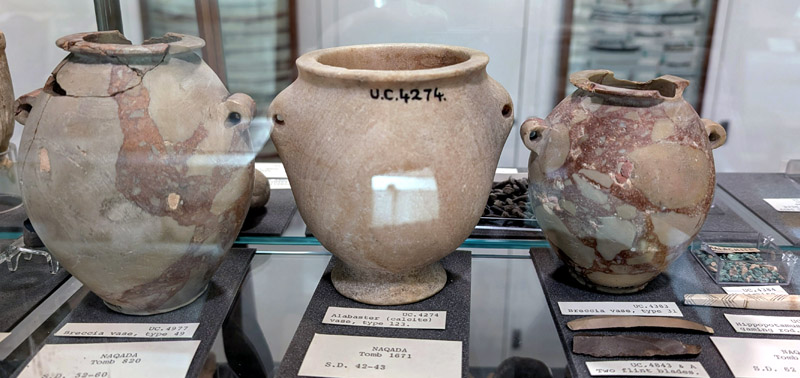
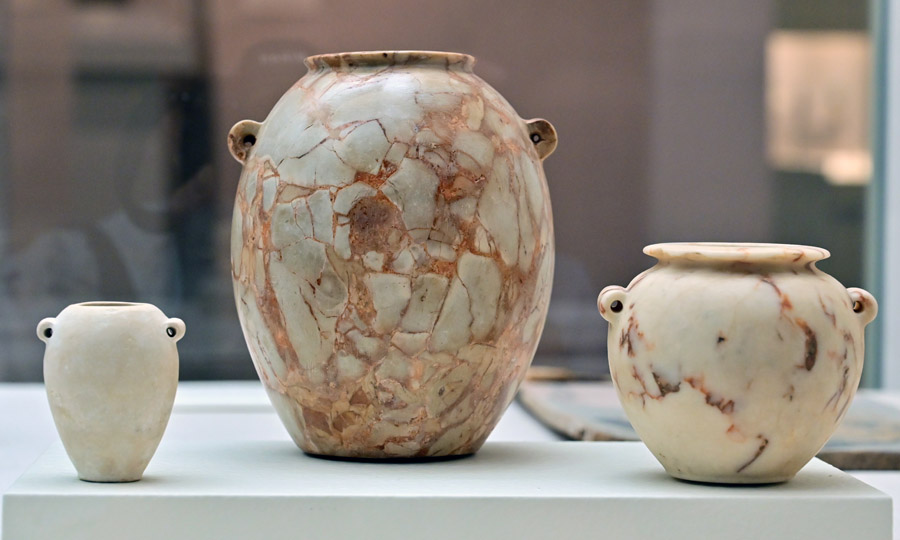
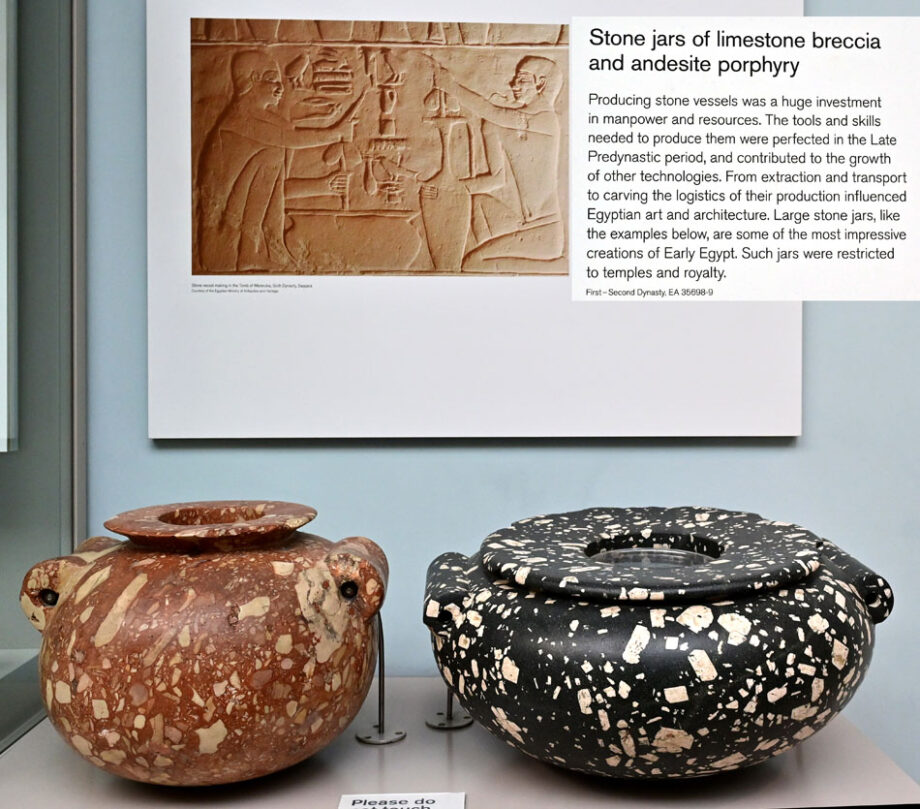
In Predynastic Egypt, breccia stone, especially limestone breccia, was used to craft vessels, particularly during the Naqada II period. Its hardness varies between 3.5-6 on the Mohs scale. Breccia, a multicolored rock composed of fragments of different minerals or rocks cemented together, was used for various objects, including cosmetic containers and offering vessels. These stone vessels were found in Gebel Matma, Gebel Mudilla, Wadi Rokham, Tahta, Issawia, Abydos, Gebel Abu Had, Gebel el-Serei, Gebel Aras, Wadi Ain. Examples of breccia vases include the white-red limestone vases in the British Museum and the Petrie Museum.
Milky quartz
Milky quartz is a hard stone that was highly valued among the royalty. It’s a hard stone (Mohs hardness is 7). Mined near Aswan, it was carved in the Early Dynastic period. Also, milky quartz was mainly used in small ritual vessels and inlaid eyes for statues, Early Dynastic, EA 64357
Andesite porphyry
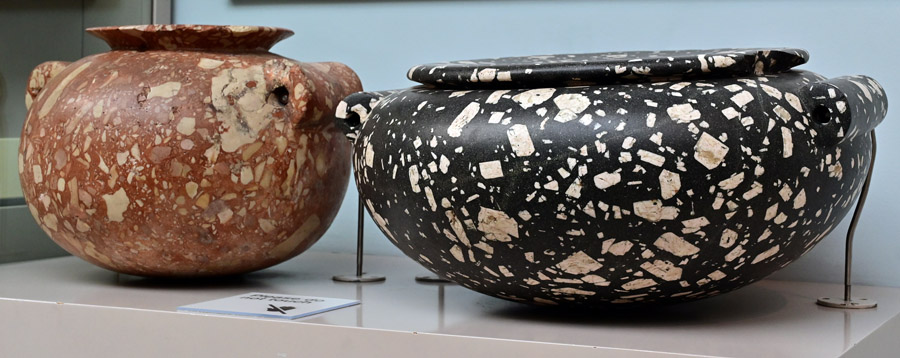
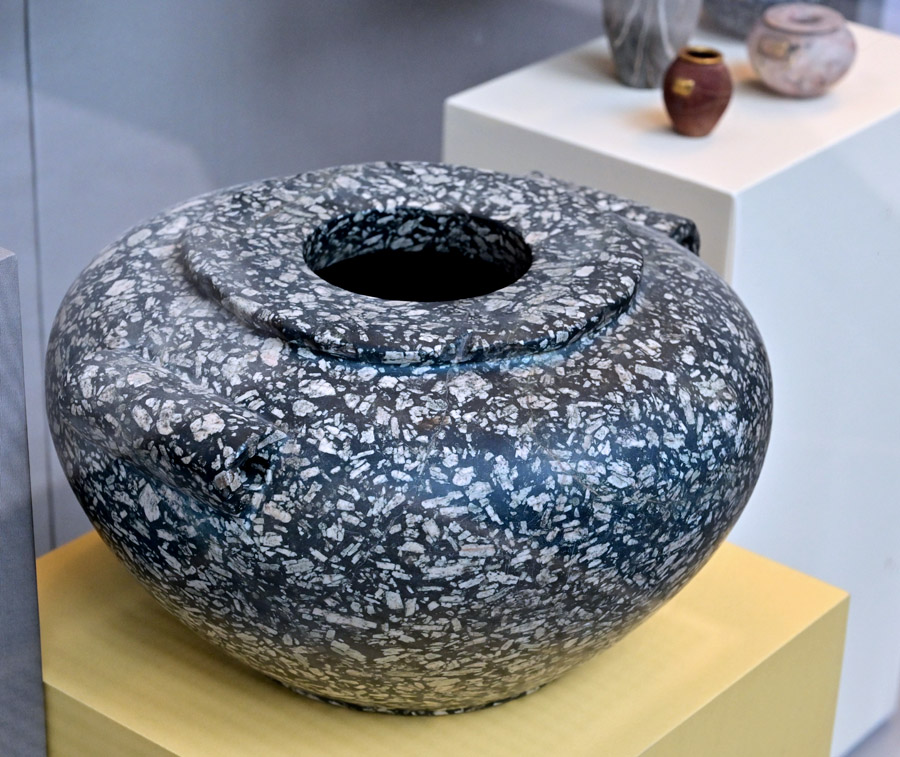
Andesite porphyry is a dark, volcanic stone with a beautiful texture of large white crystals and a Mohs hardness of 7. Mined from the Red Sea Hills, it was used to make jars during the Predynastic and Early Dynastic periods.
- Examples: Naqada IIC-First Dynasty, EA 35298, 35304, and Early Dynastic, EA 29572, the British Museum
- Jar, E1326, Egyptian First Dynasty, 3000-2625 BCE, Andesite Porphyry, from Naqada Cem. A or Ballas Cem. C – GR608, Penn Museum, https://www.penn.museum/collections/object/251207
Serpentine
Serpentinite is a green stone with dark veins that was mined in the Eastern Desert to create vessels in several periods. It varies in hardness between 3 and 6 on the Mohs scale.
Example: animal, Naqada II, EA 36355, and Naqada IIC-III, EA 35075
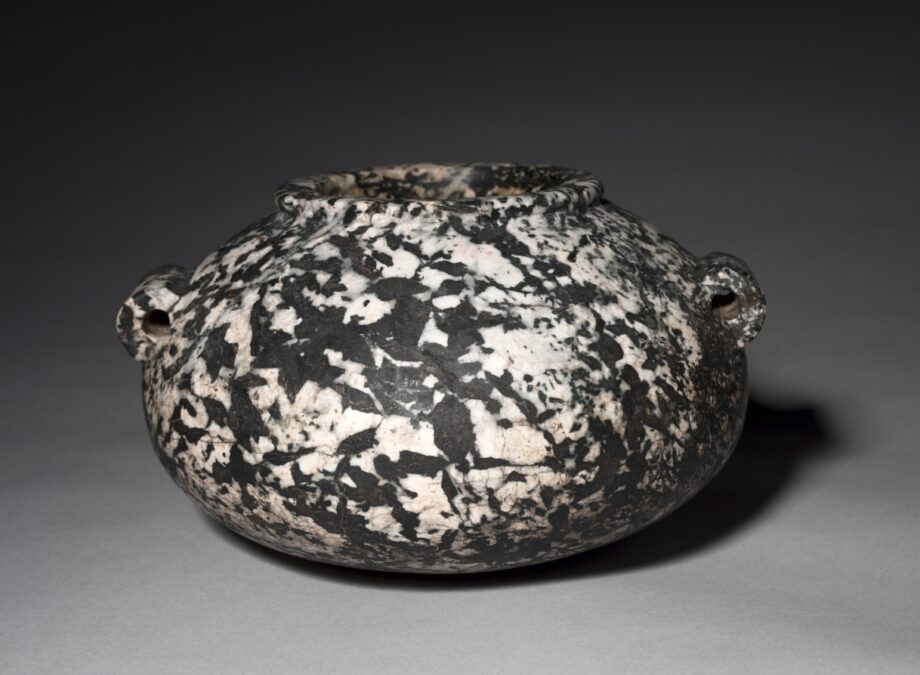
Pegmatitic diorite
Pegmatitic diorite is a hard stone that was quarried in the desert along the route to the Red Sea until the rise of the Old Kingdom. Pegmatitic diorite has many varieties of molten stone with 6-7 Mohs hardness. Egyptians abandoned the use of this material because of transportation difficulties, but this beautiful stone was rediscovered by the Romans for sculpture.
Examples: Badarian-Naqada I, EA 29306, Naqada II-III, EA 32636, 4732 The British Museum
Tuff
Tuff is a green, volcanic ash composite mined at Gebel Manzal el Seyl in the Eastern Desert. Mohs hardness is 4-6. Egyptians pre-cut the vessels next to the mines and shipped them to the Nile Valley for final carving. It was used only during the First and Second Dynasties. Example: EA 29932
Dolomite
Dolomite is a fine-grained, soft white stone with thin dark veins. Mohs hardness is 3.5-4. Mined in the Eastern desert, the stone was a popular material during the first two dynasties.
Example: a tall jar with a rim added separately, a common practice at that time. Second Dynasty, EA 59061, 3635, British Museum
Alabaster
Alabaster is the softest stone. Fine-grained, translucent form of gypsum or calcite, its Mohs hardness is 1.5-2. Soft to carve, alabaster could be gypsum alabaster and calcite alabaster (looking similar to marble visually).
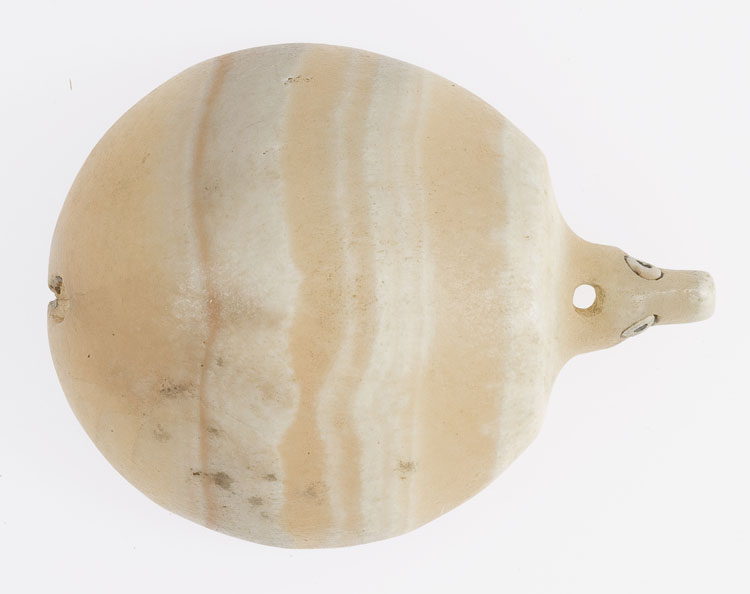
Vase, E4878, tall ovoid footed jar with lug handles, Type 12, Naqada I-II,from Hierakonpolis, Penn museum, https://www.penn.museum/collections/object/116206 .
Rose Granite. Mohs hardness is 7.
Foil & Leaf Gilding of Stone Vessels in Predynastic Egypt
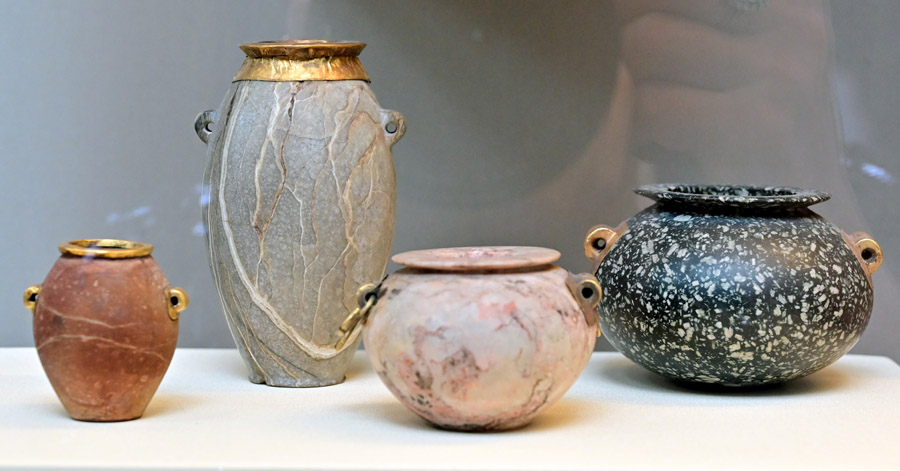
Some predynastic stone vessels were gilded with gold (handles and necks). To learn about this practice, I came across a 2011 study. Below is a summary of the paper available for download on the ResearchGate website “Foil and Leaf Gilding on Cultural Artifacts: Forming and Adhesion” by E. Darque-Ceretti, E. Felder, and M. Aucouturier, published in Revista Matéria (2011, Vol. 16, No. 1, pp. 540–559).
The paper explores the historical development of gold foil and leaf gilding techniques across several cultures and periods, emphasizing the mechanical forming of gold and the adhesion methods used to apply it to substrates, like metal, stone, ceramic, wood, and cartonnage. It discusses the evolution of gold thinning, from thick foils to ultra-thin leaves, and examines adhesion mechanisms through laboratory studies of museum artifacts. Non-destructive and destructive analytical methods (e.g., SEM-EDS, XRF, Rutherford backscattering spectrometry) are used to characterize gilding composition, thickness, and adhesion. The paper mentions a need for improving the understanding of adhesion mechanisms to enhance conservation efforts.
Image example: Stone vase with foil-gilded handles, Naqada, South Egypt, 4000-3100 BC, Louvre museum, and art from an ancient Egyptian tomb at Saqqara (2500B.C.) showing the melting and beating of gold.
Gold Thinning Technique:
- Gilding began with thick gold foils (several micrometers thick) mechanically fastened to substrates in early civilizations, including ancient Egypt (ca. 4000 BCE onward). By the second millennium BCE, goldsmiths developed techniques to produce thinner foils and leaves (down to 0.1–1 µm) through hammering and beating, leveraging gold’s exceptional ductility.
- By the 18th Dynasty (ca. 1550–1300 BCE), Egyptian goldbeaters achieved leaf thicknesses as thin as 0.2 µm, a feat not significantly surpassed until modern times.
- Mechanical modeling in the paper explains how gold’s malleability allows such thin leaves, with ancient Egyptian techniques refined through generations of artisanal expertise.
Adhesion Techniques:
- Pliny the Elder (ancient Greek writer and traveler) wrote down a gold foil gilding technique on metal with mercury in his 1st century AD Encyclopedia, known today as cold mercury gilding. The amalgam gilding is a different and most popular technique between 1st-19th centuries, where gold powder or gold pieces are mixed into liquid mercury to make a compound that gets applied on the metal surface and heated to 400° C to evaporate the mercury. (p.542)
- Early gilding relied on mechanical fastening (e.g., burnishing foil edges into grooves or wrapping around objects). Later, adhesives like animal or vegetable glues were used, particularly for leaf gilding on non-metallic substrates.
- Surface preparation varied by substrate: “white preparation” (a chalk or gypsum-based ground) was common in ancient Egypt for wood and cartonnage, while “oil gilding” (using resinous adhesives) appeared in later periods. High-temperature firing was used for glass gilding in medieval Syria but not in early Egypt. Adhesion strength depended on substrate type and preparation.
Gilding in Naqada Periods (ca. 4000–3100 BCE)
The paper references a stone vase with foil-gilded handles from South Egypt, dated to the Naqada period (ca. 4000–3100 BCE), exhibited at the Louvre Museum. This artifact demonstrates early use of gold foil gilding in Egypt, applied to stone substrates. Gilding during this period involved thick foils (likely >10 µm), mechanically fastened without chemical bonding, as thinner leaves required advanced purification techniques not yet developed. The foil was probably burnished or hammered into place, with possible use of a “white preparation” (chalk or gypsum layer) to enhance adhesion on stone. No evidence of adhesives like animal glue is confirmed for Naqada gilding, suggesting mechanical attachment (e.g., wrapping or pressing foil into grooves) was predominant. Gilding in the Naqada period was likely reserved for elite artifacts, such as vases used in burials or rituals, symbolizing wealth and status.
The art of the tomb at Saqqara (ca. 2500 BCE) depicts gold melting and a worker beating gold with a round stone, possibly a dolerite pounder, to form foils. This suggests that by the Early Dynastic period, goldbeating was an established craft, likely rooted in Dynasty 1 practices. Mechanical fastening remained the primary adhesion method, with no evidence of advanced adhesives or mercury-based gilding (introduced later, ca. 4th century BCE in China). By the New Kingdom, gold leaf became much thinner in applications with either adhesives or burnishing. Researchers noted that it’s difficult to detect organic adhesives (animal glue) in early artifacts.
First Dynasty stones & vessels:
Although this period is out of the scope of this article, I still want to include this information as a quick reference guide to compare the vessels and materials. Some materials overlap the periods, thus making it impossible to create completely separate categories. Precious materials were reserved for the elite and royalty, while softer stones had much higher demand among the less fortunate.
The stones and materials used during the first dynasties:
1. Greywacke: Mined in the Wadi Hammamat of the Eastern Desert, this grey stone became a popular material to make cosmetic palettes in Egypt that started in the Badarian (Naqada I) period. Mohs hardness of greywacke is 6-7. The stone may have symbolized fertility and was fairly easy to carve into a basic animal or fish shape.
Examples in the British Museum: Saqqara 3506, First Dynasty, EA 68229; First-Second Dynasty, EA 32237, 22734, 32180.
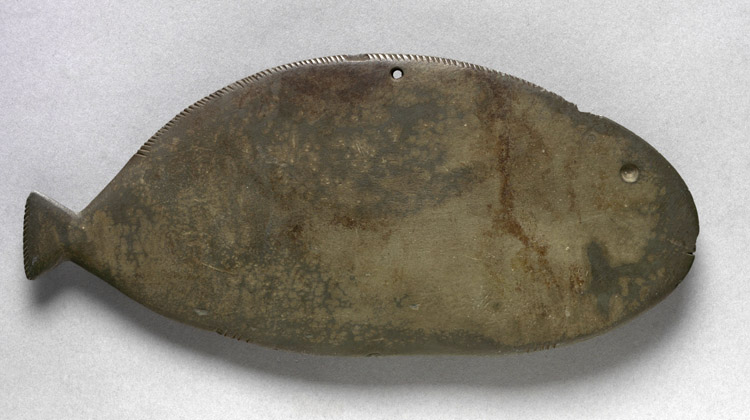
(3650–3000 BCE), Graywacke, Cleveland Museum of Art https://www.clevelandart.org/art/1989.32
2. Travertine: Travertine or Egyptian alabaster is a soft stone widely used from the Early Dynastic period into the Roman period. Mohs hardness is 4-5.
Examples: Saggara 3507, First Dynasty, EA 67151; Second-Third Dynasty, EA 4569; Late Predynastic-First Dynasty, EA 32160
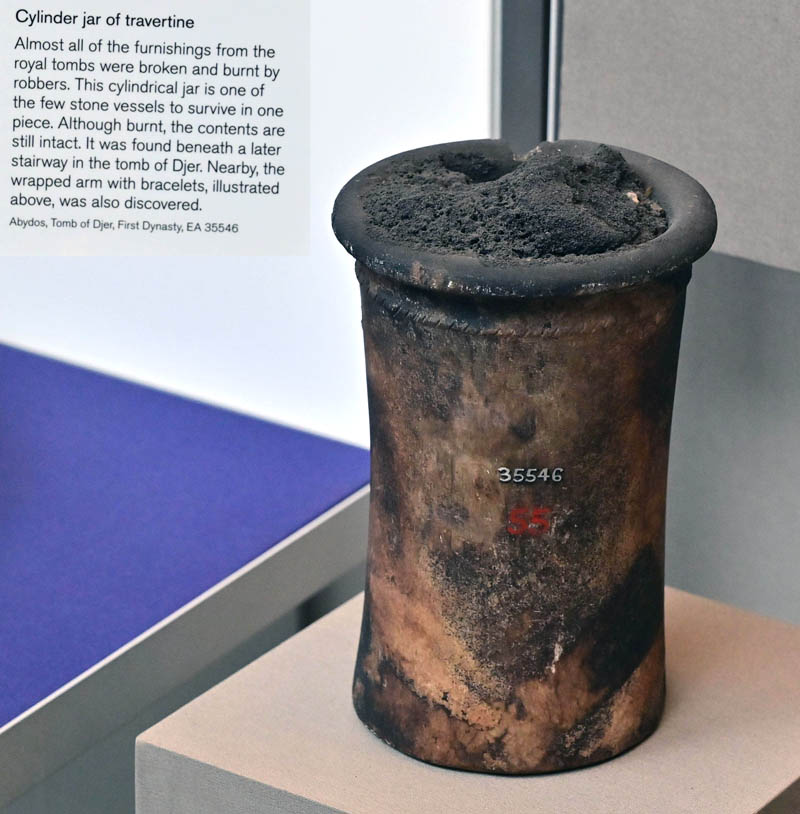
Because the royal tombs were often raided, broken into, and burned by robbers, most artifacts are gone. However, this cylindrical jar survived its fate, standing behind the glass in the museum. Found beneath a
stairway in the tomb of Djer, the wrapped arm with bracelets also survived the burn.
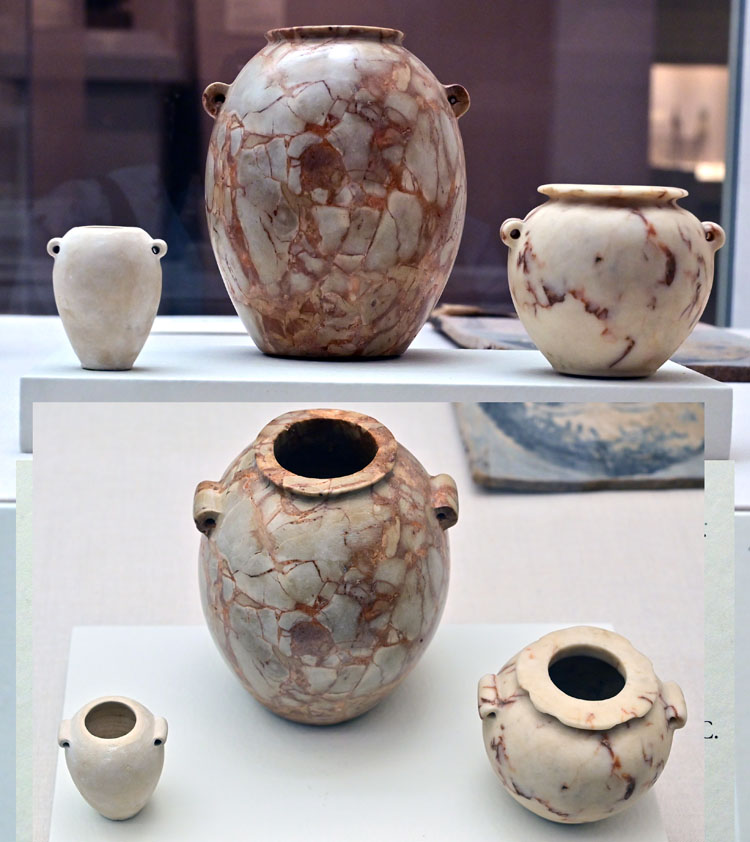
3. Anorthosite gneiss: This translucent but hard stone came from the Nubian Desert to Egypt and required transportation across the desert. Mohs hardness is 6-7. This stone is reminiscent of granite in texture with bright blue intrusions. At first, Egyptians carved small vessels from it, but later used the speckled stone for large royal statuary during the Old and Middle Kingdoms.
Example: Third Dynasty, EA 59029
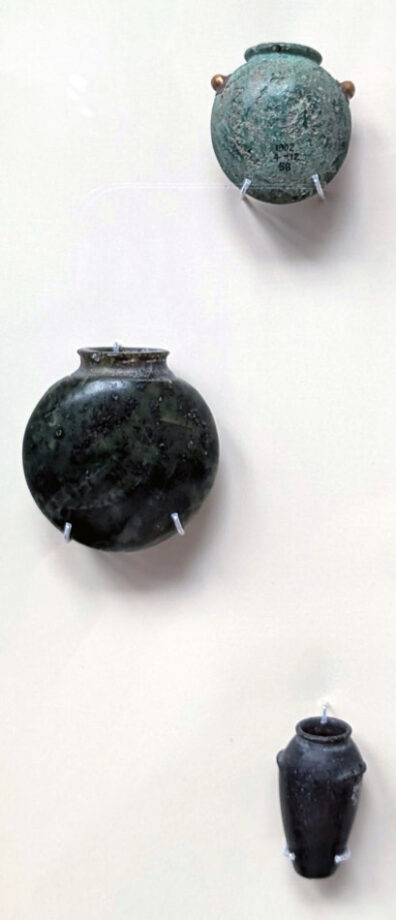
7. Amazonite jar, First Dynasty, EA 4711, the British Museum, green amazonite was among the most expensive stones, next to turquoise and lapis lazuli. Originally gold-leafed rim.
8. Miniature basalt jar, First Dynasty, EA 36336, the British Museum. This tiny jar was decorated with gold leaf.
Basic Stone Tools & Maceheads in Predynastic Egypt
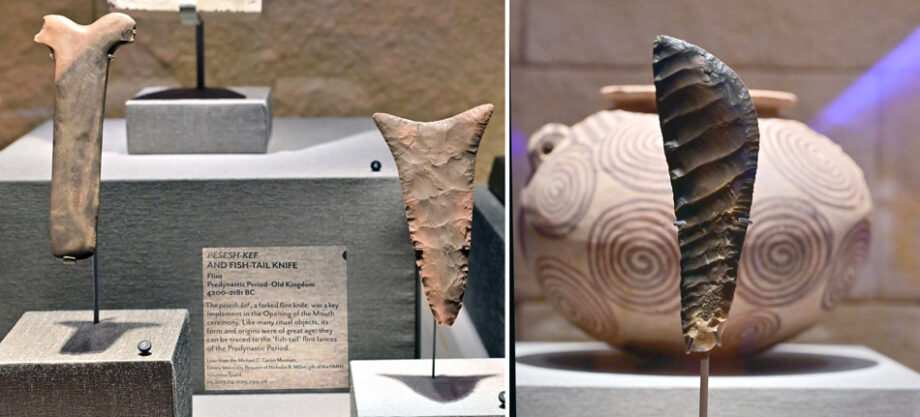
The pesesh-kef, a forked flint knife, was a key implement in the Opening of the Mouth ceremony. Like many ritual objects, its form and origins were of great age: they can be traced to the ‘fish-tail’ flint lances
of the Predynastic Period.
Flint Axes, sickle blades, and fishtail knives:
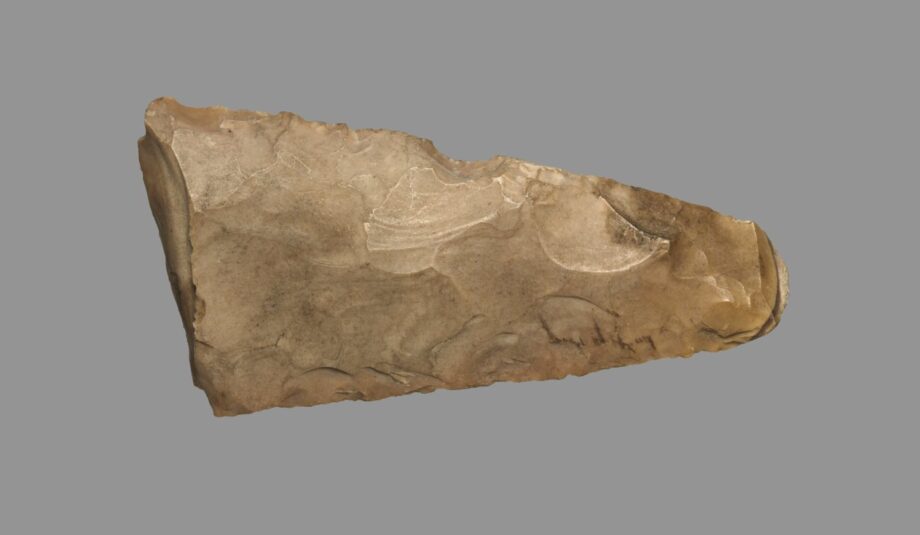
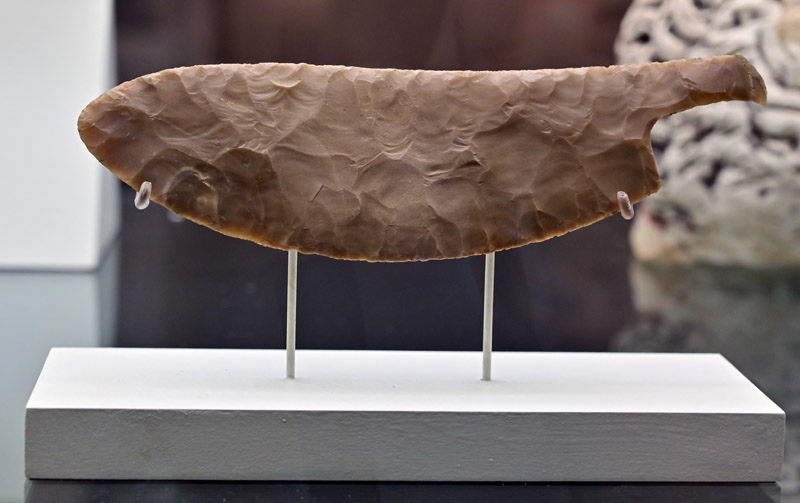
There were several types of common stone tools found in Naqada cultures used in farming, fishing, hunting, and ceremonial rituals. They were flint axes, sickle blades, fishtail knives, polishing stones, scrapers, blade knives, bifacial curved-back knives, and highly valued ceremonial ripple-flaked knives that had either ivory or gold handles on them. Hand-crafted to a high degree of polish, the hand axes were often made of basalt, granite, quartzite, schist, limestone, or chalcedony.
The Badarian craftsmen ( about 4500–3800 BC) made non-bifacial stone end-scrapers and perforators, like concave-base projectile points, denticulated sickles, triangles, and ovate axes. Black or dark grey, flint and chert were the sharpest, primary materials for tools during the Naqada periods. With a Mohs 7 hardness, they were often refined to a flint tool with denticulations to increase sharpness. Flint was mined in several locations in ancient Egypt, including the Thebes West, Wadi el-Sheikh, and Wadi Sojoor.
Copper tools:
The Amratian culture used the grinding stones with sand, or flint tools to perforate the basalt stone vase lugs around 4000-3600 BC. The Gerzean culture (3600-3200 BC, Naqada II) began to use copper chisels, axes, and so on. So, stone working with copper tubular drills became common by the Naqada III period and could be used in drilling holes in vase lugs or maceheads. However, for practical reasons, a soft stone, Calcite, replaced hard stones like basalt and diorite for the manufacture of stone vessels in the late Old Kingdom and beyond.
Copper: Metal tools, mainly copper beads and small objects, began appearing in Egypt during the second half of the fourth millennium BCE. Badarian craftsmen had already made copper beads before Naqada I and continued using copper for pins, drills, and punches into this period. So, copper tools expanded to include tools for craftsmen and jewelry within a few centuries. However, Egyptians began to cast bronze (an alloy of copper and tin) in the Middle Kingdom. Copper and arsenic were the primary metals used for tools and weapons for a significant period. Iron was introduced by the Hittites in the 13th century BC.
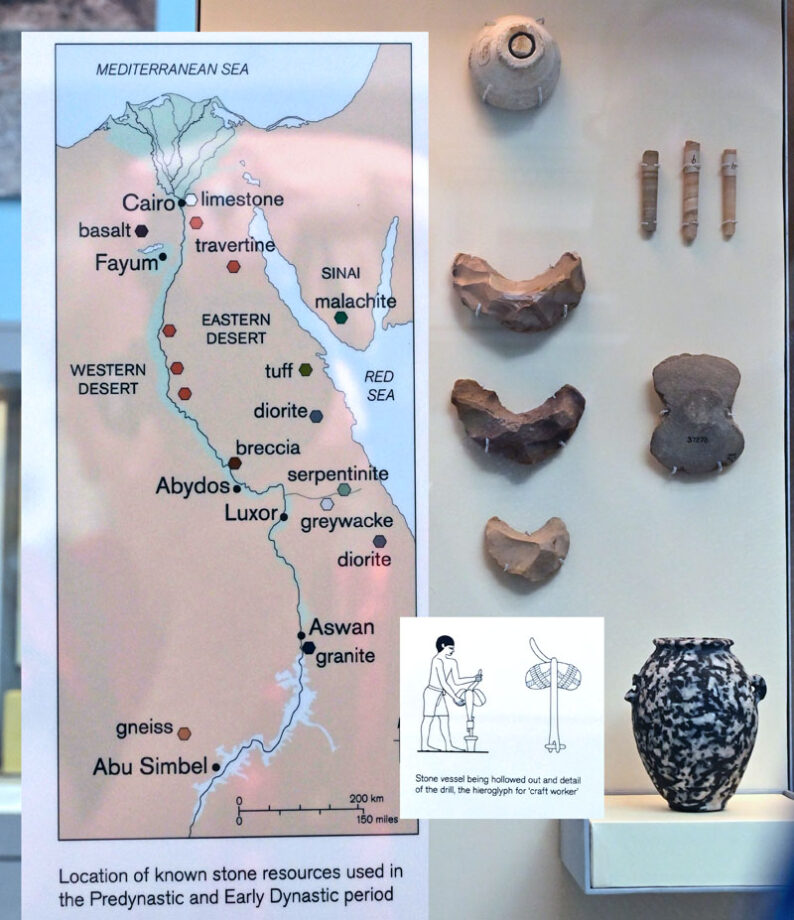
Armies of workers must have been needed to extract and transport the amount of stone used during the first two dynasties. Harder still was turning the stone block into a highly polished jar or bowl fit for a king. This job required special tools and training. In recognition of this skill, the drill for stone vessels became the hieroglyph for the word ‘craft worker’. This was composed of a stout wooden shaft, weighed down by stones held in nets. At the top was a crank for turning, at the bottom a fork for attaching specific drill bits for different tasks.
The drawing shows a worker with a tone vessel being hollowed out.
Shaping and drilling: First, a stone block was hammered and chiseled into a vessel shape. The interior
was then bored out. For this a hollow copper tube was attached to the drill. Using the crank to move the copper bit back and forth, a circular cutting was made in the center with the aid of abrasive sand. EA 68940
Drill cores: The cylinder of stone created by the copper drill was then snapped off, leaving a hollow space in the vessel’s center. The cylinders of stone are called drill cores. EA 37258, 68943-4
Flint drill bits: To widen the interior space stone drill bits were attached to the drill. Rotary action with crescent drills of flint was used to hollow out soft stones like travertine. Beit Khallaf, Third Dynasty, EA 67626-7 Abydos, First Dynasty, EA 37266
Figure-of-eight drill bit: Figure-of-eight drill bits of quartzite were used for harder stones. Drilling
with these bits left tell-tale grooves on the vessel walls and on the drill itself. Inhaling the fine dust produced during this process was hazardous. Abydos, Osiris Temple, First Dynasty, EA 37278
Unfinished andesite porphyry jar: Once hollowed out, vessels were polished with stone rubbers and fine sand. This jar shows the rough appearance prior to smoothing. It was probably left unfinished when the handle broke. Middle-Late Predynastic (Naqada II-III), EA 26964
Travertine jar made in two parts: To hollow out jars with small mouths and wide shoulders it was easier to make them in two parts. After initial shaping the stone was sawn in half and then drilled. The two
pieces were later glued together. Second-Third Dynasty, EA 36353
Stone borers & sand:
Mainstream archaeology, as detailed by Denys A. Stocks (Experiments in Egyptian Archaeology, p. 143), states that during the Badarian and Naqada I periods (ca. 4400–3500 BCE), artisans hollowed hard-stone vessels, such as those made from basalt, using hand-held stone borers with sand abrasive. Archaeological evidence supports this notion because dark, basalt vessels were found in Badarian and Naqada I burials. Examples of such stone vessels include a syenite vessel with drilled lugs from Hierakonpolis (displayed at the Manchester Museum), and some basalt vessels (displayed in the Petrie Museum), which appear in Naqada II–III burials (ca. 3500–3100 BCE).
Too hard to make?
My view on this, Naqada I–III Egyptians may have manufactured these hard-stone vessels as imitations of a much older culture. They used hand-held stone borers primarily for working softer stones, such as calcite (Egyptian alabaster), and probably made imitations of these uniquely-shaped, hard-stone vessels from earlier culture. The softer-stone replicas, possibly inspired by earlier or externally sourced hard-stone originals, have been produced in greater quantities during later dynasties, reflecting a shift toward more accessible materials while maintaining the aesthetic and functional forms of the originals. Egyptians already made such imitations via cylinder seals, miniature vases, and black fired pottery seen in the Petrie Museum, among others.
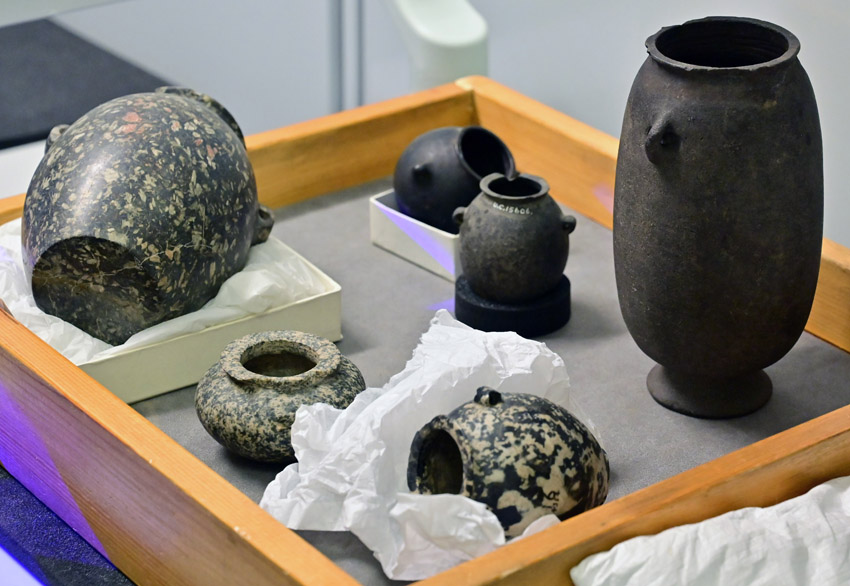
In my opinion, the shapes of basalt and granite vessels don’t look functional visually to carry food, drink, or ointments compared to mass-produced pottery. Basalt jars often feature awkward, lug handles or a somewhat crooked foot that don’t seem to have a visual, devotional, or utilitarian purpose. In fact, the foot of some stone vessels is so crooked at times that the stone jar can’t stand on it. The foot looks like a byproduct- it must have been a holder for the vessel during manufacture to be cut off later, just like in pottery. Yet, some stone vessels kept their foot. Perhaps, they were abandoned at a final stage of production.

The basalt vessels are heavy. They are super hard to carve into a particular shape with ancient tools. Some basalt jars have no handles and feature flat rims that differ from other pottery pieces produced in Naqada culture. It’s difficult to say if these particular shapes of pots were used in stonework first and pottery later, or if it was done in reverse. Also, the stone vessels have varied wall thickness and weight, which suggests unfinished work, handmade quality, and limited production standards. The time to manufacture one stone vessel would be enormous in comparison to pottery-making. Finally, both basalt and diorite stones are not aesthetically pleasing materials to use for ritual objects, in my opinion.
“Extensive tests of diorite, dolerite, silicified, or crystalline, limestone tools, and of flint and chert chisels and punches show that only flint tools can truly cut into all igneous stones, particularly the coarse-grained variety, such as rose granite.” (p.86, Denys A. Stocks’ Experiments in Egyptian Archaeology: Stoneworking Technology in Ancient Egypt, 2022, Routledge). The author suggests that the granite was cut at 15 cm3/hour rate.
Tools or rituals?
While elite-sponsored, full-time specialization emerged later in the Predynastic period, earlier production included part-time specialists creating tools for both ritual and utilitarian purposes across social classes in Naqada, Egypt. Early fishtail knives, axes, large-blade knives, and microend scrapers were mass-produced as tools. For example, people ate bread and drank beer daily, so many knife types were used in agriculture, like the sickle blades to reap grain. The fishtail knives were used in childbirth delivery and ceremonies, and flint axes were the most abundant tools by far found in predynastic Egypt. They were found in early temples, tombs, regular houses, storage areas, and trash middens.
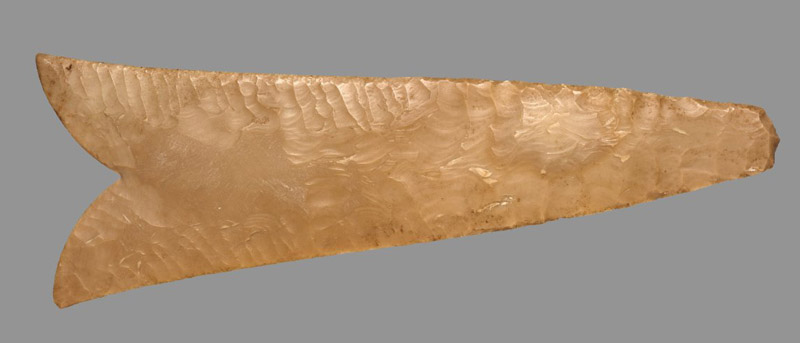
Rotationally symmetric objects of Naqada culture were Mace heads, cylinder seals, beads, and spindle whorls. Mace heads, cylinder seals, and beads seemed to have dual function: ritual and utilitarian, but the spindle whorls were tools used in textile production during the Naqada I and II periods (3800-3300 BCE). These are artifacts used in the process of spinning fibers into yarn. They are typically made from limestone or pottery, and their primary function was to help twist fibers into thread.
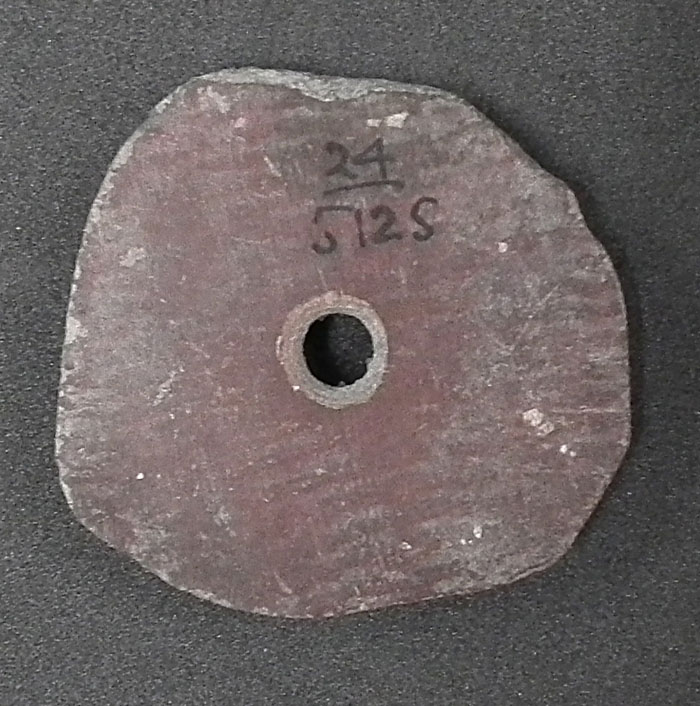
Perforated disk or spindle whorl made from a fragment of Black-top red pot with a rippled and red burnished exterior, and a black polished interior. The edges are roughly chipped and smoothed; the boring is central. https://www.britishmuseum.org/collection/object/Y_EA59665)
Another example is Spindle Whorl, ca. 3800–3300 B.C.E.. Limestone, 1 3/16 x Diam. 1 3/4 in. (3 x 4.4 cm). Brooklyn Museum, Charles Edwin Wilbour Fund, 09.889.201.https://www.brooklynmuseum.org/objects/20630
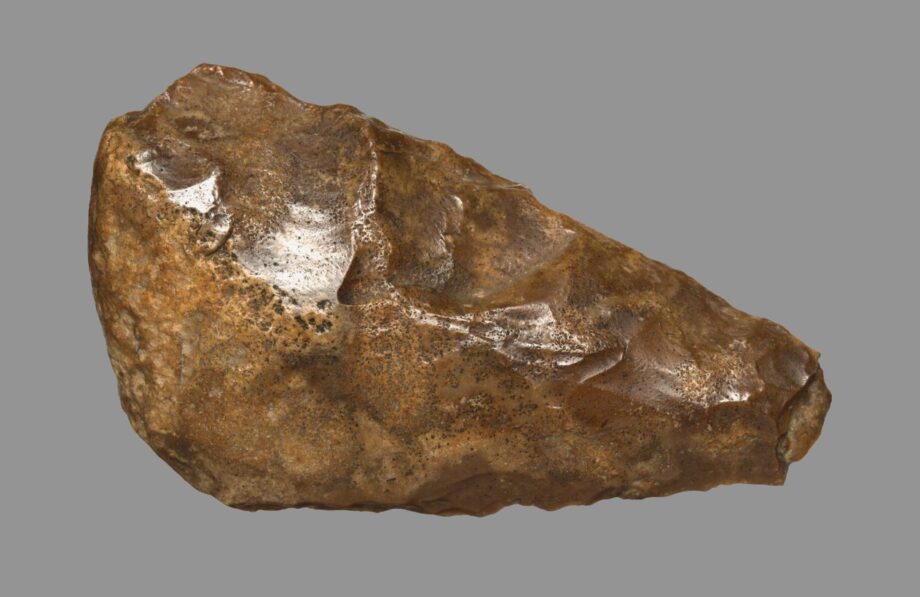
The excavations in the Thebes area preserved little evidence of the Naqada culture, with some finds, like ceramics, pottery, stone vessels, and flints. However, the Thebes region revealed the concentration of eight flint workshops and five Neolithic ones located next to the flint mines in the Theban mountain area at Deir el-Bahari and in the Valley of the Kings. The excavated Wadi G area contained huts with pottery of Type D, B, W. (Sherif Abd el-Monaem, Hanan Mahmoud, The Naqada period in Thebes, p.566).
In her dissertation, Elizabeth Hart Skarzynski Lansing lists all the tool classes and tool types of the Naqada culture, mainly burins (A burin with several divisions is a tool with a scar from a flake removed parallel to a flake margin, rather than off of the face of the tool. The scar meets with the dorsal and ventral surfaces of a flake at ~ 90 degree angles, leaving a very sturdy working edge. Burins are a very common type of Predynastic tools), notches & denticulates, scrapers, truncations, perforators, knives, planes, worked nodules, bifacial tools (drills ,varia, daggers, fishtails, Bifacial sickle, bifacial knives, and axes). (p.401-434, “Beyond Prestige: A ritual production model for stone tool specialization in Naqada period Egypt,” Elizabeth Hart Skarzynski Lansing, MIM.A. University of Virginia, 2010B.A. University of Michigan, 2004)
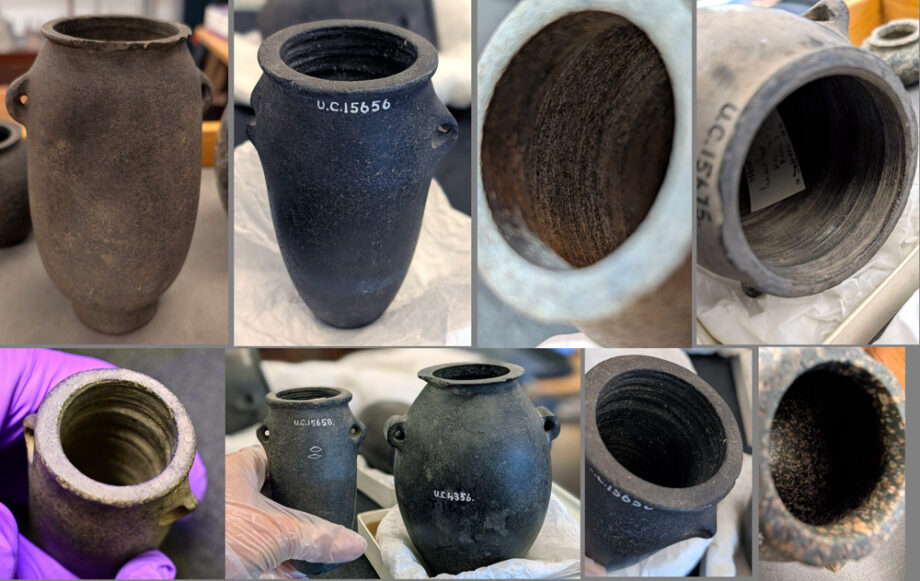
An experimental research about ancient Egyptian Stone-Drilling was first completed and published at Penn Museum in 1983. Many predynastic stone vessels have concentric circles inside. Petrie made a hypothesis that ancient Egyptians did granite cutting by using a tubular drill that produced these circles. The researchers, Leonard Gorelick and A. John Gwinnett experimented with several materials, doing stone drilling, and concluded that:
- 1. Loose, dry abrasives (except diamond) did not produce concentric lines.
- 2. Fixed abrasives or those in a watery slurry or a lubricant such as olive oil produced concentric cutting lines
- 3. Corundum and diamond cannot be ruled out as not having been used to drill granite.
- 4. Each type of stone will have to be dealt with separately in future research.
Although this research points to the use of tools and abrasives, it doesn’t comment on the precision or quality of manufactured stone vessels using these tools and methods. Therefore, the book referenced below demystifies some of the tools and techniques used in ancient Egypt.
Tools and Techniques for Stone Vessel Production in the Naqada period based on Denys A. Stocks’ Experiments
This summary focuses on how artisans in the Naqada period used their tools to create stone vessels and the results they achieved, as detailed in Denys A. Stocks’ Experiments in Egyptian Archaeology: Stoneworking Technology in Ancient Egypt (2022, Routledge).
In his book, Danys A. Stocks shows both replicas and images of copper and wood tools used in ancient Egypt. They include a bow and wood drill, adze blade, copper adze, copper chisels, and a mallet used in the predynastic Egypt, but if you’re curious about his experiments with many other tools ancient Egyptians employed to create stonework, like copper saws, hard-stone mauls (quartzite maul or sledge-hammer or stone/dolerite pounder), or flat-edged saws, steel scrapers and many more from old to new kingdom dynasties, he put them to the test in his book.
Copper Tubular Drills:
- Use: During the Naqada II period (ca. 3500–3200 BCE), the main tech tool was the copper tubular drills, which replaced earlier reed tubes used in the Neolithic period. These drills were force-fitted onto wooden shafts and used with dry quartz sand as an abrasive to hollow out stone vessels. The copper tubes, typically 1–5 mm thick, were cast in sand molds and ranged in diameter to suit various vessel sizes.
- Operation: The drills were driven by a twist/reverse twist drilling device (TRTD), which involved a central shaft with a forked wooden component and stone weights (3 kg each) to apply pressure. The TRTD allowed for both clockwise and anticlockwise twisting to create tubular holes, enabling efficient removal of stone cores.
- Materials Worked: These drills were used on soft stones like calcite (Egyptian alabaster, Mohs 3) and harder stones such as syenite, granite, and diorite (Mohs 6–7). The use of dry sand abrasive was critical, as wet sand was found to be less effective, reducing cutting efficiency.
Stone Borers:
- Design and Use: Figure-of-eight-shaped stone borers, made from materials like chert or flint, were employed to widen the interiors of vessels after initial drilling. These borers were engaged in grooves scraped under the vessel’s shoulder, often using hook-shaped flint tools. The borers were mounted on forked wooden shafts and operated horizontally or vertically to expand the vessel’s interior.
- Application: This technique was particularly effective for oblate spheroidal vessels, such as the Naqada II syenite vessel from Hierakonpolis, which featured drilled lugs. The borers allowed artisans to shape complex interior profiles, accommodating vessels with narrow necks or wide mouths.
Flint and Chert Tools:
- Exterior Shaping: Flint and chert tools, including chisels, punches, and scrapers, were used to shape the exterior of stone vessels. These tools were knapped to create sharp edges and points, capable of working both soft and hard stones. For example, crescent-shaped flint borers were used to carve initial forms, as seen in artifacts from Hierakonpolis.
- Finishing: Sandstone rubbers (coarse and fine grades) were employed to smooth exterior surfaces, followed by polishing with leather laps and mud or fine sand/stone/copper powder mixtures to achieve a glossy finish.
Other Tools & Techniques:
- Bow-Driven Drills: The bow was used to rotate drills, enhancing efficiency. It was effective for smaller tubular drills used in bead-making and initial vessel drilling.
- Sand Abrasive: Dry quartz sand was the primary abrasive, embedding into the copper drill’s end-face to abrade stone. The resulting waste powder (sand/stone/copper) was later repurposed for faience core and glaze production, which was probably nearby to make blue beads and other faience.
The unfinished, handmade work on a stone vessel can be seen here: https://www.liverpoolmuseums.org.uk/artifact/jar-42
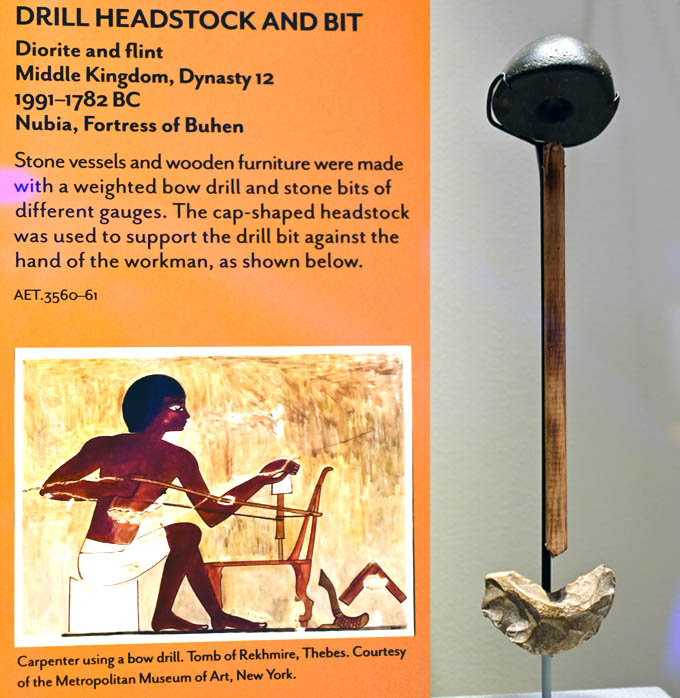
Nubia, Fortress of Buhen (left).
Stone vessels and wooden furniture were made with a weighted bow drill and stone bits of
different gauges. The cap-shaped headstock was used to support the drill bit against the
hand of the workman. Image (left): Carpenter using a bow drill. Tomb of Rekhmire, Thebes. Courtesy
of the Metropolitan Museum of Art, New York.
Image (right): stone drill of the Naqada period on display in Houston, TX.
Results of Tool Use:
“The tests proved that no copper, bronze, or leaded bronze tool, except for the tubes and the flat-edged saws with sand abrasive, could effectively cut stone other than red sandstone, soft limestone, gypsum, and steatite, and that all of the tools used for cutting woods of all hardness’s were practical for this purpose. Only stones of hardness Mohs 3 and below can effectively be cut with any copper, bronze,or leaded bronze edged tool. The tests with the modern steel chisel and punch indicate that Late Period craftworkers did not employ their softer iron chisels for cutting hieroglyphs and reliefs into granite, diorite, porphyry and other stones of similar hardness (Stocks, p.73-74)….Even calcite, a relatively ‘soft’ stone of hardness Mohs 3–4, cannot efficiently be cut with copper alloy tools (Stocks, p.78).
- Production scale: The introduction of copper tubular drills in Naqada II enabled the production of stone vessels. The TRTD’s efficiency in drilling and boring allowed for faster hollowing, reducing labor time compared to earlier flint-based (chert or flint tool) methods.
- Precision: The use of copper tubular drills produced parallel-sided cores and consistent tubular holes, as evidenced by experimental results where drilling rates for soft limestone were approximately 2.4–2.7 cm³/hour and for harder stones like syenite and granite, around 2.7 cm³/hour. This precision facilitated the creation of vessels with uniform interiors, such as the Hierakonpolis syenite vessel.
- Materials variety: Artisans successfully worked a range of stones, from soft calcite to hard igneous rocks, including oblate spheroidal shapes and those with drilled lugs.
- By-products: The drilling process generated significant quantities of sand/stone/copper powder, which was later used in faience production. This by-product, containing copper compounds, contributed to the development of blue and green glazes, an example of which you can see below under the “Amulets & Jewelry” section.
- The use of dry sand abrasive produced fine dust particles (0.5–5 microns), which posed health risks to artisans. Inhalation of these particles, combined with copper dust, likely contributed to respiratory issues, a consequence of the intensive drilling processes.
- Social Stratification: The scale of stone vessel production was supported by the emergence of elite-controlled workshops.
As you can see, in the Naqada period, particularly Naqada II, the adoption of copper tubular drills and stone borers, combined with flint tools and dry sand abrasives, modernized stone vessel production to an impressive degree.
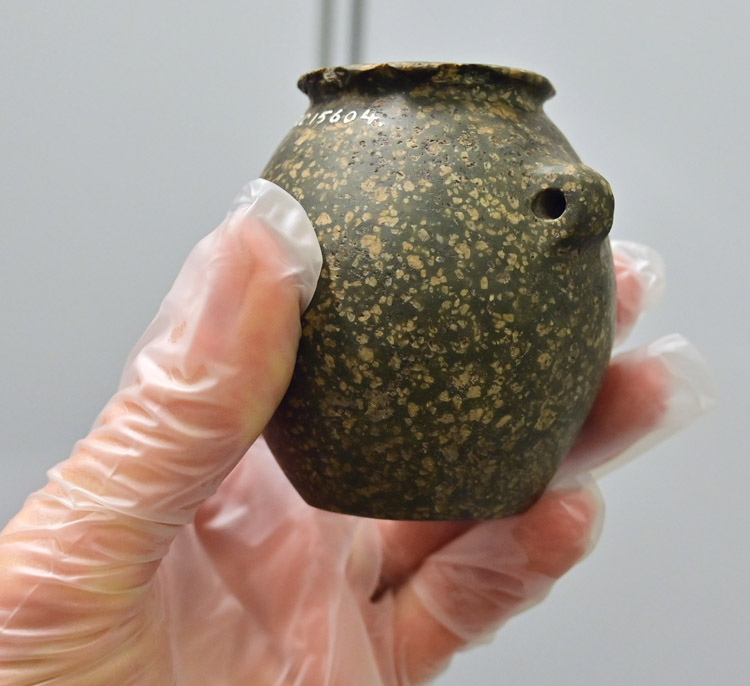
The Dolerite Pounders
According to mainstream archeology, dolerite pounders were hand-held stone tools used by ancient Egyptians, primarily for quarrying and shaping hard rocks like granite. These tools, found in large numbers at ancient quarries, were likely used to break, crush, and dress stone through blunt force impact. While some pounders were hafted with handles, many were used unhafted, held in the hand during use.
The article, Dolerite Pounders: Petrology, Sources and Use by Adel Kelany and James A. Harell et al. (2010) provides insights into the use of dolerite pounders in ancient Egyptian quarrying and stone dressing, with some relevance to the Naqada period (ca. 4000–3100 BCE). While the article primarily focuses on dolerite pounders used from the third to late first millennium BCE, it briefly references their use in Predynastic Egypt. The quarrying of hard stones was linked to elite-controlled workshops and regional exchange networks.
The dolerite pounders were used for quarrying and dressing hard rocks such as granite. These tools shaped stone used in elite objects like ceremonial palettes, vessels, and greywacke objects, as seen in production sites like Wadi Hammamat. The article notes that dolerite pounders were initially angular, compact, and irregular to sub-rectangular in form, not the spherical shapes often found in later quarry sites. This angular form was likely used during the Naqada period, becoming rounded through use and eventually discarded. The study refutes the idea that pounders were held during impact, suggesting instead that workmen released them just before striking the rock and caught them on the rebound. This technique, likely used in the Naqada period, minimized hand and wrist injuries while quarrying or dressing stone.
It seems to me a grueling work pounding these small stones against the hard surface of granite and alike to produce a reasonable result.
How flint tools became both utilitarian and non-functional in Upper Egypt
The document The Lithic tool economy in Upper Egypt in the Late Predynastic: The Naqada II proliferation of fine flint tools and its implications for socioeconomic complexity by Andrea Gover, published in 2016, examines the lithic tool industry in Upper Egypt during the Late Predynastic period, specifically Naqada II (c. 3600–3350 BCE), to explore how technological changes in flint tool production reflect increased socioeconomic complexity. It analyzes functional and non-functional flint tools at key sites—Naqada, Hierakonpolis, and Abydos—to understand their role in the gradual consolidation of the Egyptian state. The paper situates itself within debates on Egyptian state formation, emphasizing a multilinear, gradual process rather than a singular event. It draws on archaeological evidence from settlements, cemeteries, and temples to study flint tool typologies, following Kohler’s (2010) theory of state consolidation and Kemp’s (1989) identification of Abydos, Hierakonpolis, and Naqada as proto-states. The author distinguishes between functional tools (e.g., sickle blades, flint axes, blade knives) associated with agriculture and daily use, and non-functional tools (e.g., fishtail knives, ripple-flaked knives) linked to ritual, prestige, or elite contexts. The analysis relies on tool typology comparisons due to incomplete assemblages caused by early Egyptologists’ selective collection practices, which neglected debitage and common tools.
This paper touches on some key discoveries. Over the centuries, people refined their tools used in agriculture, like sickle blades and flint axes. Flint axes, identified as the most abundant tool at Naqada’s South Town, date to Naqada II (c. 3800 BCE), supporting agricultural reliance (Holmes 1990). A Naqada II innovation, Blade Knives, were refined versions of Naqada I bifacial curved-back knives, found in settlements and graves, suggesting both practical and prestige uses (Baumgartel 1960).
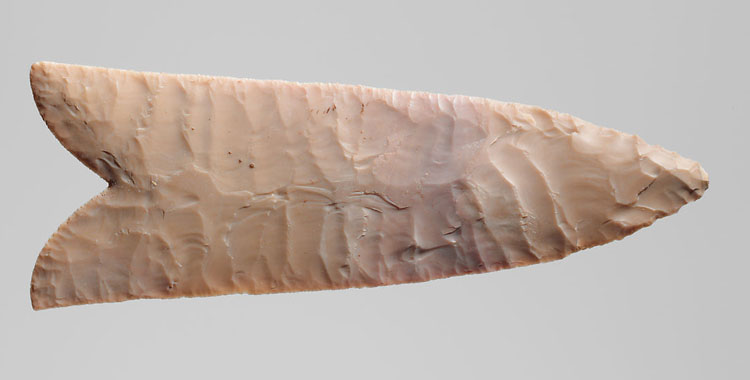
The evolution of pšš-kf Fishtail Knives from Naqada I to Naqada II shifted from functional use to ritual one. Their refined Naqada II form, with a deeper V-shape, may symbolize fertility and childbirth rituals (Roth 1992). Examples include a fishtail knife in Hierakonpolis’ Tomb 100 and HK43 burial 412, and another Fishtail Knife at the Met from Naqada II, 3650–3300 B.C. The V-shaped notch of the knife is the cutting edge used to cut the umbilical cord. It was also placed in the grave to assist the dead in their afterlife rebirth. A similar tool was used in ancient Egypt in the funerary ceremony titled the “Opening of the Mouth”https://www.metmuseum.org/art/collection/search/548235.
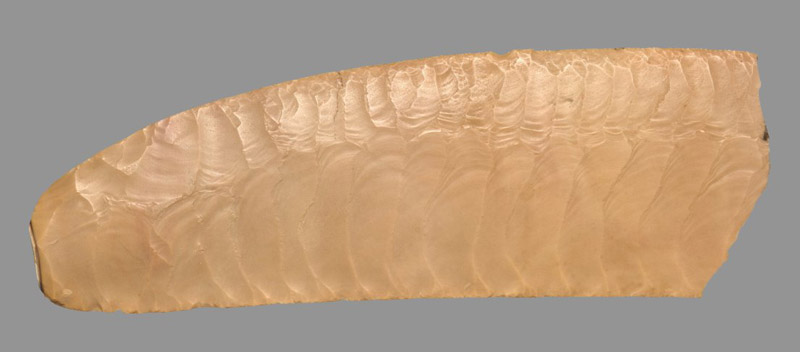
A Naqada II–III innovation, the ripple-flaked knives were high-quality, pressure-flaked knives made from caramel-colored chert are found exclusively in mortuary contexts, often with elite grave goods like ivory or gold handles (e.g., Gebel el-Arak knife). Their craftsmanship and exotic material suggest a specialized craft economy tied to elites (Holmes 1989). As a result, functional tools’ refinement prompted population growth, and non-functional tools’ manufacture indicates production control and regional trade of emerging elites in the country.
Stone tools as ritual objects?
The document Beyond Prestige: A Ritual Production Model for Stone Tool Specialization in Naqada Period Egypt by Elizabeth Hart, published in 2017, is a dissertation that examines the organization and development of specialized stone tool production in 4th-millennium BCE Egypt, specifically during the Naqada period (ca. 4000–3000 BCE). During this period, the tribes transitioned from small-scale pastoral and early agricultural societies to a centralized state with complex social, political, and economic structures. The study challenges the prevailing prestige-goods model, which states that specialized production primarily served elites by creating status-displaying goods, and proposes a ritual production model to explain the widespread use of certain symbolically significant stone tools among both elites and commoners. Hart argues that this model is insufficient because many specialized products, such as lithic blades and black-topped red ware ceramics, were widely distributed across social strata, not restricted to elites. This widespread use suggests that specialized production served purposes beyond elite status display. During the Naqada period, the ritual production model, inspired by Spielmann (2002), suggests that specialized production was driven by the need for ritual items used in community-wide ceremonies and life-cycle events, not exclusively for elite consumption. The study draws on archaeological data from settlement sites (el-Mahâsna, Abydos, and Nag el-Qarmila).
- el-Mahâsna: Excavations revealed patterns of elite activities focused on ritual and ceremony, possibly linked to an early cult structure. The site’s lithic assemblages included tools like fishtail knives and microend scrapers for rituals.
- Abydos: Known for its early temples and tombs, Abydos provided evidence of standardized lithic production, including fishtail knives and large-blade knives, found in both ritual and domestic contexts.
- Nag el-Qarmila: This site, mainly a storage area with some burials, contributed to understanding regional variations in tool production.
The study identifies specific tool types—fishtail knives, axes, large-blade knives, and microendscrapers—that fit the ritual production model. These tools were often made from materials chosen for their symbolic properties, such as the color of chert or flint, which held cultural significance traceable from the Predynastic to Pharaonic periods. For example:
- Fishtail Knives: Linked to rituals like the “Opening of the Mouth” ceremony, possibly used to cut umbilical cords, symbolizing birth and rebirth. Fishtail knife shapes varied over time (p.602). Their widespread distribution contradicts the prestige-goods model’s elite exclusivity.
- Axes and Large-Blade Knives: Found in ritual contexts like offering deposits and tombs, but also in domestic settings, suggesting broad societal use.
- Microendscrapers: Likely used in ritual or craft activities, with raw material choices reflecting symbolic rather than functional priorities.
Besides limestone, obsidian, quartzite, and sandstone, chert was the most numerous raw material type with many varieties (Elizabeth Hart, p.378).
Visual examples of tools:
I divide them into three main periods for easier access, although some of them have dates that could be placed in both periods.
Naqada I & earlier:
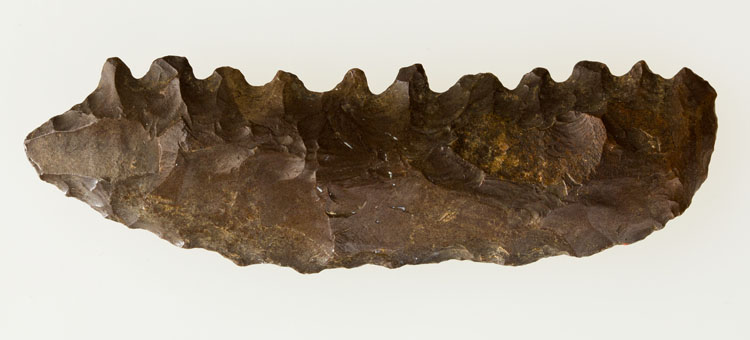
This small flint fragment played a vital role in ensuring a bountiful agricultural season in ancient Egypt. Grain, the cornerstone of the economy, was essential for producing daily staples like bread and beer, as well as serving as offerings for eternal sustenance in funerary practices. To harvest grain, ancient Egyptians crafted sickles by embedding flint inserts, like this one, into wooden handles. Multiple flint pieces were carefully shaped and secured with adhesive to form a sharp cutting edge for reaping grain stalks. Over time, use caused the flint to wear, developing a glossy sheen, but the inserts could be resharpened or replaced to maintain functionality.
Bifacial sickle inserts, such as this example, represent some of the earliest evidence of agriculture in Egypt, primarily produced during the 5th to 4th millennia BC. These robust, thick inserts were later succeeded by thinner blade-based sickle inserts with less extensive retouching. While these newer inserts were quicker to manufacture, they were less durable than the bifacial ones. This shift reflects broader changes in the production and distribution of flint tools, aligning with the emergence of the Egyptian state.
Flint remained the primary material for sickle production in Egypt until iron became prevalent in the 1st millennium BC, despite the availability of copper alloys. The preference for flint likely stemmed from its abundance, ease of shaping compared to metal casting, effectiveness in cutting grain, and the established social networks between flint toolmakers and farmers.
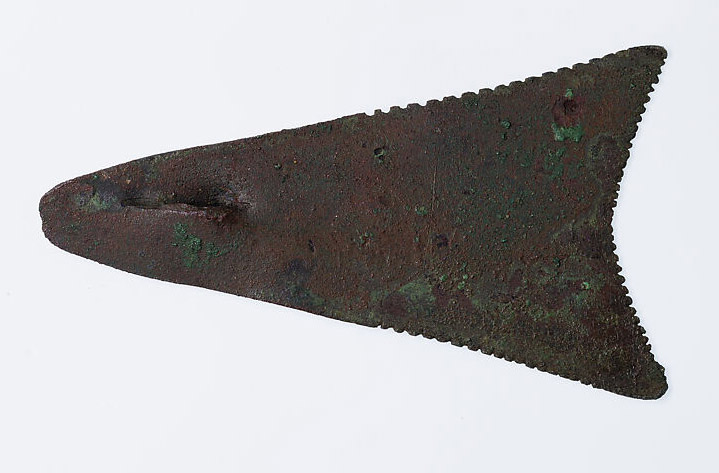
- Rhomboidal Knife, 4500–3500 BCE, Egypt, Predynastic (5000–2950 BCE), Naqada Ia–b, (3900–3500 BCE)
light brown flint, Overall: 4 cm (1 9/16 in.), the Cleveland Museum of Art, https://www.clevelandart.org/art/1914.672 - Fishtail Knife, 4500–4000 BCE, Egypt, Predynastic (5000–2950 BCE), Naqada Ia–IIa, (3900–3300 BCE)
dark brown to a dark green colored flint, The Cleveland Museum of Art, https://www.clevelandart.org/art/1914.674 - Hand Axe, 5000–3000 BCE, Egypt, Haraga, excavated in 1914, Predynastic (5000–2950 BCE), tan-colored flint, Overall: 3 cm (1 3/16 in.), Cleveland Museum of Art, https://www.clevelandart.org/art/1915.39
Naqada II
Naqada II Flint Knives and Craftsmanship: One of the standout achievements of the Naqada II culture (c. 3500–3200 BCE) was the creation of exceptionally crafted flint knives, representing a significant leap from the roughly flaked tools of the earlier Badarian culture (fifth millennium BCE). These fine knives were likely not used for practical purposes but served as ceremonial or status symbols.
Flint Knife Production: The knives were crafted by grinding high-quality flint into the desired shape. A flat edge was formed on the back of the blade to allow for precise pressure flaking. This technique involved detaching small, uniformly sized flakes from one face of the blade, creating a distinctive rippled pattern. The opposite face was left smooth, showcasing the ground surface. The blade’s edge was meticulously worked into fine serrations.
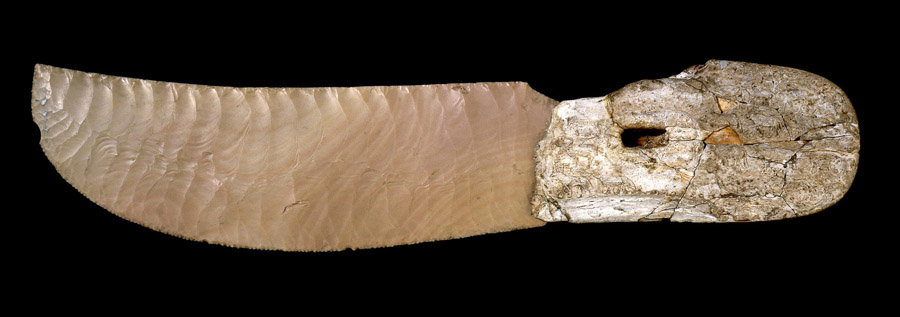
A prime example is the Pitt-Rivers Knife displayed in the British Museum, London. It has an ivory handle decorated with carvings in raised relief on both sides. These depict rows of animals, like cranes, elephants, lions, Barbary sheep, hyenas, donkeys, and cattle—species likely present in Egypt or known through trade at the time. These motifs also appear on other knife handles and slate palettes, but the knife handles are distinctive for their orderly rows, a precursor to the horizontal register divisions seen in later Dynastic art. According to Strudwick ( Masterpieces of Ancient Egypt, pp.32-33, 2006), the delicate and elaborate decoration of these knives suggests they were not utilitarian but rather created for an elite group, likely for ceremonial or ritual purposes. While ceremonial palettes, such as the “Battlefield” Palette (British Museum, EA 20791), are often associated with findings in temples, many knife handles, including two from late Predynastic cemeteries at Abydos excavated in the 1980s and 1990s, were found in tombs. This indicates they were likely elite status symbols, buried with their owners to signify wealth and power. Other examples include knives with boat scenes or figures in Near Eastern styles, reflecting trade. Their craftsmanship, including the use of imported materials like ivory and the depiction of exotic animals, underscores the Naqada II culture’s advanced artistry and trade connections, setting the stage for the artistic conventions of Dynastic Egypt.
- Fishtail Knife, 4000–3000 BCE, Egypt, Predynastic (5000–2950 BCE), Naqada II, (3650–3300 BCE), tan-colored flint, Overall: 6.5 cm (2 9/16 in.), Cleveland Museum of Art, https://www.clevelandart.org/art/1914.717
- Ripple-Flaked Knife, 4000–3000 BCE, Egypt, Haraga, cemetery G, tomb 413, excavated in 1914, Predynastic (5000–2950 BCE), Naqada IIc–IIId (3650–3000 BCE), flint, Overall: 5 x 14.3 cm (1 15/16 x 5 5/8 in.), The Cleveland Museum of Art, https://www.clevelandart.org/art/1915.30
Naqada III
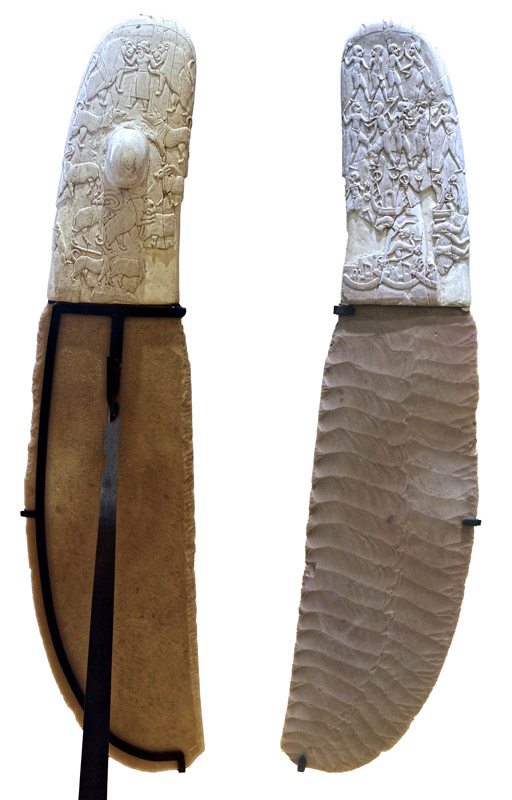
The Gebel el Arak knife, an ivory and flint ripple-flake knife, Naqada III (3500—3200 BC), no provenance, the Louvre, art on the ivory handle displays one of the first examples of bas-relief carving with Mesopotamian influence. Non-functional and used for religious ceremonies, it depicts the Mesopotamian king as Master of Animals on one side of the handle. The Metropolitan Museum has decorated ivory knife handles with art that includes the rosette, the boat, the hero or pharaoh, and the prisoner. The rosette is a Mesopotamian motif that symbolizes royalty. The ivory knife handles, the Master of Animals, and rosette motifs seem to have been appropriated by the emerging elite as symbols of prestige (Andrea Gover, p.18). This type of ceremonial knife was rare and probably produced in a single workshop of highly skilled artisans over a few generations, according to Holmes (Holmes 1989: 338).
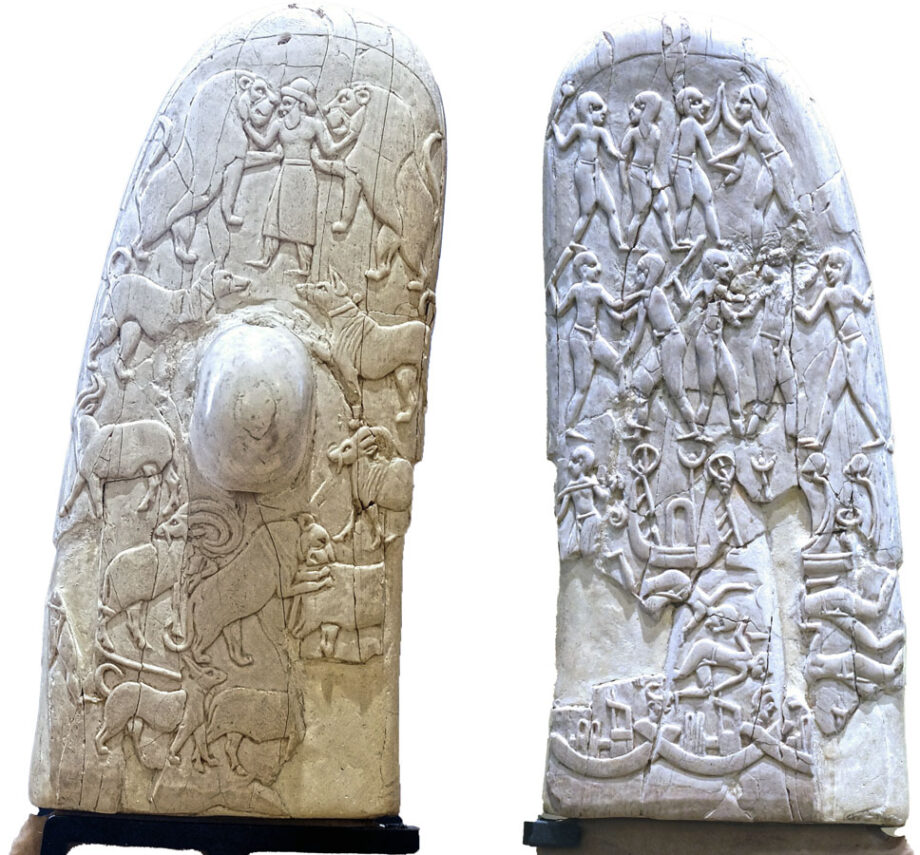
While elites later fostered full-time specialization, the early Naqada period featured a production system that included part-time specialists creating tools with symbolic significance for widespread societal use. The ritual production model highlights the role of community-encompassing rituals in driving economic intensification and specialization. This non-elite participation in specialized production changes our understanding of Egypt’s state formation.
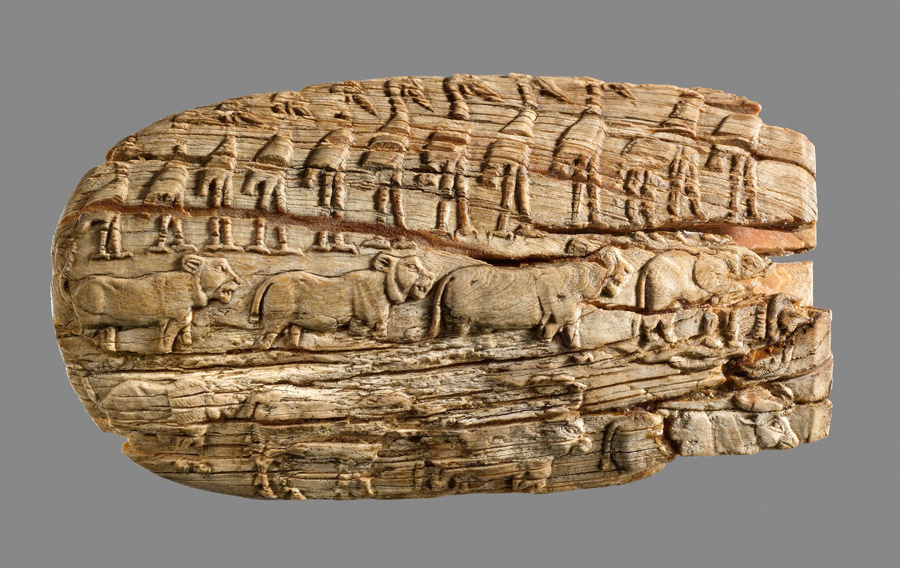
Maceheads Types:

Maceheads were club-like weapons with a heavy head mounted on a handle (3600-3200BCE). Both disc-shaped (a disk with a hole) (early Naqada I-II) and pear-shaped or piriform (Naqada II-III) maceheads were used as weapons and ceremonial items. Maceheads were usually made of diorite, limestone, and breccia. Merimde’s excavations revealed perforated maceheads made of slate, calcite, and hard limestone.
Sometimes, you can see Egyptian art depicting a king holding the macehead over his head, who is about to punish his enemies, like in the Narmer palette. Crafted from various stones, with limestone favored in the Late Predynastic, these maceheads were symbols of power and wealth. They were attached to wood or ivory handles that didn’t survive the time. They were probably drilled with a copper tubular drill as copper smelting appeared around 3600 BC.
Naqada I
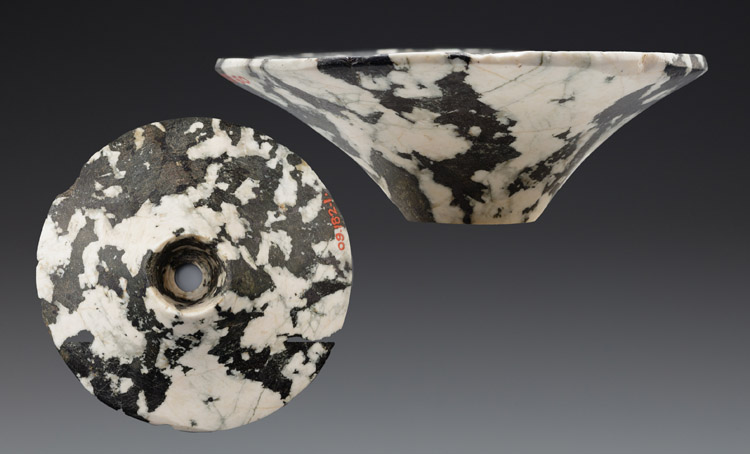
Imitation tusk, Naqada I–II, Limestone, 3850–3300 B.C, MFA Boston. Petrie hypothesized that they were used as water skin stoppers.
Naqada II
Predynastic Maceheads, 3600-3100 B.C.E.), pink banded limestone and Hematite, Institute of Egyptian Art and Archaeology, the University of Memphis. The limestone macehead was excavated from a predynastic cemetery, Mesaeed, by the Harvard University and Museum of Fine Arts Boston joint expedition in 1910. https://www.memphis.edu/egypt/exhibit/macehead.php
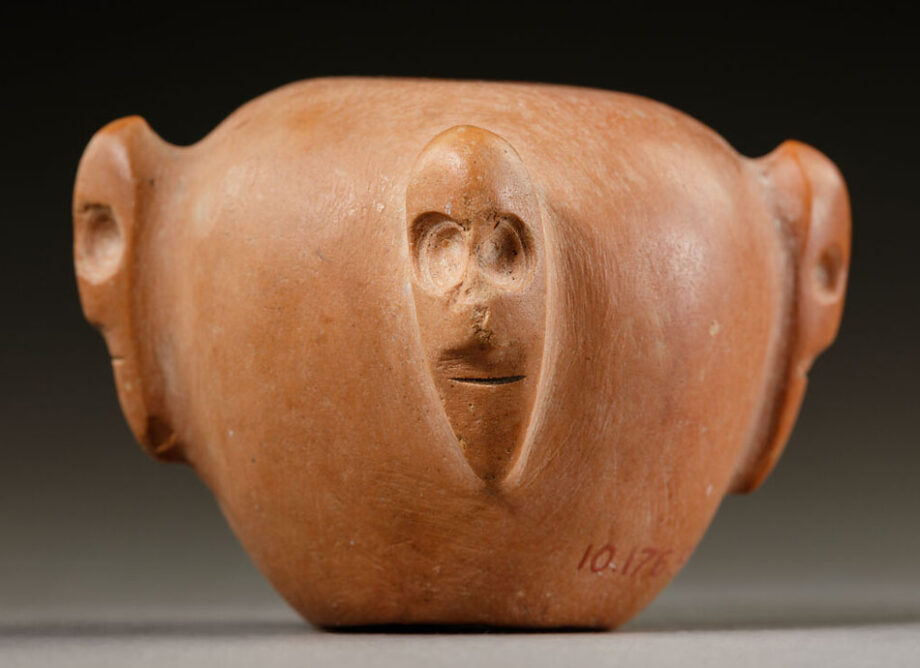
The Piriform maceheads appeared in imagery of kings using them throughout Egyptian history, not just the Naqada period. Examples: Piriform macehead, made of Breccia, Predynastic, Naqada II–Naqada III, ca. 3500–3100 B.C. https://www.metmuseum.org/art/collection/search/547193
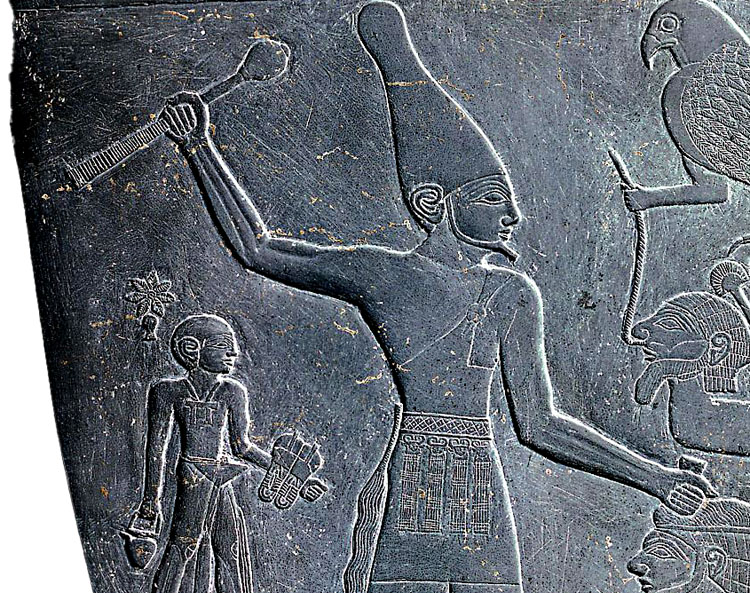
The pear-shaped macehead served dual purposes as both a functional weapon and a ceremonial object. Ceremonial maceheads were often larger and sometimes elaborately decorated, distinguishing them from their practical counterparts. Archaeological evidence shows maceheads in both male and female graves. In later Dynastic art, the pear-shaped mace became a symbolic motif, depicted in scenes of pharaohs smiting enemies, even after its practical use waned. An example is the Narmer Palette, where King Narmer is shown wielding a pear-shaped mace.
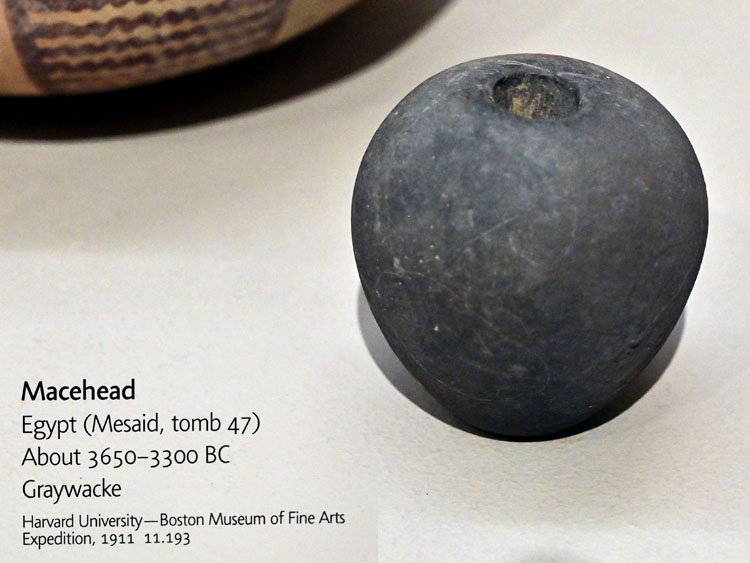
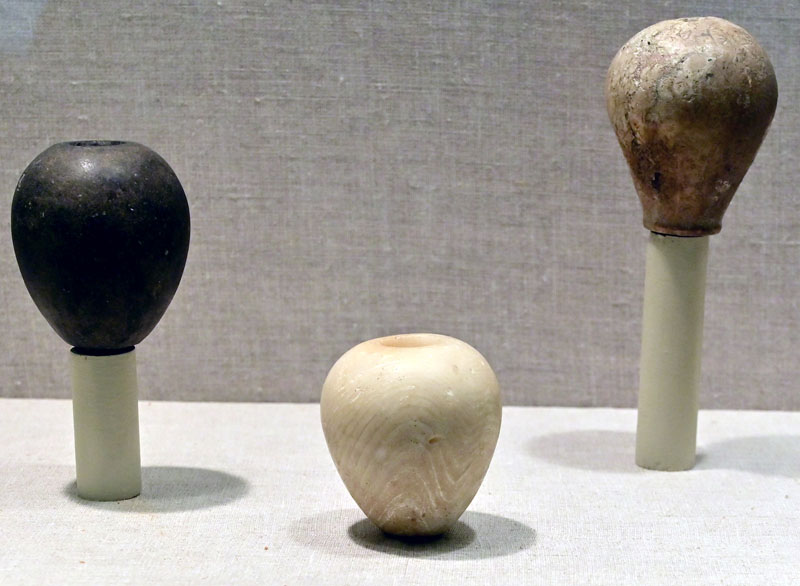
Egyptian, Predynastic Period (Naqada II), ca. 3700-3300 B.C. , Travertine (Egyptian alabaster), basalt, and limestone. Bequest of Gilbert M. Denman, Jr., 2005.
Museum’s description: Stone maceheads were attached with a leather thong to a handle of wood, ivory, or horn to make a club-like weapon. Originally used for hunting or fighting, by the late Predynastic Period maces took on a more ceremonial purpose as a symbol of royal authority. The image of the king smiting his enemies with a mace became a frequently repeated motif in Egyptian art.
Naqada III
The Scorpion King macehead is the ceremonial object. Hierakonpolis’ earliest ruler is known as ” the Scorpion King,” and the evidence for this name is the great mace-head with the seven leaved rosette over a scorpion, placed before the king’s figure.
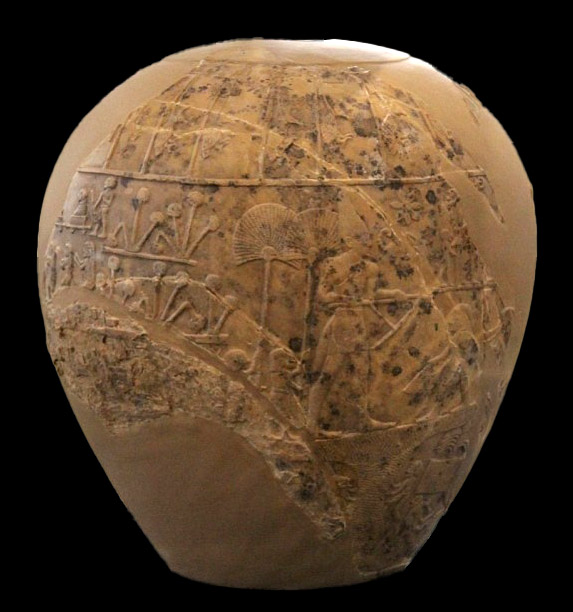
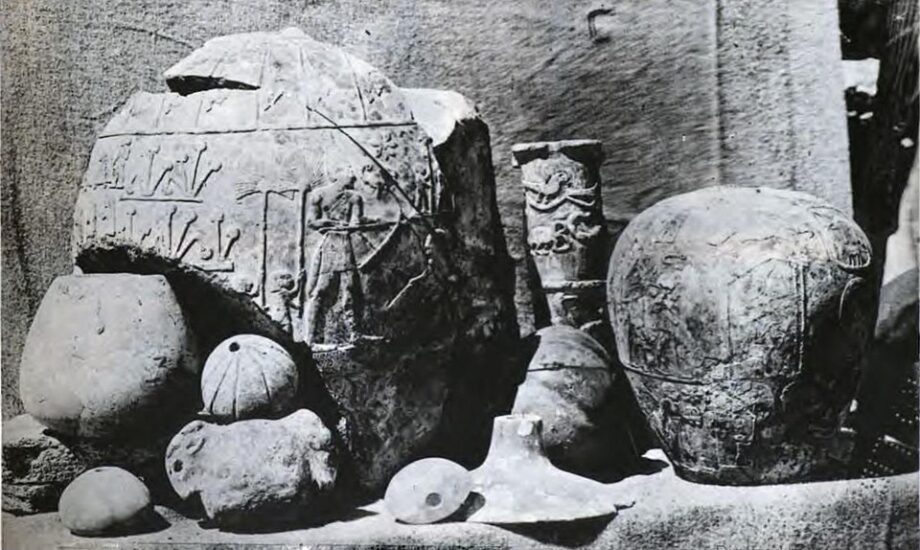
The Narmer macehead is an ancient Egyptian decorative stone macehead, The longitudinally drilled limestone macehead is 19.8 centimeters high, has a maximum diameter of 18.7 centimeters, and weighs 8 kilograms, Oxford.
Seals:
First imported from Mesopotamia, the seals were exotic objects of the elite worn in necklaces and bracelets, later becoming functional tools in Egypt for the management of goods as well.
Just like the Mesopotamians and later Greeks, Egyptians used seals to mark their ownership on objects. Cylinder-shaped seals were used in administrative markings. The earliest found limestone seal was found during Petrie’s excavations in the Naqada tomb in 1863. It’s 1.75 x 1.5 cm in size and probably comes from Mesopotamia. Cylinder seals first appeared in Egypt around 3500-3300 BC.
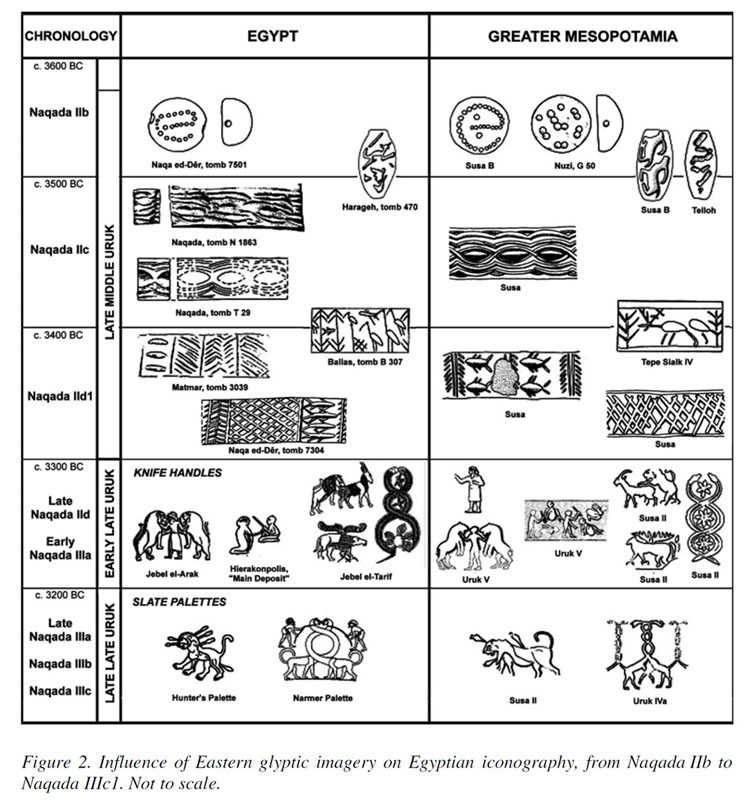
The earliest cylinder-seals were created from beads. Unlike in Mesopotamia, the Egyptians integrated the seals into their necklaces and bracelets from the start, along with lapis lazuli beads during the Naqada II period. Over the centuries, they evolved into more sophisticated shapes like scarabs, button seals, and ring-name seals. Greeks (see Knossos) and later Romans adopted this method of marking ownership on goods with ring seals, among other shapes.
Early tombs attest that only the wealthiest people wore necklaces, had a cylinder-seal, lapis lazuli beads, and expensive small objects like stone vessels in their graves. Early Egyptian seals highlighted the elite status of the dead, unlike in Mesopotamian culture, which used them for the management of goods. For some reason, Egyptians didn’t import the Mesopotamian accounting system along with the seals.
While early limestone cylinder seals were imports for the elite (Naqada I-II), the seals became functional during the late Naqada II-Naqada III periods. Local artisans carved the Egyptian seals from different materials like steatite, ivory, and glazed ceramics. The art of the Egyptian seals soon transformed into central motifs and became independent from Mesopotamian influence. However, art on knives and palettes remained similar to the Mesopotamian culture.
Examples of Egyptian Seals in the Naqada period:
- Cylinder Seals: Introduced in Naqada IIc-d1 (c. 3300 BCE), used for sealing, with evidence from Abydos and Lower Nubia, as detailed in recent papers (e.g., 2006 study on glyptic transmission).https://www.metmuseum.org/art/collection/search/547394 https://www.academia.edu/41692593/Earliest_Cylinder_Seal_Glyptic_in_Egypt_From_Greater_Mesopotamia_to_Naqada , https://www.ucl.ac.uk/museums-static/digitalegypt/seals/index.html
- Uninscribed cylinder ivory seal, Late Naqada III or early Dynasty 1, ca. 3100 B.C., Abydos, Umm el-Qaab, Tomb complex of Aha https://www.metmuseum.org/art/collection/search/547394
- Earliest Limestone seal at Petrie Museum: https://www.ucl.ac.uk/museums-static/digitalegypt/seals/index.html and button seals: https://www.ucl.ac.uk/museums-static/digitalegypt/seals/buttonseals.html
- Animal seals from Naqada III: https://www.ucl.ac.uk/museums-static/digitalegypt/seals/animalseals.htm
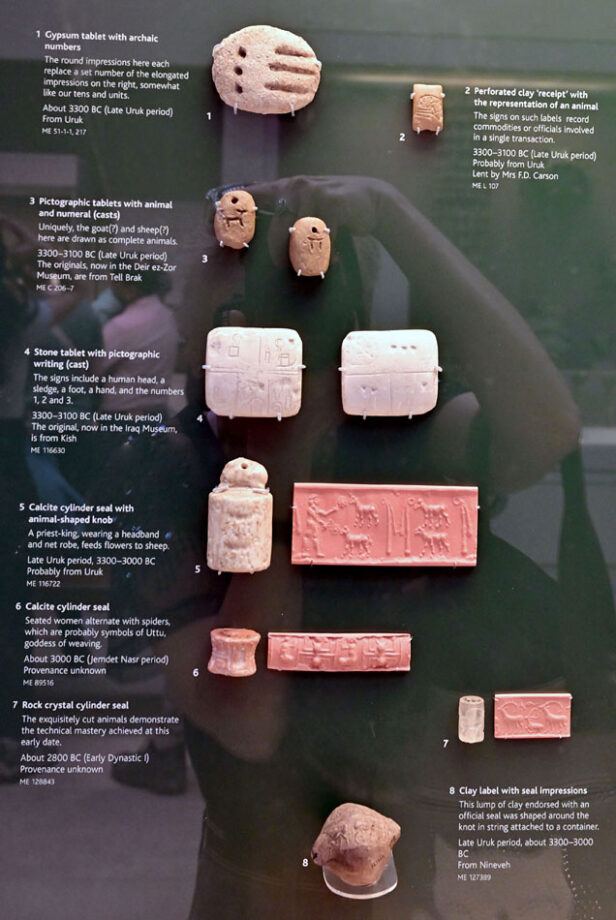
The document, Earliest Cylinder-Seal Glyptic in Egypt: From Greater Mesopotamia to Naqada by Emmanuelle Honoré, 2007, discusses the transmission and development of cylinder-seal glyptics from Greater Mesopotamia to Egypt during the Naqada IIcd1 period in greater detail, highlighting the emergence of an autonomous Egyptian glyptic tradition.
- Cylinder-seals first appeared in Egypt around 3500-3300 BC, with significant finds at Harageh and Naqa ed-Dêr. In Mesopotamia, the cylinder-seals emerged in the first half of the IVth millennium BC during the Uruk period. The invention was driven by the need for efficient management processes in growing urban centers.
- The earliest cylinder-seals were found in Naqada, with Naqada II examples discovered by Flinders Petrie in 1894-1895, imported as adornments from Mesopotamia. Cylinder-seals were found in elite graves, such as tomb N 1863 and tomb T 29, indicating their role as status symbols. Tomb N 1863 contained a Mesopotamian cylinder-seal alongside various luxury items, suggesting a high social standing. The cylinder seal was imported into Egypt shortly after its invention.
- The transition from ornamental to functional use of seals occurred as they began to serve administrative purposes.
- Early seals in Egypt closely resemble Middle Uruk seals, complicating the identification of their origins. The materials used for seals provide clues, as early seals were predominantly limestone, while later ones diversified in material.
- Influence of Mesopotamian Glyptics on Egyptian Art: Mesopotamian motifs were integrated into Egyptian art, with some examples found in knife handles and palettes. The transmission of glyptic motifs continued even after the emergence of an independent Egyptian glyptic tradition. The Egyptian glyptic style developed its own unique art style in the late period. Motifs from Mesopotamian glyptics continued to influence prestige objects-knife handles and palettes, in Egypt.
- This paper also traces trade routes and cultural exchange. The Northern route goes up the Tigris and Euphrates towards Syria and Lebanon to reach the Nile Delta. Exchanges occurred between various regions: South and North Mesopotamia, North Mesopotamia and the Levant, Palestine and the Nile Delta, and Lower and Upper Egypt. Cylinder seals were not known in Palestine during the Middle Uruk period. Lapis lazuli appeared in the Nile Delta, first in Naqada IId graves and later in the Fayum region during Naqada IIc. The Southern route is hypothetical without archaeological evidence such as shipwrecks or artefacts found on Egyptian coasts.
- You can read the paper here: https://www.academia.edu/41692593/Earliest_Cylinder_Seal_Glyptic_in_Egypt_From_Greater_Mesopotamia_to_Naqada
Figurines & Cosmetic Palettes:
Figurines:
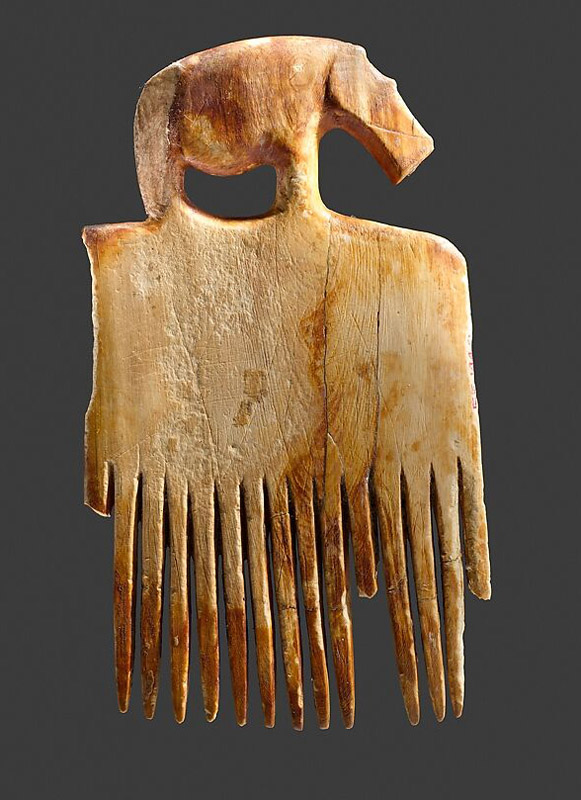
The earliest examples of Egyptian sculpture represent people in formal poses. primitive figurines and statuettes were made of various materials, like stone, ivory, bone, mud, ceramic, or unbaked clay, often found in graves. These primitive figures had carved details like hair and clothing that were either incised or painted on the clay surface.
Most of the Ivory carvings from Hierakonpolis were deposited in England’s Ashmolean Museum, Oxford, and the Petrie Museum.
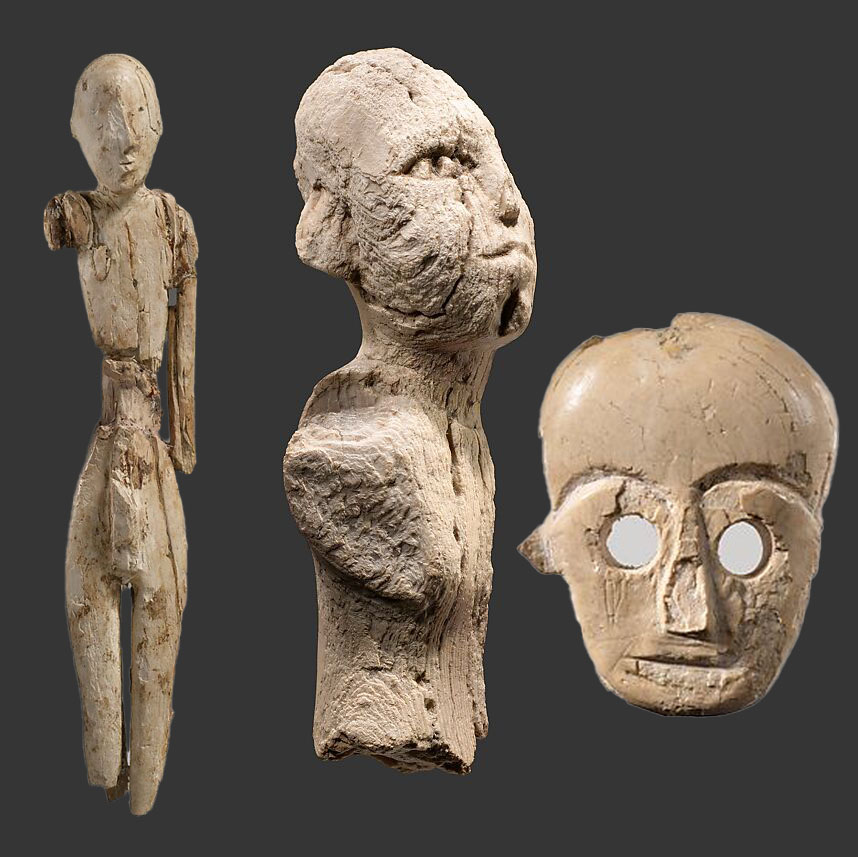
Some examples of ivory objects from other areas include:
- Comb, E1167, ivory, from Ballas, Naqada, Penn Museum, https://www.penn.museum/collections/object/229953, and Cosmetic Spoon, E1179 ,ivory, Ballas, Naqada, 5000-3000BCE, Penn Museum https://www.penn.museum/collections/object/178098;
- Figurine of a man, early Naqada II, 3650-3450BC, the Met https://www.metmuseum.org/art/collection/search/547233
- MacGregor Man, statuette, 5300 – c. 3300 BC, Basalt, 39.5 cm (height), the Ashmolean museum, Oxford https://images.ashmolean.org/search/?searchQuery=egyptian+ivory
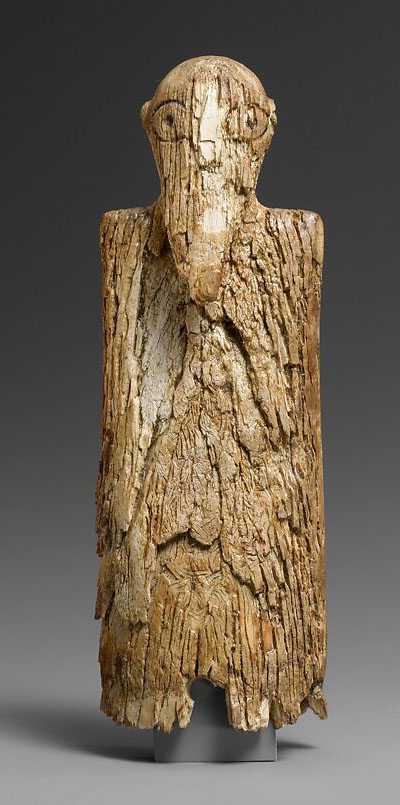
Cosmetic palettes
I think the cosmetic palettes are interesting objects that are also unique to ancient Egyptian culture along with the Mesopotamian one. First, slate cosmetic palettes for eye paint were simple in decoration and function. A small, greenish-grey cosmetic palette was about 4 inches tall and was often the only object placed in a woman’s grave in early predynastic Egypt. They were found in male graves as well. The earliest palettes are small, flat, and often rectangular, and during the Naqada I period took the shape of birds, fish, turtles, and other animals captured in profile. Using the flint pebble, people ground the green paint from malachite (copper ore). They believed that this paint mix protected their eyes from the sun glare and infections. Another paint mix consisted of ground black paint made from galena (lead ore).
The slate palettes evolved into larger ones with more elaborate designs, incised or low-relief decorations in Naqada III. Their function changed from functional to sacred as animal-shaped palettes became much larger, found in the temples along with carved mace-heads. Large, slate palettes shared the ceremonial role just like the flint knives. Made of dark mudstone, the middle of the palette has a flat area surrounded by a raised ring, used for grinding eye-paint on these palettes. These palettes often have symmetrical drawings of animals carved in low relief.
Naqada I
The Egyptians used stone palettes for grinding malachite and other pigments; a small pebble served as a grinder. Many Predynastic palettes, like these, take the form of animals, with a hole for suspension.
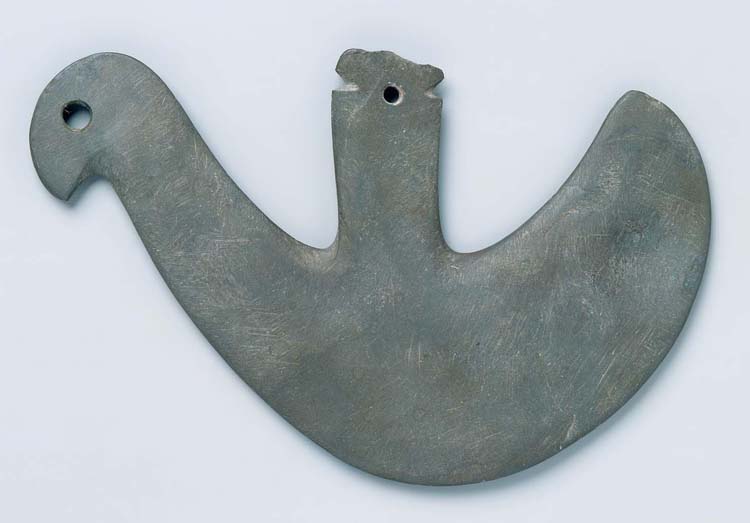
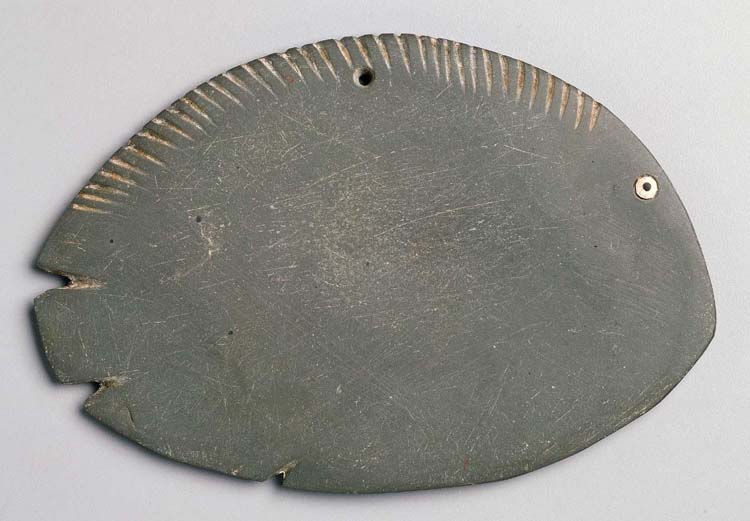
KOHL AND COSMETICS:
(This information comes from the museum in Boston)
Beautiful eyeliner over dark, almond-shaped eyes is a symbolic representation of ancient Egyptians as we know them today. Kohl on the eyes was a status symbol and an eye-protection from the sun for ancient Egyptians. It’s believed that the minerals used for kohl-green malachite (copper ore) and dark grey galena (lead ore) may have had antibiotic properties.
Ancient Egyptians also made cosmetics for their skin using oil scented with spices. Some images show women with small cone-shaped objects on their heads that released the oil scent during the day perfuming their hair and skin. They stored skin and eye cosmetics in narrow-mouthed vessels, and had special trays and spoons to take it out and apply cosmetics to their skin. Cosmetic jars and kohl pots were often made of a very soft, yellow-white alabaster.
In ancient Greece, ‘alabaster’ or alabastron meant ‘perfume vessel’ deriving its name for these cosmetic vases.
Early palettes: The Gerzean palette and the Min palette. date? The Man-Ostrich palette, the Ibis palette, the Plover palette. They are small, without text, and with minimal low-relief figures.
- The Gerzean palette has no text. Found at Gerzeh, it seems to represent a cow’s head and horns. Pierced for suspension, the palette’s reverse side showed traces of malachite rubbing. The image is similar to the figures of women with upraised arms, goddesses, painted on the Decorated pottery of the Gerzean period. The figure on the slate palette is a 5-star constellation, suggesting Orion.
- Rhombic palette, Naqada I-II, 23 cm x 10.9 cm, findspot:Hu, slate, the Ashmolean Museum, Oxford
Naqada II
Many cosmetic palettes show animals in low relief, like dogs, gazelles, bulls, and birds.
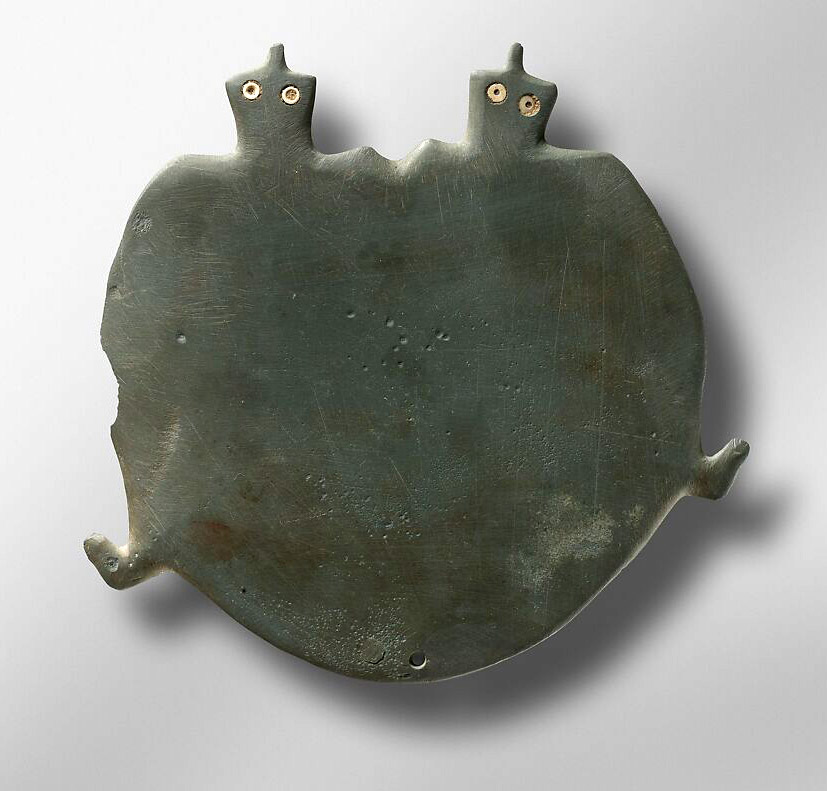
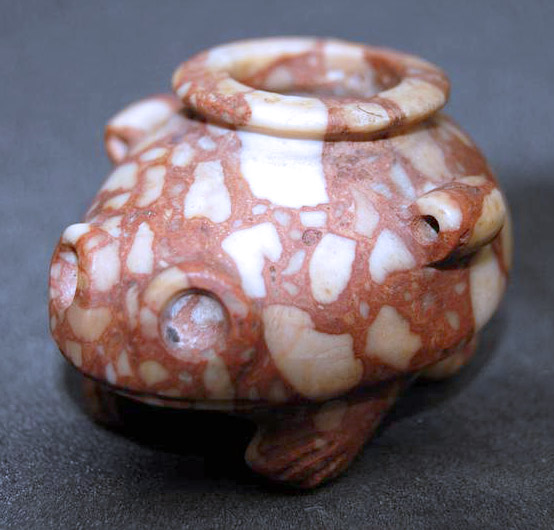
Naqada III
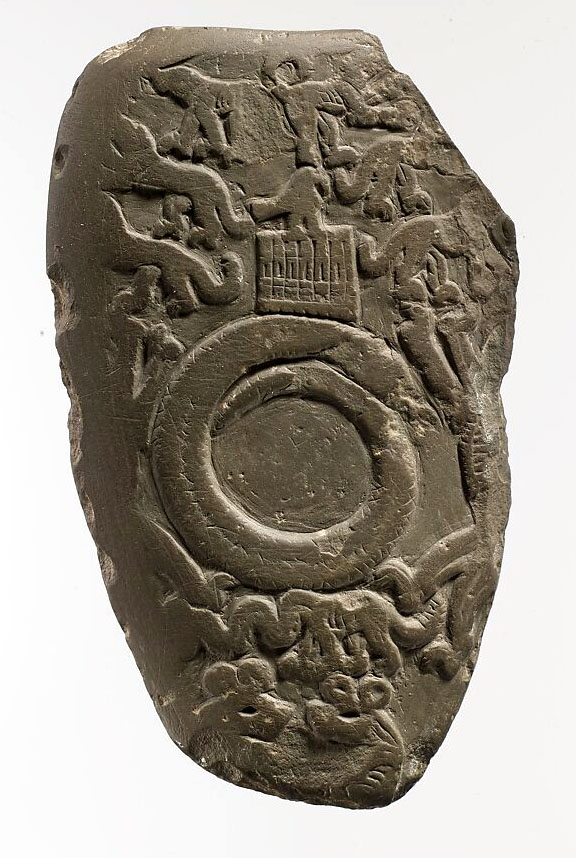
The Hunters’ Palette, cosmetic palette, grey mudstone, Naqada III, the British Museum. One of two fragments at the British Museum with a cast of a third fragment in the Louvre, the Hunters palette shows bearded warriors in headdresses hunting the wild animals carved in low relief. Their weapons include the bow, spear, mace, throw stick, and lariat. Their flint-tipped arrows have a chisel edge. Artists depicted a wide variety of hunted animals, like the lion, gazelle, hartebeest, hare, jackal, ostrich, and deer.
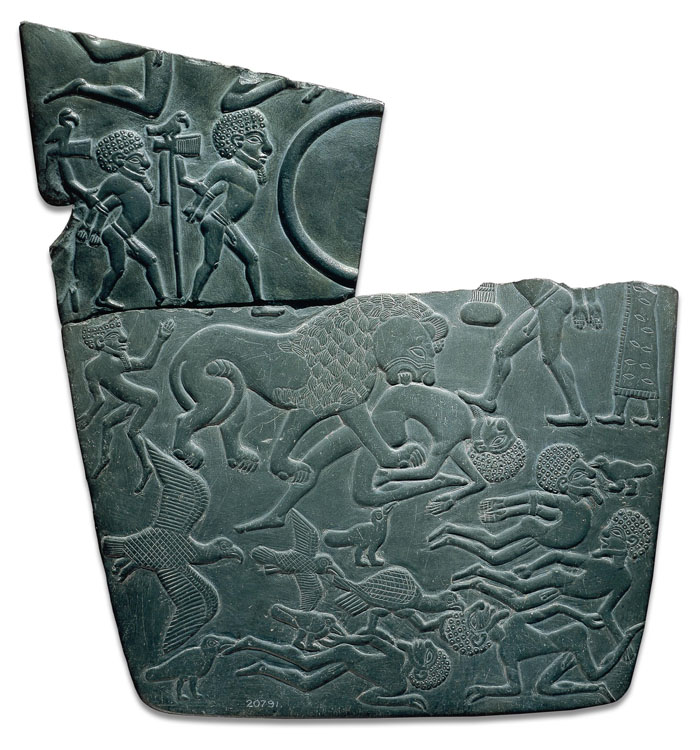
Narmer Palette
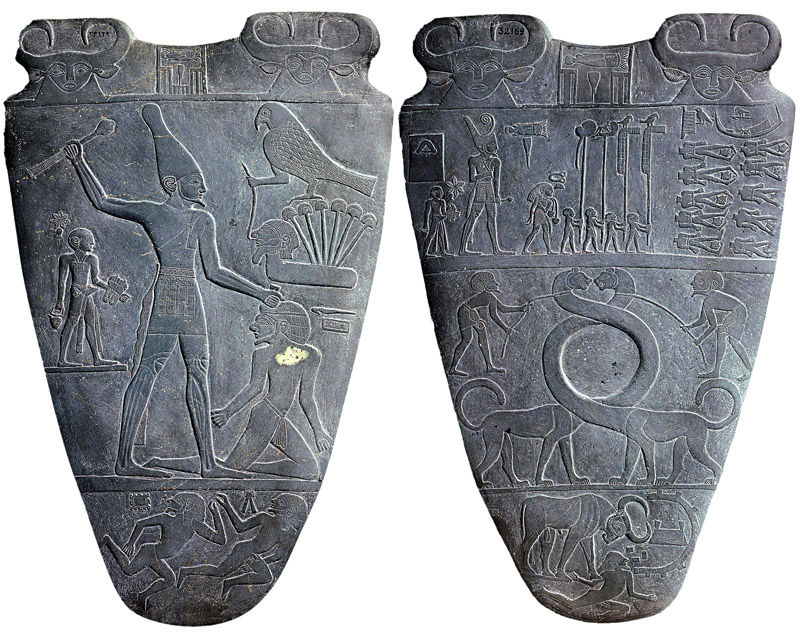
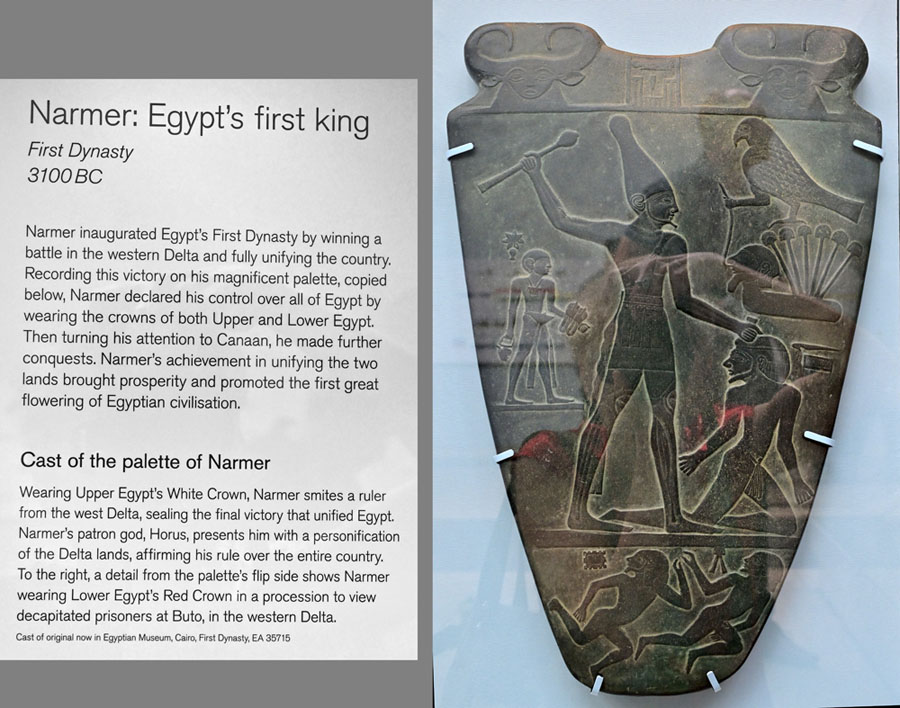
The Narmer Palette, siltstone, Egyptian Museum, Cairo, 3100 BC, 1st Dynasty, found in 1897–1898, Hierakonpolis. EA 35715 is a cast of the original in British Museum. A large, shield-shaped slate cosmetic palette in greenish-black stone was commissioned by King Narmer to celebrate the unification of Upper and Lower Egypt under his leadership after Narmer won a battle in the western Delta. This is the recording of his victory and founding document of ancient Egypt and the pharaonic state. Narmer came to power around 2950 BC as the first king of the first dynasty. He’s wearing two crowns (white and red) as one of both Upper and Lower Egypt.
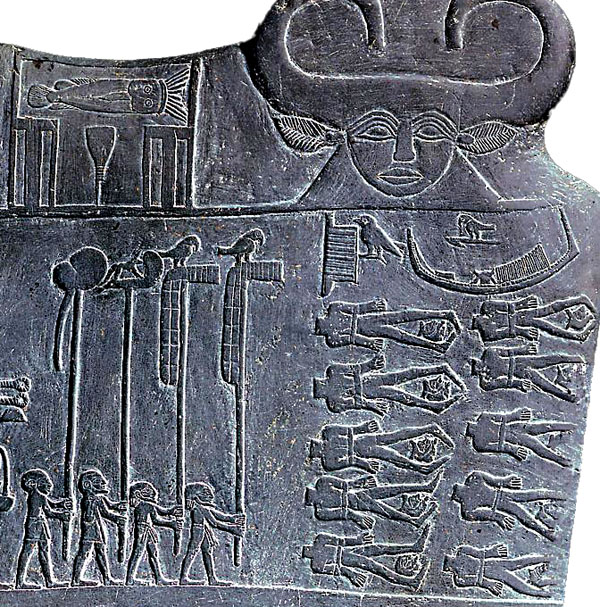
The palette depicts King Narmer smiting his enemy with a mace in low-relief carving on one side. Narmer’s patron god, Horus, presents him with a personification of the Delta lands. The flip side of the palette depicts Narmer in Lower Egypt’s Red Crown watching decapitated prisoners at Buto.
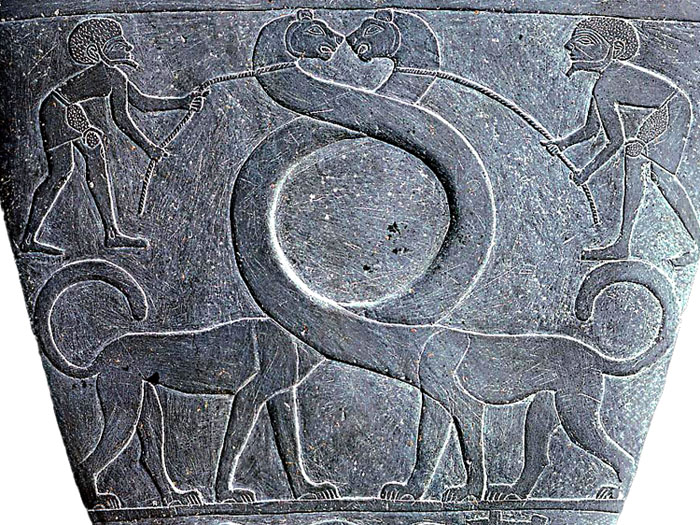
The palette also depicts a mythological creature, the leopard-snake, among other people and animals on the other side. These are strange creatures with long, intertwined necks forming a circle on the palette. Two top hieroglyphs spell the king’s name: ‘nar’=catfish and a ‘mer’=chisel. (T.Wilkinson, p.6). Two British archaeologists, James Quibell and Frederick Green, searched for a treasure in an eroded site of an old temple in Hierakonpolis to discover the most important document of the beginning of civilization.
Narmer declared his control over all of Egypt by wearing the crowns of both Upper and Lower Egypt.
Jewelry & Amulets:
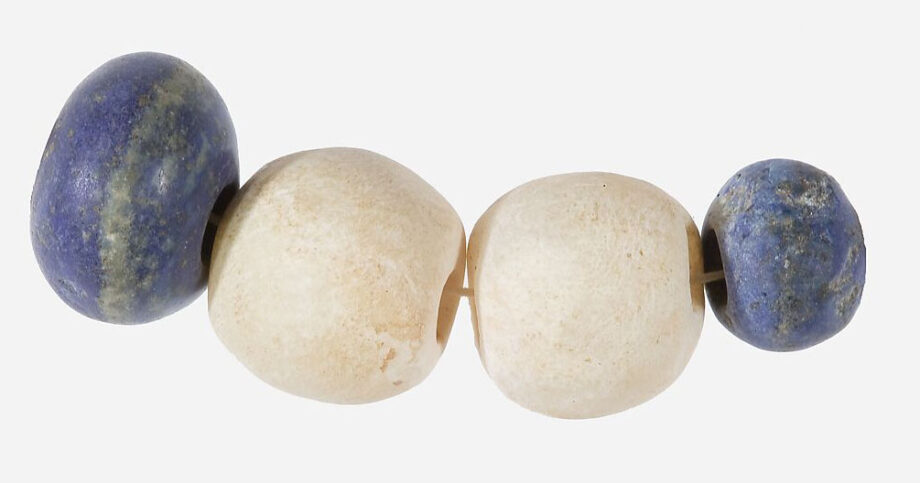
Beads: Predynastic Egyptians made beads, pendants, and amulets from travertine, copper, silver, gold, steatite, quartz, and blue-glazed faience made over calcite, agate, diorite, garnet, limestone, and serpentine. Spherical or cylindrical stone beads were often made from imported materials like carnelian, found in graves, as seen in the British Museum’s collections. Beads had many shapes, like rings, spheroids, barrels, cylinders, and convex bicones. (Glass beads appeared in the 5th Dynasty and are out of the scope of this article.) To drill the holes, predynastic craftsmen used flint and copper tools to drill the holes from either one side or from both sides to meet in the center. Artists probably worked in specialized workshops, drilling multiple holes and making necklaces like those in later dynasties.
Example: A copper tubular bead, Naqada burial, Petrie Museum UC5066
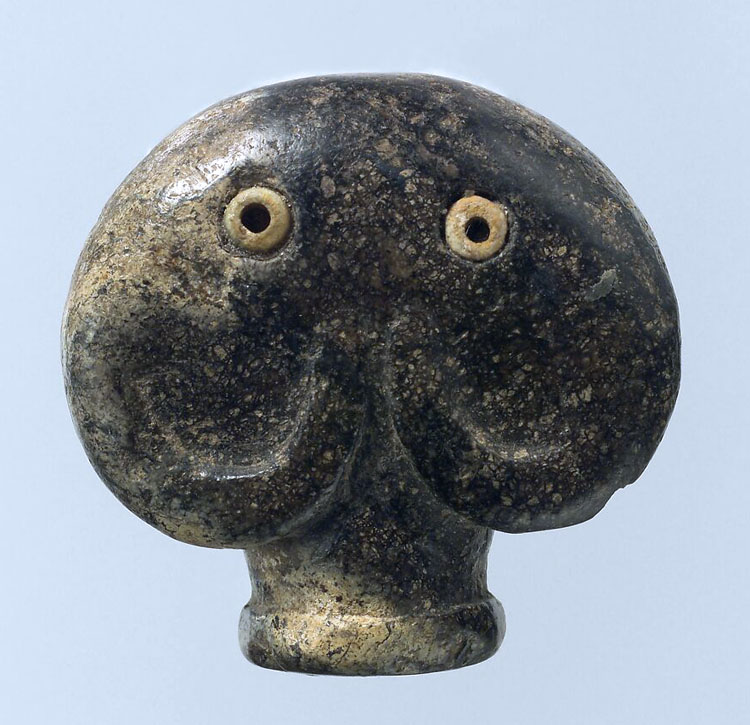
Amulets: Necklaces of amulets, especially in the shape of animals, were both decorations and religious objects. People wore them as protection tools against illness, animal attacks, injury, etc. The vultures became Egypt’s most popular protective symbols.
Gold button and gold jar lid, the British Museum: During the first dynasty, the king exercised monopoly on gold use. Hammered from sheets, gold was used to decorate objects like clothing and stone vessels.
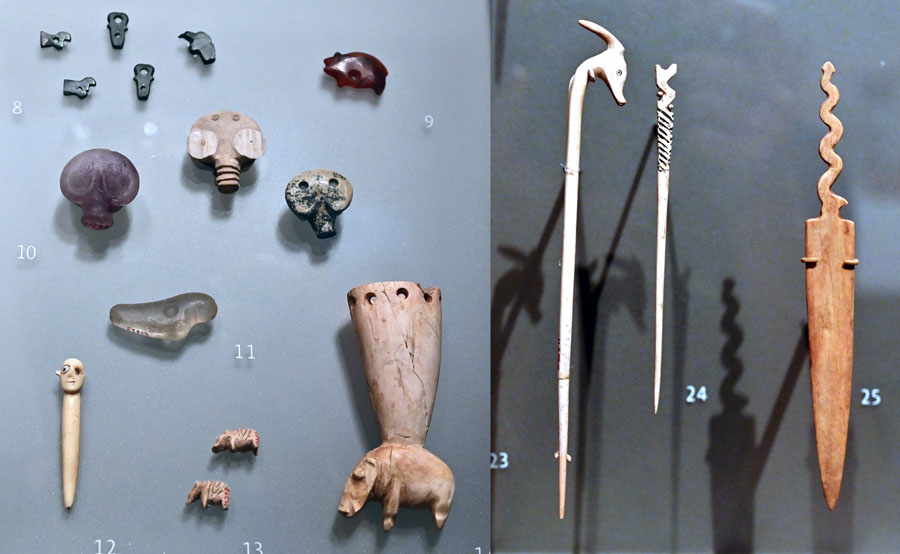
Lapis Lazuli or Blue Faience glaze?
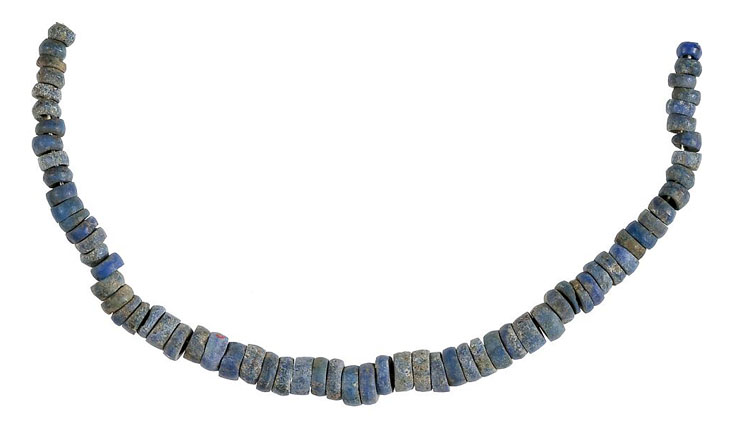
Lapis Lazuli was a rare stone coming from Afghanistan, carried on foot across mountains, sand, and land. To replace it in crafted objects on a much larger scale and at a fraction of its cost, Egyptians created stonework with blue-green glaze imitating the color of the stone. Egyptians considered this color magical and applied it to beads, amulets, scarabs, jewelry inlays, statuettes, vessels, tiles, etc.
The coating of carved steatite beads and stones, with a green alkaline glaze, seems to appear in the Badarian culture around 4000BC. To manufacture this beautiful glaze, Egyptians used a ground mix of malachite, copper ore, and waste sand powder to fire them in kilns. (They used silica, quartz, alkaline salts, lime, and mineral-based colorants.) There were large quantities of waste powders derived from drilling stones containing copper particles. So, glazing was probably applied in a workshop closely related to the stone production facility.
Paul Kriwaczek, the author of Babylon: Mesopotamia and the Birth of Civilization, 2012, talks about the origin of the invention that actually comes from Mesopotamia, but for some reason got misnamed as Egyptian faience. Egyptians began to use this technique around 5000BC, according to the author. The heavenly color of blue faience glaze is created because of copper in the mix during the firing in a kiln at 1000 degrees. You can read about the Egyptian Faience technology here.
There were several techniques for working with faience. They shaped faience with clay molds but also the paste could also be worked into a slab by shaking and patting to create flat inlays or tiles. Another technique was to form the paste around an organic core that burns away during firing. A layer of paste was either modeled around the combustible core or it was dipped into a slurry of faience ingredients. Large objects were likely hand-modeled or molded in parts and jointed together later. There were two other glazing techniques: direct application and cementation. (Riccardelli, Carolyn. “Egyptian Faience: Technology and Production.” In Heilbrunn Timeline of Art History. New York: The Metropolitan Museum of Art, 2000–. http://www.metmuseum.org/toah/hd/egfc/hd_egfc.htm (December 2017).
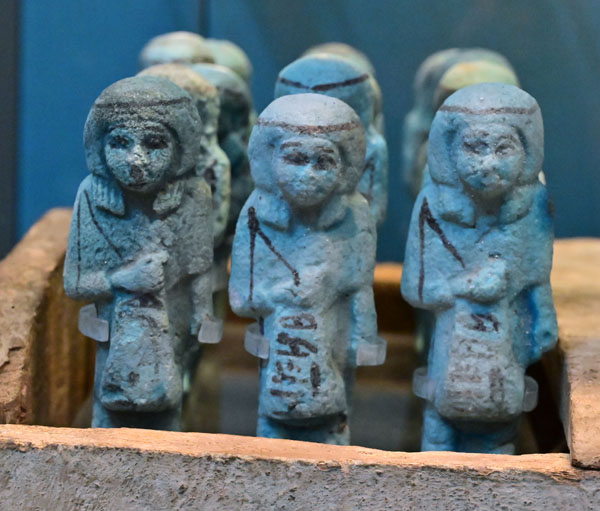
Shabti servants of the dead are small figurines placed in tombs of faience blue, white, stone, or clay color. These figurines are on display at several museums, including the British Museum and the Petrie Museum. Faience—a non-clay ceramic—was the most common material for such figures, allowing mass production in molds. The faience paste, infused with copper, gave the fired shabtis a vibrant blue-green hue. The ancient Egyptians believed that manual labor continued in the afterlife. So Shabtis, small figurines placed in tombs, were designed to magically perform these tasks for the deceased. The term “shabti” translates to “answerer,” reflecting their role in responding to their master’s call to work in the afterlife. These figures the “shabti spell” inscription, a recitation to activate them for labor. Typically, shabtis are depicted holding tools or an over the shoulder basket. Petrie arranged these artifacts by type in his displays.
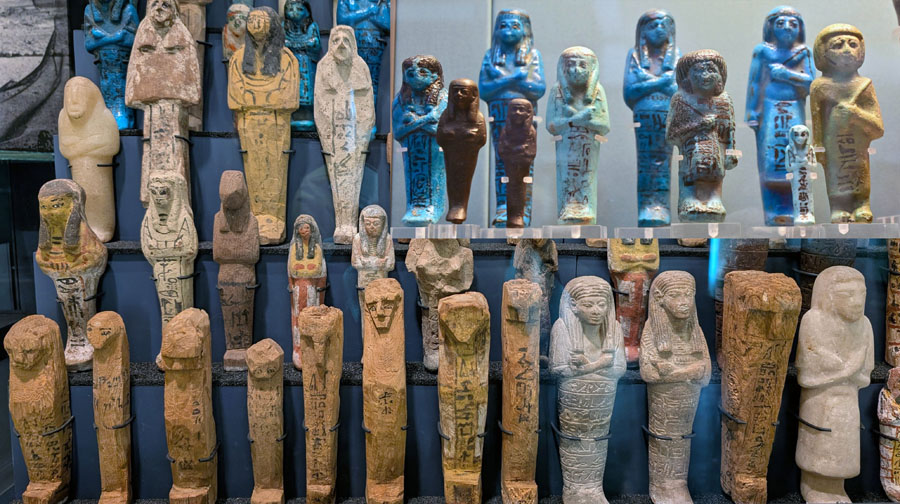
Examples:
- The Naqada I bone figure with lapis lazuli inlays is at the British Museum.
- The Ashmolean museum at the University of Oxford includes: Figurine of a falcon, Naqada I (c. 3800 – 3450 BC), excavated in Naqada, grave 1774, 3.3 cm, blue-green glazed sandstone or faience.
- Vulture & Falcon amulet, Naqada II (Gerzean), 3650–3300 B.C., Findspot: Egypt, Naga el-Hai (Qena), tomb K 128, MFA Boston
Most famous, 19th-century archaeologists and their legacy:
The Petrie Museum of Egyptian Archaeology, named after William Matthew Flinders Petrie (1853–1942), showcases artifacts from his extensive excavations in Egypt. However, Petrie’s work was a collaborative effort, supported by a diverse team of assistants and workers from both Egypt and Europe. European researchers and students, including T.E. Lawrence, Ernest Gardiner, and Margaret Murray, contributed to his projects, bringing academic expertise and enthusiasm, according to the museum’s descriptions.
Equally vital were the contributions of Egyptian workers, whose local knowledge was indispensable. Among them, Ali Suefi stood out as Petrie’s key collaborator from 1891 until Petrie ceased fieldwork in Egypt in 1924. Based in Qift (Koptos), Ali Suefi managed Petrie’s workforce, playing a critical role in identifying, organizing, and excavating archaeological sites. Petrie regarded him as a trusted colleague, praising his dedication in a letter to his future wife, Hilda: “a faithful, quiet, unselfish right-hand to help. As far as character goes, he is really more to me than almost any of my own race. Few men, I believe, have worked harder for me or trusted me more.”
Another famous Egyptologist of the 19th century was John Gardner Wilkinson. He published the most comprehensive volumes of research about ancient Egyptian civilization in 1843. Artist, Howard Carter, also contributed to the archeological research in Egypt, discovering the burial of Tutankhamun among other treasures. Jean-François Champollion, a talented French scholar, also became famous for his research and reading of ancient Egyptian language.
Discoveries of the Egyptian Writing & the Rosetta Stone:
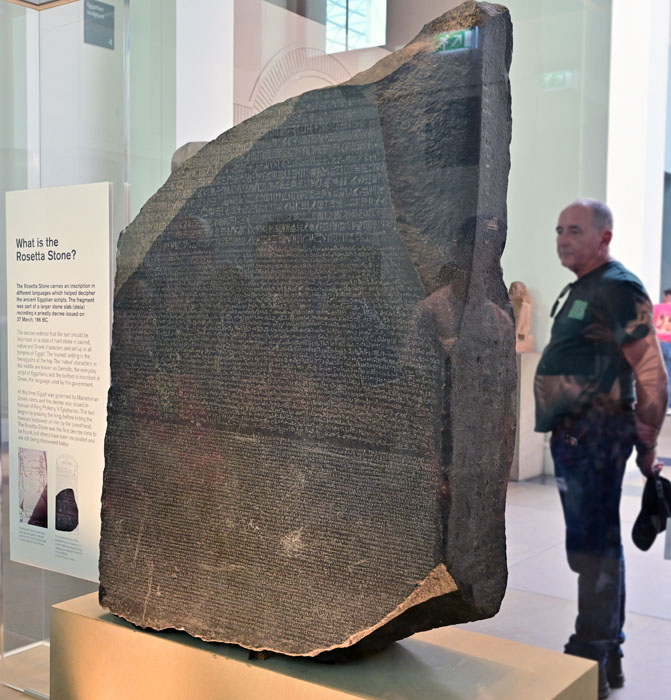
Egyptian hieroglyphs, used from approximately 3250 BCE to 300 AD, formed a unique writing system integral to ancient Egyptian culture. This script, employed in temples, art, monuments, and administrative records, was lost with the rise of Christianity in the 4th century AD, which suppressed and replaced pagan practices and temples across Egypt, Greece, and other regions. The knowledge of hieroglyphs faded to history as Christian institutions dismantled ancient cultural traditions.
In 1798, Napoleon’s expedition to Egypt sparked renewed interest in its ancient heritage. Following his defeat at the Battle of the Nile, Napoleon left Egypt, but his team of researchers and archaeologists remained, conducting excavations and recovering artifacts, including the Rosetta Stone, discovered at el-Rashid (Rosetta). Housed in the British Museum, the Rosetta Stone proved pivotal in deciphering hieroglyphs, which had been incomprehensible for centuries.
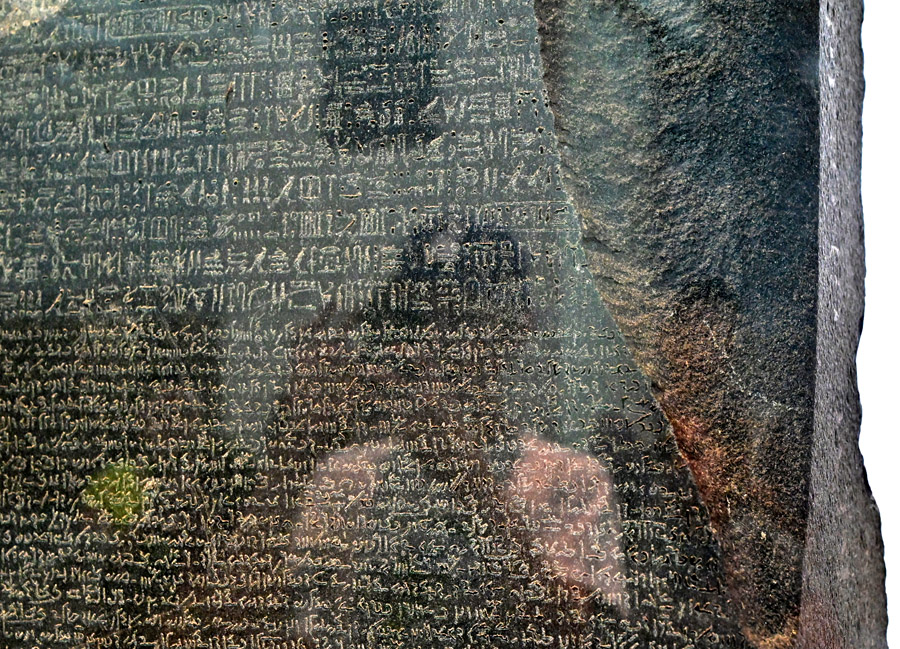
Jean-François Champollion, a brilliant French scholar fluent in Greek and Coptic (the liturgical language of Egyptian Christians), figured out the hieroglyphic script in the early 19th century. Interested in ancient Egypt since early childhood, the young scholar identified hieroglyphs as a complex system combining phonetic signs (representing sounds), logographs (representing whole words), and determinatives (silent signs clarifying meaning). A distinctive feature of hieroglyphs is their integration of phonetic and pictorial elements, with signs depicting animals, plants, or objects. Typically, a sequence of phonetic signs would record sounds, followed by a determinative sign indicating the word’s category, such as an animal, plant, or object, enhancing both clarity and aesthetic appeal.
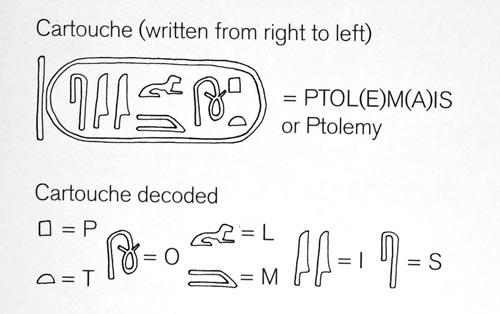
What about provenance?
This 2016 Master’s thesis, submitted by Dirk Philippus Conradie to the University of South Africa in Biblical Archaeology under supervisor Professor Willem S. Boshoff, examines the critical threats to archaeological provenance— the documented origin and context of artifacts—in the Ancient Near East (ANE). Titled Unknown Provenance: The Forgery, Illicit Trade and Looting of Ancient Near Eastern Artefacts and Antiquities, the work argues that provenance is the “sine qua non” (essential element) of archaeological study, enabling historical reconstruction, cultural understanding, and future research. Once lost through unscientific excavation, forgery, or illicit activities, artifacts become “mute” objects valued only aesthetically or monetarily, fragmenting the archaeological record and distorting history.
The thesis spans 219 pages, blending historical analysis, case studies, economic insights, and ethical debates. It draws on scholarly sources like Oscar White Muscarella and Neil Brodie to highlight how human exploitation—driven by collectors, looters, dealers, museums, and even some academics—exacerbates the problem. Key themes include the economic incentives of the global antiquities market, the role of war and ideology, and the tension between “cosmopolitan” (universal heritage) and “particularist” (national ownership) views. Conradie posits that without provenance, artifacts contribute to a “fictional history” rather than genuine knowledge.
The abstract emphasizes the ANE’s rich but non-renewable archaeological resources, noting how forgery, illicit trade, and looting destroy context, rendering objects useless for research except as art. Despite exceptions like the Rosetta Stone or Dead Sea Scrolls, the overall impact is devastating.
Conclusion:
By looking at existing objects, excavations, and literature, I wanted to create a visual context of the prehistoric Egyptian world that existed about 5000-3100 BC. I focused on the craftsmanship of various predynastic vessels and tools to understand the culture deeply, and find overlooked clues and possibilities for the existence of another civilization or technology.
As you can see, predynastic Egyptians used a variety of tools and techniques to manufacture their tools, pottery, stone vessels, amulets, necklaces, and other funerary items during the Naqada period. Flint, chert, copper, and sand were the main materials for tools used in Predynastic Egypt. Craftsmen must have had a short life because of injuries and hazardous conditions working in the workshops. W.M.F. Petrie became the first man to recognize the ancient use of saws and tubular drills on stone in Egypt during the 1880s excavations. He noticed saw marks on the basalt pavement of Giza’s pyramid of Khufu, 4th dynasty, and the rose granite sarcophagi of Khufu and Khafre (p.110, Denys A. Stocks). Although these dynasties are out of the scope of this article, we can see a rapid progression of tools and objects created in predynastic Egypt that led to the sudden building of temples and pyramids in the Old Kingdom.
In my research of the first ancient Egyptian tribes, I found a surprising connection to Mesopotamia. The online world looks at Egypt in isolation. Yes, trade routes had already existed back then, but I think that ancient Egypt connects to Mesopotamia in a more profound way. Art is a clue.
There’s archaeological evidence of the first cylinder seals, ivory handles, knives, maces, pictographs, a rotation table/potter’s wheel, and stone vessels, all coming from ancient Mesopotamia. Due to trade and cultural exchange, this connection deepened and evolved over time (the example is the art style of the recessed paneled façade design in architecture seen in the Pyramid of Djoser’s wall, built 2667-2648 BC). Beer, scribes, circular stone borers, copper tools, and techniques- all came to Egypt from a more advanced civilization during the Naqada period. Naqada people lived in fairly small agricaltural settlements before unification, while the Mesopotamian city-states housed tens of thousands of people around 3500BC. Cities, like Uruk estimated to have had a population of 50,000 to 80,000 at its height, possibly making it the largest urban area globally at the time. Mesopotamian cities featured complex systems for managing property, trade, and exchange, alongside public art, monumental columns, and temples built from mud brick. In the predynastic Egypt, however, a population of roughly 1 million was estimated for the entire Nile Valley. Large Egyptian settlements in emerging cities were about 5,000 residents. This means that Mesopotamians might have had a much greater influence on predynastic Egypt than we think.
While we can think that it’s just the influence, it could later be discovered that people who built the pyramids came from Mesopotamia or (other place) as the first known, advanced civilization. After all, cuneiform text translates that Sumerian gods lived for thousands of years and taught people how to live. Perhaps, those people needed fast and easy access to water and stronger structures than sand to create a place along the Nile River. Or perhaps, the pyramids became the invention of a different people who lived in that region before Naqada or Mesopotamian societies emerged.
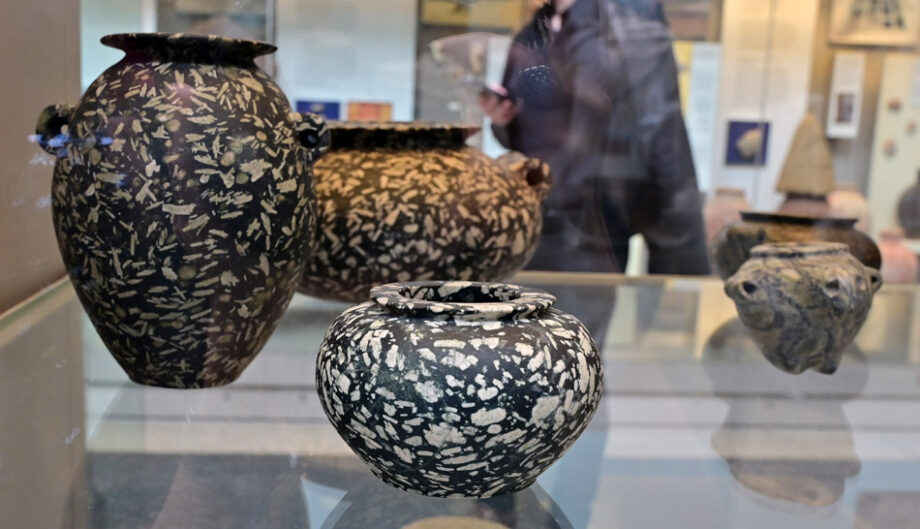
Stone/basalt vessels of the Naqada period didn’t have the straightforward utilitarian function; rather, they were found in tombs of the elites as devotional objects. Egyptians did both pottery imitations of black stone vessels and calcite stone vessels with strange lugs. Basalt was hazardous to mine in Egypt, difficult and slow to shape into a specific vase, requiring skills, time, and patience. Pottery seemed to be a much better option, logically. Mainstream archaeology suggests that during the Badarian and Naqada I periods (ca. 4400–3500 BCE), artisans hollowed hard-stone vessels, such as those made from basalt, using hand-held stone borers with sand abrasive. Recently, Dr. Max Fomitchev found a scientific proof that Naqada I–III Egyptians did manufacture these hard-stone vessels with the tools we know of today. There was a sharp decline in hard stone vessel production after the first or second dynasties in favor of soft-stone vase manufacture in ancient Egypt.
The earliest metal drill of Naqada IID culture:
Researchers from Newcastle University and the Academy of Fine Arts, Vienna, have just published a fascinating discovery in the journal ‘Egypt and the Levant.’ They identified the earliest rotary metal drill from ancient Egypt’s Predynastic period!
Abstract: This study presents a reassessment of the earliest known metal drill from Egypt, the copper alloy artefact 1924.948 A (Museum of Archaeology and Anthropology, The University of Cambridge) from Badari, datable to Naqada IID. Originally published by Guy Brunton but long neglected due to insufficient documentation, the object has been re-examined through microscopic and compositional analysis. The drill exhibits clear evidence of rotary motion and retains remnants of a leather thong, identifying it as part of a bow drill mechanism. Portable X-ray fluorescence analysis revealed a highly unusual CuAsNi material with the addition of silver and lead, suggesting either long-distance exchange networks or underexplored Eastern Desert ore sources. The article situates the Badari drill within the broader context of Egyptian craft technologies, tracing the development and depiction of bow drills from the Predynastic through the New Kingdom. The technological continuity observed across nearly two millennia stresses the enduring utility of the bow drill and accentuates its significance in both woodworking and bead production.
There are no visuals, wall art, or hieroglyphs until the Third Dynasty, depicting tools needed for stone vessel production of the Badarian-Naqada III periods. The art of drilling is well-documented in wall art since the 5th dynasty onward. By doing scanning and mathematical analysis of the stone vessels, Dr. Max Fomitchev concluded that ancient Egyptians did use the stone borers and other stone tools to drill the stone vessels by hand in Naqada I-II. Moreover, the stone vases turned out to be not as precise as suggested in numerous videos. The super precise vases are not of ancient Egyptian origin.
Nevertheless, unusual stone vessels stand out from all the tools and ritual objects produced by the Naqada people. The question remains: why were they made and what culture did they imitate? Dr.Max Fomitchev-Zamilov wrote the code to analyze the stone vases based on high-resolution scans of such stone vessels with lugs. His analysis determines that stone vessels from the Petrie museum were hand-made without ‘super precision’. Other analyzed vessels from private collections and contemporary vases we bought on eBay showed a more precise, machine-like execution. So what gives? Max’s algorithm can weed out machine-made pieces from the original, ancient Egyptian vessels. His research proves that ancient stone vessels were made with handheld tools and not on a lathe or other ‘high-precision’ instrument that we could call a modern tech today.
Fomitchev-Zamilov, M. A metrological method for manufacturing quality assessment and classification of ancient Egyptian stone vessels. npj Herit. Sci. 13, 659 (2025). https://doi.org/10.1038/s40494-025-02196-7
The Great Egyptian Vase Mystification
“It’s easier to fool people than to convince them that they have been fooled,” Mark Twain.
Update December 12, 2025
I still believe in the possibility of advanced ancient technologies, but the truth about predynastic Egyptian stone vessels is that they are handmade—not the product of high-tech machining. I know this revelation is deeply disappointing to many people, just as it was for me at first. Like anyone, we all navigate stages of denial, disappointment, and eventual acceptance of the fact. I certainly went through these phases while looking at my husband’s research.
Here’s the thing:
- We aren’t trying to sell anyone on a particular narrative. We began with the idea of finding that ‘high-tech civilisation and precision’. Instead, we found handmade tools and products.
- We’re not inflating the antiquities art market, as we have no affiliation with this business.
- We funded this extensive and costly study ourselves. Just buying a high-end scanner alone, transporting it every mile to, from, and around London from the US, cost us a fortune. Max spent countless weeks writing the algorithm and studying the scans. I spent weeks reading archeological dissertations and papers to learn about the predynastic Egypt and Naqada culture, in particular.
- Personally, I’m equally disappointed in the results and people I met and believed in telling stories about the vases.
- I’m open to seeing a mistake in Max’s research that would change the current result of this lengthy, novel study. If these precise stone vases appear in the museums with definite provenance that could be cross-examined by several independent researches not close collaborators or friends.
Why were the predynastic Egyptian vases not made on a lathe?
Our sole goal was to understand how these predynastic Egyptian stone vessels were truly made. However, Dr. Max’s mathematical analysis revealed something striking: the so-called “super-precise” examples we examined in scans exhibit clear hallmarks of modern machining. In short, they are replicas, likely produced in modern times or as far back as the early 20th century. The predynastic Egyptian vases are not super precise, and they were not made on a lathe because they exhibit poor concentricity. Objects made on the lathe have perfect concentricity.
Many ask us to make a stone vase to prove that they’re not handmade. The Naqada people left us with these handmade vases. (Plus, Olga Vdovina made a stone vessel as part of the research project in Russia. Video is below). We actually made several granite vases in China. (You’ll find one of the images below).
Dr Max’s algorithm sorts out the handmade vases against machine-made ones! The machine-made, super-precise vases come from private collections thus far. We haven’t found a single precise one with definite provenance (not gift, unknown, or bequest) in archeological museums. The most precise little stone vase (UC-15682) we found on our second trip to the Petrie museum exhibits the highest handmade quality we found there. It looks very precise visually. Image is below.
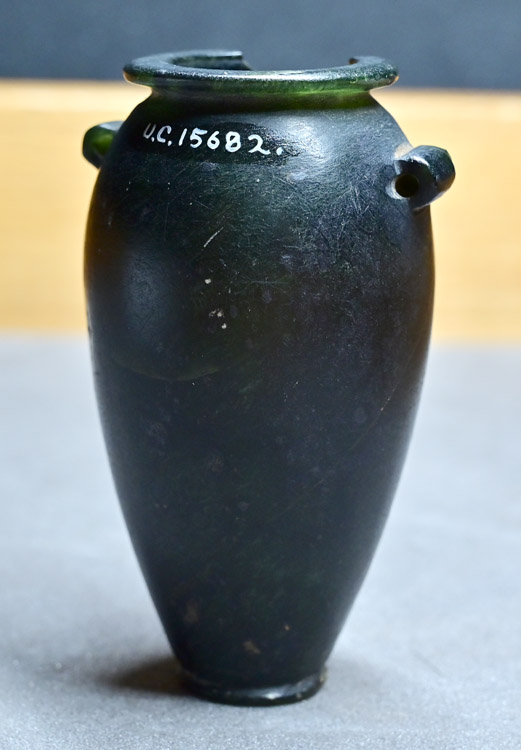
How precise are they really?
The next argument that follows is that ‘but they look so perfect and precise! I’ve seen plenty in the museums myself.” The thing is, they do look precise at first sight, but when you analyze the scan mathematically, they don’t. I think their surface fools the eye. It fooled me. Just like with optical illusions, the human eye sees differently from math algorithms, compensating or exaggerating, or re-interpreting information. Trompe l’oeil painting style is all about it (visual illusion in art, especially as used to trick the eye into perceiving a painted detail as a three-dimensional object). Some predynastic Egyptian vases I took pictures of were super nice visually, but after running the scans through, they still exhibited the same handmade qualities of ancient Egyptian vessels. I think the human eye responds to shiny, polished, and sparkling things and surfaces different from matte objects. Polished, predynastic vases looked symmetrical and precise at first sight, but when I photographed and studied them further, they showed the details that lacked precision and perfection. The scans and numbers show a well-made handmade object…
Each stone vessel is unique. There are no “exact copies,” similar shapes only.
It’s about data collection and analysis, not storytelling
Who else published the data? Finally, Max has collected and published many of his scans for free on his site as well as in a paper. He spent months writing this research paper to publish it in one of the top journals. If you have the argument that the predynastic Egyptian stone vases are super precise, that’s totally fine if you can prove your point with PUBLISHED facts, research, and data found in a top publication online. This way, it could be cross-examined by a number of researchers in the field, archeologists, etc.
Fomitchev-Zamilov, M. A metrological method for manufacturing quality assessment and classification of ancient Egyptian stone vessels. npj Herit. Sci. 13, 659 (2025). https://doi.org/10.1038/s40494-025-02196-7
I think it would be thrilling—and frankly, a lot of fun—to discover a truly super-precise vase in its original tomb context (provenance) and subject it to rigorous analysis. That said, the majority of the “precise-looking” examples we’ve examined in museums and from private collections turn out to be either not precise at all upon closer inspection, or machine-made, accompanied by vague provenances. Currently, top art museums invest in their staff to research provenances of exhibited art. To make it short, super precise vases come from private collections, not the top art and science museums with definite provenances.
What about the handles?
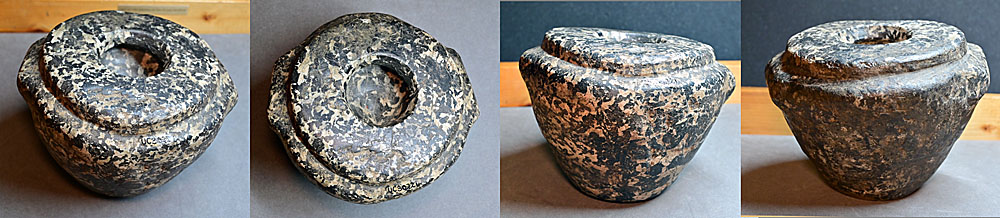
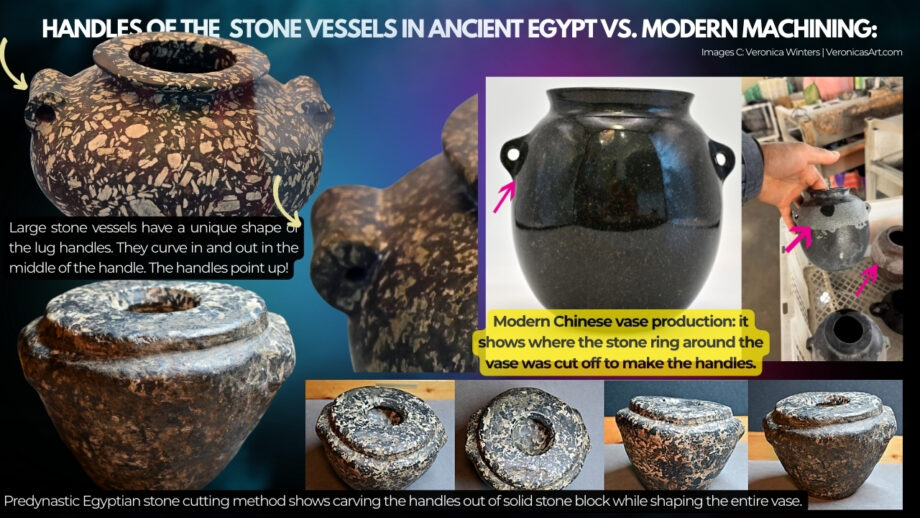
What about them? In genuine predynastic Egyptian stone vessels, the handles are far from perfectly symmetrical, the stone walls are relatively thick, and the outer surfaces bear clear signs of age and wear (based on scans with one of the best scanners out there). When I studied and took pictures of stone vases in the Petrie Museum twice and in the archaeological museum in Manchester, some unfinished examples had different degrees of finish on the handles. They were carved out.
By contrast, the so-called “precise” Egyptian vases not only fail to hold up under mathematical scrutiny but also stand out visually: their surfaces appear exceptionally fresh—sometimes even glossy and unnaturally new. The argument could be that they were polished before the sale to an art collector. Even if the vases were polished, they still show the same concentricity and circularity on the inside that’s either predynastic Egyptian or modern-made…
The handles of the machine-made vases have a different shape and don’t look the same as in the predynastic Egyptian ones. They show the modern machining approach to making them.
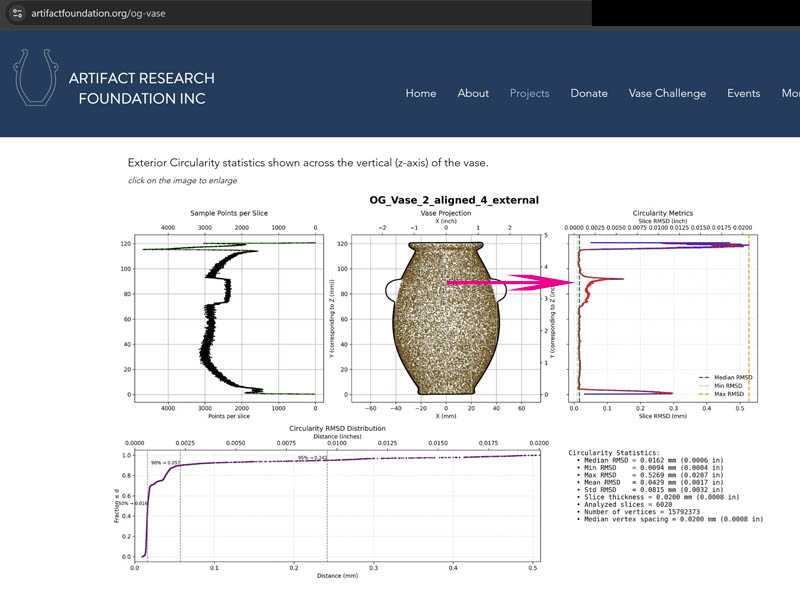
I’m skeptical that this vase is a predynastic Egyptian one. Red arrow points to the graph of circularity metrics. This graph shows that the outer surface circularity chart indicates that the entire vase was turned on a lathe with the protruding disk-shaped rim left for handles. Then the rim was ground flush with the surface of the vase leaving only two smaller sections of the rim intact that formed the handles. This modern grinding method is reflected as a bump on the outer surface circularity chart.
This type of modern machining technique is shown in a Chinese stone vase (we ordered) below.
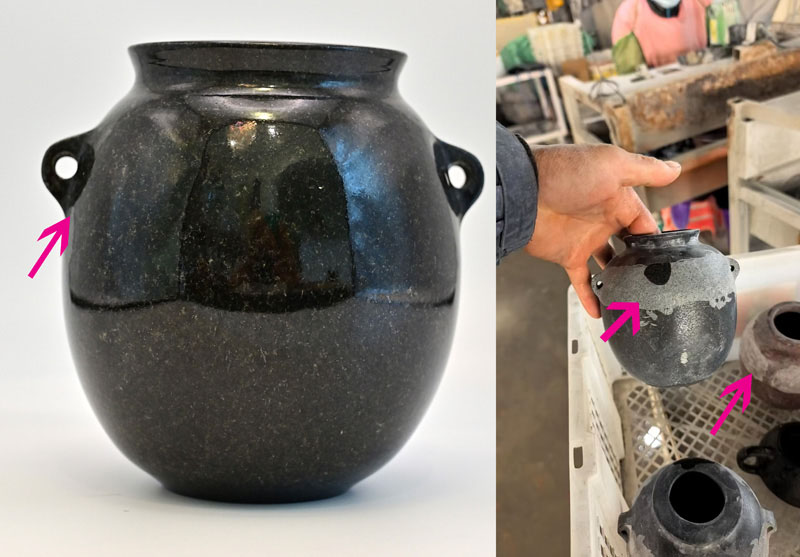
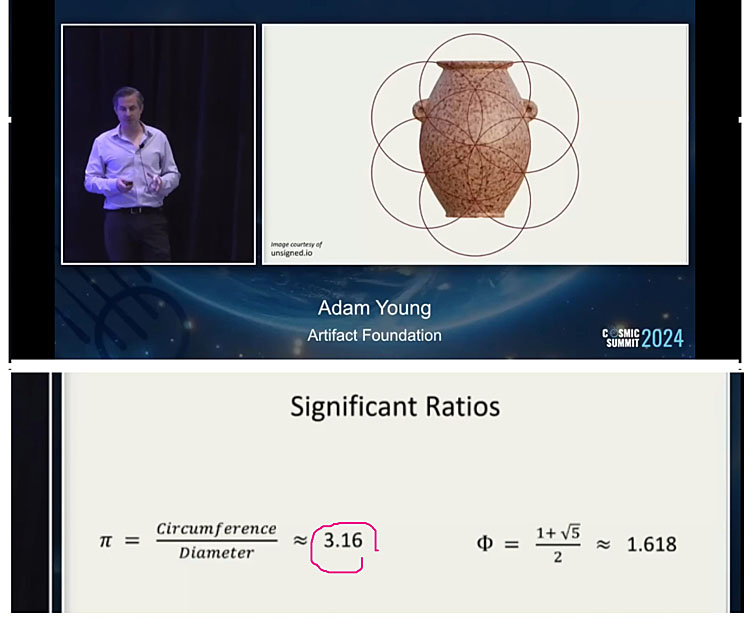
What about the super-thin walls in stone vases?
Super-thin walls in stone vases are found only in machine-made examples. Besides plates and soft-stone alabaster/travertine vessels, none of the predynastic Egyptian stone vases I’ve seen are close to that level of thinness. In other words, it seems likely that super-thin vase examples have a high probability of being machine-made in later periods or by a different culture. If you see thin, broken pieces of stone, high chance they were plates, not ancient vases.
It’s about studying the predynastic Egyptian stone vase shapes & stones!
There are several extensive books that have been published featuring all known shapes of stone vases. Modern vases or Egyptian replicas have shapes similar to those of the Naqada culture, but they’re not the same ones. That’s how forgeries are made in art, painting to be specific. The forger usually doesn’t try to copy the exact, famous painting created in the past and lost to time; rather, the forger studies the artist’s work and finds the gap in it to place his fake painting on a timeline of the artist’s career. If you’re a collector, please pay attention to the original shapes of the predynastic Egyptian stone vases. They are all listed in the literature.
(Examples: Aston, Barbara G. Ancient Egyptian Stone Vessels : Materials and Forms / by Barbara G. Aston. Heidelberg: Heidelberger Orientverlag, 1994. Print.)
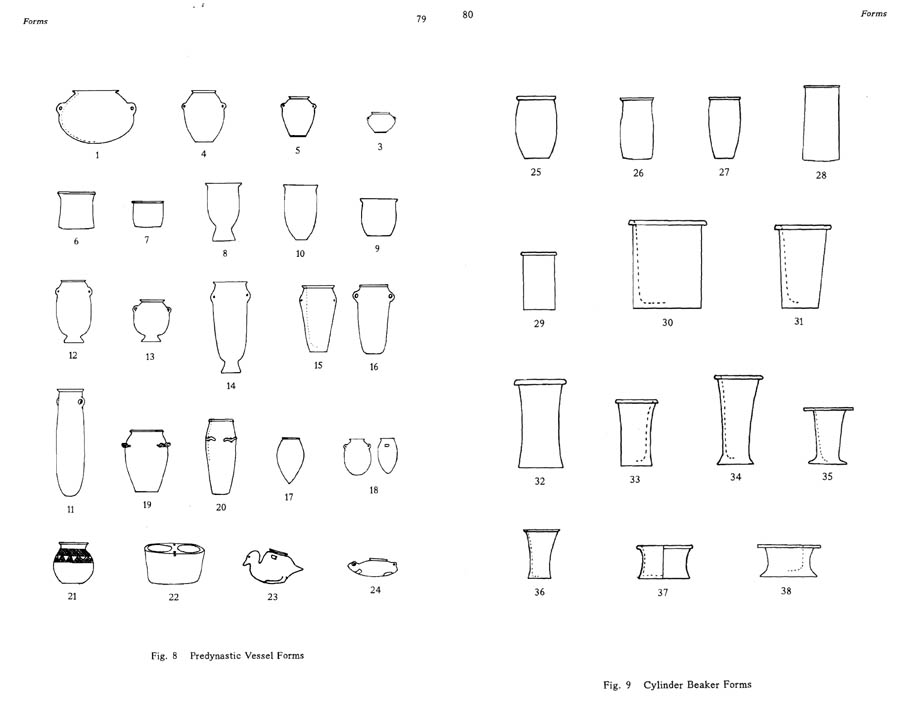
Ancient Egyptian Stone Vessels: Materials and Forms (1994) by Barbara G. Aston is a seminal, comprehensive study of stone vessel production in ancient Egypt, originally submitted as a PhD dissertation at the University of California, Berkeley, in 1989. Spanning 221 pages, the book combines geological fieldwork (quarry surveys in the Eastern Desert and Aswan), petrographic analysis (thin sections of over 200 samples), and examination of museum collections (e.g., British Museum, Cairo Museum, Ashmolean, Metropolitan Museum of Art) to catalog and analyze approximately 50 stone types and hundreds of vessel forms from the Predynastic period (c. 4000 BCE) to Roman times (c. 30 BCE–395 CE). Aston’s interdisciplinary approach bridges Egyptology, geology, and archaeology, emphasizing how material choice reflected technological capabilities, aesthetic preferences, trade networks, social status, and ritual functions. Vessels—used for oils, cosmetics, offerings, and elite display—served as key indicators of cultural evolution, with hard stones symbolizing power in early periods and softer varieties dominating later for practicality.
The work is illustrated with 22 figures (e.g., geological maps, shape typologies), 16 plates of examples, and appendices including a geologic glossary, Egypt’s geologic history, shape terminology, thin-section lists, and multilingual stone names. It draws on over 300 sources, from Petrie’s excavations to modern petrography. Aston’s methodology involved sourcing raw materials from quarries, testing workability (via Mohs’ hardness scale), and correlating vessel forms with chronological contexts to trace production trends. The book highlights stone vessels as non-perishable artifacts offering insights into economy, craftsmanship, and ideology, contrasting with perishable pottery.
Chapter 2: Materials (pp. 11–74)
The core analytical chapter, divided by rock type, details 40+ materials’ geology, sources, properties, and suitability for vessel carving. Aston uses IUGS classifications, petrographic descriptions, and quarry visits to authenticate types, noting hardness, color, and fracture influenced form choices (e.g., hard stones for prestige items).
Igneous Rocks (2.1, pp. 11–26): 8 types from Aswan/Nubia. Gabbro/hornblende diorite (hard, gray; elite Early Dynastic bowls). Granodiorite/granite (pink/gray; durable jars). Basalt/andesite porphyry (black/red; Predynastic prestige). Obsidian/tuff (rare, volcanic; small vessels).
Sedimentary Rocks (2.2, pp. 27–53): 11 types, most common. Siltstone/conglomerate/quartzite (local Nile Valley; everyday forms). Limestone variants (yellow/red/pink/gray; ubiquitous, soft for mass production). Travertine/alabaster/anhydrite (white/translucent; New Kingdom cosmetics jars). Breccia (polychrome; decorative).
Metamorphic Rocks (2.3, pp. 54–63): 7 types. Marble/serpentine/steatite (green/white; imported, luxury). Meta-andesite/amphibolite/mica schist/diorite gneiss (hard; Early Dynastic elite).
Minerals (2.4, pp. 64–74): Quartz variants (crystal/rose/amethyst/chalcedony/carnelian/agate/chert; colorful, semi-precious). Malachite/lapis lazuli/hematite (green/blue/black; rare imports for high-status items).
Aston quantifies usage: ~80% sedimentary (easy to work), hard igneous/metamorphic for status (10–15%), minerals for exotica (5%). Thin sections reveal fakes or misidentifications in collections.
Chapter 3: Forms (pp. 75–166)
Chronological typology of ~200 forms, with line drawings and plates. Aston traces evolution from simple Predynastic bowls to complex New Kingdom amphorae, linking shapes to function (e.g., tall jars for oils, low bowls for offerings).
Chapter 4: Conclusions (pp. 167–172)
Aston synthesizes trends: Material use shifted from hard, imported igneous/metamorphic stones (Predynastic–Early Dynastic; symbolizing elite power and foreign trade) to soft, local sedimentary like alabaster (Middle Kingdom onward; for efficiency and aesthetics). Peak production: Early Dynastic (thousands of vessels in tombs like Abydos). Decline post-New Kingdom due to economic shifts, glass/metal alternatives. Forms evolved from functional basics to stylized ritual items, with imports (e.g., Mycenaean stirrup jars) indicating networks. Petrography confirms ~90% authentic sourcing; fakes rare but provenance crucial. Culturally, vessels embodied ka (life force) in rituals, with translucent stones evoking purity. Aston calls for integrated geo-archaeological studies to refine chronologies.
What about the use of granite for stone vases in ancient Egypt?
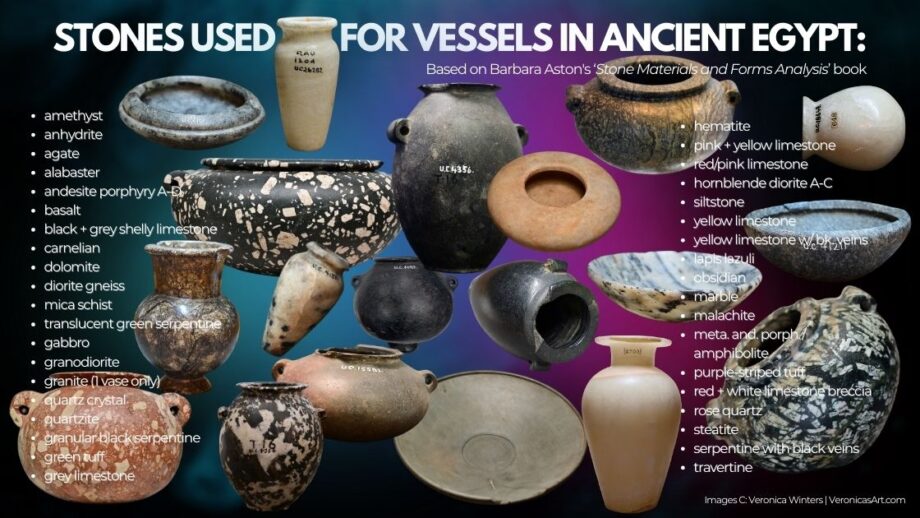
According to Barbara Aston, there’s only one granite vase found. Egyptians didn’t use granite for stone vessel production for the most part!
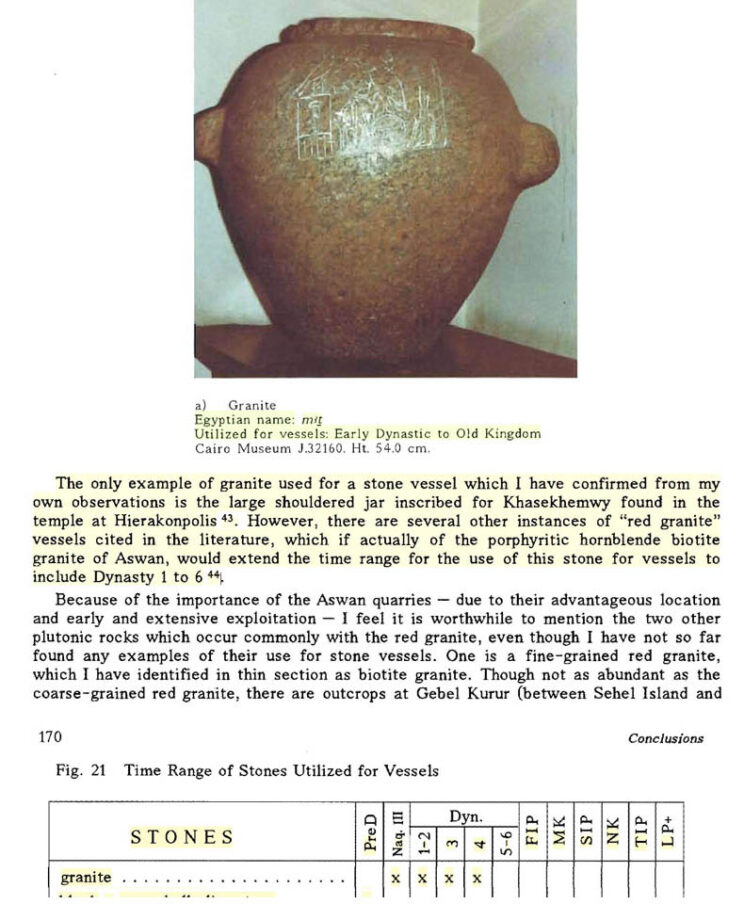
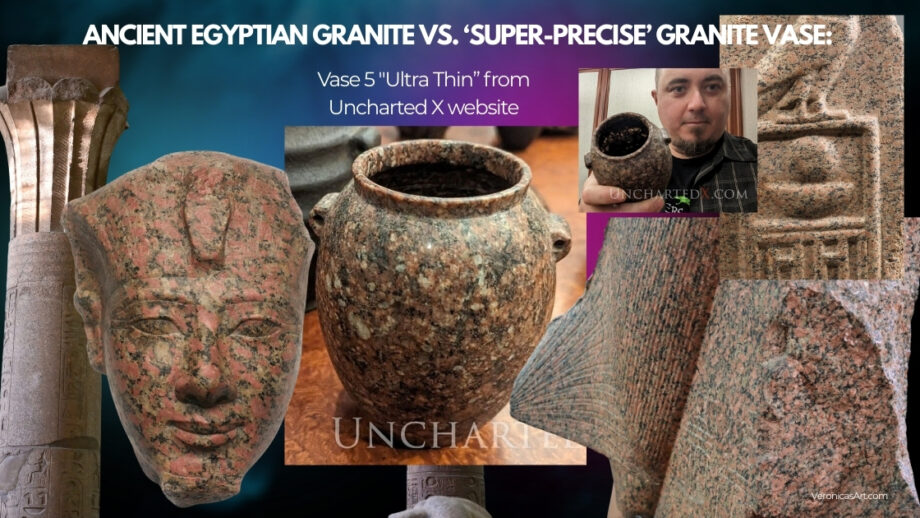
Granite, especially the Aswan granite, has a specific pattern of two colors+ quartz that’s different from all super-precise vases paraded by Ben and friends on YouTube.

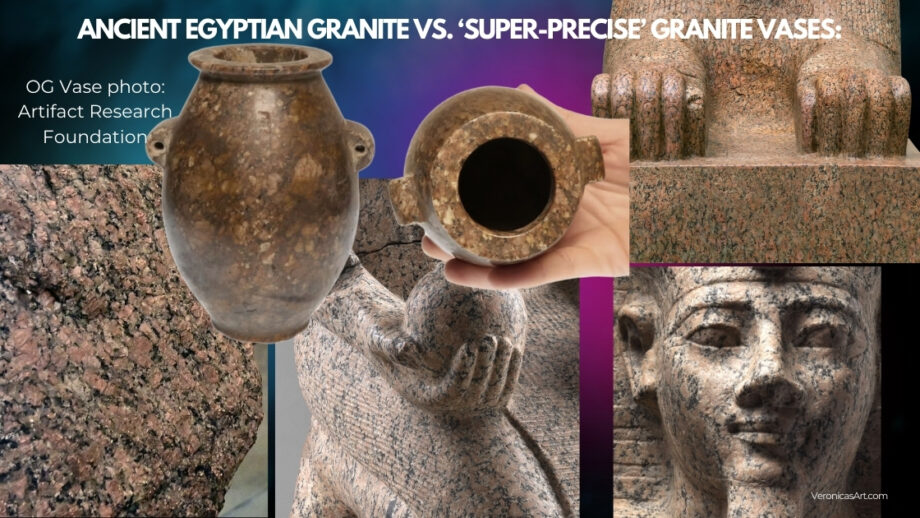
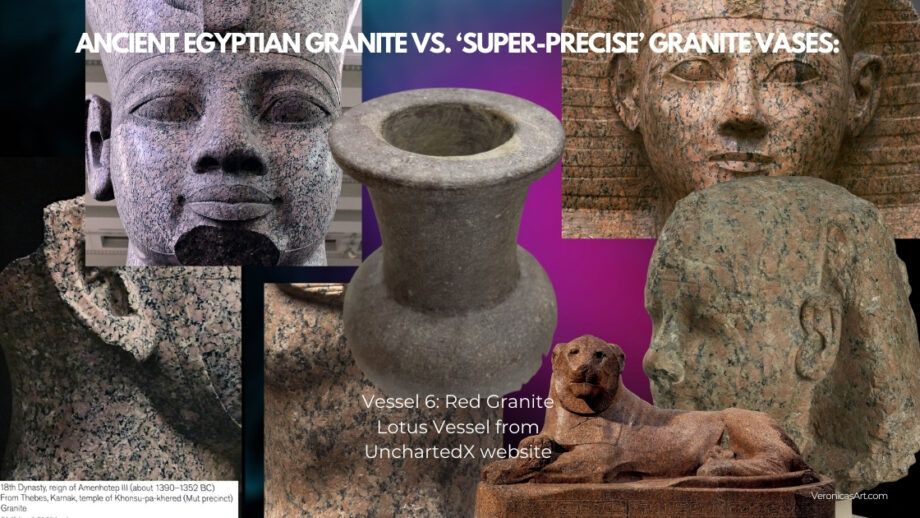
What about the transparency of granite in the ‘spinner’ vase?
The spinner vase exhibits the same machine-made qualities as other studied, modern vases. The reason why you see the light getting through this vase is pieces of quartz, Quartz is naturally present in granite.
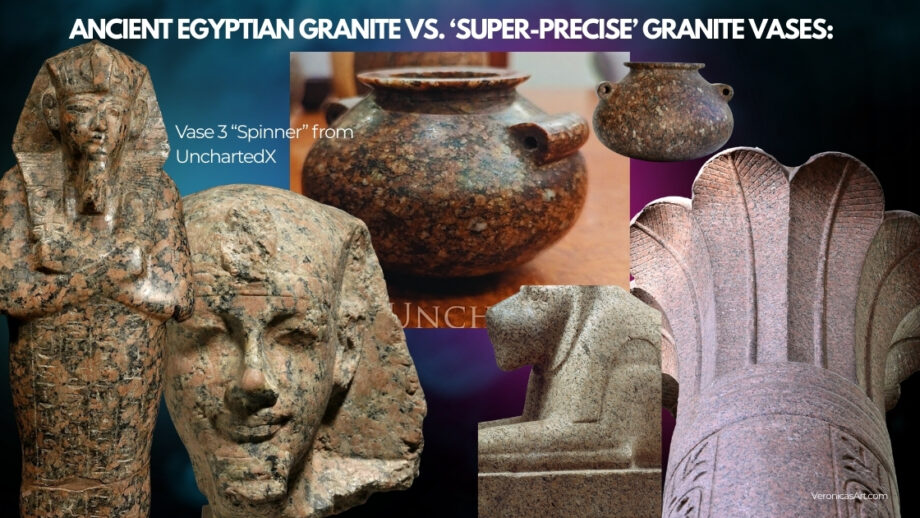
Consider the auction house, seller, or source of your stone vessels
Provenance of highly valuable artifacts should lead to a specific name/wealthy donor, fund, museum, organization or excavation site dated to the late 19th-early 20th century.
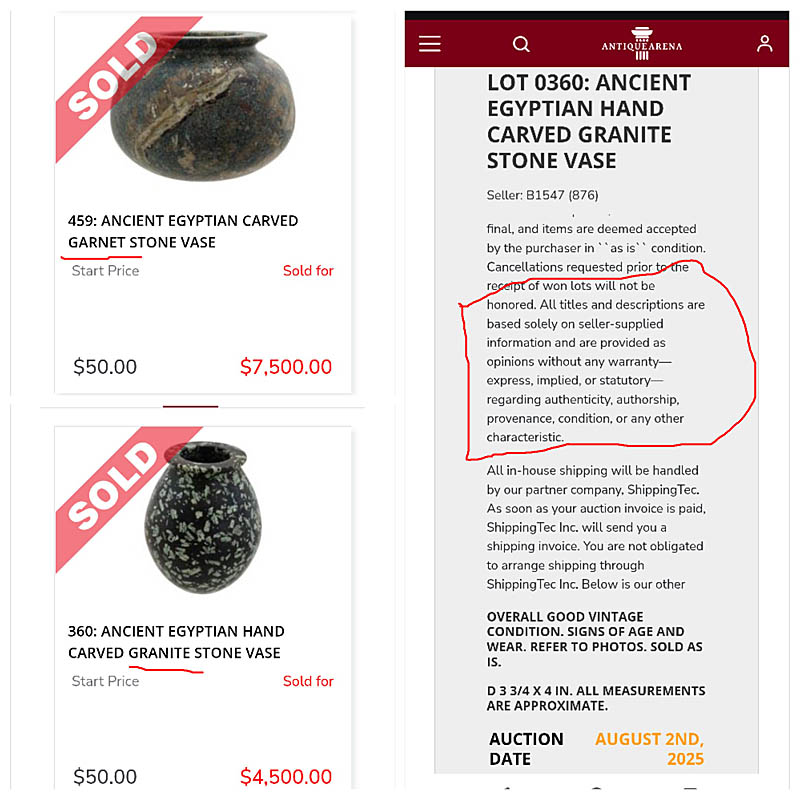
Personally, I looked at several auctions online to see how they do business selling these predynastic Egyptian stone vases. Their listings are often incorrect, mislabeling the stone type and time period. Also, there’s no clear provenance listed, or worse, they hide it by saying that they don’t release information about their collectors/sellers. I would be concerned about the origins of such objects, to say the least.
To sum up:
If you’re a collector of these stone vases or wish to buy them, please consider these points to increase your chances of purchasing real, Predynastic Egyptian stone vessels:
- 1. Who is the dealer?
- 2. What is the material? There’s only ONE granite vase found (see Aston’s book). Egyptians didn’t really use granite for stone vessel production, but for statues and architecture.
- 3. What’s the shape? Is it Predynastic?
- 4. What’s the provenance?
- 5. What’s the surface wear outside?
- 6. What’s the surface like inside? (Concentric circles)
- 7. Handles? (They are not perfectly symmetrical) and have a varied shape
- 8. Weight
- 9. How thin/thick are the vase’s walls?
- 10. What’s the shape of the rim?
Ultimately, this debate—both in our study and in online arguments—boils down to personal ethics. If I were a collector, art dealer, reseller, or storyteller, I’d be tempted to hype the notion of “precision” in these predynastic vessels, as it would skyrocket the value of my hypothetical collection. But we have no interest in fabricating claims about their manufacturing quality, which is predominantly handmade (not highly precise or turned on a modern lathe).
When I first meet people, I tend to trust their words. If you’re like me, we start by believing in the inspirational stories and figures who promote compelling ideas, and that’s not a bad thing. Exploring unconventional theories and sparking human creativity is vital—we need it in every corner of our lives! Inspiration and creativity must exist in every person and profession. The distinction, though, lies in ethics. Is that person championing ideas he genuinely believes in, or is he not?
What I’ve learned about the internet and online personas is that they’re often skewed, unrealistic, and the polar opposite of the characters we project on screens. We all craft our social media narratives, intentionally or not, but motivations eventually surface.
I’m disappointed that it’s the end I didn’t expect to reach with this project. I know it’s disheartening to purchase a stone vase that’s not the ancient Egyptian one, and I’d be disappointed in a big way. I hope that by reading my solid overview of the Naqada culture in the article above, you’d be well-prepared in picking the real, Predynastic Egyptian stone vase. Personally, I’m very disappointed in some people who hyped this idea of ‘lost ancient tech’ in vases. It was difficult for me to reconcile that we spent so much time, effort, and capital on this project. But most importantly, I had to come to terms with my metric of belief and trust I place in others.
It may take time for collectors to process this information as they work through denial, reasoning, and—hopefully—acceptance. And if acceptance never comes? That’s ok with me. We all have our own opinions, and I gain nothing from anyone’s stance on this, whether positive, negative, or somewhere in between. I’m not selling Egyptian stuff, taking you on tours, or curating exhibitions. I simply wanted to know how they were made…
If we find new evidence and data on super-precision in predynastic Egyptian stone vases with conclusive provenance, we’ll surely update you on our sites and YouTube!
If it’s not enough, read this article From Minor Misrepresentations to Major Fabrications (scroll way down to read the revelations). 🙁
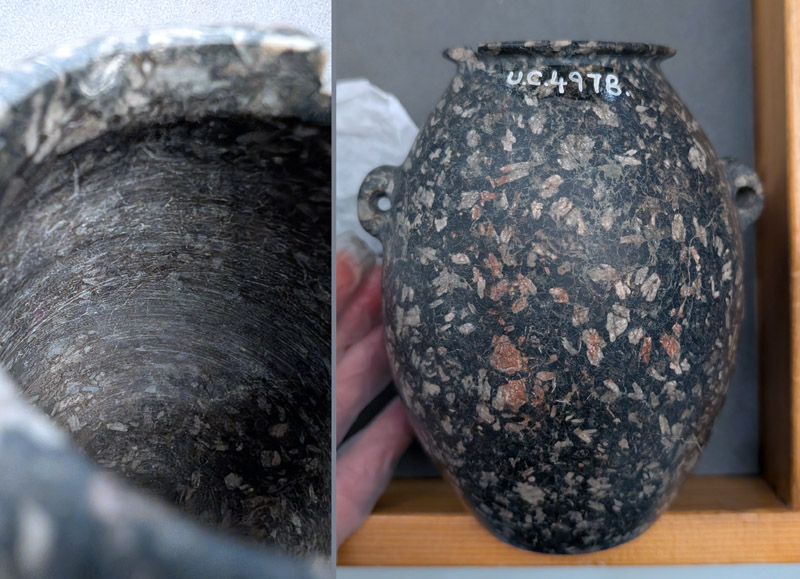
“Ancient Egyptian Stone-Drilling.” Expedition Magazine 25, no. 3 (March, 1983): -. Accessed February 21, 2026. https://www.penn.museum/sites/expedition/ancient-egyptian-stone-drilling/
If you collect ancient Egyptian artifacts, especially these stone vessels, and wish to know if they are machine-made or not, start paying attention to their surface and material. The real, predynastic Egyptian vases have a considerable and specific weathering pattern on their surface. There are only a few stone types Naqada people used (see the article above). The predynastic Egyptian stone vases are quite heavy depending on size. The stone walls are fairly thick with noticeable circular, concentric lines inside.
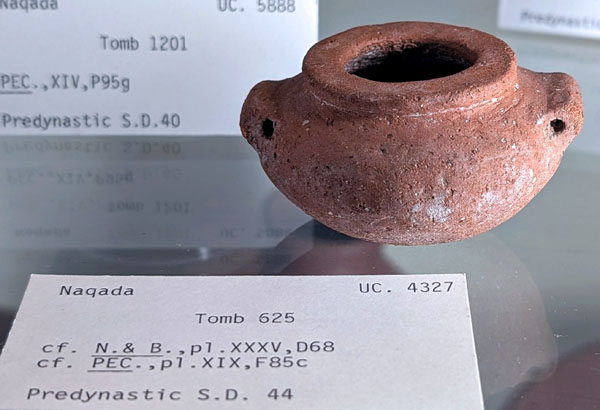
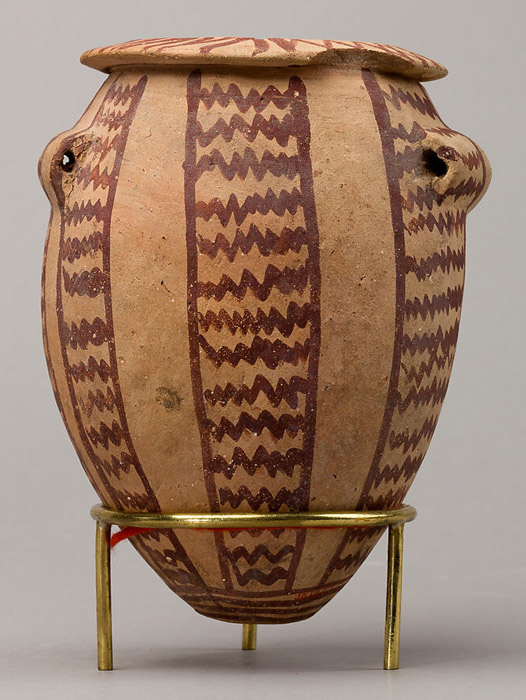
If we visually compare quite symmetrical stone vessels made of porphyry with ancient figurines, pottery, and amulets of the same period, the stone vessels look vastly different in quality. Primitive, ivory figurines look primitive. The cosmetic palettes lack symmetry and refinement. Moreover, the figurines, palettes, pottery, and beads didn’t require that much time, effort, or skill to create functional objects, unlike drilling a hard basalt stone to make a vase.
When I began working on this project, I thought it was impossible to drill a hard stone with primitive tools. However, when I learned about the effective use of wet sand, drill tools, water use, and possible rotational device, it’s obvious that the stone vases were handmade.
There’s a growing feud between the archaeologists and the ‘amateur’ world about the construction of the pyramids and other megalithic structures. It’s obvious that the pyramids were not built with chisels and flint knives, but I can also understand the archaeologists’ point of view, stating that there is no evidence left in sand and stone from that mystical civilization. What’s clear is that archaeologists can’t dig deeper than 12 meters down into the ground and shift tons of sand in search of that new tech evidence. I think we also should stop conflating different subjects into one. For example, the pre-dynastic Egyptian stone vessels were produced by the Naqada culture, but the megalithic stonework is probably not of the same people or period. This is something to find out for me by reading available literature/archeological papers on this subject… Numerous YouTube videos and book authors talk about ancient tech without scientific facts or mathematical proof. These creative ideas must exist, but at the same time, they’re not worth much without solid scientific reports, published numbers and concepts in relevant journals.
Besides the clash of egos on both sides promoting narratives one way or another, we could probably see the truth in the golden middle. As of today, there’s no obvious evidence of advanced technology lying on the surface, not in these Predynastic Egyptian stone vases at least, but if we dig deeper both into the ground and into existing evidence with emerging new technologies, perhaps we might find the truth about the megalithic structures in the near future. Ancient Egyptians repurposed art, materials, and structures of earlier civilizations. So, perhaps we need to pay more attention to the ancient imagery that formed Predynastic Egypt.
*I’m not an archaeologist and might have made mistakes in my article. Reach out to correct if you see it. nika@veronicasart.com
Museum and Scholarly Contributions:
Major museums hold significant Naqada Period collections, including the British Museum, the Ashmolean Museum, the Cairo Archaeological Museum, the Penn Museum, the Metropolitan Museum of Art, the Cleveland Museum of Art, MFA Boston, Philadelphia museum, etc. For more details, explore these museums or scholarly articles listed on ResearchGate, Academia, Science Direct, etc.
References:
- “Ceremonial Slate Palettes and corpus of proto-dynastic pottery” W. M. Flinders Petrie, KT., British School of Egyptian Archeology, 1953, book in public domain
- “A Guide to the Egyptian Collections.” Museum Bulletin XV, no. 2-3 (November, 1950): 21-109. Accessed July 29, 2025. https://www.penn.museum/sites/bulletin/3289/
- “The History and Research of the Naqada Region Collection”, G. J. Tassie (University of Winchester) and Joris van Wetering (ECHO), 2013
- “The Lithic tool economy in Upper Egypt in the Late Predynastic: The Naqada II proliferation of
fine flint tools and its implications for socioeconomic complexity,” Andrea Gover, Prepared for: Topical Seminar in Early and Historic States, Dr. Rita P. Wright, Fall 2016 - “Beyond Prestige: A ritual production model for stone tool specialization in Naqada period Egypt,” Elizabeth Hart Skarzynski Lansing, MIM.A. University of Virginia, 2010B.A. University of Michigan, 2004
A Dissertation presented to the Graduate Faculty of the University of Virginia in Candidacy for the Degree of Doctor of Philosophy, Department of Anthropology, University of Virginia, May 2017 - “Earliest Cylinder-Seal Glyptic in Egypt: From Greater Mesopotamia to Naqada,” Emmanuelle Honoré
- “The Naqada Period in Thebes, New Evidence,” Sherif Abd el-Monaem, Hanan Mahmoud, 2023
- “Fine pottery shaping techniques in Predynastic Egypt: A pilot study on non-destructive analysis using an X-Ray CT scanning system,” Authors: Keita Takenouchi and Kyoko Yamahana, Journal of Archaeological Science: Reports, Volume 37, June 2021, 102989
- The origins and the use of the potters wheel in Ancient Egypt. Doherty, Sarah, 2013, PhD Thesis, Cardiff University
Emulation in painted pottery styles in Egypt in the prehistoric period, Sakura Sanada, Studies in Ancient Art and Civilization, Vol 27, 2023, pp. 47-75, https://doi.org/10.12797/SAAC.27.2023.27.03- “Ancient Egyptian Stone-Drilling.” Expedition Magazine 25, no. 3 (March, 1983): -. Accessed August 04, 2025. https://www.penn.museum/sites/expedition/ancient-egyptian-stone-drilling/
- Experiments in Egyptian Archaeology: Stoneworking Technology in Ancient Egypt 2nd Edition, 2022, by Denys A. Stocks (Author)
- Babylon: Mesopotamia and the Birth of Civilization, Paperback – Illustrated, 2012, by Paul Kriwaczek (Author)
- Dolerite Pounders: Petrology, Sources and Use, September 2010, Lithic Technology 35(2):127-148
DOI:10.1080/01977261.2010.11721087, Authors: Adel Kelany, Ministry of Antiquities, Egypt, Cairo,
James A. Harrell, University of Toledo and V. Max Brown - Ancient Egyptian calligraphy : a beginner’s guide to writing hieroglyphs by Henry George Fischer
b1063383 13, Metropolitan Museum of Art Publications, hardcover book, January 1, 1988 - Egypt. People, Gods, Pharaohs, by Rainer & Rose-Marie Hagen (Author), TASCHEN, Hardcover book– July 1, 2016
Eternal Egypt: Masterworks of Ancient Art from the British Museum, by British Museum (Author), Toledo Museum of Art (Author), essays by Edna R. Russmann and T. G. H. James, Paperback – January 1, 2001 - Provenance reinterpretation of some early Egyptian copper alloy artefacts, Frederik W. Rademakers,,
Georges Verly, Luc Delvaux, Patrick Degryse; Journal of Archaeological Science: Reports, Volume 38, August 2021, 103095 - Foil and leaf gilding on cultural artifacts; forming and adhesion, January 2011Matéria (Rio de Janeiro) 16(1):540-559 DOI:10.1590/S1517-70762011000100002, Authors: Evelyne Darque-Ceretti Mines Paris, PSL University, Eric Felder, California State University, Fullerton Marc Aucouturier, French National Center for Scientific Research, article is available on Research Gate.
- Joanne M. Rowland (2021), New Perspectives and Methods Applied to the ‘Known’ Settlement of Merimde Beni Salama, Western Nile Delta. in Joanne M. Rowland, Giulio Lucarini (eds.), Geoffrey J. Tassie | Revolutions. The Neolithisation of the Mediterranean Basin: the Transition to Food Producing Economies in North Africa, Southern Europe and the Levant | Berlin Studies of the Ancient World
- Arnold, D., Bourriau, J., 1993. An Introduction to Ancient Egyptian Pottery Fascicle 1: Techniques and Traditions of Manufacture in the Pottery of Ancient Egypt. Verlag Philipp von Zabern and Mainz am Rhein.
Bourriau, D.J., 1981. Umm el Ga’ab. Pottery from the Nile Valley before the Arab Conquest, Cambridge.
Bourriau, J., Bellido, A., Bryan, N., Robinson, V., 2004. Neutron Activation Analysis of Predynastic to Early Dynastic Pottery from Minshat Abu Omar, Hemamieh and Armant. In: Hendrickx, S., Friedman, R., Cialowicz, K.M., Chlodnicki, M. (Eds.), - Mechanical Engineering in Ancient Egypt, Part XIII: Stone Vessels (Predynastic to Old Kingdom Periods) by Galal Ali Hassaan, International Journal of Recent Engineering Science (IJRES), ISSN: 2349-7157, volume19 April 2016
- https://collections.ucl.ac.uk/results
- https://www.ees.ac.uk/resource/the-naqada-regional-archaeological-survey-and-site-management-project.html
- https://ancientegyptonline.co.uk/naqada
- Hendrickx, S. & Claes, W., Bibliography of the Prehistory and the Early Dynastic period of Egypt and Northern Sudan. 2013 https://www.academia.edu/41692593/Earliest_Cylinder_Seal_Glyptic_in_Egypt_From_Greater_Mesopotamia_to_Naqada
- https://www.academia.edu/855402/Eyckerman_M_and_Hendrickx_S_The_Naqada_I_tombs_H17_and_H41_at_el_Mahasna_a_visual_reconstruction_in_Friedman_R_F_and_Fiske_P_N_eds_Egypt_at_its_Origins_3_Proceedings_of_the_International_Conference_Origin_of_the_State_Predynastic_and_Early_Dynastic_Egypt_London_27th_July_1st_August_2008_OLA_205_Leuven_379_429
- https://www.academia.edu/40430578/Plates_The_Naqada_III_First_Intermediate_Period_Stratification
- https://www.academia.edu/103248701/The_Naqada_Period_in_Thebes
More references from Egypt exploration society:
Hassan, F. A., Tassie, G. J. van Wetering, J. and Banks, M. K. 2017. The exogenous/impressed decorated ceramics from the Naqada Region, in Y. Tristant, B. Midant-Reynes & E. M. Ryan (eds.) Egypt at its Origins 5: Proceedings of the Fifth International Conference “Origin of the State. Predynastic to Early Dynastic Egypt”, Cairo (Egypt), 13th-18th April 2014. Leuven – Paris – Walpole: Peeters, Orientalia Lovaniensia Analecta.
Hassan, F. A., van Wetering, J. and Tassie, G. J. 2017. Urban development at Nubt, in B. Midant-Reynes, Y. Tristant & E. M. Ryan (eds.) Egypt at its Origins 5: Proceedings of the Fifth International Conference “Origin of the State. Predynastic to Early Dynastic Egypt”, Cairo (Egypt), 13th-18th April 2014. Leuven – Paris – Bristol [CT]: Peeters, Orientalia Loveniensia Analecta 260, pp. 81-127.
Hassan, F. A., van Wetering, J. and Tassie, G. J. In Press. The Early Dynastic cemetery at el-Quleila North (Kh.2): Preliminary archaeological report, in E. C. Köhler, F. Junge, N. Kuch and A.-K. Jeske (eds.) Egypt at its Origins 6: Proceedings of the Sixth International Conference “Origin of the State. Predynastic to Early Dynastic Egypt”, Vienna (Austria), 10th-15th September 2017. Leuven – Paris – Bristol [CT]: Peeters, Orientalia Loveniensia Analecta.
Hays, T. R. 1984. Predynastic developments in Upper Egypt, in L. Krzy?aniak & M. Kobusiewicz (eds.) Origin and Early Development of Food-Producing Cultures in Northeastern Africa, Pozna?: Pozna? Archaeological Museum, pp. 211-19.
Holmes, D. L. In Press. Recollecting the Predynastic of Nagada Project, in A. De Trafford, G. J. Tassie, J. van Wetering & O. El Daly (eds.) A River Runs Through It: Studies in Honour of Prof. Fekri A. Hassan on the Occasion of his 75th Birthday. London: Golden House Publications, pp. 70-93.
Petrie, W.M.F. & Quibell, J.E. 1896. Naqada and Ballas. London.
di Pietro, G. A. 2017. Beyond the bounds of domestic life? Naqada: aspects of the settlement in the middle-late IV millennium BC, in B. Midant-Reynes, Y. Tristant & E. M. Ryan (eds.) Egypt at its Origins 5: Proceedings of the Fifth International Conference “Origin of the State. Predynastic to Early Dynastic Egypt”, Cairo (Egypt), 13th-18th April 2014. Leuven – Paris – Bristol [CT]: Peeters, Orientalia Loveniensia Analecta 260, pp.145-164.
Tassie, G. J. & van Wetering, J. 2011. ‘Re-excavating’ Predynastic sites in London, Ancient Egypt Magazine 11(4), Issue 64: 24-28.
Tassie, G. J. & van Wetering, J. 2013/4. The history and research of the Naqada region collection, in P. Piacentini, C. Orsenigo, and S. Quirke (eds) Forming Material Egypt: Proceedings of the International Conference in London, 20-21 May 2013, Special Edition of Egyptian & Egyptological Documents, Archives, Libraries (EDAL) 4: 61-77, Pl. VI-IX.
Tassie, G.J., van Wetering, J. & Carroll, I. 2010a. Repatriating prehistoric artefacts to Egypt: Prof. Hassan’s Naqada and Siwa study collections, Archaeology International 12: 52-57.
van Wetering, J., 2012. Relocating De Morgan’s Royal Tomb at Naqada and identifying its occupant in J. Kabaci?ski, M. Ch?odnicki & M. Kobusiewicz (eds.) Prehistory of Northeastern Africa New Ideas and Discoveries. Studies in African Archaeology 11, Pozna? Archaeological Museum, pp. 91-124.
van Wetering, J., 2017. The cemeteries of Nubt, Naqada Region, Upper Egypt in B. Midant-Reynes, Y. Tristant & E. M. Ryan (eds.) Egypt at its Origins 5: Proceedings of the Fifth International Conference “Origin of the State. Predynastic to Early Dynastic Egypt”, Cairo (Egypt), 13th-18th April 2014. Leuven – Paris – Bristol [CT]: Peeters, Orientalia Lovaniensia Analecta 260, pp. 521-549.
van Wetering, J. & G.J. Tassie, in press. Nubt (Petrie’s Naqada site, De Morgan’s Toukh site), an overview in A. Stevenson (ed.) The Many Histories of Naqada. London: GHP.